US6465074B1 - Base substrates for coated belts - Google Patents
Base substrates for coated belts Download PDFInfo
- Publication number
- US6465074B1 US6465074B1 US09/383,141 US38314199A US6465074B1 US 6465074 B1 US6465074 B1 US 6465074B1 US 38314199 A US38314199 A US 38314199A US 6465074 B1 US6465074 B1 US 6465074B1
- Authority
- US
- United States
- Prior art keywords
- yarns
- belt
- resin material
- polymeric resin
- base support
- Prior art date
- Legal status (The legal status is an assumption and is not a legal conclusion. Google has not performed a legal analysis and makes no representation as to the accuracy of the status listed.)
- Expired - Lifetime
Links
- 239000000758 substrate Substances 0.000 title 1
- 239000000463 material Substances 0.000 claims abstract description 113
- 239000002952 polymeric resin Substances 0.000 claims abstract description 112
- 229920003002 synthetic resin Polymers 0.000 claims abstract description 112
- 238000000576 coating method Methods 0.000 claims abstract description 70
- 239000011248 coating agent Substances 0.000 claims abstract description 69
- 239000000126 substance Substances 0.000 claims abstract description 7
- 238000009877 rendering Methods 0.000 claims abstract 3
- 239000004744 fabric Substances 0.000 claims description 147
- 239000000835 fiber Substances 0.000 claims description 31
- 239000004696 Poly ether ether ketone Substances 0.000 claims description 30
- 229920002530 polyetherether ketone Polymers 0.000 claims description 30
- 239000004952 Polyamide Substances 0.000 claims description 16
- 229920002647 polyamide Polymers 0.000 claims description 16
- 229920000728 polyester Polymers 0.000 claims description 16
- 229920003235 aromatic polyamide Polymers 0.000 claims description 15
- 229920005672 polyolefin resin Polymers 0.000 claims description 15
- 230000003014 reinforcing effect Effects 0.000 claims description 11
- 239000002759 woven fabric Substances 0.000 claims description 11
- KXGFMDJXCMQABM-UHFFFAOYSA-N 2-methoxy-6-methylphenol Chemical compound [CH]OC1=CC=CC([CH])=C1O KXGFMDJXCMQABM-UHFFFAOYSA-N 0.000 claims description 5
- 229920001568 phenolic resin Polymers 0.000 claims description 5
- 239000005011 phenolic resin Substances 0.000 claims description 5
- 229920005749 polyurethane resin Polymers 0.000 claims description 5
- 229920002635 polyurethane Polymers 0.000 claims description 4
- 239000004814 polyurethane Substances 0.000 claims description 4
- 239000007788 liquid Substances 0.000 claims description 3
- ISWSIDIOOBJBQZ-UHFFFAOYSA-N Phenol Chemical compound OC1=CC=CC=C1 ISWSIDIOOBJBQZ-UHFFFAOYSA-N 0.000 claims 1
- 239000004745 nonwoven fabric Substances 0.000 claims 1
- XLYOFNOQVPJJNP-UHFFFAOYSA-N water Substances O XLYOFNOQVPJJNP-UHFFFAOYSA-N 0.000 abstract description 14
- 239000010410 layer Substances 0.000 description 66
- 238000004519 manufacturing process Methods 0.000 description 7
- 239000003921 oil Substances 0.000 description 6
- 238000005470 impregnation Methods 0.000 description 4
- 238000000034 method Methods 0.000 description 4
- 238000009954 braiding Methods 0.000 description 3
- 239000000047 product Substances 0.000 description 3
- 238000003860 storage Methods 0.000 description 3
- 238000003490 calendering Methods 0.000 description 2
- 230000008020 evaporation Effects 0.000 description 2
- 238000001704 evaporation Methods 0.000 description 2
- 238000009940 knitting Methods 0.000 description 2
- 238000003475 lamination Methods 0.000 description 2
- 230000001050 lubricating effect Effects 0.000 description 2
- 239000010687 lubricating oil Substances 0.000 description 2
- 230000004048 modification Effects 0.000 description 2
- 238000012986 modification Methods 0.000 description 2
- 239000011527 polyurethane coating Substances 0.000 description 2
- 230000008569 process Effects 0.000 description 2
- 229920005989 resin Polymers 0.000 description 2
- 239000011347 resin Substances 0.000 description 2
- 239000002002 slurry Substances 0.000 description 2
- 238000009941 weaving Methods 0.000 description 2
- 229920000271 Kevlar® Polymers 0.000 description 1
- 229920000784 Nomex Polymers 0.000 description 1
- 238000011109 contamination Methods 0.000 description 1
- 238000005520 cutting process Methods 0.000 description 1
- 230000032798 delamination Effects 0.000 description 1
- 238000000151 deposition Methods 0.000 description 1
- 238000003618 dip coating Methods 0.000 description 1
- 238000005553 drilling Methods 0.000 description 1
- 238000001035 drying Methods 0.000 description 1
- 238000005516 engineering process Methods 0.000 description 1
- 238000001125 extrusion Methods 0.000 description 1
- 238000009434 installation Methods 0.000 description 1
- 239000000314 lubricant Substances 0.000 description 1
- 238000005461 lubrication Methods 0.000 description 1
- 230000007246 mechanism Effects 0.000 description 1
- 238000002844 melting Methods 0.000 description 1
- 230000008018 melting Effects 0.000 description 1
- 239000004763 nomex Substances 0.000 description 1
- 230000000149 penetrating effect Effects 0.000 description 1
- 230000035515 penetration Effects 0.000 description 1
- 238000003825 pressing Methods 0.000 description 1
- 230000031070 response to heat Effects 0.000 description 1
- 230000000630 rising effect Effects 0.000 description 1
- 238000004826 seaming Methods 0.000 description 1
- 239000002356 single layer Substances 0.000 description 1
- 239000007787 solid Substances 0.000 description 1
- 239000013589 supplement Substances 0.000 description 1
- 238000004804 winding Methods 0.000 description 1
Images




Classifications
-
- D—TEXTILES; PAPER
- D21—PAPER-MAKING; PRODUCTION OF CELLULOSE
- D21F—PAPER-MAKING MACHINES; METHODS OF PRODUCING PAPER THEREON
- D21F3/00—Press section of machines for making continuous webs of paper
- D21F3/02—Wet presses
- D21F3/0209—Wet presses with extended press nip
- D21F3/0218—Shoe presses
- D21F3/0227—Belts or sleeves therefor
-
- B—PERFORMING OPERATIONS; TRANSPORTING
- B29—WORKING OF PLASTICS; WORKING OF SUBSTANCES IN A PLASTIC STATE IN GENERAL
- B29C—SHAPING OR JOINING OF PLASTICS; SHAPING OF MATERIAL IN A PLASTIC STATE, NOT OTHERWISE PROVIDED FOR; AFTER-TREATMENT OF THE SHAPED PRODUCTS, e.g. REPAIRING
- B29C63/00—Lining or sheathing, i.e. applying preformed layers or sheathings of plastics; Apparatus therefor
-
- D—TEXTILES; PAPER
- D03—WEAVING
- D03D—WOVEN FABRICS; METHODS OF WEAVING; LOOMS
- D03D1/00—Woven fabrics designed to make specified articles
- D03D1/0094—Belts
-
- Y—GENERAL TAGGING OF NEW TECHNOLOGICAL DEVELOPMENTS; GENERAL TAGGING OF CROSS-SECTIONAL TECHNOLOGIES SPANNING OVER SEVERAL SECTIONS OF THE IPC; TECHNICAL SUBJECTS COVERED BY FORMER USPC CROSS-REFERENCE ART COLLECTIONS [XRACs] AND DIGESTS
- Y10—TECHNICAL SUBJECTS COVERED BY FORMER USPC
- Y10T—TECHNICAL SUBJECTS COVERED BY FORMER US CLASSIFICATION
- Y10T428/00—Stock material or miscellaneous articles
- Y10T428/24—Structurally defined web or sheet [e.g., overall dimension, etc.]
- Y10T428/24273—Structurally defined web or sheet [e.g., overall dimension, etc.] including aperture
-
- Y—GENERAL TAGGING OF NEW TECHNOLOGICAL DEVELOPMENTS; GENERAL TAGGING OF CROSS-SECTIONAL TECHNOLOGIES SPANNING OVER SEVERAL SECTIONS OF THE IPC; TECHNICAL SUBJECTS COVERED BY FORMER USPC CROSS-REFERENCE ART COLLECTIONS [XRACs] AND DIGESTS
- Y10—TECHNICAL SUBJECTS COVERED BY FORMER USPC
- Y10T—TECHNICAL SUBJECTS COVERED BY FORMER US CLASSIFICATION
- Y10T428/00—Stock material or miscellaneous articles
- Y10T428/24—Structurally defined web or sheet [e.g., overall dimension, etc.]
- Y10T428/24479—Structurally defined web or sheet [e.g., overall dimension, etc.] including variation in thickness
-
- Y—GENERAL TAGGING OF NEW TECHNOLOGICAL DEVELOPMENTS; GENERAL TAGGING OF CROSS-SECTIONAL TECHNOLOGIES SPANNING OVER SEVERAL SECTIONS OF THE IPC; TECHNICAL SUBJECTS COVERED BY FORMER USPC CROSS-REFERENCE ART COLLECTIONS [XRACs] AND DIGESTS
- Y10—TECHNICAL SUBJECTS COVERED BY FORMER USPC
- Y10T—TECHNICAL SUBJECTS COVERED BY FORMER US CLASSIFICATION
- Y10T428/00—Stock material or miscellaneous articles
- Y10T428/31504—Composite [nonstructural laminate]
- Y10T428/31551—Of polyamidoester [polyurethane, polyisocyanate, polycarbamate, etc.]
-
- Y—GENERAL TAGGING OF NEW TECHNOLOGICAL DEVELOPMENTS; GENERAL TAGGING OF CROSS-SECTIONAL TECHNOLOGIES SPANNING OVER SEVERAL SECTIONS OF THE IPC; TECHNICAL SUBJECTS COVERED BY FORMER USPC CROSS-REFERENCE ART COLLECTIONS [XRACs] AND DIGESTS
- Y10—TECHNICAL SUBJECTS COVERED BY FORMER USPC
- Y10T—TECHNICAL SUBJECTS COVERED BY FORMER US CLASSIFICATION
- Y10T428/00—Stock material or miscellaneous articles
- Y10T428/31504—Composite [nonstructural laminate]
- Y10T428/31551—Of polyamidoester [polyurethane, polyisocyanate, polycarbamate, etc.]
- Y10T428/31554—Next to second layer of polyamidoester
-
- Y—GENERAL TAGGING OF NEW TECHNOLOGICAL DEVELOPMENTS; GENERAL TAGGING OF CROSS-SECTIONAL TECHNOLOGIES SPANNING OVER SEVERAL SECTIONS OF THE IPC; TECHNICAL SUBJECTS COVERED BY FORMER USPC CROSS-REFERENCE ART COLLECTIONS [XRACs] AND DIGESTS
- Y10—TECHNICAL SUBJECTS COVERED BY FORMER USPC
- Y10T—TECHNICAL SUBJECTS COVERED BY FORMER US CLASSIFICATION
- Y10T428/00—Stock material or miscellaneous articles
- Y10T428/31504—Composite [nonstructural laminate]
- Y10T428/31551—Of polyamidoester [polyurethane, polyisocyanate, polycarbamate, etc.]
- Y10T428/31594—Next to aldehyde or ketone condensation product [phenol-aldehyde, etc.]
-
- Y—GENERAL TAGGING OF NEW TECHNOLOGICAL DEVELOPMENTS; GENERAL TAGGING OF CROSS-SECTIONAL TECHNOLOGIES SPANNING OVER SEVERAL SECTIONS OF THE IPC; TECHNICAL SUBJECTS COVERED BY FORMER USPC CROSS-REFERENCE ART COLLECTIONS [XRACs] AND DIGESTS
- Y10—TECHNICAL SUBJECTS COVERED BY FORMER USPC
- Y10T—TECHNICAL SUBJECTS COVERED BY FORMER US CLASSIFICATION
- Y10T442/00—Fabric [woven, knitted, or nonwoven textile or cloth, etc.]
- Y10T442/10—Scrim [e.g., open net or mesh, gauze, loose or open weave or knit, etc.]
- Y10T442/102—Woven scrim
- Y10T442/133—Inorganic fiber-containing scrim
- Y10T442/143—Including a nonwoven fabric which is not a scrim
-
- Y—GENERAL TAGGING OF NEW TECHNOLOGICAL DEVELOPMENTS; GENERAL TAGGING OF CROSS-SECTIONAL TECHNOLOGIES SPANNING OVER SEVERAL SECTIONS OF THE IPC; TECHNICAL SUBJECTS COVERED BY FORMER USPC CROSS-REFERENCE ART COLLECTIONS [XRACs] AND DIGESTS
- Y10—TECHNICAL SUBJECTS COVERED BY FORMER USPC
- Y10T—TECHNICAL SUBJECTS COVERED BY FORMER US CLASSIFICATION
- Y10T442/00—Fabric [woven, knitted, or nonwoven textile or cloth, etc.]
- Y10T442/10—Scrim [e.g., open net or mesh, gauze, loose or open weave or knit, etc.]
- Y10T442/102—Woven scrim
- Y10T442/172—Coated or impregnated
-
- Y—GENERAL TAGGING OF NEW TECHNOLOGICAL DEVELOPMENTS; GENERAL TAGGING OF CROSS-SECTIONAL TECHNOLOGIES SPANNING OVER SEVERAL SECTIONS OF THE IPC; TECHNICAL SUBJECTS COVERED BY FORMER USPC CROSS-REFERENCE ART COLLECTIONS [XRACs] AND DIGESTS
- Y10—TECHNICAL SUBJECTS COVERED BY FORMER USPC
- Y10T—TECHNICAL SUBJECTS COVERED BY FORMER US CLASSIFICATION
- Y10T442/00—Fabric [woven, knitted, or nonwoven textile or cloth, etc.]
- Y10T442/20—Coated or impregnated woven, knit, or nonwoven fabric which is not [a] associated with another preformed layer or fiber layer or, [b] with respect to woven and knit, characterized, respectively, by a particular or differential weave or knit, wherein the coating or impregnation is neither a foamed material nor a free metal or alloy layer
- Y10T442/2041—Two or more non-extruded coatings or impregnations
- Y10T442/2049—Each major face of the fabric has at least one coating or impregnation
- Y10T442/2057—At least two coatings or impregnations of different chemical composition
-
- Y—GENERAL TAGGING OF NEW TECHNOLOGICAL DEVELOPMENTS; GENERAL TAGGING OF CROSS-SECTIONAL TECHNOLOGIES SPANNING OVER SEVERAL SECTIONS OF THE IPC; TECHNICAL SUBJECTS COVERED BY FORMER USPC CROSS-REFERENCE ART COLLECTIONS [XRACs] AND DIGESTS
- Y10—TECHNICAL SUBJECTS COVERED BY FORMER USPC
- Y10T—TECHNICAL SUBJECTS COVERED BY FORMER US CLASSIFICATION
- Y10T442/00—Fabric [woven, knitted, or nonwoven textile or cloth, etc.]
- Y10T442/20—Coated or impregnated woven, knit, or nonwoven fabric which is not [a] associated with another preformed layer or fiber layer or, [b] with respect to woven and knit, characterized, respectively, by a particular or differential weave or knit, wherein the coating or impregnation is neither a foamed material nor a free metal or alloy layer
- Y10T442/2213—Coating or impregnation is specified as weather proof, water vapor resistant, or moisture resistant
-
- Y—GENERAL TAGGING OF NEW TECHNOLOGICAL DEVELOPMENTS; GENERAL TAGGING OF CROSS-SECTIONAL TECHNOLOGIES SPANNING OVER SEVERAL SECTIONS OF THE IPC; TECHNICAL SUBJECTS COVERED BY FORMER USPC CROSS-REFERENCE ART COLLECTIONS [XRACs] AND DIGESTS
- Y10—TECHNICAL SUBJECTS COVERED BY FORMER USPC
- Y10T—TECHNICAL SUBJECTS COVERED BY FORMER US CLASSIFICATION
- Y10T442/00—Fabric [woven, knitted, or nonwoven textile or cloth, etc.]
- Y10T442/20—Coated or impregnated woven, knit, or nonwoven fabric which is not [a] associated with another preformed layer or fiber layer or, [b] with respect to woven and knit, characterized, respectively, by a particular or differential weave or knit, wherein the coating or impregnation is neither a foamed material nor a free metal or alloy layer
- Y10T442/2861—Coated or impregnated synthetic organic fiber fabric
Definitions
- the present invention relates to mechanisms for extracting water from a web of-material, and more particularly from a cellulosic fibrous web being processed into a paper product on a papermaking machine.
- the present invention is an impermeable belt comprising a polymeric-resin-coated and impregnated base support structure which may include polymeric-resin-coated elements.
- the belt is designed for use on a long nip press on a papermaking machine.
- the belt may also be used in other papermaking and paper-processing applications, such as calendering and sheet transfer.
- a cellulosic fibrous web is formed on a forming fabric by depositing a cellulosic fibrous slurry thereon. A large amount of water is drained from the slurry during this process, after which the newly formed web proceeds to a press section.
- the press section includes a series of press nips, in which the cellulosic fibrous web is subjected to compressive forces designed to remove water therefrom.
- the web finally proceeds to a drying section which includes heated dryer drums around which the web is directed. The heated dryer drums reduce the water content of the web to a desirable level through evaporation, thereby completing the manufacture of a paper product from the web.
- press sections have included a series of nips formed by pairs of adjacent cylindrical press rolls.
- the use of long nip presses has been found to be advantageous over the use of nips formed by pairs of adjacent press rolls. This is because the longer the time a cellulosic fibrous web can be subjected to pressure in the nip, the more water can be removed there, and, consequently, the less water will remain behind in the web for removal through evaporation in the dryer section.
- the present invention relates to long nip presses of the shoe type.
- the nip is formed between a cylindrical press roll and an arcuate pressure shoe.
- the latter has a cylindrically concave surface having a radius of curvature close to that of the cylindrical press roll.
- a nip which can be five to ten times longer in the machine direction than one formed between two press rolls, is formed. This increases the so-called dwell time of the cellulosic fibrous web in the long nip while maintaining an adequate level of pressure per square inch of pressing force.
- the result of this new long nip technology has been a dramatic increase in dewatering of the cellulosic fibrous web in the long nip when compared to conventional press nips on paper machines.
- a long nip press of the shoe type requires a special belt, such as that shown in commonly assigned U.S. Pat. No. 5,238,537 to Dutt.
- This belt is designed to protect the press fabric supporting, carrying and dewatering the cellulosic fibrous web from the accelerated wear that would result from direct, sliding contact over the stationary pressure shoe.
- Such a belt must be provided with a smooth, impervious surface that rides, or slides, over the stationary shoe on a lubricating film of oil. The belt moves through the nip at roughly the same speed as the press fabric, thereby subjecting the press fabric to minimal amounts of rubbing against the surface of the belt.
- Belts of the variety shown in U.S. Pat. No. 5,238,537 are made by impregnating a woven base fabric, which takes the form of an endless loop, with a synthetic polymeric resin.
- the resin forms a coating of some predetermined thickness at least on the inner surface of the belt, so that the yarns from which the base fabric is woven may be protected from direct contact with the arcuate pressure shoe component of the long nip press. It is specifically this coating which must have a smooth, impervious surface to slide readily over the lubricated shoe and to prevent any of the lubricating oil from penetrating the structure of the belt to contaminate the press fabric, or fabrics, and cellulosic fibrous web.
- the base fabric of the belt shown in U.S. Pat. No. 5,238,537 may be woven from monofilament yarns in a single- or multi-layer weave, and is woven so as to be sufficiently open to allow the impregnating material to totally impregnate the weave. This eliminates the possibility of any voids forming in the final belt. Such voids may allow the lubrication used between the belt and shoe to pass through the belt and contaminate the press fabric or fabrics and cellulosic fibrous web.
- the impregnating material When the impregnating material is cured to a solid condition, it is primarily bound to the base fabric by a mechanical interlock, wherein the cured impregnating material surrounds the yarns of the base fabric.
- Still other improvements relate to the coating processes, and have as their object the complete impregnation of the base fabric and the provision of a uniformly thick coating of polymeric resin material on the inner surface of its endless configuration without the step of inverting (turning inside out) the belt during the manufacturing process.
- the present invention relates, in part, to the need to improve the interlock between the base fabric and the polymeric resin coating of a long nip press belt. More specifically, the present invention is a long nip press belt having a base support structure which may include polymeric-resin-coated yarns, wherein the polymeric resin material used to coat the yarns has an affinity for the polymeric resin material used to coat the belt as a whole, so that the coating on the belt forms a chemical, as well as a mechanical, interlock with the base fabric.
- the present invention may also be used in other papermaking and paper-processing applications, such as calendering and sheet transfer.
- the present invention is a resin-impregnated endless belt for a long nip press.
- the belt may also be used on a calender of the shoe type, as both a long nip press and a calender of that type comprise a cylindrical press roll and an arcuate pressure shoe which together define a nip therebetween.
- the resin-impregnated endless belt passes through the nip in direct sliding contact with the arcuate pressure shoe, and separates a fibrous web, and perhaps a press fabric or fabrics supporting the fibrous web, from the arcuate pressure shoe, thereby protecting the fibrous web, and the press fabric or fabrics, from damage by direct sliding contact with the arcuate pressure shoe and from contamination by any lubricant on the arcuate pressure shoe.
- the belt may also be used for other papermaking and paper-processing applications, such as on a roll calender or as a sheet transfer belt.
- the resin-impregnated endless belt comprises a base support structure which may include, among the plurality of elements from which it is formed, a plurality of coated elements having a coating of a first polymeric resin material.
- the base support structure is in the form of an endless loop having an inner surface, an outer surface, a longitudinal direction and a transverse direction.
- the base support structure may take one of several forms.
- the base support structure may be a woven structure, such as that shown in U.S. Pat. No. 5,238,537, the teachings of which are incorporated herein by reference.
- Such a woven structure is woven from a plurality of warp yarns and a plurality of weft yarns, wherein the plurality of coated elements having the coating of the first polymeric resin material is included among at least one of the pluralities of warp yarns and weft yarns.
- the base support structure comprises a structure braided from a plurality of yarns, wherein the plurality of coated elements having the coating of the first polymeric resin material is included among the plurality of yarns.
- the braided structure may have a plurality of braided yarns, wherein, in each of the layers, at least one yarn thereof extends into a contiguous layer to form an interlock therebetween. The layers are therefore interlocked with one another, and are unable to delaminate from one another.
- Such a braided structure is shown and described in commonly assigned U.S. Pat. No.
- the base support structure comprises a spirally wound fabric strip, wherein the fabric strip has a width smaller than a width of the base support structure.
- the base support structure has a plurality of non-overlapping, abutting turns of the fabric strip joined along a continuous spiral seam, as shown and described in commonly assigned U.S. Pat. No. 5,360,656 to Rexfelt et al., the teachings of which are incorporated herein by reference.
- the fabric strip may be woven from a plurality of warp yarns and a plurality of weft yarns, wherein the plurality of coated elements having the coating of the first polymeric resin material is included among at least one of the pluralities of warp yarns and weft yarns.
- the fabric strip may be a non-woven mesh fabric, such as that shown in U.S. Pat. No. 4,427,734, or a fabric having open spaces between its component yarns, including knitting, lace, net, crochet, braiding and the like. Some portions of the non-woven mesh fabric, or some yarns of the knitted and braided fabrics, are coated with the first polymeric resin material.
- the base fabric may comprise a layer of yarns oriented in the longitudinal direction and a layer of yarns oriented in the transverse direction, the yarns in the two layers not being interwoven with one another.
- a belt having a base fabric of this type is shown and described in U.S. Pat. No. 5,118,391 to Matuschczyk et al., the teachings of which are incorporated herein by reference.
- the base fabric may also be a spiral-link belt of the variety shown in many U.S. patents, such as U.S. Pat. No. 4,567,077 to Gauthier, the teachings of which are also incorporated herein by reference.
- the base support structure comprises a laminated structure having a plurality of layers, each of the layers being one of the six above-described structures and each including a plurality of coated elements having a coating of a first polymeric resin material having a melting point lower than the material of the yarns themselves.
- the layers may also be laminated together by driving a fiber batt therethrough by needling or hydroentangling. In such a case, at least some of the fibers in the batt may be of the first polymeric resin material, or may be coated with the first polymeric resin material.
- one of the layers may be an on-machine-seamable fabric.
- At least one of the inner and outer surfaces of the base support structure has a coating of a second polymeric resin material.
- the coating impregnates the base support structure and renders it impermeable to liquids, such as oil and water, and is ground and buffed to provide it with a smooth surface, and the belt with a uniform thickness.
- the second polymeric resin material has an affinity for the first polymeric resin material coating the plurality of coated elements.
- the coating of the second polymeric resin material on the base support structure as a whole establishes a chemical, as well as a mechanical, interlock with the plurality of coated elements, having the coating of first polymeric resin material, of the base support structure, and/or with batt fibers, made of or coated with the first polymeric resin, which may be attached to the base support structure.
- FIG. 1 is a side cross-sectional view of a long nip press
- FIG. 2 is a perspective view of a belt of the present invention
- FIG. 3 is a perspective view of an alternate embodiment of the belt
- FIG. 4 is a perspective view of another embodiment of the belt
- FIG. 5 is a cross-sectional view taken as indicated by line 5 — 5 in FIG. 2;
- FIG. 6 is a plan view of a portion of the outer surface of a braided base fabric for the present belt
- FIG. 7 is a schematic cross-sectional view of the braided base fabric taken in the longitudinal, or machine, direction thereof;
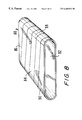
- FIG. 8 is a perspective view of still another embodiment of the belt.
- FIG. 9 is a plan view of a non-woven mesh fabric
- FIG. 10 is a plan view of a knitted fabric
- FIG. 11 is a cross-sectional view, taken in the machine direction of a base support structure having a laminated structure.
- the press nip 10 is defined by a smooth cylindrical press roll 12 and an arcuate pressure shoe 14 .
- the arcuate pressure shoe 14 has about the same radius of curvature as the cylindrical press roll 12 .
- the distance between the cylindrical press roll 12 and the arcuate pressure shoe 14 may be adjusted by hydraulic means operatively attached to arcuate pressure shoe 14 to control the loading of the nip 10 .
- Smooth cylindrical press roll 12 may be a controlled crown roll matched to the arcuate pressure shoe 14 to obtain a level cross-machine nip profile.
- Long nip press belt 16 extends in a closed loop through nip 10 , separating cylindrical press roll 12 from arcuate pressure shoe 14 .
- a press fabric 18 and a cellulosic fibrous web 20 being processed into a paper sheet pass together through nip 10 as indicated by the arrows in FIG. 1 .
- Cellulosic fibrous web 20 is supported by press fabric 18 and comes into direct contact with smooth cylindrical press roll 12 in nip 10 .
- Cellulosic fibrous web 20 and press fabric 18 proceed through the nip 10 as indicated by the arrows.
- Long nip press belt 16 also moving through press nip 10 as indicated by the arrows, that is, counterclockwise as depicted in FIG.
- the long nip press belt of the present invention is also useful on long nip presses having configurations other than that shown in FIG. 1, such as long nip presses which include a long nip press belt having a long loop travelling in an endless path, entrained around and supported from within by interior support rolls. Further, it should be understood that two press fabrics, one on each side of cellulosic fibrous web 20 , may be used on these and other configurations. Finally, the belt of the present invention may also be used as a calender belt for a roll calender or a shoe calender, and as a sheet transfer belt.
- FIG. 2 A perspective view of the long nip press belt 16 is provided in FIG. 2 .
- the belt 16 has an inner surface 28 and an outer surface 30 . On the outer surface 30 , the base support structure of the belt 16 may be visible.
- FIG. 3 is a perspective view of an alternate embodiment of the belt 32 .
- the belt 32 has an inner surface 34 and an outer surface 36 .
- the outer surface 36 is provided with a plurality of grooves 38 , for example, in the longitudinal direction around the belt 32 for the temporary storage of water pressed from press fabric 18 and fibrous web 20 in press nip 10 .
- the outer surface of the belt may be provided with a plurality of blind-drilled holes arranged in some desired geometric pattern for the temporary storage of water.
- FIG. 4 is a perspective view of such an alternate embodiment of the belt 40 .
- the belt 40 has an inner surface 42 and an outer surface 44 .
- the outer surface 44 is provided with a plurality of blind-drilled holes 46 , so called because they do not extend completely through the belt 40 .
- the long nip press belts 16 , 32 , 40 shown in FIGS. 2, 3 and 4 include a base support structure formed from a plurality of elements.
- the base support structure takes the form of an endless loop having an s inner surface, an outer surface, a longitudinal direction and a transverse direction.
- the coated elements are coated with a first polymeric resin material, which may be, for example, a polyurethane resin material.
- the elements are yarns
- the yarns may be coated by any of the methods so used by those of ordinary skill in the art, such as dip coating and crosshead extrusion.
- the coated yarns may also be given their coating after the base support structure has been assembled by weaving, knitting, braiding or the like.
- the yarns themselves, coated and uncoated may be of any of the yarn varieties used by those of ordinary skill in the art to produce paper machine clothing.
- Monofilament yarns are preferred, although plied monofilament, multifilament, plied multifilament, knitted and braided yarns may also be used. Where a plied, braided or knitted yarn is used, fewer than all of its components may be coated with the first polymeric resin material. For example, in a plied monofilament yarn comprising three pairs of two monofilament ends twisted together, two out of the three pairs may be coated with the first polymeric resin material, and one pair may remain uncoated.
- the yarns may be of any of the polymeric resins from which yarns for paper machine clothing are commonly extruded or produced, such as polyamide, polyester, polyetheretherketone (PEEK), polyaramid (for example, KEVLAR® and NOMEX®) and polyolefin resins.
- the yarns are to be coated with a polyurethane resin material
- they may be first provided with a coating of a phenolic resin, which will serve as a tie coat, binding the polyurethane coating to the yarns more effectively when the polyurethane is cured.
- the coating of phenolic resin is partially cured (B-staged) before the polyurethane coating is applied.
- the base support structure may be a woven structure, such as that shown in U.S. Pat. No. 5,238,537.
- FIG. 5 is a cross section taken as indicated by line 5 — 5 in FIG. 2 in the transverse (cross-machine) direction thereof.
- the base fabric 50 is woven from a plurality of warp yarns 52 , seen from the side, and a plurality of weft yarns 54 , seen in cross section.
- the warp yarns 52 lie in the transverse (cross-machine) direction of the belt 16
- the weft yarns 54 lie in the longitudinal (machine) direction thereof, a relationship indicating that the base fabric 50 has been woven endless.
- the base fabric 50 need not be woven endless to fall within the scope of the present invention. It may, for example, also be flat woven and joined into endless form with a woven seam, in which case the warp yarns will lie in the longitudinal (machine) direction.
- the base fabric 50 is woven in a multi-layer weave.
- the pluralities of warp yarns 52 and weft yarns 54 is a plurality of coated yarns, which may be either warp yarns 52 , weft yarns 54 or both. Weaves other than that shown may be used and fall within the scope of the present invention.
- the base fabric 50 may also include a staple fiber batt 56 needled or otherwise entangled into the woven structure thereof.
- the staple fiber batt 56 may comprise fibers of a polymeric resin material, such as polyamide or polyester, or of any of the other materials commonly used for this purpose by those in the paper machine clothing industry.
- the fibers may, in addition, be coated with the same first polymeric resin material coating the yarns, or may themselves be made of the first polymeric resin material, to improve the bond to be formed with the impregnating material. Where a polyurethane resin material is to be the coating, the fibers may first be coated with a phenolic resin, which will act as a tie coat upon curing. Again, it is preferable to cure the phenolic resin partially (B-stage) before the polyurehane resin material is applied.
- At least the inner surface of the base fabric 50 has a coating of a second polymeric resin material 58 , which impregnates the base fabric 50 and renders the belt 16 impervious to oil and water. After curing, the second polymeric resin material 58 is ground and buffed to provide the belt 16 with a smooth surface and a uniform thickness.
- the second polymeric resin material 58 coating the base fabric 50 has an affinity for the first polymeric resin material coating the plurality of coated yarns, or staple fiber batt 56 , if present.
- affinity for the first polymeric resin material coating the plurality of coated yarns, or staple fiber batt 56 , if present.
- the existence of such an affinity is what governs the choice of the materials used as the first and second polymeric resin materials. Both may be polyurethane resin materials although other polymeric resin materials having the necessary affinities may be used to coat the yarns and to coat the base fabric 50 as a whole.
- the affinity permits the establishment of a chemical interlock between the second polymeric resin material and the first polymeric resin material coating at least some of the yarns, and possibly staple fiber batt 56 , to supplement the mechanical interlock that forms between the cured second polymeric resin material and the yarns of the base fabric.
- the base support structure must be of an openness sufficient to ensure its almost complete impregnation by the second polymeric resin material, an unimpregnated portion, formed by a small portion of the warp and/or weft yarn knuckles which may be exposed above the coating on the uncoated side of the base fabric 50 , often remaining on that side.
- Such almost complete impregnation eliminates the possibility of undesirable voids forming within the finished belt.
- Voids are particularly undesirable because they may allow the lubricating oil used between the belt and the arcuate pressure shoe to pass through the belt and contaminate the press fabric 18 , or press fabrics, and cellulosic fibrous web 20 being processed into paper. Further, penetration of oil into the coating could cause the coating to delaminate from the base fabric.
- the base support structure comprises a braided structure, which is braided from a plurality of yarns, among which is a plurality of yarns coated with the first polymeric resin material.
- a braided structure may be manufactured according to the teachings of commonly assigned U.S. Pat. No. 5,501,133, which shows a multilayer braided structure in which the layers are interbraided. The interbraiding of the layers provides an interlock therebetween which prevents the delamination of multiple braided layers from one another.
- the interlock between the layers may be a direct interlock in which the interlocking yarn passes from a first layer to a contiguous second layer, and passes around at least one yarn in the second layer.
- the interlock between the layers may be an indirect interlock in which an interlocking yarn passes from the first layer through the second layer to another, not necessarily contiguous, layer in the structure, and passes around a strand in the other layer to serve to bind the first layer and the other layer together and at the same time to bind the layers therebetween.
- the braided structure may be of a hollow, tubular form.
- long nip press belts depending on the size requirements of the long nip presses on which they are installed, have lengths from roughly 10 to 40 feet (approximately 3 to 12 meters), measured longitudinally around their endless-loop forms, and widths from roughly 100 to 450 inches (approximately 250 to 1125 centimeters), measured transversely across those forms
- the production of the base fabric may require a cylindrical braiding mandrel having a diameter from roughly 3 to 12 feet (approximately 1 to 4 meters) and a length from roughly 100 to 450 inches (approximately 250 to 1125 centimeters).
- a braided base fabric for a long nip press belt is shown in U.S. Pat. No. 5,772,848.
- the base fabric must be of an openness sufficient to ensure its almost complete impregnation by the second polymeric resin material. It may also be needled with a staple fiber batt of the same varieties as were described above.
- FIG. 6 is a plan view of a portion of the outer surface of such a braided base fabric 60 .
- the machine (longitudinal) and cross-machine (transverse) directions are as indicated in the figure.
- Yarns 62 , 64 make an angle ⁇ of 5° or less with respect to the machine direction of the long nip press belt, and therefore, at their crossing points 66 , make an angle of 10° or less with respect to each other.
- FIG. 7 is a schematic cross-sectional view of the braided base fabric 60 taken in the longitudinal, or machine, direction (MD) thereof.
- Fabric 60 comprises a first braided layer 68 and a second braided layer 70 defined by yarns 64 which define left-handed spirals about the base fabric 60 .
- Yarns 62 which define right-handed spirals about the base fabric 60 , pass back and forth between the two braided layers 68 , 70 to interlock them together.
- Reinforcing yarns 72 are directed transversely across the base fabric 60 within its braided structure. The reinforcing yarns 72 are particularly important where the press belt is of the “press jacket” variety held by clamping rings on the widthwise edges of the press.
- the base support structure comprises a spirally wound woven fabric strip, wherein the woven fabric strip has a width smaller than a width of the base fabric as a whole.
- the base support structure has a plurality of non-overlapping, abutting turns of the woven fabric strip joined along a continuous seam, and may be manufactured in accordance with the teachings of commonly assigned U.S. Pat. No. 5,360,656.
- the fabric strip is woven from a plurality of warp yarns and a plurality of weft yarns. Among the pluralities of warp yarns and weft yarns is a plurality of coated yarns having a coating of the first polymeric resin material.
- FIG. 8 is a perspective view of a belt 80 belonging to this embodiment.
- Belt 80 has an inner surface 82 and an outer surface 84 .
- the base fabric 86 and its spirally continuous seam 88 may be seen.
- the woven fabric strip 80 because it is spirally wound in the production of base fabric 86 , and the continuous seam 88 are oriented at a small angle to the longitudinal (machine) direction.
- a cross section, taken as indicated in FIG. 8 in a direction parallel to the spirally continuous seam 88 has an appearance identical to that already seen and discussed in FIG. 5, although in this case, the warp yarns 52 are oriented at a slight angle to the longitudinal (machine) direction of the belt 80 .
- FIG. 5 the discussion of FIG. 5 given above is equally applicable here.
- Non-woven mesh fabric 100 comprises a plurality of crisscrossing members 102 .
- a strip of knitted or braided fabric may be spirally wound in this manner to assemble a base fabric.
- a plan view of a knitted fabric 110 is presented in FIG. 10 .
- the knitted fabric 110 comprises a network of interlaced loops 112 forming stitches 114 .
- a plan view of the braided fabric would have the same appearance as that presented earlier in FIG. 6 .
- the non-woven mesh fabric 100 and at least some of the yarns in the knitted fabric 110 and braided fabric, are coated with the first polymeric resin material.
- all of the base fabrics characterizing this third embodiment may be needled with a staple fiber batt of the same varieties as were described above.
- the base support structure may comprise a laminated structure having a plurality of layers.
- Each of the layers may be of one of the four above-described structures, each of which includes a plurality of coated yarns coated with a first polymeric resin material.
- the coating of first polymeric resin material on the plurality of coated yarns in each of the layers enables the layers to be joined to one another using heat and pressure.
- the layers may all be of the same type of structure; that is to say, they may be all woven structures, all knitted structures, and so forth.
- different types of the above-described structures may be laminated together in any desired order to form a base support structure.
- adjacent layers may be spiralled in opposite directions relative to one another.
- one layer may be a fabric structure that is seamable on a paper machine, and the other layer or layers may be of any of the structures described above, such as spirally wound fabric strip structures.
- a web or film of first polymeric resin material may be provided as an intermediate layer between each pair of layers in the laminated structure of the base fabric.
- the web or film of first polymeric resin may be on the inside or outside of an otherwise non-laminated base fabric.
- Such a film or web must be porous, perhaps as a consequence of being needled or of being perforated during manufacture, to enable the second polymeric resin to pass therethrough to impregnate the base fabric.
- the film or web may be spirally wound onto the surface of a base fabric or a layer thereof in accordance with the teachings of U.S. Pat. No. 5,360,656.
- the film may be of polyurethane and have a thickness of 0.50 mm and a weight of 350 grams per square meter. Subsequently, the film or web of first polymeric resin chemically bonds with the second polymeric resin of the coating.
- FIG. 11 is a cross-sectional view, taken in the machine direction, of a base fabric 120 having such a laminated structure.
- Base fabric 120 comprises a first layer 122 and a second layer 124 .
- the first layer 122 is woven in a two-layer, or duplex, weave.
- Machine-direction yarns 130 which are the weft yarns in the one-machine-seamable fabric used as the first layer 122 , form seaming loops 132 which are interdigitated to create a passage through which a pintle 134 is directed to join the first layer 122 into endless form.
- Cross-machine direction yarns 136 are the warp yarns during the weaving of the first layer 122 .
- the first layer 122 need not be an on-machine-seamable fabric, although this is preferred because it would permit the belt to be joined into endless form during installation on a paper machine.
- the second layer 124 is attached to the inside of the first layer 122 . That is to say, more specifically, second layer 124 is attached to the inner surface of the endless loop formed by the first layer 122 .
- the second layer 124 is of a single-layer weave, such as a plain weave, and may be joined into endless form with a woven seam, or may be woven endless.
- the second layer 124 is woven from machine-direction yarns 140 and cross-machine-direction yarns 142 .
- the first layer 122 and the second layer 124 may be separated by a film 150 of first polymeric resin material.
- the film 150 has perforations 152 , and facilitates the lamination of the first layer 122 and the second layer 124 by adhering to the yarns coated with the first polymeric resin material in the two layers 122 , 124 in response to heat and pressure to hold the two layers 122 , 124 together.
- each of the layers takes the form of an endless loop.
- the laminated structure then, comprises a plurality of nested endless loops.
- both surfaces of the base support structure may be coated with the second polymeric resin material.
- both the inner surface and the outer surface of the belt thereby obtained may be ground and buffed to provide the belt with smooth surfaces and a uniform thickness.
- the outer surface may be provided, by cutting, scoring, graving or drilling, with a plurality of grooves, for example, in the longitudinal direction around the belt, or blind holes for the temporary storage of water pressed from fibrous web 20 in the press nip 10 .
- all of the base support structures heretofore described include yarns or a non-woven mesh fabric coated with the first polymeric resin material. It is clear that the improved interlock between base support structure and polymeric resin coating sought by means of the present invention may also be achieved by attaching a staple fiber batt having fibers coated with, or entirely composed of, the first polymeric resin material to a base fabric having uncoated yarns. This modification is considered to fall within the scope of the present invention and is claimed hereinbelow.
Landscapes
- Engineering & Computer Science (AREA)
- Textile Engineering (AREA)
- Manufacturing & Machinery (AREA)
- Paper (AREA)
- Woven Fabrics (AREA)
- Laminated Bodies (AREA)
- Organic Insulating Materials (AREA)
- Knitting Of Fabric (AREA)
- Braiding, Manufacturing Of Bobbin-Net Or Lace, And Manufacturing Of Nets By Knotting (AREA)
- Nonwoven Fabrics (AREA)
- Treatment Of Fiber Materials (AREA)
- Chemically Coating (AREA)
- Reinforced Plastic Materials (AREA)
- Belt Conveyors (AREA)
Priority Applications (15)
| Application Number | Priority Date | Filing Date | Title |
|---|---|---|---|
| US09/383,141 US6465074B1 (en) | 1999-08-25 | 1999-08-25 | Base substrates for coated belts |
| AU10016/00A AU741236B2 (en) | 1999-08-25 | 2000-01-04 | Base substrates for coated belts |
| ZA200000236A ZA200000236B (en) | 1999-08-25 | 2000-01-20 | Base substrates for coated belts. |
| KR1020000006950A KR100664766B1 (ko) | 1999-08-25 | 2000-02-15 | 수지함침된 순환벨트 |
| CNB001036033A CN1181243C (zh) | 1999-08-25 | 2000-02-28 | 被覆盖带的基底织物 |
| CA002299739A CA2299739A1 (en) | 1999-08-25 | 2000-02-29 | Base substrates for coated belts |
| BRPI0001323-4A BR0001323B1 (pt) | 1999-08-25 | 2000-03-15 | Substratos de base para correias revestidas. |
| TW089111624A TW509740B (en) | 1999-08-25 | 2000-06-14 | Base substrates for coated belts |
| EP00114014A EP1087056B1 (de) | 1999-08-25 | 2000-07-04 | Trägermaterial für beschichtete Bänder |
| ES00114014T ES2379238T3 (es) | 1999-08-25 | 2000-07-04 | Sustratos de base para correas revestidas |
| AT00114014T ATE548505T1 (de) | 1999-08-25 | 2000-07-04 | Trägermaterial für beschichtete bänder |
| MXPA00007573A MXPA00007573A (es) | 1999-08-25 | 2000-08-02 | Sustratos base para bandas recubiertas. |
| JP2000249815A JP2001098485A (ja) | 1999-08-25 | 2000-08-21 | 被覆ベルト用基材 |
| IDP20000705D ID27101A (id) | 1999-08-25 | 2000-08-24 | Substrat dasar untuk sabuk berlapis |
| NO20004246A NO323196B1 (no) | 1999-08-25 | 2000-08-24 | Plastimpregnert endelost belte for en langnippresse |
Applications Claiming Priority (1)
| Application Number | Priority Date | Filing Date | Title |
|---|---|---|---|
| US09/383,141 US6465074B1 (en) | 1999-08-25 | 1999-08-25 | Base substrates for coated belts |
Publications (1)
| Publication Number | Publication Date |
|---|---|
| US6465074B1 true US6465074B1 (en) | 2002-10-15 |
Family
ID=23511907
Family Applications (1)
| Application Number | Title | Priority Date | Filing Date |
|---|---|---|---|
| US09/383,141 Expired - Lifetime US6465074B1 (en) | 1999-08-25 | 1999-08-25 | Base substrates for coated belts |
Country Status (15)
| Country | Link |
|---|---|
| US (1) | US6465074B1 (de) |
| EP (1) | EP1087056B1 (de) |
| JP (1) | JP2001098485A (de) |
| KR (1) | KR100664766B1 (de) |
| CN (1) | CN1181243C (de) |
| AT (1) | ATE548505T1 (de) |
| AU (1) | AU741236B2 (de) |
| BR (1) | BR0001323B1 (de) |
| CA (1) | CA2299739A1 (de) |
| ES (1) | ES2379238T3 (de) |
| ID (1) | ID27101A (de) |
| MX (1) | MXPA00007573A (de) |
| NO (1) | NO323196B1 (de) |
| TW (1) | TW509740B (de) |
| ZA (1) | ZA200000236B (de) |
Cited By (21)
| Publication number | Priority date | Publication date | Assignee | Title |
|---|---|---|---|---|
| US20040016473A1 (en) * | 2002-07-24 | 2004-01-29 | Hansen Robert A. | On-machine-seamable industrial fabric having seam-reinforcing rings |
| US6699368B2 (en) * | 2001-01-17 | 2004-03-02 | Ichikawa Co., Ltd. | Shoe press belt and manufacturing method |
| US20040099391A1 (en) * | 2002-11-26 | 2004-05-27 | Bob Ching | Process for producing super high bulk, light weight coated papers |
| US20040154776A1 (en) * | 2003-01-29 | 2004-08-12 | Kenji Inoue | Wet paper web transfer belt |
| US20040171318A1 (en) * | 2003-02-28 | 2004-09-02 | Rashed Mohamed Abdel Aziz | Multi-layered woven scrim |
| US20040200592A1 (en) * | 2003-04-14 | 2004-10-14 | Bo-Christer Aberg | Method and device for installing a belt onto a long nip press or shoe calender |
| US20050025935A1 (en) * | 2003-07-31 | 2005-02-03 | Levine Mark J. | Fabrics with v-guides |
| US20050139341A1 (en) * | 2003-12-24 | 2005-06-30 | Yamauchi Corporation | Press belt and manufacturing method thereof |
| US20060234575A1 (en) * | 2005-04-13 | 2006-10-19 | Joseph Salitsky | Thermally sprayed protective coating for industrial and engineered fabrics |
| US20080125263A1 (en) * | 2006-11-03 | 2008-05-29 | Donald Ray Belik | Spliceless baler belt |
| US20080248279A1 (en) * | 2007-04-04 | 2008-10-09 | Sanjay Patel | Paper machine fabrics |
| US20090047496A1 (en) * | 2007-08-16 | 2009-02-19 | Hansen Robert A | Multilayer fabric and manufacturing method thereof |
| WO2010066950A2 (en) | 2008-12-12 | 2010-06-17 | Tamfelt Pmc Oy | Shoe press belt |
| RU2525813C1 (ru) * | 2013-02-28 | 2014-08-20 | Открытое акционерное общество "Научно-исследовательский институт технических тканей" | Рукавная ткань для армирования бесконечных приводных ремней |
| US20140296011A1 (en) * | 2011-12-14 | 2014-10-02 | Bando Chemical Industries, Ltd. | Friction transmission belt and method for manufacturing the same |
| US20140378255A1 (en) * | 2011-12-20 | 2014-12-25 | Arntz Beteiligungs Gmbh & Co.Kg | Belt having a multilayer impregnated textile overlay |
| US20180010267A1 (en) * | 2015-01-28 | 2018-01-11 | Voith Patent Gmbh | Fabric tape for producing web material, in particular for producing spunbonded fabric |
| US10024389B2 (en) * | 2014-05-22 | 2018-07-17 | Bando Chemical Industries, Ltd. | Power transmission belt |
| US20190061205A1 (en) * | 2017-08-30 | 2019-02-28 | Ming-Yi Lin | Pu thin covers with waterproof and moisture permeable function |
| US11306438B2 (en) * | 2018-08-01 | 2022-04-19 | Voith Patent Gmbh | Press cover, use thereof, and press roll and shoe press |
| US20240368837A1 (en) * | 2023-05-02 | 2024-11-07 | The Procter & Gamble Company | Web material structuring belt comprising a seam and method for making and using |
Families Citing this family (18)
| Publication number | Priority date | Publication date | Assignee | Title |
|---|---|---|---|---|
| US6616812B2 (en) * | 2001-09-27 | 2003-09-09 | Voith Paper Patent Gmbh | Anti-rewet felt for use in a papermaking machine |
| DE10241010A1 (de) * | 2002-09-05 | 2004-03-25 | Voith Paper Patent Gmbh | Transferband |
| US7374640B2 (en) * | 2003-05-23 | 2008-05-20 | Albany International Corp. | Grooved surface belt or roll and method of fabrication |
| US20050003724A1 (en) * | 2003-07-02 | 2005-01-06 | Fitzpatrick Keith | Substrate for endless belt for use in papermaking applications |
| US7654296B2 (en) * | 2003-11-24 | 2010-02-02 | Albany International Corp. | Grooved single facer belt |
| EP1861530A2 (de) * | 2005-03-24 | 2007-12-05 | Federal-Mogul Corporation | Trägermaterial mit vlieselementen |
| GB2425542A (en) * | 2005-04-26 | 2006-11-01 | Autoliv Dev | A webbing belt |
| AU2006284715B2 (en) * | 2005-09-02 | 2012-11-29 | Albany International Corp. | A needled belt with high thickness and elasticity |
| US7712336B2 (en) * | 2007-01-31 | 2010-05-11 | Albany International Corp. | Subassembly for industrial fabrics |
| DE102010028917A1 (de) | 2010-05-12 | 2011-11-17 | Voith Patent Gmbh | Pressmantel für eine Schuhpresse |
| WO2013037527A2 (de) * | 2011-09-16 | 2013-03-21 | Voith Patent Gmbh | Kombination aus einem walzenbezug oder schuhpressenmantel mit einer papiermaschinenbespannung und verwendung einer derartigen kombination |
| ITTO20120080A1 (it) | 2012-01-31 | 2013-08-01 | Dayco Europe Srl | Uso di una cinghia di trasmissione in olio e relativo sistema di trasmissione |
| JP3201639U (ja) | 2012-12-07 | 2015-12-24 | ボイス パテント ゲーエムベーハーVoith Patent GmbH | プレスローラ用のプレスジャケット |
| DE102013222458A1 (de) | 2013-11-06 | 2015-05-07 | Voith Patent Gmbh | Pressmantel für Presswalze |
| WO2015091654A1 (de) * | 2013-12-20 | 2015-06-25 | Voith Patent Gmbh | Pressmantel oder prozessband für eine maschine zur herstellung und/oder behandlung einer faserbahn |
| CN107685517A (zh) * | 2016-08-03 | 2018-02-13 | 吴美华 | 一种隔液面料缝合物及其缝合方法 |
| DE102019125908A1 (de) * | 2019-09-26 | 2021-04-01 | Voith Patent Gmbh | Pressmantel, dessen Verwendung sowie Schuhpresse und Maschine |
| CN115341320A (zh) * | 2022-07-27 | 2022-11-15 | 上海永利带业股份有限公司 | 一种环形增强体和无接头输送带的制造方法 |
Citations (12)
| Publication number | Priority date | Publication date | Assignee | Title |
|---|---|---|---|---|
| US3032441A (en) * | 1960-04-18 | 1962-05-01 | Huyck Corp | Open weave endless fabric and method for producing the same |
| US4427734A (en) | 1982-04-19 | 1984-01-24 | Albany International Corp. | Wet press felt for papermaking machines |
| US4567077A (en) | 1980-11-13 | 1986-01-28 | Cofpa | Papermaker's fabric constituted by plastic spirals |
| GB2202873A (en) * | 1987-03-31 | 1988-10-05 | Leonard Robert Lefkowitz | Apertured parallel filament reinforced plastics sheet |
| US5118391A (en) | 1990-07-18 | 1992-06-02 | J. M. Voith Gmbh | Press blanket for a pressing device |
| US5238537A (en) | 1981-09-15 | 1993-08-24 | Dutt William H | Extended nip press belt having an interwoven base fabric and an impervious impregnant |
| US5342486A (en) * | 1990-07-28 | 1994-08-30 | Scapa Group Plc | Endless belt for extended nip dewatering presses |
| US5360656A (en) | 1990-12-17 | 1994-11-01 | Albany International Corp. | Press felt and method of manufacturing it |
| US5501133A (en) | 1990-03-29 | 1996-03-26 | Albany International Corp. | Apparatus for making a braid structure |
| US5772848A (en) | 1996-12-03 | 1998-06-30 | Albany International Corp. | Braided base fabrics for shoe press belts |
| US6027615A (en) * | 1997-05-06 | 2000-02-22 | Albany International Corp. | Belts for compliant calendering |
| US6174825B1 (en) * | 1997-12-09 | 2001-01-16 | Albany International Corp. | Resin-impregnated belt for application on papermaking machines and in similar industrial application |
Family Cites Families (4)
| Publication number | Priority date | Publication date | Assignee | Title |
|---|---|---|---|---|
| US4552620A (en) * | 1983-09-19 | 1985-11-12 | Beloit Corporation | Paper machine belt |
| US5360518A (en) * | 1991-12-18 | 1994-11-01 | Albany International Corp. | Press fabrics for paper machines |
| US5656279A (en) * | 1994-02-23 | 1997-08-12 | Bio Med Sciences, Inc. | Semi-interpenetrating polymer network scar treatment sheeting, process of manufacture and useful articles thereof |
| US5792323A (en) * | 1995-09-07 | 1998-08-11 | Albany International Corp. | Spiral base structres for long nip paper machine press belts |
-
1999
- 1999-08-25 US US09/383,141 patent/US6465074B1/en not_active Expired - Lifetime
-
2000
- 2000-01-04 AU AU10016/00A patent/AU741236B2/en not_active Ceased
- 2000-01-20 ZA ZA200000236A patent/ZA200000236B/xx unknown
- 2000-02-15 KR KR1020000006950A patent/KR100664766B1/ko not_active Expired - Fee Related
- 2000-02-28 CN CNB001036033A patent/CN1181243C/zh not_active Expired - Fee Related
- 2000-02-29 CA CA002299739A patent/CA2299739A1/en not_active Abandoned
- 2000-03-15 BR BRPI0001323-4A patent/BR0001323B1/pt not_active IP Right Cessation
- 2000-06-14 TW TW089111624A patent/TW509740B/zh active
- 2000-07-04 EP EP00114014A patent/EP1087056B1/de not_active Expired - Lifetime
- 2000-07-04 ES ES00114014T patent/ES2379238T3/es not_active Expired - Lifetime
- 2000-07-04 AT AT00114014T patent/ATE548505T1/de active
- 2000-08-02 MX MXPA00007573A patent/MXPA00007573A/es active IP Right Grant
- 2000-08-21 JP JP2000249815A patent/JP2001098485A/ja active Pending
- 2000-08-24 ID IDP20000705D patent/ID27101A/id unknown
- 2000-08-24 NO NO20004246A patent/NO323196B1/no not_active IP Right Cessation
Patent Citations (12)
| Publication number | Priority date | Publication date | Assignee | Title |
|---|---|---|---|---|
| US3032441A (en) * | 1960-04-18 | 1962-05-01 | Huyck Corp | Open weave endless fabric and method for producing the same |
| US4567077A (en) | 1980-11-13 | 1986-01-28 | Cofpa | Papermaker's fabric constituted by plastic spirals |
| US5238537A (en) | 1981-09-15 | 1993-08-24 | Dutt William H | Extended nip press belt having an interwoven base fabric and an impervious impregnant |
| US4427734A (en) | 1982-04-19 | 1984-01-24 | Albany International Corp. | Wet press felt for papermaking machines |
| GB2202873A (en) * | 1987-03-31 | 1988-10-05 | Leonard Robert Lefkowitz | Apertured parallel filament reinforced plastics sheet |
| US5501133A (en) | 1990-03-29 | 1996-03-26 | Albany International Corp. | Apparatus for making a braid structure |
| US5118391A (en) | 1990-07-18 | 1992-06-02 | J. M. Voith Gmbh | Press blanket for a pressing device |
| US5342486A (en) * | 1990-07-28 | 1994-08-30 | Scapa Group Plc | Endless belt for extended nip dewatering presses |
| US5360656A (en) | 1990-12-17 | 1994-11-01 | Albany International Corp. | Press felt and method of manufacturing it |
| US5772848A (en) | 1996-12-03 | 1998-06-30 | Albany International Corp. | Braided base fabrics for shoe press belts |
| US6027615A (en) * | 1997-05-06 | 2000-02-22 | Albany International Corp. | Belts for compliant calendering |
| US6174825B1 (en) * | 1997-12-09 | 2001-01-16 | Albany International Corp. | Resin-impregnated belt for application on papermaking machines and in similar industrial application |
Cited By (31)
| Publication number | Priority date | Publication date | Assignee | Title |
|---|---|---|---|---|
| US6699368B2 (en) * | 2001-01-17 | 2004-03-02 | Ichikawa Co., Ltd. | Shoe press belt and manufacturing method |
| US20040016473A1 (en) * | 2002-07-24 | 2004-01-29 | Hansen Robert A. | On-machine-seamable industrial fabric having seam-reinforcing rings |
| US7273074B2 (en) * | 2002-07-24 | 2007-09-25 | Albany International Corp. | On-machine-seamable industrial fabric having seam-reinforcing rings |
| US20040099391A1 (en) * | 2002-11-26 | 2004-05-27 | Bob Ching | Process for producing super high bulk, light weight coated papers |
| US7118650B2 (en) * | 2003-01-29 | 2006-10-10 | Ichikawa Co., Ltd. | Wet paper web transfer belt |
| US20040154776A1 (en) * | 2003-01-29 | 2004-08-12 | Kenji Inoue | Wet paper web transfer belt |
| US20040171318A1 (en) * | 2003-02-28 | 2004-09-02 | Rashed Mohamed Abdel Aziz | Multi-layered woven scrim |
| US7132376B2 (en) | 2003-02-28 | 2006-11-07 | Interwrap, Inc. | Multi-layered woven scrim |
| US20040200592A1 (en) * | 2003-04-14 | 2004-10-14 | Bo-Christer Aberg | Method and device for installing a belt onto a long nip press or shoe calender |
| US20050025935A1 (en) * | 2003-07-31 | 2005-02-03 | Levine Mark J. | Fabrics with v-guides |
| US7862879B2 (en) | 2003-07-31 | 2011-01-04 | Albany International Corp. | Fabrics with v-guides |
| US20050139341A1 (en) * | 2003-12-24 | 2005-06-30 | Yamauchi Corporation | Press belt and manufacturing method thereof |
| US7384517B2 (en) * | 2003-12-24 | 2008-06-10 | Yamauchi Corporation | Press belt and manufacturing method thereof |
| US20060234575A1 (en) * | 2005-04-13 | 2006-10-19 | Joseph Salitsky | Thermally sprayed protective coating for industrial and engineered fabrics |
| US8058188B2 (en) | 2005-04-13 | 2011-11-15 | Albany International Corp | Thermally sprayed protective coating for industrial and engineered fabrics |
| US20080125263A1 (en) * | 2006-11-03 | 2008-05-29 | Donald Ray Belik | Spliceless baler belt |
| US20080248279A1 (en) * | 2007-04-04 | 2008-10-09 | Sanjay Patel | Paper machine fabrics |
| US20090047496A1 (en) * | 2007-08-16 | 2009-02-19 | Hansen Robert A | Multilayer fabric and manufacturing method thereof |
| US8568567B2 (en) | 2008-12-12 | 2013-10-29 | Metso Fabrics Inc. | Shoe press belt |
| WO2010066950A2 (en) | 2008-12-12 | 2010-06-17 | Tamfelt Pmc Oy | Shoe press belt |
| US20140296011A1 (en) * | 2011-12-14 | 2014-10-02 | Bando Chemical Industries, Ltd. | Friction transmission belt and method for manufacturing the same |
| US9303722B2 (en) * | 2011-12-14 | 2016-04-05 | Bando Chemical Industries, Ltd. | Friction transmission belt and method for manufacturing the same |
| US9644706B2 (en) * | 2011-12-20 | 2017-05-09 | Arntz Beteiligungs Gmbh & Co. Kg | Belt having a multilayer impregnated textile overlay |
| US20140378255A1 (en) * | 2011-12-20 | 2014-12-25 | Arntz Beteiligungs Gmbh & Co.Kg | Belt having a multilayer impregnated textile overlay |
| RU2525813C1 (ru) * | 2013-02-28 | 2014-08-20 | Открытое акционерное общество "Научно-исследовательский институт технических тканей" | Рукавная ткань для армирования бесконечных приводных ремней |
| US10024389B2 (en) * | 2014-05-22 | 2018-07-17 | Bando Chemical Industries, Ltd. | Power transmission belt |
| US20180010267A1 (en) * | 2015-01-28 | 2018-01-11 | Voith Patent Gmbh | Fabric tape for producing web material, in particular for producing spunbonded fabric |
| US10907281B2 (en) * | 2015-01-28 | 2021-02-02 | Voith Patent Gmbh | Fabric tape for producing web material, in particular for producing spunbonded fabric |
| US20190061205A1 (en) * | 2017-08-30 | 2019-02-28 | Ming-Yi Lin | Pu thin covers with waterproof and moisture permeable function |
| US11306438B2 (en) * | 2018-08-01 | 2022-04-19 | Voith Patent Gmbh | Press cover, use thereof, and press roll and shoe press |
| US20240368837A1 (en) * | 2023-05-02 | 2024-11-07 | The Procter & Gamble Company | Web material structuring belt comprising a seam and method for making and using |
Also Published As
| Publication number | Publication date |
|---|---|
| EP1087056B1 (de) | 2012-03-07 |
| ATE548505T1 (de) | 2012-03-15 |
| ZA200000236B (en) | 2000-08-02 |
| JP2001098485A (ja) | 2001-04-10 |
| BR0001323B1 (pt) | 2010-12-28 |
| CN1181243C (zh) | 2004-12-22 |
| CA2299739A1 (en) | 2001-02-25 |
| TW509740B (en) | 2002-11-11 |
| MXPA00007573A (es) | 2005-12-01 |
| KR100664766B1 (ko) | 2007-01-04 |
| NO20004246D0 (no) | 2000-08-24 |
| NO20004246L (no) | 2001-02-26 |
| AU1001600A (en) | 2001-03-01 |
| BR0001323A (pt) | 2001-04-03 |
| EP1087056A2 (de) | 2001-03-28 |
| ES2379238T3 (es) | 2012-04-24 |
| ID27101A (id) | 2001-03-01 |
| NO323196B1 (no) | 2007-01-15 |
| KR20010020636A (ko) | 2001-03-15 |
| AU741236B2 (en) | 2001-11-29 |
| CN1286332A (zh) | 2001-03-07 |
| EP1087056A3 (de) | 2001-10-24 |
Similar Documents
| Publication | Publication Date | Title |
|---|---|---|
| EP1087056B1 (de) | Trägermaterial für beschichtete Bänder | |
| AU708601B2 (en) | Spiral base structures for long nip paper machine press belts | |
| US20120097353A1 (en) | Substrate for endless belt for use in papermaking applications | |
| US6428874B1 (en) | Grooved long nip shoe press belt | |
| CA2245734C (en) | Braided base fabrics for shoe press belts | |
| US7303656B2 (en) | Low permeability textile substrate for a two-sided coated product |
Legal Events
| Date | Code | Title | Description |
|---|---|---|---|
| AS | Assignment |
Owner name: ALBANY INTERNATIONAL CORP., NEW YORK Free format text: ASSIGNMENT OF ASSIGNORS INTEREST;ASSIGNOR:DAVENPORT, FRANCIS L.;REEL/FRAME:010193/0964 Effective date: 19990728 Owner name: ALBANY INTERNATIONAL CORP., NEW YORK Free format text: ASSIGNMENT OF ASSIGNORS INTEREST;ASSIGNOR:FITZPATRICK, KEITH;REEL/FRAME:010193/0973 Effective date: 19990818 |
|
| STCF | Information on status: patent grant |
Free format text: PATENTED CASE |
|
| FPAY | Fee payment |
Year of fee payment: 4 |
|
| FPAY | Fee payment |
Year of fee payment: 8 |
|
| FPAY | Fee payment |
Year of fee payment: 12 |