US6515598B2 - System and method for compressing and decompressing data in real time - Google Patents
System and method for compressing and decompressing data in real time Download PDFInfo
- Publication number
- US6515598B2 US6515598B2 US10/021,893 US2189301A US6515598B2 US 6515598 B2 US6515598 B2 US 6515598B2 US 2189301 A US2189301 A US 2189301A US 6515598 B2 US6515598 B2 US 6515598B2
- Authority
- US
- United States
- Prior art keywords
- string
- characters
- match
- character string
- character
- Prior art date
- Legal status (The legal status is an assumption and is not a legal conclusion. Google has not performed a legal analysis and makes no representation as to the accuracy of the status listed.)
- Expired - Lifetime
Links
Images




Classifications
-
- H—ELECTRICITY
- H03—ELECTRONIC CIRCUITRY
- H03M—CODING; DECODING; CODE CONVERSION IN GENERAL
- H03M7/00—Conversion of a code where information is represented by a given sequence or number of digits to a code where the same, similar or subset of information is represented by a different sequence or number of digits
- H03M7/30—Compression; Expansion; Suppression of unnecessary data, e.g. redundancy reduction
- H03M7/3084—Compression; Expansion; Suppression of unnecessary data, e.g. redundancy reduction using adaptive string matching, e.g. the Lempel-Ziv method
-
- H—ELECTRICITY
- H03—ELECTRONIC CIRCUITRY
- H03M—CODING; DECODING; CODE CONVERSION IN GENERAL
- H03M7/00—Conversion of a code where information is represented by a given sequence or number of digits to a code where the same, similar or subset of information is represented by a different sequence or number of digits
- H03M7/30—Compression; Expansion; Suppression of unnecessary data, e.g. redundancy reduction
- H03M7/3084—Compression; Expansion; Suppression of unnecessary data, e.g. redundancy reduction using adaptive string matching, e.g. the Lempel-Ziv method
- H03M7/3086—Compression; Expansion; Suppression of unnecessary data, e.g. redundancy reduction using adaptive string matching, e.g. the Lempel-Ziv method employing a sliding window, e.g. LZ77
-
- H—ELECTRICITY
- H03—ELECTRONIC CIRCUITRY
- H03M—CODING; DECODING; CODE CONVERSION IN GENERAL
- H03M7/00—Conversion of a code where information is represented by a given sequence or number of digits to a code where the same, similar or subset of information is represented by a different sequence or number of digits
- H03M7/30—Compression; Expansion; Suppression of unnecessary data, e.g. redundancy reduction
- H03M7/40—Conversion to or from variable length codes, e.g. Shannon-Fano code, Huffman code, Morse code
Definitions
- the present invention relates to a system and method for compressing and decompressing data in real time.
- Lossless compression algorithms can be separated in two different classes, statistical methods and dictionary methods. The present invention is based on a lossless dictionary algorithm.
- Lossless compression and decompression algorithms are well known in the art. Reference may be made for example to the LZ77 algorithm, and its variations (see for example U.S. Pat. Nos. 5,155,484 (Chambers), U.S. Pat. No. 4,701,745 (Waterworth) and U.S. Pat. No. 5,521,597 (Dimitri), to name a few).
- the LZ77 compression algorithm reduces the length of messages by replacing repeated patterns of data by references to those patterns of data.
- the references are given with a pair of numbers, the length of the repeated data and its “offset” from the previous occurrence.
- the string “abracadabra” would be compressed as “ ⁇ abracad> ⁇ 4,7>” meaning that the first seven characters contained no repeated data and that the last three could be referenced as a repetition of 4 characters 7 characters back in the string.
- Four characters (32 bits) were replaced by a pair (2) of numbers sometimes called a reference. Compression therefore occurs if one is able to express the two numbers in less than 32 bits.
- bits have no meaning unless a given representation exists, one also has to be able to differentiate between a pair of numbers and a sequence of normal characters (this is denoted by the ⁇ > symbols). This means that additional bits are needed to determine if bits represent a reference or actual characters.
- the present invention features a system and method for efficiently and quickly compressing and decompressing data in real time utilizing several novel approaches to data compression, including the dynamic representation of coded values.
- One feature of the present invention processes characters by checking to see if they have been seen before in the input string. If they haven't, the present system and method adds them to a dictionary or table, and if they have, the system and method finds the longest match possible with the previous occurrence of the character(s) and the one(s) under examination. When a match is found, the present invention writes a representation of the characters that could not be compressed (if there are characters between the last match and this one) and a representation for the matching characters. This process is repeated until there are no characters left in the input string. The present system and method checks for previous encounters of one or more characters, and uses a lookup table for that purpose. The lookup table references simply linked lists of the same characters. The first node of the list references the most recent occurrence of the characters.
- the present invention also utilizes a vector of integers called expansion schemes, which is a binary representation of the length of characters NOT compressed (nclen); the length of the matching characters (mlen); and the number of characters processed since the last match (offset).
- expansion schemes produce variable length codes that are efficient in representing values that obey strictly decreasing probability distribution functions.
- Expansion schemes also provide a highly economical way, in terms of memory usage, of storing bit representations. Depending on the number of bytes that have been processed, the compressor changes its expansion schemes to reflect changes in the probability distribution of the lengths and offsets.
- FIG. 1 is a block diagram of the compression system according to the present invention.
- FIG. 3 is a schematic representation of structure manipulations including the temporary store structure of the prior art which makes reference to only the last occurrence of a matching character string;
- FIG. 4 is a schematic representation of structure manipulations including the lookup table and the tractable array which includes a chained list of matching character strings, in accordance with one feature of the present invention.
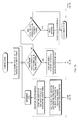
- FIG. 5 is a high level flow chart of the compression process in accordance with the method and system of the present invention.
- FIG. 6 is a high level flow chart of the decompression process in accordance with the method and system of the present invention.
- FIG. 7 is a detailed flow chart of the compression process in accordance with the method and system of the present invention.
- FIG. 8 is a detailed flow chart of the decompression process in accordance with the method and system of the present invention.
- FIG. 8 is a detailed flow chart of the Write CToken subroutine of the present invention.
- FIG. 9 is a detailed flow chart of the Write NCToken subroutine of the present invention.
- FIG. 10 is a detailed flow chart of the Calculate Hash subroutine of the present invention.
- FIG. 11 is a detailed flow chart of the procedure to find the longest matching string in accordance with one feature of the present invention.
- FIG. 12 is a detailed flow chart of the procedure to update the lookup table and the tracking table.
- FIG. 13 is a schematic representation of an output string containing various uncompressed data and tokens in accordance with one feature of the present invention.
- the present invention is more specifically directed to a system and method for use in packet-based communications, although its use is not limited thereto.
- Such communications include a header and the communication data.
- the present invention is directed to the compression and the decompression of the data itself, in order to reduce the bandwidth (i.e. time) required to send the message over a network.
- One of the important considerations of the present invention is that it be able to compress and decompress the data in real-time.
- the system and method of the present invention permits an average compression rate of 30% on a typical sampling of an internet communication using standard services such as “ftp”, “http”, “telnet”, “flash”, “Java”, “streaming” and “mpeg”. For example, with an initial communication session of 10 megabytes and an average compression rate of 30%, the information that is truly sent over for the network is 7 megabytes.
- the system and method of the invention thus permits an optimization of 1.4:1.
- the compression rate is directly related to the nature of the information that is to be transmitted. It is therefore impossible to predict a constant compression rate during a transmission. If it happens that the nature of the information to be sent is incompressible and that the use of the system and method of the present invention would result in an increase of the size of the packet, the packet would be sent without being compressed.
- the system and method of the present invention uses as its basis the LZ77 compression algorithm with important modifications and optimization which maximizes the compression ratio on restricted quantities of information (1,500 bytes in the case of Ethernet) in order to use it on the payload of a packet of information during its transmission. Furthermore, the performance has been increased in order to apply the compression in high-speed links.
- FIG. 1 is a block diagram 10 of the system for performing data compression in accordance with the teaching of the present invention.
- This string contains the data to compress and the number of characters is known.
- When decompressing, this string contains the compressed string.
- the output string 14 is a vector of eight bits characters. When compressing, this string contains the compressed data. When decompressing, it contains the decompressed string.
- the hash generator is responsible for the calculation of indexes in the lookup table.
- the lookup table 18 FIG. 4, is an array of 65536 pointers to the tracking table (tractable 20 ).
- the lookup table 18 does not need to be initialized prior to compression. Indexes in the lookup table are calculated by the hash generator module.
- a valid pointer in the lookup table points to a slot in the tracking table containing a simply linked list of occurrences of the same pair of characters. The first element of the list is the most recently encountered. The validity of a pointer in the lookup table is checked by the validity module.
- the tracking table 20 is a structure that permits a sequential search to find the longest matching string within those already encountered that begin by the same pair of characters.
- Each tracktab slot contains: a pointer to the input store and a pointer to the previously encountered tracktab slot that has the same pair of characters hashed value. This means that each time a pair is encountered a new tracktab slot is created and linked with the previous one.
- the pointer in the lookup table is always pointing to the most recent occurrence of the pair of characters.
- the prior art lookup table 21 FIG. 3, used with LZ77 compression and decompression algorithms only had one entry pointing only to the last occurrence of the pair of characters.
- the hash generator 16 calculates the index according to the following: it is generated with the pair of characters currently under examination (character pointed to by look_cur 22 , FIG. 4 , and the next or following character). It is given by the concatenation of these two characters. Since each character is eight bits wide, the hash code is thus 16 bit wide yielding values between 0 and 65535.
- the index given by the hash generator module is used to access the pointer to the most recent tracktab slot which references the same pair of bytes as the one under examination (at look_cur).
- the validity module (or validator) 24 verifies that a given pointer in the lookup table 18 is a valid pointer. To be a valid pointer, it has to reference a tracktab slot inside the tracking table 20 (between the start of the tracking table and the next available element), and the tracktab slot has to reference a pair of bytes that corresponds to its hash code. If these conditions are true, then the pointer in the lookup table 18 is valid and the slot it references in the tracktab is also valid.
- the best match finder module 26 searches for a longest matching string by examining the tracktab array.
- the best match finder 26 starts at the tracktab slot pointed by the lookup table 18 entry.
- the entry in this tracktab will be the most recent occurrence of the matching character(s) under examination.
- the best match finder 26 will begin examining characters from the position pointed to in the tracktab slot to determine the maximum length of each possible match and return the position and length of the longest match by sequentially examining each tracktab slot in the chain pointed to by the lookup table entry 18 and each previous occurrence of the pair if characters under study.
- the tracktab updater module modifies the tracking table 20 and the lookup table 18 in order for them to reference all possible occurrences of pair of characters previously seen in the input string.
- each valid (as determined by the validity module 24 ) lookup table pointer 28 given by an index calculated by the hash generator 16 with a pair of characters, references a tracktab slot 30 of the most recent occurrence of this pair of characters. This slot also has a pointer 32 to the previous occurrence of the pair.
- the token generator module 36 assumes the task of creating the tokens that represent sequence of not compressed characters (nctokens) or matches/compressed (ctoken). It also writes these tokens to the output string 14 .
- the token generator module 36 also modifies the expansion schemes used to write nclen, mlen and offset values based on the position of the look pointer in the input string.
- the token reader module 40 is part of the decompressor 42 . It reads tokens from the input string 14 (which is the output string of the compressor 10 ) and extracts nclen, mlen and offset values. The token reader module 40 also tells the substring copier module 44 how many characters to write to the output string 46 and where to get those characters.
- the present invention has a window of characters that can be referenced, and characters beyond the window cannot be used for compression.
- a memory efficient way of storing the tracktab array and the input string is as a circular buffer. In this context, a fixed number of tracktab slots are used and old slots are replaced by the newer slots.
- the steps used by the method of the present invention to compress data are fairly simple. They can be summarized as follows and as shown in FIG. 5 : after determining that there is more than one (1) character in the input string, act, 60 and calculating a hash value on the current pair of characters being examined, act 62 , the method processes characters by checking if they have been seen before in the input string, act 64 . If they haven't, add them to the lookup table, act 66 , and if they have, find the longest match possible with the previous occurrence of the character(s) under examination, act 68 , and update the lookup table, act 70 .
- the method of the present invention checks for previous encounters of pairs of characters and uses a lookup table 18 , FIG. 4, for that purpose.
- the lookup table references simply-linked lists 31 of the same pair of characters.
- the first node 50 of the list references the most recent occurrence of the pair of characters.
- the binary representation of nclen, mlen, and offset values are given by a vector of integers called “expansion schemes”. Expansion schemes produce variable length codes that are efficient in representing values that obey strictly decreasing probability distribution functions. Expansion schemes also provide a highly economical way, in terms of memory usage, of storing bit representations.
- the method of the present invention works on the following principle: It is a truism that the number of times that each length is met in compression is greatly decreasing following the value of the length. For example, many tests have demonstrated that approximately 50% of the time one is writing a length of 2, 25% of the time of 3, 12% of the time of 4 and so on, by dividing each increase of one of the length. Consequently, for the purpose of the present invention, it is essential to maximize the gain as much as possible on all of the short sequences since they arise much more frequently. This, of course, results in a penalty for lengths greater than 7, but these are very infrequent, i.e. between 5% and 10% of the time.
- the method of the present invention is thus quite appropriate for the compression of small sequences such as those that would be found on a packet of data on a network, where the length is generally smaller. Furthermore, since the compression is directed to small sequences, one must maximize the writing of the match length, not compressed length and offset as a function of the size of the data.
- the method of the present invention proceeds as follows to differentiate between sequences of characters and matches (pairs of numbers ⁇ length, offset>). If the bit read is a 0 then a sequence of characters and a match are next, if the bit read is a I then a match is next. This works because two consecutive sequences of characters can be considered as one, that is “ ⁇ abra> ⁇ cada>” is equivalent to “ ⁇ abracada>”. Since a match always follows a sequence of characters only one bit is needed to distinguish between “ ⁇ seq> ⁇ mlen,offset>” and “ ⁇ mlen,offset>”. It is also necessary to know the length of the sequence of characters. This is usually called a not compressed length or in short nclen.
- An nctoken corresponds to the bit indicating the sequence, the nclen and the characters themselves.
- a compressed token or ctoken is comprised of a bit indicating the sequence, if it immediately follows another ctoken, and the match length and offset pair or mlen and offset in short form. The method of writing a ctoken and an nctoken are shown and described in detail in FIGS. 9 and 10.
- the decompressor associated with the present invention is quite simple.
- the input string is comprised of tokens representing the original string and at the end, the output string will contain the decompressed string. If there are bytes remaining to be read in the input string, act 80 , FIG. 6, the decompressor reads a token, act 82 . If the token is a nctoken, then the decompressor reads the length of the sequence, copies those characters to the output string, reads the ctoken that follows and copies mlen characters at the given offset to the output string, act 84 . If the token is a ctoken, the decompressor copies mlen characters at the given offset to the output string, act 84 . This goes on until all of the tokens are read.
- expansion schemes are an efficient way of storing the binary representation of the values to be coded.
- the maximum possible offset and match length value respectively increase and decrease.
- the present invention makes use of vectors of expansion schemes to enable the compressor to dynamically change the codes associated to the match lengths, the offsets, and the length of the not compressed sequences.
- Three distinct vectors are used because the probability distributions for these three elements are quite different from one another and different vectors allow the codes to be adapted to the distributions.
- the number of expansion schemes per vector has to be the same as the desired number of dynamic changes in the codes (it can go from 1 to N, the maximal size of the data to compress). This number can be chosen arbitrarily or can be determined by a proper statistical analysis.
- the position where the compressor changes from an expansion scheme to the next can also be chosen arbitrarily or determined by a statistical analysis.
- unsigned int bsizeswitch[19] ⁇ 32, 64, 96, 128, 192, 256, 320, 384, 448, 512, 640, 768,896, 1024, 1280, 1536, 2048, 3072, 4096 ⁇ ;
- These vectors contain 7 different expansion schemes of 6 integers each. Normally, tual values contained in the expansion schemes are assigned according to the results of a analysis of sample data.
- the expansion schemes can contain any number of integers (as long as there are enough codes to represent all the possible values) and the vector of expansion schemes should contain a number of expansion schemes equal to the number of times a dynamic change of codes is desired.
- Binary codes representing match lengths start at the value 2 because the minimum match length that can be used is of length 2. In other words, no binary representations are wasted for the values 0 or 1 for mlen since they would not be used anyway.
- Table 3 gives an example of nclen values and their binary representation given by the expansion scheme ⁇ 1,2,2,3,5,12 ⁇ .
- the offset codes also dynamically change similarly using the same principle.
- the difference between the codes generated for match lengths and offsets is that the offsets are prefixed by a fixed bit length indicator, and the integers of the expansion do not have the same meaning.
- the length of the field is set at three bits.
- the three bit “indicator” tells the decompressor how many bits to read to determine the offset.
- the number of bits to read are the integers of the expansion scheme and their position corresponds to the three bits indicator.
- the values used by the previous indicators are also subtracted from the desired value to waste as little code space as possible.
- the following is an example of expansion schemes of offsets
- the value 5 will be coded as 01000.
- the procedure is as follows: for each of the numbers offset_exp[1][i] of the expansion calculate 2 (offset —exp[ 1][i]) and check if it is larger than the number to code. If it is larger, subtract that value from the number to code, increment i and repeat this process until the number obtained is less than 2 (offset — exp[1][i]) . Subtract 1 from the rest of the number to code (this is because we don't need a code to represent an offset of zero so we subtract this possibility). Write i on three bits and write the rest of the number on offset_exp[ 1 ][i] bits.
- FIG. 13 illustrates the makeup of the output string in terms of characters (in the case of no match) and tokens (both match and no match tokens.)
- the character string to compress is “abracadebrabrac”
- the compression steps will be the following (note that binary numbers are appended with the letter “b” to distinguish them from standard base 10 numbers): the hash generator generates an index with the first two (2) characters “ab”; the validator determines if this pair of characters occurred before. In the present example, they have not therefore the lookup table and the tracking table are updated to contain the reference to this pair of characters.
- the compressor then studies the next pair of characters (“br”) followed by the next pair of characters (“ra”) and so on and as long as there is not a match, updates the data structures until it finds a match.
- the best match finder calculates the length of the match and finds an mIen (matching length) of the three (3) characters “bra”, the offset (the number of characters since the beginning of the previous match) is 7 and the number of not compressed characters (nclen) is 8 (that is, the characters “abracade”).
- the token generator will generate an nctoken 102 and a ctoken 103 to the output string 100 .
- the nctoken is comprised of a mark (ncm) 104 , (the bit 0 in this example) indicating a not compressed sequence, followed by the nclen 8 code and the ascii representation of the eight characters themselves.
- the ctoken 103 contains the mlen 3 code and the offset 7 code.
- the bit patterns are generated according the expansion schemes ⁇ 1,2,2,3,5,12 ⁇ for the nclen, ⁇ 1,2,4,4,7,12 ⁇ for the mlen and ⁇ 1,1,1,1,1,2,4 ⁇ for the offset.
- the first level expansion schemes are used because the number of characters processed is lower than 32 characters (the first value of the bsizeswitch vector). This yields the code 00000001(b) for an nclen of 8,001(b) for an mlen of 3 and 0110(b) for an offset of 7.
- the process starts again, now examining the next character string, the character pair “br”.
- the validator detects a match, the best match finder calculates a match of length 3 (“bra”) with the previous occurrence of “br”, and a match length of 4 (“brac”) with the first occurrence.
- the mlen of 4 is chosen as the best match, its offset is 10.
- the token generator will then output another ctoken 105 .
- the ctoken 105 is comprised of a compressed mark cm 106 (the bit 1 ) since the last token was a ctoken, an mlen of 4 (written as 010(b)) and an offset of 10 (written as 1001(b)).
Landscapes
- Engineering & Computer Science (AREA)
- Theoretical Computer Science (AREA)
- Compression, Expansion, Code Conversion, And Decoders (AREA)
- Optical Modulation, Optical Deflection, Nonlinear Optics, Optical Demodulation, Optical Logic Elements (AREA)
- Reduction Or Emphasis Of Bandwidth Of Signals (AREA)
- Apparatus For Radiation Diagnosis (AREA)
Priority Applications (1)
| Application Number | Priority Date | Filing Date | Title |
|---|---|---|---|
| US10/021,893 US6515598B2 (en) | 2000-12-22 | 2001-12-13 | System and method for compressing and decompressing data in real time |
Applications Claiming Priority (2)
| Application Number | Priority Date | Filing Date | Title |
|---|---|---|---|
| US25710100P | 2000-12-22 | 2000-12-22 | |
| US10/021,893 US6515598B2 (en) | 2000-12-22 | 2001-12-13 | System and method for compressing and decompressing data in real time |
Publications (2)
| Publication Number | Publication Date |
|---|---|
| US20020140583A1 US20020140583A1 (en) | 2002-10-03 |
| US6515598B2 true US6515598B2 (en) | 2003-02-04 |
Family
ID=22974888
Family Applications (1)
| Application Number | Title | Priority Date | Filing Date |
|---|---|---|---|
| US10/021,893 Expired - Lifetime US6515598B2 (en) | 2000-12-22 | 2001-12-13 | System and method for compressing and decompressing data in real time |
Country Status (6)
| Country | Link |
|---|---|
| US (1) | US6515598B2 (de) |
| EP (1) | EP1360771B1 (de) |
| AT (1) | ATE360920T1 (de) |
| CA (2) | CA2432939A1 (de) |
| DE (1) | DE60128146T2 (de) |
| WO (1) | WO2002052731A2 (de) |
Cited By (8)
| Publication number | Priority date | Publication date | Assignee | Title |
|---|---|---|---|---|
| US20030020639A1 (en) * | 1998-08-13 | 2003-01-30 | Fujitsu Limited | Encoding and decoding apparatus using context |
| US6678733B1 (en) * | 1999-10-26 | 2004-01-13 | At Home Corporation | Method and system for authorizing and authenticating users |
| US6732179B1 (en) | 1997-03-05 | 2004-05-04 | At Home Corporation | Method and system for restricting access to user resources |
| US20060041682A1 (en) * | 2000-08-23 | 2006-02-23 | Johnson Jeremy T | Sharing IP network resources |
| US20070239752A1 (en) * | 2006-04-11 | 2007-10-11 | Beitman Bruce A | Fuzzy alphanumeric search apparatus and method |
| US7313587B1 (en) * | 2003-07-14 | 2007-12-25 | Microsoft Corporation | Method and apparatus for localizing Web applications |
| US20110029642A1 (en) * | 1997-03-05 | 2011-02-03 | Medin Milo S | Delivering Multimedia Services |
| US20230060055A1 (en) * | 2018-05-31 | 2023-02-23 | Microsoft Technology Licensing, Llc | Computer Data Compression Utilizing Multiple Symbol Alphabets And Dynamic Binding Of Symbol Alphabets |
Families Citing this family (11)
| Publication number | Priority date | Publication date | Assignee | Title |
|---|---|---|---|---|
| US8819288B2 (en) * | 2007-09-14 | 2014-08-26 | Microsoft Corporation | Optimized data stream compression using data-dependent chunking |
| US8725927B2 (en) * | 2008-10-15 | 2014-05-13 | Micron Technology, Inc. | Hot memory block table in a solid state storage device |
| US10019378B1 (en) * | 2014-10-09 | 2018-07-10 | Google Llc | Addressing recent strings with ring buffer |
| US9912624B2 (en) * | 2015-09-25 | 2018-03-06 | International Business Machines Corporation | Lossy text source coding by word length |
| US10097201B1 (en) * | 2017-11-30 | 2018-10-09 | Intel Corporation | LZ77 compression of data with data runs |
| CN108494408B (zh) * | 2018-03-14 | 2021-07-13 | 电子科技大学 | 基于哈希字典的随钻密度测井仪井下高速实时压缩方法 |
| CN109361398B (zh) * | 2018-10-11 | 2022-12-30 | 南威软件股份有限公司 | 一种基于并行和流水线设计的lz过程硬件压缩方法及系统 |
| CN115189696A (zh) * | 2022-08-01 | 2022-10-14 | 杭州电子科技大学 | 一种基于Huffman解码表的硬件压缩解压方法 |
| CN115913246A (zh) * | 2022-09-07 | 2023-04-04 | 江苏科技大学 | 基于自适应瞬时熵的无损数据压缩算法 |
| CN116032292B (zh) * | 2023-03-27 | 2023-06-09 | 山东智慧译百信息技术有限公司 | 一种基于翻译文件的大数据高效存储方法 |
| CN119892111B (zh) * | 2025-03-26 | 2025-07-04 | 江西省交通投资集团有限责任公司 | 基于云计算的工程项目数据高效存储系统 |
Citations (14)
| Publication number | Priority date | Publication date | Assignee | Title |
|---|---|---|---|---|
| US4701745A (en) | 1985-03-06 | 1987-10-20 | Ferranti, Plc | Data compression system |
| US4906991A (en) | 1988-04-29 | 1990-03-06 | Xerox Corporation | Textual substitution data compression with finite length search windows |
| US4955066A (en) | 1989-10-13 | 1990-09-04 | Microsoft Corporation | Compressing and decompressing text files |
| US5001478A (en) | 1989-12-28 | 1991-03-19 | International Business Machines Corporation | Method of encoding compressed data |
| US5003307A (en) | 1989-01-13 | 1991-03-26 | Stac, Inc. | Data compression apparatus with shift register search means |
| US5016009A (en) | 1989-01-13 | 1991-05-14 | Stac, Inc. | Data compression apparatus and method |
| US5049881A (en) | 1990-06-18 | 1991-09-17 | Intersecting Concepts, Inc. | Apparatus and method for very high data rate-compression incorporating lossless data compression and expansion utilizing a hashing technique |
| US5051745A (en) | 1990-08-21 | 1991-09-24 | Pkware, Inc. | String searcher, and compressor using same |
| US5126739A (en) | 1989-01-13 | 1992-06-30 | Stac Electronics | Data compression apparatus and method |
| US5140321A (en) | 1991-09-04 | 1992-08-18 | Prime Computer, Inc. | Data compression/decompression method and apparatus |
| US5155484A (en) | 1991-09-13 | 1992-10-13 | Salient Software, Inc. | Fast data compressor with direct lookup table indexing into history buffer |
| US5455577A (en) | 1993-03-12 | 1995-10-03 | Microsoft Corporation | Method and system for data compression |
| US5710895A (en) * | 1994-03-22 | 1998-01-20 | Intel Corporation | Method and apparatus for capturing and compressing video data in real time |
| US6252830B1 (en) * | 1999-10-15 | 2001-06-26 | William Hsu | Real-time compressing and decompressing apparatus for recording and reproducing multi-soundtrack voice data |
Family Cites Families (4)
| Publication number | Priority date | Publication date | Assignee | Title |
|---|---|---|---|---|
| US4730348A (en) * | 1986-09-19 | 1988-03-08 | Adaptive Computer Technologies | Adaptive data compression system |
| US5455943A (en) * | 1992-10-08 | 1995-10-03 | Salient Software, Inc. | Method and apparatus for finding longest and closest matching string in history buffer prior to current string |
| WO1995019662A1 (en) * | 1994-01-13 | 1995-07-20 | Telco Systems, Inc. | Data compression apparatus and method |
| US5798718A (en) * | 1997-05-12 | 1998-08-25 | Lexmark International, Inc. | Sliding window data compression method and apparatus |
-
2001
- 2001-12-13 US US10/021,893 patent/US6515598B2/en not_active Expired - Lifetime
- 2001-12-19 CA CA002432939A patent/CA2432939A1/en not_active Abandoned
- 2001-12-19 AT AT01272202T patent/ATE360920T1/de not_active IP Right Cessation
- 2001-12-19 CA CA002365544A patent/CA2365544A1/en not_active Abandoned
- 2001-12-19 WO PCT/IB2001/002614 patent/WO2002052731A2/en not_active Ceased
- 2001-12-19 EP EP01272202A patent/EP1360771B1/de not_active Expired - Lifetime
- 2001-12-19 DE DE60128146T patent/DE60128146T2/de not_active Expired - Lifetime
Patent Citations (14)
| Publication number | Priority date | Publication date | Assignee | Title |
|---|---|---|---|---|
| US4701745A (en) | 1985-03-06 | 1987-10-20 | Ferranti, Plc | Data compression system |
| US4906991A (en) | 1988-04-29 | 1990-03-06 | Xerox Corporation | Textual substitution data compression with finite length search windows |
| US5126739A (en) | 1989-01-13 | 1992-06-30 | Stac Electronics | Data compression apparatus and method |
| US5003307A (en) | 1989-01-13 | 1991-03-26 | Stac, Inc. | Data compression apparatus with shift register search means |
| US5016009A (en) | 1989-01-13 | 1991-05-14 | Stac, Inc. | Data compression apparatus and method |
| US4955066A (en) | 1989-10-13 | 1990-09-04 | Microsoft Corporation | Compressing and decompressing text files |
| US5001478A (en) | 1989-12-28 | 1991-03-19 | International Business Machines Corporation | Method of encoding compressed data |
| US5049881A (en) | 1990-06-18 | 1991-09-17 | Intersecting Concepts, Inc. | Apparatus and method for very high data rate-compression incorporating lossless data compression and expansion utilizing a hashing technique |
| US5051745A (en) | 1990-08-21 | 1991-09-24 | Pkware, Inc. | String searcher, and compressor using same |
| US5140321A (en) | 1991-09-04 | 1992-08-18 | Prime Computer, Inc. | Data compression/decompression method and apparatus |
| US5155484A (en) | 1991-09-13 | 1992-10-13 | Salient Software, Inc. | Fast data compressor with direct lookup table indexing into history buffer |
| US5455577A (en) | 1993-03-12 | 1995-10-03 | Microsoft Corporation | Method and system for data compression |
| US5710895A (en) * | 1994-03-22 | 1998-01-20 | Intel Corporation | Method and apparatus for capturing and compressing video data in real time |
| US6252830B1 (en) * | 1999-10-15 | 2001-06-26 | William Hsu | Real-time compressing and decompressing apparatus for recording and reproducing multi-soundtrack voice data |
Non-Patent Citations (2)
| Title |
|---|
| Jerry Gibson et al., Digital Compression for Multimedia, 1998, USA. |
| Khalid Sayood, Introduction to Data Compression (Second Edition), 2000, USA. |
Cited By (20)
| Publication number | Priority date | Publication date | Assignee | Title |
|---|---|---|---|---|
| US20110023117A1 (en) * | 1997-03-05 | 2011-01-27 | Brown Ralph W | Method and System for Restricting Access to User Resources |
| US6732179B1 (en) | 1997-03-05 | 2004-05-04 | At Home Corporation | Method and system for restricting access to user resources |
| US9038145B2 (en) | 1997-03-05 | 2015-05-19 | At Home Bondholders' Liquidating Trust | Method and system for restricting access to user resources |
| US8631474B2 (en) | 1997-03-05 | 2014-01-14 | At Home Bondholders' Liquidating Trust | Method and system for restricting access to user resources |
| US8364848B2 (en) * | 1997-03-05 | 2013-01-29 | At Home Bondholders' Liquidating Trust | Delivering multimedia services |
| US8209427B2 (en) | 1997-03-05 | 2012-06-26 | At Home Bondholders' Liquidating Trust | Method and system for restricting access to user resources |
| US20110029642A1 (en) * | 1997-03-05 | 2011-02-03 | Medin Milo S | Delivering Multimedia Services |
| US8103799B2 (en) | 1997-03-05 | 2012-01-24 | At Home Bondholders' Liquidating Trust | Delivering multimedia services |
| US20120096118A1 (en) * | 1997-03-05 | 2012-04-19 | Medin Milo S | Delivering Multimedia Services |
| US6778103B2 (en) * | 1998-08-13 | 2004-08-17 | Fujitsu Limited | Encoding and decoding apparatus using context |
| US6906644B2 (en) | 1998-08-13 | 2005-06-14 | Fujitsu Limited | Encoding and decoding apparatus with matching length means for symbol strings |
| US20030020639A1 (en) * | 1998-08-13 | 2003-01-30 | Fujitsu Limited | Encoding and decoding apparatus using context |
| US6678733B1 (en) * | 1999-10-26 | 2004-01-13 | At Home Corporation | Method and system for authorizing and authenticating users |
| US20060041682A1 (en) * | 2000-08-23 | 2006-02-23 | Johnson Jeremy T | Sharing IP network resources |
| US8463920B2 (en) | 2000-08-23 | 2013-06-11 | At Home Bondholders' Liquidating Trust | Sharing IP network resources |
| US7313587B1 (en) * | 2003-07-14 | 2007-12-25 | Microsoft Corporation | Method and apparatus for localizing Web applications |
| US7464101B2 (en) * | 2006-04-11 | 2008-12-09 | Alcatel-Lucent Usa Inc. | Fuzzy alphanumeric search apparatus and method |
| US20070239752A1 (en) * | 2006-04-11 | 2007-10-11 | Beitman Bruce A | Fuzzy alphanumeric search apparatus and method |
| US20230060055A1 (en) * | 2018-05-31 | 2023-02-23 | Microsoft Technology Licensing, Llc | Computer Data Compression Utilizing Multiple Symbol Alphabets And Dynamic Binding Of Symbol Alphabets |
| US12425045B2 (en) * | 2018-05-31 | 2025-09-23 | Microsoft Technology Licensing, Llc | Computer data compression utilizing multiple symbol alphabets and dynamic binding of symbol alphabets |
Also Published As
| Publication number | Publication date |
|---|---|
| DE60128146T2 (de) | 2008-02-07 |
| US20020140583A1 (en) | 2002-10-03 |
| EP1360771A2 (de) | 2003-11-12 |
| EP1360771B1 (de) | 2007-04-25 |
| ATE360920T1 (de) | 2007-05-15 |
| DE60128146D1 (de) | 2007-06-06 |
| CA2432939A1 (en) | 2002-07-04 |
| WO2002052731A3 (en) | 2003-05-22 |
| WO2002052731A2 (en) | 2002-07-04 |
| CA2365544A1 (en) | 2002-06-21 |
Similar Documents
| Publication | Publication Date | Title |
|---|---|---|
| US6515598B2 (en) | System and method for compressing and decompressing data in real time | |
| US7099884B2 (en) | System and method for data compression and decompression | |
| US5710562A (en) | Method and apparatus for compressing arbitrary data | |
| US5229768A (en) | Adaptive data compression system | |
| US6489902B2 (en) | Data compression for use with a communications channel | |
| US5945933A (en) | Adaptive packet compression apparatus and method | |
| US6570511B1 (en) | Data compression method and apparatus implemented with limited length character tables and compact string code utilization | |
| US5635932A (en) | Lempel-ziv compression with expulsion of dictionary buffer matches | |
| US5281967A (en) | Data compression/decompression method and apparatus | |
| US5049881A (en) | Apparatus and method for very high data rate-compression incorporating lossless data compression and expansion utilizing a hashing technique | |
| Rigler et al. | FPGA-based lossless data compression using Huffman and LZ77 algorithms | |
| KR100332709B1 (ko) | 스트링 검색이 포함되어 있는 즉각적인 사전 갱신을 갖춘 데이터 | |
| US5729228A (en) | Parallel compression and decompression using a cooperative dictionary | |
| EP0695040A2 (de) | Verfahren zur Datenkomprimierung und -Dekomprimierung und zugehöriges Datenkomprimierungs- und Dekomprimierungsgerät | |
| JP2000315954A (ja) | 入力データストリームの圧縮方法とその装置 | |
| EP0903866A1 (de) | Verfahren und Vorrichtung zur Datenkompression | |
| US6400286B1 (en) | Data compression method and apparatus implemented with limited length character tables | |
| JPS6356726B2 (de) | ||
| US7864085B2 (en) | Data compression method and apparatus | |
| WO2001063772A1 (en) | Method and apparatus for optimized lossless compression using a plurality of coders | |
| EP1201036B1 (de) | Verfahren und vorrichtung zur reduzierung der datenkompressionszeit | |
| US6426711B1 (en) | Character table implemented data compression method and apparatus | |
| US20030088537A1 (en) | High speed data compression and decompression apparatus and method | |
| CN110598057A (zh) | 一种面向遥测数据的数据搜索方法及装置 | |
| US5406280A (en) | Data retrieval system using compression scheme especially for serial data stream |
Legal Events
| Date | Code | Title | Description |
|---|---|---|---|
| AS | Assignment |
Owner name: CILYS 53 INC., CANADA Free format text: ASSIGNMENT OF ASSIGNORS INTEREST;ASSIGNORS:PARENTEAU, GUILLAUME;LEVESQUE, MICHEL;PLANTE, GUILLAUME;REEL/FRAME:012718/0506 Effective date: 20020215 |
|
| STCF | Information on status: patent grant |
Free format text: PATENTED CASE |
|
| AS | Assignment |
Owner name: OPENWAVE SYSTEMS (CANADA) LIMITED, CANADA Free format text: ASSIGNMENT OF ASSIGNORS INTEREST;ASSIGNOR:CILYS 53, INC.;REEL/FRAME:016926/0195 Effective date: 20050201 Owner name: OPENWAVE SYSTEMS INC., CALIFORNIA Free format text: ASSIGNMENT OF ASSIGNORS INTEREST;ASSIGNOR:OPENWAVE SYSTEMS (CANADA) LIMITED;REEL/FRAME:016926/0198 Effective date: 20050307 |
|
| FPAY | Fee payment |
Year of fee payment: 4 |
|
| FPAY | Fee payment |
Year of fee payment: 8 |
|
| AS | Assignment |
Owner name: UNWIRED PLANET, INC., CALIFORNIA Free format text: MERGER;ASSIGNOR:OPENWAVE SYSTEMS INC.;REEL/FRAME:028447/0940 Effective date: 20120427 |
|
| AS | Assignment |
Owner name: UNWIRED PLANET, LLC, NEVADA Free format text: ASSIGNMENT OF ASSIGNORS INTEREST;ASSIGNOR:UNWIRED PLANET IP MANAGER, LLC;REEL/FRAME:031030/0115 Effective date: 20130213 Owner name: UNWIRED PLANET IP MANAGER, LLC, NEVADA Free format text: ASSIGNMENT OF ASSIGNORS INTEREST;ASSIGNOR:UNWIRED PLANET, INC.;REEL/FRAME:031030/0081 Effective date: 20130213 |
|
| FEPP | Fee payment procedure |
Free format text: PAYOR NUMBER ASSIGNED (ORIGINAL EVENT CODE: ASPN); ENTITY STATUS OF PATENT OWNER: LARGE ENTITY |
|
| FPAY | Fee payment |
Year of fee payment: 12 |