US6542947B1 - Data bus for serial data transmission - Google Patents
Data bus for serial data transmission Download PDFInfo
- Publication number
- US6542947B1 US6542947B1 US09/406,283 US40628399A US6542947B1 US 6542947 B1 US6542947 B1 US 6542947B1 US 40628399 A US40628399 A US 40628399A US 6542947 B1 US6542947 B1 US 6542947B1
- Authority
- US
- United States
- Prior art keywords
- block
- message
- data bus
- data
- bits
- Prior art date
- Legal status (The legal status is an assumption and is not a legal conclusion. Google has not performed a legal analysis and makes no representation as to the accuracy of the status listed.)
- Expired - Fee Related
Links
Images

Classifications
-
- H—ELECTRICITY
- H04—ELECTRIC COMMUNICATION TECHNIQUE
- H04L—TRANSMISSION OF DIGITAL INFORMATION, e.g. TELEGRAPHIC COMMUNICATION
- H04L12/00—Data switching networks
- H04L12/28—Data switching networks characterised by path configuration, e.g. LAN [Local Area Networks] or WAN [Wide Area Networks]
- H04L12/40—Bus networks
- H04L12/407—Bus networks with decentralised control
- H04L12/413—Bus networks with decentralised control with random access, e.g. carrier-sense multiple-access with collision detection [CSMA-CD]
- H04L12/4135—Bus networks with decentralised control with random access, e.g. carrier-sense multiple-access with collision detection [CSMA-CD] using bit-wise arbitration
-
- H—ELECTRICITY
- H04—ELECTRIC COMMUNICATION TECHNIQUE
- H04L—TRANSMISSION OF DIGITAL INFORMATION, e.g. TELEGRAPHIC COMMUNICATION
- H04L12/00—Data switching networks
- H04L12/28—Data switching networks characterised by path configuration, e.g. LAN [Local Area Networks] or WAN [Wide Area Networks]
- H04L12/40—Bus networks
- H04L12/40143—Bus networks involving priority mechanisms
- H04L12/40163—Bus networks involving priority mechanisms by assigning priority to messages according to a message field
-
- H—ELECTRICITY
- H04—ELECTRIC COMMUNICATION TECHNIQUE
- H04L—TRANSMISSION OF DIGITAL INFORMATION, e.g. TELEGRAPHIC COMMUNICATION
- H04L12/00—Data switching networks
- H04L12/28—Data switching networks characterised by path configuration, e.g. LAN [Local Area Networks] or WAN [Wide Area Networks]
- H04L12/40—Bus networks
- H04L2012/40208—Bus networks characterized by the use of a particular bus standard
- H04L2012/40215—Controller Area Network CAN
-
- H—ELECTRICITY
- H04—ELECTRIC COMMUNICATION TECHNIQUE
- H04L—TRANSMISSION OF DIGITAL INFORMATION, e.g. TELEGRAPHIC COMMUNICATION
- H04L12/00—Data switching networks
- H04L12/28—Data switching networks characterised by path configuration, e.g. LAN [Local Area Networks] or WAN [Wide Area Networks]
- H04L12/40—Bus networks
- H04L2012/40267—Bus for use in transportation systems
- H04L2012/40273—Bus for use in transportation systems the transportation system being a vehicle
Definitions
- the invention relates to a data bus for serial data transmission between apparatus which are capable of transmitting and/or receiving data via the data bus, recessive and dominant states being present on the data bus and a respective bit value being associated with each of said states.
- messages are transmitted in message blocks, each message block having at its beginning a start block with (n+k) dominant bits and j subsequent recessive bits and subsequent data blocks with n data bits and m subsequent recessive bits, that a message block of low priority currently being transmitted can be interrupted by another apparatus in order to transmit a message block of higher priority in that said other apparatus generates a new start block on the data bus and subsequently transmits the associated data blocks, and that an apparatus transmitting a message block on the data bus continuously checks whether a start block appears on the data bus and interrupts the transmission of its message block, if necessary.
- the bus may then be configured, for example, in such a manner that a transmitting source realizes the dominant state in that it reduces the amplitude of the bus to zero or substantially zero.
- the recessive state can be realized by way of high impedance behavior of the source, since the bus then automatically assumes a high level.
- the bus also assumes the recessive state in the absence of message transmission.
- the form in which messages are transmitted is defined. Transmission takes place in the form of message blocks, each message block having a start block at its beginning and subsequently at least one data block. Given formats are defined for the start blocks as well as for the data blocks. For example, for each start block at the beginning of a message block it is defined that it should include n+k dominant bits and j subsequent recessive bits. Data blocks, however, contain at the most n data bits which are succeeded by m subsequent recessive bits.
- a start block must be concerned when more than n dominant bits appear on the bus, because data blocks contain at the most n data bits and hence, even when the n data bits are all dominant, no more than n dominant bits can appear in succession in a data block, because each data block is always succeeded by m subsequent recessive bits. Unambiguous identification of the start blocks is thus obtained already.
- message blocks of different priority At least two priorities are provided, said priorities being configured so that a message block of lower priority which is being transmitted can be interrupted at any time and immediately by a message block of higher priority. This is realized in that the sender of the message block of higher priority generates a start block of the message block of higher priority on the data bus.
- the sender of the message block of higher priority realizes the foregoing by generating n+k dominant bits on the data bus as the start block. For this purpose use may also be made, if desired, of dominant bits of the transmitted message block of lower priority. However, recessive bits of the message block of lower priority may also be overwritten by dominant bits. It is only important that the sender of the message block of higher priority generates n+k dominant bits with j subsequent recessive bits on the data bus.
- the transmission of the message of higher priority can be successful only if the sender of the message of lower priority interrupts the transmission of the relevant message block upon recognition of a start block on the data bus. Therefore, for the data bus according to the invention it is also necessary that a sender of a message continuously monitors the data bus for the appearance of a start block from another sender on the data bus. In that case the sender must interrupt his message. Similarly, a receiver continuously checks whether a new start block appears. If this is the case before the reception of the previous message has been duly completed, the reception is interrupted and the reception of a new message commences after the start block.
- a message block of higher priority can interrupt the transmission of a message block of lower priority at any time by generating a start block of the message of higher priority on the bus.
- a current message of lower priority can indeed be extremely simply interrupted by a message of higher priority on the data bus according to the invention. It is also ensured that the urgent message can indeed be transmitted immediately and that it is not necessary to wait a given period of time so as to complete a message already present on the bus or to execute a decision process. Because of the simplicity of the procedure, the data bus according to the invention can be extremely simply implemented. by the defined apparatus.
- a currently transmitted message block may already be interrupted when the (n+1) th bit of a data block on the data bus is dominant. In that case it can already be expected that another sender generates a start block on the bus, even though the n+k necessary dominant bits are not yet present on the bus. In this manner the fastest possible interruption of the transmission of the data block of lower priority can be realized.
- the transmitting apparatus interrupts the transmission of its message block only if a defined number of bits between the n+1 th and the (n+k) th bit on the bus is dominant. Depending on the selected predetermined number, a high degree of reliability can be achieved that not a data error is concerned but a start block from another transmitting apparatus.
- a transmitting apparatus can already interrupt its message block when a bit by bit check reveals that a bit transmitted as being recessive is actually dominant on the data bus. In that case either the start block of another transmitting apparatus or a data error is concerned.
- a start block with n+k dominant bits must be generated.
- the transmitting apparatus can replace these bits by n+k dominant bits.
- the apparatus can also involve dominant bits of the message block of lower priority being transmitted in the generation of the dominant bits of its start block. It can thus also utilize dominant bits of the message block of lower priority in order to generate the dominant bits of its start block. This enables even faster interruption and hence also faster transmission of the message block of higher priority.
- the number of recessive bits in the start blocks and the data blocks each time amounts to only one and the number of dominant bits of a start block is one bit larger than the number of data bits in the data blocks.
- the simplest case may involve only messages of two priorities as in a further embodiment of the invention. This makes it very simply clear which message may interrupt other messages.
- the steps described in claim 11 may be advantageously used to signal the priority of a transmitted message.
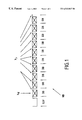
- FIG. 1 is a diagrammatic representation of the structure of a message block on the data bus according to the invention.
- FIG. 2 is a diagrammatic representation of the interruption of the transmission of a message block of lower priority by a message block of higher priority.
- FIG. 1 shows diagrammatically a message block NB as it could be transmitted via the data bus according to the invention.
- two states may exist on the bus.
- the dominant state d meaning a low level in the present embodiment.
- a recessive state r which signifies a high level on the bus in the present example.
- bit value 0 is assigned to the dominant state and the bit value 1 to the recessive state of the bus.
- a start block SOF is transmitted at the beginning of each message block NB. It is defined that n+k dominant bits are transmitted in each start block at the beginning. In the Figure this is represented by a corresponding low amplitude at the level d of the dominant bits. It is also defined that the n+k dominant bits in the start block are succeeded by j recessive bits. This can be recognized in FIG. 1 in that the data bus assumes the high level at the end of the start block SOF, so that at least one recessive bit is transmitted.
- a predetermined number of data blocks DB is transmitted within the message block; in the embodiment of FIG. 1 ten data blocks are concerned.
- each data block DB first n data bits are transmitted.
- the n data bits in each data block are succeeded by m recessive bits.
- these bits are indicated each time behind the data bits and are symbolized by the letters b r .
- each data block DB in the Figure can be either recessive or dominant, depending on the contents of the message to be transmitted.
- bit d denotes the transmission of a dominant bit
- r denotes the transmission of a recessive bit on the data bus.
- Bits d or r in heavy print belong either to a start block SOF or constitute a recessive bit of a data block DB.
- FIG. 2A shows first of all a possible transmission of a message block of lower priority on the data bus.
- the message block has a start block SOF at its beginning; first five dominant bits d and one subsequently transmitted recessive bit r appear in said start block.
- the start block SOF is followed by four data blocks DB in which each time first four data bits d or r are transmitted and subsequently each time one recessive bit r.
- the data blocks DB of the message of higher priority can subsequently be transmitted via the data bus as indicated in FIG. 2 C.
- FIG. 2F shows the result of the interruption of the message block of FIG. 2A by the message block of higher priority of FIG. 2 C.
- FIG. 2F first shows the start block SOF of the message of lower priority and subsequently a data block DB of the message block of lower priority in conformity with FIG. 2 A.
- the two dominant bits d, originally transmitted in the message of FIG. 2A, have now also been used for the start block SOF of the subsequently transmitted message of higher priority.
- the start block SOF the two bits of the second message block DB of the message of FIG. 2 A and the three bits actually transmitted by the sender in conformity with FIG. 2C have been combined so as to form a new start block SOF which contains five dominant bits d which are succeeded by a recessive bit r.
- the data blocks DB of the message of higher priority as shown in FIG. 2C appear on the data bus in conformity with FIG. 2 F.
- the message of higher priority of FIG. 2C has thus indeed been started immediately. It has even been possible to utilize dominant bits d of the message of FIG. 2A, transmitted already prior to the desired starting instant t 1 , for the start block of the message block of higher priority.
- An essential condition to be satisfied in order to achieve such fast transmission of the message block of higher priority according to FIG. 2C consists in that the sender of the message block of lower priority according to FIG. 2A interrupts the transmission of this message block immediately when the more urgent message of FIG. 2C is to be transmitted.
- the transmission can be interrupted when a start block of another apparatus appears on the bus.
- the transmission can also be interrupted already when a bit which was transmitted as a recessive bit r actually appears as a dominant bit on the data bus. This case was selected for the representation of FIG. 2 .
- FIG. 2D indicates that at the instant t 2 the sender of the message shown in FIG. 2A recognizes that the recessive bit r of the second data block of the message block on the data bus, transmitted directly before the instant t 2 , actually appears as a dominant bit as shown in FIG. 2 F. This is so because the sender of the message of higher priority as shown in FIG. 2C has generated the shortened start block with three dominant bits and hence the last bit before the instant t 2 appears as a dominant bit on the data bus.
- the sender of the message shown in FIG. 2A continuously monitors the bits on the data bus, at the instant t 2 the sender recognizes that the last bit transmitted as a recessive bit by this sender actually appears as a dominant bit on the data bus. Therefore, the sender interrupts the transmission of this message as shown in FIG. 2 E.
- the last bit transmitted by the sender as a recessive bit and actually appearing on the data bus as a dominant bit is the last transmitted bit, because it was detected at the instant t 2 and the transmission of the message was interrupted in conformity with FIG. 2 E.
- the last data block transmitted is a reduced data block DB v which will not be further transmitted thereafter.
- a message of lower priority on the data bus according to the invention can be interrupted at any instant by a message of higher priority, without additional transmission capacity being required and without the interruption being delayed by a coordination procedure.
Landscapes
- Engineering & Computer Science (AREA)
- Computer Networks & Wireless Communication (AREA)
- Signal Processing (AREA)
- Small-Scale Networks (AREA)
- Information Transfer Systems (AREA)
- Data Exchanges In Wide-Area Networks (AREA)
- Communication Control (AREA)
Applications Claiming Priority (2)
| Application Number | Priority Date | Filing Date | Title |
|---|---|---|---|
| DE19843810A DE19843810A1 (de) | 1998-09-24 | 1998-09-24 | Datenbus |
| DE19843810 | 1998-09-24 |
Publications (1)
| Publication Number | Publication Date |
|---|---|
| US6542947B1 true US6542947B1 (en) | 2003-04-01 |
Family
ID=7882092
Family Applications (1)
| Application Number | Title | Priority Date | Filing Date |
|---|---|---|---|
| US09/406,283 Expired - Fee Related US6542947B1 (en) | 1998-09-24 | 1999-09-24 | Data bus for serial data transmission |
Country Status (4)
| Country | Link |
|---|---|
| US (1) | US6542947B1 (fr) |
| EP (1) | EP0989701A3 (fr) |
| JP (1) | JP2000112882A (fr) |
| DE (1) | DE19843810A1 (fr) |
Cited By (12)
| Publication number | Priority date | Publication date | Assignee | Title |
|---|---|---|---|---|
| US20020146068A1 (en) * | 2001-04-09 | 2002-10-10 | Mitsubishi Denki Kabushiki Kaisha | Data transceiving method and data transceiving equipment |
| US6721918B2 (en) * | 2000-12-29 | 2004-04-13 | Intel Corporation | Method and apparatus for encoding a bus to minimize simultaneous switching outputs effect |
| US20040075538A1 (en) * | 2002-10-16 | 2004-04-22 | Omega Patents, L.L.C. | Vehicle data communications bus disrupter and associated methods |
| US6842808B2 (en) * | 2000-01-05 | 2005-01-11 | Robert Bosch Gmbh | Data exchange between users connected by a bus system and having separate time bases |
| US6851067B2 (en) * | 2000-02-22 | 2005-02-01 | Siemens Aktiengesellschaft | Current driven serial bus system having an energy saving mode |
| US20050129055A1 (en) * | 2003-11-19 | 2005-06-16 | Honeywell International, Inc. | Priority based arbitration for TDMA schedule enforcement in a multi-channel system |
| US7289438B2 (en) | 2000-06-21 | 2007-10-30 | Dr. Johannes Heidenhain Gmbh | Method and device for serial data transmission between a position measuring system and a processing unit |
| DE102008010385A1 (de) * | 2008-02-21 | 2009-09-03 | Ic-Haus Gmbh | Verfahren und Datenübertragungsanlage zur seriellen Datenübertragung zwischen einer Leiteinrichtung und wenigstens einer Teilnehmereinrichtung |
| US20120185627A1 (en) * | 2011-01-18 | 2012-07-19 | ASMedica Technology Inc. | Bus host controller and method thereof |
| US20130073757A1 (en) * | 2010-02-08 | 2013-03-21 | Rasmus Rettig | Novel circuit and method for communicating via a single line |
| WO2018113945A1 (fr) * | 2016-12-21 | 2018-06-28 | Vacon Oy | Communication série priorisée |
| WO2019112697A1 (fr) * | 2017-12-05 | 2019-06-13 | Qualcomm Incorporated | Transmissions décalées sur un bus semi-duplex multipoint |
Families Citing this family (2)
| Publication number | Priority date | Publication date | Assignee | Title |
|---|---|---|---|---|
| WO2001065479A2 (fr) * | 2000-03-03 | 2001-09-07 | Koninklijke Philips Electronics N.V. | Porteuse de donnees a systeme de synchronisation avec un flux de donnees reçu |
| JP4657179B2 (ja) * | 2006-09-05 | 2011-03-23 | ティーオーエー株式会社 | データ伝送方法 |
Citations (8)
| Publication number | Priority date | Publication date | Assignee | Title |
|---|---|---|---|---|
| US5323385A (en) * | 1993-01-27 | 1994-06-21 | Thermo King Corporation | Serial bus communication method in a refrigeration system |
| US5524213A (en) * | 1991-03-28 | 1996-06-04 | Robert Bosch Gmbh | Method of structuring messages for exchanging data and/or for synchronizing processes in a data processing system wherein at least two stations are connected to each other via a serial bus |
| US5600782A (en) * | 1993-08-24 | 1997-02-04 | National Semiconductor Corporation | Can interface with enhanced fault confinement |
| US5760489A (en) * | 1996-10-04 | 1998-06-02 | Motorola, Inc. | Method for transmitting signals between a microprocessor and an interface circuit |
| US5764919A (en) * | 1993-02-15 | 1998-06-09 | Honda Giken Kogyo Kabushiki Kaisha | Data transmission method and system therefor |
| US5928344A (en) * | 1996-06-13 | 1999-07-27 | Cerberus Ag | Serial data bus and use thereof |
| US6111888A (en) * | 1997-05-27 | 2000-08-29 | Micro Motion, Inc. | Deterministic serial bus communication system |
| US6385210B1 (en) * | 1998-04-17 | 2002-05-07 | Ford Global Technologies, Inc. | Method for detecting and resolving data corruption in a UART based communication network |
Family Cites Families (1)
| Publication number | Priority date | Publication date | Assignee | Title |
|---|---|---|---|---|
| DE3546683C3 (de) * | 1985-02-22 | 2003-10-09 | Bosch Gmbh Robert | Verfahren zum Betreiben einer Datenverarbeitungsanlage |
-
1998
- 1998-09-24 DE DE19843810A patent/DE19843810A1/de not_active Withdrawn
-
1999
- 1999-09-15 EP EP99203000A patent/EP0989701A3/fr not_active Withdrawn
- 1999-09-24 JP JP11269784A patent/JP2000112882A/ja active Pending
- 1999-09-24 US US09/406,283 patent/US6542947B1/en not_active Expired - Fee Related
Patent Citations (8)
| Publication number | Priority date | Publication date | Assignee | Title |
|---|---|---|---|---|
| US5524213A (en) * | 1991-03-28 | 1996-06-04 | Robert Bosch Gmbh | Method of structuring messages for exchanging data and/or for synchronizing processes in a data processing system wherein at least two stations are connected to each other via a serial bus |
| US5323385A (en) * | 1993-01-27 | 1994-06-21 | Thermo King Corporation | Serial bus communication method in a refrigeration system |
| US5764919A (en) * | 1993-02-15 | 1998-06-09 | Honda Giken Kogyo Kabushiki Kaisha | Data transmission method and system therefor |
| US5600782A (en) * | 1993-08-24 | 1997-02-04 | National Semiconductor Corporation | Can interface with enhanced fault confinement |
| US5928344A (en) * | 1996-06-13 | 1999-07-27 | Cerberus Ag | Serial data bus and use thereof |
| US5760489A (en) * | 1996-10-04 | 1998-06-02 | Motorola, Inc. | Method for transmitting signals between a microprocessor and an interface circuit |
| US6111888A (en) * | 1997-05-27 | 2000-08-29 | Micro Motion, Inc. | Deterministic serial bus communication system |
| US6385210B1 (en) * | 1998-04-17 | 2002-05-07 | Ford Global Technologies, Inc. | Method for detecting and resolving data corruption in a UART based communication network |
Cited By (22)
| Publication number | Priority date | Publication date | Assignee | Title |
|---|---|---|---|---|
| US6842808B2 (en) * | 2000-01-05 | 2005-01-11 | Robert Bosch Gmbh | Data exchange between users connected by a bus system and having separate time bases |
| US6851067B2 (en) * | 2000-02-22 | 2005-02-01 | Siemens Aktiengesellschaft | Current driven serial bus system having an energy saving mode |
| US7289438B2 (en) | 2000-06-21 | 2007-10-30 | Dr. Johannes Heidenhain Gmbh | Method and device for serial data transmission between a position measuring system and a processing unit |
| US6721918B2 (en) * | 2000-12-29 | 2004-04-13 | Intel Corporation | Method and apparatus for encoding a bus to minimize simultaneous switching outputs effect |
| US7733947B2 (en) * | 2001-04-09 | 2010-06-08 | Mitsubishi Denki Kabushiki Kaisha | Data transceiving method and data transceiving equipment |
| US20020146068A1 (en) * | 2001-04-09 | 2002-10-10 | Mitsubishi Denki Kabushiki Kaisha | Data transceiving method and data transceiving equipment |
| US20040075538A1 (en) * | 2002-10-16 | 2004-04-22 | Omega Patents, L.L.C. | Vehicle data communications bus disrupter and associated methods |
| US7061137B2 (en) * | 2002-10-16 | 2006-06-13 | Omega Patents, L.L.C. | Vehicle data communications bus disrupter and associated methods |
| US20050129055A1 (en) * | 2003-11-19 | 2005-06-16 | Honeywell International, Inc. | Priority based arbitration for TDMA schedule enforcement in a multi-channel system |
| WO2005053243A3 (fr) * | 2003-11-19 | 2005-08-04 | Honeywell Int Inc | Arbitrage base sur la priorite pour mise en application d'un programme amrt dans un systeme multicanaux |
| US7907628B2 (en) | 2003-11-19 | 2011-03-15 | Honeywell International Inc. | Priority based arbitration for TDMA schedule enforcement in a multi-channel system |
| DE102008010385B4 (de) * | 2008-02-21 | 2009-10-29 | Ic-Haus Gmbh | Verfahren und Datenübertragungsanlage zur seriellen Datenübertragung zwischen einer Leiteinrichtung und wenigstens einer Teilnehmereinrichtung |
| DE102008010385A1 (de) * | 2008-02-21 | 2009-09-03 | Ic-Haus Gmbh | Verfahren und Datenübertragungsanlage zur seriellen Datenübertragung zwischen einer Leiteinrichtung und wenigstens einer Teilnehmereinrichtung |
| US20130073757A1 (en) * | 2010-02-08 | 2013-03-21 | Rasmus Rettig | Novel circuit and method for communicating via a single line |
| US9170967B2 (en) * | 2010-02-08 | 2015-10-27 | Robert Bosch Gmbh | System and method for transmitting information from a transmitter to a receiver via a single line |
| US20120185627A1 (en) * | 2011-01-18 | 2012-07-19 | ASMedica Technology Inc. | Bus host controller and method thereof |
| US8732367B2 (en) * | 2011-01-18 | 2014-05-20 | Asmedia Technology Inc. | Bus host controller and method thereof |
| WO2018113945A1 (fr) * | 2016-12-21 | 2018-06-28 | Vacon Oy | Communication série priorisée |
| CN110036602A (zh) * | 2016-12-21 | 2019-07-19 | 伟肯有限公司 | 按优先级排序的串行通信 |
| US11552820B2 (en) * | 2016-12-21 | 2023-01-10 | Vacon Oy | Prioritized serial communication |
| WO2019112697A1 (fr) * | 2017-12-05 | 2019-06-13 | Qualcomm Incorporated | Transmissions décalées sur un bus semi-duplex multipoint |
| US10579549B2 (en) | 2017-12-05 | 2020-03-03 | Qualcomm Incorporated | Staggered transmissions on a multi-drop half-duplex bus |
Also Published As
| Publication number | Publication date |
|---|---|
| EP0989701A3 (fr) | 2004-01-02 |
| EP0989701A2 (fr) | 2000-03-29 |
| JP2000112882A (ja) | 2000-04-21 |
| DE19843810A1 (de) | 2000-03-30 |
Similar Documents
| Publication | Publication Date | Title |
|---|---|---|
| US4723239A (en) | Serial bus system and method for selection of bus subscribers | |
| Dijkstra et al. | Derivation of a termination detection algorithm for distributed computations | |
| US4663767A (en) | Optical data bus having a statistical access method | |
| JP2700843B2 (ja) | 多重通信制御装置 | |
| JP2000112882A (ja) | デ―タバス | |
| US4866706A (en) | Token-passing local area network with improved throughput | |
| EP0831621A2 (fr) | Dispositif de gestion de communication | |
| EP0174182B1 (fr) | Système de transmission d'informations dans un réseau local adapté pour la détection de collisions | |
| EP0893019B1 (fr) | Procede et circuit d'interface pour communication multiplexe | |
| JPH0556052A (ja) | 多重伝送方式の受信応答方法 | |
| GB2030825A (en) | Message broadcast system receiver arrangement | |
| EP0441041B1 (fr) | Méthode et appareil permettant la génération d'une séquence de test de 48 bits | |
| EP0595985A1 (fr) | Systeme "van" avec protocol d'acces aditionel pour conditions de coupure de ligne | |
| US6993082B2 (en) | Station and method for operating a CAN communication line | |
| EP0459325B1 (fr) | Système de communication multipoint | |
| EP0505306A2 (fr) | Circuit de commande pour interface semi-duplex/simplex dans un système de communication | |
| US5428617A (en) | Data transmission system for portable terminal device | |
| EP0479607B1 (fr) | Méthode et appareil de détection d'une séquence au bits de trame dans un système numérique de transmission de données | |
| KR920000388B1 (ko) | 송·수신 데이타 충돌 감지회로 | |
| GB2114403A (en) | Computer-telex interface | |
| JPS5826582B2 (ja) | 端末システムの障害通知方式 | |
| US4255813A (en) | Dicode transmission system | |
| EP0075423B1 (fr) | Système de contrôle de synchronisme de la courroie dans une imprimante par ligne | |
| JP2654610B2 (ja) | 並列伝送システム | |
| JPS6297448A (ja) | デ−タ伝送方式 |
Legal Events
| Date | Code | Title | Description |
|---|---|---|---|
| AS | Assignment |
Owner name: U.S. PHILIPS CORPORATION, NEW YORK Free format text: ASSIGNMENT OF ASSIGNORS INTEREST;ASSIGNOR:BUHRING, PETER;REEL/FRAME:010426/0604 Effective date: 19991014 |
|
| AS | Assignment |
Owner name: KONINKLIJKE PHILIPS ELECTRONICS N.V., NETHERLANDS Free format text: ASSIGNMENT OF ASSIGNORS INTEREST;ASSIGNOR:U.S. PHILIPS CORPORATION;REEL/FRAME:013739/0812 Effective date: 20021230 |
|
| REMI | Maintenance fee reminder mailed | ||
| LAPS | Lapse for failure to pay maintenance fees | ||
| STCH | Information on status: patent discontinuation |
Free format text: PATENT EXPIRED DUE TO NONPAYMENT OF MAINTENANCE FEES UNDER 37 CFR 1.362 |
|
| FP | Lapsed due to failure to pay maintenance fee |
Effective date: 20070401 |