US6553801B2 - Impact resistant lock apparatus with anti-theft lock core - Google Patents
Impact resistant lock apparatus with anti-theft lock core Download PDFInfo
- Publication number
- US6553801B2 US6553801B2 US09/915,146 US91514601A US6553801B2 US 6553801 B2 US6553801 B2 US 6553801B2 US 91514601 A US91514601 A US 91514601A US 6553801 B2 US6553801 B2 US 6553801B2
- Authority
- US
- United States
- Prior art keywords
- lock core
- shackle
- key
- locking
- engaging
- Prior art date
- Legal status (The legal status is an assumption and is not a legal conclusion. Google has not performed a legal analysis and makes no representation as to the accuracy of the status listed.)
- Expired - Fee Related
Links
Images




Classifications
-
- E—FIXED CONSTRUCTIONS
- E05—LOCKS; KEYS; WINDOW OR DOOR FITTINGS; SAFES
- E05B—LOCKS; ACCESSORIES THEREFOR; HANDCUFFS
- E05B67/00—Padlocks; Details thereof
- E05B67/06—Shackles; Arrangement of the shackle
- E05B67/22—Padlocks with sliding shackles, with or without rotary or pivotal movement
- E05B67/24—Padlocks with sliding shackles, with or without rotary or pivotal movement with built- in cylinder locks
-
- E—FIXED CONSTRUCTIONS
- E05—LOCKS; KEYS; WINDOW OR DOOR FITTINGS; SAFES
- E05B—LOCKS; ACCESSORIES THEREFOR; HANDCUFFS
- E05B21/00—Locks with lamelliform tumblers which are not set by the insertion of the key and in which the tumblers do not follow the movement of the bolt e.g. Chubb-locks
- E05B21/06—Cylinder locks, e.g. protector locks
- E05B21/066—Cylinder locks, e.g. protector locks of the rotary-disc tumbler type
-
- E—FIXED CONSTRUCTIONS
- E05—LOCKS; KEYS; WINDOW OR DOOR FITTINGS; SAFES
- E05B—LOCKS; ACCESSORIES THEREFOR; HANDCUFFS
- E05B29/00—Cylinder locks and other locks with plate tumblers which are set by pushing the key in
- E05B29/0013—Cylinder locks and other locks with plate tumblers which are set by pushing the key in with rotating plate tumblers
-
- E—FIXED CONSTRUCTIONS
- E05—LOCKS; KEYS; WINDOW OR DOOR FITTINGS; SAFES
- E05B—LOCKS; ACCESSORIES THEREFOR; HANDCUFFS
- E05B31/00—Cylinder locks with both tumbler pins or balls and plate tumblers
-
- E—FIXED CONSTRUCTIONS
- E05—LOCKS; KEYS; WINDOW OR DOOR FITTINGS; SAFES
- E05B—LOCKS; ACCESSORIES THEREFOR; HANDCUFFS
- E05B67/00—Padlocks; Details thereof
- E05B67/06—Shackles; Arrangement of the shackle
- E05B67/08—Padlocks with shackles hinged on the case
- E05B67/18—Padlocks with shackles hinged on the case with devices for securing both ends of the shackle
-
- E—FIXED CONSTRUCTIONS
- E05—LOCKS; KEYS; WINDOW OR DOOR FITTINGS; SAFES
- E05B—LOCKS; ACCESSORIES THEREFOR; HANDCUFFS
- E05B67/00—Padlocks; Details thereof
- E05B67/38—Auxiliary or protective devices
-
- Y—GENERAL TAGGING OF NEW TECHNOLOGICAL DEVELOPMENTS; GENERAL TAGGING OF CROSS-SECTIONAL TECHNOLOGIES SPANNING OVER SEVERAL SECTIONS OF THE IPC; TECHNICAL SUBJECTS COVERED BY FORMER USPC CROSS-REFERENCE ART COLLECTIONS [XRACs] AND DIGESTS
- Y10—TECHNICAL SUBJECTS COVERED BY FORMER USPC
- Y10T—TECHNICAL SUBJECTS COVERED BY FORMER US CLASSIFICATION
- Y10T70/00—Locks
- Y10T70/40—Portable
- Y10T70/413—Padlocks
- Y10T70/437—Key-controlled
- Y10T70/446—Rigid shackle
- Y10T70/452—Sliding
- Y10T70/459—Both legs engaged
-
- Y—GENERAL TAGGING OF NEW TECHNOLOGICAL DEVELOPMENTS; GENERAL TAGGING OF CROSS-SECTIONAL TECHNOLOGIES SPANNING OVER SEVERAL SECTIONS OF THE IPC; TECHNICAL SUBJECTS COVERED BY FORMER USPC CROSS-REFERENCE ART COLLECTIONS [XRACs] AND DIGESTS
- Y10—TECHNICAL SUBJECTS COVERED BY FORMER USPC
- Y10T—TECHNICAL SUBJECTS COVERED BY FORMER US CLASSIFICATION
- Y10T70/00—Locks
- Y10T70/40—Portable
- Y10T70/413—Padlocks
- Y10T70/437—Key-controlled
- Y10T70/446—Rigid shackle
- Y10T70/452—Sliding
- Y10T70/461—Short leg engaged
-
- Y—GENERAL TAGGING OF NEW TECHNOLOGICAL DEVELOPMENTS; GENERAL TAGGING OF CROSS-SECTIONAL TECHNOLOGIES SPANNING OVER SEVERAL SECTIONS OF THE IPC; TECHNICAL SUBJECTS COVERED BY FORMER USPC CROSS-REFERENCE ART COLLECTIONS [XRACs] AND DIGESTS
- Y10—TECHNICAL SUBJECTS COVERED BY FORMER USPC
- Y10T—TECHNICAL SUBJECTS COVERED BY FORMER US CLASSIFICATION
- Y10T70/00—Locks
- Y10T70/40—Portable
- Y10T70/413—Padlocks
- Y10T70/437—Key-controlled
- Y10T70/446—Rigid shackle
- Y10T70/452—Sliding
- Y10T70/463—Long leg engaged
-
- Y—GENERAL TAGGING OF NEW TECHNOLOGICAL DEVELOPMENTS; GENERAL TAGGING OF CROSS-SECTIONAL TECHNOLOGIES SPANNING OVER SEVERAL SECTIONS OF THE IPC; TECHNICAL SUBJECTS COVERED BY FORMER USPC CROSS-REFERENCE ART COLLECTIONS [XRACs] AND DIGESTS
- Y10—TECHNICAL SUBJECTS COVERED BY FORMER USPC
- Y10T—TECHNICAL SUBJECTS COVERED BY FORMER US CLASSIFICATION
- Y10T70/00—Locks
- Y10T70/70—Operating mechanism
- Y10T70/7441—Key
- Y10T70/7486—Single key
- Y10T70/7508—Tumbler type
- Y10T70/7559—Cylinder type
- Y10T70/7588—Rotary plug
- Y10T70/7627—Rotary or swinging tumblers
-
- Y—GENERAL TAGGING OF NEW TECHNOLOGICAL DEVELOPMENTS; GENERAL TAGGING OF CROSS-SECTIONAL TECHNOLOGIES SPANNING OVER SEVERAL SECTIONS OF THE IPC; TECHNICAL SUBJECTS COVERED BY FORMER USPC CROSS-REFERENCE ART COLLECTIONS [XRACs] AND DIGESTS
- Y10—TECHNICAL SUBJECTS COVERED BY FORMER USPC
- Y10T—TECHNICAL SUBJECTS COVERED BY FORMER US CLASSIFICATION
- Y10T70/00—Locks
- Y10T70/70—Operating mechanism
- Y10T70/7441—Key
- Y10T70/7486—Single key
- Y10T70/7508—Tumbler type
- Y10T70/7559—Cylinder type
- Y10T70/7588—Rotary plug
- Y10T70/7627—Rotary or swinging tumblers
- Y10T70/7633—Transverse of plug
Definitions
- the present invention relates to a lock apparatus, more particularly to a lock apparatus which has an enhanced resistance to external impact and which has a lock core device that provides an enhanced anti-theft effect.
- U.S. Pat. No. 5,934,121 discloses block apparatus having a lock core unit and a coded key for operating the lock core unit.
- the lock core unit includes a stack of locking plates, each of which confines a central hole in a shape of three quarters of a circle to permit extension of the coded key therethrough.
- the locking plates have an outer periphery formed with engaging notches.
- the coded key has a cross-section in the form of a circular sector, and is formed with a plurality of key bit projections and key bit grooves which have inclined actuating surfaces at different angles to set the code of the key.
- the engaging notches are misaligned with one another in accordance with the code of the key when the lock core unit is in a locking position, and are aligned with one another when the lock core unit is in an unlocking position.
- the locking plates rotate by different angles to align the engaging notches with one another to enable a locking rod of the lock core unit to extend into the aligned engaging notches and to disengage from a lock shell that houses the lock core unit so as to prevent the locking rod from hindering rotation of the lock core unit relative to a lock shell that houses the lock core unit.
- U.S. Pat. No. 5,931,030 discloses a padlock having a lock base, a lock core unit received in the lock base, and a U-shaped shackle with longer and shorter leg portions inserted removably into shackle insert holes in the lock base.
- a pair of catch members are disposed in a catch chamber within the lock base adjacent to the lock core unit.
- Each of the catch members has one end disposed adjacent to a plunger that is formed on a latch member of the lock core unit so as to be actuatable by the plunger, and an opposite end disposed adjacent to a respective one of the shackle insert holes for engaging a respective one of the longer and shorter legs of the shackle member. It is desirable to modify the connection between the catch members and the latch member to enhance the impact resistance of the catch members.
- the main object of the present invention is to provide a lock apparatus with an enhanced resistance to external impact and an enhanced anti-theft effect.
- the lock apparatus of the present invention includes a lock body, a lock core device, a coded key, a shackle member, and a catch member.
- the lock body is formed with a lock core chamber, a lock core opening for access to the lock core chamber, and a shackle insert hole.
- the lock core chamber has a section formed as a catch chamber which is adjacent to and is communicated with the shackle insert hole.
- the lock core device is received in the lock core chamber via the lock core opening.
- the lock core device includes a cylindrical and axially rotatable lock core which is provided with a latch member that is disposed in the catch chamber.
- the latch member has an end face which is transverse to an axis of the lock core and which is formed with a pin hole that is eccentric to the axis of the lock core.
- the key is insertible into the lock core device via the lock core opening, and is operable for rotating the lock core and the latch member between locking and unlocking positions.
- the shackle member has a leg portion which is formed with a shackle groove and which is inserted into the shackle insert hole in the lock body.
- the catch member is disposed in the catch chamber of the lock body.
- the catch member has a shackle engaging end portion for engaging the shackle groove in the leg portion of the shackle member, and a latch engaging end portion opposite to the shackle engaging end portion and formed with a pin which extends rotatably into the pin hole in the latch member for engaging the latch member such that the catch member is movable between locking and unlocking positions when the latch member moves between the locking and unlocking positions.
- the shackle engaging end portion of the catch member extends into the shackle insert hole for engaging the shackle groove in the leg portion of the shackle member when the catch member is disposed in the locking position.
- the shackle engaging end portion is retracted into the catch chamber for disengaging from the leg portion of the shackle member to permit removal of the shackle member from the shackle insert hole when the catch member is disposed in the unlocking position.
- FIG. 1 is an exploded perspective view showing a lock core device and a key of a lock apparatus of a first preferred embodiment of the present invention
- FIG. 2 is an exploded perspective view illustrating how the key engages a protective plate, a locking plate and a drive plate of the lock core device of the first preferred embodiment
- FIG. 3 is a cross-sectional view illustrating the engagement between the key and the locking plate
- FIG. 4 is a cross-sectional view illustrating the engagement between a distal end of the key and the drive plate
- FIG. 5 is a perspective view illustrating a lock core of a second preferred embodiment of the lock apparatus of the present invention.
- FIG. 6 is a perspective view illustrating a lock core of a third preferred embodiment of the lock apparatus of the present invention.
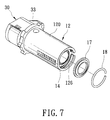
- FIG. 7 is a partly-exploded perspective view illustrating block core of a fourth preferred embodiment of the lock apparatus of the present invention.
- FIG. 8 is a fragmentary exploded perspective view illustrating a key and a lock core device of a fifth preferred embodiment of the lock apparatus of the present invention.
- FIGS. 9 and 10 are cross-sectional views of the fifth preferred embodiment, illustrating how the key is retained in the lock core device by a retaining plate;
- FIG. 11 is a perspective view illustrating the engagement between the key and the retaining plate in the fifth preferred embodiment
- FIG. 12 is an exploded perspective view illustrating a key and a lock core device of a sixth preferred embodiment of the lock apparatus of the present invention.
- FIG. 13 is a cross-sectional view illustrating the lock core device of the sixth preferred embodiment prior to insertion of the key into the lock core device;
- FIG. 14 is a cross-sectional view of the lock core device of the sixth preferred embodiment, where the key is inserted into the lock core device and engages a third tumbler member;
- FIG. 15 is a cross-sectional view of the lock core device of the sixth preferred embodiment when the key is rotated in the lock core device, where the key is rotated and the third tumbler member is disengaged from the key;
- FIG. 16 is a cross-sectional view of the lock core device of the sixth preferred embodiment, where the key continues to rotate independently of a corresponding locking plate;
- FIG. 17 is a cross-sectional view of the lock core device of the sixth preferred embodiment, where the key is rotated to unlock the lock core device;
- FIG. 18 is a schematic plan view of a lock core device of a seventh preferred embodiment of the lock apparatus of the present invention.
- FIG. 19 is a cross-sectional view of the lock core device of the seventh preferred embodiment.
- FIG. 20 is an exploded perspective view of a key and a lock core device of an eighth preferred embodiment of the lock apparatus of the present invention.
- FIG. 21 is a cross-sectional view of a lock core device of a ninth preferred embodiment of the lock apparatus of the present invention.
- FIG. 22 is an exploded perspective view showing a latch member and a catch member of a tenth preferred embodiment of the lock apparatus of the present invention.
- FIG. 23 is an exploded perspective view of the tenth preferred embodiment
- FIG. 24A is a sectional view of the lock apparatus of FIG. 23 in a locking state
- FIG. 24B is a cross-sectional view of the lock apparatus of FIG. 23 in the locking state
- FIG. 25A is a sectional view of the lock apparatus of FIG. 23 in an unlocking state
- FIG. 25B is a cross-sectional view of the lock apparatus of FIG. 23 in the unlocking state
- FIG. 26A is a sectional view of a eleventh preferred embodiment of a lock apparatus of the present invention in a locking state
- FIG. 26B is a cross-sectional view of the eleventh preferred embodiment in the locking state
- FIG. 27A is a sectional view of a twelfth preferred embodiment of the lock apparatus of the present invention in a locking state
- FIG. 27B is a cross-sectional view of the twelfth preferred embodiment in the locking state
- FIG. 28A is a sectional view of a padlock incorporating a lock core device of the twelfth preferred embodiment
- FIG. 28B is a cross-sectional view of the padlock of FIG. 28A;
- FIG. 29 is a fragmentary, partly sectioned, exploded perspective view showing a thirteen preferred embodiment of the lock apparatus of the present invention.
- FIG. 30 is an exploded perspective view illustrating a catch member and a latch member of a fourteenth preferred embodiment of the lock apparatus of the present invention.
- FIG. 31A is a sectional view of the lock apparatus of the fourteenth preferred embodiment in an unlocking state
- FIG. 31B is a cross-sectional view of the lock apparatus of the fourteenth preferred embodiment in the unlocking state
- FIG. 32A is a sectional view of the lock apparatus of the fourteenth preferred embodiment in a locking state
- FIG. 32B is a cross-sectional view of the lock apparatus of the fourteenth preferred embodiment in the locking state
- FIG. 33 is an exploded perspective view illustrating a catch member and a latch member of a fifteenth preferred embodiment of the lock apparatus of the present invention.
- FIG. 34 is a top view of the latch member of FIG. 33;
- FIG. 35 is a fragmentary sectional view of the latch member and the catch member of FIG. 33, illustrating engagement between a pin on the latch member and a stepped straight hole section of a pin hole in the latch member;
- FIG. 36A is a sectional view of the lock apparatus of the fifteenth preferred embodiment in a locking state
- FIG. 36B is a cross-sectional view of the lock apparatus of the fifteenth preferred embodiment in the locking state
- FIG. 37 is a cross-sectional view of the fifteenth preferred embodiment, where leg portions of a shackle member are inserted into a pair of shackle insert holes in a lock body of the lock apparatus;
- FIG. 38 is a schematic view illustrating the engagement between a latch member and a catch member of a sixteenth preferred embodiment of the lock apparatus of the present invention.
- FIG. 39 is an exploded perspective view illustrating a latch member and a catch member of a seventeenth preferred embodiment of the lock apparatus of the present invention.
- FIG. 40 is a schematic view illustrating relative positions of the latch member and a pair of the catch members of the lock apparatus of the seventeenth preferred embodiment in a locking state
- FIG. 41 is a schematic view illustrating relative positions of the latch member and the catch members of the lock apparatus of the seventeenth preferred embodiment in an unlocking state
- FIG. 42 is a sectional view of the lock apparatus of the seventeenth preferred embodiment in the locking state
- FIG. 43 is a fragmentary sectional view of an eighteenth preferred embodiment of the lock apparatus of the present invention, where a cover unit is shown to be in a closed position;
- FIG. 44 is a fragmentary sectional view of the lock apparatus of the eighteenth preferred embodiment, where the cover unit is shown to be in an open position.
- a lock core device 10 is shown to include a lock casing 11 with an inner surface that confines a cylindrical chamber 110 for receiving an axially rotatable lock core 12 .
- the lock core 12 includes a cylindrical inner shell 120 , a stack of annular locking plates 13 , 13 ′, 13 a received in the inner shell 120 , a plurality of annular spacer plates 14 disposed among the locking plates 13 , 13 ′, 13 a , a locking rod 124 received in an axially extending slot 125 formed in the inner shell 120 , an annular drive plate 15 received in the inner shell 120 at a rear end of the inner shell 120 , and a latch member 30 ′ connected to the rear end of the inner shell 120 .
- Each of the locking plates 13 , 13 ′, 13 a has an inner periphery formed with a radial inward key engaging protrusion 134 so as to define a central hole 131 that has an arc length equal to three quarters of a circle.
- Each of the locking plates 13 , 13 ′, 13 a further has an outer periphery formed with at least one engaging notch 132 .
- the central holes 131 of the locking plates 13 , 13 ′, 13 a cooperatively confine a keyhole aligned with a key access hole 112 formed in a front end of the lock casing 11 .
- the drive plate 15 has an inner periphery which confines a key engaging hole 151 and which is formed with a key actuatable projection 153 that projects radially and inwardly.
- the drive plate 15 has a drive projection 154 which extends axially and rearwardly toward the latch member 30 ′.
- the latch member 30 ′ has an actuatable section 31 ′ which is driven by the drive projection 154 such that rotation of the drive plate 15 can result in corresponding rotation of the latch member 30 ′ between locking and unlocking positions.
- a coded key 20 is insertible into the key access hole 112 and into the keyhole defined by the central holes 131 of the locking plates 13 , 13 ′, 13 a .
- the key 20 has a handle portion 22 and a shank portion 21 extending from the handle portion 22 .
- the shank portion 21 has a cross-section formed as a circular sector, a flat first radial surface 211 extending along the length of the shank portion 21 , a second radial surface 212 constituted by a plurality of key bit portions 24 , 24 a which are arranged along the length of the shank portion 21 and which have radial key bit surfaces that form different angles with the flat first radial surface 211 to set a code of the key 20 , and a curved surface 213 that extends along the length of the shank portion 21 and that extends circumferentially between the first and second radial surfaces 211 , 212 .
- the shank portion 21 further has a distal end formed as an actuating tip portion 23 that is extendible into the key engaging hole 151 in the drive plate 15 for engaging the key actuatable projection 153 so as to enable co-rotation of the drive plate 15 with the key 20 .
- the angles of the actuating surfaces on the key bit portions 24 , 24 a relative to the first radial surface 211 can be varied in a range from 0 to 180 degrees. As such, a relatively large number of codes can be selected for the key 20 .
- the inner periphery of one of the locking plates 13 ′ is further formed with a radial inward engaging protrusion 133 .
- the shank portion 21 of the key 20 is formed with an axially extending engaging groove 25 on the curved surface 213 .
- the engaging groove 25 extends along the length of the shank portion 21 for engaging the engaging protrusion 133 .
- the engaging protrusion 133 may be formed on the shank portion 21 of the key 20
- the engaging groove 25 may be formed on one of the locking plates.
- the shape of the engaging protrusion 133 is not limited to that shown in FIGS. 2 and 3.
- the angular position of the engaging groove 25 on the curved surface 213 can be varied. An improved anti-theft effect is thus achieved.
- the inner periphery of the drive plate 15 is further formed with a radial inward engaging protrusion 152 .
- the actuating tip portion 23 of the key 20 is formed with an engaging groove 231 for engaging the engaging protrusion 152 .
- the position of the engaging protrusion 152 on the inner periphery of the locking plate 15 can be varied to further improve the anti-theft effect of the lock core device 10 .
- an annular protective plate 16 is received rotatably in the cylindrical chamber 110 of the lock casing 11 between the key access hole 112 and a front end of the inner shell 120 .
- the protective plate 16 has an inner periphery that confines a key passage hole 161 with a shape of three quarters of a circle to permit extension of the shank portion 21 of the key 20 therethrough. Before the key 20 is inserted into the key access hole 112 , the protective plate 16 is fully rotatable within the cylindrical chamber 110 .
- the protective plate 16 When a drill extends into the key access hole 112 and works on the protective plate 16 for the purpose of damaging the lock core device 10 , the protective plate 16 will rotate idly relative to the lock casing 11 , thereby preventing the drill from reaching the interior of the lock core device 10 .
- the protective plate 16 is preferably made from a high strength metal alloy.
- the inner periphery of the protective plate 16 is formed with a radial inward engaging protrusion 162 for engaging the engaging groove 25 on the curved surface 213 of the shank portion 21 of the key 20 , thereby providing the lock core device 10 with an improved anti-theft effect.
- one of the locking plates 13 a that is disposed at a selected position within the inner shell 120 is increased in thickness relative to the remaining ones of the locking plates 13 , 13 ′. Accordingly, a selected one of the key bit portions 24 a that is corresponding to the thicker locking plate 13 a is increased in width measured in a longitudinal direction of the shank portion 21 .
- an annular positioning plate 17 is secured to the front end of the inner shell 120 to reduce spaces formed among the locking plates 13 , 13 ′, 13 a and the spacer plates 14 .
- the positioning plate 17 may be welded to the inner shell 120 at three points 121 on its outer periphery, as shown in FIG. 5 .
- the front end of the inner shell 120 may be formed with three angularly displaced stop members 122 which are bent to extend radially and inwardly for retaining the positioning plate 17 within the inner shell 120 at the front end of the inner shell 120 , as shown in FIG. 6 .
- FIG. 6 Alternatively, with reference to FIG.
- the inner shell 12 is formed with an annular groove 126 on its inner surface at the front end.
- the positioning plate 17 is first received in the inner shell 120 adjacent to the annular groove 126 .
- a C-shaped resilient ring 18 is disposed in the annular groove 126 anteriorly of and adjacent to the positioning plate 17 .
- the resilient ring 18 normally expands to engage the inner shell 120 for retaining the positioning plate 17 in the inner shell 120 at the front end of the latter.
- a limiting groove 123 is formed on an inner surface of the inner shell 120 a of the lock core device to limit rotation of the locking plates 13 b within the inner shell 12 a so as to facilitate operation of the key 20 b .
- the limiting groove 123 extends longitudinally along the length of the inner shell 120 a , and extends circumferentially on the inner surface along a curved line.
- the curved line can be designed to have an arc length of 180 degrees, greater than 180 degrees or smaller than 180 degrees.
- the outer periphery of at least one of the locking plates 13 b is formed with a radial limiting projection 134 b which projects into the limiting groove 123 to limit rotation of the locking plate 13 b within an angle defined by the arc length of the limiting groove 123 during operation of the key 20 b .
- the locking plates 13 b are rotatable within a small angular range, and are thus actuatable by the key 20 within a short amount of time for unlocking the lock core device.
- the arc length of the limiting groove 123 is long, the locking plates 13 b are rotatable within a large angular range. A longer amount of time would be required for actuating the locking plates 13 b by operating the key 20 b to unlock the lock core device.
- annular retaining plate 14 a is received in the inner shell 120 a proximate to the front end of the inner shell 120 a , and is disposed between the positioning plate 17 and one of the locking plates 13 b that is disposed proximate to the front end of the inner shell 120 a .
- the retaining plate 14 a has an outer periphery formed with a fan-shaped retaining projection 143 a that extends fittingly into the limiting groove 123 in the inner shell 120 a .
- the retaining plate 14 a further has an inner periphery formed with a radial inward blocking protrusion 142 a and defining a key passage hole 141 a in the shape of three quarters of a circle.
- the shank portion 21 b of the key 20 b has a retainer section 24 b which is formed between the key bit portions 24 and the handle portion 22 b of the key 20 b and is disposed immediately adjacent to the key bit portions 24 .
- the retainer section 24 b has a semi-circular cross-section. As shown in FIG. 9, the retainer section 24 b extends into the key passage hole 141 a of the retaining plate 14 a when the key 20 b is inserted into the keyhole.
- the key bit portions 24 are blocked by the blocking protrusion 142 a on the retaining plate 14 a when the key 20 b is rotated in the keyhole, as best illustrated in FIGS. 10 and 11. In this manner, untimely removal of the key 20 b from the lock core device can be prevented during operation of the key so as to facilitate operation of the key 20 b within the keyhole.
- a plurality of spring-loaded tumbler units 19 are installed in the lock core device 10 a .
- the lock casing 11 a of the lock core device 10 a is formed with a plurality of radial first tumbler holes 113 a .
- the inner shell 120 b is formed with a plurality of radial second tumbler holes 127 b .
- Each of the locking plates 13 c is formed with a radial third tumbler hole 133 c that extends through inner and outer peripheries thereof.
- Each of the tumbler units 19 includes a first compression spring 194 and a first tumbler member 191 which are received in a respective one of the first tumbler holes 113 a in the lock casing 11 a , a second tumbler member 192 received in a respective one of the second tumbler holes 127 b in the inner shell 120 b , and a third tumbler member 193 and a second compression spring 196 which are received in the third tumbler hole 133 c in a respective one of the locking plates 13 c .
- the first tumbler holes 113 a are aligned respectively with the second tumbler holes 127 b and with the third tumbler holes 133 c in radial directions.
- the first compression spring 194 biases the first, second and third tumbler members 191 , 192 , 193 to move radially and inwardly so as to enable the first tumbler member 191 to project into a respective one of the second tumbler holes 127 b in the inner shell 120 b , to enable the second tumbler member 192 to project into the third tumbler hole 133 c in a respective one of the locking plates 13 c , and to enable the third tumbler member 193 to project radially from the inner periphery of the respective locking plate 13 c .
- the third tumbler hole 133 c in each of the locking plates 13 c is provided with a mounting sleeve 195 within which the second compression spring 196 is installed.
- the second compression spring 196 biases the third tumbler member 193 in a radial outward direction toward the inner surface of the inner shell 120 b .
- the curved surface 213 ′ on the shank portion of the key 20 ′ is formed with a plurality of tumbler recesses 26 , each of which is defined by a recessed tumbler push wall. As shown in FIG.
- the engaging notches 132 on the locking plates 13 c are misaligned with one another, and the locking rod 124 is forced by the outer peripheries of the locking plates 13 c to extend into an axially extending locking groove 115 formed on the inner surface of the lock casing 11 a in order to hinder rotation of the inner shell 120 b relative to the lock casing 11 a .
- the third tumbler member 193 of each of the tumbler units 19 projects into a respective one of the tumbler recesses 26 on the shank portion of the key 20 ′.
- Each of the tumbler recesses 26 has a predetermined depth such that the third tumbler member 193 of each of the tumbler units 19 is pushed by the tumbler push wall of the respective tumbler recess 26 in a radial outward direction against biasing action of the first compression spring 194 so as to retract the second tumbler member 192 into the second tumbler hole 127 b in the inner shell 120 b and to retract the first tumbler member 191 into the first tumbler hole 113 a .
- engagement of the third tumbler member 193 with the respective tumbler recess 26 enables co-rotation of the respective locking plate 13 c with the key 20 ′.
- the locking plate 13 c rotates with the key 20 ′ by a certain angular range when the key 20 ′ is rotated, such as in a clockwise direction shown in FIG. 15 .
- the third tumbler member 193 then extends into the limiting groove 123 formed on the inner surface of the inner shell 120 b , and is disengaged from the corresponding tumbler recess 26 and from the key 20 ′ due to biasing action of the second compression spring 196 .
- the key 20 ′ continues to rotate relative to the locking plate 13 c until the actuating surface of the key bit portion 24 that corresponds to the respective locking plate 13 c is in contact with the key engaging protrusion 134 c on the respective locking plate 13 c , as shown in FIG. 16 .
- Co-rotation of the key 12 ′ and the respective locking plate 13 c occurs once again at this moment due to the engagement between the key engaging protrusion 134 c and the actuating surface of the corresponding key bit portion 24 on the key 20 ′.
- the locking rod 124 is extendible into the aligned engaging notches 132 and is disengaged from the locking groove 115 , thereby permitting rotation of the inner shell 120 b relative to the lock casing 11 ′, as shown in FIG. 17 .
- a plurality of pairs of tumbler units 19 are installed in the lock core device 10 d , in which each locking plate 13 d has a thickness sufficient to form two tumbler holes 133 d which are angularly and axially displaced from each other for receiving a respective pair of the tumbler units 19 .
- each locking plate 13 d has a thickness sufficient to form two tumbler holes 133 d which are angularly and axially displaced from each other for receiving a respective pair of the tumbler units 19 .
- a plurality of tumbler units 19 are installed in a lock core device and are displaced angularly by predetermined angles. Examples of the lock core device of this type are shown in FIGS. 20 and 21.
- the key 20 shown in FIGS. 1 and 2 is formed with key bit portions 24 , 24 a and an axially extending groove 25 , and thus works to operate the lock core device 10 , which is installed with the locking plates 13 , 13 ′, 13 a , the drive plate 15 , and the protective plate 16 that are each formed with the radial inward protrusion 133 , 152 , 162 .
- the key 20 ′ shown in FIG. 12 is formed with tumbler recesses 26 on its curved surface 213 ′, and thus works to operate the lock core device 10 a that is installed with the tumbler units 19 .
- a key of the type that is formed with the key bit portions 24 , 24 a , the engaging groove 25 , and the tumbler recesses 26 work for operating any of the lock core devices described above.
- the latch member mounted on the rear end of the inner shell of the lock core may be one formed integrally with a plunger, such as the latch member 30 ′ shown in FIG. 1 and the latch member 30 a shown in FIG. 30, or one mounted resiliently with a plunger, such as the latch member 30 shown in FIG. 22 .
- the latch member 30 is provided on a lock core device 10 ′ and includes a latch base 301 which is formed with a cavity 31 .
- a plunger 33 is installed in the cavity 31 in the latch base 301 .
- a cover plate 34 is mounted on the latch base 301 for closing one end of the cavity 31 .
- a compression spring 32 is disposed in the cavity 31 between the plunger 33 and the cover plate 34 for biasing the plunger 33 to extend out of the cavity 31 via an open end of the cavity 31 that opens in a direction transverse to the axis of the lock core device 10 ′.
- the latch member 30 has a distal end face 302 which is transverse to the axis of the lock core device 10 ′ and which is formed with a pair of circular pin holes 35 that have axes eccentric to the axis of the lock core device 10 ′ and that are symmetric to each other with respect to the axis of the lock core device 10 ′.
- a catch member 60 has a latch engaging end portion 63 formed with a pin 64 that extends rotatably into and that engages one of the pin holes 35 in the latch member 30 , and a shackle engaging end portion 61 opposite to the latch engaing end portion 63 .
- the catch member 60 has a pair of side walls, each of which has a sliding block 62 projecting therefrom. The sliding block 62 extends in a direction from the shackle engaging end portion 61 toward the latch engaging end portion 63 .
- the lock apparatus of the present embodiment is in the form of a padlock which includes a lock body 40 formed with a lock core chamber 401 that extends from a bottom end of the lock body 40 toward a top end of the same for receiving a lock core device 10 ′, and first and second shackle insert holes 404 , 405 which extend from the top end toward the bottom end of the lock body 40 .
- the lock core chamber 401 has an upper section formed as a catch chamber 403 which extends between and which is communicated with the first and second shackle insert holes 404 , 405 for accommodating the latch member 30 and the catch member 60 .
- a rectangular lock core opening 402 is formed in a bottom wall of the lock body 40 for access to the lock core chamber 401 .
- a shackle member 50 with an inverted U-shaped configuration has longer and shorter leg portions 51 , 52 extending respectively into the first and second shackle insert holes 404 , 405 .
- Each of the longer and shorter leg portions 51 , 52 is formed with a shackle groove 53 .
- the longer leg portion 51 is further formed with a longitudinally extending retaining groove 54 and an annular groove 55 adjacent to a distal end of the longer leg portion 51 and communicated with the retaining groove 54 .
- the retaining groove 54 does not extend to the shackle groove 53 on the longer leg portion 51 such that the shackle member 50 has an increased strength to resist an external pulling force.
- the lock body 40 is installed with an L-shaped retaining member 41 which has one end extending into the retaining groove 54 .
- a compression spring 42 is disposed deep within a bottom end of the second shackle insert hole 405 for biasing the shorter leg portion 52 upwardly.
- the shackle engaging end portion 61 of the catch member 60 extends into the first shackle insert hole 404 for engaging the shackle groove 53 on the longer leg portion 51
- the plunger 33 extends into the second shackle insert hole 405 for engaging the shackle groove 53 on the shorter leg portion 52 .
- the plunger 33 turns with the latch member 30 to retract into the catch chamber 403
- the latch member 30 pulls the catch member 60 so as to retract the shackle engaging end portion 61 of the catch member 60 into the catch chamber 403 .
- the shackle member 50 is thus disengaged from the catch member 60 and the plunger 33 , and springs upwardly due to biasing action of the compression spring 42 , thereby permitting removal of the shorter leg portion 52 from the second shackle insert hole 405 .
- the retaining member 41 extends into the annular groove 55 to prevent removal of the longer leg portion 51 from the lock body 40 .
- the engagement between the pin 64 on the catch member 60 and the pin hole 35 in the latch member 30 provides the catch member 60 and the padlock with an increased impact strength such that the catch member 60 is not susceptible to undesired displacement within the lock body 40 and undesired disengagement from the latch member 30 when the padlock is subjected to strong impact.
- the lock body 40 is mounted fixedly with a nut 43 which is disposed within the lock body 40 between the lock core chamber 401 and the first shackle insert hole 404 .
- a threaded rod 44 extends threadedly through the nut 43 and has one end abutting tightly against an outer surface of the lock core device 10 ′ for retaining the lock core device 10 ′ in the lock core chamber 401 .
- the lock body 40 has a lateral side wall adjacent to the first shackle insert hole 404 and formed with an aperture 406 that is communicated with the first shackle insert hole 404 and that is aligned with the threaded rod 44 .
- the aperture 406 is blocked by the longer leg portion 51 to prevent access to the threaded rod 44 .
- the threaded rod 44 is accessible by a tool (not shown) extending into the aperture 406 and is operable by the tool for disengaging from the lock core device 10 ′ so as to permit removal of the lock core device 10 ′ from the lock body 40 for replacement of the lock core device 10 ′.
- the catch chamber 403 is formed in the lock body 40 between confronting front and rear walls, each of which is formed with a slide groove 408 for receiving a respective one of the sliding blocks 62 on the catch member 60 .
- the sliding blocks 62 are slidable along the slide grooves 408 when the catch member 60 is pushed by the latch member 30 to move to the locking position shown in FIGS. 24A and 24B, and when the catch member 60 is pulled by the latch member 30 to move to the unlocking position shown in FIGS. 25A and 25B.
- the provision of the slide grooves 408 in the lock body 40 and the sliding blocks 62 on the catch member 60 further enhances impact resistance of the padlock, and increases strength of the padlock to resist external pulling forces applied in opposite directions to the shackle member 50 and the lock body 40 , respectively.
- the plunger 33 engages resiliently an inner side wall 403 a in a catch chamber of a lock body 40 a to prevent removal of the lock core device 10 ′ from the lock body 40 a .
- An aperture 407 a is formed in a lateral side wall of the lock body 40 a and is communicated with the second shackle insert hole 405 a .
- the lock core device 10 ′ is first operated to unlock the padlock so as to permit removal of the shorter leg portion 52 from the second shackle insert hole 405 a .
- a tool (not shown) is extended into the aperture 407 a to depress the plunger 33 for retracting the plunger 33 into the cavity 31 (see FIG. 22) in the latch base 301 of the latch member 30 .
- the latch member 30 is thus disengaged from the inner side wall 403 a of the lock body 40 a to permit removal of the lock core device 10 ′ from the lock body 40 a via the lock core opening 402 .
- yet another preferred embodiment of the lock apparatus of the present invention is shown to be in the form of a padlock with a U-shaped lock body 600 that has a lock core mounting portion and parallel first and second shackle mounting portions 610 , 610 ′ which extend upwardly from the lock core mounting portion 612 and which are spaced-apart from each other.
- the lock core device 10 ′ is received in a lock core chamber formed in the lock core mounting portion 612 .
- a catch member 630 has a pin 631 engaging one of the pin holes 35 in the latch member 30 .
- the catch member 630 and the latch member 30 are disposed in a catch chamber 613 that extends from one end of the lock core chamber into the first shackle mounting portion 610 and that is communicated with a shackle insert hole 614 formed through the first shackle mounting portion 610 .
- a shackle bar 620 extends transversely between shackle insert holes 614 , 614 ′ formed in the first and second shackle mounting portions 610 , 610 ′, and has a shackle groove 622 that engages the shackle engaging end portion of the catch member 630 .
- the catch member 630 is pulled by the latch member 30 to retract into the catch chamber 613 for disengaging from the shackle groove 622 in the shackle bar 620 .
- the shackle bar 620 springs leftwardly due to biasing action of a compression spring 616 installed in the shackle insert hole 614 ′ in the second shackle mounting portion 610 ′, and is removed from the second shackle mounting portion 610 ′.
- the shackle bar 620 is provided with a spring-loaded stop member 621 which engages a retaining groove 615 formed in the first shackle mounting portion 610 to prevent removal of the shackle bar 620 from the lock body 600 when the padlock is unlocked.
- the lock core device 10 in the lock apparatus of the present invention is also useful in a conventional lock apparatus which does not includes a catch member, such as a padlock 100 shown in FIGS. 28A and 28B.
- the plunger 33 projects resiliently from the latch member 30 in a direction transverse to the axis of the lock core device 10 ′.
- the plunger 33 extends through a plunger passage 101 between a lock core chamber and a shackle insert hole 102 of a lock body of the padlock 100 , and projects into the shackle insert hole 102 for engaging the shorter leg portion 130 of a shackle member.
- the plunger 33 turns with the latch member 30 and moves into the lock core chamber to disengage from the shorter leg portion 130 , thereby unlocking the padlock 100 .
- the lock body 40 b is provided with a protective sleeve 70 which is disposed fittingly in the catch chamber 403 b .
- the protective sleeve 70 has an inner surface that defines a cavity 71 with opposite open ends for receiving a catch member 60 a , and that is formed with a pair of confronting slide grooves 712 which extend between the opposite open ends of the cavity 71 .
- the sliding blocks 62 a on the catch member 60 a extend respectively into the slide grooves 712 and are slidable along the slide grooves 712 .
- the protective sleeve 70 is preferably formed from a high strength metal alloy to protect the catch member 60 a from being damaged by a drilling action.
- a latch member 30 a is shown to be formed integrally with a plunger 33 a , and has a distal end face 302 a formed with a pin hole 35 a which is in the form of a curved slot extending along a curved line on the end face 302 a and which has opposite first and second ends 354 a , 355 a .
- the latch member 30 a has a curved pushing surface 36 a which is adjacent and transverse to the end face 302 a of the latch member 30 a .
- a catch member 60 a has a latch engaging end portion 63 a which is formed with a pin 64 a that extends into the pin hole 35 a in the latch member 30 a , a shackle engaging end portion 61 a opposite to the latch engaging end portion 63 a , and two opposite side walls formed with sliding blocks 62 a that extend in a direction from the shackle engaging end portion 61 a toward the latch engaging end portion 63 a .
- the catch member 60 a is formed with an abutment wall 65 a to contact the pushing surface 36 a of the latch member 30 a so as to be actuated thereby.
- the lock apparatus of the present invention is formed as a padlock with a lock body formed with a lock core chamber that has the lock core device 10 b received therein.
- the latch member 30 a and the catch member 60 a are received in a catch chamber that is communicated with first and second shackle insert holes of the lock body.
- the plunger 33 a turns with the latch member 30 a and retracts into the catch chamber for disengaging from the shorter leg portion 52 a of a shackle member 50 a , and the latch member 30 a pulls the catch member 60 a so as to retract the catch member 60 a into the catch chamber for disengaging from the longer leg portion 51 a of the shackle member 50 a .
- the pin 64 a of the catch member 60 a is disposed at the first end 354 a of the pin hole 35 a .
- the plunger 33 a turns with the latch member 30 a and extends into the second shackle insert hole for engaging the shackle groove 53 a in the shorter leg portion 52 a of the shackle member 50 a .
- the curved pushing surface 36 a of the latch member 30 a pushes the abutment wall 65 a of the catch member 60 a and forces the catch member 60 a to move apart from the latch member 30 a , thereby enabling the shackle engaging end portion 61 a of the catch member 60 a to extend into the first shackle insert hole to engage the shackle groove 53 a in the longer leg portion 51 a of the shackle member 50 a , and thereby moving the pin 64 a to the second end 355 a of the pin hole 35 a.
- a latch member 30 b is formed with a pair of pin holes 35 b on its distal end face 300 .
- Each of the pin holes 35 b includes a curved hole section 351 that extends along a curved line on the end face 300 and that has opposite first and second ends 354 , 355 , and a straight hole section 352 that extends along a straight line on the end face 300 and that extends transversely from the second end 355 of the curved hole section 351 .
- the straight hole section 352 is defined by a stepped hole defining wall and is formed to include a wider hole portion 352 a proximate to the end face 300 , and a narrower hole portion 352 b adjacent to the wider hole portion 352 a . Both the wider and narrower hole portions 352 a , 352 b extend along the length of the straight hole section 352 and are communicated with the second end 355 of the curved hole section 351 .
- the latch member 30 b engages a pair of catch members 60 b (only one is shown in FIG.
- the pin 64 b has adjacent wider and narrower sections 641 b , 642 b which are extendible respectively into the wider and narrower hole portions 352 a , 352 b of the straight hole section 352 of a respective one of the pin holes 35 b when the pin 64 b extends into the straight hole section 352 .
- the lock apparatus in the present embodiment is in the form of a padlock which includes a lock body 800 , a lock core device 10 e received in a lock core chamber 801 of the lock body 800 , and a U-shaped shackle member 810 mounted in a pair of shackle insert holes 820 of the lock body 800 .
- the lock core device 10 e is mounted with the latch member 30 b of FIG. 33 .
- the latch member 30 b and the catch members 60 b are disposed in a catch chamber 802 formed between the shackle insert holes 820 of the lock body 800 .
- the compression spring 67 b has one end abutting against an outer surface of the lock core device 10 e , and another end abutting against the spring abutment stud 66 b on a respective one of the catch members 60 b for biasing the catch member 60 b in a direction away from the latch member 30 b .
- 36A and 36B show the padlock in a locking state, in which the shackle engaging end portion 61 b of each of the catch members 60 b extends into a respective one of the shackle insert holes 820 to engage a respective leg portion of the shackle member 810 , and in which the pin 64 b of each of the catch members 60 b is disposed in the second end 355 of the curved hole section 351 of a respective one of the pin holes 35 b immediately adjacent to the straight hole section 352 .
- the shackle engaging end portion 61 b of each of the catch members 60 b has a tapered guiding wall 68 b confronting an opening in a respective one of the shackle insert holes 820 .
- the lock core device 10 e is operated to rotate the latch member 30 b to the unlocking position, thereby pulling the catch members 60 b inwardly toward each other for disengaging the catch members 60 b from the leg portions of the shackle member 810 .
- the shackle member 810 can be entirely removed from the lock body.
- the latch member 30 b is designed to be normally disposed in the locking position.
- leg portions of the shackle member 810 When the leg portions of the shackle member 810 are once again inserted into the shackle insert holes 820 of the lock body 800 , the leg portions push the catch members 60 b at the tapered guiding wall 68 b and depress the catch members 60 b for retracting the catch members 60 b into the catch chamber 802 against biasing action of the compression spring 67 b to enable the pins 64 b to move into and slide along the straight slot sections 352 of the pin holes 35 b, respectively, as best illustrated in FIG. 37 .
- the compression spring 67 b expand to enable the shackle engaging end portions 61 b of the catch members 60 b to extend into the shackle insert holes 820 and into the shackle grooves 813 and to enable the pins 64 to move back to the second ends 355 of the curved hole sections 351 , as shown in FIG. 36 B.
- the catch members 60 b operate automatically to lock the shackle member 810 on the lock body 800 when the shackle member 810 is inserted into the shackle insert holes 820 without the use of a key.
- the pin 64 b on each of the catch members 60 c maybe designed to have a cross-section larger than the narrower hole portion 352 b of the straight hole section 352 of the pin hole 35 b such that the pin 64 c is prevented from moving into the straight hole section 352 , thereby preventing retraction of the catch members 60 c into the catch chamber 802 (see FIG. 36A) and preventing insertion of the leg portions of the shackle member 810 into the shackle insert holes 820 when the latch member 30 b is in the locking position.
- insertion of the leg portions of the shackle member into the shackle insert holes is allowed only after the lock core unit has been operated by a correct key to dispose the latch member 30 b in the unlocking position.
- the latch member 30 c has a distal end face 35 c formed with a pair of circular pin holes 31 c which are eccentric to an axis of the lock core device 10 c (see FIG. 42) on which the latch member 30 c is mounted, and which are symmetric to each other with respect to the axis of the lock core device 10 c .
- the latch member 30 c has a pair of opposite side walls 34 c transverse to the distal end face 35 c .
- Each of the side walls 34 c is formed with a slide slot 32 c that extends along a plane parallel to the end face 35 c , and a communicating hole 33 c that extends parallel to the axis of the lock core device 10 c from the end face 35 c to the slide slot 32 c to communicate with the slide slot 32 .
- a curved stop flange 341 c is formed on a respective side wall 34 c between the slide slot 32 c and the end face 35 c .
- the latch member 30 c engages a pair of catch members 60 c , each of which has a latch engaging end portion 61 c formed with a cylindrical pin 62 c , and a shackle engaging end portion 64 c opposite to the latch engaging end portion 61 c .
- Each of the catch members 60 c is further formed with a stop projection 63 c which extends in a direction transverse to the pin 62 c from the shackle engaging end portion 64 c toward the latch engaging end portion 61 c .
- the pin 62 c on each of the catch members 60 c extends rotatably into a respective one of the pin holes 31 c in the latch member 30 c .
- the stop projection 63 c passes through an adjacent one of the communicating holes 33 c during assembly of the respective catch member 60 c to the latch member 30 c , and is disposed in a corresponding one of the slide slots 32 c of the latch member 30 c.
- the present embodiment is in the form of a padlock which has a lock body formed with a lock core chamber that is installed with the lock core device 10 c .
- the latch member 30 c and the catch members 60 c are received in a catch chamber that extends between a pair of shackle insert holes of the lock body.
- the catch members 60 c are pushed apart from each other toward the shackle insert holes for engaging longer and shorter leg portions of the shackle member. At this time, as shown in FIG.
- a distal end 631 c of the stop projection 63 c on each of the catch members 60 c is registered with the curved stop flange 341 c on a respective one of the side walls 34 c of the latch member 30 c . Since the stop projections 63 c of the catch members 60 c are blocked respectively by the stop flanges 341 c of the latch member 30 c , removal of the catch members 60 c from the latch member 30 c in the direction along the axis of the lock core device 10 c can be prevented. This increases the strength of the engagement between the catch members 60 c and the latch member 30 c . The catch members 60 c do not easily disengage from the latch member 30 c even when the padlock is subjected to strong impact.
- the latch member 30 c turns by an angle of 90 degrees, and the catch members 60 c are pulled inwardly toward each other for disengaging the shackle engaging end portions 64 c from the leg portions of the shackle member.
- the stop projections 63 c of the catch members 60 c are aligned respectively with the communicating holes 33 c in the latch member 30 c .
- the lock core device 10 c can be removed from the lock body and the catch members 60 c in a direction along axis thereof.
- a cover unit 900 is provided for covering the lock core opening 402 of the lock body 40 ′ and the key access hole 112 of the lock core device 10 .
- the cover unit 900 includes a mounting seat 910 mounted on a bottom wall of the lock body 40 ′ adjacent to the lock core opening 402 .
- the mounting seat 910 is provided with a spring-loaded ball member 912 .
- a cover flap 920 has a hinge end portion 924 disposed adjacent to the ball member 912 and hinged to the lock body 40 ′ by means of a pivot shaft 921 such that the cover flap 920 is pivotable toward the lock core opening 402 to a closed position shown in FIG.
- the ball member 912 is biased toward the hinge end portion 924 of the cover flap 920 .
- the hinge end portion 924 has an annular outer periphery formed with three angularly displaced ball retaining grooves 923 for engaging resiliently the ball member 912 so as to retain the cover flap 920 releasably at a selected one of the open and closed positions.
- the cover flap 920 is formed with a plug 922 which extends fittingly into the key access hole 112 to prevent entry of dust and moisture into the interior of the lock core-device 10 .
Landscapes
- Physics & Mathematics (AREA)
- Electromagnetism (AREA)
- Lock And Its Accessories (AREA)
Priority Applications (9)
| Application Number | Priority Date | Filing Date | Title |
|---|---|---|---|
| AU55910/01A AU750069B1 (en) | 2001-07-23 | 2001-07-23 | Impact resistant lock apparatus with anti-theft lock core |
| AT01306336T ATE304638T1 (de) | 2001-07-23 | 2001-07-24 | Schlagfeste verriegelungseinrichtung mit diebstahlsicherem zylinderkern |
| ES01306336T ES2249393T3 (es) | 2001-07-23 | 2001-07-24 | Dispositivo de bloqueo resistente a los bloques con nucleo antirrobo. |
| DE2001613404 DE60113404T2 (de) | 2001-07-23 | 2001-07-24 | Schlagfeste Verriegelungseinrichtung mit diebstahlsicherem Zylinderkern |
| DK01306336T DK1279788T3 (da) | 2001-07-23 | 2001-07-24 | Slagfast låseapparat med tyverisikker låsecylinder |
| EP20010306336 EP1279788B1 (de) | 2001-07-23 | 2001-07-24 | Schlagfeste Verriegelungseinrichtung mit diebstahlsicherem Zylinderkern |
| US09/915,146 US6553801B2 (en) | 2001-07-23 | 2001-07-25 | Impact resistant lock apparatus with anti-theft lock core |
| CA 2354496 CA2354496C (en) | 2001-07-23 | 2001-07-27 | Impact resistant lock apparatus with anti-theft lock core |
| JP2001286438A JP3675747B2 (ja) | 2001-07-23 | 2001-09-20 | シリンダ装置及びそれをそなえたロック装置 |
Applications Claiming Priority (5)
| Application Number | Priority Date | Filing Date | Title |
|---|---|---|---|
| AU55910/01A AU750069B1 (en) | 2001-07-23 | 2001-07-23 | Impact resistant lock apparatus with anti-theft lock core |
| EP20010306336 EP1279788B1 (de) | 2001-07-23 | 2001-07-24 | Schlagfeste Verriegelungseinrichtung mit diebstahlsicherem Zylinderkern |
| US09/915,146 US6553801B2 (en) | 2001-07-23 | 2001-07-25 | Impact resistant lock apparatus with anti-theft lock core |
| CA 2354496 CA2354496C (en) | 2001-07-23 | 2001-07-27 | Impact resistant lock apparatus with anti-theft lock core |
| JP2001286438A JP3675747B2 (ja) | 2001-07-23 | 2001-09-20 | シリンダ装置及びそれをそなえたロック装置 |
Publications (2)
| Publication Number | Publication Date |
|---|---|
| US20030019263A1 US20030019263A1 (en) | 2003-01-30 |
| US6553801B2 true US6553801B2 (en) | 2003-04-29 |
Family
ID=27808819
Family Applications (1)
| Application Number | Title | Priority Date | Filing Date |
|---|---|---|---|
| US09/915,146 Expired - Fee Related US6553801B2 (en) | 2001-07-23 | 2001-07-25 | Impact resistant lock apparatus with anti-theft lock core |
Country Status (9)
| Country | Link |
|---|---|
| US (1) | US6553801B2 (de) |
| EP (1) | EP1279788B1 (de) |
| JP (1) | JP3675747B2 (de) |
| AT (1) | ATE304638T1 (de) |
| AU (1) | AU750069B1 (de) |
| CA (1) | CA2354496C (de) |
| DE (1) | DE60113404T2 (de) |
| DK (1) | DK1279788T3 (de) |
| ES (1) | ES2249393T3 (de) |
Cited By (16)
| Publication number | Priority date | Publication date | Assignee | Title |
|---|---|---|---|---|
| US20040194516A1 (en) * | 2003-04-03 | 2004-10-07 | Waterson Corp. | Weather-resistant lock apparatus |
| AU2004216656B2 (en) * | 2004-10-01 | 2006-11-30 | Waterson Corp. | Weather-resistant lock apparatus |
| US20060276882A1 (en) * | 2005-04-11 | 2006-12-07 | Cook Incorporated | Medical device including remodelable material attached to frame |
| US20070067022A1 (en) * | 2005-09-02 | 2007-03-22 | Cook Incorporated | Implantable support frame with electrolytically removable material |
| US7614268B2 (en) | 2003-06-16 | 2009-11-10 | Camware Holdings Pty Ltd. | Rotary lock and key |
| US20100212382A1 (en) * | 2006-06-19 | 2010-08-26 | Abloy Oy | Key and disc tumbler cylinder lock |
| US20130067972A1 (en) * | 2011-03-29 | 2013-03-21 | Abus August Bremicker Sohne Kg | Lock cylinder |
| CN104005603A (zh) * | 2013-02-26 | 2014-08-27 | 张书江 | 一种非接触机械钥匙锁 |
| US20140366592A1 (en) * | 2013-06-12 | 2014-12-18 | Shanghai Saintsung Polytron Technologies Inc. | Combination Lock |
| US20150292238A1 (en) * | 2012-12-10 | 2015-10-15 | Viro S.P.A. | Lock device based on a mechanically re-programmable disc-type device and key for the same |
| US10174521B2 (en) * | 2016-12-15 | 2019-01-08 | Xiamen Make Security Technology Co., Ltd. | Disc tumbler lock assembly |
| US10358842B2 (en) * | 2014-12-29 | 2019-07-23 | ABUS August Bremicker Söhne KG | Lock cylinder, key and key blank |
| US10940167B2 (en) | 2012-02-10 | 2021-03-09 | Cvdevices, Llc | Methods and uses of biological tissues for various stent and other medical applications |
| US11162278B2 (en) * | 2016-09-01 | 2021-11-02 | Urbanalps Ag | Key for controlling a lock with a cylindrical plug and a lock for validating this key |
| US11406495B2 (en) | 2013-02-11 | 2022-08-09 | Cook Medical Technologies Llc | Expandable support frame and medical device |
| US20220389738A1 (en) * | 2021-06-07 | 2022-12-08 | David Truffet | Lock structure and method of protection |
Families Citing this family (35)
| Publication number | Priority date | Publication date | Assignee | Title |
|---|---|---|---|---|
| ATE329109T1 (de) * | 2001-10-18 | 2006-06-15 | Waterson Chen | Vorhängeschloss mit einem u-förmigen schlossgehäuse |
| CN1538026B (zh) * | 2003-04-18 | 2010-06-09 | 美和锁株式会社 | 旋转圆片转臂锁和钥匙 |
| DK1643058T3 (da) * | 2004-09-22 | 2008-01-28 | Waterson Corp | Vejrbestandigt låseapparat |
| FR2893063B1 (fr) * | 2005-11-07 | 2009-02-13 | Serrures Muel | Serrure a pompe avec goupille et clef associee. |
| WO2008034345A1 (fr) * | 2006-09-08 | 2008-03-27 | Shande Li | Verrou antivol dont les plaques peuvent tourner de 360° et clé associée |
| CN101638954B (zh) * | 2008-07-30 | 2013-01-09 | 吴潮胜 | 一种防盗锁具 |
| FI124224B (fi) * | 2010-01-04 | 2014-05-15 | Abloy Oy | Levyhaittasylinterilukko ja avain yhdistelmä |
| CZ2010843A3 (cs) * | 2010-11-16 | 2012-03-14 | Tokoz A.S. | Válcový zámek s otocným klícem |
| US20130000367A1 (en) * | 2011-07-01 | 2013-01-03 | Dewalch Norman Binz | Disk Tumbler Lock and an Improved Key and Restrictive Keyway |
| AP4021A (en) | 2012-02-16 | 2017-02-01 | Abloy Oy | Key and disc tumbler cylinder lock |
| US9021843B2 (en) * | 2012-08-09 | 2015-05-05 | Schlage Lock Company Llc | Hybrid lock cylinder |
| CN104179394B (zh) * | 2013-05-23 | 2016-12-28 | 集橙国际有限公司 | 锁及钥匙 |
| CN103670019B (zh) * | 2013-12-20 | 2016-11-02 | 广东雅洁五金有限公司 | 卡盘式锁头以及匹配钥匙 |
| CN104631922B (zh) * | 2014-12-23 | 2017-04-05 | 李运福 | 空转锁 |
| FI126060B (fi) * | 2015-05-26 | 2016-06-15 | Sarjoitin Oy | Menetelmä avaimen valmistamiseksi, avainaihio ja sarja-avain |
| CN105840000A (zh) * | 2015-11-24 | 2016-08-10 | 安徽杰尔斯工贸有限公司 | 高性能防盗转片锁芯 |
| JP6130581B1 (ja) * | 2016-12-01 | 2017-05-17 | 株式会社日乃本錠前 | ロック装置 |
| CN106884576A (zh) * | 2017-04-17 | 2017-06-23 | 中山市基信锁芯有限公司 | 一种锁芯 |
| BE1026394B1 (fr) * | 2018-06-18 | 2020-01-28 | Euro Locks Sa | Clef pour serrure à disques et serrure à disques |
| CN108798265B (zh) * | 2018-08-03 | 2023-09-08 | 厦门曦然科技有限公司 | 可变换密码锁具 |
| TWI714189B (zh) * | 2019-07-30 | 2020-12-21 | 寬豐工業股份有限公司 | 鎖芯結構及其鑰匙 |
| CN110397351B (zh) * | 2019-08-26 | 2024-05-31 | 珠海优特电力科技股份有限公司 | 锁芯、锁具及解锁钥匙 |
| DE102020115134A1 (de) | 2020-06-08 | 2021-12-09 | ABUS August Bremicker Söhne Kommanditgesellschaft | Schlüsselrohling und Schlüssel zum Betätigen eines Scheibenzylinders sowie Verfahren zum Herstellen eines solchen Schlüsselrohlings und Schlüssels |
| CN111706174B (zh) * | 2020-06-18 | 2021-06-04 | 刘安文 | 一种机械锁芯及与机械锁芯配套的钥匙 |
| CN112443202A (zh) * | 2020-11-11 | 2021-03-05 | 宁波领零灵锁业科技有限公司 | 离合式锁头 |
| CN112727253B (zh) * | 2021-01-14 | 2024-09-03 | 刘霞明 | 一种叶片锁芯 |
| CN115881465A (zh) * | 2021-08-06 | 2023-03-31 | 南京南瑞继保电气有限公司 | 一种电编码锁 |
| CN114233107B (zh) * | 2021-10-27 | 2024-03-15 | 泉州思为工业设计有限公司 | 一种锁芯的解锁舌及其锁芯及钥匙 |
| CN113990704B (zh) * | 2021-11-26 | 2024-09-17 | 山东盖伊尔智能电气有限公司 | 一种高压开关柜接地开关挂锁装置 |
| DE102022102254B3 (de) | 2022-02-01 | 2023-03-16 | Rerlly Industry Co., Ltd. | Aus Schließzylinder und Schlüssel bestehende Diebstahlsicherungsstruktur |
| GB2625199B (en) * | 2022-10-24 | 2025-06-04 | Sun Lock Co Ltd | Key lock |
| TWI820978B (zh) * | 2022-10-24 | 2023-11-01 | 展迪工業有限公司 | 排片式圓筒鎖 |
| CN117967138B (zh) * | 2022-10-24 | 2026-06-02 | 展迪工业有限公司 | 排片式圆筒锁 |
| JP2025183678A (ja) * | 2024-06-05 | 2025-12-17 | 株式会社Lixil | 施錠装置、建具及び解錠鍵の製造方法 |
| TWI909956B (zh) * | 2025-02-06 | 2025-12-21 | 瑞爾工業股份有限公司 | 鎖心及鑰匙的結構 |
Citations (15)
| Publication number | Priority date | Publication date | Assignee | Title |
|---|---|---|---|---|
| US4345447A (en) * | 1980-11-03 | 1982-08-24 | Keung Poon C | Double lock |
| US4551997A (en) * | 1984-01-17 | 1985-11-12 | Huang Chung I | Laminated padlock |
| US4620429A (en) * | 1985-11-12 | 1986-11-04 | Quillen John D | Cycle lock |
| US4651546A (en) * | 1984-06-18 | 1987-03-24 | Sargent & Greenleaf, Inc. | High security rotary disc, pin tumbler type cylinder lock |
| US4742703A (en) * | 1985-04-04 | 1988-05-10 | Dewalch Norman B | Cylinder lock and key with rotating elements |
| US4838051A (en) * | 1986-02-10 | 1989-06-13 | Yang Yaw Mein | Padlock and key assembly with transversely movable tumbler units and vertically movable tumbler units |
| US5086631A (en) * | 1990-07-09 | 1992-02-11 | Olson Manufacturing Co. | Disc cylinder lock |
| US5388438A (en) * | 1989-06-01 | 1995-02-14 | Haavikko Paavo | Cylinder lock with detent disks |
| US5394711A (en) * | 1993-02-09 | 1995-03-07 | Abloy Security Ltd Oy | Padlock with removable cover |
| US5490405A (en) * | 1993-03-25 | 1996-02-13 | Abloy Security Ltd Oy | Cylinder lock--key--combination |
| US5727405A (en) * | 1997-02-03 | 1998-03-17 | Cromwell; Daryl | Alarm padlock |
| US5931030A (en) * | 1997-10-03 | 1999-08-03 | Chen; Waterson | Padlock with replaceable key-operated lock core |
| US5934121A (en) * | 1997-12-17 | 1999-08-10 | Chen; Waterson | Lock apparatus |
| US6155089A (en) * | 1998-03-20 | 2000-12-05 | Abloy Oy | Electromechanical cylinder lock |
| US6185966B1 (en) * | 1999-07-27 | 2001-02-13 | Waterson Chen | Lock apparatus |
Family Cites Families (6)
| Publication number | Priority date | Publication date | Assignee | Title |
|---|---|---|---|---|
| FR953722A (fr) * | 1947-02-04 | 1949-12-12 | Cadenas | |
| US5823021A (en) * | 1995-12-18 | 1998-10-20 | Chang; Charlie | Structure of padlock |
| DE29520227U1 (de) * | 1995-12-20 | 1996-02-29 | Rerlly Industry Co., Ltd., Jen Te Hsiang, Tainan | Schloß, insbesondere für Motorräder |
| CN1158444C (zh) * | 1997-08-15 | 2004-07-21 | 洛克伍德澳大利亚有限公司 | 制栓锁和制栓锁与钥匙的组合件 |
| IL122509A (en) * | 1997-12-08 | 2000-02-29 | Mul T Lock Technologies Ltd | Padlock |
| FI108308B (fi) * | 1998-09-25 | 2001-12-31 | Abloy Oy | Sylinterilukko-avain-yhdistelmä |
-
2001
- 2001-07-23 AU AU55910/01A patent/AU750069B1/en not_active Ceased
- 2001-07-24 AT AT01306336T patent/ATE304638T1/de not_active IP Right Cessation
- 2001-07-24 DK DK01306336T patent/DK1279788T3/da active
- 2001-07-24 DE DE2001613404 patent/DE60113404T2/de not_active Expired - Fee Related
- 2001-07-24 ES ES01306336T patent/ES2249393T3/es not_active Expired - Lifetime
- 2001-07-24 EP EP20010306336 patent/EP1279788B1/de not_active Expired - Lifetime
- 2001-07-25 US US09/915,146 patent/US6553801B2/en not_active Expired - Fee Related
- 2001-07-27 CA CA 2354496 patent/CA2354496C/en not_active Expired - Fee Related
- 2001-09-20 JP JP2001286438A patent/JP3675747B2/ja not_active Expired - Fee Related
Patent Citations (15)
| Publication number | Priority date | Publication date | Assignee | Title |
|---|---|---|---|---|
| US4345447A (en) * | 1980-11-03 | 1982-08-24 | Keung Poon C | Double lock |
| US4551997A (en) * | 1984-01-17 | 1985-11-12 | Huang Chung I | Laminated padlock |
| US4651546A (en) * | 1984-06-18 | 1987-03-24 | Sargent & Greenleaf, Inc. | High security rotary disc, pin tumbler type cylinder lock |
| US4742703A (en) * | 1985-04-04 | 1988-05-10 | Dewalch Norman B | Cylinder lock and key with rotating elements |
| US4620429A (en) * | 1985-11-12 | 1986-11-04 | Quillen John D | Cycle lock |
| US4838051A (en) * | 1986-02-10 | 1989-06-13 | Yang Yaw Mein | Padlock and key assembly with transversely movable tumbler units and vertically movable tumbler units |
| US5388438A (en) * | 1989-06-01 | 1995-02-14 | Haavikko Paavo | Cylinder lock with detent disks |
| US5086631A (en) * | 1990-07-09 | 1992-02-11 | Olson Manufacturing Co. | Disc cylinder lock |
| US5394711A (en) * | 1993-02-09 | 1995-03-07 | Abloy Security Ltd Oy | Padlock with removable cover |
| US5490405A (en) * | 1993-03-25 | 1996-02-13 | Abloy Security Ltd Oy | Cylinder lock--key--combination |
| US5727405A (en) * | 1997-02-03 | 1998-03-17 | Cromwell; Daryl | Alarm padlock |
| US5931030A (en) * | 1997-10-03 | 1999-08-03 | Chen; Waterson | Padlock with replaceable key-operated lock core |
| US5934121A (en) * | 1997-12-17 | 1999-08-10 | Chen; Waterson | Lock apparatus |
| US6155089A (en) * | 1998-03-20 | 2000-12-05 | Abloy Oy | Electromechanical cylinder lock |
| US6185966B1 (en) * | 1999-07-27 | 2001-02-13 | Waterson Chen | Lock apparatus |
Cited By (23)
| Publication number | Priority date | Publication date | Assignee | Title |
|---|---|---|---|---|
| US6860127B2 (en) * | 2003-04-03 | 2005-03-01 | Waterson Corporation | Weather-resistant lock apparatus |
| US20040194516A1 (en) * | 2003-04-03 | 2004-10-07 | Waterson Corp. | Weather-resistant lock apparatus |
| US7614268B2 (en) | 2003-06-16 | 2009-11-10 | Camware Holdings Pty Ltd. | Rotary lock and key |
| AU2004216656B2 (en) * | 2004-10-01 | 2006-11-30 | Waterson Corp. | Weather-resistant lock apparatus |
| US8128682B2 (en) | 2005-04-11 | 2012-03-06 | Cook Medical Technologies Llc | Medical device with tensionably attached remodelable material |
| US20060276882A1 (en) * | 2005-04-11 | 2006-12-07 | Cook Incorporated | Medical device including remodelable material attached to frame |
| US20070067022A1 (en) * | 2005-09-02 | 2007-03-22 | Cook Incorporated | Implantable support frame with electrolytically removable material |
| US8689595B2 (en) * | 2006-06-19 | 2014-04-08 | Abloy Oy | Key and disc tumbler cylinder lock |
| US20100212382A1 (en) * | 2006-06-19 | 2010-08-26 | Abloy Oy | Key and disc tumbler cylinder lock |
| US8656746B2 (en) * | 2011-03-29 | 2014-02-25 | Abus August Bremicker Sohne Kg | Lock cylinder |
| US20130067972A1 (en) * | 2011-03-29 | 2013-03-21 | Abus August Bremicker Sohne Kg | Lock cylinder |
| US10940167B2 (en) | 2012-02-10 | 2021-03-09 | Cvdevices, Llc | Methods and uses of biological tissues for various stent and other medical applications |
| US10246902B2 (en) * | 2012-12-10 | 2019-04-02 | Viro S.P.A. | Lock device based on a mechanically re-programmable disc-type device and key for the same |
| US20150292238A1 (en) * | 2012-12-10 | 2015-10-15 | Viro S.P.A. | Lock device based on a mechanically re-programmable disc-type device and key for the same |
| US11406495B2 (en) | 2013-02-11 | 2022-08-09 | Cook Medical Technologies Llc | Expandable support frame and medical device |
| CN104005603A (zh) * | 2013-02-26 | 2014-08-27 | 张书江 | 一种非接触机械钥匙锁 |
| CN104005603B (zh) * | 2013-02-26 | 2018-03-23 | 张书江 | 一种非接触机械钥匙锁 |
| US9464463B2 (en) * | 2013-06-12 | 2016-10-11 | Shanghai Saintsung Polytron Technologies Inc. | Combination lock |
| US20140366592A1 (en) * | 2013-06-12 | 2014-12-18 | Shanghai Saintsung Polytron Technologies Inc. | Combination Lock |
| US10358842B2 (en) * | 2014-12-29 | 2019-07-23 | ABUS August Bremicker Söhne KG | Lock cylinder, key and key blank |
| US11162278B2 (en) * | 2016-09-01 | 2021-11-02 | Urbanalps Ag | Key for controlling a lock with a cylindrical plug and a lock for validating this key |
| US10174521B2 (en) * | 2016-12-15 | 2019-01-08 | Xiamen Make Security Technology Co., Ltd. | Disc tumbler lock assembly |
| US20220389738A1 (en) * | 2021-06-07 | 2022-12-08 | David Truffet | Lock structure and method of protection |
Also Published As
| Publication number | Publication date |
|---|---|
| DK1279788T3 (da) | 2006-02-06 |
| AU750069B1 (en) | 2002-07-11 |
| CA2354496C (en) | 2006-01-31 |
| EP1279788B1 (de) | 2005-09-14 |
| US20030019263A1 (en) | 2003-01-30 |
| CA2354496A1 (en) | 2003-01-27 |
| ES2249393T3 (es) | 2006-04-01 |
| DE60113404D1 (de) | 2005-10-20 |
| EP1279788A1 (de) | 2003-01-29 |
| ATE304638T1 (de) | 2005-09-15 |
| JP3675747B2 (ja) | 2005-07-27 |
| JP2003097105A (ja) | 2003-04-03 |
| DE60113404T2 (de) | 2006-06-22 |
Similar Documents
| Publication | Publication Date | Title |
|---|---|---|
| US20030019263A1 (en) | Impact resistant lock apparatus with anti-theft lock core | |
| US5921123A (en) | Rekeyable padlock | |
| US5934121A (en) | Lock apparatus | |
| US6351976B1 (en) | Door lock assembly | |
| US7174756B2 (en) | Padlock | |
| US4055972A (en) | Combination-controlled and key-operated security padlock | |
| US4030321A (en) | Padlock with protected slide bolt and locking means | |
| CA3008424C (en) | Padlock assembly | |
| US7213425B2 (en) | Padlock having dual unlocking modes | |
| US3721112A (en) | Locks | |
| US6453706B1 (en) | Padlock with a U-shaped lock casing | |
| US8601839B1 (en) | Deadlocking drawer lock | |
| US11913249B2 (en) | Modular and interchangeable lock plug | |
| US6782723B2 (en) | Flexible shackle lock with a replaceable shackle and a replaceable lock core | |
| US6574999B2 (en) | Padlock with a U-shaped lock casing | |
| AU2009201742B2 (en) | Padlock having a preloaded locking member | |
| US20240328205A1 (en) | Padlock with vending cylinder | |
| CN210530521U (zh) | 叶片锁芯、锁具、钥匙及锁具系统 | |
| EP1304434B1 (de) | Vorhängeschloss mit einem U-förmigen Schlossgehäuse | |
| US20260055642A1 (en) | Cylinder Lock | |
| JP3804958B2 (ja) | 南京錠 | |
| GB1567322A (en) | Locking assembly with deadlocking means | |
| JP2543463Y2 (ja) | シリンダ錠 | |
| US3541817A (en) | Key operated lock | |
| JP3074077U (ja) | 二重ピンタンブラ型錠装置 |
Legal Events
| Date | Code | Title | Description |
|---|---|---|---|
| FEPP | Fee payment procedure |
Free format text: PAT HOLDER CLAIMS SMALL ENTITY STATUS, ENTITY STATUS SET TO SMALL (ORIGINAL EVENT CODE: LTOS); ENTITY STATUS OF PATENT OWNER: SMALL ENTITY |
|
| REFU | Refund |
Free format text: REFUND - PAYMENT OF MAINTENANCE FEE, 4TH YEAR, LARGE ENTITY (ORIGINAL EVENT CODE: R1551); ENTITY STATUS OF PATENT OWNER: SMALL ENTITY |
|
| FPAY | Fee payment |
Year of fee payment: 4 |
|
| FPAY | Fee payment |
Year of fee payment: 8 |
|
| REMI | Maintenance fee reminder mailed | ||
| LAPS | Lapse for failure to pay maintenance fees | ||
| STCH | Information on status: patent discontinuation |
Free format text: PATENT EXPIRED DUE TO NONPAYMENT OF MAINTENANCE FEES UNDER 37 CFR 1.362 |
|
| STCH | Information on status: patent discontinuation |
Free format text: PATENT EXPIRED DUE TO NONPAYMENT OF MAINTENANCE FEES UNDER 37 CFR 1.362 |
|
| FP | Lapsed due to failure to pay maintenance fee |
Effective date: 20150429 |