US6630300B2 - Oligonucleotides and method for characterizing and detecting Genogroup II type small round structured virus - Google Patents
Oligonucleotides and method for characterizing and detecting Genogroup II type small round structured virus Download PDFInfo
- Publication number
- US6630300B2 US6630300B2 US09/989,002 US98900201A US6630300B2 US 6630300 B2 US6630300 B2 US 6630300B2 US 98900201 A US98900201 A US 98900201A US 6630300 B2 US6630300 B2 US 6630300B2
- Authority
- US
- United States
- Prior art keywords
- seq
- rna
- dna
- primer
- contiguous bases
- Prior art date
- Legal status (The legal status is an assumption and is not a legal conclusion. Google has not performed a legal analysis and makes no representation as to the accuracy of the status listed.)
- Expired - Fee Related
Links
Images




Classifications
-
- C—CHEMISTRY; METALLURGY
- C12—BIOCHEMISTRY; BEER; SPIRITS; WINE; VINEGAR; MICROBIOLOGY; ENZYMOLOGY; MUTATION OR GENETIC ENGINEERING
- C12Q—MEASURING OR TESTING PROCESSES INVOLVING ENZYMES, NUCLEIC ACIDS OR MICROORGANISMS; COMPOSITIONS OR TEST PAPERS THEREFOR; PROCESSES OF PREPARING SUCH COMPOSITIONS; CONDITION-RESPONSIVE CONTROL IN MICROBIOLOGICAL OR ENZYMOLOGICAL PROCESSES
- C12Q1/00—Measuring or testing processes involving enzymes, nucleic acids or microorganisms; Compositions therefor; Processes of preparing such compositions
- C12Q1/70—Measuring or testing processes involving enzymes, nucleic acids or microorganisms; Compositions therefor; Processes of preparing such compositions involving virus or bacteriophage
- C12Q1/701—Specific hybridization probes
Definitions
- SRSV Small Round Structured Virus
- the present invention relates to nucleic acid sequences, oligonucleotides and method for detection of SRSV and, in particular, a virus which belongs to Genotype II (GII) in clinical examinations, public health examinations, food evaluations and food poisoning examinations.
- GPI Genotype II
- SRSV belongs to the human Calicivirus group. Human Caliciviruses are classified according to their three genetic types: Genogroup I (GI), Genogroup II (GII) and Genogroup III (GIII). Generally speaking, GI and GII Caliciviruses are generally referred to as SRSV, and GIII Caliciviruses are referred to as human Caliciviruses in the narrow sense.
- GI Genogroup I
- GII Genogroup II
- GIII Genogroup III
- SRSV is detected in over 80% of these viral food poisoning cases.
- the major source of infection is food, and raw oysters are often implicated.
- SRSV has also been detected in infant (sporadic) acute enterogastritis, thus suggesting the possibility of propagation from human to human. SRSV detection therefore provides an important contribution to public health and food quality.
- SRSV detection has been relied on electron microscope observation. Detection by this method, however, requires the virus to be present in an amount of 10 6 /ml or greater, and thus the detection subject was limited to patient's feces. Further, even though observation of the virus was possible, it could not be identified.
- RT-PCR reverse transcription-polymerase chain reaction
- This method comprises synthesis of a cDNA for the target RNA by a reverse transcription step, and then repeating a cycle of heat denaturation, primer annealing and extension reaction in the presence of a pair of primers which are complementary and homologous to both ends of specific sequences of the cDNA (the antisense primer may be the one used in the reverse transcription step) as well as a thermostable DNA polymerase, thereby amplifying the specific DNA sequence.
- the RT-PCR method requires a two-step procedure (a reverse transcription step and a PCR step), as well as a procedure involving rapidly increasing and decreasing the temperature, which prevent its automation.
- RNA polymerase RNA polymerase-specific RNA sequences
- the target RNA is used as a template in the synthesis of a promoter sequence-containing double-stranded DNA using a promoter sequence-containing primer, reverse transcriptase and Ribonuclease H; this double-stranded DNA provides a template in the synthesis of an RNA containing the specific base sequence of the target RNA using an RNA polymerase; subsequently, this RNA provides a template in a chain reaction for synthesizing a double-stranded DNA containing the promoter sequence.
- the NASBA and 3SR methods allow nucleic acid amplification at a constant temperature and are therefore considered suitable for automation.
- these amplification methods involve relatively low temperature reactions (41° C., for example)
- the target RNA forms an intramolecular structure which inhibits binding of the primer and may reduce the reaction efficiency. Therefore, they require subjecting the target RNA to heat denaturation before the amplification reaction so as to destroy the intramolecular structure of the target RNA and thus to improve the primer binding efficiency.
- these methods require an oligonucleotide capable of binding to the RNA forming such a molecular structure.
- an object of the present invention is to provide nucleic acid sequences, oligonucleotides or suitable combination thereof, capable of specifically cleaving or amplifying SRSV and, in particular, a virus which belongs to GII type, preferably at a relatively low and constant temperature (between 35° C. and 50° C., preferably 41° C.), useful in detecting and identifying such a virus at high sensitivity.
- the invention of claim 1 which has been accomplished to achieve this object, relates to a cDNA as shown in SEQ. ID. No.1, or fragment or derivative thereof having a size sufficient to bind to Genogroup II type Small Round Structured Virus (SRSV).
- SRSV Genogroup II type Small Round Structured Virus
- the invention of claim 2 which has been accomplished to achieve the aforementioned object, relates to an oligonucleotide for detection of GII type SRSV, which oligonucleotide is capable of binding to said GII type SRSV at specific site, and comprises at least 10 contiguous bases of any of the sequences listed as SEQ. ID. Nos.2 to 9.
- the invention of claim 3 which has been accomplished to achieve the aforementioned object, relates to the oligonucleotide according to claim 2 , wherein said oligonucleotide is an oligonucleotide probe for cleaving said RNA at said specific site by binding to said specific site of said RNA.
- the invention of claim 4 which has been accomplished to achieve the aforementioned object, relates to the oligonucleotide according to claim 2 , wherein said oligonucleotide is an oligonucleotide primer for a DNA elongation reaction.
- the invention of claim 5 which has been accomplished to achieve the aforementioned object, relates to the oligonucleotide according to claim 2 , wherein said oligonucleotide is an oligonucleotide probe a portion of which is modified or labeled with a detectable marker.
- the invention of claim 6 which has been accomplished to achieve the aforementioned object, relates to the oligonucleotide according to claim 2 , wherein said oligonucleotide is a synthetic oligonucleotide in which a portion of its base(s) is (are) modified without impairing the function of said oligonucleotide as an oligonucleotide probe.
- the present invention relates to an oligonucleotide primer which cleaves the target RNA mentioned above at specific site, an oligonucleotide primer for amplifying the above target DNA with PCR, an oligonucleotide primer for amplifying the above target DNA with NASBA or the like, and an oligonucleotide probe for detecting the target nucleic acid without or after these amplifications, thereby accomplishes rapid and highly sensitive detection.
- the oligonucleotides of the present invention can be, for example, used as an RNA-cleavable probe. Cleavage of a target RNA at a specific site can be accomplished by hybridizing the oligonucleotide of the present invention to a single-stranded target RNA, and then exposing it to an enzyme which cleaves only the RNA moieties of the heteronucleic double-stranded RNA-DNA. As for this enzyme, those which are known to have common ribonuclease H activity can be used.
- the oligonucleotides of the present invention can be used, for example, as oligonucleotide primers for nucleic acid amplification. If a nucleic acid amplification method is carried out using the oligonucleotide of the present invention as the primer, only the target nucleic acid, namely nucleic acids of the GII type SRSV, can be amplified.
- examples of amplification methods include PCR, LCR, NASBA and 3SR, nucleic acid amplification methods that can be carried out at a constant temperature such as LCR, NASBA and 3SR are particularly preferable.
- GII type SRSV can be detected by detecting the amplification product by various methods. In this case, any of the above oligonucleotides other than the oligonucleotide used in the amplification may be used as probes, and the fragment of the amplified specific sequence can be confirmed by electrophoresis or the like.
- the oligonucleotides of the present invention can be used as probes by, for example, modifying its portion or labeling it with a detectable marker.
- the oligonucleotide of the present invention labeled with the detectable marker may be hybridized to a single-stranded target nucleic acid, after which the hybridized probe can be detected via the marker.
- the marker detection may be carried out by a method suitable for the particular marker and, for example, when using an intercalator fluorescent dye for labeling the oligonucleotide, a dye with the property of exhibiting increased fluorescent intensity by intercalation in the double-stranded nucleic acid comprising the target nucleic acid, and the oligonucleotide probe, may be used in order to allow easy detection of only the hybridized probe without removal of the probe that has not hybridized to the target nucleic acid.
- the marker may be detected after removal of the probe that has not hybridized to the target nucleic acid.
- the target nucleic acid in the sample is preferably amplified to a detectable amount by a nucleic acid amplification method such as PCR, NASBA or 3SR method, among which isothermal nucleic acid amplification methods such as the NASBA and 3SR methods are most preferable.
- a nucleic acid amplification method such as PCR, NASBA or 3SR method, among which isothermal nucleic acid amplification methods such as the NASBA and 3SR methods are most preferable.
- it is especially preferable to modify the probe by, for example, adding glycolic acid to the 3′-end so that the probe will not function as a nucleotide primer.
- the invention of claim 7 which has been accomplished to achieve the aforementioned object, relates to a GII type SRSV RNA amplification process in which the specific sequence of said GII type SRSV RNA present in a sample is used as a template for synthesis of a cDNA employing an RNA-dependent DNA polymerase, the RNA of the formed RNA/DNA hybrid is decomposed by Ribonuclease H to produce a single-stranded DNA, said single-stranded DNA is then used as a template for production of a double-stranded DNA having a promoter sequence capable of transcribing RNA comprising said specific sequence or the sequence complementary to said specific sequence employing a DNA-dependent DNA polymerase, said double-stranded DNA produces an RNA transcription product in the presence of an RNA polymerase, and said RNA transcription product is then used as a template for cDNA synthesis employing said RNA-dependent DNA polymerase, wherein said RNA amplification process being characterized by employing a
- the invention of claim 8 which has been accomplished to achieve the aforementioned object, relates to the process of claim 7 , wherein said RNA amplification process is carried out in the presence of an oligonucleotide probe capable of specifically binding to the RNA transcription product resulting from the amplification and labeled with an intercalator fluorescent pigment, and changes in the fluorescent properties of the reaction solution are measured (with the proviso that said labeled oligonucleotide is different from said first oligonucleotide and said second oligonucleotide).
- the invention of claim 9 which has been accomplished to achieve the aforementioned object, relates to the detection method of claim 8 , characterized in that said probe is designed so as to complementarily bind with at least a portion of the sequence of the RNA transcription product, and the fluorescent property changes relative to that of a situation where a complex formation is absent.
- the invention of claim 10 which has been accomplished to achieve the aforementioned object, relates to the detection method of claim 9 , characterized in that said probe comprises at least 10 contiguous bases of any of the sequences listed as SEQ. ID. No. 32 to No. 35 or its complementary sequence.
- the present invention provides a nucleic acid amplification process for amplification of GII type SRSV RNA in a sample, and a detection method for RNA transcription products obtained by the nucleic acid amplification process.
- the amplification process of the invention includes the PCR, NASBA and 3SR methods, but is preferably a constant temperature nucleic acid amplification method such as the NASBA or the 3SR methods whereby GII type SRSV-specific RNA sequences are amplified by the concerted action of reverse transcriptase and RNA polymerase (a reaction under conditions in which reverse transcriptase and RNA polymerase act in concert).
- the NASBA method is an RNA amplification process in which the specific sequence of GII type SRSV RNA present in a sample is used as a template for synthesis of a cDNA employing an RNA-dependent DNA polymerase, the RNA of the formed RNA/DNA hybrid is decomposed by Ribonuclease H to produce a single-stranded DNA, the single-stranded DNA is then used as a template for production of a double-stranded DNA having a promoter sequence capable of transcribing RNA comprising the specific sequence or the sequence complementary to the specific sequence employing a DNA-dependent DNA polymerase, the double-stranded DNA produces an RNA transcription product in the presence of an RNA polymerase, and the RNA transcription product is then used as a template for cDNA synthesis employing the RNA-dependent DNA polymerase, and the process of the present invention is characterized by employing a first primer comprising at least 10 contiguous bases of any of the sequences listed as SEQ.
- RNA-dependent DNA polymerase While there are no particular restrictions on the RNA-dependent DNA polymerase, the DNA-dependent DNA polymerase and the Ribonuclease H, AMV reverse transcriptase which has all of these types of activity is preferred.
- the RNA polymerase is also not particularly restricted, but T7 phase RNA polymerase and SP6 phage RNA polymerase are preferred.
- oligonucleotide which is complementary to the region adjacent and overlapping with the 5′ end of the specific sequence region (bases 1 to 10) of the GII type SRSV RNA sequence, and the GII type SRSV RNA is cleaved (with Ribonuclease H) at the 5′ end region of the specific sequence to prepare the initial template for nucleic acid amplification, thereby allowing amplification of GII type SRSV RNA without the specific sequence at the 5′ end.
- the oligonucleotide used for this cleaving may, for example, be any of those of SEQ. ID. No. 25 to No.
- the cleaving oligonucleotide is preferably chemically modified (for example, aminated) at the 3′ hydroxyl in order to prevent an extension reaction at the 3′ end.
- the RNA amplification product obtained by the aforementioned nucleic acid amplification process may be detected by a known detection method but, preferably, the amplification process is carried out in the presence of an oligonucleotide probe labeled with an intercalator fluorescent pigment, while measuring the changes in the fluorescent properties of the reaction solution.
- the oligonucleotide probe will typically be the one wherein the intercalator fluorescent pigment is bonded to a phosphorus atom in the oligonucleotide by way of a linker.
- the probe sequence is not particularly restricted so long as it has a sequence complementary to at least a portion of the RNA transcription product, but it is preferably a sequence comprising at least 10 contiguous bases of the sequences listed as SEQ. ID. Nos.32 to No.35. Also, chemical modification (for example, glycolic acid addition) at the 3′ end hydroxyl group of the probe is preferred in order to prevent an extension reaction with the probe as a primer.
- RNA comprising the same sequence as the specific sequence of GII type SRSV RNA in a single tube at a constant temperature and in a single step, thus facilitating its application for automation.
- FIG. 1 is a urea modified 6% polyacrylamide electrophoresis diagram for samples after performing GII type SRSV standard RNA binding tests at 41° C., using oligonucleotides G2-1R to G2-17R (black and white inverted). The arrows indicate the positions of the specific bands. Lanes 1 to 17 show the results of the binding test using G2-1R to G2-17R respectively, and lane N represents the negative control (using only the diluent instead of RNA samples).
- the molecular weight markers (lanes M1 and M2) used therein are RNA markers (0.1 to 1 kb and 0.2 to 10 kb).
- FIG. 2 is a urea modified 6% polyacrylamide electrophoresis diagram for samples after performing GII type SRSV standard RNA binding tests at 41° C., using the oligonucleotides selected in Example 1 (black and white inverted). The arrows indicate the positions of the specific bands. Lanes 1 to 8 show the results for GI type SRSV standard RNA of the binding tests, and lanes 9 to 16 show the results for GII type SRSV standard RNA of the binding test.
- the molecular weight markers (lanes M1 and M2) used therein are RNA markers (0.1 to 1 kb and 0.2 to 10 kb).
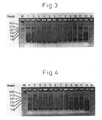
- FIG. 3 is an electrophoresis diagram for RNA amplification reactions in Example 3 using oligonucleotide combinations (a) to (d) shown in Table 2 (black and white inverted), with an initial RNA amount of 10 4 copies/test.
- Lanes 1 and 2 are the results for combination (a)
- lanes 4 and 5 are for combination (b)
- lanes 7 and 8 are for combination (c)
- lanes 10 and 11 are for combination (d)
- lanes 3, 6, 9, and 12 are for the negative control (using only the diluent instead of RNA samples).
- the molecular marker used therein was ⁇ X174/Hae III digest (Marker 4). Specific bands were confirmed in every combination.
- FIG. 4 is an electrophoresis diagram for RNA amplification reactions in Example 3 using oligonucleotide combinations (e) to (h) shown in Table 2 (black and white inverted), with an initial RNA amount of 10 4 copies/test.
- Lanes 1 and 2 are the results for combination (e)
- lanes 4 and 5 are for combination (f)
- lanes 7 and 8 are for combination (g)
- lanes 10 and 11 are for combination (h)
- lanes 3, 6, 9, and 12 are for the negative control (using only the diluent instead of RNA samples).
- the molecular marker used therein was ⁇ X174/Hae III digest (Marker 4). Specific bands were confirmed in every combination.
- FIG. 5 is an electrophoresis diagram for RNA amplification reactions in Example 3 using oligonucleotide combinations (i) to (l) shown in Table 2 (black and white inverted), with an initial RNA amount of 10 4 copies/test.
- Lanes 1 and 2 are the results for combination (i)
- lanes 4 and 5 are for combination (j)
- lanes 7 and 8 are for combination (k)
- lanes 10 and 11 are for combination (l)
- lanes 3, 6, 9, and 12 are for the negative control (using only the diluent instead of RNA samples).
- the molecular marker used therein was ⁇ X174/Hae III digest (Marker 4). Of these combinations, specific bands were confirmed in combinations (k) and (l).
- FIG. 6 shows graphs (A)-1 through (A)-6 of the fluorescence increase ratio which increases as the reaction time and production of RNA progress, and calibration curve (B) obtained for the initial RNA amount logarithm and the rising time, with an initial RNA amount of between 10 1 copies/test and 10 5 copies/test in Example 4.
- the initial amount of 10 3 copies/test of RNA was detectable after approximately 20 minutes of reaction, and a correlation between initial RNA amount and rise time was demonstrated.
- RNA (SEQ ID No.10) comprising a region of 2843 bases in total containing the SEQ ID No.1 region and a portion of the structural protein-coding gene region, as well as a 69 base-partial region derived from the 5′ end of a vector (pCR2.1, Invitrogen) was quantified by ultraviolet absorption at 260 nm, and then diluted to a concentration of 0.62 pmol/ ⁇ l with an RNA diluent (10 mM Tris-HCl (pH 8.0)), 0.1 mM EDTA, 1 mM DTT, 0.5 U/ ⁇ l RNase Inhibitor (Takara Shuzo Co. Ltd.).
- oligonucleotide one of the oligonucleotides shown below was used
- G2-1R (Oligonucleotide complementary to base Nos.23 to 42 of SEQ ID No.1; SEQ ID No.2)
- G2-2R Oligonucleotide complementary to base Nos.46 to 67 of SEQ ID No.1; SEQ ID No.3
- G2-3R (Oligonucleotide complementary to base Nos.104 to 125 of SEQ ID No.1; SEQ ID No.4)
- G2-4R Olionucleotide complementary to base Nos.201 to 220 of SEQ ID No.1; SEQ ID No.11
- G2-5R (Oligonucleotide complementary to base Nos.222 to 241 of SEQ ID No.1; SEQ ID No.12)
- G2-6R oligonucleotide complementary to base Nos.249 to 271 of SEQ ID No.1; SEQ ID No.13
- G2-7R (Oligonucleotide complementary to base Nos.274 to 293 of SEQ ID No.1; SEQ ID No.14)
- G2-8R oligonucleotide complementary to base Nos.324 to 344 of SEQ ID No.1; SEQ ID No.5
- G2-9R (Oligonucleotide complementary to base Nos.512 to 533 of SEQ ID No.1; SEQ ID No.15)
- G2-10R (Oligonucleotide complementary to base Nos.725 to 745 of SEQ ID No.1; SEQ ID No.6)
- G2-11R (Oligonucleotide complementary to base Nos.812 to 831 of SEQ ID No.1; SEQ ID No.7)
- G2-12R (Oligonucleotide complementary to base Nos.930 to 952 of SEQ ID No.1; SEQ ID No.8)
- G2-13R (Oligonucleotide complementary to base Nos.1061 to 1081 of SEQ ID No.1; SEQ ID No.16)
- G2-14R (Oligonucleotide complementary to base Nos.1107 to 1126 of SEQ ID No.1; SEQ ID No.17)
- G2-15R (Oligonucleotide complementary to base Nos.1222 to 1244 of SEQ ID No.1; SEQ ID No.18)
- G2-16R (Oligonucleotide complementary to base Nos.1280 to 1299 of SEQ ID No.1; SEQ ID No.19)
- G2-17R (Oligonucleotide complementary to base Nos.1303 to 1322 of SEQ ID No.1; SEQ ID No.9)
- reaction solutions were then incubated at 41° C. for 5 minutes, and then 1 ⁇ l of 8 U/ ⁇ l AMV-Reverse Transcriptase (Takara Shuzo Co. Ltd.; an enzyme which cleaves RNA of a double stranded-DNA/RNA) was added thereto.
- AMV-Reverse Transcriptase Takara Shuzo Co. Ltd.; an enzyme which cleaves RNA of a double stranded-DNA/RNA
- Modified-urea polyacrylamide gel (acrylamide concentration: 6%; urea: 7M) electrophoresis was conducted to confirm the cleaved fragments after the reaction. Dyeing following the electrophoresis was carried out with SYBR Green IITM (Takara Shuzo Co. Ltd.). Upon binding of the oligonucleotide to the specific site of the target RNA, RNA of the double stranded DNA/RNA is cleaved by the ribonuclease H activity of AMV-Reverse Transcriptase and, thereby, a characteristic band could be observed.
- FIG. 1 The results of the electrophoresis are shown in FIG. 1 (black and white inverted). If the oligonucleotide binds specifically to the standard RNA, the standard RNA will be decomposed at this region, yielding a decomposition product having a characteristic chain length. Specific bands were confirmed with G2-1R, G2-2R, G2-3R, G2-8R, G2-10R, G2-11R, G2-12R, G2-17R. This indicated that these oligonucleotides bind strongly to the GII type SRSV RNA under a certain condition at a temperature of 41° C.
- the numbers in Table 1 are assigned by designating the initiation base of SEQ ID No.1 in the base sequence of SEQ. ID No.10 as 1. The circles in the table indicate that a specific band was observed, and the symbols “X” indicate that a specific band was observed together with a non-specific band.
- RNA As a GI type SRSV standard RNA, an RNA comprising base Nos.1 to 3861 of the structural gene of an RNA-dependent RNA polymerase derived from the base sequence of Chiba virus RNA was quantified by ultraviolet absorption at 260 nm, and then diluted with an RNA diluent (10 mM Tris-HCl (pH 8.0), 0.1 mM EDTA, 1 mM DTT, 0.5 U/ ⁇ l RNase Inhibitor (Takara Shuzo Co. Ltd.)) to 0.45 pmol/ ⁇ l.
- RNA diluent 10 mM Tris-HCl (pH 8.0), 0.1 mM EDTA, 1 mM DTT, 0.5 U/ ⁇ l RNase Inhibitor (Takara Shuzo Co. Ltd.)
- Example 2 As a GII type SRSV standard RNA, the same RNA solution as in Example 1 (SEQ ID No.10; concentration: 0.62 pmol/ ⁇ l) was used.
- oligonucleotide one of the oligonucleotides shown below was used
- Modified-urea polyacrylamide gel (acrylamide concentration: 6%, urea: 7M) electrophoresis was conducted to confirm the cleaved fragments after the reaction. Dyeing following the electrophoresis was carried out with SYBR Green IITM (Takara Shuzo Co. Ltd.). Upon binding of the oligonucleotide to the specific site of the target RNA, RNA of the double stranded DNA/RNA is cleaved by the ribonuclease H activity of AMV-Reverse Transcriptase and, thereby, a characteristic band could be observed.
- FIG. 2 The results of the electrophoresis are shown in FIG. 2 (black and white inverted). If the oligonucleotide binds specifically to the standard RNA, the standard RNA will be decomposed at this region, yielding a decomposition product having a characteristic chain length. The results showed that the oligonucleotides selected in Example 1 bind specifically to GII type SRSV RNA.
- the oligonucleotides of the present invention are oligonucleotides that complementary bind to RNA derived from GII type SRSV, even under conditions of relatively low and constant temperature (35-50° C., preferably 41° C.), which tend to produce an intramolecular structure in RNA and prevent binding of primers or probes thereto. Specific binding of the oligonucleotides is therefore possible without heat denaturation of the target RNA.
- the oligonucleotides of the invention are thus useful as oligonucleotides for cleavage, amplification, detection or the like of RNA derived from GII type SRSV, i.e. as oligonucleotide primers or oligonucleotide probes to be used in RNA amplification methods.
- oligonucleotides of the invention are also useful for amplification and detection of GII type SRSV gene.
- oligonucleotides of the invention are not limited to the sequences shown in the Sequence Listings (20 to 23 mers), and may be oligonucleotides comprising at least 10 contiguous bases within those sequences. This is apparent from the fact that an order of 10-mer base sequence is sufficient to ensure adequate specificity of primers or probes to target nucleic acids under relatively low temperature condition (preferably, at 41° C.).
- RNA amplification reactions were carried out using the oligonucleotides which specifically bind to the RNA of GII type SRSV.
- RNA diluent 10 mM Tris-HCl (pH 8.0), 1 mM EDTA, 0.5 U/ ⁇ l RNase Inhibitor (Takara Shuzo Co. Ltd.), 5 mM DTT. In the control test sections (negative), only the diluent was used.
- RNA amplification reactions were carried out using the oligonucleotides of the sequences listed in Table 2, as the first, second and third oligonucleotides. Solutions were prepared so that the combinations of the first, second and third oligonucleotides would be those as listed in Table 2.
- RNA amplified portion after the reaction agarose gel (agarose concentration 4%) electrophoresis was performed. Dyeing following the electrophoresis was performed with SYBR Green II (Takara Shuzo Co. Ltd.). When an oligonucleotide probe binds to the specific portion of the target RNA, the RNA portion between the second and third oligonucleotide is amplified, thereby a characteristic band could be observed.
- FIGS. 3 to 5 black and white inverted.
- the chain lengths of the specific bands amplified in this reaction are shown in Table 2. Since specific bands were confirmed in combinations from (a) to (h), and from (k) to (l), it was demonstrated that the oligonucleotides used in these combinations are effective in detecting GII type SRSV.
- Table 2 shows the combinations of first, second and third oligonucleotides used in this example, as well as the chain lengths of the amplified specific bands resulted from the RNA amplification reaction using these combinations.
- the 3′ end hydroxyl group of each first oligonucleotide base sequence was aminated.
- the region of the 1st “A” to the 22nd “A” from the 5′ end corresponds to the T7 promoter region, and the subsequent region from the 23rd “G” to the 28th “A” corresponds to the enhancer sequence.
- the base numbers are assigned by designating the initiation base of the RNA-dependent RNA polymerase gene of GII SRSV in SEQ ID No.36 as 1.
- G2-2S (SEQ ID No.37, base Nos.29 to 67)
- G2-3S (SEQ ID No.38, base Nos.87 to 125)
- G2-10S (SEQ ID No.39, base Nos.707 to 745)
- G2-11S (SEQ ID No.40, base Nos.792 to 831)
- G2-12S (SEQ ID No.41, base Nos.1303 to 1322)
- G2-1F1 (SEQ ID No.42, base Nos.37 to 59)
- G2-1F2 (SEQ ID No.43, base Nos.34 to 56)
- G2-2F1 (SEQ ID No.44, base Nos.62 to 84)
- G2-2F2 (SEQ ID No.45, base Nos.59 to 81)
- G2-3F1 (SEQ ID No.46, base Nos.120 to 142)
- G2-3F2 (SEQ ID No.47, base Nos.117 to 139)
- G2-10F1 (SEQ ID No.48, base Nos.740 to 762)
- G2-10F2 (SEQ ID No.49, base Nos.737 to 759)
- G2-11F1 (SEQ ID No.50, base Nos.826 to 848)
- G2-11F2 (SEQ ID No.51, base Nos.823 to 845)
- G2-12F1 (SEQ ID No.52, base Nos.947 to 969)
- G2-12F2 (SEQ ID No.53, base Nos.944 to 966)
- G2-8R (SEQ ID No.28, base Nos.324 to 344)
- G2-12R (SEQ ID No.30, base Nos.930 to 952)
- G2-17R (SEQ ID No.31, base Nos.1303 to 1322)
- Combinations of oligonucleotide primers according to the present invention were used for specific detection of different initial copy numbers of the target GII type SRSV RNA.
- RNA diluent 10 mM Tris-HCl (pH 8.0), 1 mM EDTA, 0.5 U/ ⁇ l RNase Inhibitor (Takara Shuzo Co. Ltd.), 5 mM DTT, to concentrations ranging from 1.0 ⁇ 10 5 copies/5 ⁇ l to 10 1 copies/5 ⁇ l.
- RNA diluent 10 mM Tris-HCl (pH 8.0), 1 mM EDTA, 0.5 U/ ⁇ l RNase Inhibitor (Takara Shuzo Co. Ltd.), 5 mM DTT,
- intercalator fluorescent pigment-labeled oligonucleotide (YO-G2 SRSV-S-G, SEQ ID No.35, labeled with an intercalator fluorescent pigment at the phosphorous atom between the 7th “T” and the 8th “A” from the 5′ end, and modified with a glycol group at its 3′ end hydroxyl)
- Enzyme Solution Composition (Each Concentration Represents that in a Final Reaction Solution of 30 ⁇ l)
- the PCR tube was then incubated at 41° C. using a direct-measurable fluorescence spectrophotometer equipped with a temperature-controller, and the reaction solution was periodic measured at an excitation wavelength of 470 nm and a fluorescent wavelength of 510 nm.
- FIGS. 6 (A)- 1 through (A)- 6 shows the time-course changes in the fluorescence increase ratio (fluorescence intensity at predetermined time/background flourescence intensity) of the sample, where enzyme was added at 0 minutes.
- FIG. (B) shows the relationship between the logarithm of the initial RNA amount and the rise time (time at which the relative fluorescence reaches the negative sample's average value plus 3 standard deviation; i.e., the time to reach 1.2).
- the initial RNA amount was between 10.sup.1 copies/test and 10.sup.5 copies/test.
- FIG. 6 shows that 10 3 copies ((A)-4) were detected after approximately 20 minutes.
- a fluorescent profile and calibration curve depending on the initial concentration of the labeled RNA were obtained, indicating that it is possible to quantify the GII type SRSV RNA present in unknown samples. This demonstrated that rapid, highly sensitive detection of GII type SRSV RNA is possible by this method.
- the present invention provides useful combinations of oligonucleotide primers or oligonucleotide probes which specifically bind to RNA derived from GII type SRSV, and rapidly amplify and detect the target RNA, even under relatively low and constant temperature (35-50° C. and preferably 41° C.) conditions in which an RNA in a sample would form an intramolecular structure which inhibit the primer and probe binding.
- the base lengths of the oligonucleotides in the combinations of the present invention are not limited to the ones concretely described herein, and the present oligonucleotides may include those comprised of at least 10 contiguous bases within these sequences. This is apparent from the fact that about 10-mer base sequence is sufficient to ensure adequate specificity of primers or probes to target nucleic acids under relatively low temperature condition (preferably, at 41° C.).
Landscapes
- Chemical & Material Sciences (AREA)
- Life Sciences & Earth Sciences (AREA)
- Health & Medical Sciences (AREA)
- Organic Chemistry (AREA)
- Zoology (AREA)
- Engineering & Computer Science (AREA)
- Immunology (AREA)
- Wood Science & Technology (AREA)
- Proteomics, Peptides & Aminoacids (AREA)
- Virology (AREA)
- Biotechnology (AREA)
- Microbiology (AREA)
- Molecular Biology (AREA)
- Physics & Mathematics (AREA)
- Biophysics (AREA)
- Analytical Chemistry (AREA)
- Biochemistry (AREA)
- Bioinformatics & Cheminformatics (AREA)
- General Engineering & Computer Science (AREA)
- General Health & Medical Sciences (AREA)
- Genetics & Genomics (AREA)
- Measuring Or Testing Involving Enzymes Or Micro-Organisms (AREA)
Priority Applications (2)
| Application Number | Priority Date | Filing Date | Title |
|---|---|---|---|
| US10/441,126 US7339041B2 (en) | 2000-11-21 | 2003-05-20 | Oligonucleotides and method for characterizing and detecting Genogroup II type small round structured virus |
| US10/678,124 US20040063096A1 (en) | 2000-11-21 | 2003-10-06 | Oligonucleotides and method for characterizing and detecting genogroup II type small round structured virus |
Applications Claiming Priority (5)
| Application Number | Priority Date | Filing Date | Title |
|---|---|---|---|
| JP2000-359482 | 2000-11-21 | ||
| JP2000359482A JP2002153289A (ja) | 2000-11-21 | 2000-11-21 | ジェノグループii型小型球形ウイルスを特徴づける塩基配列および検出のためのオリゴヌクレオチド |
| JP2001020231A JP2002218999A (ja) | 2001-01-29 | 2001-01-29 | ジェノグループii型小型球形ウイルスrnaの検出法 |
| JP2001-020231 | 2001-01-29 | ||
| JP2001-20231 | 2001-01-29 |
Related Child Applications (2)
| Application Number | Title | Priority Date | Filing Date |
|---|---|---|---|
| US10/441,126 Division US7339041B2 (en) | 2000-11-21 | 2003-05-20 | Oligonucleotides and method for characterizing and detecting Genogroup II type small round structured virus |
| US10/678,124 Continuation US20040063096A1 (en) | 2000-11-21 | 2003-10-06 | Oligonucleotides and method for characterizing and detecting genogroup II type small round structured virus |
Publications (2)
| Publication Number | Publication Date |
|---|---|
| US20020099201A1 US20020099201A1 (en) | 2002-07-25 |
| US6630300B2 true US6630300B2 (en) | 2003-10-07 |
Family
ID=26604620
Family Applications (3)
| Application Number | Title | Priority Date | Filing Date |
|---|---|---|---|
| US09/989,002 Expired - Fee Related US6630300B2 (en) | 2000-11-21 | 2001-11-21 | Oligonucleotides and method for characterizing and detecting Genogroup II type small round structured virus |
| US10/441,126 Expired - Fee Related US7339041B2 (en) | 2000-11-21 | 2003-05-20 | Oligonucleotides and method for characterizing and detecting Genogroup II type small round structured virus |
| US10/678,124 Abandoned US20040063096A1 (en) | 2000-11-21 | 2003-10-06 | Oligonucleotides and method for characterizing and detecting genogroup II type small round structured virus |
Family Applications After (2)
| Application Number | Title | Priority Date | Filing Date |
|---|---|---|---|
| US10/441,126 Expired - Fee Related US7339041B2 (en) | 2000-11-21 | 2003-05-20 | Oligonucleotides and method for characterizing and detecting Genogroup II type small round structured virus |
| US10/678,124 Abandoned US20040063096A1 (en) | 2000-11-21 | 2003-10-06 | Oligonucleotides and method for characterizing and detecting genogroup II type small round structured virus |
Country Status (2)
| Country | Link |
|---|---|
| US (3) | US6630300B2 (de) |
| EP (1) | EP1209242A3 (de) |
Cited By (1)
| Publication number | Priority date | Publication date | Assignee | Title |
|---|---|---|---|---|
| US20030180894A1 (en) * | 2000-11-21 | 2003-09-25 | Tosoh Corporation | Oligonucleotides and method for characterizing and detecting Genogroup II type small round structured virus |
Families Citing this family (2)
| Publication number | Priority date | Publication date | Assignee | Title |
|---|---|---|---|---|
| EP1705482B1 (de) * | 2003-12-11 | 2017-09-27 | Kazuhiro Imai | Nachweis-, trenn- und identifizierungsverfahren für spuren von exprimiertem protein/peptid |
| CN110073005A (zh) | 2016-06-03 | 2019-07-30 | 奎斯特诊断投资有限责任公司 | 检测诺如病毒的方法 |
Citations (2)
| Publication number | Priority date | Publication date | Assignee | Title |
|---|---|---|---|---|
| WO1994005700A2 (en) | 1992-09-07 | 1994-03-17 | Baylor College Of Medicine | Methods and reagents to detect and characterize norwalk and related viruses |
| US20020031760A1 (en) * | 2000-05-31 | 2002-03-14 | Juichi Saito | Oligonucleotides and method for detection of small round structured virus (SRSV) RNA |
Family Cites Families (3)
| Publication number | Priority date | Publication date | Assignee | Title |
|---|---|---|---|---|
| IT1282287B1 (it) * | 1995-05-16 | 1998-03-16 | Ist Superiore Sanita | La sequenza del dna completo dell'inserto carlubo codificante per una proteina heat shch di forda (cansp 70) di candida albicans ceppo atcc |
| JP3752102B2 (ja) * | 1999-04-21 | 2006-03-08 | 株式会社三菱化学ビーシーエル | 小型球形ウイルスの検出方法 |
| US6630300B2 (en) * | 2000-11-21 | 2003-10-07 | Tosoh Corporation | Oligonucleotides and method for characterizing and detecting Genogroup II type small round structured virus |
-
2001
- 2001-11-21 US US09/989,002 patent/US6630300B2/en not_active Expired - Fee Related
- 2001-11-21 EP EP01309779A patent/EP1209242A3/de not_active Ceased
-
2003
- 2003-05-20 US US10/441,126 patent/US7339041B2/en not_active Expired - Fee Related
- 2003-10-06 US US10/678,124 patent/US20040063096A1/en not_active Abandoned
Patent Citations (2)
| Publication number | Priority date | Publication date | Assignee | Title |
|---|---|---|---|---|
| WO1994005700A2 (en) | 1992-09-07 | 1994-03-17 | Baylor College Of Medicine | Methods and reagents to detect and characterize norwalk and related viruses |
| US20020031760A1 (en) * | 2000-05-31 | 2002-03-14 | Juichi Saito | Oligonucleotides and method for detection of small round structured virus (SRSV) RNA |
Non-Patent Citations (4)
| Title |
|---|
| Cauchi et al. sequence alignment of SEQ ID No: 28 with GenEmbl accession No: U46500 from Journal of Medical Virology. 1996; 49 (1): 70-76.* * |
| Dingle et al. sequence alignment of SEQ ID No: 20 with GenEmbl accession No: X86557 from Journal of General Virology. 1995; 76 (9): 2349-2355.* * |
| Green et al. sequence alignment of SEQ ID No: 35 with GenEmbl accession No: X76716 from Journal of General Virology. 1994; 75 (8): 1883-1888.* * |
| Takahiko Ishiguro, et al., Nucleic Acids Research, vol. 24, No. 24, pp. 4992-4997, "Fluorescence Detection of Specific Sequence of Nucleic Acids by Oxazole Yellow-Linked Oligonucleotides. Homogeneous Quantitative Monitoring of In Vitro Transcription", 1996. |
Cited By (2)
| Publication number | Priority date | Publication date | Assignee | Title |
|---|---|---|---|---|
| US20030180894A1 (en) * | 2000-11-21 | 2003-09-25 | Tosoh Corporation | Oligonucleotides and method for characterizing and detecting Genogroup II type small round structured virus |
| US7339041B2 (en) * | 2000-11-21 | 2008-03-04 | Tosoh Corporation | Oligonucleotides and method for characterizing and detecting Genogroup II type small round structured virus |
Also Published As
| Publication number | Publication date |
|---|---|
| US20040063096A1 (en) | 2004-04-01 |
| US20030180894A1 (en) | 2003-09-25 |
| US20020099201A1 (en) | 2002-07-25 |
| US7339041B2 (en) | 2008-03-04 |
| EP1209242A2 (de) | 2002-05-29 |
| EP1209242A3 (de) | 2004-01-14 |
Similar Documents
| Publication | Publication Date | Title |
|---|---|---|
| US20090117537A1 (en) | Method for detecting sars coronavirus | |
| CN101680040A (zh) | 改良的诺如病毒rna检测方法 | |
| US7297517B2 (en) | Oligonucleotides and method for detection of meca gene of methicillin-resistant Staphylococcus aureus | |
| US6562955B2 (en) | Oligonucleotides for detection of Vibrio parahaemolyticus and detection method for Vibrio parahaemolyticus using the same oligonucleotides | |
| US20090181365A1 (en) | Norovirus detection reagent | |
| CN100577816C (zh) | 一种荧光标记的寡核苷酸探针及其应用 | |
| CN1637152B (zh) | 用于检测副溶血弧菌的耐热性溶血素相关溶血素基因的检测试剂 | |
| US7339041B2 (en) | Oligonucleotides and method for characterizing and detecting Genogroup II type small round structured virus | |
| US7105319B2 (en) | Oligonucleotides for detecting tubercle bacillus and method therefor | |
| JP2011078389A (ja) | サポウイルスrnaの検出方法および検出試薬 | |
| US6893847B2 (en) | Oligonucleotide for detecting Salmonella and method of detecting Salmonella | |
| US20020031760A1 (en) | Oligonucleotides and method for detection of small round structured virus (SRSV) RNA | |
| JP2012503472A (ja) | 診断用ハイブリダイゼーションアッセイにおける核酸標的の配列変異に対する依存性を低下させるための方法 | |
| CN1637153B (zh) | 用于检测副溶血弧菌的耐热性溶血素基因的检测试剂 | |
| US6756198B2 (en) | Oligonucleotide for highly sensitive detection of hepatitis C virus and method for detection thereof | |
| KR20230091008A (ko) | 고리매개 등온 증폭용 변형된 프라이머 및 이의 용도 | |
| JP2002218999A (ja) | ジェノグループii型小型球形ウイルスrnaの検出法 | |
| JP2003284565A (ja) | 非定型抗酸菌Mycobacteriumintracellulare検出のためのオリゴヌクレオチドおよび検出法 | |
| JP2005245434A (ja) | ノロウイルスの検出試薬 | |
| JP2002153289A (ja) | ジェノグループii型小型球形ウイルスを特徴づける塩基配列および検出のためのオリゴヌクレオチド | |
| JP2001340086A (ja) | 腸炎ビブリオ菌の耐熱性溶血毒遺伝子の検出法 |
Legal Events
| Date | Code | Title | Description |
|---|---|---|---|
| AS | Assignment |
Owner name: TOSOH CORPORATION, JAPAN Free format text: ASSIGNMENT OF ASSIGNORS INTEREST;ASSIGNORS:MASUDA, NORIYOSHI;ISHIQURO, TAKAHIKO;SAITO, JUICHI;AND OTHERS;REEL/FRAME:012399/0898 Effective date: 20011108 |
|
| AS | Assignment |
Owner name: TOSOH CORPORATION, JAPAN Free format text: CORRECTIVE ASSIGNMENT TO CORRECT THE SECOND ASSIGNOR'S NAME PREVIOUSLY RECORDED ON REEL 012399 FRAME 0898;ASSIGNORS:MASUDA, NORIYOSHI;ISHIGURO, TAKAHIKO;SAITO, JUICHI;AND OTHERS;REEL/FRAME:012886/0661 Effective date: 20011108 |
|
| FPAY | Fee payment |
Year of fee payment: 4 |
|
| FEPP | Fee payment procedure |
Free format text: PAYOR NUMBER ASSIGNED (ORIGINAL EVENT CODE: ASPN); ENTITY STATUS OF PATENT OWNER: LARGE ENTITY Free format text: PAYER NUMBER DE-ASSIGNED (ORIGINAL EVENT CODE: RMPN); ENTITY STATUS OF PATENT OWNER: LARGE ENTITY |
|
| FPAY | Fee payment |
Year of fee payment: 8 |
|
| REMI | Maintenance fee reminder mailed | ||
| LAPS | Lapse for failure to pay maintenance fees | ||
| STCH | Information on status: patent discontinuation |
Free format text: PATENT EXPIRED DUE TO NONPAYMENT OF MAINTENANCE FEES UNDER 37 CFR 1.362 |
|
| STCH | Information on status: patent discontinuation |
Free format text: PATENT EXPIRED DUE TO NONPAYMENT OF MAINTENANCE FEES UNDER 37 CFR 1.362 |
|
| FP | Lapsed due to failure to pay maintenance fee |
Effective date: 20151007 |