US6993342B2 - Buffer occupancy used in uplink scheduling for a communication device - Google Patents
Buffer occupancy used in uplink scheduling for a communication device Download PDFInfo
- Publication number
- US6993342B2 US6993342B2 US10/431,249 US43124903A US6993342B2 US 6993342 B2 US6993342 B2 US 6993342B2 US 43124903 A US43124903 A US 43124903A US 6993342 B2 US6993342 B2 US 6993342B2
- Authority
- US
- United States
- Prior art keywords
- communication device
- base station
- buffer occupancy
- information
- active set
- Prior art date
- Legal status (The legal status is an assumption and is not a legal conclusion. Google has not performed a legal analysis and makes no representation as to the accuracy of the status listed.)
- Expired - Lifetime, expires
Links
Images




Classifications
-
- H—ELECTRICITY
- H04—ELECTRIC COMMUNICATION TECHNIQUE
- H04W—WIRELESS COMMUNICATION NETWORKS
- H04W72/00—Local resource management
- H04W72/20—Control channels or signalling for resource management
- H04W72/21—Control channels or signalling for resource management in the uplink direction of a wireless link, i.e. towards the network
-
- H—ELECTRICITY
- H04—ELECTRIC COMMUNICATION TECHNIQUE
- H04L—TRANSMISSION OF DIGITAL INFORMATION, e.g. TELEGRAPHIC COMMUNICATION
- H04L47/00—Traffic control in data switching networks
- H04L47/10—Flow control; Congestion control
- H04L47/30—Flow control; Congestion control in combination with information about buffer occupancy at either end or at transit nodes
-
- H—ELECTRICITY
- H04—ELECTRIC COMMUNICATION TECHNIQUE
- H04B—TRANSMISSION
- H04B7/00—Radio transmission systems, i.e. using radiation field
- H04B7/02—Diversity systems; Multi-antenna system, i.e. transmission or reception using multiple antennas
- H04B7/022—Site diversity; Macro-diversity
-
- H—ELECTRICITY
- H04—ELECTRIC COMMUNICATION TECHNIQUE
- H04W—WIRELESS COMMUNICATION NETWORKS
- H04W72/00—Local resource management
- H04W72/50—Allocation or scheduling criteria for wireless resources
- H04W72/52—Allocation or scheduling criteria for wireless resources based on load
-
- H—ELECTRICITY
- H04—ELECTRIC COMMUNICATION TECHNIQUE
- H04W—WIRELESS COMMUNICATION NETWORKS
- H04W72/00—Local resource management
- H04W72/50—Allocation or scheduling criteria for wireless resources
- H04W72/535—Allocation or scheduling criteria for wireless resources based on resource usage policies
Definitions
- the present invention relates generally to a wireless communication device, and more specifically to fairness in uplink scheduling of a communication device.
- UMTS Universal Mobile Telecommunications System
- UTRAN Universal Mobile Telecommunications System
- WCDMA wideband code division multiple access
- UE user equipment
- BSSs base station subsystems
- a BSS (known as Node-B in WCDMA) services a coverage area that is divided up into multiple sectors (known as cells in WCDMA).
- each sector is serviced by one or more of multiple base transceiver stations (BTSs) included in the BSS.
- BTSs base transceiver stations
- the mobile station is typically a cellular communication device.
- Each BTS continuously transmits a downlink (pilot) signal.
- the MS monitors the pilots and measures the received energy of the pilot symbols.
- the MS In a cellular system, there are a number of states and channels for communications between the MS and the BSS.
- the BSS communicates with the MS over a Forward Traffic Channel in a forward link and the MS communicates with the BSS over a Reverse Traffic Channel in a reverse link.
- the MS must constantly monitor and maintain four sets of pilots.
- the four sets of pilots are collectively referred to as the Pilot Set and include an Active Set, a Candidate Set, a Neighbor Set, and a Remaining Set, where, although the terminology may differ, the same concepts generally apply to the WCDMA system.
- the Active Set includes pilots associated with the Forward Traffic Channel assigned to the MS. This set is active in that the pilots and companion data symbols associated with this set are all actively combined and demodulated by the MS.
- the Candidate Set includes pilots that are not currently in the Active Set but have been received by the MS with sufficient strength to indicate that an associated Forward Traffic Channel could be successfully demodulated.
- the Neighbor Set includes pilots that are not currently in the Active Set or Candidate Set but are likely candidates for handoff.
- the Remaining Set includes all possible pilots in the current system on the current frequency assignment, excluding the pilots in the Neighbor Set, the Candidate Set, and the Active Set.
- the MS When the MS is serviced by a first BTS, the MS constantly searches pilot channels of neighboring BTSs for a pilot that is sufficiently stronger than a threshold value. The MS signals this event to the first, serving BTS using a Pilot Strength Measurement Message. As the MS moves from a first sector serviced by a first BTS to a second sector serviced by a second BTS, the communication system promotes certain pilots from the Candidate Set to the Active Set and from the Neighbor Set to the Candidate Set. The serving BTS notifies the MS of the promotions via a Handoff Direction Message. Afterwards, for the MS to commence communication with a new BTS that has been added to the Active Set before terminating communications with an old BTS, a “soft handoff” will occur.
- each BTS in the Active Set independently demodulates and decodes each frame or packet received from the MS. It is then up to a switching center or selection distribution unit (SDU) normally located in a Base Station Site Controller (BSC), which is also known as a Radio Network Controller (RNC) using WCDMA terminology, to arbitrate between the each BTS's decoded frames.
- SDU switching center or selection distribution unit
- BSC Base Station Site Controller
- RNC Radio Network Controller
- At least some of these standards support synchronous communications between the system elements, while at least some of the other standards support asynchronous communications.
- At least one example of a standard that supports synchronous communications includes cdma2000.
- At least one example of a standard that supports asynchronous communications includes WCDMA.
- One such common method employed for synchronizing base stations includes the use of global positioning system (GPS) receivers, which are co-located with the base stations that rely upon line of sight transmissions between the base station and one or more satellites located in orbit around the earth.
- GPS global positioning system
- asynchronous transmissions are not without their own set of concerns.
- the timing of uplink transmissions in an environment supporting MS autonomous scheduling (whereby a MS may transmit whenever the MS has data in its transmit buffer and all MSs are-allowed to transmit as needed) by the individual MSs can be quite sporadic and/or random in nature.
- traffic volume is low, the autonomous scheduling of uplink transmissions is less of a concern, because the likelihood of a collision (i.e. overlap) of data being simultaneously transmitted by multiple MSs is also low.
- traffic volume increases, the likelihood of data collisions (overlap) also increases.
- FIG. 1 is a block diagram of communication system 100 of the prior art.
- Communication system 100 can be a cdma2000 or a WCDMA system.
- Communication system 100 includes multiple cells (seven shown), wherein each cell is divided into three sectors (a, b, and c).
- a BSS 101 – 107 located in each cell provides communications service to each mobile station located in that cell.
- Each BSS 101 – 107 includes multiple BTSs, which BTSs wirelessly interface with the mobile stations located in the sectors of the cell serviced by the BSS.
- Communication system 100 further includes a radio network controller (RNC) 110 coupled to each BSS and a gateway 112 coupled to the RNC.
- Gateway 112 provides an interface for communication system 100 with an external network such as a Public Switched Telephone Network (PSTN) or the Internet.
- PSTN Public Switched Telephone Network
- the quality of a communication link between an MS, such as MS 114 , and the BSS servicing the MS, such as BSS 101 typically varies over time and movement by the MS.
- communication system 100 provides a soft handoff (SHO) procedure by which MS 114 can be handed off from a first communication link whose quality has degraded to another, higher quality communication link.
- SHO soft handoff
- MS 114 which is serviced by a BTS servicing sector b of cell 1 , is in a 3-way soft handoff with sector c of cell 3 and sector a of cell 4 .
- the BTSs associated with the sectors concurrently servicing the MS that is, the BTSs associated with sectors 1 - b, 3 - c, and 4 - a, are known in the art as the Active Set of the MS.
- FIG. 2 is a block diagram of a hierarchical structure of communication system 100 .
- RNC 110 includes an ARQ function 210 , a scheduler 212 , and a soft handoff (SHO) function 214 .
- FIG. 2 further depicts multiple BTSs 201 – 207 , wherein each BTS provides a wireless interface between a corresponding BSS 101 – 107 and the MSs located in a sector serviced by the BSS.
- each BTS 201 , 203 , 204 in the Active Set of the MS 114 receives a transmission from MS 114 over a reverse link of a respective communication channel 221 , 223 , 224 .
- the Active Set BTSs 201 , 203 , and 204 are determined by SHO function 214 .
- each Active Set BTS 201 , 203 , 204 demodulates and decodes the contents of a received radio frame.
- each Active Set BTS 201 , 203 , 204 then conveys the demodulated and decoded radio frame to RNC 110 , along with related frame quality information.
- RNC 110 receives the demodulated and decoded radio frames along with related frame quality information from each BTS 201 , 203 , 204 in the Active Set and selects a best frame based on frame quality information.
- Scheduler 212 and ARQ function 210 of RNC 110 then generate control channel information that is distributed as identical pre-formatted radio frames to each BTS 201 , 203 , 204 in the Active Set.
- the Active Set BTSs 201 , 203 , 204 then simulcast the pre-formatted radio frames over the forward link.
- the BTS of the current cell where the MS is camped can include its own scheduler and bypass the RNC 110 when providing scheduling information to the MS.
- scheduling functions are distributed by allowing a mobile station (MS) to signal control information corresponding to an enhanced reverse link transmission to Active Set base transceiver stations (BTSs) and by allowing the BTSs to perform control functions that were previously supported by a RNC.
- the MS in a SHO region can choose a scheduling assignment corresponding to a best Transport Format and Resource Indicator information (TFRI) out of multiple scheduling assignments that the MS receives from multiple Active Set BTS.
- TFRI Resource Indicator information
- explicit transmit power constraints (which are implicit data rate constraints) are provided by a scheduler, which are used by the MS 114 , along with control channel information, to determine what transmission rate to use.
- MS buffer occupancy is also a parameter that is considered in determining a transmission rate.
- a MS can use an enhanced uplink dedicated transport channel (EUDCH) to achieve an increased uplink data rate.
- EUDCH enhanced uplink dedicated transport channel
- the MS must determine the data rate to use for the enhanced uplink based on local measurements at the MS, such as buffer occupancy for example, and information provided by the scheduler.
- the MS when an MS is explicitly scheduled (Explicit Mode) by the BTS, for example, to use the enhanced uplink channel, or when a MS autonomously decides when to transmit data (Autonomous mode), the MS must determine a transmission rate given the constraints of a maximum rate or equivalently a maximum power margin indicated by the scheduler and the amount of data in its buffer. This is particularly important when the MS is in a multi-coverage area served by multiple cells where, in a CDMA system, such a MS is typically in soft handoff (SHO) with any of the said multiple cells if more than one are members of the MS's current Active Set.
- SHO soft handoff
- the scheduling assignment is based on scheduling information that is sent by the mobile including buffer occupancy (BO), which is the amount of data in buffer that is to be transmitted in the uplink.
- BO buffer occupancy
- the MS may get a scheduling assignment message from a BTS, and may successfully transmit data to this scheduling BTS.
- the other members of the active set may or may not be aware of this transaction depending on the relative strength of the uplink legs. This however potentially leads to several issues. Firstly, a non-scheduling BTS may schedule the MS based on outdated buffer occupancy reports received prior to the last successful scheduling of the MS.
- the fairness of the overall system in scheduling users on the uplink may not be achieved. Further, the system will be skewed towards MSs reporting high BO with the potential for multiple BTSs scheduling the MS, resulting in a very unfair overall uplink throughput and there may also possibly be many wasted scheduling opportunities due to scheduling collisions between members of this MS's active set.
- the MS include the BO in the TFRI sent on the uplink when scheduled. Since the TFRI is CRC protected this is a reliable mechanism for updating the BTSs.
- the TFRI includes information required by the BTS to decode the data channel and is sent in a separate message on an UL control channel, with the data sent on the enhanced uplink dedicated channel shortly following the control channel.
- the BTS needs to be aware of the success of the data transmission linked to this TFRI message for the update to be successful, i.e. it needs to know if the data sent was successfully received. This is a problem since it is possible that the BTS receives the TFRI successfully but not the data. In this case, the BTS cannot reliably determine whether the MS was successful in the transmission or not depending on whether other BTSs in the active set received the data correctly or not in case it did not.
- Another solution is to have more frequent BO reports.
- the frequency of the BO reporting can be increased to ensure that all the BTSs in the active set receive the latest BO status.
- This is not useful since it increases the uplink control messaging and reduces battery life and increases processing at the BTS.
- Another solution is to restrict non-scheduling BTSs from scheduling the MS until it receives the BO report again. This technique is rather limiting and can negatively impact system throughput in that the BTSs cannot take advantage of good radio conditions to schedule the MA. Further, due to the rapidly changing radio conditions, updates will have to be sent frequently on the MS to enable the BTSs to respond to radio conditions and MS movements. In addition, a BTS would need to schedule a MS immediately after the report is received to be sure that the BO report is meaningful.
- Another solution is to include the BO in the data channel as part of the header. This avoids the problem described in the first solution described above. However, in this case only the successfully receiving BTS would be aware of the latest buffer occupancy. It does however help in avoiding the TFRI channel from being burdened with information that is not needed for the successful decoding of the data linked to the TFRI message.
- the receiving BTS could in principle determine the buffer status through combination of the traffic volume successfully received and the last BO report.
- this solution does not account for the change in buffer occupancy due to new data being generated at the transmitter. Even in this case by definition, the non-receiving BTSs in the active set do not have the latest BO report from the MS.
- a variant of the information in the header could be the sending of the rate of increase of BO as opposed to the actual BO. Or another variant is mobile could send the BO and include one bit as a rate indicator. However, this does lower data throughput.
- FIG. 1 is a block diagram of an exemplary communication system of the prior art
- FIG. 2 is a block diagram of a hierarchical structure of the communication system of FIG. 1 ;
- FIG. 3 depicts a distributed network architecture in accordance with an embodiment of the present invention
- FIG. 4 is a message flow diagram in accordance with an embodiment of the present invention.
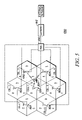
- FIG. 5 is a block diagram of an exemplary communication system, in accordance with the present invention.
- FIGS. 6 and 7 are illustrative of one aspect of the present invention.
- FIG. 8 is illustrative of another aspect of the present invention.
- the present invention provides novel techniques to ensure that BTSs receive reliable buffer occupancy information, such that a macro selection diversity benefit is obtained.
- time-stamping of the last transmission opportunity along with buffer occupancy is reported so that BTSs have the latest information that can assist it in ensuring a higher degree of fairness.
- Another aspect of the present invention provides the last known transmission opportunity to the BTS when first added to the active set of the mobile, since it is likely that this BTS may schedule the mobile early on, to help it initialize its fairness setting.
- Another aspect of the present invention transmits a buffer occupancy report when the mobile determines that a BTS has exceed a certain predetermined uplink channel quality and is therefore most likely to schedule the mobile.
- Another aspect of the present invention indicates the rate of buffer increase to help differentiate applications and make appropriate scheduling decisions and assisting with flow control at the mobile.
- the indication of the last transmission opportunity by the mobile assists the non-scheduling and non-receiving BTSs to improve the fairness of scheduling.
- new BTSs added to the active set are instantly made aware of the transmission opportunities since they are most likely to schedule depending on the algorithm used to add BTSs in SHO and need to have their fairness initialized with the new mobile being served.
- the unsolicited scheduling information is a very rapid trigger to the BTSs that assist in not only ensuring fairness but also ensuring that the latest information is at the BTSs so that a scheduling BTS can choose the most optimal assignment parameters (number of subframes, coding, etc.) if the mobile is scheduled.
- information related to most current speed, fading environment can also be made available.
- Providing the rate of increase of buffer occupancy, instead of or in addition to just the buffer occupancy, further helps the scheduler in differentiating different applications (identities of which are not visible to the BTS) and provides preferential treatment for users with higher rate of increase of buffer occupancy. This also helps with flow control at the mobile, a substantive issue as application data rates keep rising.
- the present invention is applicable in the downlink for HSDPA.
- the mobile triggers a CQI (Channel quality indicator) report on the uplink any time it detects that a downlink leg exceeds some quality target and that therefore the BTS is most likely to transmit.
- CQI Channel quality indicator
- This new technique would ensure that the BTS has the latest information on the mobile's radio environment and could therefore be better able to make a good decision in terms of scheduling, modulation, etc. If and when mechanisms are added to the standards for enabling diversity benefits on the HS-DSCH (for HSDPA) this technique could also then assist in ensuring fairness similar to the uplink enhanced channel described above.
- the invention described here provides both timely information to help maximize system throughput and ensures fairness, thereby improving uplink capacity and throughput performance.
- Most known techniques only relates to the improvement of the HSDPA performance.
- the BTS requests the MS to send the latest CQI information prior to the transmission of the first packet of a packet call.
- activity based feedback is provided that relates to the mobile sending CQI information along with every ACK/NACK information.
- any downlink activity is indication of more downlink activity especially in the case of a NACK being transmitted.
- This does not ensure fairness.
- the present invention solves these problems in a novel way, as will be explained below.
- FIG. 5 is a block diagram of a communication system 1000 in accordance with an embodiment of the present invention.
- communication system 1000 is a Code Division Multiple Access (CDMA) communication system, such as cdma2000 or Wideband CDMA (WCDMA) communication system, that includes multiple communication channels.
- CDMA Code Division Multiple Access
- WCDMA Wideband CDMA
- GSM Global System for Mobile communication
- TDMA Time Division Multiple Access
- FDMA Frequency Division Multiple Access
- OFDM Orthogonal Frequency Division Multiple Access
- communication system 1000 includes multiple cells (seven shown). Each cell is divided into multiple sectors (three shown for each cell—sectors a, b, and c).
- a base station subsystem (BSS) 1001 – 1007 located in each cell provides communications service to each mobile station located in that cell.
- Each BSS 1001 – 1007 includes multiple base stations, also referred to herein as base transceiver stations (BTSs) or Node-Bs, which wirelessly interface with the mobile stations located in the sectors of the cell serviced by the BSS.
- Communication system 1000 further includes a radio network controller (RNC) 1010 coupled to each BSS, preferably through a 3GPP TSG UTRAN Iub Interface, and a gateway 1012 coupled to the RNC.
- Gateway 1012 provides an interface for communication system 1000 with an external network such as a Public Switched Telephone Network (PSTN) or the Internet.
- PSTN Public Switched Telephone Network
- communication system 1000 further includes at least one mobile station (MS) 1014 .
- MS 1014 may be any type of wireless user equipment (UE), such as a cellular telephone, a portable telephone, a radiotelephone, or a wireless modem associated with data terminal equipment (DTE) such as a personal computer (PC) or a laptop computer.
- UE wireless user equipment
- DTE data terminal equipment
- MS 1014 is serviced by multiple BTSs that are included in an Active Set associated with the MS.
- MS 1014 wirelessly communicates with each BTS in communication system 1000 via an air interface that includes a forward link (from the BTS to the MS) and a reverse link (from the MS to the BTS).
- Each forward link includes multiple forward link control channels, a paging channel, and traffic channel.
- Each reverse link includes multiple reverse link control channels, a paging channel, and a traffic channel.
- each reverse link of communication system 1000 further includes another traffic channel, an Enhanced Uplink Dedicated Transport Channel (EUDCH), that facilitates high speed data transport by permitting a transmission of data that can be dynamically modulated and coded, and demodulated and decoded, on a sub-frame by sub-frame basis.
- EUDCH Enhanced Uplink Dedicated Transport Channel
- FIG. 3 depicts a network architecture 300 of communication system 1000 in accordance with an embodiment of the present invention.
- communication system includes multiple BTSs 301 – 307 , wherein each BTS provides a wireless interface between a corresponding BSS 1001 – 1007 and the MSs located in a sector serviced by the BTS.
- a scheduling function 316 is distributed in each of the BTSs 301 – 307 .
- RNC 1010 is responsible for managing mobility by defining the members of the Active Set of each MS serviced by communication system 1000 , such as MS 1014 , and for coordinating multicast/multireceive groups.
- IP Internet Protocol
- each BTS 301 – 307 of communication system 1000 includes a SHO function 318 that performs at least a portion of the SHO functions.
- SHO function 318 of each BTS 301 , 303 , 304 in the Active Set of the MS 1014 performs SHO functions such as frame selection and signaling of a new data indicator.
- Each BTS 301 – 307 can include a scheduler, or scheduling function, 316 that alternatively can reside in the RNC 110 .
- each Active Set BTS such as BTSs 301 , 303 , and 304 with respect to MS 1014 , can choose to schedule the associated MS 1014 without need for communication to other Active Set BTSs based on scheduling information signaled by the MS to the BTS and local interference and SNR information measured at the BTS.
- scheduling functions 306 to the BTSs 301 – 307 , there is no need for Active Set handoffs of a EUDCH in communication system 1000 .
- the ARQ function 314 and AMC function which functionality also resides in RNC 110 of communication system 100 , can also be distributed in BTSs 301 – 307 in communication system 1000 .
- the BTS acknowledges the successful decoding by conveying an ACK to the source MS (e.g. MS 1014 ) without waiting to be instructed to send the ACK by the RNC 1010 .
- MS 1014 conveys to each Active Set BTS, in association with the EUDCH frame, modulation and coding information, incremental redundancy version information, HARQ status information, and transport block size information from MS 1014 , which information is collectively referred to as transport format and resource-related information (TFRI).
- TFRI transport format and resource-related information
- the TFRI defines rate and modulation coding information and H-ARQ status.
- the MS 1014 codes the TFRI and sends the TFRI over the same frame interval as the EUDCH.
- the communication system 1000 can support HARQ, AMC, Active Set handoff, and scheduling functions in a distributed fashion. As described in greater detail below, the communication system 1000 allows Active Set BTSs 301 , 303 , 304 to provide an efficient control channel structure to support scheduling, HARQ, AMC functions for an enhanced reverse link, or uplink, channel in order to maximize throughput, and enables an MS in a SHO region to choose a scheduling assignment corresponding to the best TFRI out of multiple assignments it receives from multiple Active Set BTS.
- FIG. 4 shows a message flow diagram 400 illustrates an exchange of communications between an MS of communication system 1000 , such as MS 1014 , and each of the multiple BTSs included in an Active Set of the MS, that is, BTSs 301 , 303 , and 304 .
- MS 1014 communicates scheduling information 402 to each Active Set BTS 301 , 303 , 304 using a first reverse link control channel 406 with a known fixed modulation and coding rate and transport block size.
- a corresponding code assignment for the first reverse link control channel is done on a semi-static basis.
- MS 1014 does not transmit control information when the MS's corresponding data queue is empty.
- Each Active Set BTS 301 , 303 , 304 receives scheduling information 402 from the MS 1014 serviced by the BTS via the first reverse link control channel 406 .
- the scheduling information 402 may include the data queue status and the power status of the MS.
- each serving, or Active Set, BTS 301 , 303 , 304 schedules one or more of the MSs serviced by the BTS, that is, MS 1014 , for each scheduling transmission interval 410 .
- Each Active Set BTS 301 , 303 , 304 uses reverse link interference level, MS scheduling information 402 , and power control information to determine a maximum allowed power margin target or limit for each MS 1014 serviced by the BTS.
- Power margin is the difference between a current DPCCH power level and the maximum power level supported by the MS.
- the pilot is a reverse link channel that is used for demodulation purposes such as automatic frequency control, synchronization, and power control. For example, in a WCDMA system this channel is referred to as a DPCCH.
- a maximum EUDCH to DPCCH power ratio target can also be determined.
- each Active Set BTS 301 , 303 , 304 conveys a scheduling assignment 418 to the chosen MS, such as MS 1014 , on a first forward link control channel 426 .
- the scheduling assignment 418 consists of the maximum allowed ‘power margin’ limit or target and a map of the allowed EUDCH sub-frame transmission intervals, such as a 2 ms sub-frame interval, for the next 10 ms transmission interval using a first forward link control channel 426 .
- communication system 1000 includes a soft handoff (SHO) procedure by which MS 1014 can be handed off from a first air interface whose quality has degraded to another, higher quality air interface.
- SHO soft handoff
- MS 1014 which is serviced by a BTS servicing sector b of cell 1 , is in a 3-way soft handoff with sector c of cell 3 and sector a of cell 4 .
- the BTSs associated with the sectors concurrently servicing the MS that is, the BTSs associated with sectors 1 - b, 3 - c, and 4 - a, are the Active Set of the MS.
- MS 1014 is in soft handoff (SHO) with the BTSs 301 , 303 , and 304 , associated with the sectors 1 - b, 3 - c, and 4 - a servicing the MS, which BTSs are the Active Set of the MS.
- SHO soft handoff
- the terms ‘Active Set’ and ‘serving,’ such as an Active Set BTS and a serving BTS, are interchangeable and both refer to a BTS that is in an Active Set of an associated MS.
- each BTS 301 – 307 may concurrently schedule, and service, multiple MSs, that is, each BTS 301 – 307 may concurrently be a member of multiple Active Sets.
- one embodiment of the present invention requires that the mobile provide indication to the BTSs in the active set of the last transmission opportunity provided to it in terms of a time-stamp along with the latest buffer occupancy.
- a time stamp is expensive in terms of number of bits required.
- the new BTS is provided information of the last transmission opportunity provided to the mobile. This could be either through the RNC determining this on basis of the RLC protocol layer information (in the present context the RLC protocol is still resident at the RNC) or the mobile providing this while sending measurement reports in the uplink to the RNC on potential active set members. This helps to initialize the fairness at this BTS to account for the new user it is serving.
- the mobile sends an unsolicited scheduling information (including power margin, buffer occupancy, etc.) to the active set BTSs any time it determines that the uplink signal strength at a particular BTS has exceeded some predetermined target and that therefore this BTS is likely to trigger a transmission opportunity to this mobile.
- This determination could be on the basis of simple downlink pilot strength and/or uplink power control command information available at the mobile.
- the mobile would also indicate the last transmission opportunity provided to it.
- the mobile could also provide information on persistence of fading information on basis of the variation of energy in the receiver fingers of the mobile, provide some speed information on basis of Doppler detection mechanism in the mobile, distance from base station, etc.
- the information can instead be used to set the threshold level.
- the frequency of reporting the above information can be increased during the period the uplink quality of this BTS (which has not scheduled this mobile for a prior predetermined time period) stays above a certain threshold.
- the reporting could be stopped once this BTS schedules the mobile. This can be configured by the BTS since the BTS may continue to schedule the mobile in subsequent frames if there are not too many mobiles in the cell and hence this BTS can still maintain local fairness in scheduling.
- the mobile provides the rate of increase of buffer occupancy as opposed to just the size of the buffer occupancy. This helps the scheduler in differentiating different applications (identity of which are not visible to the BTS) and provide preferential treatment for users with higher rate of increase of buffer occupancy. This also helps with flow control at the mobile, which is a substantive issue as application data rates keep rising.
- CQI Channel quality indicator
- the mobile triggers a CQI (Channel quality indicator) report on the uplink any time it detects that a downlink leg exceeds some quality target and that therefore the BTS is most likely to transmit. Note that in this case this information is not used for ensuring fairness since there is a single scheduler in the downlink, i.e. only one leg has the HS-DSCH configured. However this new technique would ensure that the BTS has the latest information on the mobile's radio environment and could therefore be better able to make a good decision in terms of scheduling, modulation, etc. If and when standards are developed for enabling diversity benefits on the HS-DSCH (for HSDPA), the novel techniques of the present invention could also then assist in ensuring fairness as for the uplink enhanced channel described above.
- CQI Channel quality indicator
- FIGS. 6 and 7 are illustrative of one aspect of the present invention. Only two BTSs (A and B) are show for simplicity. In each case, the mobile periodically transmits 60 buffer occupancy and channel quality information to the active set of BTSs. In FIG. 6 at the first periodic transmission 60 , neither BTS (A or B) have particularly good signal quality, and it may be that the mobile is being scheduled by another BTS (not shown) of the active set. At a later time, the signal quality of BTS A improves to over the threshold, as previously defined. At this point, the mobile can be scheduled 62 by BTS A.
- the mobile may detect that non-scheduling BTS B now also has a signal level greater than the threshold, indicating that BTS B may become a scheduler. Upon this detection, the mobile provides 64 a buffer occupancy and time stamp update to the active set of BTSs. In addition, the mobile can provide channel quality information to the BTSs. The fairness settings of the BTSs (A and B) can now be updated. In this example, BTS A still has a better signal than BTS B, so BTS A remains as the scheduler BTS and BTS B remains as a non-scheduling BTS.
- the mobile again periodically transmits 60 buffer occupancy and channel quality information to the active set of BTSs.
- BTS A has particularly good signals (i.e. above the threshold) and schedules 62 the mobile, while BTS B has a poor signal and is a non-scheduling BTS.
- the signal quality of BTS B improves to over the threshold.
- the mobile can detect that non-scheduling BTS B now has a signal level greater than the threshold, indicating that BTS B may become a scheduler.
- the mobile provides 70 a buffer occupancy and time stamp (e.g. 50 frames) update to the active set of BTSs.
- the mobile can provide channel quality information to the BTSs.
- the fairness settings of the BTSs (A and B) can now be updated.
- the rate of signal quality of scheduler A is degrading while the rate of signal quality of non-scheduler B is improving. This is taken into account in the fairness settings of the BTSs, such that BTS B can then schedule 72 the mobile while BTS A becomes a non-scheduling BTS. It is not necessary to wait for BTS B to actually improve over BTS A before switching scheduling assignments as long as the rate indications indicate that this is going to happen anyway.
- FIG. 8 is illustrative of another aspect of the present invention, wherein the rate of buffer occupancy is considered in order to provide application-driven differentiated scheduling.
- Individual mobiles MS 1 and MS 2
- the second mobile MS 2 has much higher rates of change of buffer occupancy than the first mobile MS 1 .
- a BTS will want to give preference to MS 2 given its higher rate of buffer occupancy increase. This improves the user experience and assists with buffer overflow (i.e. controlling data flow so as to keep buffer requirements to a minimum while ensuring maximum user experience).
Landscapes
- Engineering & Computer Science (AREA)
- Computer Networks & Wireless Communication (AREA)
- Signal Processing (AREA)
- Mobile Radio Communication Systems (AREA)
Priority Applications (8)
| Application Number | Priority Date | Filing Date | Title |
|---|---|---|---|
| US10/431,249 US6993342B2 (en) | 2003-05-07 | 2003-05-07 | Buffer occupancy used in uplink scheduling for a communication device |
| KR1020057020980A KR101040776B1 (ko) | 2003-05-07 | 2004-04-16 | 통신 디바이스용 업링크 스케줄링에서 이용되는 버퍼점유율 |
| CN2004800120953A CN1784844B (zh) | 2003-05-07 | 2004-04-16 | 在通信设备的上行链路调度中使用缓冲区占用量的方法 |
| EP04750327.1A EP1620962B1 (fr) | 2003-05-07 | 2004-04-16 | Occupation de memoire tampon utilisee dans l'ordonnancement de liaison montante pour dispositif de communication |
| PCT/US2004/012044 WO2004102981A2 (fr) | 2003-05-07 | 2004-04-16 | Occupation de memoire tampon utilisee dans l'ordonnancement de liaison montante pour dispositif de communication |
| ES04750327T ES2433677T3 (es) | 2003-05-07 | 2004-04-16 | Ocupación de memoria intermedia utilizada en programación de enlace ascendente para un dispositivo de comunicación |
| JP2006515353A JP4234756B2 (ja) | 2003-05-07 | 2004-04-16 | 通信装置のためのアップリング・スケジューリングにおいて用いられるバッファ占有率 |
| FI20051093A FI124285B (fi) | 2003-05-07 | 2005-10-28 | Puskurin varaustilan käyttö yläsuuntaisen linkin aikataulutuksessa viestintälaitetta varten |
Applications Claiming Priority (1)
| Application Number | Priority Date | Filing Date | Title |
|---|---|---|---|
| US10/431,249 US6993342B2 (en) | 2003-05-07 | 2003-05-07 | Buffer occupancy used in uplink scheduling for a communication device |
Publications (2)
| Publication Number | Publication Date |
|---|---|
| US20040224677A1 US20040224677A1 (en) | 2004-11-11 |
| US6993342B2 true US6993342B2 (en) | 2006-01-31 |
Family
ID=33416417
Family Applications (1)
| Application Number | Title | Priority Date | Filing Date |
|---|---|---|---|
| US10/431,249 Expired - Lifetime US6993342B2 (en) | 2003-05-07 | 2003-05-07 | Buffer occupancy used in uplink scheduling for a communication device |
Country Status (8)
| Country | Link |
|---|---|
| US (1) | US6993342B2 (fr) |
| EP (1) | EP1620962B1 (fr) |
| JP (1) | JP4234756B2 (fr) |
| KR (1) | KR101040776B1 (fr) |
| CN (1) | CN1784844B (fr) |
| ES (1) | ES2433677T3 (fr) |
| FI (1) | FI124285B (fr) |
| WO (1) | WO2004102981A2 (fr) |
Cited By (79)
| Publication number | Priority date | Publication date | Assignee | Title |
|---|---|---|---|---|
| US20020044524A1 (en) * | 2000-09-13 | 2002-04-18 | Flarion Technologies, Inc. | OFDM communications methods and apparatus |
| US20050014506A1 (en) * | 2003-07-18 | 2005-01-20 | Thorson Dean E. | Method and apparatus for reducing call setup time in a wireless communication system |
| US20050096054A1 (en) * | 2003-11-05 | 2005-05-05 | Interdigital Technology Corporation | Method and apparatus for processing data blocks during soft handover |
| US20050105553A1 (en) * | 2003-11-14 | 2005-05-19 | Interdigital Technology Corporation | Wireless communication method and apparatus for transferring buffered enhanced uplink data from a mobile station to a node-B |
| US20050169209A1 (en) * | 2004-01-30 | 2005-08-04 | Allen Miu | Systems and methods for multi-access point transmission of data using a plurality of access points |
| US20050220049A1 (en) * | 2004-03-31 | 2005-10-06 | Interdigital Technology Corporation | Wireless communication method and apparatus for reporting traffic volume measurement information to support enhanced uplink data transmissions |
| US20050249187A1 (en) * | 2004-05-04 | 2005-11-10 | Samsung Electronics Co., Ltd. | Apparatus and method for supporting soft combining of scheduling signals for uplink packet data service in a mobile communication system |
| US20050259662A1 (en) * | 2004-05-19 | 2005-11-24 | Samsung Electronics., Ltd. | Method and apparatus for scheduling enhanced uplink dedicated channels in a mobile communication system |
| US20060018336A1 (en) * | 2004-07-21 | 2006-01-26 | Arak Sutivong | Efficient signaling over access channel |
| US20060046733A1 (en) * | 2004-08-25 | 2006-03-02 | Denis Fauconnier | Method for controlling transmission over a radio channel between a sending unit and receiving units and equipments for implementing the method |
| US20060128410A1 (en) * | 2003-06-10 | 2006-06-15 | Derryberry Thomas R | Method and apparatus for switching mobile station between autonomous and scheduled transmissions |
| US20060126524A1 (en) * | 2003-07-04 | 2006-06-15 | Tateson Jane E | Ad hoc communications system |
| US20060133521A1 (en) * | 2004-07-21 | 2006-06-22 | Qualcomm Incorporated | Performance based rank prediction for MIMO design |
| US20060140154A1 (en) * | 2004-10-19 | 2006-06-29 | Yong-Jun Kwak | Method and apparatus for signaling user equipment status information for uplink data transmission in a mobile communication system |
| US20060182022A1 (en) * | 2003-10-03 | 2006-08-17 | Saied Abedi | Virtually centralized uplink scheduling |
| US20060203794A1 (en) * | 2005-03-10 | 2006-09-14 | Qualcomm Incorporated | Systems and methods for beamforming in multi-input multi-output communication systems |
| US20060203708A1 (en) * | 2005-03-11 | 2006-09-14 | Hemanth Sampath | Systems and methods for beamforming feedback in multi antenna communication systems |
| US20060209754A1 (en) * | 2005-03-16 | 2006-09-21 | Ji Tingfang | Channel structures for a quasi-orthogonal multiple-access communication system |
| US20060233131A1 (en) * | 2005-04-19 | 2006-10-19 | Qualcomm Incorporated | Channel quality reporting for adaptive sectorization |
| US20060251030A1 (en) * | 2005-05-03 | 2006-11-09 | Ipwireless, Inc. | Apparatus and method for communicating uplink signaling information |
| US20060251031A1 (en) * | 2005-05-03 | 2006-11-09 | Ipwireless, Inc. | Apparatus and method for communicating signaling information |
| US20060251041A1 (en) * | 2005-05-06 | 2006-11-09 | Kari Pajukoski | Radio resource allocation in telecommunication system |
| US20060274836A1 (en) * | 2005-06-01 | 2006-12-07 | Hemanth Sampath | Sphere decoding apparatus |
| US20060280226A1 (en) * | 2005-05-10 | 2006-12-14 | Krasner Norman F | Base station synchronization using multi-communication mode user equipment |
| US20060286974A1 (en) * | 2005-06-16 | 2006-12-21 | Qualcomm Incorporated | Adaptive sectorization in cellular systems |
| US20070047485A1 (en) * | 2005-08-24 | 2007-03-01 | Qualcomm Incorporated | Varied transmission time intervals for wireless communication system |
| US20070047495A1 (en) * | 2005-08-29 | 2007-03-01 | Qualcomm Incorporated | Reverse link soft handoff in a wireless multiple-access communication system |
| US20070047451A1 (en) * | 2005-07-25 | 2007-03-01 | Matsushita Electric Industrial Co., Ltd. | HARQ process restriction and transmission of non-scheduled control data via uplink channels |
| US20070049218A1 (en) * | 2005-08-30 | 2007-03-01 | Qualcomm Incorporated | Precoding and SDMA support |
| US20070060178A1 (en) * | 2005-08-22 | 2007-03-15 | Alexei Gorokhov | Segment sensitive scheduling |
| US20070097942A1 (en) * | 2005-10-27 | 2007-05-03 | Qualcomm Incorporated | Varied signaling channels for a reverse link in a wireless communication system |
| US20070097910A1 (en) * | 2005-10-27 | 2007-05-03 | Ji Tingfang | SDMA resource management |
| US20070097909A1 (en) * | 2005-10-27 | 2007-05-03 | Aamod Khandekar | Scalable frequency band operation in wireless communication systems |
| US20070098050A1 (en) * | 2005-10-27 | 2007-05-03 | Aamod Khandekar | Pilot symbol transmission in wireless communication systems |
| US20070097889A1 (en) * | 2005-10-27 | 2007-05-03 | Qualcomm Incorporated | Method and apparatus for pre-coding frequency division duplexing system |
| US20070106924A1 (en) * | 2003-08-14 | 2007-05-10 | Matsushita Electric Industrial Co., Ltd. | Time monitoring of packet retransmissions during soft handover |
| US20070115795A1 (en) * | 2005-11-18 | 2007-05-24 | Gore Dhananjay A | Frequency division multiple access schemes for wireless communication |
| US20070115815A1 (en) * | 2003-06-11 | 2007-05-24 | Nec Corporation | Receiver, transmitter and transmission/reception system for media signal |
| US20070147370A1 (en) * | 2005-12-26 | 2007-06-28 | Fujitsu Limited | Apparatus and method for resetting physical channel |
| US20070168827A1 (en) * | 2003-12-19 | 2007-07-19 | Matsushita Electric Industrial Co., Ltd. | Harq protocol with synchronous retransmissions |
| US20070171809A1 (en) * | 2005-05-06 | 2007-07-26 | Nokia Corporation | Radio resource control in FDMA system |
| US20070201369A1 (en) * | 2006-02-03 | 2007-08-30 | Nokia Corporation | Apparatus, method, and computer program product providing threshold-based buffer state reports from user equipment to a wireless network |
| US20070207812A1 (en) * | 2006-01-05 | 2007-09-06 | Qualcomm Incorporated | Reverse link other sector communication |
| US20070211667A1 (en) * | 2005-10-27 | 2007-09-13 | Avneesh Agrawal | Assignment acknowledgement for a wireless communication system |
| US20070211616A1 (en) * | 2005-10-27 | 2007-09-13 | Aamod Khandekar | Resource allocation for shared signaling channels |
| US20070211668A1 (en) * | 2005-05-31 | 2007-09-13 | Avneesh Agrawal | Use of supplemental assignments to decrement resources |
| US20080049667A1 (en) * | 2006-08-24 | 2008-02-28 | Futurewei Technologies, Inc. | System For Packet-Error Triggered Control Channel Transmissions |
| US20080076415A1 (en) * | 2006-09-27 | 2008-03-27 | Samsung Electronics Co., Ltd. | Apparatus and method for controlling pilot channel search in a communication system |
| US20080132242A1 (en) * | 2006-11-06 | 2008-06-05 | Nokia Corporation | Radio resource allocation and radio system |
| US20080267129A1 (en) * | 2005-10-17 | 2008-10-30 | Torsner Per Johan | Uplink Cell Changes in a Mobile Communication Network |
| US20090029713A1 (en) * | 2000-12-28 | 2009-01-29 | Bhupal Kanaiyalal Dharia | System for fast macrodiversity switching in mobile wireless networks |
| US20090196248A1 (en) * | 2004-01-09 | 2009-08-06 | Interdigital Technology Corporation | Transport format combination selection in a wireless transmit/receive unit |
| US20090196177A1 (en) * | 2008-02-01 | 2009-08-06 | Nokia Siemens Networks Oy | Method, apparatus and computer program for uplink scheduling in a network that employs relay nodes |
| US20090213950A1 (en) * | 2005-03-17 | 2009-08-27 | Qualcomm Incorporated | Pilot signal transmission for an orthogonal frequency division wireless communication system |
| US20090227261A1 (en) * | 2006-07-07 | 2009-09-10 | Nokia Corporation | Radio resource allocation mechanism |
| US20100056151A1 (en) * | 2007-02-08 | 2010-03-04 | Andras Veres | Reducing Buffer Overflow |
| US20100128653A1 (en) * | 2007-03-30 | 2010-05-27 | British Telecommunications Pulbic Limited | Ad hoc communication system |
| US20100232384A1 (en) * | 2009-03-13 | 2010-09-16 | Qualcomm Incorporated | Channel estimation based upon user specific and common reference signals |
| US20100271990A1 (en) * | 2009-04-24 | 2010-10-28 | Motorola, Inc. | Method and apparatus for triggering buffer status reports with packet discarding |
| US20100322187A1 (en) * | 2006-06-29 | 2010-12-23 | Mitsubishi Electric Corporation | Communication system, base station, and mobile station |
| US8045512B2 (en) | 2005-10-27 | 2011-10-25 | Qualcomm Incorporated | Scalable frequency band operation in wireless communication systems |
| US8098569B2 (en) | 2000-09-13 | 2012-01-17 | Qualcomm Incorporated | Signaling method in an OFDM multiple access system |
| US20120236767A1 (en) * | 2009-12-28 | 2012-09-20 | Peng Zhu | Power Control Method, Base Station and Terminal for Physical Uplink Control Channel |
| US20130039282A1 (en) * | 2011-08-08 | 2013-02-14 | Qualcomm Incorporated | Synchronized use of a wireless channel by multiple applications |
| US8477684B2 (en) | 2005-10-27 | 2013-07-02 | Qualcomm Incorporated | Acknowledgement of control messages in a wireless communication system |
| US8565194B2 (en) | 2005-10-27 | 2013-10-22 | Qualcomm Incorporated | Puncturing signaling channel for a wireless communication system |
| US8599945B2 (en) | 2005-06-16 | 2013-12-03 | Qualcomm Incorporated | Robust rank prediction for a MIMO system |
| US8885628B2 (en) | 2005-08-08 | 2014-11-11 | Qualcomm Incorporated | Code division multiplexing in a single-carrier frequency division multiple access system |
| US8917654B2 (en) | 2005-04-19 | 2014-12-23 | Qualcomm Incorporated | Frequency hopping design for single carrier FDMA systems |
| US9143305B2 (en) | 2005-03-17 | 2015-09-22 | Qualcomm Incorporated | Pilot signal transmission for an orthogonal frequency division wireless communication system |
| US9184870B2 (en) | 2005-04-01 | 2015-11-10 | Qualcomm Incorporated | Systems and methods for control channel signaling |
| US9210651B2 (en) | 2005-10-27 | 2015-12-08 | Qualcomm Incorporated | Method and apparatus for bootstraping information in a communication system |
| US9225488B2 (en) | 2005-10-27 | 2015-12-29 | Qualcomm Incorporated | Shared signaling channel |
| US9246560B2 (en) | 2005-03-10 | 2016-01-26 | Qualcomm Incorporated | Systems and methods for beamforming and rate control in a multi-input multi-output communication systems |
| US9461859B2 (en) | 2005-03-17 | 2016-10-04 | Qualcomm Incorporated | Pilot signal transmission for an orthogonal frequency division wireless communication system |
| US9520972B2 (en) | 2005-03-17 | 2016-12-13 | Qualcomm Incorporated | Pilot signal transmission for an orthogonal frequency division wireless communication system |
| US9660776B2 (en) | 2005-08-22 | 2017-05-23 | Qualcomm Incorporated | Method and apparatus for providing antenna diversity in a wireless communication system |
| US11356154B2 (en) | 2015-05-07 | 2022-06-07 | Toshiba Electronic Devices & Storage Corporation | Wireless communication device, wireless communication terminal and wireless communication method |
| US11606232B2 (en) * | 2015-05-07 | 2023-03-14 | International Semiconductor Group | Wireless communication device, wireless communication terminal and wireless communication method |
Families Citing this family (66)
| Publication number | Priority date | Publication date | Assignee | Title |
|---|---|---|---|---|
| JP4071598B2 (ja) * | 2002-10-04 | 2008-04-02 | 株式会社エヌ・ティ・ティ・ドコモ | 移動通信システム、移動通信方法、及びこれらに用いて好適な無線局 |
| US8811348B2 (en) | 2003-02-24 | 2014-08-19 | Qualcomm Incorporated | Methods and apparatus for generating, communicating, and/or using information relating to self-noise |
| US9661519B2 (en) | 2003-02-24 | 2017-05-23 | Qualcomm Incorporated | Efficient reporting of information in a wireless communication system |
| US7218948B2 (en) | 2003-02-24 | 2007-05-15 | Qualcomm Incorporated | Method of transmitting pilot tones in a multi-sector cell, including null pilot tones, for generating channel quality indicators |
| US9544860B2 (en) | 2003-02-24 | 2017-01-10 | Qualcomm Incorporated | Pilot signals for use in multi-sector cells |
| KR100703131B1 (ko) * | 2003-08-16 | 2007-04-05 | 삼성전자주식회사 | 이동통신 시스템에서 상향링크 패킷 전송을 위한 스케쥴링 할당 방법 및 장치 |
| JP4272675B2 (ja) * | 2003-08-19 | 2009-06-03 | エルジー エレクトロニクス インコーポレイティド | 移動通信システムにおけるNodeBスケジューリング方法 |
| US7353025B2 (en) * | 2003-09-29 | 2008-04-01 | Lg Electronics Inc. | Uplink scheduling method of wireless mobile communication system |
| DE60328235D1 (de) * | 2003-09-30 | 2009-08-13 | Mitsubishi Electric Corp | System für Mobilkommunikation zur Steuerung des Kommunikationsmodus |
| KR100606062B1 (ko) * | 2004-02-26 | 2006-07-26 | 삼성전자주식회사 | 이동통신 시스템에서 시변채널의 특성에 따라 채널품질정보의 전송을 제어하는 방법 |
| US7801490B1 (en) * | 2004-03-17 | 2010-09-21 | Hewlett-Packard Company | Interference based scheduling using cognitive radios |
| FI20040652A0 (fi) * | 2004-05-07 | 2004-05-07 | Nokia Corp | Viestintämenetelmä, pakettiradiojärjestelmä, ohjain ja päätelaite |
| EP1766895A1 (fr) * | 2004-07-02 | 2007-03-28 | Nokia Corporation | Differenciation de qualite de service pour des services wcdma representes sur un canal e-dch |
| KR100856248B1 (ko) * | 2004-08-17 | 2008-09-03 | 삼성전자주식회사 | 아이피 망을 기반으로 하는 음성 서비스에서 상향링크스케줄링 방법 |
| NZ555079A (en) | 2004-10-14 | 2010-04-30 | Qualcomm Inc | Methods and apparatus for determining, communicating and using information which can be used for interference control purposes |
| US8503938B2 (en) | 2004-10-14 | 2013-08-06 | Qualcomm Incorporated | Methods and apparatus for determining, communicating and using information including loading factors which can be used for interference control purposes |
| JP4530148B2 (ja) * | 2004-11-30 | 2010-08-25 | 日本電気株式会社 | Cdma移動通信システムと基地局およびアクティブセット選択方法 |
| WO2006059933A1 (fr) * | 2004-12-03 | 2006-06-08 | Telefonaktiebolaget Lm Ericsson (Publ) | Fixation d'une limite de taux de transmission en liaison montante pour des terminaux mobiles emettant via un canal partage grande vitesse de liaison descendante |
| US7974253B2 (en) * | 2005-03-08 | 2011-07-05 | Qualcomm Incorporated | Methods and apparatus for implementing and using a rate indicator |
| US8306541B2 (en) | 2005-03-08 | 2012-11-06 | Qualcomm Incorporated | Data rate methods and apparatus |
| US7894324B2 (en) * | 2005-03-08 | 2011-02-22 | Qualcomm Incorporated | Methods and apparatus for signaling data rate option information |
| GB2425882A (en) * | 2005-04-29 | 2006-11-08 | Univ Northumbria Newcastle | Positioning apparatus |
| JP2006311417A (ja) * | 2005-05-02 | 2006-11-09 | Nec Corp | 移動端末送信スケジューリング方法及び基地局 |
| US20060280145A1 (en) * | 2005-06-10 | 2006-12-14 | Revel Agnes M | Event trigger for scheduling information in wireless communication networks |
| US8654712B2 (en) * | 2005-06-16 | 2014-02-18 | Qualcomm Incorporated | OFDMA reverse link scheduling |
| US8644246B2 (en) * | 2005-07-05 | 2014-02-04 | Nokia Corporation | Scheduling information at serving cell change |
| US8315240B2 (en) * | 2005-07-20 | 2012-11-20 | Qualcomm Incorporated | Enhanced uplink rate indicator |
| KR101024890B1 (ko) * | 2005-08-05 | 2011-03-31 | 노키아 코포레이션 | 채널 품질 지시자 리포트를 통한 업링크 제어 채널 게이팅조정 |
| KR20070019063A (ko) * | 2005-08-09 | 2007-02-15 | 엘지전자 주식회사 | 이동 단말기의 핸드오버 트리거링 방법 및 그 장치 |
| KR101194108B1 (ko) * | 2005-09-22 | 2012-10-24 | 리서치 인 모션 리미티드 | 통신 방법 |
| US8694042B2 (en) | 2005-10-14 | 2014-04-08 | Qualcomm Incorporated | Method and apparatus for determining a base station's transmission power budget |
| US9191840B2 (en) | 2005-10-14 | 2015-11-17 | Qualcomm Incorporated | Methods and apparatus for determining, communicating and using information which can be used for interference control |
| US8514771B2 (en) | 2005-12-22 | 2013-08-20 | Qualcomm Incorporated | Methods and apparatus for communicating and/or using transmission power information |
| US9137072B2 (en) | 2005-12-22 | 2015-09-15 | Qualcomm Incorporated | Methods and apparatus for communicating control information |
| US20070149132A1 (en) | 2005-12-22 | 2007-06-28 | Junyl Li | Methods and apparatus related to selecting control channel reporting formats |
| US9125093B2 (en) | 2005-12-22 | 2015-09-01 | Qualcomm Incorporated | Methods and apparatus related to custom control channel reporting formats |
| US9148795B2 (en) | 2005-12-22 | 2015-09-29 | Qualcomm Incorporated | Methods and apparatus for flexible reporting of control information |
| US9338767B2 (en) | 2005-12-22 | 2016-05-10 | Qualcomm Incorporated | Methods and apparatus of implementing and/or using a dedicated control channel |
| US9119220B2 (en) | 2005-12-22 | 2015-08-25 | Qualcomm Incorporated | Methods and apparatus for communicating backlog related information |
| US20070249360A1 (en) | 2005-12-22 | 2007-10-25 | Arnab Das | Methods and aparatus related to determining, communicating, and/or using delay information in a wireless communications system |
| US9451491B2 (en) | 2005-12-22 | 2016-09-20 | Qualcomm Incorporated | Methods and apparatus relating to generating and transmitting initial and additional control information report sets in a wireless system |
| US8437251B2 (en) | 2005-12-22 | 2013-05-07 | Qualcomm Incorporated | Methods and apparatus for communicating transmission backlog information |
| US9125092B2 (en) | 2005-12-22 | 2015-09-01 | Qualcomm Incorporated | Methods and apparatus for reporting and/or using control information |
| US9572179B2 (en) | 2005-12-22 | 2017-02-14 | Qualcomm Incorporated | Methods and apparatus for communicating transmission backlog information |
| US9473265B2 (en) | 2005-12-22 | 2016-10-18 | Qualcomm Incorporated | Methods and apparatus for communicating information utilizing a plurality of dictionaries |
| EP1982478B1 (fr) * | 2006-02-06 | 2019-03-20 | Telefonaktiebolaget LM Ericsson (publ) | Optimisation de performance pour un canal de liaison montante dans un réseau de communication sans fil |
| KR100770849B1 (ko) * | 2006-02-17 | 2007-10-26 | 삼성전자주식회사 | 무선 페이딩 환경에서의 압축된 비디오 정합 장치 및 방법 |
| WO2007108657A1 (fr) * | 2006-03-22 | 2007-09-27 | Electronics And Telecommunications Research Institute | Procédé de demande de ressources sur la base d'un temporisateur de systèmes de télécommunication mobile |
| KR101354630B1 (ko) * | 2006-03-22 | 2014-01-22 | 삼성전자주식회사 | 이동통신 시스템에서의 타이머 기반의 자원 요청 방법 |
| US20070243882A1 (en) | 2006-04-12 | 2007-10-18 | Qualcomm Incorporated | Method and apparatus for locating a wireless local area network associated with a wireless wide area network |
| WO2007144956A1 (fr) * | 2006-06-16 | 2007-12-21 | Mitsubishi Electric Corporation | Système de communication mobile et terminal mobile |
| JP4903861B2 (ja) * | 2006-06-21 | 2012-03-28 | テレフオンアクチーボラゲット エル エム エリクソン(パブル) | 無線通信システムにおいて、スケジュール情報を効率的に伝えるための方法及び装置 |
| CN1905568A (zh) * | 2006-08-11 | 2007-01-31 | 华瑞龙腾(北京)信息技术有限公司 | 局域网的信息处理设备的输入输出接口及通讯方法 |
| KR100933161B1 (ko) * | 2006-12-11 | 2009-12-21 | 삼성전자주식회사 | 통신시스템의 업링크 스케줄링 방법 및 장치 |
| US8116805B2 (en) * | 2006-12-17 | 2012-02-14 | Qualcomm Incorporated | Uplink scheduling for OFDM systems |
| EP2156681B1 (fr) * | 2007-06-21 | 2010-10-20 | Telefonaktiebolaget L M Ericsson (publ) | Procédé et équipement utilisateur dans un système de télécommunications |
| US9113478B2 (en) * | 2008-08-20 | 2015-08-18 | Qualcomm Incorporated | Methods and apparatus for requesting and allocating resources in multiple transmission opportunities |
| US8560696B2 (en) * | 2009-04-28 | 2013-10-15 | Intel Corporation | Transmission of advanced-MAP information elements in mobile networks |
| US8718658B2 (en) * | 2009-06-25 | 2014-05-06 | Samsung Electronics Co., Ltd. | Communication system for distributedly managing interference using feedback message |
| WO2012011704A2 (fr) * | 2010-07-19 | 2012-01-26 | 엘지전자 주식회사 | Procédé et dispositif permettant de transmettre un signal de réaction dans un système multinoeud |
| US20120182893A1 (en) * | 2011-01-17 | 2012-07-19 | Solomon Trainin | Method, apparatus and system for controlling power of wireless communication device |
| CN102811119B (zh) | 2011-06-01 | 2014-12-10 | 华为技术有限公司 | 传输信道信息的方法、设备和系统 |
| WO2013048438A1 (fr) * | 2011-09-30 | 2013-04-04 | Intel Corporation | Technique de régulation du débit à la source d'applications prenant en compte les liaisons |
| CN103139368B (zh) * | 2011-12-05 | 2015-11-25 | 联想(北京)有限公司 | 提示方法和装置 |
| US20140376459A1 (en) * | 2013-06-21 | 2014-12-25 | Qualcomm Incorporated | Aggregating data to improve performance at a user equipment (ue) |
| US9504058B2 (en) | 2014-12-18 | 2016-11-22 | Motorola Solutions, Inc. | Methods and systems for scheduling transmission of uplink communication |
Citations (8)
| Publication number | Priority date | Publication date | Assignee | Title |
|---|---|---|---|---|
| US6449290B1 (en) * | 1997-06-13 | 2002-09-10 | Telefonaktiebolaget Lm Ericsson (Publ) | Methods and arrangements in a radio communications system |
| US20020154610A1 (en) * | 2001-02-15 | 2002-10-24 | Tiedemann Edward G. | Reverse link channel architecture for a wireless communication system |
| US20020175855A1 (en) * | 2001-05-24 | 2002-11-28 | Richton Robert E. | Autonomous calibration of a wireless-global positioning system |
| US20020183066A1 (en) * | 2001-04-12 | 2002-12-05 | Pankaj Rajesh K. | Method and apparatus for scheduling transmissions in a communication system |
| US20030133457A1 (en) * | 2002-01-17 | 2003-07-17 | Nec Corporation | Packet scheduling method and apparatus for downlink transmission to mobile terminals |
| US20030152059A1 (en) * | 2002-01-22 | 2003-08-14 | Odman Knut T. | System and method for handling asynchronous data in a wireless network |
| US20030161343A1 (en) * | 2000-06-30 | 2003-08-28 | Amitava Ghosh | Transmission procedures |
| US6822969B2 (en) * | 2003-04-03 | 2004-11-23 | Motorola, Inc. | Method and apparatus for scheduling asynchronous transmissions |
Family Cites Families (6)
| Publication number | Priority date | Publication date | Assignee | Title |
|---|---|---|---|---|
| JP3413788B2 (ja) * | 1997-09-25 | 2003-06-09 | 日本電信電話株式会社 | 層間のフロー制御を行う通信プロトコルを持つ通信方法およびデータ通信端末 |
| US6216004B1 (en) * | 1998-06-23 | 2001-04-10 | Qualcomm Incorporated | Cellular communication system with common channel soft handoff and associated method |
| AU1125300A (en) | 1998-10-22 | 2000-05-08 | University Of Maryland | Method and system for providing location dependent and personal identification information to a public safety answering point |
| US6658258B1 (en) | 2000-09-29 | 2003-12-02 | Lucent Technologies Inc. | Method and apparatus for estimating the location of a mobile terminal |
| GB0101115D0 (en) | 2001-01-16 | 2001-02-28 | Siemens Ag | Improvements in or relating to radio communications network |
| US6836666B2 (en) | 2001-05-08 | 2004-12-28 | Lucent Technologies Inc. | Method to control uplink transmissions in a wireless communication system |
-
2003
- 2003-05-07 US US10/431,249 patent/US6993342B2/en not_active Expired - Lifetime
-
2004
- 2004-04-16 KR KR1020057020980A patent/KR101040776B1/ko not_active Expired - Lifetime
- 2004-04-16 ES ES04750327T patent/ES2433677T3/es not_active Expired - Lifetime
- 2004-04-16 EP EP04750327.1A patent/EP1620962B1/fr not_active Expired - Lifetime
- 2004-04-16 JP JP2006515353A patent/JP4234756B2/ja not_active Expired - Lifetime
- 2004-04-16 CN CN2004800120953A patent/CN1784844B/zh not_active Expired - Lifetime
- 2004-04-16 WO PCT/US2004/012044 patent/WO2004102981A2/fr not_active Ceased
-
2005
- 2005-10-28 FI FI20051093A patent/FI124285B/fi active IP Right Grant
Patent Citations (8)
| Publication number | Priority date | Publication date | Assignee | Title |
|---|---|---|---|---|
| US6449290B1 (en) * | 1997-06-13 | 2002-09-10 | Telefonaktiebolaget Lm Ericsson (Publ) | Methods and arrangements in a radio communications system |
| US20030161343A1 (en) * | 2000-06-30 | 2003-08-28 | Amitava Ghosh | Transmission procedures |
| US20020154610A1 (en) * | 2001-02-15 | 2002-10-24 | Tiedemann Edward G. | Reverse link channel architecture for a wireless communication system |
| US20020183066A1 (en) * | 2001-04-12 | 2002-12-05 | Pankaj Rajesh K. | Method and apparatus for scheduling transmissions in a communication system |
| US20020175855A1 (en) * | 2001-05-24 | 2002-11-28 | Richton Robert E. | Autonomous calibration of a wireless-global positioning system |
| US20030133457A1 (en) * | 2002-01-17 | 2003-07-17 | Nec Corporation | Packet scheduling method and apparatus for downlink transmission to mobile terminals |
| US20030152059A1 (en) * | 2002-01-22 | 2003-08-14 | Odman Knut T. | System and method for handling asynchronous data in a wireless network |
| US6822969B2 (en) * | 2003-04-03 | 2004-11-23 | Motorola, Inc. | Method and apparatus for scheduling asynchronous transmissions |
Non-Patent Citations (7)
| Title |
|---|
| "Averaging of CQI measurements for mixed UE velocities." 3GPP TSG-RAN WG1#30; Philips, Jan. 2003. |
| "CQI Reporting Enhancement." 3GPP TSG-RAN WG1#28; Siemens, Aug. 2002. |
| "Improvement of HSDPA throughput and resource consumption using fast CQI messages." 3GPP TSG-RAN WG1#30; Siemens, Jan. 2003. |
| "Need for variable rate channel quality indication in HSDPA." 3GPP TSG-RAN WG1#24; Lucent Technologies, Feb. 2002. |
| "UL overhead reduction by using DL activity dependent CQI reporting" 3GPP TSG-RAN WGI#28; Lucent Technologies, Aug. 2002. |
| "Variable rate channel quality indication in HSDPA." 3GPP TSG-RAN WG1#22; Lucent Technologies, Nov. 2001. |
| "Variable Rate Channel Quality Indication." 3GPP TSG-RAN WG1#27; Lucent, Jul. 2002. |
Cited By (185)
| Publication number | Priority date | Publication date | Assignee | Title |
|---|---|---|---|---|
| US11032035B2 (en) | 2000-09-13 | 2021-06-08 | Qualcomm Incorporated | Signaling method in an OFDM multiple access system |
| US9130810B2 (en) | 2000-09-13 | 2015-09-08 | Qualcomm Incorporated | OFDM communications methods and apparatus |
| US10313069B2 (en) | 2000-09-13 | 2019-06-04 | Qualcomm Incorporated | Signaling method in an OFDM multiple access system |
| US9426012B2 (en) | 2000-09-13 | 2016-08-23 | Qualcomm Incorporated | Signaling method in an OFDM multiple access system |
| US20020044524A1 (en) * | 2000-09-13 | 2002-04-18 | Flarion Technologies, Inc. | OFDM communications methods and apparatus |
| US8098568B2 (en) | 2000-09-13 | 2012-01-17 | Qualcomm Incorporated | Signaling method in an OFDM multiple access system |
| US8098569B2 (en) | 2000-09-13 | 2012-01-17 | Qualcomm Incorporated | Signaling method in an OFDM multiple access system |
| US7613463B2 (en) * | 2000-12-28 | 2009-11-03 | Bhupal Kanaiyalal Dharia | System for fast macrodiversity switching in mobile wireless networks |
| US20090029713A1 (en) * | 2000-12-28 | 2009-01-29 | Bhupal Kanaiyalal Dharia | System for fast macrodiversity switching in mobile wireless networks |
| US20060128410A1 (en) * | 2003-06-10 | 2006-06-15 | Derryberry Thomas R | Method and apparatus for switching mobile station between autonomous and scheduled transmissions |
| US7764966B2 (en) * | 2003-06-10 | 2010-07-27 | Nokia Corporation | Method and apparatus for switching mobile station between autonomous and scheduled transmissions |
| US20070115815A1 (en) * | 2003-06-11 | 2007-05-24 | Nec Corporation | Receiver, transmitter and transmission/reception system for media signal |
| US20060126524A1 (en) * | 2003-07-04 | 2006-06-15 | Tateson Jane E | Ad hoc communications system |
| US7609644B2 (en) * | 2003-07-04 | 2009-10-27 | British Telecommunications Plc | Ad hoc communications system |
| US20050014506A1 (en) * | 2003-07-18 | 2005-01-20 | Thorson Dean E. | Method and apparatus for reducing call setup time in a wireless communication system |
| US7096026B2 (en) * | 2003-07-18 | 2006-08-22 | Motorola, Inc. | Method and apparatus for reducing call setup time in a wireless communication system |
| US20070106924A1 (en) * | 2003-08-14 | 2007-05-10 | Matsushita Electric Industrial Co., Ltd. | Time monitoring of packet retransmissions during soft handover |
| US7921348B2 (en) * | 2003-08-14 | 2011-04-05 | Panasonic Corporation | Time monitoring of packet retransmissions during soft handover |
| US20100098017A1 (en) * | 2003-10-03 | 2010-04-22 | Fujitsu Limited | Virtually Centralized Uplink Scheduling |
| US20060182022A1 (en) * | 2003-10-03 | 2006-08-17 | Saied Abedi | Virtually centralized uplink scheduling |
| US20100142469A1 (en) * | 2003-10-03 | 2010-06-10 | Fujitsu Limited | Virtually Centralized Uplink Scheduling |
| US8059596B2 (en) * | 2003-10-03 | 2011-11-15 | Fujitsu Limited | Virtually centralized uplink scheduling |
| US8160005B2 (en) | 2003-10-03 | 2012-04-17 | Fujitsu Limited | Virtually centralized uplink scheduling |
| US8184583B2 (en) | 2003-10-03 | 2012-05-22 | Fujitsu Limited | Virtually centralized uplink scheduling |
| US20100099427A1 (en) * | 2003-10-03 | 2010-04-22 | Fujitsu Limited | Virtually Centralized Uplink Scheduling |
| US20100098018A1 (en) * | 2003-10-03 | 2010-04-22 | Fujitsu Limited | Virtually Centralized Uplink Scheduling |
| US8054794B2 (en) | 2003-10-03 | 2011-11-08 | Fujitsu Limited | Virtually centralized uplink scheduling |
| US7660280B2 (en) * | 2003-10-03 | 2010-02-09 | Fujitsu Limited | Virtually centralized uplink scheduling |
| US7206581B2 (en) * | 2003-11-05 | 2007-04-17 | Interdigital Technology Corporation | Method and apparatus for processing data blocks during soft handover |
| US9397789B2 (en) | 2003-11-05 | 2016-07-19 | Interdigital Technology Corporation | Uplink radio access network with uplink scheduling |
| US20070184840A1 (en) * | 2003-11-05 | 2007-08-09 | Interdigital Technology Corporation | Uplink radio access network with uplink scheduling |
| US20050255823A1 (en) * | 2003-11-05 | 2005-11-17 | Interdigital Technology Corporation | Integrated circuit for processing data blocks received from a plurality of data sources |
| US20050096054A1 (en) * | 2003-11-05 | 2005-05-05 | Interdigital Technology Corporation | Method and apparatus for processing data blocks during soft handover |
| AU2008207342B2 (en) * | 2003-11-05 | 2011-05-26 | Interdigital Technology Corporation | Method and apparatus for processing data blocks during soft handover |
| US8488457B2 (en) * | 2003-11-14 | 2013-07-16 | Interdigital Technology Corporation | Wireless communication method and apparatus for transferring buffered enhanced uplink data from a mobile station to a node-B |
| US9699798B2 (en) | 2003-11-14 | 2017-07-04 | Interdigital Technology Corporation | Wireless communication method and apparatus for transferring buffered enhanced uplink data from a mobile station to a Node-B |
| US10517109B2 (en) | 2003-11-14 | 2019-12-24 | Interdigital Technology Corporation | Wireless communication method and apparatus for transferring buffered uplink data from a WTRU to a Node-B |
| US20050105553A1 (en) * | 2003-11-14 | 2005-05-19 | Interdigital Technology Corporation | Wireless communication method and apparatus for transferring buffered enhanced uplink data from a mobile station to a node-B |
| US20070168827A1 (en) * | 2003-12-19 | 2007-07-19 | Matsushita Electric Industrial Co., Ltd. | Harq protocol with synchronous retransmissions |
| US7509554B2 (en) * | 2003-12-19 | 2009-03-24 | Panasonic Corporation | HARQ protocol with synchronous retransmissions |
| US9942878B2 (en) | 2004-01-09 | 2018-04-10 | Intel Corporation | Transport format combination selection in a wireless transmit/receive unit |
| US8483148B2 (en) * | 2004-01-09 | 2013-07-09 | Intel Corporation | Transport format combination selection in a wireless transmit/receive unit |
| US20090196248A1 (en) * | 2004-01-09 | 2009-08-06 | Interdigital Technology Corporation | Transport format combination selection in a wireless transmit/receive unit |
| US20130250892A1 (en) * | 2004-01-09 | 2013-09-26 | Guodong Zhang | Transport format combination selection in a wireless transmit/receive unit |
| US20050169209A1 (en) * | 2004-01-30 | 2005-08-04 | Allen Miu | Systems and methods for multi-access point transmission of data using a plurality of access points |
| US8553611B2 (en) * | 2004-01-30 | 2013-10-08 | Hewlett-Packard Development Company, L.P. | Systems and methods for multi-access point transmission of data using a plurality of access points |
| US9723596B2 (en) | 2004-03-31 | 2017-08-01 | Interdigital Technology Corporation | Wireless communication method and apparatus for reporting traffic volume measurement information to support enhanced uplink data transmissions |
| US20100061329A1 (en) * | 2004-03-31 | 2010-03-11 | Interdigital Technology Corporation | Wireless communication method and apparatus for reporting traffic volume measurement information to support enhanced uplink data transmissions |
| US20050220049A1 (en) * | 2004-03-31 | 2005-10-06 | Interdigital Technology Corporation | Wireless communication method and apparatus for reporting traffic volume measurement information to support enhanced uplink data transmissions |
| US8040834B2 (en) | 2004-03-31 | 2011-10-18 | Interdigital Technology Corporation | Wireless communication method and apparatus for reporting traffic volume measurement information to support enhanced uplink data transmissions |
| US10356766B2 (en) | 2004-03-31 | 2019-07-16 | Interdigital Technology Corporation | Wireless communication method and apparatus for reporting traffic volume measurement information to support uplink data transmissions |
| US9775142B2 (en) | 2004-03-31 | 2017-09-26 | Interdigital Technology Corporation | Wireless communication method and apparatus for reporting traffic volume measurement information to support uplink data transmissions |
| US9826510B2 (en) | 2004-03-31 | 2017-11-21 | Interdigital Technology Corporation | Wireless communication method and apparatus for reporting traffic volume measurement information to support uplink data transmissions |
| US7701921B2 (en) * | 2004-05-04 | 2010-04-20 | Samsung Electronics Co., Ltd. | Apparatus and method for supporting soft combining of scheduling signals for uplink packet data service in a mobile communication system |
| US20050249187A1 (en) * | 2004-05-04 | 2005-11-10 | Samsung Electronics Co., Ltd. | Apparatus and method for supporting soft combining of scheduling signals for uplink packet data service in a mobile communication system |
| US20050259662A1 (en) * | 2004-05-19 | 2005-11-24 | Samsung Electronics., Ltd. | Method and apparatus for scheduling enhanced uplink dedicated channels in a mobile communication system |
| US20060018336A1 (en) * | 2004-07-21 | 2006-01-26 | Arak Sutivong | Efficient signaling over access channel |
| US20060133521A1 (en) * | 2004-07-21 | 2006-06-22 | Qualcomm Incorporated | Performance based rank prediction for MIMO design |
| US9137822B2 (en) | 2004-07-21 | 2015-09-15 | Qualcomm Incorporated | Efficient signaling over access channel |
| US11039468B2 (en) | 2004-07-21 | 2021-06-15 | Qualcomm Incorporated | Efficient signaling over access channel |
| US9148256B2 (en) | 2004-07-21 | 2015-09-29 | Qualcomm Incorporated | Performance based rank prediction for MIMO design |
| US10849156B2 (en) | 2004-07-21 | 2020-11-24 | Qualcomm Incorporated | Efficient signaling over access channel |
| US10517114B2 (en) | 2004-07-21 | 2019-12-24 | Qualcomm Incorporated | Efficient signaling over access channel |
| US10237892B2 (en) | 2004-07-21 | 2019-03-19 | Qualcomm Incorporated | Efficient signaling over access channel |
| US10194463B2 (en) | 2004-07-21 | 2019-01-29 | Qualcomm Incorporated | Efficient signaling over access channel |
| US20060046733A1 (en) * | 2004-08-25 | 2006-03-02 | Denis Fauconnier | Method for controlling transmission over a radio channel between a sending unit and receiving units and equipments for implementing the method |
| US8699408B2 (en) * | 2004-08-25 | 2014-04-15 | Alcatel Lucent | Method for controlling transmission over a radio channel between a sending unit and receiving units and equipments for implementing the method |
| US20060140154A1 (en) * | 2004-10-19 | 2006-06-29 | Yong-Jun Kwak | Method and apparatus for signaling user equipment status information for uplink data transmission in a mobile communication system |
| US9246560B2 (en) | 2005-03-10 | 2016-01-26 | Qualcomm Incorporated | Systems and methods for beamforming and rate control in a multi-input multi-output communication systems |
| US20060203794A1 (en) * | 2005-03-10 | 2006-09-14 | Qualcomm Incorporated | Systems and methods for beamforming in multi-input multi-output communication systems |
| US9154211B2 (en) | 2005-03-11 | 2015-10-06 | Qualcomm Incorporated | Systems and methods for beamforming feedback in multi antenna communication systems |
| US20060203708A1 (en) * | 2005-03-11 | 2006-09-14 | Hemanth Sampath | Systems and methods for beamforming feedback in multi antenna communication systems |
| US20100238902A1 (en) * | 2005-03-16 | 2010-09-23 | Qualcomm Incorporated | Channel Structures for a Quasi-Orthogonal Multiple-Access Communication System |
| US8446892B2 (en) | 2005-03-16 | 2013-05-21 | Qualcomm Incorporated | Channel structures for a quasi-orthogonal multiple-access communication system |
| US8547951B2 (en) | 2005-03-16 | 2013-10-01 | Qualcomm Incorporated | Channel structures for a quasi-orthogonal multiple-access communication system |
| US20060209754A1 (en) * | 2005-03-16 | 2006-09-21 | Ji Tingfang | Channel structures for a quasi-orthogonal multiple-access communication system |
| US9143305B2 (en) | 2005-03-17 | 2015-09-22 | Qualcomm Incorporated | Pilot signal transmission for an orthogonal frequency division wireless communication system |
| US20090213950A1 (en) * | 2005-03-17 | 2009-08-27 | Qualcomm Incorporated | Pilot signal transmission for an orthogonal frequency division wireless communication system |
| US9520972B2 (en) | 2005-03-17 | 2016-12-13 | Qualcomm Incorporated | Pilot signal transmission for an orthogonal frequency division wireless communication system |
| US9461859B2 (en) | 2005-03-17 | 2016-10-04 | Qualcomm Incorporated | Pilot signal transmission for an orthogonal frequency division wireless communication system |
| US9184870B2 (en) | 2005-04-01 | 2015-11-10 | Qualcomm Incorporated | Systems and methods for control channel signaling |
| US20060233131A1 (en) * | 2005-04-19 | 2006-10-19 | Qualcomm Incorporated | Channel quality reporting for adaptive sectorization |
| US9408220B2 (en) | 2005-04-19 | 2016-08-02 | Qualcomm Incorporated | Channel quality reporting for adaptive sectorization |
| US9307544B2 (en) | 2005-04-19 | 2016-04-05 | Qualcomm Incorporated | Channel quality reporting for adaptive sectorization |
| US9036538B2 (en) | 2005-04-19 | 2015-05-19 | Qualcomm Incorporated | Frequency hopping design for single carrier FDMA systems |
| US8917654B2 (en) | 2005-04-19 | 2014-12-23 | Qualcomm Incorporated | Frequency hopping design for single carrier FDMA systems |
| US8929320B2 (en) | 2005-05-03 | 2015-01-06 | Sony Corporation | Apparatus and method for communicating uplink signaling information |
| US7616603B2 (en) | 2005-05-03 | 2009-11-10 | Nicholas William Anderson | Apparatus and method for communicating signaling information |
| US7701901B2 (en) | 2005-05-03 | 2010-04-20 | Ipwireless, Inc. | Apparatus and method for communicating uplink signaling information |
| US8472395B2 (en) | 2005-05-03 | 2013-06-25 | Sony Corporation | Apparatus and method for communicating uplink signaling information |
| US20100195544A1 (en) * | 2005-05-03 | 2010-08-05 | Ipwireless, Inc. | Apparatus and Method for Communicating Uplink Signaling Information |
| US20060251030A1 (en) * | 2005-05-03 | 2006-11-09 | Ipwireless, Inc. | Apparatus and method for communicating uplink signaling information |
| US20060251031A1 (en) * | 2005-05-03 | 2006-11-09 | Ipwireless, Inc. | Apparatus and method for communicating signaling information |
| US8149778B2 (en) | 2005-05-03 | 2012-04-03 | Sony Corporation | Apparatus and method for communicating uplink signaling information |
| US9307552B2 (en) | 2005-05-03 | 2016-04-05 | Sony Corporation | Apparatus and method for communicating uplink signaling information |
| US9674864B2 (en) | 2005-05-03 | 2017-06-06 | Sony Corporation | Apparatus and method for communicating uplink signaling information |
| US8570968B2 (en) | 2005-05-03 | 2013-10-29 | Sony Corporation | Apparatus and method for communicating uplink signaling information |
| US20060251041A1 (en) * | 2005-05-06 | 2006-11-09 | Kari Pajukoski | Radio resource allocation in telecommunication system |
| US20070171809A1 (en) * | 2005-05-06 | 2007-07-26 | Nokia Corporation | Radio resource control in FDMA system |
| US8320395B2 (en) | 2005-05-06 | 2012-11-27 | Nokia Corporation | Reduced interference channel allocation based on subband grouping by modulation, coding, and power |
| US8243712B2 (en) * | 2005-05-10 | 2012-08-14 | Qualcomm Incorporated | Base station synchronization using multi-communication mode user equipment |
| US20060280226A1 (en) * | 2005-05-10 | 2006-12-14 | Krasner Norman F | Base station synchronization using multi-communication mode user equipment |
| US20070211668A1 (en) * | 2005-05-31 | 2007-09-13 | Avneesh Agrawal | Use of supplemental assignments to decrement resources |
| US8611284B2 (en) | 2005-05-31 | 2013-12-17 | Qualcomm Incorporated | Use of supplemental assignments to decrement resources |
| US20060274836A1 (en) * | 2005-06-01 | 2006-12-07 | Hemanth Sampath | Sphere decoding apparatus |
| US8462859B2 (en) | 2005-06-01 | 2013-06-11 | Qualcomm Incorporated | Sphere decoding apparatus |
| US8599945B2 (en) | 2005-06-16 | 2013-12-03 | Qualcomm Incorporated | Robust rank prediction for a MIMO system |
| US20060286974A1 (en) * | 2005-06-16 | 2006-12-21 | Qualcomm Incorporated | Adaptive sectorization in cellular systems |
| US9179319B2 (en) | 2005-06-16 | 2015-11-03 | Qualcomm Incorporated | Adaptive sectorization in cellular systems |
| US20090034487A1 (en) * | 2005-07-25 | 2009-02-05 | Matsushita Electric Industrial Co., Ltd. | Harq process restriction and transmission of non-scheduled control data via uplink channels |
| US20070047451A1 (en) * | 2005-07-25 | 2007-03-01 | Matsushita Electric Industrial Co., Ltd. | HARQ process restriction and transmission of non-scheduled control data via uplink channels |
| US8259693B2 (en) | 2005-07-25 | 2012-09-04 | Panasonic Corporation | HARQ process restriction and transmission of non-scheduled control data via uplink channels |
| US7447504B2 (en) * | 2005-07-25 | 2008-11-04 | Matsushita Electric Industrial Co., Ltd. | HARQ process restriction and transmission of non-scheduled control data via uplink channels |
| US8885628B2 (en) | 2005-08-08 | 2014-11-11 | Qualcomm Incorporated | Code division multiplexing in a single-carrier frequency division multiple access system |
| US9693339B2 (en) | 2005-08-08 | 2017-06-27 | Qualcomm Incorporated | Code division multiplexing in a single-carrier frequency division multiple access system |
| US9860033B2 (en) | 2005-08-22 | 2018-01-02 | Qualcomm Incorporated | Method and apparatus for antenna diversity in multi-input multi-output communication systems |
| US9209956B2 (en) | 2005-08-22 | 2015-12-08 | Qualcomm Incorporated | Segment sensitive scheduling |
| US9240877B2 (en) | 2005-08-22 | 2016-01-19 | Qualcomm Incorporated | Segment sensitive scheduling |
| US9246659B2 (en) | 2005-08-22 | 2016-01-26 | Qualcomm Incorporated | Segment sensitive scheduling |
| US9660776B2 (en) | 2005-08-22 | 2017-05-23 | Qualcomm Incorporated | Method and apparatus for providing antenna diversity in a wireless communication system |
| US20070060178A1 (en) * | 2005-08-22 | 2007-03-15 | Alexei Gorokhov | Segment sensitive scheduling |
| US20090201872A1 (en) * | 2005-08-22 | 2009-08-13 | Qualcomm Incorporated | Segment sensitive scheduling |
| US20090201826A1 (en) * | 2005-08-22 | 2009-08-13 | Qualcomm Incorporated | Segment sensitive scheduling |
| US20090213750A1 (en) * | 2005-08-24 | 2009-08-27 | Qualcomm, Incorporated | Varied transmission time intervals for wireless communication system |
| US8787347B2 (en) | 2005-08-24 | 2014-07-22 | Qualcomm Incorporated | Varied transmission time intervals for wireless communication system |
| US20070047485A1 (en) * | 2005-08-24 | 2007-03-01 | Qualcomm Incorporated | Varied transmission time intervals for wireless communication system |
| US20070047495A1 (en) * | 2005-08-29 | 2007-03-01 | Qualcomm Incorporated | Reverse link soft handoff in a wireless multiple-access communication system |
| US9136974B2 (en) * | 2005-08-30 | 2015-09-15 | Qualcomm Incorporated | Precoding and SDMA support |
| US20070049218A1 (en) * | 2005-08-30 | 2007-03-01 | Qualcomm Incorporated | Precoding and SDMA support |
| US20080267129A1 (en) * | 2005-10-17 | 2008-10-30 | Torsner Per Johan | Uplink Cell Changes in a Mobile Communication Network |
| US8284777B2 (en) * | 2005-10-17 | 2012-10-09 | Telefonaktiebolaget Lm Ericsson (Publ) | Uplink cell changes in a mobile communication network |
| US9144060B2 (en) | 2005-10-27 | 2015-09-22 | Qualcomm Incorporated | Resource allocation for shared signaling channels |
| US20070098050A1 (en) * | 2005-10-27 | 2007-05-03 | Aamod Khandekar | Pilot symbol transmission in wireless communication systems |
| US8045512B2 (en) | 2005-10-27 | 2011-10-25 | Qualcomm Incorporated | Scalable frequency band operation in wireless communication systems |
| US9088384B2 (en) | 2005-10-27 | 2015-07-21 | Qualcomm Incorporated | Pilot symbol transmission in wireless communication systems |
| US10805038B2 (en) | 2005-10-27 | 2020-10-13 | Qualcomm Incorporated | Puncturing signaling channel for a wireless communication system |
| US8842619B2 (en) | 2005-10-27 | 2014-09-23 | Qualcomm Incorporated | Scalable frequency band operation in wireless communication systems |
| US8879511B2 (en) | 2005-10-27 | 2014-11-04 | Qualcomm Incorporated | Assignment acknowledgement for a wireless communication system |
| US8582509B2 (en) | 2005-10-27 | 2013-11-12 | Qualcomm Incorporated | Scalable frequency band operation in wireless communication systems |
| US20070211667A1 (en) * | 2005-10-27 | 2007-09-13 | Avneesh Agrawal | Assignment acknowledgement for a wireless communication system |
| US8693405B2 (en) | 2005-10-27 | 2014-04-08 | Qualcomm Incorporated | SDMA resource management |
| US20070097942A1 (en) * | 2005-10-27 | 2007-05-03 | Qualcomm Incorporated | Varied signaling channels for a reverse link in a wireless communication system |
| US20070097910A1 (en) * | 2005-10-27 | 2007-05-03 | Ji Tingfang | SDMA resource management |
| US9172453B2 (en) | 2005-10-27 | 2015-10-27 | Qualcomm Incorporated | Method and apparatus for pre-coding frequency division duplexing system |
| US8477684B2 (en) | 2005-10-27 | 2013-07-02 | Qualcomm Incorporated | Acknowledgement of control messages in a wireless communication system |
| US20070097909A1 (en) * | 2005-10-27 | 2007-05-03 | Aamod Khandekar | Scalable frequency band operation in wireless communication systems |
| US9210651B2 (en) | 2005-10-27 | 2015-12-08 | Qualcomm Incorporated | Method and apparatus for bootstraping information in a communication system |
| US8565194B2 (en) | 2005-10-27 | 2013-10-22 | Qualcomm Incorporated | Puncturing signaling channel for a wireless communication system |
| US9225416B2 (en) | 2005-10-27 | 2015-12-29 | Qualcomm Incorporated | Varied signaling channels for a reverse link in a wireless communication system |
| US9225488B2 (en) | 2005-10-27 | 2015-12-29 | Qualcomm Incorporated | Shared signaling channel |
| US20070211616A1 (en) * | 2005-10-27 | 2007-09-13 | Aamod Khandekar | Resource allocation for shared signaling channels |
| US20070097889A1 (en) * | 2005-10-27 | 2007-05-03 | Qualcomm Incorporated | Method and apparatus for pre-coding frequency division duplexing system |
| US8582548B2 (en) | 2005-11-18 | 2013-11-12 | Qualcomm Incorporated | Frequency division multiple access schemes for wireless communication |
| US20070115795A1 (en) * | 2005-11-18 | 2007-05-24 | Gore Dhananjay A | Frequency division multiple access schemes for wireless communication |
| US8681764B2 (en) | 2005-11-18 | 2014-03-25 | Qualcomm Incorporated | Frequency division multiple access schemes for wireless communication |
| US7558581B2 (en) * | 2005-12-26 | 2009-07-07 | Fujitsu Limited | Apparatus and method for resetting physical channel |
| US20070147370A1 (en) * | 2005-12-26 | 2007-06-28 | Fujitsu Limited | Apparatus and method for resetting physical channel |
| US20070207812A1 (en) * | 2006-01-05 | 2007-09-06 | Qualcomm Incorporated | Reverse link other sector communication |
| US20070201369A1 (en) * | 2006-02-03 | 2007-08-30 | Nokia Corporation | Apparatus, method, and computer program product providing threshold-based buffer state reports from user equipment to a wireless network |
| US8331230B2 (en) * | 2006-02-03 | 2012-12-11 | Nokia Corporation | Apparatus, method, and computer program product providing threshold-based buffer state reports from user equipment to a wireless network |
| US20100322187A1 (en) * | 2006-06-29 | 2010-12-23 | Mitsubishi Electric Corporation | Communication system, base station, and mobile station |
| US8165083B2 (en) | 2006-06-29 | 2012-04-24 | Mitsubishi Electric Corporation | Communication system, base station, and mobile station |
| US20090227261A1 (en) * | 2006-07-07 | 2009-09-10 | Nokia Corporation | Radio resource allocation mechanism |
| US9155100B2 (en) | 2006-07-07 | 2015-10-06 | Nokia Technologies Oy | Radio resource allocation mechanism |
| US20080049667A1 (en) * | 2006-08-24 | 2008-02-28 | Futurewei Technologies, Inc. | System For Packet-Error Triggered Control Channel Transmissions |
| US20080076415A1 (en) * | 2006-09-27 | 2008-03-27 | Samsung Electronics Co., Ltd. | Apparatus and method for controlling pilot channel search in a communication system |
| US20080132242A1 (en) * | 2006-11-06 | 2008-06-05 | Nokia Corporation | Radio resource allocation and radio system |
| US10231246B2 (en) | 2006-11-06 | 2019-03-12 | Nokia Technologies Oy | Radio resource allocation and radio system |
| US8170557B2 (en) * | 2007-02-08 | 2012-05-01 | Telefonaktiebolaget L M Ericsson (Publ) | Reducing buffer overflow |
| US20100056151A1 (en) * | 2007-02-08 | 2010-03-04 | Andras Veres | Reducing Buffer Overflow |
| US8462691B2 (en) | 2007-03-30 | 2013-06-11 | British Telecommunications Plc | Ad hoc communication system |
| US20100128653A1 (en) * | 2007-03-30 | 2010-05-27 | British Telecommunications Pulbic Limited | Ad hoc communication system |
| US8248941B2 (en) * | 2008-02-01 | 2012-08-21 | Nokia Siemens Networks Oy | Method, apparatus and computer program for uplink scheduling in a network that employs relay nodes |
| US20090196177A1 (en) * | 2008-02-01 | 2009-08-06 | Nokia Siemens Networks Oy | Method, apparatus and computer program for uplink scheduling in a network that employs relay nodes |
| US20100232384A1 (en) * | 2009-03-13 | 2010-09-16 | Qualcomm Incorporated | Channel estimation based upon user specific and common reference signals |
| US20100271990A1 (en) * | 2009-04-24 | 2010-10-28 | Motorola, Inc. | Method and apparatus for triggering buffer status reports with packet discarding |
| US20120236767A1 (en) * | 2009-12-28 | 2012-09-20 | Peng Zhu | Power Control Method, Base Station and Terminal for Physical Uplink Control Channel |
| US8811324B2 (en) * | 2009-12-28 | 2014-08-19 | Zte Corporation | Power control method, base station and terminal for physical uplink control channel |
| US20130039282A1 (en) * | 2011-08-08 | 2013-02-14 | Qualcomm Incorporated | Synchronized use of a wireless channel by multiple applications |
| US8792437B2 (en) * | 2011-08-08 | 2014-07-29 | Qualcomm Incorporated | Synchronized use of a wireless channel by multiple applications |
| US11356154B2 (en) | 2015-05-07 | 2022-06-07 | Toshiba Electronic Devices & Storage Corporation | Wireless communication device, wireless communication terminal and wireless communication method |
| US11606232B2 (en) * | 2015-05-07 | 2023-03-14 | International Semiconductor Group | Wireless communication device, wireless communication terminal and wireless communication method |
| US11923926B2 (en) | 2015-05-07 | 2024-03-05 | International Semiconductor Group | Wireless communication device, wireless communication terminal and wireless communication method |
| US11929857B2 (en) | 2015-05-07 | 2024-03-12 | International Semiconductor Group | Wireless communication device, wireless communication terminal and wireless communication method |
| US12273163B2 (en) | 2015-05-07 | 2025-04-08 | International Semiconductor Group | Wireless communication device, wireless communication terminal and wireless communication method |
Also Published As
| Publication number | Publication date |
|---|---|
| WO2004102981A2 (fr) | 2004-11-25 |
| EP1620962B1 (fr) | 2013-10-23 |
| WO2004102981B1 (fr) | 2005-05-26 |
| EP1620962A2 (fr) | 2006-02-01 |
| US20040224677A1 (en) | 2004-11-11 |
| WO2004102981A3 (fr) | 2005-04-14 |
| JP4234756B2 (ja) | 2009-03-04 |
| FI20051093A0 (fi) | 2005-10-28 |
| JP2006525775A (ja) | 2006-11-09 |
| EP1620962A4 (fr) | 2011-11-23 |
| KR20060013529A (ko) | 2006-02-10 |
| FI124285B (fi) | 2014-06-13 |
| FI20051093L (fi) | 2006-01-03 |
| CN1784844B (zh) | 2010-04-28 |
| ES2433677T3 (es) | 2013-12-12 |
| KR101040776B1 (ko) | 2011-06-13 |
| CN1784844A (zh) | 2006-06-07 |
Similar Documents
| Publication | Publication Date | Title |
|---|---|---|
| US6993342B2 (en) | Buffer occupancy used in uplink scheduling for a communication device | |
| EP1621026B1 (fr) | Determination de fiabilite d'admission/non admission pour un dispositif de communication | |
| US7013143B2 (en) | HARQ ACK/NAK coding for a communication device during soft handoff | |
| JP4347339B2 (ja) | ソフトハンドオフ中の通信装置によるエンハンスト・アップリンクのレート選択 | |
| CA2769603C (fr) | Methode de planification de transmissions par liaison montante de station mobile | |
| US20050250497A1 (en) | Acknowledgement method for ACK/NACK signaling to facilitate UE uplink data transfer | |
| US20050250511A1 (en) | Method for rate control signaling to facilitate UE uplink data transfer | |
| HK1194893A (en) | Delivery of handover command | |
| HK1142751B (en) | Delivery of handover command | |
| HK1142751A1 (en) | Delivery of handover command |
Legal Events
| Date | Code | Title | Description |
|---|---|---|---|
| AS | Assignment |
Owner name: MOTOROLA, INC., ILLINOIS Free format text: ASSIGNMENT OF ASSIGNORS INTEREST;ASSIGNORS:KUCHIBHOTIA, RAVI;LOVE, ROBERT T.;REEL/FRAME:014053/0165 Effective date: 20030506 |
|
| STCF | Information on status: patent grant |
Free format text: PATENTED CASE |
|
| FPAY | Fee payment |
Year of fee payment: 4 |
|
| AS | Assignment |
Owner name: MOTOROLA MOBILITY, INC, ILLINOIS Free format text: ASSIGNMENT OF ASSIGNORS INTEREST;ASSIGNOR:MOTOROLA, INC;REEL/FRAME:025673/0558 Effective date: 20100731 |
|
| AS | Assignment |
Owner name: MOTOROLA MOBILITY LLC, ILLINOIS Free format text: CHANGE OF NAME;ASSIGNOR:MOTOROLA MOBILITY, INC.;REEL/FRAME:029216/0282 Effective date: 20120622 |
|
| FPAY | Fee payment |
Year of fee payment: 8 |
|
| AS | Assignment |
Owner name: GOOGLE TECHNOLOGY HOLDINGS LLC, CALIFORNIA Free format text: ASSIGNMENT OF ASSIGNORS INTEREST;ASSIGNOR:MOTOROLA MOBILITY LLC;REEL/FRAME:034371/0612 Effective date: 20141028 |
|
| FPAY | Fee payment |
Year of fee payment: 12 |