US7160680B2 - Mutation analysis by mass spectrometry using photolytically cleavable primers - Google Patents
Mutation analysis by mass spectrometry using photolytically cleavable primers Download PDFInfo
- Publication number
- US7160680B2 US7160680B2 US10/079,043 US7904302A US7160680B2 US 7160680 B2 US7160680 B2 US 7160680B2 US 7904302 A US7904302 A US 7904302A US 7160680 B2 US7160680 B2 US 7160680B2
- Authority
- US
- United States
- Prior art keywords
- primer
- extension
- mass
- dna
- terminating
- Prior art date
- Legal status (The legal status is an assumption and is not a legal conclusion. Google has not performed a legal analysis and makes no representation as to the accuracy of the status listed.)
- Expired - Lifetime, expires
Links
Images

Classifications
-
- C—CHEMISTRY; METALLURGY
- C12—BIOCHEMISTRY; BEER; SPIRITS; WINE; VINEGAR; MICROBIOLOGY; ENZYMOLOGY; MUTATION OR GENETIC ENGINEERING
- C12Q—MEASURING OR TESTING PROCESSES INVOLVING ENZYMES, NUCLEIC ACIDS OR MICROORGANISMS; COMPOSITIONS OR TEST PAPERS THEREFOR; PROCESSES OF PREPARING SUCH COMPOSITIONS; CONDITION-RESPONSIVE CONTROL IN MICROBIOLOGICAL OR ENZYMOLOGICAL PROCESSES
- C12Q1/00—Measuring or testing processes involving enzymes, nucleic acids or microorganisms; Compositions therefor; Processes of preparing such compositions
- C12Q1/68—Measuring or testing processes involving enzymes, nucleic acids or microorganisms; Compositions therefor; Processes of preparing such compositions involving nucleic acids
- C12Q1/6844—Nucleic acid amplification reactions
- C12Q1/6858—Allele-specific amplification
Definitions
- the invention relates to mass spectrometric analysis of known mutation sites in the genome, such as single nucleotide polymorphisms (SNPs), by primer extension.
- SNPs single nucleotide polymorphisms
- Subject of this invention is a method for the detection of actual mutative changes in the genome DNA, whereby the possible mutation site has to be known beforehand.
- mutative sequence changes may either be a base exchange (point mutation) or the introduction of nucleotides (insertion) or removal of nucleotides (deletion).
- Point mutations have become particularly well known under the abbreviation SNP (single nucleotide polymorphisms).
- SNP single nucleotide polymorphisms
- wild type which is regarded as free of mutation
- mutant which contains a mutation.
- the definition of the wild type is arbitrary or at least purely accidental.
- Mass spectrometry is a very powerful and precise tool for determining the mass of a bio-molecule.
- a mass spectrometric method such as time-of-flight mass spectrometry (TOF-MS) with ionization by matrix-assisted laser desorption and ionization (MALDI)
- TOF-MS time-of-flight mass spectrometry
- MALDI matrix-assisted laser desorption and ionization
- ionization can also be achieved using electrospray ionization (ESI), in the latter case with mass spectrometers which are generally of a different type.
- ESI electrospray ionization
- selection primers i.e. single strand oligonucleotides about 20 bases long
- the mutation site can be incorporated by adequately choosing the sequences of the two selection primers.
- This method consists of the following steps: Firstly, a sufficient number of copies of the DNA segment containing the mutation site is produced by PCR using a pair of primary primers. These DNA segments then serve as templates for the enzymatic, mutation-dependent extension of a secondary primer. If in the following the word “primer” is used, always this secondary or extension primer is meant.
- the extension primer may be identical with one of the two selection primers; however it is regularly much better to use a primer which is not identical.
- This primer is a short DNA chain of approximately 15 to 25 nucleotides and functions as a recognition sequence for the site of a possible mutation.
- the primer is synthesized with a base sequence so that it can be annealed to the template strand as an exact compliment to the base in the vicinity of a known point mutation site. (This form of attachment is known as “hybridization” or “annealing”).
- the primer is designed so that it is attached directly neighboring the possible mutation site.
- the enzymatically controlled extension of this primer by a polymerase is carried out using the dideoxy versions (ddNTP) of the four deoxynucleoside triphosphates (dNTP or, to be precise, dATP, dGTP, dCTP and dTTP). These dideoxynucleoside triphosphates serve as terminators; when built in, they terminate the extension. Which one of the four ddNTPs is inserted depends on the master template: the mutation site is mirrored in a complementary fashion.
- the four possible terminators differ (as do the associated deoxynucleoside triphosphates) by at least 9 and by a maximum of 40 atomic mass units. In principle, therefore, conclusions about the actual mutation can be made from the mass determination of the primer which has been extended in this way. This method, which always leads to products with the same number of nucleotides, will be referred to in the following as “equal-number-nucleotide primer extension”.
- oligonucleotides Unfortunately, precise determination of the mass of oligonucleotides is difficult. Because of the polyanion character of the DNA, various numbers of ubiquitous sodium (23 atomic mass units) or potassium ions (39 atomic mass units) are particularly likely to attach to the oligonucleotides (instead of the protons), and so-called “adducts” are formed. This uncertainty in the degree to which the adducts are formed makes any precise mass determination exceptionally difficult—at the very least, it means that cleaning has to be extremely thorough and all process parameters have to be carefully monitored for constancy. The equal-number-nucleotide primer extension method is therefore very difficult to use as it is susceptible to error.
- the primer does not have to hybridize directly next to the possible mutation site.
- the sequence of the template strand may consist of three of the four nucleotides in maximum. The fourth nucleotide appears for the first time at the mutation site.
- the primer is extended as a complementary copy at the template.
- the chain extension is terminated by the dideoxynucleoside triphosphate.
- the polymerase reaction is terminated at the mutation site or is not terminated until the next nucleotide corresponding to a terminator on the other side of the potential mutation site.
- extension products of wild type and mutant differ after this different-number-nucleotide primer extension, i.e. they differ in length by at least one nucleotide or by at least approximately 300 atomic mass units.
- high mass precision is no longer necessary for determining the mutation type; the difference between the masses of the mutation and the wild type are beyond the range of metal-ion adducts. The mass spectrometric analysis is therefore made considerably easier.
- the MALDI preparation and measurement procedure consists of first embedding on a sample support the analyte molecules in a solid UV-absorbent matrix, usually an organic acid.
- the sample support is then introduced into the ion source of the mass spectrometer.
- the matrix is then evaporated by a short laser pulse of about 3 nanoseconds, producing a so-called plume consisting of a weakly ionized plasma.
- This process transports the analyte molecules into the gas phase but, unfortunately, a part of the fragile analyte molecules will be fragmented.
- the analyte molecules are ionized as a result of collisions with matrix ions of the plume.
- the voltage which is applied to the ion source apertures accelerates the ions into the flight tube which has no electrical field. Due to their differing masses, the ions are accelerated to different velocities. The smaller ions reach the detector earlier than the larger ions. The flight times are measured and converted into ion masses.
- MALDI is ideally suited for the analysis of peptides and proteins.
- the analysis of nucleic acid chains is somewhat more difficult. Ionization in the case of short-chain nucleic acids in the MALDI process is approximately 100 times less intense than it is for peptides and decreases superproportionally with increasing mass. The reason for this is that only a single proton has to be captured to ionize peptides and proteins.
- nucleic acids with multiple negative charges on the poly-anionic sugar-phosphate backbone one negative charge for each nucleotide
- the process to generate singly charged ions has to use such a lot of protons that it is considerably less efficient.
- the DNA segments (extended primers) which have to be detected must therefore be as short as possible so that they can be detected well.
- an ionization method can also be used which uses a solution of the samples as the starting point. This is known as electrospray ionization (ESI).
- EESI electrospray ionization
- the method is also ideally suited to the detection of peptides and proteins but has similar problems with oligonucleotides.
- the oligonucleotides which are to be detected have to be as short as possible.
- a group with a single positive or negative charge covalently to this modified DNA.
- Attaching a charge means that non-protonating matrices can be used.
- the use of non-protonating matrix substances leads to an increase in sensitivity for the modified DNA and suppresses the ionization of impurities not carrying a charge.
- Another advantage of “charge tagging” is the increased stability of the analysis as far as the impurities are concerned which make the detection of unmodified DNA analyte molecules much more difficult.
- phosphorothioate nucleic acids Using phosphorothioate nucleic acids, a method has been developed for shortening the oligonucleotides whereby a part of the extended primer is digested using an enzyme. This can be achieved by providing only a short chain of nucleotides at the 3′ position of the extended primer with thioate groups and not modifying the majority of the nucleotides.
- the regular nucleotides can then be digested using an exonuclease (e.g. phosphodiesterase) whereas the phosphorothioates are resistant to digestion. Exonuclease digestion takes a considerable amount of time and is not always quantitative.
- the invention provides simplified and reliable method for the rapid preparation of clean and short DNA samples for the analysis of gene material for previously known mutation sites by mass spectrometry.
- the analysis procedure should show some multiplexing potential.
- the invention uses primers with photocleavable linkers.
- the linker forms a bridge over a base pair without inhibiting hybridization or enzymatic extension by polymerases.
- the linker allows the primer to be cleaved after extension in order to obtain short DNA fragments which can be more easily detected by mass spectrometry.
- the chain products it is advantageous to make the chain products as short as possible by removing the greater part of the primer (which does not contain any information on the mutation) from the chain products. This reduces the molecular weight of the DNA chain products and increases the precision of the mass determination. It is also advantageous to neutralize largely the DNA chain products which carry information about the mutation being examined in the form of their molecular weight and to provide the products on a selective basis with charge carrying groups so that the products can be ionized in the MALDI or ESI process in preference with high sensitivity and selectively with respect to other components of the PCR reaction solution.
- the invention consists of working with modified primers, instead of the primers which are usually used for the method of primer extension:
- the primers contain a photocleavable linker which is precisely as large to approximately bridge one nucleobase and does not significantly hinder either hybridization at the PCR-amplified template or enzymatic extension of the primer.
- the linker is cleaved by UV light. In this process, very short cleavage fragments of the extended primer are generated which serve as products for the mass spectrometric measurements. The short cleavage fragments contain the information about the mutation.
- the length of the cleavage fragments may be selected at will from between approximately four to ten bases. Consequently, the weight of the DNA products which are to be measured ranges from approximately 1200 to 3000 atomic mass units. This is the best mass range both for MALDI and ESI mass spectrometers. These primary fragments can be analyzed very easily in a mass spectrometer, especially when the further modifications mentioned below are used. Both MALDI and ESI can be used.
- photocleavable linkers building blocks from the o-nitrobenzyl derivatives class of compounds are particularly suitable. After converting the o-nitrobenzyl derivatives into activated phosphoramidites for automatic DNA synthesis (most likely ⁇ -cyanoethyl phosphoramidites), the photolinker can be incorporated at any position of the primer, replacing a regular nucleotide. Such o-nitrobenzyl derivatives do not interfere with hybridization and only slightly lower the optimum hybridization temperature during a DNA polymerase reaction. They are accepted by various polymerases as non-interfering the elongation at the 3′ end if there are at least three nucleotides between 3′ end and linker.
- phosphorothioate nucleotides are inserted between the linker and the 3′ position of a primer, then these can be alkylated either before or after the photocleavage and can therefore yield short modified oligomers with “peptide-like properties” from the point of MALDI-MS as the products.
- Mutation-dependent primer extension can be carried out very simply in this method by using four ddNTPs (equal-number-nucleotide primer extension), since the mass of these “peptide-like products” can be determined very well and the neutralized molecules do not form metal-ion adducts. It is therefore very easy to determine the differences from 9 to 40 atomic mass units.
- ⁇ -thiodideoxynucleoside triphosphates ( ⁇ -S-ddNTPs) are used as terminators which are alkylated after the extension like the phosporothioate nucleotides, then it is possible to measure the products in the negative operating mode of the mass spectrometer since, during the decomposition, the photolinker generates a phosphate group with two negative charges at the 5′ position of the test oligomer. Because one negative charge on the phosphate group is easily neutralized by the acid matrix (e.g. 3 HPA) in the gas phase, an oligomer with a single negative charge ultimately appears and this may be regarded as having been given a negative charge tag.
- the acid matrix e.g. 3 HPA
- the charge can, for example, be attached by bonding a positively charged group to the ⁇ -S-ddNTP terminal positions or it can be bonded to one of the phosphorothioate nucleoside building blocks of the primer.
- Quaternary ammonium salts for example, can be used to provide the positive charge.
- the charge-neutralized variations of the equal-number-nucleotide primer extension method are therefore particularly suitable for multiplexing.
- several possible mutations are examined simultaneously in a single sample.
- the mutations can be easily distinguished according to the lengths of the DNA products generated, usually even when the number of nucleotides is the same.
- This multiplexing procedure is familiar to the specialist. In this case, however, its application is particularly advantageous because, for normal DNA products, neutralization reduces the otherwise dramatic drop in sensitivity with their length and this means that parallel detection of the products is made easier. Due to the shift in product masses to a range of higher resolution, it is also possible to arrange the product masses more narrowly in the multiplex reactions.
- differential-number-nucleotide primary extension method as described can also be improved by using photocleavable linkers. It is also possible to use the equal-number-nucleotide primer extension method without further chemical modifications with increased reliability and increased multiplexing capability by photolytic shortening of the reaction products as described, since the very short DNA molecules have a much smaller tendency to form adducts because there is a significantly smaller number of negative charges.
- primers can also be made labelled with biotin at the 5′ end.
- biotinylated extension primers containing linkers according to the invention, the cleaning process can be simplified.
- the test solutions with the extended primers for example, are pipetted onto special anchor surfaces on the sample supports used for mass spectrometry. These anchor surfaces contain streptavidine which is covalently bonded to the support surface.
- streptavidine which is covalently bonded to the support surface.
- the biotinylated positions of the products bond in a known manner to the streptavidin. It is now a very simple matter to wash the sample support with the samples attached and in this way, the polymerase, the excess ddNTPs, the buffers from the solutions used, the template and impurities can be washed away from all of the samples at the same time.
- the products After drying the sample support plate, the products can be subjected to photolytic cleavage.
- the biotinylated oligomers can alternatively be bonded to other streptavidine-coated surfaces, such as the bottoms of wells in microtitre plates.
- the cleavage products are then taken up from the wells with a matrix solution, crystallized out with the matrix substance on the sample support plate by drying and then measured using a mass spectrometer.
- linker-carrying primer Apart from the biotin/streptavidine interaction, other mechanisms are also conceivable for bonding the linker-carrying primer to a surface, such as the reaction of a 5′ amino group on the oligomer.
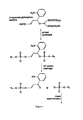
- FIG. 1 shows the structure of the linker.
- the photocleavable ⁇ -cyanoethylphosporamidite of the o-nitrobenzyl derivative can be used to replace, during primer synthesis, a regular nucleotide.
- the linker bridges the neighboring nucleotides with approximately the same distance as a regular nucleotide, but containing a 1,3-propandiol moity instead of a sugar unit.
- Hybridization of the linker-containing primer to the complementary master template is possible with any counter-nucleotide, whereby the R 2 sequence is obtained as a monophosphate.
- R 1 and R 2 are the two DNA sequences upstream and down-stream from the linker.
- Cleavage produces the R 2 sequence for mass spectrometric measurements, whereby the R 2 sequence is bound to a phosphate group with doubly negative anion character. After protonation of these two anions in the MALDI process, the phosphate group adds 81 atomic mass units to the weight of the protonated R 2 sequence. (After UV-irradiation, a second cleavage product, not shown here, containing the R1 group is formed as the 3′-monophosphate).
- FIG. 2 exhibits three mass spectra of DNA pentamers, produced from samples obtained by primer extension and cleavage according to this invention (SNP PAI1).
- the upper spectrum shows the heterozygous case, the two lower spectra present the two homozygous cases. In all three spectra, the leftovers of the non-elongated extension primers are visible; these may serve as easy mass references.
- One favorable embodiment is based on a biotinylated primer with a photocleavable linker according to the invention which is extended by exactly one base.
- the method consists of the following steps:
- a selection primer pair or primary primer pair is selected, made or purchased for amplifying a DNA product by PCR.
- These primary primers enclose the possible mutation site (or sites) over a relatively wide range. Using appropriate software programs if necessary, they are selected so that PCR amplification can be carried out using a standard procedure, i.e. by using the same process parameters for all samples.
- the primers can be ordered from specialist companies who need to be informed about the sequence.
- These selection-primer pairs are used to make enough templates to be used as the master templates for primer extension.
- extension primers (or secondary primers) are determined. It must be possible to attach them directly next to the possible mutation site. They contain a biotinylated 5′ position, a chain of approximately 10 to 20 standard nucleotides, a photocleavable linker according to the invention and approximately 3 to 7 other nucleotides up to the 3′ position. These primers can also be made by specialist companies who need to be supplied with specialized data (with the possible provision of the linker triphosphates).
- the PCR solution is cleaned from the dNTP building blocks using, for example, the enzymatic digestion of the dNTPs followed by thermal deactivation of the digestion enzyme.
- extension primer and the terminating ddNTPs and a suitable DNA polymerase extension of the primers is started by the usual temperature cycles. The temperature cycle for extension is repeated several times since extension is not always successful during the first stage.
- the uncleaned PCR solution with the extended primers is mixed with a bonding buffer and pipetted onto the anchors containing the streptavidine on the sample support plate, the biotinylated positions of the extended primer bonding to the streptavidin.
- all components of the PCR solution, the buffer, the unused ddNTPs, the templates, the remaining primary primers, the enzymes and the salts can now be removed by washing all the samples together.
- Many different samples can be attached to a single sample support plate and washed at the same time.
- the sample support plate is then dried.
- the dried sample support plate is now radiated with UV light to cleave the linkers.
- the cleavage period lasts from 5 to 30 minutes depending on the strength of the UV light.
- a solution of a MALDI matrix e.g. 3-hydroxypicolinic acid
- the plate is dried again.
- the matrix crystallizes out and the DNA cleavage products which are separated from the primers are incorporated in the tiny crystals.
- the samples on the sample support are then subjected to analysis in a MALDI mass spectrometer.
- a part of the matrix together with the analyte molecules is vaporized in a laser shot and molecules with preferably one positive or negative charge are produced by the transference of protons from the 3-HPA matrix to the DNA molecules.
- the mass of the molecules can be determined in a MALDI TOF mass spectrometer in the appropriate operating mode. The measurement is finished with a mass determination and the assignment of the sample to wild type or known mutant.
- the sample preparation for analysis using electrospray ionization mass spectrometry can be carried out in a similar way.
- the samples are not dried and all the steps of the procedure are carried out in the solution.
- Bonding to the surface-bound streptavidin can take place in a known way by using magnetic beads or the cavities of a microtitre plate with streptavidine bonded to the surfaces.
- the magnetic beads can be arrested magnetically on the walls of the cleaning vessels, such as the wells of microtitre plates.
- Another version of the method uses primers which have some phosphothioates neighboring the 3′ position and ⁇ -thiodideoxynucleoside triphosphate terminators and this involves alkylation of the phosphorothioates following primer extension in order to neutralize the DNA fragments being measured. It is then particularly beneficial to use nucleoside triphosphate derivatives such as these which have already been provided with a positively charged group such as a quaternary ammonium group as the charge tag.
- the charge-carrying group can also be attached to the phosphorothioate nucleotides of the extended primer, especially favorably at the second, third or fourth base counting from the 3′ position.
- the method consists of the following steps:
- a favorable method may appear as follows:
- the ⁇ -S nucleotides can be easily neutralized using a method such as alkylation, particularly methylation.
- the extension primer should already have a positive charge tag.
- the charge tag is preferably attached near to the 3′ position of the primer.
- the sugar-phosphate backbone between the 3′ position and the charge tag should be selected so that it can be charge-neutralized.
- the newly added extension primers are now attached to each of the strands of the PCR products serving as templates and then extended by enzymatic replication.
- DNA chain products are shortened by photolyzing the linkers with UV light. Chemical preparation then takes place giving rise to products, neutralized and provided with charge tags, which are particularly easy to ionize using MALDI.
- charge tags only makes sense if all the residual charges are removed from the DNA products in the process, since it is only then that the charge state of the analyte molecule can be fully defined.
- charge tagging and neutralizing the residual DNA the sensitivity is improved by a factor of 100 and matrices can be used which selectively support the ionized desorption of these modifications so that it is possible to carry out the mass spectrometric analysis without cleaning up.
- DNA has a polyanionic backbone.
- sulphurized internucleotide cyanoethyl phosphite bonds of the primer nucleotides between the linker and the 3′ position forming phosphorothioate nucleotides By using sulphurized internucleotide cyanoethyl phosphite bonds of the primer nucleotides between the linker and the 3′ position forming phosphorothioate nucleotides, a chemical function is produced in which the negative charge can be removed using simple chemistry, e.g. by alkylation. Neutralizing the DNA not only contributes to raising the ionization yield but also suppresses the formation of adducts and helps to stabilize the DNA in the MALDI process.
- the potential of this method lies in its ability to increase sensitivity and reduce adduct formation by the modifications implemented.
- certain classes of substances can be selectively promoted in MALDI mass spectrometry so that undesirable reaction side products can be screened out.
- the template DNA for example, can be screened out completely and therefore does not have to be removed in a cleaning process. This also increases the possibility of multiplexing. The whole process can be carried out with very little or no cleaning after the enzymatic and chemical reaction stages.
- point-mutation sites By appropriate primer design, cut functions and various distances to the point-mutation sites which are familiar to every specialist working in this area, several point-mutation sites can be analyzed simultaneously in a so-called multiplex analysis. Indeed, these sites can be analyzed on both sides of the DNA strands of the DNA double strand, i.e. in counter orientation; an internal result control is produced and, therefore, a high level of analytical reliability.
- a multiplex analysis can also be carried out simultaneously with a set of several PCR products which have been amplified in a single multiplex PCR process. Different parts of a genome are amplified simultaneously in a multiplexed PCR. After this, the analysis can be carried out on each PCR product with the necessary number of primers. The method is particularly straightforward for equal-base-number primer extensions.
Landscapes
- Chemical & Material Sciences (AREA)
- Life Sciences & Earth Sciences (AREA)
- Organic Chemistry (AREA)
- Engineering & Computer Science (AREA)
- Zoology (AREA)
- Wood Science & Technology (AREA)
- Proteomics, Peptides & Aminoacids (AREA)
- Health & Medical Sciences (AREA)
- Biophysics (AREA)
- Chemical Kinetics & Catalysis (AREA)
- Immunology (AREA)
- Microbiology (AREA)
- Molecular Biology (AREA)
- Analytical Chemistry (AREA)
- Physics & Mathematics (AREA)
- Biotechnology (AREA)
- Biochemistry (AREA)
- Bioinformatics & Cheminformatics (AREA)
- General Engineering & Computer Science (AREA)
- General Health & Medical Sciences (AREA)
- Genetics & Genomics (AREA)
- Measuring Or Testing Involving Enzymes Or Micro-Organisms (AREA)
- Other Investigation Or Analysis Of Materials By Electrical Means (AREA)
Applications Claiming Priority (2)
| Application Number | Priority Date | Filing Date | Title |
|---|---|---|---|
| DE10108453A DE10108453B4 (de) | 2001-02-22 | 2001-02-22 | Massenspektrometrische Mutationsanalyse mit photolytisch spaltbaren Primern |
| DE10108453.6 | 2001-02-22 |
Publications (2)
| Publication Number | Publication Date |
|---|---|
| US20020187493A1 US20020187493A1 (en) | 2002-12-12 |
| US7160680B2 true US7160680B2 (en) | 2007-01-09 |
Family
ID=7675060
Family Applications (1)
| Application Number | Title | Priority Date | Filing Date |
|---|---|---|---|
| US10/079,043 Expired - Lifetime US7160680B2 (en) | 2001-02-22 | 2002-02-20 | Mutation analysis by mass spectrometry using photolytically cleavable primers |
Country Status (3)
| Country | Link |
|---|---|
| US (1) | US7160680B2 (fr) |
| EP (1) | EP1234888A3 (fr) |
| DE (1) | DE10108453B4 (fr) |
Families Citing this family (48)
| Publication number | Priority date | Publication date | Assignee | Title |
|---|---|---|---|---|
| DE10015797B4 (de) * | 2000-03-26 | 2006-02-02 | Bruker Daltonik Gmbh | Multiplex-Analyse von DNA-Gemischen mittels photolytisch ablesbarer DNA-Chips |
| US7718354B2 (en) | 2001-03-02 | 2010-05-18 | Ibis Biosciences, Inc. | Methods for rapid identification of pathogens in humans and animals |
| WO2004060278A2 (fr) | 2002-12-06 | 2004-07-22 | Isis Pharmaceuticals, Inc. | Procedes d'identification rapide de pathogenes chez l'homme et les betes |
| US20040121309A1 (en) | 2002-12-06 | 2004-06-24 | Ecker David J. | Methods for rapid detection and identification of bioagents in blood, bodily fluids, and bodily tissues |
| US20030027135A1 (en) | 2001-03-02 | 2003-02-06 | Ecker David J. | Method for rapid detection and identification of bioagents |
| US7666588B2 (en) | 2001-03-02 | 2010-02-23 | Ibis Biosciences, Inc. | Methods for rapid forensic analysis of mitochondrial DNA and characterization of mitochondrial DNA heteroplasmy |
| US7226739B2 (en) | 2001-03-02 | 2007-06-05 | Isis Pharmaceuticals, Inc | Methods for rapid detection and identification of bioagents in epidemiological and forensic investigations |
| DE10112387B4 (de) | 2001-03-15 | 2004-03-25 | Bruker Daltonik Gmbh | Massenspektrometrische Genotypisierung |
| US7217510B2 (en) | 2001-06-26 | 2007-05-15 | Isis Pharmaceuticals, Inc. | Methods for providing bacterial bioagent characterizing information |
| US8073627B2 (en) | 2001-06-26 | 2011-12-06 | Ibis Biosciences, Inc. | System for indentification of pathogens |
| US8046171B2 (en) | 2003-04-18 | 2011-10-25 | Ibis Biosciences, Inc. | Methods and apparatus for genetic evaluation |
| US8057993B2 (en) | 2003-04-26 | 2011-11-15 | Ibis Biosciences, Inc. | Methods for identification of coronaviruses |
| US7964343B2 (en) | 2003-05-13 | 2011-06-21 | Ibis Biosciences, Inc. | Method for rapid purification of nucleic acids for subsequent analysis by mass spectrometry by solution capture |
| US8158354B2 (en) | 2003-05-13 | 2012-04-17 | Ibis Biosciences, Inc. | Methods for rapid purification of nucleic acids for subsequent analysis by mass spectrometry by solution capture |
| EP1493824A1 (fr) * | 2003-07-02 | 2005-01-05 | Consortium National de Recherche en Genomique (CNRG) | Méthode de détection de mutation dans l'ADN |
| US8097416B2 (en) * | 2003-09-11 | 2012-01-17 | Ibis Biosciences, Inc. | Methods for identification of sepsis-causing bacteria |
| US8546082B2 (en) | 2003-09-11 | 2013-10-01 | Ibis Biosciences, Inc. | Methods for identification of sepsis-causing bacteria |
| US8242254B2 (en) | 2003-09-11 | 2012-08-14 | Ibis Biosciences, Inc. | Compositions for use in identification of bacteria |
| US7666592B2 (en) | 2004-02-18 | 2010-02-23 | Ibis Biosciences, Inc. | Methods for concurrent identification and quantification of an unknown bioagent |
| US8119336B2 (en) | 2004-03-03 | 2012-02-21 | Ibis Biosciences, Inc. | Compositions for use in identification of alphaviruses |
| ES2641832T3 (es) | 2004-05-24 | 2017-11-14 | Ibis Biosciences, Inc. | Espectrometría de masas con filtración de iones selectiva por establecimiento de umbrales digitales |
| US20050266411A1 (en) | 2004-05-25 | 2005-12-01 | Hofstadler Steven A | Methods for rapid forensic analysis of mitochondrial DNA |
| US7811753B2 (en) | 2004-07-14 | 2010-10-12 | Ibis Biosciences, Inc. | Methods for repairing degraded DNA |
| WO2006135400A2 (fr) | 2004-08-24 | 2006-12-21 | Isis Pharmaceuticals, Inc. | Procedes pour l'identification rapide d'organismes recombinants |
| DE102004058555A1 (de) * | 2004-12-03 | 2006-06-08 | Qiagen Gmbh | Verfahren zur Aufkonzentrierung von Biomolekülen in der Nähe der Oberfläche einer kristallinen Struktur |
| US20060205040A1 (en) | 2005-03-03 | 2006-09-14 | Rangarajan Sampath | Compositions for use in identification of adventitious viruses |
| US8084207B2 (en) | 2005-03-03 | 2011-12-27 | Ibis Bioscience, Inc. | Compositions for use in identification of papillomavirus |
| JP2009502137A (ja) | 2005-07-21 | 2009-01-29 | アイシス ファーマシューティカルズ インコーポレイティッド | 核酸変種の迅速な同定および定量のための方法 |
| DE102006007778B3 (de) * | 2006-02-20 | 2007-11-08 | Biotype Ag | Verfahren zur Analyse von Multiplex-Gemischen bestehend aus Nukleinsäure-Amplifikationsprodukten mit überlappenden Detektionsbereichen |
| EP2010679A2 (fr) | 2006-04-06 | 2009-01-07 | Ibis Biosciences, Inc. | Compositions pour l'identification de champignons |
| US20080213841A1 (en) * | 2006-08-21 | 2008-09-04 | Pondicherry Biotech Private Limited | Novel Method for Assembling DNA Metasegments to use as Substrates for Homologous Recombination in a Cell |
| US9149473B2 (en) | 2006-09-14 | 2015-10-06 | Ibis Biosciences, Inc. | Targeted whole genome amplification method for identification of pathogens |
| EP2126132B1 (fr) | 2007-02-23 | 2013-03-20 | Ibis Biosciences, Inc. | Procédé d'analyse d'adn médico-légale rapide |
| WO2008151023A2 (fr) | 2007-06-01 | 2008-12-11 | Ibis Biosciences, Inc. | Procédés et compositions pour l'amplification par déplacement multiple d'acides nucléiques |
| US8148163B2 (en) | 2008-09-16 | 2012-04-03 | Ibis Biosciences, Inc. | Sample processing units, systems, and related methods |
| WO2010033625A1 (fr) | 2008-09-16 | 2010-03-25 | Ibis Biosciences, Inc. | Systèmes de manipulation de microplaques et produits-programmes informatiques et procédés connexes |
| US8550694B2 (en) | 2008-09-16 | 2013-10-08 | Ibis Biosciences, Inc. | Mixing cartridges, mixing stations, and related kits, systems, and methods |
| EP2396803A4 (fr) | 2009-02-12 | 2016-10-26 | Ibis Biosciences Inc | Ensembles sonde d'ionisation |
| US9719083B2 (en) | 2009-03-08 | 2017-08-01 | Ibis Biosciences, Inc. | Bioagent detection methods |
| WO2010114842A1 (fr) | 2009-03-30 | 2010-10-07 | Ibis Biosciences, Inc. | Systèmes, dispositifs et procédés de détection d'agent biologique |
| US8950604B2 (en) | 2009-07-17 | 2015-02-10 | Ibis Biosciences, Inc. | Lift and mount apparatus |
| EP2454000A4 (fr) | 2009-07-17 | 2016-08-10 | Ibis Biosciences Inc | Systèmes pour l'identification d'un bioagent |
| WO2011014811A1 (fr) | 2009-07-31 | 2011-02-03 | Ibis Biosciences, Inc. | Amorces de capture et supports solides liés à une séquence de capture pour tests diagnostiques moléculaires |
| EP3098325A1 (fr) | 2009-08-06 | 2016-11-30 | Ibis Biosciences, Inc. | Compositions de base déterminée sans masse pour la détection d'acide nucléique |
| EP2488656B1 (fr) | 2009-10-15 | 2015-06-03 | Ibis Biosciences, Inc. | Amplification par déplacement multiple |
| US9758840B2 (en) | 2010-03-14 | 2017-09-12 | Ibis Biosciences, Inc. | Parasite detection via endosymbiont detection |
| WO2023278333A1 (fr) * | 2021-06-28 | 2023-01-05 | Somalogic Operating Co., Inc. | Génération de colonies monoclonales et organisation spatiale à l'aide de structures supramoléculaires d'acides nucléiques |
| CN118711661B (zh) * | 2024-06-28 | 2025-08-22 | 中国科学院天津工业生物技术研究所 | 一种面向质粒点突变改造引物设计的自动化在线工具 |
Citations (4)
| Publication number | Priority date | Publication date | Assignee | Title |
|---|---|---|---|---|
| US5547835A (en) * | 1993-01-07 | 1996-08-20 | Sequenom, Inc. | DNA sequencing by mass spectrometry |
| WO1997027325A2 (fr) * | 1996-01-23 | 1997-07-31 | Rapigene, Inc. | Procedes et compositions servant a analyser des molecules d'acides nucleiques au moyen de techniques de dimensionnement |
| US5830655A (en) * | 1995-05-22 | 1998-11-03 | Sri International | Oligonucleotide sizing using cleavable primers |
| US6043031A (en) | 1995-03-17 | 2000-03-28 | Sequenom, Inc. | DNA diagnostics based on mass spectrometry |
Family Cites Families (7)
| Publication number | Priority date | Publication date | Assignee | Title |
|---|---|---|---|---|
| GB9504598D0 (en) * | 1995-03-03 | 1995-04-26 | Imp Cancer Res Tech | Method of nucleic acid analysis |
| AU2069597A (en) * | 1996-03-04 | 1997-09-22 | Genetrace Systems, Inc. | Methods of screening nucleic acids using mass spectrometry |
| EP1002128A1 (fr) * | 1997-07-11 | 2000-05-24 | Brax Genomics Limited | Caracterisation des acides nucleiques |
| CA2312945A1 (fr) * | 1997-12-05 | 1999-06-17 | Max-Planck-Gesellschaft Zur Forderung Der Wissenschaften E.V. | Procede d'identification d'acides nucleiques par spectrometrie de masse par electropulverisation |
| DE19824280B4 (de) * | 1998-05-29 | 2004-08-19 | Bruker Daltonik Gmbh | Mutationsanalyse mittels Massenspektrometrie |
| EP1170379A1 (fr) * | 2000-06-30 | 2002-01-09 | Centre National de Genotypage | Génération des échantillons pour déterminer le génotype par spectroscopie de masse |
| EP1333101B1 (fr) * | 2002-02-01 | 2007-03-28 | Bruker Daltonik GmbH | Analyse de mutations par PCR et spectrométrie de masse |
-
2001
- 2001-02-22 DE DE10108453A patent/DE10108453B4/de not_active Expired - Lifetime
-
2002
- 2002-02-01 EP EP02002521A patent/EP1234888A3/fr not_active Withdrawn
- 2002-02-20 US US10/079,043 patent/US7160680B2/en not_active Expired - Lifetime
Patent Citations (6)
| Publication number | Priority date | Publication date | Assignee | Title |
|---|---|---|---|---|
| US5547835A (en) * | 1993-01-07 | 1996-08-20 | Sequenom, Inc. | DNA sequencing by mass spectrometry |
| US6043031A (en) | 1995-03-17 | 2000-03-28 | Sequenom, Inc. | DNA diagnostics based on mass spectrometry |
| US6221601B1 (en) * | 1995-03-17 | 2001-04-24 | Sequenom, Inc. | DNA diagnostics based on mass spectrometry |
| US5830655A (en) * | 1995-05-22 | 1998-11-03 | Sri International | Oligonucleotide sizing using cleavable primers |
| WO1997027325A2 (fr) * | 1996-01-23 | 1997-07-31 | Rapigene, Inc. | Procedes et compositions servant a analyser des molecules d'acides nucleiques au moyen de techniques de dimensionnement |
| EP0840804B1 (fr) | 1996-01-23 | 2000-04-05 | Rapigene, Inc. | Procedes et compositions servant a analyser des molecules d'acides nucleiques au moyen de techniques de dimensionnement |
Non-Patent Citations (2)
| Title |
|---|
| Phillip Ordoukhanian and John-Stephen Taylor, Design and Synthesis of a Versatile Photocleavable DNA Building Block. Application to Phototriggered Hybridization, American Chemical Society 1995, vol. 117, pp. 9570-9571, St. Louis, Missouri. |
| Sascha Sauer, et al., A novel procedure for efficient genotyping of single nucleotide polymorphisms, Nucleic Acids Research, 2000, vol. 28, No. 5, Oxford University Press, Berlin-Dahlem, Germany. |
Also Published As
| Publication number | Publication date |
|---|---|
| US20020187493A1 (en) | 2002-12-12 |
| DE10108453A1 (de) | 2002-09-12 |
| EP1234888A3 (fr) | 2004-01-02 |
| EP1234888A2 (fr) | 2002-08-28 |
| DE10108453B4 (de) | 2005-10-20 |
Similar Documents
| Publication | Publication Date | Title |
|---|---|---|
| US7160680B2 (en) | Mutation analysis by mass spectrometry using photolytically cleavable primers | |
| US6750022B2 (en) | Mutation analysis by PCR and mass spectrometry | |
| US9051608B2 (en) | Detection and quantification of biomolecules using mass spectrometry | |
| US8133701B2 (en) | Detection and quantification of biomolecules using mass spectrometry | |
| Limbach | Indirect mass spectrometric methods for characterizing and sequencing oligonucleotides | |
| CA2671864C (fr) | Detection et quantification de biomolecules a l'aide de la spectrometrie de masse | |
| EP1400599B1 (fr) | Sondes d'hybridation couplées à des marqueurs de masse | |
| CA2741959C (fr) | Sequencage de molecules d'acides nucleiques par spectrometrie de masse | |
| JP2001505045A (ja) | 質量決定による核酸検出方法 | |
| JP2019041769A (ja) | 構造に基づくプローブ切断による核酸標的の同定 | |
| JP6542777B2 (ja) | 構造に基づくプローブ切断によるマルチプレックス核酸標的同定 | |
| US6699668B1 (en) | Mass label linked hybridisation probes | |
| CN106687597A (zh) | 通过基于结构的探针切割鉴定核酸靶标 | |
| WO1999014362A1 (fr) | Caracterisation d'acide nucleique par spectrometrie de masse | |
| Timar | 5 Sequence Determination and Confirmation by |
Legal Events
| Date | Code | Title | Description |
|---|---|---|---|
| AS | Assignment |
Owner name: BRUKER SAXONIA ANALYTIK GMBH, GERMANY Free format text: ASSIGNMENT OF ASSIGNORS INTEREST;ASSIGNORS:KOSTRZEWA, MARKUS;FROHLICH, THOMAS;WENZEL, THOMAS;AND OTHERS;REEL/FRAME:013099/0915;SIGNING DATES FROM 20020325 TO 20020707 |
|
| STCF | Information on status: patent grant |
Free format text: PATENTED CASE |
|
| CC | Certificate of correction | ||
| FEPP | Fee payment procedure |
Free format text: PAYOR NUMBER ASSIGNED (ORIGINAL EVENT CODE: ASPN); ENTITY STATUS OF PATENT OWNER: LARGE ENTITY |
|
| FPAY | Fee payment |
Year of fee payment: 4 |
|
| FPAY | Fee payment |
Year of fee payment: 8 |
|
| MAFP | Maintenance fee payment |
Free format text: PAYMENT OF MAINTENANCE FEE, 12TH YEAR, LARGE ENTITY (ORIGINAL EVENT CODE: M1553) Year of fee payment: 12 |
|
| AS | Assignment |
Owner name: BRUKER DALTONICS GMBH & CO. KG, GERMANY Free format text: NUNC PRO TUNC ASSIGNMENT;ASSIGNOR:BRUKER DALTONIK GMBH;REEL/FRAME:057209/0070 Effective date: 20210531 |