US7561532B2 - Method and device for designing a data network - Google Patents
Method and device for designing a data network Download PDFInfo
- Publication number
- US7561532B2 US7561532B2 US10/538,833 US53883305A US7561532B2 US 7561532 B2 US7561532 B2 US 7561532B2 US 53883305 A US53883305 A US 53883305A US 7561532 B2 US7561532 B2 US 7561532B2
- Authority
- US
- United States
- Prior art keywords
- network
- complexity
- network configuration
- flows
- probability
- Prior art date
- Legal status (The legal status is an assumption and is not a legal conclusion. Google has not performed a legal analysis and makes no representation as to the accuracy of the status listed.)
- Expired - Fee Related, expires
Links
Images



Classifications
-
- H—ELECTRICITY
- H04—ELECTRIC COMMUNICATION TECHNIQUE
- H04L—TRANSMISSION OF DIGITAL INFORMATION, e.g. TELEGRAPHIC COMMUNICATION
- H04L45/00—Routing or path finding of packets in data switching networks
Definitions
- the present invention refers to a method and a device for designing a transport network.
- an optimum design of a network is conducted only when a new network is planned for the first time.
- path and link capacities of a network are designed for a given specific traffic demand.
- an optimisation of the network design is conducted, and an optimum network minimizing the cost is designed.
- the demand pattern changes from the pattern considered during the initial planning phase, it is likely that the efficiency of the network decreases day after day.
- U.S. Pat. No. 6,223,220 a method of designing a computer network is disclosed making use of an object-based computer representation which allows on-screen linking of a service object, representative of a network service, to site objects representative of physical sites on a wide-area network.
- the user specifies expected traffic demands between the sites, and an algorithm calculates a physical connectivity map representative of proposed hardware circuits linking physical sites.
- the Applicant has tackled the problem of designing or optimising a transport network, or even a single network node, in order to satisfy an estimated future traffic demand on the network, with particular attention to realization and reorganization costs.
- a network design and analysis method allowing to evaluate the flow's cost for different network structures is described.
- flow is intended as the allocation, on a transport network system, of an amount of structured bandwidth.
- the Applicant observes that one of the main goals when a telecommunication network has to be planned or optimised, is to understand which is the best topology to adopt in order to satisfy the traffic demand and, preferably, to save money.
- the Applicant is of the opinion that, since one would hardly know how the traffic demand will evolve in a network, it would be useful to a network administrator/designer to have a methodology able to show, for different network topologies, the probability to satisfy client's needs.
- a method and a device for designing a transport network the network having a plurality of network elements and a plurality of connections connecting the elements, comprising means for defining a plurality of alternative network topologies to be analysed, means for evaluating, for each alternative topology, a probability of satisfying a maximum number n of flows, and means for evaluating a flow's relative cost for the alternative topologies, allowing to understand which is the best configuration or evolution for the network under study.
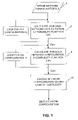
- FIG. 1 is a flow diagram of a method of designing a transport network realized according to the present invention
- FIG. 2 is a detailed flow diagram of a probability evaluation routine used in the method shown in FIG. 1 ;
- FIG. 3 is a block diagram of a first network topology considered for illustrating a method according to the present invention
- FIG. 4 is a block diagram of a second network topology considered for illustrating a method according to the present invention
- FIG. 5 is a graph showing a probability of satisfying a maximum number n of flows
- FIG. 6 is a graph showing a flow's unit cost as a function of the probability of satisfying a maximum number n of flows.
- FIG. 7 is a graph showing comparison results of a method/device realized according to the present invention.
- each configuration being defined by a plurality of network elements interconnected by a plurality of connections.
- a first network configuration can be, for example, the configuration of an existing network which will be compared with a number of alternative network configurations, in case the design method is used for optimising an existing network or node; otherwise the method according to the invention can be used as a design tool for designing a new network architecture or even a single node of a network.
- this step calculates, for each alternative network configuration X i , a probability function P(n) representing, for each maximum number n of routable flows, the probability of routing such a number of flows in the network configuration currently considered;
- a complexity value representative of a flow's unitary cost, for different network configurations; this step calculates, for each alternative network configuration, a complexity function C i (n), corresponding, in terms of costs, to a unit-cost-per-flow function, calculated as the ratio between a sum of complexity factors, or costs, relative to the network elements of the network configuration currently considered and the probability function P(n) previously obtained;
- this step is performed by comparing each other the complexity, or unit-cost-per-flow, functions C i (n) of the alternative network configurations, for choosing a network configuration having a lowest unit-cost-per-flow, or complexity, value.
- a random number in the range between 1 and the number of nodes/equipments of the network is generated (block 26 in FIG. 2 ); this number represents the flow's origin (block 22 in FIG. 2 ).
- a second random number, belonging to the same range but different to the first one, is then generated (block 28 in FIG. 2 ); this second number will be the flow's destination (block 24 in FIG. 2 ).
- a polarized traffic demand has to be considered, different weights have to be assigned to one or more directions (a direction is the path between origin and destination), in the traffic generator (blocks 26 and 28 of FIG. 2 ).
- the process tries to route it on the cheapest path, that's to say on the path using only one hop (block 30 FIG. 2 ). If this path is free, the flow is routed, a partial counter n_OK of maximum routable flows is increased (block 32 FIG. 2 ), and a new flow is generated (routine 20 is re-executed until no more routable flows can be found). Otherwise, the process tries to route the same flow on a more expensive path (i.e. a two hops path, block 34 of FIG. 2 , and so on, up to n-hops path, block 36 of FIG. 2 . When it is not possible anymore to route a path inside the network's structure under study, routine 20 terminates, and a maximum number of flows routable n_OK is obtained.
- n_OK(i) are used for calculating the probability function P(n), as the empirical probability of an event can be defined as the ratio between the number of favourable outcomes and the total number of outcomes:
- F(n) is the frequency of each maximum number n of routable flows, and m is the number of times the procedure has been repeated.
- the maximum number n of routable flows corresponds to the value n_OK previously determined.
- the step previously described is repeated for every network configuration X i under evaluation, calculating, for each configuration, a probability function P i (n). In this way, the maximum number of flows routable inside the network is evaluated for all network configurations.
- the method considers the number of transmitting elements, or network elements, used in the different network's structures analysed and their relative complexity, or costs, for calculating a complexity function C i (n) representing a unitary cost per flow for each network configuration.
- the function C i (n) which is a function of the maximum number of routable flows, corresponds to a unit-cost-per-flow function and is defined as follows:
- Function C i (n) represents, for each alternative network configuration X i , the ratio between a sum of the costs (relativecost(j)) relative to the network elements of the network configuration currently considered, which are proportional to the complexity of the same network elements, and the corresponding probability function P i (n).
- the step of comparing the unit-cost-per-flow functions C i (n) is performed calculating the function C i (n) in correspondence of a particular estimated maximum number n of routable flows.
- the estimated maximum number n of routable flows can be based, for example, on a forecast.
- the method described above can be implemented in a device, whose structure is as well represented by the diagram of FIG. 1 , for designing a transport network comprising the following main units:
- a network configuration unit 4 for defining a first network configuration and at least one alternative network configuration
- a probability evaluation unit 6 for calculating, for each network configuration X i , a probability function P i (n) representing, for each maximum number n of routable flows, the probability of routing such a number of flows in the network configuration currently considered;
- a complexity, or unit-cost-per-flow, evaluation unit 8 for calculating, for each network configuration, a complexity function C i (n) calculated as the ratio between a sum of the costs relative to the network elements of the network configuration currently considered X i and the probability function P i (n);
- a comparison unit 10 for comparing the complexity functions C i (n) of the network configurations, for choosing a network configuration having a lowest complexity, or unit-cost-per-flow, value.
- the method and device according to the present invention can be implemented as a computer program comprising computer program code means adapted to run on a computer.
- Such computer program can be embodied on a computer readable medium.
- FIGS. 3 and 4 a Mesh topology and a Star topology connecting five Network Elements NE 1 . . . NE 5 inside a same node. It is supposed that, for each Network Element, 24 ports are dedicated to connect the elements each other, in the way described in FIGS. 3 and 4 .
- the values of the probability P(n) of routing at maximum n flows for the two topologies considered are shown in the graph diagram represented in FIG. 5 .
- the two curves 42 , 44 represent, respectively, the probability to satisfy at maximum n flows for the Mesh and for the Star topology.
- the chart of FIG. 7 can be used for determining three different regions, indicated by the black arrows 54 , 56 and 58 , showing different regions of decision.
- the chart shows that if one knows that, inside the network under study, it will not be necessary to route more than 55 flows, the Mesh topology will be more economical, on the other hand, if it will be necessary to route, at maximum, between 56 and 58 flows, the two topologies will be equivalent, ultimately, if it will be necessary to route more than 58 flows, the Star topology will be more convenient than the Mesh one.
Landscapes
- Engineering & Computer Science (AREA)
- Computer Networks & Wireless Communication (AREA)
- Signal Processing (AREA)
- Data Exchanges In Wide-Area Networks (AREA)
- Selective Calling Equipment (AREA)
- Communication Control (AREA)
Applications Claiming Priority (1)
| Application Number | Priority Date | Filing Date | Title |
|---|---|---|---|
| PCT/EP2002/014312 WO2004056041A1 (en) | 2002-12-16 | 2002-12-16 | Method and device for designing a data network |
Publications (2)
| Publication Number | Publication Date |
|---|---|
| US20060067234A1 US20060067234A1 (en) | 2006-03-30 |
| US7561532B2 true US7561532B2 (en) | 2009-07-14 |
Family
ID=32523969
Family Applications (1)
| Application Number | Title | Priority Date | Filing Date |
|---|---|---|---|
| US10/538,833 Expired - Fee Related US7561532B2 (en) | 2002-12-16 | 2002-12-16 | Method and device for designing a data network |
Country Status (10)
| Country | Link |
|---|---|
| US (1) | US7561532B2 (de) |
| EP (1) | EP1573961B1 (de) |
| CN (1) | CN100356726C (de) |
| AT (1) | ATE406015T1 (de) |
| AU (1) | AU2002368461A1 (de) |
| BR (1) | BRPI0215978B1 (de) |
| CA (1) | CA2507598C (de) |
| DE (1) | DE60228506D1 (de) |
| ES (1) | ES2314134T3 (de) |
| WO (1) | WO2004056041A1 (de) |
Cited By (3)
| Publication number | Priority date | Publication date | Assignee | Title |
|---|---|---|---|---|
| US20050188059A1 (en) * | 2004-01-05 | 2005-08-25 | Sbc Knowledge Ventures, L.P. | System and method for ethernet network design |
| US20060083170A1 (en) * | 2004-10-19 | 2006-04-20 | Silva Claudio B | Method and apparatus for automatically determining the manner in which to allocate available capital to achieve a desired level of network quality performance |
| US10491748B1 (en) | 2006-04-03 | 2019-11-26 | Wai Wu | Intelligent communication routing system and method |
Families Citing this family (5)
| Publication number | Priority date | Publication date | Assignee | Title |
|---|---|---|---|---|
| US20060025984A1 (en) * | 2004-08-02 | 2006-02-02 | Microsoft Corporation | Automatic validation and calibration of transaction-based performance models |
| ATE486482T1 (de) | 2005-06-30 | 2010-11-15 | Telecom Italia Spa | Verfahren und system zur steuerung der zuteilung von diensten in einem kommunikationsnetz und computerprogrammprodukt |
| US7532586B2 (en) | 2005-07-18 | 2009-05-12 | Sbc Knowledge Ventures, L.P. | Method of augmenting deployed networks |
| CN101252484B (zh) * | 2008-04-11 | 2011-08-17 | 清华大学 | 基于自适应非线性抽样方法的每流分组数目统计装置 |
| US9832073B2 (en) * | 2013-10-17 | 2017-11-28 | Cisco Technology, Inc. | Analyzing network configuration complexity |
Citations (7)
| Publication number | Priority date | Publication date | Assignee | Title |
|---|---|---|---|---|
| US5809282A (en) | 1995-06-07 | 1998-09-15 | Grc International, Inc. | Automated network simulation and optimization system |
| US6223220B1 (en) | 1997-04-15 | 2001-04-24 | British Telecommunications Public Limited Company | Design of computer networks |
| US6285688B1 (en) | 1996-02-22 | 2001-09-04 | Mci Communications Corporation | Network management system |
| US20020036988A1 (en) * | 2000-07-31 | 2002-03-28 | Network Design Tools, Inc. | Method for designing rings in telecommunications network |
| US20020097716A1 (en) * | 2000-11-01 | 2002-07-25 | Krishnan Kumaran | Method and apparatus for processing of regulated connections in a communication network |
| US20020186665A1 (en) * | 2001-03-14 | 2002-12-12 | Donald Chaffee | Efficient path learning in network |
| US20040095887A1 (en) * | 2000-01-18 | 2004-05-20 | At&T Corp. | Apparatus and method for designing a network |
Family Cites Families (4)
| Publication number | Priority date | Publication date | Assignee | Title |
|---|---|---|---|---|
| US5274643A (en) * | 1992-12-11 | 1993-12-28 | Stratacom, Inc. | Method for optimizing a network having virtual circuit routing over virtual paths |
| US5442347A (en) * | 1993-01-25 | 1995-08-15 | The United States Of America As Represented By The Administrater, National Aeronautics & Space Administration | Double-driven shield capacitive type proximity sensor |
| GB9410461D0 (en) * | 1994-05-25 | 1994-07-13 | Coveley Michael | Removal detector circuit |
| NZ527384A (en) * | 2001-02-07 | 2005-05-27 | Gerenraich Family Trust | Control system with capacitive sensor to provide a signal responsive to a rate of change in capacitance |
-
2002
- 2002-12-16 AU AU2002368461A patent/AU2002368461A1/en not_active Abandoned
- 2002-12-16 BR BRPI0215978A patent/BRPI0215978B1/pt not_active IP Right Cessation
- 2002-12-16 WO PCT/EP2002/014312 patent/WO2004056041A1/en not_active Ceased
- 2002-12-16 AT AT02808238T patent/ATE406015T1/de not_active IP Right Cessation
- 2002-12-16 EP EP02808238A patent/EP1573961B1/de not_active Expired - Lifetime
- 2002-12-16 CA CA2507598A patent/CA2507598C/en not_active Expired - Fee Related
- 2002-12-16 ES ES02808238T patent/ES2314134T3/es not_active Expired - Lifetime
- 2002-12-16 DE DE60228506T patent/DE60228506D1/de not_active Expired - Lifetime
- 2002-12-16 US US10/538,833 patent/US7561532B2/en not_active Expired - Fee Related
- 2002-12-16 CN CNB028300491A patent/CN100356726C/zh not_active Expired - Fee Related
Patent Citations (7)
| Publication number | Priority date | Publication date | Assignee | Title |
|---|---|---|---|---|
| US5809282A (en) | 1995-06-07 | 1998-09-15 | Grc International, Inc. | Automated network simulation and optimization system |
| US6285688B1 (en) | 1996-02-22 | 2001-09-04 | Mci Communications Corporation | Network management system |
| US6223220B1 (en) | 1997-04-15 | 2001-04-24 | British Telecommunications Public Limited Company | Design of computer networks |
| US20040095887A1 (en) * | 2000-01-18 | 2004-05-20 | At&T Corp. | Apparatus and method for designing a network |
| US20020036988A1 (en) * | 2000-07-31 | 2002-03-28 | Network Design Tools, Inc. | Method for designing rings in telecommunications network |
| US20020097716A1 (en) * | 2000-11-01 | 2002-07-25 | Krishnan Kumaran | Method and apparatus for processing of regulated connections in a communication network |
| US20020186665A1 (en) * | 2001-03-14 | 2002-12-12 | Donald Chaffee | Efficient path learning in network |
Non-Patent Citations (1)
| Title |
|---|
| López et al., "Optimizing Network Throughput: Optimal Versus Robust Design"; Proceedings of the Seventh Euromicro workshop on Funchal, Portugal, Feb. 3-5, 1999, Parallel and Distributed Processing, IEEE Comput. Soc., pp. 45-52, (1999). |
Cited By (6)
| Publication number | Priority date | Publication date | Assignee | Title |
|---|---|---|---|---|
| US20050188059A1 (en) * | 2004-01-05 | 2005-08-25 | Sbc Knowledge Ventures, L.P. | System and method for ethernet network design |
| US7610361B2 (en) * | 2004-01-05 | 2009-10-27 | At&T Intellectual Property I, L.P. | System and method for ethernet network design |
| US8239502B2 (en) | 2004-01-05 | 2012-08-07 | At&T Intellectual Property I, L.P. | System and method for network design |
| US20060083170A1 (en) * | 2004-10-19 | 2006-04-20 | Silva Claudio B | Method and apparatus for automatically determining the manner in which to allocate available capital to achieve a desired level of network quality performance |
| US7929459B2 (en) * | 2004-10-19 | 2011-04-19 | At&T Mobility Ii Llc | Method and apparatus for automatically determining the manner in which to allocate available capital to achieve a desired level of network quality performance |
| US10491748B1 (en) | 2006-04-03 | 2019-11-26 | Wai Wu | Intelligent communication routing system and method |
Also Published As
| Publication number | Publication date |
|---|---|
| US20060067234A1 (en) | 2006-03-30 |
| BR0215978A (pt) | 2005-11-01 |
| ES2314134T3 (es) | 2009-03-16 |
| WO2004056041A1 (en) | 2004-07-01 |
| CN1714535A (zh) | 2005-12-28 |
| CA2507598C (en) | 2011-09-20 |
| EP1573961B1 (de) | 2008-08-20 |
| BRPI0215978B1 (pt) | 2016-06-28 |
| AU2002368461A1 (en) | 2004-07-09 |
| CN100356726C (zh) | 2007-12-19 |
| EP1573961A1 (de) | 2005-09-14 |
| DE60228506D1 (de) | 2008-10-02 |
| CA2507598A1 (en) | 2004-07-01 |
| ATE406015T1 (de) | 2008-09-15 |
Similar Documents
| Publication | Publication Date | Title |
|---|---|---|
| US7920468B2 (en) | Method and system for constraint-based traffic flow optimisation system | |
| US6831895B1 (en) | Methods and devices for relieving congestion in hop-by-hop routed packet networks | |
| Zhao et al. | Towards unbiased end-to-end network diagnosis | |
| US7688740B1 (en) | System and method for identifying cost metrics for a network | |
| Liu et al. | OpenMeasure: Adaptive flow measurement & inference with online learning in SDN | |
| Nucci et al. | Design of IGP link weight changes for estimation of traffic matrices | |
| US20090285124A1 (en) | Wireless mesh network transit link topology optimization method and system | |
| EP1762053B1 (de) | Verfahren und Ssystem zur Netzwerktopologie-Aktualisierung unter Verwendung einer Topologie-Perturbation | |
| Park et al. | A neural network based multi-destination routing algorithm for communication network | |
| US7263069B2 (en) | Arrangement for evaluating network capacity, network utilization, and network efficiency in a communications network | |
| Ren et al. | A new scheme for IoT service function chains orchestration in SDN-IoT network systems | |
| US20060067234A1 (en) | Method and device for designing a data network | |
| Alenazi et al. | Cost-Efficient network improvement to achieve maximum path diversity | |
| Syaifuddin et al. | Comparison analysis of multipath routing implementation in software defined network | |
| Schneider et al. | Verifying maximum link loads in a changing world | |
| Eramo et al. | Design and evaluation of a new multi-path incremental routing algorithm on software routers | |
| Herrera et al. | Bipartite networks to enable management of internet core and metro infrastructure | |
| Kirilin et al. | A protocol-ignorance perspective on incremental deployability of routing protocols | |
| Salman et al. | A New Software Framework for Traffic Engineering: Path Cardinality and the Effect of Multipath on Residual Capacity | |
| Lawniczak et al. | Impact of source load and routing on QoS of packets delivery | |
| Alenazi | Network resilience improvement and evaluation using link additions | |
| Gaipov et al. | Using of the contour method to solving the problem of optimal traffic dis-tribution in the network | |
| Mohan et al. | A data mining approach for predicting reliable path for congestion free routing using self-motivated neural network | |
| Matsumura et al. | Linear programming approach to link capacity design for shared protection | |
| Feng | Concentrated network tomography and bound-based network tomography |
Legal Events
| Date | Code | Title | Description |
|---|---|---|---|
| AS | Assignment |
Owner name: TELECOM ITALIA S.P.A., ITALY Free format text: ASSIGNMENT OF ASSIGNORS INTEREST;ASSIGNORS:BOSSI, MARIACHIARA;ALLASIA, ANDREA;VARETTO, LIUIGI GIUSEPPE;AND OTHERS;REEL/FRAME:017377/0263 Effective date: 20050418 |
|
| FEPP | Fee payment procedure |
Free format text: PAYOR NUMBER ASSIGNED (ORIGINAL EVENT CODE: ASPN); ENTITY STATUS OF PATENT OWNER: LARGE ENTITY |
|
| STCF | Information on status: patent grant |
Free format text: PATENTED CASE |
|
| FPAY | Fee payment |
Year of fee payment: 4 |
|
| FPAY | Fee payment |
Year of fee payment: 8 |
|
| FEPP | Fee payment procedure |
Free format text: MAINTENANCE FEE REMINDER MAILED (ORIGINAL EVENT CODE: REM.); ENTITY STATUS OF PATENT OWNER: LARGE ENTITY |
|
| LAPS | Lapse for failure to pay maintenance fees |
Free format text: PATENT EXPIRED FOR FAILURE TO PAY MAINTENANCE FEES (ORIGINAL EVENT CODE: EXP.); ENTITY STATUS OF PATENT OWNER: LARGE ENTITY |
|
| STCH | Information on status: patent discontinuation |
Free format text: PATENT EXPIRED DUE TO NONPAYMENT OF MAINTENANCE FEES UNDER 37 CFR 1.362 |
|
| FP | Lapsed due to failure to pay maintenance fee |
Effective date: 20210714 |