US7638993B2 - Method of feedback controlling a switched regulator - Google Patents
Method of feedback controlling a switched regulator Download PDFInfo
- Publication number
- US7638993B2 US7638993B2 US11/767,082 US76708207A US7638993B2 US 7638993 B2 US7638993 B2 US 7638993B2 US 76708207 A US76708207 A US 76708207A US 7638993 B2 US7638993 B2 US 7638993B2
- Authority
- US
- United States
- Prior art keywords
- cycle
- duty
- pwm
- percentage
- decrementing
- Prior art date
- Legal status (The legal status is an assumption and is not a legal conclusion. Google has not performed a legal analysis and makes no representation as to the accuracy of the status listed.)
- Expired - Fee Related, expires
Links
- 238000000034 method Methods 0.000 title claims abstract description 69
- 230000001105 regulatory effect Effects 0.000 claims abstract description 26
- 230000001276 controlling effect Effects 0.000 claims description 3
- 238000004088 simulation Methods 0.000 description 14
- 230000003247 decreasing effect Effects 0.000 description 6
- 230000001052 transient effect Effects 0.000 description 5
- 239000003990 capacitor Substances 0.000 description 4
- 238000010586 diagram Methods 0.000 description 3
- 238000005070 sampling Methods 0.000 description 3
- XUIMIQQOPSSXEZ-UHFFFAOYSA-N Silicon Chemical compound [Si] XUIMIQQOPSSXEZ-UHFFFAOYSA-N 0.000 description 2
- 230000002045 lasting effect Effects 0.000 description 2
- 229910052710 silicon Inorganic materials 0.000 description 2
- 239000010703 silicon Substances 0.000 description 2
- 101100428764 Drosophila melanogaster vret gene Proteins 0.000 description 1
- 230000033228 biological regulation Effects 0.000 description 1
- 239000003985 ceramic capacitor Substances 0.000 description 1
- 230000009977 dual effect Effects 0.000 description 1
- 238000001914 filtration Methods 0.000 description 1
- 230000010355 oscillation Effects 0.000 description 1
- 238000003359 percent control normalization Methods 0.000 description 1
- 230000002028 premature Effects 0.000 description 1
- 238000004904 shortening Methods 0.000 description 1
Images




Classifications
-
- H—ELECTRICITY
- H02—GENERATION; CONVERSION OR DISTRIBUTION OF ELECTRIC POWER
- H02M—APPARATUS FOR CONVERSION BETWEEN AC AND AC, BETWEEN AC AND DC, OR BETWEEN DC AND DC, AND FOR USE WITH MAINS OR SIMILAR POWER SUPPLY SYSTEMS; CONVERSION OF DC OR AC INPUT POWER INTO SURGE OUTPUT POWER; CONTROL OR REGULATION THEREOF
- H02M3/00—Conversion of DC power input into DC power output
- H02M3/02—Conversion of DC power input into DC power output without intermediate conversion into AC
- H02M3/04—Conversion of DC power input into DC power output without intermediate conversion into AC by static converters
- H02M3/10—Conversion of DC power input into DC power output without intermediate conversion into AC by static converters using discharge tubes with control electrode or semiconductor devices with control electrode
- H02M3/145—Conversion of DC power input into DC power output without intermediate conversion into AC by static converters using discharge tubes with control electrode or semiconductor devices with control electrode using devices of a triode or transistor type requiring continuous application of a control signal
- H02M3/155—Conversion of DC power input into DC power output without intermediate conversion into AC by static converters using discharge tubes with control electrode or semiconductor devices with control electrode using devices of a triode or transistor type requiring continuous application of a control signal using semiconductor devices only
- H02M3/156—Conversion of DC power input into DC power output without intermediate conversion into AC by static converters using discharge tubes with control electrode or semiconductor devices with control electrode using devices of a triode or transistor type requiring continuous application of a control signal using semiconductor devices only with automatic control of output voltage or current, e.g. switching regulators
- H02M3/157—Conversion of DC power input into DC power output without intermediate conversion into AC by static converters using discharge tubes with control electrode or semiconductor devices with control electrode using devices of a triode or transistor type requiring continuous application of a control signal using semiconductor devices only with automatic control of output voltage or current, e.g. switching regulators with digital control
Definitions
- This invention relates to power supply equipment and, more specifically, to pulse width modulated switching regulators.
- Conventional switching-mode voltage regulators may use analog circuitry. They generally may include a closed loop as shown in FIG. 1 comprising a switching stage controlled by a driver, a low-pass filter (typically a L-C filter) producing a regulated output voltage, a pulse width modulated (PWM) controller and a feedback error amplifier.
- a low-pass filter typically a L-C filter
- PWM pulse width modulated
- the switching stage is usually realized with transistors or SCRs that are switched between a fully conducting state and a non-conducting state, such that the load of the regulator may be powered for a certain Ton time interval and is disconnected from the power supply line for a Toff time interval.
- the Ton and Toff intervals are typically determined by a PWM control signal, the duty cycle of which is varied as a function of the load for compensating eventual variations and regulating the output voltage.
- FIG. 2 illustrates one way to close the voltage loop in a regulator of the pulse skipping comparator type.
- the output voltage V 0 supplied to the load is compared with a reference voltage Vref, and the PWM control signal is either applied or skipped to regulate the output voltage at a desired value Vref.
- Analog closed loop regulators may be straightforward to realize, but system stability may be obtained using relatively large capacitance values (often not easily integrated on silicon) or using rather complex filtering architectures (for example, switched capacitors filters, sigma-delta converters and digital filters).
- An alternative design approach to the analog closed-loop control of a voltage regulator illustrated in FIG. 1 may comprise using a comparator, and in using the comparator output in a LOGIC CONTROL BLOCK for implementing a digital control method based on the so-called “pulse skipping”, or “burst mode” or “constant Ton” technique.
- the “pulse skipping” technique comprises regulating the output voltage by supplying the load for a PWM cycle with the maximum allowed duty cycle and successively leaving it unchanged for one or more consecutive PWM pulses as far as the output voltage drops to or below a certain reference voltage Vref.
- the “pulse skipping” technique also comprises again supplying the load for another PWM pulse at the maximum allowed duty cycle and so on. The fact that the duty cycle maintains the maximum theoretical value may ensure that the regulator produces the desired output voltage regulation with the lowest supply voltage.
- a characteristic of the “pulse skipping” technique comprises transient responses being generally faster than in analog closed-loop regulators. This may be because the duty cycle is always fixed at the maximum theoretical value. In addition, the system may be intrinsically stable; there may be need for discrete silicon resistors and capacitors for loop compensation. On a different account, the output voltage ripple is larger than in analog closed-loop regulators for the same reason: the load being powered in a PWM cycle with the largest possible duty cycle. It may be difficult to control a voltage regulator with a pulse skipping technique such as to obtain a fast transient response and a small output voltage ripple.
- This method may comprise adjusting the duty cycle of PWM signals and eventually powering the load for one or more consecutive PWM pulses based upon the reference voltage Vref.
- the duty cycle is not always kept at its maximum value, which is the cause of the typically large ripple, but it is reduced to a smaller value under a steady state condition, and rapidly increased upon an increase of the load for shortening output voltage transients.
- a related architecture of a pulse skipping switching regulator suitable for implementing this method is provided.
- FIG. 1 depicts a closed-loop voltage regulator according to the prior art.
- FIG. 2 depicts the S KIP L OGIC C ONTROL of the regulator shown in FIG. 1 according to the prior art.
- FIG. 3 shows a sample voltage regulator that uses a pulse skipping technique according to the present invention.
- FIG. 4 is a basic flow chart of an embodiment of the method according to the present invention.
- FIG. 5 is a flow chart of the embodiment of the C HECK I NCREASE routine of FIG. 4 according to the present invention.
- FIG. 6 is a sample time graph of a PWM driving signal and of a regulated output voltage generated by implementing the C HECK I NCREASE routine of FIG. 5 according to the present invention.
- FIG. 7 is a circuit schematic diagram included in the block PWM GENERATOR of the regulator of FIG. 3 for implementing the C HECK I NCREASE routine according to the present invention.
- FIG. 8 is a flow chart of the embodiment of the C HECK D ECREASE routine of FIG. 4 according to the present invention.
- FIG. 9 is a sample time graph of a PWM driving signal and of a regulated output voltage generated by implementing the C HECK D ECREASE routine of FIG. 8 in continuous current mode according to the present invention.
- FIG. 10 is a circuit schematic diagram included in the block CCM D ETECTOR of the regulator of FIG. 3 for implementing the C HECK D ECREASE routine in discontinuous current mode according to the present invention.
- FIGS. 11 to 13 are sample time graphs of a PWM driving signal and of a regulated output voltage generated by implementing the C HECK D ECREASE routine of FIG. 8 in discontinuous current mode according to the present invention.
- FIGS. 14 and 16 show simulation graphs of the functioning of the regulator of FIG. 3 implementing a prior art pulse skipping technique, powering a resistive load absorbing a current of 50 mA.
- FIGS. 15 and 17 show simulation graphs of the functioning of the regulator of FIG. 3 implementing an embodiment of the method according to the present invention, powering a resistive load absorbing a current of 50 mA.
- FIGS. 18 and 20 show simulation graphs of the functioning of the regulator of FIG. 3 implementing a prior art pulse skipping technique, powering a resistive load absorbing a current of 0.7 A.
- FIGS. 19 and 21 show simulation graphs of the functioning of the regulator of FIG. 3 implementing an embodiment of the method according to the present invention, powering a resistive load absorbing a current of 0.7 A.
- FIGS. 22 and 24 show simulation graphs of the functioning of the regulator of FIG. 3 implementing a prior art pulse skipping technique, powering a resistive load absorbing a current of 50 mA and a current pulse of 1 A lasting 1 ms.
- FIGS. 23 and 25 show simulation graphs of the functioning of the regulator of FIG. 3 implementing an embodiment of the method according to the present invention, powering a resistive load absorbing a current of 50 mA and a current pulse of 1 A lasting 1 ms.
- FIGS. 26 and 28 show simulation graphs of the functioning of the regulator of FIG. 3 implementing a prior art pulse skipping technique, powering a resistive load absorbing a current of 0.7 A with a negative step variation of the input voltage Vin at 9 ms.
- FIGS. 27 and 29 show simulation graphs of the functioning of the regulator of FIG. 3 implementing an embodiment of the method according to the present invention, powering a resistive load absorbing a current of 0.7 A with a negative step variation of the input voltage Vin at 9 ms.
- FIG. 3 shows a voltage regulator suitable for implementing the method according to an embodiment. The meaning of each block and of each signal is explained in the following table:
- the Mosfet on/off state is driven by the S KIP L OGIC C ONTROL block.
- the functioning of the S KIP L OGIC C ONTROL block depends on the state of the F EEDBACK C OMPARATOR , since the G ATE L OGIC signal may switch on the Mosfet only when the F EEDBACK C OMP signal is sampled in correspondence of the leading edge of the PWM signal.
- the duty cycle of the PWM signal may be gradually increased with any classic soft-start procedure that terminates when the load is supplied with the desired voltage Vref.
- the duty cycle is increased linearly in an open loop mode by changing the phase during which the PWM signal is active and/or by changing the frequency of the PWM signal.
- the regulator may be still kept in an open-loop state for a pre-established period Twait, during which the duty cycle is further increased before starting a closed-loop control according to this method. This may prevent noise, spikes or overshoots on the output voltage that cause a premature beginning of the closed-loop control before the voltage drop on the load has stably reached the desired design value Vref.
- the closed loop control method comprises the steps of sampling the voltage drop on the load at the beginning of each PWM cycle, powering the load or disconnecting it for one or more PWM cycles according to a pulse skipping technique and adjusting the duty cycle in function of the difference between the output voltage and the reference voltage Vref.
- the duty cycle may be adjusted by executing two routines: the C HECK I NCREASE routine and the C HECK D ECREASE routine for increasing and decreasing, respectively, or even leaving unchanged the duty cycle of the PWM signal.
- INC_COUNT Number of consecutive PWM cycles in which the duty cycle has been increased DC %(n) Duty cycle at n th PWM cycle from the beginning of the closed loop control INC_COUNTmax Pre-established threshold value of INC_COUNT for starting the SUPER INCREASE step DCmax Maximum admissible duty cycle INC Pre-established percentage increment of the duty cycle SUP_INC Pre-established supplementary Percentage increment of the duty cycle
- the duty cycle may be increased if during the current PWM cycle and during the previous PWM cycle the voltage drop on the load is below a reference voltage Vref.
- the duty cycle may be increased if for only one or for at least three (or more) consecutive PWM cycles the voltage drop on the load is below the reference voltage.
- the duty cycle is smaller than the maximum admissible value DCmax.
- the C HECK I NCREASE routine is stopped because the duty cycle cannot be increased further.
- it is checked whether the duty cycle in the previous PWN cycle has been decreased or not. If so, it may be preferable not to increase the duty cycle but to leave it unchanged, for simplifying the control method, while in the opposite case, the variable INC_COUNT is incremented. According to a less preferred alternative, this optional check may be omitted.
- FIG. 6 A sample time diagram, for illustrating the Check Increase routine, of a PWM signal and the relative voltage drop on the load is depicted in FIG. 6 .
- FIG. 7 shows a logic circuit to check if the Super Increase or the Normal Increase steps may be executed. The functioning of this circuit, included in the block PWM GENERATOR of the regulator of FIG. 3 , is explained hereinbelow.
- N ORMAL I NCREASE operation (INC_DC) is made by sampling the FEEDBACK COMP signal on the leading and trailing edge of the PWM signal, as shown in FIG. 6 . Then the decision to execute or not a SUPER I NCREASE operation is done by sampling the (INC_DC) signal at every PWM leading edge: in this particular sample case, three D-latch have been used since the constant INC_COUNTmax has been fixed to 3.
- DEC_COUNT Number of consecutive PWM cycles in which the duty cycle has been decreased DC %(n) Duty cycle at n th PWM cycle from the beginning of the closed loop control DEC_COUNTmax Pre-established threshold value of DEC_COUNT for starting the SUPER DECREASE step DCmin Maximum admissible duty cycle DEC Pre-established percentage decrement of the duty cycle SUP_DEC Pre-established supplementary percentage decrement of the duty cycle
- This routine is substantially dual more so than the C HECK I NCREASE routine, besides the fact that a check for verifying whether the regulator is functioning in continuous or discontinuous current mode is carried out.
- the operations to be carried out according to the method depend on whether a continuous current mode (CCM) or a discontinuous current mode (DCM) are in progress.
- CCM continuous current mode
- DCM discontinuous current mode
- the regulator verifies whether in the last N consecutive PWM pulses, at least a pulse has been skipped.
- the information on DCM mode comes from a circuit that compares the output current with a certain threshold. This information is used as clock to sample the G ATE L OGIC signal coming from the pulse skipping logic. As soon as the current in the inductor has become zero and the G ATE L OGIC signal is also zero, the DCM mode is asserted.
- a sample circuit for commanding the discontinuous current functioning mode is depicted in detail in FIG. 10 and corresponds to the block CCM D ETECTOR in FIG. 3 . It comprises a hysteresis comparator H YST C OMPARATOR that transforms the switching signal V SOURCE in a square wave signal used to clock a D-latch that samples the G ATE L OGIC signal.
- the regulator is functioning in discontinuous current mode, according to this embodiment, it is checked whether or not after leaving the continuous current mode at least one supply pulse has been provided to the load.
- the reason for waiting at least one Ton pulse on G ATE L OGIC signal before starting to decrease the duty cycle is due to the fact that it is worth maintaining the regulator working in “pulse skipping” mode also in DCM, in order to have fast transient responses, that are typical of pulse skipping regulators.
- the criterion to decide if the duty cycle may be decreased or not in DCM is based on the previous sampled values of the feedback comparator, as in CCM.
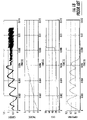
- FIGS. 14 and 15 depict simulation graphs of the main signals of the regulator of FIG. 3 supplying a resistive load with a current of 50 mA, controlled according to a prior art pulse skipping technique and according to the method of this embodiment, respectively.
- the duty cycle is fixed at the maximum allowed value when the start-up procedure ends at about 0.008 s.
- the duty cycle is adjusted according to the needs after the start-up procedure.
- FIGS. 16 and 17 of the root-mean-square (RMS) ripple of FIGS. 14 and 15 show that the RMS voltage ripple obtained with the method of this embodiment ( FIG. 17 ) is only one third of that obtained with a prior art control method ( FIG. 16 ).
- RMS root-mean-square
- the simulations graphs from FIG. 18 to FIG. 21 are analogous to those from FIG. 14 to FIG. 17 , respectively, but they are obtained for a resistive load that absorbs a current of 0.7 A. From FIG. 20 it is possible to notice that the continuous component of the voltage drop on the load is not at the desired design value of 5V when using a prior art control method, but it is at a voltage of 5.02V. In practice, using a prior art control method, there may be an output offset of about 0.02V and a RMS voltage ripple of about 17 mV. This output offset voltage is substantially intrinsic in prior art pulse skipping techniques because the load is powered during a PWM conduction phase with the largest possible duty cycle, thus the output voltage becomes relevantly larger than the reference voltage Vref when the load is powered.
- the regulator of FIG. 3 controlled according to the method of this embodiment may not generate any output offset, and the RMS voltage ripple is about 7 mV because the duty cycle is reduced, when it may be necessary. It is worth noticing that, using the method of this embodiment, the duty cycle oscillates around a certain value. This is due to the pulse skipping technique and also to the fact that the regulator of this embodiment is digital, thus the duty cycle is not continuously adjusted, as it would be in an analog closed-loop control method, but it may be varied only in correspondence of non skipped PWM pulses.
- FIGS. 22 to 25 are substantially identical to FIGS. 14 to 17 , respectively, except for a pulse of 1 A absorbed by the load at about 0.009 s and that terminates at 0.01 s.
- the regulator of FIG. 3 controlled with the method of this embodiment reacts promptly to the current load variation and adjusts immediately the value of the duty cycle.
- the output voltage is subject to an undershoot of about 140 mV ( FIG. 25 ) and a 25 mV peak to peak variation in steady state, while the regulator of FIG. 3 controlled with a prior art control method presents an undershoot of 90 mV and a substantially faster transient response, but a larger peak-to-peak range of oscillation (50 mV) in steady state and an output offset.
- the RMS voltage ripple is evidently relevantly smaller.
- Figures from 26 to 29 show simulation graphs for a resistive load absorbing a current of 0.7 A with a negative ( FIGS. 26 and 27 ) and a positive ( FIGS. 28 and 29 ) input voltage step at 9 ms, when the regulator of FIG. 3 is controlled with a prior art control method ( FIGS. 26 and 28 ) and with the method of this embodiment ( FIGS. 27 and 29 ).
- the advantages of using this method are evident: there may be no output offset voltage, a fast response to load variations and the duty cycle is adjusted fast and this allows to obtain a relevantly smaller RMS voltage ripple (about 7 mV against about 17 mV).
Landscapes
- Engineering & Computer Science (AREA)
- Power Engineering (AREA)
- Dc-Dc Converters (AREA)
Applications Claiming Priority (2)
| Application Number | Priority Date | Filing Date | Title |
|---|---|---|---|
| EP06425431.1 | 2006-06-23 | ||
| EP06425431A EP1870992A1 (fr) | 2006-06-23 | 2006-06-23 | méthode de contrôle par rétroaction d'un régulateur à découpage |
Publications (2)
| Publication Number | Publication Date |
|---|---|
| US20080030183A1 US20080030183A1 (en) | 2008-02-07 |
| US7638993B2 true US7638993B2 (en) | 2009-12-29 |
Family
ID=37898342
Family Applications (1)
| Application Number | Title | Priority Date | Filing Date |
|---|---|---|---|
| US11/767,082 Expired - Fee Related US7638993B2 (en) | 2006-06-23 | 2007-06-22 | Method of feedback controlling a switched regulator |
Country Status (2)
| Country | Link |
|---|---|
| US (1) | US7638993B2 (fr) |
| EP (1) | EP1870992A1 (fr) |
Cited By (3)
| Publication number | Priority date | Publication date | Assignee | Title |
|---|---|---|---|---|
| US20110084747A1 (en) * | 2009-10-14 | 2011-04-14 | Kuan-Jen Tseng | Voltage converting circuit and method |
| US20180106187A1 (en) * | 2015-03-26 | 2018-04-19 | Keihin Corporation | Valve control device and valve system |
| US20240048131A1 (en) * | 2022-08-05 | 2024-02-08 | Stmicroelectronics S.R.I. | Control circuit for a switching stage of an electronic converter and corresponding converter device |
Families Citing this family (8)
| Publication number | Priority date | Publication date | Assignee | Title |
|---|---|---|---|---|
| TWI465011B (zh) * | 2011-06-02 | 2014-12-11 | Richtek Technology Corp | Pwm電壓調節器的控制電路及方法 |
| TWI443930B (zh) * | 2011-09-23 | 2014-07-01 | 亞旭電子科技(江蘇)有限公司 | 充電電流控制方法及充電系統 |
| US9197124B2 (en) * | 2012-10-24 | 2015-11-24 | Marvell World Trade Ltd. | Method and apparatus to reduce overcurrent during the startup of a switching regulator |
| JP6331539B2 (ja) * | 2014-03-19 | 2018-05-30 | カシオ計算機株式会社 | 駆動装置、光源駆動装置、光源装置、投影装置及び駆動方法 |
| CN106716804B (zh) | 2014-06-30 | 2019-08-30 | 天工方案公司 | 用于旁路电压调节器中的电压调节的电路、设备及方法 |
| US9577527B2 (en) * | 2015-03-20 | 2017-02-21 | Active-Semi, Inc. | Current metering for transitioning between operating modes in switching regulators |
| CN111262563B (zh) * | 2020-03-19 | 2023-09-08 | 湖南品腾电子科技有限公司 | 大电流输出电路 |
| CN116232008B (zh) * | 2023-03-09 | 2026-03-10 | 上海南麟电子股份有限公司 | 脉冲调压电路及dc-dc芯片 |
Citations (7)
| Publication number | Priority date | Publication date | Assignee | Title |
|---|---|---|---|---|
| EP0709948A1 (fr) | 1994-10-27 | 1996-05-01 | STMicroelectronics S.r.l. | Convertisseur continu-continu fonctionnant en mode d'élimination d'impulsions sous des conditions de charge faible |
| US5747977A (en) | 1995-03-30 | 1998-05-05 | Micro Linear Corporation | Switching regulator having low power mode responsive to load power consumption |
| US5905370A (en) * | 1997-05-06 | 1999-05-18 | Fairchild Semiconductor Corporation | Programmable step down DC-DC converter controller |
| US6034517A (en) * | 1998-10-27 | 2000-03-07 | Linear Technology Corporation | High efficiency step-down switching regulators |
| US6366070B1 (en) | 2001-07-12 | 2002-04-02 | Analog Devices, Inc. | Switching voltage regulator with dual modulation control scheme |
| US6396252B1 (en) * | 2000-12-14 | 2002-05-28 | National Semiconductor Corporation | Switching DC-to-DC converter with discontinuous pulse skipping and continuous operating modes without external sense resistor |
| US20040174152A1 (en) | 2003-03-04 | 2004-09-09 | Hwang Jeffrey H. | Pulse-skipping switching power converter |
-
2006
- 2006-06-23 EP EP06425431A patent/EP1870992A1/fr not_active Withdrawn
-
2007
- 2007-06-22 US US11/767,082 patent/US7638993B2/en not_active Expired - Fee Related
Patent Citations (7)
| Publication number | Priority date | Publication date | Assignee | Title |
|---|---|---|---|---|
| EP0709948A1 (fr) | 1994-10-27 | 1996-05-01 | STMicroelectronics S.r.l. | Convertisseur continu-continu fonctionnant en mode d'élimination d'impulsions sous des conditions de charge faible |
| US5747977A (en) | 1995-03-30 | 1998-05-05 | Micro Linear Corporation | Switching regulator having low power mode responsive to load power consumption |
| US5905370A (en) * | 1997-05-06 | 1999-05-18 | Fairchild Semiconductor Corporation | Programmable step down DC-DC converter controller |
| US6034517A (en) * | 1998-10-27 | 2000-03-07 | Linear Technology Corporation | High efficiency step-down switching regulators |
| US6396252B1 (en) * | 2000-12-14 | 2002-05-28 | National Semiconductor Corporation | Switching DC-to-DC converter with discontinuous pulse skipping and continuous operating modes without external sense resistor |
| US6366070B1 (en) | 2001-07-12 | 2002-04-02 | Analog Devices, Inc. | Switching voltage regulator with dual modulation control scheme |
| US20040174152A1 (en) | 2003-03-04 | 2004-09-09 | Hwang Jeffrey H. | Pulse-skipping switching power converter |
Cited By (6)
| Publication number | Priority date | Publication date | Assignee | Title |
|---|---|---|---|---|
| US20110084747A1 (en) * | 2009-10-14 | 2011-04-14 | Kuan-Jen Tseng | Voltage converting circuit and method |
| US8779737B2 (en) * | 2009-10-14 | 2014-07-15 | Himax Analogic, Inc. | Voltage converting circuit and method |
| US20180106187A1 (en) * | 2015-03-26 | 2018-04-19 | Keihin Corporation | Valve control device and valve system |
| US10280834B2 (en) * | 2015-03-26 | 2019-05-07 | Keihin Corporation | Valve control device and valve system |
| US20240048131A1 (en) * | 2022-08-05 | 2024-02-08 | Stmicroelectronics S.R.I. | Control circuit for a switching stage of an electronic converter and corresponding converter device |
| US12375068B2 (en) * | 2022-08-05 | 2025-07-29 | Stmicroelectronics S.R.L. | Control circuit for a switching stage of an electronic converter and corresponding converter device |
Also Published As
| Publication number | Publication date |
|---|---|
| EP1870992A1 (fr) | 2007-12-26 |
| US20080030183A1 (en) | 2008-02-07 |
Similar Documents
| Publication | Publication Date | Title |
|---|---|---|
| US7638993B2 (en) | Method of feedback controlling a switched regulator | |
| US8436591B2 (en) | Buck-boost converter with smooth transitions between modes | |
| US8593125B1 (en) | Buck DC-DC converter with dual feedback control | |
| US8773084B2 (en) | Buck-boost converter using timers for mode transition control | |
| CN114094825B (zh) | 电子转换器的控制电路、相关集成电路、电子转换器和方法 | |
| US9455626B2 (en) | Hysteretic buck DC-DC converter | |
| US9013165B2 (en) | Switching regulator including a configurable multi-mode PWM controller implementing multiple control schemes | |
| KR101045737B1 (ko) | 벅 스위칭 레귤레이터 및 방법 | |
| US8890499B2 (en) | Buck DC-DC converter with improved accuracy | |
| KR101045718B1 (ko) | 벅 스위칭 레귤레이터 및 방법 | |
| CN106788398B (zh) | 时钟分频电路、控制电路以及电源管理集成电路 | |
| US20080088292A1 (en) | Constant On-Time Regulator With Internal Ripple Generation and Improved Output Voltage Accuracy | |
| US8922187B2 (en) | Buck DC-DC converter with improved accuracy and stability | |
| KR20080023648A (ko) | 임의의 esr을 갖는 출력 캐패시터를 사용할 수 있도록고정된 온-타임을 이용하여 버크 조정기에서 리플을발생하는 방법 | |
| US6326774B1 (en) | Step-up DC voltage converter and method of operation | |
| US20060232256A1 (en) | Adaptive power control for hysteretic regulators | |
| US10727743B2 (en) | Systems and methods for enhancing dynamic response of power conversion systems | |
| US6130528A (en) | Switching regulator controlling system having a light load mode of operation based on a voltage feedback signal | |
| US7570033B1 (en) | Apparatus and method for PWM buck-or-boost converter with smooth transition between modes | |
| WO2022143725A1 (fr) | Convertisseur abaisseur-élévateur non inverseur | |
| US9774251B2 (en) | Boost converter with improved stability | |
| US11081957B2 (en) | Power converter with multi-mode timing control | |
| US12537448B2 (en) | Control method and control circuit for switched-mode power supply with a power transistor and an inductor, and control chip | |
| US11507128B1 (en) | Low on-time control for switching power supply | |
| US11411556B2 (en) | Duty cycle control for switching power converters |
Legal Events
| Date | Code | Title | Description |
|---|---|---|---|
| AS | Assignment |
Owner name: STMICROELECTRONICS S.R.L., ITALY Free format text: ASSIGNMENT OF ASSIGNORS INTEREST;ASSIGNOR:VALENTINO, GIANLUCA;REEL/FRAME:019469/0625 Effective date: 20070621 |
|
| STCF | Information on status: patent grant |
Free format text: PATENTED CASE |
|
| CC | Certificate of correction | ||
| FPAY | Fee payment |
Year of fee payment: 4 |
|
| FPAY | Fee payment |
Year of fee payment: 8 |
|
| FEPP | Fee payment procedure |
Free format text: MAINTENANCE FEE REMINDER MAILED (ORIGINAL EVENT CODE: REM.); ENTITY STATUS OF PATENT OWNER: LARGE ENTITY |
|
| LAPS | Lapse for failure to pay maintenance fees |
Free format text: PATENT EXPIRED FOR FAILURE TO PAY MAINTENANCE FEES (ORIGINAL EVENT CODE: EXP.); ENTITY STATUS OF PATENT OWNER: LARGE ENTITY |
|
| STCH | Information on status: patent discontinuation |
Free format text: PATENT EXPIRED DUE TO NONPAYMENT OF MAINTENANCE FEES UNDER 37 CFR 1.362 |
|
| FP | Lapsed due to failure to pay maintenance fee |
Effective date: 20211229 |