US7788825B2 - Shoe, in particular sports shoe, with internal shock-absorbing element for the heel - Google Patents
Shoe, in particular sports shoe, with internal shock-absorbing element for the heel Download PDFInfo
- Publication number
- US7788825B2 US7788825B2 US11/636,641 US63664106A US7788825B2 US 7788825 B2 US7788825 B2 US 7788825B2 US 63664106 A US63664106 A US 63664106A US 7788825 B2 US7788825 B2 US 7788825B2
- Authority
- US
- United States
- Prior art keywords
- shock
- absorbing element
- outer sole
- thickness
- shoe
- Prior art date
- Legal status (The legal status is an assumption and is not a legal conclusion. Google has not performed a legal analysis and makes no representation as to the accuracy of the status listed.)
- Active, expires
Links
Images


Classifications
-
- A—HUMAN NECESSITIES
- A43—FOOTWEAR
- A43B—CHARACTERISTIC FEATURES OF FOOTWEAR; PARTS OF FOOTWEAR
- A43B7/00—Footwear with health or hygienic arrangements
- A43B7/14—Footwear with health or hygienic arrangements with foot-supporting parts
- A43B7/1405—Footwear with health or hygienic arrangements with foot-supporting parts with pads or holes on one or more locations, or having an anatomical or curved form
- A43B7/1415—Footwear with health or hygienic arrangements with foot-supporting parts with pads or holes on one or more locations, or having an anatomical or curved form characterised by the location under the foot
- A43B7/144—Footwear with health or hygienic arrangements with foot-supporting parts with pads or holes on one or more locations, or having an anatomical or curved form characterised by the location under the foot situated under the heel, i.e. the calcaneus bone
-
- A—HUMAN NECESSITIES
- A43—FOOTWEAR
- A43B—CHARACTERISTIC FEATURES OF FOOTWEAR; PARTS OF FOOTWEAR
- A43B13/00—Soles; Sole-and-heel integral units
- A43B13/14—Soles; Sole-and-heel integral units characterised by the constructive form
- A43B13/18—Resilient soles
- A43B13/181—Resiliency achieved by the structure of the sole
-
- A—HUMAN NECESSITIES
- A43—FOOTWEAR
- A43B—CHARACTERISTIC FEATURES OF FOOTWEAR; PARTS OF FOOTWEAR
- A43B13/00—Soles; Sole-and-heel integral units
- A43B13/14—Soles; Sole-and-heel integral units characterised by the constructive form
-
- A—HUMAN NECESSITIES
- A43—FOOTWEAR
- A43B—CHARACTERISTIC FEATURES OF FOOTWEAR; PARTS OF FOOTWEAR
- A43B21/00—Heels; Top-pieces or top-lifts
- A43B21/24—Heels; Top-pieces or top-lifts characterised by the constructive form
- A43B21/26—Resilient heels
Definitions
- This present invention concerns the area of shoes, in particular sports shoes. More particularly, it concerns a shoe whose outer sole includes, in its heel part, an internal shock-absorbing element intended to protect the heel from shock, such as when playing court games, for example.
- an internal shock-absorbing element intended to protect the heel from shock, such as when playing court games, for example.
- a very large majority, of the order of 75%, of the weight of the user is placed on the calcaneum or heelbone. This proportion increases still further during the practice of certain sports.
- the manufacturers of sports shoes take great care to ensure the protection of the calcaneum from the shock to which the latter can be subjected during the practice of sports.
- shock-absorbing element placed in the heel part of the shoe, under the calcaneum.
- This shock-absorbing element is generally an independent element, with increased elasticity, placed inside the outer sole. However, it can nevertheless be incorporated into the said sole.
- the shock-absorbing element is located between the inner sole of the shoe and the outer sole proper, and is made from a rubber or plastic material that is characteristic of a high-level shock-absorber.
- the outer sole is made from a cellular material whose elasticity and shock-absorbing properties allow the design of the shock-absorbing element and of the said outer sole as a single part.
- This shock-absorbing element takes the form of a vertical hollow cylinder that bears upon the base of the outer sole proper, at the level of an annular groove formed in the latter. The inner sole rests on the top edge of the tubular shock-absorbing element.
- the outer sole into which the shock-absorbing element is incorporated is made from a rubber or plastic material that is characteristic of a high-level shock-absorber. It therefore cannot be a conventional outer-sole material, and this can have drawbacks in relation to resistance to wear or abrasion of the outer sole.
- the objective of this present invention is to propose a shoe, in particular a sports shoe, whose outer sole can include, as in the above variant of document FR 2.438.983, a built-in tubular shock-absorbing element, which overcomes the aforementioned drawback and/or which however has a different structure.
- the shock-absorbing element preferably forming a single block with the outer sole, has a hollow tubular configuration whose annular section is not of constant thickness over all of its height, presenting locally a zone of reduced thickness, from which the deformation, by flexing of the shock-absorbing element, preferably occurs.
- the shock-absorbing effect, at the heel is obtained due to the deformation, by flexing or flexing, of the hollow tubular element, this therefore occurring in the zone of the shock-absorbing element which presents a locally reduced thickness that develops toward the exterior of the shock-absorbing element.
- the outer wall of the tubular shock-absorbing element is perpendicular to the general pressure plane of the outer sole, while its inner wall has a concave curvature.
- general pressure plane refers to the plane of the inner face of the outer sole in the heel part, which comes into contact with the ground. Because of the concave curvature of its inner wall, the shock-absorbing element has an annular section whose thickness varies progressively from its top edge to its bottom edge, with this variation decreasing from its top edge to the zone of reduced thickness, and then increasing to the bottom edge.
- the radius of curvature of the concave inner wall is of the order of 6 to 10 mm, and the zone of reduced thickness is approximately at mid-height of the shock-absorbing element.
- the opening of the tubular shock-absorbing element is oriented upwards, and the said shoe includes a flexible disk in a plastic material, at least partially closing off the opening of the heel part and resting on the top edge of the shock-absorbing element.
- the shock-absorbing effect at the heel, is achieved by the combination firstly of the deformation, by flexing, of the tubular shock-absorbing element, and secondly of a suspension effect caused by the deformation of the flexible disk during the vertical pressure applied by the calcaneum along the vertical axis of symmetry of the hollow tubular shock-absorbing element, with this deformation curving the said disk inwards toward the interior of the shock-absorbing element.
- the portion of outer sole that constitutes the bottom of the shock-absorbing element has a concave configuration, and a thickness that is approximately constant.
- the central zone of the bottom of the shock-absorbing element is raised in relation to the general pressure plane of the outer sole.
- the portion of outer sole constituting the bottom of the shock-absorbing element should be fully displaced in height in relation to the general pressure plane of the said outer sole.
- the portion of sole constituting the bottom of the shock-absorbing element cannot under any circumstances constitute an impediment to the deformation of the tubular shock-absorbing element.
- the tubular element is hollow, it constitutes a sort of air chamber with the flexible disk that covers it.
- the suspension effect deforms the flexible disk that constitutes the upper wall of this air chamber, which in turn causes an increase in the pressure of the air trapped inside the said chamber, with correlative deformation of the portion of outer sole constituting the bottom of the said chamber and therefore the bottom of the shock-absorbing element.
- the flexible disk can be pierced with at least one through hole, which gives onto the inner space of the tubular shock-absorbing element, with this space corresponding to the internal volume of the air chamber.
- This through hole allows the air chamber to reach a pressure equilibrium during the lifting of the foot of the user in relation to the inner sole, at least partially.
- the tubular shock-absorbing element preferably has a height of 13 to 15 mm, a thickness in cross section of 4 to 5 mm at its top edge, and a thickness in cross section of 2 to 3 mm in the zone of reduced thickness.
- the zone of reduced thickness is preferably at a distance of 5 to 6 mm from the top edge of the shock-absorbing element.
- the flexible disk in a plastic material is in fact preferably in rubber, and has a thickness of 3 mm.
- the flexible disk in a plastic material partially closes off the opening of the heel part and is positioned under the inner sole, which itself covers the whole of the opening in the heel part.
- the opening of the tubular shock-absorbing element is oriented downwards.
- it is the portion of outer sole constituting the top of the tubular element that is in contact with the inner sole.
- the bottom edge of the tubular element is displaced in height in relation to the general pressure plane of the outer sole.
- FIG. 1 is a schematic representation in section of the shoes of the first example, in a vertical plane passing through the axis of symmetry of the internal shock-absorbing element, corresponding to the vertical axis of the calcaneum.
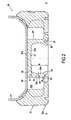
- FIG. 2 is a schematic representation in section of the shoes of the second example, in a vertical plane passing through the axis of symmetry of the internal shock-absorbing element, corresponding to the vertical axis of the calcaneum.
- FIGS. 1 and 2 are schematic representations in section of the shoes of the first and second examples respectively, in a vertical plane passing through the axis of symmetry of the internal shock-absorbing element, corresponding to the vertical axis of the calcaneum.
- the sports shoe 1 includes an upper 2 , an inner sole 3 and an outer sole 4 .
- the outer sole 4 is in a material that is conventionally used for sports shoes, in rubber of 70 Shore A hardness for example.
- This outer sole has a heel part which has an inner space 4 a , opening upwards, meaning toward the inner sole 3 .
- a shock-absorbing element 5 which is made in a single piece with the outer sole 4 , being created from the same material as the latter.
- This shock-absorbing element 5 has a hollow tubular configuration which extends the base 4 b of the outer sole 4 upwards, and which also opens upwards.
- This tubular element 5 is fitted in the inner space 4 a with as its vertical axis of symmetry PP′ the central axis of the calcaneum.
- the shock-absorbing element 5 has a height H between its top edge 6 and its bottom edge 7 , with the latter corresponding to its junction with the portion of the outer sole that closes off the shock-absorbing element across the opening.
- This shock-absorbing element has an annular cross section which is not of constant thickness over all of its height H. Locally, it has a zone 9 of reduced thickness E 0 , meaning less than the thickness E 1 measured at its top edge 6 , and preferably also than the thickness E 2 measured at its bottom edge 7 .
- a flexible disk 8 rests on the top edge 6 of the shock-absorbing element 5 , lying at least partially above the space 4 a formed in the heel part of the outer sole 4 .
- the disk 8 does not cover the whole of space 4 a , so that there remains around the periphery of the said disk 8 an access opening 13 to the inner space 4 a of the outer sole 4 .
- the inner sole 3 totally covers the flexible disk 8 and opening 13 , as well as the bottom end 2 a of the upper 2 in part.
- the flexible disk 8 can be fixed onto the top edge 6 of the shock-absorbing element 5 , by glueing for example.
- the outer wall 5 a of the shock-absorbing element 5 is perpendicular to the general pressure plane QQ′ of the outer sole.
- This general pressure plane QQ′ corresponds to the plane of the inner face of the base 4 b of the outer sole, which makes contact with the ground.
- the inner wall 5 b of the shock-absorbing element 5 has a concave curvature, so that the variation of thickness between the top edge 6 and the bottom edge 7 of the shock-absorbing element 5 is progressive, decreasing from the top edge 6 to the section corresponding to the zone 9 of reduced thickness E 0 and then increasing to the bottom edge 7 .
- the radius of curvature of the concave inner wall 5 b was of the order of 6 to 10 mm
- the height H of the shock-absorbing element 5 was of the order of 13 to 15 mm
- the thickness E 1 at the top edge 6 was of the order of 4 to 5 mm
- the thickness E 0 in the zone of reduced thickness 9 was of the order of 2 to 3 mm
- the distance d between the zone of reduced thickness 9 and the top edge 6 was of the order of 5 to 6 mm.
- the tubular element 5 had an ovoid cross section whose major longitudinal axis, along the general direction of the shoe, measured 42 mm, and the minor axis, visible in FIG. 1 , measured 37 mm.
- the portion of the base 4 b of the outer sole 4 that constitutes the bottom 10 of the shock-absorbing element 5 has a slightly concave configuration, curving inwards toward the inner space 5 c of the shock-absorbing element 5 .
- the lower wall 10 a of this bottom 10 is displaced in height in relation to the general pressure plane QQ′ of the outer sole 4 .
- the junction 11 between the bottom 10 and the base 4 b of the outer sole has a thickness E 3 which is of the order of, or even less than, the thickness E 0 of the zone of reduced thickness 9 of the shock-absorbing element 5 , so as to facilitate the transverse flexing of the said shock-absorbing element 5 .
- the flexible disk 8 is equipped with four through holes 12 .
- the inner sole 3 is applied with force onto the flexible disk 8 so that the through holes 12 are totally closes off, and the inner space 5 c of the shock-absorbing element 5 acts as an air chamber, with an increase in the pressure generated by the deformation of the walls of the said chamber.
- the air is possible for the air to enter via the through holes 12 so that equilibrium is again restored during the progressive return of the flexible disk 8 to its normal position.
- the flexible disk 8 was a rubber disk with a thickness of 3 mm and a Shore A hardness of 63 to 73, preferably 68.
- the flexible disk 8 can possibly be incorporated into the inner sole 3 .
- the sports shoe 20 includes an upper 21 , an inner sole 22 and an outer sole 23 which is in a conventional material used for sports shoes, in rubber with a Shore A hardness of 70 for example.
- This outer sole has a heel part with an inner space 23 a opening upwards, meaning toward the inner sole 22 .
- a shock-absorbing element 24 which is made in a single piece with the outer sole 23 , being made of the same material as the latter.
- This shock-absorbing element 24 has a hollow tubular configuration which extends the base 23 b of the outer sole 23 upwards, and which is open downwards, meaning toward the ground when the shoe is worn by the user and resting on the ground.
- This tubular element 24 is fitted in the inner space 23 a with as its vertical axis of symmetry the central axis of the calcaneum.
- the shock-absorbing element 24 has a height H between its bottom edge 25 and its top edge 26 which corresponds to its junction with the portion of the outer sole that closes off the shock-absorbing element 24 across the opening, the portion 27 on the upper face 27 a of which rests the inner sole 22 .
- This shock-absorbing element 24 has an annular cross section which is not of constant thickness over all of its height H. Locally it has a zone 28 of reduced thickness E 0 , meaning less than the thickness E 1 measured at its top edge 26 .
- the outer wall 24 a of the shock-absorbing element 24 is perpendicular to the general pressure plane QQ′ of the outer sole.
- This general pressure plane QQ′ corresponds to the plane of the inner face of the base 23 b of the outer sole, which makes contact with the ground.
- the inner wall 24 b of the shock-absorbing element 24 has a concave curvature, so that the variation of thickness between the top edge 26 and the bottom edge 25 of the shock-absorbing element 24 is progressive, decreasing from the top edge 26 to the section corresponding to the zone 28 of reduced thickness E 0 and then increasing to the bottom edge 25 .
- the portion of the outer sole 24 that constitutes the top 27 of the shock-absorbing element 24 has an inner face 27 b with a slightly concave configuration, so that during the impact which occurs at the vertical axis of the calcaneum, the top 27 of the shock-absorbing element 24 tends to flex preferentially in the central zone of reduced thickness.
- the shock-absorbing effect of the heel therefore results from this double deformation of the shock-absorbing element 24 .
- the bottom edge 25 of the shock-absorbing element is displaced in height in relation to the general pressure plane QQ′ of the outer sole 23 .
- the junction 29 between the shock-absorbing element 24 and the base 23 b of the outer sole 23 has a thickness E 3 which is of the order of, or even less than, the thickness E 0 of the zone 28 of reduced thickness of the shock-absorbing element 24 so as to facilitate the transverse flexing of the said shock-absorbing element 24 .
- This junction 29 can be achieved by means of a groove 30 formed in the thickness of the shock-absorbing element 24 from its bottom edge 25 .
- the tubular shock-absorbing element is made in a single piece with the outer sole, since this greatly simplifies the manufacturing process.
- This feature is not exclusive, and the shock-absorbing element can also be a separate element in the heel part hollowed out of the outer sole, particularly made of a material that is different from that of the outer sole.
Landscapes
- Health & Medical Sciences (AREA)
- Epidemiology (AREA)
- General Health & Medical Sciences (AREA)
- Public Health (AREA)
- Footwear And Its Accessory, Manufacturing Method And Apparatuses (AREA)
Applications Claiming Priority (3)
| Application Number | Priority Date | Filing Date | Title |
|---|---|---|---|
| FR06/01208 | 2006-02-10 | ||
| FR0601208A FR2897243B1 (fr) | 2006-02-10 | 2006-02-10 | Chaussure de sport a element interne amortisseur pour le talon |
| FR0601208 | 2006-02-10 |
Publications (2)
| Publication Number | Publication Date |
|---|---|
| US20070186445A1 US20070186445A1 (en) | 2007-08-16 |
| US7788825B2 true US7788825B2 (en) | 2010-09-07 |
Family
ID=36754690
Family Applications (1)
| Application Number | Title | Priority Date | Filing Date |
|---|---|---|---|
| US11/636,641 Active 2029-04-11 US7788825B2 (en) | 2006-02-10 | 2006-12-11 | Shoe, in particular sports shoe, with internal shock-absorbing element for the heel |
Country Status (5)
| Country | Link |
|---|---|
| US (1) | US7788825B2 (it) |
| CN (1) | CN101015400B (it) |
| ES (1) | ES2316269B1 (it) |
| FR (1) | FR2897243B1 (it) |
| IT (1) | ITMI20070174A1 (it) |
Families Citing this family (10)
| Publication number | Priority date | Publication date | Assignee | Title |
|---|---|---|---|---|
| CN102302242A (zh) * | 2011-08-17 | 2012-01-04 | 茂泰(福建)鞋材有限公司 | 减震鞋底 |
| DE102012207300B4 (de) * | 2012-05-02 | 2019-10-24 | Adidas Ag | Verfahren zur Herstellung eines Schafts für einen Schuh und danach hergestellter Schaft und Schuh |
| US10856612B2 (en) | 2012-09-20 | 2020-12-08 | Nike, Inc. | Sole structures and articles of footwear having plate moderated fluid-filled bladders and/or foam type impact force attenuation members |
| US10849387B2 (en) * | 2012-09-20 | 2020-12-01 | Nike, Inc. | Sole structures and articles of footwear having plate moderated fluid-filled bladders and/or foam type impact force attenuation members |
| DK3058837T3 (en) * | 2013-10-18 | 2018-07-30 | Desarrollo Integral Del Molde Sl | SOLD WITH DOUBLE SPRING |
| CN104585967B (zh) * | 2014-12-19 | 2016-08-17 | 乔丹体育股份有限公司 | 具有环形减震装置的鞋底 |
| US10045587B2 (en) * | 2015-06-02 | 2018-08-14 | Under Armour, Inc. | Footwear including lightweight outsole structure and method of forming outsole structure |
| WO2016195425A1 (ko) * | 2015-06-05 | 2016-12-08 | 주문균 | 충격흡수가 가능한 조립식 신발굽 및 그 제조방법 |
| CN106820324B (zh) * | 2015-12-03 | 2018-12-11 | 林芍苇 | 人体保护垫 |
| CN107495532A (zh) * | 2017-09-12 | 2017-12-22 | 茂泰(福建)鞋材有限公司 | 一种减震换气鞋底 |
Citations (6)
| Publication number | Priority date | Publication date | Assignee | Title |
|---|---|---|---|---|
| FR2438983A1 (fr) | 1978-10-17 | 1980-05-16 | Funck Herbert | Semelle moulee prefabriquee |
| DE19509636A1 (de) | 1995-03-17 | 1996-09-19 | Spiess Schuhfabrik Gmbh | Absorber für Schuhabsätze |
| FR2732197A1 (fr) | 1995-03-28 | 1996-10-04 | Salomon Sa | Chaussure de ski avec moyens d'amortissement |
| US20050022426A1 (en) | 2000-12-22 | 2005-02-03 | The Timberland Company | Shoe construction |
| US20050241082A1 (en) * | 2000-04-13 | 2005-11-03 | Geox S.P.A. | Method for manufacturing breathable shoe |
| US20060117605A1 (en) * | 2003-02-14 | 2006-06-08 | Martin Michaeli | Footwear sole comprising a shock-absorbing device |
-
2006
- 2006-02-10 FR FR0601208A patent/FR2897243B1/fr not_active Expired - Fee Related
- 2006-12-11 US US11/636,641 patent/US7788825B2/en active Active
-
2007
- 2007-01-08 CN CN2007100014517A patent/CN101015400B/zh not_active Expired - Fee Related
- 2007-01-26 ES ES200700216A patent/ES2316269B1/es active Active
- 2007-02-02 IT IT000174A patent/ITMI20070174A1/it unknown
Patent Citations (6)
| Publication number | Priority date | Publication date | Assignee | Title |
|---|---|---|---|---|
| FR2438983A1 (fr) | 1978-10-17 | 1980-05-16 | Funck Herbert | Semelle moulee prefabriquee |
| DE19509636A1 (de) | 1995-03-17 | 1996-09-19 | Spiess Schuhfabrik Gmbh | Absorber für Schuhabsätze |
| FR2732197A1 (fr) | 1995-03-28 | 1996-10-04 | Salomon Sa | Chaussure de ski avec moyens d'amortissement |
| US20050241082A1 (en) * | 2000-04-13 | 2005-11-03 | Geox S.P.A. | Method for manufacturing breathable shoe |
| US20050022426A1 (en) | 2000-12-22 | 2005-02-03 | The Timberland Company | Shoe construction |
| US20060117605A1 (en) * | 2003-02-14 | 2006-06-08 | Martin Michaeli | Footwear sole comprising a shock-absorbing device |
Also Published As
| Publication number | Publication date |
|---|---|
| ITMI20070174A1 (it) | 2007-08-11 |
| US20070186445A1 (en) | 2007-08-16 |
| CN101015400A (zh) | 2007-08-15 |
| ES2316269A1 (es) | 2009-04-01 |
| FR2897243B1 (fr) | 2008-08-01 |
| CN101015400B (zh) | 2011-06-15 |
| ES2316269B1 (es) | 2009-10-14 |
| FR2897243A1 (fr) | 2007-08-17 |
Similar Documents
| Publication | Publication Date | Title |
|---|---|---|
| US7788825B2 (en) | Shoe, in particular sports shoe, with internal shock-absorbing element for the heel | |
| US20110289799A1 (en) | Shoe outsole having tubes | |
| US4881329A (en) | Athletic shoe with energy storing spring | |
| US8347526B2 (en) | Shoes, devices for shoes, and methods of using shoes | |
| US5933983A (en) | Shock-absorbing system for shoe | |
| US7441347B2 (en) | Shock resistant shoe | |
| US20070294832A1 (en) | Air cushion with multistage shock-absorbing assembly and fabricating method | |
| KR890001486A (ko) | 충격을 흡수하는 신발 바닥과 신발 바닥을 결합한 신발 | |
| US5852887A (en) | Shoe with lateral support member | |
| US20110162233A1 (en) | Air cushion with multistage shock-absorbing assembly and fabricating method | |
| US6021590A (en) | Elastic spikes and sports shoes with the elastic spikes | |
| KR101188875B1 (ko) | 밸런스 기능성 쿠션신발창 | |
| US20030110661A1 (en) | Shock-absorbing shoe | |
| KR102421694B1 (ko) | 완충 신발 | |
| KR200442659Y1 (ko) | 신발의 완충장치 구조 | |
| CN203762404U (zh) | 具减震功能鞋底 | |
| KR100999901B1 (ko) | 스프링 완충력을 갖는 여성용 하이힐 | |
| KR101785854B1 (ko) | 골프클럽의 길이 연장 장치 | |
| KR20090109387A (ko) | 스프링 완충 신발 | |
| CN220140939U (zh) | 运动舒适的气垫鞋底 | |
| KR101217094B1 (ko) | 충격흡수 신발 | |
| KR100904042B1 (ko) | 쿠션 소자 및 그 소자를 가진 신발 | |
| CN215387415U (zh) | 一种高耐磨性的篮球 | |
| CN207411600U (zh) | 后跟加强结构鞋子 | |
| CN219845265U (zh) | 一种带有缓冲装置的运动鞋 |
Legal Events
| Date | Code | Title | Description |
|---|---|---|---|
| AS | Assignment |
Owner name: PROMILES, FRANCE Free format text: ASSIGNMENT OF ASSIGNORS INTEREST;ASSIGNORS:GRATADOUR, VINCENT;BALY, LAURENT;REEL/FRAME:018863/0557;SIGNING DATES FROM 20070102 TO 20070104 Owner name: PROMILES, FRANCE Free format text: ASSIGNMENT OF ASSIGNORS INTEREST;ASSIGNORS:GRATADOUR, VINCENT;BALY, LAURENT;SIGNING DATES FROM 20070102 TO 20070104;REEL/FRAME:018863/0557 |
|
| AS | Assignment |
Owner name: DECATHLON, FRANCE Free format text: ASSIGNMENT OF ASSIGNORS INTEREST;ASSIGNOR:PROMILES;REEL/FRAME:021861/0622 Effective date: 20081116 Owner name: DECATHLON,FRANCE Free format text: ASSIGNMENT OF ASSIGNORS INTEREST;ASSIGNOR:PROMILES;REEL/FRAME:021861/0622 Effective date: 20081116 |
|
| STCF | Information on status: patent grant |
Free format text: PATENTED CASE |
|
| FPAY | Fee payment |
Year of fee payment: 4 |
|
| MAFP | Maintenance fee payment |
Free format text: PAYMENT OF MAINTENANCE FEE, 8TH YEAR, LARGE ENTITY (ORIGINAL EVENT CODE: M1552) Year of fee payment: 8 |
|
| MAFP | Maintenance fee payment |
Free format text: PAYMENT OF MAINTENANCE FEE, 12TH YEAR, LARGE ENTITY (ORIGINAL EVENT CODE: M1553); ENTITY STATUS OF PATENT OWNER: LARGE ENTITY Year of fee payment: 12 |