US7820137B2 - Lithium titanate and method of forming the same - Google Patents
Lithium titanate and method of forming the same Download PDFInfo
- Publication number
- US7820137B2 US7820137B2 US12/152,352 US15235208A US7820137B2 US 7820137 B2 US7820137 B2 US 7820137B2 US 15235208 A US15235208 A US 15235208A US 7820137 B2 US7820137 B2 US 7820137B2
- Authority
- US
- United States
- Prior art keywords
- lithium
- titanium
- lithium titanate
- mixture
- titanate
- Prior art date
- Legal status (The legal status is an assumption and is not a legal conclusion. Google has not performed a legal analysis and makes no representation as to the accuracy of the status listed.)
- Expired - Fee Related, expires
Links
Images



Classifications
-
- C—CHEMISTRY; METALLURGY
- C01—INORGANIC CHEMISTRY
- C01G—COMPOUNDS CONTAINING METALS NOT COVERED BY SUBCLASSES C01D OR C01F
- C01G23/00—Compounds of titanium
- C01G23/003—Titanates
- C01G23/005—Alkali titanates
-
- H—ELECTRICITY
- H01—ELECTRIC ELEMENTS
- H01M—PROCESSES OR MEANS, e.g. BATTERIES, FOR THE DIRECT CONVERSION OF CHEMICAL ENERGY INTO ELECTRICAL ENERGY
- H01M4/00—Electrodes
- H01M4/02—Electrodes composed of, or comprising, active material
- H01M4/36—Selection of substances as active materials, active masses, active liquids
- H01M4/48—Selection of substances as active materials, active masses, active liquids of inorganic oxides or hydroxides
- H01M4/485—Selection of substances as active materials, active masses, active liquids of inorganic oxides or hydroxides of mixed oxides or hydroxides for inserting or intercalating light metals, e.g. LiTi2O4 or LiTi2OxFy
-
- C—CHEMISTRY; METALLURGY
- C01—INORGANIC CHEMISTRY
- C01P—INDEXING SCHEME RELATING TO STRUCTURAL AND PHYSICAL ASPECTS OF SOLID INORGANIC COMPOUNDS
- C01P2002/00—Crystal-structural characteristics
- C01P2002/70—Crystal-structural characteristics defined by measured X-ray, neutron or electron diffraction data
- C01P2002/72—Crystal-structural characteristics defined by measured X-ray, neutron or electron diffraction data by d-values or two theta-values, e.g. as X-ray diagram
-
- C—CHEMISTRY; METALLURGY
- C01—INORGANIC CHEMISTRY
- C01P—INDEXING SCHEME RELATING TO STRUCTURAL AND PHYSICAL ASPECTS OF SOLID INORGANIC COMPOUNDS
- C01P2002/00—Crystal-structural characteristics
- C01P2002/70—Crystal-structural characteristics defined by measured X-ray, neutron or electron diffraction data
- C01P2002/77—Crystal-structural characteristics defined by measured X-ray, neutron or electron diffraction data by unit-cell parameters, atom positions or structure diagrams
-
- C—CHEMISTRY; METALLURGY
- C01—INORGANIC CHEMISTRY
- C01P—INDEXING SCHEME RELATING TO STRUCTURAL AND PHYSICAL ASPECTS OF SOLID INORGANIC COMPOUNDS
- C01P2006/00—Physical properties of inorganic compounds
- C01P2006/40—Electric properties
-
- H—ELECTRICITY
- H01—ELECTRIC ELEMENTS
- H01M—PROCESSES OR MEANS, e.g. BATTERIES, FOR THE DIRECT CONVERSION OF CHEMICAL ENERGY INTO ELECTRICAL ENERGY
- H01M10/00—Secondary cells; Manufacture thereof
- H01M10/05—Accumulators with non-aqueous electrolyte
- H01M10/052—Li-accumulators
-
- Y—GENERAL TAGGING OF NEW TECHNOLOGICAL DEVELOPMENTS; GENERAL TAGGING OF CROSS-SECTIONAL TECHNOLOGIES SPANNING OVER SEVERAL SECTIONS OF THE IPC; TECHNICAL SUBJECTS COVERED BY FORMER USPC CROSS-REFERENCE ART COLLECTIONS [XRACs] AND DIGESTS
- Y02—TECHNOLOGIES OR APPLICATIONS FOR MITIGATION OR ADAPTATION AGAINST CLIMATE CHANGE
- Y02E—REDUCTION OF GREENHOUSE GAS [GHG] EMISSIONS, RELATED TO ENERGY GENERATION, TRANSMISSION OR DISTRIBUTION
- Y02E60/00—Enabling technologies; Technologies with a potential or indirect contribution to GHG emissions mitigation
- Y02E60/10—Energy storage using batteries
Definitions
- the present invention generally relates to a lithium titanate and a method of forming the lithium titanate. More specifically, the present invention relates to a lithium titanate that has excellent electronic conductivity and excellent electric power-generating capacity.
- Motor vehicles such as, for example, hybrid vehicles use multiple propulsion systems to provide motive power.
- the most common hybrid vehicles are gasoline-electric hybrid vehicles, which include both an internal-combustion engine (ICE) and an electric motor.
- the gasoline-electric hybrid vehicles use gasoline to power the ICE, and an electric battery to power the electric motor.
- the gasoline-electric hybrid vehicles recharge their batteries by capturing kinetic energy.
- the kinetic energy may be provided via regenerative braking or, when cruising or idling, from the output of the ICE. This contrasts with pure electric vehicles, which use batteries charged by an external source such as a power grid or a range extending trailer.
- the batteries include rechargeable lithium-based cells that typically comprise two dissimilar electrodes, i.e., an anode and a cathode, that are immersed in an ion conducting electrolyte, with a separator positioned between the two electrodes. Electrical energy is produced in the cells by an electrochemical reaction that occurs between the two dissimilar electrodes.
- the largest demand placed on the battery occurs when it must supply current to operate the electric motor during acceleration, especially during start-up of the electric motor.
- the amperage requirements of the electric motor may be over several hundred amps.
- Most types of batteries that are capable of supplying the necessary amperage have a large volume or require bulky packaging, which results in excessive weight of the batteries and adds cost to the batteries.
- high currents are only required for short periods of time, usually seconds. Therefore, so called “high-rate” batteries, which provide high currents for short periods of time, are typically ideal for hybrid and pure electric vehicle applications.
- Rechargeable batteries that include rechargeable lithium-based cells, which may be characterized as either lithium cells, lithium ion cells, or lithium polymer cells, combine high electric power-generating capacity with the potential for power and cycle-life needed to enable the hybrid vehicles to meet performance standards while remaining economical.
- high electric power-generating capacity it is meant that the rechargeable batteries have four times the energy density of lead-acid batteries and two to three times the energy density of nickel-cadmium and nickel-metal hydride batteries.
- Rechargeable batteries including the lithium-based cells also have the potential to be one of the lowest-cost battery systems.
- Lithium titanate represented by the formula Li 4 Ti 5 O 12 (or Li 4/3 Ti 5/3 O 4 ) is considered to be one of the most prospective materials for use in the anodes of rechargeable lithium ion and lithium polymer cells.
- Lithium titanate, Li 4 Ti 5 O 12 is known from A. Deschanvers et al. (Mater. Res. Bull., v. 6, 1971, p. 699). As it was later published by K. M. Colbow et al. (J. of Power Sources, v. 26, N. 3/4, May 16, 1989, pp. 397-402), Li 4 Ti 5 O 12 is able to act in a reversible electrochemical reaction, while elemental lithium is incapable of such reversible reactions.
- the '468 patent specifies that fundamentally, x+y ⁇ 3.
- the '468 patent teaches that the lithium titanate may include different ratios of lithium to titanium, so long as the amount of lithium and titanium together about 3 such that there is a stoichiometric amount of lithium and titanium to oxygen.
- United States Patent Publication No. 2002/0197532 to Thackeray et al. also discloses a lithium titanate that is used as an anode in a lithium cell.
- the lithium titanate may be a stoichiometric or defect spinel, in which the distribution of lithium can vary from compound to compound.
- Li 4 Ti 5 O 12 In addition to an ability to act in the reversible electrochemical reaction, Li 4 Ti 5 O 12 also has other advantages that make it useful in rechargeable lithium-based cells. For example, due to a unique low volume change of the lithium titanate during the charge and discharge processes, the lithium titanate has excellent cycleability, i.e., many cycles of charging and discharging may occur without deterioration of the cells. The excellent cycleability of the lithium titanate is primarily due to a cubic spinel structure of Li 4 Ti 5 O 12 . According to data of S. Schamer et al. (J. of Electrochemical Society, v. 146, N. 3, 1999, pp. 857-861) a lattice parameter of the cubic spinel structure (cubic, Sp. gr.
- Li 4 Ti 15 O 12 has an electrochemical potential versus elemental lithium of about 1.55 V and can be intercalated with lithium to produce an intercalated lithium titanate represented by the formula Li 7 Ti 5 O 12 , which has a theoretical electric power-generating capacity of up to and including 175 mA*hrs/g.
- Li 4 Ti 5 O 12 has a flat discharge curve. More specifically, the charge and discharge processes of Li 4 Ti 5 O 12 take place in a two-phase system. Li 4 Ti 5 O 12 has a spinel structure and, during charging, transforms into Li 7 Ti 5 O 12 , which has an ordered rock-salt type structure. As a result, electric potential during the charge and discharge processes is determined by electrochemical equilibrium of the Li 4 Ti 5 O 12 /Li 7 Ti 5 O 12 pair, and is not dependant on lithium concentration. This is in contrast to the discharge curve of most other electrode materials for lithium power sources, which maintain their structure during the charge and discharge processes.
- Li 4 Ti 5 O 12 includes titanium in a highest oxidation degree of +4, which correlates to very low electronic conductivity.
- An electronic conductivity of similar compounds is so low that many of those compounds are borderline dielectrics or insulators.
- power generating capacity of Li 4 Ti 5 O 12 is less than ideal.
- the lithium titanates of the '468 patent and the '532 publication as set forth above.
- electronic conductivity of the Li 4 Ti 5 O 12 is improved by doping the Li 4 Ti 5 O 12 with 3d-elements, as disclosed by M. Nakayama et al (Solid State Ionics, v. 117, I. 3-4, 2 Feb. 1999, pp. 265-271).
- electronic conductivity of Li[Li (1-x)/3 Cr x Ti (5-2x)/3 ]O 4 which is considered to be a solid solution between Li 4 Ti 5 O 12 and LiCrTiO 4 , is better than electronic conductivity of the Li 4 Ti 5 O 12 .
- an increase in the amount of Cr ions substituted for titanium ions in the Li 4 Ti 5 O 12 also decreases reversible electric power-generating capacity, as compared to Li 4 Ti 5 O 12 , due to electrochemical inactivity attributable to the presence of the Cr ions.
- the presence of the Cr ions lowers area specific impedance (ASI) and increases rate capability, as compared to ASI and rate capability of Li 4 Ti 5 O 12 .
- the loss in capacity is substantially equal to the share of replaced titanium.
- lithium titanate that is modified to exhibit excellent electronic conductivity while maintaining reversible electric power-generating capacity that is characteristic of lithium titanate.
- lithium-based cell that includes the lithium titanate.
- the subject invention provides a method for synthesizing lithium titanate that include 1) mixing lithium carbonate powder or lithium hydroxide powder with titanium oxide by various mixing methods and using the same as the precursor for calcination, 2) using a synthetic product or mixture containing titanium and lithium obtained from solutions containing both titanium and lithium ingredients as the precursor for calcination and 3) preparing a mixed slurry of titanium compound powder and a solution containing lithium, followed by depositing a lithium compound by spray-drying, to produce a mixture of titanium compound powder and lithium compound and using the same as the precursor for calcination.
- Each method utilizes production parameters to produce lithium titanate with the quality that satisfies the performance required of secondary batteries.
- the lithium titanate of the present invention is suitable for lithium-based cells that are used in rechargeable batteries that are a power source for electric motors in gasoline-electric hybrid vehicles, and the lithium titanate of the present invention materially contributes to the conservation of energy resources by improving performance of the lithium-based cells.
- FIG. 1 is a schematic view of a rechargeable battery including lithium-based cells
- FIG. 2 is a schematic view of a vehicle including the rechargeable battery of FIG. 2 ;
- FIG. 3 is a lithium titanate composition-valence diagram showing a relationship between ratios of lithium to titanium in lithium titanate to a valence of titanium in the lithium titanate, with diamonds indicating spinel structures, squares indicating non-spinel structures, with filled symbols indicating lithium titanates that include intercalated lithium ions;
- FIG. 4 is an X-ray diffraction spectra for conventional Li 4 Ti 5 O 12 of the prior art, synthesized according to Comp. Example 1 in Table 2;
- FIG. 5 is an X-ray diffraction spectra for Li 4 Ti 5 O 11.985 of the present invention, synthesized according to Example 2 in Table 1;
- FIG. 6 is a graph showing a dependence of log( ⁇ ) vs. 1/T measured for Li 4 Ti 5 O 11.985 of the present invention, synthesized according to Example 2 in Table 1 and measured by the 4-probe method;
- FIG. 7 is a kinetic curve of a sintering step whereby Li 4 Ti 5 O 12 is reduced by a H 2 /Argon gas mixture (4.81 vol. % H 2 ), representing dependence of concentration of H 2 on temperature during heating with constant temperature increase of 2.5° C./min.;
- FIG. 8 is a kinetic curve of the sintering step of FIG. 7 in log(x) vs. 1/T coordinates, wherein x is x in Li 4 Ti 5 O 12-x ;
- FIG. 9 is a graph showing a dependence of electric power generating capacity (mAh) vs. a number of cycles for a cell including an electrode with Li 4 Ti 5 O 12-x of the present invention wherein a counter electrode is lithium metal;
- FIG. 10 is a graph showing a first discharge of a cell including an electrode with Li 4 Ti 5 O 12-x of the present invention wherein a counter electrode is lithium metal;
- FIG. 11 is a graph showing a second charge of the cell including the electrode with Li 4 Ti 5 O 12-x of the present invention wherein the counter electrode is lithium metal;
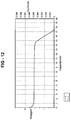
- FIG. 12 is a graph showing a 382 nd discharge of the cell including the electrode with Li 4 Ti 5 O 12-x of the present invention wherein the counter electrode is lithium metal;
- FIG. 13 is a graph showing a 382 nd charge of the cell including the electrode with Li 4 Ti 5 O 12-x of the present invention wherein the counter electrode is lithium metal.
- a lithium titanate of the present invention is useful in lithium-based cells.
- the lithium-based cells including the lithium titanate of the present invention are useful in many applications, but are particularly useful in rechargeable batteries for vehicles 10 , such as hybrid or electric vehicles 10 ; however, it is to be appreciated that the lithium-based cells may be used in non-rechargeable batteries.
- the rechargeable batteries are a power source 12 for an electric motor of the vehicles 10 .
- the lithium-based cells include an electrolyte, an anode, and a cathode. Electrolytes for the lithium-based cells are typically non-aqueous lithium ion-conducting electrolytes and are known in the art. At least one of the anode and the cathode includes the lithium titanate of the present invention.
- the lithium-based cell may be further defined as a lithium cell, wherein the cathode comprises the lithium titanate of the present invention.
- the lithium titanate is typically present in the cathode in an amount of at least 80 parts by weight, more typically from 80 to 90 parts by weight, most typically in an amount of about 82 parts by weight based on the total weight of the cathode.
- the cathode in the lithium cell also typically includes a conductive agent such as carbon black along with a binder agent, such as polyvinylidene fluoride, which make up the balance of the cathode.
- a conductive agent such as carbon black
- a binder agent such as polyvinylidene fluoride
- the carbon black is typically present in an amount of from 8 to 10 parts by weight, more typically about 8 parts by weight based on the total weight of the cathode
- the binder agent is typically present in an amount of from 8 to 12 parts by weight, more typically about 10 parts by weight, based on the total weight of the cathode.
- the anode in the lithium cells is typically a lithium metal or lithium alloy with magnesium or aluminum.
- the lithium-based cell may be further defined as one of a lithium ion cell and a lithium polymer cell, wherein the anode comprises the lithium titanate of the present invention in the amounts set forth above.
- the cells When used in rechargeable batteries for hybrid or electric vehicles 10 , the cells are typically used in a battery pack, represented by 14 in FIGS. 1 and 2 .
- the battery packs 14 typically include four rows of the cells that are interconnected and extend along each row in overlapping relationship. Each row typically includes five stacks of the cells. However, it is to be appreciated that other configurations of the cells within the battery pack 14 may also be used.
- the rechargeable batteries typically include a plurality of the battery packs 14 connected in a circuit in order to provide sufficient energy for powering the vehicle 10 .
- the circuit is configured with switches 18 and a battery management system 20 disposed in the circuit 16 .
- the battery management system 20 includes a switch control and interface circuit 22 to control energy usage from and recharge of the cells in the battery packs 14 .
- the lithium titanate of the present invention has the following formula: Li 4 Ti 5 O 12-x wherein x is greater than 0. Typically, 0 ⁇ x ⁇ 0.02.
- the lithium titanate of the present invention is deficient of oxygen, which has excellent electronic conductivity, as compared to lithium titanate of the above formula that is not deficient of oxygen.
- concentration of lithium in the lithium titanate of the present invention remains the same as for lithium titanate that is not deficient of oxygen.
- expected reversible electric power-generating capacity of the lithium titanate of the present invention will remain the same as the reversible electric power-generating capacity of lithium titanate that includes a stoichiometric amount of oxygen.
- lithium titanates that include titanium atoms in a +3 oxidation state exhibit high electronic conductivity that is characteristic of metal-like material
- lithium titanates that include titanium atoms in a +4 oxidation state exhibit low electronic conductivity that is characteristic of a dielectric material.
- the oxidation state of various lithium titanates is represented on the vertical axis as v(Ti), i.e., valence of titanium. As such, FIG.
- Li 4 Ti 5 O 12 is an example of lithium titanate having the titanium atoms in the +4 oxidation state.
- Li 7 Ti 5 O 12 has a higher electronic conductivity than the conventional Li 4 Ti 5 O 12 due to the transformation of titanium atoms in the conventional Li 4 Ti 5 O 12 from the +4 oxidation state to the +3 oxidation state during intercalation, as shown in FIG.
- the conventional Li 4 Ti 5 O 12 exhibits variable electronic conductivity based on the state of intercalation and zones of low and high electronic conductivity may exist during intercalation and discharge due to the disparate differences in electronic conductivity between the conventional Li 4 Ti 5 O 12 and Li 7 Ti 5 O 12 . Poor electronic conductivity of the conventional Li 4 Ti 5 O 12 causes initial “training” of the cells by low current as well as prevention of a complete charge. These circumstances extremely limit opportunities of use of the conventional Li 4 Ti 5 O 12 for high rate applications.
- reduction of Li 4 Ti 5 O 12 to form the Li 4 Ti 5 O 12-x results in the transformation of titanium atoms in the Li 4 Ti 5 O 12 from the +4 oxidation state to the +3 oxidation state as a result of charge compensation, thereby exhibiting increased electronic conductivity of the Li 4 Ti 5 O 12-x while retaining the same number of lithium and titanium atoms in the lithium titanate.
- an average valence of titanium in the lithium titanate of the present invention is less than 4.
- the lithium titanate will exhibit less drastic changes in electronic conductivity at all stages of charge and discharge processes, as opposed to the conventional Li 4 Ti 5 O 12 that exhibits electronic conductivity that is near that of dielectric materials prior to charging, such that different zones of Li 4 Ti 5 O 12-x and Li 7 Ti 5 O 12-x will exhibit more uniform media for charge and discharge processes, as compared to conventional Li 4 Ti 5 O 12 , which is advantageous for high-rate applications.
- the Li 4 Ti 5 O 12-x also retains the same spinel structure as Li 4 Ti 5 O 12 , which has excellent cycleability. As set forth above, typically, 0 ⁇ x ⁇ 0.02 in order to maintain the lithium titanate having the same spinel structure as the Li 4 Ti 5 O 12 . More specifically, referring to FIG. 3 , the lithium titanate of the present invention, by having the oxygen deficiency, shifts the Li 4 Ti 5 O 12-x to a position represented by “A” in FIG.
- Li 4 Ti 5 O 12 due to the transformation of titanium atoms in the Li 4 Ti 5 O 12 from the +4 oxidation state to the +3 oxidation state, with the position represented by “B” indicating an intercalation state of the Li 4 Ti 5 O 12-x .
- Li 2 Ti 3 O 7 has an orthorhombic crystal structure with space group Pbnm (62).
- Li 2 Ti 3 O 7 may be suitable for certain applications
- the spinel structure of Li 4 Ti 5 O 12 is preferred due to the ability to intercalate more lithium into the structure than can be intercalated into the Li 2 Ti 3 O 7 and also due to the fact that Li 4 Ti 5 O 12 exhibits low volume change of from 8.3595 to 8.3538 ⁇ between intercalated and deintercalated states, which provides the excellent cycleability.
- a method of forming the Li 4 Ti 5 O 12-x includes the step of providing a mixture of titanium dioxide and a lithium-based component.
- Titanium dioxide can be used both in the form of rutile and in the form of anatase, as well as any form of titanium oxide-hydroxide (such as Ti(OH) 2x O 2-x ).
- Any lithium-based component that is typically used for forming Li 4 Ti 5 O 12 may be used.
- the lithium-based component is selected from the group of lithium carbonate, lithium hydroxide, lithium oxide, and combinations thereof, and the lithium-based component is typically at least 99% pure.
- Lithium salts or organic acids can also be used.
- the mixture including the titanium dioxide and the lithium-based component is sintered in a gaseous atmosphere comprising a reducing agent to form the lithium titanate. More specifically, the mixture is sintered at a temperature of at least 450° C., more typically from about 500 to 925° C., most typically from about 700 to about 920° C., for a period of at least 30 minutes, more typically from about 60 to about 180 minutes.
- the reducing agent may be any agent that is capable of reducing the oxygen in the Li 4 Ti 5 O 12 and is typically selected from the group of hydrogen, a hydrocarbon, carbon monoxide and combinations thereof.
- the reducing agent is typically present in the gaseous atmosphere in a concentration of at least 0.1% by volume, more typically from about 1 to about 100% by volume, in order to sufficiently reduce the Li 4 Ti 5 O 12 to form the Li 4 Ti 5 O 12-x .
- the gaseous atmosphere typically includes another gas selected from the group of an inert, an inactive gas, and combinations thereof.
- Any inert gas may be used, such as any noble gas, in order to prevent unwanted side reactions during sintering and in order to prevent introduction of impurities into the Li 4 Ti 5 O 12-x .
- Inactive gas that may be used is, for example, pure nitrogen.
- Lithium titanate of the present invention having the formula Li 4 Ti 5 O 12-x is formed according to the method of the invention as set forth above. More specifically, conventional Li 4 Ti 5 O 12 is first formed by forming a mixture including titanium dioxide and a lithium-based compound. The mixture is formed by introducing the titanium dioxide and the lithium-based compound into a vessel in the amounts shown in Table 1. The titanium dioxide and the lithium-based compound are mixed and milled in a ball mill for a period of about 60 minutes at least 150 rpm rotation speed using a particle size distribution measurement till particle size less than 5 mkm, more preferably less than 2 mkm, with unimodal distribution to ensure sufficient mixing of the titanium dioxide and the lithium-based component.
- the mixture is then sintered in a gaseous atmosphere, created by a gas or gas mixture with constant flow at temperatures and times as indicated in Table 1.
- the gas or gas mixture includes a reducing agent and an inert gas or inactive gas in the amounts indicated in Table 1.
- the resulting lithium titanate has the formula Li 4 Ti 5 O 12-x with 0 ⁇ x ⁇ 0.02. Relevant properties of the lithium titanate of the present invention are also included in Table 1 below.
- Example 2 Example 3 Mixture Titanium Dioxide, pbw 72.992 80.655 76.632 based on total weight of mixture Lithium-based 27.008 — 14.178 Component A, pbw based on total weight of mixture Lithium-based — 19.345 9.190 Component B, pbw based on total weight of mixture Total 100.0 100.0 100.0 Gaseous Reducing Agent A flow, 0.002 — — Atmosphere L/(min ⁇ kg) based on total weight of mixture Reducing Agent B flow, — 0.0025 — L/(min ⁇ kg) based on total weight of mixture Reducing Agent C flow, — — 0.05 L/(min ⁇ kg) based on total weight of mixture Inert Gas A flow, 0.048 0.0225 — L/(min ⁇ kg) based on total weight of mixture Inactive Gas B flow, — — 0.095 L/(min ⁇ kg) based on total weight of mixture Total 0.05
- Lithium-based Component A Li 2 CO 3 .
- Lithium-based Component B is LiOH.
- Reducing Agent A is H 2 .
- Reducing Agent B is CH 4 (methane).
- Reducing Agent C is CO (carbon monoxide).
- Inert Gas A is Argon.
- Inactive Gas B is N 2 (nitrogen).
- Conventional lithium titanate having the formula Li 4 Ti 5 O 12 is formed in the same manner as set forth above; however the reducing agent is not present in the gaseous atmosphere.
- the amounts of the components used to form the conventional lithium titanate are shown below in Table 2, along with relevant properties of the conventional lithium titanate.
- the lithium titanates of the present invention exhibit higher electronic conductivity than conventional lithium titanates of the Comparative Examples, while exhibiting even higher reversible electric power-generating capacity.
- XRD spectra are received on an x-ray diffractometer Bruker D4 on CuK ⁇ radiation with Sol-X detector. All samples listed in Table 1 and 2 give well-defined spectra correspond to cubic structure (Sp. gr. Fd-3m (227)). Small amounts of residual TiO 2 ( ⁇ 0.5%) are present in most of samples.
- conventional structure model see for example, S. Scharner, W. Wepner, P. Schmid-Beurmann. Evidence of Two-Phase Formation upon Lithium insertion into the Li 1.33 Ti 1.67 O 4 Spinel, Journal of the Electrochemical Society. v. 146, I. 3, pp.
- parameter (a) of a cubic crystal lattice is calculated, and is shown in the Tables 1 and 2.
- Electronic conductivity of the Examples is measured on 20 mm diameter, 2-3 mm thick pellets that have been pressed and tempered inside powder samples under synthesis conditions until an equilibrium state is reached. Measurements are made by the 4-probe method on direct current, under potential of 90 volts. Attempts to receive reliable data for Li 4 Ti 5 O 12 samples (Table 2, Comp. Examples 1 and 2) are unsatisfactory, as the conductivity of these samples lies very close to a low limit of measurement for this method. Therefore, only order of conductivity is determinate. Results of measurements for Li 4 Ti 5 O 11.985 , synthesized according to Example 2 in Table 1, in a narrow temperature interval of about room temperature, are shown on FIG. 6 . Main sources of measurement discrepancies are the nature of compacted powder samples with significant porosity, as well as proximity to grain boundaries and contact effects.
- the kinetics of the sintering step for reducing the Li 4 Ti 5 O 12 is tested through the Temperature Controlled Reduction method.
- gas concentration is measured after flowing past the sample.
- FIG. 7 dependence of concentration of hydrogen, i.e., the reducing agent, against temperature of Li 4 Ti 5 O 12 is shown.
- a difference between initial concentration of hydrogen and concentration of hydrogen after the gaseous atmosphere flows past the sample gives an amount of hydrogen used for the sintering process.
- FIG. 8 shows a dependence of the logarithm of x in formula Li 4 Ti 5 O 12-x against reverse absolute temperature (in Kelvin). This curve has an Arrhenius-like character and is close to linear in the temperature interval 500° C. ⁇ T ⁇ 925° C.
- FIG. 9 shows that the lithium-based cell that includes the Li 4 Ti 5 O 12-x maintains electric power generating capacity after many cycles
- FIGS. 10-13 illustrate flat charge and discharge curves of the Li 4 Ti 5 O 12-x , even after many cycles of charge and discharge.
- the quality of the active substance affecting the performance of a lithium secondary battery is obviously regulated by its composition and is also associated with various powder properties including particle size, particle size distribution, specific area, crystallinity, crystal size, crystal size distribution, pore volume, pore volume distribution and crystallinity.
- the crystallinity is determined by the heating temperature and heating time when mixing and heating the lithium compound and titanium compound selected, and the powder properties are determined by the subsequent pulverization and sieving.
- improvement of the crystallinity and micronization of the crystal particles are regulated simultaneously, improvement of the crystallinity is achieved by focusing on the heating temperature and heating time by setting a high temperature and long heating time while micronization is generally regulated at low temperature for a short time.
- the regulating range is thus very narrow because the conflicting operations must be performed simultaneously.
- the active substance is produced from secondary particles and in case coarsening of the secondary particles and micronization of the primary particles are regulated simultaneously, the coarsening of the secondary particles is achieved by high temperature and long heating time while the micronization of the primary particles is generally regulated at low temperature for a short time.
- the regulating range is thus very narrow because the conflicting operations must be performed simultaneously. Furthermore, the regulating range is even narrower if the aforementioned four items are to be regulated to reach certain targets. Accordingly, the introduction of new production parameters is expected for regulating even higher quality for the active substance for high battery performance.
- the methods proposed for synthesizing lithium titanate include mixing lithium carbonate powder or lithium hydroxide powder with titanium oxide by various mixing methods and using the same as the precursor for calcination, using a synthetic product or mixture containing titanium and lithium obtained from solutions containing both titanium and lithium ingredients as the precursor for calcination and preparing a mixed slurry of titanium compound powder and a solution containing lithium, followed by depositing a lithium compound by spray-drying, to produce a mixture of titanium compound powder and lithium compound and using the same as the precursor for calcination.
- multiple lithium compounds are utilized as the starting materials at the same time for thermal synthesis of lithium titanate, in that the thermal synthesis is conducted by focusing on the behavior of the inherent property of each lithium compound and their behaviors in the reaction with the titanium compound and regulating the powder properties including the crystalline conditions such as crystallinity, crystal size and crystal size distribution and powder properties such as powder particle size and specific area that reflect the quality of the lithium titanate, so that the quality can meet the performance required of lithium batteries.
- the method of the present invention for producing lithium titanate involves thermal synthesis after mixing two or more lithium compounds with titanium oxide.
- the atomic transfer accompanying the formation of lithium titanate during the thermal synthesis of lithium titanate is considered to depend on whether it is a solid-solid reaction or liquid-solid reaction.
- the growth of the crystal particles depends on the existing condition of the surrounding particles, temperature and time.
- the lithium carbonate melts at 726° C. and decomposes to give lithium oxide and carbon dioxide at temperatures higher than 1500° C.
- lithium hydroxide melts at 450° C. and decomposes to give lithium oxide at temperatures higher than 924° C.
- the heating process for synthesizing lithium titanate is not the same as in the case of utilizing a mixture of lithium carbonate and titanium oxide and the case of utilizing a mixture of lithium hydroxide and titanium oxide in thermal synthesis.
- lithium carbonate and titanium oxide undergo a solid-solid reaction while lithium hydroxide and titanium oxide undergo a liquid-solid reaction, at 500° C. for example.
- a liquid-solid reaction the atomic transfer accompanying the formation of lithium titanate is considered to proceed more readily compared to the case of a solid-solid reaction.
- lithium titanate is formed, the growth of the crystal particles depends on the existing condition of the surrounding particles, temperature and time.
- the temperature and time vary with the type of starting materials utilized, which expands the quality control range for lithium titanate due to the new parameters.
- representative compounds of lithium carbonate, lithium hydroxide and titanium oxide are products procurable in the industry, but the lithium compounds and titanium compound are not limited to them.
- titanium compounds can be utilized, and pre-prepared titanium and lithium compounds can be utilized as part of the starting material for the thermal synthesis.
- Application example include and not limited to titanium oxide powder ( ⁇ 325 mesh) produced by Alfa Aesar, lithium carbonate powder ( ⁇ 325 mesh) produced by FMC and lithium hydroxide powder ( ⁇ 200 mesh) produced by Science Lab were utilized.
- sample 1 containing 11.3 g lithium carbonate
- sample 2 containing 8.5 g lithium carbonate and 3.3 g lithium hydroxide
- sample 3 containing 5.7 g lithium carbonate and 6.5 g lithium hydroxide
- sample 4 containing 2.8 g lithium carbonate and 9.8 g lithium hydroxide and sample 5 containing 13.0 g lithium hydroxide
- the heating conditions include heating from room temperature to 150° C. and maintaining the temperature for 2 h and subsequently heating to 450° C. and maintaining the temperature for 2 h and further heating to 950° C. and maintaining the temperature for 8 h, followed by cooling to room temperature to obtain the synthetic products.
Landscapes
- Chemical & Material Sciences (AREA)
- Inorganic Chemistry (AREA)
- Organic Chemistry (AREA)
- Life Sciences & Earth Sciences (AREA)
- Environmental & Geological Engineering (AREA)
- General Life Sciences & Earth Sciences (AREA)
- Geology (AREA)
- Chemical Kinetics & Catalysis (AREA)
- Electrochemistry (AREA)
- General Chemical & Material Sciences (AREA)
- Inorganic Compounds Of Heavy Metals (AREA)
- Battery Electrode And Active Subsutance (AREA)
Priority Applications (8)
| Application Number | Priority Date | Filing Date | Title |
|---|---|---|---|
| US12/152,352 US7820137B2 (en) | 2006-08-04 | 2008-05-14 | Lithium titanate and method of forming the same |
| CN2009801171118A CN102026920A (zh) | 2008-05-14 | 2009-05-14 | 钛酸锂及其制备方法 |
| RU2010150909/05A RU2519840C2 (ru) | 2008-05-14 | 2009-05-14 | Способ получения титаната лития |
| PCT/US2009/043962 WO2009140501A1 (fr) | 2008-05-14 | 2009-05-14 | Titanate de lithium et son procédé de fabrication |
| JP2011509704A JP2011520752A (ja) | 2008-05-14 | 2009-05-14 | チタン酸リチウムおよび同一物の形成方法 |
| KR1020107027616A KR20110013460A (ko) | 2008-05-14 | 2009-05-14 | 리튬 티타네이트 및 이의 제조 방법 |
| EP09747583.4A EP2294013A4 (fr) | 2008-05-14 | 2009-05-14 | Titanate de lithium et son procédé de fabrication |
| US12/912,506 US8052955B2 (en) | 2006-04-11 | 2010-10-26 | Lithium-based materials and methods of forming the same |
Applications Claiming Priority (3)
| Application Number | Priority Date | Filing Date | Title |
|---|---|---|---|
| US11/462,520 US7541016B2 (en) | 2006-04-11 | 2006-08-04 | Lithium titanate and method of forming the same |
| US91772107P | 2007-05-14 | 2007-05-14 | |
| US12/152,352 US7820137B2 (en) | 2006-08-04 | 2008-05-14 | Lithium titanate and method of forming the same |
Related Parent Applications (1)
| Application Number | Title | Priority Date | Filing Date |
|---|---|---|---|
| US11/462,520 Continuation-In-Part US7541016B2 (en) | 2006-04-11 | 2006-08-04 | Lithium titanate and method of forming the same |
Related Child Applications (1)
| Application Number | Title | Priority Date | Filing Date |
|---|---|---|---|
| US12/912,506 Continuation US8052955B2 (en) | 2006-04-11 | 2010-10-26 | Lithium-based materials and methods of forming the same |
Publications (2)
| Publication Number | Publication Date |
|---|---|
| US20090136415A1 US20090136415A1 (en) | 2009-05-28 |
| US7820137B2 true US7820137B2 (en) | 2010-10-26 |
Family
ID=41319058
Family Applications (2)
| Application Number | Title | Priority Date | Filing Date |
|---|---|---|---|
| US12/152,352 Expired - Fee Related US7820137B2 (en) | 2006-04-11 | 2008-05-14 | Lithium titanate and method of forming the same |
| US12/912,506 Expired - Fee Related US8052955B2 (en) | 2006-04-11 | 2010-10-26 | Lithium-based materials and methods of forming the same |
Family Applications After (1)
| Application Number | Title | Priority Date | Filing Date |
|---|---|---|---|
| US12/912,506 Expired - Fee Related US8052955B2 (en) | 2006-04-11 | 2010-10-26 | Lithium-based materials and methods of forming the same |
Country Status (7)
| Country | Link |
|---|---|
| US (2) | US7820137B2 (fr) |
| EP (1) | EP2294013A4 (fr) |
| JP (1) | JP2011520752A (fr) |
| KR (1) | KR20110013460A (fr) |
| CN (1) | CN102026920A (fr) |
| RU (1) | RU2519840C2 (fr) |
| WO (1) | WO2009140501A1 (fr) |
Families Citing this family (47)
| Publication number | Priority date | Publication date | Assignee | Title |
|---|---|---|---|---|
| KR101153888B1 (ko) * | 2009-09-23 | 2012-06-18 | 한국세라믹기술원 | 수산화 티타늄을 이용한 나노구상 티탄산니튬 산화물 및 그 제조방법 |
| JP5829796B2 (ja) * | 2010-03-31 | 2015-12-09 | 日本ケミコン株式会社 | チタン酸リチウムナノ粒子とカーボンの複合体の製造方法 |
| CN102208609B (zh) * | 2010-03-31 | 2014-05-28 | 比亚迪股份有限公司 | 一种用于锂离子电池的钛酸锂材料制备方法及钛酸锂材料 |
| US9296623B2 (en) | 2010-03-31 | 2016-03-29 | Nippon Chemi-Con Corporation | Lithium titanate nanoparticles, composite of lithium titanate nanoparticles and carbon, method of production thereof, electrode material consisting of said composite, electrode, electrochemical element, and electrochemical capacitor employing said electrode material |
| KR101250587B1 (ko) * | 2010-04-20 | 2013-04-03 | 연세대학교 산학협력단 | 전이금속 산화물/탄소나노튜브 복합체 제조 방법 및 그 복합체 |
| CA2809511A1 (fr) * | 2010-08-31 | 2012-03-08 | Toda Kogyo Corporation | Poudre particulaire de titanate de lithium et son procede de production, poudre particulaire de titanate de lithium contenant mg et son procede de production, poudre particulaire de materiau actif d'electrode negative pour batterie rechargeable a electrolyte non aqueux, et batterie rechargeable a electrolyte non aqueux |
| US9269948B2 (en) | 2010-11-16 | 2016-02-23 | Toyota Jidosha Kabushiki Kaisha | Positive electrode active material, process for producing same, and lithium secondary battery using same |
| JP2012146763A (ja) * | 2011-01-11 | 2012-08-02 | Nippon Chemicon Corp | 電気化学キャパシタ |
| WO2012134594A1 (fr) * | 2011-03-28 | 2012-10-04 | Blue Juice, Inc. | Matériaux d'électrode à large plage de températures, à puissance élevée, électrodes, dispositifs apparentés et procédés de fabrication |
| JP5698052B2 (ja) * | 2011-03-30 | 2015-04-08 | 株式会社クボタ | チタン酸リチウムの製造方法、電極、及びリチウムイオン二次電池 |
| DE102011016836A1 (de) * | 2011-04-12 | 2012-10-18 | Süd-Chemie AG | Verfahren zur Herstellung von Lithiumtitan-Spinell |
| WO2012169331A1 (fr) * | 2011-06-10 | 2012-12-13 | 東邦チタニウム株式会社 | Particules primaires de titanate de lithium, agrégat de titanate de lithium, batterie secondaire au lithium-ion mettant en oeuvre les particules primaires de titanate de lithium ou l'agrégat de titanate de lithium et condensateur au lithium-ion mettant en oeuvre les particules primaires de titanate de lithium ou l'agrégat de titanate de lithium |
| CN102354748A (zh) * | 2011-09-30 | 2012-02-15 | 苏州大学 | 一种锂离子电池负极材料及其制备方法 |
| JP5884084B2 (ja) * | 2011-11-29 | 2016-03-15 | パナソニックIpマネジメント株式会社 | 負極活物質、蓄電デバイス及び負極活物質の製造方法 |
| JP6053325B2 (ja) * | 2012-05-22 | 2016-12-27 | スリーエム イノベイティブ プロパティズ カンパニー | 焼成物、金属イオン吸着材、金属イオンの除去方法、及び金属イオン除去設備 |
| JP5968712B2 (ja) * | 2012-07-27 | 2016-08-10 | 東邦チタニウム株式会社 | チタン酸リチウム粉体の製造方法、及び該チタン酸リチウム粉体を用いたリチウムイオン二次電池及びリチウムイオンキャパシタ |
| CN103700828B (zh) * | 2012-09-27 | 2016-03-09 | 清华大学 | 锂离子电池正极复合材料 |
| US9059451B2 (en) | 2012-10-18 | 2015-06-16 | GM Global Technology Operations LLC | Coatings for lithium titanate to suppress gas generation in lithium-ion batteries and methods for making and use thereof |
| KR101515991B1 (ko) | 2012-11-21 | 2015-04-30 | 삼화콘덴서공업주식회사 | 티탄계 산화물 복합체 제조방법 |
| US9034519B2 (en) | 2013-01-18 | 2015-05-19 | GM Global Technology Operations LLC | Ultrathin surface coating on negative electrodes to prevent transition metal deposition and methods for making and use thereof |
| KR101479626B1 (ko) | 2013-05-03 | 2015-01-06 | 삼화콘덴서공업주식회사 | Lto/탄소 복합체, lto/탄소 복합체 제조방법, lto/탄소 복합체를 이용한 이용한 음극활물질 및 음극활물질을 이용한 하이브리드 슈퍼커패시터 |
| CN103332735A (zh) * | 2013-07-04 | 2013-10-02 | 南京航空航天大学 | 氢化钛酸锂纳米材料的制备方法 |
| RU2538254C1 (ru) * | 2013-07-17 | 2015-01-10 | Хожбауди Хамзатович Альвиев | Способ получения наноразмерных порошков композита на основе титаната лития |
| CN103474645B (zh) * | 2013-09-22 | 2016-01-20 | 四川科能锂电有限公司 | 钛酸锂的制备方法 |
| US9531004B2 (en) | 2013-12-23 | 2016-12-27 | GM Global Technology Operations LLC | Multifunctional hybrid coatings for electrodes made by atomic layer deposition techniques |
| US9564639B2 (en) | 2014-02-12 | 2017-02-07 | GM Global Technology Operations LLC | High performance silicon electrodes having improved interfacial adhesion between binder and silicon |
| US11223042B2 (en) | 2014-03-31 | 2022-01-11 | Tronox Llc | Lithium-intercalated titanium dioxide, lithium titanate particles made therefrom, and related methods |
| CN104617287A (zh) * | 2014-04-25 | 2015-05-13 | 上海应用技术学院 | 一种锂离子电池负极材料纳米氧缺位型钛酸锂的制备方法 |
| CN104600269A (zh) * | 2014-04-25 | 2015-05-06 | 上海应用技术学院 | 一种石墨烯/氧缺位钛酸锂复合材料的制备方法 |
| CN105185973B (zh) * | 2014-05-28 | 2019-04-16 | 神华集团有限责任公司 | 一种复合材料及其制备以及含有该材料的锂离子电池负极活性物质、负极材料、负极和电池 |
| JP6329034B2 (ja) * | 2014-09-01 | 2018-05-23 | 東邦チタニウム株式会社 | チタン酸リチウムの製造方法およびそれを用いたリチウムイオン二次電池の製造方法 |
| KR101924036B1 (ko) * | 2015-06-09 | 2018-11-30 | 주식회사 엘지화학 | 리튬 이차전지용 음극활물질의 제조방법, 이에 의해 제조된 음극활물질, 및 이를 포함하는 음극 슬러리 및 리튬 이차전지 |
| JP6012057B2 (ja) * | 2015-06-22 | 2016-10-25 | 日本ケミコン株式会社 | チタン酸リチウムナノ粒子の製造方法 |
| JP6612566B2 (ja) * | 2015-09-16 | 2019-11-27 | 株式会社東芝 | リチウムイオン非水電解質二次電池用負極、リチウムイオン非水電解質二次電池、電池パック及び自動車 |
| CN105810901A (zh) * | 2016-03-14 | 2016-07-27 | 中国科学院广州能源研究所 | 一种Ti3+/Ti4+混合价态的掺杂铁元素的锂离子电池钛酸锂负极材料及其制备方法 |
| US10396360B2 (en) | 2016-05-20 | 2019-08-27 | Gm Global Technology Operations Llc. | Polymerization process for forming polymeric ultrathin conformal coatings on electrode materials |
| US10164245B2 (en) | 2016-09-19 | 2018-12-25 | GM Global Technology Operations LLC | High performance silicon electrodes having improved interfacial adhesion between binder, silicon and conductive particles |
| WO2018135113A1 (fr) * | 2017-01-20 | 2018-07-26 | 東邦チタニウム株式会社 | Titanate de lithium ayant une caractéristique de batterie constante, batterie secondaire au lithium-ion l'utilisant et sa méthode de production |
| RU2658305C1 (ru) * | 2017-06-15 | 2018-06-20 | федеральное государственное бюджетное образовательное учреждение высшего образования "Национальный исследовательский университет "МЭИ" (ФГБОУ ВО "НИУ "МЭИ") | Способ изготовления активной массы анода литиевого аккумулятора |
| US10868307B2 (en) | 2018-07-12 | 2020-12-15 | GM Global Technology Operations LLC | High-performance electrodes employing semi-crystalline binders |
| US11228037B2 (en) | 2018-07-12 | 2022-01-18 | GM Global Technology Operations LLC | High-performance electrodes with a polymer network having electroactive materials chemically attached thereto |
| US10741873B2 (en) * | 2018-07-16 | 2020-08-11 | Ford Global Technologies, Llc | Composition for sintered lithium titanate-lithium lanthanum titanium oxide composite |
| KR102640207B1 (ko) * | 2018-11-05 | 2024-02-23 | 삼성전자주식회사 | 혼합전도체, 이를 포함하는 전기화학소자 및 그 제조방법 |
| KR102361162B1 (ko) | 2020-06-03 | 2022-02-10 | 한국세라믹기술원 | 고출력 특성을 갖는 하이브리드 슈퍼커패시터용 음극활물질 제조 방법과, 이를 갖는 하이브리드 슈퍼커패시터 및 그 제조 방법 |
| CN112397680A (zh) * | 2020-11-20 | 2021-02-23 | 北方奥钛纳米技术有限公司 | 钛酸锂复合材料及其制备方法、电池极片和锂离子电池 |
| US11799083B2 (en) | 2021-08-26 | 2023-10-24 | GM Global Technology Operations LLC | Lithiation additive for a positive electrode |
| US12609299B2 (en) | 2022-08-03 | 2026-04-21 | GM Global Technology Operations LLC | Protective particle coatings for electroactive material particles and methods of forming the same |
Citations (1)
| Publication number | Priority date | Publication date | Assignee | Title |
|---|---|---|---|---|
| US6022640A (en) * | 1996-09-13 | 2000-02-08 | Matsushita Electric Industrial Co., Ltd. | Solid state rechargeable lithium battery, stacking battery, and charging method of the same |
Family Cites Families (97)
| Publication number | Priority date | Publication date | Assignee | Title |
|---|---|---|---|---|
| US1920719A (en) * | 1931-01-15 | 1933-08-01 | Stich Eugen | Aerating device |
| US2517525A (en) * | 1947-10-13 | 1950-08-01 | Sun Oil Co | Catalytic reaction apparatus |
| US3441216A (en) * | 1964-11-16 | 1969-04-29 | Raymond J Good | Air diffuser unit for aerating sewage |
| US3708206A (en) * | 1970-07-20 | 1973-01-02 | Union Carbide Corp | Process for leaching base elements, such as uranium ore, in situ |
| US3814394A (en) * | 1971-11-17 | 1974-06-04 | M Murray | Apparatus for encapsulating hot gases from high stacks |
| US3823776A (en) * | 1973-04-26 | 1974-07-16 | Mobil Oil Corp | Oil recovery method by oxidation and forming surfactants in situ |
| US4007118A (en) * | 1975-10-16 | 1977-02-08 | Cubic Corporation | Ozone oxidation of waste water |
| US4021347A (en) * | 1976-01-09 | 1977-05-03 | Teller Ray E | Sewage treatment system |
| US4203837A (en) * | 1976-01-16 | 1980-05-20 | Hoge John H | Process for removal of discrete particulates and solutes from liquids by foam flotation |
| US4838434A (en) * | 1979-11-15 | 1989-06-13 | University Of Utah | Air sparged hydrocyclone flotation apparatus and methods for separating particles from a particulate suspension |
| US4268283A (en) * | 1979-12-31 | 1981-05-19 | W-K-M Wellhead Systems, Inc. | Fluid control means for geothermal wells |
| US4310057A (en) * | 1980-05-30 | 1982-01-12 | Brame Durward B | Apparatus for extracting subterranean gas samples |
| USRE34890E (en) * | 1981-08-06 | 1995-04-04 | Gore Enterprise Holdings, Inc. | Waterproof shoe construction |
| SU1119982A1 (ru) * | 1983-08-05 | 1984-10-23 | Институт химии Уральского научного центра АН СССР | Способ получени титаната лити |
| US4837153A (en) * | 1984-08-22 | 1989-06-06 | Laurenson Jr John G | Compost air injection and evacuation system with improved air control |
| US4639314A (en) * | 1985-01-18 | 1987-01-27 | Tyer Robert R | Fine bubble diffuser and diffuser system having filtered blow-down tube |
| US4684479A (en) * | 1985-08-14 | 1987-08-04 | Arrigo Joseph S D | Surfactant mixtures, stable gas-in-liquid emulsions, and methods for the production of such emulsions from said mixtures |
| US4941957A (en) * | 1986-10-22 | 1990-07-17 | Ultrox International | Decomposition of volatile ogranic halogenated compounds contained in gases and aqueous solutions |
| DE3703824A1 (de) * | 1987-02-07 | 1988-08-18 | Thomae Gmbh Dr K | Verfahren zur simultanen chemischen und biologischen beseitigung fester und fluessiger organischer abfaelle und vorrichtungen zur durchfuehrung dieses verfahrens |
| US4730672A (en) * | 1987-03-04 | 1988-03-15 | Midwest Water Resource, Inc. | Method of removing and controlling volatile contaminants from the vadose layer of contaminated earth |
| US4804050A (en) * | 1987-04-30 | 1989-02-14 | K-V Associates, Inc. | Method of underground fluid sampling |
| US5205927A (en) * | 1987-09-25 | 1993-04-27 | Battelle Memorial Institute | Apparatus for treatment of soils contaminated with organic pollutants |
| US5227184A (en) * | 1987-10-30 | 1993-07-13 | American Water Purification, Inc. | Method for sanitizing food products |
| CA1321664C (fr) * | 1988-05-04 | 1993-08-24 | Stan Houser | Appareil servant a eliminer le fer contenu dans de l'eau de puits, et methode connexe |
| US4844795A (en) * | 1988-05-13 | 1989-07-04 | Bassim Halwani | Method and apparatus for decontaminating the aquifer of hydrocarbons |
| DE8808089U1 (de) * | 1988-06-23 | 1988-10-06 | IEG - Industrie-Engineering GmbH, 7410 Reutlingen | Brunnen zum Austreiben leichtflüchtiger Verunreinigungen aus gespanntem Grundwasser |
| US4832122A (en) * | 1988-08-25 | 1989-05-23 | The United States Of America As Represented By The United States Department Of Energy | In-situ remediation system and method for contaminated groundwater |
| US5078921A (en) * | 1988-10-21 | 1992-01-07 | The Deister Concentrator Company, Inc. | Froth flotation apparatus |
| DE4001012C1 (fr) * | 1990-01-16 | 1991-05-02 | Ieg - Industrie-Engineering Gmbh, 7410 Reutlingen, De | |
| US5221159A (en) * | 1990-03-28 | 1993-06-22 | Environmental Improvement Technologies, Inc. | Subsurface contaminant remediation, biodegradation and extraction methods and apparatuses |
| US5122165A (en) * | 1990-07-10 | 1992-06-16 | International Environmental Systems, Inc. | Removal of volatile compounds and surfactants from liquid |
| US5215680A (en) * | 1990-07-10 | 1993-06-01 | Cavitation-Control Technology, Inc. | Method for the production of medical-grade lipid-coated microbubbles, paramagnetic labeling of such microbubbles and therapeutic uses of microbubbles |
| US5133906A (en) * | 1990-10-09 | 1992-07-28 | Tony Louis | Aerator |
| US5126111A (en) * | 1990-12-05 | 1992-06-30 | Nutech Energy Systems Inc. | Fluid purification |
| US5389267A (en) * | 1991-05-10 | 1995-02-14 | The Board Of Trustees Of The Leland Stanford Junior University | In-situ vapor stripping for removing volatile organic compounds from groundwater |
| US5180503A (en) * | 1991-05-10 | 1993-01-19 | The Board Of Trustees Of The Leland Stanford Junior University | In-situ vapor stripping for removing volatile organic compounds from groundwater |
| US5178491A (en) * | 1991-06-19 | 1993-01-12 | International Technology Corporation | Vapor-phase nutrient delivery system for in situ bioremediation of soil |
| CA2182668C (fr) * | 1992-01-07 | 2004-09-21 | Joseph A. Pezzullo | Procede de decontamination du sol par oxydation et par extraction sous vide |
| US6217767B1 (en) * | 1992-02-03 | 2001-04-17 | Clark Environmental Services | Vacuum sparging process for treating contaminated groundwater and/or wastewater |
| US5427693A (en) * | 1992-02-10 | 1995-06-27 | O-Three Limited | Modular ozone water treatment apparatus and associated method |
| US5178755A (en) * | 1992-02-20 | 1993-01-12 | Estr Inc. | UV-enhanced ozone wastewater treatment system |
| US5302286A (en) * | 1992-03-17 | 1994-04-12 | The Board Of Trustees Of The Leland Stanford Junior University | Method and apparatus for in situ groundwater remediation |
| DE4227570C1 (de) * | 1992-05-29 | 1993-09-30 | Ieg Ind Engineering Gmbh | Anordnung zum Austreiben leichtflüchtiger Verunreinigungen an Ort und Stelle |
| US5332333A (en) * | 1993-01-27 | 1994-07-26 | Bentley Harold W | Vacuum extraction method and apparatus for removing volatile contaminants from the vadose layer of contaminated earth |
| US5286141A (en) * | 1993-02-12 | 1994-02-15 | Vigneri Ronald J | Method and system for remediation of groundwater contamination |
| US5430228A (en) * | 1993-02-24 | 1995-07-04 | Hughes Aircraft Company | Ozone methods for the destruction of chemical weapons |
| JP3502118B2 (ja) | 1993-03-17 | 2004-03-02 | 松下電器産業株式会社 | リチウム二次電池およびその負極の製造法 |
| US5425598B1 (en) * | 1993-08-12 | 1997-07-15 | Leslie H Pennington | System for sparging ground water contaminants |
| ZA94750B (en) | 1993-09-02 | 1994-09-29 | Technology Finance Corp | Electrochemical cell |
| US5406950A (en) * | 1993-12-23 | 1995-04-18 | Mallinckrodt Medical, Inc. | Inhalable contrast agent |
| US5431286A (en) * | 1994-01-06 | 1995-07-11 | Inco Limited | Recirculating column flotation apparatus |
| US5624635A (en) * | 1994-01-18 | 1997-04-29 | Pryor; Alan E. | Method and apparatus for ozone treatment of soil |
| US5480549A (en) * | 1994-01-25 | 1996-01-02 | The United States Of America As Represented By The United States Department Of Energy | Method for phosphate-accelerated bioremediation |
| US5398757A (en) * | 1994-02-22 | 1995-03-21 | K N Energy, Inc. | Mono-well for soil sparging and soil vapor extraction |
| US5402848A (en) * | 1994-04-07 | 1995-04-04 | Kelly; Leo G. | Method and apparatus for conducting environmental procedures |
| US6210955B1 (en) * | 1994-10-05 | 2001-04-03 | Gas Research Institute | Foam transport process for in-situ remediation of contaminated soils |
| US5525008A (en) * | 1995-01-11 | 1996-06-11 | Wilson; James T. | Remediation apparatus and method for organic contamination in soil and groundwater |
| SE503894C2 (sv) * | 1995-01-19 | 1996-09-30 | Norrtaelje Kommun | Anordning för distribution och dispersion av luftmättat vatten |
| US5622450A (en) * | 1995-03-24 | 1997-04-22 | Grant, Jr.; Richard P. | Pressure extraction process for removing soil and groundwater contaminants |
| US6827861B2 (en) * | 1995-05-05 | 2004-12-07 | William B. Kerfoot | Gas-gas-water treatment system for groundwater and soil remediation |
| US5855775A (en) * | 1995-05-05 | 1999-01-05 | Kerfoot; William B. | Microporous diffusion apparatus |
| US5609798A (en) * | 1995-06-07 | 1997-03-11 | Msp Corporation | High output PSL aerosol generator |
| US6403034B1 (en) * | 1995-10-31 | 2002-06-11 | Christopher Nelson | Method of reducing the concentration of recalcitrant organic contamination in a soil matrix |
| US5741427A (en) * | 1996-03-14 | 1998-04-21 | Anesys Corp. | Soil and/or groundwater remediation process |
| US6197835B1 (en) * | 1996-05-13 | 2001-03-06 | Universidad De Sevilla | Device and method for creating spherical particles of uniform size |
| US5620593A (en) * | 1996-06-12 | 1997-04-15 | Stagner; Joseph C. | Multi-stage in-well aerator |
| IL118741A0 (en) * | 1996-06-26 | 1996-10-16 | Ozontech Ltd | Ozone application for disinfection purification and deodorization |
| US6086769A (en) * | 1996-09-16 | 2000-07-11 | Commodore Separation Technologies, Inc. | Supported liquid membrane separation |
| US5925257A (en) * | 1996-09-27 | 1999-07-20 | Albelda; David | Method and apparatus for removing biofilm from an aqueous liquid |
| US6007274A (en) * | 1997-05-19 | 1999-12-28 | Arcadis Geraghty & Miller | In-well air stripping, oxidation, and adsorption |
| US5879108A (en) * | 1997-06-09 | 1999-03-09 | Eder Associates | Air sparging/soil vapor extraction apparatus |
| DE69842254D1 (de) | 1997-07-15 | 2011-06-16 | Ishihara Sangyo Kaisha | Lithiumwasserstofftitanat und verfahren zu dessen herstellung |
| US5860598A (en) * | 1997-08-14 | 1999-01-19 | Cruz; Luis R | Fog atomizer |
| JPH11333476A (ja) * | 1998-05-29 | 1999-12-07 | Mitsubishi Electric Corp | オゾン混合処理法およびオゾン混合処理装置 |
| US6221531B1 (en) | 1998-07-09 | 2001-04-24 | The University Of Chicago | Lithium-titanium-oxide anodes for lithium batteries |
| US6083403A (en) * | 1998-11-05 | 2000-07-04 | Nalco Chemical Company | Stabilized substituted aminomethane-1, 1-diphosphonic acid n-oxides and use thereof in preventing scale and corrosion |
| DE29821687U1 (de) * | 1998-12-05 | 2000-04-06 | GEA Finnah GmbH, 48683 Ahaus | Vorrichtung zum Erzeugen eines Aerosols |
| US6645673B2 (en) | 1999-02-16 | 2003-11-11 | Toho Titanium Co., Ltd. | Process for producing lithium titanate and lithium ion battery and negative electrode therein |
| US6251289B1 (en) * | 1999-06-03 | 2001-06-26 | Grt, Inc. | Treatment of contaminated liquids with oxidizing gases and liquids |
| US6352387B1 (en) * | 1999-12-02 | 2002-03-05 | Robert A. Briggs | Recirculation-enhanced subsurface reagent delivery system |
| US6436285B1 (en) * | 1999-12-22 | 2002-08-20 | William B. Kerfoot | Laminated microporous diffuser |
| US6364162B1 (en) * | 2000-01-06 | 2002-04-02 | Johnson Research & Development Co. | Automatic pressurized fluid gun |
| US6367555B1 (en) * | 2000-03-15 | 2002-04-09 | Corley P. Senyard, Sr. | Method and apparatus for producing an oil, water, and/or gas well |
| US6582611B1 (en) * | 2000-07-06 | 2003-06-24 | William B. Kerfoot | Groundwater and subsurface remediation |
| US6409487B1 (en) * | 2000-09-12 | 2002-06-25 | Dc Shoes, Inc. | Shoe with inflatable bladder and secure deflation valve |
| JP3894778B2 (ja) * | 2000-11-20 | 2007-03-22 | 石原産業株式会社 | チタン酸リチウム及びそれを用いてなるリチウム電池 |
| US6533499B2 (en) * | 2001-03-13 | 2003-03-18 | Boyd Breeding | Soil and groundwater remediation system |
| US6805798B2 (en) * | 2001-05-18 | 2004-10-19 | William B. Kerfoot | Environmental remediation method and apparatus |
| US6866781B2 (en) * | 2001-06-06 | 2005-03-15 | A. Russell Schindler | Direct oxygen injection groundwater remediation method and system |
| CA2454324C (fr) * | 2001-07-20 | 2012-01-03 | Altair Nanomaterials Inc. | Procede destine a fabriquer du titanate de lithium |
| US6733207B2 (en) * | 2002-03-14 | 2004-05-11 | Thomas R. Liebert, Jr. | Environmental remediation system and method |
| US6921477B2 (en) * | 2002-04-08 | 2005-07-26 | Steven L. Wilhelm | Groundwater treatment system and method |
| US6916579B2 (en) | 2002-05-30 | 2005-07-12 | Enerl Battery Company | Cathode material for lithium battery |
| US7264419B2 (en) * | 2003-03-19 | 2007-09-04 | Applied Process Technology, Inc. | System and method for remediating contaminated soil and groundwater in situ |
| US7208090B2 (en) * | 2003-12-23 | 2007-04-24 | Usfilter Corporation | Wastewater treatment control |
| JP2005340078A (ja) * | 2004-05-28 | 2005-12-08 | Matsushita Electric Ind Co Ltd | リチウムイオン二次電池用活物質、その製造方法およびリチウムイオン二次電池 |
| US7541016B2 (en) * | 2006-04-11 | 2009-06-02 | Enerdel, Inc. | Lithium titanate and method of forming the same |
-
2008
- 2008-05-14 US US12/152,352 patent/US7820137B2/en not_active Expired - Fee Related
-
2009
- 2009-05-14 JP JP2011509704A patent/JP2011520752A/ja active Pending
- 2009-05-14 CN CN2009801171118A patent/CN102026920A/zh active Pending
- 2009-05-14 EP EP09747583.4A patent/EP2294013A4/fr not_active Withdrawn
- 2009-05-14 RU RU2010150909/05A patent/RU2519840C2/ru not_active IP Right Cessation
- 2009-05-14 KR KR1020107027616A patent/KR20110013460A/ko not_active Ceased
- 2009-05-14 WO PCT/US2009/043962 patent/WO2009140501A1/fr not_active Ceased
-
2010
- 2010-10-26 US US12/912,506 patent/US8052955B2/en not_active Expired - Fee Related
Patent Citations (1)
| Publication number | Priority date | Publication date | Assignee | Title |
|---|---|---|---|---|
| US6022640A (en) * | 1996-09-13 | 2000-02-08 | Matsushita Electric Industrial Co., Ltd. | Solid state rechargeable lithium battery, stacking battery, and charging method of the same |
Also Published As
| Publication number | Publication date |
|---|---|
| US8052955B2 (en) | 2011-11-08 |
| EP2294013A1 (fr) | 2011-03-16 |
| RU2519840C2 (ru) | 2014-06-20 |
| JP2011520752A (ja) | 2011-07-21 |
| CN102026920A (zh) | 2011-04-20 |
| RU2010150909A (ru) | 2012-06-20 |
| WO2009140501A1 (fr) | 2009-11-19 |
| EP2294013A4 (fr) | 2013-06-12 |
| US20090136415A1 (en) | 2009-05-28 |
| KR20110013460A (ko) | 2011-02-09 |
| US20110044886A1 (en) | 2011-02-24 |
Similar Documents
| Publication | Publication Date | Title |
|---|---|---|
| US7820137B2 (en) | Lithium titanate and method of forming the same | |
| US7541016B2 (en) | Lithium titanate and method of forming the same | |
| US7820327B2 (en) | Lithium titanate and lithium cells and batteries including the same | |
| CN114930570B (zh) | Li/Na离子电池阳极材料 | |
| EP2115801B1 (fr) | Cellules au titanate de lithium et au lithium et batteries qui en sont constituées | |
| KR102716743B1 (ko) | 리튬 이온 이차 전지용 정극 활물질 및 리튬 이온 이차 전지 | |
| US8168330B2 (en) | Lithium titanate cell with reduced gassing | |
| JP5265187B2 (ja) | リチウム金属酸化物材料、及び合成方法と用途 | |
| US8535829B2 (en) | Lithium transition metal-based compound powder for positive electrode material in lithium rechargeable battery, method for manufacturing the powder, spray dried product of the powder, firing precursor of the powder, and positive electrode for lithium rechargeable battery and lithium rechargeable battery using the powder | |
| CN103080010B (zh) | 钛酸锂颗粒粉末及其制造方法、含Mg钛酸锂颗粒粉末及其制造方法、非水电解质二次电池用负极活性物质颗粒粉末以及非水电解质二次电池 | |
| KR101340821B1 (ko) | 리튬 이차 전지용 고전압 음극 활성 물질 | |
| KR20100060362A (ko) | 리튬 이차 전지용 양극 활물질, 이의 제조방법 및 이를 포함하는 리튬 이차 전지 | |
| EP4441808B1 (fr) | Matériau actif d'électrode | |
| CN118524991B (zh) | 活性电极材料 | |
| Deng et al. | The enhancement of rate and cycle performance of LiMn2O4 at elevated temperatures by the synergistic roles of porous structure and dual-cation doping | |
| JPH10241689A (ja) | 非水系電池用電極活物質 | |
| Griffith et al. | Translating a Material Discovery into a Commercial Product in the Modern Lithium-ion Battery Market | |
| WO2026078357A1 (fr) | Matériau de batterie |
Legal Events
| Date | Code | Title | Description |
|---|---|---|---|
| AS | Assignment |
Owner name: ENERDEL, INC., INDIANA Free format text: ASSIGNMENT OF ASSIGNORS INTEREST;ASSIGNORS:GORSHKOV, VADIM;VOLKOV, OLEG;SIGNING DATES FROM 20060802 TO 20060803;REEL/FRAME:026957/0205 |
|
| AS | Assignment |
Owner name: BZINFIN S.A., SWITZERLAND Free format text: SECURITY AGREEMENT;ASSIGNORS:ENERDEL, INC.;ENERFUEL, INC.;ENER1, INC.;AND OTHERS;REEL/FRAME:027370/0979 Effective date: 20111116 |
|
| AS | Assignment |
Owner name: ENERDEL, INC., ILLINOIS Free format text: TERMINATION AND RELEASE OF SECURITY INTEREST IN PATENTS;ASSIGNOR:BZINFIN, S.A.;REEL/FRAME:027982/0854 Effective date: 20120330 Owner name: ENER1, INC., INDIANA Free format text: TERMINATION AND RELEASE OF SECURITY INTEREST IN PATENTS;ASSIGNOR:BZINFIN, S.A.;REEL/FRAME:027982/0854 Effective date: 20120330 Owner name: ENERFUEL, INC., FLORIDA Free format text: TERMINATION AND RELEASE OF SECURITY INTEREST IN PATENTS;ASSIGNOR:BZINFIN, S.A.;REEL/FRAME:027982/0854 Effective date: 20120330 Owner name: NANO ENER, INC., FLORIDA Free format text: TERMINATION AND RELEASE OF SECURITY INTEREST IN PATENTS;ASSIGNOR:BZINFIN, S.A.;REEL/FRAME:027982/0854 Effective date: 20120330 |
|
| AS | Assignment |
Owner name: WILMINGTON TRUST, NATIONAL ASSOCIATION, MINNESOTA Free format text: PATENT SECURITY AGREEMENT;ASSIGNORS:ENER1, INC.;ENERDEL, INC.;ENERFUEL, INC.;AND OTHERS;REEL/FRAME:027999/0516 Effective date: 20120330 |
|
| REMI | Maintenance fee reminder mailed | ||
| FPAY | Fee payment |
Year of fee payment: 4 |
|
| SULP | Surcharge for late payment | ||
| FEPP | Fee payment procedure |
Free format text: MAINTENANCE FEE REMINDER MAILED (ORIGINAL EVENT CODE: REM.) |
|
| LAPS | Lapse for failure to pay maintenance fees |
Free format text: PATENT EXPIRED FOR FAILURE TO PAY MAINTENANCE FEES (ORIGINAL EVENT CODE: EXP.); ENTITY STATUS OF PATENT OWNER: SMALL ENTITY |
|
| STCH | Information on status: patent discontinuation |
Free format text: PATENT EXPIRED DUE TO NONPAYMENT OF MAINTENANCE FEES UNDER 37 CFR 1.362 |
|
| FP | Lapsed due to failure to pay maintenance fee |
Effective date: 20181026 |