US7842886B2 - Transmission cable - Google Patents
Transmission cable Download PDFInfo
- Publication number
- US7842886B2 US7842886B2 US12/161,131 US16113106A US7842886B2 US 7842886 B2 US7842886 B2 US 7842886B2 US 16113106 A US16113106 A US 16113106A US 7842886 B2 US7842886 B2 US 7842886B2
- Authority
- US
- United States
- Prior art keywords
- ground line
- transmission cable
- layer
- signal lines
- sides
- Prior art date
- Legal status (The legal status is an assumption and is not a legal conclusion. Google has not performed a legal analysis and makes no representation as to the accuracy of the status listed.)
- Active, expires
Links
Images


Classifications
-
- H—ELECTRICITY
- H01—ELECTRIC ELEMENTS
- H01P—WAVEGUIDES; RESONATORS, LINES, OR OTHER DEVICES OF THE WAVEGUIDE TYPE
- H01P3/00—Waveguides; Transmission lines of the waveguide type
- H01P3/02—Waveguides; Transmission lines of the waveguide type with two longitudinal conductors
- H01P3/08—Microstrips; Strip lines
-
- H—ELECTRICITY
- H01—ELECTRIC ELEMENTS
- H01B—CABLES; CONDUCTORS; INSULATORS; SELECTION OF MATERIALS FOR THEIR CONDUCTIVE, INSULATING OR DIELECTRIC PROPERTIES
- H01B11/00—Communication cables or conductors
- H01B11/02—Cables with twisted pairs or quads
- H01B11/06—Cables with twisted pairs or quads with means for reducing effects of electromagnetic or electrostatic disturbances, e.g. screens
- H01B11/08—Screens specially adapted for reducing cross-talk
-
- H—ELECTRICITY
- H01—ELECTRIC ELEMENTS
- H01B—CABLES; CONDUCTORS; INSULATORS; SELECTION OF MATERIALS FOR THEIR CONDUCTIVE, INSULATING OR DIELECTRIC PROPERTIES
- H01B11/00—Communication cables or conductors
- H01B11/02—Cables with twisted pairs or quads
- H01B11/06—Cables with twisted pairs or quads with means for reducing effects of electromagnetic or electrostatic disturbances, e.g. screens
- H01B11/10—Screens specially adapted for reducing interference from external sources
- H01B11/1091—Screens specially adapted for reducing interference from external sources with screen grounding means, e.g. drain wires
-
- H—ELECTRICITY
- H01—ELECTRIC ELEMENTS
- H01B—CABLES; CONDUCTORS; INSULATORS; SELECTION OF MATERIALS FOR THEIR CONDUCTIVE, INSULATING OR DIELECTRIC PROPERTIES
- H01B7/00—Insulated conductors or cables characterised by their form
- H01B7/08—Flat or ribbon cables
-
- H—ELECTRICITY
- H01—ELECTRIC ELEMENTS
- H01B—CABLES; CONDUCTORS; INSULATORS; SELECTION OF MATERIALS FOR THEIR CONDUCTIVE, INSULATING OR DIELECTRIC PROPERTIES
- H01B7/00—Insulated conductors or cables characterised by their form
- H01B7/17—Protection against damage caused by external factors, e.g. sheaths or armouring
-
- H—ELECTRICITY
- H01—ELECTRIC ELEMENTS
- H01P—WAVEGUIDES; RESONATORS, LINES, OR OTHER DEVICES OF THE WAVEGUIDE TYPE
- H01P3/00—Waveguides; Transmission lines of the waveguide type
- H01P3/003—Coplanar lines
-
- H—ELECTRICITY
- H05—ELECTRIC TECHNIQUES NOT OTHERWISE PROVIDED FOR
- H05K—PRINTED CIRCUITS; CASINGS OR CONSTRUCTIONAL DETAILS OF ELECTRIC APPARATUS; MANUFACTURE OF ASSEMBLAGES OF ELECTRICAL COMPONENTS
- H05K9/00—Screening of apparatus or components against electric or magnetic fields
-
- H—ELECTRICITY
- H01—ELECTRIC ELEMENTS
- H01B—CABLES; CONDUCTORS; INSULATORS; SELECTION OF MATERIALS FOR THEIR CONDUCTIVE, INSULATING OR DIELECTRIC PROPERTIES
- H01B7/00—Insulated conductors or cables characterised by their form
- H01B7/08—Flat or ribbon cables
- H01B7/0838—Parallel wires, sandwiched between two insulating layers
Definitions
- the present disclosure relates to a transmission cable having an interlayer connection with a bump.
- a transmission cable network cable
- a flat transmission cable allowing easy handling of wiring has been developed.
- the flat transmission cable is made by performing a patterning processing to form a signal line using a method similar to that used for a so-called flexible wiring board, and is advantageous in reducing irregularities when the flat transmission cable is wired at an arbitrary location such as under floor furnishings and the like.
- the transmission cable made by merely forming a signal line involves problems such as malfunctions caused by noise, interference of signals, and the like.
- Japanese Patent Application Publication No. H11-162267 discloses a flat cable in which a shield pattern and a shield layer are electrically connected with an electrically-conductive bump formed by an electrically-conductive resin paste.
- Japanese Patent Application Publication No. H11-162267 discloses a flat cable in which a shield pattern and a shield layer are electrically connected with an electrically-conductive bump formed by an electrically-conductive resin paste.
- 2002-117726 discloses a sheet flexible cable in which a sheet shield conductor and a sheet insulator are laminated, wherein a shield ground line among multiple conducting wires arranged parallel in the insulator is connected to the shield conductor via an electrically-conductive through-hole and the like. It should be noted that a similar structure can be seen in a circuit board structure (see, for example, Japanese Patent Application Publication No. 7-99397 and the like).
- a problem of increasing a manufacturing cost arises in a case where a manufacturing method is employed that involves forming an electrically-conductive bump using a conductive paste and pressing the electrically-conductive bump into an insulator layer to penetrate therethrough.
- a manufacturing method for example, Japanese Patent Application Publication No. H11-162267 discloses a technology to form an electrically-conductive bump according to a stamp method and the like that involves pressing an electrically-conductive composition (paste), contained in a casing, onto a predetermined position of a stainless plate and pushing out the electrically-conductive composition from holes of a mask.
- Such a method requires a dedicated apparatus such as a stamp apparatus, and furthermore requires, e.g., to perform a heat hardening processing upon repeatedly performing a printing and drying processing at an identical position, thus resulting in complicated steps.
- a transmission cable includes a bump easily formed for a highly reliable connection using a manufacturing process for an ordinary wiring circuit board.
- the transmission cable can simplify a manufacturing process and reduce a manufacturing cost, can suppress an increase of an electrical resistance and a connection resistance between a ground line and a shield line, and is capable of fast transfer and large-capacity transfer while sufficiently suppressing a noise and an interference between signal lines.
- the transmission cable includes an insulation layer, a plurality of signal lines formed on one side of the insulation layer, a ground line formed between the signal lines, a shield layer formed on a back surface side of the insulation layer, a metal bump formed and embedded in the insulation layer, a part mounting area formed to mount one or more parts realizing predefined functions on one side or both sides of the insulation layer, and a wiring extending from the part mounting area, wherein the ground line is electrically connected to the shield layer via the metal bump.
- the transmission cable, the metal bump connecting as an interlayer connection between the ground line and the shield layer is a metal bump formed by etching a copper foil and the like.
- the transmission cable has a low electric resistance because the metal bump itself is made of metal.
- connections between the metal bump and the ground line and between the metal bump and the shield layer are connections between metals. Thus, a connection resistance therebetween is suppressed to be a low value.
- the electric resistance of the bump itself for the interlayer connection and the connection resistances between the ground line and the bump and between the shield layer and the bump can be held low.
- the ground line effectively functions as a shield, and an interference between the signal lines and an induction of a noise can be reliably suppressed.
- the metal bump is formed by etching a copper foil and the like.
- the etching is a general purpose technology in a wiring patterning and the like. By using the etching technology, the metal bump can be easily formed.
- An etching apparatus for manufacturing a wiring circuit board can be utilized as it is, and for example, a special apparatus for bump formation such as a stamp apparatus is ot needed.
- the transmission cable according to the embodiment has the shield layer made of the copper foil and the like, and can thus be manufactured utilizing a manufacturing process for an ordinary wiring circuit board that often uses the copper foil and the like as the shield layer. Accordingly, in the transmission cable according to the embodiment, an existing manufacturing process can be utilized to easily form the highly reliable metal bump, so that a manufacturing process can be simplified and a manufacturing cost can be reduced.
- the transmission cable includes a part mounting area formed to mount one or more parts, realizing predefined functions, on one side or both sides of the insulation layer and also has a wiring extending from the part mounting area.
- the transmission cable can be structured as a multi-functional transmission cable realizing functions with the mounted parts.
- the signal lines may be made as the differential signal lines.
- the transmission cable can enjoy numerous advantages such as high resistance against noise, a larger margin for signal fade, low voltage operation capability, and reduction of EMI (Electromagnetic Interference), compared with a single-end signal line.
- EMI Electromagnetic Interference
- the pitch of the metal bump is shorter a wavelength of the transmission signal flowing in the signal line.
- the transmission cable according to an embodiment includes a material made of polyimide or liquid crystal polymer as the insulation layer.
- the transmission cable can enjoy advantages such as not needing an adhesive agent and the like when the transmission cable is connected with a metal.
- the metallic bond may connect the metal bump with the shield layer and/or with the signal lines and the ground line.
- the transmission cable may have the multiple signal lines on one side of the insulation layer, the ground lines formed between the multiple signal lines, and a noise suppressing layer having a high electric resistance value than the shield layer, wherein the ground lines are electrically connected to the shield layer and the noise suppressing layer formed on a back surface side of the insulation layer via the metal bump formed and embedded in the insulation layer, and wherein the noise suppressing layer has a function to suppress an unwanted emission and/or a noise and a function as an etching barrier layer serving as an etching stopper in a step for forming the metal bump.
- the metal bump connecting as the interlayer connection between the ground line and the shield layer and between the ground line and the noise suppressing layer is the metal bump formed by etching the copper foil and the like.
- the metal bump itself is made of a metal, and accordingly, has a low electric resistance.
- a connection between the ground line and the metal bump, a connection between the shield layer and the metal bump, and a connection between the noise suppressing layer and the metal bump are all connections established by contact of metals. Accordingly, the connection resistances therebetween are suppressed to be a low value.
- the electric resistance of the bump itself connecting between the layers, a connection resistance between the ground line and the metal bump, a connection resistance between the shield layer and the metal bump, and a connection resistance between the noise suppressing layer and the metal bump are held low, and accordingly, the ground line effectively functions as a shield, so that an interference between the signal lines and an induction of a noise are reliably suppressed.
- the transmission cable according to the embodiment is arranged with the noise suppressing layer, and thus, can suppress the unwanted emission and the noise and can reliably suppress the interference between the signal lines and the induction of the noise.
- the transmission cable does not use a large amount of expensive material for the shield layer, but uses an inexpensive material such as the copper foil and the like for the shield layer.
- the transmission cable is arranged with the noise suppressing layer, and achieves a high suppressing effect of the unwanted emission and the noise at extremely low cost.
- the noise suppressing layer can be formed between the back surface side of the insulation layer and the shield layer to be in contact with the insulation layer and the shield layer.
- the noise suppressing layer is preferably a layer including Ni. This is because the layer including Ni can be used as the etching barrier layer when the transmission cable according to the embodiment is manufactured.
- the metal bump is preferably connected via metallic bond with the shield layer, the noise suppressing layer, and/or the signal lines and the ground lines, so that a reliable conduction is achieved with extremely low resistance.
- the insulation layers, the shield layers, and the noise suppressing layers may be formed on both sides of the signal lines and the ground lines, and the ground line may be electrically connected, at both sides of the ground line, to each of the shield layers and the noise suppressing layers via the metal bump.
- the transmission cable according to the embodiment has a completely shielded structure that completely shields surroundings of the signal lines, and can be used as the superhigh frequency transmission cable.
- the embodiment can suppress an increase of the electrical resistance and the connection resistance between the ground line and the shield, and can sufficiently suppress the noise and the interference between the signal lines.
- the highly reliable transmission cable is provided that is capable of fast transfer and large-capacity transfer.
- a normal wiring circuit board process can be utilized to easily form the highly reliable bump for connection, so that a manufacturing process can be simplified and a manufacturing cost can be reduced.
- FIG. 1 is a schematic cross-sectional view of an essential portion to show an example of the transmission cable according to an embodiment
- FIG. 2 is a schematic cross-sectional view of the essential portion to show a manufacturing process of the transmission cable according to the embodiment, (a) is a figure showing a cladding material, (b) is a figure showing a resist film formation step, (c) is a figure showing a metal bump formation step, (d) is a figure showing a resist film removal step, (e) is a figure showing an insulation layer formation step, (f) is a figure showing a copper foil pressure-bonding step for forming wirings, (g) is a figure showing a resist formation step for forming wiring patterns, (h) is a figure showing a wiring pattern etching step, and (i) is a figure showing a resist film removal step;
- FIG. 3 is a schematic cross-sectional view of the essential portion to shown an example of a completely shielded type transmission cable according to the embodiment
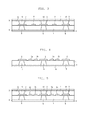
- FIG. 4 is a schematic cross-sectional view of the essential portion to show an example of the transmission cable according to the embodiment, and is a figure showing an example of the transmission cable having a structure shown in FIG. 1 to which differential signal lines are applied.
- FIG. 5 is a schematic cross-sectional view of the essential portion to show an example of the completely shielded type transmission cable according to the embodiment, and is a figure showing an example of the transmission cable having a structure shown in FIG. 3 to which the differential signal lines are applied.
- the present embodiment is a transmission cable used for data transfer and the like in various network systems and the like. Especially, a manufacturing process of the transmission cable can be simplified by using a manufacturing process for an ordinary wiring circuit board, and a manufacturing cost thereof can be reduced.
- the transmission cable sufficiently suppresses a noise and an interference between signal lines, and thus is capable of fast transfer and large-capacity transfer and is highly reliable.
- FIG. 1 shows a structure of the transmission cable shown as an embodiment.
- the transmission cable has signal lines 2 and ground lines 2 formed on one surface of an insulation layer 1 serving as a substrate, namely, on an upper surface here.
- the signal line 2 is used for transfer of various signals such as data transfer and the like, and plays a central role in this transmission cable.
- a malfunction and the like caused by an induced noise is a problem in the transmission cable.
- a mutual interference between the signal lines 2 becomes problematic.
- this transmission cable has ground lines 3 formed between these signal lines 2 , so that the mutual interference is solved.
- this transmission cable has a shield layer 4 , made of a copper foil and the like, formed on a back surface of the insulation layer 1 .
- This transmission cable also has metal bumps 5 penetrating the insulation layer 1 , and the ground lines 3 and the shield layer 4 are electrically connected via the metal bumps 5 .
- the shield layer 4 is formed substantially all over the back surface of the insulation layer 1 , and any portion thereof is grounded.
- the transmission cable has the ground lines 3 electrically connected to the shield layer 4 via the metal bumps 5 , so that the ground lines 3 are grounded.
- the transmission cable is preferably arranged with a noise suppressing layer 6 , and the ground lines 3 are preferably electrically connected to not only the shield layer 4 but also the noise suppressing layer 6 via the metal bumps 5 .
- the noise suppressing layer 6 is made of a material including Ni, for example, Ni and the like.
- the noise suppressing layer 6 has a higher electric resistance value than the shield layer 4 , and is formed between the back surface side of the insulation layer 1 and the shield layer 4 to be in contact with the insulation layer 1 and the shield layer 4 .
- transmission cables in general should not be affected by an unwanted emission and a noise in a case, e.g., where the transmission cables have a completely shielded structure completely shielding the periphery of a signal line or are coaxial cables of infinite length and the like.
- an actual transmission cable is of a finite length, and thus cannot be completely free from an influence of the unwanted emission and the noise caused by an influence of a signal reflection and the like at terminals.
- the transmission cable according to the present embodiment has a noise suppressing layer 6 having a function to suppress the unwanted emission and/or the noise in order to solve such problems.
- the noise suppressing layer 6 should have a higher electric resistance value than the shield layer 4 .
- the transmission cable is arranged with the noise suppressing layer 6 having a higher electric resistance value than the shield layer 4 . Accordingly, even if the shield layer 4 is used that is made of a material having a low electric resistance value such as a copper foil and the like, the unwanted emission and the noise can be effectively suppressed without deteriorating an electromagnetic shield function of the shield layer 4 , so that a mutual interference between the signal lines 2 and an induction of noise can be reliably suppressed.
- the noise suppressing layer 6 has not only a function to suppress the unwanted emission and/or the noise, but also a function as an etching barrier layer serving as an etching stopper in a step of forming the metal bump 5 as described later.
- the metal bump 5 is formed by, for example, etching the copper foil, and the entirety thereof consists of metal material. Accordingly, the metal bump 5 has far less electric resistance than a conductive paste and the like made of a resin having electrically conductive particles dispersed therein.
- a connection between the ground line 3 and the metal bump 5 , a connection between the shield layer 4 and the metal bump 5 , and a connection between the noise suppressing layer 6 and the metal bump 5 are all connections established by contact of metals, and a connection resistance therebetween is also low.
- the ground line 3 effectively functions as a shield between the signal lines 2 , and reliably suppresses the mutual interference between the signal lines 2 and the induction of the noise, so that the transmission cable becomes a high frequency transmission cable suitable for fast transfer and large-capacity transfer.
- the transmission cable as described above is manufactured according to a series of steps, as described below.
- a cladding material is prepared, as shown in FIG. 2( a ), that is made by laminating an etching barrier layer 12 and a bump formation copper foil 13 , for making the metal bump 5 , on a copper foil 11 corresponding to the shield layer 4 .
- the etching barrier layer 12 is made of material including Ni, such as Ni and the like, has an etching selectivity with respect to the bump formation copper foil 13 , and serves as an etching stopper when the bump formation copper foil 13 is etched. It should be noted that the etching barrier layer 12 is not removed but remains as the noise suppressing layer 6 , as described above.
- the bump formation copper foil 13 is etched, so that the metal bump 15 is formed.
- This etching of the bump formation copper foil 13 is preferably performed by a combination of an acid etching liquid and an alkali etching liquid. That is, in a manufacturing of the transmission cable, a resist film 14 serving as a mask is formed on the bump formation copper foil 13 , and thereafter, the acid etching liquid such as cupric chloride is sprayed, as shown in FIG. 2( b ).
- the bump formation copper foil 13 is etched, but an etching depth caused by this acid etching liquid is made shallower than a thickness of the bump formation copper foil 13 , and the etching is performed within such range that the etching barrier layer 12 is not exposed.
- the metal bumps 15 is formed as shown in FIG. 2 ( c ).
- the resist film 14 remaining on the metal bumps 15 is removed as shown in FIG. 2 ( d ), spaces between the metal bumps 15 are filled with the insulation layer 16 as shown in FIG. 2 ( e ), and a wiring formation copper foil 17 is formed overlappingly on an apical surface of the metal bumps 15 as shown in FIG. 2( f ).
- the insulation layer 16 is formed by filling a thermoplastic resin and the like such as polyimide, liquid crystal polymer, and the like.
- the insulation layer 16 is preferably formed to an extent that the insulation layer 16 is slightly lower than a height of the metal bump 15 so that a contact between the metal bumps 15 and the wiring formation copper foil 17 in ensured.
- the transmission cable uses the liquid crystal polymer as the insulation layer 16 , and thus, an adhesive and the like are not necessary to connect the insulation layer 16 with a metal, and a low hygroscopic property of the liquid crystal polymer achieves superior dimensional stability.
- the liquid crystal polymer has a low dielectric constant, thus achieving to reduce a transmission loss.
- the wiring formation copper foil 17 is placed overlappingly and unified. At this moment, for example, the wiring formation copper foil 17 is sandwiched between stainless boards, and a press machine applies thereto a predefined pressure, thereby pressure-bonding the wiring formation copper foil 17 .
- the wiring formation copper foil 17 slightly crushes the apical surfaces of the metal bumps 15 , and reliably comes in contact with the metal bumps 15 and conducts electricity to the metal bumps 15 .
- An anisotropic conductive adhesive agent film and the like may be arranged between the metal bumps 15 and the wiring formation copper foil 17 to achieve an electrical conduction between the metal bumps 15 and the wiring formation copper foil 17 .
- thermocompression bonding enables metallic bond connection between a signal line and the wiring formation copper foil 17 serving as a ground line, thus achieving reliable conduction.
- thermocompression bonding enables metallic bond connection between the metal bumps 15 and each of the copper foil 11 and the etching barrier layer 12 serving as the shield layer 4 and the noise suppressing layer 6 , respectively, thus achieving reliable conduction.
- the wiring formation copper foil 17 is etched so that a wiring pattern, specifically the signal line and the ground line, is formed.
- a resist layer 18 is formed according to a pattern of the signal line and the ground line as shown in FIG. 2( g ).
- the resist layer 18 is formed with a normal photolithography technology.
- a resist material is formed on all over the wiring formation copper foil 17 and is thereafter exposed and developed so that the resist layer 18 remains in the predefined pattern.
- an etching is performed using the resist layer 18 as an etching mask, and a patterning is performed to make the signal lines 19 and the ground lines 20 as shown in FIG. 2( h ).
- the etching process here is similar to an etching process for forming a wiring pattern in a manufacturing process of normal wiring circuit boards.
- the resist layer 18 remaining on the signal lines 19 and the ground lines 20 is removed as shown in FIG. 2( i ).
- the transmission cable as previously shown in FIG. 1 is completed.
- the metal bumps 15 are formed by etching the bump formation copper foil 13 .
- the etching is a general-purpose technology for patterning of wiring and the like. Accordingly, by utilizing, for example, an existing manufacturing apparatus such as an etching bath and the like and a photolithography technology and the like, the metal bumps 15 can be easily formed without using a special apparatus and technology.
- the metal bumps 15 are laminated as the cladding material on the copper foil 11 , and thus have good electrical connection with the copper foil 11 serving as the shield layer and with the etching barrier layer 12 serving as the noise suppressing layer 6 . Furthermore, the metal bumps 15 are pressure-bonded with the wiring formation copper foil 17 , and thus have good electrical connection with the ground line 20 .
- a pitch of the metal bumps 15 shorter than a wavelength ⁇ , expressed by Formula (I) below, of the transmission signal flowing in the signal line.
- c is the light speed (3 ⁇ 10 8 m)
- ⁇ r is a dielectric constant of the insulation layer 16
- f is a transmission frequency.
- the pitch of the metal bump 15 it is preferable to set the pitch of the metal bump 15 equal to or less than 0.5 mm.
- the transmission cable shown as the embodiment of the present invention is formed with the noise suppressing layer 6 made of a material including Ni, and thus, even where the shield layer 4 made of the copper foil and the like is used, the transmission cable suppresses the unwanted emission and the noise and reliably suppresses the mutual interference between the signal lines 2 and the induction of the noise without diminishing an electromagnetic shield function of the shield layer 4 .
- the transmission cable has the shield layer 4 made of the copper foil and the like, and thus, a manufacturing process for a normal wiring circuit board can be utilized that often use the copper foil and the like as the shield layer.
- the highly reliable metal bump 5 can be formed easily in the transmission cable, the manufacturing process can be simplified, and a manufacturing cost can be reduced. Furthermore, an increase in the electric resistance and the connection resistance between the ground lines 3 and the shield layer 4 can be suppressed in the transmission cable. Thus, the noise and the mutual interference between the signal lines can be sufficiently suppressed, and the transmission cable can achieve the fast transfer and the large-capacity transfer with high reliability. Furthermore, the transmission cable does not use a large amount of expensive material such as Ni and the like for the shield layer, but uses an inexpensive material such as the copper foil and the like for the shield layer 4 . The transmission cable is arranged with the noise suppressing layer 6 at extremely low cost, and achieves a high suppressing effect of the unwanted emission and the noise.
- the present embodiment is not limited to the embodiment as described above.
- the embodiment also allows the shield layers to be arranged on both sides of the insulation layer 1 to completely shield the surrounding of each of the signal lines.
- the transmission cable having the shield layers on the both sides as described above is structured, for example, as shown in FIG. 3 . That is, the transmission cable having the shield layers on the both sides has the same structure, with respect to below the signal lines 2 and the ground lines 3 , as an example of the transmission cable previously shown in FIG. 1 . That is, the transmission cable has: the signal lines 2 and the ground lines 3 arranged on top of the insulation layer 1 ; the shield layer 4 and the noise suppressing layer 6 arranged on a back side (a lower side) of the insulation layer 1 ; and the shield layer 4 and the noise suppressing layer 6 electrically connected to the ground lines 3 via the metal bumps 5 .
- the same structure as described above is also formed on top of the signal lines 2 and the ground lines 3 . That is, the transmission cable in FIG. 3 has a second insulation layer 7 covering the signal lines 2 and the ground lines 3 , and has a second shield layer 8 and a second noise suppressing layer 9 formed on top of the second insulation layer 7 .
- the second shield layer 8 and the second noise suppressing layer 9 are electrically connected to the ground line 3 via metal bumps 10 that are the same as the metal bumps 5 .
- the manufacturing of the transmission cable as shown in FIG. 3 should involve a step for placing the cladding material formed with the metal bumps overlappingly on a surface formed with the signal lines 2 and the ground lines 3 . That is, in the manufacturing of the transmission cable of FIG. 3 , the cladding material formed with the insulation layer as shown in FIG. 2 ( e ) is disposed upside down so that the metal bump 15 is on a lower side, and tips of the metal bumps 15 are butted against and pressure-bonded with the ground lines 3 .
- a transmission cable is formed in which the signal lines 2 and the ground lines 3 are sandwiched between the shield layers 4 , 8 and the noise suppressing layers 6 , 9 on the upper and lower sides, respectively, and in which the shield layers 4 , 8 and the noise suppressing layers 6 , 9 are connected to the ground layer 3 via the metal bumps 5 , 10 , respectively.
- the transmission cable has a three-layer structure, which is a completely shielded structure completely shielding the surroundings of the signal lines 2 , and thus, can be used as a superhigh frequency transmission cable. It should be noted that the transmission cable can be further multi-layered to achieve the transmission cable capable of superfast large-capacity transmission
- the present embodiment may also be applied to a case where a differential signal is transmitted via two sets of signal lines. That is, in a case where the transmission cable shown in FIG. 1 is made for the differential signal lines, two sets of the signal lines 2 a , 2 b should be arranged corresponding to the ground lines 3 as shown in FIG. 4 . In a case where the transmission cable shown in FIG. 3 is made for the differential signal lines, two sets of the signal lines 2 a , 2 b should be arranged corresponding to the ground lines 3 as shown in FIG. 5 . Therefore, compared with a single-end signal line, the transmission cable arranged with the differential signal lines enjoys numerous advantages such as high resistance against noise, a larger margin for signal fade, low voltage operation capability, and reduction of EMI (Electromagnetic Interference).
- EMI Electromagnetic Interference
- the transmission cable only for data transfer is described in the above-described embodiment, but one or more parts and wirings in a form of chip and the like realizing predefined functions may also be mounted on the transmission cable because the transmission cable is structured the same as the normal wiring circuit board. That is, the transmission cable may have a part mounting area, not shown in the figures, formed on either or both sides of the insulation layer 1 , 7 to mount one or more parts realizing predefined functions, and wirings extending from the part mounting area may be formed.
- this kind of the transmission cable is flat shaped, and is thus preferred to be mounted in the inside of electronic devices such as cellular telephone and the like required to be made smaller, and for example, the transmission cable may mount parts such as a power source module for liquid crystal display. Therefore, the transmission cable is structured the same as the normal wiring circuit board, and can be structured as a multi-functional transmission cable realizing functions with mounted parts in addition to data transmission function, thus greatly contributing to miniaturization of the electronic devices having the above-described transmission cable.
- a width of wirings can be made narrower compared with a so-called through-hole circuit board.
- a through-hole is perforated on the circuit board and is thereafter plated with a copper foil and the like, and the plating adheres not only to the inside of the through-hole but also on a wiring copper foil.
- the through-hole circuit board tends to result in a thick overall thickness and to create variation in the thickness. Accordingly, the through-hole circuit board requires the width of wirings to be made wider and has a problem that it is difficult to form a fine pattern on the through-hole circuit board.
- the transmission cable is formed with the shield layer 4 and the like made of the copper foil and the like having a previously defined thickness, and has the metal bumps 5 embedded to penetrate the insulation layer 1 , and thus, the transmission cable does not result in problems such as am unnecessarily thick thickness and a variation in the thickness, and can easily control the width of wirings and can easily form a fine pattern. Therefore, the transmission cable is highly effective for the use for only data transmission, and is also highly effective as multi-functional transmission cable mounted with one or more parts achieving predefined functions as described above.
Landscapes
- Physics & Mathematics (AREA)
- Electromagnetism (AREA)
- Insulated Conductors (AREA)
- Engineering & Computer Science (AREA)
- Microelectronics & Electronic Packaging (AREA)
- Communication Cables (AREA)
- Shielding Devices Or Components To Electric Or Magnetic Fields (AREA)
- Waveguides (AREA)
Applications Claiming Priority (3)
| Application Number | Priority Date | Filing Date | Title |
|---|---|---|---|
| JP2006-009293 | 2006-01-17 | ||
| JP2006009293A JP2007193999A (ja) | 2006-01-17 | 2006-01-17 | 伝送ケーブル |
| PCT/JP2006/321836 WO2007083429A1 (fr) | 2006-01-17 | 2006-11-01 | Cable de transmission |
Publications (2)
| Publication Number | Publication Date |
|---|---|
| US20090000804A1 US20090000804A1 (en) | 2009-01-01 |
| US7842886B2 true US7842886B2 (en) | 2010-11-30 |
Family
ID=38287389
Family Applications (1)
| Application Number | Title | Priority Date | Filing Date |
|---|---|---|---|
| US12/161,131 Active 2027-07-03 US7842886B2 (en) | 2006-01-17 | 2006-11-01 | Transmission cable |
Country Status (7)
| Country | Link |
|---|---|
| US (1) | US7842886B2 (fr) |
| EP (1) | EP1978531A4 (fr) |
| JP (1) | JP2007193999A (fr) |
| KR (1) | KR101017874B1 (fr) |
| CN (1) | CN101361142A (fr) |
| TW (1) | TW200730057A (fr) |
| WO (1) | WO2007083429A1 (fr) |
Cited By (6)
| Publication number | Priority date | Publication date | Assignee | Title |
|---|---|---|---|---|
| US20100314164A1 (en) * | 2009-06-10 | 2010-12-16 | Wu Chung-Lun | Flexible printed circuit and fabrication method thereof |
| US9552995B2 (en) * | 2014-11-26 | 2017-01-24 | Intel Corporation | Electrical interconnect for an electronic package |
| US9627736B1 (en) * | 2013-10-23 | 2017-04-18 | Mark W. Ingalls | Multi-layer microwave crossover connected by vertical vias having partial arc shapes |
| US20180146543A1 (en) * | 2011-03-10 | 2018-05-24 | Mediatek Inc. | Printed circuit board design for high speed application |
| US10218045B2 (en) * | 2017-06-07 | 2019-02-26 | Raytheon Company | Serially connected transmission line sections each having a conductive shield member overlying a portion of a strip conductor |
| US20190371494A1 (en) * | 2018-05-30 | 2019-12-05 | Sumitomo Electric Industries, Ltd. | Shielded flat cable |
Families Citing this family (27)
| Publication number | Priority date | Publication date | Assignee | Title |
|---|---|---|---|---|
| JP2009246092A (ja) | 2008-03-31 | 2009-10-22 | Nitto Denko Corp | 配線回路基板およびその製造方法 |
| US8022861B2 (en) | 2008-04-04 | 2011-09-20 | Toyota Motor Engineering & Manufacturing North America, Inc. | Dual-band antenna array and RF front-end for mm-wave imager and radar |
| US8378759B2 (en) * | 2009-01-16 | 2013-02-19 | Toyota Motor Engineering & Manufacturing North America, Inc. | First and second coplanar microstrip lines separated by rows of vias for reducing cross-talk there between |
| KR101378027B1 (ko) * | 2009-07-13 | 2014-03-25 | 가부시키가이샤 무라타 세이사쿠쇼 | 신호선로 및 회로기판 |
| US8786496B2 (en) | 2010-07-28 | 2014-07-22 | Toyota Motor Engineering & Manufacturing North America, Inc. | Three-dimensional array antenna on a substrate with enhanced backlobe suppression for mm-wave automotive applications |
| US8867219B2 (en) | 2011-01-14 | 2014-10-21 | Harris Corporation | Method of transferring and electrically joining a high density multilevel thin film to a circuitized and flexible organic substrate and associated devices |
| US9949360B2 (en) * | 2011-03-10 | 2018-04-17 | Mediatek Inc. | Printed circuit board design for high speed application |
| JPWO2013077108A1 (ja) * | 2011-11-24 | 2015-04-27 | タツタ電線株式会社 | シールドフィルム、シールドプリント配線板、及び、シールドフィルムの製造方法 |
| FR2991108A1 (fr) * | 2012-05-24 | 2013-11-29 | St Microelectronics Sa | Ligne coplanaire blindee |
| JP2015005668A (ja) * | 2013-06-21 | 2015-01-08 | 株式会社フジクラ | 差動信号伝送回路及びその製造方法 |
| JP6190345B2 (ja) | 2014-09-22 | 2017-08-30 | 株式会社フジクラ | プリント配線板 |
| KR102552614B1 (ko) * | 2016-02-26 | 2023-07-06 | 주식회사 기가레인 | 연성회로기판 |
| FI3626034T3 (fi) * | 2017-05-16 | 2026-04-23 | Rigetti & Co Llc | Sähköisen kytkentäjärjestelmän kytkeminen kvanttitietokonejärjestelmässä |
| CN107274998B (zh) * | 2017-06-19 | 2019-05-17 | 南京汉欣电线电缆有限公司 | 一种电缆及信号传输系统 |
| CN107635385B (zh) * | 2017-07-31 | 2024-04-30 | 武汉芯宝科技有限公司 | Esd全屏蔽功能箔、全屏蔽功能箔电路板及制造方法 |
| JP7013579B2 (ja) * | 2017-11-10 | 2022-02-15 | レイセオン カンパニー | ミリメータ波伝送線アーキテクチャ |
| US11289814B2 (en) | 2017-11-10 | 2022-03-29 | Raytheon Company | Spiral antenna and related fabrication techniques |
| JP6976433B2 (ja) | 2017-11-10 | 2021-12-08 | レイセオン カンパニー | アディティブ製造技術(amt)低プロファイル放射器 |
| EP3707970A1 (fr) | 2017-11-10 | 2020-09-16 | Raytheon Company | Techniques de fabrication additive (amt) d'enceintes de faraday dans des circuits radiofréquence |
| CN108109740A (zh) * | 2017-12-16 | 2018-06-01 | 亳州联滔电子有限公司 | 扁平线缆及其制造方法 |
| JP7000589B2 (ja) | 2018-02-28 | 2022-01-19 | レイセオン カンパニー | アディティブ製造技術(amt)低プロファイル信号分割器 |
| US10849219B2 (en) | 2018-02-28 | 2020-11-24 | Raytheon Company | SNAP-RF interconnections |
| US10694618B2 (en) * | 2018-10-29 | 2020-06-23 | Cellink Corporation | Flexible hybrid interconnect circuit |
| KR102733474B1 (ko) * | 2019-07-25 | 2024-11-25 | 삼성전자 주식회사 | 플렉서블 평판 케이블 및 그 제조 방법 |
| WO2023017774A1 (fr) * | 2021-08-12 | 2023-02-16 | 日本碍子株式会社 | Élément de guide d'ondes et procédé de production d'élément de guide d'ondes |
| DE102021213198A1 (de) | 2021-11-23 | 2023-05-25 | Leoni Bordnetz-Systeme Gmbh | Kabelsatz sowie Verfahren zur Herstellung eines Kabelsatzes |
| CN119521521A (zh) * | 2023-08-22 | 2025-02-25 | 宏启胜精密电子(秦皇岛)有限公司 | 电路板及其制造方法 |
Citations (12)
| Publication number | Priority date | Publication date | Assignee | Title |
|---|---|---|---|---|
| US4845311A (en) * | 1988-07-21 | 1989-07-04 | Hughes Aircraft Company | Flexible coaxial cable apparatus and method |
| JPH0799397A (ja) | 1993-09-29 | 1995-04-11 | Toshiba Corp | プリント板構造 |
| JPH11162267A (ja) | 1997-11-26 | 1999-06-18 | Yamaichi Electron Co Ltd | フラット型ケーブルおよびその製造方法 |
| US6320133B1 (en) * | 1996-10-11 | 2001-11-20 | Tunewell Technology Ltd | Power distribution system |
| US20010054512A1 (en) * | 1998-09-10 | 2001-12-27 | Horst Belau | Printed circuit board configuration with a multipole plug-in connector |
| JP2002117726A (ja) | 2000-10-06 | 2002-04-19 | Canon Inc | フレキシブルケーブル |
| US6459041B1 (en) * | 2000-11-01 | 2002-10-01 | Visteon Global Technologies, Inc. | Etched tri-layer metal bonding layer |
| US6523252B1 (en) * | 1997-10-22 | 2003-02-25 | Nokia Mobile Phones Limited | Coaxial cable, method for manufacturing a coaxial cable, and wireless communication device |
| US6541711B1 (en) * | 2000-05-22 | 2003-04-01 | Cisco Technology, Inc. | Isolated ground circuit board apparatus |
| WO2006003732A1 (fr) | 2004-06-30 | 2006-01-12 | Sony Chemicals Corporation | Câble de transmission et processus de fabrication de celui-ci |
| US7196273B2 (en) * | 2004-03-09 | 2007-03-27 | Sony Corporation | Flat cable, flat cable sheet, and flat cable sheet producing method |
| US7737359B2 (en) * | 2003-09-05 | 2010-06-15 | Newire Inc. | Electrical wire and method of fabricating the electrical wire |
Family Cites Families (4)
| Publication number | Priority date | Publication date | Assignee | Title |
|---|---|---|---|---|
| ATE475999T1 (de) * | 2003-03-04 | 2010-08-15 | Rohm & Haas Elect Mat | Koaxiale wellenleitermikrostrukturen und verfahern zu ihrer bildung |
| US7288723B2 (en) * | 2003-04-02 | 2007-10-30 | Sun Microsystems, Inc. | Circuit board including isolated signal transmission channels |
| JP4189588B2 (ja) * | 2004-01-14 | 2008-12-03 | ソニーケミカル&インフォメーションデバイス株式会社 | 多層配線基板の製造方法 |
| US20050156693A1 (en) * | 2004-01-20 | 2005-07-21 | Dove Lewis R. | Quasi-coax transmission lines |
-
2006
- 2006-01-17 JP JP2006009293A patent/JP2007193999A/ja active Pending
- 2006-10-18 TW TW095138440A patent/TW200730057A/zh not_active IP Right Cessation
- 2006-11-01 KR KR1020087017442A patent/KR101017874B1/ko not_active Expired - Fee Related
- 2006-11-01 US US12/161,131 patent/US7842886B2/en active Active
- 2006-11-01 EP EP06822765A patent/EP1978531A4/fr not_active Withdrawn
- 2006-11-01 WO PCT/JP2006/321836 patent/WO2007083429A1/fr not_active Ceased
- 2006-11-01 CN CNA2006800512770A patent/CN101361142A/zh active Pending
Patent Citations (13)
| Publication number | Priority date | Publication date | Assignee | Title |
|---|---|---|---|---|
| US4845311A (en) * | 1988-07-21 | 1989-07-04 | Hughes Aircraft Company | Flexible coaxial cable apparatus and method |
| JPH0799397A (ja) | 1993-09-29 | 1995-04-11 | Toshiba Corp | プリント板構造 |
| US6320133B1 (en) * | 1996-10-11 | 2001-11-20 | Tunewell Technology Ltd | Power distribution system |
| US6523252B1 (en) * | 1997-10-22 | 2003-02-25 | Nokia Mobile Phones Limited | Coaxial cable, method for manufacturing a coaxial cable, and wireless communication device |
| JPH11162267A (ja) | 1997-11-26 | 1999-06-18 | Yamaichi Electron Co Ltd | フラット型ケーブルおよびその製造方法 |
| US20010054512A1 (en) * | 1998-09-10 | 2001-12-27 | Horst Belau | Printed circuit board configuration with a multipole plug-in connector |
| US6541711B1 (en) * | 2000-05-22 | 2003-04-01 | Cisco Technology, Inc. | Isolated ground circuit board apparatus |
| JP2002117726A (ja) | 2000-10-06 | 2002-04-19 | Canon Inc | フレキシブルケーブル |
| US6459041B1 (en) * | 2000-11-01 | 2002-10-01 | Visteon Global Technologies, Inc. | Etched tri-layer metal bonding layer |
| US7737359B2 (en) * | 2003-09-05 | 2010-06-15 | Newire Inc. | Electrical wire and method of fabricating the electrical wire |
| US7196273B2 (en) * | 2004-03-09 | 2007-03-27 | Sony Corporation | Flat cable, flat cable sheet, and flat cable sheet producing method |
| WO2006003732A1 (fr) | 2004-06-30 | 2006-01-12 | Sony Chemicals Corporation | Câble de transmission et processus de fabrication de celui-ci |
| US7429702B2 (en) * | 2004-06-30 | 2008-09-30 | Sony Chemical & Information Device Corporation | Transmission cable and method for manufacturing the same |
Cited By (9)
| Publication number | Priority date | Publication date | Assignee | Title |
|---|---|---|---|---|
| US20100314164A1 (en) * | 2009-06-10 | 2010-12-16 | Wu Chung-Lun | Flexible printed circuit and fabrication method thereof |
| US8344257B2 (en) * | 2009-06-10 | 2013-01-01 | Htc Corporation | Flexible printed circuit and fabrication method thereof |
| US20180146543A1 (en) * | 2011-03-10 | 2018-05-24 | Mediatek Inc. | Printed circuit board design for high speed application |
| US10485095B2 (en) * | 2011-03-10 | 2019-11-19 | Mediatek, Inc. | Printed circuit board design for high speed application |
| US9627736B1 (en) * | 2013-10-23 | 2017-04-18 | Mark W. Ingalls | Multi-layer microwave crossover connected by vertical vias having partial arc shapes |
| US9552995B2 (en) * | 2014-11-26 | 2017-01-24 | Intel Corporation | Electrical interconnect for an electronic package |
| US10218045B2 (en) * | 2017-06-07 | 2019-02-26 | Raytheon Company | Serially connected transmission line sections each having a conductive shield member overlying a portion of a strip conductor |
| US20190371494A1 (en) * | 2018-05-30 | 2019-12-05 | Sumitomo Electric Industries, Ltd. | Shielded flat cable |
| US10726971B2 (en) * | 2018-05-30 | 2020-07-28 | Sumitomo Electric Industries, Ltd. | Shielded flat cable |
Also Published As
| Publication number | Publication date |
|---|---|
| EP1978531A1 (fr) | 2008-10-08 |
| US20090000804A1 (en) | 2009-01-01 |
| CN101361142A (zh) | 2009-02-04 |
| TWI330061B (fr) | 2010-09-01 |
| WO2007083429A1 (fr) | 2007-07-26 |
| KR20080084837A (ko) | 2008-09-19 |
| EP1978531A4 (fr) | 2009-03-04 |
| JP2007193999A (ja) | 2007-08-02 |
| KR101017874B1 (ko) | 2011-03-04 |
| TW200730057A (en) | 2007-08-01 |
Similar Documents
| Publication | Publication Date | Title |
|---|---|---|
| US7842886B2 (en) | Transmission cable | |
| US8238109B2 (en) | Flex-rigid wiring board and electronic device | |
| US8609991B2 (en) | Flex-rigid wiring board and method for manufacturing the same | |
| US7745731B2 (en) | Transmission cable | |
| US8677612B2 (en) | Method for manufacturing flex-rigid wiring board | |
| TWI643334B (zh) | 高頻信號傳輸結構及其製作方法 | |
| US20100051326A1 (en) | Flex-rigid wiring board and electronic device | |
| TW201711534A (zh) | 柔性線路板及其製作方法 | |
| WO2004079755A1 (fr) | Cable a blindage plat | |
| CN101534610A (zh) | 埋入式电容元件电路板及其制造方法 | |
| TWI699143B (zh) | 印刷電路板及製造印刷電路板之方法 | |
| CN104425286A (zh) | Ic载板、具有该ic载板的半导体器件及制作方法 | |
| CN104427740B (zh) | 电路板及其制作方法 | |
| JPH1168313A (ja) | プリント配線基板 | |
| CN115241636A (zh) | 天线模块及其制作方法和终端 | |
| US20230268256A1 (en) | Electronic package structure and manufacturing method thereof | |
| CN112020222A (zh) | 内埋电路板及其制作方法 | |
| CN116581087A (zh) | 一种高频高速半导体器件结构及其制备方法 | |
| JP2009010004A (ja) | 積層プリント基板とその製造方法 | |
| CN115087202B (zh) | 线路板及其制作方法、电子设备 | |
| JP2006344887A (ja) | プリント配線板およびその製造方法 | |
| WO2026014221A1 (fr) | Ligne de transmission et dispositif électronique | |
| CN119676990A (zh) | 具有可靠屏蔽性能的多层柔性线路板及其制作方法 | |
| CN119521522A (zh) | 电路板结构及其制造方法 | |
| JP2003194852A (ja) | 半導体回路検査治具 |
Legal Events
| Date | Code | Title | Description |
|---|---|---|---|
| AS | Assignment |
Owner name: SONY CHEMICAL & INFORMATION DEVICE CORPORATION, JA Free format text: ASSIGNMENT OF ASSIGNORS INTEREST;ASSIGNORS:KOBAYASHI, KAZUYOSHI;HANAMURA, KENICHIROU;HORI, TOMOMITSU;REEL/FRAME:021410/0578 Effective date: 20080724 |
|
| AS | Assignment |
Owner name: SONY CORPORATION, JAPAN Free format text: ASSIGNMENT OF ASSIGNORS INTEREST;ASSIGNOR:SONY CHEMICAL & INFORMATION DEVICE CORPORATION;REEL/FRAME:025020/0553 Effective date: 20100913 Owner name: SONY CHEMICAL & INFORMATION DEVICE CORPORATION, JA Free format text: ASSIGNMENT OF ASSIGNORS INTEREST;ASSIGNOR:SONY CHEMICAL & INFORMATION DEVICE CORPORATION;REEL/FRAME:025020/0553 Effective date: 20100913 |
|
| STCF | Information on status: patent grant |
Free format text: PATENTED CASE |
|
| FEPP | Fee payment procedure |
Free format text: PAYOR NUMBER ASSIGNED (ORIGINAL EVENT CODE: ASPN); ENTITY STATUS OF PATENT OWNER: LARGE ENTITY |
|
| FPAY | Fee payment |
Year of fee payment: 4 |
|
| MAFP | Maintenance fee payment |
Free format text: PAYMENT OF MAINTENANCE FEE, 8TH YEAR, LARGE ENTITY (ORIGINAL EVENT CODE: M1552) Year of fee payment: 8 |
|
| MAFP | Maintenance fee payment |
Free format text: PAYMENT OF MAINTENANCE FEE, 12TH YEAR, LARGE ENTITY (ORIGINAL EVENT CODE: M1553); ENTITY STATUS OF PATENT OWNER: LARGE ENTITY Year of fee payment: 12 |