US7918883B2 - Non-invasive heating of implanted vascular treatment device - Google Patents
Non-invasive heating of implanted vascular treatment device Download PDFInfo
- Publication number
- US7918883B2 US7918883B2 US10/084,857 US8485702A US7918883B2 US 7918883 B2 US7918883 B2 US 7918883B2 US 8485702 A US8485702 A US 8485702A US 7918883 B2 US7918883 B2 US 7918883B2
- Authority
- US
- United States
- Prior art keywords
- vascular treatment
- core
- treatment device
- stent
- coating
- Prior art date
- Legal status (The legal status is an assumption and is not a legal conclusion. Google has not performed a legal analysis and makes no representation as to the accuracy of the status listed.)
- Expired - Fee Related, expires
Links
Images




Classifications
-
- A—HUMAN NECESSITIES
- A61—MEDICAL OR VETERINARY SCIENCE; HYGIENE
- A61F—FILTERS IMPLANTABLE INTO BLOOD VESSELS; PROSTHESES; DEVICES PROVIDING PATENCY TO, OR PREVENTING COLLAPSING OF, TUBULAR STRUCTURES OF THE BODY, e.g. STENTS; ORTHOPAEDIC, NURSING OR CONTRACEPTIVE DEVICES; FOMENTATION; TREATMENT OR PROTECTION OF EYES OR EARS; BANDAGES, DRESSINGS OR ABSORBENT PADS; FIRST-AID KITS
- A61F2/00—Filters implantable into blood vessels; Prostheses, i.e. artificial substitutes or replacements for parts of the body; Appliances for connecting them with the body; Devices providing patency to, or preventing collapsing of, tubular structures of the body, e.g. stents
- A61F2/82—Devices providing patency to, or preventing collapsing of, tubular structures of the body, e.g. stents
-
- A—HUMAN NECESSITIES
- A61—MEDICAL OR VETERINARY SCIENCE; HYGIENE
- A61B—DIAGNOSIS; SURGERY; IDENTIFICATION
- A61B18/00—Surgical instruments, devices or methods for transferring non-mechanical forms of energy to or from the body
- A61B18/04—Surgical instruments, devices or methods for transferring non-mechanical forms of energy to or from the body by heating
-
- A—HUMAN NECESSITIES
- A61—MEDICAL OR VETERINARY SCIENCE; HYGIENE
- A61B—DIAGNOSIS; SURGERY; IDENTIFICATION
- A61B17/00—Surgical instruments, devices or methods
- A61B17/22—Implements for squeezing-off ulcers or the like on inner organs of the body; Implements for scraping-out cavities of body organs, e.g. bones; for invasive removal or destruction of calculus using mechanical vibrations; for removing obstructions in blood vessels, not otherwise provided for
- A61B2017/22001—Angioplasty, e.g. PCTA
- A61B2017/22002—Angioplasty, e.g. PCTA preventing restenosis
-
- A—HUMAN NECESSITIES
- A61—MEDICAL OR VETERINARY SCIENCE; HYGIENE
- A61F—FILTERS IMPLANTABLE INTO BLOOD VESSELS; PROSTHESES; DEVICES PROVIDING PATENCY TO, OR PREVENTING COLLAPSING OF, TUBULAR STRUCTURES OF THE BODY, e.g. STENTS; ORTHOPAEDIC, NURSING OR CONTRACEPTIVE DEVICES; FOMENTATION; TREATMENT OR PROTECTION OF EYES OR EARS; BANDAGES, DRESSINGS OR ABSORBENT PADS; FIRST-AID KITS
- A61F2250/00—Special features of prostheses classified in groups A61F2/00 - A61F2/26 or A61F2/82 or A61F9/00 or A61F11/00 or subgroups thereof
- A61F2250/0001—Means for transferring electromagnetic energy to implants
Definitions
- the present invention relates to heating of implanted devices. More specifically, the present invention relates to non-invasive heating of implanted vascular treatment devices, such as stents.
- the methods used to heat the cells vary. However, one method is described in Diamantopolous, Langenhove, Foley, Feyter, Non - Invasive Heating of Implanted Arterial Stents In Vivo: A Novel New Method To Prevent Restenosis, Feasibility and Safety .
- the method of heating the stent proposed by Diamantopolous et al. is based on inherent properties of metals when placed inside an alternating electromagnetic field. Because of the retentively of the metallic stent used in Diamantopolous et al., the stent forms a magnetic circuit. As the magnetizing force of an alternating magnetic field periodically changes, the magnetic flux inside the stent lags, resulting in power loss in the stent. At least a portion of the power loss, of course, manifests itself as heat.
- Diamantopoulos et al. a high frequency alternating magnetic field was generated based on control signals from a personal computer.
- donor blood was pressurized to achieve a desired flow rate through the model.
- the stents were heated to 60° C.
- Diamantopoulos et al. also mentioned that maintenance of the stent temperature at levels of 43-45° C. would be feasible by power-algorithm and magnetic feedback techniques.
- Diamantopoulos et al. also verified that Nitinol stents could be heated to accomplish remote expansion.
- One of the primary disadvantages with the technique mentioned by Diamantopoulos et al. is that the heating in the stent is dependent upon the change of magnetic flux through the stent. This, in turn, is dependent on the alignment and positioning of the stent relative to the magnetic field lines generated in the applied magnetic field. If the magnetic field and the stent are not aligned properly, then little or no heating effect will be obtained.
- Diamantopoulos et al. technique Another disadvantage with the Diamantopoulos et al. technique is that the stent temperature is raised by the resistance to the electric currents induced by the change in magnetic flux. That temperature rise is therefore not distributed homogeneously throughout the stent. This is because the stent is not a homogeneous tube, and therefore some points within the stent will become hotspots, which can damage the arterial wall.
- a further disadvantage of the Diamantopoulos et al. technique is its lack of flexibility. In other words, if the stent is aligned with the magnetic field, the entire stent will heat. If it is not aligned with the magnetic field, then the stent will not heat. In either case, there is no mechanism by which only portions of the stent can be heated while retaining other portions of the stent substantially unheated under the influence of the applied magnetic field.
- One embodiment of the present invention involves employing, in a vascular treatment device, a material which has a magnetic susceptibility which is heat sensitive.
- the vascular treatment device can then be heated using an applied alternating magnetic field to the temperature at which the vascular treatment device becomes substantially non-magnetically susceptible.
- a vascular treatment device which includes material that heats in the presence of an applied alternating magnetic field regardless of the orientation of the vascular device relative to the applied magnetic field.
- the vascular treatment device can then be heated without the need for exact alignment of the vascular treatment device (or the patient) with respect to the applied magnetic field.
- an implantable vascular treatment device is formed such that only portions of it heat in the presence of an applied alternating magnetic field.
- the present invention can also be implemented as methods.
- the above heating techniques are used to heat a stent to inhibit restenosis.
- the above heating techniques can be used to heat and thus deploy a device, such as an expandable stent.
- the heating techniques can be used to remotely release therapeutic agents.
- FIG. 1 is a side sectional view illustrating a stent deployed in a vessel.
- FIG. 2 is a cross-sectional view showing one embodiment of a coating on the outside of the stent shown in FIG. 1 .
- FIG. 3 is a cross-sectional view showing a coating on the inside of the stent shown in FIG. 1 .
- FIG. 4 is a cross-sectional view showing a stent coated on both the inside and outside.
- FIG. 5 is a cross-sectional view illustrating a stent incorporating material in accordance with the present invention.
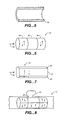
- FIGS. 6-8 illustrate stents which have portions thereof heatable.
- FIG. 9 illustrates the remote deployment of an expandable stent in accordance with one embodiment of the present invention.
- FIG. 10 illustrates the remote release of therapeutic agent in accordance with one embodiment of the present invention.
- FIGS. 11A-12C illustrate additional embodiments of the present invention.
- FIG. 1 illustrates a system 10 for inducing heating of an intravascular treatment device.
- intravascular treatment device 12 is comprised of a stent deployed within a vessel 14 at the site of a lesion 16 .
- FIG. 1 also illustrates alternating electromagnetic field generator 18 which generates and applies an alternating electromagnetic field from a remote location (such as external to the patient). The alternating electromagnetic field is illustrated by arrow 20 in FIG. 1 .
- stent 12 is formed with, or includes, magnetically susceptible material
- the alternating electromagnetic field causes current to flow in the stent material in the alternating directions illustrated by arrows 22 . This causes twisting of dipoles in the stent material and thus creates heat.
- simply employing a magnetically susceptible material can result in a number of disadvantages.
- stent 12 includes a magnetically susceptible material (or radio frequency (RF) acceptor material) which exhibits ferromagnetic properties in that it loses its magnetic properties when it is raised past a certain temperature referred to as the Curie point.
- the particular material is chosen to have a Curie point within a specific, preselected, degree range such that the material will not heat above a maximum desired temperature in the presence of an alternating magnetic field.
- Ferrite Oxide FEO
- nanoparticles in the scope of this disclosure is of benefit as it allows a much finer distribution throughout the medical device and by such a more homogeneous heat distribution.
- the particles of Smartbond are in the range of 500 nm or larger.
- This material can be obtained with a Curie point within a temperature range of approximately 3-5 degrees Kelvin. Thus, the stent will heat to the Curie temperature and no further. By choosing material having an appropriate Curie temperature, temperatures can be achieved sufficient to inhibit restenosis, but the stent does not continue to heat sufficiently to damage the wall of vessel 14 . It should be noted that the specific material mentioned above is but one exemplary material and others with desired Curie temperatures can be used as well.
- FIG. 2 illustrates stent 12 with a coating of FEO (or similar material) 24 deployed on the exterior surface of stent 12 .
- FEO or similar material
- FIG. 3 stent 12 can have a coating 26 disposed on the interior surface thereof.
- FIG. 4 stent 12 can be dipped coated or otherwise coated such that it includes both coatings 24 and 26 on the outer surface and inner surface of stent 12 , respectively.
- the coating may illustratively be formed such that the FEO material is dispersed as a powder throughout a polymer coating which is added to the surface of the stent.
- the stent core 12 can illustratively be formed of a conventional stent material, such as stainless steel or tantalum with the coatings 24 and/or 26 scintered on or painted on, or otherwise applied to, the stent core 12 .
- the stent core 12 is formed of a magnetically susceptible material, that material can still be used without obtaining undesirably high levels of heating.
- the orientation of the applied electromagnetic field 20 is simply randomized or rotated. Since the coatings 24 and/or 26 are formed of discrete individual elements or particles, even the random or rotating magnetic field will cause heating on the coatings. However, since the electromagnetic field is randomized or rotating, it will not be properly aligned with the core stent material 12 sufficiently to obtain any undesirable heating.
- the stent core 12 can be formed of conventional materials even in accordance with the present invention.
- the entire stent 12 can be formed of the FEO (or similar material) which has the desired magnetic susceptibility properties.
- the FEO (or similar material) can be embedded in the material.
- stent 30 in FIG. 5 Such an embodiment is illustrated by stent 30 in FIG. 5 in which stent 30 is formed of a polymer material having the desired FEO material embedded therein.
- the FEO material can be coated thereon in a similar fashion to that shown in FIGS. 2-4 .
- the applied electromagnetic field can simply be applied at a frequency chosen to increase the heating affect of the coatings while reducing the heating affect of the stent core.
- the electromagnetic field can be applied at a much lower frequency than that required to undesirably heat the metal stent core 12 . In that embodiment, only the portions containing the desired material in layers 24 and 26 would heat, while the metal stent core 12 would not heat undesirably.
- the present invention can be practiced using yet another technique to prevent the sent core 12 from heating. Even if stent core 12 is magnetically susceptible, and even if the electromagnetic field is applied at a frequency that would otherwise induce significant heating in stent core 12 and is not rotated or randomized, the present invention can be utilized by aligning the applied magnetic field with the patient (or stent) such that the integral of the magnetic field lines passing through the stent are substantially zero. This causes the change in magnetic flux in the stent to be zero and thus avoids heating.
- FIGS. 6-8 illustrate yet other alternative embodiments in accordance with the present invention. It may be desirable that only certain portions of the vascular treatment device (e.g., stent 12 ) heat while the other portions do not heat. For example, if restenosis is more often seen at the edges of the implanted stent, or at the center, then it may be desirable that those portions be formed such that they preferentially heat relative to the other portions of the stent under the applied electromagnetic field. Similarly, if, for example, the stent is being used to bridge an aneurysm, cell growth may be highly desired in the area of the aneurysm neck. However, cell growth at the edge of the stent may not be desired. Further, in applications where the stent needs to bend during deployment, the bending portion of the stent may need to be free of coatings in order to maintain its deformability.
- the vascular treatment device e.g., stent 12
- those portions be formed such that they preferentially heat relative to the other portions of the
- FIGS. 6-8 illustrate different embodiments of a stent in accordance with the present invention to address these issues.
- stent 12 has two opposite end portions 34 and 36 and a generally centrally located portion 38 .
- heating is desired at the end portions 34 and 36 but not at the intermediate portion 38 .
- This can be accomplished in a number of different ways. For example, if the stents are large enough, then the coating process can be controlled such that only ends 34 and 36 are coated with the magnetically susceptible material.
- ends 34 and 36 can be coated with additional coating material such that the heating affect is more pronounced at ends 34 and 36 than it is at intermediate portion 38 .
- intermediate portion 38 can be formed with discontinuities therein (i.e., it can be formed with areas which are non-susceptible to the electromagnetic field).
- portion 38 can be formed with areas or patches of metal which has a very high resistance, in order to inhibit currents from flowing therein.
- the discontinuities or application of metal with high resistance can be formed in any number of conventionally known ways. Both act as electrical discontinuities which reduce current flow and thus reduce heating in the areas where they occur. Thus, these techniques can be employed in areas of the stent where heating is not desired.
- FIG. 6 shows stent 12 divided into portions along its longitudinal axis
- FIG. 7 shows stent 12 divided into portions 40 , 42 and 44 about its periphery.
- portions 42 and 44 may be formed similar to portions 34 and 36 shown in FIG. 6
- portion 40 is formed similar to portion 38 .
- portions 42 and 44 would heat to the desired temperature under the applied electromagnetic field while portion 40 would not.
- FIG. 8 shows still a further embodiment in which the stent 12 is divided both along its longitudinal axis (as shown in FIG. 6 ) and radially (as shown in FIG. 7 ).
- This provides a stent which has a significantly larger number of portions, or patches, which can be individually selected for heating.
- portion 50 is adjacent a neck of an aneurysm 52 and is thus chosen such that it does not heat under the applied electromagnetic field.
- the remaining portions are chosen and configured such that they do heat.
- any other number of configurations with various portions heating nor non-heating can be selected as well.
- the opposite of the configuration shown in FIG. 6 can be implemented. In that embodiment, the center portion 38 will be configured to heat while end portions 34 and 36 will not.
- the portions can be coated with different powders which have different Curie temperatures or different thicknesses or concentrations of magnetically susceptible material.
- the different portions of stent 12 will heat to a plurality of different temperatures. This is because they will be variously susceptible to the applied electromagnetic field or because the heating affect will be different.
- FIGS. 9 and 10 illustrate two other embodiments of the present invention.
- the present invention is used to deploy a self-expanding stent, which expands in the presence of a temperature change.
- FIG. 9 shows stent 54 in a collapsed position as well as in an expanded position.
- Stent 54 in the collapsed position is designated by the numeral 54 A and stent 54 in the expanded position is designated by the numeral 54 B.
- stent 54 is formed of Nitinol material.
- the Nitinol is coated or otherwise has disposed thereon, the coatings discussed above.
- Electromagnetic field 20 is then applied to stent 54 A and as it heats, it reaches the transition temperature of the Nitinol material and expands to the configuration designated 54 B.
- the stent can thus be remotely and non-invasively expanded.
- Nitinol grades with Af (Austinitic finish temperature) in the range of ⁇ 25 C. to 120 C. ( ⁇ 13 F to 248 F.) can be obtained from Shape memory Application, Inc. of San Jose, Calif.
- FIG. 10 also illustrates a stent or an expandable capsule 60 in the collapsed position illustrated by numeral 60 A and in the expanded position illustrated by numeral 60 B.
- Capsule or stent 60 A includes therein a therapeutic agent 62 .
- the therapeutic agent can be, for example, a drug, genetic material such as endothelial cells or drugs which promote the growth of endothelial cells, medicines, etc.
- Capsule 60 A is shown in the insertion position in which the capsule is collapsed around therapeutic agent 62 .
- the capsule 60 is then inserted to the treatment site where the therapeutic agent is to be released and electromagnetic field 20 is applied. This causes the material to heat and thus expand to the expanded position designated by numeral 60 B. Expansion of capsule 60 releases the therapeutic agent 62 therefrom at the treatment site.
- stent 54 and capsule 60 can be formed of Nitinol material, they can also be formed of a temperature memory polymer or other temperature sensitive material.
- FIGS. 11A-11C illustrate yet another embodiment of the present invention.
- a first device such as a shape memory alloy (SMA) stent 80
- SMA shape memory alloy
- FIG. 11A shows both in a collapsed position, However, when using two grades of susceptible material with two Curie temperatures Tc1 and Tc2, SMA stent 80 is heated to Tc1 to open SMA based stent 80 (which is Nitinol, for example). This is shown in FIG. 11B .
- Capsules 82 are then heated to Tc2 to release and activate a release of therapeutic agent 84 . This is shown in FIG. 11C .
- capsules 82 When heated to Tc2, capsules 82 open and shrink back to the position shown in FIG. 11C , thus releasing therapeutic agent 84 .
- the present invention can be used to deploy or heat a balloon catheter 90 , a filter 92 , a guidewire 94 , etc., as shown in FIGS. 12A-12C , respectively.
- the present invention overcomes a number of significant disadvantages associated with prior art techniques.
- the present invention can be used to remotely and non-invasively heat stents or various portions of stents (or other vascular treatment devices) but to control heating such that it does not reach undesirable levels.
- the present invention can also be used to control the different portions of a stent which are heated and the temperature to which they are heated.
- the present invention can be used to deploy stents or other similar vascular treatment devices. Further, the present invention can be used to release therapeutic agents at a desired treatment site in a body cavity.
Landscapes
- Health & Medical Sciences (AREA)
- Engineering & Computer Science (AREA)
- Life Sciences & Earth Sciences (AREA)
- Biomedical Technology (AREA)
- Animal Behavior & Ethology (AREA)
- General Health & Medical Sciences (AREA)
- Surgery (AREA)
- Veterinary Medicine (AREA)
- Public Health (AREA)
- Heart & Thoracic Surgery (AREA)
- Cardiology (AREA)
- Medical Informatics (AREA)
- Physics & Mathematics (AREA)
- Otolaryngology (AREA)
- Plasma & Fusion (AREA)
- Nuclear Medicine, Radiotherapy & Molecular Imaging (AREA)
- Transplantation (AREA)
- Oral & Maxillofacial Surgery (AREA)
- Molecular Biology (AREA)
- Vascular Medicine (AREA)
- Media Introduction/Drainage Providing Device (AREA)
- Thermotherapy And Cooling Therapy Devices (AREA)
- Materials For Medical Uses (AREA)
- Magnetic Treatment Devices (AREA)
Priority Applications (7)
| Application Number | Priority Date | Filing Date | Title |
|---|---|---|---|
| US10/084,857 US7918883B2 (en) | 2002-02-25 | 2002-02-25 | Non-invasive heating of implanted vascular treatment device |
| CA002477204A CA2477204A1 (en) | 2002-02-25 | 2003-02-24 | Non-invasive heating of implanted vascular treatment device |
| AT03713664T ATE530136T1 (de) | 2002-02-25 | 2003-02-24 | Nichtinvasive erwärmung einer implantierten vorrichtung zur gefässbehandlung |
| AU2003217705A AU2003217705A1 (en) | 2002-02-25 | 2003-02-24 | Non-invasive heating of implanted vascular treatment device |
| EP03713664A EP1489985B1 (de) | 2002-02-25 | 2003-02-24 | Nichtinvasive erwärmung einer implantierten vorrichtung zur gefässbehandlung |
| JP2003570715A JP2005518244A (ja) | 2002-02-25 | 2003-02-24 | 移植脈管治療器具の非侵入加熱法 |
| PCT/US2003/005681 WO2003071967A2 (en) | 2002-02-25 | 2003-02-24 | Non-invasive heating of implanted vascular treatment device |
Applications Claiming Priority (1)
| Application Number | Priority Date | Filing Date | Title |
|---|---|---|---|
| US10/084,857 US7918883B2 (en) | 2002-02-25 | 2002-02-25 | Non-invasive heating of implanted vascular treatment device |
Publications (2)
| Publication Number | Publication Date |
|---|---|
| US20030163187A1 US20030163187A1 (en) | 2003-08-28 |
| US7918883B2 true US7918883B2 (en) | 2011-04-05 |
Family
ID=27753549
Family Applications (1)
| Application Number | Title | Priority Date | Filing Date |
|---|---|---|---|
| US10/084,857 Expired - Fee Related US7918883B2 (en) | 2002-02-25 | 2002-02-25 | Non-invasive heating of implanted vascular treatment device |
Country Status (7)
| Country | Link |
|---|---|
| US (1) | US7918883B2 (de) |
| EP (1) | EP1489985B1 (de) |
| JP (1) | JP2005518244A (de) |
| AT (1) | ATE530136T1 (de) |
| AU (1) | AU2003217705A1 (de) |
| CA (1) | CA2477204A1 (de) |
| WO (1) | WO2003071967A2 (de) |
Cited By (5)
| Publication number | Priority date | Publication date | Assignee | Title |
|---|---|---|---|---|
| US9861504B2 (en) | 2016-03-25 | 2018-01-09 | Abbott Cardiovascular Systems Inc. | System and method for renal neuromodulation by adjustable oversized stent |
| US9918822B2 (en) | 2015-10-20 | 2018-03-20 | Abbott Cardiovascular Systems Inc. | System and method for renal neuromodulation by oversized stent |
| CN108289856A (zh) * | 2015-10-07 | 2018-07-17 | 波士顿科学国际有限公司 | 用以提高热疗的感应加热效率的具有不同居里温度的LaFeSiH磁性纳米粒子混合物 |
| US10543035B2 (en) | 2014-04-17 | 2020-01-28 | Boston Scientific Scimed, Inc. | Devices and methods for therapeutic heat treatment |
| US11510615B2 (en) | 2016-07-14 | 2022-11-29 | The Board Of Regents Of The University Of Texas System | Methods, apparatuses, and systems for inductive heating of foreign metallic implants |
Families Citing this family (28)
| Publication number | Priority date | Publication date | Assignee | Title |
|---|---|---|---|---|
| US6993394B2 (en) * | 2002-01-18 | 2006-01-31 | Calfacion Corporation | System method and apparatus for localized heating of tissue |
| US7343659B2 (en) * | 2002-07-10 | 2008-03-18 | Boston Scientific Scimed, Inc. | Method of making a medical device |
| US8012454B2 (en) | 2002-08-30 | 2011-09-06 | Boston Scientific Scimed, Inc. | Embolization |
| DE10326976B4 (de) * | 2003-06-12 | 2011-12-15 | Manroland Ag | Schneidzylinder zum Querschneiden einer Bedruckstoffbahn in einer Rotationsdruckmaschine |
| US8293349B1 (en) | 2003-07-18 | 2012-10-23 | Boston Scientific Scimed, Inc. | Balloon forming process and balloons made therefrom |
| US7976823B2 (en) | 2003-08-29 | 2011-07-12 | Boston Scientific Scimed, Inc. | Ferromagnetic particles and methods |
| US7311861B2 (en) | 2004-06-01 | 2007-12-25 | Boston Scientific Scimed, Inc. | Embolization |
| US7858183B2 (en) | 2005-03-02 | 2010-12-28 | Boston Scientific Scimed, Inc. | Particles |
| US7963287B2 (en) | 2005-04-28 | 2011-06-21 | Boston Scientific Scimed, Inc. | Tissue-treatment methods |
| US8060214B2 (en) * | 2006-01-05 | 2011-11-15 | Cardiac Pacemakers, Inc. | Implantable medical device with inductive coil configurable for mechanical fixation |
| US20080033522A1 (en) * | 2006-08-03 | 2008-02-07 | Med Institute, Inc. | Implantable Medical Device with Particulate Coating |
| AU2007340273B2 (en) | 2006-10-17 | 2012-08-30 | Rutgers, The State University Of New Jersey | N-substituted monomers and polymers |
| EP2326360A2 (de) * | 2008-08-22 | 2011-06-01 | Boston Scientific Scimed, Inc. | Medizinische vorrichtungen mit einer beschichtung zur elektromagnetisch gesteuerten freisetzung von therapeutischen mitteln |
| WO2011064782A2 (en) | 2009-11-30 | 2011-06-03 | Endospan Ltd. | Multi-component stent-graft system for implantation in a blood vessel with multiple branches |
| EP2533722B1 (de) * | 2010-02-08 | 2017-03-29 | Endospan Ltd. | Wärmeenergieanwendung zur verhinderung und behandlung innerer leckagen in stent-grafts |
| US9526638B2 (en) | 2011-02-03 | 2016-12-27 | Endospan Ltd. | Implantable medical devices constructed of shape memory material |
| EP2680788A4 (de) | 2011-03-02 | 2014-12-10 | Endospan Ltd | Gefässaussenring mit reduzierter spannung zur behandlung von aortenaneurysmen |
| WO2013005207A1 (en) | 2011-07-07 | 2013-01-10 | Endospan Ltd. | Stent fixation with reduced plastic deformation |
| US9839510B2 (en) | 2011-08-28 | 2017-12-12 | Endospan Ltd. | Stent-grafts with post-deployment variable radial displacement |
| WO2013065040A1 (en) | 2011-10-30 | 2013-05-10 | Endospan Ltd. | Triple-collar stent-graft |
| WO2014108895A2 (en) | 2013-01-08 | 2014-07-17 | Endospan Ltd. | Minimization of stent-graft migration during implantation |
| US9668892B2 (en) | 2013-03-11 | 2017-06-06 | Endospan Ltd. | Multi-component stent-graft system for aortic dissections |
| US10603197B2 (en) | 2013-11-19 | 2020-03-31 | Endospan Ltd. | Stent system with radial-expansion locking |
| EP3068339B1 (de) | 2014-12-18 | 2017-11-01 | Endospan Ltd. | Endovaskuläre stentprothese mit einem ermüdungsbeständigen lateralrohr |
| US12035709B2 (en) | 2018-08-28 | 2024-07-16 | Boston Scientific Scimed, Inc. | Systems and methods for thawing cells using magnetic particles |
| DE102020134541A1 (de) | 2020-12-22 | 2022-06-23 | Rheinisch-Westfälische Technische Hochschule (RWTH) Aachen, Körperschaft des öffentlichen Rechts | Implantat und Anordnung aufweisend eine Strahlungsquelle und ein Implantat |
| CA3245097A1 (en) * | 2022-03-07 | 2023-09-14 | University Of Houston System | USE OF FERRITE MATERIALS FOR RF-INDUCED HEATING REDUCTION IN MEDICAL DEVICES |
| CN115501491B (zh) * | 2022-08-02 | 2024-08-06 | 上海交通大学 | 一种无创血管再狭窄防治系统 |
Citations (20)
| Publication number | Priority date | Publication date | Assignee | Title |
|---|---|---|---|---|
| US5360440A (en) | 1992-03-09 | 1994-11-01 | Boston Scientific Corporation | In situ apparatus for generating an electrical current in a biological environment |
| US5545210A (en) | 1994-09-22 | 1996-08-13 | Advanced Coronary Technology, Inc. | Method of implanting a permanent shape memory alloy stent |
| US5599352A (en) | 1992-03-19 | 1997-02-04 | Medtronic, Inc. | Method of making a drug eluting stent |
| US5670161A (en) | 1996-05-28 | 1997-09-23 | Healy; Kevin E. | Biodegradable stent |
| US5733327A (en) | 1994-10-17 | 1998-03-31 | Igaki; Keiji | Stent for liberating drug |
| US5775338A (en) | 1997-01-10 | 1998-07-07 | Scimed Life Systems, Inc. | Heated perfusion balloon for reduction of restenosis |
| US5911926A (en) | 1993-05-01 | 1999-06-15 | Sumitomo Electric Industries, Ltd. | Porous material of polytetrafluoroethylene and production process thereof |
| US5951881A (en) | 1996-07-22 | 1999-09-14 | President And Fellows Of Harvard College | Fabrication of small-scale cylindrical articles |
| US5954744A (en) | 1995-06-06 | 1999-09-21 | Quanam Medical Corporation | Intravascular stent |
| US6056844A (en) * | 1997-06-06 | 2000-05-02 | Triton Systems, Inc. | Temperature-controlled induction heating of polymeric materials |
| WO2000045868A1 (en) | 1999-02-05 | 2000-08-10 | The Regents Of The University Of California | Thermo-reversible polymer for intralumenal implant |
| WO2000066192A1 (de) | 1999-04-30 | 2000-11-09 | Magforce Applications Gmbh | Stent zur offenhaltung gangartiger strukturen |
| US6149576A (en) | 1997-10-29 | 2000-11-21 | Paragon Medical Limited | Targeted hysteresis hyperthermia as a method for treating tissue |
| US6228109B1 (en) | 1998-08-31 | 2001-05-08 | Lily Chen Tu | Methods for treating atherosclerosis and vulnerable plaques |
| US6231600B1 (en) | 1995-02-22 | 2001-05-15 | Scimed Life Systems, Inc. | Stents with hybrid coating for medical devices |
| US6238421B1 (en) | 1997-08-15 | 2001-05-29 | GüNTHER ROLF. W. | Induction heating device and method for metallic implants in living beings |
| US6248129B1 (en) | 1990-09-14 | 2001-06-19 | Quanam Medical Corporation | Expandable polymeric stent with memory and delivery apparatus and method |
| US6253443B1 (en) | 1997-09-30 | 2001-07-03 | Scimed Life Systems, Inc. | Method of forming a stent |
| US6364823B1 (en) * | 1999-03-17 | 2002-04-02 | Stereotaxis, Inc. | Methods of and compositions for treating vascular defects |
| US6786904B2 (en) * | 2002-01-10 | 2004-09-07 | Triton Biosystems, Inc. | Method and device to treat vulnerable plaque |
Family Cites Families (1)
| Publication number | Priority date | Publication date | Assignee | Title |
|---|---|---|---|---|
| JPH0663155A (ja) | 1992-05-12 | 1994-03-08 | Riken Corp | ステント |
-
2002
- 2002-02-25 US US10/084,857 patent/US7918883B2/en not_active Expired - Fee Related
-
2003
- 2003-02-24 AT AT03713664T patent/ATE530136T1/de not_active IP Right Cessation
- 2003-02-24 AU AU2003217705A patent/AU2003217705A1/en not_active Abandoned
- 2003-02-24 WO PCT/US2003/005681 patent/WO2003071967A2/en not_active Ceased
- 2003-02-24 JP JP2003570715A patent/JP2005518244A/ja active Pending
- 2003-02-24 CA CA002477204A patent/CA2477204A1/en not_active Abandoned
- 2003-02-24 EP EP03713664A patent/EP1489985B1/de not_active Expired - Lifetime
Patent Citations (20)
| Publication number | Priority date | Publication date | Assignee | Title |
|---|---|---|---|---|
| US6248129B1 (en) | 1990-09-14 | 2001-06-19 | Quanam Medical Corporation | Expandable polymeric stent with memory and delivery apparatus and method |
| US5360440A (en) | 1992-03-09 | 1994-11-01 | Boston Scientific Corporation | In situ apparatus for generating an electrical current in a biological environment |
| US5599352A (en) | 1992-03-19 | 1997-02-04 | Medtronic, Inc. | Method of making a drug eluting stent |
| US5911926A (en) | 1993-05-01 | 1999-06-15 | Sumitomo Electric Industries, Ltd. | Porous material of polytetrafluoroethylene and production process thereof |
| US5545210A (en) | 1994-09-22 | 1996-08-13 | Advanced Coronary Technology, Inc. | Method of implanting a permanent shape memory alloy stent |
| US5733327A (en) | 1994-10-17 | 1998-03-31 | Igaki; Keiji | Stent for liberating drug |
| US6231600B1 (en) | 1995-02-22 | 2001-05-15 | Scimed Life Systems, Inc. | Stents with hybrid coating for medical devices |
| US5954744A (en) | 1995-06-06 | 1999-09-21 | Quanam Medical Corporation | Intravascular stent |
| US5670161A (en) | 1996-05-28 | 1997-09-23 | Healy; Kevin E. | Biodegradable stent |
| US5951881A (en) | 1996-07-22 | 1999-09-14 | President And Fellows Of Harvard College | Fabrication of small-scale cylindrical articles |
| US5775338A (en) | 1997-01-10 | 1998-07-07 | Scimed Life Systems, Inc. | Heated perfusion balloon for reduction of restenosis |
| US6056844A (en) * | 1997-06-06 | 2000-05-02 | Triton Systems, Inc. | Temperature-controlled induction heating of polymeric materials |
| US6238421B1 (en) | 1997-08-15 | 2001-05-29 | GüNTHER ROLF. W. | Induction heating device and method for metallic implants in living beings |
| US6253443B1 (en) | 1997-09-30 | 2001-07-03 | Scimed Life Systems, Inc. | Method of forming a stent |
| US6149576A (en) | 1997-10-29 | 2000-11-21 | Paragon Medical Limited | Targeted hysteresis hyperthermia as a method for treating tissue |
| US6228109B1 (en) | 1998-08-31 | 2001-05-08 | Lily Chen Tu | Methods for treating atherosclerosis and vulnerable plaques |
| WO2000045868A1 (en) | 1999-02-05 | 2000-08-10 | The Regents Of The University Of California | Thermo-reversible polymer for intralumenal implant |
| US6364823B1 (en) * | 1999-03-17 | 2002-04-02 | Stereotaxis, Inc. | Methods of and compositions for treating vascular defects |
| WO2000066192A1 (de) | 1999-04-30 | 2000-11-09 | Magforce Applications Gmbh | Stent zur offenhaltung gangartiger strukturen |
| US6786904B2 (en) * | 2002-01-10 | 2004-09-07 | Triton Biosystems, Inc. | Method and device to treat vulnerable plaque |
Non-Patent Citations (1)
| Title |
|---|
| Written Opinion. |
Cited By (7)
| Publication number | Priority date | Publication date | Assignee | Title |
|---|---|---|---|---|
| US10543035B2 (en) | 2014-04-17 | 2020-01-28 | Boston Scientific Scimed, Inc. | Devices and methods for therapeutic heat treatment |
| CN108289856A (zh) * | 2015-10-07 | 2018-07-17 | 波士顿科学国际有限公司 | 用以提高热疗的感应加热效率的具有不同居里温度的LaFeSiH磁性纳米粒子混合物 |
| US10661092B2 (en) | 2015-10-07 | 2020-05-26 | Boston Scientific Scimed, Inc. | Mixture of lafesih magnetic nanoparticles with different curie temperatures for improved inductive heating efficiency for hyperthermia therapy |
| US9918822B2 (en) | 2015-10-20 | 2018-03-20 | Abbott Cardiovascular Systems Inc. | System and method for renal neuromodulation by oversized stent |
| US9861504B2 (en) | 2016-03-25 | 2018-01-09 | Abbott Cardiovascular Systems Inc. | System and method for renal neuromodulation by adjustable oversized stent |
| US11510615B2 (en) | 2016-07-14 | 2022-11-29 | The Board Of Regents Of The University Of Texas System | Methods, apparatuses, and systems for inductive heating of foreign metallic implants |
| US11864911B2 (en) | 2016-07-14 | 2024-01-09 | The Board Of Regents Of The University Of Texas System | Methods, apparatuses, and systems for inductive heating of foreign metallic implants |
Also Published As
| Publication number | Publication date |
|---|---|
| JP2005518244A (ja) | 2005-06-23 |
| AU2003217705A8 (en) | 2003-09-09 |
| CA2477204A1 (en) | 2003-09-04 |
| US20030163187A1 (en) | 2003-08-28 |
| WO2003071967A2 (en) | 2003-09-04 |
| EP1489985A2 (de) | 2004-12-29 |
| EP1489985B1 (de) | 2011-10-26 |
| AU2003217705A1 (en) | 2003-09-09 |
| WO2003071967A3 (en) | 2004-04-01 |
| ATE530136T1 (de) | 2011-11-15 |
Similar Documents
| Publication | Publication Date | Title |
|---|---|---|
| US7918883B2 (en) | Non-invasive heating of implanted vascular treatment device | |
| CA2657682C (en) | Stent | |
| CA2915597C (en) | Thin film devices for occlusion of a vessel | |
| CN103561814B (zh) | 用于从内部消融血管壁的系统、装置和方法 | |
| JP4814874B2 (ja) | 血管内用器具を磁力で操作するための器具及び方法 | |
| US7344560B2 (en) | Medical devices and methods of making the same | |
| CN102379762B (zh) | 一种带凹槽的生物可降解支架及其制备方法 | |
| US20050119725A1 (en) | Energetically controlled delivery of biologically active material from an implanted medical device | |
| ES2338560T3 (es) | Implantes metalicos implantables y procedimientos para fabricarlos. | |
| US20050149169A1 (en) | Implantable medical device | |
| WO1997048343A9 (en) | System and method for delivering helical stents | |
| US20050165471A1 (en) | Implantable medical device | |
| JP6873998B2 (ja) | Ivcフィルタ回収システムのシース改良 | |
| US10575972B2 (en) | Medical device with induction triggered anchors and system for deployment of the same | |
| CN101267780A (zh) | 顺应性的万分之一级金属加固的支架输送指引套管或限制件 | |
| US20160045202A1 (en) | A guidewire/ partial occluder for intraluminal travel | |
| US7172622B2 (en) | Medical devices including a magnetically activatable body or portion for treatment | |
| WO2019120489A1 (en) | Heatable implant device for tumor treatment | |
| Yi et al. | Wireless hyperthermia stent system for restenosis treatment and testing with swine model | |
| Yi et al. | Wirelessly powered resonant-heating stent system: Design, prototyping, and optimization | |
| JPH0663155A (ja) | ステント | |
| Chen et al. | Experimental analysis on wireless heating of resonant stent for hyperthermia treatment of in-stent restenosis | |
| US20070073380A1 (en) | Longitudinally expanding, rotating & contracting shaped memory superelastic stent |
Legal Events
| Date | Code | Title | Description |
|---|---|---|---|
| AS | Assignment |
Owner name: SCIMED LIFE SYSTEMS, INC., MINNESOTA Free format text: ASSIGNMENT OF ASSIGNORS INTEREST;ASSIGNOR:WEBER, JAN;REEL/FRAME:012650/0387 Effective date: 20020220 |
|
| AS | Assignment |
Owner name: BOSTON SCIENTIFIC SCIMED, INC., MINNESOTA Free format text: CHANGE OF NAME;ASSIGNOR:SCIMED LIFE SYSTEMS, INC.;REEL/FRAME:018505/0868 Effective date: 20050101 Owner name: BOSTON SCIENTIFIC SCIMED, INC.,MINNESOTA Free format text: CHANGE OF NAME;ASSIGNOR:SCIMED LIFE SYSTEMS, INC.;REEL/FRAME:018505/0868 Effective date: 20050101 |
|
| FEPP | Fee payment procedure |
Free format text: PAYOR NUMBER ASSIGNED (ORIGINAL EVENT CODE: ASPN); ENTITY STATUS OF PATENT OWNER: LARGE ENTITY |
|
| REMI | Maintenance fee reminder mailed | ||
| LAPS | Lapse for failure to pay maintenance fees | ||
| STCH | Information on status: patent discontinuation |
Free format text: PATENT EXPIRED DUE TO NONPAYMENT OF MAINTENANCE FEES UNDER 37 CFR 1.362 |
|
| STCH | Information on status: patent discontinuation |
Free format text: PATENT EXPIRED DUE TO NONPAYMENT OF MAINTENANCE FEES UNDER 37 CFR 1.362 |
|
| FP | Lapsed due to failure to pay maintenance fee |
Effective date: 20150405 |