US7933915B2 - Graph querying, graph motif mining and the discovery of clusters - Google Patents
Graph querying, graph motif mining and the discovery of clusters Download PDFInfo
- Publication number
- US7933915B2 US7933915B2 US11/711,326 US71132607A US7933915B2 US 7933915 B2 US7933915 B2 US 7933915B2 US 71132607 A US71132607 A US 71132607A US 7933915 B2 US7933915 B2 US 7933915B2
- Authority
- US
- United States
- Prior art keywords
- graph
- vertex
- database
- database graph
- subgraph
- Prior art date
- Legal status (The legal status is an assumption and is not a legal conclusion. Google has not performed a legal analysis and makes no representation as to the accuracy of the status listed.)
- Expired - Fee Related, expires
Links
Images




Classifications
-
- G—PHYSICS
- G06—COMPUTING OR CALCULATING; COUNTING
- G06F—ELECTRIC DIGITAL DATA PROCESSING
- G06F16/00—Information retrieval; Database structures therefor; File system structures therefor
- G06F16/90—Details of database functions independent of the retrieved data types
- G06F16/901—Indexing; Data structures therefor; Storage structures
- G06F16/9024—Graphs; Linked lists
Definitions
- the invention is related to a method for analyzing, querying, and mining graph databases using subgraph and similarity querying of graph databases.
- Graph data models have been studied in the database community for semantic data modeling, hypertext, geographic information systems, XML, multimedia, and schema matching and integration.
- schema of heterogeneous web-based data sources and e-commerce sites can be modeled as graphs and the problem of schema matching and integration can be solved through graph matching.
- video data scenes were modeled as graphs of primitive objects and similarity queries were answered through graph isomorphism.
- graphs have been used for modeling biological pathways, chemical compounds, protein structures, social networks, and taxonomies.
- a metabolic pathway is modeled as a set of reactions, enzymes, and metabolites, and an edge is placed between a reaction and a metabolite (or enzyme) if it participates in the reaction.
- the 3D structure of proteins can be modeled as contact maps: atoms whose distance is less than a threshold have an edge between them.
- a systems level understanding of the signaling pathways and networks in a disease model allows one to evaluate the consequences of modulating activity, expression levels, or post-translational modification of a potential drug discovery target.
- protein-protein interactions play a fundamental role in all biological and pathological processes, they represent attractive targets for therapeutic intervention.
- critical evaluation of protein interactions within a network can lead to selection of a specific protein target (e.g. enzyme, receptor) readily amenable to intervention by a drug-like small molecule.
- the present invention discloses a method for analyzing, querying, and mining graph databases using subgraph and similarity querying.
- An index structure known as a closure tree, is defined for topological summarization of a set of graphs.
- a significance model is created in which the graphs are transformed into histograms of primitive components.
- connected substructures or clusters comprising paths or trees, are detected in networks found in the graph databases using a random walk technique and a repeated random walk technique.
- FIG. 1 illustrates a sample graph database according to the preferred embodiment of the present invention.
- FIG. 2 illustrates some sample graph closures according to the preferred embodiment of the present invention.
- FIG. 3 illustrates an exemplary closure-tree according to the preferred embodiment of the present invention.
- FIG. 4 illustrates the relationship among the definitions according to the preferred embodiment of the present invention.
- FIG. 5 illustrates an example of pseudo subgraph iso-morphism at levels 0 , 1 , 2 according to the preferred embodiment of the present invention.
- FIG. 6 illustrates frequent subgraphs and their supports according to the preferred embodiment of the present invention.
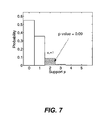
- FIG. 7 is a graph that illustrates the probability distribution of g 3 's support and its p-value.
- FIG. 8 illustrates a running example of ClosedVect according to the preferred embodiment of the present invention.
- FIG. 9 illustrates repeated random walks starting from node n 1,1 with a branching factor of 3 and a maximum cluster size of 4.
- FIG. 10 shows a modified network structure at two consecutive expansion levels, wherein a single designated node, n a , is used for restarts.
- FIG. 11 is a graph of theoretical versus empirical change in the affinity vectors of consecutive expansion levels.
- FIG. 14 illustrates the logical flow for conducting a database graph query in accordance with one or more embodiments of the invention.
- FIG. 15 is a flowchart illustrating the logical flow for determining a significance of frequent subgraphs is a database graph in accordance with one or more embodiments of the invention.
- FIG. 16 is a flowchart illustrating the logical flow for finding a significant group of proteins in a genome scale interaction network in accordance with one or more embodiments of the invention.
- FIG. 17 schematically illustrates a hardware and software environment in accordance with one or more embodiments of the invention.
- Queries in graph databases can be broadly classified into two categories: subgraph queries and similarity queries.
- subgraph queries one looks for a specific pattern in the graph database.
- the pattern can be either a small graph or a graph where some parts are uncertain, e.g., vertices with wildcard labels.
- Subgraph queries are useful in a number of applications such as finding structural motifs in (chemical compound or protein) 3D structures, or interconnection patterns in database schemas.
- posing similarity queries one looks for graphs that are similar to a given graph. There are two common kinds of similarity queries: A K-NN query finds K nearest graphs to the query graph; a range query finds graphs within a specified distance to the query graph. Similarity queries can be used as a building block for applications such as classification and evolutionary studies.
- Section B addresses subgraph and similarity querying in graph databases.
- a novel index structure called Closure tree, has been defined for the topological summarization of a set of graphs.
- Section C describes a novel significance model in which graphs are transformed into histograms of primitive components.
- the probability of occurrence of a subgraph in a graph is computed in the histogram domain. Based on this probability, we establish the probability distribution of a subgraph's support in a graph database. The significance of a subgraph is defined using this distribution.
- Section D describes an invention comprising a technique based on random walks and repeated random walks, wherein new theoretical bounds to speed up the basic algorithm.
- Closure-tree organizes graphs hierarchically where each node summarizes its descendants by a graph closure. Closure-tree can efficiently support both subgraph queries and similarity queries. Subgraph queries find graphs that contain a specific subgraph, whereas similarity queries find graphs that are similar to a query graph. For subgraph queries, we propose a technique called pseudo subgraph isomorphism which approximates subgraph isomorphism with high accuracy.
- graphs have been used for modeling biological pathways [4], chemical compounds [5], protein structures [6], social networks [7], and taxonomies [8, 9].
- a metabolic pathway is modeled as a set of reactions, enzymes, and metabolites, and an edge is placed between a reaction and a metabolite (or enzyme) if it participates in the reaction.
- the 3D structure of proteins can be modeled as contact maps: atoms whose distance is less than a threshold have an edge between them.
- Queries in graph databases can be broadly classified into two categories.
- the first category one looks for a specific pattern in the graph database.
- the pattern can be either a small graph or a graph where some parts are uncertain, e.g., vertices with wildcard labels.
- Subgraph queries are useful in a number of applications such as finding structural motifs in protein 3D structures, and pathway discovery in protein interaction graphs.
- the second query category one looks for graphs that are similar to a given graph.
- Similarity queries There are two common kinds of similarity queries: A K-NN query finds K nearest graphs to the query graph; a range query finds graphs within a specified distance to the query graph. Similarity queries can be used as a building block for applications such as schema matching and classification.
- Pairwise graph comparisons are usually difficult.
- subgraph queries one faces the subgraph isomorphism problem, known to be NP-Complete.
- similarity queries it is difficult to give a meaningful definition of graph similarity.
- the problem is also not known to be in the complexity class P.
- Graph datasets can also be very large, leading to a number of pairwise comparisons. Reducing the number of graph comparisons through good summarization and heuristics is the primary motivation for graph index structures.
- GraphGrep enumerates paths up to a threshold length from each graph.
- An index table is constructed where each row stands for a path and each column stands for a graph. Each entry in the table is the number of occurrences of the path in the graph.
- Queries are processed in two phases.
- the filtering phase generates a set of candidate graphs for which the count of each path is at least that of the query.
- the verification phase verifies each candidate graph by subgraph isomorphism and returns the answer set.
- GraphGrep and GIndex have some common disadvantages. First, they do not support graphs where attributes on vertices or edges are continuous values. The underlying reason is that the index features need to be matched exactly with the query. Second, their index construction requires an exhaustive enumeration of paths or fragments with high space and time overhead. Third, since paths or fragments carry little information about a graph, loss of information at the filtering step appears unavoidable.
- Berretti et al. [1] proposed a metric based indexing on attributed relational graphs (ARGs) for content-based image retrieval.
- Graphs are clustered hierarchically according to their mutual distances and indexed by M-trees [13]. Queries are processed in a top-down manner by routing the query along the reference graphs of clusters. Triangle inequality is used for pruning unnecessary nodes.
- Lee et al. [3] use a graphical representation for modeling foreground and background scenes in videos. These graphs are clustered using the edit distance metric, and similarity queries are answered using a multi-level index structure.
- Closure-tree a tree-based index
- C-tree a tree-based index
- Each node in the tree contains discriminative information about its descendants in order to facilitate effective pruning.
- This summary information is represented as a graph closure, a “bounding box” of the structural information of the constituent graphs.
- C-tree can support both subgraph queries and similarity queries on various kinds of graphs.
- C-tree extends many techniques developed for spatial access methods, e.g., R-trees [14, 15].
- C-tree avoids an exhaustive enumeration procedure as in GraphGrep and GIndex.
- C-tree can be contrasted by graph indexing approaches based on M-trees [1, 3], where the summary graph in the index structure (routing object) is a database graph; in our approach, this graph is a generalized graph that is a structural union of the underlying database graphs.
- C-tree is the first index structure that efficiently supports both subgraph queries and similarity queries on graphs.
- our techniques outperform GraphGrep by up to two orders of magnitude in terms of candidate answer set size and index size.
- similarity queries our experiments demonstrate the quality and efficiency of our techniques.
- Our work also demonstrates how traditional query and indexing techniques can be extended to graph data.
- V directed or undirected
- E vertex set
- Vertices and edges have attributes denoted by attr(v) or attr(e).
- Definition 1 (Graph Isomorphism).
- the edit distance between two objects is the cost of transforming one object into the other.
- the transformations are the insertion and removal of vertices and edges, and the changing of attributes on vertices and edges.
- the cost of these transformations can be generally regarded as a distance function between the two elements (in case of insertion and removal, the other element is a dummy).
- Given two graphs G 1 and G 2 we can find a mapping ⁇ between G* 1 and G* 2 , and compute the distance under this mapping.
- d(v, ⁇ (v)) and d(e, ⁇ (e)) are the vertex distance and the edge distance measures, respectively.
- vertex and edge distance measures are application specific. For simplicity, we assume a uniform distance measure: the distance between two vertices or two edges is 1 if they have different labels; otherwise it is 0.
- Definition 4 (Graph Distance). The distance between two graphs G 1 and G 2 is the minimum edit distance under all possible mappings:
- Subgraph distance can also be obtained by considering graph mappings and limiting distance consideration to the non-dummy vertices and edges in the first graph:
- d sub ⁇ ( G 1 , G 2 ) min ⁇ ⁇ ⁇ ⁇ v ⁇ V 1 ⁇ d ⁇ ( v , ⁇ ⁇ ( v ) ) + ⁇ e ⁇ E 1 ⁇ d ⁇ ( e , ⁇ ⁇ ( e ) ) ⁇ ( 4 )
- graph similarity is more meaningful than distance, especially when the underlying vertex and distance measures are based on similarity. This notion of similarity is defined as follows.
- sim(v, ⁇ (v)) and sim(e, ⁇ (e)) are the vertex similarity and the edge similarity measures, respectively.
- the similarity between two graphs is the maximum similarity under all possible mappings:
- Sim(V 1 ,V 2 ) and Sim(E 1 ,E 2 ) are the maximum similarity between two sets of vertices or edges, respectively. This can be computed by constructing a bipartite graph, and finding the maximum matching.
- Definition 7 (Vertex Closure and Edge Closure).
- the closure of a set of vertices is a generalized vertex whose attribute is the union of the attribute values of the vertices.
- the closure of a set of edges is a generalized edge whose attribute is the union of the attribute values of the edges.
- a vertex (or edge) closure may contain the special value ⁇ corresponding to a dummy.
- a graph closure has the characteristics of a graph: only instead of singleton labels on vertices and edges, a graph closure can have multiple labels.
- the ideas of graph isomorphism, subgraph isomorphism can be extended to them easily.
- the notion of distance needs to be reconsidered. Since a graph closure represents a set of graphs (akin to a Minimum Bounding Rectangle (MBR) in usual index structures), we define the notion of minimum distance between two graph closures (akin to the minimum distance between two MBRs).
- d min (v, ⁇ (v)) and d min (e, ⁇ (e)) is 0 if the closures share a label and is 1 otherwise.
- the minimum distance between two graph closures is defined as the minimum of the above distance under all possible mappings ⁇ ; this is denoted as d min .
- the notion of maximum similarity between graph closures is defined analogously: define the maximum similarity under a mapping, and then take the maximum of these over all possible mappings. This is denoted as Sim max .
- the distance between two graph closures refers to the minimum distance
- the similarity refers to the maximum similarity, unless specified otherwise.
- An upper bound to the similarity between two graph closures can be obtained by considering the vertex sets and the edge sets separately as in Eqn. (7) of Section B.
- the distance (or similarity) between a graph G and a graph closure C is a lower bound (or upper bound) to the distance (or similarity) between G and any graph H contained in C.
- a graph closure may contain graphs that do not actually exist in a given dataset (just as an MBR may contain points that do not exist in a given point dataset). To measure the number of graphs that a graph closure can possibly contain, we define the volume of a graph closure:
- the volume of a graph closure C is the product of the sizes of its vertex closures VC and its edge closures EC:
- volume ⁇ ⁇ ( C ) ⁇ v ⁇ ⁇ c ⁇ V ⁇ ⁇ C ⁇ ⁇ ⁇ ⁇ ⁇ c ⁇ ⁇ ⁇ e ⁇ ⁇ c ⁇ E ⁇ ⁇ C ⁇ ⁇ e ⁇ ⁇ c ⁇ ( 9 )
- FIG. 2 shows some graph closures of the graphs in FIG. 1 .
- the dotted edges represent the closure of a dummy and a non-dummy edge.
- the closure of two graphs depends on the graph mapping.
- the quality of the summary achieved by a closure depends on the quality of the graph mapping.
- a state search method can be used to find the optimal mapping between two small graphs.
- a branch-and-bound scheme can be implemented as follows. At each search state, we map a free vertex in one graph onto a free vertex in the other graph, and estimate an upper bound of future states using Eqn. (7) of Section B. If the upper bound is less than to equal to the maximum similarity found so far, then the current state can be pruned.
- the state search method works well only on small graphs, e.g., graphs of size less than 10. For larger graphs, we need approximate methods. These are discussed next.
- This method constructs a bipartite graph B between two graphs G 1 and G 2 .
- the two partitions in B are the vertices from G 1 and G 2 .
- the edges of B are formed by connecting the vertices across the partitions.
- the maximum matching in B defines the graph mapping.
- the bipartite graph can be either unweighted or weighted, based on the similarity measure used. If it is unweighted, then the maximum matching is computed using Hopcroft and Karp's algorithm [16]. If it is weighted, then the maximum matching is computed by the Hungarian algorithm [17, 18]. The weight between two vertices is measured by the similarity of their attributes as well as their neighbors. Using matrix iteration, weights can be propagated to all the vertices until convergence. Heymans and Singh [19] used this method to compute the similarity between metabolic pathway graphs.
- NBM Neighbor Biased Mapping
- v ⁇ G 2 , v is unmatched ⁇ PQ.Insert(W u,v m , ⁇ u, v m >) mate[u] : v m wt[u]
- the time complexity of the algorithm can be computed as follows. Let n be the number of vertices and d be the maximum degree of vertices. The initial computation of matrix W and insertions into the priority queue take O(n 2 ) time, assuming uniform distance measures. In each iteration, the algorithm removes one pair from and inserts at most d 2 unmatched pairs into the priority queue. Totally, there are O(n) iterations. Thus, the time complexity is O(nd 2 log n).
- a C-tree is a tree of nodes where:
- Each node is a graph closure of its children.
- the children of an internal node are nodes; the children of a leaf node are database graphs.
- Each node has at least m children unless it is root, m ⁇ 2.
- Each node has at most M children, (M+1)/2 ⁇ m.
- FIG. 3 shows an example of a C-tree for the sample graph database where the graph closures are shown in FIG. 2 .
- C-tree is similar to that of tree-based spatial access methods, e.g., R-trees [14].
- the main difference is that each node in C-tree is represented by a graph closure instead of an MBR. Operations of a C-tree are analogous to that of an R-tree.
- an insertion operation begins at the root and iteratively chooses a child node until it reaches a leaf node.
- the given graph is inserted at this leaf node.
- Graph closures at each node along the path are enlarged accordingly.
- the main challenge of insertion is the criterion for choosing a child node. We describe several such criteria next.
- Linear partitioning takes time linear in the number of child nodes. We use this criterion in our implementation.
- a straightforward approach to building a C-tree is by inserting the graphs sequentially. However, the tree structure will not be globally optimized since it is affected by the insertion order. Further, this approach involves a large number of insertion and splitting operations.
- An alternative approach is to build the C-tree in combination with some clustering algorithm. In our implementation, we use hierarchical clustering [21] to build the C-tree.
- Subgraph queries find all graphs that contain a specific subgraph.
- Section B.6.1 presents our approximation algorithm for subgraph isomorphism.
- Section B.6.2 describes the processing of subgraph queries on a C-tree.
- a level-n adjacent subgraph of u as a subgraph derived from G that contains all vertices reachable from u within a distance of n.
- u is called level-n compatible to v if the level-n adjacent subgraph of u is sub-isomorphic to that of v.
- the vertex sets of B are the vertex sets of G 1 and G 2 ; for any two vertices u ⁇ G 1 , v ⁇ G 2 , if u is level-n compatible to v, then (u, v) is an edge in B. If B has a semi-perfect matching, i.e., every vertex in G 1 is matched, then G 1 is called level-n sub-isomorphic to G 2 .
- level-n sub-isomorphism implies actual subgraph isomorphism.
- the computation of level-n sub-isomorphism is computationally intensive and does not scale for large n. Therefore, we further approximate adjacent subgraphs by adjacent subtrees.
- Level-n Adjacent Subtree Given a graph G and a vertex u ⁇ G, a level-n adjacent subtree of u is a breadth-first tree on G starting at u and consisting of paths of length ⁇ n.
- vertices may appear repeatedly in an adjacent sub-tree.
- Vertex u is called level-n pseudo compatible to v if the level-n adjacent subtree of u is sub-isomorphic to that of v.
- Definition 13 Level-n Pseudo Sub-Isomorphism.
- the vertex sets of B are the vertex sets of G 1 and G 2 ; for any u ⁇ G 1 , v ⁇ G 2 , if u is level-n pseudo compatible to v, then (u, v) is an edge in B.
- G 1 is called level-n pseudo sub-isomorphic to G 2 if B has a semi-perfect matching.
- FIG. 4 outlines the approximation idea.
- G 1 is sub-isomorphic to G 2 , then G 1 is sub-isomorphic to G 2 at any level. If G 1 is level-n sub-isomorphic to G 2 , then G 1 is level-n pseudo sub-isomorphic to G 2 .
- FIG. 5 shows an example of pseudo subgraph isomorphism.
- G 1 and G 2 the subscripts of the labels in G 2 are used to distinguish vertices with the same label
- the “vertices” of the bipartite graph are adjacent subtrees of the vertices in G 1 and G 2 .
- the subtree of each vertex is a single vertex.
- Each vertex in G 1 is pseudo compatible to at least one vertex in G 2 .
- the subtree of vertex B in G 1 is not sub-isomorphic to that of vertex B 2 in G 2 .
- B is not pseudo compatible to B 2 .
- level-n pseudo compatibility can be computed in a recursive way.
- Vertex u is level-n pseudo compatible to vertex v if
- u is level- 0 compatible to v
- NG 1 (u) and NG 2 (v) be the neighbors of u and v; define a local bipartite graph B′ as follows: for any u′ ⁇ N G 1 (u), v′ ⁇ N G 2 (v), (u′,v′) is an edge in B′ if and only if u′ is level-(n ⁇ 1) pseudo compatible to v′. Then, B′ has a semi-perfect matching.
- level-n compatibility of a vertex is equivalent to the level-(n ⁇ 1) compatibility of all its neighbors and the existence of a semi-perfect matching.
- Theorem 1 provides an efficient way to compute level-n pseudo compatibility and level-n pseudo subgraph isomorphism. This is encoded in the Algorithm PseudoSubIsomorphic set forth below.
- B u,v 1 if u can be mapped onto v, e.g., u and v share a label.
- B′ a local bipartite graph B′ is constructed. If B′ has no semi-perfect matchings, then u is not pseudo compatible to v. The refinement continues until B converges or the given level 1 is reached. Finally, we check if B has a semi-perfect matching. If it does, then G 1 is pseudo sub-isomorphic to G 2 .
- the worst case time complexity of the pseudo subgraph isomorphism test is O(ln 1 n 2 (d 1 d 2 +M(d 1 ,d 2 ))+M(n 1 ,n 2 )) where 1 is the pseudo compatibility level, n 1 and n 2 are numbers of vertices in G 1 and G 2 , d 1 and d 2 are the maximum degrees of G 1 and G 2 , M( ) is the time complexity of maximum cardinality matching for bipartite graphs. Hopcroft and Karp's algorithm [16] finds a maximum cardinality matching in O(n 2.5 ) time.
- G 1 is pseudo sub-isomorphic to G 2 at level n 1 n 2 , then G 1 is pseudo sub-isomorphic to G 2 at any level.
- a subgraph query is processed in two phases.
- the first phase traverses the C-tree, pruning nodes based on pseudo subgraph isomorphism.
- a candidate answer set is returned.
- the second phase verifies each candidate answer for exact subgraph isomorphism and returns the answers.
- a lightweight histogram-based pruning can also be employed.
- the histogram of a graph is a vector that counts the number of each distinct attribute of the vertices and edges.
- the histogram of a node is stored at its parent node. Given a query Q and a graph G, let F Q and F G be their histograms. If Q is sub-isomorphic to G, then ⁇ i F Q [i] ⁇ F G [i]. We use this condition to test a child node before we visit that node. Histogram tests are less accurate but faster than pseudo subgraph isomorphism tests.
- Algorithm SubgraphQuery set forth below outlines the code for subgraph query processing. We use Ullmann's algorithm [22] for exact subgraph isomorphism. Note that the compatibility matrix B in the Algorithm PseudoSubIsomorphic can be used to accelerate Ullmann's algorithm.
- the present invention also comprises a technique for evaluating the statistical significance of frequent subgraphs in a database.
- a graph is represented by a feature vector that is a histogram over a set of basis elements.
- the set of basis elements is chosen based on domain knowledge and consists generally of vertices, edges, or small graphs.
- a given subgraph is transformed to a feature vector and the significance of the subgraph is computed by considering the significance of occurrence of the corresponding vector.
- the probability of occurrence of the vector in a random vector is computed based on the prior probability of the basis elements. This is then used to obtain a probability distribution on the support of the vector in a database of random vectors.
- the statistical significance of the vector/subgraph is then defined as the p-value of its observed support.
- FIG. 6 For illustrative purposes, consider some frequent subgraphs, shown in FIG. 6 , obtained from the sample graph database, shown in FIG. 1 .
- the support of a subgraph is the number of graphs that contain the subgraph. A subgraph is frequent if its support is above a given threshold. Neither the support nor the size of a subgraph is sufficient to measure the statistical significance of a subgraph, and to rank the listed subgraphs.
- the present invention provides a technique for computing the statistical significance of frequent subgraphs.
- the main challenge of the above procedure is how to estimate the probability that a subgraph occurs in a random graph.
- graphs have flexible structures, it is difficult to estimate such probability directly in the graph space (Note that the problem of determining whether a graph is a subgraph of another is NP-complete).
- Milo et al [36] adopted a simulation approach: generate many random graphs while maintaining some empirical measures such as degree of vertices, number of edges, and then count the ones that contain the subgraph.
- this approach is neither scalable to a large collection of graphs nor precise for computing and comparing small p-values.
- Section C.2 discusses how to represent graphs as feature vectors
- Sections C.3 and C.4 present a probabilistic model and a simplified model
- Section C.5 describes the feature vector mining.
- the prior probabilities are empirically computed using their frequency in the database, i.e.,
- ⁇ _ ( 6 17 , 2 17 , 3 17 , 5 17 , 1 17 ) .
- the definition extends to a group of vectors.
- the ceiling of a group of vectors is defined analogously.
- the feature vector of subgraph g 3 under the basis B is (2, 0, 1, 0, 0).
- basis B as a set of m distinct events, one for every basis element, where basis element b i is associated with its prior probability ⁇ i .
- a feature vector of a certain size l is thus regarded as an outcome of l independent trials.
- y (y 1 , . . . , y m )
- Eqn. (1) of Section C gives the probability of observing y in a random vector of size l.
- this is the probability that x occurs in a random vector of size l.
- the size constraint l is reasonable: the larger a random vector, the more likely that x will occur in the vector.
- n the number of vectors in the target database
- l (l 1 , . . . , l d )
- n (n 1 , . . . , n d )
- n i the number of vectors of size l i
- ⁇ n i n.
- the database of random vectors corresponds to n trials, and the support of x corresponds to the number of successes in n trials.
- the support can be modeled as a binomial random variable, with parameters n and P( x ;l). When the sizes are distinct, each size will correspond to one binomial random variable with parameters n i and P( x ;l).
- the support of x is the sum of the binomial random variables: the probability of x 's support being equal to ⁇ is given by
- FIG. 7 plots the probability distribution of g 3 's support in the random database.
- ⁇ 0 be the observed support in the target database.
- the p-value i.e., the probability of observing a support of at least ⁇ 0 in the random database
- Table 1 above shows the p-values of the subgraphs in FIG. 6 , as well as their expected supports.
- g 3 has the smallest p-value.
- P(Y i ⁇ x i ) is the probability that element ⁇ circumflex over (b) ⁇ i occurs at least x i times in a random vector. Since ⁇ circumflex over (P) ⁇ ( x ) is fixed, we then model the support of x by a single binomial distribution, with parameters n and ⁇ circumflex over (P) ⁇ ( x ).
- Empirically obtain the prior probabilities P(Y i ⁇ j) for every basis element ⁇ circumflex over (b) ⁇ i and every j (up to the maximum possible value). For example, element b 1 “A ⁇ B” occurs twice (G 1 and G 2 ) in the sample database, thus
- feature vector mining is important in two aspects.
- feature vectors also known as histograms and multisets, are common ways to summarize complex data.
- feature vector patterns are profiles of structured patterns, and feature vector mining can work as a foundation of structured pattern mining.
- feature vector mining is an important generalization of the well studied frequent itemset mining: each item is now associated with a count instead of a boolean value.
- the Algorithm ClosedVect outlines the phase of exploring closed sub-vectors.
- the algorithm explores closed sub-vectors in a bottom-up, depth-first manner.
- the algorithm “jumps” to a future state that has an immediately smaller supporting set along a branch (line 3 of the Algorithm ClosedVect).
- the corresponding sub-vector is then promoted as the floor of the supporting set (line 6 of the Algorithm ClosedVect).
- each search state is associated with a beginning position b. Any future state must extend at a position greater than or equal to b. If an extension designated at position i results in a starting position of less than i, then it must be a duplicate extension (lines 7-8 of the Algorithm ClosedVect).
- the evaluation phase (line 1 of the Algorithm ClosedVect) computes the p-value of a sub-vector and reports top-K significant ones (see [38] for details).
- Lines 9-10 of the Algorithm ClosedVect estimate a lower bound on the p-value of the super-vectors of x ′ and prune it if this bound is too high. This pruning is discussed further in [38].
- FIG. 8 shows a running example of the Algorithm ClosedVect.
- the underlined number denotes the beginning position b.
- Duplicate search states are pruned. For instance, the extension to “2 3 2” at position “ 3 ” leads to a supporting set “ ⁇ h1, h3 ⁇ ”, of which the floor is “3 4 2”. This extension violates the search order and is pruned (lines 7-8 of the Algorithm ClosedVect).
- Theorem 3. (Correctness and Efficiency of ClosedVect).
- the Algorithm ClosedVect explores closed and only closed sub-vectors. It is complete, compact, and duplicate-free.
- the Algorithm ClosedVect is optimal in terms of the number of search states because every search state corresponds to a distinct closed sub-vector.
- Genome-scale protein interaction networks have become available in recent years due to high throughput methods for detecting protein-protein interactions.
- Studies that utilize additional indirect genomic data have provided probabilistic functional networks for a number of model organisms.
- a major and a computationally intensive challenge is the identification and extraction of functional modules from these massive genome-scale protein networks.
- Genome-scale protein networks have been realized with the help of high throughput methods, like yeast-two-hybrid (Y2H) [52, 67] and affinity purification with mass spectrometry (APMS) [49, 50].
- Y2H yeast-two-hybrid
- APMS affinity purification with mass spectrometry
- information integration techniques that utilize indirect genomic evidence have provided both increased genome coverage by predicting new interactions and more accurate associations with multiple supporting evidence [44, 53, 56, 68].
- RRW repeated random walk
- the idea is based on expansion of a given cluster to include the protein with the highest proximity to that cluster. Starting with a cluster of size one (any protein in the network), this iterative process is repeated k times for obtaining clusters of size ⁇ k.
- the random walk method implicitly exploits the global structure of a network by simulating the behavior of a random walker [58].
- Google search engine uses a similar technique to exploit the global hyperlink structure of the Web and produce better rankings of search results [45].
- Weston et al. [70] use the random walk technique on a protein sequence similarity graph created using PSIBLAST scores to provide better rankings for a given query protein sequence.
- Section D.2 we give a formal description of the problem and we describe the proposed repeated random walk (RRW) algorithm; in Section D.2.4, we provide theoretical bounds for reducing computational complexity; and in Section D.3, we describe how the statistical significance of a cluster of proteins is assessed.
- RRW repeated random walk
- G (V, E) be the graph representing a genome scale protein interaction network, where V is the set of nodes (proteins), and E is the set of weighted undirected edges between pairs of proteins. The edges are weighted by the probability of interaction (or functional association).
- a biologically significant group entails proteins that function together in a biological pathway, are members of a protein complex, or have the same cellular function.
- significant clusters may contain proteins from different complexes, therefore reveal modular interactions at a higher level. (Assessment of statistical significance is discussed in detail in Section D.3.)
- the random walk technique exploits the global structure of a network by simulating the behavior of a random walker [58].
- the random walker starts on an initial node (or a set of source nodes simultaneously), and moves to a neighboring node based on the probabilities of the connecting edges.
- the random walker may also choose to teleport to the start nodes with a certain probability, called the restart probability, ⁇ .
- the walking process is repeated at every time tick for a certain amount of time. At the end, the percentage of time spent on a node gives a notion of its proximity to the starting nodes.
- the idea of random walks with restarts is closely related to Google's PageRank algorithm [45] and RANKPROP of Weston et al. [70].
- the Algorithm RandomWalk set forth below, finds the j closest proteins to a set of proteins using random walks with restarts. A single designated node, n a , is used for restarts.
- the Algorithm RandomWalk finds the top few proteins that are adjacent to a start node. We can add one of these proteins to the start set and repeat the random walk. Successive iterations can be used to identify clusters of any given size. Repeated random walks is based on this idea.
- the Algorithm RepeatedRandomWalk shows the repeated random walk (RRW) algorithm for finding strongly connected clusters of proteins. Starting from every node in the network, sets of strongly connected proteins are found by expanding the clusters repeatedly using the Algorithm RandomWalk. Clusters of size ⁇ k are inserted into a priority queue ordered by their statistical significance, i.e., p-values. For expanding a cluster C, the Algorithm RandomWalk is run and top-j closest proteins are recorded. Each of the j neighbor proteins is added to C one by one resulting in j new clusters to be further expanded. The expansion process can be viewed as a tree with height k and branching factor j.
- FIG. 9 gives a graphical view of the expansion process starting from node n 1,1 .
- the branching factor is 3 and the maximum size of clusters is 4.
- the nodes in the tree are labeled with subscripts indicating their level and their order in that level. All possible paths in the expansion tree are candidate clusters and are assessed for statistical significance. (The nodes in the path from the root node to an intermediate node constitutes a cluster). Note that, in general, n 3,1 may represent the same protein as n 4,8 ). Therefore, a path may contain the same set of nodes as another path, in which case the expansion is omitted to avoid duplication (line 13 in the Algorithm RepeatedRandomWalk).
- the observed complexity of the algorithm may not be exponential in j based on the structure of the network.
- the computational requirements of the algorithm is such that it may take days to run on a yeast interaction network with ⁇ 4,500 proteins and ⁇ 35,000 interactions.
- Running the Algorithm RandomWalk at each level of expansion is computationally very expensive.
- this naive nearest neighbor approach does not capture the structure of the network around starting nodes [46, 70].
- one may consider starting from a select number of nodes, e.g., the nodes adjacent to strongest edges in the network, instead of all the nodes in the network.
- FIG. 10 two protein networks at expansion levels i and i+1 are shown.
- expansion level i+1 of the repeated random walk one of nodes from the “rest of the network”, c, is added to the set of starting nodes.
- the only change in the transition matrix to reflect addition of c is the insertion of a directed edge from n a to c with a weight of
- the restart vector, s is constant at every expansion level.
- Theorem 4 The L 1 distance between the affinity vectors computed at two consecutive expansion levels is bounded by
- the second sum term in the second equation is 0, because when X t and Y t are equal and different from n a , X t+1 and Y t+1 should be equal because all the nodes except n a are unperturbed.
- the first sum term in the first inequality is
- FIG. 11 shows the theoretical bounds in the total change of affinities along with the observed total changes on the yeast network ConfidentNet [18]. Note that the predicted bounds are always higher than the observed bound.
- Theorem 4 gives a bound on the total change in the affinities of all the nodes in the network between consecutive expansions of a cluster.
- the total bound of 4/(i+1) also holds for the change on the affinity of each node.
- the total bound is too large compared to affinity differences between two consecutive nodes in the ranking, i.e., the total bound is too loose to guarantee the same rank order. Therefore, we need tighter bounds to be able to avoid costly invocations of the Algorithm RandomWalk. To achieve this goal, we analyzed the distributions of element-wise changes at different expansion levels. FIG.
- the standard deviation ⁇ is obtained using the element-wise affinity changes from level i ⁇ i to level i.
- the affinity changes from level i to level i+1 are assumed to follow the distribution
- x j +1 is the affinity of the (j+1) th closest protein at expansion level i and ⁇ x j+1 is the change in the affinity of that protein at expansion level i+1.
- j is the branching factor and is constant at all expansion levels.
- the computed probability provides a measure of confidence on (j+1) th protein's inclusion in the next expansion level.
- the call to RandomWalk is avoided when the confidence level is above a certain threshold. We use 0.95 as the threshold in our experiments. The same check is performed for consequent levels of expansion, e.g., (i+2), (i+3), and so on, and execution of RandomWalk is delayed until the ranking is likely to change. Using the developed bounds and pruning the call to RandomWalk method, we reduce the computational cost greatly, as demonstrated in Section D.4.
- the y-axis in the graphs shows the count of proteins that falls into a certain bin of maximum spanning tree weight (x-axis).
- the p-value scoring scheme provides a mechanism to compare clusters of different sizes. We show in our experiments that statistically significant clusters usually correspond to biologically significant clusters.
- FIG. 14 illustrates the logical flow for conducting a database graph query in accordance with one or more embodiments of the invention.
- a first and second database graph are obtained.
- the two graphs each have two or more vertices and one or more edges.
- first database graph is mapped to the second database graph.
- each vertex and edge in the first graph has a corresponding vertex and edge in the second graph.
- the mapping may include extending the first graph by creating dummy vertices and dummy edges wherein every vertex and every edge of the first graph (including the dummy vertices and edges) has a corresponding element in the second graph.
- the mapping may also include the construction of a bipartite graph between the two graphs.
- a first partition contains vertices from the first graph and the second partition contains vertices from the second graph.
- Edges of the bipartite graph are formed by connecting the vertices from the two graphs. Once the edges and vertices are established, the mapping is defined as a maximum similarity for each edge and vertex.
- the mapping biases neighbors of similar vertices. In other words, the mapping biases the matching of vertices towards neighbors of already matched vertices (i.e., even if two vertices have been unmatched).
- an initial similarity matrix is computed for the first graph and the second graph. Each entry of the similarity matrix represents a weight similarity of each vertex of the first graph to each vertex of the second graph.
- a priority queue is then created that includes vertex pairs based on the weight similarity. Each vertex pair has a vertex from the first graph and a most similar vertex from the second graph (based on the weight similarity).
- the priority queue is then processed by marking a first vertex pair in the queue as “matched”. A higher similarity weight is assigned to unmatched vertex pairs that are neighbors to the first vertex pair. The marking and assigning steps are repeated for each vertex pair in the priority queue until all vertices in the first graph have been marked as “matched”.
- a closure tree is a union of the first graph and the second graph based on the mapping.
- Each node of the graph closure tree is a graph closure of the node's children and each child of a leaf node is a database graph.
- the graph closure tree may also consists of a set of closure vertices and a set of closure edges.
- Each vertex in the set of closed vertices is a union of attribute values of each vertex from the first graph and the corresponding (i.e., mapped) vertex of the second graph.
- each edge in the set of closure edges is a union of attribute values of each edge of the first graph and each corresponding (i.e., mapped) edge of the second graph.
- a graph query is conducted based on the graph closure tree.
- Such a graph query may consists of a subgraph query.
- the subgraph query may also determine if a subgraph is subisomorphic.
- a level-n adjacent subgraph is defined for each vertex u of the first graph G1.
- the level-n adjacent subgraph contains all vertices reachable from the vertex u within a distance of n.
- a bipartite graph B may then be constructed for G1 and the second graph G2. Vertex sets of the graph B are vertex sets of G1 and G2.
- any two vertices u ⁇ G1, v ⁇ G2 if u is level-n pseudo compatible to v, then (u,v) comprises an edge of B, wherein vertex u is called level-n pseudo compatible to v if a level-n adjacent subgraph of u is level-n sub-isomorphic to that of v, wherein G1 is called level-n sub-isomorphic if every vertex in G1 is matched to a vertex in G2.
- the subgraph query may be further expedited by pruning nodes of the graph closure tree based on the subgraph isomorphism.
- each level-n sub-isomorphic subgraph may then be verified for exact subgraph isomorphism.
- FIG. 15 is a flowchart illustrating the logical flow for determining a significance of frequent subgraphs is a database graph in accordance with one or more embodiments of the invention.
- one or more vertices or edges of a database graph are selected as features. Such a selection may be based on various properties. For example, the selection may be based on a frequency that a vertex or edge occurs in the database graph, a size of a vertex or edge in the graph, a structural overlap between vertices and/or edges in the graph, or the co-occurrence of vertices and/or edges in the graph.
- the selected features are transformed into feature vectors.
- Each feature vector is a frequency of the selected feature in the database graph.
- the feature vectors are evaluated.
- the statistical significance of the feature vectors are determined based on the evaluating.
- the evaluation of step 1504 may model the probability that the selected features occur in a random vector through statistical observations. Such a random vector may be further constrained by a size of the random vector.
- the evaluating may explore closed sub-vectors of the feature vectors. Such exploring evaluates sets of closed vectors in a defined order and prunes duplicate sets during the evaluation. Further, to determine the statistical significance of the feature vectors, the statistical significance of each closed sub-vector that is not within a pruned duplicate set is evaluated.
- FIG. 16 is a flowchart illustrating the logical flow for finding a significant group of proteins in a genome scale interaction network in accordance with one or more embodiments of the invention.
- V is a set of nodes/proteins in the graph and E is a set of weighted undirected edges between pairs of nodes/proteins, wherein the edges are weighted by a probability of interaction.
- the nodes V are traversed. Beginning on an initial node, the traversal entails moving to a neighboring node based on the weight of connecting edges. The traversal moves to a new neighboring node based on the weight of connecting edges at every time tick for a defined period of time. Further, the traversal entails teleporting to the initial node and repeating the traversal based on a restart probability ⁇ . The traversal records each time a node is visited.
- a significant group of proteins is determined based on a proximity of a node to the initial node, wherein the proximity is based on a percentage of time spent on the node during the traversal.
- the insertion of the nodes/proteins into the cluster may involve reordering the proteins in the priority queue.
- a reordering may consume significant time.
- a current order of the cluster of proteins in the priority queue is not processed for reordering upon insertion of the cluster of proteins into the priority queue.
- the reordering does not occur until a confidence level, that the current order in the priority queue will change, is above a defined threshold.
- a confidence level is based on a probability or reordering that is based on a Gaussian distribution
- FIG. 17 schematically illustrates a hardware and software environment in accordance with one or more embodiments of the invention, and more particularly, illustrates a typical distributed computer system 1700 using a network 1702 to connect one or more client computers 1704 to one or more server computers 1706 .
- a typical combination of resources may include a network 1702 comprising the Internet, LANs, WANs, SNA networks, or the like, clients 1704 that are personal computers or workstations, and servers 1706 that are personal computers, workstations, minicomputers, or mainframes. Additionally, both client 1704 and server 1706 may receive input (e.g., cursor location input) and display a cursor in response to an input device such as cursor control device 1718 .
- input e.g., cursor location input
- the client 1704 may execute a graph visualization application 1708 , which performs some or all of the logic described herein, and which communicates with one or more server computers 1706 .
- the server computers 1706 each execute under the control of a server operating system (OS) 1710 .
- the server computers 1706 may execute a graph querying and mining application 1712 , which performs some or all of the logic described herein.
- the graph querying and mining application 1712 may access and/or manipulate data stored in a graph database 1716 by means of a database management system (DBMS) 1714 .
- DBMS database management system
- these components 1708 , 1710 1712 , 1714 and 1716 comprise instructions and/or data that is embodied in or retrievable from device, medium, signal, or carrier, e.g., a data storage device, a data communications device, a remote computer or device coupled to the computer 1704 , 1706 via a network or via another data communications device, etc.
- this logic and/or data when read, executed, and/or interpreted, results in the steps necessary to implement and/or use the present invention being performed.
- embodiments of the invention may be implemented as a method, apparatus, or article of manufacture using standard programming and/or engineering techniques to produce software, firmware, hardware, or any combination thereof.
- article of manufacture (or alternatively, “computer program product”) as used herein is intended to encompass logic and/or data accessible from any computer-readable device, carrier, or media.
Landscapes
- Engineering & Computer Science (AREA)
- Databases & Information Systems (AREA)
- Theoretical Computer Science (AREA)
- Software Systems (AREA)
- Data Mining & Analysis (AREA)
- Physics & Mathematics (AREA)
- General Engineering & Computer Science (AREA)
- General Physics & Mathematics (AREA)
- Information Retrieval, Db Structures And Fs Structures Therefor (AREA)
- Management, Administration, Business Operations System, And Electronic Commerce (AREA)
Priority Applications (2)
| Application Number | Priority Date | Filing Date | Title |
|---|---|---|---|
| US11/711,326 US7933915B2 (en) | 2006-02-27 | 2007-02-27 | Graph querying, graph motif mining and the discovery of clusters |
| US13/073,452 US8396884B2 (en) | 2006-02-27 | 2011-03-28 | Graph querying, graph motif mining and the discovery of clusters |
Applications Claiming Priority (3)
| Application Number | Priority Date | Filing Date | Title |
|---|---|---|---|
| US77703706P | 2006-02-27 | 2006-02-27 | |
| US82248706P | 2006-08-15 | 2006-08-15 | |
| US11/711,326 US7933915B2 (en) | 2006-02-27 | 2007-02-27 | Graph querying, graph motif mining and the discovery of clusters |
Related Child Applications (1)
| Application Number | Title | Priority Date | Filing Date |
|---|---|---|---|
| US13/073,452 Continuation US8396884B2 (en) | 2006-02-27 | 2011-03-28 | Graph querying, graph motif mining and the discovery of clusters |
Publications (2)
| Publication Number | Publication Date |
|---|---|
| US20070239694A1 US20070239694A1 (en) | 2007-10-11 |
| US7933915B2 true US7933915B2 (en) | 2011-04-26 |
Family
ID=38459643
Family Applications (1)
| Application Number | Title | Priority Date | Filing Date |
|---|---|---|---|
| US11/711,326 Expired - Fee Related US7933915B2 (en) | 2006-02-27 | 2007-02-27 | Graph querying, graph motif mining and the discovery of clusters |
Country Status (2)
| Country | Link |
|---|---|
| US (1) | US7933915B2 (fr) |
| WO (1) | WO2007100834A2 (fr) |
Cited By (44)
| Publication number | Priority date | Publication date | Assignee | Title |
|---|---|---|---|---|
| US20060136428A1 (en) * | 2004-12-16 | 2006-06-22 | International Business Machines Corporation | Automatic composition of services through semantic attribute matching |
| US20080235315A1 (en) * | 2006-10-01 | 2008-09-25 | Javaid Aslam | Technique for solving np-hard problems using polynomial sequential time and polylogarithmic parallel time |
| US20090276389A1 (en) * | 2008-05-02 | 2009-11-05 | Paul Constantine | Systems and methods for ranking nodes of a graph using random parameters |
| US20090315890A1 (en) * | 2008-06-18 | 2009-12-24 | International Business Machines Corporation | Method for enumerating cliques |
| US20100014675A1 (en) * | 2008-07-15 | 2010-01-21 | The Mitre Corporation | Appraising Systems With Zero Knowledge Proofs |
| US20100179955A1 (en) * | 2007-04-13 | 2010-07-15 | The University Of Vermont And State Agricultural College | Relational Pattern Discovery Across Multiple Databases |
| US20100293203A1 (en) * | 2009-05-18 | 2010-11-18 | Henry Roberts Williams | User interface for graph database data |
| US20100306166A1 (en) * | 2009-06-01 | 2010-12-02 | Yahoo! Inc. | Automatic fact validation |
| US20110040619A1 (en) * | 2008-01-25 | 2011-02-17 | Trustees Of Columbia University In The City Of New York | Belief propagation for generalized matching |
| US20110040766A1 (en) * | 2009-08-13 | 2011-02-17 | Charité-Universitätsmedizin Berlin | Methods for searching with semantic similarity scores in one or more ontologies |
| US20110081074A1 (en) * | 2009-10-07 | 2011-04-07 | Mikael Rousson | Method of Computing Global-to-Local Metrics for Recognition |
| US20120005238A1 (en) * | 2008-12-12 | 2012-01-05 | Tony Jebara | Machine optimization devices, methods, and systems |
| KR101218795B1 (ko) | 2011-02-21 | 2013-01-09 | 경희대학교 산학협력단 | 그래프 분류를 위한 유사한 그래프 구조를 이용한 특징 선택 방법 및 장치 |
| US20130024479A1 (en) * | 2011-07-20 | 2013-01-24 | Salesforce.Com, Inc. | Methods and systems for processing large graphs using density-based processes using map-reduce |
| US20130185335A1 (en) * | 2012-01-13 | 2013-07-18 | Quova, Inc. | Method and apparatus for implementing a learning model for facilitating answering a query on a database |
| US20130246439A1 (en) * | 2010-07-01 | 2013-09-19 | Vib Vzw | Method and system for using an information system |
| US20130254169A1 (en) * | 2009-01-20 | 2013-09-26 | Kount Inc. | Fast Component Enumeration in Graphs with Implicit Edges |
| US20140037227A1 (en) * | 2012-07-31 | 2014-02-06 | Bin Zhang | Hierarchical cluster determination based on subgraph density |
| US8705870B2 (en) | 2012-03-02 | 2014-04-22 | Microsoft Corporation | Image searching by approximate κ-NN graph |
| US20140136520A1 (en) * | 2012-11-12 | 2014-05-15 | Software Ag | Method and system for processing graph queries |
| US8825566B2 (en) | 2009-05-20 | 2014-09-02 | The Trustees Of Columbia University In The City Of New York | Systems, devices, and methods for posteriori estimation using NAND markov random field (NMRF) |
| US20140337719A1 (en) * | 2013-05-10 | 2014-11-13 | Peking University Founder Group Co., Ltd. | Apparatus And A Method For Logically Processing A Composite Graph In A Formatted Document |
| US20150100568A1 (en) * | 2013-10-09 | 2015-04-09 | Google Inc. | Automatic definition of entity collections |
| US9042648B2 (en) | 2012-02-23 | 2015-05-26 | Microsoft Technology Licensing, Llc | Salient object segmentation |
| US9082082B2 (en) | 2011-12-06 | 2015-07-14 | The Trustees Of Columbia University In The City Of New York | Network information methods devices and systems |
| US20150213115A1 (en) * | 2014-01-24 | 2015-07-30 | Samsung Electronics Co., Ltd. | Methods and systems for customizable clustering of sub-networks for bioinformatics and health care applications |
| US20160048633A1 (en) * | 2013-03-15 | 2016-02-18 | Cypher Genomics, Inc. | Systems and methods for genomic variant annotation |
| US9330063B2 (en) | 2012-10-12 | 2016-05-03 | Microsoft Technology Licensing, Llc | Generating a sparsifier using graph spanners |
| US9336302B1 (en) | 2012-07-20 | 2016-05-10 | Zuci Realty Llc | Insight and algorithmic clustering for automated synthesis |
| US9507875B2 (en) | 2012-02-09 | 2016-11-29 | Fujitsu Limited | Symbolic hyper-graph database |
| US9652875B2 (en) | 2012-10-29 | 2017-05-16 | Yahoo! Inc. | Systems and methods for generating a dense graph |
| US9710493B2 (en) | 2013-03-08 | 2017-07-18 | Microsoft Technology Licensing, Llc | Approximate K-means via cluster closures |
| WO2017189026A1 (fr) * | 2016-04-25 | 2017-11-02 | GraphSQL, Inc. | Système et procédé de requête pour un modèle graphique |
| US9934327B2 (en) | 2015-06-01 | 2018-04-03 | International Business Machines Corporation | Mining relevant approximate subgraphs from multigraphs |
| CN108020750A (zh) * | 2016-11-02 | 2018-05-11 | 全球能源互联网研究院 | 一种配电网停电范围分析方法和分析装置 |
| US10042836B1 (en) * | 2012-04-30 | 2018-08-07 | Intuit Inc. | Semantic knowledge base for tax preparation |
| US10754861B2 (en) | 2016-10-10 | 2020-08-25 | Tata Consultancy Services Limited | System and method for content affinity analytics |
| US10769335B1 (en) | 2019-10-29 | 2020-09-08 | Nxp Usa, Inc. | System and method for graph based verification of electronic circuit design |
| US10810210B2 (en) | 2017-05-12 | 2020-10-20 | Battelle Memorial Institute | Performance and usability enhancements for continuous subgraph matching queries on graph-structured data |
| US10949466B2 (en) * | 2017-04-24 | 2021-03-16 | Oracle International Corporation | Multi-source breadth-first search (Ms-Bfs) technique and graph processing system that applies it |
| US11205103B2 (en) | 2016-12-09 | 2021-12-21 | The Research Foundation for the State University | Semisupervised autoencoder for sentiment analysis |
| US11243949B2 (en) | 2017-04-21 | 2022-02-08 | Microsoft Technology Licensing, Llc | Query execution across multiple graphs |
| US11475032B2 (en) * | 2019-03-13 | 2022-10-18 | International Business Machines Corporation | Analyzing multidimensional process traces under edit-distance constraint |
| US11941054B2 (en) * | 2018-10-12 | 2024-03-26 | International Business Machines Corporation | Iterative constraint solving in abstract graph matching for cyber incident reasoning |
Families Citing this family (126)
| Publication number | Priority date | Publication date | Assignee | Title |
|---|---|---|---|---|
| US7539697B1 (en) | 2002-08-08 | 2009-05-26 | Spoke Software | Creation and maintenance of social relationship network graphs |
| US20050283753A1 (en) * | 2003-08-07 | 2005-12-22 | Denise Ho | Alert triggers and event management in a relationship system |
| US7373389B2 (en) * | 2003-08-27 | 2008-05-13 | Spoke Software | Periodic update of data in a relationship system |
| WO2008154029A1 (fr) * | 2007-06-11 | 2008-12-18 | The Trustees Of Columbia University In The City Of New York | Classification de données et groupement hiérarchisé |
| US7975301B2 (en) * | 2007-03-05 | 2011-07-05 | Microsoft Corporation | Neighborhood clustering for web spam detection |
| US20100121839A1 (en) * | 2007-03-15 | 2010-05-13 | Scott Meyer | Query optimization |
| US8204856B2 (en) * | 2007-03-15 | 2012-06-19 | Google Inc. | Database replication |
| US20090024590A1 (en) * | 2007-03-15 | 2009-01-22 | Sturge Timothy | User contributed knowledge database |
| US20100174692A1 (en) * | 2007-03-15 | 2010-07-08 | Scott Meyer | Graph store |
| US7788254B2 (en) * | 2007-05-04 | 2010-08-31 | Microsoft Corporation | Web page analysis using multiple graphs |
| US8060540B2 (en) * | 2007-06-18 | 2011-11-15 | Microsoft Corporation | Data relationship visualizer |
| US8321424B2 (en) * | 2007-08-30 | 2012-11-27 | Microsoft Corporation | Bipartite graph reinforcement modeling to annotate web images |
| US8775475B2 (en) * | 2007-11-09 | 2014-07-08 | Ebay Inc. | Transaction data representations using an adjacency matrix |
| US8046324B2 (en) * | 2007-11-30 | 2011-10-25 | Ebay Inc. | Graph pattern recognition interface |
| US8326847B2 (en) * | 2008-03-22 | 2012-12-04 | International Business Machines Corporation | Graph search system and method for querying loosely integrated data |
| US8000262B2 (en) * | 2008-04-18 | 2011-08-16 | Bonnie Berger Leighton | Method for identifying network similarity by matching neighborhood topology |
| US9727532B2 (en) * | 2008-04-25 | 2017-08-08 | Xerox Corporation | Clustering using non-negative matrix factorization on sparse graphs |
| US8825646B1 (en) * | 2008-08-08 | 2014-09-02 | Google Inc. | Scalable system for determining short paths within web link network |
| US9135396B1 (en) * | 2008-12-22 | 2015-09-15 | Amazon Technologies, Inc. | Method and system for determining sets of variant items |
| US20110093500A1 (en) * | 2009-01-21 | 2011-04-21 | Google Inc. | Query Optimization |
| US8364615B2 (en) * | 2009-02-06 | 2013-01-29 | Microsoft Corporation | Local graph partitioning using evolving sets |
| US9171077B2 (en) * | 2009-02-27 | 2015-10-27 | International Business Machines Corporation | Scaling dynamic authority-based search using materialized subgraphs |
| US8090729B2 (en) * | 2009-03-03 | 2012-01-03 | Microsoft Corporation | Large graph measurement |
| US9471645B2 (en) * | 2009-09-29 | 2016-10-18 | International Business Machines Corporation | Mechanisms for privately sharing semi-structured data |
| US8433701B2 (en) * | 2009-11-19 | 2013-04-30 | 21Ct, Inc. | System and method for optimizing pattern query searches on a graph database |
| US8630967B2 (en) * | 2009-12-07 | 2014-01-14 | Hewlett-Packard Development Company, L.P. | Determining operational settings for fluid moving devices using a multivariate time series of data |
| US8700611B2 (en) * | 2010-01-12 | 2014-04-15 | Vmware, Inc. | Extensible tree views for managing datacenter resources |
| KR101208828B1 (ko) | 2010-05-03 | 2012-12-06 | 엔에이치엔(주) | 논문 검색 랭킹 시스템 및 방법 |
| US9268615B2 (en) * | 2010-05-28 | 2016-02-23 | Microsoft Technology Licensing, Llc | Distributed computing using communities |
| US8768105B2 (en) * | 2011-01-21 | 2014-07-01 | Kodak Alaris Inc. | Method for searching a database using query images and an image anchor graph-based ranking algorithm |
| US9116968B2 (en) | 2011-06-30 | 2015-08-25 | Bmc Software, Inc. | Methods and apparatus related to graph transformation and synchronization |
| US8762390B2 (en) * | 2011-11-21 | 2014-06-24 | Nec Laboratories America, Inc. | Query specific fusion for image retrieval |
| US8719299B2 (en) * | 2011-12-02 | 2014-05-06 | Sap Ag | Systems and methods for extraction of concepts for reuse-based schema matching |
| JP2015510408A (ja) * | 2011-12-30 | 2015-04-09 | ザ・ジョンズ・ホプキンス・ユニバーシティー | バイオイメージンググリッド |
| CN102609528B (zh) * | 2012-02-14 | 2014-06-18 | 云南大学 | 基于概率图模型的频繁模式关联分类方法 |
| US9563669B2 (en) | 2012-06-12 | 2017-02-07 | International Business Machines Corporation | Closed itemset mining using difference update |
| US9542462B1 (en) | 2012-06-14 | 2017-01-10 | Google Inc. | Scaling high-level statistical languages to large, distributed datasets |
| US20140025691A1 (en) * | 2012-07-20 | 2014-01-23 | Adobe Systems Inc. | Method and apparatus for dynamic filtering of an object graph in a content repository |
| US9165068B2 (en) * | 2012-08-03 | 2015-10-20 | Adobe Systems Incorporated | Techniques for cloud-based similarity searches |
| US20140047089A1 (en) * | 2012-08-10 | 2014-02-13 | International Business Machines Corporation | System and method for supervised network clustering |
| US8751963B1 (en) | 2013-01-23 | 2014-06-10 | Splunk Inc. | Real time indication of previously extracted data fields for regular expressions |
| US9753909B2 (en) | 2012-09-07 | 2017-09-05 | Splunk, Inc. | Advanced field extractor with multiple positive examples |
| US20140208217A1 (en) | 2013-01-22 | 2014-07-24 | Splunk Inc. | Interface for managing splittable timestamps across event records |
| US10394946B2 (en) | 2012-09-07 | 2019-08-27 | Splunk Inc. | Refining extraction rules based on selected text within events |
| US8682906B1 (en) | 2013-01-23 | 2014-03-25 | Splunk Inc. | Real time display of data field values based on manual editing of regular expressions |
| US9594814B2 (en) | 2012-09-07 | 2017-03-14 | Splunk Inc. | Advanced field extractor with modification of an extracted field |
| US8751499B1 (en) | 2013-01-22 | 2014-06-10 | Splunk Inc. | Variable representative sampling under resource constraints |
| CN103207884B (zh) * | 2012-11-23 | 2016-05-18 | 浙江工业大学 | 一种加权网络间的权重迭代节点匹配方法 |
| CN103914493A (zh) * | 2013-01-09 | 2014-07-09 | 北大方正集团有限公司 | 一种微博用户群体结构发现分析方法及系统 |
| US8909642B2 (en) | 2013-01-23 | 2014-12-09 | Splunk Inc. | Automatic generation of a field-extraction rule based on selections in a sample event |
| US9152929B2 (en) | 2013-01-23 | 2015-10-06 | Splunk Inc. | Real time display of statistics and values for selected regular expressions |
| US10318583B2 (en) * | 2013-03-15 | 2019-06-11 | The Board Of Trustees Of The Leland Stanford Junior University | Systems and methods for recommending relationships within a graph database |
| US10223637B1 (en) | 2013-05-30 | 2019-03-05 | Google Llc | Predicting accuracy of submitted data |
| CA2920691A1 (fr) * | 2013-07-23 | 2015-01-29 | Research Foundation Of The City University Of New York | Procede d'identification de nouveaux usages de medicaments connus |
| US10776965B2 (en) * | 2013-07-26 | 2020-09-15 | Drisk, Inc. | Systems and methods for visualizing and manipulating graph databases |
| US9348947B2 (en) | 2013-07-26 | 2016-05-24 | Helynx, Inc. | Systems and methods for visualizing and manipulating graph databases |
| US9934323B2 (en) | 2013-10-01 | 2018-04-03 | Facebook, Inc. | Systems and methods for dynamic mapping for locality and balance |
| US10152557B2 (en) * | 2014-01-31 | 2018-12-11 | Google Llc | Efficient similarity ranking for bipartite graphs |
| US9529833B2 (en) * | 2014-02-19 | 2016-12-27 | Palo Alto Research Center Incorporated | Graph pruning in hipergraph |
| JP6310721B2 (ja) * | 2014-02-19 | 2018-04-11 | 国立大学法人京都大学 | 関係性グラフ評価システム |
| CN105095239A (zh) * | 2014-04-30 | 2015-11-25 | 华为技术有限公司 | 一种不确定图查询方法及装置 |
| US20150324481A1 (en) * | 2014-05-06 | 2015-11-12 | International Business Machines Corporation | Building Entity Relationship Networks from n-ary Relative Neighborhood Trees |
| WO2015172253A1 (fr) * | 2014-05-16 | 2015-11-19 | Nextwave Software Inc. | Procédé et système pour effectuer des transactions de commerce électronique dans une messagerie par recherche, discussion et prédiction d'agent |
| CN105243064A (zh) * | 2014-06-23 | 2016-01-13 | 华为技术有限公司 | 一种子图匹配的方法及装置 |
| US9639598B2 (en) * | 2014-07-31 | 2017-05-02 | International Business Machines Corporation | Large-scale data clustering with dynamic social context |
| US9703890B2 (en) * | 2014-10-17 | 2017-07-11 | Vmware, Inc. | Method and system that determine whether or not two graph-like representations of two systems describe equivalent systems |
| US9916187B2 (en) | 2014-10-27 | 2018-03-13 | Oracle International Corporation | Graph database system that dynamically compiles and executes custom graph analytic programs written in high-level, imperative programming language |
| WO2016081880A1 (fr) * | 2014-11-21 | 2016-05-26 | Trustees Of Boston University | Recherche vidéo à grande échelle au moyen d'interrogations qui définissent des relations entre des objets |
| EP3230903A4 (fr) * | 2014-12-10 | 2018-10-03 | Kyndi, Inc. | Appareil et procédé de représentations et de fonctions relatives à des données reposant sur des hypercartes combinatoires |
| US10489524B2 (en) * | 2015-01-01 | 2019-11-26 | Deutsche Telekom Ag | Synthetic data generation method |
| AU2016235087A1 (en) * | 2015-03-24 | 2017-09-21 | Kyndi, Inc. | Cognitive memory graph indexing, storage and retrieval |
| US10061715B2 (en) * | 2015-06-02 | 2018-08-28 | Hong Kong Baptist University | Structure-preserving subgraph queries |
| CN107851099A (zh) * | 2015-07-07 | 2018-03-27 | 慧与发展有限责任合伙企业 | 图形数据库 |
| US9378239B1 (en) | 2015-09-18 | 2016-06-28 | Linkedin Corporation | Verifying graph-based queries |
| US9330138B1 (en) * | 2015-09-18 | 2016-05-03 | Linkedin Corporation | Translating queries into graph queries using primitives |
| US9378303B1 (en) | 2015-09-18 | 2016-06-28 | Linkedin Corporation | Representing compound relationships in a graph database |
| US9378241B1 (en) | 2015-09-18 | 2016-06-28 | Linkedin Corporation | Concatenated queries based on graph-query results |
| US9535963B1 (en) | 2015-09-18 | 2017-01-03 | Linkedin Corporation | Graph-based queries |
| US9514247B1 (en) | 2015-10-28 | 2016-12-06 | Linkedin Corporation | Message passing in a distributed graph database |
| US9569558B1 (en) * | 2015-11-25 | 2017-02-14 | International Business Machines Corporation | Method for backfilling graph structure and articles comprising the same |
| US10572501B2 (en) | 2015-12-28 | 2020-02-25 | International Business Machines Corporation | Steering graph mining algorithms applied to complex networks |
| JP6757913B2 (ja) * | 2016-02-26 | 2020-09-23 | 国立研究開発法人情報通信研究機構 | 画像クラスタリングシステム、画像クラスタリング方法、画像クラスタリングプログラム、および、コミュニティ構造検出システム |
| US10180992B2 (en) | 2016-03-01 | 2019-01-15 | Microsoft Technology Licensing, Llc | Atomic updating of graph database index structures |
| US10089761B2 (en) * | 2016-04-29 | 2018-10-02 | Hewlett Packard Enterprise Development Lp | Graph processing using a shared memory |
| US10506016B2 (en) | 2016-05-19 | 2019-12-10 | Oracle International Corporation | Graph analytic engine that implements efficient transparent remote access over representational state transfer |
| US11030246B2 (en) * | 2016-06-10 | 2021-06-08 | Palo Alto Research Center Incorporated | Fast and accurate graphlet estimation |
| US20180025073A1 (en) * | 2016-07-21 | 2018-01-25 | Ayasdi, Inc. | Scalable topological data analysis using topological summaries of subsets |
| US10789295B2 (en) | 2016-09-28 | 2020-09-29 | Microsoft Technology Licensing, Llc | Pattern-based searching of log-based representations of graph databases |
| US10754859B2 (en) | 2016-10-28 | 2020-08-25 | Microsoft Technology Licensing, Llc | Encoding edges in graph databases |
| US10599638B2 (en) * | 2017-02-06 | 2020-03-24 | The Texas State University-San Marcos | System and method for identifying maximal independent sets in parallel |
| US10445321B2 (en) | 2017-02-21 | 2019-10-15 | Microsoft Technology Licensing, Llc | Multi-tenant distribution of graph database caches |
| US10671671B2 (en) | 2017-06-09 | 2020-06-02 | Microsoft Technology Licensing, Llc | Supporting tuples in log-based representations of graph databases |
| US10445370B2 (en) | 2017-06-09 | 2019-10-15 | Microsoft Technology Licensing, Llc | Compound indexes for graph databases |
| US10628492B2 (en) | 2017-07-20 | 2020-04-21 | Microsoft Technology Licensing, Llc | Distributed graph database writes |
| CN110019975B (zh) | 2017-10-10 | 2020-10-16 | 创新先进技术有限公司 | 随机游走、基于集群的随机游走方法、装置以及设备 |
| CN109658094B (zh) | 2017-10-10 | 2020-09-18 | 阿里巴巴集团控股有限公司 | 随机游走、基于集群的随机游走方法、装置以及设备 |
| CN107887023A (zh) * | 2017-12-08 | 2018-04-06 | 中南大学 | 一种基于相似性和双随机游走的微生物‑疾病关系预测方法 |
| US10983997B2 (en) | 2018-03-28 | 2021-04-20 | Microsoft Technology Licensing, Llc | Path query evaluation in graph databases |
| CN108595686B (zh) * | 2018-05-07 | 2020-10-20 | 华东师范大学 | 一种单图中近似频繁图挖掘的方法、装置、设备、介质和系统 |
| US11244013B2 (en) * | 2018-06-01 | 2022-02-08 | International Business Machines Corporation | Tracking the evolution of topic rankings from contextual data |
| US11507099B2 (en) | 2018-09-10 | 2022-11-22 | Drisk, Inc. | Systems and methods for graph-based AI training |
| CN109522432B (zh) * | 2018-09-21 | 2023-01-31 | 重庆大学 | 一种融合自适应相似度和贝叶斯框架的图像检索方法 |
| US11205050B2 (en) * | 2018-11-02 | 2021-12-21 | Oracle International Corporation | Learning property graph representations edge-by-edge |
| US10728105B2 (en) * | 2018-11-29 | 2020-07-28 | Adobe Inc. | Higher-order network embedding |
| US11567995B2 (en) | 2019-07-26 | 2023-01-31 | Microsoft Technology Licensing, Llc | Branch threading in graph databases |
| US10990879B2 (en) | 2019-09-06 | 2021-04-27 | Digital Asset Capital, Inc. | Graph expansion and outcome determination for graph-defined program states |
| US11132403B2 (en) | 2019-09-06 | 2021-09-28 | Digital Asset Capital, Inc. | Graph-manipulation based domain-specific execution environment |
| US12339904B2 (en) * | 2019-09-06 | 2025-06-24 | Digital Asset Capital, Inc | Dimensional reduction of categorized directed graphs |
| US11113267B2 (en) | 2019-09-30 | 2021-09-07 | Microsoft Technology Licensing, Llc | Enforcing path consistency in graph database path query evaluation |
| CN111274457B (zh) * | 2020-02-03 | 2023-12-19 | 中国人民解放军国防科技大学 | 一种网络图分割方法及存储介质 |
| CN114600097A (zh) * | 2020-08-27 | 2022-06-07 | 清华大学 | 子图匹配策略确定方法、子图匹配方法、子图计数方法和计算装置 |
| CN112417247B (zh) * | 2020-11-22 | 2022-04-05 | 同济大学 | 基于随机游走的动态流图数据顶点重要性更新方法和装置 |
| US12141171B2 (en) * | 2021-05-20 | 2024-11-12 | Xactly Corporation | Machine generation of balanced digital territory maps |
| US11928117B2 (en) * | 2021-06-23 | 2024-03-12 | International Business Machines Corporation | Live comment management |
| US20230004977A1 (en) * | 2021-06-30 | 2023-01-05 | Oracle International Corporation | Exploiting graph structure to improve results of entity resolution |
| CN116415664A (zh) * | 2021-12-31 | 2023-07-11 | 胜斗士(上海)科技技术发展有限公司 | 用于为所关注的业务进行关联分析的方法、设备和介质 |
| WO2023215484A1 (fr) * | 2022-05-06 | 2023-11-09 | Innovaccer Inc. | Procédé et système pour fournir une bibliothèque de caractéristiques à base de faas à l'aide d'un dag |
| CN114943284B (zh) * | 2022-05-17 | 2025-10-24 | 阿里巴巴(中国)有限公司 | 行为预测模型的数据处理系统与方法 |
| US12603162B2 (en) | 2022-06-21 | 2026-04-14 | Innovaccer Inc. | System and method for automatic display of contextually related data on multiple devices |
| US12013897B2 (en) * | 2022-09-02 | 2024-06-18 | Tsinghua University | Systems and methods for general-purpose out-of-core random walk graph computing |
| CN116304237B (zh) * | 2023-03-20 | 2026-04-14 | 浙江大学 | 基于分层联合图索引的房屋租赁多度量空间搜索方法 |
| CN116450897B (zh) * | 2023-03-24 | 2025-11-21 | 中国人民解放军国防科技大学 | 基于流图的Top-K频繁模式挖掘方法、装置和设备 |
| WO2024197433A1 (fr) | 2023-03-24 | 2024-10-03 | Paypal, Inc. | Traitement de graphe de grand réseau |
| CN116525025B (zh) * | 2023-05-10 | 2026-03-27 | 大连海事大学 | 一种基于分区的化合物结构图相似查询方法 |
| EP4636610A1 (fr) * | 2024-04-15 | 2025-10-22 | Dassault Systèmes | Extraction de similarité topologique locale dans un modèle b-rep |
| CN120705307B (zh) * | 2025-06-17 | 2026-01-16 | 湖北中软科怡档案信息技术有限公司 | 一种基于自然语言处理技术的档案智能摘要生成系统及方法 |
-
2007
- 2007-02-27 WO PCT/US2007/005113 patent/WO2007100834A2/fr not_active Ceased
- 2007-02-27 US US11/711,326 patent/US7933915B2/en not_active Expired - Fee Related
Non-Patent Citations (71)
| Title |
|---|
| A. C. Gavin, M. Bosche, R. Krause, P. Grandi, M. Marzioch, A. Bauer, J. Schultz, J. M. Rick, A. M. Michon, and C. M. Cruciat. Functional organization of the yeast proteome by systematic analysis of protein complexes. Nature, 415:141-147, 2002. |
| A. Guttman. R-trees: A dynamic index structure for spatial searching. In Proc. of SIGMOD, 1984. |
| A. Inokuchi, T. Washio, and H. Motoda. An apriori-based algorithm for mining frequent substructures from graph data. In Principles of Data Mining and Knowledge Discovery, pp. 13-23, 2000. |
| A. Y. Ng, A. X. Zheng, and M. I. Jordan. Link analysis, eigenvectors, and stability. In International Joint Conference on Artificial Intelligence (IJCAI), 2001. |
| C. Faloutsos and K.-I. Lin. Fastmap: A fast algorithm for indexing, data-mining and visualization of traditional and multimedia datasets. In SIGMOD Conference, 1995. |
| C. H. Papadimitriou and K. Steiglit. Combinatorial optimization: algorithms and complexity, pp. 247-255. 1982. |
| C. J. Roberts et al. Signaling and circuitry of multiple MAPK pathways revealed by a matrix of global gene expression profiles. Science, 287:873-880, 2000. |
| C. von Mering, L. J. Jensen, B. Snel, S. D. Hooper, M. Krupp, M. Foglierini, N. Jouffre, M. A. Huynen, and P. Bork. STRING: known and predicted protein-protein associations, integrated and transferred across organisms. Nucleic Acids Research, 33:D433-D437, 2005. |
| C. von Mering, R. Krause, B. Snel, M. Cornell, S. G. Oliver, S. Fields, and P. Bork. Comparative assessment of large-scale data sets of protein-protein interactions. Nature, 417:399-403, May 2002. |
| D. J. Aldous. Random walks on finite groups and rapidly mixing Markov chains. In Seminaire de Probabilites XVII, pp. 243-297. 1983. Lecture Notes in Math. 986. |
| D. Scholtens, M. Vidal, and R. Gentleman. Local modeling of global interactome networks. Bioinformatics, 21(17):3548-3557, 2005. |
| D. Shasha, J. T. L. Wang, and R. Giugno. Algorithmics and applications of tree and graph searching. 2002. |
| E. Larschan and F. Winston. The Saccharomyces cerevisiae Srb8-Srb11 complex functions with the SAGA complex during Gal4-activated transcription. Mol Cell Biol, 25(1):114-123, 2005. |
| E. Rahm and P. Bernstein. A survey of approaches to automatic schema matching. VLDB J. 10(4): 334-350 (2001). |
| G. D. Bader and C. W. V. Hogue. An automated method for finding molecular complexes in large protein interaction networks. BMC Bioinformatics, 4(2), 2003. |
| G. M. D. Corso. Estimating an eigenvector by the power method with a random start. SIAM J. Matrix Anal. Appl., 18(4):913-937, 1997. |
| G. R. G. Lanckriet, M. Deng, N. Cristianini, M. I. Jordan, and W. S. Noble. Kernel-based data fusion and its application to protein function prediction in yeast. In Proceedings of PSB, 2004. |
| G. R. Hjaltason and H. Samet. Ranking in spatial databases. In Proc. 4th Int. Symposium on Large Spatial Databases (SSD'95), pp. 83-95, 1995. |
| Gene Ontology. http://www.geneontology.org/. |
| H. Berman et al. The protein data bank. Nucleic Acids Research, (28):235-242, 2000. |
| H. W. Kuhn. The hungarian method for the assignment problem. Naval Research Logistics Quarterly, 1955. |
| H. W. Mewes, C. Amid, R. Arnold, D. Frishman, U. Guldener, G. Mannhaupt, M. Munsterkotter, P. Pagel, N. Strack, V. Stumpfien, J. Warfsmann, and A. Ruepp. MIPS: analysis and annotation of proteins from whole genomes. Nucleic Acids Research, 32:D41-D44, 2004. |
| H.-J. Schuller. Transcriptional control of nonfermentative metabolism in the yeast Saccharomyces cerevisiae. Curr Genet, 43:139-160, 2003. |
| Hu, X. Yan, Y. Huang, J. Han, and X. J. Zhou. Mining coherent dense subgraphs across massive biological networks for functional discovery. Bioinformatics, 21(Suppl. 1):i213-i221, 2005. |
| Huahai He and Ambuj K. Singh. GraphRank: Statistical modeling and mining of significant subgraphs in the feature space. Technical report, department of computer science, University of California at Santa Barbara, 2006. |
| I. Lee, S. V. Date, A. T. Adai, and E. M. Marcotte. A probabilistic functional network of yeast genes. Science, 306:1555-1558, Nov. 2004. |
| J. Hopcroft and R. Karp. An n 5/2 algorithm for maximum matchings in bipartite graphs. SIAM J. Computing, 1973. |
| J. Hu, X. Shen, Y. Shao, C. Bystroff, and M. J. Zaki. Mining protein contact maps. In BIOKDD, 2002. |
| J. Huan, W. Wang, and J. Prins. Efficient mining of frequent subgraph in the presence of isomorphism. In ICDM, 2003. |
| J. Huan, W. Wang, J. Prins, and J. Yang. SPIN: Mining maximal frequent subgraphs from graph databases. In KDD, 2004. |
| J. Lee, J. Oh, and S. Hwang. STRG-index: Spatio-temporal region graph indexing for large video databases. In SIGMOD Conference, 2005. |
| J. R. Ullmann. An algorithm for subgraph isomorphism. Journal of the ACM, 1976. |
| J. S. Bader. Greedily building protein networks with confidence. Bioinformatics, 19(15):1869-1874, 2003. |
| J. Scott, T. Ideker, R. M. Karp, and R. Sharan. Efficient algorithms for detecting signaling pathways in protein interaction networks. In Proceedings of RECOMB, 2005. |
| J. Weston, A. Elisseeff, D. Zhou, C. S. Leslie, and W. S. Noble. Protein ranking: From local to global structure in the protein similarity network. Proc. Natl. Acad. Sci., 101:6559-6563, 2004. |
| K. Tsuda and W. S. Noble. Learning kernels from biological networks by maximizing entropy. Bioinformatics, 20(S1):i326-i333, 2004. |
| KEGG. http://www.genome.ad.jp/kegg/. |
| L. Lovasz. Random walks on graphs: A survey. Combinatorics, Paul Erdos is Eighty, 2:353-398, 1996. |
| Lee et al. "STRG-Index: Spatio-Temporal Region Graph indexing for Large Video Databases, SIGMOD 2005 Jun. 14-16, 2005" pp. 718-729. * |
| M. A. Collart. Global control of gene expression in yeast by the Ccr4-Not complex. Gene, 313:1-16, 2003. |
| M. Heymans and A. K. Singh. Deriving phylogenetic trees from the similarity analysis of metabolic pathways. Bioinformatics, 19, 2003. |
| M. Kuramochi and G. Karypis. Frequent subgraph discovery. In Proc. of ICDM, 2001. |
| MeSH. http://www.nlm.nih.gov/mesh/. |
| N. Beckmann, H.-P. Kriegel, R. Schneider, and B. Seeger. The R*tree: An efficient and robust access method for points and rectangles. In SIGMOD Conference, 1990. |
| National Cancer Institute. http://dtp.nci.nih.gov/. |
| P. Ciaccia, M. Patella, and P. Zezula. M-tree: An efficient access method for similarity search in metric spaces. In Proc. of VLDB, 1997. |
| P. M. Bowers, M. Pellegrini, M. J. Thompson, J. Fierro, T. O. Yeates, and D. Eisenberg. Prolinks: a database of protein functional linkages derived from coevolution. Genome Biology, 5(5):R35, 2004. |
| P. Uetz, G. Cagney, T. A. Mansfield, R. Judson, J. R. Knight, D. Lockshon, V. Narayan, M. Srinivasan, and P. Pochart. A comprehensive analysis of protein-protein interactions in Saccharomyces cerevisiae. Nature, 403:623-627, 2000. |
| P. Y. Wu et al. Molecular architecture of the S. cerevisiae SAGA complex. Mol Cell, 15(2):199-208, 2004. |
| R. Jansen, H. Yu, D. Greenbaum, Y. Kluger, N. J. Krogan, S. Chung, A. Emili, M. Snyder, J. F. Greenblatt, and M. Gerstein. A bayesian networks approach for predicting protein-protein interactions from genomic data. Science, 302:449-453, Oct. 2003. |
| R. Milo, S. Shen-Orr, S. Itzkovitz, N. Kashtan, D. Chklovskii, and U. Alon. Network motifs: Simple building blocks of complex networks. Science, Oct. 2002. |
| R. Sharan, S. Suthram, R. M. Kelley, T. Kuhn, S. McCuine, P. Uetz, T. Sittler, R. M. Karp, and T. Ideker. Conserved patterns of protein interaction in multiple species. In Proc Natl Acad Sci, 2005. |
| S. Asthana, O. D. King, F. D. Gibbons, and F. P. Roth. Predicting protein complex membership using probabilistic network reliability. Genome Research, 14:1170-1175, May 2004. |
| S. Berretti, A. D. Bimbo, and E. Vicario. Efficient matching and indexing of graph models in content-based retrieval. In IEEE Trans. on Pattern Analysis and Machine Intelligence, vol. 23, 2001. |
| S. Brin and L. Page. The anatomy of a large-scale hypertextual Web search engine. Computer Networks and ISDN Systems, 30:107-117, 1998. |
| S. Kramer, L. D. Raedt, and C. Helma. Molecular feature mining in HIV data. In KDD, 2001. |
| S. Letovsky and S. Kasif. Predicting protein function from protein/protein interaction data: a probabilistic approach. Bioinformatics, 19:i197-i204, 2003. |
| S. White and P. Smyth. Algorithms for estimating relative importance in networks. In Proc. SIGKDD, 2003. |
| Sun et al. "Relevance Search and Anomaly Detection in Bipartite Graphs, SIGKDD Explorations, vol. 7, Issue 2, pp. 48-55". * |
| T. Can, O. C, amo.glu, and A. K. Singh. Analysis of protein-protein interaction networks using random walks. In Proceedings of the 5th ACM SIGKDD Workshop on Data Mining in Bioinformatics, Chicago, Aug. 2005. |
| T. Ito, T. Chiba, R. Ozawa, M. Yoshida, M. Hattori, and Y. Sakaki. A comprehensive two-hybrid analysis to explore the yeast protein interactome. Proc. Natl. Acad. Sci., 98:4569-4574, 2001. |
| T. Seidl and H.-P. Kriegel. Optimal multi-step k-nearest neighbor search. In SIGMOD Conference, 1998. |
| V. Arnau, S. Mars, and I. Marin. Iterative cluster analysis of protein interaction data. Bioinformatics, 21(3):364-378, 2005. |
| V. Maytal-Kivity, R. Piran, E. Pick, K. Hofmann, and M. H. Glickman. COP9 signalosome components play a role in the mating pheromone response of S. cerevisiae. EMBO reports, 3(12):1215-1221, 2002. |
| Weston et al. "Protein Ranking: From Local to Global Structure in the Protein Similarity Network" PNAS 27 vol. 101, No. 17, Apr. 27, 2004 pp. 6559-6563. * |
| X. Yan and J. Han. gSpan: Graph-based substructure pattern mining. In ICDM, 2002. |
| X. Yan, P. S. Yu, and J. Han. Graph indexing: A frequent structure-based approach. In SIGMOD Conference, 2004. |
| X. Yan, P. S. Yu, and J. Han. Substructure similarity search in graph databases. In SIGMOD Conference, 2005. |
| Y. Ho, A. Gruhler, A. Heilbut, G. D. Bader, L. Moore, S. L. Adams, A. Millar, P. Taylor, K. Bennett, and K. Boutilier. Systematic identification of protein complexes in Saccharomyces cerevisiae by mass spectrometry. Nature, 415:180-183, 2002. |
| Y. Yamanishi, J.-P. Vert, and M. Kanehisa. Protein network inference from multiple genomic data: a supervised approach. Bioinformatics, 20(S1):i363-i370, 2004. |
| Yan et al. "CloseGraph: Mining Closed Frequent Graph Patterns SIGKDD 2003 Aug. 2003 pp. 286-295". * |
Cited By (74)
| Publication number | Priority date | Publication date | Assignee | Title |
|---|---|---|---|---|
| US8195693B2 (en) * | 2004-12-16 | 2012-06-05 | International Business Machines Corporation | Automatic composition of services through semantic attribute matching |
| US20060136428A1 (en) * | 2004-12-16 | 2006-06-22 | International Business Machines Corporation | Automatic composition of services through semantic attribute matching |
| US20080235315A1 (en) * | 2006-10-01 | 2008-09-25 | Javaid Aslam | Technique for solving np-hard problems using polynomial sequential time and polylogarithmic parallel time |
| US20100179955A1 (en) * | 2007-04-13 | 2010-07-15 | The University Of Vermont And State Agricultural College | Relational Pattern Discovery Across Multiple Databases |
| US8112440B2 (en) * | 2007-04-13 | 2012-02-07 | The University Of Vermont And State Agricultural College | Relational pattern discovery across multiple databases |
| US9117235B2 (en) | 2008-01-25 | 2015-08-25 | The Trustees Of Columbia University In The City Of New York | Belief propagation for generalized matching |
| US20110040619A1 (en) * | 2008-01-25 | 2011-02-17 | Trustees Of Columbia University In The City Of New York | Belief propagation for generalized matching |
| US8972329B2 (en) * | 2008-05-02 | 2015-03-03 | The Board Of Trustees Of The Leland Stanford Junior University | Systems and methods for ranking nodes of a graph using random parameters |
| US20090276389A1 (en) * | 2008-05-02 | 2009-11-05 | Paul Constantine | Systems and methods for ranking nodes of a graph using random parameters |
| US8395622B2 (en) * | 2008-06-18 | 2013-03-12 | International Business Machines Corporation | Method for enumerating cliques |
| US20090315890A1 (en) * | 2008-06-18 | 2009-12-24 | International Business Machines Corporation | Method for enumerating cliques |
| US20100014675A1 (en) * | 2008-07-15 | 2010-01-21 | The Mitre Corporation | Appraising Systems With Zero Knowledge Proofs |
| US8750520B2 (en) * | 2008-07-15 | 2014-06-10 | The Mitre Corporation | Appraising systems with zero knowledge proofs |
| US8422683B2 (en) * | 2008-07-15 | 2013-04-16 | The Mitre Corporation | Appraising systems with zero knowledge proofs |
| US20120063600A1 (en) * | 2008-07-15 | 2012-03-15 | The Mitre Corporation | Appraising systems with zero knowledge proofs |
| US20140122506A1 (en) * | 2008-12-12 | 2014-05-01 | The Trustees Of Columbia University In The City Of New York | Machine optimization devices, methods, and systems |
| US20120005238A1 (en) * | 2008-12-12 | 2012-01-05 | Tony Jebara | Machine optimization devices, methods, and systems |
| US9223900B2 (en) * | 2008-12-12 | 2015-12-29 | The Trustees Of Columbia University In The City Of New York | Machine optimization devices, methods, and systems |
| US8631044B2 (en) * | 2008-12-12 | 2014-01-14 | The Trustees Of Columbia University In The City Of New York | Machine optimization devices, methods, and systems |
| US20130254169A1 (en) * | 2009-01-20 | 2013-09-26 | Kount Inc. | Fast Component Enumeration in Graphs with Implicit Edges |
| US9075896B2 (en) * | 2009-01-20 | 2015-07-07 | Kount Inc. | Fast component enumeration in graphs with implicit edges |
| US10642899B2 (en) | 2009-01-20 | 2020-05-05 | Kount Inc. | Fast component enumeration in graphs with implicit edges |
| US11176200B2 (en) | 2009-01-20 | 2021-11-16 | Kount Inc. | Fast component enumeration in graphs with implicit edges |
| US20100293203A1 (en) * | 2009-05-18 | 2010-11-18 | Henry Roberts Williams | User interface for graph database data |
| US8825566B2 (en) | 2009-05-20 | 2014-09-02 | The Trustees Of Columbia University In The City Of New York | Systems, devices, and methods for posteriori estimation using NAND markov random field (NMRF) |
| US20100306166A1 (en) * | 2009-06-01 | 2010-12-02 | Yahoo! Inc. | Automatic fact validation |
| US9002857B2 (en) * | 2009-08-13 | 2015-04-07 | Charite-Universitatsmedizin Berlin | Methods for searching with semantic similarity scores in one or more ontologies |
| US20110040766A1 (en) * | 2009-08-13 | 2011-02-17 | Charité-Universitätsmedizin Berlin | Methods for searching with semantic similarity scores in one or more ontologies |
| US8488873B2 (en) * | 2009-10-07 | 2013-07-16 | Apple Inc. | Method of computing global-to-local metrics for recognition |
| US20110081074A1 (en) * | 2009-10-07 | 2011-04-07 | Mikael Rousson | Method of Computing Global-to-Local Metrics for Recognition |
| US20130246439A1 (en) * | 2010-07-01 | 2013-09-19 | Vib Vzw | Method and system for using an information system |
| KR101218795B1 (ko) | 2011-02-21 | 2013-01-09 | 경희대학교 산학협력단 | 그래프 분류를 위한 유사한 그래프 구조를 이용한 특징 선택 방법 및 장치 |
| US8521782B2 (en) * | 2011-07-20 | 2013-08-27 | Salesforce.Com, Inc. | Methods and systems for processing large graphs using density-based processes using map-reduce |
| US20130024479A1 (en) * | 2011-07-20 | 2013-01-24 | Salesforce.Com, Inc. | Methods and systems for processing large graphs using density-based processes using map-reduce |
| US9082082B2 (en) | 2011-12-06 | 2015-07-14 | The Trustees Of Columbia University In The City Of New York | Network information methods devices and systems |
| US8874615B2 (en) * | 2012-01-13 | 2014-10-28 | Quova, Inc. | Method and apparatus for implementing a learning model for facilitating answering a query on a database |
| US20130185335A1 (en) * | 2012-01-13 | 2013-07-18 | Quova, Inc. | Method and apparatus for implementing a learning model for facilitating answering a query on a database |
| US9507875B2 (en) | 2012-02-09 | 2016-11-29 | Fujitsu Limited | Symbolic hyper-graph database |
| US9042648B2 (en) | 2012-02-23 | 2015-05-26 | Microsoft Technology Licensing, Llc | Salient object segmentation |
| US8705870B2 (en) | 2012-03-02 | 2014-04-22 | Microsoft Corporation | Image searching by approximate κ-NN graph |
| US10042836B1 (en) * | 2012-04-30 | 2018-08-07 | Intuit Inc. | Semantic knowledge base for tax preparation |
| US9607023B1 (en) | 2012-07-20 | 2017-03-28 | Ool Llc | Insight and algorithmic clustering for automated synthesis |
| US10318503B1 (en) | 2012-07-20 | 2019-06-11 | Ool Llc | Insight and algorithmic clustering for automated synthesis |
| US11216428B1 (en) | 2012-07-20 | 2022-01-04 | Ool Llc | Insight and algorithmic clustering for automated synthesis |
| US9336302B1 (en) | 2012-07-20 | 2016-05-10 | Zuci Realty Llc | Insight and algorithmic clustering for automated synthesis |
| US20140037227A1 (en) * | 2012-07-31 | 2014-02-06 | Bin Zhang | Hierarchical cluster determination based on subgraph density |
| US8971665B2 (en) * | 2012-07-31 | 2015-03-03 | Hewlett-Packard Development Company, L.P. | Hierarchical cluster determination based on subgraph density |
| US9330063B2 (en) | 2012-10-12 | 2016-05-03 | Microsoft Technology Licensing, Llc | Generating a sparsifier using graph spanners |
| US9652875B2 (en) | 2012-10-29 | 2017-05-16 | Yahoo! Inc. | Systems and methods for generating a dense graph |
| US20140136520A1 (en) * | 2012-11-12 | 2014-05-15 | Software Ag | Method and system for processing graph queries |
| US9092481B2 (en) * | 2012-11-12 | 2015-07-28 | Software Ag | Method and system for processing graph queries |
| US9710493B2 (en) | 2013-03-08 | 2017-07-18 | Microsoft Technology Licensing, Llc | Approximate K-means via cluster closures |
| US20160048633A1 (en) * | 2013-03-15 | 2016-02-18 | Cypher Genomics, Inc. | Systems and methods for genomic variant annotation |
| US9569407B2 (en) * | 2013-05-10 | 2017-02-14 | Peking University Founder Group Co., Ltd. | Apparatus and a method for logically processing a composite graph in a formatted document |
| US20140337719A1 (en) * | 2013-05-10 | 2014-11-13 | Peking University Founder Group Co., Ltd. | Apparatus And A Method For Logically Processing A Composite Graph In A Formatted Document |
| US20150100568A1 (en) * | 2013-10-09 | 2015-04-09 | Google Inc. | Automatic definition of entity collections |
| US9454599B2 (en) * | 2013-10-09 | 2016-09-27 | Google Inc. | Automatic definition of entity collections |
| US9690844B2 (en) * | 2014-01-24 | 2017-06-27 | Samsung Electronics Co., Ltd. | Methods and systems for customizable clustering of sub-networks for bioinformatics and health care applications |
| US20150213115A1 (en) * | 2014-01-24 | 2015-07-30 | Samsung Electronics Co., Ltd. | Methods and systems for customizable clustering of sub-networks for bioinformatics and health care applications |
| US9934327B2 (en) | 2015-06-01 | 2018-04-03 | International Business Machines Corporation | Mining relevant approximate subgraphs from multigraphs |
| US10229223B2 (en) | 2015-06-01 | 2019-03-12 | International Business Machines Corporation | Mining relevant approximate subgraphs from multigraphs |
| WO2017189026A1 (fr) * | 2016-04-25 | 2017-11-02 | GraphSQL, Inc. | Système et procédé de requête pour un modèle graphique |
| US11615143B2 (en) | 2016-04-25 | 2023-03-28 | Tigergraph, Inc. | System and method for querying a graph model |
| US11366856B2 (en) | 2016-04-25 | 2022-06-21 | Tigergraph, Inc. | System and method for updating target schema of graph model |
| US11157560B2 (en) | 2016-04-25 | 2021-10-26 | Tigergraph, Inc. | System and method for managing graph data |
| US10754861B2 (en) | 2016-10-10 | 2020-08-25 | Tata Consultancy Services Limited | System and method for content affinity analytics |
| CN108020750A (zh) * | 2016-11-02 | 2018-05-11 | 全球能源互联网研究院 | 一种配电网停电范围分析方法和分析装置 |
| US11205103B2 (en) | 2016-12-09 | 2021-12-21 | The Research Foundation for the State University | Semisupervised autoencoder for sentiment analysis |
| US11243949B2 (en) | 2017-04-21 | 2022-02-08 | Microsoft Technology Licensing, Llc | Query execution across multiple graphs |
| US10949466B2 (en) * | 2017-04-24 | 2021-03-16 | Oracle International Corporation | Multi-source breadth-first search (Ms-Bfs) technique and graph processing system that applies it |
| US10810210B2 (en) | 2017-05-12 | 2020-10-20 | Battelle Memorial Institute | Performance and usability enhancements for continuous subgraph matching queries on graph-structured data |
| US11941054B2 (en) * | 2018-10-12 | 2024-03-26 | International Business Machines Corporation | Iterative constraint solving in abstract graph matching for cyber incident reasoning |
| US11475032B2 (en) * | 2019-03-13 | 2022-10-18 | International Business Machines Corporation | Analyzing multidimensional process traces under edit-distance constraint |
| US10769335B1 (en) | 2019-10-29 | 2020-09-08 | Nxp Usa, Inc. | System and method for graph based verification of electronic circuit design |
Also Published As
| Publication number | Publication date |
|---|---|
| WO2007100834A3 (fr) | 2008-07-31 |
| US20070239694A1 (en) | 2007-10-11 |
| WO2007100834A2 (fr) | 2007-09-07 |
Similar Documents
| Publication | Publication Date | Title |
|---|---|---|
| US7933915B2 (en) | Graph querying, graph motif mining and the discovery of clusters | |
| US8396884B2 (en) | Graph querying, graph motif mining and the discovery of clusters | |
| Souravlas et al. | A classification of community detection methods in social networks: a survey | |
| Yuan et al. | Index-based densest clique percolation community search in networks | |
| Liu et al. | Graph summarization methods and applications: A survey | |
| Kashyap et al. | Big data analytics in bioinformatics: A machine learning perspective | |
| Berlingerio et al. | Abacus: frequent pattern mining-based community discovery in multidimensional networks | |
| Aggarwal et al. | Evolutionary network analysis: A survey | |
| Harenberg et al. | Community detection in large‐scale networks: a survey and empirical evaluation | |
| Li et al. | Spectral clustering in heterogeneous information networks | |
| Zhu et al. | Diversified coherent core search on multi-layer graphs | |
| Anastasiu et al. | Efficient identification of Tanimoto nearest neighbors: all-pairs similarity search using the extended Jaccard coefficient | |
| Zou et al. | Top-k subgraph matching query in a large graph | |
| Shen et al. | Sequential pattern mining | |
| Wang et al. | A note on graph-based nearest neighbor search | |
| Banerjee | A survey on mining and analysis of uncertain graphs | |
| Monath et al. | Online level-wise hierarchical clustering | |
| Gleich et al. | Mining Large Graphs. | |
| Wu et al. | D 2-GCN: a graph convolutional network with dynamic disentanglement for node classification | |
| Guo et al. | Combining structured node content and topology information for networked graph clustering | |
| Freeman et al. | Web content management by self-organization | |
| Parthasarathy et al. | Network clustering | |
| Zhu et al. | Fast diversified coherent core search on multi-layer graphs | |
| Liu et al. | Structural clustering of multi-layer graphs | |
| Paraskevas et al. | Data Organisation for Efficient Pattern Retrieval: Indexing, Storage, and Access Structures |
Legal Events
| Date | Code | Title | Description |
|---|---|---|---|
| AS | Assignment |
Owner name: THE REGENTS OF THE UNIVERSITY OF CALIFORNIA, CALIF Free format text: ASSIGNMENT OF ASSIGNORS INTEREST;ASSIGNORS:SINGH, AMBUJ K.;HE, HUAHAI;CAN, TOLGA;AND OTHERS;REEL/FRAME:019470/0783;SIGNING DATES FROM 20070621 TO 20070622 Owner name: THE REGENTS OF THE UNIVERSITY OF CALIFORNIA, CALIF Free format text: ASSIGNMENT OF ASSIGNORS INTEREST;ASSIGNORS:SINGH, AMBUJ K.;HE, HUAHAI;CAN, TOLGA;AND OTHERS;SIGNING DATES FROM 20070621 TO 20070622;REEL/FRAME:019470/0783 |
|
| AS | Assignment |
Owner name: NATIONAL SCIENCE FOUNDATION,VIRGINIA Free format text: CONFIRMATORY LICENSE;ASSIGNOR:UNIVERSITY OF CALIFORNIA;REEL/FRAME:024537/0484 Effective date: 20080724 Owner name: NATIONAL SCIENCE FOUNDATION, VIRGINIA Free format text: CONFIRMATORY LICENSE;ASSIGNOR:UNIVERSITY OF CALIFORNIA;REEL/FRAME:024537/0484 Effective date: 20080724 |
|
| STCF | Information on status: patent grant |
Free format text: PATENTED CASE |
|
| AS | Assignment |
Owner name: NATIONAL SCIENCE FOUNDATION, VIRGINIA Free format text: CONFIRMATORY LICENSE;ASSIGNOR:UNIVERSITY OF CALIFORNIA;REEL/FRAME:026321/0290 Effective date: 20080724 |
|
| FPAY | Fee payment |
Year of fee payment: 4 |
|
| FEPP | Fee payment procedure |
Free format text: MAINTENANCE FEE REMINDER MAILED (ORIGINAL EVENT CODE: REM.); ENTITY STATUS OF PATENT OWNER: SMALL ENTITY |
|
| LAPS | Lapse for failure to pay maintenance fees |
Free format text: PATENT EXPIRED FOR FAILURE TO PAY MAINTENANCE FEES (ORIGINAL EVENT CODE: EXP.); ENTITY STATUS OF PATENT OWNER: SMALL ENTITY |
|
| STCH | Information on status: patent discontinuation |
Free format text: PATENT EXPIRED DUE TO NONPAYMENT OF MAINTENANCE FEES UNDER 37 CFR 1.362 |
|
| FP | Lapsed due to failure to pay maintenance fee |
Effective date: 20190426 |