US8016034B2 - Methods of fluid placement and diversion in subterranean formations - Google Patents
Methods of fluid placement and diversion in subterranean formations Download PDFInfo
- Publication number
- US8016034B2 US8016034B2 US12/551,713 US55171309A US8016034B2 US 8016034 B2 US8016034 B2 US 8016034B2 US 55171309 A US55171309 A US 55171309A US 8016034 B2 US8016034 B2 US 8016034B2
- Authority
- US
- United States
- Prior art keywords
- subterranean formation
- fluid
- diverting material
- introducing
- flow
- Prior art date
- Legal status (The legal status is an assumption and is not a legal conclusion. Google has not performed a legal analysis and makes no representation as to the accuracy of the status listed.)
- Active, expires
Links
- 239000012530 fluid Substances 0.000 title claims abstract description 218
- 230000015572 biosynthetic process Effects 0.000 title claims abstract description 161
- 238000000034 method Methods 0.000 title claims abstract description 75
- 238000005755 formation reaction Methods 0.000 title abstract description 118
- 239000000463 material Substances 0.000 claims abstract description 90
- 238000012544 monitoring process Methods 0.000 claims description 16
- 230000000149 penetrating effect Effects 0.000 claims description 4
- 238000011282 treatment Methods 0.000 abstract description 68
- 239000003795 chemical substances by application Substances 0.000 description 10
- 230000008901 benefit Effects 0.000 description 9
- XLYOFNOQVPJJNP-UHFFFAOYSA-N water Substances O XLYOFNOQVPJJNP-UHFFFAOYSA-N 0.000 description 8
- 239000000654 additive Substances 0.000 description 7
- YXFVVABEGXRONW-UHFFFAOYSA-N Toluene Chemical compound CC1=CC=CC=C1 YXFVVABEGXRONW-UHFFFAOYSA-N 0.000 description 6
- 230000015556 catabolic process Effects 0.000 description 6
- 150000001875 compounds Chemical class 0.000 description 6
- 238000006731 degradation reaction Methods 0.000 description 6
- 239000000499 gel Substances 0.000 description 6
- 239000011159 matrix material Substances 0.000 description 6
- -1 poly(orthoesters) Polymers 0.000 description 6
- VYPSYNLAJGMNEJ-UHFFFAOYSA-N Silicium dioxide Chemical compound O=[Si]=O VYPSYNLAJGMNEJ-UHFFFAOYSA-N 0.000 description 5
- 239000007789 gas Substances 0.000 description 5
- 238000002347 injection Methods 0.000 description 5
- 239000007924 injection Substances 0.000 description 5
- 239000003921 oil Substances 0.000 description 5
- 230000035699 permeability Effects 0.000 description 5
- 239000011435 rock Substances 0.000 description 5
- 150000003839 salts Chemical class 0.000 description 5
- 239000004094 surface-active agent Substances 0.000 description 5
- 238000006243 chemical reaction Methods 0.000 description 4
- 239000011347 resin Substances 0.000 description 4
- 229920005989 resin Polymers 0.000 description 4
- 239000000839 emulsion Substances 0.000 description 3
- 239000000835 fiber Substances 0.000 description 3
- 239000000203 mixture Substances 0.000 description 3
- 238000012856 packing Methods 0.000 description 3
- 239000004576 sand Substances 0.000 description 3
- 125000006850 spacer group Chemical group 0.000 description 3
- VTYYLEPIZMXCLO-UHFFFAOYSA-L Calcium carbonate Chemical compound [Ca+2].[O-]C([O-])=O VTYYLEPIZMXCLO-UHFFFAOYSA-L 0.000 description 2
- 239000004215 Carbon black (E152) Substances 0.000 description 2
- CTQNGGLPUBDAKN-UHFFFAOYSA-N O-Xylene Chemical compound CC1=CC=CC=C1C CTQNGGLPUBDAKN-UHFFFAOYSA-N 0.000 description 2
- 230000009471 action Effects 0.000 description 2
- 238000005553 drilling Methods 0.000 description 2
- 230000003628 erosive effect Effects 0.000 description 2
- 150000002148 esters Chemical class 0.000 description 2
- 239000006260 foam Substances 0.000 description 2
- 239000013505 freshwater Substances 0.000 description 2
- 229930195733 hydrocarbon Natural products 0.000 description 2
- 150000002430 hydrocarbons Chemical class 0.000 description 2
- 238000011065 in-situ storage Methods 0.000 description 2
- 230000002427 irreversible effect Effects 0.000 description 2
- 239000003350 kerosene Substances 0.000 description 2
- 239000007788 liquid Substances 0.000 description 2
- 239000002480 mineral oil Substances 0.000 description 2
- 239000003607 modifier Substances 0.000 description 2
- 239000011236 particulate material Substances 0.000 description 2
- 229920000747 poly(lactic acid) Polymers 0.000 description 2
- 239000004626 polylactic acid Substances 0.000 description 2
- 229920000642 polymer Polymers 0.000 description 2
- 239000002455 scale inhibitor Substances 0.000 description 2
- 239000000344 soap Substances 0.000 description 2
- 239000008096 xylene Substances 0.000 description 2
- BTBUEUYNUDRHOZ-UHFFFAOYSA-N Borate Chemical compound [O-]B([O-])[O-] BTBUEUYNUDRHOZ-UHFFFAOYSA-N 0.000 description 1
- 229940123973 Oxygen scavenger Drugs 0.000 description 1
- 229920002732 Polyanhydride Polymers 0.000 description 1
- 229920001710 Polyorthoester Polymers 0.000 description 1
- 239000002253 acid Substances 0.000 description 1
- 230000002378 acidificating effect Effects 0.000 description 1
- 150000007513 acids Chemical class 0.000 description 1
- 239000002518 antifoaming agent Substances 0.000 description 1
- 239000003139 biocide Substances 0.000 description 1
- 230000000903 blocking effect Effects 0.000 description 1
- 229910000019 calcium carbonate Inorganic materials 0.000 description 1
- 150000001735 carboxylic acids Chemical class 0.000 description 1
- 239000003054 catalyst Substances 0.000 description 1
- 239000003638 chemical reducing agent Substances 0.000 description 1
- 239000004927 clay Substances 0.000 description 1
- 239000011248 coating agent Substances 0.000 description 1
- 238000000576 coating method Methods 0.000 description 1
- 238000004891 communication Methods 0.000 description 1
- 238000007596 consolidation process Methods 0.000 description 1
- 238000010276 construction Methods 0.000 description 1
- 238000007796 conventional method Methods 0.000 description 1
- 230000007797 corrosion Effects 0.000 description 1
- 238000005260 corrosion Methods 0.000 description 1
- 239000003431 cross linking reagent Substances 0.000 description 1
- 230000000593 degrading effect Effects 0.000 description 1
- 238000013461 design Methods 0.000 description 1
- 239000002270 dispersing agent Substances 0.000 description 1
- 238000004090 dissolution Methods 0.000 description 1
- 238000005516 engineering process Methods 0.000 description 1
- 239000012065 filter cake Substances 0.000 description 1
- 239000008394 flocculating agent Substances 0.000 description 1
- 235000013312 flour Nutrition 0.000 description 1
- 230000003301 hydrolyzing effect Effects 0.000 description 1
- 239000003112 inhibitor Substances 0.000 description 1
- 150000002484 inorganic compounds Chemical class 0.000 description 1
- 229910010272 inorganic material Chemical class 0.000 description 1
- 239000000314 lubricant Substances 0.000 description 1
- 238000004519 manufacturing process Methods 0.000 description 1
- 150000007524 organic acids Chemical class 0.000 description 1
- 235000005985 organic acids Nutrition 0.000 description 1
- 150000002894 organic compounds Chemical class 0.000 description 1
- 150000002905 orthoesters Chemical class 0.000 description 1
- 239000002245 particle Substances 0.000 description 1
- 239000006187 pill Substances 0.000 description 1
- 229920000728 polyester Polymers 0.000 description 1
- 230000008569 process Effects 0.000 description 1
- 239000000047 product Substances 0.000 description 1
- 230000005855 radiation Effects 0.000 description 1
- 230000009467 reduction Effects 0.000 description 1
- 230000007281 self degradation Effects 0.000 description 1
- 239000000377 silicon dioxide Substances 0.000 description 1
- 239000000126 substance Substances 0.000 description 1
- 238000009827 uniform distribution Methods 0.000 description 1
- 238000012800 visualization Methods 0.000 description 1
- 239000000080 wetting agent Substances 0.000 description 1
Images


Classifications
-
- E—FIXED CONSTRUCTIONS
- E21—EARTH OR ROCK DRILLING; MINING
- E21B—EARTH OR ROCK DRILLING; OBTAINING OIL, GAS, WATER, SOLUBLE OR MELTABLE MATERIALS OR A SLURRY OF MINERALS FROM WELLS
- E21B33/00—Sealing or packing boreholes or wells
- E21B33/10—Sealing or packing boreholes or wells in the borehole
- E21B33/13—Methods or devices for cementing, for plugging holes, crevices or the like
- E21B33/138—Plastering the borehole wall; Injecting into the formation
-
- E—FIXED CONSTRUCTIONS
- E21—EARTH OR ROCK DRILLING; MINING
- E21B—EARTH OR ROCK DRILLING; OBTAINING OIL, GAS, WATER, SOLUBLE OR MELTABLE MATERIALS OR A SLURRY OF MINERALS FROM WELLS
- E21B43/00—Methods or apparatus for obtaining oil, gas, water, soluble or meltable materials or a slurry of minerals from wells
- E21B43/25—Methods for stimulating production
- E21B43/26—Methods for stimulating production by forming crevices or fractures
Definitions
- the present invention relates to methods that may be useful in treating subterranean formations, and more specifically, to improved methods of placing and/or diverting treatment fluids in subterranean formations.
- Treatment fluids may be used in a variety of subterranean treatments.
- treatment or “treating,” refers to any subterranean operation that uses a fluid in conjunction with a desired function and/or for a desired purpose.
- treatment and “treating,” as used herein, do not imply any particular action by the fluid or any particular component thereof.
- Examples of common subterranean treatments include, but are not limited to, drilling operations, pre-pad treatments, fracturing operations, perforation operations, preflush treatments, afterflush treatments, sand control treatments (e.g., gravel packing), acidizing treatments (e.g., matrix acidizing or fracture acidizing), “frac-pack” treatments, cementing treatments, water control treatments, fluid loss control treatments (e.g., gel pills), and well bore clean-out treatments.
- an interval of a subterranean formation having sections of varying permeability, porosity, damage, and/or reservoir pressures, and thus may accept varying amounts of certain treatment fluids.
- low reservoir pressure in certain areas of a subterranean formation or a rock matrix or proppant pack of high porosity may permit that portion to accept larger amounts of certain treatment fluids.
- the treatment fluid may preferentially enter portions of the interval with low fluid flow resistance at the expense of portions of the interval with higher fluid flow resistance.
- these intervals with variable flow resistance may be water-producing intervals.
- the portion of an interval with low fluid flow resistance may be an elbow or turn in a well bore, into which the treatment fluid may preferentially enter.
- the portion of an interval with low fluid flow resistance may be a junction of a multi-lateral well, into which the treatment fluid may preferentially enter.
- That area may be sealed off using variety of techniques to divert treatment fluids to more fluid flow-resistant portions of the interval.
- Such techniques may have involved, among other things, the injection of particulates, foams, plugs, packers, or blocking polymers (e.g., crosslinked aqueous gels) into the interval so as to substantially plug off high-permeability portions of the subterranean formation once they have been treated, thereby diverting subsequently injected fluids to more fluid flow-resistant portions of the subterranean formation.
- diverting material may be placed in the more fluid flow-resistant portion of the subterranean formation inadvertently, which may hinder or prevent the complete treatment of that portion.
- certain types of diverting agents e.g., particulates
- the present invention relates to methods that may be useful in treating subterranean formations, and more specifically, to improved methods of placing and/or diverting treatment fluids in subterranean formations.
- the methods of the present invention comprise: introducing a diverting material into a subterranean formation penetrated by a well bore to reduce or prevent the flow of fluid into a first portion of the subterranean formation; introducing a portion of a first fluid into a second portion of the subterranean formation having a higher fluid flow resistance than the first portion of the subterranean formation; allowing the diverting material to be removed from the subterranean formation after at least a portion of the first fluid has been introduced into the second portion of the subterranean formation; and introducing a portion of a second fluid into the first portion of the subterranean formation.
- the methods of the present invention comprise: introducing a diverting material into a subterranean formation penetrated by a well bore to reduce or prevent the flow of fluid into a first portion of the subterranean formation; introducing a portion of a first fluid into a second portion of the subterranean formation having a higher fluid flow resistance than the first portion of the subterranean formation; allowing the diverting material to be removed from the subterranean formation after at least a portion of the first fluid has been introduced into the second portion of the subterranean formation; and introducing a portion of a second fluid into the first portion of the subterranean formation at a rate sufficient to create or enhance one or more fractures in the first portion of the subterranean formation.
- the methods of the present invention comprise: (a) introducing a first diverting material into a subterranean formation penetrated by a well bore to reduce or prevent the flow of fluid into a first portion of the subterranean formation; (b) determining when the first diverting material has reduced or prevented the flow of fluid into a first portion of the subterranean formation; (c) introducing a portion of a first fluid into a second portion of the subterranean formation having a higher fluid flow resistance than the first portion of the subterranean formation; (d) introducing a second diverting material into a subterranean formation penetrated by a well bore to reduce or prevent the flow of fluid into the second portion of the subterranean formation; (e) introducing a portion of a second fluid into the first portion of the subterranean formation at a first flow rate; (f) allowing the first diverting material to be removed from the subterranean formation; (g) determining when the first diverting material has been
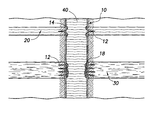
- FIGS. 1-8 illustrate a series of steps performed in one embodiment of the methods of the present invention.
- the present invention relates to methods that may be useful in treating subterranean formations, and more specifically, to improved methods of placing and/or diverting treatment fluids in subterranean formations.
- the methods of the present invention generally comprise: introducing a diverting material into a subterranean formation penetrated by a well bore to reduce or prevent the flow of fluid into a first portion of the subterranean formation; introducing a first fluid into a second portion of the subterranean formation having a higher fluid flow resistance than the first portion of the subterranean formation; allowing the diverting material to be removed from the subterranean formation after at least a portion of the first fluid has been introduced into the second portion of the subterranean formation; and introducing a second fluid into the first portion of the subterranean formation.
- splitting material means and refers generally to a material that functions to reduce or prevent, either temporarily or permanently, the flow of a fluid into a particular location, usually located in a subterranean formation, wherein the material serves to at least partially obstruct the location and thereby cause the fluid to “divert” to a different location.
- fluid flow resistance is used herein to refer to the diminishment of the rate at which fluid will flow into and/or through an area at a fixed rate of injection.
- fluid flow resistance may result from low connective porosity of a portion of a formation, and/or the reduced ability of a portion of a formation to accept or transmit fluids, for example, due to higher reservoir pressure.
- low reservoir pressure in certain areas of a subterranean formation or a rock matrix or proppant pack of high porosity may permit that portion of a formation to accept larger amounts of certain treatment fluids and thereby reduce its “fluid flow resistance.”
- Another factor that may affect the “fluid flow resistance” of a portion of a subterranean formation may be low permeability in certain areas of a subterranean formation or rock matrix may permit that a portion of a formation or rock matrix to accept a larger amount of certain treatment fluids and thereby also reduce its “fluid flow resistance.”
- the methods of the present invention are generally used to treat subterranean formations having portions of differing fluid flow resistances.
- these portions with variable fluid flow resistances may comprise water-producing intervals.
- a portion of a subterranean formation with low fluid flow resistance may comprise an elbow or turn in a well bore into which the treatment fluid may preferentially enter.
- the portion of a subterranean formation with low fluid flow resistance may be a junction of a multi-lateral well bore into which the treatment fluid may preferentially enter.
- the methods of the present invention may facilitate improved control over the placement of treatment fluids in a subterranean formation, increased fluid efficiency in various subterranean treatments, and/or more complete treatment of fluid flow-resistant portions of a subterranean formation.
- the subterranean formations treated in the methods of the present invention may be any subterranean formation having at least two portions of differing fluid flow resistances. At least a portion of the subterranean formation generally is penetrated by one or more well bores drilled in any direction through the formation.
- all or part of a well bore penetrating the subterranean formation may include casing pipes or strings placed in the well bore (a “cased hole” or a “partially cased hole”), among other purposes, to facilitate production of fluids out of the formation and through the well bore to the surface.
- the well bore may be an “open hole” that has no casing.
- the well bore is a cased or a partially cased hole
- These perforations may be made by any means or technique known in the art.
- the diverting material(s) used in the present invention may comprise any material or combination of materials that functions to reduce or prevent, either temporarily or permanently, the flow of a fluid into a particular location in a subterranean formation, wherein the material serves to at least partially obstruct the location and thereby cause the fluid to “divert” to a different location.
- Examples of materials that may be suitable for use as a diverting material in the present invention include, but are not limited to, fluids (e.g., aqueous-base and/or non-aqueous-base fluids), emulsions, gels (including but not limited to viscoelastic surfactant gels), surfactants (e.g., soaps or viscoelastic surfactants), foams, particulate materials (e.g., calcium carbonate, silica flour), certain polymers, relative permeability modifiers, degradable materials (e.g., polyesters, orthoesters, poly(orthoesters), polyanhydrides, polylactic acid, dehydrated organic or inorganic compounds, anhydrous borate, salts of organic acids, or any derivative thereof), resins (e.g., water soluble resins, oil soluble resins, etc.), balls, packers (e.g., pinpoint packers and selective injection packers), ball sealers, pack-off devices, sand plugs, bridge plugs,
- Degradable materials include those materials that are capable of undergoing an irreversible degradation downhole.
- irreversible means that the degradable diverting agent, once degraded, should not recrystallize or reconsolidate while downhole, e.g., the degradable diverting agent should degrade in situ but should not recrystallize or reconsolidate in situ.
- degradation or “degradable” refer to both the two relatively extreme cases of hydrolytic degradation that the degradable diverting agent may undergo, e.g., bulk erosion and surface erosion, and any stage of degradation in between these two. This degradation can be a result of, inter alia, a chemical or thermal reaction, or a reaction induced by radiation.
- the term “derivative” is defined herein to include any compound that is made from one of the listed compounds, for example, by replacing one atom in the listed compound with another atom or group of atoms, rearranging two or more atoms in the listed compound, ionizing the listed compounds, or creating a salt of the listed compound.
- Examples of commercially-available materials that may be suitable diverting materials in the methods of the present invention include those products available under the tradenames GUIDON SM AGS, BIOVERTTM, BARACARB®, OSR 100TM, and MATRISEAL®, all available from Halliburton Energy Services of Duncan, Okla.
- Other examples of diverting materials that may be suitable for use in the methods of the present invention also may include those described in U.S. Pat. Nos. 6,983,798 and 6,896,058 and U.S. patent application Ser. No. 12/501,881 (filed on Jul. 13, 2009), the entireties of which are herein incorporated by reference.
- a diverting material including the desired size and shape of any particulate diverting material, in the methods of the present invention may depend on, among other factors, the type of subterranean formation (e.g., rock characteristics), the presence or absence of a casing in the subterranean formation, the composition of the treatment fluid(s) to be used, the temperature of the subterranean formation, the size of the perforations, the desired timing and rate for its removal, and any subsequent treatments to be performed following the method of the present invention.
- a diverting material should be chosen that it is capable of forming a filter cake on the inside wall of the well bore.
- the particle size of a particulate diverting material may be selected such that the fluid permeability of those particulates in a pack is relatively low.
- the diverting material used in the present invention should be degradable, dissolvable, or otherwise removable by some means known in the art.
- this diverting material may be selected as a material that degrades or dissolves in the presence of the fluid used to treat the less fluid flow-resistant portion of the subterranean formation (or a component thereof) and/or an intermediate fluid introduced into the formation after the more fluid flow-resistant portion of the formation has been treated.
- the diverting material may be selected as a material that is simply removed over the passage of time.
- a second diverting material optionally may be introduced into the subterranean formation, among other purposes, to reduce or prevent the flow of fluid into the more fluid flow-resistant portion of the subterranean formation after at least a portion of the first fluid has been introduced into that portion of the subterranean formation.
- the optional second diverting material may be chosen such that it will not substantially degrade, dissolve, or otherwise be removed by the fluid used to treat the less fluid flow-resistant portion of the subterranean formation, or will not substantially degrade, dissolve, or otherwise be removed by that fluid within a particular period of time allotted for treatment.
- such a second diverting material may be otherwise removable (e.g., removable after a long period of time) even though it is not removable under the conditions set forth above.
- a second diverting material that degrades or dissolves in the presence of water, such as polylactic acid.
- the first and second fluids used in the methods of the present invention may comprise any formation fluid or treatment fluid used or found in subterranean formations or treatments.
- treatment fluid refers generally to any fluid that may be used in a subterranean application in conjunction with a desired function and/or for a desired purpose.
- treatment fluid does not imply any particular action by the fluid or any component thereof.
- These fluids may be used to perform one or more subterranean treatments or operations, which may include any subterranean treatment or operation known in the art.
- Examples of common subterranean treatments include, but are not limited to, drilling operations, pre-pad treatments, fracturing operations, perforation operations, preflush treatments, afterflush treatments, sand control treatments (e.g., gravel packing), acidizing treatments (e.g., matrix acidizing or fracture acidizing), “frac-pack” treatments, cementing treatments, water control treatments, and well bore clean-out treatments.
- the fluid may comprise any treatment fluid known in the art.
- treatment fluids that may be suitable include fracturing fluids, gravel packing fluids, pre-pad fluids, pad fluids, preflush fluids, afterflush fluids, acidic fluids, consolidation fluids, cementing fluids, well bore clean-out fluids, conformance fluids, aqueous fluids (e.g., fresh water, salt water, brines, etc.), non-aqueous fluids (e.g., mineral oils, synthetic oils, esters, etc.), hydrocarbon-based fluids (e.g., kerosene, xylene, toluene, diesel, oils, etc.), foamed fluids (e.g., a liquid that comprises a gas), gels, emulsions, gases, and the like.
- aqueous fluids e.g., fresh water, salt water, brines, etc.
- non-aqueous fluids e.g., mineral oils, synthetic oils, est
- the fluids used in the present invention optionally may comprise one or more of any additives known in the art, provided that such additives do not interfere with other components of the fluid or other elements present during its use.
- additional additives include, but are not limited to, salts, soaps, surfactants, co-surfactants, carboxylic acids, acids, fluid loss control additives, gas, foamers, corrosion inhibitors, scale inhibitors, crosslinking agents, catalysts, clay control agents, biocides, friction reducers, antifoam agents, bridging agents, dispersants, flocculants, H 2 S scavengers, oxygen scavengers, lubricants, viscosifiers, breakers, weighting agents, relative permeability modifiers, resins, particulate materials (e.g., proppant particulates), wetting agents, coating enhancement agents, and the like.
- a person skilled in the art, with the benefit of this disclosure, will recognize the types of additives that may be included in the fluids for a particular application.
- the second fluid may be used not only to treat a less fluid flow-resistant portion of the subterranean formation, but it also may be used to remove at least a portion of the diverting material used to divert fluid while the more fluid flow-resistant portion(s) is treated.
- the second fluid may be introduced initially at a lower flow rate or with a short initial stage followed by a significant reduction of flow rate, among other things, to permit the second fluid to soak into the diverting material to facilitate its removal.
- the well bore may be shut in for some period of time, among other purposes, to permit the diverting material to react with the second fluid and be removed. Once the diverting material has been at least partially removed, the flow rate of the second fluid may be increased to allow the fluid to penetrate into the less fluid flow-resistant portion of the formation.
- FIGS. 1-8 To illustrate one embodiment of the methods of the present invention, the following example of one embodiment of the invention is explained with reference to FIGS. 1-8 . In no way should the following example be read to limit, or define, the entire scope of the invention.
- FIG. 1 shows a side view of subterranean formation penetrated by a well bore with a casing string 10 placed in the well bore.
- the well bore penetrates two zones 20 and 30 in the subterranean formation, wherein the fluid flow resistance of zone 30 is higher than the fluid flow resistance of zone 20 .
- FIG. 2 shows perforations 12 created in the casing 10 .
- the portion of the casing adjacent to zone 30 has been perforated with a higher perforation density than zone 20 .
- a diverting material 14 is placed to obstruct zone 20 and divert fluid flowing into the well bore to other portions of the subterranean formation.
- FIG. 5 shows the zone 30 fully treated by the treatment fluid 16 , which may include treatments such as fracturing (i.e., introducing a fluid at a rate sufficient to create or enhance one or more fractures in the subterranean formation), acidizing, scale inhibitor treatment, and/or any other subterranean treatment known in the art.
- treatments such as fracturing (i.e., introducing a fluid at a rate sufficient to create or enhance one or more fractures in the subterranean formation), acidizing, scale inhibitor treatment, and/or any other subterranean treatment known in the art.
- FIG. 6 illustrates the next step in this embodiment where a treatment fluid 40 is introduced into the well bore and the injection rate is reduced to allow the fluid to sit in the well bore.
- this fluid may contact diverting material 18 without substantially dissolving, degrading, or otherwise removing diverting material 18 .
- treatment fluid 40 may be formulated to dissolve, degrade, or otherwise remove most or all of diverting material 14 , as shown in FIG. 7 .
- treatement fluid 40 is introduced into zone 20 (in certain embodiments, a fluid different from treatment fluid 40 may be introduced at this time instead). As shown, treatment fluid 40 is diverted away from zone 30 by diverting material 18 , and zone 20 is then treated (e.g., fractured, acidized, etc.) by treatment fluid 40 .
- the methods of the present invention optionally may comprise introducing one or more spacer fluids before or after any of the other steps of the methods of the present invention, among other purposes, to isolate different fluids used to treat the formation at different times.
- spacer fluids may comprise any fluid known in the art, such as aqueous fluids (e.g., fresh water, salt water, brines, etc.), non-aqueous fluids (e.g., mineral oils, synthetic oils, esters, etc.), hydrocarbon-based fluids (e.g., kerosene, xylene, toluene, diesel, oils, etc.), foamed fluids (e.g., a liquid that comprises a gas), gels, emulsions, gases, and the like.
- aqueous fluids e.g., fresh water, salt water, brines, etc.
- non-aqueous fluids e.g., mineral oils, synthetic oils, esters, etc.
- hydrocarbon-based fluids e.
- the methods of the present invention optionally may comprise monitoring the flow of one or more fluids (e.g., the first and/or second fluids) in at least a portion of the subterranean formation during all or part of a method of the present invention, for example, to ensure that the more fluid flow-resistant portions of the subterranean formation have been treated before a diverting material is removed, to determine the presence or absence of a first or second diverting material in the formation, and/or to determine whether a first and/or second diverting material actually diverts fluids introduced into the subterranean formation. This may be accomplished by any technique or combination of techniques known in the art.
- this may be accomplished by monitoring the fluid pressure at the surface of a well bore penetrating the subterranean formation where fluids are introduced. For example, if the fluid pressure at the surface increases, this may indicate that the fluid is being diverted to a more fluid flow-resistant portion of the subterranean formation.
- These techniques may include various logging techniques and/or computerized fluid tracking techniques known in the art that are capable of monitoring fluid flow. Examples of commercially available services involving surface fluid pressure sensing that may be suitable for use in the methods of the present invention include those available under the tradename EZ-GAUGETM from Halliburton Energy Services of Duncan, Okla.
- monitoring the flow of one or more fluids in at least a portion of the subterranean formation may be accomplished, in part, by using a distributed temperature sensing (DTS) technique.
- DTS distributed temperature sensing
- a temperature sensing device e.g., thermocouples, thermistors, or fiber optic cables
- a fiber optic cable may be pre-installed in a casing string before the casing string is placed in the well bore.
- an additional apparatus e.g., coiled tubing
- fluid to place the fiber optic cable in the well bore.
- one may establish baseline temperature profile for all or part of the subterranean formation, and then monitor changes in temperature to determine the flow of fluids in various portions of the subterranean formation.
- Various computer software packages may be used to process the temperature data and/or create visualizations based on that data.
- Certain DTS techniques that may be suitable for use in the methods of the present invention may include commercially-available DTS services such as those known under the tradenames STIMWATCH® (available from Halliburton Energy Services of Duncan, Okla.) or SENSATM (available from Schlumberger Technology Corporation, Sugar Land, Tex.).
- DTS techniques that may be suitable for use in the methods of the present invention also may include those described in U.S. Pat. Nos. 7,055,604; 6,751,556; 7,086,484; 6,557,630; and 5,028,146, the entireties of which are herein incorporated by reference.
- a person of skill in the art with the benefit of this disclosure will recognize whether it is desirable to monitor the flow of one or more fluids in at least a portion of the subterranean formation as well as techniques of doing so appropriate for a particular application of the present invention based on, inter alia, the characteristics (e.g., fluid flow resistances) of various portions of the subterranean formation, the types of fluids present, equipment availability, and other relevant factors.
- the methods of the present invention optionally may comprise monitoring the presence of a diverting material during all or part of a method of the present invention. This may be accomplished by any technique or combination of techniques known in the art. In certain embodiments, this may be accomplished by monitoring the temperature in a portion of the subterranean formation and/or well bore, for example, to determine whether a diverting material has been degraded or dissolved before the less fluid flow-resistant portion of the formation is treated. For example, the degradation and/or dissolution of certain diverting materials may comprise an exothermic reaction that gives off heat, and thus an increase in temperature may indicate that the diverting material is being or has been removed.
- the presence of a diverting material may be monitored by calculating the estimated time of its removal, for example, based on the reaction rate of a diverting material with a fluid that is introduced downhole to degrade or dissolve the material or to initiate its self-degradation.
- compositions and methods are described in terms of “comprising,” “containing,” or “including” various components or steps, the compositions and methods can also “consist essentially of” or “consist of” the various components and steps.
Landscapes
- Geology (AREA)
- Life Sciences & Earth Sciences (AREA)
- Engineering & Computer Science (AREA)
- Mining & Mineral Resources (AREA)
- Environmental & Geological Engineering (AREA)
- Fluid Mechanics (AREA)
- Physics & Mathematics (AREA)
- General Life Sciences & Earth Sciences (AREA)
- Geochemistry & Mineralogy (AREA)
- Physical Or Chemical Processes And Apparatus (AREA)
- Consolidation Of Soil By Introduction Of Solidifying Substances Into Soil (AREA)
- Footwear And Its Accessory, Manufacturing Method And Apparatuses (AREA)
- Processing Of Solid Wastes (AREA)
- Examining Or Testing Airtightness (AREA)
Priority Applications (8)
| Application Number | Priority Date | Filing Date | Title |
|---|---|---|---|
| US12/551,713 US8016034B2 (en) | 2009-09-01 | 2009-09-01 | Methods of fluid placement and diversion in subterranean formations |
| BR112012004707-8A BR112012004707B1 (pt) | 2009-09-01 | 2010-08-27 | método de colocação e desvio de fluido em formações subterrâneas |
| PCT/GB2010/001628 WO2011027100A2 (fr) | 2009-09-01 | 2010-08-27 | Procédés améliorés pour placer et détourner des fluides dans des formations souterraines |
| RU2012112472/03A RU2527988C2 (ru) | 2009-09-01 | 2010-08-27 | Улучшенные способы размещения и отклонения текучих сред в подземных пластах |
| MX2012002513A MX2012002513A (es) | 2009-09-01 | 2010-08-27 | Metodos mejorados de colocacion y desviacion de fluidos en formaciones subterraneas. |
| AU2010291050A AU2010291050B2 (en) | 2009-09-01 | 2010-08-27 | Improved methods of fluid placement and diversion in subterranean formations |
| ARP100103165A AR078110A1 (es) | 2009-09-01 | 2010-08-30 | Metodos mejorados de desviacion y colocacion de fluidos en formaciones subterraneas |
| NO20120247A NO338442B1 (no) | 2009-09-01 | 2012-03-05 | Forbedrede metoder for fluidplassering og avledning i underjordiske formasjoner Bakgrunn |
Applications Claiming Priority (1)
| Application Number | Priority Date | Filing Date | Title |
|---|---|---|---|
| US12/551,713 US8016034B2 (en) | 2009-09-01 | 2009-09-01 | Methods of fluid placement and diversion in subterranean formations |
Publications (2)
| Publication Number | Publication Date |
|---|---|
| US20110048708A1 US20110048708A1 (en) | 2011-03-03 |
| US8016034B2 true US8016034B2 (en) | 2011-09-13 |
Family
ID=43623121
Family Applications (1)
| Application Number | Title | Priority Date | Filing Date |
|---|---|---|---|
| US12/551,713 Active 2030-04-28 US8016034B2 (en) | 2009-09-01 | 2009-09-01 | Methods of fluid placement and diversion in subterranean formations |
Country Status (8)
| Country | Link |
|---|---|
| US (1) | US8016034B2 (fr) |
| AR (1) | AR078110A1 (fr) |
| AU (1) | AU2010291050B2 (fr) |
| BR (1) | BR112012004707B1 (fr) |
| MX (1) | MX2012002513A (fr) |
| NO (1) | NO338442B1 (fr) |
| RU (1) | RU2527988C2 (fr) |
| WO (1) | WO2011027100A2 (fr) |
Cited By (20)
| Publication number | Priority date | Publication date | Assignee | Title |
|---|---|---|---|---|
| US20110005761A1 (en) * | 2009-07-13 | 2011-01-13 | Hongyu Luo | Degradable Diverting Agents and Associated Methods |
| US8714249B1 (en) | 2012-10-26 | 2014-05-06 | Halliburton Energy Services, Inc. | Wellbore servicing materials and methods of making and using same |
| US8905133B2 (en) | 2011-05-11 | 2014-12-09 | Schlumberger Technology Corporation | Methods of zonal isolation and treatment diversion |
| US9410076B2 (en) | 2012-10-25 | 2016-08-09 | Halliburton Energy Services, Inc. | Wellbore servicing methods and compositions comprising degradable polymers |
| US9702238B2 (en) | 2012-10-25 | 2017-07-11 | Halliburton Energy Services, Inc. | Wellbore servicing methods and compositions comprising degradable polymers |
| US9938800B2 (en) | 2015-04-09 | 2018-04-10 | Halliburton Energy Services, Inc. | Methods and systems for determining acidizing fluid injection rates |
| US9951266B2 (en) | 2012-10-26 | 2018-04-24 | Halliburton Energy Services, Inc. | Expanded wellbore servicing materials and methods of making and using same |
| US10001613B2 (en) | 2014-07-22 | 2018-06-19 | Schlumberger Technology Corporation | Methods and cables for use in fracturing zones in a well |
| US10280352B2 (en) | 2014-12-23 | 2019-05-07 | Halliburton Energy Services, Inc. | Water swellable polymer as a diverter for acid stimulation treatments in high temperature environments |
| US10301903B2 (en) | 2016-05-16 | 2019-05-28 | Schlumberger Technology Corporation | Well treatment |
| US10738577B2 (en) | 2014-07-22 | 2020-08-11 | Schlumberger Technology Corporation | Methods and cables for use in fracturing zones in a well |
| US10774638B2 (en) | 2015-05-29 | 2020-09-15 | Halliburton Energy Services, Inc. | Methods and systems for characterizing and/or monitoring wormhole regimes in matrix acidizing |
| US10787901B2 (en) | 2016-09-16 | 2020-09-29 | Halliburton Energy Services, Inc. | Dynamically optimizing a pumping schedule for stimulating a well |
| US10808497B2 (en) | 2011-05-11 | 2020-10-20 | Schlumberger Technology Corporation | Methods of zonal isolation and treatment diversion |
| US11168542B2 (en) | 2015-11-16 | 2021-11-09 | Halliburton Energy Services, Inc. | Scheduling treatment fluid placement and fluid diversion in a subterranean formation |
| US11584878B1 (en) | 2021-12-16 | 2023-02-21 | Halliburton Energy Services, Inc. | Acid precursors for enhanced inhibitor placement in scale squeeze treatments |
| US11732179B2 (en) | 2018-04-03 | 2023-08-22 | Schlumberger Technology Corporation | Proppant-fiber schedule for far field diversion |
| WO2024083796A1 (fr) | 2022-10-18 | 2024-04-25 | Poweltec | Procédé de traitement de formations souterraines |
| US12270288B2 (en) | 2021-03-25 | 2025-04-08 | Schlumberger Technology Corporation | Method for single-stage acid treatment of siliceous subterranean formations |
| US12577450B2 (en) | 2021-03-25 | 2026-03-17 | Schlumberger Technology Corporation | Compositions for single-stage treatment of siliceous subterranean formations |
Families Citing this family (51)
| Publication number | Priority date | Publication date | Assignee | Title |
|---|---|---|---|---|
| US8016034B2 (en) | 2009-09-01 | 2011-09-13 | Halliburton Energy Services, Inc. | Methods of fluid placement and diversion in subterranean formations |
| US9206386B2 (en) | 2011-08-05 | 2015-12-08 | Halliburton Energy Services, Inc. | Systems and methods for analyzing microbiological substances |
| US8997860B2 (en) | 2011-08-05 | 2015-04-07 | Halliburton Energy Services, Inc. | Methods for monitoring the formation and transport of a fracturing fluid using opticoanalytical devices |
| US20130032545A1 (en) | 2011-08-05 | 2013-02-07 | Freese Robert P | Methods for monitoring and modifying a fluid stream using opticoanalytical devices |
| US9441149B2 (en) | 2011-08-05 | 2016-09-13 | Halliburton Energy Services, Inc. | Methods for monitoring the formation and transport of a treatment fluid using opticoanalytical devices |
| US8960294B2 (en) | 2011-08-05 | 2015-02-24 | Halliburton Energy Services, Inc. | Methods for monitoring fluids within or produced from a subterranean formation during fracturing operations using opticoanalytical devices |
| US9395306B2 (en) | 2011-08-05 | 2016-07-19 | Halliburton Energy Services, Inc. | Methods for monitoring fluids within or produced from a subterranean formation during acidizing operations using opticoanalytical devices |
| US9182355B2 (en) | 2011-08-05 | 2015-11-10 | Halliburton Energy Services, Inc. | Systems and methods for monitoring a flow path |
| US20130031972A1 (en) | 2011-08-05 | 2013-02-07 | Halliburton Energy Services, Inc. | Methods for monitoring a water source using opticoanalytical devices |
| US9222348B2 (en) | 2011-08-05 | 2015-12-29 | Halliburton Energy Services, Inc. | Methods for monitoring the formation and transport of an acidizing fluid using opticoanalytical devices |
| US20130032333A1 (en) | 2011-08-05 | 2013-02-07 | Halliburton Energy Services, Inc. | Methods for monitoring bacteria using opticoanalytical devices |
| US8908165B2 (en) | 2011-08-05 | 2014-12-09 | Halliburton Energy Services, Inc. | Systems and methods for monitoring oil/gas separation processes |
| US9297254B2 (en) | 2011-08-05 | 2016-03-29 | Halliburton Energy Services, Inc. | Methods for monitoring fluids within or produced from a subterranean formation using opticoanalytical devices |
| US9222892B2 (en) | 2011-08-05 | 2015-12-29 | Halliburton Energy Services, Inc. | Systems and methods for monitoring the quality of a fluid |
| US9261461B2 (en) | 2011-08-05 | 2016-02-16 | Halliburton Energy Services, Inc. | Systems and methods for monitoring oil/gas separation processes |
| US9702811B2 (en) | 2012-04-26 | 2017-07-11 | Halliburton Energy Services, Inc. | Methods and devices for optically determining a characteristic of a substance using integrated computational elements |
| US9383307B2 (en) | 2012-04-26 | 2016-07-05 | Halliburton Energy Services, Inc. | Methods and devices for optically determining a characteristic of a substance |
| US9019501B2 (en) | 2012-04-26 | 2015-04-28 | Halliburton Energy Services, Inc. | Methods and devices for optically determining a characteristic of a substance |
| US9080943B2 (en) | 2012-04-26 | 2015-07-14 | Halliburton Energy Services, Inc. | Methods and devices for optically determining a characteristic of a substance |
| US9013702B2 (en) | 2012-04-26 | 2015-04-21 | Halliburton Energy Services, Inc. | Imaging systems for optical computing devices |
| US8912477B2 (en) | 2012-04-26 | 2014-12-16 | Halliburton Energy Services, Inc. | Methods and devices for optically determining a characteristic of a substance |
| US9658149B2 (en) | 2012-04-26 | 2017-05-23 | Halliburton Energy Services, Inc. | Devices having one or more integrated computational elements and methods for determining a characteristic of a sample by computationally combining signals produced therewith |
| US8879053B2 (en) | 2012-04-26 | 2014-11-04 | Halliburton Energy Services, Inc. | Devices having an integrated computational element and a proximal interferent monitor and methods for determining a characteristic of a sample therewith |
| US8780352B2 (en) | 2012-04-26 | 2014-07-15 | Halliburton Energy Services, Inc. | Methods and devices for optically determining a characteristic of a substance |
| US9013698B2 (en) | 2012-04-26 | 2015-04-21 | Halliburton Energy Services, Inc. | Imaging systems for optical computing devices |
| US8941046B2 (en) | 2012-04-26 | 2015-01-27 | Halliburton Energy Services, Inc. | Methods and devices for optically determining a characteristic of a substance |
| US8823939B2 (en) | 2012-04-26 | 2014-09-02 | Halliburton Energy Services, Inc. | Methods and devices for optically determining a characteristic of a substance |
| US9103716B2 (en) | 2012-08-31 | 2015-08-11 | Halliburton Energy Services, Inc. | Handheld characteristic analyzer and methods of using the same |
| US9170208B2 (en) | 2012-08-31 | 2015-10-27 | Halliburton Energy Services, Inc. | Handheld characteristic analyzer and methods of using the same |
| US9222896B2 (en) | 2012-09-14 | 2015-12-29 | Halliburton Energy Services, Inc. | Systems and methods for inspecting and monitoring a pipeline |
| US8765061B2 (en) | 2012-09-14 | 2014-07-01 | Halliburton Energy Services, Inc. | Systems and methods for inspecting and monitoring a pipeline |
| US9176052B2 (en) | 2012-09-14 | 2015-11-03 | Halliburton Energy Services, Inc. | Systems and methods for inspecting and monitoring a pipeline |
| US9086383B2 (en) | 2012-09-14 | 2015-07-21 | Halliburton Energy Services, Inc. | Systems and methods for monitoring chemical processes |
| CA2909745A1 (fr) * | 2013-04-19 | 2014-10-23 | Lubrizol Oilfield Solutions, Inc. | Systemes de deviation hydraulique pour ameliorer des traitements de matrice, et procedes d'utilisation de ceux-ci |
| EP2994740A4 (fr) | 2013-07-09 | 2016-12-28 | Halliburton Energy Services Inc | Éléments de calcul intégrés ayant des filtres spectraux répartis latéralement |
| EP2989442A4 (fr) | 2013-07-09 | 2016-12-28 | Halliburton Energy Services Inc | Éléments de calcul intégrés ayant une surface sélective en fréquence |
| US9376888B2 (en) * | 2013-08-08 | 2016-06-28 | Halliburton Energy Services, Inc. | Diverting resin for stabilizing particulate in a well |
| US20160290115A1 (en) * | 2014-01-09 | 2016-10-06 | Halliburton Energy Services, Inc. | Re-fracturing a fracture stimulated subterranean formation |
| EP3129592A4 (fr) | 2014-06-13 | 2017-11-29 | Halliburton Energy Services, Inc. | Élément de calcul intégré à surfaces multiples sélectives en fréquence |
| US20160108713A1 (en) * | 2014-10-20 | 2016-04-21 | Schlumberger Technology Corporation | System and method of treating a subterranean formation |
| US11466535B2 (en) | 2014-12-18 | 2022-10-11 | Halliburton Energy Services, Inc. | Casing segment methods and systems with time control of degradable plugs |
| US9828843B2 (en) | 2015-04-09 | 2017-11-28 | Highlands Natural Resources, Plc | Gas diverter for well and reservoir stimulation |
| US10344204B2 (en) | 2015-04-09 | 2019-07-09 | Diversion Technologies, LLC | Gas diverter for well and reservoir stimulation |
| US10012064B2 (en) * | 2015-04-09 | 2018-07-03 | Highlands Natural Resources, Plc | Gas diverter for well and reservoir stimulation |
| US9759053B2 (en) | 2015-04-09 | 2017-09-12 | Highlands Natural Resources, Plc | Gas diverter for well and reservoir stimulation |
| US11421149B2 (en) * | 2015-11-16 | 2022-08-23 | Halliburton Energy Services, Inc. | Alkyl polyglycoside surfactants for use in subterranean formations |
| CN105443071A (zh) * | 2015-12-07 | 2016-03-30 | 中国石油天然气股份有限公司 | 封堵顶水下窜工艺方法 |
| MX2018007531A (es) * | 2016-03-18 | 2018-09-07 | Halliburton Energy Services Inc | Divergentes autodegradables para acidificacion de fractura apuntalada. |
| US10982520B2 (en) | 2016-04-27 | 2021-04-20 | Highland Natural Resources, PLC | Gas diverter for well and reservoir stimulation |
| WO2018013096A1 (fr) * | 2016-07-13 | 2018-01-18 | Halliburton Energy Services, Inc. | Procédés de réduction de la communication fluidique entre puits |
| WO2018231236A1 (fr) * | 2017-06-15 | 2018-12-20 | Halliburton Energy Services, Inc. | Matériaux de dérivation plastifiés à base d'alcool polyvinylique |
Citations (20)
| Publication number | Priority date | Publication date | Assignee | Title |
|---|---|---|---|---|
| US3724549A (en) * | 1971-02-01 | 1973-04-03 | Halliburton Co | Oil soluble diverting material and method of use for well treatment |
| US3998272A (en) * | 1975-04-21 | 1976-12-21 | Union Oil Company Of California | Method of acidizing wells |
| US4157116A (en) | 1978-06-05 | 1979-06-05 | Halliburton Company | Process for reducing fluid flow to and from a zone adjacent a hydrocarbon producing formation |
| US4261421A (en) | 1980-03-24 | 1981-04-14 | Union Oil Company Of California | Method for selectively acidizing the less permeable zones of a high temperature subterranean formation |
| US4527628A (en) * | 1983-08-15 | 1985-07-09 | Halliburton Company | Method of temporarily plugging portions of a subterranean formation using a diverting agent |
| US5028146A (en) | 1990-05-21 | 1991-07-02 | Kabushiki Kaisha Toshiba | Apparatus and method for measuring temperatures by using optical fiber |
| US6367548B1 (en) | 1999-03-05 | 2002-04-09 | Bj Services Company | Diversion treatment method |
| US6557630B2 (en) | 2001-08-29 | 2003-05-06 | Sensor Highway Limited | Method and apparatus for determining the temperature of subterranean wells using fiber optic cable |
| US6751556B2 (en) | 2002-06-21 | 2004-06-15 | Sensor Highway Limited | Technique and system for measuring a characteristic in a subterranean well |
| US6896058B2 (en) | 2002-10-22 | 2005-05-24 | Halliburton Energy Services, Inc. | Methods of introducing treating fluids into subterranean producing zones |
| US6983798B2 (en) | 2003-03-05 | 2006-01-10 | Halliburton Energy Services, Inc. | Methods and fluid compositions for depositing and removing filter cake in a well bore |
| US7036587B2 (en) | 2003-06-27 | 2006-05-02 | Halliburton Energy Services, Inc. | Methods of diverting treating fluids in subterranean zones and degradable diverting materials |
| US7055604B2 (en) | 2002-08-15 | 2006-06-06 | Schlumberger Technology Corp. | Use of distributed temperature sensors during wellbore treatments |
| US7086484B2 (en) | 2003-06-09 | 2006-08-08 | Halliburton Energy Services, Inc. | Determination of thermal properties of a formation |
| US20060175059A1 (en) * | 2005-01-21 | 2006-08-10 | Sinclair A R | Soluble deverting agents |
| US20060276345A1 (en) | 2005-06-07 | 2006-12-07 | Halliburton Energy Servicers, Inc. | Methods controlling the degradation rate of hydrolytically degradable materials |
| US20070169935A1 (en) | 2005-12-19 | 2007-07-26 | Fairmount Minerals, Ltd. | Degradable ball sealers and methods for use in well treatment |
| US20100212906A1 (en) * | 2009-02-20 | 2010-08-26 | Halliburton Energy Services, Inc. | Method for diversion of hydraulic fracture treatments |
| US20110005761A1 (en) | 2009-07-13 | 2011-01-13 | Hongyu Luo | Degradable Diverting Agents and Associated Methods |
| WO2011027100A2 (fr) | 2009-09-01 | 2011-03-10 | Halliburton Energy Services, Inc. | Procédés améliorés pour placer et détourner des fluides dans des formations souterraines |
Family Cites Families (5)
| Publication number | Priority date | Publication date | Assignee | Title |
|---|---|---|---|---|
| SU595488A1 (ru) * | 1974-10-18 | 1978-02-28 | Татарский Государственный Научно-Исследовательский И Проектный Институт Нефтяной Промышленности | Способ изол ции закачиваемых вод в скважине |
| RU1480411C (ru) * | 1987-04-20 | 1994-10-30 | ТатНИПИнефть | Способ разработки нефтяного пласта |
| RU2026968C1 (ru) * | 1991-11-25 | 1995-01-20 | Приклонский Анатолий Юрьевич | Способ воздействия на залежь с разнопроницаемыми пластами |
| RU2057916C1 (ru) * | 1993-10-08 | 1996-04-10 | Валентин Иванович Кудинов | Способ разработки нефтяной залежи |
| RU2255215C1 (ru) * | 2004-02-09 | 2005-06-27 | Румянцева Елена Александровна | Способ обработки призабойной зоны пласта |
-
2009
- 2009-09-01 US US12/551,713 patent/US8016034B2/en active Active
-
2010
- 2010-08-27 BR BR112012004707-8A patent/BR112012004707B1/pt not_active IP Right Cessation
- 2010-08-27 RU RU2012112472/03A patent/RU2527988C2/ru not_active IP Right Cessation
- 2010-08-27 AU AU2010291050A patent/AU2010291050B2/en not_active Ceased
- 2010-08-27 MX MX2012002513A patent/MX2012002513A/es active IP Right Grant
- 2010-08-27 WO PCT/GB2010/001628 patent/WO2011027100A2/fr not_active Ceased
- 2010-08-30 AR ARP100103165A patent/AR078110A1/es active IP Right Grant
-
2012
- 2012-03-05 NO NO20120247A patent/NO338442B1/no unknown
Patent Citations (20)
| Publication number | Priority date | Publication date | Assignee | Title |
|---|---|---|---|---|
| US3724549A (en) * | 1971-02-01 | 1973-04-03 | Halliburton Co | Oil soluble diverting material and method of use for well treatment |
| US3998272A (en) * | 1975-04-21 | 1976-12-21 | Union Oil Company Of California | Method of acidizing wells |
| US4157116A (en) | 1978-06-05 | 1979-06-05 | Halliburton Company | Process for reducing fluid flow to and from a zone adjacent a hydrocarbon producing formation |
| US4261421A (en) | 1980-03-24 | 1981-04-14 | Union Oil Company Of California | Method for selectively acidizing the less permeable zones of a high temperature subterranean formation |
| US4527628A (en) * | 1983-08-15 | 1985-07-09 | Halliburton Company | Method of temporarily plugging portions of a subterranean formation using a diverting agent |
| US5028146A (en) | 1990-05-21 | 1991-07-02 | Kabushiki Kaisha Toshiba | Apparatus and method for measuring temperatures by using optical fiber |
| US6367548B1 (en) | 1999-03-05 | 2002-04-09 | Bj Services Company | Diversion treatment method |
| US6557630B2 (en) | 2001-08-29 | 2003-05-06 | Sensor Highway Limited | Method and apparatus for determining the temperature of subterranean wells using fiber optic cable |
| US6751556B2 (en) | 2002-06-21 | 2004-06-15 | Sensor Highway Limited | Technique and system for measuring a characteristic in a subterranean well |
| US7055604B2 (en) | 2002-08-15 | 2006-06-06 | Schlumberger Technology Corp. | Use of distributed temperature sensors during wellbore treatments |
| US6896058B2 (en) | 2002-10-22 | 2005-05-24 | Halliburton Energy Services, Inc. | Methods of introducing treating fluids into subterranean producing zones |
| US6983798B2 (en) | 2003-03-05 | 2006-01-10 | Halliburton Energy Services, Inc. | Methods and fluid compositions for depositing and removing filter cake in a well bore |
| US7086484B2 (en) | 2003-06-09 | 2006-08-08 | Halliburton Energy Services, Inc. | Determination of thermal properties of a formation |
| US7036587B2 (en) | 2003-06-27 | 2006-05-02 | Halliburton Energy Services, Inc. | Methods of diverting treating fluids in subterranean zones and degradable diverting materials |
| US20060175059A1 (en) * | 2005-01-21 | 2006-08-10 | Sinclair A R | Soluble deverting agents |
| US20060276345A1 (en) | 2005-06-07 | 2006-12-07 | Halliburton Energy Servicers, Inc. | Methods controlling the degradation rate of hydrolytically degradable materials |
| US20070169935A1 (en) | 2005-12-19 | 2007-07-26 | Fairmount Minerals, Ltd. | Degradable ball sealers and methods for use in well treatment |
| US20100212906A1 (en) * | 2009-02-20 | 2010-08-26 | Halliburton Energy Services, Inc. | Method for diversion of hydraulic fracture treatments |
| US20110005761A1 (en) | 2009-07-13 | 2011-01-13 | Hongyu Luo | Degradable Diverting Agents and Associated Methods |
| WO2011027100A2 (fr) | 2009-09-01 | 2011-03-10 | Halliburton Energy Services, Inc. | Procédés améliorés pour placer et détourner des fluides dans des formations souterraines |
Non-Patent Citations (16)
| Title |
|---|
| Crowe, C.W.; Evaluation of Oil Soluble Resin Mixtures as Diverting Agents for Matrix Acidizing; 46th Annual Fall Meeting of the Society of Petroleum Engineers of AIME; New Orleans, LA Oct. 3-6, 1971, SPE 3505. |
| Glasbergen et al.; Design and Field Testing of a Truly Novel Diverting Agent; 2006 SPE Annual Technical Conference and Exhibition; San Antonio, Texas; Sep. 24-27, 2006; SP 102606. |
| Glasbergen et al.; Real-Time Diversion Quantification and Optimization Using DTS; Society of Petroleum Engineers; 2007 SPE Annual Technical Conference and Exhibition; Anaheim, CA Nov. 11-14, 2007; SPE 110707. |
| Gualtieri, Dan; The Application and Benefits of the StimWatch® Stimulation Monitoring Service; Drilling and Well Technology; Exploration & Production-Oil & Gas Review 2007. |
| Gualtieri, Dan; The Application and Benefits of the StimWatch® Stimulation Monitoring Service; Drilling and Well Technology; Exploration & Production—Oil & Gas Review 2007. |
| Halliburton brochure entitled Conformance; OSR-100(TM) Fluid-Loss Additive; Dec. 2007. |
| Halliburton brochure entitled Conformance; OSR-100™ Fluid-Loss Additive; Dec. 2007. |
| Halliburton brochure entitled Stimulation; Guidon AGSsm Service, Revolutionary Diverter Technology Helps Achieve Optimum Results from Acidizing Treatments; Sep. 2005. |
| Halliburton brochure, Stimulation, US Land: Acid Stimulation Optimization; StimWatch® Stimulation Monitoring Service Powered by OptoLog® DTS Technology; 2008. |
| Halliburton brochure; Baroid Fluid Services; BARABARB® Bridging Agent, Product Data Sheet; 2006. |
| Halliburton brochure; Conformance, Matriseal® O Diverting Agent; Dec. 2007. |
| Halliburton brochure; Stimulation, BioVert(TM) H150 Diverter and Fluid Loss Control Material; Jul. 2008. |
| Halliburton brochure; Stimulation, BioVert™ H150 Diverter and Fluid Loss Control Material; Jul. 2008. |
| International Search Report and Written Opinion for PCT/GB2010/001628 dated May 11, 2011. |
| Real-Time Fluid Tracking Optimizes Treatment Design, Improves Strategy; JPT, Oct. 2006. |
| U.S. Appl. No. 12/501,881, filed Jul. 13, 2009. |
Cited By (25)
| Publication number | Priority date | Publication date | Assignee | Title |
|---|---|---|---|---|
| US20110005761A1 (en) * | 2009-07-13 | 2011-01-13 | Hongyu Luo | Degradable Diverting Agents and Associated Methods |
| US8109335B2 (en) | 2009-07-13 | 2012-02-07 | Halliburton Energy Services, Inc. | Degradable diverting agents and associated methods |
| US9322260B2 (en) | 2011-05-11 | 2016-04-26 | Schlumberger Techonology Corporation | Methods of zonal isolation and treatment diversion |
| US10808497B2 (en) | 2011-05-11 | 2020-10-20 | Schlumberger Technology Corporation | Methods of zonal isolation and treatment diversion |
| US8905133B2 (en) | 2011-05-11 | 2014-12-09 | Schlumberger Technology Corporation | Methods of zonal isolation and treatment diversion |
| US10023792B2 (en) | 2012-10-25 | 2018-07-17 | Halliburton Energy Services, Inc. | Wellbore servicing methods and compositions comprising degradable polymers |
| US9410076B2 (en) | 2012-10-25 | 2016-08-09 | Halliburton Energy Services, Inc. | Wellbore servicing methods and compositions comprising degradable polymers |
| US9702238B2 (en) | 2012-10-25 | 2017-07-11 | Halliburton Energy Services, Inc. | Wellbore servicing methods and compositions comprising degradable polymers |
| US8714249B1 (en) | 2012-10-26 | 2014-05-06 | Halliburton Energy Services, Inc. | Wellbore servicing materials and methods of making and using same |
| US9951266B2 (en) | 2012-10-26 | 2018-04-24 | Halliburton Energy Services, Inc. | Expanded wellbore servicing materials and methods of making and using same |
| US10001613B2 (en) | 2014-07-22 | 2018-06-19 | Schlumberger Technology Corporation | Methods and cables for use in fracturing zones in a well |
| US10738577B2 (en) | 2014-07-22 | 2020-08-11 | Schlumberger Technology Corporation | Methods and cables for use in fracturing zones in a well |
| US10280352B2 (en) | 2014-12-23 | 2019-05-07 | Halliburton Energy Services, Inc. | Water swellable polymer as a diverter for acid stimulation treatments in high temperature environments |
| US9938800B2 (en) | 2015-04-09 | 2018-04-10 | Halliburton Energy Services, Inc. | Methods and systems for determining acidizing fluid injection rates |
| US10774638B2 (en) | 2015-05-29 | 2020-09-15 | Halliburton Energy Services, Inc. | Methods and systems for characterizing and/or monitoring wormhole regimes in matrix acidizing |
| US11613992B2 (en) | 2015-05-29 | 2023-03-28 | Halliburton Energy Services, Inc. | Methods and systems for characterizing and/or monitoring wormhole regimes in matrix acidizing |
| US11168542B2 (en) | 2015-11-16 | 2021-11-09 | Halliburton Energy Services, Inc. | Scheduling treatment fluid placement and fluid diversion in a subterranean formation |
| US10301903B2 (en) | 2016-05-16 | 2019-05-28 | Schlumberger Technology Corporation | Well treatment |
| US10787901B2 (en) | 2016-09-16 | 2020-09-29 | Halliburton Energy Services, Inc. | Dynamically optimizing a pumping schedule for stimulating a well |
| US11732179B2 (en) | 2018-04-03 | 2023-08-22 | Schlumberger Technology Corporation | Proppant-fiber schedule for far field diversion |
| US12269988B2 (en) | 2018-04-03 | 2025-04-08 | Schlumberger Technology Corporation | Proppant-fiber schedule for far field diversion |
| US12270288B2 (en) | 2021-03-25 | 2025-04-08 | Schlumberger Technology Corporation | Method for single-stage acid treatment of siliceous subterranean formations |
| US12577450B2 (en) | 2021-03-25 | 2026-03-17 | Schlumberger Technology Corporation | Compositions for single-stage treatment of siliceous subterranean formations |
| US11584878B1 (en) | 2021-12-16 | 2023-02-21 | Halliburton Energy Services, Inc. | Acid precursors for enhanced inhibitor placement in scale squeeze treatments |
| WO2024083796A1 (fr) | 2022-10-18 | 2024-04-25 | Poweltec | Procédé de traitement de formations souterraines |
Also Published As
| Publication number | Publication date |
|---|---|
| US20110048708A1 (en) | 2011-03-03 |
| AU2010291050B2 (en) | 2014-11-06 |
| WO2011027100A2 (fr) | 2011-03-10 |
| AR078110A1 (es) | 2011-10-12 |
| MX2012002513A (es) | 2012-04-11 |
| BR112012004707B1 (pt) | 2019-12-31 |
| BR112012004707A2 (pt) | 2016-04-12 |
| NO338442B1 (no) | 2016-08-15 |
| NO20120247A1 (no) | 2012-06-01 |
| WO2011027100A3 (fr) | 2011-06-30 |
| RU2527988C2 (ru) | 2014-09-10 |
| AU2010291050A1 (en) | 2012-03-15 |
| RU2012112472A (ru) | 2013-10-10 |
Similar Documents
| Publication | Publication Date | Title |
|---|---|---|
| US8016034B2 (en) | Methods of fluid placement and diversion in subterranean formations | |
| US8726991B2 (en) | Circulated degradable material assisted diversion | |
| NO20171076A1 (en) | Compositions and methods of improving hydraulic fracture network | |
| US11802231B2 (en) | Pelletized diverting agents using degradable polymers | |
| US20100093891A1 (en) | Self-Viscosifying and Self-Breaking Gels | |
| WO2017100222A1 (fr) | Procédé et composition pour le contrôle d'une géométrie de fracture | |
| Bist et al. | Diverting agents in the oil and gas industry: A comprehensive analysis of their origins, types, and applications | |
| US11578252B2 (en) | Composite diverting particulates | |
| Madyanova et al. | Effective matrix stimulation of high-temperature carbonate formations in south Sumatra through the combination of emulsified and viscoelastic self-diverting acids | |
| Taylor et al. | Acidizing—Lessons from the Past and New Opportunities | |
| US11667828B2 (en) | Multi-grade diverting particulates | |
| US11254860B2 (en) | Diversion using solid particulates | |
| AU2018441598A1 (en) | Multi-functional diverter particulates | |
| Otaibi et al. | Unlocking the Well Potential with a Novel Solids-Free Acid Diverter System in Middle Eastern Stimulation Operations | |
| Weiton et al. | Glasbergen et a | |
| Masoodi et al. | Optimized Stimulation Efficiency with Degradable Particulates in High-Anisotropy Carbonate Reservoirs: Comparative Study of Horizontal and Vertical Wells in Iraq | |
| Pandey | Well Stimulation Techniques | |
| Uchendu et al. | Effective Approach to Horizontal Wellbore Clean-out of Calcium Carbonate Mud Cake in Sandstone Reservoirs |
Legal Events
| Date | Code | Title | Description |
|---|---|---|---|
| AS | Assignment |
Owner name: HALLIBURTON ENERGY SERVICES, INC., TEXAS Free format text: ASSIGNMENT OF ASSIGNORS INTEREST;ASSIGNORS:GLASBERGEN, GERARD;WELTON, THOMAS D.;GUALTIERI, DANIAL;SIGNING DATES FROM 20090814 TO 20090831;REEL/FRAME:023175/0763 |
|
| STCF | Information on status: patent grant |
Free format text: PATENTED CASE |
|
| FPAY | Fee payment |
Year of fee payment: 4 |
|
| MAFP | Maintenance fee payment |
Free format text: PAYMENT OF MAINTENANCE FEE, 8TH YEAR, LARGE ENTITY (ORIGINAL EVENT CODE: M1552); ENTITY STATUS OF PATENT OWNER: LARGE ENTITY Year of fee payment: 8 |
|
| MAFP | Maintenance fee payment |
Free format text: PAYMENT OF MAINTENANCE FEE, 12TH YEAR, LARGE ENTITY (ORIGINAL EVENT CODE: M1553); ENTITY STATUS OF PATENT OWNER: LARGE ENTITY Year of fee payment: 12 |