US8040823B2 - Method and system for network data transmitting - Google Patents
Method and system for network data transmitting Download PDFInfo
- Publication number
- US8040823B2 US8040823B2 US11/955,582 US95558207A US8040823B2 US 8040823 B2 US8040823 B2 US 8040823B2 US 95558207 A US95558207 A US 95558207A US 8040823 B2 US8040823 B2 US 8040823B2
- Authority
- US
- United States
- Prior art keywords
- node
- nodes
- child
- level
- receiving
- Prior art date
- Legal status (The legal status is an assumption and is not a legal conclusion. Google has not performed a legal analysis and makes no representation as to the accuracy of the status listed.)
- Active, expires
Links
- 238000000034 method Methods 0.000 title claims abstract description 91
- 238000004891 communication Methods 0.000 claims abstract description 83
- 230000005540 biological transmission Effects 0.000 claims abstract description 23
- 230000026676 system process Effects 0.000 claims 3
- 230000001131 transforming effect Effects 0.000 claims 1
- 238000004422 calculation algorithm Methods 0.000 description 7
- 238000010586 diagram Methods 0.000 description 7
- 238000004364 calculation method Methods 0.000 description 2
- 238000004590 computer program Methods 0.000 description 2
- 239000000284 extract Substances 0.000 description 1
- 238000012986 modification Methods 0.000 description 1
- 230000004048 modification Effects 0.000 description 1
- 230000003068 static effect Effects 0.000 description 1
- 238000011144 upstream manufacturing Methods 0.000 description 1
Images



Classifications
-
- H—ELECTRICITY
- H04—ELECTRIC COMMUNICATION TECHNIQUE
- H04L—TRANSMISSION OF DIGITAL INFORMATION, e.g. TELEGRAPHIC COMMUNICATION
- H04L12/00—Data switching networks
- H04L12/28—Data switching networks characterised by path configuration, e.g. LAN [Local Area Networks] or WAN [Wide Area Networks]
-
- H—ELECTRICITY
- H04—ELECTRIC COMMUNICATION TECHNIQUE
- H04L—TRANSMISSION OF DIGITAL INFORMATION, e.g. TELEGRAPHIC COMMUNICATION
- H04L45/00—Routing or path finding of packets in data switching networks
- H04L45/02—Topology update or discovery
-
- H—ELECTRICITY
- H04—ELECTRIC COMMUNICATION TECHNIQUE
- H04B—TRANSMISSION
- H04B7/00—Radio transmission systems, i.e. using radiation field
- H04B7/24—Radio transmission systems, i.e. using radiation field for communication between two or more posts
-
- H—ELECTRICITY
- H04—ELECTRIC COMMUNICATION TECHNIQUE
- H04L—TRANSMISSION OF DIGITAL INFORMATION, e.g. TELEGRAPHIC COMMUNICATION
- H04L45/00—Routing or path finding of packets in data switching networks
- H04L45/46—Cluster building
-
- H—ELECTRICITY
- H04—ELECTRIC COMMUNICATION TECHNIQUE
- H04L—TRANSMISSION OF DIGITAL INFORMATION, e.g. TELEGRAPHIC COMMUNICATION
- H04L45/00—Routing or path finding of packets in data switching networks
- H04L45/48—Routing tree calculation
-
- H—ELECTRICITY
- H04—ELECTRIC COMMUNICATION TECHNIQUE
- H04L—TRANSMISSION OF DIGITAL INFORMATION, e.g. TELEGRAPHIC COMMUNICATION
- H04L45/00—Routing or path finding of packets in data switching networks
- H04L45/48—Routing tree calculation
- H04L45/484—Routing tree calculation using multiple routing trees
-
- H—ELECTRICITY
- H04—ELECTRIC COMMUNICATION TECHNIQUE
- H04L—TRANSMISSION OF DIGITAL INFORMATION, e.g. TELEGRAPHIC COMMUNICATION
- H04L45/00—Routing or path finding of packets in data switching networks
- H04L45/48—Routing tree calculation
- H04L45/488—Routing tree calculation using root node determination
-
- H—ELECTRICITY
- H04—ELECTRIC COMMUNICATION TECHNIQUE
- H04L—TRANSMISSION OF DIGITAL INFORMATION, e.g. TELEGRAPHIC COMMUNICATION
- H04L45/00—Routing or path finding of packets in data switching networks
- H04L45/74—Address processing for routing
- H04L45/742—Route cache; Operation thereof
-
- H—ELECTRICITY
- H04—ELECTRIC COMMUNICATION TECHNIQUE
- H04L—TRANSMISSION OF DIGITAL INFORMATION, e.g. TELEGRAPHIC COMMUNICATION
- H04L61/00—Network arrangements, protocols or services for addressing or naming
- H04L61/50—Address allocation
- H04L61/5038—Address allocation for local use, e.g. in LAN or USB networks, or in a controller area network [CAN]
-
- H—ELECTRICITY
- H04—ELECTRIC COMMUNICATION TECHNIQUE
- H04W—WIRELESS COMMUNICATION NETWORKS
- H04W40/00—Communication routing or communication path finding
-
- H—ELECTRICITY
- H04—ELECTRIC COMMUNICATION TECHNIQUE
- H04W—WIRELESS COMMUNICATION NETWORKS
- H04W8/00—Network data management
- H04W8/26—Network addressing or numbering for mobility support
Definitions
- a network node In communication systems a network node (or so called host) can allocate its ID or address statically or dynamically. In a static configuration, users need to acquire an available address in advance and manually configure the address. In contrast, in a flexible multi-hop environment, such as the type described in IEEE 802.16j, it is not reasonable for operators or users to perform manual configuration.
- Another choice, dynamic configuration allows a node to configure its ID or acquire an ID from a centralized server dynamically. In a typical dynamic configuration scheme, all node IDs are assigned randomly, and additional routing algorithms or routing tables are required in order for nodes to exchange or maintain additional routing information and to decide routing paths.
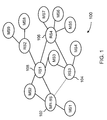
- FIG. 1 illustrates an exemplary multi-hop relay (MR) network 100 .
- a multi-hop relay base station BS (MR-BS) 102 acts as a root node, and relay stations (RSs) and mobile stations (MSs) act as intermediate nodes or leaf nodes.
- a network setup process assigns each network node an identification (or address) and constructs routing groups between nodes.
- RS 3 104 is assigned an address and is responsible for forwarding packets from MR-BS destined to RS 4 106 , and RS 1 108 will drop the packets it receives from MR-BS that are destined to RS 3 .
- Such routing information may be maintained in a routing table of each RS so that when an intermediate node leaves or enters the network, that newest routing information can be updated.
- U.S. Pat. No. 6,192,051 discloses a multi-level tree data structure in a centralized routing table and in distributed forwarding tables for forwarding network packets. Each level of each structure is associated with a different field of a network address appearing in received packets.
- U.S. Pat. No. 6,934,252 discloses binary network address lookups using parent node information stored in routing table entries. Variable length prefixes are stored in a network address forwarding table. Each prefix corresponds to an entry in the forwarding table. Each entry in the forwarding table includes path information regarding parent nodes of each entry in the binary tree.
- U.S. Pat. No. 6,618,755 discloses a software facility for automatically identifying subnets in a network by a range of addresses within the network represented by nodes in the network.
- the addresses each include an ordered series of a fixed number of bits.
- a prime factorization method to represent nodes of a network and groups between nodes is described in US2006/0198320, as well as in IEEE C802.16j-06/171.
- a receiving node needs to factorize the ID number of the packet received to determine where to forward the packet.
- Another method is described in IEEE C802.16j-07/048r6, which relates to a contiguous integer block routing method, in which a network node identifies the integer block of a received address to determine where to forward the packet or if it should drop the packet.
- the method comprises forming a logical tree topology by connecting a root node and one or more child nodes among a plurality of nodes in the network; generating a node ID for each of the child nodes by a N-carry operation of a determined number N, and transmitting data by utilizing the generated node ID of the child nodes.
- a communication system comprising a plurality of communication nodes interconnected to form a network, and a root node and one or more child nodes are connected among the plurality of communication nodes to form a logical tree topology; each of the child nodes having assigned thereto a node ID generated by a N-carry operation of a determined number N; and wherein data is transmitted by utilizing the assigned node IDs of the child nodes.
- a communication node in a transmission-receiving group of a network the network including a plurality of network nodes and the transmission-receiving group including at least one transmission node and at least one receiving node.
- the communication node comprising: at least one memory to store data and instructions; and at least one processor configured to access the memory, and when executing the instructions, configured to: transmitting a communication data by utilizing a node ID, the node ID is being assigned by a N-carry operation of a determined number N.
- FIG. 1 is a block diagram of a multi-hop relay network
- FIG. 2 a illustrates a schematic exemplary example of a logical tree topology
- FIG. 2 b illustrates an exemplary example of block diagram of a communication node
- FIG. 3 illustrates an exemplary network node ID assignment of a communication system consistent with certain disclosed embodiments
- FIG. 4 illustrates an ID assignment operation by expanding the node IDs assigned in FIG. 3 with binary form
- FIG. 5 illustrates another exemplary network node ID assignment of a communication system utilizing an N-carry operation by a polynomial consistent with certain disclosed embodiments
- FIG. 6 further illustrates the exemplary N-carry operation node ID assignment of FIG. 5 consistent with certain disclosed embodiments
- FIG. 7 is a flow chart illustrating an exemplary process for data forwarding in a communication system
- FIG. 8 is a flow chart illustrating another exemplary process for data forwarding in a communication system
- FIG. 9 is a schematic diagram illustrates a handover of a network node
- FIG. 10 a is a schematic diagram illustrates a mesh topology network
- FIG. 10 b is a schematic diagram illustrates logical trees formed in the mesh network of FIG. 10 a;
- FIG. 11 is a schematic diagram illustrates inter logical tree data transmitting
- FIG. 12 is an exemplary flow chart of a data transmitting consistent with embodiments of the invention.
- a logical tree-based topology may be formed a network including a plurality of nodes by designating one of the network nodes as a root node, and one or more other nodes as child nodes among the plurality of nodes of the network.
- FIG. 2 is a schematic example of a network 200 configured to have such a logical tree-based topology consistent with embodiments of the invention.
- the tree based topology configured with a maximum number of k child levels.
- the communication system could be any network topology, for example, a tree-based network or a mesh network.
- Each of the child nodes in a k th child level of network 200 is assigned an identification a k for each parent node to identify this child node, where identification a k could be any number.
- identification a k could be an integer greater than or equal to 0, and less than or equal to N, N is a determined number.
- N may be pre-defined to any arbitrary number or to a maximum number of child nodes connected to each of the plurality of nodes of the tree topology. In some implementation, the determined number N could maintain by the system dynamically.
- identification a k may be assigned by a random sequence or sequentially. In one example, identification a k of each child node may be assigned according to a sequence in which it becomes associated with its parent node.
- child nodes of node S are connected to form the k th child level of the tree topology and N child nodes are connected to Node S.
- the identification a k of each of the child nodes of node S could be assigned a number selected within 1 to N.
- One of the implementation could be to assign N as identification a k of node T, N ⁇ 1 as identification a k of node U, . . . , 2 as identification a k of node Y and 1 as identification a k of node Z.
- the identification a k each of the child nodes of node S could instead be assigned a number selects within 0 to N ⁇ 1, for example, identification a k of node T is assigned as 0, identification a k of node U is assigned as 1, . . . , identification a k of node Y is assigned as N ⁇ 2 and identification a k of node Z is assigned as N ⁇ 1.
- the identification a 1 of 1 st child level is assigned from 1 to N ⁇ 1, and the determined number N is 2 i , where i is an integer equal to or greater than 0.
- the root node or at least one of some other nodes with control capability or a child node may store information to generate the node IDs, and manage data forwarding or network configuration.
- Other information or parameters could also be provided, and the kind of information to be stored optionally depends on the implementation.
- Embodiments of the present invention may be practiced in any network communication system.
- multi-hop relay networks are described as exemplary communication systems to demonstrate data transmitting algorithms for generating a node ID in a communication network environment in which there is a determined number N of nodes, wherein the node IDs are utilized to transmit data.
- FIG. 3 illustrates an exemplary multi-hop relay network 300 that includes a multi-hop relay base station (MR-BS) and multiple relay stations (RSs).
- MR-BS multi-hop relay base station
- RSs relay stations
- Mobile stations may be associated with either MR-BS or RS.
- Network 300 is configured to have a logical tree topology including a MR-BS root node 302 having five child levels.
- the identification a k of each of the nodes of other child levels is a sequentially assigned integer from 0 to 3 in this exemplary example.
- FIG. 4 illustrates network 300 in which node IDs are represented in binary notation.
- the node IDs of the first child level nodes are assigned by an integer selected within 1 to 2 i ⁇ 1 by setting different values of the lowest i bits of each node ID.
- a control node MR-BS for example, left shifts i bits of the parent node ID of each child and sets different values of the lowest i bits by selecting an integer within 0 to 2 i ⁇ 1. This process could be used to generate the node IDs for newly arriving nodes or for connecting the child nodes RS.
- control node MR-BS left shifts 2 bits of its own ID, as a parent node, resulting in 00 01 00 00, and sets the lowest 2 bits as 10 since node RS I is the third node that attaches to RS D , resulting in 00 01 00 10.
- node MR-BS assigns 00 01 00 11 to node RS J after assigning the ID to node RS I .
- the node IDs of the first child level nodes could also be assigned by an integer by setting different values of the highest i bits of each node ID. While for the nodes of other child levels, a control node, MR-BS for example, right shifts i bits of the parent node ID of each child and sets different values of the highest i bits by selecting an integer within 0 to 2 i ⁇ 1.
- each child node may assign an identification a k
- a node ID of each of the nodes of the first child level may assign its own identification a 1
- the node ID of each of nodes of other child levels is assigned by performing an operation of left shifting i bits of the parent node ID of each of the child nodes and setting the lowest i bits to the identification a k of each of the child nodes.
- the MR-BS To assign an ID to RS I , the MR-BS perform a left shift of 2 bits of the ID of the parent node RS D and adds binary “10” (decimal 2, its identification a 3 ) resulting in decimal 18. Similarly, node ID 19 of RS J is generated by left shifting 2 bits of the parent node ID and adding 3, it's a 3 identification.
- FIG. 5 illustrates an exemplary embodiment of an N-carry operation as a polynomial.
- the node ID of each child node of the first child level is generated by a polynomial (a 1 ⁇ N 0 )
- the node ID of each child node of the second child level is generated by a polynomial (a 2 ⁇ N 1 +a 1 ⁇ N 0 )
- the node ID of each child node of the third child level is generated by a polynomial (a 3 ⁇ N 2 +a 2 ⁇ N 1 +a 1 ⁇ N 0 )
- the node ID of each child node of the fourth child level is generated by a polynomial (a 4 ⁇ N 3 +a 3 ⁇ N 2 +a 2 ⁇ N 1 +a 1 ⁇ N 0 ).
- the N-carry operation of child nodes of the k th child level is performed by adding a k ⁇ N k-1 to the parent node ID.
- data could be transmitted by utilizing the node IDs of child nodes.
- a destination node ID of the data is checked against the node ID of each child node, and each child node accepts the data for further processing if the destination node ID is the node ID of each such child node; and decides to forward the data to subordinate child nodes or to discard the data depending on whether the destination node ID is not the node ID of the child node.
- FIG. 7 is a flowchart illustrating an exemplary example of data transmission in a communication system.
- the receiving node subtracts its own node ID from the destination node ID (step 710 ). If the subtraction result equals 0 (step 715 , yes), the node accepts (receives) the data packet for further processing (step 720 ). If the subtraction result is not 0 (step 715 , no), the subtraction result is subjected to a modulo N k operation (step 725 ). If the result of the modulo operation equals 0 (step 730 , yes), the node forwards the data to its subordinate child nodes (step 735 ). Otherwise (step 730 , no), the data is discarded (step 740 ).
- tree topology 600 is used to explain a data forwarding example for a data packet destined for node X 4 having ID 672 .
- ID 672 is subjected to subtraction by 2. Because the subtraction result is not equal 0, node X 1 determines that is not the destination of the packet and subjects the subtraction result to the modulo N k operation. After the calculation, the modulo result is 0 so that node X 1 forwards the packet to subordinate nodes. The same process is executed in nodes X 2 and X 3 .
- node X 4 receives the forwarded data packet, it subtracts its ID from the node ID of the packet. The subtraction result is 0, so node X 4 receives the packet for further processing.
- the modulo result is not 0 so these nodes discard the data packet.
- each RS may determine its level and perform forwarding of data packets efficiently.
- each RS may readily determine its parent ID by right shifting i bits of its own ID.
- the ID of RS M is 01 00 10 10
- RS M knows the ID of its parent node RS I is 00 01 00 10 by right shifting 2 bits of its ID.
- the child node needs to determine if it should accept, forward, or discard the frame, such as in accordance with the process shown in FIG. 7 .
- a node receiving a data packet checks if the destination node ID of the packet is equal to its own ID (step 810 ) and accepts the frame if these two IDs are the same (step 810 , yes). If the two IDs are not the same, the node performs an i-bit right shift of the destination node ID (step 820 ) and checks the result against its own ID (step 830 ).
- the node discards the frame if all checks fail (step 840 , yes).
- the step 820 performs left shift instead of right shift and the other steps remain the same procedure.
- a root node or another designated node with network control capability may process the identifying and broadcasting/forwarding, and each of the child nodes may update its own ID based on the broadcasted or forwarded information to generate the node ID, for example by identifying a set ⁇ a 1 , a 2 , . . . , a k ⁇ or based on decoding its own old node ID, for example, by bit shifting the old node ID.
- the information could be stored in the child node or forwarded by at least one node with network control capability during a broadcasting or forwarding process.
- the packet When forwarding a packet in the logical tree network, the packet may include a destination address including at least a logical tree prefix field 1001 and a destination node ID field 1002 as illustrated in FIG. 10 a .
- a node that receives a packet with a destination address assigns a logical tree prefix to forward the data. For example, in order for node 4 to transmit a packet to node 9 using logical tree 1 ( 1010 ), node 4 assigns 1 to the logical tree prefix field, and allocates the ID of node 9 of logical tree 1 to the destination node ID field of the destination address.
- FIG. 11 shows an exemplary schematic diagram 1100 illustrating transmission of data between logical trees.
- node 8 inserts the logical tree prefix field 1 and inserts the node ID of node 9 in logical tree 1 as the destination node ID field, and forwards the packet via logical tree 1 .
- node 7 decides to forward the packet via logical tree 2 , by utilizing a conventional algorithm to make that decision.
- Node 7 changes the logical prefix field to 2, and transforms the node ID of node 9 in logical tree 1 (represented by the notation 9 1 ) into the node ID of node 9 in logical tree 2 ( 9 2 ).
- the packet is forwarded to node 9 using the node ID 9 2 and the data transmitting algorithm of logical tree 2 .
- the system may assign a different logical tree prefix value and transform the destination node ID in original logical tree to the node ID in the assigned logical tree, to transmit data utilizing one or more logical trees.
- FIG. 12 illustrates an example of a data transmitting flow chart.
- a network node receives a packet and extracts the destination address of the packet (step 1210 ), it identifies the logical tree prefix (step 1220 ) and identifies the destination node ID of the logical tree (step 1230 ). After identifying the destination node ID, the receiving node decides whether to forward the packet to another logical tree or not (step 1240 ).
- the receiving node may uses any conventional or any of previous described data transmitting methods base on assigning node ID (data transmitting algorithm) of the identified logical tree (step 1250 ), if not forwarding the packet by another logical tree (step 1240 , No).
- the node decides to forward the packet by another logical tree (step 1240 , Yes)
- the node indicates a new logical tree in the logical tree prefix field and transforms the destination node ID into the node ID of the new logical tree (step 1270 ) after the new logical tree is assigned by some algorithm (step 1260 ).
- the packet is forwarded via the new path by utilizing the data transmitting algorithm of the new logical tree (step 1280 ).
Landscapes
- Engineering & Computer Science (AREA)
- Computer Networks & Wireless Communication (AREA)
- Signal Processing (AREA)
- Mobile Radio Communication Systems (AREA)
- Data Exchanges In Wide-Area Networks (AREA)
Priority Applications (6)
| Application Number | Priority Date | Filing Date | Title |
|---|---|---|---|
| US11/955,582 US8040823B2 (en) | 2007-01-08 | 2007-12-13 | Method and system for network data transmitting |
| JP2007340873A JP4933421B2 (ja) | 2007-01-08 | 2007-12-28 | ネットワークデータの送信方法及びシステム |
| TW096151013A TWI350674B (en) | 2007-01-08 | 2007-12-28 | Method and system for network data transmitting |
| EP20080250019 EP1944926B1 (fr) | 2007-01-08 | 2008-01-03 | Procédé et système de distribution de données de réseau |
| KR20080001931A KR100975109B1 (ko) | 2007-01-08 | 2008-01-07 | 네트워크 데이터 전송을 위한 방법 및 시스템 |
| CN200810002258XA CN101222426B (zh) | 2007-01-08 | 2008-01-08 | 用于网络数据传输的方法以及系统 |
Applications Claiming Priority (3)
| Application Number | Priority Date | Filing Date | Title |
|---|---|---|---|
| US87904707P | 2007-01-08 | 2007-01-08 | |
| US90167307P | 2007-02-16 | 2007-02-16 | |
| US11/955,582 US8040823B2 (en) | 2007-01-08 | 2007-12-13 | Method and system for network data transmitting |
Publications (2)
| Publication Number | Publication Date |
|---|---|
| US20090028069A1 US20090028069A1 (en) | 2009-01-29 |
| US8040823B2 true US8040823B2 (en) | 2011-10-18 |
Family
ID=39521767
Family Applications (1)
| Application Number | Title | Priority Date | Filing Date |
|---|---|---|---|
| US11/955,582 Active 2028-11-13 US8040823B2 (en) | 2007-01-08 | 2007-12-13 | Method and system for network data transmitting |
Country Status (6)
| Country | Link |
|---|---|
| US (1) | US8040823B2 (fr) |
| EP (1) | EP1944926B1 (fr) |
| JP (1) | JP4933421B2 (fr) |
| KR (1) | KR100975109B1 (fr) |
| CN (1) | CN101222426B (fr) |
| TW (1) | TWI350674B (fr) |
Cited By (1)
| Publication number | Priority date | Publication date | Assignee | Title |
|---|---|---|---|---|
| US20110289101A1 (en) * | 2010-05-21 | 2011-11-24 | Vonage Network Llc. | Method and apparatus for rapid data access and distribution using structured identifiers |
Families Citing this family (9)
| Publication number | Priority date | Publication date | Assignee | Title |
|---|---|---|---|---|
| US8300555B2 (en) * | 2008-01-30 | 2012-10-30 | Qualcomm Incorporated | Management of wireless relay nodes using identifiers |
| CN102449979B (zh) * | 2009-05-29 | 2015-03-25 | 瑞典爱立信有限公司 | 用于改进包括内容共享客户端的内容共享系统的性能的系统、方法和装置 |
| US20110090833A1 (en) * | 2009-10-21 | 2011-04-21 | Nokia Corporation | Group addressed frame delivery in wireless networks |
| KR101019291B1 (ko) * | 2009-11-05 | 2011-03-07 | 인하대학교 산학협력단 | 다중 사용자 mimo 시스템에서 고정 복잡도를 갖는 스피어 인코딩 방법 |
| JP2012195774A (ja) * | 2011-03-16 | 2012-10-11 | Toshiba Corp | ノード及びプログラム |
| US9667528B2 (en) * | 2014-03-31 | 2017-05-30 | Vmware, Inc. | Fast lookup and update of current hop limit |
| CN105630733B (zh) * | 2015-12-24 | 2017-05-03 | 中国科学院计算技术研究所 | 分形树中向量数据回传处理单元的装置、方法、控制装置及智能芯片 |
| CN110430546A (zh) * | 2019-07-12 | 2019-11-08 | 重庆电子工程职业学院 | 一种无线传感网络的抗干扰优化系统 |
| US20220147400A1 (en) * | 2020-11-06 | 2022-05-12 | Edjx, Inc. | Tokenization of distributed compute resources |
Citations (12)
| Publication number | Priority date | Publication date | Assignee | Title |
|---|---|---|---|---|
| US5974236A (en) * | 1992-03-25 | 1999-10-26 | Aes Corporation | Dynamically reconfigurable communications network and method |
| US6188675B1 (en) * | 1996-08-23 | 2001-02-13 | International Business Machines Corporation | System and method for self-identifying and configuring the nodes of a network |
| US6192051B1 (en) | 1999-02-26 | 2001-02-20 | Redstone Communications, Inc. | Network router search engine using compressed tree forwarding table |
| US20030074450A1 (en) * | 1998-11-26 | 2003-04-17 | Sung-Bong Kang | Home network system and method of allocating node identification |
| US6618755B1 (en) | 1999-12-07 | 2003-09-09 | Watchguard Technologies, Inc. | Automatically identifying subnetworks in a network |
| US6870818B1 (en) * | 1998-05-26 | 2005-03-22 | Thomson Licensing S.A. | Method for identifying devices in a communication network and device for implementing said method |
| US6934252B2 (en) | 2002-09-16 | 2005-08-23 | North Carolina State University | Methods and systems for fast binary network address lookups using parent node information stored in routing table entries |
| US20060029002A1 (en) * | 2004-05-04 | 2006-02-09 | Samsung Electronics Co., Ltd. | ZigBee network device for assigning addresses to child nodes after constructing cluster-tree structure, address assigning method and routing method |
| US20060245360A1 (en) * | 2003-06-03 | 2006-11-02 | Tim Ensor | System and method for wireless mesh networking |
| US20060268854A1 (en) * | 2005-05-26 | 2006-11-30 | Lee Kenneth S | Auto-addressing system and method |
| US20070082621A1 (en) | 2005-10-11 | 2007-04-12 | Samsung Electronics Co., Ltd. | Apparatus and method for managing connection identifiers in multi-hop relay broadband wireless access system |
| US7257628B2 (en) * | 2002-11-08 | 2007-08-14 | Cisco Technology, Inc. | Methods and apparatus for performing content distribution in a content distribution network |
Family Cites Families (6)
| Publication number | Priority date | Publication date | Assignee | Title |
|---|---|---|---|---|
| WO1997002680A1 (fr) | 1995-06-30 | 1997-01-23 | Philips Electronics N.V. | Procede et dispositif d'acheminement de messages dans un reseau de noeuds |
| FI103544B1 (fi) | 1996-03-25 | 1999-07-15 | Nokia Telecommunications Oy | Menetelmä osoitteiden määrittämiseksi tietoliikenneverkon solmuissa |
| US6842430B1 (en) | 1996-10-16 | 2005-01-11 | Koninklijke Philips Electronics N.V. | Method for configuring and routing data within a wireless multihop network and a wireless network for implementing the same |
| US6788650B2 (en) | 2002-06-06 | 2004-09-07 | Motorola, Inc. | Network architecture, addressing and routing |
| WO2005116792A1 (fr) | 2004-05-28 | 2005-12-08 | Koninklijke Philips Electronics N.V. | Procede et dispositif de recherche de donnees structurees protegees |
| US7280489B2 (en) | 2005-03-01 | 2007-10-09 | Industrial Technology Research Institute | Prime numbering address allocation method and unique numbering address allocation method using the same in wireless multi-hop network |
-
2007
- 2007-12-13 US US11/955,582 patent/US8040823B2/en active Active
- 2007-12-28 JP JP2007340873A patent/JP4933421B2/ja active Active
- 2007-12-28 TW TW096151013A patent/TWI350674B/zh active
-
2008
- 2008-01-03 EP EP20080250019 patent/EP1944926B1/fr active Active
- 2008-01-07 KR KR20080001931A patent/KR100975109B1/ko active Active
- 2008-01-08 CN CN200810002258XA patent/CN101222426B/zh active Active
Patent Citations (12)
| Publication number | Priority date | Publication date | Assignee | Title |
|---|---|---|---|---|
| US5974236A (en) * | 1992-03-25 | 1999-10-26 | Aes Corporation | Dynamically reconfigurable communications network and method |
| US6188675B1 (en) * | 1996-08-23 | 2001-02-13 | International Business Machines Corporation | System and method for self-identifying and configuring the nodes of a network |
| US6870818B1 (en) * | 1998-05-26 | 2005-03-22 | Thomson Licensing S.A. | Method for identifying devices in a communication network and device for implementing said method |
| US20030074450A1 (en) * | 1998-11-26 | 2003-04-17 | Sung-Bong Kang | Home network system and method of allocating node identification |
| US6192051B1 (en) | 1999-02-26 | 2001-02-20 | Redstone Communications, Inc. | Network router search engine using compressed tree forwarding table |
| US6618755B1 (en) | 1999-12-07 | 2003-09-09 | Watchguard Technologies, Inc. | Automatically identifying subnetworks in a network |
| US6934252B2 (en) | 2002-09-16 | 2005-08-23 | North Carolina State University | Methods and systems for fast binary network address lookups using parent node information stored in routing table entries |
| US7257628B2 (en) * | 2002-11-08 | 2007-08-14 | Cisco Technology, Inc. | Methods and apparatus for performing content distribution in a content distribution network |
| US20060245360A1 (en) * | 2003-06-03 | 2006-11-02 | Tim Ensor | System and method for wireless mesh networking |
| US20060029002A1 (en) * | 2004-05-04 | 2006-02-09 | Samsung Electronics Co., Ltd. | ZigBee network device for assigning addresses to child nodes after constructing cluster-tree structure, address assigning method and routing method |
| US20060268854A1 (en) * | 2005-05-26 | 2006-11-30 | Lee Kenneth S | Auto-addressing system and method |
| US20070082621A1 (en) | 2005-10-11 | 2007-04-12 | Samsung Electronics Co., Ltd. | Apparatus and method for managing connection identifiers in multi-hop relay broadband wireless access system |
Non-Patent Citations (7)
| Title |
|---|
| Aik Chindapol et al., "Connection Management and Relay Path Configuration", IEEE C80216j-07/241r5, Mar. 15, 2007, pp. 0-26. |
| Aik Chindapol et al., "Efficient Systematic CID Allocation and Relay Path Configuration Mechanism for IEEE 802.16j (Multi-hop Relay)", IEEE C80216j-07/048r6, Jan. 8, 2007, pp. 0-10. |
| C. Perkins et al., "Ad hoc On-Demand Distance Vector (AODV) Routing", Network Working Group for Comments:3561, Jul. 2003, pp. 1-33. |
| Charles Perkins et al., "Highly Dynamic Destination-Sequenced Distance-Vector Routing (DSDV) for Mobile Computer", 1994 ACM 0-89791-682-4/94, Aug. 1994, pp. 234-244. |
| Elizabeth Royer et al., "A Review of Current Routing Protocols for Ad Hoc Mobile Wireless Networks", IEEE Personal Communications, Apr. 1999, pp. 46-55. |
| Santosh Abraham et al., "802.11 TGs Simple Efficient Extensible Mesh (SEE-Mesh) Proposal", IEEE 802.11-05/0562r4, Jan. 9, 2006, pp. 1-152. |
| Yuan-Ying Hsu et al., "Systematic relay station identification allocation and relay path configuration mechanism for IEEE 802.16j (Multi-Hop Relay)", IEEE C802.16j-06/171, Nov. 7, 2006, pp. 0-15. |
Cited By (2)
| Publication number | Priority date | Publication date | Assignee | Title |
|---|---|---|---|---|
| US20110289101A1 (en) * | 2010-05-21 | 2011-11-24 | Vonage Network Llc. | Method and apparatus for rapid data access and distribution using structured identifiers |
| US8364700B2 (en) * | 2010-05-21 | 2013-01-29 | Vonage Network Llc | Method and apparatus for rapid data access and distribution using structured identifiers |
Also Published As
| Publication number | Publication date |
|---|---|
| EP1944926A2 (fr) | 2008-07-16 |
| CN101222426A (zh) | 2008-07-16 |
| CN101222426B (zh) | 2013-08-21 |
| EP1944926A3 (fr) | 2011-12-07 |
| TW200833011A (en) | 2008-08-01 |
| KR20080065233A (ko) | 2008-07-11 |
| US20090028069A1 (en) | 2009-01-29 |
| EP1944926B1 (fr) | 2013-04-24 |
| JP2008228274A (ja) | 2008-09-25 |
| JP4933421B2 (ja) | 2012-05-16 |
| TWI350674B (en) | 2011-10-11 |
| KR100975109B1 (ko) | 2010-08-11 |
Similar Documents
| Publication | Publication Date | Title |
|---|---|---|
| US8040823B2 (en) | Method and system for network data transmitting | |
| US11902244B2 (en) | Address generation for networks | |
| Basagni et al. | A mobility-transparent deterministic broadcast mechanism for ad hoc networks | |
| EP2323441B1 (fr) | Procédé de transmission d'un message dans un réseau maillé avec un nombre maximal d'adresses pour un saute se second ordre | |
| CN107124363B (zh) | 报文广播方法及设备 | |
| US20030218988A1 (en) | Network for transferring active packet and method for employing same | |
| WO2017190559A1 (fr) | Procédé de recherche de routage, dispositif, nœud d'attribution, nœud de recherche et nœud d'entrée | |
| CN114268584A (zh) | 转发报文的方法和相关装置 | |
| CN107547346B (zh) | 一种报文传输方法和装置 | |
| Bao et al. | Design of logical topology with K‐connected constraints and channel assignment for multi‐radio wireless mesh networks | |
| CN113381934B (zh) | 一种差分服务代码点dscp引流方法及装置 | |
| US10333830B2 (en) | Passive routing in mesh network | |
| CN102143244B (zh) | 配置子网掩码的方法及设备 | |
| CN106230730B (zh) | 一种组播传输方法和装置 | |
| Chlebus et al. | Efficient distributed communication in ad-hoc radio networks | |
| Guler et al. | Multicast-aware service function tree embedding | |
| Kuehne et al. | Corridor-based routing using opportunistic forwarding in OFDMA multihop networks | |
| CN114363183A (zh) | 一种业务链地址池切片处理方法、装置及系统 | |
| US20240098012A1 (en) | Data packet transmission methods, data packet transmission apparatuses, and storage media | |
| Sekhar et al. | Routing and scheduling in packet radio networks | |
| CN117729258B (zh) | 基于云边协同的边缘服务网关系统及方法 | |
| EP3742686B1 (fr) | Calcul d'un débit durable pour le trafic de diffusion dans un réseau | |
| Asaduzzaman et al. | Towards a decentralized algorithm for mapping network and computational resources for distributed data-flow computations | |
| CN109714259B (zh) | 一种流量处理方法及装置 | |
| CN106856618B (zh) | 一种实现无线Mesh网络最大吞吐率方法 |
Legal Events
| Date | Code | Title | Description |
|---|---|---|---|
| AS | Assignment |
Owner name: INDUSTRIAL TECHNOLOGY RESEARCH INSTITUTE, TAIWAN Free format text: ASSIGNMENT OF ASSIGNORS INTEREST;ASSIGNORS:LIN, TZU-MING;HSU, YUAN-YING;YANG, JEN-SHUN;AND OTHERS;REEL/FRAME:020677/0768;SIGNING DATES FROM 20080226 TO 20080307 Owner name: TELCORDIA APPLIED RESEARCH CENTER TAIWAN COMPANY, Free format text: ASSIGNMENT OF ASSIGNORS INTEREST;ASSIGNORS:LIN, TZU-MING;HSU, YUAN-YING;YANG, JEN-SHUN;AND OTHERS;REEL/FRAME:020677/0768;SIGNING DATES FROM 20080226 TO 20080307 Owner name: INDUSTRIAL TECHNOLOGY RESEARCH INSTITUTE, TAIWAN Free format text: ASSIGNMENT OF ASSIGNORS INTEREST;ASSIGNORS:LIN, TZU-MING;HSU, YUAN-YING;YANG, JEN-SHUN;AND OTHERS;SIGNING DATES FROM 20080226 TO 20080307;REEL/FRAME:020677/0768 Owner name: TELCORDIA APPLIED RESEARCH CENTER TAIWAN COMPANY, Free format text: ASSIGNMENT OF ASSIGNORS INTEREST;ASSIGNORS:LIN, TZU-MING;HSU, YUAN-YING;YANG, JEN-SHUN;AND OTHERS;SIGNING DATES FROM 20080226 TO 20080307;REEL/FRAME:020677/0768 |
|
| FEPP | Fee payment procedure |
Free format text: PAYOR NUMBER ASSIGNED (ORIGINAL EVENT CODE: ASPN); ENTITY STATUS OF PATENT OWNER: LARGE ENTITY |
|
| STCF | Information on status: patent grant |
Free format text: PATENTED CASE |
|
| CC | Certificate of correction | ||
| FPAY | Fee payment |
Year of fee payment: 4 |
|
| MAFP | Maintenance fee payment |
Free format text: PAYMENT OF MAINTENANCE FEE, 8TH YEAR, LARGE ENTITY (ORIGINAL EVENT CODE: M1552); ENTITY STATUS OF PATENT OWNER: LARGE ENTITY Year of fee payment: 8 |
|
| MAFP | Maintenance fee payment |
Free format text: PAYMENT OF MAINTENANCE FEE, 12TH YEAR, LARGE ENTITY (ORIGINAL EVENT CODE: M1553); ENTITY STATUS OF PATENT OWNER: LARGE ENTITY Year of fee payment: 12 |