US8090470B2 - Method and system for optimizing containers in a block - Google Patents
Method and system for optimizing containers in a block Download PDFInfo
- Publication number
- US8090470B2 US8090470B2 US12/142,596 US14259608A US8090470B2 US 8090470 B2 US8090470 B2 US 8090470B2 US 14259608 A US14259608 A US 14259608A US 8090470 B2 US8090470 B2 US 8090470B2
- Authority
- US
- United States
- Prior art keywords
- container
- block
- crane
- containers
- insert
- Prior art date
- Legal status (The legal status is an assumption and is not a legal conclusion. Google has not performed a legal analysis and makes no representation as to the accuracy of the status listed.)
- Expired - Fee Related, expires
Links
Images



Classifications
-
- B—PERFORMING OPERATIONS; TRANSPORTING
- B66—HOISTING; LIFTING; HAULING
- B66C—CRANES; LOAD-ENGAGING ELEMENTS OR DEVICES FOR CRANES, CAPSTANS, WINCHES, OR TACKLES
- B66C13/00—Other constructional features or details
- B66C13/18—Control systems or devices
- B66C13/48—Automatic control of crane drives for producing a single or repeated working cycle; Program control
-
- G—PHYSICS
- G06—COMPUTING OR CALCULATING; COUNTING
- G06Q—INFORMATION AND COMMUNICATION TECHNOLOGY [ICT] SPECIALLY ADAPTED FOR ADMINISTRATIVE, COMMERCIAL, FINANCIAL, MANAGERIAL OR SUPERVISORY PURPOSES; SYSTEMS OR METHODS SPECIALLY ADAPTED FOR ADMINISTRATIVE, COMMERCIAL, FINANCIAL, MANAGERIAL OR SUPERVISORY PURPOSES, NOT OTHERWISE PROVIDED FOR
- G06Q10/00—Administration; Management
- G06Q10/08—Logistics, e.g. warehousing, loading or distribution; Inventory or stock management
Definitions
- the present invention relates to a method for optimizing the position of a plurality of containers in a block, especially a container block in a container port.
- the invention is also related to software and a system configured to perform said optimization.
- a system to optimize the block handling operations could increase the capacity of terminals too small to afford the high investment costs of large facility improvements.
- larger terminals could of course also benefit from a system that increases their capacity and effectiveness.
- the traditional solution is to have a logistics system for the entire port handling all blocks and loading/unloading of the ships.
- the port logistics system determines in which block a certain container should be stored and communicates this information to a crane control system that inserts the container in the appropriate block.
- the export of a specific container is ordered by the port logistics system and the information is communicated to the crane control system for the appropriate block and the specific container is removed from the block where it has been stored.
- a drawback of the prior art system is that only the port logistics system has an overall picture of each block and the crane available for moving the containers within each block performs the assigned orders whenever the port logistics system detects a container to move to a more favorable position.
- a small port without an expensive port logistics system having only one or a few container blocks will lack the possibility to use the unused capacity of the crane to optimize the position of each container within the block.
- An object of the present invention is to provide a method that provides an optimization process for the stored containers in a block which reduces the drawbacks of the prior art systems.
- the crane control calculates required container moves to handle these tasks and in order to make it efficient, a queue of container moves is assigned to each crane.
- the content of the queue i.e. the order of the container moves, are reviewed and the queue rearranged in such a way to reduce the time needed to perform the tasks.
- An advantage with the present invention is that the crane capacity is better used compared to prior art solutions.
- Another advantage is that an optimization of a container block may be achieved even though a port logistics system is not present.
- Still another advantage with the present invention is that the operating speed of the cranes may be reduced, in order to reduce wear and energy consumptions, since the crane control unit has a more complete knowledge compared to prior art systems.
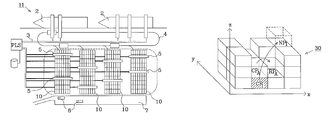
- FIG. 1 shows an overview of a container port.
- FIG. 2 shows a container block with one crane illustrating insert, removal and re-stacking operation according to the invention.
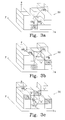
- FIGS. 3 a - 3 c illustrates a re-stacking operation according to the present invention.
- FIG. 4 shows a container block with two cranes illustrating insert, removal and re-stacking operation according to the invention.
- FIG. 5 is a flow chart of the process for insert, removal and re-stacking operation according to the invention.
- FIG. 1 shows a port 11 provided with a prior art port logistics system PLS that controls all movements of container blocks in the port.
- Ships 2 arrive to unload or load containers 1 , and the containers are stored, in this embodiment, in four blocks 10 .
- the PLS controls the cranes that unload/load the ships through a communication bus 3 , and an unloaded container is brought from a ship via a transport rail 4 to a block selected by the PLS.
- Cranes 5 that are dedicated to a block, and controlled by the PLS, move the unloaded container into a suitable position within the block.
- a container that is going to be loaded onto a ship is collected by the cranes 5 and moved to the transport rail 4 to be transported to the ship 2 .
- the PLS issues orders to each crane and these orders are arranged in a queue for each crane. The same applies when a truck 6 loads or unloads a container on the “landside” 7 .
- FIG. 2 shows a first embodiment of the present invention applied to a block 20 of a multiple containers 1 stacked in a three dimensional space.
- a single crane 21 is provided to move the containers within the block (re-stacking operation) as illustrated by the arrow 24 , inserting a container into the block (insert operation) from an input position 22 as illustrated by the arrow 25 , and removing a container from the block (removal operation) to an output position 23 , as illustrated by the arrow 26 .
- Input and output positions are provided outside the block 20 in a dedicated space 27 for the “landside” of the block, and a dedicated space 28 for the “seaside” of the block.
- a crane control unit configured to communicate with the port logistics system (PLS) controls the movement of the crane by assigning container moves to a queue.
- the PLS informs the CCU of which block a container should be stored in and the CCU controls the handling of the containers within the block 20 , and the insert and removal operations from the external dedicated spaces 27 and 28 in which the input position 22 and output position 23 are located.
- the CCU is provided with an internal memory or an external memory 29 is accessible to the CCU. Information regarding container identification, current position (CP) of each container, time-until-removal TUR, and desired output position (OUT) are stored in the memory 29 . There are normally several output positions and input positions available in each external dedicated space 27 and 28 .
- a block may be dynamically divided into sub-sections dependent on the number of cranes and tasks assigned to each crane. This will become obvious from the description in connection with FIG. 4 .
- FIGS. 3 a - 3 c illustrates a re-stacking operation according to the present invention.
- a sub-section 30 of the block 20 described in connection with FIG. 2 comprises in this embodiment twenty containers arranged in an area with two by four containers wherein the maximum height is four containers.
- a three dimensional space is created having thirty two available positions.
- a single crane (not shown) moves a container at the time as defined by the required container moves arranged in a queue.
- the queue comprises a number of calculated container moves to perform the re-stacking according to the invention.
- Re-stacking is normally performed to put the containers within the sub-section at a more favorable position compared to the current position. This task is performed when there is no new container to be inserted into the sub-section 30 , and when no container is to be removed from the sub-section 30 . Insert and removal operation have priority over re-stacking operations and the process of re-stacking is preferably interrupted immediately when an order to insert or remove a container is received by the CCU from the PLS.
- the CCU calculates a value R for each container present within the sub-section 30 .
- the calculated value R is based on: time until removal (TUR) of the container from the block, and time for moving (TFM) the container from the current position (CP) to a selected external output position (OUT).
- TUR time until removal
- TFM time for moving
- the calculated value R for each container is a measure of how optimal the current position of the container is compared to all other containers in the sub-section.
- a goal of the present invention is to reduce the sum of the calculated values R for all containers within the sub-section, and therefore the container with one of the highest values R is normally selected to be moved.
- FIG. 3 a illustrates the case when container “ 1 ” at current position CP 1 is selected.
- Alternative positions (AP) are identified and a corresponding value R new is calculated for each AP to identify a new position NP 1 for the selected container “ 1 ”, as marked with dashed lines.
- a more detailed description of how to calculate the value R new and select NP 1 from the plurality of AP can be found below.
- container “A” positioned above container “ 1 ” needs to be relocated to a relocation position RP A from its current position CP A , as shown in FIG. 3 a .
- Available relocation positions (ARP) are identified and a corresponding R relocate is calculated for each ARP to identify the relocation position RP 1 for container “A”, as marked with dotted lines.
- a more detailed description of how to calculate the value R relocate and select RP 1 from the plurality of ARP can be found below.
- Task ID Move 1 “A” CP A -> RP A 2 “1” CP 1 -> NP 1
- This queue is assigned to the crane (only one crane present in this example) and the first task is initiated, i.e. to move container A from its current position to the selected relocation position.
- the CCU thereafter selects another container “ 2 ”, preferably the container having the second highest value “R”, which is positioned at CP 2 as illustrated in FIG. 3 b .
- a new position NP 2 for container “ 2 ” is identified and selected, as marked with dashed lines.
- container “B” positioned above container “ 2 ” needs to be relocated to a relocation position RP B from its current position CP B , as shown in FIG. 3 b .
- the relocation position RP B is identified and selected for container “B”, as marked with dotted lines
- the status field indicates that the crane presently is busy with performing task 1 .
- the crane performs the next task in the queue, i.e. first moving container “ 1 ” to its new position and thereafter moving container “B” to its relocation position, or first moving container “B” to its relocation position and thereafter moving container “ 1 ” to its new position dependent on which queue is assigned to the crane by the CCU.
- Container “ 3 ” is selected to be moved from its current position CP 3 to a new position NP 3 and container “ 4 ” is selected to be moved from its current position CP 4 to a new position NP 4 , as illustrated by the dashed lines in FIG. 3 c .
- No other container needs to be moved in order to move the selected containers, but container “ 1 ” needs to be moved before container “ 3 ” can be moved into its new position NP 3 .
- Container “ 4 ” can not be moved into its new position NP 4 until container “ 3 ” has been moved its new position NP 3 .
- the tasks in the queue for the crane are rearranged and the container moves for container “ 3 ” and “ 4 ” are added as follows:
- FIG. 3 c illustrates the positions of the container in the sub-section 30 after the completion of the move of container “ 1 ”.
- the memory which is accessible to the CCU contains the current position of each container, and when the move is completed (as indicated by “done” in the status field), the current position of the moved containers are updated in the memory as indicated in the comments field.
- the re-stacking operation continues until the sum of the calculated values R for all containers present within the sub-section 30 is minimized, or until the re-stacking operation is interrupted by an insert operation or removal operation.
- the calculated value R is updated for each container that is affected by the move of the selected container to a new position before another container is selected.
- the calculated value of the container positioned below the relocation position RP A for container “A” should be updated, as well as the calculated value for the containers positioned below the new position NP 1 for container “ 1 ”.
- These updated values will increase as a result of the additional container on top.
- the updated values will then be taken into consideration when selecting the next container to be moved. It is possible that the next container will be a container positioned below the new position NP 1 for container “ 1 ”, and that container needs to be moved before container “ 1 ” can be moved.
- These parameters are preferably taken into consideration when selecting the new position NP 1 for container “ 1 ” from the plurality of alternative positions, as described in more detail below.
- Container parameters such as CP i , TUR i , OUT i , type, size, etc, are stored in the memory.
- the current position CP i of each container i is updated when the container is moved, but may also be updated regularly if the crane is provided with a means to verify the container ID when moving across the sub-section.
- Such a means may involve bar code reader system, transponder system, image recognition system, etc.
- the calculated value R for a container is based on TUR and on a parameter “time for moving” (TFM), which is determined based on the current position and the output position.
- TFM is calculated as the estimated time to move the selected container from its current position to a desired output position. Intermediately positioned containers between CP and OUT may affect the calculated TFM. It is preferred that TFM also is based on time for relocating (TFR) containers, such as container “A” and container “B” described in connection with FIGS. 3 a - 3 c , to facilitate the move of the selected container.
- TFR time for relocating
- FIG. 4 shows a top view of a block 40 serviced by two cranes 41 a and 41 b .
- An area 42 , 43 not being a part of the block 40 is provided on each side of the block, each area is provided with an output position OUT and an input position IN.
- a crane control unit CCU comprising a microprocessor ⁇ P and an internal memory 44 , communicates with the cranes 41 a and 41 b.
- An external command center EEC such as a Port Logistics System, communicates with the CCU to initiate insert operation of a container into the block 40 using one of the available input positions, or to initiate a removal operation of a container from the block 40 to one of the available output positions.
- the optimization process of block 40 is described in connection with FIG. 5 , wherein the process starts at step 50 when the optimization is initiated.
- a value R is therefore calculated in step 51 , which reflects the time it takes to move each container to the correct output position from a position within the block (or sub-section if not the entire block is selected).
- R is based on, as mentioned above, time until removal (TUR) of the container from the block, and time for moving (TFM) the container from the current position (CP) to a selected external output position (OUT).
- TUR and desired OUT is provided from PLS, or calculated, when the container is inserted.
- the PLS may also supply this information at a later stage (see below).
- TFM may be based on the time for relocating (TFR) containers to facilitate the move of containers located below.
- TFR time for relocating
- TFM for a container being located beneath two containers will include TFR compared to a container situated on top of a stack of containers.
- TUR for most containers within a block is much higher than TFM, and TUR will therefore be an essential parameter for the optimization process.
- the value R should be considered to be a cost function that is attached to each container representing the time it would take to transport this particular container from its current position to the position where it is most likely going to be removed from the block (preferably taking into account that other containers stacked on top of this one have to be removed first). Weights are thereafter introduced to give higher cost to containers that are due for delivery soon.
- the value R is stored in a memory 44 arranged within the CCU and the process continue to step 52 , in which CCU checks if there are any orders from the PLS to insert a container in the block 40 or to remove a container from the block. If there is an order to interrupt the re-stacking process, the process continues to step 53 in which the CCU determines the type of interrupt process. The steps associated with insert operation and removal operation is described below.
- step 62 to perform a re-stacking operation by selecting a container.
- the container having the highest value R (or cost function) is preferably selected.
- Alternative positions (APs) for the selected container is thereafter identified within the block, as described in connection with FIGS. 3 a - 3 c , and a new value R new is calculated for each AP as the values R was calculated in step 51 .
- a new position for the selected container is selected from the AP based on: the calculated value R for its CP, the calculated new value R new for its AP, and a travel cost (TC) based on time for moving the container from CP to each AP.
- TC is preferably further based on time for relocating containers to facilitate the move of the selected container to NP.
- the selected container is the container that will decrease the sum of the value R for all containers when the selected container has been moved to NP. In that case a new value R new for every alternative position for all containers in the block needs to be calculated before a container can be selected. The calculations to find NP for each container in the block is performed as described above.
- step 63 in which necessary moves are calculated in order to be able to move the selected container from CP to NP. These moves may include relocating containers that are stacked on top of the selected container, etc.
- RP relocation position
- ARP available relocation positions
- the CCU When the moves have been calculated in step 63 , the CCU create a queue in step 64 for each crane 41 a , 41 b to perform the tasks. If there are pending tasks in the queue, these may be taken under consideration when creating the queues, as described above in connection with FIGS. 3 a - 3 c . It is also possible to rearrange tasks between the queues of the cranes, to further reduce the time needed to perform the tasks.
- step 65 the cranes perform the next task assigned to each queue and the process continues to step 66 in which the database containing the cost function R is updated.
- the calculated container moves will affect the calculated value R for some containers in the block. These values are preferably updated before the process continues to step 67 .
- the order sent from the PLS comprises:
- TUR is preferably estimated using the stored TUR for containers located within the block 40 if the TUR for the container to be inserted is unknown to the system, and the estimated value is stored in the memory 44 . The estimation is calculated as an average value of the stored TUR for containers within the block 40 . If OUT is not provided in the order to insert the container, OUT is preferably selected to be a central position of the block 40 . The PLS may naturally update TUR and OUT for a given container at any time before it has been removed from the block 40 .
- An insert position is selected by the CCU based on a calculated value R insert for each available insert position (AIP) in the block, and a calculated travel cost (TC).
- R insert is based on the same parameters as the value R, see above, with the exception that TFM is selected to be the time for moving the container from each AIP to the OUT.
- TC is based on the time for moving the new container from the external input position (IN) to each AIP.
- the insert position (IP) for the new container may further be selected based on an updated calculated value R for each container affected by inserting the container at each AIP, and with the aim of minimizing the sum of the updated calculated values R and the insert value R insert for the selected IP.
- the selection of the insert position (IP) is based on reducing (preferably minimizing) a cost C insert for the inserted container:
- FIG. 4 An order to insert container 45 from the external input position IN at the “seaside” is received from PLS to CCU and the re-stacking operation is interrupted.
- Each crane has a queue of tasks to perform, as described in connection with FIGS. 3 a - 3 c .
- the system is preferably configured to prioritize the insert operation and the tasks in the crane 41 a , operating at the “seaside”, will only be performed until the CCU has selected an IP.
- the queue assigned to crane 41 b is not affected by the insert operation, and the block may be considered to be divided into dynamical sub-sections 46 a and 46 b .
- Each crane service a sub-section of the block 40 , which sub-sections may be overlapping.
- the insert position is selected, as described above, and the tasks in the queue assigned to crane 41 a are rearranged to include the moves required to insert the new container at IP as fast as possible.
- Tasks assigned to crane 41 b needs to be taken into consideration when rearranging the tasks in the queue for crane 41 a to avoid unnecessary delay and risk for collision between the cranes.
- the moves required inserting the container in the block are preferably prioritized in the queue in step 56 .
- the container moves performed in step 57 are preferably carried out until the container has been inserted in the block 40 before the process continues to step 66 and the value R is updated and stored in the memory 44 for each affected container within the block.
- the order sent from the PLS comprises:
- the moves required removing the container from the block are preferably prioritized in the queue in step 60 , and the selection of RP for each container that needs to be relocated in step 59 is based on a calculated relocation value (Rrelocate) for available relocation position (ARP) as described in more detail above.
- the container moves performed in step 61 are preferably carried out until the container has been removed from the block 40 before the process continues to step 66 and the value R is updated and stored in the memory 44 for each affected container within the block.
- the relocation position (RP) is based on reducing, preferably minimizing, a cost Crelocate for each additional container:
- the aim of the optimization is to reduce the sum of the calculated values R (cost function) for all containers present within each block, or a sub-section of the block.
- the described process is preferably implemented as a computer program configured to perform, when executed on a computer, an optimization of the position of a plurality of containers in a block, or sub-section.
- a computer-readable medium is preferably encoded with the computer program.
- the invention also relates to a system for optimizing the position of a plurality of containers in a block (or sub-section of a block).
- the system is adapted to control at least one crane 21 ; 41 a , 41 b configured to move said containers within said block (or sub-section) and is further provided with a crane control unit CCU that is configured to perform the optimization process.
Landscapes
- Engineering & Computer Science (AREA)
- Business, Economics & Management (AREA)
- Economics (AREA)
- Marketing (AREA)
- Quality & Reliability (AREA)
- Mechanical Engineering (AREA)
- Entrepreneurship & Innovation (AREA)
- Human Resources & Organizations (AREA)
- Automation & Control Theory (AREA)
- Operations Research (AREA)
- Development Economics (AREA)
- Strategic Management (AREA)
- Tourism & Hospitality (AREA)
- Physics & Mathematics (AREA)
- General Business, Economics & Management (AREA)
- General Physics & Mathematics (AREA)
- Theoretical Computer Science (AREA)
- Control And Safety Of Cranes (AREA)
- Warehouses Or Storage Devices (AREA)
Applications Claiming Priority (3)
| Application Number | Priority Date | Filing Date | Title |
|---|---|---|---|
| EP07110565A EP2006237B1 (en) | 2007-06-19 | 2007-06-19 | A method and system for optimizing containers in a block |
| EP07110565.4 | 2007-06-19 | ||
| EP07110565 | 2007-06-19 |
Publications (2)
| Publication Number | Publication Date |
|---|---|
| US20080319573A1 US20080319573A1 (en) | 2008-12-25 |
| US8090470B2 true US8090470B2 (en) | 2012-01-03 |
Family
ID=38740449
Family Applications (1)
| Application Number | Title | Priority Date | Filing Date |
|---|---|---|---|
| US12/142,596 Expired - Fee Related US8090470B2 (en) | 2007-06-19 | 2008-06-19 | Method and system for optimizing containers in a block |
Country Status (7)
| Country | Link |
|---|---|
| US (1) | US8090470B2 (da) |
| EP (1) | EP2006237B1 (da) |
| CN (1) | CN101329579B (da) |
| DK (1) | DK2006237T3 (da) |
| ES (1) | ES2400525T3 (da) |
| PT (1) | PT2006237E (da) |
| SG (1) | SG148915A1 (da) |
Cited By (1)
| Publication number | Priority date | Publication date | Assignee | Title |
|---|---|---|---|---|
| EP3023918A1 (en) * | 2014-11-19 | 2016-05-25 | Airbus Operations GmbH | Freight container storage system |
Families Citing this family (11)
| Publication number | Priority date | Publication date | Assignee | Title |
|---|---|---|---|---|
| WO2011066856A1 (en) * | 2009-12-02 | 2011-06-09 | Abb Research Ltd | A method, apparatus, computer program and computer program product for controlling a crane set |
| EP2965274B1 (en) * | 2013-03-04 | 2017-02-01 | ABB Schweiz AG | System and method for controlling at least two automated non-passing rail mounted gantry cranes |
| US20150186828A1 (en) * | 2013-12-26 | 2015-07-02 | Dassault Systemes GEOVIA, Inc. | State based dump location determination |
| GB201409883D0 (en) * | 2014-06-03 | 2014-07-16 | Ocado Ltd | Methods, systems, and apparatus for controlling movement of transporting devices |
| US20180040092A1 (en) * | 2014-12-12 | 2018-02-08 | Rakkatec Oy | Logistics system and method for managing objects in a space |
| CN107128700A (zh) * | 2017-06-20 | 2017-09-05 | 上海振华重工(集团)股份有限公司 | 码头集装箱输送系统 |
| CN109615773B (zh) * | 2018-10-16 | 2021-06-01 | 浙江工业大学 | 基于直导轨的食品自动售卖机货物优化调整方法 |
| CN109377133B (zh) * | 2018-11-08 | 2021-04-13 | 上海海勃物流软件有限公司 | 一种集装箱堆叠状态的数据预处理方法及系统 |
| CN116157344B (zh) * | 2020-07-15 | 2025-11-11 | 株式会社日立制作所 | 集装箱堆存计划装置、集装箱堆存计划系统和集装箱堆存计划方法 |
| US20230237424A1 (en) * | 2022-01-21 | 2023-07-27 | Conor Moynihan | Distribution system for containerized and non-containerized freight through intermodal networks |
| CN114394440B (zh) * | 2022-01-29 | 2024-04-16 | 北京百度网讯科技有限公司 | 集装箱的堆叠处理方法、装置、设备、存储介质及产品 |
Citations (3)
| Publication number | Priority date | Publication date | Assignee | Title |
|---|---|---|---|---|
| US6826452B1 (en) * | 2002-03-29 | 2004-11-30 | The Penn State Research Foundation | Cable array robot for material handling |
| US20060182527A1 (en) | 2004-12-17 | 2006-08-17 | Navis Llc | Automated container terminal scheduling |
| US20060251498A1 (en) * | 2005-02-25 | 2006-11-09 | Maersk, Inc. | System and process for improving container flow in a port facility |
Family Cites Families (3)
| Publication number | Priority date | Publication date | Assignee | Title |
|---|---|---|---|---|
| CN1702652A (zh) * | 2004-09-09 | 2005-11-30 | 上海浦东国际集装箱码头有限公司 | 智能堆场的自动配位方法 |
| CN100428247C (zh) * | 2004-09-09 | 2008-10-22 | 上海浦东国际集装箱码头有限公司 | 一种装船时减少集装箱翻箱量的优化方法 |
| CN1877589A (zh) * | 2006-07-06 | 2006-12-13 | 上海交通大学 | 集装箱船舶在线实时配载方法 |
-
2007
- 2007-06-19 ES ES07110565T patent/ES2400525T3/es active Active
- 2007-06-19 PT PT71105654T patent/PT2006237E/pt unknown
- 2007-06-19 EP EP07110565A patent/EP2006237B1/en not_active Revoked
- 2007-06-19 DK DK07110565.4T patent/DK2006237T3/da active
-
2008
- 2008-04-28 SG SG200803268-2A patent/SG148915A1/en unknown
- 2008-06-18 CN CN200810126945.2A patent/CN101329579B/zh not_active Expired - Fee Related
- 2008-06-19 US US12/142,596 patent/US8090470B2/en not_active Expired - Fee Related
Patent Citations (3)
| Publication number | Priority date | Publication date | Assignee | Title |
|---|---|---|---|---|
| US6826452B1 (en) * | 2002-03-29 | 2004-11-30 | The Penn State Research Foundation | Cable array robot for material handling |
| US20060182527A1 (en) | 2004-12-17 | 2006-08-17 | Navis Llc | Automated container terminal scheduling |
| US20060251498A1 (en) * | 2005-02-25 | 2006-11-09 | Maersk, Inc. | System and process for improving container flow in a port facility |
Non-Patent Citations (5)
| Title |
|---|
| Database Compendex [online], Engineering Information, Inc., New York, NY, US; Nov. 2007, Lee Yusin et al: "An Optimization Model for the Container Pre-Marshalling Problem" XP002461092 Database Accession No.E20071410533503, Available on Line Feb. 24, 2006, Abstract & Comp. Oper. Res.; Computers and Operations Research Nov. 2007, Online, vol. 34, No. 11, Nov. 2007, pp. 3295-3313, Retrieved on Nov. 28, 2007. |
| Duinkerken M. B. et al; Institute of Electrical and Electronics Engineers: "The Application of Distributed Simulation in TOMAS: Redesigning a Complex Transportation Model", Proceedings of the 2002 Winter Simulation Conference, WSC'02, San Diego, CA, Dec. 8-11, 2002, Winter Simulation Conference, New York, NY, IEEE, US, vol. 1 of 2, Conf. 35, Dec. 8, 2002, pp. 1207-1213. |
| European Search Report, Dec. 5, 2007, 4 pages. |
| Thurston T. et al.; "Distributed Agent Architecture for Port Automation" Proceedings of the 26th.Annual International Computer Software and Applications Conference, COMPSAC 2002, Oxford, England, Aug. 26-29, 2002 Annual International Computer Software and Applications Conference, Los Alamitos, CA, IEEE COMP. SOC, US, vol. CONF. 26, Aug. 26, 2002, pp. 81-87. |
| Yusin Lee, An Optimization Model for the Container Pre--Marshalling Problem, pp. 3296-3301, Department of Civil Engineering, National Cheng Kung University, Feb. 2006, available at www.sciencedirect.com. * |
Cited By (1)
| Publication number | Priority date | Publication date | Assignee | Title |
|---|---|---|---|---|
| EP3023918A1 (en) * | 2014-11-19 | 2016-05-25 | Airbus Operations GmbH | Freight container storage system |
Also Published As
| Publication number | Publication date |
|---|---|
| ES2400525T3 (es) | 2013-04-10 |
| CN101329579A (zh) | 2008-12-24 |
| EP2006237B1 (en) | 2012-12-05 |
| EP2006237A1 (en) | 2008-12-24 |
| PT2006237E (pt) | 2013-03-07 |
| CN101329579B (zh) | 2013-06-05 |
| DK2006237T3 (da) | 2013-03-11 |
| US20080319573A1 (en) | 2008-12-25 |
| SG148915A1 (en) | 2009-01-29 |
Similar Documents
| Publication | Publication Date | Title |
|---|---|---|
| US8090470B2 (en) | Method and system for optimizing containers in a block | |
| CN110239868B (zh) | 取货任务分配方法及其货品分拣系统 | |
| US20030093176A1 (en) | Transportation system | |
| KR20090118979A (ko) | 재고 주문용 팔레트의 어셈블링 방법 및 시스템 | |
| WO2006065744A2 (en) | Automated container terminal scheduling | |
| CN115545416A (zh) | 桥吊作业计划生成方法、控制方法、装置、设备及介质 | |
| JP4410515B2 (ja) | コンテナヤードの荷役システム | |
| Park et al. | Planning for remarshaling in an automated container terminal using cooperative coevolutionary algorithms | |
| JP6911826B2 (ja) | 倉庫設備の制御システム及び制御方法 | |
| KR102884161B1 (ko) | 하역 작업 작성 장치 및 하역 작업 작성 방법 | |
| CN117985375A (zh) | 用于动态配置移动机器人的容器的方法和系统 | |
| JP2002160813A (ja) | 在庫管理システム及び記録媒体 | |
| JP2011018737A (ja) | 半導体製造システム | |
| JP3890873B2 (ja) | 入出庫制御装置及びその入出庫制御装置を有する自動倉庫 | |
| JP7250352B2 (ja) | 荷物入出庫システム及び入出庫プログラム | |
| CN111736538A (zh) | 插队调度方法和装置 | |
| JP7493136B2 (ja) | 倉庫設備の制御システム及び制御方法 | |
| JP3849836B2 (ja) | ストッカの運行管理方法 | |
| JP2009294852A (ja) | 仕掛分配制御方法および仕掛分配制御装置 | |
| CN111832985A (zh) | 一种钢材入库时货位分配管理方法及系统 | |
| RU2793998C1 (ru) | Устройство создания перечня погрузочно-разгрузочных работ и способ создания перечня погрузочно-разгрузочных работ | |
| JP3925309B2 (ja) | 出庫棚決定方法及び装置並びにその出庫棚決定装置を有する自動倉庫 | |
| JPH09231271A (ja) | 自動搬送設備運行計画方法 | |
| JP2025126831A (ja) | 計画システム、計画方法およびプログラム | |
| JP2024142737A (ja) | 配置計画立案装置、配置計画立案手法およびプログラム |
Legal Events
| Date | Code | Title | Description |
|---|---|---|---|
| AS | Assignment |
Owner name: ABB RESEARCH LTD., SWITZERLAND Free format text: ASSIGNMENT OF ASSIGNORS INTEREST;ASSIGNORS:LINDEBERG, ERIK;HEIDENBACK, CLAES;HENRIKSSON, BJORN;AND OTHERS;REEL/FRAME:021169/0412;SIGNING DATES FROM 20080502 TO 20080616 Owner name: ABB RESEARCH LTD., SWITZERLAND Free format text: ASSIGNMENT OF ASSIGNORS INTEREST;ASSIGNORS:LINDEBERG, ERIK;HEIDENBACK, CLAES;HENRIKSSON, BJORN;AND OTHERS;SIGNING DATES FROM 20080502 TO 20080616;REEL/FRAME:021169/0412 |
|
| STCF | Information on status: patent grant |
Free format text: PATENTED CASE |
|
| FPAY | Fee payment |
Year of fee payment: 4 |
|
| FEPP | Fee payment procedure |
Free format text: MAINTENANCE FEE REMINDER MAILED (ORIGINAL EVENT CODE: REM.); ENTITY STATUS OF PATENT OWNER: LARGE ENTITY |
|
| LAPS | Lapse for failure to pay maintenance fees |
Free format text: PATENT EXPIRED FOR FAILURE TO PAY MAINTENANCE FEES (ORIGINAL EVENT CODE: EXP.); ENTITY STATUS OF PATENT OWNER: LARGE ENTITY |
|
| STCH | Information on status: patent discontinuation |
Free format text: PATENT EXPIRED DUE TO NONPAYMENT OF MAINTENANCE FEES UNDER 37 CFR 1.362 |
|
| FP | Lapsed due to failure to pay maintenance fee |
Effective date: 20200103 |