US8144864B2 - Method for speeding up the computations for characteristic 2 elliptic curve cryptographic systems - Google Patents
Method for speeding up the computations for characteristic 2 elliptic curve cryptographic systems Download PDFInfo
- Publication number
- US8144864B2 US8144864B2 US11/966,572 US96657207A US8144864B2 US 8144864 B2 US8144864 B2 US 8144864B2 US 96657207 A US96657207 A US 96657207A US 8144864 B2 US8144864 B2 US 8144864B2
- Authority
- US
- United States
- Prior art keywords
- polynomial
- coefficients
- carry
- computing
- less product
- Prior art date
- Legal status (The legal status is an assumption and is not a legal conclusion. Google has not performed a legal analysis and makes no representation as to the accuracy of the status listed.)
- Expired - Fee Related, expires
Links
Images




Classifications
-
- G—PHYSICS
- G06—COMPUTING OR CALCULATING; COUNTING
- G06F—ELECTRIC DIGITAL DATA PROCESSING
- G06F7/00—Methods or arrangements for processing data by operating upon the order or content of the data handled
- G06F7/60—Methods or arrangements for performing computations using a digital non-denominational number representation, i.e. number representation without radix; Computing devices using combinations of denominational and non-denominational quantity representations, e.g. using difunction pulse trains, STEELE computers, phase computers
- G06F7/72—Methods or arrangements for performing computations using a digital non-denominational number representation, i.e. number representation without radix; Computing devices using combinations of denominational and non-denominational quantity representations, e.g. using difunction pulse trains, STEELE computers, phase computers using residue arithmetic
- G06F7/724—Finite field arithmetic
- G06F7/725—Finite field arithmetic over elliptic curves
-
- G—PHYSICS
- G06—COMPUTING OR CALCULATING; COUNTING
- G06F—ELECTRIC DIGITAL DATA PROCESSING
- G06F7/00—Methods or arrangements for processing data by operating upon the order or content of the data handled
- G06F7/60—Methods or arrangements for performing computations using a digital non-denominational number representation, i.e. number representation without radix; Computing devices using combinations of denominational and non-denominational quantity representations, e.g. using difunction pulse trains, STEELE computers, phase computers
- G06F7/72—Methods or arrangements for performing computations using a digital non-denominational number representation, i.e. number representation without radix; Computing devices using combinations of denominational and non-denominational quantity representations, e.g. using difunction pulse trains, STEELE computers, phase computers using residue arithmetic
- G06F7/724—Finite field arithmetic
-
- H—ELECTRICITY
- H04—ELECTRIC COMMUNICATION TECHNIQUE
- H04L—TRANSMISSION OF DIGITAL INFORMATION, e.g. TELEGRAPHIC COMMUNICATION
- H04L9/00—Cryptographic mechanisms or cryptographic arrangements for secret or secure communications; Network security protocols
- H04L9/30—Public key, i.e. encryption algorithm being computationally infeasible to invert or user's encryption keys not requiring secrecy
- H04L9/3006—Public key, i.e. encryption algorithm being computationally infeasible to invert or user's encryption keys not requiring secrecy underlying computational problems or public-key parameters
- H04L9/3026—Public key, i.e. encryption algorithm being computationally infeasible to invert or user's encryption keys not requiring secrecy underlying computational problems or public-key parameters details relating to polynomials generation, e.g. generation of irreducible polynomials
-
- H—ELECTRICITY
- H04—ELECTRIC COMMUNICATION TECHNIQUE
- H04L—TRANSMISSION OF DIGITAL INFORMATION, e.g. TELEGRAPHIC COMMUNICATION
- H04L9/00—Cryptographic mechanisms or cryptographic arrangements for secret or secure communications; Network security protocols
- H04L9/30—Public key, i.e. encryption algorithm being computationally infeasible to invert or user's encryption keys not requiring secrecy
- H04L9/3066—Public key, i.e. encryption algorithm being computationally infeasible to invert or user's encryption keys not requiring secrecy involving algebraic varieties, e.g. elliptic or hyper-elliptic curves
-
- H—ELECTRICITY
- H04—ELECTRIC COMMUNICATION TECHNIQUE
- H04L—TRANSMISSION OF DIGITAL INFORMATION, e.g. TELEGRAPHIC COMMUNICATION
- H04L2209/00—Additional information or applications relating to cryptographic mechanisms or cryptographic arrangements for secret or secure communication H04L9/00
- H04L2209/80—Wireless
Definitions
- the embodiments relate to the field of cryptography, and in particular to a apparatus, system, and method for speeding up the computations for characteristic 2 elliptic curve cryptographic systems.
- the Karatsuba algorithm (A. Karatsuba and Y. Ofman, Multiplication of Multidigit Numbers on Automata, Soviet Physics—Doklady, 7 (1963), pages 595-596) was proposed in 1962 as an attempt to reduce the number of scalar multiplications required for computing the product of two large numbers.
- This technique is different from the na ⁇ ve (also called the ‘schoolbook’) way of multiplying polynomials a(x) and b(x) which is to perform 4 scalar multiplications, i.e., find the products a 0 b 0 , a 0 b 1 , a 1 b 0 and a 1 b 1 .
- Karatsuba showed that you only need to do three scalar multiplications, i.e., you only need to find the products a 1 b 1 , (a 1 +a 0 )(b 1 +b 0 ) and a 0 b 0 .
- the missing coefficient (a 1 b 0 +a 0 b 1 ) can be computed as the difference (a 1 +a 0 )(b 1 +b 0 ) ⁇ a 0 b 0 ⁇ a 1 b 1 once scalar multiplications are performed.
- the Karatsuba algorithm is applied recursively.
- Karatsuba is not only applicable to polynomials but, also large numbers. Large numbers can be converted to polynomials by substituting any power of 2 with the variable x.
- One of the most important open problems associated with using Karatsuba is how to apply the algorithm to large numbers without having to lose processing time due to recursion. There are three reasons why recursion is not desirable. First, recursive Karatsuba processes interleave dependent additions with multiplications. As a result, recursive Karatsuba processes cannot take full advantage of any hardware-level parallelism supported by a processor architecture or chipset. Second, because of recursion, intermediate scalar terms produced by recursive Karatsuba need more than one processor word to be represented. Hence, a single scalar multiplication or addition requires more than one processor operation to be realized. Such overhead is significant. Third, recursive Karatsuba incurs the function call overhead.
- Elliptic curve cryptography originally proposed by Koblitz (N. Koblitz, “Elliptic Curve Cryptosystems”, Mathematics of Computation, 48, pg. 203-209, 1987) and Miller (V. Miller, “Uses of Elliptic Curvers in Cryptography”, Proceedings, Advances in Cryptology ( Crypto ' 85), pg. 416-426, 1985) has recently gained significant interest from the industry and key establishment and digital signature operations like RSA with similar cryptographic strength, but much smaller key sizes.
- elliptic curve cryptography points in an elliptic curve form an additive group.
- a point can be added to itself many times where the number of additions can be a very large number. Such operation is often called ‘point times scalar multiplication’ or simply ‘point multiplication’.
- the suitability of elliptic curve cryptography for public key operations comes from the fact that if the original and resulting points are known but the number of additions is unknown then it is very hard to find this number from the coordinates of the original and resulting points.
- the coordinates of a resulting point can form a public key whereas the number of additions resulting in the public key can form a private key.
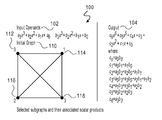
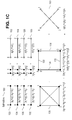
- FIGS. 1A-1C illustrates flow of an embodiment of a process illustrating a 4 by 4 example
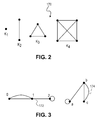
- FIG. 2 illustrates examples of complete graphs
- FIG. 3 illustrates examples of graph isomorphism
- FIG. 4 illustrates graph representations of an embodiment for an 18 by 18 example
- FIG. 5 illustrates a representation of a spanning plane of an embodiment using a local index sequence notation
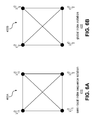
- FIGS. 6A and 6B illustrate a representation of spanning planes of an embodiment using a semi-local index sequence and global index notations
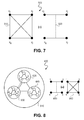
- FIG. 7 illustrates an alternative representation of a spanning plane
- FIG. 8 illustrates another example of a 9 by 9 spanning plane
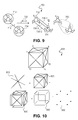
- FIG. 9 illustrates an embodiment representation of edge to spanning edge, and spanning plane mapping
- FIG. 10 illustrates a graphical representation of subtraction generation of an embodiment
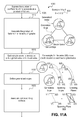
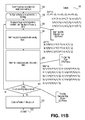
- FIG. 11A-B illustrate a block diagram of an embodiment
- FIG. 12 illustrates comparison of prior art processes with an embodiment
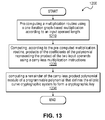
- FIG. 13 is a flowchart illustrating a method for computing a remainder of a carry-less product of two input operands according to one embodiment.
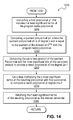
- FIG. 14 is a flowchart illustrating a method for computing a remainder of FIG. 13 according to one embodiment.
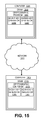
- FIG. 15 illustrates an embodiment of an apparatus in a system.
- a projective space such as the Lopez-Dahab space (J. Lopez and R. Dahab, “Fast Multiplication on Elliptic Curves over GF(2 m ) without Precomputation”, Proceedings, Workshop on Cryptographic Hardware and Embedded Systems (CHES 1999), pg. 316-327, 1999) is used to represent point coordinates, point additions and point doublings are accelerated by introducing a novel way for multiply elements in finite fields of the form GF(2 m ).
- the Lopez-Dahab space J. Lopez and R. Dahab, “Fast Multiplication on Elliptic Curves over GF(2 m ) without Precomputation”, Proceedings, Workshop on Cryptographic Hardware and Embedded Systems (CHES 1999), pg. 316-327, 1999
- elements are multiplied using a CPU instruction for carry-less multiplication (GFMUL) and single iteration Karatsuba-like formulae (M. Kounavis, “A New Method for Fast Integer Multiplication and its Application to Cryptography”, Proceedings, International Symposium on the Performance Evaluation of Computer and Telecommunication Systems (SPECTS 2007), San Diego, Calif., July 2007) for computing the carry-less product of large degree polynomials in GF(2).
- GFMUL carry-less multiplication
- Karatsuba-like formulae M. Kounavis, “A New Method for Fast Integer Multiplication and its Application to Cryptography”, Proceedings, International Symposium on the Performance Evaluation of Computer and Telecommunication Systems (SPECTS 2007), San Diego, Calif., July 2007
- reduction of the carry-less product of these polynomials is performed by recognizing that many curves specify fields with irreducible polynomials which are sparse. For example, National Institute of Standards and Technology (NIST) curves specify polynomials with either three terms (trinomials) or five terms (pentanomials).
- NIST National Institute of Standards and Technology
- One embodiment speeds up Elliptic Curve Diffie Hellman based on the NIST B-233 curve by 55% in software on a 3.6 GHz Pentium 4 processor. If a 3 clock latency GFMUL instruction is introduced to the CPU then the acceleration factor becomes 5.2 ⁇ . Further software optimizations have the potential to increase the speedup beyond 10 ⁇ .
- point multiplication is accelerated for elliptic curves where point coordinates are elements of finite fields of the form GF(2 m ) and a projective space such as the Lopez-Dahab projective space (Lopez and Dahab 1999) is for representing point coordinates to ensure that all basic operations in point multiplication (i.e., point additions and point doublings) involve Galois field additions and multiplications but without division.
- a projective space such as the Lopez-Dahab projective space (Lopez and Dahab 1999) is for representing point coordinates to ensure that all basic operations in point multiplication (i.e., point additions and point doublings) involve Galois field additions and multiplications but without division.
- Our implementation differs from the state-of-the-art (“The OpenSSL Source Code Distribution”, available at: www.openssl.org) by the way Galois field multiplications are implemented.
- Galois Field (GF) multiplications are realized using 4-bit table lookups for 32 or 64-bit carry-less multiplication, recursive Karatsuba for extending the carry-less multiplication to operands of larger sizes and word-by-word reduction of the final product modulo the irreducible polynomial of the field used.
- instruction (GFMUL) that implements the carry-less multiplication of two 64-bit inputs, is used in place of table lookups.
- a novel single iteration extension (Kounavis 2007) to the well known Karatsuba algorithm is applied in order to get the required carry-less multiplication of large inputs (e.g., 233 bitds), using the GFMUL instruction as a building block.
- a method for reducing the result modulo sparse irreducible polynomials helps with improving the overall performance.
- the reduction for the NIST B-233 curve requires no more than 3 256-bit wide shift and 3 256-bit wide XOR operations enabling a single Intel Pentium 4 to execute Elliptic Curve Diffie Hellman 55% faster than the state-of-the-art (OpenSSL n.d.). Moreover, if a 3 clock GFMUL instruction is used then the accelerator factor becomes 5.2 ⁇ . In one embodiment, reduction method eliminates the need for placing field specific-reduction logic into the implementation of a processor instructions. We first describe carry-less multiplication.
- “carry-less multiplication,” also known as Galois Field (GF(2)) Multiplication is the operation of multiplying two numbers without generating or propagating carries.
- the first operand is shifted as many times as the positions of bits equal to “1” in the second operand.
- the product of the two operands is derived by adding the shifted versions of the first operand with each other.
- the carry-less multiplication the same procedure is followed except that additions do not generate or propagate carry. In this way, bit additions are equivalent to the exclusive OR (XOR) logical operation.
- bits of the output C are defined as the following logic functions of the bits of the inputs A and B:
- each of the logic functions of equations (4) and (5) can be implemented using XOR trees.
- the deepest XOR tree is the one implementing the function c n ⁇ 1 which takes n inputs.
- GMMUL Galois Field multiplication
- an XOR tree can be used for building a carry-less multiplier instruction logic of modest input operand size (e.g., 64 bits).
- One embodiment provides a carry-less multiplication for operands of larger sizes by expanding using a fast polynomial multiplication technique which is a generalization of the well known Karatsuba algorithm (Karatsuba and Ofman, 1963) characterized by sub-quadratic complexity as a function of the input operand size while avoiding the cost of recursion.
- This carry-less multiplication instruction is shown in table 1.
- Carry-less multiplication instruction Compat/Leg Instruction 64-bit Mode Mode Description CMUL Valid valid Carry-less Multiply r/m32 ([EDX:EAX] ⁇ EAX * r/ m32) CMUL Valid N.E. Carry-less Multiply r/m64 ([RDX:RAX] ⁇ RAX * r/ m64) Description: This instruction performs carry-less multiplication.
- FIGS. 1A-1C illustrate an example of generating the terms of a 4 by 4 product using graphs to provide a multiplication routine 100 according to an embodiment.
- the input operands 102 are of size 4 words.
- the operand size is the native operand size of a machine, such as a computing device (e.g., a computer).
- the embodiment builds a complete square 110 .
- the vertices ( 112 , 114 , 116 , 118 ) of the square 110 are indexed 0 , 1 , 2 , and 3 as illustrated in FIG. 1A .
- the complete square is constructed in a first part of a process of an embodiment (see FIG. 11A ).
- a set of complete sub-graphs are selected and each sub-graph is mapped to a scalar product (see FIG. 11B ).
- a complete sub-graph connecting vertices i 0 , i 2 , . . . , i m ⁇ 1 is mapped to the scalar product (a i 0 +a i 1 + . . . +a i m ⁇ 1 ) ⁇ (b i 0 +b i 1 + . . . +b i m ⁇ 1 ).
- 1B are the vertices 0 ( 112 ), 1 ( 114 ), 2 ( 116 ) and 3 ( 118 ), the edges 0 - 1 ( 130 ), 2 - 3 ( 132 ), 0 - 2 ( 134 ) and 1 - 3 ( 136 ), and the entire square 0 - 1 - 2 - 3 ( 138 ).
- the scalar products defined in the second part of the process are a 0 b 0 ( 122 ), a 1 b 1 ( 124 ), a 2 b 2 ( 126 ), a 3 b 3 ( 128 ), (a 0 +a 1 )(b 0 +b 1 ) 140 , (a 2 +a 3 )(b 2 +b 3 ) 142 , (a 0 +a 2 )(b 0 +b 2 ) 144 , (a 1 +a 3 )(b 1 +b 3 ) 146 , and (a 0 +a 1 +a 2 +a 3 )(b 1 +b 1 +b 2 +b 3 ) 148 .
- a number of subtractions are performed (see FIG. 1C and FIG. 11B , 1165 ).
- FIG. 1C illustrates an example of subtraction process 150 where the edges 0 - 1 and 2 - 3 ( 130 and 132 with their adjacent vertices), and 0 - 2 and 1 - 3 ( 134 and 136 without their adjacent vertices) are subtracted from the complete square 0 - 1 - 2 - 3 138 .
- These diagonals 160 correspond to the term a 1 b 2 +a 2 b 1 +a 3 b 0 +a 0 b 3 , which is the coefficient of x 3 of the result.
- the differences produced by the subtractions of sets of formulae ( 110 , 120 , 150 ) represent diagonals of complete graphs where the number of vertices in these graphs is a power of 2 (i.e., squares, cubes, hyper-cubes, etc.).
- N represents the size of the input (i.e., the number of terms in each input polynomial).
- N is the product of L integers n 0 , n 1 , . . . , n L ⁇ 1 .
- the number L represents the number of levels of multiplication.
- N n 0 ⁇ n 1 ⁇ . . . ⁇ n L ⁇ 1 (6)
- the set of graphs of level l is represented as G (l) .
- the cardinality of the set G (l) is represented as
- the i-th element of the set G (l) is represented as G i (l) .
- Each set of graphs G (l) has a finite number of elements.
- the cardinality of the set G (l) is defined as:
- G (l) ⁇ G i (l) : i ⁇ [ 0 ,
- a complete graph K a is a graph consisting of a vertices indexed 0 , 1 , 2 , . . . , a ⁇ 1 , where each vertex is connected with each other vertex of the graph with an edge.
- FIG. 2 illustrates examples of complete graphs 170 .
- Two graphs A and B are called isomorphic if there exists a vertex mapping function f v and an edge mapping function f e such that for every edge e of A the function f v maps the endpoints of e to the endpoints of f e (e). Both the edge f e (e) and it endpoints belong to graph B.
- FIG. 3 illustrates an example of two isomorphic graphs.
- an element of the set G (l) can be indexed in two ways.
- One way is by using a unique index i which can take all possible values between 0 and
- Such an element is represented as G i (l) .
- This way of representing graphs is denoted as a ‘global index’. That is, the index used for representing a graph at a particular level is called global index.
- Another way to index the element G i (l) is by using a set of l indexes i 0 , i 1 , . . . , i l ⁇ 1 , with l>0.
- This type of index sequence is denoted as a ‘local index’ sequence.
- the local index sequence consists of one index only, which is equal to zero.
- the local indexes i 0 , i 1 , . . . , i l ⁇ 1 are related with the global index i of a particular element G i (l) in a manner illustrated in equation (9).
- i ((( i 0 ⁇ n 1 )+ i 1 ) ⁇ n 2 +i 2 ) ⁇ n 3 + . . . +i l ⁇ 1 (9)
- Equation (9) can also be written in closed form as:
- the local indexes i 0 , i 1 , . . . , i l ⁇ 1 satisfy the following inequalities: 0 ⁇ i 0 ⁇ n 0 ⁇ 1 0 ⁇ i 1 ⁇ n 1 ⁇ 1 . . . 0 ⁇ i l ⁇ 1 ⁇ n l ⁇ 1 (11)
- the value of a global index i related to a local index sequence i 0 , i 1 , . . . , i l ⁇ 1 is between 0 and
- i is a non-decreasing function of i 0 , i 1 , . . . , i l ⁇ 1 . Therefore, the smallest value of i is produced by setting each local index equal to zero. Therefore, the smallest i is zero.
- each local index i 0 , i 1 , . . . , i l ⁇ 1 The highest value of i is obtained by setting each local index i 0 , i 1 , . . . , i l ⁇ 1 to be equal to its maximum value. Substituting each local index i j with n j ⁇ 1 for 0 ⁇ j ⁇ l ⁇ 1 results in:
- V (i 0 )(i 1 ) . . . (i l ⁇ 1 ) (l) ⁇ v (i 0 )(i 1 ) . . . (i l ⁇ 1 )(i l ) (l) : 0 ⁇ i l ⁇ n l ⁇ 1 ⁇ (15)
- a second way to represent the vertices of a graph is using a ‘semi-local’ index sequence notation.
- a semi-local index sequence consists of a global index of a graph and a local index associated with a vertex.
- the i l -th vertex of a graph G i (l) is represented as v i,i l (l) , where 0 ⁇ i l ⁇ n l ⁇ 1.
- a unique global index i g ⁇ i ⁇ n l +i l is assigned for each vertex v i,i l (l) . It is shown that 0 ⁇ i g ⁇
- the global index i g of a vertex is associated with a local index sequence i 0 , i 1 , . . . , i l ⁇ 1 , i l .
- the indexes i 0 , i 1 , . . . , i l ⁇ 1 characterize the graph that contains the vertex whereas the index i l characterizes the vertex itself.
- the relationship between i g and i 0 , i 1 , . . . i l ⁇ 1 , i l is given in equation (17):
- a global index i g associated with some vertex of a graph at level l has an one-to-one correspondence to a unique sequence of local indexes i 0 , i 1 , . . . , i l ⁇ 1 , i l satisfying identity (12), the inequalities (6) and 0 ⁇ i l ⁇ n l ⁇ 1.
- the set of all vertices of a graph G i (l) (or G i 0 )(i l ) . . . (i l ⁇ 1 ) (l) ) is defined as:
- the edge which connects two vertices v j (l) and v k (l) of a graph at level l is represented as e j ⁇ k (l) . If two vertices v i,i l (l) and v′ i,i l (l) are represented using the semi-local index sequence notation, the edge which connects these two vertices is represented as e i,i l ⁇ i,i′ l (l) . Finally, if two vertices v (i 0 )(i 1 ) . . . (i l ⁇ 1 )(i l ) (l) and v (i 0 )(i 1 ) . . .
- the notation used for edges between vertices of different graphs of the same level is the same as the notation used for edges between vertices of the same graph.
- an edge connecting two vertices v (i 0 )(i 1 ) . . . (i l ⁇ 1 )(i l ) (l) and v (i′ 0 )(i′ 1 ) . . . (i′ l ⁇ 1 )(i′ l ) (l) which are represented using the local index sequence notation is denoted as e (i 0 )(i 1 ) . . . (i l ⁇ 1 )(i l ) ⁇ (i′ 0 )(i′ 1 ) . . . (i′ l ⁇ 1 )(i′ l ) (l) .
- alternative notations for the sets of vertices and edges of a graph G are V(G) and E(G) respectively.
- the term ‘simple’ from graph theory is used to refer to graphs, vertices and edges associated with the last level L ⁇ 1.
- the graphs, vertices and edges of all other levels l, l ⁇ L ⁇ 1 are referred to as ‘generalized’.
- the level associated with a particular graph G, vertex v or edge e is denoted as l(G), l(v) or l(e) respectively.
- a vertex to graph mapping function f v ⁇ G is defined as a function that accepts as input a vertex of a graph at a particular level l, l ⁇ L ⁇ 1 and returns a graph at a next level l+1 that is associated with the same global index or local index sequence as the input vertex.
- f v ⁇ g ( v i,i l (l) ) G n l ⁇ i+i l (l+1) (23)
- a graph to vertex mapping function f g ⁇ v is defined as a function that accepts as input a graph at a particular level l, l>0 and returns a vertex at a previous level l ⁇ 1 that is associated with the same global index or local index sequence as the input graph.
- f g ⁇ v ( G i (l) ) v ⁇ i/n l ⁇ 1 ⁇ , i mod n l ⁇ 1 (l ⁇ 1) (26)
- each vertex of a graph is represented as a circle.
- a graph is drawn at the next level, which maps to the vertex represented by the circle.
- FIG. 4 illustrates how the graphs 200 are drawn and defined for an 18 by 18 multiplication.
- N 18.
- spanning is overloaded from graph theory.
- the term spanning is used to refer to edges or collections of edges that connect vertices of different graphs at a particular level.
- a spanning plane is defined as a graph resulting from the join ‘+’ operation between two sub-graphs of two different graphs of the same level.
- Each of the two sub-graphs consists of a single edge connecting two vertices.
- Such two sub-graphs are described below: ⁇ v (i 0 )(i 1 ) . . . (i l ⁇ 1 )(i l ) (l) , v (i 0 )(i 1 ) . . . (i l ⁇ 1 )(î l ) (l) ⁇ , e (i 0 )(i 1 ) . . .
- the join operation ‘+’ between two graphs is defined as a new graph consisting of the two operands of ‘+’ plus new edges connecting every vertex of the first operand to every vertex of the second operand.
- vertices and edges are represented using the local index sequence notation.
- i′ i 0 ⁇ n 1 ⁇ n 2 ⁇ . . . ⁇ n l ⁇ 1 +i 1 ⁇ n 2 ⁇ . . . ⁇ n l ⁇ 1 + . . . +i′ q ⁇ n q+1 ⁇ . . . ⁇ n l ⁇ 1 + . . . +i l ⁇ 2 ⁇ n l ⁇ 1 +i l ⁇ 1 (34)
- global index notation is used for representing a spanning plane.
- the index i in identity (31) is given by identity (5) whereas the index i′ in (31) is given by identity (29).
- a pictorial representation of spanning planes 400 ( 400 A, 400 B) using the semi-local index sequence 410 and global index notations 420 is given in FIGS. 6A and 6B .
- FIG. 7 an alternative pictorial representation of a spanning plane 500 used as illustrated in FIG. 7 .
- the vertices shown in FIG. 7 are represented using the global index notation. The level of the vertices is omitted for simplicity.
- FIG. 8 An example of a spanning plane 600 is illustrated in FIG. 8 .
- the example shows the graphs 610 built for a 9-by-9 multiplication and the global indexes of all simple vertices.
- the example also shows the spanning plane 660 defined by the edges e 1-2 (1) and e 4-5 (1) .
- a spanning edge is an edge that connects two vertices v (i 0 )(i 1 ) . . . (i l ⁇ 1 )(i l ) (l) and v (i′ 0 )(i′ 1 ) . . . (i′ l ⁇ 1 )(i′ l ) (l) of different graphs of the same level.
- mappings defined between edges, spanning edges and spanning planes are introduced.
- corresponding is used to refer to vertices of different graphs of the same level that are associated with the same last local index.
- Two edges of different graphs of the same level are called ‘corresponding’ if they are connecting corresponding endpoints.
- a generalized edge i.e., an edge of a graph G i (l) , 0 ⁇ l ⁇ L ⁇ 1 or a spanning edge can map to a set of spanning edges and spanning planes through a mapping function f e ⁇ s .
- the function f e ⁇ s accepts as input an edge (if it is a spanning edge, the endpoints are excluded) and returns the set of all possible spanning edges and spanning planes that can be considered between the corresponding vertices and edges of the graphs that map to the endpoints of the input edge through the function f v ⁇ g .
- the generalized edge e 710 (its level and indexes are omitted for simplicity) connects two vertices ( 712 , 714 ) that map to the triangles 0 - 1 - 2 732 and 3 - 4 - 5 734 .
- This mapping is done through the function f v ⁇ g .
- Edge e 710 maps to three spanning edges 730 and three spanning planes 740 as shown in FIG. 9 through the function f e ⁇ s .
- the spanning edges 730 are those connecting the vertices with global indexes 0 and 3 730 - 1 , 1 and 4 730 - 2 , and 2 and 5 730 - 3 respectively.
- the spanning planes 740 are those which are produced by the join operation between edges 0 - 1 and 3 - 4 , 0 - 2 and 3 - 5 , and 1 - 2 and 4 - 5 respectively.
- mapping f e ⁇ s e is defined between edges and spanning edges only and the mapping f e ⁇ s p is defined between edges and spanning planes only.
- mappings between sets of vertices and products are defined.
- the coefficients of the polynomials a(x) and b(x) are real or complex numbers. In other embodiments the coefficients of the polynomials a(x) and b(x) are elements of a finite field.
- V ⁇ v i 0 , v i 1 , . . . , v i m ⁇ 1 ⁇ (47)
- V The elements of V are described using the global index notation and their level is omitted for the sake of simplicity.
- the product generation process accepts as input two polynomials of degree N ⁇ 1 as shown in equation (46).
- the degree N of the polynomials can be factorized as shown in equation (6).
- GENERALIZED_EDGE_PROCESS( ) 1. for l ⁇ 0 to L ⁇ 2 2. do for i ⁇ 0 to
- the process GENERALIZED_EDGE_PROCESS( ) processes each generalized edge from the set G (l) one-by-one. If the level of a generalized edge is less than L ⁇ 2, then the procedure GENERALIZED_EDGE_PROCESS( ) invokes two other processes for processing the spanning edges and spanning planes associated with the generalized edge. The first of the two, SPANNING_EDGE_PROCESS( ), is shown below in pseudo code:
- SPANNING_PLANE_PROCESS( ) The second process, SPANNING_PLANE_PROCESS( ), is shown below in pseudo code:
- EXPAND_VERTEX_SETS( ) is shown below in pseudo code.
- the notation g(v) is used to refer to the global index of a vertex v.
- EXPAND_VERTEX_SETS( V ) 1. V r ⁇ ⁇ 2. for every V′ ⁇ V 3. do V r ⁇ V r ⁇ EXPAND_SINGLE_VERTEX_SET(V′) 4. return V r
- EXPAND_SINGLE_VERTEX_SET(V) 1. V r ⁇ ⁇ 2. let v ⁇ V 3. l ⁇ l(v) 4. for p ⁇ 0 to n l+1 ⁇ 1 5. do for q ⁇ 0 to n l+1 ⁇ 1 6. do if p q 7. then 8. continue 9. else 10.
- each generalized edge is decomposed into its associated spanning edges and spanning planes. This occurs in lines 9 and 10 of the process GENERALIZED_EDGE_PROCESS( ).
- a spanning edge connects simple vertices. If it does, the process computes the product associated with the spanning edge from the global indexes of the endpoints of the edge. This occurs in line 14 of the process GENERALIZED_EDGE_PROCESS( ). If a spanning edge does not connect simple vertices, this spanning edge is further decomposed into its associated spanning edges and spanning planes. This occurs in lines 2 and 3 of the process SPANNING_EDGE_PROCESS( ). For each resulting spanning edge that is not at the last level the process SPANNING_EDGE_PROCESS( ) is performed recursively. This occurs in line 10 of the process SPANNING_EDGE_PROCESS( ).
- the process expands these generalized vertices into graphs and creates sets of corresponding vertices and edge endpoints. This occurs in lines 14 and 21 of the process EXPAND_SINGLE_VERTEX_SET( ). For each such set the expansion is performed down to the last level. This occurs in lines 7-9 of the process SPANNING_PLANE_PROCESS( ).
- the first type includes all products created from simple vertices.
- a second type of products includes those products formed by the endpoints of simple edges.
- a third type of products includes all products formed by endpoints of spanning edges. These spanning edges result from recursive spanning edge decomposition down to the last level L ⁇ 1.
- a fourth type of products includes those products formed from spanning planes after successive vertex set expansions have taken place.
- the set P 4 a consists of all products formed from sets of vertices characterized by identical local indexes apart from those indexes at some index positions q 0 , q 1 , . . . , q m ⁇ 1 .
- vertices take all possible different values from among the pairs of local indexes: (i q 0 , i′ q 0 ), (i q 1 , i′ q 1 ), . . . , (i q m ⁇ 1 , i′ q m ⁇ 1 ). All possible 2 m local index sequences formed this way are included into the specification of the products of the set P 4 a .
- the number of index positions m for which vertices differ needs to be greater than, or equal to 2.
- the structure of the set P 4 a is very similar to the structure of the set of all products generated by our process
- Equation (58) is identical to equation (57) with one exception:
- the number of index positions m for which vertices differ may also take the values 0 and 1.
- P a ⁇ P ( ⁇ v (i 0 ) . . . (i q0 ) . . . (i q1 ) . . .
- equation (58) is in a closed form that can be used for generating the products without performing spanning plane and spanning edge decomposition.
- all local index sequences defined in equation (58) are generated and form the products associated with these local index sequences.
- the set P 1 a contains all products formed by sets which contain a single vertex only. Each single vertex is characterized by some arbitrary local index sequence. Hence the cardinality
- the set P 2 a contains products formed by sets which contain two vertices. These vertices are characterized by identical local indexes for all index positions apart from the last one L ⁇ 1. Since the number of all possible pairs of distinct values that can be considered from 0 to n L ⁇ 1 ⁇ 1 is n L ⁇ 1 ⁇ (n L ⁇ 1 ⁇ 1)/2, the cardinality of the set P 2 a is equal to:
- the set P 3 a contains products formed by sets which contain two vertices as well.
- the products of the set P 3 a are formed differently from P 2 a , however.
- the vertices that form the products of P 3 a are characterized by identical local indexes for all index positions apart from one position between 0 and L ⁇ 2. Since the number of all possible pairs of local index values the can be considered for an index position j is n j ⁇ (n j ⁇ 1)/2, the cardinality of the set P 3 a , is equal to:
- the number of products generated by an embodiment process is equal to the number of multiplication performed by using a generalized recursive Karatsuba process. It should be noted that the number of products generated by an embodiment process is substantially smaller than the number of scalar multiplication performed by the one-iteration Karatsuba solution of Paar and Weimerskirch (A. Weimerskirch and C. Paar, “Generalizations of the Karatsuba Algorithm for Efficient Implementations”, Technical Report , University of Ruhr, Bochum, Germany, 2003), which is N ⁇ (N+1)/2.
- î q pk ⁇ 1 is defined as the product that derives from p by setting the local indexes of all vertices of p to be equal to î q p0 , î q p1 , . . . , î q pk ⁇ 1 at the occupied index positions, and by allowing the indexes at the free positions to take any value between i q f0 and i′ q f0 , and i′ q f1 , . . . , i q fm ⁇ k ⁇ 1 and i′ q fm ⁇ k ⁇ 1 .
- the sets of the free and occupied index positions satisfy the following conditions: ⁇ q f 0 , q f 1 , . . . , q f m ⁇ k ⁇ 1 ⁇ q 0 , q 1 , . . . , q m ⁇ 1 ⁇ , ⁇ q p 0 , q p 1 , . . . , q p k ⁇ 1 ⁇ q 0 , q 1 , . . . , q m ⁇ 1 ⁇ , ⁇ q f 0 , q f 1 , . . . .
- indexes for the occupied positions î q p0 , î q p1 , . . . , î q pk ⁇ 1 satisfy: î q p0 ⁇ i q p0 ,i′ q p0 ⁇ , î q p1 ⁇ i q p1 ,i′ q p1 ⁇ , . . . , î q pk ⁇ 1 ⁇ i q pk ⁇ 1 ,i′ q pk ⁇ 1 ⁇ (70)
- u u q f 0 , q f 1 , ⁇ ... ⁇ , q f m - k - 1 ; q p 0 , q p 1 , ⁇ ... ⁇ , q p k - 1 p ; m - k ; i ⁇ q p 0 , i ⁇ q p 1 , ⁇ ... ⁇ , i ⁇ q p k - 1 is defined as the surface associated with the product p, occupied index positions q p 0 , q p 1 , . . .
- ⁇ ( u ) u q f 0 , q f 1 , ⁇ ... ⁇ , q f m - k - 1 , q p k - 1 ; ⁇ q p 0 , q p 1 , ⁇ ... ⁇ , q p k - 2 p ; m - k + 1 ; i ⁇ q p 0 , i ⁇ q p 1 , ⁇ ... ⁇ , i ⁇ p k - 2 ( 74 )
- a process that generates subtraction formulae uses a matrix M which size is equal to the cardinality of P a , i.e., the number of all products generated by the procedure CREATE_PRODUCTS( ).
- the cardinality of P a is also equal to the number of unique surfaces that can be defined in all possible dimensions for all products of P a . This is because each surface of a product is also a product by itself.
- the matrix M is initialized as M[p] ⁇ p, or equivalently M[u] ⁇ u. Initialization takes place every time a set of subtractions is generated for a product p of P a .
- Subtractions are generated by a generate subtractions process GENERATE_SUBTRACTIONS( ), which pseudo code is listed below.
- the subtraction formulae which are generated by generate subtractions process GENERATE_SUBTRACTIONS( ) are returned in the set S a .
- ⁇ (p) the final value of the table entry M[p] after the procedure GENERATE_SUBTRACTIONS_FOR_PRODUCT( ) is executed for the product p. It can be seen that ⁇ (p) is in fact the product p minus all surfaces of p defined in the m ⁇ 1 dimensions, plus all surfaces of p defined in the m ⁇ 2 dimensions, . . . , minus (plus) all surfaces of p defined in 0 dimensions (i.e., products of single vertices). By m it is meant that the number of free index positions of p.
- This graph 800 has the shape of a cube but it also contains the diagonals that connect every other vertex, as shown in FIG. 10 .
- the product has 6 associated surfaces defined in 2 dimensions, 12 surfaces defined in 1 dimension and 8 surfaces defined in 0 dimensions.
- the surfaces defined in 2 dimensions are the products (a 0 +a 1 +a 6 +a 7 ) ⁇ (b 0 +b 1 +b 6 +b 7 ), (a 0 +a 1 +a 9 +a 10 ) ⁇ (b 0 +b 1 +b 9 +b 10 ), (a 6 +a 7 +a 15 +a 16 ) ⁇ (b 6 +b 7 +b 15 +b 16 ), (a 9 +a 10 +a 15 +a 16 ) ⁇ (b 9 +b 10 +b 15 +b 16 ), (a 1 +a 7 +a 10 +a 16 ) ⁇ (b 1 +b 7 +b 10 +b 16 ), and (a 0 +a 6 +a 9 +a 15 ) ⁇ (b 0 +b 6 +b 9 +b 15 ).
- the surfaces defined in a single dimension are the products (a 0 +a 1 ) ⁇ (b 0 +b 1 ), (a 0 +a 6 ) ⁇ (b 0 +b 6 ), (a 1 +a 7 ) ⁇ (b 1 +b 7 ), (a 6 +a 7 ) ⁇ (b 6 +b 7 ), (a 9 +a 10 ) ⁇ (b 9 +b 10 ), (a 9 +a 15 ) ⁇ (b 9 +b 15 ), (a 10 +a 16 ) ⁇ (b 10 +b 16 ), (a 15 +a 16 ) ⁇ (b 15 +b 16 ), (a 1 +a 10 ) ⁇ (b 1 +b 10 ), (a 0 +a 9 ) ⁇ (b 0 +b 9 ), (a 7 +a 16 ) ⁇ (b 7 +b 16 ), and (a 6 +a 15 ) ⁇ (b 6 +b 15 ).
- every term ⁇ (p) produced by the subtractions of the process GENERATE_SUBTRACTIONS( ) is part of one coefficient of a Karatsuba output c(x). It is also shown that for two different products p, ⁇ tilde over (p) ⁇ P a , the terms ⁇ (p) and ⁇ ( ⁇ tilde over (p) ⁇ ) do not include common terms of the form a i 1 ⁇ b i 2 +a i 2 ⁇ b i 1 .
- each term of the form a I 1 b I 2 +a I 2 ⁇ b I 1 of every coefficient of the Karatsuba output c(x) is part of some term ⁇ (p) resulting from a product p ⁇ P a .
- I 1 i 0 ⁇ n 1 ⁇ . . . ⁇ N L ⁇ 1 + . . . +î q 0 ⁇ n q 0 +1 ⁇ . . . ⁇ n l ⁇ 1 + . . . +î q m ⁇ 1 ⁇ n q m ⁇ 1 +1 ⁇ . . . ⁇ n l ⁇ 1 + . . . +i L ⁇ 1
- I 2 i 0 ⁇ n 1 ⁇ .
- ⁇ (p) is the sum of all terms of the form a I 1 ⁇ b I 2 +a I 2 ⁇ b I 1 such that the global index I 1 in each term a I 1 ⁇ b I 2 +a I 2 ⁇ b I 1 is created by selecting some local index values î q 0 , . . . , î q m ⁇ 1 from among ⁇ i q 0 ,i′ q 0 ⁇ , . . . , ⁇ i q m ⁇ 1 ,i′ q m ⁇ 1 ⁇ , whereas the global index I 2 in the same term is created by selecting those local index values not used by I 1 .
- the product p is the sum of terms which are either of the form a I 1 ⁇ b I 2 +a I 2 ⁇ b I 1 or a I 1 ⁇ b I 1 .
- the term ⁇ (p) is derived from p by sequentially subtracting and adding surfaces of m ⁇ 1, m ⁇ 2, . . . , 0 dimensions. These surfaces are also sums of terms of the forms a I 1 ⁇ b I 2 +a I 2 ⁇ b I 1 or a I 1 ⁇ b I 1 (from equation (71)).
- every term of the forms a I 1 ⁇ b I 2 +a I 2 ⁇ b I 1 or a I 1 ⁇ b I 1 of every surface of p is included in p.
- ⁇ (p) does not contain terms of the form a I 1 ⁇ b I 1 and that the terms of the form a I 1 ⁇ b I 2 +a I 2 ⁇ b I 1 satisfy equation (76).
- equation (76) Assume for the moment that there exist a term a I 1 ⁇ b I 2 +a I 2 ⁇ b I 1 in ⁇ (p) that does not satisfy equation (76).
- this term there exists a subset of local index positions ⁇ q e 0 , q e 1 , . . . , q e l ⁇ 1 ⁇ ⁇ q 0 , q 1 . . . , q m ⁇ 1 ⁇ for which the global indexes I 1 and I 2 are associated with the same local index values. Because of this reason this term is part of
- N L ⁇ ( l l ) - ( l l - 1 ) + ( l l - 2 ) - ... + ( - 1 ) l ⁇ ( l l ) - ( - 1 ) l ⁇ ( l 0 ) ⁇ ( 77 )
- ⁇ (p) contains all possible terms of the form a I 1 ⁇ b I 2 +a I 2 ⁇ b I 1 by that satisfy equation (76). This is because these terms are part of p and they are not included into any surface of p. Therefore, these terms are not subtracted out when ⁇ (p) is derived.
- ⁇ (p) is a sum of terms of the form a I 1 ⁇ b I 2 +a I 2 ⁇ b I 1 that satisfy equation (76).
- I 1 +I 2 i c for every term a I 1 +b I 2 +a I 2 ⁇ b I 1 .
- i c 2 ⁇ i 0 ⁇ n 1 ⁇ n 2 ⁇ ... ⁇ n L - 1 + ... + ( i q 0 + i q 0 ′ ) ⁇ n q 0 + 1 ⁇ n q 0 + 2 ⁇ ... ⁇ n L - 1 + ⁇ ... + ( i q 1 + i q 1 ′ ) ⁇ n q 1 + 1 ⁇ n q 1 + 2 ⁇ ...
- both p and ⁇ tilde over (p) ⁇ are characterized by at least one free index position and that there exist two terms a I 1 ⁇ b I 2 +a I 2 ⁇ b I 1 and a ⁇ 1 ⁇ b ⁇ 2 +a ⁇ 2 ⁇ b ⁇ 1 from ⁇ (p) and ⁇ ( ⁇ tilde over (p) ⁇ ) respectively that are equal.
- Equality of global indexes means equality of their associated sequences of local indexes.
- the local index positions for which I 1 and I 2 (or ⁇ 1 and ⁇ 2 ) differ are free index positions for both p and ⁇ tilde over (p) ⁇ . On the other hand, all other local index positions must be occupied.
- Every term of the form a I 1 ⁇ b I 2 +a I 2 ⁇ b I 1 of a coefficient of the Karatsuba output is part of a term ⁇ (p) for some product p ⁇ P a .
- the global indexes I 1 and I 2 can be converted into 2 local index sequences. These sequences will be identical for some local index positions and different for others.
- a product p can be completely defined in this case from I 1 and I 2 by specifying the local index positions for which I 1 and I 2 differ as free and all others as occupied.
- the pairs of local index values for which I 1 and I 2 differ are specified at the free index positions of all vertices of the product p, whereas the local index values which are in common between I 1 and I 2 are specified at the occupied positions. From the manner in which the product p is specified it is evident that ⁇ (p) contains the term a I 1 ⁇ b I 2 +a I 2 ⁇ b I 1 .
- Additions connect the “a” terms and the “b” terms 6 , 7 and 8 in order to form the nodes of the triangle 6 - 7 - 8 .
- Additions connect the “a” terms and the “b” terms 3 , 4 and 5 to form the triangle 3 - 4 - 5 .
- Additions connect the “a” terms and the “b” terms 0 , 1 and 2 to form the triangle 0 - 1 - 2 .
- Additions connect 1-by-1 the “a” and “b” terms 6 - 7 - 8 and 3 - 4 - 5 .
- Additions connect 1-by-1 the “a” and “b” terms 6 - 7 - 8 and 0 - 1 - 2 . Additions connect 1-by-1 the “a” and “b” terms 3 - 4 - 5 and 0 - 1 - 2 . Additions create the spanning planes associated the edges of the triangles 6 - 7 - 8 and 3 - 4 - 5 . Additions create the spanning planes associated with the edges of the triangles 6 - 7 - 8 and 0 - 1 - 2 . Additions create the spanning planes associated with the edges of the edges of the triangles 3 - 4 - 5 and 0 - 1 - 2 .
- Multiplications create the nodes of the triangles 0 - 1 - 2 , 3 - 4 - 5 , and 6 - 7 - 8 .
- Multiplications create the edges of the triangle 6 - 7 - 8 .
- Multiplications create the edges of the triangle 3 - 4 - 5 .
- Multiplications create the edges of the triangle 0 - 1 - 2 .
- Multiplications create the edges that connect the nodes of the triangles 6 - 7 - 8 and 3 - 4 - 5 .
- Multiplications create the edges that connect the nodes of the triangles 6 - 7 - 8 and 0 - 1 - 2 .
- Multiplications create the edges that connect the nodes of the triangles 3 - 4 - 5 and 0 - 1 - 2 .
- Multiplications create the spanning planes that connect the edges of the triangles 6 - 7 - 8 and 3 - 4 - 5 .
- Multiplications create the spanning planes that connect the edges of the triangles 6 - 7 - 8 and 0 - 1 - 2 .
- Multiplications create the spanning planes that connect the edges of the triangles 3 - 4 - 5 and 0 - 1 - 2 .
- Subtractions are performed, associated with the edges of the triangle 6 - 7 - 8 . Subtractions are performed, associated with the edges of the triangle 3 - 4 - 5 . Subtractions are performed, associated with the edges of the triangle 0 - 1 - 2 . Subtractions are performed, associated with the edges that connect the nodes of the triangles 6 - 7 - 8 and 3 - 4 - 5 . Subtractions are performed, associated with the edges that connect the nodes of the triangles 6 - 7 - 8 and 0 - 1 - 2 . Subtractions are performed, associated with the edges that connect the nodes of the triangles 3 - 4 - 5 and 0 - 1 - 2 .
- Subtractions are performed, associated with the spanning planes that connect the edges of the triangles 6 - 7 - 8 and 3 - 4 - 5 .
- Subtractions are performed, associated with the spanning planes that connect the edges of the triangles 6 - 7 - 8 and 0 - 1 - 2 .
- subtractions are performed, associated with the spanning planes that connect the edges of the triangles 3 - 4 - 5 and 0 - 1 - 2 .
- FIGS. 11A-B illustrates a block diagram and graphical illustration of process of an embodiment.
- Process 1000 starts with block 1105 where the number of coefficients of operands are expressed as a product of factors. It should be noted that the graphical illustration is an example for a 9 ⁇ 9 operation.
- each of the factors is associated with a level in a hierarchy of interconnected graphs.
- a fully connected graph i.e., generalized graphs having generalized vertices and generalized edges
- At the last level of the hierarchy there exist simple graphs with simple interconnected vertices and simple edges.
- each simple vertex is associated with a global index and a last level local index.
- generalized edges are defined consisting of a number of spanning edges and spanning planes.
- a spanning edge is an edge between two corresponding generalized (or simple) vertices. Corresponding vertices are associated with the same last level local index but different global indexes.
- a spanning plane is a fully connected graph interconnecting four generalized (or simple) vertices.
- Block 1135 starts a loop between blocks 1040 , 1045 , 1050 and 1060 , where each block is performed for all generalized edges at each level.
- a generalized edge is decomposed into its constituent spanning edges and spanning planes.
- the products associated with spanning edges are determined. If a spanning edge connects simple vertices, the product associated with the edge from the global indexes of the edge's adjacent vertices is formed. Otherwise the products associated with spanning edges are determined by treating each spanning edge as a generalized edge and applying a generalized edge process (blocks 1040 and 1045 ) recursively.
- process 1010 examines if the vertices of the plane are simple or not. If they are simple, the product associated with the global indexes of the planes vertices is formed and returned. If the vertices are not simple, the generalized vertices are expanded into graphs and sets of corresponding vertices and edges are created. Corresponding edges are edges interconnecting vertices with the same last level local index but different global index. For each set, the vertices which are elements of the set are used for running the spanning plane process (block 1050 ) recursively.
- block 1060 it is determined whether the last generalized edge has been processed by blocks 1040 , 1045 and 1050 . If the last edge has not been processed, process 1010 returns to block 1040 . If the last edge has been processed, process 1010 continues with block 1065 . In block 1065 , for all the graphs associated with products created, (i.e., edges, squares, cubes, hyper-cubes, etc.) the periphery is subtracted and the diagonals are used to create coefficients of a final product. Process 1010 then proceeds with returning the final product at 1070 .
- the periphery is subtracted and the diagonals are used to create coefficients of a final product.
- Carry-less big number multiplication is used by popular cryptographic algorithms like Rivest, Shamir, & Adleman (RSA).
- the embodiment processes avoid the cost of recursion.
- the embodiments correlate between graph properties (i.e. vertices, edges and sub-graphs) and the Karatsuba-like terms of big number multiplication routines and these embodiments generate and use one iteration Karatsuba-like multiplication processes for any given operand size which require the same scalar operations as recursive Karatsuba, without recursion.
- Embodiments are associated with the least possible number of ‘scalar’ multiplications.
- scalar multiplications it is meant multiplications between ‘slices’ of big numbers or coefficients of polynomials.
- the embodiments can generate optimal, ‘one-iteration’, Karatsuba-like formulae using graphs. Reduction of the carry big number multiplication modulo an irreducible polynomial that defines an EC-crypto system is now described
- FIG. 13 is a flowchart illustrating a method for computing a remainder of a carry-less product of two polynomials of large degree modulo an irreducible polynomial that defines a cryptographic system, according to one embodiment.
- a multiplication routine is pre-computed using a one iteration based multiplication according to an input operand length.
- the graph-based multiplication routine may be performed according to any of the embodiments illustrated with reference to FIGS. 1-11 .
- products of the coefficients of a polynomial representing the product of two input operands are computed according to the pre-computed multiplication routine using a carry-less multiplication instruction available from an architecture.
- the carry-less multiplication is directionless, for example, a 64-bit/32-bit carry-less multiplication instruction, for example, as shown in Table 1.
- a remainder of the carry-less product polynomial modulo a programmable polynomial is computed where the programmable polynomial defines the elliptic curve cryptographic system and the remainder forms a cryptographic key.
- a method for computing the remainder of the carry-less product is illustrated with reference to the flowchart of FIG. 14 .
- to reduce the carry-less product of two polynomials of large degree we split it into two parts of equal length.
- the least significant half is just XOR-ed with the final remainder.
- one embodiment realizes division via two multiplications.
- This algorithm can be seen as an extension of the Barrett (P. Barrett, “Implementing the Revest, Shamir and Adleman Public Key Encryption Algorithm on a Standard Digital Signal Processor”, Master's Thesis , University of Oxford, UK, 1986) reduction algorithm to modulo-2 arithmetic or the Feldmeier CRC generation algorithm (D.
- c ( x ) c s ⁇ 1 x s ⁇ 1 +c s ⁇ 2 x s ⁇ 2 + . . . +c 1 x+c 0
- p ( x ) p t ⁇ 1 x t ⁇ 1 +p t ⁇ 2 x t ⁇ 2 + . . . +p 1 x+p 0
- g ( x ) g t x t +g t ⁇ 1 x t ⁇ 1 + . . . +g 1 x+g 0 (81)
- L u (v) the coefficients of the u least significant terms of the polynomial v
- M u (v) the coefficients of its u most significant terms.
- Equation (82) is that the t least significant terms of the dividend c(x) ⁇ x t equal zero.
- q + is an s-degree polynomial equal to the quotient from the division of x t+s with g and p + is the remainder from this division.
- the degree of the polynomial p + is t ⁇ 1.
- the s most significant terms of the polynomial c ⁇ g ⁇ q + are equal to the s most significant terms of the polynomial g ⁇ M s (c ⁇ q + ) ⁇ x s .
- the polynomial M s (c ⁇ q + ) ⁇ x s results from c ⁇ q + by replacing the s least significant terms of this polynomial with zeros.
- the s most significant terms of the polynomial c ⁇ g ⁇ q + are calculated by adding the s most significant terms of the polynomial c ⁇ q + with each other in as many offset positions as defined by the terms of the polynomial g.
- the s most significant terms of c ⁇ g ⁇ q + do not depend on the s least significant terms of c ⁇ q + , and consequently,
- Equation (95) indicates the algorithm for computing the polynomial p may be performed as described with reference to FIG. 14 .
- FIG. 14 is a flowchart illustrating a method for computing and reducing a remainder of the carry-less product polynomial modulo, a programmable polynomial of process block 1230 of FIG. 13 according to one embodiment.
- process blocks 1240 and 1260 may be pre-computed and used during the calculation reduction of the remainder of the carry-less product modulo and a reducible polynomial of a cryptographic system.
- the polynomials g* and q + are computed first.
- the polynomial g* is of degree t ⁇ 1 and is computed as the t least significant terms of g.
- the polynomial q + is of degree s and is equal to the quotient of the division of x t+s with the polynomial g.
- the input c is multiplied with q + .
- the result is a polynomial of degree 2s ⁇ 1.
- the s most significant terms of the polynomial resulting from step 1 are multiplied with g*.
- the result is a polynomial of degree t+s ⁇ 2.
- the algorithm returns the t least significant terms of the polynomial resulting from step 2. This is the desired remainder.
- WORD_TYPE *a, WORD_TYPE *b, WORD_TYPE *result WORD_TYPE S_0, S_1, S_2, S_3, S_4, S_5, S_6, S_7, S_8, S_9; WORD_TYPE P_0_0, P_0_1, P_1_0, P_1_1; WORD_TYPE P_2_0 P_2_1, P_3_0, P_3_1, P_4_0, P_4_1; WORD_TYPE P_5_0, P_5_1, P_6_0, P_6_1, P_7_0, P_7_1, P_8_0, P_8_1; WORD_TYPE D_0_0, D_0_1, D_1_0, D_1_1; WORD_TYPE L_0, L_1, L_2, L_3; WORD_TYPE D_0_0, D_0_1, D_1_1; WORD_TYPE
- the polynomial g is a trinomial.
- the polynomials g* and q + contain only two digits equal to ‘1’.
- the entire reduction algorithm can be implemented at the cost of three 233 bit-wide shift and XOR operations.
- the code for implementing Galois field multiplication for the curve NISR B-233 is listed in Table 2.
- the embodiments described have some advantages over existing methods because it is highly flexible and enables high performance elliptic curve processing. This can help opening new markets for companies (e.g., packet by packet public key cryptography). Furthermore the improved method can even influence companies to take leadership steps in the crypto and networking. For example, the proposed instruction accelerates both Elliptic Curve cryptography and the GCM mode of AES. In this way, high performance public key operations and message authenticity can be accelerated using the same hardware assists.
- Currently used hash family SHA* scales badly because its state increases with digest length. This gives strong motivation for companies to move to AES-based authenticity schemes and for the penetration of AES-based schemes into the security products market.
- the embodiments described presented a new approach for implementing Galois field multiplication for Characteristic 2 Elliptic Curves.
- the new ingredients are an efficient reduction method combined with using a GFMUL instruction, currently not part of the instruction set of processors and single iteration extensions to the Karatsuba multiplication algorithm.
- software implementations do not use Karatsuba and Barrett because the cost of such algorithms when implemented the straightforward way.
- Hardware approaches found in cryptographic processors perform the reduction step using a tree of XOR gates specific to the polynomial of the finite field. This approach is field specific and not suitable for general purpose processor implementations.
- Our approach, on the other had, is novel and accelerates characteristic 2 Elliptic Curve cryptography without introducing field-specific functionality into the CPU. We believe that our work has some importance because of its associated measured acceleration gain and may pave the way for further innovations for high speed security in the future Internet.
- Embodiments of the present invention may be implemented using hardware, software, or a combination thereof and may be implemented in one or more computer systems or other processing systems.
- the invention is directed toward one or more computer systems capable of carrying out the functionality described herein.
- the invention is directed to a computing device.
- An example of a computing device 1300 is illustrated in FIG. 13 .
- Various embodiments are described in terms of this example of device 1300 , however other computer systems or computer architectures may be used.
- One embodiment incorporates process 1100 in a cryptographic program.
- process 1100 is incorporated in a hardware cryptographic device.
- FIG. 13 is a diagram of one embodiment of a device utilizing an optimized cryptographic system.
- the system may include two devices that are attempting to communicate with one another securely. Any type of devices capable of communication may utilize the system.
- the system may include a first computer 1301 attempting to communicate securely with a device.
- the device is smartcard 1303 .
- devices that use the optimized cryptographic system may include, computers, handheld devices, cellular phones, gaming consoles, wireless devices, smartcards and other similar devices. Any combination of these devices may communicate using the system.
- Each device may include or execute an cryptographic program 1305 .
- the cryptographic program 1305 may be a software application, firmware, an embedded program, hardware or similarly implemented program.
- the program may be stored in a non-volatile memory or storage device or may be hardwired.
- a software encryption program 1305 may be stored in system memory 1319 during use and on a hard drive or similar non-volatile storage.
- RAM random access memory
- SRAM static RAM
- DRAM dynamic RAM
- FPM DRAM fast page mode DRAM
- EDO DRAM Extended Data Out DRAM
- EPROM erasable programmable ROM
- Flash memory also known as Flash memory
- RDRAM® Rabus® dynamic random access memory
- SDRAM synchronous dynamic random access memory
- DDR double data rate SDRAM
- DDRn double data rate SDRAM
- DDRn double data
- the secondary memory may include, for example, a hard disk drive and/or a removable storage drive, representing a floppy disk drive, a magnetic tape drive, an optical disk drive, etc.
- the removable storage drive reads from and/or writes to a removable storage unit.
- the removable storage unit represents a floppy disk, magnetic tape, optical disk, etc., which is read by and written to by the removable storage drive.
- the removable storage unit may include a machine readable storage medium having stored therein computer software and/or data.
- the cryptographic program 1305 may utilize any encryption protocol including SSL (secure sockets layer), IPsec, Station-to-Station and similar protocols.
- the encryption program may include a Diffie-Hellman key-exchange protocol or an RSA encryption/decryption algorithm.
- the encryption program 1305 may include a secret key generator 1309 component that generates a secret key for a key-exchange protocol.
- the cryptographic program 1309 may also include an agreed key generator 1307 component.
- the agreed key generator 1307 may utilize the secret key from the encryption component 1313 of the device 1303 in communication with the computer 1301 running the cryptographic program 1305 .
- Both the secret key generator 1309 and the agreed key generator 1307 may also utilize a public prime number and a public base or generator. The public prime and base or generator are shared between the two communicating devices (i.e., computer 1301 and smartcard 1303 ).
- the cryptographic program may be used for communication with devices over a network 1311 .
- the network 1311 may be a local area network (LAN), wide area network (WAN) or similar network.
- the network 1311 may utilize any communication medium or protocol.
- the network 1311 may be the Internet.
- the devices may communicate over a direct link including wireless direct communications.
- Device 1301 may also include a communications interface (not shown).
- the communications interface allows software and data to be transferred between computer 1301 and external devices (such as smartcard 1303 ).
- Examples of communications interfaces may include a modem, a network interface (such as an Ethernet card), a communications port, a PCMCIA (personal computer memory card international association) slot and card, a wireless LAN interface, etc.
- Software and data transferred via the communications interface are in the form of signals which may be electronic, electromagnetic, optical or other signals capable of being received by the communications interface. These signals are provided to the communications interface via a communications path (i.e., channel).
- the channel carries the signals and may be implemented using wire or cable, fiber optics, a phone line, a cellular phone link, a wireless link, and other communications channels.
- an encryption component 1313 may be part of a smartcard 1303 or similar device.
- the encryption component 1313 may be software stored or embedded on a SRAM 1315 , implemented in hardware or similarly implemented.
- the encryption component may include a secret key generator 1309 and agreed key generator 1307 .
- the secondary memory may include other ways to allow computer programs or other instructions to be loaded into device 1301 , for example, a removable storage unit and an interface, Examples may include a program cartridge and cartridge interface (such as that found in video game devices), a removable memory chip or card (such as an EPROM (erasable programmable read-only memory), PROM (programmable read-only memory), or flash memory) and associated socket, and other removable storage units and interfaces which allow software and data to be transferred from the removable storage unit to device 1301 .
- a program cartridge and cartridge interface such as that found in video game devices
- a removable memory chip or card such as an EPROM (erasable programmable read-only memory), PROM (programmable read-only memory), or flash memory
- computer program product may refer to the removable storage units, and signals. These computer program products allow software to be provided to device 1301 . Embodiments of the invention may be directed to such computer program products.
- Computer programs also called computer control logic
- Computer programs are stored in memory 1319 , and/or the secondary memory and/or in computer program products. Computer programs may also be received via the communications interface. Such computer programs, when executed, enable device 1301 to perform features of embodiments of the present invention as discussed herein. In particular, the computer programs, when executed, enable computer 1301 to perform the features of embodiments of the present invention.
- Such features may represents parts or the entire blocks 1005 , 1010 , 1015 , 1020 , 1025 , 1030 , 1035 , 1040 , 1045 , 1050 , 1060 , 1065 and 1070 of FIGS. 11A and 11B .
- computer programs may represent controllers of computer 1301 .
- the software may be stored in a computer program product and loaded into device 1301 using the removable storage drive, a hard drive or a communications interface.
- the control logic when executed by computer 1301 , causes computer 1301 to perform functions described herein.
- Computer 1301 and smartcard 1303 may include a display (not shown) for displaying various graphical user interfaces (GUIs) and user displays.
- the display can be an analog electronic display, a digital electronic display a vacuum fluorescent (VF) display, a light emitting diode (LED) display, a plasma display (PDP), a liquid crystal display (LCD), a high performance addressing (HPA) display, a thin-film transistor (TFT) display, an organic LED (OLED) display, a heads-up display (HUD), etc.
- GUIs graphical user interfaces
- the display can be an analog electronic display, a digital electronic display a vacuum fluorescent (VF) display, a light emitting diode (LED) display, a plasma display (PDP), a liquid crystal display (LCD), a high performance addressing (HPA) display, a thin-film transistor (TFT) display, an organic LED (OLED) display, a heads-up display (HUD), etc.
- VF vacuum fluorescent
- LED light
- the invention is implemented primarily in hardware using, for example, hardware components such as application specific integrated circuits (ASICs) using hardware state machine(s) to perform the functions described herein.
- ASICs application specific integrated circuits
- the invention is implemented using a combination of both hardware and software.
- Embodiments of the present disclosure described herein may be implemented in circuitry, which includes hardwired circuitry, digital circuitry, analog circuitry, programmable circuitry, and so forth. These embodiments may also be implemented in computer programs. Such computer programs may be coded in a high level procedural or object oriented programming language. The program(s), however, can be implemented in assembly or machine language if desired. The language may be compiled or interpreted. Additionally, these techniques may be used in a wide variety of networking environments.
- Such computer programs may be stored on a storage media or device (e.g., hard disk drive, floppy disk drive, read only memory (ROM), CD-ROM device, flash memory device, digital versatile disk (DVD), or other storage device) readable by a general or special purpose programmable processing system, for configuring and operating the processing system when the storage media or device is read by the processing system to perform the procedures described herein.
- a storage media or device e.g., hard disk drive, floppy disk drive, read only memory (ROM), CD-ROM device, flash memory device, digital versatile disk (DVD), or other storage device
- ROM read only memory
- CD-ROM device compact disc-read only memory
- flash memory device e.g., compact flash memory
- DVD digital versatile disk
- Embodiments of the disclosure may also be considered to be implemented as a machine-readable or machine recordable storage medium, configured for use with a processing system, where the storage medium so configured causes the processing system to operate in a specific and predefined manner to perform the functions described herein.
- references in the specification to “an embodiment,” “one embodiment,” “some embodiments,” or “other embodiments” means that a particular feature, structure, or characteristic described in connection with the embodiments is included in at least some embodiments, but not necessarily all embodiments.
- the various appearances “an embodiment,” “one embodiment,” or “some embodiments” are not necessarily all referring to the same embodiments. If the specification states a component, feature, structure, or characteristic “may”, “might”, or “could” be included, that particular component, feature, structure, or characteristic is not required to be included. If the specification or claim refers to “a” or “an” element, that does not mean there is only one of the element. If the specification or claims refer to “an additional” element, that does not preclude there being more than one of the additional element.
Landscapes
- Engineering & Computer Science (AREA)
- Theoretical Computer Science (AREA)
- General Physics & Mathematics (AREA)
- Physics & Mathematics (AREA)
- Mathematical Analysis (AREA)
- Mathematical Optimization (AREA)
- Pure & Applied Mathematics (AREA)
- Computing Systems (AREA)
- Mathematical Physics (AREA)
- Computational Mathematics (AREA)
- Algebra (AREA)
- Computer Security & Cryptography (AREA)
- Computer Networks & Wireless Communication (AREA)
- Signal Processing (AREA)
- General Engineering & Computer Science (AREA)
- Complex Calculations (AREA)
- Error Detection And Correction (AREA)
Priority Applications (4)
| Application Number | Priority Date | Filing Date | Title |
|---|---|---|---|
| US11/966,572 US8144864B2 (en) | 2007-12-28 | 2007-12-28 | Method for speeding up the computations for characteristic 2 elliptic curve cryptographic systems |
| EP08171398A EP2075689B1 (de) | 2007-12-28 | 2008-12-11 | Eine Technik zur Beschlenigung der Kryptographie mit elliptischen Kurven der Charakteristik 2 |
| CN2008101897061A CN101483517B (zh) | 2007-12-28 | 2008-12-26 | 加速对特性2椭圆曲线密码系统的计算的方法 |
| CN201210297970.3A CN102866878B (zh) | 2007-12-28 | 2008-12-26 | 加速对特性2椭圆曲线密码系统的计算的方法 |
Applications Claiming Priority (1)
| Application Number | Priority Date | Filing Date | Title |
|---|---|---|---|
| US11/966,572 US8144864B2 (en) | 2007-12-28 | 2007-12-28 | Method for speeding up the computations for characteristic 2 elliptic curve cryptographic systems |
Publications (2)
| Publication Number | Publication Date |
|---|---|
| US20100020965A1 US20100020965A1 (en) | 2010-01-28 |
| US8144864B2 true US8144864B2 (en) | 2012-03-27 |
Family
ID=40411729
Family Applications (1)
| Application Number | Title | Priority Date | Filing Date |
|---|---|---|---|
| US11/966,572 Expired - Fee Related US8144864B2 (en) | 2007-12-28 | 2007-12-28 | Method for speeding up the computations for characteristic 2 elliptic curve cryptographic systems |
Country Status (3)
| Country | Link |
|---|---|
| US (1) | US8144864B2 (de) |
| EP (1) | EP2075689B1 (de) |
| CN (2) | CN102866878B (de) |
Cited By (1)
| Publication number | Priority date | Publication date | Assignee | Title |
|---|---|---|---|---|
| US20100058059A1 (en) * | 2008-08-28 | 2010-03-04 | James Paul Schneider | Sharing keys between cooperating parties |
Families Citing this family (16)
| Publication number | Priority date | Publication date | Assignee | Title |
|---|---|---|---|---|
| US8024391B2 (en) * | 2006-11-06 | 2011-09-20 | Atmel Rousset S.A.S. | Modular multiplication method with precomputation using one known operand |
| EP2415199B1 (de) * | 2009-03-31 | 2017-10-18 | Koninklijke Philips N.V. | Verfahren zur durchführung einer kryptographischen aufgabe in einem elektronischen bauelement |
| CN102521785B (zh) * | 2011-10-26 | 2014-04-16 | 哈尔滨工业大学 | 用于图像共享的基于EC-ElGamal算法的同态图像加密和解密方法 |
| CN105027492B (zh) * | 2013-02-28 | 2019-05-07 | 皇家飞利浦有限公司 | 用于确定共享密钥的设备、方法和系统 |
| US10812252B2 (en) | 2017-01-09 | 2020-10-20 | Microsoft Technology Licensing, Llc | String matching in encrypted data |
| US11196539B2 (en) | 2017-06-22 | 2021-12-07 | Microsoft Technology Licensing, Llc | Multiplication operations on homomorphic encrypted data |
| US10541805B2 (en) | 2017-06-26 | 2020-01-21 | Microsoft Technology Licensing, Llc | Variable relinearization in homomorphic encryption |
| US10749665B2 (en) | 2017-06-29 | 2020-08-18 | Microsoft Technology Licensing, Llc | High-precision rational number arithmetic in homomorphic encryption |
| US10637656B2 (en) * | 2017-11-28 | 2020-04-28 | Blackberry Limited | Method and system for key agreement utilizing semigroups |
| CN112468290B (zh) * | 2020-10-30 | 2021-12-10 | 华控清交信息科技(北京)有限公司 | 一种数据处理方法、装置和用于数据处理的装置 |
| CN113504895B (zh) * | 2021-07-13 | 2024-02-20 | 深圳市智芯华玺信息技术有限公司 | 椭圆曲线多标量点乘计算优化方法及优化装置 |
| US12493450B2 (en) * | 2021-12-27 | 2025-12-09 | SanDisk Technologies, Inc. | System and method for big number hardware multiplication for cryptography |
| CN115103357B (zh) * | 2022-08-26 | 2022-11-25 | 汉仪科技(深圳)有限公司 | 一种基于fpga的5g通讯加密系统 |
| US12587355B2 (en) * | 2023-09-05 | 2026-03-24 | International Business Machines Corporation | Polynomial evaluation under fully homomorphic encryption |
| US12562886B2 (en) | 2024-03-13 | 2026-02-24 | International Business Machines Corporation | Fast polynomial evaluation under fully homomorphic encryption by products of differences from roots using rotations |
| CN119536684B (zh) * | 2025-01-23 | 2025-06-17 | 山东浪潮科学研究院有限公司 | 一种基于fpga的浮点乘法器、计算方法及设备 |
Citations (25)
| Publication number | Priority date | Publication date | Assignee | Title |
|---|---|---|---|---|
| US5847981A (en) * | 1997-09-04 | 1998-12-08 | Motorola, Inc. | Multiply and accumulate circuit |
| US20020021803A1 (en) * | 2000-08-18 | 2002-02-21 | Solinas Jerome Anthony | Cryptographic identification and digital signature method using efficient elliptic curve |
| US6356636B1 (en) * | 1998-07-22 | 2002-03-12 | Motorola, Inc. | Circuit and method for fast modular multiplication |
| US20030009503A1 (en) * | 1998-12-18 | 2003-01-09 | Philipp Michael Glaser | Multiplier cell and method of computing |
| US20030044004A1 (en) * | 2001-05-02 | 2003-03-06 | Blakley George Robert | Ring arithmetic method, system, and apparatus |
| US20030059043A1 (en) * | 2001-09-26 | 2003-03-27 | Katsuyuki Okeya | Elliptic curve signature verification method and apparatus and a storage medium for implementing the same |
| US20030140078A1 (en) * | 2001-12-29 | 2003-07-24 | Markus Feuser | Method for multiplying two factors from the Galois field and multiplier for performing the method |
| US20030208518A1 (en) * | 2002-05-01 | 2003-11-06 | Sun Microsystems, Inc. | Generic implementations of ellipitic curve cryptography using partial reduction |
| US20040096057A1 (en) * | 2002-11-20 | 2004-05-20 | Moore Stephen F. | Modular multiplication of multi-precision numbers |
| US20060045262A1 (en) * | 2004-08-24 | 2006-03-02 | Gerardo Orlando | Reliable elliptic curve cryptography computation |
| US7124351B2 (en) * | 2002-12-04 | 2006-10-17 | Stmicroelectronics Asia Pacific Pte. Ltd. | Software instructions utilizing a hardwired circuit |
| US20060282743A1 (en) * | 2005-05-24 | 2006-12-14 | Michael Kounavis | Instructions for performing modulo-2 multiplication and bit reflection |
| US20060285682A1 (en) * | 2005-06-03 | 2006-12-21 | Sarangarajan A | Authentication system executing an elliptic curve digital signature cryptographic process |
| US20070297601A1 (en) * | 2006-06-27 | 2007-12-27 | Hasenplaugh William C | Modular reduction using folding |
| US20080037787A1 (en) * | 2002-01-08 | 2008-02-14 | Seven Networks, Inc. | Secure transport for mobile communication network |
| US20080109501A1 (en) * | 2006-11-06 | 2008-05-08 | Atmel Corporation | Modular multiplication method with precomputation using one known operand |
| US7447310B2 (en) * | 2002-08-06 | 2008-11-04 | The State Of Oregon Acting By And Through The State Board Of Higher Education On Behalf Of Oregon State University | Lean multiplication of multi-precision numbers over GF(2m) |
| US20090006517A1 (en) * | 2007-06-30 | 2009-01-01 | Vinodh Gopal | UNIFIED INTEGER/GALOIS FIELD (2m) MULTIPLIER ARCHITECTURE FOR ELLIPTIC-CURVE CRYTPOGRAPHY |
| US20090285386A1 (en) * | 2006-01-11 | 2009-11-19 | Katsuyuki Takashima | Apparatus for Generating Elliptic Curve Cryptographic Parameter, Apparatus for Processing Elliptic Curve Cryptograph, Program for Generating Elliptic Curve Cryptographic Parameter, and Program for Processing Elliptic Cryptograph |
| US20100023572A1 (en) * | 2005-05-12 | 2010-01-28 | Vincent Dupaquis | Randomized modular polynomial reduction method and hardware therefor |
| US20100067690A1 (en) * | 2006-12-06 | 2010-03-18 | Electronics And Telecommunications Research Institute | Spa-resistant left-to-right recoding and unified scalar multiplication methods |
| US7860911B2 (en) * | 2001-02-21 | 2010-12-28 | Mips Technologies, Inc. | Extended precision accumulator |
| US7904719B2 (en) * | 2000-05-15 | 2011-03-08 | Sandisk Il Ltd. | Extending the range of computational fields of integers |
| US7986779B2 (en) * | 2007-06-30 | 2011-07-26 | Intel Corporation | Efficient elliptic-curve cryptography based on primality of the order of the ECC-group |
| US20110182423A1 (en) * | 2007-12-10 | 2011-07-28 | Peter Lablans | Data Encryption and Decryption with a Key by an N-state Inverter Modified Switching Function |
Family Cites Families (1)
| Publication number | Priority date | Publication date | Assignee | Title |
|---|---|---|---|---|
| CN100414492C (zh) * | 2005-11-04 | 2008-08-27 | 北京浦奥得数码技术有限公司 | 一种椭圆曲线密码系统及实现方法 |
-
2007
- 2007-12-28 US US11/966,572 patent/US8144864B2/en not_active Expired - Fee Related
-
2008
- 2008-12-11 EP EP08171398A patent/EP2075689B1/de not_active Not-in-force
- 2008-12-26 CN CN201210297970.3A patent/CN102866878B/zh not_active Expired - Fee Related
- 2008-12-26 CN CN2008101897061A patent/CN101483517B/zh not_active Expired - Fee Related
Patent Citations (28)
| Publication number | Priority date | Publication date | Assignee | Title |
|---|---|---|---|---|
| US5847981A (en) * | 1997-09-04 | 1998-12-08 | Motorola, Inc. | Multiply and accumulate circuit |
| US6356636B1 (en) * | 1998-07-22 | 2002-03-12 | Motorola, Inc. | Circuit and method for fast modular multiplication |
| US6671709B2 (en) * | 1998-12-18 | 2003-12-30 | Motorola, Inc. | Multiplier cell and method of computing |
| US20030009503A1 (en) * | 1998-12-18 | 2003-01-09 | Philipp Michael Glaser | Multiplier cell and method of computing |
| US7904719B2 (en) * | 2000-05-15 | 2011-03-08 | Sandisk Il Ltd. | Extending the range of computational fields of integers |
| US20020021803A1 (en) * | 2000-08-18 | 2002-02-21 | Solinas Jerome Anthony | Cryptographic identification and digital signature method using efficient elliptic curve |
| US7860911B2 (en) * | 2001-02-21 | 2010-12-28 | Mips Technologies, Inc. | Extended precision accumulator |
| US20030044004A1 (en) * | 2001-05-02 | 2003-03-06 | Blakley George Robert | Ring arithmetic method, system, and apparatus |
| US20030059043A1 (en) * | 2001-09-26 | 2003-03-27 | Katsuyuki Okeya | Elliptic curve signature verification method and apparatus and a storage medium for implementing the same |
| US20030140078A1 (en) * | 2001-12-29 | 2003-07-24 | Markus Feuser | Method for multiplying two factors from the Galois field and multiplier for performing the method |
| US20080037787A1 (en) * | 2002-01-08 | 2008-02-14 | Seven Networks, Inc. | Secure transport for mobile communication network |
| US20030212729A1 (en) * | 2002-05-01 | 2003-11-13 | Sun Microsystems, Inc. | Modular multiplier |
| US20030208518A1 (en) * | 2002-05-01 | 2003-11-06 | Sun Microsystems, Inc. | Generic implementations of ellipitic curve cryptography using partial reduction |
| US20080215658A1 (en) * | 2002-05-01 | 2008-09-04 | Nils Gura | Generic implementations of elliptic curve cryptography using partial reduction |
| US7447310B2 (en) * | 2002-08-06 | 2008-11-04 | The State Of Oregon Acting By And Through The State Board Of Higher Education On Behalf Of Oregon State University | Lean multiplication of multi-precision numbers over GF(2m) |
| US20040096057A1 (en) * | 2002-11-20 | 2004-05-20 | Moore Stephen F. | Modular multiplication of multi-precision numbers |
| US7124351B2 (en) * | 2002-12-04 | 2006-10-17 | Stmicroelectronics Asia Pacific Pte. Ltd. | Software instructions utilizing a hardwired circuit |
| US20060045262A1 (en) * | 2004-08-24 | 2006-03-02 | Gerardo Orlando | Reliable elliptic curve cryptography computation |
| US20100023572A1 (en) * | 2005-05-12 | 2010-01-28 | Vincent Dupaquis | Randomized modular polynomial reduction method and hardware therefor |
| US20060282743A1 (en) * | 2005-05-24 | 2006-12-14 | Michael Kounavis | Instructions for performing modulo-2 multiplication and bit reflection |
| US20060285682A1 (en) * | 2005-06-03 | 2006-12-21 | Sarangarajan A | Authentication system executing an elliptic curve digital signature cryptographic process |
| US20090285386A1 (en) * | 2006-01-11 | 2009-11-19 | Katsuyuki Takashima | Apparatus for Generating Elliptic Curve Cryptographic Parameter, Apparatus for Processing Elliptic Curve Cryptograph, Program for Generating Elliptic Curve Cryptographic Parameter, and Program for Processing Elliptic Cryptograph |
| US20070297601A1 (en) * | 2006-06-27 | 2007-12-27 | Hasenplaugh William C | Modular reduction using folding |
| US20080109501A1 (en) * | 2006-11-06 | 2008-05-08 | Atmel Corporation | Modular multiplication method with precomputation using one known operand |
| US20100067690A1 (en) * | 2006-12-06 | 2010-03-18 | Electronics And Telecommunications Research Institute | Spa-resistant left-to-right recoding and unified scalar multiplication methods |
| US20090006517A1 (en) * | 2007-06-30 | 2009-01-01 | Vinodh Gopal | UNIFIED INTEGER/GALOIS FIELD (2m) MULTIPLIER ARCHITECTURE FOR ELLIPTIC-CURVE CRYTPOGRAPHY |
| US7986779B2 (en) * | 2007-06-30 | 2011-07-26 | Intel Corporation | Efficient elliptic-curve cryptography based on primality of the order of the ECC-group |
| US20110182423A1 (en) * | 2007-12-10 | 2011-07-28 | Peter Lablans | Data Encryption and Decryption with a Key by an N-state Inverter Modified Switching Function |
Non-Patent Citations (26)
| Title |
|---|
| "Standards for Efficient Cryptography, SEC1: Elliptic Curve Cryptography", Technical Report, Certicom Research, Sep. 2000. |
| "The Digital Signature Standard (DSS)", NIST Publication FIPS Pub 186-2, Jan. 2000. |
| A. Weimerskirch and C. Paar, "Generalizations of the Karatsuba Algorithm for Efficient Implementations", Technical Report, University of Ruhr, Bochum, Germany, 2003. |
| C. H. Lim and P. J. Lee, "More Flexible Exponentiation with Precomputation", Advances in Cryptography (CRYPT0'94), pp. 95-107, 1997. |
| C. Koc and T. Acar, "Montgomery Multiplication in GF(2k)", Designs, Codes and Cryptography, vol. 14, No. 1, pp. 57-69, Apr. 1998. |
| D. Feldmeier, "Fast Software Implementation of Error Correcting Codes", IEEE Transactions on Networking, Dec. 1995. |
| Dhem, J-F , "Efficient Modular Reduction Algorithm in IFq[x] and its Application to Left to Right Modular Multiplication in IF2[x]", Parallel & Distributed Processing & Applications: 2nd Int'l Symposium, ISPA 2004 Proceedings, Hong Kong, China, Dec. 13-15, 2004, (in: Lecture Notes in Computer Sciences, Springer, DE) vol. 2779, Jan. 1, 2003, pp. 203-213, XP112358295. |
| Extended European Search Report mailed Nov. 18, 2010 for European Patent Application No. 08171398.4-2212 / 2075689. |
| First Office Action mailed Dec. 14, 2010 for Chinese Patent Application No. 200810189706. |
| First Substantive Examination Report mailed Sep. 19, 2011 for Ep Application No. 08 171 398.Apr. 2212 (Attorney Docket No. 42P26009EP),. |
| Groszchaeldl J., Kamendje G.: Instruction set for fast elliptic curve cryptography over binary finite fields GF (2m), 2003, IEEE, Proceedings of the Application Specific systems Architectures and Processors. * |
| H. Eberle, N. Gura, S. Chang-Shantz, "A Cryptographic Processor for Arbitrary Elliptic Curves over GF(2m)", Proceedings, 14th IEEE International Conference on Application-Specific Systems, Architectures and Processors (ASAP'03), 2003. |
| J. Guajardo and C. Paar, "Efficient Algorithms for Elliptic Curve Cryptosystems", Proceedings, Advances in Cryptology (Crypto'97), p. 342-356, 1997. |
| J. Lopez and R. Dahab, "Fast Multiplication on Elliptic Curves over GF(2m) without Precomputation", Proceedings, Workshop on Cryptographic Hardware and Embedded Systems (CHES 1999), p. 316-327, 1999. |
| J. Lopez and R. Dahab, "High Speed Software Multiplication in F2m", Lecture Notes in Computer Science, vol. 1997, pp. 203-212, 2000. |
| Knezevic, M. et al., "Modular Reduction in GF(2n) without Pre-Computational Phase", Parallels & Distributed Processing & Applications: 2nd Int'l Symposium, ISPA 2004 Proceedings, Hong Kong, China, Dec. 13-15, 2004, (in: Lecture Notes in Computer Sciences, Springer, DE) LNKD-DOI:10.1007/978-3-540-69499-1-7, vol. 4130, Jul. 8, 2008, pages. |
| Kounavis, "A New Method for Fast Integer Multiplication and its Application to Cryptography", 2007 Int'l Symposium on Performance Evaluation of Computer & Telecommunication Systems, SPECTS, Jul. 16, 2007, pp. 161-170, XP007915272. |
| Milos Ercegovac and Tomas Lang: "Fast Multiplication without carry-propagate Addition", Nov. 1990, IEEE Transactions on Computer, vol. 39, No. 11, pp. 1385-1390. * |
| Montgomery, P. , "Five, Six, and Seven-Term Karatsuba-Like Formulae", IEEE Transaction on Computers, IEEE Service Center, Los Alamitos, CA, US LNKD-DOI: 10.1109/TC.2005.49, vol. 54, No. 3, Mar. 1, 2005, pp. 362-369, XP011125915. |
| N. Koblitz, "Elliptic Curve Cryptosystems", Mathematics of Computation, 48, p. 203-209, 1987. |
| P. Barrett, "Implementing the Rivest, Shamir and Adleman Public Key Encryption Algorithm on a Standard Digital Signal Processor", Master's Thesis, University of Oxford, UK, 1986. |
| P. Montgomery, "Five, Six and Seven-Term Karatsuba-like Formulae", IEEE Transactions on Computers, Mar. 2005. |
| S. Chang-Shantz, "From Euclid's GCD to Montgomery Multiplication to the Great Divide", Technical Report, Sun Microsystems, SMLI TR-2001-95, Jun. 2001. |
| S. S. Erdem and C. K. Koc, "A less recursive variant of Karatsuba-Ofman algorithm for multiplying operands of size of a power of two", Proceedings, 16th IEEE Symposium on Computer Arithmetic, Spain, Jun. 15-18, 2003. |
| V. Miller, "Uses of Elliptic Curves in Cryptography", Proceedings, Advances in Cryptology (Crypto '85), p. 416-426, 1985. |
| Weimerskirch, A. et al., "Generalizations of the Karatsuba Algorithm for Efficient Implementations", Jan. 1, 2006, pp. 1-17, XP007915274, Retrieved from the Internet: URL: http://citeseerx.ist.psu.edu/viewdoc/summary?doi=10.1.1.61.6211, section 4.4. |
Cited By (2)
| Publication number | Priority date | Publication date | Assignee | Title |
|---|---|---|---|---|
| US20100058059A1 (en) * | 2008-08-28 | 2010-03-04 | James Paul Schneider | Sharing keys between cooperating parties |
| US8707042B2 (en) * | 2008-08-28 | 2014-04-22 | Red Hat, Inc. | Sharing keys between cooperating parties |
Also Published As
| Publication number | Publication date |
|---|---|
| EP2075689B1 (de) | 2013-03-27 |
| EP2075689A3 (de) | 2010-12-22 |
| CN102866878B (zh) | 2016-09-28 |
| EP2075689A2 (de) | 2009-07-01 |
| CN102866878A (zh) | 2013-01-09 |
| US20100020965A1 (en) | 2010-01-28 |
| CN101483517A (zh) | 2009-07-15 |
| CN101483517B (zh) | 2012-10-10 |
Similar Documents
| Publication | Publication Date | Title |
|---|---|---|
| US8144864B2 (en) | Method for speeding up the computations for characteristic 2 elliptic curve cryptographic systems | |
| Costello et al. | Efficient algorithms for supersingular isogeny Diffie-Hellman | |
| US8243920B2 (en) | Method for scalar multiplication in elliptic curve groups over binary polynomial fields for side-channel attack-resistant cryptosystems | |
| Aranha et al. | Faster implementation of scalar multiplication on Koblitz curves | |
| Liu et al. | Efficient and side-channel resistant RSA implementation for 8-bit AVR microcontrollers | |
| Azarderakhsh et al. | A new double point multiplication algorithm and its application to binary elliptic curves with endomorphisms | |
| Weimerskirch et al. | Elliptic curve cryptography on a Palm OS device | |
| Rafik et al. | The impact of ECC's scalar multiplication on wireless sensor networks | |
| US9722773B2 (en) | Method of determining a representation of a product of a first element and a second element of a finite set, method of evaluating a function applied to an element of a finite set and associated devices | |
| Cohen et al. | Gpu accelerated elliptic curve cryptography in gf (2 m) | |
| Takahashi et al. | An implementation and evaluation of pairing library ELiPS for BLS curve with several techniques | |
| US7680268B2 (en) | Elliptic curve point octupling using single instruction multiple data processing | |
| Yu et al. | Montgomery algorithm over a prime field | |
| May et al. | Dlog is Practically as Hard (or Easy) as DH–Solving Dlogs via DH Oracles on EC Standards | |
| Azarderakhsh et al. | NEON-SIDH: Effi cient Implementation of Supersingular Isogeny Diffi e-Hellman Key-Exchange Protocol on ARM. | |
| US7844655B2 (en) | System, method and apparatus for multiplying large numbers in a single iteration using graphs | |
| US20080005209A1 (en) | System, method and apparatus for public key encryption | |
| Sakai et al. | Simple power analysis on fast modular reduction with generalized mersenne prime for elliptic curve cryptosystems | |
| US20150092940A1 (en) | Method for Complete Atomic Blocks for Elliptic Curves in Jacobian Coordinates over Prime Fields Countermeasure for Simple-Side Channel Attacks and C-Safe-Fault Attacks for Right-to-Left Algorithms | |
| Chatterjee et al. | Software Implementation of Curve based Cryptography for Constrained Devices | |
| Banoth et al. | Mathematical Foundation for Classical and Modern Cryptography | |
| US7702098B2 (en) | Elliptic curve point octupling for weighted projective coordinates | |
| Gueron et al. | A technique for accelerating characteristic 2 elliptic curve cryptography | |
| Jalali | Efficient implementations of post-quantum isogeny-based cryptography | |
| Orhon Kılıç | Efficient and secure Montgomery curves over TMVP-friendly primes for next-generation ECC |
Legal Events
| Date | Code | Title | Description |
|---|---|---|---|
| AS | Assignment |
Owner name: INTEL CORPORATION, CALIFORNIA Free format text: ASSIGNMENT OF ASSIGNORS INTEREST;ASSIGNORS:GUERON, SHAY;KOUNAVIS, MICHAEL E.;SIGNING DATES FROM 20110601 TO 20110615;REEL/FRAME:026449/0009 |
|
| FEPP | Fee payment procedure |
Free format text: PAYOR NUMBER ASSIGNED (ORIGINAL EVENT CODE: ASPN); ENTITY STATUS OF PATENT OWNER: LARGE ENTITY |
|
| STCF | Information on status: patent grant |
Free format text: PATENTED CASE |
|
| CC | Certificate of correction | ||
| FPAY | Fee payment |
Year of fee payment: 4 |
|
| FEPP | Fee payment procedure |
Free format text: MAINTENANCE FEE REMINDER MAILED (ORIGINAL EVENT CODE: REM.); ENTITY STATUS OF PATENT OWNER: LARGE ENTITY |
|
| LAPS | Lapse for failure to pay maintenance fees |
Free format text: PATENT EXPIRED FOR FAILURE TO PAY MAINTENANCE FEES (ORIGINAL EVENT CODE: EXP.); ENTITY STATUS OF PATENT OWNER: LARGE ENTITY |
|
| STCH | Information on status: patent discontinuation |
Free format text: PATENT EXPIRED DUE TO NONPAYMENT OF MAINTENANCE FEES UNDER 37 CFR 1.362 |
|
| FP | Lapsed due to failure to pay maintenance fee |
Effective date: 20200327 |