US8297432B2 - Method and device for conveying planar products - Google Patents
Method and device for conveying planar products Download PDFInfo
- Publication number
- US8297432B2 US8297432B2 US12/864,270 US86427009A US8297432B2 US 8297432 B2 US8297432 B2 US 8297432B2 US 86427009 A US86427009 A US 86427009A US 8297432 B2 US8297432 B2 US 8297432B2
- Authority
- US
- United States
- Prior art keywords
- products
- product
- circulating system
- compartments
- grippers
- Prior art date
- Legal status (The legal status is an assumption and is not a legal conclusion. Google has not performed a legal analysis and makes no representation as to the accuracy of the status listed.)
- Expired - Fee Related, expires
Links
Images



Classifications
-
- B—PERFORMING OPERATIONS; TRANSPORTING
- B65—CONVEYING; PACKING; STORING; HANDLING THIN OR FILAMENTARY MATERIAL
- B65H—HANDLING THIN OR FILAMENTARY MATERIAL, e.g. SHEETS, WEBS, CABLES
- B65H29/00—Delivering or advancing articles from machines; Advancing articles to or into piles
- B65H29/38—Delivering or advancing articles from machines; Advancing articles to or into piles by movable piling or advancing arms, frames, plates, or like members with which the articles are maintained in face contact
- B65H29/40—Members rotated about an axis perpendicular to direction of article movement, e.g. star-wheels formed by S-shaped members
-
- B—PERFORMING OPERATIONS; TRANSPORTING
- B65—CONVEYING; PACKING; STORING; HANDLING THIN OR FILAMENTARY MATERIAL
- B65H—HANDLING THIN OR FILAMENTARY MATERIAL, e.g. SHEETS, WEBS, CABLES
- B65H29/00—Delivering or advancing articles from machines; Advancing articles to or into piles
- B65H29/003—Delivering or advancing articles from machines; Advancing articles to or into piles by grippers
-
- B—PERFORMING OPERATIONS; TRANSPORTING
- B65—CONVEYING; PACKING; STORING; HANDLING THIN OR FILAMENTARY MATERIAL
- B65H—HANDLING THIN OR FILAMENTARY MATERIAL, e.g. SHEETS, WEBS, CABLES
- B65H29/00—Delivering or advancing articles from machines; Advancing articles to or into piles
- B65H29/02—Delivering or advancing articles from machines; Advancing articles to or into piles by mechanical grippers engaging the leading edge only of the articles
- B65H29/04—Delivering or advancing articles from machines; Advancing articles to or into piles by mechanical grippers engaging the leading edge only of the articles the grippers being carried by endless chains or bands
- B65H29/042—Intermediate conveyors, e.g. transferring devices
- B65H29/044—Intermediate conveyors, e.g. transferring devices conveying through a machine
-
- B—PERFORMING OPERATIONS; TRANSPORTING
- B65—CONVEYING; PACKING; STORING; HANDLING THIN OR FILAMENTARY MATERIAL
- B65H—HANDLING THIN OR FILAMENTARY MATERIAL, e.g. SHEETS, WEBS, CABLES
- B65H29/00—Delivering or advancing articles from machines; Advancing articles to or into piles
- B65H29/26—Delivering or advancing articles from machines; Advancing articles to or into piles by dropping the articles
- B65H29/28—Delivering or advancing articles from machines; Advancing articles to or into piles by dropping the articles from mechanical grippers
-
- B—PERFORMING OPERATIONS; TRANSPORTING
- B65—CONVEYING; PACKING; STORING; HANDLING THIN OR FILAMENTARY MATERIAL
- B65H—HANDLING THIN OR FILAMENTARY MATERIAL, e.g. SHEETS, WEBS, CABLES
- B65H2301/00—Handling processes for sheets or webs
- B65H2301/40—Type of handling process
- B65H2301/44—Moving, forwarding, guiding material
- B65H2301/447—Moving, forwarding, guiding material transferring material between transport devices
- B65H2301/4471—Grippers, e.g. moved in paths enclosing an area
- B65H2301/44712—Grippers, e.g. moved in paths enclosing an area carried by chains or bands
-
- B—PERFORMING OPERATIONS; TRANSPORTING
- B65—CONVEYING; PACKING; STORING; HANDLING THIN OR FILAMENTARY MATERIAL
- B65H—HANDLING THIN OR FILAMENTARY MATERIAL, e.g. SHEETS, WEBS, CABLES
- B65H2301/00—Handling processes for sheets or webs
- B65H2301/40—Type of handling process
- B65H2301/44—Moving, forwarding, guiding material
- B65H2301/447—Moving, forwarding, guiding material transferring material between transport devices
- B65H2301/4473—Belts, endless moving elements on which the material is in surface contact
- B65H2301/44732—Belts, endless moving elements on which the material is in surface contact transporting articles in overlapping stream
-
- B—PERFORMING OPERATIONS; TRANSPORTING
- B65—CONVEYING; PACKING; STORING; HANDLING THIN OR FILAMENTARY MATERIAL
- B65H—HANDLING THIN OR FILAMENTARY MATERIAL, e.g. SHEETS, WEBS, CABLES
- B65H2301/00—Handling processes for sheets or webs
- B65H2301/40—Type of handling process
- B65H2301/44—Moving, forwarding, guiding material
- B65H2301/447—Moving, forwarding, guiding material transferring material between transport devices
- B65H2301/44765—Rotary transport devices with compartments
-
- B—PERFORMING OPERATIONS; TRANSPORTING
- B65—CONVEYING; PACKING; STORING; HANDLING THIN OR FILAMENTARY MATERIAL
- B65H—HANDLING THIN OR FILAMENTARY MATERIAL, e.g. SHEETS, WEBS, CABLES
- B65H2511/00—Dimensions; Position; Numbers; Identification; Occurrences
- B65H2511/50—Occurence
- B65H2511/51—Presence
-
- B—PERFORMING OPERATIONS; TRANSPORTING
- B65—CONVEYING; PACKING; STORING; HANDLING THIN OR FILAMENTARY MATERIAL
- B65H—HANDLING THIN OR FILAMENTARY MATERIAL, e.g. SHEETS, WEBS, CABLES
- B65H2511/00—Dimensions; Position; Numbers; Identification; Occurrences
- B65H2511/50—Occurence
- B65H2511/515—Absence
-
- B—PERFORMING OPERATIONS; TRANSPORTING
- B65—CONVEYING; PACKING; STORING; HANDLING THIN OR FILAMENTARY MATERIAL
- B65H—HANDLING THIN OR FILAMENTARY MATERIAL, e.g. SHEETS, WEBS, CABLES
- B65H2511/00—Dimensions; Position; Numbers; Identification; Occurrences
- B65H2511/50—Occurence
- B65H2511/52—Defective operating conditions
-
- B—PERFORMING OPERATIONS; TRANSPORTING
- B65—CONVEYING; PACKING; STORING; HANDLING THIN OR FILAMENTARY MATERIAL
- B65H—HANDLING THIN OR FILAMENTARY MATERIAL, e.g. SHEETS, WEBS, CABLES
- B65H2513/00—Dynamic entities; Timing aspects
- B65H2513/10—Speed
-
- B—PERFORMING OPERATIONS; TRANSPORTING
- B65—CONVEYING; PACKING; STORING; HANDLING THIN OR FILAMENTARY MATERIAL
- B65H—HANDLING THIN OR FILAMENTARY MATERIAL, e.g. SHEETS, WEBS, CABLES
- B65H2513/00—Dynamic entities; Timing aspects
- B65H2513/40—Movement
Definitions
- the invention covers the field of conveying technology and is concerned, in particular, with conveying printed products.
- Apparatuses in the form of paddle wheels for transferring sheet-like products are generally known. They are used, for example in printing technology, to receive folded printed products coming from a rotary printing machine, or from the folding unit thereof, and to deliver them in imbricated form onto delivery belts arranged beneath the paddle wheel. The resulting imbricated formation can then be fed for further processing.
- the products are fed to the paddle wheel usually from above or from the side, with the folding edge in front, and are discharged again approximately after a half revolution of the wheel, with the assistance of gravitational force, at the lowermost point of the path.
- a fixed-location stripping device is usually present in order to assist this process, the stripping device acting on the leading edge (folding edge) and pushing the product out of the compartment as the wheel rotates further.
- the grippers accompany the compartments, or compartment bases, some way, the products are moved, and conveyed further, at the receiving location in the direction of circulation of the paddle wheel.
- the products are then deposited in imbricated form from above on a removal conveyor or transferred to a further gripper conveyor.
- the imbricated formation produced is one in which the leading edges—as in the original formation—are arranged upstream of the trailing edges. Since the grippers only act on the products in the lower part of the movement path of the paddle wheel, there is a risk of the products sliding out of the compartments in an uncontrolled manner, on account of gravitational force, before being gripped. This can also give rise to irregularities in the formation produced.
- the movement path of the grippers is located well within the paddle wheel, as seen in a plan view of the axis of rotation of the paddle wheel.
- the products are guided out of the compartments in the downward direction and conveyed further by the gripper conveyor beneath the paddle wheel and/or deposited, with the assistance of gravitational force, on a conveying belt arranged beneath the paddle wheel.
- This requires the apparatus as a whole (paddle wheel and conveying belt arranged therebeneath) to be of a certain minimal overall height.
- the circulatory path of the grippers, and of the drive means thereof is located, at least in part, within the surface area of the paddle wheel.
- the gripper conveyor has to engage in the paddle wheel, which is mechanically complex.
- a further disadvantage resides in the fact that the leading edge is gripped.
- the leading edge is usually the folding edge of the product. It is precisely in the case of relatively thick or multi-part printed products, prior to stitching or stapling, that gripping of the folding edge can result in product parts falling out.
- the product for the purpose of further processing, often has to be introduced into a further-processing station with the folding edge in front, e.g. it has to be introduced into an insertion or cutting drum in order for further products to be inserted or for the edge located opposite the folding edge to be cut. In such cases, therefore, engagement around the product is necessary, and this requires transfer to a further gripper conveyor or depositing and regripping operations.
- the additional component which is necessary for engaging around the product renders this practice complex and expensive.
- ER-A 0 265 735 discloses the practice of evening out the products, in order to produce a constant imbrication spacing, by action on their trailing edges once they have been removed from the compartments.
- a conveying belt with an auxiliary conveyor is arranged beneath the paddle wheel, and this auxiliary conveyor moves in the same direction as the direction of circulation at the receiving location.
- the auxiliary conveyor has a plurality of clamping elements. The products are pushed out of the compartments of the paddle wheel in the downward direction on account of gravitational force, and with the assistance of strippers acting on the leading edges, and end up located in an imbricated formation on the conveying belt.
- the clamping elements serve as a stop for the trailing edges of the already deposited products and clamp the same firmly against the conveying belt. They thus ensure a constant spacing of the trailing edges on the conveying belt. Once the product has been evened out in this way, the clamping elements are removed and the products are conveyed further in the evened-out imbricated formation.
- the known apparatus has guide elements for the products, e.g. lateral directing plates or supporting belts, which are intended to support, in particular, the trailing edges. It is, thus, not possible to prevent slipping of product parts, for example of different formats, within a product.
- the conveying belt moves in the same direction as the paddle wheel in its lower region. It is, thus, also the case here that the role of the leading and trailing edges in the exiting formation remains unchanged in relation to the original formation.
- an object of the invention to reduce the disadvantages described above.
- the intention is to provide a method and an apparatus which make it possible for products, in particular folded printed products, to be transferred in a well-controlled and reliable manner between a paddle wheel and a further conveying device.
- the method according to the invention and the apparatus according to the invention both for conveying sheet-like products, in particular printed products, proceed from the fact that the products are introduced into compartments of a circulating system, these compartments moving along a closed circulatory path, at a transfer location in a manner known per se, with their leading edge in front.
- the circulating system is a paddle wheel like that in the prior art cited above.
- the products are fed preferably in a feed direction which corresponds to the orientation of the compartments as they pass the transfer location. Since compartment bases are spaced apart from the axis of rotation of the paddle wheel and the compartments are open in a direction other than the radial direction, pronounced acceleration and changes in direction of the product during transfer are avoided and the products are therefore treated very carefully.
- the leading edge is usually—but not necessarily—a folding edge of a printed product. If the product is folded a number of times, the leading edge is, in particular, the final folding edge.
- the products are conveyed further, by way of their compartments, to a receiving location, for example by rotation of the paddle wheel.
- Individually fed products. here are usually braked in comparison with the conveying speed of the feed conveyor by being rearranged into a more compact formation as they are introduced into the circulating system. If they have been fed already in a compact formation, e.g. an imbricated formation or in small stacks, they are usually separated as they are introduced into the compartments. Following passage through part of the circulatory path of the compartments, e.g.
- the products are received at the receiving location by grippers of a gripper conveyor and are conveyed away by the same.
- the trailing edge is gripped here.
- the products are preferably oriented here such that the trailing edge is located above the leading edge, that is to say the product is supported, on account of gravitational force, on the compartment base and thus assumes a well-defined position prior to, and as it is, being received.
- the product is released from the circulating system and can be conveyed further by the gripper conveyor.
- the practice of gripping the trailing edge which is preferably a non-folded, open product edge, has the advantage that it can be realized in a space-saving manner, which is straightforward in design terms, without any complicated interengagement of the circulating system and gripper conveyor.
- the grippers can act, in particular in the immediate vicinity of the compartment openings, on the trailing edge of the product arranged in the respective compartment, in which case the products are optimally supported by the compartment wall until being gripped.
- the compartment bases or a stripper which is preferably present, and acts on the leading edge butting against the compartment base, may be adjustable, in which case the receiving operation can take place always at the same location.
- the practice of gripping the trailing edge has the additional advantage of, in particular, folded printed products being moved into a position which is optimal for further processing. They can be introduced into an insertion or cutting drum for example with the folding edge in front, in which case the open edge (“bloom”), which is located opposite the folding edge, can be processed.
- a further advantage resides in the fact that gripping of the product at the open edge means that it is not possible for any constituent parts of the product to fall out.
- the fact that the products are present within the circulating system, usually already in a separated state, is utilized in order for them to be conveyed further, and processed further, individually by way of the gripper conveyor. If required, it is also possible for two or more products to be introduced into one compartment and into one gripper.
- the invention has the further advantage that it is possible to compensate for timing inaccuracies in the fed formation which have not already been compensated for by the circulating system or which arise within the circulating system. This is because the grippers are conveyed preferably at a constant spacing and grip the products always at the same location, while the latter are still essentially fully supported by the compartments and are, thus, positioned in a very well-controllable manner.
- Paddle wheel is understood as being any conveyor with a plurality of compartments which move along a circular path and into which the products are inserted without necessarily being actively fixed. Active fixing (e.g. clamping), however, is possible.
- the paddle wheel for example, is a rotary body which has one or more compartments or pockets which can receive products and convey them along a circular path as a result of the rotary body being rotated above an axis of rotation.
- the aforementioned paddle wheels (star wheels) can usually be rotated about a horizontal axis.
- the compartment base is spaced apart from the axis of rotation by a certain spacing r which is greater than zero, in order for it to be possible for the products to be pushed out of the compartments, in dependence on the rotary position, by action on the leading edges.
- the compartments open at an angle relative to the radial direction, counter to the direction of circulation, in which case the leading edge of the products is located upstream of the trailing edge, as seen in the direction of circulation of the paddle wheel.
- the compartments are located, for example, one above the other in an imbricated manner in cross section, in order to achieve the greatest possible conveying capacity. These observations are also transferrable to differently configured circulating systems.
- the compartments are fastened for example, to conveying means, e.g. a chain or a cable, and are moved by a drive along the circulatory path at a constant or variable spacing. It is preferred, but not necessary, for the circulatory path of the circulating system to be located in a vertical plane.
- the leading edge of a product during conveying through the circulating system, at least until the product is gripped, is located beneath the trailing edge of the product.
- This has the advantage that the position of the leading edge, on account of gravitational force, is defined at any point in time by the position of the compartment base or of a stripper which may be present. The situation where the product slides out of the compartment or is displaced within the compartment on account of the gravitational force is prevented.
- a defined position of the leading edge means that the position of the trailing edge is also well defined at any point in time of the movement operation.
- the trailing edges are gripped directly, in this defined position, by the grippers, which, for this purpose, are located in particular above, or to the side of, the circulating system and approach the same from above.
- the conveying direction and speed of the gripper conveyor are adapted to the conveying direction and speed of the circulating system.
- the leading edge may also be located above the trailing edge, since the product position is then well defined by the gripper.
- the products are introduced into the compartments in a state ranging from preferably essentially horizontal (trailing edge directed toward the feed means) to upright (trailing edge at the top). When they are gripped at the receiving location, the products are located in a position ranging from upright (trailing edge at the top) to approximately horizontal (trailing edge directed toward the gripper).
- the above described orientation of the leading and trailing edges means that there is no need for any additional elements in order to fix the products in the compartments.
- the conveyor for feeding the products and the gripper conveyor for conveying the products away are arranged such that the products are transferred, and respectively received, at a point in time after, or respectively before, the compartments are inclined such that the leading edge (or a point on the compartment base) would be located beneath the trailing edge (or a point in the opening region of the compartment).
- the transfer location is located, for this purpose, preferably in an upper region of the circulating system.
- the receiving location is located, for this purpose, usually vertically beneath the transfer location.
- the receiving location is located preferably laterally alongside the circulating system, as seen in the plan view of the axis of rotation. This also has the advantage of a low overall height, and a more straightforward design, of the apparatus, since the movement paths of the compartments (or the opening regions thereof) and of the grippers have to overlap only to a slight extent, if at all.
- the transfer location i.e. the location at which the products are transferred to the compartments of the circulating system, and the receiving location are preferably arranged, and the compartments are preferably formed, such that the horizontal position of the leading edge and of the trailing edge is swapped over between the transfer location and receiving location by the movement of the compartments along the circulatory path of the circulating system. That is to say that, as seen from the receiving location, the leading edge is located horizontally upstream of the trailing edge at the transfer location and in the region of, or downstream of, the trailing edge at the receiving location.
- the product executes a kind of switchback turn during conveying.
- the products can be conveyed to the circulating system, for transfer to the circulating system, individually, in an imbricated formation and/or in small stacks.
- the products come, for example, directly from a rotary printing machine, from an interim store (e.g. product roll) or from some other upstream process.
- the operation of the product being received by the grippers is preferably assisted in that the products are displaced relative to the compartment, counter to gravitational force, e.g. by action on the leading edges by means of a stripping device, in which case they project a little way out of the compartment and can be gripped more easily.
- the amount by which the products project out of the compartment preferably in relation to the overall length of the product, is small, particularly preferably smaller than a quarter, to smaller than a tenth, of the overall length of the product.
- the stripping device can be displaced preferably for adaptation to different product formats, in order to achieve the situation where the trailing edge, despite different product lengths, is always located in the same position in the region of the receiving location.
- a monitoring device preferably serves for monitoring the formation of products which is fed to the circulating system, in particular for determining irregularities or defective products.
- This monitoring device may be, for example, an optical sensor.
- the monitoring device communicates with a control device by emitting a corresponding signal, for example when a product arrives or in the presence of an irregularity or of a defective product.
- the control device uses this signal to control the movement of the circulating system and/or of the gripper conveyor and/or of the gripper, in particular with the aim of compensating for defects and irregularities in the exiting formation produced by the gripper conveyor. For example, when each product arrives, the monitoring device emits a clock signal to the control device, and this signal serves for controlling the circulatory movement of the circulating system and of the gripper conveyor.
- the circulating system and gripper conveyor are driven synchronously in the customary manner, but the circulatory speed, on account of a signal from the monitoring device, is adapted in a controlled manner in order to compensate for, for example, gaps (e.g. brief standstill period).
- the grippers are activated individually in order for, for example, defective products to be specifically deflected rather than picked up.
- the control device is connected in control terms to the drive of the circulating system and/or of the gripper conveyor and/or of any controllable guide tracks, and can transmit signals to these components.
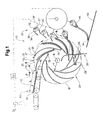
- FIG. 1 shows an apparatus according to the invention with a paddle wheel as the circulating system, as seen in a side view of the axis of rotation of the paddle wheel, during processing of products of a first format;
- FIG. 2 shows the apparatus from FIG. 1 during processing of products of a smaller, second format
- FIG. 3 shows the operations of folded products being conveyed by the gripper conveyor and transferred to a belt conveyor
- FIG. 4 shows the operations of folded products being conveyed by the gripper conveyor and processed further in an insertion or cutting apparatus.
- FIG. 1 shows, schematically, an apparatus 10 according to the invention with a paddle wheel 20 as the circulating system, with a gripper conveyor 30 and with a feed conveyor 40 , as seen in a projection of the axis of rotation D of the paddle wheel 20 .
- the paddle wheel 20 has a plurality of compartments 22 which are defined by supporting/separating elements 23 which are curved slightly convexly relative to the axis of rotation D.
- the separating elements 23 wind around the axis of rotation D in the manner of a very elongate helix.
- the walls 26 , 27 of a compartment 22 are defined by the facing surfaces of two adjacent separating elements 23 .
- the separating elements 23 run toward one another and in this way, and/or by way of a connecting piece, define the compartment base 24 .
- the compartment bases 24 are spaced apart from the axis of rotation D approximately at a constant spacing r.
- the compartments 22 open counter to the direction of rotation of the paddle wheel, which in this case rotates in the clockwise direction.
- a horizontally displaceable stripping device 28 which does not circulate along with the paddle wheel and has a guide surface 29 which is curved in the upper region and, for the rest, is oriented approximately vertically.
- the stripping device 28 can be displaced in the horizontal direction by means of a suitable drive 28 ′.
- the feed conveyor 40 here is a belt conveyor, which has the products 12 resting individually on its conveying belt. It is likewise possible for small stacks or an imbricated formation to be fed by the feed conveyor.
- the front region 42 of the feed conveyor 40 projects into the paddle wheel 20 .
- the feed conveyor 40 and/or the separating elements 23 are/is of interrogating configuration.
- the location at which the products 12 are introduced into the compartments 22 is denoted as transfer region A.
- the transfer region A is located just upstream, as seen in the direction of rotation, of the upper vertex S of the movement path U of the compartments 22 , approximately at the “11-o-clock” position.
- the feed direction F is predetermined by the orientation of the belt conveyor.
- the orientation of the compartments 22 e.g. orientation of the trailing compartment wall 26 ) corresponds, in the transfer region A, approximately to the feed direction F.
- the gripper conveyor 30 has a plurality of individually controllable grippers 32 which are moved along a closed circulatory path U′.
- U′ is used here to denote, for example, the movement path of drive means (not illustrated specifically here) to which the grippers 32 are connected.
- the grippers 32 can be pivoted relative to the circulatory path U′ in a manner known per se by means of suitable guide tracks. It is likewise possible for the position of the two gripper jaws 34 , 35 , e.g. open or closed gripper mouth, to be set using suitable guide tracks.
- the gripper 32 for this purpose, has control elements 36 , 37 in the form of control rollers, which interact with the aforementioned guide tracks in order for the gripper 32 to be closed, opened and/or pivoted.
- the region in which the grippers 32 are closed is also denoted as receiving location B.
- the receiving location B is located to the side of the paddle wheel 20 , approximately at the “3-o-clock” position. It is located vertically beneath the transfer location A.
- a supporting surface 50 is located beneath the gripper conveyor 30 .
- the products 12 of product length L are introduced into the compartments 22 with their leading edge 14 in front, in which case the leading edge 14 is located in the region of the compartment base 24 and the trailing edge 16 is located in the region of the compartment opening 25 .
- the compartments 22 are oriented in the region of the transfer location A such that the compartment base 24 is located beneath the front end 42 of the feed conveyor 40 .
- the spacing r from the axis of rotation means that the compartment base 24 , as the product 12 is being received in the compartment 22 , and after it has been received therein, moves initially with a movement component in the original conveying direction F.
- the product 12 immediately after having been introduced into the compartment 22 , is thus moved further essentially in its original conveying direction F, and it is only as the paddle wheel rotates further that it is subjected gently to a change in direction. Pronounced acceleration is thus avoided.
- the products 12 butt, in the first instance, against the trailing compartment wall 26 , as seen in the direction of revolution, and, as movement progresses, against the leading compartment wall 27 , as seen in the direction of revolution. In this position, they reach the receiving location B.
- the position of the latter is selected such that the leading edges 14 , at least until the products 12 are gripped by the grippers 32 , are located beneath the trailing edges 16 .
- the compartments 22 are oriented between the transfer location A and receiving location B such that the compartment bases 24 are located beneath the compartment openings 25 .
- the grippers 32 are moved in an open state to the receiving location B and are closed there.
- the receiving location B As they approach the receiving location B, they can engage slightly, by way of their gripper jaws 34 , 35 , between the compartment walls 26 , 27 , and this allows them to be closed together as they approach.
- the actual receiving operation by virtue of the gripper 32 being closed takes place, in the present example, outside the circulatory path U and/or outside the surface area which is covered over by the paddle wheel 20 , as seen in a plan view of the axis of rotation D thereof. There is therefore no need for the compartment walls 26 , 27 to have any recesses for engagement of the grippers 32 .
- the stripping device 28 serves to push the products 12 a little way out of the compartment, counter to gravitational force, by action on the leading edges 14 , which are initially located on the compartment base 24 , and this means that the trailing edges 16 are moved into the region of the grippers 32 , or of the distal ends of the gripper jaws 34 , 35 and can be gripped securely there.
- the products 12 are, thus, in a well-defined position at any point in time during the movement operation.
- the products 12 are drawn out of the compartments, and conveyed further, by the gripper conveyor 30 . It is possible here to produce a spatially very compact formation made up of separated products 12 conveyed in a hanging state one beside the other. At least immediately following gripping, the trailing edge 16 is located upstream of the leading edge 14 , as seen in the conveying direction of the gripper conveyor 30 . The roles of the leading and trailing edges 14 , 16 have thus been swapped over in relation to the original formation.
- the supporting surface 50 may also be the conveying belt of a further belt conveyor, on which the products can then also be deposited in their entirety. This makes it possible for the products to be carefully rearranged (leading edge becomes the trailing edge, and vice versa). This is shown by way of example in FIG. 3 .
- the control device 70 serves for synchronizing the movement of the feed conveyor 40 , circulating system 20 and gripper conveyor 30 . It optionally receives, from a monitoring device 72 a signal which serves for adapting the movements of these components in the manner mentioned in the general part of the description. It is thus possible to compensate for irregularities or to eject defective products.
- FIG. 2 shows the apparatus from FIG. 1 during processing of products 12 of a product length L′, which is smaller than the product length L of the products from FIG. 1 .
- These products 12 likewise end up located with their leading edge 14 on the compartment base 24 .
- the shorter product length L′ means that the trailing edge 16 is positioned further into the compartment 22 .
- the stripping device 28 can be displaced in a horizontal direction in order to compensate for the differences in length of the products 12 such that the operation of the products being received by the grippers 32 can take place at always the same position.
- FIG. 3 shows the transfer of the products 12 to a belt conveyor 52 , of which the conveying belt constitutes the aforementioned supporting surface 50 .
- the latter moves in the same direction as the grippers 32 of the gripper conveyor 30 arranged above.
- the products 12 are conveyed in a hanging position downstream of the receiving location B, wherein the (originally) leading edge 14 rests on the supporting surface 50 and is arranged downstream of the gripped (originally) trailing edge 16 , as seen in the conveying direction of the gripper conveyor 30 .
- a triggering element 38 opens the grippers 32 at a discharge location C. This results in an imbricated formation in which the open (originally) trailing edges 16 are leading, and rest on the preceding product 12 , being produced on the conveying belt.
- FIG. 4 shows the transfer of the products 12 from the gripper conveyor 30 to an insertion or cutting drum 60 .
- the grippers 32 are opened by a triggering element 38 at a discharge location C, in which case the products 12 fall downward into compartments of the insertion or cutting drum 60 .
- the folded open (originally) leading edge 14 is located on the compartment base and the (originally) trailing edge 16 is located in the region of the opening of the compartment, and thus in the correct position for the cutting operation. It is thus possible, using little outlay, to achieve the correct product position in order for it to be possible for the desired processing to be carried out.
Landscapes
- Engineering & Computer Science (AREA)
- Mechanical Engineering (AREA)
- Discharge By Other Means (AREA)
- Feeding Of Articles By Means Other Than Belts Or Rollers (AREA)
- Supplying Of Containers To The Packaging Station (AREA)
Applications Claiming Priority (4)
| Application Number | Priority Date | Filing Date | Title |
|---|---|---|---|
| CH98/08 | 2008-01-24 | ||
| CH982008 | 2008-01-24 | ||
| CH0098/08 | 2008-01-24 | ||
| PCT/CH2009/000022 WO2009092175A2 (de) | 2008-01-24 | 2009-01-20 | Verfahren und vorrichtung zum fördern von flächigen produkten |
Publications (2)
| Publication Number | Publication Date |
|---|---|
| US20100326795A1 US20100326795A1 (en) | 2010-12-30 |
| US8297432B2 true US8297432B2 (en) | 2012-10-30 |
Family
ID=39402591
Family Applications (1)
| Application Number | Title | Priority Date | Filing Date |
|---|---|---|---|
| US12/864,270 Expired - Fee Related US8297432B2 (en) | 2008-01-24 | 2009-01-20 | Method and device for conveying planar products |
Country Status (7)
| Country | Link |
|---|---|
| US (1) | US8297432B2 (de) |
| EP (1) | EP2265528B1 (de) |
| AT (1) | ATE556968T1 (de) |
| AU (1) | AU2009208038B2 (de) |
| CA (1) | CA2710749A1 (de) |
| DK (1) | DK2265528T3 (de) |
| WO (1) | WO2009092175A2 (de) |
Cited By (1)
| Publication number | Priority date | Publication date | Assignee | Title |
|---|---|---|---|---|
| US20120292156A1 (en) * | 2011-05-16 | 2012-11-22 | Ferag Ag | Method and device for the transfer of printed products |
Families Citing this family (3)
| Publication number | Priority date | Publication date | Assignee | Title |
|---|---|---|---|---|
| CH703816A1 (de) * | 2010-09-17 | 2012-03-30 | Ferag Ag | Vorrichtung zur übergabe von produkten an einen greiferförderer. |
| JP6296336B2 (ja) * | 2013-07-19 | 2018-03-20 | 株式会社リコー | 用紙処理装置および画像形成装置 |
| EP3085501B1 (de) * | 2015-04-21 | 2017-12-20 | Müller Martini Holding AG | Einrichtung für die durchführung von schneidoperationen offener formatkanten eines druckproduktes |
Citations (9)
| Publication number | Priority date | Publication date | Assignee | Title |
|---|---|---|---|---|
| US4434979A (en) * | 1981-03-07 | 1984-03-06 | M.A.N.-Roland Druckmaschinen Aktiengesellschaft | Printed goods removal apparatus |
| EP0265735A1 (de) | 1986-10-22 | 1988-05-04 | Ferag AG | Verfahren und Vorrichtung zum Übernehmen von gefalzten Druckereierzeugnissen von Druckmaschinen |
| EP0309702A1 (de) | 1987-10-02 | 1989-04-05 | Ferag AG | Endlos umlaufende Stückgut-Transportvorrichtung |
| EP0346578A1 (de) | 1988-06-14 | 1989-12-20 | Ferag AG | Einrichtung zum Sammeln, Zusammentragen und Einstecken von Druckereiprodukten |
| EP0568883A1 (de) | 1992-05-07 | 1993-11-10 | Ferag AG | Fehlermanagement-System für Fehler in Schuppenformationen von Druckprodukten |
| EP0854105A1 (de) | 1997-01-16 | 1998-07-22 | Ferag AG | Verfahren und Vorrichtung zum Verarbeiten von flächigen Druckereierzeugnissen, wie Zeitungen, Zeitschriften und Teilen hievon |
| US20030021659A1 (en) * | 2001-07-27 | 2003-01-30 | Michler James R. | Vibration reduction assembly for a web converting machine component |
| US6672447B2 (en) * | 2001-07-30 | 2004-01-06 | Ferag Ag | Process and apparatus for combining sheet-like articles and jointly transporting them further |
| US6851544B2 (en) * | 2003-05-19 | 2005-02-08 | Graphic Management Associates, Inc. | Transfer device |
Family Cites Families (1)
| Publication number | Priority date | Publication date | Assignee | Title |
|---|---|---|---|---|
| US4813662A (en) * | 1988-01-29 | 1989-03-21 | Hall Processing Systems | High speed drum processing apparatus |
-
2009
- 2009-01-20 CA CA2710749A patent/CA2710749A1/en not_active Abandoned
- 2009-01-20 EP EP09704092A patent/EP2265528B1/de not_active Not-in-force
- 2009-01-20 AT AT09704092T patent/ATE556968T1/de active
- 2009-01-20 AU AU2009208038A patent/AU2009208038B2/en not_active Ceased
- 2009-01-20 DK DK09704092.7T patent/DK2265528T3/da active
- 2009-01-20 WO PCT/CH2009/000022 patent/WO2009092175A2/de not_active Ceased
- 2009-01-20 US US12/864,270 patent/US8297432B2/en not_active Expired - Fee Related
Patent Citations (9)
| Publication number | Priority date | Publication date | Assignee | Title |
|---|---|---|---|---|
| US4434979A (en) * | 1981-03-07 | 1984-03-06 | M.A.N.-Roland Druckmaschinen Aktiengesellschaft | Printed goods removal apparatus |
| EP0265735A1 (de) | 1986-10-22 | 1988-05-04 | Ferag AG | Verfahren und Vorrichtung zum Übernehmen von gefalzten Druckereierzeugnissen von Druckmaschinen |
| EP0309702A1 (de) | 1987-10-02 | 1989-04-05 | Ferag AG | Endlos umlaufende Stückgut-Transportvorrichtung |
| EP0346578A1 (de) | 1988-06-14 | 1989-12-20 | Ferag AG | Einrichtung zum Sammeln, Zusammentragen und Einstecken von Druckereiprodukten |
| EP0568883A1 (de) | 1992-05-07 | 1993-11-10 | Ferag AG | Fehlermanagement-System für Fehler in Schuppenformationen von Druckprodukten |
| EP0854105A1 (de) | 1997-01-16 | 1998-07-22 | Ferag AG | Verfahren und Vorrichtung zum Verarbeiten von flächigen Druckereierzeugnissen, wie Zeitungen, Zeitschriften und Teilen hievon |
| US20030021659A1 (en) * | 2001-07-27 | 2003-01-30 | Michler James R. | Vibration reduction assembly for a web converting machine component |
| US6672447B2 (en) * | 2001-07-30 | 2004-01-06 | Ferag Ag | Process and apparatus for combining sheet-like articles and jointly transporting them further |
| US6851544B2 (en) * | 2003-05-19 | 2005-02-08 | Graphic Management Associates, Inc. | Transfer device |
Cited By (2)
| Publication number | Priority date | Publication date | Assignee | Title |
|---|---|---|---|---|
| US20120292156A1 (en) * | 2011-05-16 | 2012-11-22 | Ferag Ag | Method and device for the transfer of printed products |
| US9061855B2 (en) * | 2011-05-16 | 2015-06-23 | Ferag Ag | Method and device for the transfer of printed products |
Also Published As
| Publication number | Publication date |
|---|---|
| WO2009092175A2 (de) | 2009-07-30 |
| EP2265528A2 (de) | 2010-12-29 |
| DK2265528T3 (da) | 2012-08-20 |
| CA2710749A1 (en) | 2009-07-30 |
| WO2009092175A3 (de) | 2010-12-09 |
| US20100326795A1 (en) | 2010-12-30 |
| AU2009208038B2 (en) | 2013-05-16 |
| AU2009208038A1 (en) | 2009-07-30 |
| ATE556968T1 (de) | 2012-05-15 |
| EP2265528B1 (de) | 2012-05-09 |
Similar Documents
| Publication | Publication Date | Title |
|---|---|---|
| US20120128460A1 (en) | Apparatus and Method for Collating Products | |
| US4604851A (en) | Method and apparatus for the intermediate storage of printed products arriving in an imbricated product formation such as newspapers, periodicals and the like | |
| US20010010282A1 (en) | Turning device for graphic publishing products in a conveyor line and/or packaging machine | |
| US6976674B2 (en) | Method of, and apparatus for, conveying sheet like products | |
| AU2009208038B2 (en) | Method and device for conveying planar products | |
| JP2925345B2 (ja) | 給紙装置及び丁合装置 | |
| US20180244488A1 (en) | Feeding device of an intra-logistics system | |
| GB2182025A (en) | Method and apparatus for processing printed products | |
| US5556087A (en) | Apparatus for processing printed products | |
| JP2007186346A (ja) | 互いに続いて個々に供給される複数の印刷製品を、ずれ重なった配列になるように載せる装置 | |
| US7192028B2 (en) | Device for processing printed products supplied to a stacking device | |
| US6196538B1 (en) | Apparatus for processing flexible, sheet-like products | |
| US20090309289A1 (en) | Apparatus and method for removing flat printed products from a stack and transfering the printed products to a moving transporting device | |
| US6578843B2 (en) | Method and apparatus for conveying printed products | |
| AU2004203812A1 (en) | Method and device for the conversion of a conveyed stream of flat articles | |
| US7422203B2 (en) | Apparatus for producing final printed products | |
| US5662319A (en) | Apparatus for processing printed products | |
| US20110024972A1 (en) | Device and method for depositing products | |
| US9061855B2 (en) | Method and device for the transfer of printed products | |
| US6726000B2 (en) | Method of, and apparatus for, raising sheet-like products | |
| US8800749B2 (en) | Apparatus for processing flat articles, in particular print products | |
| US8434752B2 (en) | Apparatus for opening and transporting a product with a non-symmetrical fold | |
| US5791641A (en) | Apparatus for processing printed products | |
| US7850158B2 (en) | Method and device for supplying, opening and depositing folded printed products | |
| US7588238B2 (en) | Method and device for gathering sheets |
Legal Events
| Date | Code | Title | Description |
|---|---|---|---|
| AS | Assignment |
Owner name: FERAG AG, SWITZERLAND Free format text: ASSIGNMENT OF ASSIGNORS INTEREST;ASSIGNOR:STAUBER, ULRICH H.;REEL/FRAME:024734/0157 Effective date: 20100708 |
|
| STCF | Information on status: patent grant |
Free format text: PATENTED CASE |
|
| FEPP | Fee payment procedure |
Free format text: PAYOR NUMBER ASSIGNED (ORIGINAL EVENT CODE: ASPN); ENTITY STATUS OF PATENT OWNER: LARGE ENTITY |
|
| FPAY | Fee payment |
Year of fee payment: 4 |
|
| FEPP | Fee payment procedure |
Free format text: MAINTENANCE FEE REMINDER MAILED (ORIGINAL EVENT CODE: REM.); ENTITY STATUS OF PATENT OWNER: LARGE ENTITY |
|
| LAPS | Lapse for failure to pay maintenance fees |
Free format text: PATENT EXPIRED FOR FAILURE TO PAY MAINTENANCE FEES (ORIGINAL EVENT CODE: EXP.); ENTITY STATUS OF PATENT OWNER: LARGE ENTITY |
|
| STCH | Information on status: patent discontinuation |
Free format text: PATENT EXPIRED DUE TO NONPAYMENT OF MAINTENANCE FEES UNDER 37 CFR 1.362 |
|
| FP | Lapsed due to failure to pay maintenance fee |
Effective date: 20201030 |