US8577379B2 - Method of handling automatic call origination and system determination on multi-network mobile devices - Google Patents
Method of handling automatic call origination and system determination on multi-network mobile devices Download PDFInfo
- Publication number
- US8577379B2 US8577379B2 US10/752,607 US75260704A US8577379B2 US 8577379 B2 US8577379 B2 US 8577379B2 US 75260704 A US75260704 A US 75260704A US 8577379 B2 US8577379 B2 US 8577379B2
- Authority
- US
- United States
- Prior art keywords
- call
- allowed
- communications
- dialing string
- dialing
- Prior art date
- Legal status (The legal status is an assumption and is not a legal conclusion. Google has not performed a legal analysis and makes no representation as to the accuracy of the status listed.)
- Expired - Fee Related, expires
Links
Images


Classifications
-
- H—ELECTRICITY
- H04—ELECTRIC COMMUNICATION TECHNIQUE
- H04W—WIRELESS COMMUNICATION NETWORKS
- H04W48/00—Access restriction; Network selection; Access point selection
- H04W48/18—Selecting a network or a communication service
-
- H—ELECTRICITY
- H04—ELECTRIC COMMUNICATION TECHNIQUE
- H04L—TRANSMISSION OF DIGITAL INFORMATION, e.g. TELEGRAPHIC COMMUNICATION
- H04L63/00—Network architectures or network communication protocols for network security
- H04L63/08—Network architectures or network communication protocols for network security for authentication of entities
- H04L63/0853—Network architectures or network communication protocols for network security for authentication of entities using an additional device, e.g. smartcard, SIM or a different communication terminal
-
- H—ELECTRICITY
- H04—ELECTRIC COMMUNICATION TECHNIQUE
- H04W—WIRELESS COMMUNICATION NETWORKS
- H04W4/00—Services specially adapted for wireless communication networks; Facilities therefor
- H04W4/90—Services for handling of emergency or hazardous situations, e.g. earthquake and tsunami warning systems [ETWS]
-
- H—ELECTRICITY
- H04—ELECTRIC COMMUNICATION TECHNIQUE
- H04W—WIRELESS COMMUNICATION NETWORKS
- H04W48/00—Access restriction; Network selection; Access point selection
- H04W48/02—Access restriction performed under specific conditions
-
- H—ELECTRICITY
- H04—ELECTRIC COMMUNICATION TECHNIQUE
- H04W—WIRELESS COMMUNICATION NETWORKS
- H04W72/00—Local resource management
-
- H—ELECTRICITY
- H04—ELECTRIC COMMUNICATION TECHNIQUE
- H04W—WIRELESS COMMUNICATION NETWORKS
- H04W76/00—Connection management
- H04W76/50—Connection management for emergency connections
Definitions
- the present disclosure relates to systems and techniques for originating calls in multi-mode network environments.
- CDMA 1X Code-Division Multiple Access
- GSM Global System for Mobile Communications
- CDMA 1xEV-DO for high speed data services based on spread-spectrum technology
- GPRS General Packet Radio Service
- UMTS Universal Mobile Telecommunications System
- communications devices that are compatible with one wireless network are incompatible with other wireless networks. This is due, in part, to each network's use of its own unique protocols for communicating between compatible communications devices.
- each wireless network may have its own unique set of services. For example, CDMA 1X, GSM and UMTS support both wireless voice and data services whereas CDMA 1xEV-DO and GPRS are limited to wireless data services. Even wireless networks that support the same services may not be compatible with one another due to different operating parameters.
- a method of communications includes receiving an origination request for a call, selecting a communications network from a plurality of communications networks, accessing information to determine as a function of the origination request and the information that the call is allowed on the selected communications network, and originating the call over the selected communications network.
- a method of communications includes receiving an origination request for a call, selecting a communications network from a plurality of communications networks, accessing information to determine as a function of the origination request and the information that the call is not allowed on the selected communications network, and preventing the call from being originated over the selected communications network.
- computer readable media embodying a program of instructions executable by a computer program may be configured to perform a method of communications, the method including receiving an origination request for a call, selecting a communications network from a plurality of communications networks, accessing information to determine as a function of the origination request and the information whether the call is allowed on the selected communications network, and originating the call over the selected communications network if the call is determined to be allowed, and preventing the call from being originated over the selected communications network if the call is determined not to be allowed.
- a communications device includes an input device configured to receive an origination request for a call, a memory device for storing information, a processor configured to select a communications network from a plurality of communications networks, access the information and determine as a function of the origination request and the information whether the call is allowed on the selected communications network, originate the call over the selected communications network if the processor determines that the call is allowed, and prevent the call from being originated over the selected communications network if the processor determines that the call is not allowed.
- a communications device includes means for receiving an origination request for a call, means for selecting a communications network from a plurality of communications networks, means for accessing information to determine as a function of the origination request and the information, whether the call is allowed on the selected communications network, means for originating the call over the selected communications network if the call is determined to be allowed, and means for preventing the call over the selected communications network if the call is determined not be allowed.
- FIG. 1 is a functional block diagram of an exemplary hardware configuration to support a software based processor system operating in a multi-mode wireless communications device;
- FIG. 2 is a top view of an exemplary communications device with a display presenting a sub-menu selection screen
- FIG. 3 is a functional block diagram of an exemplary multi-layer software architecture for the software based processor system of FIG. 1 ;
- FIG. 4 is a flow diagram showing the function of an exemplary call manager operating within the multi-layer software architecture of FIG. 3 ;
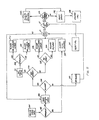
- FIG. 5 is a flow diagram illustrating an exemplary identification algorithm implemented by the exemplary call manager.
- An exemplary wireless communications device such as a cellular telephone or similar device can be used to communicate with various wireless networks. Access to these networks can be managed by the device in a way that is transparent to the user. More specifically, the communications device can automatically designate whether, and in what format, a call can be placed on each one of the various wireless networks, without the user needing to know which network the call is originated on or how the call origination request is handled for originating the call.
- the manner in which the wireless network is designated may vary from device to device, and those skilled in the art will readily be able to determine the selection criteria best suited for the particular application.
- an algorithm or similar methodology can be used to determine whether a call is allowed on various wireless networks based on a call origination request by the user or a call origination request by an application such as a browser.
- the automatic formatting of the call origination request and selection of a compatible wireless network can then be made.
- Determination of whether a call is allowed on a particular network may be made as a function of user preferences. Preferences can be programmed into the communications device, such as by programming the device's communications card or cards, by the user before making the call. Alternatively, the user preferences can be set by the manufacturer at the factory or by the carriers, phone service or sales outlet before sale. Virtually any algorithm could be implemented to manage access to the various wireless networks. This concept can be extended to other wireless technologies including any satellite or terrestrial application.
- Network access in a wireless communications device can be managed with a software based processor system, or any other configuration known in the art.
- An exemplary hardware configuration for a software based processor system is shown in FIG. 1 .
- the processor system has a microprocessor 102 at its core with non-volatile memory 104 .
- Non-volatile memory may comprise memory that is resident on the communications device, or memory on a communications card that may be inserted into the communications device.
- the microprocessor 102 can provide a platform to run software programs that, among other things, manage call origination on various networks based on (1) the preferences of the user which can be programmed into the non-volatile memory 104 ; (2) other information indicative of whether a call is allowed on the various networks; and (3) the protocol compatibility of those networks with the call as originated by the user.
- a digital signal processor (DSP) 108 can be implemented with an embedded communications software layer which runs application specific algorithms to reduce the processing demands on the microprocessor 102 .
- the DSP 108 can be used to provide encoding and modulation of text messages from the keypad 106 before those text messages are transmitted to a far end user through an analog front end 112 .
- the DSP 108 can also provide decoding and demodulation of text messages from the far end user received through the analog front end 112 before presentation to a display 110 .
- the software layer also interfaces the DSP hardware to the microprocessor 102 and may provide low level services such as allocation of resources to allow the higher level software programs to run.
- the exemplary processor system supports user entry and editing functions. Such functions may be utilized, for example, to program user preferences into the communications device or its memory card(s).
- the user interface can be fully menu driven or implemented in any other fashion.
- on-screen options can be presented to display 110 in the form of a main menu for programming the communications device. From the main menu, the user can select an on-screen option for programming user network preferences through various keypad manipulations. Once this on-screen option is selected by the user, the microprocessor 102 retrieves a list of networks from the non-volatile memory 104 and presents the list to the display 114 in a sub-menu format.
- the sub-menu may contain a list of all networks supported by the communications device, or alternatively can display a list of networks for voice services separately from data services.
- a sub-menu format is shown in FIG. 2 with an exemplary type of information for determining whether a call is allowed on a particular network.
- the “fixed dialing list” comprises all phone numbers allowed by an exemplary communications device or by a card within the communications device.
- each phone number is represented by a user-defined code that allows for easy identification and selection by the user when he desires to place a phone call.
- phone numbers represented by HOME 202 , OFFICE 204 , DOCTOR 206 , SCHOOL 208 and EMERGENCY 210 are allowed in the illustrated example.
- any combination of phone numbers may be allowed according to the user preferences. It is also possible that a user may program a “block list,” including numbers that are not allowed on a particular network.
- a communications device may contain multiple communications cards, thereby becoming constrained by multiple, different fixed dialing, block, or other such permission-driven lists. It is further understood that any one communications device may, because of multiple cards, be enabled to originate a call on a first network where the dialed phone number is represented on that card's fixed dialing list, but be restrained from originating the same call on a second network, where the dialed phone number is represented on that card's block list. Thus, for any dialing string input received by the communications device, each card must be tested for its ability to allow the call.
- FIG. 3 An exemplary microprocessor multi-layer software architecture is shown in FIG. 3 .
- the software architecture includes a user interface 302 , a call manager 304 and a protocol layer 306 running on a microprocessor platform.
- the DSP 108 and analog front end 112 are shown for completeness, but will not be discussed further.
- each software layer can be run on separate processors or any combination of processors.
- the processors can be internal to the communications device, or alternatively, one or more processors could be located in an external device such as a laptop computer connected to the communications device. As those skilled in the art will appreciate, the implementation details may vary depending on the particular communications application and the overall design constraints.
- User interface 302 provides structure to the interaction between the user and the communications device. During the programming of user network preferences, the user interface 302 may be used to generate the menu and sub-menus presented to the display from data stored in the non-volatile memory 104 . The user interface 302 may also be responsible for deleting, adding and reordering user preferred networks within the non-volatile memory 104 in response to menu and sub-menu selections.
- the user interface 302 may be a software program, or set of programs, that sits as a layer above the call manager 304 .
- the software programs can be applications such as a phone book, SAT (SIM Application Toolkit), SAT CC (SAT Call Control), SMS, browser, e-mail or any other software programs.
- SAT SIM Application Toolkit
- SAT CC SAT Call Control
- SMS browser
- e-mail any other software programs.
- the user interface 302 determines the parameters of the call from the keypad entries, including for example service parameters and dialing string input information.
- the service parameters typically include, among other things, the type of service requested.
- the requested service can be a voice call, a data call, or any other service provided by the carrier.
- Dialing string input information typically includes data representing the numbers entered by a user who dialed a phone number on the keypad of the communications device.
- the user interface 302 may also include other service parameters such as the quality of service needed to support the call. For example, if the user initiates a video application, the user interface 202 may determine that the call requires a data rate of 64 kbits/s or higher.
- the call manager 304 can be used to manage access to various networks in a way that is transparent to the user. Based on the parameters derived from the user's call origination request, the call manager 304 determines whether the call is allowed on each one of the various networks. The call manager 304 may also determine other network selection parameters, such as the service compatibility of all the networks supported by the communications device. Then, the determination of whether a call is allowed may be made for only those networks that are first determined to be compatible with the call. For example, if the communications device supports CDMA 1X, CDMA 1xEV-DO, GSM, GPRS, and UMTS networks, and the service requested is a video application, the call manager 304 may determine that only the CDMA 1xEV-DO and UMTS networks can support this application.
- the call manager 304 will limit its inquiry regarding whether the call is allowed to just those two compatible networks.
- FIG. 4 is a flow diagram showing the operation of the call manager.
- the call manager may attempt to register with the user preferred network stored in non-volatile memory in step 402 . Once registered, the call manager accepts a call origination request from the user through the user interface in step 404 .
- the call origination request includes various parameters such as service parameters (e.g. type of service requested by the user and the quality of service needed to support the call) and dialing string input information.
- service parameters e.g. type of service requested by the user and the quality of service needed to support the call
- dialing string input information e.g. type of service requested by the user and the quality of service needed to support the call
- the call manager may identify the networks supported by the communications device that are service compatible with the call origination request. Alternatively, this step may be omitted, such that the determination of whether a call is allowed (explained below) may be made for each network, whether it is service compatible or not.
- step 408 the call manager determines whether the call identified in the call origination request is allowed on the network currently registered. This determination is made as a function of the output of an identification algorithm, the details of which are explained below with reference to FIG. 5 . If the identification algorithm output indicates that the call is allowed on the registered network, the call manager attempts to originate a call on that network in step 410 . If the registered network is not among the networks on which the call is allowed, or if the service for the registered network is lost, then the call manager selects one of the other “allowed” networks for re-registration in step 412 .
- the call manager first determines whether any other networks were identified as “allowed” by the identification algorithm output and, if so, determines whether any of those networks are among the service compatible networks. Once an alternative network is selected, the call manager will de-register the communications device from the current network and attempt to register with the new selected network in step 414 . If the call manager is unsuccessful in registering the communications device with the new selected network, the call manager will select another network for registration among the service compatible networks in step 412 . Finally, the call manager will attempt to originate a call over the registered network in step 416 .
- FIG. 5 is a flow diagram illustrating an exemplary identification algorithm whose output is utilized by the call manager described above.
- the identification algorithm implements a method for identifying which of the networks that a communications device is compatible with will be allowed by the communications device to support a dialed call.
- the identification algorithm also implements a procedure for formatting the call origination request so that the call may be originated on different networks.
- a communications device may operate on certain networks by means of a communications card adapted to a particular network or group of networks.
- a communications device may also have multiple such cards, enabling it to operate on multiple networks or groups of networks.
- a communications device may simultaneously support both a SIM (Subscriber Identity Module) card enabling it to operate on GSM and GPRS networks, a R-UIM (Removable User Identity Module) card enabling it to operate on a CDMA network or hybrid CDMA/GSM network, and a USIM (UTMS SIM) card enabling it to operate on a UMTS network.
- SIM Subscriber Identity Module
- R-UIM Removable User Identity Module
- USIM UTMS SIM
- the identification algorithm illustrated in FIG. 5 accepts the user's dialing string as an input at block 500 .
- the algorithm considers whether the dialing string input indicates an emergency number. For example, in certain areas of the United States, a dialing string comprising the digit sequence “911” indicates an emergency number. If the request is for an emergency call, the call manager marks the call “allowed” for all available networks at block 504 , indicating that the call may be originated on any available and service compatible network.
- a service compatible network is one that is compatible with a communications card within the communications device.
- the algorithm may skip the remaining usual steps in the case of an emergency call, direct the call manager to originate the emergency call on the currently registered network, and continue to attempt call origination on any available network until the call is successfully placed. If, on the other hand, it is determined at block 502 that the call origination request does not comprise an emergency number, then at block 506 the algorithm selects one card from a plurality of communications cards and proceeds to test and format the call origination request so that the call can be rejected from or placed on the network that is compatible with the selected card.
- a call may be allowed, for example, if the dialing string input received with the call origination request is contained in a fixed dialing list that a user has programmed into the communications card. Such a situation may occur, for example, when a parent provides a wireless communications device to a child and programs the communications card to only allow the child to dial certain telephone numbers. This has the effect of causing the communications device to operate only for the purpose of dialing those numbers. Of course, there are other situations in which such a permissive dialing list might be created.
- information such as fixed dialing lists, blocked call lists, or other user-defined information is accessed for the purpose of comparing the dialing string input to the information and determining whether the call is allowed. If it is determined at block 508 that the call is not allowed, for example because the dialing string does not represent a number included on a fixed dialing list, or represents a number included on a blocked call list, then at block 510 the call is marked “not allowed” for networks compatible with the selected card. At block 512 it is queried whether additional networks, compatible with other communications cards within the communications device, are available to support the call. If not, the call is rejected at block 514 and the call is never originated.
- the algorithm returns to block 506 , where the next card and its compatible networks are selected to test for its availability to support the call.
- a communications device includes two separate communications cards, each having its own fixed dialing list such that a phone number represented by the dialing string input appears on one of the lists but not on the other. In that case, the call would be “not allowed” for the networks accessible with one of the cards, but may be allowed on the networks accessible with the other card.
- the algorithm checks at block 516 whether the dialing string must be converted to a new number. For example, if the dialing string input received at block 500 represents a pre-set command programmed by the user into the communications card to represent a frequently-used telephone number, it must be converted to a new dialing string representative of the actual telephone number. Or, it may need to be converted so that it includes appropriate digits for being placed as a long distance call. If, for any reason, it is determined that the dialing string must be converted, then it is converted to a new dialing string at block 517 , and at block 518 the new dialing string is checked to determine whether it is an emergency number.
- the call is marked at block 520 to indicate that it is an “allowed new emergency number” for the selected mode. This may occur if the dialing string represents a user-defined code for an emergency number. That user defined-emergency code must then be changed to an actual emergency number, and this number will be recognized at block 518 as an emergency number. Otherwise, the call is marked at block 522 to indicate that it is an “allowed new normal number” for the selected card, wherein “normal” denotes that the call is not an emergency call.
- the algorithm queries whether the dialing string input represents a SS (Supplementary Service request) or a USSD (Unstructured SS Data request). For example, certain information within a dialing string may indicate to a carrier associated with the selected network that a service request is being dialed. In that event, the dialing string is converted to an SS or USSD request code and the call is marked at block 526 to indicate that it is an “allowed SS/USSD” for the selected network. Otherwise, the call is marked at block 528 to indicate that it is an “allowed original number” for networks compatible with the selected card.
- SS Supplementary Service request
- USSD Unstructured SS Data request
- an incoming call request may have resulted in one of at least six different markings to indicate whether and in what form it was allowed on the selected card, as indicated at blocks 504 , 514 , 520 , 522 , 526 and 528 .
- a call request may be marked with any combination of two or more of the markings that represent the conditions indicated at blocks 504 , 514 , 520 , 522 , 526 and 528 .
- the identification algorithm input comprises at least one data field, which contains the dialing string input
- the output may comprise two or more data fields.
- One output data field contains a dialing string, which may be identical to the dialing string input or may be altered as a result of the algorithm's operative steps.
- a second data field may include one or more bits for indicating the marking conditions representative of the conditions indicated at blocks 504 , 514 , 520 , 522 , 526 and 528 . The bits may be appropriately set according to the determinations of the identification algorithm.
- a third data field may include the same number of bits for marking the call as the second data field, with the difference between the two fields being the card or networks that the bits are set for.
- a three-field selection algorithm output may include a dialing string in the first field, a set of bits in the second field set to indicate one of the marking conditions for a first network, and a set of bits in the second field set to indicate one of the marking conditions for a second network.
- extra fields may be used to contain alternate dialing strings, which may be different in the algorithm output for each of the different communications cards.
- the selection algorithm may generate two or more separate outputs, one for each network. In that case, each output may comprise two data fields, one for the dialing string (whether original or changed) and one for the marking condition.
- a call origination request may require any of a number of different markings to indicate its ability to be originated on that network.
- the algorithm checks at block 530 whether other networks are available in order to handle the call. If so, the algorithm returns to block 506 where the next network is selected. The same procedure previously described is then followed for the newly selected network, and this process continues until the call has been appropriately marked for each available network that the communications device is compatible with. Once each network or card has been considered, it will be determined at block 530 that no further networks are available.
- the algorithm considers whether any of the calls have been marked as an emergency call. For example, a call marked at block 520 is one that has had its dialing string changed such that the new dialing string indicates an emergency call. If, at block 531 , it is determined that there is an emergency call, then the call is marked at block 533 as allowed on all networks.
- the various markings generated for each iteration of the algorithm as described above are considered.
- the algorithm selects an appropriate network on which the call is to be originated as a function of the markings. For example, if a call is marked allowed for a first network and marked allowed for a second network, the algorithm may direct the call manager to originate the call on whichever one of the first or second networks is currently registered. As another example, if a call is marked allowed on a first network and rejected on a second network, but the second network is the currently active one, the algorithm may direct the call manager to disconnect the second network, re-register the first network, and originate the call on the now-active first network. Or, if the call has been marked as an emergency, it is allowed on all networks and will therefore be originated on the currently registered network.
- the algorithm may, at block 532 , direct the call manager to attempt to originate the call on the current active network. If the origination attempt fails after a certain amount of time, which may be set for example by the network carrier, the communications device manufacturer, or some other source, the algorithm may direct the call manager to retain the current network as the active network and repeat the call origination request, or may direct the call manager to disconnect from the current network, switch to a new active network, and attempt to originate the call on the new active network. The call manager may repeat either situation, or any combination of these situations, until the emergency call is successfully originated on a compatible network.
- the dialing input string may be changed to a new emergency number for a first communications card, and either changed to a new normal number or retained as the original normal number for a second communications card.
- the algorithm may direct the call manager to originate the emergency call on the network compatible with the first communications card. If that is the currently active network, the call may be originated immediately. Otherwise, the call manager may disconnect from the active network, register the network compatible with the first call, and then attempt to originate the emergency call on the now-active network.
- the emergency call may be originated via a series of origination attempts, each of which may time out after a predetermined length of time.
- the call manager may switch to the other network, and attempt to originate the call using the normal number, whether it has been changed by the algorithm or retained as the original dialing string input. Whichever network is used, and whether the dialing string is a normal or emergency dialing string, the call origination may be made transparent to the user of the communications device. For example, a user interface may display the call origination on either network as an “emergency call.” At the end of the call, the call manager may either remain on the active network, or switch to another network compatible with the communications device's other communications card, according to a system selection preference. Such preference may be determined by the user, or by default settings made by the communications device manufacturer, or by some other method.
- the algorithm may cause the dialing string input to be changed to a new emergency number for a first communications card, and either changed to an SS or USSD, or rejected, for a second communications card.
- the algorithm may cause the call manager to originate the emergency number on the network compatible with the first communications card as described above.
- the call manager may alternate between attempts to originate the emergency call on the network compatible with the first communications card, and attempts to originate the SS or USSD call on the network compatible with the second communications card.
- the dialing string input may be changed by the algorithm to a new emergency number for each of two different cards in the communications device.
- the algorithm may direct the call manager to attempt to originate the emergency call on whichever network is currently active. If the call origination attempt fails, the call manager may either re-attempt to originate the call, or switch to the network compatible with the other communications card, and attempt to originate the call using the other emergency number on the now-registered network. Subsequent origination attempts, whether sequentially on the same network, alternating between multiple networks, or some combination thereof, may continue until the emergency call is successfully originated. At the end of the call, the call manager may insure registration or re-registration of the originally active network, or may retain the currently active network, according to system selection preference.
- the dialing string input may be a normal number for each of two communications cards, and may be unchanged by the algorithm.
- the call manager may attempt to originate the call on the currently active network, and may make any subsequent origination attempts either on the same network or by alternating between compatible networks. After the call is terminated, the call manager causes the communications device to have either network registered, according to system selection preference.
- the dialing string input may be rejected on a first communications card, but accepted or changed to a new normal number, SS or USSD on a second card.
- the call manager may attempt to originate the SS or USSD on the network compatible with the second card, whether that network is currently active or must be registered first. The call manager may repeat origination attempts until the SS or USSD call is placed, and then cause either of the networks to be registered after termination of the call, according to system selection preference.
- dialing string input is rejected by the algorithm for both communications cards. In this case, the call is simply rejected, and no origination attempt is made for either network.
- DSP digital signal processor
- ASIC application specific integrated circuit
- FPGA field programmable gate array
- a general-purpose processor may be a microprocessor, but in the alternative, the processor may be any conventional processor, controller, microcontroller, or state machine.
- a processor may also be implemented as a combination of computing devices, e.g., a combination of a DSP and a microprocessor, a plurality of microprocessors, one or more microprocessors in conjunction with a DSP core, or any other such configuration.
- a software module may reside in RAM memory, flash memory, ROM memory, EPROM memory, EEPROM memory, registers, hard disk, a removable disk, a CD-ROM, or any other form of storage medium known in the art.
- An exemplary storage medium is coupled to the processor such that the processor can read information from, and write information to, the storage medium.
- the storage medium may be integral to the processor.
- the processor and the storage medium may reside in an ASIC.
- the ASIC may reside in a user terminal.
- the processor and the storage medium may reside as discrete components in a user terminal.
Landscapes
- Engineering & Computer Science (AREA)
- Computer Security & Cryptography (AREA)
- Computer Networks & Wireless Communication (AREA)
- Signal Processing (AREA)
- Mobile Radio Communication Systems (AREA)
- Telephonic Communication Services (AREA)
- Telephone Function (AREA)
Priority Applications (9)
| Application Number | Priority Date | Filing Date | Title |
|---|---|---|---|
| US10/752,607 US8577379B2 (en) | 2003-09-25 | 2004-01-06 | Method of handling automatic call origination and system determination on multi-network mobile devices |
| JP2006528056A JP4988348B2 (ja) | 2003-09-25 | 2004-09-13 | 自動呼発生の操作方法及びマルチ−ネットワークモバイル装置上のシステム決定 |
| CA002540075A CA2540075A1 (en) | 2003-09-25 | 2004-09-13 | Method of handling automatic call origination and system determination on multi-network mobile devices |
| RU2006113924/09A RU2369985C2 (ru) | 2003-09-25 | 2004-09-13 | Способ обработки автоматического создания вызова и определение системы на многосетевых мобильных устройствах |
| AT04784078T ATE433647T1 (de) | 2003-09-25 | 2004-09-13 | Verfahren zur abwicklung einer automatischen verbindungseinleitung und systembestimmung auf mehrfach-netzwerk-mobileinrichtungen |
| PCT/US2004/030104 WO2005034566A1 (en) | 2003-09-25 | 2004-09-13 | Method of handling automatic call origination and system determination on multi-network mobile devices |
| EP04784078A EP1668950B1 (de) | 2003-09-25 | 2004-09-13 | Verfahren zur abwicklung einer automatischen verbindungseinleitung und systembestimmung auf mehrfach-netzwerk-mobileinrichtungen |
| DE602004021491T DE602004021491D1 (de) | 2003-09-25 | 2004-09-13 | Verfahren zur abwicklung einer automatischen verbindungseinleitung und systembestimmung auf mehrfach-netzwerk-mobileinrichtungen |
| TW093128868A TW200524437A (en) | 2003-09-25 | 2004-09-23 | Method of handling automatic call origination and system determination on multi-network mobile devices |
Applications Claiming Priority (4)
| Application Number | Priority Date | Filing Date | Title |
|---|---|---|---|
| US50636203P | 2003-09-25 | 2003-09-25 | |
| US50634203P | 2003-09-25 | 2003-09-25 | |
| US50622403P | 2003-09-26 | 2003-09-26 | |
| US10/752,607 US8577379B2 (en) | 2003-09-25 | 2004-01-06 | Method of handling automatic call origination and system determination on multi-network mobile devices |
Publications (2)
| Publication Number | Publication Date |
|---|---|
| US20050070291A1 US20050070291A1 (en) | 2005-03-31 |
| US8577379B2 true US8577379B2 (en) | 2013-11-05 |
Family
ID=34382179
Family Applications (1)
| Application Number | Title | Priority Date | Filing Date |
|---|---|---|---|
| US10/752,607 Expired - Fee Related US8577379B2 (en) | 2003-09-25 | 2004-01-06 | Method of handling automatic call origination and system determination on multi-network mobile devices |
Country Status (8)
| Country | Link |
|---|---|
| US (1) | US8577379B2 (de) |
| EP (1) | EP1668950B1 (de) |
| JP (1) | JP4988348B2 (de) |
| AT (1) | ATE433647T1 (de) |
| CA (1) | CA2540075A1 (de) |
| DE (1) | DE602004021491D1 (de) |
| TW (1) | TW200524437A (de) |
| WO (1) | WO2005034566A1 (de) |
Cited By (1)
| Publication number | Priority date | Publication date | Assignee | Title |
|---|---|---|---|---|
| US9002315B2 (en) | 2009-05-01 | 2015-04-07 | Qualcomm Incorporated | Systems, apparatus and methods for facilitating emergency call service in wireless communication systems |
Families Citing this family (16)
| Publication number | Priority date | Publication date | Assignee | Title |
|---|---|---|---|---|
| FR2865604B1 (fr) * | 2004-01-26 | 2008-05-30 | Cit Alcatel | Localisation assistee, par etablissement d'un canal de transport ussd, de terminaux mobiles de communication d'un reseau cellulaire, pour un centre d'appels |
| US7489930B2 (en) * | 2004-05-28 | 2009-02-10 | Motorola, Inc. | Apparatus and method for multimode terminals |
| KR100703276B1 (ko) * | 2005-03-14 | 2007-04-03 | 삼성전자주식회사 | Sim과 me간에 sat를 이용한 매크로 구현 방법 및그 장치 |
| US20060258328A1 (en) * | 2005-05-10 | 2006-11-16 | Lucent Technologies Inc. | User defined codes for emergency calls |
| TWI273450B (en) * | 2005-07-12 | 2007-02-11 | Asustek Comp Inc | Method and apparatus for searching data |
| US8149867B2 (en) * | 2007-01-30 | 2012-04-03 | Broadcom Corporation | Multi-network shared PHY layer |
| US9363633B2 (en) * | 2010-02-22 | 2016-06-07 | Nokia Technologies Oy | Accurate GNSS time handling in dual/multi-SIM terminals |
| JP5864390B2 (ja) * | 2012-09-26 | 2016-02-17 | 京セラ株式会社 | 通信装置、通信方法、及び通信プログラム |
| US9351203B2 (en) | 2013-09-13 | 2016-05-24 | Microsoft Technology Licensing, Llc | Voice call continuity in hybrid networks |
| US9510251B2 (en) | 2013-12-31 | 2016-11-29 | Microsoft Technology Licensing, Llc | Call handoff initiation in hybrid networks |
| US9560185B2 (en) | 2014-03-19 | 2017-01-31 | Microsoft Technology Licensing, Llc | Hybrid telecommunications network connection indicator |
| US9363711B2 (en) | 2014-04-07 | 2016-06-07 | Microsoft Technology Licensing, Llc | User experiences during call handovers on a hybrid telecommunications network |
| US9456333B2 (en) * | 2014-07-09 | 2016-09-27 | Microsoft Technology Licensing, Llc | Centralized routing in hybrid networks |
| US9930504B2 (en) * | 2015-07-28 | 2018-03-27 | Qualcomm Incorporated | Reducing call failure rate in multi-subscriber identity module capable devices |
| JP2017049776A (ja) * | 2015-09-01 | 2017-03-09 | 株式会社ハイスピードボーイズ | サーバ装置及びプログラム |
| TWI583233B (zh) * | 2015-11-12 | 2017-05-11 | 宏碁股份有限公司 | 緊急通話的控制方法及使用此方法的使用者設備 |
Citations (20)
| Publication number | Priority date | Publication date | Assignee | Title |
|---|---|---|---|---|
| WO1995001070A1 (en) | 1993-06-22 | 1995-01-05 | Telefonaktiebolaget Lm Ericsson | Multinetwork terminal |
| EP0724371A1 (de) | 1995-01-30 | 1996-07-31 | CABLE & WIRELESS PLC | Schnurloses Kommunikationsendgerät |
| RU2111619C1 (ru) | 1990-12-07 | 1998-05-20 | Квэлкомм Инкорпорейтед | Система связи с коллективным доступом и кодовым разделением каналов (сдма), система связи абонентов с помощью базовой станции с абонентами удаленной системы, система местной связи и способ создания многолучевого распространения передаваемых сигналов сдма в системе связи |
| JPH10327463A (ja) | 1997-03-28 | 1998-12-08 | Sanyo Electric Co Ltd | 携帯用情報端末装置 |
| US5884193A (en) * | 1997-02-03 | 1999-03-16 | Qualcomm Incorporated | System and method for call restriction in a wireless communication device |
| RU2134489C1 (ru) | 1995-07-05 | 1999-08-10 | Моторола, Инк. | Способ и устройство для выбора входящего канала в системе связи |
| JPH11262064A (ja) | 1998-03-10 | 1999-09-24 | Hitachi Software Eng Co Ltd | 公衆・自営モードの選択方法および公衆・自営共用phs端末装置 |
| US5999811A (en) | 1996-02-16 | 1999-12-07 | Ericsson, Inc. | Mobile telephone for roaming using dual mode/band equipment including SIM cards |
| US6125283A (en) * | 1998-05-18 | 2000-09-26 | Ericsson Inc. | Multi-mode mobile terminal and methods for operating the same |
| US6208872B1 (en) * | 1998-09-04 | 2001-03-27 | Ericsson Inc. | Method and apparatus for inhibition of calls while roaming |
| WO2001067796A2 (en) | 2000-03-10 | 2001-09-13 | Nokia Corporation | Method for selecting an emergency service number in a mobile phone |
| US6334052B1 (en) * | 1997-03-07 | 2001-12-25 | Telefonaktiebolaget Lm Ericsson (Publ) | Subscription-based mobile station idle mode cell selection |
| US20020039892A1 (en) | 2000-10-04 | 2002-04-04 | Bo Lindell | System and method for network and service selection in a mobile communication station |
| US20020098874A1 (en) * | 2001-01-22 | 2002-07-25 | Jocelyn Zirul | Cellular telephone with programmable authorized telephone number |
| EP1271881A1 (de) | 2001-06-25 | 2003-01-02 | Siemens Aktiengesellschaft | Verfahren zur Übertragung von Daten |
| US20030103607A1 (en) * | 2000-04-05 | 2003-06-05 | Kieren Feakes | System and method for providing an internet audio stream to a wap mobile telephone |
| US6766159B2 (en) * | 2000-03-10 | 2004-07-20 | Nokia Mobile Phones Ltd. | Alpha tagging and type indication of emergency call number |
| US6889059B1 (en) * | 1999-11-03 | 2005-05-03 | Guala Dispensing S.P.A. | Multi-card device for telecommunications, and process for automatically managing telephone communications |
| US6891811B1 (en) * | 2000-04-18 | 2005-05-10 | Telecommunication Systems Inc. | Short messaging service center mobile-originated to HTTP internet communications |
| US7010296B2 (en) * | 1998-10-13 | 2006-03-07 | Fujitsu Limited | Method of registering services in mobile-communication system |
Family Cites Families (1)
| Publication number | Priority date | Publication date | Assignee | Title |
|---|---|---|---|---|
| US39892A (en) * | 1863-09-15 | Improvement in sewing-machines |
-
2004
- 2004-01-06 US US10/752,607 patent/US8577379B2/en not_active Expired - Fee Related
- 2004-09-13 DE DE602004021491T patent/DE602004021491D1/de not_active Expired - Lifetime
- 2004-09-13 WO PCT/US2004/030104 patent/WO2005034566A1/en not_active Ceased
- 2004-09-13 EP EP04784078A patent/EP1668950B1/de not_active Expired - Lifetime
- 2004-09-13 AT AT04784078T patent/ATE433647T1/de not_active IP Right Cessation
- 2004-09-13 CA CA002540075A patent/CA2540075A1/en not_active Abandoned
- 2004-09-13 JP JP2006528056A patent/JP4988348B2/ja not_active Expired - Fee Related
- 2004-09-23 TW TW093128868A patent/TW200524437A/zh unknown
Patent Citations (22)
| Publication number | Priority date | Publication date | Assignee | Title |
|---|---|---|---|---|
| RU2111619C1 (ru) | 1990-12-07 | 1998-05-20 | Квэлкомм Инкорпорейтед | Система связи с коллективным доступом и кодовым разделением каналов (сдма), система связи абонентов с помощью базовой станции с абонентами удаленной системы, система местной связи и способ создания многолучевого распространения передаваемых сигналов сдма в системе связи |
| US5915224A (en) * | 1993-06-22 | 1999-06-22 | Telefonaktiebolaget Lm Ericsson | Telecommunications method for multi-network communications |
| WO1995001070A1 (en) | 1993-06-22 | 1995-01-05 | Telefonaktiebolaget Lm Ericsson | Multinetwork terminal |
| EP0724371A1 (de) | 1995-01-30 | 1996-07-31 | CABLE & WIRELESS PLC | Schnurloses Kommunikationsendgerät |
| RU2134489C1 (ru) | 1995-07-05 | 1999-08-10 | Моторола, Инк. | Способ и устройство для выбора входящего канала в системе связи |
| US5999811A (en) | 1996-02-16 | 1999-12-07 | Ericsson, Inc. | Mobile telephone for roaming using dual mode/band equipment including SIM cards |
| US5884193A (en) * | 1997-02-03 | 1999-03-16 | Qualcomm Incorporated | System and method for call restriction in a wireless communication device |
| US6334052B1 (en) * | 1997-03-07 | 2001-12-25 | Telefonaktiebolaget Lm Ericsson (Publ) | Subscription-based mobile station idle mode cell selection |
| JPH10327463A (ja) | 1997-03-28 | 1998-12-08 | Sanyo Electric Co Ltd | 携帯用情報端末装置 |
| JPH11262064A (ja) | 1998-03-10 | 1999-09-24 | Hitachi Software Eng Co Ltd | 公衆・自営モードの選択方法および公衆・自営共用phs端末装置 |
| US6125283A (en) * | 1998-05-18 | 2000-09-26 | Ericsson Inc. | Multi-mode mobile terminal and methods for operating the same |
| US6208872B1 (en) * | 1998-09-04 | 2001-03-27 | Ericsson Inc. | Method and apparatus for inhibition of calls while roaming |
| US7010296B2 (en) * | 1998-10-13 | 2006-03-07 | Fujitsu Limited | Method of registering services in mobile-communication system |
| US6889059B1 (en) * | 1999-11-03 | 2005-05-03 | Guala Dispensing S.P.A. | Multi-card device for telecommunications, and process for automatically managing telephone communications |
| WO2001067796A2 (en) | 2000-03-10 | 2001-09-13 | Nokia Corporation | Method for selecting an emergency service number in a mobile phone |
| JP2003526296A (ja) | 2000-03-10 | 2003-09-02 | ノキア コーポレーション | 緊急呼番号のアルファタグ付けおよび型の指摘 |
| US6766159B2 (en) * | 2000-03-10 | 2004-07-20 | Nokia Mobile Phones Ltd. | Alpha tagging and type indication of emergency call number |
| US20030103607A1 (en) * | 2000-04-05 | 2003-06-05 | Kieren Feakes | System and method for providing an internet audio stream to a wap mobile telephone |
| US6891811B1 (en) * | 2000-04-18 | 2005-05-10 | Telecommunication Systems Inc. | Short messaging service center mobile-originated to HTTP internet communications |
| US20020039892A1 (en) | 2000-10-04 | 2002-04-04 | Bo Lindell | System and method for network and service selection in a mobile communication station |
| US20020098874A1 (en) * | 2001-01-22 | 2002-07-25 | Jocelyn Zirul | Cellular telephone with programmable authorized telephone number |
| EP1271881A1 (de) | 2001-06-25 | 2003-01-02 | Siemens Aktiengesellschaft | Verfahren zur Übertragung von Daten |
Non-Patent Citations (4)
| Title |
|---|
| International Search Report and Written Opinion-PCT/US2004/030104, International Search Authority-European Patent Office-Jan. 17, 2005. |
| International Search Report and Written Opinion—PCT/US2004/030104, International Search Authority—European Patent Office—Jan. 17, 2005. |
| Taiwan Search Report-TW093128868-TIPO-Mar. 24, 2012. |
| Taiwan Search Report—TW093128868—TIPO—Mar. 24, 2012. |
Cited By (1)
| Publication number | Priority date | Publication date | Assignee | Title |
|---|---|---|---|---|
| US9002315B2 (en) | 2009-05-01 | 2015-04-07 | Qualcomm Incorporated | Systems, apparatus and methods for facilitating emergency call service in wireless communication systems |
Also Published As
| Publication number | Publication date |
|---|---|
| ATE433647T1 (de) | 2009-06-15 |
| JP2007516642A (ja) | 2007-06-21 |
| CA2540075A1 (en) | 2005-04-14 |
| US20050070291A1 (en) | 2005-03-31 |
| DE602004021491D1 (de) | 2009-07-23 |
| TW200524437A (en) | 2005-07-16 |
| EP1668950A1 (de) | 2006-06-14 |
| JP4988348B2 (ja) | 2012-08-01 |
| WO2005034566A1 (en) | 2005-04-14 |
| EP1668950B1 (de) | 2009-06-10 |
Similar Documents
| Publication | Publication Date | Title |
|---|---|---|
| US8577379B2 (en) | Method of handling automatic call origination and system determination on multi-network mobile devices | |
| EP2830339B1 (de) | Verfahren und endgerät zum laden von konfigurationsinformationen eines mobilfunknetzbetreibers | |
| US20040192301A1 (en) | Systems and techniques for originating calls in multi-mode network environments | |
| RU2355025C2 (ru) | Загружаемая конфигурирующая прикладная программа для беспроводного устройства | |
| CN102137389B (zh) | 一种多卡移动终端及其sim卡数据转存方法 | |
| US8914069B2 (en) | Method and apparatus for speed dialing by mobile country code/mobile network code in mobile communication system | |
| US8060140B2 (en) | Method and apparatus for increasing data read speed from subscriber identity module | |
| US20050227666A1 (en) | Method of accessing emergency numbers for mobile station users | |
| US20150099516A1 (en) | System and Methods for Using Wireless Network Correlations to Acquire Service on a Multi-SIM Device | |
| US20200037153A1 (en) | Method and electronic device for automatically switching among plurality of profiles in esim | |
| EP2446667B1 (de) | Mobiles endgerät und verfahren zur begrenzung von endpunktidentifikatoren in einem kommunikationssystem | |
| CN101018374A (zh) | 辨别选择的线路信息的方法和装置 | |
| CN109996315A (zh) | 多卡多待终端的搜网方法、装置、存储介质和电子设备 | |
| EP2685780B1 (de) | Mobiltelefon und datenverarbeitungsverfahren dafür | |
| CN101553043B (zh) | 用于从双模式的移动终端建立通信的方法 | |
| CN104378806B (zh) | 信息处理方法以及终端设备 | |
| KR100574558B1 (ko) | 이동통신 단말기의 접속제어 방법 및 접속제어 시스템 | |
| RU2369985C2 (ru) | Способ обработки автоматического создания вызова и определение системы на многосетевых мобильных устройствах | |
| KR20090056277A (ko) | 이동통신 사업자 변경 방법 및 이동통신 사업자 설정 정보제공 방법 | |
| CA2623688A1 (en) | Methods and apparatus for mobile equipment depersonalization | |
| KR20090056278A (ko) | 이동통신 사업자 변경 방법 | |
| KR101384861B1 (ko) | 복수 개의 유저 식별자를 포함하는 통신 단말기 및 그 제어방법 |
Legal Events
| Date | Code | Title | Description |
|---|---|---|---|
| AS | Assignment |
Owner name: QUALCOMM INCORPORATED, CALIFORNIA Free format text: ASSIGNMENT OF ASSIGNORS INTEREST;ASSIGNOR:SHI, GUANGMING CARL;REEL/FRAME:014880/0076 Effective date: 20040105 |
|
| AS | Assignment |
Owner name: QUALCOMM INCORPORATED, CALIFORNIA Free format text: ASSIGNMENT OF ASSIGNORS INTEREST;ASSIGNORS:SHI, GUANGMING;TORCHALSKI, ANDREW;IYER, REKHA;AND OTHERS;REEL/FRAME:015314/0121;SIGNING DATES FROM 20040429 TO 20040503 Owner name: QUALCOMM INCORPORATED, CALIFORNIA Free format text: ASSIGNMENT OF ASSIGNORS INTEREST;ASSIGNORS:SHI, GUANGMING;TORCHALSKI, ANDREW;IYER, REKHA;AND OTHERS;SIGNING DATES FROM 20040429 TO 20040503;REEL/FRAME:015314/0121 |
|
| STCF | Information on status: patent grant |
Free format text: PATENTED CASE |
|
| FPAY | Fee payment |
Year of fee payment: 4 |
|
| FEPP | Fee payment procedure |
Free format text: MAINTENANCE FEE REMINDER MAILED (ORIGINAL EVENT CODE: REM.); ENTITY STATUS OF PATENT OWNER: LARGE ENTITY |
|
| LAPS | Lapse for failure to pay maintenance fees |
Free format text: PATENT EXPIRED FOR FAILURE TO PAY MAINTENANCE FEES (ORIGINAL EVENT CODE: EXP.); ENTITY STATUS OF PATENT OWNER: LARGE ENTITY |
|
| STCH | Information on status: patent discontinuation |
Free format text: PATENT EXPIRED DUE TO NONPAYMENT OF MAINTENANCE FEES UNDER 37 CFR 1.362 |
|
| FP | Lapsed due to failure to pay maintenance fee |
Effective date: 20211105 |