US8767636B2 - Scheduling in wireless networks - Google Patents
Scheduling in wireless networks Download PDFInfo
- Publication number
- US8767636B2 US8767636B2 US12/674,335 US67433510A US8767636B2 US 8767636 B2 US8767636 B2 US 8767636B2 US 67433510 A US67433510 A US 67433510A US 8767636 B2 US8767636 B2 US 8767636B2
- Authority
- US
- United States
- Prior art keywords
- user terminals
- quality
- user
- networks
- delivery
- Prior art date
- Legal status (The legal status is an assumption and is not a legal conclusion. Google has not performed a legal analysis and makes no representation as to the accuracy of the status listed.)
- Expired - Fee Related, expires
Links
Images




Classifications
-
- H—ELECTRICITY
- H04—ELECTRIC COMMUNICATION TECHNIQUE
- H04L—TRANSMISSION OF DIGITAL INFORMATION, e.g. TELEGRAPHIC COMMUNICATION
- H04L47/00—Traffic control in data switching networks
- H04L47/70—Admission control; Resource allocation
- H04L47/82—Miscellaneous aspects
- H04L47/824—Applicable to portable or mobile terminals
-
- H—ELECTRICITY
- H04—ELECTRIC COMMUNICATION TECHNIQUE
- H04L—TRANSMISSION OF DIGITAL INFORMATION, e.g. TELEGRAPHIC COMMUNICATION
- H04L47/00—Traffic control in data switching networks
- H04L47/10—Flow control; Congestion control
- H04L47/24—Traffic characterised by specific attributes, e.g. priority or QoS
- H04L47/2425—Traffic characterised by specific attributes, e.g. priority or QoS for supporting services specification, e.g. SLA
- H04L47/2433—Allocation of priorities to traffic types
-
- H—ELECTRICITY
- H04—ELECTRIC COMMUNICATION TECHNIQUE
- H04L—TRANSMISSION OF DIGITAL INFORMATION, e.g. TELEGRAPHIC COMMUNICATION
- H04L47/00—Traffic control in data switching networks
- H04L47/50—Queue scheduling
-
- H—ELECTRICITY
- H04—ELECTRIC COMMUNICATION TECHNIQUE
- H04L—TRANSMISSION OF DIGITAL INFORMATION, e.g. TELEGRAPHIC COMMUNICATION
- H04L47/00—Traffic control in data switching networks
- H04L47/70—Admission control; Resource allocation
-
- H—ELECTRICITY
- H04—ELECTRIC COMMUNICATION TECHNIQUE
- H04L—TRANSMISSION OF DIGITAL INFORMATION, e.g. TELEGRAPHIC COMMUNICATION
- H04L47/00—Traffic control in data switching networks
- H04L47/70—Admission control; Resource allocation
- H04L47/80—Actions related to the user profile or the type of traffic
- H04L47/808—User-type aware
-
- H—ELECTRICITY
- H04—ELECTRIC COMMUNICATION TECHNIQUE
- H04W—WIRELESS COMMUNICATION NETWORKS
- H04W28/00—Network traffic management; Network resource management
- H04W28/02—Traffic management, e.g. flow control or congestion control
- H04W28/10—Flow control between communication endpoints
-
- H—ELECTRICITY
- H04—ELECTRIC COMMUNICATION TECHNIQUE
- H04W—WIRELESS COMMUNICATION NETWORKS
- H04W72/00—Local resource management
- H04W72/50—Allocation or scheduling criteria for wireless resources
- H04W72/56—Allocation or scheduling criteria for wireless resources based on priority criteria
-
- H—ELECTRICITY
- H04—ELECTRIC COMMUNICATION TECHNIQUE
- H04W—WIRELESS COMMUNICATION NETWORKS
- H04W8/00—Network data management
- H04W8/02—Processing of mobility data, e.g. registration information at HLR [Home Location Register] or VLR [Visitor Location Register]; Transfer of mobility data, e.g. between HLR, VLR or external networks
- H04W8/04—Registration at HLR or HSS [Home Subscriber Server]
Definitions
- the present invention generally relates to communication systems, and more particularly to scheduling and resource allocation in wireless networks.
- Scheduling is normally part of the general resource management, and typically involves allocating communication resources, such as the transmission resources of a shared radio medium, to users according to some priority order.
- Scheduling is of outmost importance in many wireless applications and system environments such as the IP Multimedia Subsystem (IMS) that supports user-to-user communication services.
- IMS IP Multimedia Subsystem
- MMTel multimedia telephony
- the present invention overcomes these and other drawbacks of the prior art arrangements.
- a basic idea is to determine scheduling priorities of users based on information representative of experienced end-to-end quality of user communication in an overall network, and allocate communication resources in a wireless sub-network of the overall network to users based on the determined scheduling priorities.
- the sub-network may be a wireless access network within an overall network, and end-to-end quality information related to the overall network may then be taken into account in the local scheduling procedure in the access network.
- QoS Quality of Service
- the end-to-end quality information is based on quality of service (QoS) feedback information extracted from a control protocol associated with the end-to-end transport protocol used for communication within the overall network to provide an estimate of actually experienced end-to-end quality in the overall network.
- QoS quality of service
- the invention covers at least a scheduling method, a corresponding scheduling arrangement or system and a network node for scheduling.
- FIG. 1 is a schematic diagram illustrating a basic principle according to a preferred exemplary embodiment of the present invention from a network point of view.
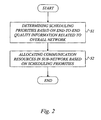
- FIG. 2 is a schematic flow diagram of a method according to a preferred exemplary embodiment of the present invention.
- FIG. 3 is a schematic network diagram according to an exemplary embodiment of the present invention.
- FIG. 4 is a schematic diagram illustrating radio access networks interconnected by an intermediate core network according to an exemplary embodiment of the present invention.
- FIG. 5 is a schematic block diagram of a scheduler according to an exemplary embodiment of the invention.
- FIG. 6 is a schematic flow diagram of an exemplary method according to a preferred embodiment of the present invention.
- FIG. 7 is a schematic diagram illustrating RTCP packet exchange.
- FIG. 8 is a schematic diagram illustrating RTCP RR packet format.
- FIG. 9 is a schematic diagram illustrating the improved scheduling policy in uplink and downlink according to an exemplary embodiment of the invention in a wireless network scenario.
- FIG. 10 is a schematic flow diagram illustrating an RTCP based downlink scheduling policy according to an exemplary embodiment of the invention.
- FIG. 11 is a schematic flow diagram illustrating an RTCP based uplink scheduling policy according to an exemplary embodiment of the invention.
- FIG. 1 is a schematic diagram illustrating a basic principle according to a preferred exemplary embodiment of the present invention from a network point of view.
- An overall network comprises two sub-networks 100 , 200 interconnected via an intermediate network 300 .
- the inventors have recognized that it is beneficial to consider information representative of experienced end-to-end quality of user communication in the overall network when scheduling users for communication in a wireless sub-network of the overall network. This means that information on experienced end-to-end quality related to the overall network will be used in the local scheduling procedure of at least one of the sub-networks.
- FIG. 1 Although merely two sub-networks are illustrated in FIG. 1 , it should be understood that the invention can be applied to a network scenario with more than two sub-networks.
- the sub-networks may be of the same type or of different types. It is also possible to use the invention in a network scenario where only part of the sub-networks support(s) scheduling.
- scheduling priorities of users are determined based on information representative of experienced end-to-end quality of user communication in the overall network (S 1 ).
- Communication resources in the considered wireless sub-network of the overall network are then allocated to the users based on the determined scheduling priorities (S 2 ).
- the communication resources to be allocated in the considered sub-network may for example include transmission resources of a shared radio medium.
- the end-to-end quality information may for example be related to factors such as the experienced end-to-end delay, end-to-end packet loss and/or end-to-end jitter.
- the sub-networks may for example be wireless access networks interconnected by an intermediate core network, as schematically illustrated in FIG. 3 .
- each access network 100 , 200 comprises a base station 120 , 220 such as a NodeB that serves a number of users 110 , 210 within a radio coverage area.
- Information on experienced end-to-end quality of user communication in the overall network may then preferably be used locally in the uplink and/or downlink scheduling procedures executed by a corresponding scheduler 130 , 230 in at least one of the access networks 100 , 200 .
- the considered access networks may be any type of access networks such as Wireless Local Area Networks (WLANs), World Interoperability for Microwave Access (WiMax) based access networks, or even Wireless Personal Area Networks (WPANs).
- WLANs Wireless Local Area Networks
- WiMax World Interoperability for Microwave Access
- WPANs Wireless Personal Area Networks
- the invention can be applied to network scenarios in which any types of access networks are interconnected through a core network, and end-to-end quality is taken into account in the local scheduling procedure of one or more of the access networks.
- PCF Point Coordination Function
- the term “user” is normally considered synonymous to, and occasionally referred to as, mobile, mobile station, user equipment, client, subscriber, remote station, user terminal and so forth, it may also relate to other types of nodes in a wireless network.
- HSPA High Speed Packet Access
- LTE Long Term Evolution
- scheduling of users is performed from the network side, and is therefore sometimes referred to as network-based multi-user scheduling.
- scheduling normally worked as an operation unit in the network controller.
- HSPA and similar modem systems scheduling was relocated to Node B.
- HSPA is generally based on High Speed Downlink Packet Access (HSDPA) in the downlink and Enhanced Uplink (EUL) in the uplink.
- HSDPA High Speed Downlink Packet Access
- EUL Enhanced Uplink
- HSPA High Speed Downlink Packet Access
- HSUPA High Speed Uplink Packet Access
- HSDPA is an enhancement to WCDMA that provides a smooth evolutionary path to higher data rates.
- HSDPA is specified in 3GPP release 5, and includes additional transport and control channels such as the High-Speed Downlink Shared Channel (HS-DSCH).
- EUL is specified in 3GPP release 6 and includes additional transport and control channels such as the Enhanced Dedicated Channel (E-DCH).
- HSDPA High Speed Data Packet Access
- HS-DSCH Downlink Control Channel
- HSDPA Similarly to HSDPA in the downlink, there will be a packet scheduler for E-DCH in the uplink, but it will normally operate on a request-grant principle, where the user equipment (UE) or terminal requests permission to send data and the scheduler on the network side decides when and how many terminals will be allowed to do so.
- a request for transmission will normally contain data about the state of the transmission data buffer and the queue at the terminal side and its available power margin.
- scheduling typically involves allocating communication resources to users according to some priority order.
- the scheduling algorithm generally determines the priorities of the users by using one or more metrics. For example, for MMTel services, the delay in the wireless access network is an important metric. Delay factors and optionally other factors based on radio channel quality are then normally used to grant scheduling priorities to the users. It is known that so-called delay-sensitive schedulers for the downlink can achieve rather good performance for MMTel services such as Voice over IP (VoIP) traffic. For example, reference [1] relates to delay-based scheduling.
- VoIP Voice over IP
- HARQ Hybrid Automatic Repeat ReQuest
- FIG. 4 An example of delay-based scheduling is shown in FIG. 4 .
- UE User Equipment
- UE A User Equipment
- UE B the ingoing and outgoing VoIP packets are normally scheduled by the downlink and uplink scheduling units at Node B.
- the scheduling units normally operate with factors related to the QoS evaluation in the RAN part, such as packet queuing time in the HARQ queues. Then, users with longer queuing time will be served with higher priority. This will help them to reduce the delay in the RAN part. However, users who have shorter RAN packet delay may experience longer end-to-end delay.
- VoIP perceptual performance is mainly determined by the end-to-end delay, not the RAN delay.
- the invention may provide improved uplink or downlink scheduling working at Node B.
- the scheduling priorities are calculated not only based on the factors related to QoS evaluation in the RAN part, but also based on some factors related to the end-to-end QoS evaluation, such as the experienced end-to-end delay for VoIP traffic. It should be emphasized that under certain circumstances it may be desirable to consider only, or at least primarily, the experienced end-to-end quality of user communication in the overall network. Normally, users experiencing lower end-to-end quality (e.g. longer end-to-end delay or higher end-to-end packet loss) should be granted relatively higher priority in the scheduler.
- end-to-end quality information and especially when combined with local quality of service information and/or other factors, the underlying basis for the scheduling decisions will generally be improved.
- the end-to-end quality aspects are only considered in the form of an end-to-end delay budget, which merely represents a desired target such as a maximum allowed delay.
- the incoming delay is the accumulated delay up until the base station, and does not include the downlink delay in the radio access network part from the scheduler to the mobile user.
- the downlink scheduler performs scheduling based on the time remaining in the end-to-end delay budget defined for the considered packet data traffic. The remaining period of time before the end-to-end delay budget is exceeded is referred to as the allowable scheduling delay in the downlink scheduler. Packets of those users having a smaller allowable scheduling delay will naturally be given higher priority in the scheduling procedure.
- Performing scheduling based on the remaining time before an end-to-end delay budget is met is clearly not the same as performing scheduling based on the actual end-to-end delay experienced by user packet data.
- a budget is merely a target value, and can not show the variation in actually experienced end-to-end delay.
- the invention When using both local quality of service information and end-to-end quality information, the invention considers two different granularities of scheduling, so-called inner-loop (local) scheduling and outer-loop (end-to-end) scheduling.
- FIG. 5 is a schematic block diagram of a scheduler according to an exemplary embodiment of the invention.
- the packet scheduler 130 comprises a unit 131 for compilation and/or estimation of information on experienced end-to-end quality for user communication in the overall network, a prioritization unit 132 for dynamically determining scheduling priorities of the users (i.e. the priority order), a resource allocation unit 133 , as well as one or more conventional packet buffers (data queues) 134 for storing packet data of the users.
- the end-to-end quality information unit 131 may receive end-to-end QoS feedback information.
- this QoS feedback information is extracted from a control protocol associated with the end-to-end transport protocol used for user communication in the overall network.
- the QoS feedback information will be used for providing an estimate, for each considered user, of actually experienced end-to-end quality in the overall network.
- This or similar information on experienced end-to-end quality is transferred to the prioritization unit 132 , which determines scheduling priorities of the users based on the received information. For example, the experienced end-to-end quality is compared to a corresponding quality (QoS) requirement, normally on a per-user basis, to determine the individual priority of each user.
- QoS quality
- the end-to-end QoS requirement may be set and updated per user.
- the prioritization unit 132 may optionally use additional information such as local QoS information, user channel quality information as well as other factors in the scheduling procedure.
- the actual resource allocation in the resource allocation unit 133 follows generally accepted technology and is based on detailed information about the shared communication resources as well-known to the skilled person.
- the user(s) decided to be served during a given scheduling period such as a Transmission Time Interval (TTI) will thus be allocated communication resources for transmission of the corresponding user packet data stored in the packet buffer(s) 134 .
- TTI Transmission Time Interval
- the functionality of the scheduler may be distributed between several nodes and/or units, or implemented in a single network node such as a network controller or base station (e.g. Node B).
- a network controller or base station e.g. Node B
- the invention can be used for allocating communication resources in any wireless sub-network irrespective of the underlying medium access technology (Frequency Division Multiplex, Time Division Multiplex, Code Division Multiplex and/or Space Division Multiplex).
- medium access technology Frequency Division Multiplex, Time Division Multiplex, Code Division Multiplex and/or Space Division Multiplex.
- the interested reader may find more information on packet scheduling in the specific context of HSDPA in reference [5].
- QoS feedback information is extracted from a control protocol associated with the end-to-end transport protocol used for communication.
- a transport protocol provides end-to-end delivery of user data in the overall network, and an accompanying control protocol monitors the end-to-end delivery of user data to provide quality of service (QoS) feedback information with respect to delivered user traffic.
- QoS feedback information is extracted from the control protocol to be able to provide estimates of the experienced end-to-end quality of the users.
- the scheduler parses control packets of the control protocol to extract the QoS feedback information.
- the QoS feedback information is extracted on the user side and subsequently delivered from the user side to the scheduling node.
- FIG. 6 is a schematic flow diagram of an exemplary method using QoS feedback information from a control protocol according to a preferred embodiment of the present invention.
- QoS feedback information for each relevant user is extracted from the control protocol associated with the used end-to-end transport protocol.
- an estimate of end-to-end quality actually experienced by user packet data in the overall network is determined for each considered user based on the extracted QoS feedback information in step S 12 .
- the scheduling priorities of the users are determined at least partly based on the estimates of experienced end-to-end quality.
- the scheduling priorities are determined in dependence on the estimates of experienced end-to-end quality such that those users experiencing relatively lower end-to-end quality are granted relatively higher priority.
- the communication resources are allocated according to the determined scheduling priorities.
- steps S 11 -S 14 may be individually and selectively repeated to provide up-to-date information.
- the end-to-end quality information may be changing dynamically, and the scheduling priorities may be adapted accordingly. This will be explained in more detail later on.
- RTP Real-time Transport Protocol
- RTCP Real-time Transport Control Protocol
- RTP/RTCP [6] protocol suite is proven to be a very useful transport mechanism.
- RTP provides the end-to-end delivery services for real-time traffic. But, it can not address the resource reservation and guarantee QoS (quality-of-service) for real-time services.
- RTCP monitors the delivery of the RTP data, and provides the QoS feedback information with respect to delivered data.
- RTCP was designed in order to enable point-to-point reporting of the experienced characteristics of the data flow.
- RTCP-XR extended RTCP reports
- the receival of these feedback reports makes it possible for the transmitting application/unit to change its behavior to make better use of the available channel resources.
- the inventors have recognized that it would be beneficial for the packet scheduler in a wireless sub-network of the overall end-to-end network to be able to get hold of certain information from the RTCP feedback reports transmitted between communicating users. For this reason it is suggested that the measures are taken to extract end-to-end QoS feedback information from the control packets, e.g. letting the scheduler parse the RTCP control packets or allowing QoS feedback information to be delivered to the scheduler from the user side.
- the RTCP protocol is suggested to deliver the QoS feedback information for MMTEL and similar services in systems such as HSPA and LTE.
- Reference [6] gives a detailed definition of RTCP protocol.
- RTCP defines five types of control packets, in which SR (sender report) and RR (receiver report) include feedback information such as packet loss, jitter and delay information.
- SR ender report
- RR receiver report
- FIG. 7 An example of a basic scenario for the RTCP SR/RR packet exchange between two clients A and B is shown in FIG. 7 .
- the RTCP RR packet format is shown in FIG. 8 .
- the packet loss and the jitter can also be evaluated from the RTCP feedback information.
- the scheduling node such as the base station or Node B has knowledge about end to end QoS requirements of traffic, like the end to end delay requirement. These QoS requirements may preferably be set per user.
- the RTCP protocol belongs to the transport layer, which is above the network layer.
- an RTCP packet will be exchanged between two mobile users, which have an end-to-end RTP-based media communication.
- the following exemplary solutions can be used for different scenarios respectively:
- RTCP packets can be parsed directly at eNodeB and the relevant RTCP-related QoS feedback information delivered to the scheduler.
- the RTCP related information can be delivered from the UE to Node B by a protocol extension, which requires a 3GPP specification change.
- the update interval of the end-to-end QoS factors may be in the order of seconds such as the RTCP transmission interval, while the scheduler may work in the unit of milliseconds.
- a similar concept as outer loop and inner loop can be used.
- the scheduling factors for the end-to-end QoS evaluation will be updated when the end-to-end QoS factors are available for the scheduler. In between RTCP transmissions, the scheduling factors will normally be kept unchanged. This means that the end-to-end quality information is preferably updated each RTCP transmission interval, while scheduling is performed, as normal, in each Transmission Time Interval (TTI) of the considered network.
- TTI Transmission Time Interval
- the cellular network may be exemplified by a Wideband Code Division Multiple Access (WCDMA) network using Enhanced Uplink (EUL) and High Speed Downlink Packet Access (HSDPA).
- WCDMA Wideband Code Division Multiple Access
- EUL Enhanced Uplink
- HSDPA High Speed Downlink Packet Access
- LTE Long Term Evolution
- FIG. 9 is a schematic diagram illustrating the improved scheduling policy in uplink and downlink according to an exemplary embodiment of the invention in a wireless network scenario.
- two cellular radio access networks are interconnected by a core network.
- Each access network includes a NodeB/eNodeB or similar base station node, which has functionality for uplink and downlink scheduling of mobile users.
- FIG. 10 is a schematic flow diagram illustrating an RTCP-based downlink scheduling policy according to an exemplary embodiment of the invention.
- a new kind of RTCP factor is involved in the calculation of the scheduling priorities.
- RTCP factors will be updated during each RTCP transmission interval, while the scheduler will work in each TTI.
- a similar concept as outer loop and inner loop is used. That means that the RTCP factor for end-to-end quality evaluation can be updated only when new, updated RTCP information is available for the scheduler. Otherwise RTCP factor is kept constant.
- At the start of each TTI it is checked whether new RTCP feedback information is available.
- an end-to-end QoS factor such as end-to-end delay is calculated/updated and the RTCP factor updated accordingly.
- the downlink scheduler will then use (outer loop) the estimated RTCP factor in the scheduling process, preferably together with complementary information such as CQI (channel quality indicator) and average rate factors, and so forth. In the period when no new RTCP feedback is available, the scheduler will use the same RTCP factor unchanged (inner loop) until the next RTCP update.
- the procedure is similar for uplink scheduling, as schematically illustrated in FIG. 11 .
- TFC Transport Format Combination
- the user priority order is preferably determined according to TFC requirement in combination with an RTCP factor based on end-to-end QoS information such as end-to-end delay, jitter or packet loss.
- additional information such as traffic type information may also be used in the scheduling procedure.
- the invention is applicable in any communication system having central resource management and user scheduling such as network-based multi-user packet scheduling in a wireless access network.
- the invention may for example be useful in HSDPA and LTE systems.
Landscapes
- Engineering & Computer Science (AREA)
- Computer Networks & Wireless Communication (AREA)
- Signal Processing (AREA)
- Databases & Information Systems (AREA)
- Mobile Radio Communication Systems (AREA)
Applications Claiming Priority (1)
| Application Number | Priority Date | Filing Date | Title |
|---|---|---|---|
| PCT/SE2007/000738 WO2009025592A1 (fr) | 2007-08-21 | 2007-08-21 | Programmation dans des réseaux sans fil |
Publications (2)
| Publication Number | Publication Date |
|---|---|
| US20110182248A1 US20110182248A1 (en) | 2011-07-28 |
| US8767636B2 true US8767636B2 (en) | 2014-07-01 |
Family
ID=40378372
Family Applications (1)
| Application Number | Title | Priority Date | Filing Date |
|---|---|---|---|
| US12/674,335 Expired - Fee Related US8767636B2 (en) | 2007-08-21 | 2007-08-21 | Scheduling in wireless networks |
Country Status (4)
| Country | Link |
|---|---|
| US (1) | US8767636B2 (fr) |
| EP (1) | EP2181532B1 (fr) |
| JP (1) | JP5091319B2 (fr) |
| WO (1) | WO2009025592A1 (fr) |
Cited By (2)
| Publication number | Priority date | Publication date | Assignee | Title |
|---|---|---|---|---|
| US20220225391A1 (en) * | 2019-05-09 | 2022-07-14 | Beijing Xiaomi Mobile Software Co., Ltd. | Sidelink data transmission method and apparatus and sidelink resource allocation method and apparatus |
| US11509556B2 (en) * | 2017-12-06 | 2022-11-22 | Telefonaktiebolaget Lm Ericsson (Publ) | Determining packet loss in a fronthaul link |
Families Citing this family (18)
| Publication number | Priority date | Publication date | Assignee | Title |
|---|---|---|---|---|
| US8923157B2 (en) * | 2007-11-05 | 2014-12-30 | Qualcomm Incorporated | Scheduling QOS flows in broadband wireless communication systems |
| WO2011096856A1 (fr) * | 2010-02-02 | 2011-08-11 | Telefonaktiebolaget L M Ericsson (Publ) | Facteur de correction d'attribution de capacité en régulation de flux basé sur la politique de planification, la mobilité, la charge ou le type de canal radio |
| KR101705359B1 (ko) * | 2010-03-12 | 2017-02-10 | 경희대학교 산학협력단 | 네트워크에서 서비스 품질 제어 관련 정보를 보고하는 방법과 이를 위한 네트워크 엔터티 |
| EP2388947A1 (fr) * | 2010-05-20 | 2011-11-23 | Thomson Licensing | Procédé de détermination de la qualité de transmission d'une liaison de communication et appareil correspondant |
| US8687576B2 (en) * | 2010-09-03 | 2014-04-01 | Telefonaktiebolaget Lm Ericsson (Publ) | Dynamic bandwidth allocation control in a multi-access radio communication system |
| US20130044582A1 (en) * | 2011-08-19 | 2013-02-21 | Faheem Ahmed | Control of end-to-end delay for delay sensitive ip traffics using feedback controlled adaptive priority scheme |
| US9332566B2 (en) | 2011-12-05 | 2016-05-03 | Telefonaktiebolaget L M Ericsson (Publ) | Method and arrangements for scheduling wireless resources in a wireless network |
| WO2014007509A1 (fr) * | 2012-07-02 | 2014-01-09 | 한국전자통신연구원 | Appareil et procédé conçus pour l'affectation d'une ressource |
| US20150351125A1 (en) * | 2012-07-02 | 2015-12-03 | Electronics And Telecommunications Research Institute | Apparatus and method for allocating resource |
| JP6147843B2 (ja) * | 2013-02-18 | 2017-06-14 | 京セラ株式会社 | 基地局及び通信制御方法 |
| JP6189545B2 (ja) * | 2013-10-01 | 2017-08-30 | インテル コーポレイション | 電力消費の低減のためのネットワークアプリケーション並行スケジューリング |
| US10142202B2 (en) * | 2014-01-30 | 2018-11-27 | Qualcomm Incorporated | Determination of end-to-end transport quality |
| WO2015174988A1 (fr) * | 2014-05-15 | 2015-11-19 | Hewlett-Packard Development Company, L.P. | Planification de réseau |
| KR102372488B1 (ko) * | 2015-05-29 | 2022-03-10 | 삼성전자 주식회사 | 무선 패킷 네트워크를 위한 스케줄링 방법 및 장치 |
| US10218457B2 (en) * | 2015-08-24 | 2019-02-26 | Qualcomm Incorporated | Techniques for improving feedback processes based on a latency between a transmission time interval (TTI) and a feedback opportunity |
| EP3537775B1 (fr) * | 2018-03-09 | 2020-04-15 | Mitsubishi Electric R&D Centre Europe B.V. | Protocole d'accès multiple pour dispositifs à consommation d'énergie ultra basse |
| EP3567807B1 (fr) * | 2018-05-09 | 2021-07-28 | FRAUNHOFER-GESELLSCHAFT zur Förderung der angewandten Forschung e.V. | Dispositif et procédé de distribution et de traitement de la zone de service d'un système de communication destinés à une meilleure estimation de la fiabilité et de la latence de transmission de données |
| US11765777B2 (en) * | 2021-12-31 | 2023-09-19 | Dish Wireless L.L.C. | Dynamic allocation of bandwidth in 5G wireless network |
Citations (37)
| Publication number | Priority date | Publication date | Assignee | Title |
|---|---|---|---|---|
| US5961599A (en) * | 1996-10-15 | 1999-10-05 | Lucent Technologies Inc. | Apparatus and method for computing the processing delay of adaptive applications network terminals and applications thereof |
| US20010027490A1 (en) * | 2000-01-25 | 2001-10-04 | Gabor Fodor | RSVP handling in 3G networks |
| US20020114305A1 (en) * | 2001-02-09 | 2002-08-22 | Johnson Oyama | Signaling quality of service class for use in multimedia communicatations |
| US20030063562A1 (en) | 2001-09-21 | 2003-04-03 | Terago Communications, Inc. | Programmable multi-service queue scheduler |
| US20030212999A1 (en) * | 2002-05-08 | 2003-11-13 | Simin Cai | System and method for providing video telephony over a cable access network infrastructure |
| US20030223429A1 (en) | 2002-06-03 | 2003-12-04 | Lucent Technologies, Inc. | Method and apparatus for scheduling users to allocate data transmissions in communications systems |
| US6693912B1 (en) * | 1999-06-04 | 2004-02-17 | Oki Electric Industry Co., Ltd. | Network interconnecting apparatus and active quality-of-service mapping method |
| US6701149B1 (en) * | 1999-07-19 | 2004-03-02 | Nortel Networks Limited | Handoff framework to support real-time delay-critical services in a next generation network |
| WO2004019521A1 (fr) | 2002-07-31 | 2004-03-04 | Sharp Kabushiki Kaisha | Dispositif de communication de donnees, son procede de communication intermittente, programme decrivant ce procede, et support d'enregistrement sur lequel le programme est enregistre |
| WO2004034726A1 (fr) | 2002-10-11 | 2004-04-22 | Telefonaktiebolaget Lm Ericsson (Publ) | Moyens de controle du debit binaire dans un systeme de telecommunications |
| US20040146067A1 (en) * | 2002-11-05 | 2004-07-29 | Lg Electronics, Inc. | Processing data units for transfer over the same channel |
| US6807156B1 (en) * | 2000-11-07 | 2004-10-19 | Telefonaktiebolaget Lm Ericsson (Publ) | Scalable real-time quality of service monitoring and analysis of service dependent subscriber satisfaction in IP networks |
| US20040240390A1 (en) * | 2003-05-30 | 2004-12-02 | Vidiator Enterprises Inc. | Method and apparatus for dynamic bandwidth adaptation |
| US20050099943A1 (en) * | 2003-11-12 | 2005-05-12 | Nokia Corporation | Traffic and radio resource control in a wireless communication device |
| US20050153725A1 (en) * | 2002-06-24 | 2005-07-14 | Nokia Corporation | Mobile mesh Ad-Hoc networking |
| US20060019662A1 (en) | 2004-07-21 | 2006-01-26 | Lucent Technologies, Inc. | Methods and apparatus for transmission scheduling in wireless networks |
| US20060039280A1 (en) * | 1999-08-10 | 2006-02-23 | Krishnasamy Anandakumar | Systems, processes and integrated circuits for rate and/or diversity adaptation for packet communications |
| US20060050705A1 (en) * | 2004-08-05 | 2006-03-09 | Lg Electronics Inc. | Distinguishing between protocol packets in a wireless communication system |
| US20060067269A1 (en) | 2004-09-27 | 2006-03-30 | Enrico Jugl | Method of scheduling users in wireless communication networks |
| WO2006032988A1 (fr) | 2004-09-24 | 2006-03-30 | Nokia Corporation | Allocation de ressources dans un systeme de communication |
| EP1643690A1 (fr) | 2004-10-01 | 2006-04-05 | Matsushita Electric Industrial Co., Ltd. | Ordonnancement tenant en compte la qualité de service pour liaisons montantes sur canales dediées |
| US20060111119A1 (en) * | 2003-08-12 | 2006-05-25 | Matsushita Electric Industrial Co., Ltd | Mobile terminal apparatus and transmission power control method |
| WO2006055173A2 (fr) | 2004-11-19 | 2006-05-26 | Telefonaktiebolaget Lm Ericsson (Publ) | Procede d'ordonnancement pour un canal d'acheminement de donnees par paquets sans fil |
| US7058042B2 (en) * | 2001-04-17 | 2006-06-06 | Nokia Corporation | One-to-one communication |
| WO2006065174A1 (fr) | 2004-12-13 | 2006-06-22 | Telefonaktiebolaget Lm Ericsson (Publ) | Reduction de latence lors de l'installation d'un canal de communications sans fil en amont |
| US20060146833A1 (en) * | 2004-12-30 | 2006-07-06 | Research In Motion Limited | Method and apparatus for selecting a transport format combination |
| WO2006130270A1 (fr) | 2005-05-27 | 2006-12-07 | Telefonaktiebolaget Lm Ericsson (Publ) | Procede et appareil destines a ameliorer la programmation dans des reseaux de donnees par paquets |
| US7245915B2 (en) * | 2001-09-27 | 2007-07-17 | Ntt Docomo, Inc. | Layer three quality of service aware trigger |
| US20070223491A1 (en) * | 2006-03-20 | 2007-09-27 | Samsung Electronics Co., Ltd. | Apparatus and method for providing quality of service in wireless communication system |
| US20070248075A1 (en) * | 2003-10-30 | 2007-10-25 | Utstarcom (China) Co. Ltd. | Apparatus and Method for Radio Transmission of Real-Time Ip Packets Using Header Compression Technique |
| US20070274284A1 (en) * | 2006-05-03 | 2007-11-29 | Raghunath Dendukuri | Media Inactivity detection in VoIP networks |
| US20070283025A1 (en) * | 2003-04-03 | 2007-12-06 | Seung June Yi | Apparatus and method for controlling access to network in wireless communication system |
| WO2008002228A1 (fr) | 2006-06-30 | 2008-01-03 | Telefonaktiebolaget Lm Ericsson (Publ) | Procédé d'amélioration de desserte pour canal d'accès par paquets de liaison descendante à grand débit |
| US7450514B2 (en) * | 2003-09-03 | 2008-11-11 | University-Industry Cooperation Group Of Kyunghee University | Method and device for delivering multimedia data using IETF QoS protocols |
| US20090028054A1 (en) * | 2007-07-25 | 2009-01-29 | Cisco Technology, Inc. | Detecting and Isolating Domain Specific Faults |
| US7616585B1 (en) * | 2006-02-28 | 2009-11-10 | Symantec Operating Corporation | Preventing network micro-congestion using send pacing based on end-to-end bandwidth |
| US7623483B2 (en) * | 2002-09-23 | 2009-11-24 | Lg Electronics, Inc. | Radio communication scheme for providing multimedia broadcast and multicast services (MBMS) |
-
2007
- 2007-08-21 EP EP07808767.3A patent/EP2181532B1/fr not_active Not-in-force
- 2007-08-21 JP JP2010521810A patent/JP5091319B2/ja not_active Expired - Fee Related
- 2007-08-21 US US12/674,335 patent/US8767636B2/en not_active Expired - Fee Related
- 2007-08-21 WO PCT/SE2007/000738 patent/WO2009025592A1/fr not_active Ceased
Patent Citations (46)
| Publication number | Priority date | Publication date | Assignee | Title |
|---|---|---|---|---|
| US5961599A (en) * | 1996-10-15 | 1999-10-05 | Lucent Technologies Inc. | Apparatus and method for computing the processing delay of adaptive applications network terminals and applications thereof |
| US6693912B1 (en) * | 1999-06-04 | 2004-02-17 | Oki Electric Industry Co., Ltd. | Network interconnecting apparatus and active quality-of-service mapping method |
| US6701149B1 (en) * | 1999-07-19 | 2004-03-02 | Nortel Networks Limited | Handoff framework to support real-time delay-critical services in a next generation network |
| US20060039280A1 (en) * | 1999-08-10 | 2006-02-23 | Krishnasamy Anandakumar | Systems, processes and integrated circuits for rate and/or diversity adaptation for packet communications |
| US20010027490A1 (en) * | 2000-01-25 | 2001-10-04 | Gabor Fodor | RSVP handling in 3G networks |
| US6807156B1 (en) * | 2000-11-07 | 2004-10-19 | Telefonaktiebolaget Lm Ericsson (Publ) | Scalable real-time quality of service monitoring and analysis of service dependent subscriber satisfaction in IP networks |
| US20020114305A1 (en) * | 2001-02-09 | 2002-08-22 | Johnson Oyama | Signaling quality of service class for use in multimedia communicatations |
| US7058042B2 (en) * | 2001-04-17 | 2006-06-06 | Nokia Corporation | One-to-one communication |
| US7099275B2 (en) | 2001-09-21 | 2006-08-29 | Slt Logic Llc | Programmable multi-service queue scheduler |
| US20030063562A1 (en) | 2001-09-21 | 2003-04-03 | Terago Communications, Inc. | Programmable multi-service queue scheduler |
| US7245915B2 (en) * | 2001-09-27 | 2007-07-17 | Ntt Docomo, Inc. | Layer three quality of service aware trigger |
| US20030212999A1 (en) * | 2002-05-08 | 2003-11-13 | Simin Cai | System and method for providing video telephony over a cable access network infrastructure |
| JP2004040786A (ja) | 2002-06-03 | 2004-02-05 | Lucent Technol Inc | スケジューリング方法 |
| US20030223429A1 (en) | 2002-06-03 | 2003-12-04 | Lucent Technologies, Inc. | Method and apparatus for scheduling users to allocate data transmissions in communications systems |
| US7746779B2 (en) | 2002-06-03 | 2010-06-29 | Alcatel-Lucent Usa Inc. | Method and apparatus for scheduling users to allocate data transmissions in communications systems |
| US20050153725A1 (en) * | 2002-06-24 | 2005-07-14 | Nokia Corporation | Mobile mesh Ad-Hoc networking |
| US20050286422A1 (en) | 2002-07-31 | 2005-12-29 | Nobuhiko Funato | Data communication device, its intermittent communication method, program describing its method, and recording medium on which program is recorded |
| US7664126B2 (en) | 2002-07-31 | 2010-02-16 | Sharp Kabushiki Kaisha | Data communication apparatus, intermittent communication method therefor, program describing the method and recording medium for recording the program |
| WO2004019521A1 (fr) | 2002-07-31 | 2004-03-04 | Sharp Kabushiki Kaisha | Dispositif de communication de donnees, son procede de communication intermittente, programme decrivant ce procede, et support d'enregistrement sur lequel le programme est enregistre |
| US7623483B2 (en) * | 2002-09-23 | 2009-11-24 | Lg Electronics, Inc. | Radio communication scheme for providing multimedia broadcast and multicast services (MBMS) |
| WO2004034726A1 (fr) | 2002-10-11 | 2004-04-22 | Telefonaktiebolaget Lm Ericsson (Publ) | Moyens de controle du debit binaire dans un systeme de telecommunications |
| JP2006502653A (ja) | 2002-10-11 | 2006-01-19 | テレフオンアクチーボラゲット エル エム エリクソン(パブル) | 通信システムにおけるビットレート制御手段 |
| US20040146067A1 (en) * | 2002-11-05 | 2004-07-29 | Lg Electronics, Inc. | Processing data units for transfer over the same channel |
| US20070283025A1 (en) * | 2003-04-03 | 2007-12-06 | Seung June Yi | Apparatus and method for controlling access to network in wireless communication system |
| US20040240390A1 (en) * | 2003-05-30 | 2004-12-02 | Vidiator Enterprises Inc. | Method and apparatus for dynamic bandwidth adaptation |
| US20060111119A1 (en) * | 2003-08-12 | 2006-05-25 | Matsushita Electric Industrial Co., Ltd | Mobile terminal apparatus and transmission power control method |
| US7450514B2 (en) * | 2003-09-03 | 2008-11-11 | University-Industry Cooperation Group Of Kyunghee University | Method and device for delivering multimedia data using IETF QoS protocols |
| US20070248075A1 (en) * | 2003-10-30 | 2007-10-25 | Utstarcom (China) Co. Ltd. | Apparatus and Method for Radio Transmission of Real-Time Ip Packets Using Header Compression Technique |
| US20050099943A1 (en) * | 2003-11-12 | 2005-05-12 | Nokia Corporation | Traffic and radio resource control in a wireless communication device |
| US7174180B2 (en) | 2004-07-21 | 2007-02-06 | Lucent Technologies Inc. | Methods and apparatus for transmission scheduling in wireless networks |
| US20060019662A1 (en) | 2004-07-21 | 2006-01-26 | Lucent Technologies, Inc. | Methods and apparatus for transmission scheduling in wireless networks |
| US20060050705A1 (en) * | 2004-08-05 | 2006-03-09 | Lg Electronics Inc. | Distinguishing between protocol packets in a wireless communication system |
| WO2006032988A1 (fr) | 2004-09-24 | 2006-03-30 | Nokia Corporation | Allocation de ressources dans un systeme de communication |
| US20060067269A1 (en) | 2004-09-27 | 2006-03-30 | Enrico Jugl | Method of scheduling users in wireless communication networks |
| US20070121542A1 (en) * | 2004-10-01 | 2007-05-31 | Matsushita Electric Industrial Co., Ltd. | Quality-of-service (qos)-aware scheduling for uplink transmission on dedicated channels |
| EP1643690A1 (fr) | 2004-10-01 | 2006-04-05 | Matsushita Electric Industrial Co., Ltd. | Ordonnancement tenant en compte la qualité de service pour liaisons montantes sur canales dediées |
| US20060153216A1 (en) * | 2004-11-19 | 2006-07-13 | Telefonaktiebolaget Lm Ericsson (Publ) | Scheduling method for wireless packet data channel |
| WO2006055173A2 (fr) | 2004-11-19 | 2006-05-26 | Telefonaktiebolaget Lm Ericsson (Publ) | Procede d'ordonnancement pour un canal d'acheminement de donnees par paquets sans fil |
| WO2006065174A1 (fr) | 2004-12-13 | 2006-06-22 | Telefonaktiebolaget Lm Ericsson (Publ) | Reduction de latence lors de l'installation d'un canal de communications sans fil en amont |
| US20060146833A1 (en) * | 2004-12-30 | 2006-07-06 | Research In Motion Limited | Method and apparatus for selecting a transport format combination |
| WO2006130270A1 (fr) | 2005-05-27 | 2006-12-07 | Telefonaktiebolaget Lm Ericsson (Publ) | Procede et appareil destines a ameliorer la programmation dans des reseaux de donnees par paquets |
| US7616585B1 (en) * | 2006-02-28 | 2009-11-10 | Symantec Operating Corporation | Preventing network micro-congestion using send pacing based on end-to-end bandwidth |
| US20070223491A1 (en) * | 2006-03-20 | 2007-09-27 | Samsung Electronics Co., Ltd. | Apparatus and method for providing quality of service in wireless communication system |
| US20070274284A1 (en) * | 2006-05-03 | 2007-11-29 | Raghunath Dendukuri | Media Inactivity detection in VoIP networks |
| WO2008002228A1 (fr) | 2006-06-30 | 2008-01-03 | Telefonaktiebolaget Lm Ericsson (Publ) | Procédé d'amélioration de desserte pour canal d'accès par paquets de liaison descendante à grand débit |
| US20090028054A1 (en) * | 2007-07-25 | 2009-01-29 | Cisco Technology, Inc. | Detecting and Isolating Domain Specific Faults |
Non-Patent Citations (5)
| Title |
|---|
| Cristina Comaniciu et al., "Wireless Access to the World Wide Web in an Integrated CDMA System", IEEE Transactions on Wireless Communications, vol. 2, No. 3, May 2003, pp. 472-483 (12 total pages). |
| H. Schulzrinne et al., "RTP: A Transport Protocol for Real-Time Applications", Network Working Group, RFC 3550, pp. 1-104 (98 total pages). |
| International Search Report dated May 16, 2008 (5 pages). |
| Pablo José et al., "Packet Scheduling and Quality of Service in HSDPA", Ph. D. Thesis, Oct. 2003 (192 total pages). |
| Written Opinion dated May 16, 2008 (4 pages). |
Cited By (3)
| Publication number | Priority date | Publication date | Assignee | Title |
|---|---|---|---|---|
| US11509556B2 (en) * | 2017-12-06 | 2022-11-22 | Telefonaktiebolaget Lm Ericsson (Publ) | Determining packet loss in a fronthaul link |
| US20220225391A1 (en) * | 2019-05-09 | 2022-07-14 | Beijing Xiaomi Mobile Software Co., Ltd. | Sidelink data transmission method and apparatus and sidelink resource allocation method and apparatus |
| US12200723B2 (en) * | 2019-05-09 | 2025-01-14 | Beijing Xiaomi Mobile Software Co., Ltd. | Sidelink data transmission method and apparatus and sidelink resource allocation method and apparatus |
Also Published As
| Publication number | Publication date |
|---|---|
| JP5091319B2 (ja) | 2012-12-05 |
| JP2010537549A (ja) | 2010-12-02 |
| EP2181532A1 (fr) | 2010-05-05 |
| WO2009025592A1 (fr) | 2009-02-26 |
| EP2181532A4 (fr) | 2013-02-06 |
| US20110182248A1 (en) | 2011-07-28 |
| EP2181532B1 (fr) | 2016-04-06 |
Similar Documents
| Publication | Publication Date | Title |
|---|---|---|
| US8767636B2 (en) | Scheduling in wireless networks | |
| US8437269B2 (en) | Uplink scheduling DSF wireless networks | |
| JP5763811B2 (ja) | 移動通信システムにおけるバッファ状態報告 | |
| JP4335619B2 (ja) | パケット優先制御装置及びその方法 | |
| JP4510006B2 (ja) | 移動局、基地局、通信システム、データ量情報送信方法、送信制御情報通知方法及び無線通信方法 | |
| CN101926133B (zh) | 通信调度方法和系统 | |
| JP4510826B2 (ja) | ユーザ装置の上りリンク送信をスケジューリングする方法及び基地局 | |
| CN101637044B (zh) | 无线承载专用信道质量指示报告 | |
| KR101233054B1 (ko) | 버퍼 상태 보고(bsr) 정보의 전송을 트리거링하는 방법 | |
| CA2503761C (fr) | Procede, systeme et programme informatique destines a gerer la transmission de paquets d'informations dans un reseau de telecommunication | |
| US8964655B2 (en) | Cooperative traffic scheduling | |
| JP2009261035A (ja) | 移動局、基地局、通信システム、データ量情報送信方法、送信制御情報通知方法及び無線通信方法 | |
| Mahdimahalleh et al. | Optimizing scheduling techniques for enhanced carrier aggregation in LTE-advanced networks | |
| JP4763085B2 (ja) | 移動局、通信システム及び無線通信方法 | |
| JP5026577B2 (ja) | 移動局 | |
| Le et al. | An improved scheduling algorithm for rtPS services in IEEE 802.16 | |
| Wu et al. | Cross-layer channel-quality-fair scheduling for video uplink of camera networks over WiMAX | |
| Shih-Jung | A channel quality-aware scheduling and resource allocation strategy for downlink LTE systems | |
| JP2011229187A (ja) | 移動局、基地局、通信システム、データ量情報送信方法、送信制御情報通知方法及び無線通信方法 | |
| Das et al. | QoS-aware distributed resource management for a WCDMA uplink | |
| JP2009273135A (ja) | パケット優先制御装置及びその方法 | |
| HK1183395A (en) | Method for optimizing the triggering of the transmission of buffer status reporting (bsr) information | |
| JP2012249039A (ja) | 無線リソース割り当て方法 |
Legal Events
| Date | Code | Title | Description |
|---|---|---|---|
| AS | Assignment |
Owner name: TELEFONAKTIEBOLAGET LM ERICSSON, SWEDEN Free format text: ASSIGNMENT OF ASSIGNORS INTEREST;ASSIGNORS:FAN, RUI;HU, RONG;WANG, MIN;SIGNING DATES FROM 20100222 TO 20100226;REEL/FRAME:024159/0667 |
|
| AS | Assignment |
Owner name: HIGHBRIDGE PRINCIPAL STRATEGIES, LLC (AS COLLATERA Free format text: LIEN;ASSIGNOR:OPTIS CELLULAR TECHNOLOGY, LLC;REEL/FRAME:031866/0697 Effective date: 20131219 |
|
| AS | Assignment |
Owner name: WILMINGTON TRUST, NATIONAL ASSOCIATION (AS COLLATE Free format text: SECURITY AGREEMENT;ASSIGNOR:OPTIS CELLULAR TECHNOLOGY, LLC;REEL/FRAME:032167/0406 Effective date: 20131219 |
|
| AS | Assignment |
Owner name: OPTIS CELLULAR TECHNOLOGY, LLC, TEXAS Free format text: ASSIGNMENT OF ASSIGNORS INTEREST;ASSIGNOR:CLUSTER LLC;REEL/FRAME:032326/0402 Effective date: 20131219 Owner name: CLUSTER LLC, DELAWARE Free format text: ASSIGNMENT OF ASSIGNORS INTEREST;ASSIGNOR:TELEFONAKTIEBOLAGET L M ERICSSON (PUBL);REEL/FRAME:032326/0219 Effective date: 20131219 |
|
| AS | Assignment |
Owner name: HIGHBRIDGE PRINCIPAL STRATEGIES, LLC, AS COLLATERA Free format text: ASSIGNMENT OF ASSIGNORS INTEREST;ASSIGNOR:OPTIS CELLULAR TECHNOLOGY, LLC;REEL/FRAME:032786/0546 Effective date: 20140424 |
|
| STCF | Information on status: patent grant |
Free format text: PATENTED CASE |
|
| AS | Assignment |
Owner name: HIGHBRIDGE PRINCIPAL STRATEGIES, LLC, AS COLLATERA Free format text: CORRECTIVE ASSIGNMENT TO CORRECT THE NATURE OF CONVEYANCE TO READ "SECURITY INTEREST" PREVIOUSLY RECORDED ON REEL 032786 FRAME 0546. ASSIGNOR(S) HEREBY CONFIRMS THE SECURITY INTEREST;ASSIGNOR:OPTIS CELLULAR TECHNOLOGY, LLC;REEL/FRAME:033281/0216 Effective date: 20140424 |
|
| AS | Assignment |
Owner name: OPTIS CELLULAR TECHNOLOGY, LLC, TEXAS Free format text: RELEASE BY SECURED PARTY;ASSIGNOR:HPS INVESTMENT PARTNERS, LLC;REEL/FRAME:039359/0916 Effective date: 20160711 |
|
| FEPP | Fee payment procedure |
Free format text: MAINTENANCE FEE REMINDER MAILED (ORIGINAL EVENT CODE: REM.) |
|
| LAPS | Lapse for failure to pay maintenance fees |
Free format text: PATENT EXPIRED FOR FAILURE TO PAY MAINTENANCE FEES (ORIGINAL EVENT CODE: EXP.); ENTITY STATUS OF PATENT OWNER: LARGE ENTITY |
|
| STCH | Information on status: patent discontinuation |
Free format text: PATENT EXPIRED DUE TO NONPAYMENT OF MAINTENANCE FEES UNDER 37 CFR 1.362 |
|
| FP | Lapsed due to failure to pay maintenance fee |
Effective date: 20220701 |