US8852312B2 - System and method for biological treatment of biodegradable waste including biodegradable municipal solid waste - Google Patents
System and method for biological treatment of biodegradable waste including biodegradable municipal solid waste Download PDFInfo
- Publication number
- US8852312B2 US8852312B2 US13/382,128 US200913382128A US8852312B2 US 8852312 B2 US8852312 B2 US 8852312B2 US 200913382128 A US200913382128 A US 200913382128A US 8852312 B2 US8852312 B2 US 8852312B2
- Authority
- US
- United States
- Prior art keywords
- biological treatment
- btp
- treatment plant
- tank
- waste
- Prior art date
- Legal status (The legal status is an assumption and is not a legal conclusion. Google has not performed a legal analysis and makes no representation as to the accuracy of the status listed.)
- Expired - Fee Related, expires
Links
Images


Classifications
-
- B—PERFORMING OPERATIONS; TRANSPORTING
- B09—DISPOSAL OF SOLID WASTE; RECLAMATION OF CONTAMINATED SOIL
- B09B—DISPOSAL OF SOLID WASTE NOT OTHERWISE PROVIDED FOR
- B09B3/00—Destroying solid waste or transforming solid waste into something useful or harmless
-
- B—PERFORMING OPERATIONS; TRANSPORTING
- B09—DISPOSAL OF SOLID WASTE; RECLAMATION OF CONTAMINATED SOIL
- B09B—DISPOSAL OF SOLID WASTE NOT OTHERWISE PROVIDED FOR
- B09B3/00—Destroying solid waste or transforming solid waste into something useful or harmless
- B09B3/30—Destroying solid waste or transforming solid waste into something useful or harmless involving mechanical treatment
- B09B3/35—Shredding, crushing or cutting
-
- B—PERFORMING OPERATIONS; TRANSPORTING
- B09—DISPOSAL OF SOLID WASTE; RECLAMATION OF CONTAMINATED SOIL
- B09B—DISPOSAL OF SOLID WASTE NOT OTHERWISE PROVIDED FOR
- B09B3/00—Destroying solid waste or transforming solid waste into something useful or harmless
- B09B3/60—Biochemical treatment, e.g. by using enzymes
- B09B3/65—Anaerobic treatment
-
- B—PERFORMING OPERATIONS; TRANSPORTING
- B09—DISPOSAL OF SOLID WASTE; RECLAMATION OF CONTAMINATED SOIL
- B09B—DISPOSAL OF SOLID WASTE NOT OTHERWISE PROVIDED FOR
- B09B3/00—Destroying solid waste or transforming solid waste into something useful or harmless
- B09B3/70—Chemical treatment, e.g. pH adjustment or oxidation
-
- C—CHEMISTRY; METALLURGY
- C02—TREATMENT OF WATER, WASTE WATER, SEWAGE, OR SLUDGE
- C02F—TREATMENT OF WATER, WASTE WATER, SEWAGE, OR SLUDGE
- C02F11/00—Treatment of sludge; Devices therefor
- C02F11/02—Biological treatment
- C02F11/04—Anaerobic treatment; Production of methane by such processes
-
- C05F17/0027—
-
- C—CHEMISTRY; METALLURGY
- C05—FERTILISERS; MANUFACTURE THEREOF
- C05F—ORGANIC FERTILISERS NOT COVERED BY SUBCLASSES C05B, C05C, e.g. FERTILISERS FROM WASTE OR REFUSE
- C05F17/00—Preparation of fertilisers characterised by biological or biochemical treatment steps, e.g. composting or fermentation
- C05F17/50—Treatments combining two or more different biological or biochemical treatments, e.g. anaerobic and aerobic treatment or vermicomposting and aerobic treatment
-
- C—CHEMISTRY; METALLURGY
- C05—FERTILISERS; MANUFACTURE THEREOF
- C05F—ORGANIC FERTILISERS NOT COVERED BY SUBCLASSES C05B, C05C, e.g. FERTILISERS FROM WASTE OR REFUSE
- C05F9/00—Fertilisers from household or town refuse
-
- C—CHEMISTRY; METALLURGY
- C05—FERTILISERS; MANUFACTURE THEREOF
- C05F—ORGANIC FERTILISERS NOT COVERED BY SUBCLASSES C05B, C05C, e.g. FERTILISERS FROM WASTE OR REFUSE
- C05F9/00—Fertilisers from household or town refuse
- C05F9/02—Apparatus for the manufacture
-
- C—CHEMISTRY; METALLURGY
- C12—BIOCHEMISTRY; BEER; SPIRITS; WINE; VINEGAR; MICROBIOLOGY; ENZYMOLOGY; MUTATION OR GENETIC ENGINEERING
- C12M—APPARATUS FOR ENZYMOLOGY OR MICROBIOLOGY; APPARATUS FOR CULTURING MICROORGANISMS FOR PRODUCING BIOMASS, FOR GROWING CELLS OR FOR OBTAINING FERMENTATION OR METABOLIC PRODUCTS, i.e. BIOREACTORS OR FERMENTERS
- C12M21/00—Bioreactors or fermenters specially adapted for specific uses
- C12M21/04—Bioreactors or fermenters specially adapted for specific uses for producing gas, e.g. biogas
-
- C—CHEMISTRY; METALLURGY
- C12—BIOCHEMISTRY; BEER; SPIRITS; WINE; VINEGAR; MICROBIOLOGY; ENZYMOLOGY; MUTATION OR GENETIC ENGINEERING
- C12M—APPARATUS FOR ENZYMOLOGY OR MICROBIOLOGY; APPARATUS FOR CULTURING MICROORGANISMS FOR PRODUCING BIOMASS, FOR GROWING CELLS OR FOR OBTAINING FERMENTATION OR METABOLIC PRODUCTS, i.e. BIOREACTORS OR FERMENTERS
- C12M23/00—Constructional details, e.g. recesses, hinges
- C12M23/36—Means for collection or storage of gas; Gas holders
-
- C—CHEMISTRY; METALLURGY
- C12—BIOCHEMISTRY; BEER; SPIRITS; WINE; VINEGAR; MICROBIOLOGY; ENZYMOLOGY; MUTATION OR GENETIC ENGINEERING
- C12M—APPARATUS FOR ENZYMOLOGY OR MICROBIOLOGY; APPARATUS FOR CULTURING MICROORGANISMS FOR PRODUCING BIOMASS, FOR GROWING CELLS OR FOR OBTAINING FERMENTATION OR METABOLIC PRODUCTS, i.e. BIOREACTORS OR FERMENTERS
- C12M27/00—Means for mixing, agitating or circulating fluids in the vessel
- C12M27/18—Flow directing inserts
- C12M27/20—Baffles; Ribs; Ribbons; Auger vanes
-
- C—CHEMISTRY; METALLURGY
- C12—BIOCHEMISTRY; BEER; SPIRITS; WINE; VINEGAR; MICROBIOLOGY; ENZYMOLOGY; MUTATION OR GENETIC ENGINEERING
- C12M—APPARATUS FOR ENZYMOLOGY OR MICROBIOLOGY; APPARATUS FOR CULTURING MICROORGANISMS FOR PRODUCING BIOMASS, FOR GROWING CELLS OR FOR OBTAINING FERMENTATION OR METABOLIC PRODUCTS, i.e. BIOREACTORS OR FERMENTERS
- C12M33/00—Means for introduction, transport, positioning, extraction, harvesting, peeling or sampling of biological material in or from the apparatus
- C12M33/20—Ribbons
-
- C—CHEMISTRY; METALLURGY
- C12—BIOCHEMISTRY; BEER; SPIRITS; WINE; VINEGAR; MICROBIOLOGY; ENZYMOLOGY; MUTATION OR GENETIC ENGINEERING
- C12M—APPARATUS FOR ENZYMOLOGY OR MICROBIOLOGY; APPARATUS FOR CULTURING MICROORGANISMS FOR PRODUCING BIOMASS, FOR GROWING CELLS OR FOR OBTAINING FERMENTATION OR METABOLIC PRODUCTS, i.e. BIOREACTORS OR FERMENTERS
- C12M41/00—Means for regulation, monitoring, measurement or control, e.g. flow regulation
- C12M41/12—Means for regulation, monitoring, measurement or control, e.g. flow regulation of temperature
-
- C—CHEMISTRY; METALLURGY
- C12—BIOCHEMISTRY; BEER; SPIRITS; WINE; VINEGAR; MICROBIOLOGY; ENZYMOLOGY; MUTATION OR GENETIC ENGINEERING
- C12M—APPARATUS FOR ENZYMOLOGY OR MICROBIOLOGY; APPARATUS FOR CULTURING MICROORGANISMS FOR PRODUCING BIOMASS, FOR GROWING CELLS OR FOR OBTAINING FERMENTATION OR METABOLIC PRODUCTS, i.e. BIOREACTORS OR FERMENTERS
- C12M41/00—Means for regulation, monitoring, measurement or control, e.g. flow regulation
- C12M41/26—Means for regulation, monitoring, measurement or control, e.g. flow regulation of pH
-
- C—CHEMISTRY; METALLURGY
- C12—BIOCHEMISTRY; BEER; SPIRITS; WINE; VINEGAR; MICROBIOLOGY; ENZYMOLOGY; MUTATION OR GENETIC ENGINEERING
- C12M—APPARATUS FOR ENZYMOLOGY OR MICROBIOLOGY; APPARATUS FOR CULTURING MICROORGANISMS FOR PRODUCING BIOMASS, FOR GROWING CELLS OR FOR OBTAINING FERMENTATION OR METABOLIC PRODUCTS, i.e. BIOREACTORS OR FERMENTERS
- C12M45/00—Means for pre-treatment of biological substances
- C12M45/04—Phase separators; Separation of non fermentable material; Fractionation
-
- C—CHEMISTRY; METALLURGY
- C02—TREATMENT OF WATER, WASTE WATER, SEWAGE, OR SLUDGE
- C02F—TREATMENT OF WATER, WASTE WATER, SEWAGE, OR SLUDGE
- C02F2209/00—Controlling or monitoring parameters in water treatment
- C02F2209/02—Temperature
-
- C—CHEMISTRY; METALLURGY
- C02—TREATMENT OF WATER, WASTE WATER, SEWAGE, OR SLUDGE
- C02F—TREATMENT OF WATER, WASTE WATER, SEWAGE, OR SLUDGE
- C02F2209/00—Controlling or monitoring parameters in water treatment
- C02F2209/06—Controlling or monitoring parameters in water treatment pH
-
- Y—GENERAL TAGGING OF NEW TECHNOLOGICAL DEVELOPMENTS; GENERAL TAGGING OF CROSS-SECTIONAL TECHNOLOGIES SPANNING OVER SEVERAL SECTIONS OF THE IPC; TECHNICAL SUBJECTS COVERED BY FORMER USPC CROSS-REFERENCE ART COLLECTIONS [XRACs] AND DIGESTS
- Y02—TECHNOLOGIES OR APPLICATIONS FOR MITIGATION OR ADAPTATION AGAINST CLIMATE CHANGE
- Y02A—TECHNOLOGIES FOR ADAPTATION TO CLIMATE CHANGE
- Y02A40/00—Adaptation technologies in agriculture, forestry, livestock or agroalimentary production
- Y02A40/10—Adaptation technologies in agriculture, forestry, livestock or agroalimentary production in agriculture
- Y02A40/20—Fertilizers of biological origin, e.g. guano or fertilizers made from animal corpses
-
- Y—GENERAL TAGGING OF NEW TECHNOLOGICAL DEVELOPMENTS; GENERAL TAGGING OF CROSS-SECTIONAL TECHNOLOGIES SPANNING OVER SEVERAL SECTIONS OF THE IPC; TECHNICAL SUBJECTS COVERED BY FORMER USPC CROSS-REFERENCE ART COLLECTIONS [XRACs] AND DIGESTS
- Y02—TECHNOLOGIES OR APPLICATIONS FOR MITIGATION OR ADAPTATION AGAINST CLIMATE CHANGE
- Y02E—REDUCTION OF GREENHOUSE GAS [GHG] EMISSIONS, RELATED TO ENERGY GENERATION, TRANSMISSION OR DISTRIBUTION
- Y02E50/00—Technologies for the production of fuel of non-fossil origin
- Y02E50/30—Fuel from waste, e.g. synthetic alcohol or diesel
-
- Y02E50/343—
-
- Y—GENERAL TAGGING OF NEW TECHNOLOGICAL DEVELOPMENTS; GENERAL TAGGING OF CROSS-SECTIONAL TECHNOLOGIES SPANNING OVER SEVERAL SECTIONS OF THE IPC; TECHNICAL SUBJECTS COVERED BY FORMER USPC CROSS-REFERENCE ART COLLECTIONS [XRACs] AND DIGESTS
- Y02—TECHNOLOGIES OR APPLICATIONS FOR MITIGATION OR ADAPTATION AGAINST CLIMATE CHANGE
- Y02P—CLIMATE CHANGE MITIGATION TECHNOLOGIES IN THE PRODUCTION OR PROCESSING OF GOODS
- Y02P20/00—Technologies relating to chemical industry
- Y02P20/141—Feedstock
- Y02P20/145—Feedstock the feedstock being materials of biological origin
-
- Y—GENERAL TAGGING OF NEW TECHNOLOGICAL DEVELOPMENTS; GENERAL TAGGING OF CROSS-SECTIONAL TECHNOLOGIES SPANNING OVER SEVERAL SECTIONS OF THE IPC; TECHNICAL SUBJECTS COVERED BY FORMER USPC CROSS-REFERENCE ART COLLECTIONS [XRACs] AND DIGESTS
- Y02—TECHNOLOGIES OR APPLICATIONS FOR MITIGATION OR ADAPTATION AGAINST CLIMATE CHANGE
- Y02W—CLIMATE CHANGE MITIGATION TECHNOLOGIES RELATED TO WASTEWATER TREATMENT OR WASTE MANAGEMENT
- Y02W10/00—Technologies for wastewater treatment
- Y02W10/20—Sludge processing
-
- Y—GENERAL TAGGING OF NEW TECHNOLOGICAL DEVELOPMENTS; GENERAL TAGGING OF CROSS-SECTIONAL TECHNOLOGIES SPANNING OVER SEVERAL SECTIONS OF THE IPC; TECHNICAL SUBJECTS COVERED BY FORMER USPC CROSS-REFERENCE ART COLLECTIONS [XRACs] AND DIGESTS
- Y02—TECHNOLOGIES OR APPLICATIONS FOR MITIGATION OR ADAPTATION AGAINST CLIMATE CHANGE
- Y02W—CLIMATE CHANGE MITIGATION TECHNOLOGIES RELATED TO WASTEWATER TREATMENT OR WASTE MANAGEMENT
- Y02W10/00—Technologies for wastewater treatment
- Y02W10/30—Wastewater or sewage treatment systems using renewable energies
- Y02W10/37—Wastewater or sewage treatment systems using renewable energies using solar energy
-
- Y—GENERAL TAGGING OF NEW TECHNOLOGICAL DEVELOPMENTS; GENERAL TAGGING OF CROSS-SECTIONAL TECHNOLOGIES SPANNING OVER SEVERAL SECTIONS OF THE IPC; TECHNICAL SUBJECTS COVERED BY FORMER USPC CROSS-REFERENCE ART COLLECTIONS [XRACs] AND DIGESTS
- Y02—TECHNOLOGIES OR APPLICATIONS FOR MITIGATION OR ADAPTATION AGAINST CLIMATE CHANGE
- Y02W—CLIMATE CHANGE MITIGATION TECHNOLOGIES RELATED TO WASTEWATER TREATMENT OR WASTE MANAGEMENT
- Y02W30/00—Technologies for solid waste management
- Y02W30/40—Bio-organic fraction processing; Production of fertilisers from the organic fraction of waste or refuse
Definitions
- the present invention relates to treatment of biodegradable waste including biodegradable municipal solid waste for producing products, such as rich biological/organic fertilizers, methane, and many useful byproducts the like, in short time span.
- Bio Degradation This method has been commonly used since many centuries where the waste is disposed off and is allowed to bio degrade naturally. On the basis of the available area of land, manpower and resources the following procedures are followed:
- the basic principle in the incineration process is the burning of the MSW in closed RCC chambers under controlled temperature and depending upon the temperature incineration process is classified into following methods:
- This pyrolysis is burning of hazardous materials in a closed chamber at approximately 300° C. and converting all such material to ash which does not carry any biological value.
- the plasma gasification/incineration chamber has to be made of heavy duty concrete and in large volumes and thus the initial cost of installation is very high. similarly initial & running costs of MBT's is also very high
- Object of present invention is to provide method and system for biological treatment of biodegradable waste (herein after referred as BW) including biodegradable municipal solid waste (herein after referred as MSW), which completes the ‘Ecological Cycle of Biomass’ by treating the biodegradable waste & thus to help to complete the Recycling II of Biomass & to make nutrients available for Recycling III & I
- BW biodegradable waste
- MSW biodegradable municipal solid waste
- Another object of the present invention is to provide a method and a system for treating BW including MSW to produce rich biological or organic fertilizers, methane and to produce useful intermediate products, by products & to install sub plants for various purposes.
- Yet another object of the present invention is to provide a method and a system for treating BW including MSW, which is capable of reducing the time span to greater extent, as compared to the known/existing processes.
- One more another object of the invention is to provide a method and a system for treating BW including MSW, which will produce products in natural form for completing the ecological and biological cycle of biomass in nature.
- Further object of the present invention is to provide a method and a system for treating BW including MSW, which is easily erected at various locations & in various capacities and even a single capacity unit can also, be in multiple stages and at various locations.
- one object of the present invention is to provide a method and a system for treating BW including MSW which will produce useful intermediate products, byproducts & sub plants which can be used for different purposes & in different industries.
- Yet another object of invention is to provide the recycling plant for BW including MSW fulfilling most of the following criteria's:
- the plant must be completing the perfect bio-geochemical cycle of all the fundamental elements and ultimately the bio-mass cycle or the food chain of the Universe.
- the present invention describes a method and system which is developed for completion of Ecological cycle of Biomass, applying Nature to Nature theory (N2N Theory), by biological treatment of any biodegradable waste (herein after referred as BW) or organic waste, including biodegradable part of Municipal waste, to produce rich biological end product i.e. biological fertilizer, methane and many useful byproducts
- BTP Bio Treatment Plant
- BW Biodegradable waste
- This Biological treatment Plant is designed for the 21 st century for the treatment of BW.
- Biomass means organic matter which is present in the body of every living organism, plants, & animals present in the nature.
- the carbohydrates, proteins and lipids are produced by plants as the basic food and this food mass is called as bio-mass.
- Biomass hereinafter, its cycle is called ‘Ecological cycle of Biomass’ hereinafter and Nature to nature theory applicable to biomass is called ‘N2N Theory of Biomass’, hereinafter).
- N2N theory means what ever is taken from the nature should be returned to the nature, which also applies to biomass.
- Plants prepare the basic food in the form of carbohydrates using the fundamental elements by carbon fixation by photosynthesis. Herbivores eat plants, carnivores eat herbivores, and omnivores eat both for their body metabolism.
- Plants absorb the basic elements from the soil as main nutrition and with the help of CO2 from the atmosphere, H2O from soil media and light energy from the sunlight, they undergo photosynthesis i.e carbon fixation and prepare the basic form of carbohydrates which is the generation of bio-mass, thus the cycle continues.
- the bio-mass cycle is complete.
- the Recycling Stage II i.e. that is animal media to soil media of biomass is completed, & good nutrients & elements are made available for the Recycling Stage III & I, which if not complete will break the chain of biomass of nature.
- BTP Biological Treatment Plant
- the entire waste created in nature is entirely bio-degradable material and it bio-degrades in the natural way, within natural time frame, which is acceptable to nature. Since in nature there is no excess waste, there is no need of a waste treatment process or plant for natural waste.
- the Biodegradable solid waste can be broadly categorized into 2 parts
- MSW Municipal Solid Waste i.e.
- Biodegradation is the only system which completes the biological/ecological chain or cycle however the time duration required is much more (i.e., from 30 days upto some months or even years).
- the time duration required is much more (i.e., from 30 days upto some months or even years).
- MSW MSW
- BW Biodegradable waste
- the main object of invention is to give the prime focus on the treatment of any BW including MSW in the BTP. Rate of production of biodegradable solid waste is very fast. If it remains untreated it will lead to many environmental problems, which are very harmful to society & ultimately to the ecology.
- a system for biological treatment of biodegradable waste comprising;
- the Biological Treatment Plant-I includes plurality of baffle walls and plurality of sprinklers, wherein the baffle wall enables enhanced movement of sludge therein, and the sprinklers enables mixing of the sludge with fluid i.e. ruminal fluid from the rumen of the cow or a ‘Fluid’ similar to it, with specific ‘Microbes’.
- fluid i.e. ruminal fluid from the rumen of the cow or a ‘Fluid’ similar to it, with specific ‘Microbes’.
- the pusher introduces waves in forward direction and the rotor to enhances proper mixing of ruminal fluid or enzymes in the prepared slurry.
- the Biological Treatment Plant-II includes plurality of baffle walls and plurality of sprinklers, wherein the baffle wall enables enhanced movement of slurry therein, and the sprinklers enables mixing of the slurry with Enzymes' of or similar to human digestive systems i.e., pancreatic & intestinal enzymes & bile salts.
- the Biological Treatment Plant-III includes plurality of baffle walls and plurality of sprinklers, wherein the baffle wall enables enhanced movement of slurry therein, and the sprinklers enables mixing of the thermophilic bacteria.
- Biological Treatment Plant-I and Biological Treatment Plant-II are connected by at least one connecting element to pass the slurry from Biological Treatment Plant-I to Biological Treatment Plant-II, therebetween treated with acid to kill the microbes from Biological Treatment Plant-I.
- the fluid i.e. ruminal fluid from the rumen of the cow or a ‘Fluid’ similar to it, with specific ‘Microbes’ is used to disintegrate carbohydrates, proteins and lipids in industries, such as paper pulp industry, textile industry, in dye industry, in preparation of laboratory medias, broths/industry, and the like
- the ruminal fluid of cow or ‘Fluid’ similar to ruminal fluid contains various types, species of microbes. Controlled action/s of specific microbes on prepared sludge in the BTP I can be conducted to obtain a sludge of specific characteristic, which we can call as ‘bulk liquid’, which will be useful in many types of industries.
- the bulk liquid can be useful for medicine production in the pharmaceutical Industry.
- the bulk liquid can be used in nutritional products like protein powder, vitamins etc., after strict sterile treatments.
- Biological Treatment Plant-I and Biological Treatment Plant-II which in industries such as in cosmetics production/industry, in essence production/industry, in production of soap like products/industry, in paper and pulp industry, in dye industry, in some industries to treat their hazardous effluents/intermediate or end products, in preparation of laboratory medias, broths/industry, in pharmaceutical industry as any type of animal feed, as cattle feed, biofertilizers/industry & in many other industries, in some industries to treat their hazardous effluents/intermediate or end products, in pharmaceutical industry, as any type of animal feed, as cattle feed, biofertilizers/industry & in many other industries
- the prepared sludge from the primary treatment tank is used to prepare herbivore's feed at low cost or feed for carnivore's and omnivore's is prepared depending upon the type of biodegradable waste.
- the prepared sludge from Biological Treatment Tank I is used to prepare perfume or essence or aromatic products.
- the Biological Treatment Plant I, Biological Treatment Plant-II, Biological Treatment Plant-III is configured in a single chamber
- the a gas collector provided with an exhaust pipe for burning the methane there from.
- the Biological treatment plant II is connected to gas collector for passing gases generated therein.
- the Biological treatment plant I, Biological treatment plant II and Biological treatment plant III is provided with manhole of predefined size at predefined location for regular maintenance.
- FIG. 1 explains the ecological cycle of biomass
- FIG. 2 shows comparison chart in digestive system and in the BTP
- FIG. 3 shows a chart of chemical reaction in BTP-I
- FIG. 4 shows top view of a system for biological treatment of BW including MSW according to the present invention
- FIG. 5 shows side view of FIG. 3 ;
- FIG. 6 shows enlarged view of the biological treatment plant I, II and III of the system of the present invention.
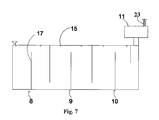
- FIG. 7 shows an embodiment of Biological Treatment plant (BTP) of FIG. 6 .
- FIGS. 5 and 6 shows a various views of system for biological treatment of biodegradable waste (herein referred as BW) including biodegradable municipal solid waste.
- the system includes an un-loading platform ( 20 ), at least one conveyor belt, the FIG. 4 is shown to include two conveyor belts ( 26 ), a magnet chamber ( 30 ), at least one separator, in FIG. 4 it is shown to include one separator ( 32 ), and first storage tank ( 28 ).
- the unloading platform ( 20 ) is provided for unloading the mixed solid waste (herein after referred as SW) collected from various sources.
- SW is generally collected from various city areas in various containers and unloaded on to the site of the system.
- the conveyor belts ( 26 ) are capable of conveying the SW from the unloading platform ( 20 ).
- the magnet chamber ( 30 ) is provided next to the unloading platform ( 20 ).
- the conveyor belts ( 26 ) with the SW are passed thought the magnet chamber ( 30 ) for separating metal part from the SW.
- the magnet chamber ( 30 ) is provided with strong magnets, which are capable of attracting metals.
- the separator ( 32 ) provided next to the magnet chamber ( 30 ).
- the recyclable inorganic waste is separated from the SW in the separator ( 32 ).
- the separation is done manually by appointing group of peoples for separating material, such as wood, plastic, small particles, cloths, papers and the like.
- the separation is done automatically, by using robotic technology.
- the first storage tank ( 28 ) is provided next to the separator ( 32 ).
- the first storage tank ( 28 ) receives segregated BW from SW. This setup may also be installed at various places including that of the urbanized society for processing
- the system also includes a primary treatment tank ( 2 ), a second storage tank ( 6 ), a third storage tank ( 6 a ), at least one Biological Treatment Plant I ( 8 ) (Biological Treatment Plant herein after referred as BTP)
- FIGS. 4 , and 5 are shown with four BTP I ( 8 ), at least one BTP II ( 9 ), FIGS. 4 , and 5 are shown with four BTP II ( 9 ), BTP III ( 10 ), and a gas collator ( 11 ).
- the above mentioned elements of the system may be configured at remote places away form urbanization.
- the segregated SW form the first storage tank ( 28 ) which is located at various places is collected at a point for processing further.
- the primary treatment tank ( 2 ) receives the segregated BW from SW from the first storage tank ( 28 ).
- the primary treatment tank ( 2 ) is capable of separating oil, grease, plastic, small particles and the like from the BW.
- the primary treatment tank ( 2 ) includes a chamber, and a rotor.
- the chamber is capable of collecting the BW and mixing the BW with hot water having temperature in the range of 70° C. to 140° C. to kill pathogens.
- the rotor is capable of rotating/churning the mixture of BW with hot water.
- the supernatant water consists of non-degradable waste, such as oil, grease and the like, which is further separated and purified in a purification plant ( 4 ).
- the purification plant includes extracted water tank ( 4 ), a chlorination tank, aerobic tank ( 4 a ), and a pure water tank ( 4 b ).
- the prepared sludge from the primary treatment tank ( 2 ) is further dried and compacted to prepare herbivore's feed at low cost or feed for carnivore's and omnivore's is prepared depending upon the type of BW.
- the system includes the second storage tank ( 6 ).
- the second storage tank ( 6 ) is disposed adjacent to the primary treatment tank ( 2 ).
- the second storage tank ( 6 ) includes a grinding and chopping mechanism for grinding and chopping the compacted prepared sludge.
- the third storage tank ( 6 a ) is disposed juxtaposition to the second storage tank ( 6 ).
- the third storage tank ( 6 a ) is capable of collecting and storing the prepared sludge received from the second storage tank ( 6 ) at a temperature ranging between 30° C. to 60° C.
- BTP-I receives pumped prepared sludge from the third storage tank by means of a pump, wherein the prepared sludge is treated with a fluid i.e. ruminal fluid from the rumen of the cow or a ‘Fluid’ similar to it, with specific ‘Microbes’ to form treated slurry therein. Further, anaerobic condition, temperature between 35° C. to 40° C., and pre-defined controlled PH is maintained in the BTP I ( 8 ).
- the BTP-II ( 9 ) disposed juxtaposition to the BTP-I ( 8 ).
- the BTP-II ( 9 ) receives treated slurry from the BTP-I ( 8 ), and treated with enzymes' of or similar to human digestive systems i.e., pancreatic & intestinal enzymes & bile salts therein.
- the BTP-I ( 8 ) and BTP-II ( 9 ) are connected by at least one connecting element ( 19 ) to pass the slurry from BTP-I ( 8 ) to BTP-II ( 9 ), therebetween treated with acid to kill the microbes from BTP-I ( 8 ).
- the connecting element ( 19 ) is a hollow pipe or a tube or passage. Furthermore, anaerobic condition, temperature between 35° C. to 40° C., and pre-defined controlled PH is maintained in the BTP II ( 9 ).
- the BTP-III ( 10 ) is disposed juxtaposition of the BTP-II ( 9 ) and BTP-I( 8 ). Further, anaerobic condition, temperature between 35° C. to 40° C., and pre-defined controlled PH is maintained in the BTP III ( 10 ).
- the BTP-III ( 10 ) is capable of maintaining anaerobic conditions for treating the treated slurry with thermophilic bacteria therein received from BTP-II ( 9 ).
- BTP-II ( 8 ), BTP-II ( 9 ), and BTP-III ( 10 ) Upon treating the slurry in BTP-I ( 8 ), BTP-II ( 9 ), and BTP-III ( 10 ), the prepared sludge is converted into rich biological fertilizer and methane gas is librated which is collected in a collector chamber ( 11 ).
- the BTP-I ( 8 ), BTP-II ( 9 ), and BTP-III ( 10 ) include plurality of baffle walls ( 17 ) to ensure continuous flow of BW therein.
- the BTP-I ( 8 ), BTP-II ( 9 ), and BTP-III ( 10 ) also include sprinklers ( 15 ) for sprinkling the all the respective treating material of the respective BTP.
- the sprinklers ( 15 ) ensures proper mixing of BW with all the respective treating material.
- an exhaust pipe ( 23 ) is provided on the gas collector ( 11 ) for burning the methane there from.
- the present invention also includes a method for biological treatment of biodegradable BW including municipal solid waste.
- the method includes steps of loading the SW on the conveyor belt ( 26 ).
- the BW is mixed with the hot water having temperature in the range of 70° C. to 140° C. to kill pathogens and thereafter rotating and thereafter allowing natural settling of the mixture for pre-determined hours and the similar process is repeated at least twice, thereby enabling separation of other non-degradable waste from BW to form prepared sludge.
- the separated supernatent and extracted water is purified in a water treatment plant as explained above.
- the prepared sludge is stored in the third storage tank ( 6 a ) at temperature ranging between 30° C. to 60° C. and the prepared sludge is pumped and treated in at least one BTP-I ( 8 ), BTP II ( 9 ) and BTP III ( 10 ) as mentioned above.
- an underground storage tank ( 16 ) is provided to collect purified water from the purification tank and is supplied to the primary treatment tank ( 2 ) which may be used as per the requirement of the system.
- the system includes storage for liquid and sold fertilizer ( 12 ) and an unloading platform for packed fertilizers ( 14 ).
- the system also includes a washing tank ( 18 ) for sorting and recycled material separated from the separator.
- a pusher and a rotor is provided in Biological Treatment Plant I ( 8 ), Biological Treatment Plant II ( 9 ), and Biological Treatment Plant III ( 10 ).
- the pusher introduces waves in forward direction and the rotor to enhances proper mixing of ruminal fluid or enzymes in the prepared slurry.
- FIG. 7 shows an embodiment of Biological Treatment plant (BTP) of FIG. 6 .
- the BTP is includes a chamber having compartments configuring BTP I ( 8 ), BTP-II ( 9 ), BTP-III ( 10 ), and a gas collector ( 11 ) suitable for small-scale residential/commercial complexes. Further, an exhaust pipe ( 23 ) is provided on the gas collector ( 11 ) for burning the methane there from.
- the BTP works in two stages—
- the object of invention is that when all the biological reactions of Stage I & II are placed in series and allowed to follow the same path as natural biological actions, then the enriched biological fertilizer, CH4 i.e. methane, CO2, H2O, & NH3 are obtained as final end products, from Biodegradable Waste and this is the basic concept of the BTP i.e. BIOLOGICAL TREATMENT PLANT.
- CH4 i.e. methane
- Methanogenesis is the process of formation of methane by microbes known as methanogens, in anaerobic conditions. It is one of the steps in the process of anaerobic digestion. In nature any biodegradable material undergoes anaerobic digestion, but it is a very slow process taking months, even years for biodegradation. Methanogens play a vital ecological role in efficiently removing the nominee products of decay i.e., hydrogen, CO2 & thus are important in the carbon cycle
- Substrate The sludge from BTP II, Tank II after its completion of process is a substrate here
- Anaerobic digestion is series of processes in which micro organisms breakdown biodegradable material in absence of oxygen
- Stage I The process of preparation of sludge—approx 24 hours
- the entire BTP can sub-divided into some of the following sub-plants:
- the Biological treatment plant, BTP can be designed in various sizes depending upon the various capacities as per requirement and generally, the plant can be made available in the following sizes.
Landscapes
- Chemical & Material Sciences (AREA)
- Life Sciences & Earth Sciences (AREA)
- Health & Medical Sciences (AREA)
- Engineering & Computer Science (AREA)
- Organic Chemistry (AREA)
- Zoology (AREA)
- Wood Science & Technology (AREA)
- Bioinformatics & Cheminformatics (AREA)
- Biochemistry (AREA)
- Genetics & Genomics (AREA)
- Microbiology (AREA)
- General Health & Medical Sciences (AREA)
- Biotechnology (AREA)
- Biomedical Technology (AREA)
- Sustainable Development (AREA)
- General Engineering & Computer Science (AREA)
- Molecular Biology (AREA)
- General Chemical & Material Sciences (AREA)
- Environmental & Geological Engineering (AREA)
- Chemical Kinetics & Catalysis (AREA)
- Analytical Chemistry (AREA)
- Oil, Petroleum & Natural Gas (AREA)
- Hydrology & Water Resources (AREA)
- Clinical Laboratory Science (AREA)
- Thermal Sciences (AREA)
- Physics & Mathematics (AREA)
- Water Supply & Treatment (AREA)
- Toxicology (AREA)
- Processing Of Solid Wastes (AREA)
- Fertilizers (AREA)
- Treatment Of Sludge (AREA)
- Micro-Organisms Or Cultivation Processes Thereof (AREA)
- Manufacturing & Machinery (AREA)
Applications Claiming Priority (3)
| Application Number | Priority Date | Filing Date | Title |
|---|---|---|---|
| IN2187MU2009 | 2009-09-22 | ||
| IN2187/MUM/2009 | 2009-09-22 | ||
| PCT/IN2009/000743 WO2011036675A2 (fr) | 2009-09-22 | 2009-12-29 | Système et procédé pour le traitement biologique des déchets biodégradables, y compris les déchets urbains solides biodégradables |
Publications (2)
| Publication Number | Publication Date |
|---|---|
| US20120131969A1 US20120131969A1 (en) | 2012-05-31 |
| US8852312B2 true US8852312B2 (en) | 2014-10-07 |
Family
ID=43608275
Family Applications (1)
| Application Number | Title | Priority Date | Filing Date |
|---|---|---|---|
| US13/382,128 Expired - Fee Related US8852312B2 (en) | 2009-09-22 | 2009-12-29 | System and method for biological treatment of biodegradable waste including biodegradable municipal solid waste |
Country Status (8)
| Country | Link |
|---|---|
| US (1) | US8852312B2 (fr) |
| EP (1) | EP2480348A2 (fr) |
| JP (1) | JP5752690B2 (fr) |
| CN (1) | CN102574172B (fr) |
| BR (1) | BR112012006419A2 (fr) |
| MX (1) | MX2012002765A (fr) |
| MY (1) | MY174058A (fr) |
| WO (1) | WO2011036675A2 (fr) |
Families Citing this family (11)
| Publication number | Priority date | Publication date | Assignee | Title |
|---|---|---|---|---|
| US8973491B1 (en) * | 2013-03-15 | 2015-03-10 | Sustainable Alternative Feed Enterprises | System for processing primary food product waste into secondary food product |
| CN104803714B (zh) * | 2014-01-27 | 2018-04-03 | 浙江华缔生物工程有限公司 | 动物源废弃物加工产品、其制备方法和应用 |
| MX379161B (es) * | 2014-05-05 | 2025-03-04 | California Safe Soil Llc | Composiciones ricas en nutrientes. |
| CN107311762A (zh) * | 2017-07-14 | 2017-11-03 | 湖北金日生态能源股份有限公司 | 一种农村生物垃圾炭底双坑及腐熟处理方法 |
| CN107243504B (zh) * | 2017-07-20 | 2020-07-24 | 北京绿安创华环保科技有限公司 | 一种闭环式垃圾消纳修复盐碱地沙化地及垃圾场同位修复的方法 |
| TWI659008B (zh) * | 2017-07-28 | 2019-05-11 | 貿凱國際股份有限公司 | 連續式有機肥料製造方法 |
| CN110615704A (zh) * | 2018-06-20 | 2019-12-27 | 广州日日红水环境处理有限公司 | 利用含脂肪、皂甙及蛋白类中药渣废弃物制备生物肥料的方法 |
| CN112715746A (zh) * | 2019-10-14 | 2021-04-30 | 付颖翱 | 一种复合消化提取物及其处理动物生鲜废弃物的方法 |
| CN111875193B (zh) * | 2020-06-27 | 2021-03-26 | 同济大学 | 一种强化污泥中蛋白质深度降解的方法 |
| US20240228397A1 (en) * | 2021-05-11 | 2024-07-11 | Wewant Llc | Method and system for producing a fertilizer from cactus plants |
| JP7814031B2 (ja) * | 2023-01-27 | 2026-02-16 | 株式会社神鋼環境ソリューション | 水素発酵処理システムおよび水素発酵処理方法 |
Citations (15)
| Publication number | Priority date | Publication date | Assignee | Title |
|---|---|---|---|---|
| US4264352A (en) * | 1978-12-13 | 1981-04-28 | Aerotherm, Inc. | Solid waste treatment system |
| US4356269A (en) * | 1978-03-06 | 1982-10-26 | A-Betone Ab | Plant for the production of methane |
| DE3420433A1 (de) | 1984-06-01 | 1985-12-05 | Zörner-Buchner, Juliane, 8000 München | Verfahren zur gleichzeitigen herstellung von biogas und duengemitteln |
| DE19508785A1 (de) | 1994-03-10 | 1995-09-28 | Mannesmann Ag | Verfahren und Anlage zur Behandlung von Restmüll |
| US5591637A (en) * | 1988-09-27 | 1997-01-07 | Inoue; Satoshi | Method for manufacturing of organic fertilizers and device thereof |
| DE19719895C1 (de) | 1997-05-12 | 1998-11-05 | M A T Muell Und Abfalltechnik | Verfahren zur Optimierung und Erhöhung der Raumbelastung von Vergärungsreaktoren |
| US6071740A (en) * | 1998-09-18 | 2000-06-06 | Kerouac; Paul E. | Vessel composting process and apparatus |
| US6887692B2 (en) * | 2002-12-17 | 2005-05-03 | Gas Technology Institute | Method and apparatus for hydrogen production from organic wastes and manure |
| US20050260744A1 (en) * | 2002-09-27 | 2005-11-24 | Angus Campbell | Organic waste treatment apparatus |
| US7410583B2 (en) * | 2006-08-10 | 2008-08-12 | East Bay Municipal Utility District | Process of treating organic waste for anaerobic digestion |
| US20090095673A1 (en) | 2007-10-11 | 2009-04-16 | Norcal Waste Systems, Inc. | Systems and methods for combining and converting solid and liquid organic waste materials into useful products |
| FR2924038A1 (fr) | 2007-11-28 | 2009-05-29 | Ile Dlmr Soc Civ Soc Civ | Procede de traitement des dechets associant une phase de traitement par methanisation et une phase de traitement aerobie thermophile |
| US20090209025A1 (en) * | 2006-03-30 | 2009-08-20 | Iut Global Pte Ltd. | High solid thermophilic anaerobic digester |
| US8124401B2 (en) * | 2005-06-02 | 2012-02-28 | Institut de Recherche et de Développment en Agroenvironnement Inc. | Method and system for the production of biofertilisers |
| US20130291608A1 (en) * | 2007-10-25 | 2013-11-07 | Landmark Structures I, Lp | Systems and methods for biomass digestion |
-
2009
- 2009-12-29 JP JP2012530408A patent/JP5752690B2/ja not_active Expired - Fee Related
- 2009-12-29 MX MX2012002765A patent/MX2012002765A/es active IP Right Grant
- 2009-12-29 US US13/382,128 patent/US8852312B2/en not_active Expired - Fee Related
- 2009-12-29 EP EP09828406.0A patent/EP2480348A2/fr not_active Withdrawn
- 2009-12-29 MY MYPI2012700073A patent/MY174058A/en unknown
- 2009-12-29 BR BR112012006419A patent/BR112012006419A2/pt not_active IP Right Cessation
- 2009-12-29 CN CN200980161513.8A patent/CN102574172B/zh not_active Expired - Fee Related
- 2009-12-29 WO PCT/IN2009/000743 patent/WO2011036675A2/fr not_active Ceased
Patent Citations (15)
| Publication number | Priority date | Publication date | Assignee | Title |
|---|---|---|---|---|
| US4356269A (en) * | 1978-03-06 | 1982-10-26 | A-Betone Ab | Plant for the production of methane |
| US4264352A (en) * | 1978-12-13 | 1981-04-28 | Aerotherm, Inc. | Solid waste treatment system |
| DE3420433A1 (de) | 1984-06-01 | 1985-12-05 | Zörner-Buchner, Juliane, 8000 München | Verfahren zur gleichzeitigen herstellung von biogas und duengemitteln |
| US5591637A (en) * | 1988-09-27 | 1997-01-07 | Inoue; Satoshi | Method for manufacturing of organic fertilizers and device thereof |
| DE19508785A1 (de) | 1994-03-10 | 1995-09-28 | Mannesmann Ag | Verfahren und Anlage zur Behandlung von Restmüll |
| DE19719895C1 (de) | 1997-05-12 | 1998-11-05 | M A T Muell Und Abfalltechnik | Verfahren zur Optimierung und Erhöhung der Raumbelastung von Vergärungsreaktoren |
| US6071740A (en) * | 1998-09-18 | 2000-06-06 | Kerouac; Paul E. | Vessel composting process and apparatus |
| US20050260744A1 (en) * | 2002-09-27 | 2005-11-24 | Angus Campbell | Organic waste treatment apparatus |
| US6887692B2 (en) * | 2002-12-17 | 2005-05-03 | Gas Technology Institute | Method and apparatus for hydrogen production from organic wastes and manure |
| US8124401B2 (en) * | 2005-06-02 | 2012-02-28 | Institut de Recherche et de Développment en Agroenvironnement Inc. | Method and system for the production of biofertilisers |
| US20090209025A1 (en) * | 2006-03-30 | 2009-08-20 | Iut Global Pte Ltd. | High solid thermophilic anaerobic digester |
| US7410583B2 (en) * | 2006-08-10 | 2008-08-12 | East Bay Municipal Utility District | Process of treating organic waste for anaerobic digestion |
| US20090095673A1 (en) | 2007-10-11 | 2009-04-16 | Norcal Waste Systems, Inc. | Systems and methods for combining and converting solid and liquid organic waste materials into useful products |
| US20130291608A1 (en) * | 2007-10-25 | 2013-11-07 | Landmark Structures I, Lp | Systems and methods for biomass digestion |
| FR2924038A1 (fr) | 2007-11-28 | 2009-05-29 | Ile Dlmr Soc Civ Soc Civ | Procede de traitement des dechets associant une phase de traitement par methanisation et une phase de traitement aerobie thermophile |
Non-Patent Citations (1)
| Title |
|---|
| International Search Report for International Application No. PCT/IN2009/000743 dated Oct. 11, 2011. |
Also Published As
| Publication number | Publication date |
|---|---|
| BR112012006419A2 (pt) | 2017-07-18 |
| JP2013505130A (ja) | 2013-02-14 |
| US20120131969A1 (en) | 2012-05-31 |
| WO2011036675A3 (fr) | 2011-12-08 |
| JP5752690B2 (ja) | 2015-07-22 |
| WO2011036675A2 (fr) | 2011-03-31 |
| EP2480348A2 (fr) | 2012-08-01 |
| MY174058A (en) | 2020-03-05 |
| MX2012002765A (es) | 2012-06-14 |
| CN102574172A (zh) | 2012-07-11 |
| CN102574172B (zh) | 2015-09-02 |
Similar Documents
| Publication | Publication Date | Title |
|---|---|---|
| US8852312B2 (en) | System and method for biological treatment of biodegradable waste including biodegradable municipal solid waste | |
| Khoiyangbam et al. | Biogas Technology: towards sustainable development | |
| CN101531936B (zh) | 一种含可燃气的固体燃料及其生产工艺 | |
| WO2009085959A1 (fr) | Procédés et compositions pour la digestion de déchets organiques | |
| CN102286541A (zh) | 一种餐厨垃圾、城市污泥和城市粪便制备沼气的方法 | |
| CN101844940A (zh) | 有机生活餐厨垃圾处理方法及处理设备 | |
| Zaher et al. | Producing energy and fertilizer from organic municipal solid waste | |
| Buekens | Energy recovery from residual waste by means of anaerobic digestion technologies | |
| CN102601100A (zh) | 一种环保餐厨垃圾处理器及垃圾处理方法 | |
| Oosterkamp | Use of volatile solids from biomass for energy production | |
| Khalid et al. | The problem of solid waste: origins, composition, disposal, recycling, and reusing | |
| Centore et al. | Worldwide survey of biodegradable feedstocks, waste-to-energy technologies, and adoption of technologies | |
| Mussoline | Enhancing the methane production from untreated rice straw using an anaerobic co-digestion approach with piggery wastewater and pulp and paper mill sludge to optimize energy conversion in farm-scale biogas plants | |
| Kusch et al. | Dry digestion of organic residues | |
| Patinvoh | Biological pretreatment and dry digestion processes for biogas production | |
| Singh et al. | Solid waste management and policies toward sustainable agriculture | |
| Montusiewicz et al. | Characterization of the biomethanization process in selected waste mixtures | |
| CN101912870A (zh) | 一种无碳化村镇建设的方法 | |
| JP5968180B2 (ja) | 地中発酵設備 | |
| Timilsena | Biogas as a source of energy and its production from kitchen waste | |
| El-Haggar et al. | Sustainable Rural Community | |
| CN110538857A (zh) | 一种有机废弃物处理与资源利用系统 | |
| Teklehaimanot | Biogas generation and main factors affecting in the production of biogas | |
| Fernandes et al. | A review of the current situation of municipal solid waste management in India and its potential for anaerobic digestion | |
| Him et al. | Application of food waste valorization technology in Hong Kong |
Legal Events
| Date | Code | Title | Description |
|---|---|---|---|
| FEPP | Fee payment procedure |
Free format text: MAINTENANCE FEE REMINDER MAILED (ORIGINAL EVENT CODE: REM.) |
|
| LAPS | Lapse for failure to pay maintenance fees |
Free format text: PATENT EXPIRED FOR FAILURE TO PAY MAINTENANCE FEES (ORIGINAL EVENT CODE: EXP.); ENTITY STATUS OF PATENT OWNER: LARGE ENTITY |
|
| STCH | Information on status: patent discontinuation |
Free format text: PATENT EXPIRED DUE TO NONPAYMENT OF MAINTENANCE FEES UNDER 37 CFR 1.362 |
|
| FP | Lapsed due to failure to pay maintenance fee |
Effective date: 20181007 |