US8852736B2 - Method of forming a reconstituted wood block - Google Patents
Method of forming a reconstituted wood block Download PDFInfo
- Publication number
- US8852736B2 US8852736B2 US12/992,866 US99286609A US8852736B2 US 8852736 B2 US8852736 B2 US 8852736B2 US 99286609 A US99286609 A US 99286609A US 8852736 B2 US8852736 B2 US 8852736B2
- Authority
- US
- United States
- Prior art keywords
- wood
- reconstituted
- article
- fibers
- resin
- Prior art date
- Legal status (The legal status is an assumption and is not a legal conclusion. Google has not performed a legal analysis and makes no representation as to the accuracy of the status listed.)
- Active, expires
Links
Images


Classifications
-
- B—PERFORMING OPERATIONS; TRANSPORTING
- B27—WORKING OR PRESERVING WOOD OR SIMILAR MATERIAL; NAILING OR STAPLING MACHINES IN GENERAL
- B27N—MANUFACTURE BY DRY PROCESSES OF ARTICLES, WITH OR WITHOUT ORGANIC BINDING AGENTS, MADE FROM PARTICLES OR FIBRES CONSISTING OF WOOD OR OTHER LIGNOCELLULOSIC OR LIKE ORGANIC MATERIAL
- B27N3/00—Manufacture of substantially flat articles, e.g. boards, from particles or fibres
- B27N3/04—Manufacture of substantially flat articles, e.g. boards, from particles or fibres from fibres
-
- Y—GENERAL TAGGING OF NEW TECHNOLOGICAL DEVELOPMENTS; GENERAL TAGGING OF CROSS-SECTIONAL TECHNOLOGIES SPANNING OVER SEVERAL SECTIONS OF THE IPC; TECHNICAL SUBJECTS COVERED BY FORMER USPC CROSS-REFERENCE ART COLLECTIONS [XRACs] AND DIGESTS
- Y10—TECHNICAL SUBJECTS COVERED BY FORMER USPC
- Y10T—TECHNICAL SUBJECTS COVERED BY FORMER US CLASSIFICATION
- Y10T428/00—Stock material or miscellaneous articles
- Y10T428/249921—Web or sheet containing structurally defined element or component
-
- Y—GENERAL TAGGING OF NEW TECHNOLOGICAL DEVELOPMENTS; GENERAL TAGGING OF CROSS-SECTIONAL TECHNOLOGIES SPANNING OVER SEVERAL SECTIONS OF THE IPC; TECHNICAL SUBJECTS COVERED BY FORMER USPC CROSS-REFERENCE ART COLLECTIONS [XRACs] AND DIGESTS
- Y10—TECHNICAL SUBJECTS COVERED BY FORMER USPC
- Y10T—TECHNICAL SUBJECTS COVERED BY FORMER US CLASSIFICATION
- Y10T428/00—Stock material or miscellaneous articles
- Y10T428/25—Web or sheet containing structurally defined element or component and including a second component containing structurally defined particles
-
- Y—GENERAL TAGGING OF NEW TECHNOLOGICAL DEVELOPMENTS; GENERAL TAGGING OF CROSS-SECTIONAL TECHNOLOGIES SPANNING OVER SEVERAL SECTIONS OF THE IPC; TECHNICAL SUBJECTS COVERED BY FORMER USPC CROSS-REFERENCE ART COLLECTIONS [XRACs] AND DIGESTS
- Y10—TECHNICAL SUBJECTS COVERED BY FORMER USPC
- Y10T—TECHNICAL SUBJECTS COVERED BY FORMER US CLASSIFICATION
- Y10T428/00—Stock material or miscellaneous articles
- Y10T428/25—Web or sheet containing structurally defined element or component and including a second component containing structurally defined particles
- Y10T428/253—Cellulosic [e.g., wood, paper, cork, rayon, etc.]
-
- Y—GENERAL TAGGING OF NEW TECHNOLOGICAL DEVELOPMENTS; GENERAL TAGGING OF CROSS-SECTIONAL TECHNOLOGIES SPANNING OVER SEVERAL SECTIONS OF THE IPC; TECHNICAL SUBJECTS COVERED BY FORMER USPC CROSS-REFERENCE ART COLLECTIONS [XRACs] AND DIGESTS
- Y10—TECHNICAL SUBJECTS COVERED BY FORMER USPC
- Y10T—TECHNICAL SUBJECTS COVERED BY FORMER US CLASSIFICATION
- Y10T428/00—Stock material or miscellaneous articles
- Y10T428/29—Coated or structually defined flake, particle, cell, strand, strand portion, rod, filament, macroscopic fiber or mass thereof
- Y10T428/2982—Particulate matter [e.g., sphere, flake, etc.]
-
- Y—GENERAL TAGGING OF NEW TECHNOLOGICAL DEVELOPMENTS; GENERAL TAGGING OF CROSS-SECTIONAL TECHNOLOGIES SPANNING OVER SEVERAL SECTIONS OF THE IPC; TECHNICAL SUBJECTS COVERED BY FORMER USPC CROSS-REFERENCE ART COLLECTIONS [XRACs] AND DIGESTS
- Y10—TECHNICAL SUBJECTS COVERED BY FORMER USPC
- Y10T—TECHNICAL SUBJECTS COVERED BY FORMER US CLASSIFICATION
- Y10T428/00—Stock material or miscellaneous articles
- Y10T428/31504—Composite [nonstructural laminate]
- Y10T428/31971—Of carbohydrate
- Y10T428/31975—Of cellulosic next to another carbohydrate
- Y10T428/31978—Cellulosic next to another cellulosic
- Y10T428/31986—Regenerated or modified
-
- Y—GENERAL TAGGING OF NEW TECHNOLOGICAL DEVELOPMENTS; GENERAL TAGGING OF CROSS-SECTIONAL TECHNOLOGIES SPANNING OVER SEVERAL SECTIONS OF THE IPC; TECHNICAL SUBJECTS COVERED BY FORMER USPC CROSS-REFERENCE ART COLLECTIONS [XRACs] AND DIGESTS
- Y10—TECHNICAL SUBJECTS COVERED BY FORMER USPC
- Y10T—TECHNICAL SUBJECTS COVERED BY FORMER US CLASSIFICATION
- Y10T428/00—Stock material or miscellaneous articles
- Y10T428/4935—Impregnated naturally solid product [e.g., leather, stone, etc.]
- Y10T428/662—Wood timber product [e.g., piling, post, veneer, etc.]
Definitions
- the present invention provides a method of manufacturing molded and/or formed wood. More specifically, the method can utilize veneer, scrap wood, splint, branches, and other secondary-grade or processed wood to replace logs in producing reconstituted molded wood.
- the dried resin impregnated wood can then be molded having wood fibers oriented in a substantially common direction, or in a multitude of directions that adhere to any formation that is designed to give a planned fiber orientation to form an uncured molded wood.
- the uncured molded wood can then be cured to form the reconstituted wood block.
- FIG. 2 is a schematic of mulberry branches, or any other wood branch composition as a wood source in accordance with one embodiment of the present invention.
- a method of forming a reconstituted wood block can include providing a recovered wood having a high aspect ratio along wood fibers or wood grains of the recovered wood.
- the recovered wood can be provided by radially crushing, slitting, stranding, or compiling a recovered wood along wood fibers to form a crushed wood, or crushed wood components.
- the recovered wood can be provided as an industrial leftover or as a primary harvested wood.
- the recovered wood can be veneer scraps which are non-laminated, e.g. a single thin layer of wood.
- the recovered wood can comprise branches, brushwood, poles (e.g. scaffolding poles), rotary milling scraps, milling wood scraps, veneers, or other wood pieces and small diameter wood.
- FIG. 1 illustrates a collection of milling scraps having a high aspect ratio suitable for use in the present invention.
- This can include branches which are removed from a tree trunk before milling, milling scraps, or other trimmed wood material.
- the scraps can have dimensions from about several millimeters to tens of meters, with lengths typically up to about 2 m and widths less than about 8 cm.
- the length of recovered wood along grains typically is at least about 5 cm, and in most cases greater than about 3 meter (e.g. Mulberry) and 5 cm to 5 meters (e.g. high-tech).
- the recovered wood can have a high aspect ratio, e.g. greater than 7:1, in some cases greater than 10:1, and often greater than 100:1.
- the wood is provided as long strands although other forms can also be used.
- a large number of trees and wood-bearing plants can provide renewable sources of wood.
- suitable wood sources include mulberry branches, batten branches, recovered branches from deadfall or timber harvesting operations, pinewood branches, wingceltis, brushwood, and the like.
- Other woods such as, but not limited to, cedar, mahogany, maple, etc. can be utilized when recovered from other milling or industrial processes.
- Low grades of wood from coniferous trees and broad-leaved trees can also be particularly suitable for use as the wood source.
- Such wood materials can be used alone or in combination, depending on the desired appearance of the final product. Each of these woods can have unique benefits, and allow for the desired visual outcome.
- mulberry trees are relatively rapid growth trees which are commonly used in silk production, medicinal formulations and pharmaceuticals. During production, the leaves and/or bark are removed. Subsequent to such production, the remaining branches are typically discarded. Such branches can be particularly useful for the present invention in terms of appearance and performance.
- FIG. 2 shows a collection of mulberry branches having a variety of dimensions, thicknesses and diameters. Suitable secondary-grade processed wood can be inferior wood grades with a mass lower than coniferous trees and broad-leaved trees but still have considerable utilizing value. Scraps left after rotary cutting from a log and veneers of reconstituted decorative wood can generally have a thickness of about 0.3 mm to about 5 mm, but can be thicker (e.g.
- the veneers can be used for rotary peeled face material by-product).
- the veneers are non-laminated and are simply single layer thin pieces of wood. These types of recovered wood often do not need to be crushed or cut. For example, recovered veneers are often strips no more than 2 to 3 inches wide. Such thin cross-sections allows the resin to permeate throughout without further crushing or cutting.
- a cross-sectional reduction step can be applied while substantially retaining and preserving linear strand lengths along wood grains.
- cross-sectional reduction can be accomplished using a crusher, slitting/stranding machine, or other method to longitudinally break up the fibers for resin impregnating.
- the recovered wood can be selected and crushed radially along wood fibers.
- the final crushed wood thickness can generally be small enough to allow substantially uniform penetration of resin and optional dyes within a desired process time, while also large enough to still provide visual contribution of grains to the final product.
- FIG. 3 illustrates a crushed wood 10 having a non-uniform distribution of cross sectional shapes and sizes.
- the crushed wood has a thickness or cross-section of less than 6 mm, such as from 3 mm to about 5 mm, although 0.2 mm or smaller can be used as long as mechanical integrity is sufficient for processing. In one specific aspect, the crushed wood thickness can be from 0.2 to 10 mm.
- crushed wood can optionally be bound into bundles for subsequent pretreatments, dying, drying and/or soaking treatments.
- veneer strips can be subjected to a steaming (similar equipment as for carbonizing) tank or boiling to break down the glue and/or formaldehyde.
- the steaming or boiling conditions can vary depending on the desired results, e.g. longer carbonization can change the color to make it darker.
- an ammonia mixture e.g. water and ammonia mixed in a tank with about 1-5% of ammonia
- the fibers can be steamed in a carbonization tank.
- the waste effluent of the ammonia can generally be reused.
- this step can be the pretreating step used to increase resin absorption or can be done in addition to a subsequent pretreatment step as described immediately below.
- the crushed wood or veneer strips can then be pretreated in order to increase later resin absorption to form a degreased wood.
- the pretreatment step also can loosen fibers, soften the wood, release formaldehyde, and break down sugars which can otherwise attract nuisance bugs.
- the pretreatment can involve at least one of a vapor/steam treatment, boiling treatment, and chemical treatment.
- degreasing can be sufficient to achieve a neutral pH so the glue can absorb into the fibers, although degreasing can also rid the veneers and other by products of any contaminants from the primary processing, which can include among other sources release agents (i.e. grease) from press platens, forming lines, and general dirt and contaminants from storing, trucking, etc.
- release agents i.e. grease
- the crushed wood can be exposed to a high temperature vapor for an extended cook time.
- the high temperature vapor is most often steam, although other vapors can be used.
- the high temperature vapor is steam at a steam temperature from about 111° C. to about 150° C. such as 130° C. to about 145° C., although temperatures as low as 105° C. can be used if cook times are increased accordingly. Temperatures above about 150° C. tend to carbonize the wood and can sometimes produce undesirable results. However, different wood fibers react differently although typically carbonizing for longer than about 3 hours can over soften the fibers and reduce efficiency. Most often the vapor treatment also occurs under high pressure conditions. This helps to increase penetration rates and cook rates.
- a vapor pressure from about 1 MPa to about 1.5 MPa is typically suitable although broadly pressures from about 1 MPa to about 3 MPa can also be suitable.
- the cook time can be long enough to provide a desired resin penetration time without excessive carbonizing of the wood. In one aspect, the cook time can be from about 1 hour to about 4 hours. In another aspect, the cook time can be about 1 to about 3 hours.
- the pretreating can include steaming the crushed wood with a chemical agent.
- a number of chemical agents can be suitable hydrogen peroxide and/or sodium hydroxide have proven effective for a wide variety of wood materials.
- the time duration for chemical pretreatments can vary depending on the particular chemical agent, steam temperature, and desired resin impregnation rates. However, generally, a chemical treatment time from about 1 hour to about 48 hours, can be suitable. When using hydrogen peroxide and/or sodium hydroxide, a chemical treatment time from about 1 hour to about 2 hours has proven effective.
- the chemical agent or agents can be used at varying concentrations. For example, about 2 to about 5 wt % hydrogen peroxide or about 1 to about 5 wt % sodium hydroxide can be effective.
- Pretreating can optionally include cooking the crushed wood in boiling water.
- the crushed wood can be boiled in water and then cooked in a retort.
- boiling is performed at about 100° C.
- Boiling time can vary but is often from about 30 minutes to about 3 hours such as about 1 to about 2 hours. Boiling can generally be done prior to and in addition to either or both of the above steam treatments.
- the degreased wood can be carbonized and/or dyed prior to resin impregnation and after the degreasing of the wood.
- the degreased wood can be soaked in a dye solution to form a dyed wood. It is generally desirable to have the dye solution substantially uniformly distributed throughout the dyed wood. This allows the wood product to be cut, sanded or shaped while retaining a substantially matching color. This further allows a final consumer or manufacturer to avoid extra color staining steps. Uniformity of dye can be controlled via a number of factors including, but not limited to, soaking time, soaking temperature, choice of dyes, additives, dimensions of crushed wood, and dye concentration. For example, a deeper shade can be achieved by extending dying times.
- the dye solution can generally be an aqueous solution of a dye or a dispersion of an insoluble pigment dye.
- suitable dye classes can include acid dyes, reactive dyes, direct dyes, vat dyes, disperse dyes, and sodium dyes. Acid dyes and reactive dyes are of particular interest due to their stability.
- the dye is a water soluble acid dye.
- the dye is a reactive dye.
- suitable reactive dyes include reactive red X-3B, X-7B, K-2BP and K-2G, reactive black JL-E, reactive yellow K-GR and reactive red brown K-B2R.
- pigments can be used which tend to have high lightfastness.
- the dye solution can further include UV stabilizers such as, but not limited to, citric acid, amines, antioxidants (vitamin C), etc. or other additives.
- Dye soaking can be accomplished at any suitable ratio of dye solution and wood.
- a bath ratio of degreased wood to dye solution of 1:10 to 1:20 has been effective.
- a lower bath ratio is apt to cause uneven dyeing, while a higher bath ratio can tend to increase dye consumption and cause waste.
- the concentration of dye in the dye solution can also vary and can depend on the type of dye, desired color shade, wood type, among other factors. However, dye concentration can often be from about 0.5 wt % to about 10 wt %, such as about 2 wt % to about 3 wt %.
- the dying step can optionally be moderately heated to facilitate permeation of dye throughout the wood. Temperatures from about 30° C. to about 98° C.
- the dye soak temperature is about 93° C.
- the molecules of water-soluble acid dye are combined within the lignin of wood.
- Dyeing time is also related to the length of wood because dye generally permeates the inside of wood along the direction of fiber. The longer the wood, the more dyeing time needed. Generally, 0.8 mm veneer needs 3 hours for dyeing.
- Dye soak times can also vary but are most often from about 30 minutes to about 12 hours, such as about 2 to about 7 hours.
- the dye concentration can be about 2 wt %, have a bath ratio of about 1:10, a dye soak temperature of about 60° C., and a dye time of about 4 to about 5 hours.
- Dyeing equipment include, for example, an atmospheric-pressure dying machine, a vacuum dyeing machine, and high-pressure dyeing machine.
- Atmospheric-pressure dying machine is a so-called dye vat and includes a dye beck, feeding system, heating system, circulating system, air aid system and cage.
- the dye solution can include one or more optional additives such as, but not limited to, impregnation accelerators, dye stabilizers, antioxidants, UV absorbers, biocides, fungicides and the like. Such additives can optionally be presented in the stabilizing soak, or resin soak step, depending on the particular additive and whether the component more effectively penetrates and remains in the wood during particular soaking steps.
- the dye solution can further comprise an impregnation accelerator.
- Such accelerators can prevent heavy adsorption before the dye enters the inside of wood cell, so that aberrations after wood dyeing are reduced or eliminated.
- Non-limiting examples of impregnation accelerators can include sodium sulfite. Concentration of the impregnation accelerator can vary, but in one aspect is from about 2.5 to about 3.5 wt %. Soaking can optionally be followed by rinsing to remove excess dye solution, e.g. a water rinse.
- the dye can have a tendency to migrate and/or bleed depending on the particular wood-dye combination.
- the dyed wood can optionally be further soaked in a coloring stabilizing diluent in solution to form a stabilized dyed degreased wood.
- suitable coloring stabilizing diluent can include polyene polyamine, polyethyl-ammonium, epichlorohydrin, alkalescent aqueous solution of sodium carbonate and sodium chloride, and combinations thereof
- the stabilizing treatment can be performed at a bath ratio of about 1:10 to about 1:20 at a moderately elevated temperature, e.g. 60° C. to 80° C.
- the stabilizing treatment time can also be relatively brief and is often from about 20 to about 30 minutes.
- the stabilizing treatment can be optionally followed by water rinsing to remove excess stabilizing solution.
- Dying can allow for tailoring of the colors to match a particular wood, style or appearance. For example, dyed wood can be adjusted to match exotic wood species or create a popular finish color. The thus dyed wood can produce rich and uniform color in the final product regardless of how the cured product is cut, milled or otherwise processed.
- the degreased wood (which has optionally been dyed) can be dried sufficient to reduce a moisture content to produce a dried wood.
- the degreased wood can be dried sufficient to reduce the moisture content to 15 wt % or less, and in some cases 10 wt % or less.
- heating temperatures and heating rates can be adjusted to achieve desirable results. Any suitable drying equipment can be used such as, but not limited to, air drying, oven drying, conveyor belt drying, and the like. Although other conditions can be suitable, the typical heating temperature can be sufficient to dry the wood in a reasonable time without causing substantial disruption or destruction of the wood fibers via rapid gas expansion.
- the drying temperature can depend largely on the particular drying equipment, e.g. above freezing to 150° C. Drying times can also be reduced by separating or spreading wood out.
- the dried wood can be soaked in a resin solution to form a resin impregnated wood.
- the degree of resin impregnation is relatively substantial so as to allow resin to impregnate substantially uniformly throughout and into even center portions of the wood pieces.
- the resin solution comprises an aqueous solution of an organic resin.
- Suitable organic resins can include, but are not limited to, urea-formaldehyde glue, phenolic glue, urea resin, natural plant gum, soy resin, plant-based resins, and combinations thereof
- suitable phenolic glues can include Bakelite, Richlite, Tufnol, Syndyne, Novolac, MDI (diphenylmethane diisocyanate), and the like.
- Phenolic resins have the advantage of good endurance at high temperature, exposure to sunshine and erosion resistance.
- the resin solution can typically be an aqueous solution.
- about 1 ton of resin solution can be made of 250-350 kilos of resin, with the balance being water and minor additives.
- the soaking time can depend on the particular choice of materials, e.g. wood type, resin, concentrations of each, and temperatures. Soaking can optionally include minor heating, especially in colder environments, but generally effects soak time, e.g. soak time can be decreased by moderate heating such as 30° C. However, resin soak time can often be from about 3 to about 30 minutes, and in some cases about 10 to about 25 minutes, and in other cases about 3 to about 15 minutes. In one specific example, a resin solution to wood ratio of from 1:5.5 to about 1:20 can be suitable.
- the resin impregnated wood can be dried to reduce the moisture content without substantially curing the resin to form a dried resin impregnated wood. This can be accomplished by drying at a drying temperature less than a cure temperature of the resin.
- a drying temperature can typically be from about 30° C. to about 55° C. Allowable drying temperatures will depend on the specific resin chosen and the associated drying time, e.g. a higher temperature may be suitable if the time is kept low enough to prevent substantial curing. Regardless, the drying temperature can be maintained a sufficient time to reduce the moisture content to about 10 wt % to about 18 wt %, such as about 12 wt % to about 18 wt %, although other moisture contents may also be suitable.
- the recovered wood is typically treated loose through the pretreating, drying and soaking steps.
- the dried resin impregnated wood can be molded.
- the dried resin impregnated wood can be oriented having a majority of wood fibers or strands oriented in a non-random predetermined pattern.
- the non-random pattern is selected to achieve a particular appearance in the final product.
- the arranged strands can then be compacted to form an uncured molded wood.
- the dried resin impregnated wood can be placed in a mold having wood fibers oriented in a substantially common direction.
- the wood fibers can be laid out longitudinally and substantially parallel to one another.
- the resulting reconstituted wood has striations in a bulk common direction and the appearance of natural wood.
- other alternative non-random patterns can be used to affect variations in visual appearance of the final product.
- a knotty appearance can be achieved by laying a portion of the wood fibers transverse or orthogonal to another portion of wood fibers. More particularly, a first portion of the dried resin impregnated wood can be oriented having wood grains along a bulk longitudinal direction.
- a second portion of the dried resin impregnated wood can be oriented along a transverse direction with respect to the longitudinal direction.
- the final product can have a substantial portion of grained appearance along a length of the wood while the transverse wood fibers are exposed at ends such that they appear similar to knots in the wood with fibers flowing around those knots.
- the number and proportions of transverse versus longitudinal wood fibers can be varied for a particular visual affect (e.g. density of knotted features).
- the first portion can be a majority of the resin impregnated wood.
- the first portion and second portion comprise substantially the entire body of the impregnated wood which is laid into a mold. Other patterns can also be used in connection with this method.
- Molding can involve pressure, and optionally heat, to form an uncured molded wood.
- substantially no wood fibers deviate from the common direction by more the 45°, e.g. less than 5%.
- a dominant majority e.g. typically greater than about 75% and often greater than 90%, of the wood fibers are oriented within 30° of the common direction.
- the uniformity of wood fiber orientation can be even higher.
- branch wood sources can allow for substantially all of the wood fibers to be oriented substantially along the common direction.
- greater than 95% of the wood fibers can be oriented within 20° of the common direction. Uniformity in fiber direction can be achieved mechanically via vibrating sorters (e.g.
- wood fibers or strands can be bound into uniform bundles for placement in a press. Further, the wood can be oriented having a non-uniform distribution of sizes both horizontally and vertically throughout the mass of wood to be molded. This can further improve replication of variations in natural grains, e.g. varied widths, lengthwise contours, colors, etc.
- the molding can be accomplished in a hydraulic press or radio frequency press, which can be a hot press or a cold press, although other devices can be suitable.
- the hydraulic press applies a pressure from about 6 MPa to about 23 MPa, such as about 13 MPa to about 23 MPa or from about 16 MPa to about 19 MPa.
- Consolidation effectiveness can also depend on the particular size and shape of strands, orientation of strands, and the like. For example, the embodiments where portions of the wood strands are transverse to one another can require higher pressures than those where the wood strands are substantially all aligned in a common direction.
- the uncured molded wood can then be cured to form the reconstituted wood block.
- Cure temperatures again can depend on the particular resin and materials chosen. However, as a general guideline, the curing can be accomplished at a cure temperature from about 50° C. to about 180° C. and a curing duration of about 10 to about 20 hours. In one specific case, the cure temperature can be from about 110° C. to about 155° C. and the curing duration can be about 10 to about 16 hours. For phenolic resins in particular, a curing temperature from about 140° C. to about 155° C. has proven particularly effective, although 11° C. to about 135° C. can also be suitable. Cure conditions can vary somewhat depending on the particular materials and strand sizes. Curing can optionally be performed and/or augmented using radio frequency curing.
- the reconstituted wood block can then be used as-is or further processed.
- the wood block can be milled, cut or otherwise reshaped to form a particular product in the same or similar manner to logs and lumber.
- the reconstituted wood block can be milled and cut to form interlocking flooring, e.g. tongue and groove.
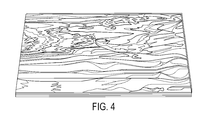
- FIG. 4 illustrates a reconstituted wood product milled into a tongue and groove flooring slat having the wood fibers substantially oriented in a common direction. These variations in grain lines contribute to mimicking natural grain appearance and providing aesthetically attractive variations. Products can also be readily produced which have more uniform grain directions, e.g. using mulberry tend to provide more uniform grains. Alternatively, when portions of the resin impregnated wood are laid out transverse to another portion of the wood fibers, the final product has a knotty appearance.
- the reconstituted wood articles can include a resin impregnated natural wood matrix where the wood matrix includes a plurality of wood pieces having wood fibers oriented in a substantially common direction. Further, the wood article can be substantially free of laminate layers and having an appearance of natural wood grains along surfaces of the wood article regardless of direction in sectional cuts. Certain embodiments of the reconstituted wood can have a density of about 0.8 to about 1.2 kg/cm 3 and features peculiar grain, refined texture, extraordinary performance. These reconstituted wood products can be formed without time intensive aging processes commonly practiced in the industry. The reconstituted wood products can also be substantially free from macropores, e.g. pores or spaces greater than about 0.2 mm, and in some cases 0.05 mm.
- macropores e.g. pores or spaces greater than about 0.2 mm, and in some cases 0.05 mm.
- the reconstituted molded wood can be characterized by rich grains and colors, stable performance, and direct applications in processing floor, furniture, building facilities, or as a substitute for logs in almost any application. Furthermore, the reconstituted molded wood so produced is better than common natural wood in many metrics and needs no treatment for resisting insect, mold, moisture, erosion and cracking. Additionally, the reconstituted molded wood can have high rigidity, pressure resistance, impact resistance and deformation resistance. Utilizing such secondary-grade processed wood to produce reconstituted molded wood is an effective way to turn trash into valuable products.
- JL series acid dye of yellow light, high concentration, high light resistance manufactured by
- the bath ratio is 1:10 and concentration of dye solution is 3%. Raise temperature to 93° C. and soak in the dye solution for 3 hours. Then rinse clean with water to remove the dye clinging to wood surfaces.
Landscapes
- Life Sciences & Earth Sciences (AREA)
- Engineering & Computer Science (AREA)
- Manufacturing & Machinery (AREA)
- Wood Science & Technology (AREA)
- Forests & Forestry (AREA)
- Chemical And Physical Treatments For Wood And The Like (AREA)
- Dry Formation Of Fiberboard And The Like (AREA)
Applications Claiming Priority (10)
| Application Number | Priority Date | Filing Date | Title |
|---|---|---|---|
| CN200810061422.4 | 2008-05-13 | ||
| CN200810061422 | 2008-05-13 | ||
| CNA2008100614224A CN101279461A (zh) | 2008-05-13 | 2008-05-13 | 一种利用次小薪材生产模块木料的方法 |
| CN200810062058 | 2008-05-22 | ||
| CN2008100620058.3 | 2008-05-22 | ||
| CN200810062058A CN100588518C (zh) | 2008-05-22 | 2008-05-22 | 一种利用次加工木材生产重组模块木料的方法 |
| CN20810062493.6 | 2008-06-19 | ||
| CN2008100624936A CN101310945B (zh) | 2008-06-19 | 2008-06-19 | 一种染色重组模块木料的生产工艺 |
| CN200810062493 | 2008-06-19 | ||
| PCT/US2009/043115 WO2009140136A2 (fr) | 2008-05-13 | 2009-05-07 | Procédé de formation d'un bloc de bois reconstitué |
Publications (2)
| Publication Number | Publication Date |
|---|---|
| US20110311798A1 US20110311798A1 (en) | 2011-12-22 |
| US8852736B2 true US8852736B2 (en) | 2014-10-07 |
Family
ID=41319266
Family Applications (1)
| Application Number | Title | Priority Date | Filing Date |
|---|---|---|---|
| US12/992,866 Active 2031-05-01 US8852736B2 (en) | 2008-05-13 | 2009-05-07 | Method of forming a reconstituted wood block |
Country Status (4)
| Country | Link |
|---|---|
| US (1) | US8852736B2 (fr) |
| AU (1) | AU2009246599B2 (fr) |
| CA (1) | CA2723923C (fr) |
| WO (1) | WO2009140136A2 (fr) |
Families Citing this family (7)
| Publication number | Priority date | Publication date | Assignee | Title |
|---|---|---|---|---|
| CN101676078A (zh) | 2008-09-19 | 2010-03-24 | 斯戴尔有限责任上市公司 | 人造木材产品及其生产方法 |
| CN102189587B (zh) * | 2011-04-22 | 2013-04-17 | 福建农林大学 | 一种斑纹装饰薄竹及其制作方法 |
| CN102514438B (zh) * | 2011-11-21 | 2013-06-19 | 彭灿银 | 一种鱼缸用沉木制备方法 |
| CN102511434B (zh) * | 2011-11-22 | 2013-08-21 | 彭灿银 | 一种鱼缸莫斯树造景方法 |
| JP6026647B2 (ja) | 2012-05-08 | 2016-11-16 | アーベー グスタフ ケール | コア、パネルブランク、フロアパネル及びその製造方法 |
| CN105751325A (zh) * | 2016-03-25 | 2016-07-13 | 王莎莎 | 一种改良的建筑用复合板的制造方法 |
| CN111805646A (zh) * | 2020-07-24 | 2020-10-23 | 绿材高科技术(宁波)有限公司 | 一种松木重组木制造工艺 |
Citations (21)
| Publication number | Priority date | Publication date | Assignee | Title |
|---|---|---|---|---|
| US3905172A (en) | 1972-11-13 | 1975-09-16 | Blackburn J | Method of laying wooden floors |
| US4393019A (en) | 1981-11-30 | 1983-07-12 | The United States Of America As Represented By The Secretary Of Agriculture | Method of pressing reconstituted lignocellulosic materials |
| JPH10235620A (ja) | 1997-02-24 | 1998-09-08 | Juken Sangyo Co Ltd | 木質ボードの製造方法 |
| EP0873829A1 (fr) * | 1997-04-25 | 1998-10-28 | CR&DO B.V. | Procédé pour la préparation de composites de cellulose |
| US6113729A (en) | 1998-08-10 | 2000-09-05 | Borden Chemical, Inc. | Wax sizing and resin bonding of a lignocellulosic composite |
| US6428871B1 (en) | 2000-05-05 | 2002-08-06 | Michael Cozzolino | Method of manufacturing decorative wood products from engineered wood products |
| US20020160114A1 (en) | 2000-05-05 | 2002-10-31 | Michael Cozzolino | Method of manufacturing decorative wood products from engineered wood products |
| CN1387981A (zh) | 2002-05-24 | 2003-01-01 | 浙江省林业科学研究院 | 重组竹材胶合板制造方法 |
| US7183339B2 (en) * | 2004-11-02 | 2007-02-27 | Shen Kuo C | Method for making dimensionally stable composite products from lignocelluloses |
| EP1815955A1 (fr) * | 2006-02-07 | 2007-08-08 | Deceuninck NV | Matériau composite à base de PVC et de bois coloré |
| US20080134296A1 (en) | 2006-11-30 | 2008-06-05 | Ofer Amitai | System and method of network authorization by scoring |
| WO2008137639A1 (fr) | 2007-05-02 | 2008-11-13 | Mascoma Corporation | Procédé de prétraitement en deux étapes de biomasse lignocellulosique |
| US20090011670A1 (en) | 2007-07-03 | 2009-01-08 | Jet Products, Llc | Manufactured construction board with reinforcing mesh |
| US20090011279A1 (en) | 2007-07-03 | 2009-01-08 | Jet Products, Llc | Manufactured construction board with texture |
| US20090025850A1 (en) | 2007-07-03 | 2009-01-29 | Feigin Michael E | Construction board for carbon capture and recycle |
| WO2010032080A1 (fr) | 2008-09-19 | 2010-03-25 | Style Limited | Produit manufacturé en bois et ses procédés de fabrication |
| US20100119857A1 (en) | 2008-09-19 | 2010-05-13 | Style Limited | Manufactured wood product and methods for producing the same |
| US20100178451A1 (en) | 2009-01-15 | 2010-07-15 | Style Limited | Method for producing bamboo boards and products |
| WO2011085518A1 (fr) | 2010-01-15 | 2011-07-21 | Style Limited | Produits de bois d'eucalyptus manufacturés |
| WO2011085556A1 (fr) | 2010-01-15 | 2011-07-21 | Style Limited | Procédés de préparation de bois d'eucalyptus |
| WO2011085554A1 (fr) | 2010-01-15 | 2011-07-21 | Style Limited | Procédés de préparation et de fabrication de produits en bois manufacturés |
-
2009
- 2009-05-07 WO PCT/US2009/043115 patent/WO2009140136A2/fr not_active Ceased
- 2009-05-07 AU AU2009246599A patent/AU2009246599B2/en not_active Ceased
- 2009-05-07 CA CA2723923A patent/CA2723923C/fr not_active Expired - Fee Related
- 2009-05-07 US US12/992,866 patent/US8852736B2/en active Active
Patent Citations (24)
| Publication number | Priority date | Publication date | Assignee | Title |
|---|---|---|---|---|
| US3905172A (en) | 1972-11-13 | 1975-09-16 | Blackburn J | Method of laying wooden floors |
| US4393019A (en) | 1981-11-30 | 1983-07-12 | The United States Of America As Represented By The Secretary Of Agriculture | Method of pressing reconstituted lignocellulosic materials |
| JPH10235620A (ja) | 1997-02-24 | 1998-09-08 | Juken Sangyo Co Ltd | 木質ボードの製造方法 |
| EP0873829A1 (fr) * | 1997-04-25 | 1998-10-28 | CR&DO B.V. | Procédé pour la préparation de composites de cellulose |
| US6113729A (en) | 1998-08-10 | 2000-09-05 | Borden Chemical, Inc. | Wax sizing and resin bonding of a lignocellulosic composite |
| US6306241B1 (en) | 1998-08-10 | 2001-10-23 | Shui-Tung Chiu | Wax sizing and resin bonding of a lignocellulosic composite |
| US6428871B1 (en) | 2000-05-05 | 2002-08-06 | Michael Cozzolino | Method of manufacturing decorative wood products from engineered wood products |
| US20020160114A1 (en) | 2000-05-05 | 2002-10-31 | Michael Cozzolino | Method of manufacturing decorative wood products from engineered wood products |
| CN1387981A (zh) | 2002-05-24 | 2003-01-01 | 浙江省林业科学研究院 | 重组竹材胶合板制造方法 |
| US7183339B2 (en) * | 2004-11-02 | 2007-02-27 | Shen Kuo C | Method for making dimensionally stable composite products from lignocelluloses |
| EP1815955A1 (fr) * | 2006-02-07 | 2007-08-08 | Deceuninck NV | Matériau composite à base de PVC et de bois coloré |
| US20080134296A1 (en) | 2006-11-30 | 2008-06-05 | Ofer Amitai | System and method of network authorization by scoring |
| WO2008137639A1 (fr) | 2007-05-02 | 2008-11-13 | Mascoma Corporation | Procédé de prétraitement en deux étapes de biomasse lignocellulosique |
| US20090011670A1 (en) | 2007-07-03 | 2009-01-08 | Jet Products, Llc | Manufactured construction board with reinforcing mesh |
| US20090011279A1 (en) | 2007-07-03 | 2009-01-08 | Jet Products, Llc | Manufactured construction board with texture |
| US20090025850A1 (en) | 2007-07-03 | 2009-01-29 | Feigin Michael E | Construction board for carbon capture and recycle |
| WO2010032080A1 (fr) | 2008-09-19 | 2010-03-25 | Style Limited | Produit manufacturé en bois et ses procédés de fabrication |
| US20100075095A1 (en) | 2008-09-19 | 2010-03-25 | Style Limited | Manufactured wood product and methods for producing the same |
| US20100119857A1 (en) | 2008-09-19 | 2010-05-13 | Style Limited | Manufactured wood product and methods for producing the same |
| US20100178451A1 (en) | 2009-01-15 | 2010-07-15 | Style Limited | Method for producing bamboo boards and products |
| WO2010082137A1 (fr) | 2009-01-15 | 2010-07-22 | Style Limited | Produit en bois manufacturé et procédés de fabrication |
| WO2011085518A1 (fr) | 2010-01-15 | 2011-07-21 | Style Limited | Produits de bois d'eucalyptus manufacturés |
| WO2011085556A1 (fr) | 2010-01-15 | 2011-07-21 | Style Limited | Procédés de préparation de bois d'eucalyptus |
| WO2011085554A1 (fr) | 2010-01-15 | 2011-07-21 | Style Limited | Procédés de préparation et de fabrication de produits en bois manufacturés |
Non-Patent Citations (2)
| Title |
|---|
| Structural Composite Lumber; Techline, Properties and Use of Wood, Composites, and Fiber; US forest Service Department of Agriculture; 1 page; Oct. 1999. |
| Timberstrand® LSL Quality Lumber for Quality Doors; Weyerhaeuser Hardwoods and Industrial Products; 2 pages; Downloaded Feb. 24, 2009. |
Also Published As
| Publication number | Publication date |
|---|---|
| CA2723923C (fr) | 2018-02-20 |
| WO2009140136A8 (fr) | 2014-09-12 |
| AU2009246599B2 (en) | 2014-03-06 |
| US20110311798A1 (en) | 2011-12-22 |
| AU2009246599A1 (en) | 2009-11-19 |
| CA2723923A1 (fr) | 2009-11-19 |
| WO2009140136A3 (fr) | 2010-02-18 |
| WO2009140136A2 (fr) | 2009-11-19 |
Similar Documents
| Publication | Publication Date | Title |
|---|---|---|
| US8852736B2 (en) | Method of forming a reconstituted wood block | |
| Chen et al. | A comprehensive overview of bamboo scrimber and its new development in China | |
| EP2344309B1 (fr) | Produit manufacturé en bois et ses procédés de fabrication | |
| Maulana et al. | Effects of steam treatment on physical and mechanical properties of bamboo oriented strand board | |
| WO2008018784A1 (fr) | Procédé de fabrication de contreplaqué | |
| US20210276218A1 (en) | Method and system for producing an engineered wood | |
| WO2010082140A1 (fr) | Procédé de production de produits et planches en bambou | |
| Iswanto et al. | Effect of pre-treatment techniques on physical, mechanical and durability properties of oriented strand board made from sentang wood (Melia excelsa Jack) | |
| CN101279461A (zh) | 一种利用次小薪材生产模块木料的方法 | |
| AU2010342713B2 (en) | Manufactured eucalyptus wood products | |
| CN107379162A (zh) | 一种重组竹板材生产工艺 | |
| AU2010342749B2 (en) | Methods of preparing and making manufactured wood products | |
| CN102795254B (zh) | 一种滑板的制作工艺 | |
| Saliman et al. | Hydrothermal treatment of oil palm wood: Effect of treatment variables on dimensional stability using response surface methodology | |
| Chawla et al. | Use of lignocellulosic biomaterials for sustainable development of bamboo strand lumber for structural applications | |
| WO2011085555A1 (fr) | Systèmes de production de produits de bois manufacturés | |
| JP6898660B2 (ja) | 竹繊維の圧縮硬化体の製造方法及びその製造方法により製造した竹繊維の圧縮硬化体 | |
| US20070077445A1 (en) | Panel containing bamboo and fungicide | |
| Masseat et al. | The physical properties of treated oil palm veneer used as face layer for laminated veneer lumber | |
| WO2011085559A1 (fr) | Procédés de fabrication de produits en bois d'eucalyptus | |
| Loh et al. | Enhancement of manufacturing process and quality for oil palm trunk plywood | |
| Paridah | Rotary veneer processing of oil palm trunk | |
| KR101261812B1 (ko) | 열개질가공 나노 무기질 주입 가공처리 집성재 및 그 제조방법 | |
| WO2011085556A1 (fr) | Procédés de préparation de bois d'eucalyptus | |
| CN112706244B (zh) | 一种阻燃黑松板的制备方法及其应用 |
Legal Events
| Date | Code | Title | Description |
|---|---|---|---|
| STCF | Information on status: patent grant |
Free format text: PATENTED CASE |
|
| MAFP | Maintenance fee payment |
Free format text: PAYMENT OF MAINTENANCE FEE, 4TH YR, SMALL ENTITY (ORIGINAL EVENT CODE: M2551) Year of fee payment: 4 |
|
| MAFP | Maintenance fee payment |
Free format text: PAYMENT OF MAINTENANCE FEE, 8TH YR, SMALL ENTITY (ORIGINAL EVENT CODE: M2552); ENTITY STATUS OF PATENT OWNER: SMALL ENTITY Year of fee payment: 8 |