US8858828B2 - Use of 2-(3-aminopropoxy)ethan-1-ol as an absorbent to remove acidic gases - Google Patents
Use of 2-(3-aminopropoxy)ethan-1-ol as an absorbent to remove acidic gases Download PDFInfo
- Publication number
- US8858828B2 US8858828B2 US13/275,357 US201113275357A US8858828B2 US 8858828 B2 US8858828 B2 US 8858828B2 US 201113275357 A US201113275357 A US 201113275357A US 8858828 B2 US8858828 B2 US 8858828B2
- Authority
- US
- United States
- Prior art keywords
- scrubbing composition
- weight
- composition
- scrubbing
- gas
- Prior art date
- Legal status (The legal status is an assumption and is not a legal conclusion. Google has not performed a legal analysis and makes no representation as to the accuracy of the status listed.)
- Active, expires
Links
Images


Classifications
-
- B—PERFORMING OPERATIONS; TRANSPORTING
- B01—PHYSICAL OR CHEMICAL PROCESSES OR APPARATUS IN GENERAL
- B01D—SEPARATION
- B01D53/00—Separation of gases or vapours; Recovering vapours of volatile solvents from gases; Chemical or biological purification of waste gases, e.g. engine exhaust gases, smoke, fumes, flue gases, aerosols
- B01D53/14—Separation of gases or vapours; Recovering vapours of volatile solvents from gases; Chemical or biological purification of waste gases, e.g. engine exhaust gases, smoke, fumes, flue gases, aerosols by absorption
- B01D53/1456—Removing acid components
- B01D53/1462—Removing mixtures of hydrogen sulfide and carbon dioxide
-
- B—PERFORMING OPERATIONS; TRANSPORTING
- B01—PHYSICAL OR CHEMICAL PROCESSES OR APPARATUS IN GENERAL
- B01D—SEPARATION
- B01D53/00—Separation of gases or vapours; Recovering vapours of volatile solvents from gases; Chemical or biological purification of waste gases, e.g. engine exhaust gases, smoke, fumes, flue gases, aerosols
- B01D53/14—Separation of gases or vapours; Recovering vapours of volatile solvents from gases; Chemical or biological purification of waste gases, e.g. engine exhaust gases, smoke, fumes, flue gases, aerosols by absorption
- B01D53/1493—Selection of liquid materials for use as absorbents
-
- B—PERFORMING OPERATIONS; TRANSPORTING
- B01—PHYSICAL OR CHEMICAL PROCESSES OR APPARATUS IN GENERAL
- B01D—SEPARATION
- B01D2252/00—Absorbents, i.e. solvents and liquid materials for gas absorption
- B01D2252/20—Organic absorbents
- B01D2252/202—Alcohols or their derivatives
-
- B—PERFORMING OPERATIONS; TRANSPORTING
- B01—PHYSICAL OR CHEMICAL PROCESSES OR APPARATUS IN GENERAL
- B01D—SEPARATION
- B01D2252/00—Absorbents, i.e. solvents and liquid materials for gas absorption
- B01D2252/20—Organic absorbents
- B01D2252/202—Alcohols or their derivatives
- B01D2252/2023—Glycols, diols or their derivatives
- B01D2252/2025—Ethers or esters of alkylene glycols, e.g. ethylene or propylene carbonate
-
- B—PERFORMING OPERATIONS; TRANSPORTING
- B01—PHYSICAL OR CHEMICAL PROCESSES OR APPARATUS IN GENERAL
- B01D—SEPARATION
- B01D2252/00—Absorbents, i.e. solvents and liquid materials for gas absorption
- B01D2252/20—Organic absorbents
- B01D2252/204—Amines
- B01D2252/20405—Monoamines
-
- B—PERFORMING OPERATIONS; TRANSPORTING
- B01—PHYSICAL OR CHEMICAL PROCESSES OR APPARATUS IN GENERAL
- B01D—SEPARATION
- B01D2252/00—Absorbents, i.e. solvents and liquid materials for gas absorption
- B01D2252/20—Organic absorbents
- B01D2252/204—Amines
- B01D2252/20436—Cyclic amines
- B01D2252/20447—Cyclic amines containing a piperazine-ring
-
- B—PERFORMING OPERATIONS; TRANSPORTING
- B01—PHYSICAL OR CHEMICAL PROCESSES OR APPARATUS IN GENERAL
- B01D—SEPARATION
- B01D2252/00—Absorbents, i.e. solvents and liquid materials for gas absorption
- B01D2252/20—Organic absorbents
- B01D2252/204—Amines
- B01D2252/20478—Alkanolamines
-
- B—PERFORMING OPERATIONS; TRANSPORTING
- B01—PHYSICAL OR CHEMICAL PROCESSES OR APPARATUS IN GENERAL
- B01D—SEPARATION
- B01D2252/00—Absorbents, i.e. solvents and liquid materials for gas absorption
- B01D2252/50—Combinations of absorbents
- B01D2252/502—Combinations of absorbents having two or more functionalities in the same molecule other than alkanolamine
-
- B—PERFORMING OPERATIONS; TRANSPORTING
- B01—PHYSICAL OR CHEMICAL PROCESSES OR APPARATUS IN GENERAL
- B01D—SEPARATION
- B01D2252/00—Absorbents, i.e. solvents and liquid materials for gas absorption
- B01D2252/50—Combinations of absorbents
- B01D2252/504—Mixtures of two or more absorbents
-
- B—PERFORMING OPERATIONS; TRANSPORTING
- B01—PHYSICAL OR CHEMICAL PROCESSES OR APPARATUS IN GENERAL
- B01D—SEPARATION
- B01D2256/00—Main component in the product gas stream after treatment
- B01D2256/24—Hydrocarbons
-
- B—PERFORMING OPERATIONS; TRANSPORTING
- B01—PHYSICAL OR CHEMICAL PROCESSES OR APPARATUS IN GENERAL
- B01D—SEPARATION
- B01D2257/00—Components to be removed
- B01D2257/30—Sulfur compounds
- B01D2257/304—Hydrogen sulfide
-
- B—PERFORMING OPERATIONS; TRANSPORTING
- B01—PHYSICAL OR CHEMICAL PROCESSES OR APPARATUS IN GENERAL
- B01D—SEPARATION
- B01D2257/00—Components to be removed
- B01D2257/50—Carbon oxides
- B01D2257/504—Carbon dioxide
-
- B—PERFORMING OPERATIONS; TRANSPORTING
- B01—PHYSICAL OR CHEMICAL PROCESSES OR APPARATUS IN GENERAL
- B01D—SEPARATION
- B01D2258/00—Sources of waste gases
- B01D2258/02—Other waste gases
- B01D2258/0283—Flue gases
-
- Y02C10/06—
-
- Y—GENERAL TAGGING OF NEW TECHNOLOGICAL DEVELOPMENTS; GENERAL TAGGING OF CROSS-SECTIONAL TECHNOLOGIES SPANNING OVER SEVERAL SECTIONS OF THE IPC; TECHNICAL SUBJECTS COVERED BY FORMER USPC CROSS-REFERENCE ART COLLECTIONS [XRACs] AND DIGESTS
- Y02—TECHNOLOGIES OR APPLICATIONS FOR MITIGATION OR ADAPTATION AGAINST CLIMATE CHANGE
- Y02C—CAPTURE, STORAGE, SEQUESTRATION OR DISPOSAL OF GREENHOUSE GASES [GHG]
- Y02C20/00—Capture or disposal of greenhouse gases
- Y02C20/40—Capture or disposal of greenhouse gases of CO2
Definitions
- This disclosure relates to an improved scrubbing composition containing an aqueous solution of 2-(3-aminopropoxy)ethan-1-ol useful for the separation of acid gases from fluid streams.
- fluid streams occur containing acid gases, for example CO 2 , H 2 S, SO 2 , CS 2 , HCN, COS or mercaptans, as impurities.
- These fluid streams can be, for example, gas streams (such as natural gas, synthesis gas or heavy oil or heavy residues, refinery gas, or reaction gas resulting from the partial oxidation of organic materials, for example coal or petroleum) or liquid or liquefied hydrocarbon streams (such as liquefied petroleum gas “LPG”) or natural gas liquids (“NGL”).
- gas streams such as natural gas, synthesis gas or heavy oil or heavy residues, refinery gas, or reaction gas resulting from the partial oxidation of organic materials, for example coal or petroleum
- LPG liquefied petroleum gas
- NNL natural gas liquids
- the acid gas content of the fluid must be significantly decreased.
- CO 2 must be removed from natural gas since a high CO 2 concentration decreases the heating value of the gas.
- CO 2 in combination with water entrained in a fluid stream can lead to corrosion on pipelines and fittings.
- sulfur compounds from these fluid streams is also of particular importance.
- the content of sulfur compounds of natural gas must be reduced by suitable treatment measures directly at the natural gas source, since the sulfur compounds can also form corrosive acids in the water entrained in the natural gas.
- numerous sulfur compounds are foul smelling, even at low concentrations, and can be toxic.
- Processes have been developed for removing acid gas constituents from fluid streams such as hydrocarbon gases, LPG, or NGL.
- the fluid mixture containing the acid gas constituents is brought into contact with absorbent solvents in a gas scrubber or a liquid/liquid extraction stage.
- Physical solvents which have proven to be industrially suitable are cyclo-tetramethylenesulfone and its derivatives, aliphatic acid amides, N-methylpyrrolidone, N-alkylated pyrrolidones and the corresponding piperidones, methanol, ethanol, and mixtures of dialkylethers of polyethylene glycols.
- Chemical solvents which have proven to be industrially useful are primary, secondary and/or tertiary amines derived from alkanolamines.
- the most frequently used amines are derived from ethanolamine, such as monoethanolamine (MEA), diethanolamine (DEA), triethanolamine (TEA), diisopropanolamine (DIPA), monomethyl ethanolamine (MMEA), piperazine and methyldiethanolamine (MDEA).
- a particularly effective absorbent solution is one that contains 2-(2-aminoethoxy)ethanol.
- 2-(2-aminoethoxyethanol) can form into morpholine which is removed in the stripper section of a gas treating system.
- this compound must either be replaced or regenerated periodically to retain efficiency. Accordingly, it is highly desirable to develop alternative absorbent solutions which are as highly effective yet overcome the problem described above.
- the present disclosure provides a scrubbing composition for the removal of acid gases from fluids which contains an aqueous solution of 2-(3-aminopropoxy)ethan-1-ol.
- the present disclosure also provides a process for the removal of acid gases from fluids in which in an absorption step, a fluid stream comprising acid gas constituents is contacted with the gas treating composition, a fluid stream depleted in acid gases and a scrubbing composition enriched with acid gases being obtained.
- a process for the separation of carbon dioxide and hydrogen sulfide from a gas stream including the steps of contacting the scrubbing composition with the gas stream wherein the scrubbing composition contains at least 3% by weight of 2-(3-aminopropoxy)ethan-1-ol.
- a gas separation process comprising contacting a scrubbing composition containing an aqueous solution of 2-(3-aminopropoxy)ethan-1-ol with a sour gas stream under conditions such that the gas stream is sweetened and wherein the process is conducted in the absence of a reclamation step.
- FIG. 1 shows an absorption process of the present disclosure
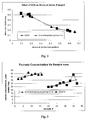
- FIG. 2 shows a graph of CO 2 loading versus amine loading in a gas treating unit
- FIG. 3 shows a graph of formate build-up over time in a gas treating unit
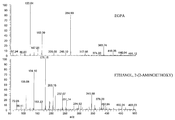
- FIG. 4 shows a LC-MS-MS of samples taken during processing in a gas treating unit.
- the scrubbing composition of the present disclosure is an aqueous solution containing 2-(3-aminopropoxy)ethan-1-ol (EGPA) (amine component a)).
- concentration of EGPA is generally at least 3% by weight, preferably at least about 20% by weight, and even more preferably at least about 40% by weight, based on the total weight of the gas treating composition.
- concentration of EGPA is no greater than 85% by weight, preferably no greater than 65% by weigh and even more preferably no greater than 60% by weight, based on the total weight of the gas treating composition.
- the scrubbing composition may also comprise one or more additional amines suitable for the abstraction of acid gases, including, but not limited to, monoethanolamine (MEA), diethanolamine (DEA), triethanolamine (TEA), diisopropanolamine (DIPA), ethanol, 2-(2-aminoethoxy, 3-methylaminopropylamine and methyldiethanolamine (MDEA), piperazine, methyl piperazine, and any other promoters, etc. (amine component b)). If present, the amine component b) may be present in an amount of from about 0.5% to about 80% by weight, preferably from about 1% to about 60% by weight, based on the total weight of the gas treating composition.
- the total amine content in the scrubbing composition is at least about 3% by weight, preferably at least 20% by weight, and even more preferably at least about 40% by weight based on the total weight of the gas treating composition.
- the total amine content in the scrubbing composition is no greater than about 85% by weight, preferably no greater than 65% by weight, and even more preferably no greater than about 60% by weight based on the total weight of the gas treating composition.
- the total amine content in the scrubbing composition is in the range from about 3% to about 85%, by weight, preferably from about 20% to about 65% by weight, more preferably from about 40% to about 60% by weight, and in some instances about 50% by weight based on the total weight of the gas treating composition. If amine component b) is present, the proportion of EGPA (amine component a)) is then decreased, so that the total amine content remains in the amounts specified above.
- amine gas treating compositions It is common for the user of amine gas treating compositions to acquire the amine of choice, and dilute with water to a percentage of choice.
- the extent of dilution of the aqueous solution of this disclosure is not critical, and can vary on a variety of factors, such as type of scrubbing unit, temperature, pressure, composition of acid gas, etc.
- a process for preparing the scrubbing composition comprising forming a gas treating concentrate comprising EGPA and diluting the concentrate with water to form the gas treating composition.
- the scrubbing composition may also comprise physical solvents, including but not limited to sulfolane, N-methylpyrrolidone or N-alkylated piperidones. If present, the physical solvents may range in an amount from about 5% by weight to about 60% by weight, based on the total weight of the gas treating composition.
- the scrubbing composition may also comprise additives, such as corrosion inhibitors, defoamers, enzymes, etc.
- additives such as corrosion inhibitors, defoamers, enzymes, etc.
- the amount of such additives range from about 0.01% by weight to about 5% by weight, based on the total weight of the gas treating composition.
- the scrubbing composition may be used for treating fluids, in particular, gas streams of all types to remove acid gases.
- the fluids may comprise acid gases such as CO 2 , H 2 S, COS, SO 3 , SO 2 , CS 2 , mercaptans, and HCN. Many of these may be removed from the gas stream.
- Fluids comprising the acid gases may be gases, such as natural gas, synthesis gas, refinery gas including refinery coker off gas, refinery fluid catalytic cracker off gas, refinery hydrogen units, gasified coal, circulation gas, landfill gases and combustion gases.
- the fluids may also be liquids which are essentially immiscible with the gas treating composition, such as liquefied petroleum gas (LPG) or natural gas liquids (NGL).
- LPG liquefied petroleum gas
- NNL natural gas liquids
- the fluids may also, in addition to one or more of the acid gases, comprise further inert gas constituents which are not absorbed by the scrubbing composition in significant quantities.
- gas constituents such as oxygen, hydrogen, nitrogen and volatile hydrocarbons, such as C 1 -C 8 hydrocarbons.
- the inventive scrubbing composition is particularly effective for removing CO 2 and H 2 S from gas streams.
- the acid gas constituents may range from 0.01 vol % up to 70 or even 80 vol % of the total gas stream.
- carbon dioxide may range from about 0.01-45 mol % and hydrogen sulfide may range from about 0.001-45 mol % (all % based on the total gas stream).
- the scrubbing composition of the present disclosure is suitable in processes for removing acid gases from gases which are not themselves absorbed by the gas treating composition, and for extracting acid gases from liquids which are essentially immiscible with the gas treating composition.
- the process sequence of a gas scrubbing is described in principle below. The process may also be applied to liquids without problem by those skilled in the art.
- the regeneration of the scrubbing composition is identical in the case of liquids and gases.
- the starting gas stream (untreated gas) rich in acid gas constituents is contacted with the scrubbing composition in an absorber in an absorption step, as a result of which the acid gas constituents are at least partially scrubbed out.
- a scrubbing apparatus such as those used in conventional gas scrubbing processes may act as the absorber.
- scrubbing apparatus including one or more columns containing internals such as random packed column, structured packed columns tray columns, membrane contractors, radial-stream scrubbers, jet scrubbers, venturi scurbbers, and rotary spray scrubbers.
- the gas stream may either be contacted with the scrubbing composition in a countercurrent flow or co-current flow, preferably countercurrent flow.
- the gas stream may enter the column at any point depending on the flow configuration of the apparatus.
- the gas treating solution may enter the apparatus at one or more locations.
- the temperatures and pressures at which the scrubbing composition contacts the gas stream to be treated may vary. In one embodiment, the temperatures are in a range from about ⁇ 20° C. to 180° C. In another embodiment, the pressure is in a range from about atmospheric to about 2500 psi.
- the flow rates at which the scrubbing composition and gas stream enter the scrubbing apparatus can vary widely depending on the make up of such streams, temperature, pressure, desired extent of acid gas removal and the like. Such flow rates are known to those skilled in the art.
- the process can comprise one or more sequential absorption steps.
- the absorption may be carried out in a plurality of sequential part-steps, the untreated gas comprising the acid gas constituents being contacted in each of the part-steps in each case with one substream of the gas treating composition.
- the scrubbing composition with which the untreated gas is contacted can already be partly loaded with acid gases, that is to say it can be, for example, a scrubbing composition which has been recirculated to the first absorption step from a following absorption step, or a partially regenerated gas treating composition.
- the acid gas constituents may be liberated in a regeneration step in a customary manner from the scrubbing composition loaded with the acid gas constituents, a regenerated scrubbing composition obtained.
- the acid gas content of the scrubbing composition is decreased and the resultant regenerated scrubbing composition is preferably then recirculated to the absorption step.
- the regeneration step may comprise at least one depressurization of the acid gas containing composition from a higher pressure.
- the depressurization may take place, for example, by means of a throttle valve and/or by an expansion turbine.
- the gas treating solution may be heated to raise the temperature to assist in the removal of the acid gas components.
- the acid gas constituents may be liberated in the regeneration step, for example, in a desorption unit or expansion column, for example, a vertical or horizontal flash container, a stream stripping column, or a countercurrent flow column possessing internals.
- a plurality of expansion of units or columns can be connected in series in which regeneration is performed at differing pressures.
- regeneration can be carried out at high pressure for example 60-100 psi and in a main unit or expansion column, at low pressure, for example atmospheric pressure to about 30 psi.
- the unit or column may be operated under vacuum, which may be produced, by example, a stream jet and a mechanical vacuum generation apparatus.
- FIG. 1 there is shown one embodiment of a process of this disclosure.
- a gas stream sour gas
- sour gas is introduced into an absorber ( 10 ) via line ( 11 ) wherein the sour gas rises countercurrent to scrubbing composition of the present disclosure which is introduced in the upper portion of absorber ( 10 ) via line ( 12 ), line ( 13 ), or both.
- Acid gas constituents e.g. CO 2 and/or H 2 S
- Original and make-up scrubbing composition may be introduced via line ( 14 ).
- Acid gas laden scrubbing composition exits absorber ( 10 ) via a second exit conduit ( 16 ), being sent under pressure to desorption unit ( 20 ), for example, a flash unit or a steam stripping column. If only one desorption unit is employed, it is typical to use line ( 12 ) only.
- desorption unit for example, a flash unit or a steam stripping column. If only one desorption unit is employed, it is typical to use line ( 12 ) only.
- desorption unit ( 20 ) desorption occurs whereby acid gas constituents are liberated from the gas treating composition, with such liberated acid gas constituents exiting via line ( 24 ).
- Regenerated scrubbing composition exits via line ( 26 ), and flows through line ( 27 ) and valve ( 21 ) to line ( 12 ) via open valve ( 23 ) if a second desorption unit is absent, or may flow to line ( 13 ) via open valve ( 22 ) if a second desorption unit is employed.
- a second desorption unit ( 30 ) for example a flash unit or steam stripping column, via open valve ( 29 ) and line ( 28 ).
- FIG. 1 depicts one arrangement of this invention, with the practice of this invention admitting to other lay-outs, configurations, multiple towers, specific pumps, valves and control features.
- the scrubbing composition may also be used in electronic applications, for example, in cleaning circuit boards, or in metal working fluids and the like.
- a further example was performed using a mixture of ethanol, 2-(2-aminoethoxy) and water. 6000 grams of ethanol, 2-(2-aminoethoxy) and 9000 grams of deionized water were mixed thoroughly to form a comparative gas treating solution. 12,615 grams of the comparative gas treating solution was then charged to a gas treating unit containing an absorber and stripper connected together in a continuous flow. The absorber was heated to approximately 38° C. while the stripper was heated to approximately 117° C. Nitrogen gas flow as started into the unit at 11.5 liters/minute. After 2.5 hours, CO 2 flow was started into the unit at 2.5 liters/minute and the gas treating solution flow was started into the unit at a rate of 0.385 lbs/minute.
- FIG. 2 Depicted in FIG. 2 , is a plot of the CO 2 /amine mole ratio versus the number of moles of amine pumped into the gas treating unit per minute. As demonstrated, both amines absorb CO 2 in a similar manner.
- formate concentration over time for the EGPA is lower than that for ethanol, 2-(2-aminoethoxy).
- FIG. 4 depicts a LC-MS for the last sample taken from each run and shows that EGPA (top MS spectra) has less by-products formed over time during processing than ethanol, 2-(2-aminoethoxy) (bottom MS spectra).
Landscapes
- Chemical & Material Sciences (AREA)
- Engineering & Computer Science (AREA)
- Analytical Chemistry (AREA)
- General Chemical & Material Sciences (AREA)
- Oil, Petroleum & Natural Gas (AREA)
- Chemical Kinetics & Catalysis (AREA)
- Gas Separation By Absorption (AREA)
- Carbon And Carbon Compounds (AREA)
- Treating Waste Gases (AREA)
Priority Applications (8)
| Application Number | Priority Date | Filing Date | Title |
|---|---|---|---|
| CA2814943A CA2814943C (en) | 2010-10-29 | 2011-10-18 | Use of 2-(3-aminopropoxy)ethan-1-ol as an absorbent to remove acidic gases |
| AU2011320717A AU2011320717B2 (en) | 2010-10-29 | 2011-10-18 | Use of 2-(3-aminopropoxy)ethan-1-ol as an absorbent to remove acidic gases |
| US13/275,357 US8858828B2 (en) | 2010-10-29 | 2011-10-18 | Use of 2-(3-aminopropoxy)ethan-1-ol as an absorbent to remove acidic gases |
| CN201180052403.5A CN103201014B (zh) | 2010-10-29 | 2011-10-18 | 2‑(3‑氨基丙氧基)乙‑1‑醇作为吸收剂以除去酸性气体的用途 |
| JP2013536663A JP5865383B2 (ja) | 2010-10-29 | 2011-10-18 | 酸性ガスの除去のための吸着剤としての2−(3−アミノプロポキシ)エタン−1−オールの使用 |
| EP11836870.3A EP2632568B1 (en) | 2010-10-29 | 2011-10-18 | Use of 2-(3-aminopropoxy)ethan-1-ol as an absorbent to remove acidic gases |
| PCT/US2011/056610 WO2012058050A1 (en) | 2010-10-29 | 2011-10-18 | Use of 2-(3-aminopropoxy)ethan-1-ol as an absorbent to remove acidic gazes |
| MX2013004701A MX2013004701A (es) | 2010-10-29 | 2011-10-18 | Uso de 2-(3-aminopropoxi)etan-1-ol como un absorbente para remover gases acidos. |
Applications Claiming Priority (3)
| Application Number | Priority Date | Filing Date | Title |
|---|---|---|---|
| US40798810P | 2010-10-29 | 2010-10-29 | |
| US201161473892P | 2011-04-11 | 2011-04-11 | |
| US13/275,357 US8858828B2 (en) | 2010-10-29 | 2011-10-18 | Use of 2-(3-aminopropoxy)ethan-1-ol as an absorbent to remove acidic gases |
Publications (2)
| Publication Number | Publication Date |
|---|---|
| US20120269707A1 US20120269707A1 (en) | 2012-10-25 |
| US8858828B2 true US8858828B2 (en) | 2014-10-14 |
Family
ID=45994324
Family Applications (1)
| Application Number | Title | Priority Date | Filing Date |
|---|---|---|---|
| US13/275,357 Active 2033-01-25 US8858828B2 (en) | 2010-10-29 | 2011-10-18 | Use of 2-(3-aminopropoxy)ethan-1-ol as an absorbent to remove acidic gases |
Country Status (8)
| Country | Link |
|---|---|
| US (1) | US8858828B2 (zh) |
| EP (1) | EP2632568B1 (zh) |
| JP (1) | JP5865383B2 (zh) |
| CN (1) | CN103201014B (zh) |
| AU (1) | AU2011320717B2 (zh) |
| CA (1) | CA2814943C (zh) |
| MX (1) | MX2013004701A (zh) |
| WO (1) | WO2012058050A1 (zh) |
Cited By (1)
| Publication number | Priority date | Publication date | Assignee | Title |
|---|---|---|---|---|
| US9919262B2 (en) * | 2013-11-07 | 2018-03-20 | Shell Oil Company | Process for capturing sulfur dioxide from a gas stream |
Families Citing this family (2)
| Publication number | Priority date | Publication date | Assignee | Title |
|---|---|---|---|---|
| CN105561756A (zh) * | 2014-10-11 | 2016-05-11 | 中国石油化工股份有限公司 | 一种用于捕集二氧化碳的复配溶剂及其应用 |
| CN110903475B (zh) * | 2019-11-15 | 2021-06-11 | 红宝丽集团股份有限公司 | 一种2-(2-氨基-丙氧基)乙醇和聚醚多元醇的联产方法 |
Citations (15)
| Publication number | Priority date | Publication date | Assignee | Title |
|---|---|---|---|---|
| US2712978A (en) | 1950-11-10 | 1955-07-12 | Fluor Corp | Amino-ether gas treating process |
| US3953586A (en) | 1972-12-15 | 1976-04-27 | Waichi Tanimura | Process for purifying gases containing H2 S |
| US4705528A (en) * | 1984-08-24 | 1987-11-10 | Imperial Chemical Industries Plc | Water-soluble triazine black dyes from cellulose reactive groups and suitable for use in inks |
| US5081305A (en) | 1988-10-13 | 1992-01-14 | Air Products And Chemicals, Inc. | Process for the preparation of bis(aminopropoxy)alkanes |
| US5618506A (en) | 1994-10-06 | 1997-04-08 | The Kansai Electric Power Co., Inc. | Process for removing carbon dioxide from gases |
| US5861051A (en) | 1996-03-06 | 1999-01-19 | Huntsman Petrochemical Corporation | Process for removing carbon dioxide from gas mixture |
| US6337059B1 (en) | 1999-05-03 | 2002-01-08 | Union Carbide Chemicals & Plastics Technology Corporation | Absorbent compositions for the removal of acid gases from gas streams |
| US20060045830A1 (en) | 2004-09-02 | 2006-03-02 | Clariant Gmbh | Method for purifying gases |
| US20060178259A1 (en) | 2003-07-22 | 2006-08-10 | Schubert Craig N | Regeneration of acid gas-containing treatment fluids |
| US7374734B2 (en) | 2003-02-14 | 2008-05-20 | Basf Aktiengesellschaft | Absorbing agent and method for eliminating acid gases from fluids |
| US20090013872A1 (en) | 2007-07-12 | 2009-01-15 | Renaud Cadours | Method of removing acid gases contained in gaseous effluents |
| US20090151318A1 (en) | 2007-12-13 | 2009-06-18 | Alstom Technology Ltd | System and method for regenerating an absorbent solution |
| US7666813B2 (en) | 2004-03-09 | 2010-02-23 | Basf Aktiengesellschaft | Absorption medium and deacidification of fluid streams |
| US7749309B2 (en) | 2002-03-12 | 2010-07-06 | Basf Aktiengesellschaft | Method for deacidifying a fluid stream and washing liquid used in such a method |
| US7758673B2 (en) | 2002-01-14 | 2010-07-20 | Shell Oil Company | Process for removing carbon dioxide from gas mixtures |
Family Cites Families (11)
| Publication number | Priority date | Publication date | Assignee | Title |
|---|---|---|---|---|
| US3829494A (en) * | 1973-04-11 | 1974-08-13 | Jefferson Chem Co Inc | Stabilized 2-(2-amino ether)ethanol and methane |
| US4405811A (en) * | 1982-01-18 | 1983-09-20 | Exxon Research And Engineering Co. | Severely sterically hindered tertiary amino compounds |
| IT1191805B (it) * | 1986-06-11 | 1988-03-23 | Snam Progetti | Processo per la rimozione selettiva di acido solfidrico |
| JPH0644972B2 (ja) * | 1988-03-11 | 1994-06-15 | ユニオン・カーバイド・コーポレーション | エチレンアミン促進剤を含有する第三級アルカノールアミン吸収剤及びその使用法 |
| JP2001079390A (ja) * | 1999-09-17 | 2001-03-27 | Toyota Central Res & Dev Lab Inc | 脱臭材及びその製造方法 |
| US7481988B2 (en) * | 2003-11-10 | 2009-01-27 | Basf Se※ | Method for obtaining a high pressure acid gas stream by removal of the acid gases from a fluid stream |
| EP2059327B1 (de) * | 2006-08-28 | 2014-10-15 | Basf Se | Entfernung von kohlendioxid aus verbrennungsabgasen |
| US8192530B2 (en) * | 2007-12-13 | 2012-06-05 | Alstom Technology Ltd | System and method for regeneration of an absorbent solution |
| JP2009213974A (ja) * | 2008-03-07 | 2009-09-24 | Research Institute Of Innovative Technology For The Earth | ガス中の二酸化炭素を効率的に吸収、脱離回収する水溶液及び方法 |
| CA2745399C (en) * | 2008-12-08 | 2016-04-19 | Huntsman Petrochemical Llc | Decreased presence of amine-derived contaminants in- and/or degradation of amine solvent solutions |
| US8524184B2 (en) * | 2009-07-08 | 2013-09-03 | Exxonmobil Research And Engineering Company | Sulfur recovery plant tail gas treatment process |
-
2011
- 2011-10-18 WO PCT/US2011/056610 patent/WO2012058050A1/en not_active Ceased
- 2011-10-18 JP JP2013536663A patent/JP5865383B2/ja active Active
- 2011-10-18 US US13/275,357 patent/US8858828B2/en active Active
- 2011-10-18 MX MX2013004701A patent/MX2013004701A/es active IP Right Grant
- 2011-10-18 CA CA2814943A patent/CA2814943C/en active Active
- 2011-10-18 AU AU2011320717A patent/AU2011320717B2/en active Active
- 2011-10-18 CN CN201180052403.5A patent/CN103201014B/zh active Active
- 2011-10-18 EP EP11836870.3A patent/EP2632568B1/en active Active
Patent Citations (15)
| Publication number | Priority date | Publication date | Assignee | Title |
|---|---|---|---|---|
| US2712978A (en) | 1950-11-10 | 1955-07-12 | Fluor Corp | Amino-ether gas treating process |
| US3953586A (en) | 1972-12-15 | 1976-04-27 | Waichi Tanimura | Process for purifying gases containing H2 S |
| US4705528A (en) * | 1984-08-24 | 1987-11-10 | Imperial Chemical Industries Plc | Water-soluble triazine black dyes from cellulose reactive groups and suitable for use in inks |
| US5081305A (en) | 1988-10-13 | 1992-01-14 | Air Products And Chemicals, Inc. | Process for the preparation of bis(aminopropoxy)alkanes |
| US5618506A (en) | 1994-10-06 | 1997-04-08 | The Kansai Electric Power Co., Inc. | Process for removing carbon dioxide from gases |
| US5861051A (en) | 1996-03-06 | 1999-01-19 | Huntsman Petrochemical Corporation | Process for removing carbon dioxide from gas mixture |
| US6337059B1 (en) | 1999-05-03 | 2002-01-08 | Union Carbide Chemicals & Plastics Technology Corporation | Absorbent compositions for the removal of acid gases from gas streams |
| US7758673B2 (en) | 2002-01-14 | 2010-07-20 | Shell Oil Company | Process for removing carbon dioxide from gas mixtures |
| US7749309B2 (en) | 2002-03-12 | 2010-07-06 | Basf Aktiengesellschaft | Method for deacidifying a fluid stream and washing liquid used in such a method |
| US7374734B2 (en) | 2003-02-14 | 2008-05-20 | Basf Aktiengesellschaft | Absorbing agent and method for eliminating acid gases from fluids |
| US20060178259A1 (en) | 2003-07-22 | 2006-08-10 | Schubert Craig N | Regeneration of acid gas-containing treatment fluids |
| US7666813B2 (en) | 2004-03-09 | 2010-02-23 | Basf Aktiengesellschaft | Absorption medium and deacidification of fluid streams |
| US20060045830A1 (en) | 2004-09-02 | 2006-03-02 | Clariant Gmbh | Method for purifying gases |
| US20090013872A1 (en) | 2007-07-12 | 2009-01-15 | Renaud Cadours | Method of removing acid gases contained in gaseous effluents |
| US20090151318A1 (en) | 2007-12-13 | 2009-06-18 | Alstom Technology Ltd | System and method for regenerating an absorbent solution |
Cited By (1)
| Publication number | Priority date | Publication date | Assignee | Title |
|---|---|---|---|---|
| US9919262B2 (en) * | 2013-11-07 | 2018-03-20 | Shell Oil Company | Process for capturing sulfur dioxide from a gas stream |
Also Published As
| Publication number | Publication date |
|---|---|
| EP2632568B1 (en) | 2018-03-21 |
| MX2013004701A (es) | 2013-05-28 |
| CA2814943C (en) | 2019-01-22 |
| CN103201014B (zh) | 2017-02-08 |
| WO2012058050A1 (en) | 2012-05-03 |
| AU2011320717B2 (en) | 2016-02-04 |
| CN103201014A (zh) | 2013-07-10 |
| AU2011320717A1 (en) | 2013-05-02 |
| US20120269707A1 (en) | 2012-10-25 |
| EP2632568A1 (en) | 2013-09-04 |
| EP2632568A4 (en) | 2014-10-01 |
| JP2013543789A (ja) | 2013-12-09 |
| CA2814943A1 (en) | 2012-05-03 |
| JP5865383B2 (ja) | 2016-02-17 |
Similar Documents
| Publication | Publication Date | Title |
|---|---|---|
| US9937462B2 (en) | Aqueous absorbent composition for enhanced removal of hydrogen sulfide from gaseous mixtures and method for using the same | |
| US7485275B2 (en) | Method for removing acid gases and ammonia from a fluid stream | |
| US7374734B2 (en) | Absorbing agent and method for eliminating acid gases from fluids | |
| US9468882B2 (en) | Aqueous alkanolamine composition and process for the removal of acid gases from gaseous mixtures | |
| US7004997B2 (en) | Method for removal of acid gases from a gas flow | |
| CN107073387B (zh) | 可用于从气态混合物中去除酸性气体的2-二甲氨基-2-羟甲基-1,3-丙二醇的水溶液 | |
| US20180257022A1 (en) | Absorption agent and a method for selectively removing hydrogen sulphide | |
| JP2018531146A6 (ja) | 硫化水素の選択的除去のための吸収剤及び方法 | |
| CN106794415B (zh) | 使用2-二甲基氨基-2-羟甲基-1,3-丙二醇的水溶液从气体混合物中除去酸性气体的方法 | |
| US8858828B2 (en) | Use of 2-(3-aminopropoxy)ethan-1-ol as an absorbent to remove acidic gases | |
| US10363519B2 (en) | Aqueous alkanolamine composition and process for the selective removal of hydrogen sulfide from gaseous mixtures |
Legal Events
| Date | Code | Title | Description |
|---|---|---|---|
| AS | Assignment |
Owner name: HUNTSMAN CORPORATION HUNGARY ZRT, HUNGARY Free format text: ASSIGNMENT OF ASSIGNORS INTEREST;ASSIGNORS:GASPAR, ATTILA;GASPAR, ZSOLT;REEL/FRAME:027266/0290 Effective date: 20111024 Owner name: HUNTSMAN PETROCHEMICAL LLC, TEXAS Free format text: ASSIGNMENT OF ASSIGNORS INTEREST;ASSIGNORS:KLEIN, HOWARD P.;GRIGSBY, ROBERT A., JR.;ZHOU, JINGJUN;AND OTHERS;SIGNING DATES FROM 20111018 TO 20111117;REEL/FRAME:027268/0404 |
|
| STCF | Information on status: patent grant |
Free format text: PATENTED CASE |
|
| MAFP | Maintenance fee payment |
Free format text: PAYMENT OF MAINTENANCE FEE, 4TH YEAR, LARGE ENTITY (ORIGINAL EVENT CODE: M1551) Year of fee payment: 4 |
|
| MAFP | Maintenance fee payment |
Free format text: PAYMENT OF MAINTENANCE FEE, 8TH YEAR, LARGE ENTITY (ORIGINAL EVENT CODE: M1552); ENTITY STATUS OF PATENT OWNER: LARGE ENTITY Year of fee payment: 8 |