US8885861B2 - Device for the combined application of a transcutaneous electrical stimulus and emission of an acoustic signal - Google Patents
Device for the combined application of a transcutaneous electrical stimulus and emission of an acoustic signal Download PDFInfo
- Publication number
- US8885861B2 US8885861B2 US14/114,632 US201314114632A US8885861B2 US 8885861 B2 US8885861 B2 US 8885861B2 US 201314114632 A US201314114632 A US 201314114632A US 8885861 B2 US8885861 B2 US 8885861B2
- Authority
- US
- United States
- Prior art keywords
- ear
- electrode
- electrical stimulus
- electrical
- designed
- Prior art date
- Legal status (The legal status is an assumption and is not a legal conclusion. Google has not performed a legal analysis and makes no representation as to the accuracy of the status listed.)
- Expired - Fee Related
Links
Images


Classifications
-
- H—ELECTRICITY
- H04—ELECTRIC COMMUNICATION TECHNIQUE
- H04R—LOUDSPEAKERS, MICROPHONES, GRAMOPHONE PICK-UPS OR LIKE ACOUSTIC ELECTROMECHANICAL TRANSDUCERS; ELECTRIC HEARING AIDS; PUBLIC ADDRESS SYSTEMS
- H04R1/00—Details of transducers, loudspeakers or microphones
- H04R1/10—Earpieces; Attachments therefor ; Earphones; Monophonic headphones
- H04R1/1091—Details not provided for in groups H04R1/1008 - H04R1/1083
-
- A—HUMAN NECESSITIES
- A61—MEDICAL OR VETERINARY SCIENCE; HYGIENE
- A61N—ELECTROTHERAPY; MAGNETOTHERAPY; RADIATION THERAPY; ULTRASOUND THERAPY
- A61N1/00—Electrotherapy; Circuits therefor
- A61N1/18—Applying electric currents by contact electrodes
- A61N1/32—Applying electric currents by contact electrodes alternating or intermittent currents
- A61N1/36—Applying electric currents by contact electrodes alternating or intermittent currents for stimulation
- A61N1/36036—Applying electric currents by contact electrodes alternating or intermittent currents for stimulation of the outer, middle or inner ear
-
- A—HUMAN NECESSITIES
- A61—MEDICAL OR VETERINARY SCIENCE; HYGIENE
- A61F—FILTERS IMPLANTABLE INTO BLOOD VESSELS; PROSTHESES; DEVICES PROVIDING PATENCY TO, OR PREVENTING COLLAPSING OF, TUBULAR STRUCTURES OF THE BODY, e.g. STENTS; ORTHOPAEDIC, NURSING OR CONTRACEPTIVE DEVICES; FOMENTATION; TREATMENT OR PROTECTION OF EYES OR EARS; BANDAGES, DRESSINGS OR ABSORBENT PADS; FIRST-AID KITS
- A61F11/00—Methods or devices for treatment of the ears or hearing sense; Non-electric hearing aids; Methods or devices for enabling ear patients to achieve auditory perception through physiological senses other than hearing sense; Protective devices for the ears, carried on the body or in the hand
-
- A—HUMAN NECESSITIES
- A61—MEDICAL OR VETERINARY SCIENCE; HYGIENE
- A61N—ELECTROTHERAPY; MAGNETOTHERAPY; RADIATION THERAPY; ULTRASOUND THERAPY
- A61N1/00—Electrotherapy; Circuits therefor
- A61N1/18—Applying electric currents by contact electrodes
- A61N1/32—Applying electric currents by contact electrodes alternating or intermittent currents
- A61N1/36—Applying electric currents by contact electrodes alternating or intermittent currents for stimulation
- A61N1/36014—External stimulators, e.g. with patch electrodes
-
- A—HUMAN NECESSITIES
- A61—MEDICAL OR VETERINARY SCIENCE; HYGIENE
- A61N—ELECTROTHERAPY; MAGNETOTHERAPY; RADIATION THERAPY; ULTRASOUND THERAPY
- A61N1/00—Electrotherapy; Circuits therefor
- A61N1/18—Applying electric currents by contact electrodes
- A61N1/32—Applying electric currents by contact electrodes alternating or intermittent currents
- A61N1/36—Applying electric currents by contact electrodes alternating or intermittent currents for stimulation
- A61N1/36014—External stimulators, e.g. with patch electrodes
- A61N1/3603—Control systems
-
- A61N1/36032—
-
- H—ELECTRICITY
- H04—ELECTRIC COMMUNICATION TECHNIQUE
- H04R—LOUDSPEAKERS, MICROPHONES, GRAMOPHONE PICK-UPS OR LIKE ACOUSTIC ELECTROMECHANICAL TRANSDUCERS; ELECTRIC HEARING AIDS; PUBLIC ADDRESS SYSTEMS
- H04R25/00—Electric hearing aids
- H04R25/75—Electric tinnitus maskers providing an auditory perception
-
- A—HUMAN NECESSITIES
- A61—MEDICAL OR VETERINARY SCIENCE; HYGIENE
- A61N—ELECTROTHERAPY; MAGNETOTHERAPY; RADIATION THERAPY; ULTRASOUND THERAPY
- A61N1/00—Electrotherapy; Circuits therefor
- A61N1/18—Applying electric currents by contact electrodes
- A61N1/32—Applying electric currents by contact electrodes alternating or intermittent currents
- A61N1/36—Applying electric currents by contact electrodes alternating or intermittent currents for stimulation
- A61N1/3605—Implantable neurostimulators for stimulating central or peripheral nerve system
- A61N1/3606—Implantable neurostimulators for stimulating central or peripheral nerve system adapted for a particular treatment
- A61N1/361—Phantom sensations, e.g. tinnitus
Definitions
- the invention relates to a device for the combined application of a transcutaneous electrical stimulus to the surface of a portion of the human ear and emission of an acoustic signal into the auditory canal of the ear, wherein the device comprises at least on electrode head with at least one electrode for the application of the electrical stimulus, wherein the device comprises a loudspeaker and an output channel for acoustic signals into the auditory canal and wherein the device further comprises a control device by which the application of the electrical stimulus and the emission of acoustic signals can be controlled.
- a device of this kind is known from the DE 10 2006 036 069 B4.
- the device in form of an audiological transfer system, which is described there, provides a possibility of the transcutaneous nerve stimulation, particularly of the vagus nerve, wherein the application of an acoustical signal is also possible at the same time; in the mentioned case it is primary but not exclusively thought of the function of a hearing aid.
- a bow-shaped extension is provided, which is inserted into the auditory canal of the ear.
- an electrode head with two electrodes is provided at the end of the extension.
- the transcutaneous nerve stimulation as such is described already in the DE 10 2006 023 824 B4.
- a device for the transcutaneous stimulation of the vagus nerves of the human body is disclosed, which device can be arranged in this case in the Pinna of the ear.
- the transcutaneous stimulation of the vagus nerve occurs here by contacting the tissue which has to be stimulated by using two spherical electrodes, which electrodes are elastically biased against the skin surface.
- the solution of this object by the invention is characterized in that the at least one electrode or the electrode head which carries it is designed to allow it to be arranged in the Cymba conchae of the ear, that an elastic holding bow is arranged at the electrode head which is designed for encompassing the ear, and that the device further comprises a vibration generator by which mechanical vibrations can be applied onto a part of the osseous cranium, wherein the vibration generator is arranged on or integrated within the holding bow.
- the area of the Cymba conchae is thereby the area of the Concha of the ear, which area lies above of the Crus helicis; it is also named Hemiconcha superior. Below the Crus helicis downward the area of the Cavum conchae extends.
- the electrode head with the at least one electrode is preferably designed kidney-shaped and comprises a substantial plane resting surface at the side facing the ear. Thereby it is provided especially preferred that the electrode head contacts the surface of the ear at a contact area which covers at least 50% of the surface of the Cymba conchae of the ear; a further preferred region covers even at least 80% of the surface of the Cymba conchae.
- the output channel for acoustic signals is preferably designed as an extension at the electrode head.
- vibration generator specifically mechanical vibrations can be applied onto the petrosal bone or onto the mastoid. Thereby, the two hearing test of Weber and Rinne (see below) can be carried out.
- the control device can be designed to provoke chronologically agreed electrical stimulus via the electrodes and acoustical signals via the loudspeaker and if applicable mechanical vibrations via the vibration generator, wherein the chronological agreement comprises preferably simultaneous phases, time shifted phases and partially overlapping phases of electrical stimulus, signal and vibrations, if applicable.
- the control device comprises therefore preferably an electrical module for the provoking of electrical stimulus, acoustic signals and mechanical vibrations, if applicable.
- the at least one electrode consists according to a further development at least partially of a synthetic material, which material is supplied with means for the establishment of electrical conductibility.
- Those means for the establishment of electrical conductibility can be electrical conductible particles, which particles are incorporated into the synthetic material; the means can also be at least one electrical conductible metal layer, which is applied galvanically on a base body of the electrode.
- At least two electrodes can be provided, that is to say at least one stimulation electrode and one reference electrode, wherein the at least one stimulation electrode contacts the surface of the ear via a first contact surface and wherein the at least one reference electrode contacts the surface of the ear via a second contact surface, wherein the second contact surface is at least 3 times as large, preferably at least 5 times as large, as the first contact surface.
- An alternative embodiment of the invention proposes a device for the combined application of a transcutaneous electrical stimulus to the surface of a portion of the human ear and emission of a mechanical vibration to a part of the osseous cranium, preferably to the petrosal bone or onto the mastoid, wherein the device comprises at least one electrode head with at least one electrode for the application of the electrical stimulus, wherein the device comprises a vibration generator for the production of mechanical vibrations, wherein the device further comprises a control device by which the application of the electrical stimulus and the emission of mechanical vibrations can be controlled and wherein the at least one electrode or the electrode head which carries them is designed to be able to be arranged in the Cymba conchae of the ear. Accordingly, the acoustic stimulation consists only of the vibration generator.
- the mentioned electrode head though has preferably two electrodes, that is to say, a stimulation and a reference electrode (as depicted in the following embodiments).
- a stimulation and a reference electrode as depicted in the following embodiments.
- it can also be worked at the electrode head with only one single (stimulation) electrode; in this case a second (reference) electrode is arranged at another place, for example a neutral and indifferent respectively counter electrode in another area of the ear, but also in general at another part of the body, e.g. at the lower leg.
- the tonal tinnitus (in particular whistling, buzzing or chirr sounds) will be treated by the combination of transcutaneous stimulation of the vagus nerve and tones.
- This comprises also the treatment of tinnitus with other qualities, as pinging, swooshing, sounds of machines, buzzing, fizzling, clicking noise, knocking, either consistent or rhythmically pulsing, partially also pulse synchronically.
- the assignation of the height of the tone of the noise of the ear mostly takes place at first. Further an occlusion measurement can occur with sinus sounds or narrow band noises.
- a noise which is conditioned to the inner ear can be covered here by sinus sounds or narrow band noises with a sound intensity level of 5 to 10 dB (until 20 dB) over the threshold. Further the measurement of the residual inhibition can occur. It is typical for noises which are conditioned to the inner ear, that the ear noise will be suppressed for several seconds after the completion of a covering with sinus sounds or narrow band noises and will appear only after that again.
- Possible ways of therapy are in this connection a periodical swelling and falling of the sound intensity of the offered sound or the mixture of the frequency, for example in form of the sinus.
- a vibrant application of the audio frequency can occur, either simultaneous to the likewise vibrated transcutaneous stimulation of the vagus nerve, alternating in the particular gaps of the likewise vibrated transcutaneous stimulation of the vagus nerve or simultaneous to the equal applied transcutaneous stimulation of the vagus nerve.
- a vibrated application of the transcutaneous stimulation of the vagus nerve can occur either simultaneous to the likewise vibrated sound therapy, alternating in the particular gaps of the likewise vibrated sound therapy or simultaneous to the equal applied sound therapy.
- a frequency band which covers a sinus-like frequence passage from the highest to the deepest identified tinnitus frequency with a duration of several seconds.
- transcranial magnet stimulation is possible as an intensifier for the retraining effect of the combined transcutaneous stimulation of the vagus nerve with the sounds.
- a description of a retraining program can occur which is applied over several days respectively weeks with a stimulation pattern which is tested respectively defined from day to day respectively from session to session individually for the patient, for example with exactly defined step-up and step-down sections.
- FIG. 1 an ear conch (Pinna) of a human
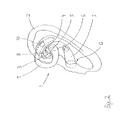
- FIG. 2 the ear conch with a device for the application of an electrical stimulus and for the emission of an acoustic signal
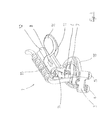
- FIG. 3 in a perspective view a device which is designed alternatively to FIG. 2 for the application of an electrical stimulus and for the emission of an acoustic signal.
- FIG. 1 an (outer) ear 2 of a human is depicted, which form is defined by the Pinna (ear conch) P.
- the Pinna P comprises in known manner the Helix H and the Antihelix AN; the Concha C is arranged centrally, which is limited sideways by the Tragus T. In the lower area the Lobule L is located.
- the Concha C is divided in an upper and a lower area; both areas are separated from each other by the Crus helicis Cr.
- the upper part of the Concha C is the Cymba conchae Cy, the lower part is the Cavum conchae Ca.
- the position of the ear canal is marked with G.
- a device 1 is arranged—as it is visible in FIG. 2 —, by which device at the one hand a transcutaneous electrical stimulus can be executed on a part of the surface of the ear 2 and by which at the other hand an acoustical signal can be dispensed in the ear canal G.
- the device 1 is designed to be fixed at the area of the vagus nerve at the ear of the person who is using the device 1 . Thereby a transcutaneous stimulation of the vagus nerve can be conducted.
- the device 1 has an electrode head 3 with two electrodes 4 and 5 , that is to say with a stimulation electrode 4 and a reference electrode 5 .
- the electrode head 3 has a kidney-shaped design and is designed even at its side which is facing the ear, so that it can be placed in such a way in the ear, that it rests on the Cymba conchae Cy. As it can be seen in the synopsis of the FIGS. 1 and 2 this occurs in such a manner that the main area of the Cymba conchae Cy is covered by the electrode head 3 .
- the two electrodes 4 , 5 are indicated as small punctual contacts in FIG. 2 . It is also possible, that the electrode surface is much larger, wherein the electrodes can be defined in particular by two (or also several) areas, which expand laminar over the Cymba conchae.
- a holding bow 9 is formed on the electrode head 3 .
- the holding bow 9 at hand is designed as elastically, C-shaped part and reaches with its end behind the ear 2 in such a way, that it comes to lie upon the ear root and holds like this the device 1 in the Pinna.
- an output channel for acoustic signals 7 is arranged—which is designed as an extension of the electrode head—, which end is designed to be lead into the auditory canal G.
- a loudspeaker 6 is arranged at an adequate location.
- the electrode head 3 forms a housing at the same time, in which housing at least a control device 8 is arranged, likewise preferably an electrical power supply (rechargeable battery). It is not depicted that in general it is also possible to conduct the control and the energy supply externally, wherefore then the device 1 comprises a cable to be supplied by an external control device and source of energy.
- a control device 8 is arranged, likewise preferably an electrical power supply (rechargeable battery). It is not depicted that in general it is also possible to conduct the control and the energy supply externally, wherefore then the device 1 comprises a cable to be supplied by an external control device and source of energy.
- the device 1 comprises as a further element a vibration generator 10 for mechanical vibrations.
- This vibration generator is presently integrated into the holding bow 9 . If the device 1 is arranged in the ear 2 , the vibration generator 10 rests behind the ear at the area of the ear root. Accordingly, mechanical vibrations can be initiated directly into the osseous tissue of the brain cranium, so that a sound can be initiated into the inner ear which is placed in the petrosal bone, which can be noticed by the patient not by the auditory canal G but directly by the bone conduct.
- the vibration generator 10 uses the same physiological principles like the so called Weber experiment. This experiment is an analysis for the conclusion of a lateralization of the auditory sensation by using a tuning fork. Together with the Rinne experiment it is a standard test in the ear, nose and throat medicine for the analysis of an auditory defect.
- the foot of an oscillating tuning fork will be put on the crest of the patient.
- the sound will be transferred in-phase into both inner ears by the bone conduction.
- the person with normal hearing hears the sound of the tuning fork in both ears equally, he has therefore the impression to hear the sound in the middle of the head, the sound will not be lateralized. If the patient indicates to hear the sound only at one side, a lateralization exists, i.e. a unilateral or asymmetrical auditory defect is at hand.
- FIG. 3 an alternative design of the device 1 can be seen but which design also underlies the principle to conduct the transcutaneous stimulation of the vagus nerve in the area of the Cymba conchae, while also an application with acoustical signals occurs next to the stimulation of the nerve. Accordingly, the above mentioned components of the device 1 are also given (not depicted is here the vibration generator 10 , which though can just as well be provided here of course).
- the device 1 has a holding element 11 as well as a holding rod 12 as essential components.
- the holding rod 12 carries the electrode head 3 at one axial end, which electrode head is provided with two electrodes 4 , 5 , that is to say with a stimulation electrode 4 and a (identically constructed) reference electrode 5 .
- the holding element 11 has a central section which section is dominated by a linear guide 13 . Here it is about a material section with a form like a bar, which extends itself in a longitudinal direction, in which a circular recess 14 is formed in.
- a resting part 15 is formed on; at the rear end, a cheek rest 16 is at hand.
- the resting part 15 comprises a circular section; the cheek rest 16 is designed at hand as an even section and serves as an additional stabilization for the resting of the device 1 .
- the holding element 11 is able to shift the holding rod 12 into the direction of the longitudinal axis by means of the linear guide 13 .
- the loud speaker 6 here lies above the circular resting part 15 , so that an output channel 7 will be formed here in form of a sound element, by which sounds of the loud speaker 6 can attain into the auditory canal.
- the ring-shaped resting part 15 lies exactly over the auditory canal opening when the device 1 is applied.
- the loud speaker 6 can fill out the whole ring of the resting part 15 .
- electrodes with the same size 4 , 5 are provided, which electrodes can be formed hemispherically. But also a variation of this is possible.
- the stimulation and reference electrodes can respectively have a form which is adapted to the area respectively to the surface of the ear 2 , where they shall be placed at. Oval or kidney-shaped structures can be previewed here.
- the at least two electrodes contact the surface of the ear 2 and namely the Cymba conchae with respective contact surfaces. In doing so, one of the contact surfaces can be considerably larger than the other one. Experiments have showed that advantageous effects can be reached if one of the areas is at least 3 times as large as the other area.
- the electrodes 4 , 5 are thereby arranged at a distance. The minimal distance is mostly 5 mm. But also distances up to 50 mm can be previewed.
- the invention can be defined by one or more of the following items wherein the reference characters are used for clarity.
Landscapes
- Health & Medical Sciences (AREA)
- Life Sciences & Earth Sciences (AREA)
- Engineering & Computer Science (AREA)
- General Health & Medical Sciences (AREA)
- Public Health (AREA)
- Otolaryngology (AREA)
- Biomedical Technology (AREA)
- Veterinary Medicine (AREA)
- Animal Behavior & Ethology (AREA)
- Acoustics & Sound (AREA)
- Physics & Mathematics (AREA)
- Biophysics (AREA)
- Heart & Thoracic Surgery (AREA)
- Radiology & Medical Imaging (AREA)
- Nuclear Medicine, Radiotherapy & Molecular Imaging (AREA)
- Signal Processing (AREA)
- Neurosurgery (AREA)
- Psychology (AREA)
- Vascular Medicine (AREA)
- Electrotherapy Devices (AREA)
Applications Claiming Priority (4)
| Application Number | Priority Date | Filing Date | Title |
|---|---|---|---|
| DE102011100065.1 | 2011-04-30 | ||
| DE102011100065 | 2011-04-30 | ||
| DE102011100065A DE102011100065A1 (de) | 2011-04-30 | 2011-04-30 | Vorrichtung zur kombinierten Aufbringung eines transkutanen elektrischen Stimulationsreizes und Abgabe eines akustischen Signals |
| PCT/EP2012/001760 WO2012150009A1 (de) | 2011-04-30 | 2012-04-25 | Vorrichtung zur kombinierten aufbringung eines transkutanen elektrischen stimulationsreizes und abgabe eines akustischen signals |
Related Parent Applications (1)
| Application Number | Title | Priority Date | Filing Date |
|---|---|---|---|
| PCT/EP2012/001760 Continuation WO2012150009A1 (de) | 2011-04-30 | 2012-04-25 | Vorrichtung zur kombinierten aufbringung eines transkutanen elektrischen stimulationsreizes und abgabe eines akustischen signals |
Publications (2)
| Publication Number | Publication Date |
|---|---|
| US20140126752A1 US20140126752A1 (en) | 2014-05-08 |
| US8885861B2 true US8885861B2 (en) | 2014-11-11 |
Family
ID=46046097
Family Applications (1)
| Application Number | Title | Priority Date | Filing Date |
|---|---|---|---|
| US14/114,632 Expired - Fee Related US8885861B2 (en) | 2011-04-30 | 2013-10-29 | Device for the combined application of a transcutaneous electrical stimulus and emission of an acoustic signal |
Country Status (11)
| Country | Link |
|---|---|
| US (1) | US8885861B2 (da) |
| EP (1) | EP2704792B1 (da) |
| JP (1) | JP5855231B2 (da) |
| AU (1) | AU2012250316B2 (da) |
| CA (1) | CA2833287A1 (da) |
| DE (1) | DE102011100065A1 (da) |
| DK (1) | DK2704792T3 (da) |
| ES (1) | ES2546314T3 (da) |
| HU (1) | HUE025998T2 (da) |
| PL (1) | PL2704792T3 (da) |
| WO (1) | WO2012150009A1 (da) |
Cited By (19)
| Publication number | Priority date | Publication date | Assignee | Title |
|---|---|---|---|---|
| US9782584B2 (en) | 2014-06-13 | 2017-10-10 | Nervana, LLC | Transcutaneous electrostimulator and methods for electric stimulation |
| WO2018106839A2 (en) | 2016-12-06 | 2018-06-14 | Nocira, Llc | Systems and methods for treating neurological disorders |
| US10130809B2 (en) | 2014-06-13 | 2018-11-20 | Nervana, LLC | Transcutaneous electrostimulator and methods for electric stimulation |
| US10441786B2 (en) | 2017-04-27 | 2019-10-15 | Medtronic Xomed, Inc. | System and method for stimulating a nerve |
| US10695568B1 (en) | 2018-12-10 | 2020-06-30 | Spark Biomedical, Inc. | Device and method for the treatment of substance use disorders |
| US10786666B2 (en) | 2018-01-30 | 2020-09-29 | Apex Neuro Holdings Inc. | Devices and methods for delivering mechanical stimulation to nerve, mechanoreceptor, and cell targets |
| US10806928B2 (en) | 2018-09-24 | 2020-10-20 | Vorso Corp. | Auricular nerve stimulation to address patient disorders, and associated systems and methods |
| US10967182B2 (en) | 2018-12-10 | 2021-04-06 | Spark Biomedical, Inc. | Devices and methods for reducing inflammation using electrical stimulation |
| US11140469B1 (en) * | 2021-05-03 | 2021-10-05 | Bose Corporation | Open-ear headphone |
| US11235156B2 (en) | 2019-09-11 | 2022-02-01 | Bose Corporation | Wearable audio device with vagus nerve stimulation |
| US11241574B2 (en) | 2019-09-11 | 2022-02-08 | Bose Corporation | Systems and methods for providing and coordinating vagus nerve stimulation with audio therapy |
| US11351370B2 (en) | 2018-12-10 | 2022-06-07 | Spark Biomedical, Inc. | Devices and methods for treating cognitive dysfunction and depression using electrical stimulation |
| US11547854B2 (en) | 2017-09-29 | 2023-01-10 | Cochlear Limited | Hearing prosthesis |
| US11623088B2 (en) | 2018-12-10 | 2023-04-11 | Spark Biomedical, Inc. | Devices and methods for the treatment of substance use disorders |
| US11832065B2 (en) | 2020-06-23 | 2023-11-28 | Bose Corporation | Haptic tinnitus therapeutic system |
| US12017068B2 (en) | 2022-05-27 | 2024-06-25 | Spark Biomedical, Inc. | Devices and methods for treating motion sickness using electrical stimulation |
| US12029893B1 (en) | 2023-06-14 | 2024-07-09 | Spark Biomedical, Inc. | Wearable auricular neurostimulator and methods of use |
| US12311114B2 (en) | 2013-08-30 | 2025-05-27 | Neuromod Devices Limited | Method and apparatus for treating a neurological disorder |
| US12502527B2 (en) | 2018-12-10 | 2025-12-23 | Spark Biomedical, Inc. | Devices and methods for treating stress and improving alertness using electrical stimulation |
Families Citing this family (15)
| Publication number | Priority date | Publication date | Assignee | Title |
|---|---|---|---|---|
| DK2968010T3 (da) | 2013-03-15 | 2018-05-22 | Univ Michigan Regents | Personlig auditiv somato-sensorisk stimulering for behandling af tinnitus |
| PT2842530T (pt) * | 2013-08-30 | 2021-11-25 | Neuromod Devices Ltd | Método e sistema para a geração de estímulo sensorial personalizado |
| KR101468355B1 (ko) * | 2014-01-03 | 2014-12-03 | 강원대학교산학협력단 | 음향 및 전기 복합 자극을 이용한 이명치료장치 |
| ES2991463T3 (es) * | 2015-11-17 | 2024-12-03 | Neuromod Devices Ltd | Un aparato y procedimiento para tratar un trastorno neurológico del sistema auditivo |
| CN109069297A (zh) * | 2015-11-23 | 2018-12-21 | 通用医疗公司 | 用于耳廓式经皮迷走神经刺激的系统和方法 |
| US10701498B2 (en) | 2016-06-07 | 2020-06-30 | Regents Of The University Of Minnesota | Systems and methods for treating tinnitus and enhancing hearing |
| IT201600112285A1 (it) * | 2016-11-08 | 2018-05-08 | Tinnitech Ltd | Sistema chimico-fisico per il trattamento degli acufeni |
| CN110891541A (zh) * | 2017-05-05 | 2020-03-17 | 巴德里·阿穆图尔 | 刺激方法和设备 |
| WO2020021329A2 (en) * | 2018-06-12 | 2020-01-30 | Adm Tronics Unlimited Inc | Digital tinnitus treatment electronic headset system, and method for operation of same |
| KR102194266B1 (ko) * | 2018-08-20 | 2020-12-22 | (주)모비프렌 | Tens 치료 기능을 가지는 골전도 장치 |
| CN109078263B (zh) * | 2018-08-22 | 2024-05-14 | 广州欧欧医疗科技有限责任公司 | 一种耳鸣治疗仪系统 |
| CN114423490A (zh) * | 2019-07-14 | 2022-04-29 | 火花生物医学股份有限公司 | 使用耳状刺激设备递送疗法的系统和方法 |
| DE102019121583A1 (de) | 2019-08-09 | 2021-02-11 | Tvns Technologies Gmbh | Gerät zur Durchführung einer tVNS-Behandlung |
| DE102019129098A1 (de) * | 2019-10-29 | 2021-04-29 | Tvns Technologies Gmbh | Elektrodenanordung zur Nervenstimulation |
| KR102923817B1 (ko) * | 2023-12-07 | 2026-02-05 | 한림대학교 산학협력단 | 복수의 미세전류 자극 및 소리 자극을 동시에 가하는 이명 재활 장치 및 이의 제어 방법 |
Citations (9)
| Publication number | Priority date | Publication date | Assignee | Title |
|---|---|---|---|---|
| US6198971B1 (en) | 1999-04-08 | 2001-03-06 | Implex Aktiengesellschaft Hearing Technology | Implantable system for rehabilitation of a hearing disorder |
| US20050020873A1 (en) | 2003-07-23 | 2005-01-27 | Epic Biosonics Inc. | Totally implantable hearing prosthesis |
| US20060015155A1 (en) * | 2002-06-21 | 2006-01-19 | Guy Charvin | Partly implanted hearing aid |
| US20060064139A1 (en) | 2002-06-24 | 2006-03-23 | Jong-Pil Chung | Electric stimilator for alpha-wave derivation |
| US20060122675A1 (en) | 2004-12-07 | 2006-06-08 | Cardiac Pacemakers, Inc. | Stimulator for auricular branch of vagus nerve |
| DE102006023824A1 (de) | 2006-05-20 | 2007-11-22 | Cerbomed Gmbh | Vorrichtung zur transkutanen Aufbringung eines Reizes oder zur transkutanen Erfassung eines Parameters |
| US20080021517A1 (en) | 2006-07-18 | 2008-01-24 | Cerbomed Gmbh | Audiological transmission system |
| US20110060383A1 (en) * | 2009-09-10 | 2011-03-10 | Cochlear Limited, IP Department | Using a genetic algorithm employing dynamic mutation |
| US20130172662A1 (en) * | 2010-05-17 | 2013-07-04 | Advanced Bionics Ag | Partially implantable hearing assistance system |
-
2011
- 2011-04-30 DE DE102011100065A patent/DE102011100065A1/de not_active Withdrawn
-
2012
- 2012-04-25 WO PCT/EP2012/001760 patent/WO2012150009A1/de not_active Ceased
- 2012-04-25 JP JP2014506791A patent/JP5855231B2/ja not_active Expired - Fee Related
- 2012-04-25 AU AU2012250316A patent/AU2012250316B2/en not_active Ceased
- 2012-04-25 ES ES12719576.6T patent/ES2546314T3/es active Active
- 2012-04-25 EP EP12719576.6A patent/EP2704792B1/de not_active Not-in-force
- 2012-04-25 PL PL12719576T patent/PL2704792T3/pl unknown
- 2012-04-25 HU HUE12719576A patent/HUE025998T2/en unknown
- 2012-04-25 CA CA2833287A patent/CA2833287A1/en not_active Abandoned
- 2012-04-25 DK DK12719576.6T patent/DK2704792T3/da active
-
2013
- 2013-10-29 US US14/114,632 patent/US8885861B2/en not_active Expired - Fee Related
Patent Citations (11)
| Publication number | Priority date | Publication date | Assignee | Title |
|---|---|---|---|---|
| US6198971B1 (en) | 1999-04-08 | 2001-03-06 | Implex Aktiengesellschaft Hearing Technology | Implantable system for rehabilitation of a hearing disorder |
| US20060015155A1 (en) * | 2002-06-21 | 2006-01-19 | Guy Charvin | Partly implanted hearing aid |
| US20060064139A1 (en) | 2002-06-24 | 2006-03-23 | Jong-Pil Chung | Electric stimilator for alpha-wave derivation |
| US20050020873A1 (en) | 2003-07-23 | 2005-01-27 | Epic Biosonics Inc. | Totally implantable hearing prosthesis |
| US20060122675A1 (en) | 2004-12-07 | 2006-06-08 | Cardiac Pacemakers, Inc. | Stimulator for auricular branch of vagus nerve |
| DE102006023824A1 (de) | 2006-05-20 | 2007-11-22 | Cerbomed Gmbh | Vorrichtung zur transkutanen Aufbringung eines Reizes oder zur transkutanen Erfassung eines Parameters |
| US20080249594A1 (en) | 2006-05-20 | 2008-10-09 | Cerbomed Gmbh | Device for applying a transcutaneous stimulus or for transcutaneous measuring of a parameter |
| US20080021517A1 (en) | 2006-07-18 | 2008-01-24 | Cerbomed Gmbh | Audiological transmission system |
| DE102006036069A1 (de) | 2006-07-18 | 2008-01-31 | Cerbomed Gmbh | Audiologisches Übertragungssystem |
| US20110060383A1 (en) * | 2009-09-10 | 2011-03-10 | Cochlear Limited, IP Department | Using a genetic algorithm employing dynamic mutation |
| US20130172662A1 (en) * | 2010-05-17 | 2013-07-04 | Advanced Bionics Ag | Partially implantable hearing assistance system |
Non-Patent Citations (1)
| Title |
|---|
| International Search Report of PCT/EP2012/001760 dated Aug. 31, 2012. |
Cited By (36)
| Publication number | Priority date | Publication date | Assignee | Title |
|---|---|---|---|---|
| US12311114B2 (en) | 2013-08-30 | 2025-05-27 | Neuromod Devices Limited | Method and apparatus for treating a neurological disorder |
| US10130809B2 (en) | 2014-06-13 | 2018-11-20 | Nervana, LLC | Transcutaneous electrostimulator and methods for electric stimulation |
| US9782584B2 (en) | 2014-06-13 | 2017-10-10 | Nervana, LLC | Transcutaneous electrostimulator and methods for electric stimulation |
| WO2018106839A2 (en) | 2016-12-06 | 2018-06-14 | Nocira, Llc | Systems and methods for treating neurological disorders |
| EP4421815A2 (en) | 2016-12-06 | 2024-08-28 | Nocira, LLC | Systems and methods for treating neurological disorders |
| US10441786B2 (en) | 2017-04-27 | 2019-10-15 | Medtronic Xomed, Inc. | System and method for stimulating a nerve |
| US12076563B2 (en) | 2017-09-29 | 2024-09-03 | Cochlear Limited | Hearing prosthesis |
| US11547854B2 (en) | 2017-09-29 | 2023-01-10 | Cochlear Limited | Hearing prosthesis |
| US11504521B2 (en) * | 2018-01-30 | 2022-11-22 | Apex Neuro Holdings, Inc. | Devices and methods for delivering mechanical stimulation to nerve, mechanoreceptor, and cell targets |
| US10786666B2 (en) | 2018-01-30 | 2020-09-29 | Apex Neuro Holdings Inc. | Devices and methods for delivering mechanical stimulation to nerve, mechanoreceptor, and cell targets |
| US11123558B2 (en) | 2018-09-24 | 2021-09-21 | Nesos Corp. | Auricular nerve stimulation to address patient disorders, and associated systems and methods |
| US11376430B2 (en) | 2018-09-24 | 2022-07-05 | Nesos Corp. | Auricular nerve stimulation to address patient disorders, and associated systems and methods |
| US12186557B2 (en) | 2018-09-24 | 2025-01-07 | Nextsense, Inc. | Auricular nerve stimulation to address patient disorders, and associated systems and methods |
| US10806928B2 (en) | 2018-09-24 | 2020-10-20 | Vorso Corp. | Auricular nerve stimulation to address patient disorders, and associated systems and methods |
| US10835747B2 (en) | 2018-09-24 | 2020-11-17 | Vorso Corp. | Auricular nerve stimulation to address patient disorders, and associated systems and methods |
| US11351370B2 (en) | 2018-12-10 | 2022-06-07 | Spark Biomedical, Inc. | Devices and methods for treating cognitive dysfunction and depression using electrical stimulation |
| US10695568B1 (en) | 2018-12-10 | 2020-06-30 | Spark Biomedical, Inc. | Device and method for the treatment of substance use disorders |
| US10967182B2 (en) | 2018-12-10 | 2021-04-06 | Spark Biomedical, Inc. | Devices and methods for reducing inflammation using electrical stimulation |
| US11623088B2 (en) | 2018-12-10 | 2023-04-11 | Spark Biomedical, Inc. | Devices and methods for the treatment of substance use disorders |
| US12502527B2 (en) | 2018-12-10 | 2025-12-23 | Spark Biomedical, Inc. | Devices and methods for treating stress and improving alertness using electrical stimulation |
| US11235156B2 (en) | 2019-09-11 | 2022-02-01 | Bose Corporation | Wearable audio device with vagus nerve stimulation |
| US11241574B2 (en) | 2019-09-11 | 2022-02-08 | Bose Corporation | Systems and methods for providing and coordinating vagus nerve stimulation with audio therapy |
| US11832065B2 (en) | 2020-06-23 | 2023-11-28 | Bose Corporation | Haptic tinnitus therapeutic system |
| US11997442B2 (en) * | 2021-05-03 | 2024-05-28 | Bose Corporation | Open-ear headphone |
| US12356132B2 (en) * | 2021-05-03 | 2025-07-08 | Bose Corporation | Open-ear headphone |
| US20240267665A1 (en) * | 2021-05-03 | 2024-08-08 | Bose Corporation | Open-Ear Headphone |
| US20230254624A1 (en) * | 2021-05-03 | 2023-08-10 | Bose Corporation | Open-Ear Headphone |
| US11659313B2 (en) * | 2021-05-03 | 2023-05-23 | Bose Corporation | Open-ear headphone |
| US11140469B1 (en) * | 2021-05-03 | 2021-10-05 | Bose Corporation | Open-ear headphone |
| AU2022270070B8 (en) * | 2021-05-03 | 2025-08-07 | Bose Corporation | Open-ear headphone |
| US20220353598A1 (en) * | 2021-05-03 | 2022-11-03 | Bose Corporation | Open-Ear Headphone |
| AU2022270070B1 (en) * | 2021-05-03 | 2025-07-17 | Bose Corporation | Open-ear headphone |
| US12017068B2 (en) | 2022-05-27 | 2024-06-25 | Spark Biomedical, Inc. | Devices and methods for treating motion sickness using electrical stimulation |
| US12214193B2 (en) | 2022-05-27 | 2025-02-04 | Spark Biomedical, Inc. | Devices and methods for treating motion sickness using electrical stimulation |
| US12337167B2 (en) | 2023-06-14 | 2025-06-24 | Spark Biomedical, Inc. | Wearable auricular neurostimulator and methods of use |
| US12029893B1 (en) | 2023-06-14 | 2024-07-09 | Spark Biomedical, Inc. | Wearable auricular neurostimulator and methods of use |
Also Published As
| Publication number | Publication date |
|---|---|
| AU2012250316B2 (en) | 2015-11-19 |
| AU2012250316A1 (en) | 2013-11-21 |
| ES2546314T3 (es) | 2015-09-22 |
| HUE025998T2 (en) | 2016-04-28 |
| JP5855231B2 (ja) | 2016-02-09 |
| CA2833287A1 (en) | 2012-11-08 |
| US20140126752A1 (en) | 2014-05-08 |
| DK2704792T3 (da) | 2015-09-14 |
| DE102011100065A1 (de) | 2012-10-31 |
| PL2704792T3 (pl) | 2015-11-30 |
| EP2704792A1 (de) | 2014-03-12 |
| EP2704792B1 (de) | 2015-06-10 |
| JP2014515671A (ja) | 2014-07-03 |
| WO2012150009A1 (de) | 2012-11-08 |
Similar Documents
| Publication | Publication Date | Title |
|---|---|---|
| AU2012250316B2 (en) | Device for the combined application of a transcutaneous electrical stimulus and emission of an acoustic signal | |
| CN111565793B (zh) | 神经刺激器 | |
| US9839779B2 (en) | Hearing assistance device comprising an implantable part | |
| EP2191663B1 (en) | Bone conduction hearing device with open-ear microphone | |
| KR101468355B1 (ko) | 음향 및 전기 복합 자극을 이용한 이명치료장치 | |
| US9511225B2 (en) | Hearing system comprising an auditory prosthesis device and a hearing aid | |
| EP2064916B1 (en) | Methods and apparatus for treating tinnitus | |
| CN104905909B (zh) | 双侧助听系统及验配双侧助听系统的方法 | |
| US20100048983A1 (en) | Multipath Stimulation Hearing Systems | |
| US10225671B2 (en) | Tinnitus masking in hearing prostheses | |
| US20170353807A1 (en) | Systems and methods for treating tinnitus and enhancing hearing | |
| EP2883495A1 (en) | Sound stimulator for memory enhancement | |
| US11924612B2 (en) | Distraction remediation at a hearing device | |
| JP2009543622A (ja) | 聴覚的伝達装置 | |
| KR102195936B1 (ko) | 유양돌기 및 귓바퀴 동시 자극 이명치료 전용 골전도 헤드셋 | |
| WO2014141060A1 (en) | Control for hearing prosthesis fitting | |
| KR101756723B1 (ko) | 이명 및 난청 치료 장치 및 이명 및 난청 치료 장치의 구동 방법 | |
| US20160199641A1 (en) | Device and method for neural cochlea stimulation | |
| US20230089767A1 (en) | Enhancing auditory percepts with vestibular simulation | |
| Nakagawa | Ultrasonic hearing by bone-conduction and its applications | |
| JP2025505805A (ja) | マルチモード音声知覚聴覚刺激システムおよび方法 | |
| WO2025149997A1 (en) | Tinnitus management techniques | |
| CN121604991A (zh) | 用于治疗诸如耳鸣或听力损失之类的内耳疾病的装置 | |
| EP3498166A1 (en) | Device for diagnosis and/or treatment of tinnitus and a system for electrical and magnetic stimulation of the ear |
Legal Events
| Date | Code | Title | Description |
|---|---|---|---|
| AS | Assignment |
Owner name: CERBOMED GMBH, GERMANY Free format text: ASSIGNMENT OF ASSIGNORS INTEREST;ASSIGNORS:BECK, CHRISTOPH;ELLRICH, JENS;HARTLEP, ANDREAS;AND OTHERS;SIGNING DATES FROM 20131014 TO 20131021;REEL/FRAME:031579/0822 |
|
| STCF | Information on status: patent grant |
Free format text: PATENTED CASE |
|
| FEPP | Fee payment procedure |
Free format text: ENTITY STATUS SET TO SMALL (ORIGINAL EVENT CODE: SMAL) |
|
| MAFP | Maintenance fee payment |
Free format text: PAYMENT OF MAINTENANCE FEE, 4TH YR, SMALL ENTITY (ORIGINAL EVENT CODE: M2551) Year of fee payment: 4 |
|
| FEPP | Fee payment procedure |
Free format text: MAINTENANCE FEE REMINDER MAILED (ORIGINAL EVENT CODE: REM.); ENTITY STATUS OF PATENT OWNER: SMALL ENTITY |
|
| LAPS | Lapse for failure to pay maintenance fees |
Free format text: PATENT EXPIRED FOR FAILURE TO PAY MAINTENANCE FEES (ORIGINAL EVENT CODE: EXP.); ENTITY STATUS OF PATENT OWNER: SMALL ENTITY |
|
| STCH | Information on status: patent discontinuation |
Free format text: PATENT EXPIRED DUE TO NONPAYMENT OF MAINTENANCE FEES UNDER 37 CFR 1.362 |
|
| FP | Lapsed due to failure to pay maintenance fee |
Effective date: 20221111 |