US8916663B2 - Production method of copolymer of allyl monomer containing polar group - Google Patents
Production method of copolymer of allyl monomer containing polar group Download PDFInfo
- Publication number
- US8916663B2 US8916663B2 US13/382,435 US201013382435A US8916663B2 US 8916663 B2 US8916663 B2 US 8916663B2 US 201013382435 A US201013382435 A US 201013382435A US 8916663 B2 US8916663 B2 US 8916663B2
- Authority
- US
- United States
- Prior art keywords
- group
- copolymer
- carbon atoms
- formula
- allyl
- Prior art date
- Legal status (The legal status is an assumption and is not a legal conclusion. Google has not performed a legal analysis and makes no representation as to the accuracy of the status listed.)
- Active, expires
Links
- 0 CC1=CC=CC(C)=N1[Pd]1(C)OS(=O)(=O)C2=C(C=CC=C2)[PH]1(C(C)C)C(C)C.[1*]C(C)CC.[2*]CC(C)CC Chemical compound CC1=CC=CC(C)=N1[Pd]1(C)OS(=O)(=O)C2=C(C=CC=C2)[PH]1(C(C)C)C(C)C.[1*]C(C)CC.[2*]CC(C)CC 0.000 description 29
- WAYVPOJNSJHBHE-UHFFFAOYSA-M CC1=CC=CC(C)=N1[Pd]1(C)CC2=C(C=CC=C2)S(=O)(=O)O1 Chemical compound CC1=CC=CC(C)=N1[Pd]1(C)CC2=C(C=CC=C2)S(=O)(=O)O1 WAYVPOJNSJHBHE-UHFFFAOYSA-M 0.000 description 2
- LUWNZZTYLKFKNR-UHFFFAOYSA-N C1=CC2=C(C=C1)C(P(C1=CC=CC3=C1C=CC=C3)C1=CC=CC3=C1C=CC=C3)=CC=C2.C1=COC(P(C2=CC=CO2)C2=CC=CO2)=C1.CC1=CC(C)=C(P(C2=C(C)C=C(C)C=C2C)C2=C(C)C=C(C)C=C2C)C(C)=C1.CC1=CC=C(P(C2=CC=C(C(F)(F)F)C=C2)C2=CC=C(C(F)(F)F)C=C2)C=C1.COC1=CC=CC=C1P(C1=CC=CC=C1)C1=C(OC)C=CC=C1.COC1=CC=CC=C1P(C1=CC=CC=C1C)C1=CC=CC=C1OC.FC1=C(F)C(F)=C(P(C2=C(F)C(F)=C(F)C(F)=C2F)C2=C(F)C(F)=C(F)C(F)=C2F)C(F)=C1F.FC1=CC=C(P(C2=CC=C(F)C=C2)C2=CC=C(F)C=C2)C=C1 Chemical compound C1=CC2=C(C=C1)C(P(C1=CC=CC3=C1C=CC=C3)C1=CC=CC3=C1C=CC=C3)=CC=C2.C1=COC(P(C2=CC=CO2)C2=CC=CO2)=C1.CC1=CC(C)=C(P(C2=C(C)C=C(C)C=C2C)C2=C(C)C=C(C)C=C2C)C(C)=C1.CC1=CC=C(P(C2=CC=C(C(F)(F)F)C=C2)C2=CC=C(C(F)(F)F)C=C2)C=C1.COC1=CC=CC=C1P(C1=CC=CC=C1)C1=C(OC)C=CC=C1.COC1=CC=CC=C1P(C1=CC=CC=C1C)C1=CC=CC=C1OC.FC1=C(F)C(F)=C(P(C2=C(F)C(F)=C(F)C(F)=C2F)C2=C(F)C(F)=C(F)C(F)=C2F)C(F)=C1F.FC1=CC=C(P(C2=CC=C(F)C=C2)C2=CC=C(F)C=C2)C=C1 LUWNZZTYLKFKNR-UHFFFAOYSA-N 0.000 description 1
- KGXSXVQUQPAXQE-UHFFFAOYSA-N C1=CC2=CC=CC(PC3=CC=CC4=C3C=CC=C4)=C2C=C1.C1=CC=C(C2=CC=CC=C2PC2=C(C3=CC=CC=C3)C=CC=C2)C=C1.COC1=CC=CC(C)=C1C1=CC=CC=C1PC1=C(C2=C(C)C=CC=C2OC)C=CC=C1.COC1=CC=CC2=C1C(PC1=C3C(C)=CC=CC3=CC=C1)=CC=C2 Chemical compound C1=CC2=CC=CC(PC3=CC=CC4=C3C=CC=C4)=C2C=C1.C1=CC=C(C2=CC=CC=C2PC2=C(C3=CC=CC=C3)C=CC=C2)C=C1.COC1=CC=CC(C)=C1C1=CC=CC=C1PC1=C(C2=C(C)C=CC=C2OC)C=CC=C1.COC1=CC=CC2=C1C(PC1=C3C(C)=CC=CC3=CC=C1)=CC=C2 KGXSXVQUQPAXQE-UHFFFAOYSA-N 0.000 description 1
- HNPIDJQVXRVEEA-UHFFFAOYSA-N C1=CC=C(C2=CC=CC=C2P(C2CCCCC2)C2CCCCC2)C=C1.CC(C)(C)P(C1=CC=CC=C1)C(C)(C)C.CC(C)(C)P(C1=CC=CC=C1C1=CC=CC=C1)C(C)(C)C.CC(C)C1=CC(C(C)C)=C(C2=CC=CC=C2P(C2CCCCC2)C2CCCCC2)C(C(C)C)=C1.CC1=CC=CC=C1C1=CC=CC=C1P(C(C)(C)C)C(C)(C)C.CC1=CC=CC=C1C1=CC=CC=C1P(C1CCCCC1)C1CCCCC1.COC1=CC=CC(OC)=C1C1=CC=CC=C1P(C1CCCCC1)C1CCCCC1.CP(C)C1=CC=CC=C1 Chemical compound C1=CC=C(C2=CC=CC=C2P(C2CCCCC2)C2CCCCC2)C=C1.CC(C)(C)P(C1=CC=CC=C1)C(C)(C)C.CC(C)(C)P(C1=CC=CC=C1C1=CC=CC=C1)C(C)(C)C.CC(C)C1=CC(C(C)C)=C(C2=CC=CC=C2P(C2CCCCC2)C2CCCCC2)C(C(C)C)=C1.CC1=CC=CC=C1C1=CC=CC=C1P(C(C)(C)C)C(C)(C)C.CC1=CC=CC=C1C1=CC=CC=C1P(C1CCCCC1)C1CCCCC1.COC1=CC=CC(OC)=C1C1=CC=CC=C1P(C1CCCCC1)C1CCCCC1.CP(C)C1=CC=CC=C1 HNPIDJQVXRVEEA-UHFFFAOYSA-N 0.000 description 1
- IEQYNSFFUDDJDL-UHFFFAOYSA-N C1=CC=C(CP(C23CC4CC(CC(C4)C2)C3)C23CC4CC(CC(C4)C2)C3)C=C1.C1=CC=C(OP(OC2=CC=CC=C2)OC2=CC=CC=C2)C=C1.C1=CC=C(P(C2=CC=CC=C2)C2CCCCC2)C=C1.CC(C)(C)COP(OCC(C)(C)C)OCC(C)(C)C.CC(C)(C)OP(OC(C)(C)C)OC(C)(C)C.CC(C)C1=CC(C(C)C)=C(C2=CC=CC=C2P(C(C)(C)C)C(C)(C)C)C(C(C)C)=C1.CC(C)OP(OC(C)C)OC(C)C.CCCOP(OCCC)OCCC.CCOP(OCC)OCC.CCP(C1=CC=CC=C1)C1=CC=CC=C1.CN(C)P(N(C)C)N(C)C.COP(OC)OC.CP(C1=CC=CC=C1)C1=CC=CC=C1.C[Si](C)(C)P([Si](C)(C)C)[Si](C)(C)C Chemical compound C1=CC=C(CP(C23CC4CC(CC(C4)C2)C3)C23CC4CC(CC(C4)C2)C3)C=C1.C1=CC=C(OP(OC2=CC=CC=C2)OC2=CC=CC=C2)C=C1.C1=CC=C(P(C2=CC=CC=C2)C2CCCCC2)C=C1.CC(C)(C)COP(OCC(C)(C)C)OCC(C)(C)C.CC(C)(C)OP(OC(C)(C)C)OC(C)(C)C.CC(C)C1=CC(C(C)C)=C(C2=CC=CC=C2P(C(C)(C)C)C(C)(C)C)C(C(C)C)=C1.CC(C)OP(OC(C)C)OC(C)C.CCCOP(OCCC)OCCC.CCOP(OCC)OCC.CCP(C1=CC=CC=C1)C1=CC=CC=C1.CN(C)P(N(C)C)N(C)C.COP(OC)OC.CP(C1=CC=CC=C1)C1=CC=CC=C1.C[Si](C)(C)P([Si](C)(C)C)[Si](C)(C)C IEQYNSFFUDDJDL-UHFFFAOYSA-N 0.000 description 1
- OQWOKRZIKSSOPF-UHFFFAOYSA-N C1=CC=C(P(C2=CC=CC=C2)C2=CC=CC=C2)C=C1.C1CCC(P(C2CCCC2)C2CCCC2)C1.C1CCC(P(C2CCCCC2)C2CCCCC2)CC1.CC(C)(C)CP(CC(C)(C)C)CC(C)(C)C.CC(C)(C)P(C(C)(C)C)C(C)(C)C.CC(C)(C)P(C1CCCCC1)C(C)(C)C.CC(C)(C)P(C1CCCCC1)C1CCCCC1.CC(C)CP(CC(C)C)CC(C)C.CC(C)P(C(C)(C)C)C(C)(C)C.CC(C)P(C(C)C)C(C)C.CC1=CC=CC=C1P(C1=CC=CC=C1C)C1=CC=CC=C1C.CCCCP(C12CC3CC(CC(C3)C1)C2)C12CC3CC(CC(C3)C1)C2.CCCCP(CCCC)CCCC.CCCP(CCC)CCC.CCP(CC)CC.CP(C(C)(C)C)C(C)(C)C.CP(C)C Chemical compound C1=CC=C(P(C2=CC=CC=C2)C2=CC=CC=C2)C=C1.C1CCC(P(C2CCCC2)C2CCCC2)C1.C1CCC(P(C2CCCCC2)C2CCCCC2)CC1.CC(C)(C)CP(CC(C)(C)C)CC(C)(C)C.CC(C)(C)P(C(C)(C)C)C(C)(C)C.CC(C)(C)P(C1CCCCC1)C(C)(C)C.CC(C)(C)P(C1CCCCC1)C1CCCCC1.CC(C)CP(CC(C)C)CC(C)C.CC(C)P(C(C)(C)C)C(C)(C)C.CC(C)P(C(C)C)C(C)C.CC1=CC=CC=C1P(C1=CC=CC=C1C)C1=CC=CC=C1C.CCCCP(C12CC3CC(CC(C3)C1)C2)C12CC3CC(CC(C3)C1)C2.CCCCP(CCCC)CCCC.CCCP(CCC)CCC.CCP(CC)CC.CP(C(C)(C)C)C(C)(C)C.CP(C)C OQWOKRZIKSSOPF-UHFFFAOYSA-N 0.000 description 1
- RYOYPHUUPXDZEG-UHFFFAOYSA-N C1=CC=C(PC2=CC=CC=C2)C=C1.C1=CCPC1.C1=CPC=C1.C1CCC(PC2CCCC2)C1.C1CCC(PC2CCCCC2)CC1.C1CCCPCC1.C1CCPC1.C1CCPCC1.CC(C)(C)CPCC(C)(C)C.CC(C)(C)PC(C)(C)C.CC(C)C1=CC=CC(C(C)C)=C1PC1=C(C(C)C)C=CC=C1C(C)C.CC(C)C1=CC=CC=C1PC1=C(C(C)C)C=CC=C1.CC(C)CC1=CC=CC=C1PC1=C(CC(C)C)C=CC=C1.CC(C)CPCC(C)C.CC(C)PC(C)C.CC(C)PC1CCCC1.CC(C)PC1CCCCC1.CC(C)PCC(C)(C)C.CC1=CC(C)=C(PC2=C(C)C=C(C)C=C2C)C(C)=C1.CC1=CC=C(C)P1.CC1C=CC(C)P1.CC1CCC(C)P1.CC1CCCC(C)P1.CC1CCCCC(C)P1.CCC(C)PC(C)CC.CCC(C)PC1CCCC1.CCC(C)PC1CCCCC1.CCPCC.COC1=CC=CC=C1PC1=C(C)C=CC=C1.CPC Chemical compound C1=CC=C(PC2=CC=CC=C2)C=C1.C1=CCPC1.C1=CPC=C1.C1CCC(PC2CCCC2)C1.C1CCC(PC2CCCCC2)CC1.C1CCCPCC1.C1CCPC1.C1CCPCC1.CC(C)(C)CPCC(C)(C)C.CC(C)(C)PC(C)(C)C.CC(C)C1=CC=CC(C(C)C)=C1PC1=C(C(C)C)C=CC=C1C(C)C.CC(C)C1=CC=CC=C1PC1=C(C(C)C)C=CC=C1.CC(C)CC1=CC=CC=C1PC1=C(CC(C)C)C=CC=C1.CC(C)CPCC(C)C.CC(C)PC(C)C.CC(C)PC1CCCC1.CC(C)PC1CCCCC1.CC(C)PCC(C)(C)C.CC1=CC(C)=C(PC2=C(C)C=C(C)C=C2C)C(C)=C1.CC1=CC=C(C)P1.CC1C=CC(C)P1.CC1CCC(C)P1.CC1CCCC(C)P1.CC1CCCCC(C)P1.CCC(C)PC(C)CC.CCC(C)PC1CCCC1.CCC(C)PC1CCCCC1.CCPCC.COC1=CC=CC=C1PC1=C(C)C=CC=C1.CPC RYOYPHUUPXDZEG-UHFFFAOYSA-N 0.000 description 1
- TWTRSCIEULHGMD-UHFFFAOYSA-N C1=CC=C([As](C2=CC=CC=C2)C2=CC=CC=C2)C=C1.CC[As](CC)CC.CN(C)[As](N(C)C)N(C)C.C[As](C)C Chemical compound C1=CC=C([As](C2=CC=CC=C2)C2=CC=CC=C2)C=C1.CC[As](CC)CC.CN(C)[As](N(C)C)N(C)C.C[As](C)C TWTRSCIEULHGMD-UHFFFAOYSA-N 0.000 description 1
- VTULQBXLPWXZSG-UHFFFAOYSA-M CC(C)[PH]1(C(C)C)C2=C(C=CC=C2)S(=O)(=O)O[Pd]1(C)C Chemical compound CC(C)[PH]1(C(C)C)C2=C(C=CC=C2)S(=O)(=O)O[Pd]1(C)C VTULQBXLPWXZSG-UHFFFAOYSA-M 0.000 description 1
- UPOWHSJBKSLIEA-UHFFFAOYSA-M CC(C)[PH]1(C(C)C)C2=C(C=CC=C2)S(=O)(=O)O[Pd]1(C)N(C)(C)CCN(C)(C)[Pd]1(C)CC2=CC=CC=C2S(=O)(=O)O1 Chemical compound CC(C)[PH]1(C(C)C)C2=C(C=CC=C2)S(=O)(=O)O[Pd]1(C)N(C)(C)CCN(C)(C)[Pd]1(C)CC2=CC=CC=C2S(=O)(=O)O1 UPOWHSJBKSLIEA-UHFFFAOYSA-M 0.000 description 1
- SFMPLCPQZGTHMO-UHFFFAOYSA-N CC(C)[PH]1(C(C)C)C2=C(C=CC=C2)S(=O)(=O)O[Pd]1(C)N1=CC=CC=C1 Chemical compound CC(C)[PH]1(C(C)C)C2=C(C=CC=C2)S(=O)(=O)O[Pd]1(C)N1=CC=CC=C1 SFMPLCPQZGTHMO-UHFFFAOYSA-N 0.000 description 1
- SDAJIOQLJUVSNP-UHFFFAOYSA-N CC.CC(C)C Chemical compound CC.CC(C)C SDAJIOQLJUVSNP-UHFFFAOYSA-N 0.000 description 1
- OPGNXLVKRZMNMU-UHFFFAOYSA-N CC1=CC=CC(C)=N1[Pd]1(C)OS(=O)(=O)C2=C(C=CC=C2)[PH]1(C(C)C)C(C)C Chemical compound CC1=CC=CC(C)=N1[Pd]1(C)OS(=O)(=O)C2=C(C=CC=C2)[PH]1(C(C)C)C(C)C OPGNXLVKRZMNMU-UHFFFAOYSA-N 0.000 description 1
- OKADZSFPVUVHMQ-UHFFFAOYSA-M CC1=CC=CC(C)=N1[Pd]1(C)OS(=O)(=O)C2=C(C=CC=C2)[PH]1(C1CCCCC1)C1CCCCC1.CCC.C[Pd]1(Cl)OS(=O)(=O)C2=C(C=CC=C2)[PH]1(C1CCCCC1)C1CCCCC1.ClCCl.ClCCl.O=S(=O)([O-])C1=C([PH+](C2CCCCC2)C2CCCCC2)C=CC=C1 Chemical compound CC1=CC=CC(C)=N1[Pd]1(C)OS(=O)(=O)C2=C(C=CC=C2)[PH]1(C1CCCCC1)C1CCCCC1.CCC.C[Pd]1(Cl)OS(=O)(=O)C2=C(C=CC=C2)[PH]1(C1CCCCC1)C1CCCCC1.ClCCl.ClCCl.O=S(=O)([O-])C1=C([PH+](C2CCCCC2)C2CCCCC2)C=CC=C1 OKADZSFPVUVHMQ-UHFFFAOYSA-M 0.000 description 1
- FAHZVKOUXAYUEX-UHFFFAOYSA-N CC1=N([Pd]2(C)OS(=O)(=O)C3=C(C=CC=C3)[PH]2(C(C)C)C(C)C)C2=C(C=CC=C2)C=C1 Chemical compound CC1=N([Pd]2(C)OS(=O)(=O)C3=C(C=CC=C3)[PH]2(C(C)C)C(C)C)C2=C(C=CC=C2)C=C1 FAHZVKOUXAYUEX-UHFFFAOYSA-N 0.000 description 1
- HNASNWMICCKBBG-UHFFFAOYSA-N CCC1=CC2=C(C=C1)S(=O)(=O)O[Pd](C)(N1=C(C)C=CC=C1C)[PH]2(C(C)C)C(C)C Chemical compound CCC1=CC2=C(C=C1)S(=O)(=O)O[Pd](C)(N1=C(C)C=CC=C1C)[PH]2(C(C)C)C(C)C HNASNWMICCKBBG-UHFFFAOYSA-N 0.000 description 1
- ZKCIYHGQRSQXPY-UHFFFAOYSA-N COC1=CC=CC(OC)=C1C1=C([PH]2(C3=CC=CC=C3C3=C(OC)C=CC=C3C)C3=C(C=CC=C3)S(=O)(=O)O[Pd]2(C)N2=C(C)C=CC=C2C)C=CC=C1 Chemical compound COC1=CC=CC(OC)=C1C1=C([PH]2(C3=CC=CC=C3C3=C(OC)C=CC=C3C)C3=C(C=CC=C3)S(=O)(=O)O[Pd]2(C)N2=C(C)C=CC=C2C)C=CC=C1 ZKCIYHGQRSQXPY-UHFFFAOYSA-N 0.000 description 1
Images




Classifications
-
- C—CHEMISTRY; METALLURGY
- C08—ORGANIC MACROMOLECULAR COMPOUNDS; THEIR PREPARATION OR CHEMICAL WORKING-UP; COMPOSITIONS BASED THEREON
- C08F—MACROMOLECULAR COMPOUNDS OBTAINED BY REACTIONS ONLY INVOLVING CARBON-TO-CARBON UNSATURATED BONDS
- C08F18/00—Homopolymers and copolymers of compounds having one or more unsaturated aliphatic radicals, each having only one carbon-to-carbon double bond, and at least one being terminated by an acyloxy radical of a saturated carboxylic acid, of carbonic acid or of a haloformic acid
- C08F18/02—Esters of monocarboxylic acids
-
- C—CHEMISTRY; METALLURGY
- C08—ORGANIC MACROMOLECULAR COMPOUNDS; THEIR PREPARATION OR CHEMICAL WORKING-UP; COMPOSITIONS BASED THEREON
- C08F—MACROMOLECULAR COMPOUNDS OBTAINED BY REACTIONS ONLY INVOLVING CARBON-TO-CARBON UNSATURATED BONDS
- C08F210/00—Copolymers of unsaturated aliphatic hydrocarbons having only one carbon-to-carbon double bond
- C08F210/02—Ethene
-
- C—CHEMISTRY; METALLURGY
- C08—ORGANIC MACROMOLECULAR COMPOUNDS; THEIR PREPARATION OR CHEMICAL WORKING-UP; COMPOSITIONS BASED THEREON
- C08F—MACROMOLECULAR COMPOUNDS OBTAINED BY REACTIONS ONLY INVOLVING CARBON-TO-CARBON UNSATURATED BONDS
- C08F110/00—Homopolymers of unsaturated aliphatic hydrocarbons having only one carbon-to-carbon double bond
- C08F110/02—Ethene
-
- C—CHEMISTRY; METALLURGY
- C08—ORGANIC MACROMOLECULAR COMPOUNDS; THEIR PREPARATION OR CHEMICAL WORKING-UP; COMPOSITIONS BASED THEREON
- C08F—MACROMOLECULAR COMPOUNDS OBTAINED BY REACTIONS ONLY INVOLVING CARBON-TO-CARBON UNSATURATED BONDS
- C08F210/00—Copolymers of unsaturated aliphatic hydrocarbons having only one carbon-to-carbon double bond
- C08F210/04—Monomers containing three or four carbon atoms
- C08F210/06—Propene
-
- C—CHEMISTRY; METALLURGY
- C08—ORGANIC MACROMOLECULAR COMPOUNDS; THEIR PREPARATION OR CHEMICAL WORKING-UP; COMPOSITIONS BASED THEREON
- C08F—MACROMOLECULAR COMPOUNDS OBTAINED BY REACTIONS ONLY INVOLVING CARBON-TO-CARBON UNSATURATED BONDS
- C08F218/00—Copolymers of compounds having one or more unsaturated aliphatic radicals, each having only one carbon-to-carbon double bond, and at least one being terminated by an acyloxy radical of a saturated carboxylic acid, of carbonic acid or of a haloformic acid
- C08F218/02—Esters of monocarboxylic acids
-
- C—CHEMISTRY; METALLURGY
- C08—ORGANIC MACROMOLECULAR COMPOUNDS; THEIR PREPARATION OR CHEMICAL WORKING-UP; COMPOSITIONS BASED THEREON
- C08F—MACROMOLECULAR COMPOUNDS OBTAINED BY REACTIONS ONLY INVOLVING CARBON-TO-CARBON UNSATURATED BONDS
- C08F220/00—Copolymers of compounds having one or more unsaturated aliphatic radicals, each having only one carbon-to-carbon double bond, and only one being terminated by only one carboxyl radical or a salt, anhydride ester, amide, imide or nitrile thereof
- C08F220/02—Monocarboxylic acids having less than ten carbon atoms; Derivatives thereof
- C08F220/10—Esters
-
- C—CHEMISTRY; METALLURGY
- C08—ORGANIC MACROMOLECULAR COMPOUNDS; THEIR PREPARATION OR CHEMICAL WORKING-UP; COMPOSITIONS BASED THEREON
- C08F—MACROMOLECULAR COMPOUNDS OBTAINED BY REACTIONS ONLY INVOLVING CARBON-TO-CARBON UNSATURATED BONDS
- C08F226/00—Copolymers of compounds having one or more unsaturated aliphatic radicals, each having only one carbon-to-carbon double bond, and at least one being terminated by a single or double bond to nitrogen or by a heterocyclic ring containing nitrogen
- C08F226/02—Copolymers of compounds having one or more unsaturated aliphatic radicals, each having only one carbon-to-carbon double bond, and at least one being terminated by a single or double bond to nitrogen or by a heterocyclic ring containing nitrogen by a single or double bond to nitrogen
Definitions
- the present invention relates to a production method of copolymers of allyl monomer containing polar group and to the copolymers obtained by the method.
- ethylene-vinyl alcohol copolymers are random copolymer comprising ethylene and vinyl alcohol and synthesized by saponifying ethylene-vinyl acetate copolymers obtained by radical copolymerization of ethylene and vinyl acetate.
- EVOH is used in a wide range of fields for purposes such as food packages by taking advantage of its excellent gas barrier property.
- copolymers obtained by copolymerization of ethylene through radical polymerization generate short-chain branches and long-chain branches by back biting reaction.
- EVOH it has been reported that about 1 mol % of alkyl branches and about 0.1 to 0.2 mol % of acetoxyl branches are present in EVOH containing about 30 mol % of ethylene (Nihon Kagaku Gakkaisi, 11, 1698 (1977)). It is known that generally, presence of branches in the polymer chain incurs decrease in the degree of crystallization and changes in the properties of the polymer.
- JP-A-S58-49792 discloses a copolymer of ethylene and allyl acetate and a tripolymer of ethylene, allyl acetate and vinyl acetate as a hydrocarbon oil composition.
- the synthesizing method thereof is radical polymerization, and a low-molecular-weight substance having limiting viscosity of about 0.12 dl/g was obtained in Examples.
- JP-A-2005-514083 discloses synthesis of ethylene-allyl alcohol copolymer aiming for higher hydrophobicity compared to EVOH as a coating material for medical instruments.
- the synthesis method is different from that of the present invention, which aims to directly obtain polymers by polymerization of allyl monomers, and the targeted polymer is obtained in JP-A-2005-514083 by reduction reaction after the radical copolymerization of ethylene and acrylic acid.
- the method had a problem that the reduction reaction of the polymer cost too much.
- the polymer since the polymer is synthesized by radical polymerization, the polymer skeleton is presumed to have a branched structure.
- Patent Document 1 discloses copolymers of propylene and allyl alcohol which are obtained by polymerization using TiCl 3 -type Ziegler-Natta catalyst. The polymerization reaction proceeds by using equimolar organic aluminum compound to allyl alcohol and by protecting the alcohol moiety with organic aluminum. Though the publication does not have description regarding the molecular weight distribution, the polymer contains 98% of isotactic fraction and is presumed to be a polymer having a wide-range of molecular weight distribution and composition distribution.
- the catalyst using metal complex of group 4 elements has high polymerization activity to monomers such as ethylene and propylene and there has also been a disclosure of copolymerization of polar group-containing monomers.
- a metallocene catalyst of group 4 elements it was necessary to use organic aluminum in at least an equimolar amount to allyl alcohol, which aluminum functions as a protecting group for the polar group-containing monomer against the catalyst.
- organic aluminum in at least an equimolar amount to allyl alcohol, which aluminum functions as a protecting group for the polar group-containing monomer against the catalyst.
- the reaction of chain transfer to organic aluminum dominantly terminated the propagation reaction, and only a saturated terminal bond was observed in a terminal structure of the polymer while a terminal double bond by ⁇ -hydrogen elimination was not.
- Non-patent Document 1 JP-A-2003-252930 (Patent Document 2) and J. Am Chem. Soc., 124, 1176 (2002) disclose an olefin polymer containing two polar groups at position of ⁇ of the main chain of the olefin polymer using metallocene complex of group 4 elements having a specific structure; an olefin polymer containing a polar group at position of ⁇ and at least one position of ( ⁇ n) (n ⁇ 1); and a production method thereof.
- ⁇ n ⁇ n
- the allyl alcohol content in the polyethylene main chain of the copolymer obtained by copolymerization of ethylene and allyl alcohol using a zirconocene catalyst having a specific structure, which copolymer described in Examples, is within the range of from 0.2 to 1.2 mol %.
- organic aluminum is used in at least an equimolar amount to allyl alcohol.
- Patent Document 3 JP-A-2006-265541 (Patent Document 3) describes a method for producing a polar olefin copolymer using a metal complex of groups 4 to 5 elements having a specific structure.
- Examples disclose copolymerization of ethylene and allyl chloride, ethylene and allyl acetate, and ethylene and allyl alcohol.
- the allyl content in the main chain of polyethylene is from 0.1 to 0.3 mol %; and organic aluminum is used in at least an equimolar amount to an allyl compound.
- Patent Document 4 JP-A-2003-231710 discloses a method for producing a copolymer of olefin and a polar vinyl monomer using a catalyst comprising a lamellar compound. Examples describe copolymerization of propylene and allyl alcohol, wherein the allyl alcohol content in the polymer is as small as 0.3% or less and organic aluminum is used.
- the polar group-containing monomer can be copolymerized without using organic aluminum as a protective group in the catalyst system using late transition metal.
- examples include copolymerization of ethylene and acrylic acid ester, acrylonitrile, vinyl acetate and the like (J. Am. Chem. Soc., 118, 267 (1996) (Non-patent Document 2); J. Am. Chem. Soc., 129, 8948 (2007) (Non-patent Document 3; JP-A-2007-046032 (Patent Document 5)).
- An objective of the present invention is to provide a high molecular weight allyl copolymer containing polar group and having a novel structure, which copolymer is available for various applications and the synthesis thereof has been considered to be difficult by a polymerization method such as radical polymerization other than that of the present invention; and a production method thereof.
- a novel copolymer of the allyl monomer containing a polar group which copolymer has a novel structure and is available for various applications, can be provided by polymerizing polar group-containing allyl monomer using a metal complex of group 10 elements as a catalyst component, which is different from the conventional radical polymerization method and the method using an early transition metal catalyst.
- the present inventors accomplished the present invention based on this finding.
- the present invention relates to the following [1] to [15]:
- R 1 represents a hydrogen atom or hydrocarbon group having 1 to 6 carbon atoms
- R 2 represents —OH, —OCOR 3 (R 3 represents hydrocarbon group having 1 to 5 carbon atoms), —N(R 4 ) 2 (R 4 represents a hydrogen atom, hydrocarbon group having 1 to 5 carbon atoms, aromatic residue having 6 to 18 carbon atoms or —COOR 10 (R 10 represents hydrocarbon group having 1 to 10 carbon atoms or aromatic residue having 6 to 10 carbon atoms) and two R 4 s may be the same or different from each other) or a halogen atom; and n and m are a value representing the molar ratio of each of the monomer units), comprising copolymerization of olefin represented by formula (1) CH 2 ⁇ CHR 1 (1) (in the formula, R 1 has the same meaning as described above) and an allyl compound represented by formula (2) CH 2 ⁇ CHCH 2 R 2 (2) (in the formula, R 2 has the same meaning as described above) using as
- M represents a metal atom of group 10 element in the periodic system
- X represents a phosphorous atom (P) or an arsenic atom (As)
- R 5 represents a hydrogen atom or hydrocarbon group having 1 to 30 carbon atoms which may be substituted by one or more groups selected from a halogen atom, alkoxy group, aryloxy group and acyloxy group
- Y, R 6 and R 7 independently represent a hydrogen atom, alkoxy group, aryloxy group, silyl group, amino group or hydrocarbon group having 1 to 30 carbon atoms which may be substituted by one or more groups selected from a halogen atom, alkoxy group and aryloxy group
- R 6 and R 7 may bond to each other to form a ring structure.
- Q represents a bivalent group indicated in the brackets of Z[—S( ⁇ O) 2 —O-]M, Z[—C( ⁇ O)—O-]M, Z[—P( ⁇ O)(—OH)—O-]M or Z[—S-]M (Z and M at the beginning and at the end of the formulae are described to show the coupling direction of the groups).
- Z represents a hydrogen atom or a hydrocarbon group having 1 to 40 carbon atoms which may be substituted by one or more groups selected from a halogen atom, alkoxy group and aryloxy group.
- Y and Z may bond to each other to form a ring structure.
- R 6 and/or R 7 may bond to Y to form a ring structure.
- L represents an electron-donating ligand and q is 0, 1 ⁇ 2, 1 or 2).
- Y 1 represents bivalent hydrocarbon group having 1 to 70 carbon atoms which may be substituted by one or more groups selected from a halogen atom, alkoxy group and aryloxy group; Q, M, X, R 5 , R 6 , R 7 , L and q have the same meanings as in [1] above).
- Q in formula (C2) is —SO 2 —O— (in which S bonds to Y 1 and O bonds to M).
- the catalyst represented by formula (C2) is represented by formula (C3)
- R 8 s independently represent a hydrogen atom, alkyl group having 1 to 8 carbon atoms, alkoxy group having 1 to 8 carbon atoms, aryloxy group having 6 to 18 carbon atoms or a halogen atom; and M, R 5 , R 6 , R 7 , L and q have the same meanings as in [1] above).
- R 1-1 represents a hydrogen atom or methyl group and R 2 , n and m have the same meaning as in [1] above);
- the main chain has one or less branch, which has two or more carbon atoms, per 1000 carbon atoms which constitute the main chain; and
- the main chain has a carbon-to-carbon double bond at least at one end of the main chain.
- a high molecular weight copolymer of allyl monomers containing a polar group can be obtained by the method of the present invention, wherein the polar group-containing allyl monomer and olefin are copolymerized using a metal complex of group 10 elements as a catalyst component, which copolymer was difficult to obtain by a conventional method.
- the polymer containing structures of (A) and (B) described below can be directly obtained using the allyl polar group as one of the copolymerizable monomers.
- the polar group-containing allyl copolymer of the present invention contains:
- This structure enables high crystallinity, thereby attaining various properties such as excellent mechanical strength; and
- the use of the terminal double bond enables necessary modification of a functional group, block copolymerization and star polymers.
- the present invention uses expensive late transition metal complex as a main component, it enables greatly reducing the catalyst cost by improving activity and dramatically improving the catalyst lifetime.
- FIG. 1 The 13 C-NMR spectrum of the ethylene/allyl acetate copolymer obtained in Example 1
- FIG. 2 An enlarged view of the portion at 12 to 40 ppm of FIG. 1
- FIG. 3 A figure showing a terminal structure, a chemical shift of the 13 C-NMR spectrum, and the carbon identification in the alphabet in the polymer analysis of Example 1
- FIG. 4 The IR spectrum of the ethylene/allyl acetate copolymer obtained in Example 1
- FIG. 5 The IR spectrum of the ethylene/allyl alcohol copolymer obtained in Example 36
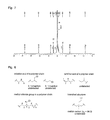
- FIG. 6 The 13 C-NMR spectrum of the ethylene/allyl chloride copolymer obtained in Example 41
- FIG. 7 An enlarged view of the portion at 10 to 55 ppm of FIG. 6
- FIG. 8 A figure showing a terminal structure, a chemical shift of the 13 C-NMR spectrum, and the carbon identification in the alphabet in the polymer analysis of Example 41
- FIG. 9 The 13 C-NMR spectrum of the ethylene/allyl bromide copolymer obtained in Example 44
- FIG. 10 An enlarged view of the portion at 10 to 45 ppm of FIG. 9
- FIG. 11 A figure showing a terminal structure, a chemical shift of the 13 C-NMR spectrum, and the carbon identification in the alphabet in the polymer analysis of Example 44
- FIG. 12 The 13 C-NMR spectrum of the ethylene/N-allylaniline copolymer obtained in Example 46
- FIG. 13 An enlarged view of the portion at 10 to 55 ppm of FIG. 12
- FIG. 14 An enlarged view of the portion at 105 to 155 ppm of FIG. 12
- FIG. 15 A figure showing a terminal structure, a chemical shift of the 13 C-NMR spectrum, and the carbon identification in the alphabet in the polymer analysis of Example 46
- FIG. 16 A graph indicating the relationship between the polymerization time and the polymer productivity per catalyst in Examples 32 to 35
- Olefin which is one of the monomers used in the method for producing the copolymer of the present invention, is represented by formula (1). CH 2 ⁇ CHR 1 (1)
- R 1 represents a hydrogen atom or hydrocarbon group having 1 to 6 carbon atoms and is preferably a hydrogen atom or alkyl group having 1 to 3 carbon atoms.
- examples of olefin of formula (1) include ethylene, propylene, 1-butene, 1-hexene, 4-methyl-1-pentene and 1-octene.
- ethylene and propylene are particularly preferable.
- One of these compounds may be used independently or two or more of them may be used in combination.
- a polar group-containing allyl compound which is the other of the monomers used for polymerization in the present invention, is represented by formula (2).
- R 2 represents —OH, —OCOR 3 (R 3 represents hydrocarbon group having 1 to 5 carbon atoms), —N(R 4 ) 2 (R 4 represents a hydrogen atom, hydrocarbon group having 1 to 5 carbon atoms or aromatic residue having 6 to 18 carbon atoms or —COOR 10 (R 10 represents hydrocarbon group having 1 to 10 carbon atoms or aromatic residue having 6 to 10 carbon atoms), wherein two R 4 s may by the same or different) or a halogen atom.
- R 3 is preferably alkyl group having 1 to 3 carbon atoms, particularly methyl group.
- R 4 is preferably a hydrogen atom, alkyl group having 1 to 3 carbon atoms or phenyl group.
- R 10 of —COOR 10 is preferably linear or branched alkyl group having 1 to 4 carbon atoms, phenyl group, benzyl group and the like.
- the halogen atom of R 2 is preferably chlorine or bromine.
- polar group-containing allyl compound represented by formula (2) examples include allyl acetate, allyl alcohol, allyl amine, N-allylaniline, N-t-butoxycarbonyl-N-allylamine, N-benzyloxycarbonyl-N-allylamine, N-benzyl-N-allylamine, allyl chloride and allyl bromide.
- allyl acetate and allyl alcohol are particularly preferable.
- One of these compounds may be used independently or two or more of them may be used in combination.
- the other monomer may be incorporated to be copolymerized.
- the other monomers include acrylate ester, metacrylate ester, acrylonitrile, vinyl acetate and styrene.
- Examples of the combination of olefin represented by formula (1) and the allyl compound represented by formula (2) include ethylene and allyl acetate; ethylene and ally alcohol; ethylene, allyl acetate and allyl alcohol; ethylene and allyl chloride; ethylene and allyl bromide; ethylene and allylamine, ethylene and N-allylaniline; ethylene and N-t-butoxycarbonyl-N-allylamine; ethylene and N-benzyloxycarbonyl-N-allylamine; ethylene and N-benzyl-N-allylamine; propylene and allyl acetate; propylene and ally alcohol; propylene, allyl acetate and allyl alcohol; propylene and allyl chloride; propylene and allyl bromide; propylene and allylamine; propylene and N-allylaniline; propylene and N-t-butoxycarbonyl-N-allylamine; propylene and N-benzyloxycarbon
- ethylene and allyl acetate preferred are ethylene and allyl acetate; ethylene and allyl alcohol; ethylene, allyl acetate and allyl alcohol; ethylene and allyl chloride; and ethylene and allylamine from the viewpoint of the polymer performance and economic efficiency.
- the (structure of the) catalyst comprising metal complex of group 10 elements of the periodic system used in the present invention is represented by formula (C1).
- M represents a metal atom of group 10 elements in the periodic system.
- X represents a phosphorous (P) atom or an arsenic (As) atom.
- R 5 represents a hydrogen atom or a hydrocarbon group having 1 to 30 carbon atoms which may be substituted by one or more groups selected from a halogen atom, alkoxy group and aryloxy group.
- Y, R 6 and R 7 independently represent a hydrogen atom, alkoxy group, aryloxy group, silyl group, amino group, or a hydrocarbon group having 1 to 30 carbon atoms which may be substituted by one or more groups selected from a halogen atom, alkoxy group and aryloxy group.
- R 6 and R 7 may bond to each other to form a ring structure.
- Q represents a bivalent group indicated in the brackets of Z[—S( ⁇ O) 2 —O-]M, Z[—C( ⁇ O)—O-]M, Z[—P( ⁇ O)(—OH)—O-]M or
- Z[—S-]M (Z and M at the beginning and at the end of the formulae are described to show the coupling direction of the groups).
- Z represents a hydrogen atom or a hydrocarbon group having 1 to 40 carbon atoms which may be substituted by one or more groups selected from a halogen atom, alkoxy group and aryloxy group.
- Y and Z may bond to each other to form a ring structure.
- R 6 and/or R 7 may bond to Y to form a ring structure.
- L represents an electron-donating ligand and q is 0, 1 ⁇ 2, 1 or 2.
- a “hydrocarbon group” includes saturated/unsaturated aliphatic carbon group and aromatic hydrocarbon group.
- M represents an element of group 10 in the periodic system.
- the elements of group 10 in the periodic system include Ni, Pd and Pt. From the viewpoint of the catalytic activity and obtained molecular weight, Ni and Pd are preferable, and Pd is particularly preferable.
- X represents a phosphorous (P) atom or an arsenic (As) atom, wherein two electrons coordinate to M.
- P is preferred as X for reasons of availability and the catalyst cost.
- Y, R 6 and R 7 each independently represent a hydrogen atom, alkoxy group, aryloxy group, silyl group, amino group, or a hydrocarbon group having 1 to 30 carbon atoms which may be substituted by one or more groups selected from a halogen atom, alkoxy group and aryloxy group.
- alkoxy group preferred are those having 1 to 20 carbon atoms including methoxy group, ethoxy group, propoxy group and isopropoxy group.
- aryloxy group preferred are those having 6 to 24 carbon atoms including phenoxy group.
- the silyl group include trimethyl silyl group
- examples of the amino group include amino group, methyl amino group and dimethyl amino group.
- R 6 and R 7 may be the same or different from each other. Also, R 6 and R 7 may bond to each other to form a ring structure. R 6 and/or R 7 may bond to Y to form a ring structure.
- Examples of the hydrocarbon group having 1 to 30 carbon atoms which may be substituted by one or more groups selected from a halogen atom, alkoxy group and aryloxy group in Y, R 6 and R 7 include alkyl group, aryl group, cycloalkyl group and furyl group.
- alkoxy group and aryloxy group in the hydrocarbon group having 1 to 30 carbon atoms which may be substituted by one or more groups selected from a halogen atom, alkoxy group and aryloxy group are the same as those mentioned above.
- the halogen atom is preferably fluorine. From the viewpoint of the catalyst activity, alkyl group and aryl group are particularly preferable.
- R 5 represents a hydrogen atom or a hydrocarbon group having 1 to 30 carbon atoms which may be substituted by one or more groups selected from a halogen atom, alkoxy group, aryloxy group and acyloxy group.
- a preferred hydrocarbon group having 1 to 30 carbon atoms which may be substituted by one or more groups selected from a halogen atom, alkoxy group and aryloxy group is alkyl group having 1 to 6 carbon atoms.
- a preferred halogen atom is chloride and bromide.
- Preferred alkoxy group is methoxy group and ethoxy group.
- Preferred aryloxy group is phenoxy group.
- Preferred acyloxy group is acetoxy group and pivaloxy group.
- R 5 include a hydrogen atom, methyl group, ethyl group, n-propyl group, isopropyl group, methoxymethyl group, phenoxy methyl group, 1-acetoxyphenyl group and 1-pivaloxypropyl group.
- Q represents a bivalent group indicated by —S( ⁇ O) 2 —O—, —C( ⁇ O)—O—, —P( ⁇ O)(—OH)—O— or —S—, which is a moiety, wherein one electron coordinates to M.
- —S( ⁇ O) 2 —O— is particularly preferable from the viewpoint of the catalyst activity.
- Z represents a hydrogen atom or a hydrocarbon group having 1 to 40 carbon atoms which may be substituted by one or more groups selected from a halogen atom, alkoxy group and aryloxy group. Y and Z may bond to each other to form a ring structure.
- Specific examples of the halogen atom, alkoxy group and aryloxy group in the “hydrocarbon atom having 1 to 40 carbon atoms which may be substituted by one or more groups selected from a halogen atom, alkoxy group and aryloxy group” include those mentioned as the examples in Y, R 6 and R 7 .
- hydrocarbon atom having 1 to 40 carbon atoms examples include methyl group, ethyl group, isopropyl group, t-butyl group, isobutyl group, cyclohexyl group, cyclopentyl group, phenyl group, 2-i-propylphenyl group, and 2,6-di-i-propylphenyl group.
- Z-Q moiety is an oxygen atom or a sulfur atom having high electronegativity and one electron of the oxygen or sulfur atom of Z-Q moiety coordinates to metal atom M. Since the bonding electron between Z-Q-M is transferred from M to Z-Q, Z-Q and M may be indicated formally as an anion state and a cation state, respectively.
- formula (C1) Y moiety and Z moiety may bond to each other.
- formula (C1) can be represented by formula (C2).
- formula (C2) Y—Z moiety as a whole is indicated by Y 1 .
- Y 1 represents a cross-linked structure between Q and X.
- Y 1 represents a bivalent hydrocarbon group having 1 to 70 carbon atoms which may be substituted by one or more groups selected from a halogen atom, alkoxy group and aryloxy group.
- Q, M, X, R 5 , R 6 , R 7 , L and q have the same meanings as in formula (C1).
- halogen atom, alkoxy group and aryloxy group as Y 1 are the same as those as Y.
- hydrocarbon group having 1 to 70 carbon atoms include alkylene group and arylene group. Particularly preferred is arylene group.
- Examples of [(R 6 )(R 7 )P] moiety when X is P (a phosphorous atom) include the following structures. In the following structure formulae, the bond between P and M or Y 1 is not shown.
- the cross-linked structure Y 1 is the crosslinking moiety which binds X and Q moiety.
- Specific examples of the cross-linked structure Y 1 in which X is represented by a P atom are shown below.
- multiple R 9 s may be the same or different to each other and represent a hydrogen atom, halogen atom, hydrocarbon group having 1 to 20 carbon atoms, or a hydrocarbon group having 1 to 20 carbon atoms substituted by a halogen atom.
- Substituents R 6 and R 7 may bond to Y 1 moiety to form a ring structure. Specific examples include the structures as follows:
- catalysts represented by formula (C2) those represented by the following formula (C3) are particularly preferable.
- R 8 s independently represent a hydrogen atom, alkyl group having 1 to 8 carbon atoms, alkoxy group having 1 to 8 carbon atoms, aryloxy group having 6 to 18 carbon atoms or halogen atom; and M, R 5 , R 6 , R 7 , L and q have the same meanings as those in formula (C1).
- R 5 is an alkyl group having 1 to 6 carbon atoms, particularly methyl group.
- R 6 and R 7 are preferably a cyclohexyl group, cyclopentyl group or isopropyl group.
- M is preferably Pd.
- the metal complex of the catalysts represented by formulae (C1) and (C2) can be synthesized according to the known documents (for example, J. Am. Chem. Soc. 2007, 129, 8948). That is, a metal complex is synthesized by reacting zerovalent or bivalent M source with a ligand in formula (C1) or (C2).
- the compound represented by formula (C3) can be synthesized by making Y 1 and Q in formula (C2) a specific group corresponding to formula (C3).
- zerovalent M source examples include tris(dibenzylidene acetone)dipalladium as a palladium source and tetracarbonyl nickel(0) (Ni(CO) 4 ) and bis(1,5-cyclooctadiene)nickel as a nickel source.
- bivalent M source examples include (1,5-cyclooctadiene)(methyl)palladium chloride, palladium chloride, palladium acetate, bis(acetonitrile)dichloropalladium (PdCl 2 (CH 3 CN) 2 ), bis(benzonitrile)dichloropalladium (PdCl 2 (PhCN) 2 ), (N,N,N′,N′-tetramethylethylenediamine)dichloro palladium(II) (PdCl 2 (TMEDA)), (N,N,N′,N′-tetramethylethylenediamine)dimethyl palladium (II) (PdMe 2 (TMEDA)), palladium(II) acetylacetonate (Pd(acac) 2 ), palladium(II) trifluoromethanesulfonate (Pd(OCOCF 3 ) 2 ) as a palladium source and (allyl)nic
- the metal complex generated by bringing a M-containing metal source and a ligand precursor in the reaction system can also be used for in-situ polymerization without isolating the metal complex.
- R 5 in formulae (C1) and (C2) is a hydrogen atom, it is preferable to use the metal complex generated in situ after reacting a metal source containing zerovalent M and a ligand precursor for polymerization without isolating the metal complex.
- ligand precursors represented by formulae (C1-1) and (C1-2) can be used for a metal complex represented by formula (C1).
- X—Y(R 6 )(R 7 ) (C1-1) Symbols in the formula have the same meanings as mentioned above.
- Z-Q-R 5 (C1-2) Symbols in the formula have the same meanings as mentioned above.
- the ligand precursor represented by the following formula (C2-1) can be used for a metal complex represented by formula (C2).
- formula (C1) it is preferable to select the ratio between the M source (M) and a ligand precursor (C1-1) (X) or a ligand precursor (C1-2) (Z) (i.e. X/M or Z/M) or the ratio between the M source (M) and a ligand precursor (C2-1) (C2 ligand) (i.e. (C2 ligand)/M) within the range of from 0.5 to 2.0, more preferably from 1.0 to 1.5.
- the one stabilized by making an electron-donating ligand (L) coordinate to the metal complex in advance may be used.
- q is 1 ⁇ 2, 1 or 2.
- q of 1 ⁇ 2 means that a bivalent electron-donating ligand coordinates to two metal complexes.
- q is preferably 1 ⁇ 2 or 1 to stabilize a metal complex catalyst.
- q of 0 means that there is no ligand in the precursor.
- An electron-donating ligand (L) is a compound which contains an electron-donating group and is capable of stabilizing a metal complex by coordinating to metal atom M.
- examples of those containing a sulfur atom include dimethyl sulfoxide (DMSO).
- examples of those containing a nitrogen atom include trialkyl amine having 1 to 10 carbon atoms in alkyl group, dialkyl amine having 1 to 10 carbon atoms in alkyl group, pyridine, 2,6-dimethylpyridine (otherwise known as “lutidine”), aniline, 2,6-dimethylaniline, 2,6-diisopropylaniline, N,N,N′,N′-tetramethylethylenediamine (TMEDA), 4-(N,N-dimethylamino)pyridine (DMAP), acetonitrile and benzonitrile.
- examples of those containing an oxygen atom include diethyl ether, tetrahydrofuran and 1,2-dimethoxyethane.
- the metal complex represented by formula (C1) or (C2) may be supported on a support to be used for polymerization.
- a support there are no particular limitations on the support and examples include an inorganic support such as silica gel and alumina and an organic support such as polystyrene, polyethylene and polypropylene.
- Examples of the method for depositing a metal complex on a support include a physical adsorption method of impregnating the support with a solution of the metal complex and drying it and a method of depositing the metal complex onto a support by chemically bonding the metal complex to a support.
- the metal complex of the present invention is used as a catalyst, there are no particular limitations on the method of polymerizing monomers represented formulae (1) and (2) and the monomers can be polymerized by a widely-used method. That is, a process such as a solution polymerization method, a suspension polymerization method and a gas-phase polymerization method is available. Particularly preferred are a solution polymerization method and a suspension polymerization method.
- a mixture of two or more of the metal complex catalysts represented by formula (C1), (C2) or (C3) may be used for the polymerization reaction.
- Using the catalysts in mixture enables controlling the molecular weight and molecular weight distribution of the polymer and the content of the monomer unit represented by formula (4) to thereby obtain a polymer suitable for the desired use.
- the molar ratio between the metal complex catalyst represented by formula (C1), (C2) or (C3) and the total amount of monomers (monomers/metal complex) is within the range of from 1 to 10,000,000, preferably the range of from 10 to 1,000,000, more preferably the range of from 100 to 100,000.
- the polymerization temperature is generally conducted at a temperature in the range of from ⁇ 30 to 200° C., preferably in the range of from 0 to 180° C., more preferably in the range of from 20 to 150° C.
- the polymerization is conducted at a polymerization pressure, wherein the internal pressure consists mostly of the pressure of olefin represented by formula (1), in the range from normal pressure to 20 MPa, preferably in the range from normal pressure to 10 MPa.
- the polymerization time can be appropriately adjusted depending on the processing mode and the polymerization activity of the catalyst, and can be as short as several minutes or as long as several thousand hours.
- an inert gas such as nitrogen and argon to prevent components other than monomers such as air, oxygen and moisture being mixed into the atmosphere to retain the catalyst activity.
- an inert solvent may be used in addition to monomers.
- inert solvent examples include aliphatic hydrocarbon such as isobutane, pentane, hexane, heptane and cyclohexane; aromatic hydrocarbon such as benzene, toluene and xylene; halogenated aliphatic hydrocarbon such as chloroform, methylene chloride, carbon tetrachloride, dichloroethane and tetrachloroethane; halogenated aromatic hydrocarbon such as chlorobenzene, dichlorobenzene and trichlorobenzene; aliphatic ester such as methyl acetate and ethyl acetate; and aromatic ester such as methyl benzoate and ethyl benzoate.
- aliphatic hydrocarbon such as isobutane, pentane, hexane, heptane and cyclohexane
- aromatic hydrocarbon such as benzene, toluene and xylene
- one or more types of third polymer units may be introduced into the copolymer of the polar group-containing allyl monomers of the present invention to thereby add functions to the polymer.
- the third monomer include an olefin compound having 9 or more carbon atoms and polar group-containing monomer other than an allyl monomer.
- the olefin compound having 9 or more carbon atoms include 1-nonene and 1-decene.
- Examples of a polar group-containing monomer other than an allyl monomer include acrylic acid, acrylic acid ester, metacrylic acid, metacrylic acid ester and acrylonitrile.
- the polymer of the present invention can be converted into various polymers using the reactivity of the functional group.
- R 2 is hydroxyl group
- a graft polymer can be produced in which two or more polymers are bonded to each other by substituting a primary hydroxyl group by halogen as a starting point of living radical polymerization to polymerize various polar group-containing monomers by radical polymerization.
- radically polymerizable monomers in this case include acrylic acid ester, metacrylic acid ester, acrylonitrile, vinyl acetate and styrene.
- the blending ratio of the monomers represented by formulae (1) and (2) is to be appropriately adjusted depending on the composition ratio of the targeted copolymer. This includes a case where a third monomer is used.
- the monomer represented by formula (1) is in the form of gas at a polymerization reaction temperature, the pressure of which is to be controlled.
- the monomer represented by formula (2) can be used as it is or may be diluted with an inert solvent to adjust the monomer blending ratio.
- the copolymer as a reaction product is to be isolated by post-treatment using a known operation and treating method (e.g. neutralization, extraction with solvents, washing with water, liquid separation, distillation with solvents and reprecipitation).
- a known operation and treating method e.g. neutralization, extraction with solvents, washing with water, liquid separation, distillation with solvents and reprecipitation.
- the copolymer can be molded into the form of a pellet, film, sheet and the like under conditions for general thermoplastic resin.
- the copolymer of allyl acetate with olefin such as ethylene can be converted to an allyl alcohol copolymer by saponification.
- the copolymer is partially saponified, it becomes a tripolymer of ethylene, allyl alcohol and allyl acetate.
- the obtained copolymer can be a product per se by molding such as injection molding, extrusion and film processing.
- the copolymer may be added to polyolefin and the like to be used as a modifier of the surface features such as adhesiveness and printing performance; a compatibility agent between nonpolar polyolefin and highly-polar other resins; and a dispersing agent of pigments and the like.
- the copolymer may also be used for purposes such as paint, ink, adhesive agent, binder, plasticizer, lubricant, lubricant oil and surface active agent.
- the copolymer of polar group-containing allyl monomers of the present invention is obtained by polymerizing compounds represented by the above formulae (1) and (2) and a third monomer as needed in the presence of the above-mentioned catalyst.
- the copolymer of polar group-containing allyl monomers of the present invention is a copolymer containing monomer units represented by formulae (3-1) and (4)
- R 1-1 represents a hydrogen atom or methyl group and R 2 , n and m have the same meaning as mentioned above) and having structures as described in (A) and (B) below:
- a branch means the one having two or more carbon atoms and the side chain of the monomer is not to be counted as a branch.
- a linear structure and a branched structure are generally known. It is known that a branched structure is obtained by back biting mechanism in ethylene-based polymers obtained by radical polymerization. In the branched structure, there exist short-chain branches having 5 or less carbon atoms and long-chain branches starting from the radical generated in the main chain, which are obtained by back biting. Meanwhile, the copolymer obtained by the catalyst system of the present invention has a linear structure containing very few long-chain branches. The copolymer of the present invention has a branch of one or less per 1000 carbon atoms which constitute the main chain.
- the number of branches per 1000 carbon atoms can be calculated by measuring the number of tertiary carbon atoms in the main chain to which a branch having two or more carbon atoms are bonded by the 13 C-NMR spectrum.
- the side chains of the monomer are not counted in the branches in the present invention. For example, when 1-butene is copolymerized as a third monomer, ethyl group becomes a side chain and shall not be counted as a branch.
- the terminal structure of the polymer of the present invention is different from that of the main chain.
- the terminal end structures are divided into a saturated bond and an unsaturated bond depending on the reaction mechanism.
- a chain transfer agent containing alkyl group such as organic aluminum
- organic aluminum is used to copolymerize a polar-group containing allyl compound, which makes a terminal structure have a saturated bond.
- organic aluminum is not used in the present invention, polymer chain growth terminates by ⁇ -hydrogen elimination, which makes at least one of the terminal structures has an unsaturated double bond.
- R means R 1 or CH 2 R 2 in formula (1) or (2) and “Polymer” means a polymer chain.
- the terminal unsaturated bond is highly reactive and enables modification of functional groups, block copolymerization and production of star polymers. Therefore, the copolymer of the present invention is very useful.
- Copolymers of the polar group-containing allyl monomers having a number average molecular weight of 3,000 or more and 1,000,000 or less in terms of polystyrene can be obtained according to the method for producing copolymers of the polar group-containing allyl monomers of the present invention. Such copolymers can be used in various molding methods.
- the method enables obtaining the copolymer with molecular distribution (Mw/Mn) as narrow as 1.0 or more and 3.0 or less.
- the narrow molecular distribution contributes to cutting back a low-molecular-weight or high-molecular-weight content, which generally has a positive effect on physical properties of the polymer and facilitates controlling the molecular distribution to achieve property balance as well.
- the content of the monomer unit represented by formula (4) is preferably 0.5 to 15.0 mol %, more preferably 1.0 to 6.0 mol % from the viewpoint of having a similar melt viscosity and molding conditions to those of polyethylene.
- m should be the total of each of the monomer units.
- a third monomer unit other than monomer units represented by formulae (3-1) and (4) may be copolymerized.
- a part or all of the monomer unit represented by formula (4) may be saponified.
- the copolymer after saponification has a structure as follows.
- the monomer unit of formula (4-2) derived from allyl acetate is saponified and changes to the monomer unit derived from allyl alcohol represented by formula (4-1).
- m 1 +m 2 m.
- m 1 becomes 0.
- the ratio between m 1 and m 2 can be adjusted by the degree of saponification.
- the saponification of the copolymer is conducted by a known method similar to that of saponifying poly(vinyl acetate).
- the copolymer can be dissolved or dispersed in a solvent and treated with acid and alkali in the presence of water and alcohol.
- R 1-1 has the same meaning as mentioned above and n, m 1 and m 2 are the values to indicate the molar ratio between each of the monomer units.
- the copolymer of N-t-butoxycarbonyl-N-allylamine and ethylene and the like can be converted to a copolymer of allylamine or allyl ammonium salts by hydrolysis under an acidic condition.
- the copolymer When the copolymer is partially saponified, it becomes a tripolymer of ethylene, allylamine and N-t-butoxycarbonyl-N-allylamine.
- the structure of the copolymers obtained in Examples was determined by various analysis of the NMR spectra using JNM-ECS400 manufactured by JEOL Ltd.
- the content of the monomer unit derived from the allyl compound represented by formula (2) and the terminal structure of the copolymer was determined by analyzing 13 C-NMR spectrum (90° pulse at 9.0 microseconds, spectrum width: 31 kHz, relaxation time: 10 seconds, acquisition time: 10 seconds, times of accumulating FID signals: 5,000 to 10,000 times) through the inverse-gated decoupling method at 120° C. using 1,2,4-trichlorobenzene (0.55 ml) as a solvent and Cr(acac) 3 (10 mg) as relaxation agent.
- a branched structure can be determined by analyzing 13 C-NMR spectrum of the tertiary carbon atom. That is, while the chemical shift value of the carbon atom in the branch of allyl acetate (corresponding to carbon atom d in FIG. 3 ) appears at 37.9 ppm, the chemical shift value of the tertiary carbon atom (carbon atom at the branch point) appears in the vicinity of 38.2 to 39 ppm when there is a branch in the polymer main chain, thereby permitting the distinction between the two (see FIG. 3) (Reference document: Macromolecules 1999, 32, 1620-1625).
- a terminal structure can be analyzed by 13 C-NMR or 1 H-NMR spectrum. Particularly, when the copolymer contains a terminal double bond, peaks appears at 114 ppm and 139 ppm in 13 C-NMR spectrum, which can be differentiated from the peak attributed to a saturated terminal structure that appears in the range of 10 to 40 ppm (Reference document: Chem. Commun. 2002, 744-745).
- a number average molecular weight and a weight average molecular weight were calculated by size extrusion chromatography in which polystyrene is employed as an internal standard substance using a high-temperature GPC apparatus, HLC-8121GPC/HT, manufactured by Tosoh Corporation, provided with TSKgel GMHHR-H(S) HT column (two columns of 7.8 mm I.D. ⁇ 30 cm arranged in series) manufactured by Tosoh Corporation (solvent: 1,2-dichlorobenzene, temperature: 145° C.).
- Metal complex catalyst 1 was synthesized according to the following reaction scheme:
- n-butyllithium manufactured by Kanto Chemical Co., Inc., 1.65 M hexane solution, 5.1 ml, 8.4 mmol
- THF tetrahydrofuran
- benzenesulfonic acid manufactured by Tokyo Chemical Industry Co., Ltd., 662 mg, 4.2 mmol
- chlorodicyclohexylphosphine manufactured by Sigma-Aldrich, 885 mg, 3.8 mmol
- a methylene chloride solution (4 ml) of complex 1b (194 mg, 0.30 mmol) was added to a methylene chloride suspension (2 ml) of potassium carbonate (420 mg, 3.03 mmol) and 2,6-lutidine (manufactured by Tokyo Chemical Industry Co., Ltd., 333 mg, 3.11 mmol) under argon atmosphere and stirred for one hour at room temperature. Solid remained after distilling away the solvent under reduced pressure was washed with diethyl ether and extracted with a methylene chloride solution. The extract was filtered through by Celite (dry diatom earth) and slowly added to hexane (40 ml). The generated precipitate was recovered by filtration, washed with hexane and then dried under reduced pressure to obtain metal complex catalyst 1. The yield was 123 mg (70%).
- the number average molecular weight and weight average molecular weight of the copolymer were calculated 8,100 and 16,200, respectively, by size exclusion chromatography and Mw/Mn was 2.0.
- the copolymer was found to be a linear polymer having one or less branch per 1000 carbon atoms. Also, 13 C-NMR signal was observed at 114 ppm and 139 ppm, which was derived from a terminal double bond, and the copolymer was confirmed to be a polymer containing a terminal double bond. In addition, in the IR spectrum shown in FIG. 4 , a peak derived from a carbonyl group was observed at 1744 cm ⁇ 1 .
- productivity and the catalyst activity were calculated by the following formulae.
- Productivity (g/mmol) Yield of the obtained copolymer (g)/Molar number of the used metal complex catalyst (mmol)
- Catalyst activity (g/mmol ⁇ h) Yield of the obtained copolymer (g)/(Molar number of the used metal complex catalyst (mmol) ⁇ reaction time (h))
- Toluene (7.5 ml) and allyl acetate (7.5 ml, 7.0 g, 70 mmol) were added to a 50 ml-volume autoclave containing metal complex catalyst 1 (58.2 g, 0.10 mmol) under argon atmosphere. After filling the autoclave with ethylene (3.0 MPa), the content of the autoclave was stirred at 80° C. for three hours. After cooling the autoclave to room temperature, methanol (about 20 ml) was added thereto. The generated copolymer was recovered by filtration, washed with methanol and dried under reduced pressure to obtain copolymer 2. The yield was 585 mg.
- the number average molecular weight and weight average molecular weight of the copolymer were calculated 7,900 and 15,500, respectively, by size exclusion chromatography and Mw/Mn was 2.0.
- Metal complex catalyst 2 was synthesized in the same way as in metal complex catalyst 1 using 2-(dicyclopentylphosphino)benzenesulfonic acid as a starting material.
- the copolymerization of allyl acetate and ethylene was conducted in the same way as in Example 2. That is, toluene (7.5 ml) and allyl acetate (7.5 ml, 7.0 g, 70 mmol) were added to a 50 ml-volume autoclave containing metal complex catalyst 2 (0.10 mmol) under argon atmosphere. After filling the autoclave with ethylene (3.0 MPa), the content of the autoclave was stirred at 80° C. for three hours. After cooling the autoclave to room temperature, methanol (about 20 ml) was added thereto.
- the generated copolymer was recovered by filtration, washed with methanol and dried under reduced pressure to obtain copolymer 3.
- the yield was 226 mg.
- the number average molecular weight and weight average molecular weight of the copolymer were calculated 3,400 and 5,400, respectively, by size exclusion chromatography and Mw/Mn was 1.6.
- Metal complex catalyst 3 was synthesized in the same way as in metal complex catalyst 1 using 2-(diisopropylphosphino)benzenesulfonic acid as a starting material.
- the generated copolymer was recovered by filtration, washed with methanol and dried under reduced pressure to obtain copolymer 4. The yield was 525 mg.
- the number average molecular weight and weight average molecular weight of the copolymer were calculated 6,700 and 12,700, respectively, by size exclusion chromatography and Mw/Mn was 1.9.
- Copolymerization of allyl acetate and ethylene was conducted using a radical generator AIBN (2,2-azobisisobutylonitrile) in place of a metal complex catalyst. That is, AIBN (0.742 g, 4.52 mmol) and allyl acetate (80 ml, 74.6 g, 747 mmol) were placed into a 120 ml-volume autoclave. After filling the autoclave with ethylene so that the pressure becomes 1.0 MPa, the content of the autoclave was stirred at 90° C. for two hours. Regarding the ethylene pressure during the reaction, after a decrease in pressure owing to the ethylene amount dissolved in a solvent (for about ten minutes after starting applying the ethylene pressure), no more decrease in the ethylene pressure due to the reaction was observed.
- AIBN 2,2-azobisisobutylonitrile
- the precipitate was removed by the filtration using a syringe filter, and the solution was added dropwise to hexane.
- the generated precipitate was recovered by filtration, washed with t-butylmethyl ether and hexane, and dried under reduced pressure to obtain metal complex catalyst 4.
- a dimethyl sulfoxide (dmso) solution of metal complex catalyst 5 (0.48 g, 0.53 mmol) (10 ml) was stirred under nitrogen atmosphere and reduced pressure at 40° C. for ten hours.
- methylene chloride (30 ml) and water (30 ml) were added to the reaction solution, an organic layer and a water layer were separated using a separating funnel.
- magnesium sulfate After drying the organic layer with magnesium sulfate, the solvent was distilled away with an evaporator.
- Methylene chloride (10 ml) was added to the residue to dissolve it, and the obtained solution was added dropwise to hexane (50 ml).
- the generated precipitate was recovered by filtration, washed with t-butylmethyl ether and hexane, and dried under reduced pressure to obtain metal complex catalyst 6.
- the yield was 0.26 (52%).
- the precipitate was removed by the filtration using a syringe filter, and the solution was added dropwise to hexane.
- the generated precipitate was recovered by filtration, washed with t-butylmethyl ether and hexane, and dried under reduced pressure to obtain metal complex catalyst 9.
- the yield was 0.51 g (77%).
- the number average molecular weight and weight average molecular weight of the copolymer were calculated 4,000 and 7,000, respectively, by size exclusion chromatography and Mw/Mn was 1.7.
- the allyl acetate content in the copolymer was determined to be 3.7% by molar ratio by 13 C-NMR spectrum using the inverse-gated decoupling method.
- a toluene solution (37.5 ml) of metal complex catalyst 1 (0.10 mmol) was added to a 120 ml-volume autoclave containing allyl acetate (37.5 ml, 34.9 g, 350 mmol) under nitrogen atmosphere. After filling the autoclave with ethylene (3.0 MPa), the content of the autoclave was stirred at 80° C. for five hours. After cooling the autoclave to room temperature, the reaction mixture was added to methanol (400 ml). The generated copolymer was recovered by filtration, washed with methanol and dried under reduced pressure to obtain copolymer 6. The yield was 2.1 g.
- the number average molecular weight and weight average molecular weight of the copolymer were calculated 14,000 and 29,000, respectively, by size exclusion chromatography and Mw/Mn was 2.1.
- the allyl acetate content in the copolymer was determined to be 3.8% by molar fraction by 13 C-NMR spectrum using the inverse-gated decoupling method.
- Copolymers 7 to 30 were produced in the same way as in Examples 5 and 6. The polymerization conditions and results are shown in Tables 1 and 2.
- A* Molar fraction of the allyl compound monomer units (mol %)
- Ethylene homopolymerization was conducted using metal complex catalyst 1. That is, a toluene solution (75 ml) of metal complex catalyst 1 (0.050 mmol) was added to a 120 ml-volume autoclave under nitrogen atmosphere. After filling the autoclave with ethylene (3.0 MPa), the content of the autoclave was stirred at 80° C. for one hour. After cooling the autoclave to room temperature, the reaction mixture was added to methanol (400 ml). The generated copolymer was recovered by filtration, washed with methanol and dried under reduced pressure. The yield was 8.3 g. The number average molecular weight and weight average molecular weight of the copolymer were calculated 30,000 and 70,000, respectively, by size exclusion chromatography and Mw/Mn was 2.1.
- organic aluminum is used in an amount that is equal to or more than the polar group-containing monomers.
- organic aluminum it has been reported in a publication that the polymer chain transfers to aluminum atoms, which terminates the polymerization reaction, and therefore a terminal double bond is not observed in the polymer (Macromolecules 2004, 37, 5145).
- the generated precipitate was recovered by filtration, washed with methanol and dried under reduced pressure to obtain copolymer 31.
- the yield was 1.7 g.
- the number average molecular weight and weight average molecular weight of the copolymer were calculated 4,000 and 9,000, respectively, by size exclusion chromatography and Mw/Mn was 2.7.
- the allyl acetate content in the copolymer was determined to be 2.7% by molar fraction by 13 C-NMR spectrum using the inverse-gated decoupling method.
- 13 C-NMR signal was observed at 114 ppm and 139 ppm, which was derived from a terminal double bond, and the copolymer was confirmed to be a linear polymer containing a terminal double bond.
- a toluene solution (37.5 ml) of metal complex catalyst 3 (0.010 mmol) was added to a 120 ml-volume autoclave containing allyl acetate (37.5 ml, 34.9 g, 348 mmol) under nitrogen atmosphere. After filling the autoclave with ethylene (3.0 MPa), the content of the autoclave was stirred at 80° C. for five hours. After cooling the autoclave to room temperature, the reaction mixture was added to methanol (about 400 ml). The generated precipitate was recovered by filtration, washed with methanol and dried under reduced pressure to obtain copolymer 32. The yield was 0.89 g.
- the number average molecular weight and weight average molecular weight of the copolymer were calculated 13,000 and 29,000, respectively, by size exclusion chromatography and Mw/Mn was 2.2.
- the allyl acetate content in the copolymer was determined to be 3.3% by molar fraction by 13 C-NMR spectrum using the inverse-gated decoupling method.
- 13 C-NMR signal was observed at 114 ppm and 139 ppm, which was derived from a terminal double bond, and the copolymer was confirmed to be a linear polymer containing a terminal double bond.
- Copolymers 33 to 35 were obtained in the same manner as in Example 32 except for setting the reaction time to 25 hours, 50 hours and 100 hours, respectively.
- the polymerization conditions and results are shown in Tables 1 and 2.
- the polymer productivity per catalyst with respect to the polymerization time in Examples 32 to 35 is shown as a graph in FIG. 16 . It can be seen that the present polymerization catalyst system shows very little loss of catalyst activity and the polymer yield increases with the polymerization time. This greatly differs from the phenomenon in copolymerization of ethylene and vinyl acetate that the polymerization activity decreases with the polymerization time and the polymer productivity hits a peak (e.g.: see “J. Am. Chem. Soc.”, 2009, 131, 14606, Supporting Information S10) and shows that the present invention is an effective technology for promoting industrialization.
- the analysis of the obtained powder by 13 C-NMR and IR spectra showed that the ester groups present in the allyl acetate and ethylene copolymer were completely converted to hydroxyl groups and the powder is a copolymer of allyl alcohol and ethylene.
- the IR spectrum is shown in FIG. 5 .
- the allyl alcohol content was determined to be 3.2% by molar fraction by 13 C-NMR.
- 13 C-NMR signal was observed at 114 ppm and 139 ppm, which was derived from a terminal double bond, and the copolymer was confirmed to be a polymer containing a terminal double bond.
- the number average molecular weight and weight average molecular weight of the copolymer were calculated 12,000 and 26,000, respectively, by size exclusion chromatography and Mw/Mn was 2.2.
- a toluene solution (60 ml) of metal complex catalyst 1 (0.15 mmol) was added to a 120 ml-volume autoclave containing allyl alcohol (15 ml, 12.8 g, 219.8 mmol) under nitrogen atmosphere. After filling the autoclave with ethylene (4.0 MPa), the content of autoclave was stirred at 80° C. for seven hours. After being cooled to room temperature, the reaction solution was added to methanol (400 ml). The generated copolymer was recovered by filtration, washed with methanol and then dried under reduced pressure to obtain copolymer 38. The yield was 0.12 g.
- the number average molecular weight and weight average molecular weight of the copolymer were calculated 2,000 and 3,400, respectively, by size exclusion chromatography and Mw/Mn was 1.7.
- the allyl acetate content in the copolymer was determined to be 2.7% by molar fraction by 13 C-NMR spectrum using the inverse-gated decoupling method.
- Copolymers 39 and 40 were produced in the same manner as in Example 38 except for setting the conditions shown in Table 3. The results are shown in Table 4.
- the number average molecular weight and weight average molecular weight of the copolymer were calculated 10,000 and 19,000, respectively, by size exclusion chromatography and Mw/Mn was 1.9.
- the allyl chloride content in the copolymer was determined to be 1.0% by molar fraction by 13 C-NMR spectrum using the inverse-gated decoupling method.
- 13 C-NMR signal was observed at 114 ppm and 139 ppm, which was derived from a terminal double bond, and the copolymer was confirmed to be a linear polymer containing a terminal double bond.
- Copolymers 42 and 43 were produced in the same manner as in Example 41 except for setting the conditions shown in Table 3. The results are shown in Table 4.
- the number average molecular weight and weight average molecular weight of the copolymer were calculated 8,000 and 15,000, respectively, by size exclusion chromatography and Mw/Mn was 1.9.
- the allyl chloride content in the copolymer was determined to be 0.71% by molar fraction by 13 C-NMR spectrum using the inverse-gated decoupling method.
- 13 C-NMR signal was observed at 114 ppm and 139 ppm, which was derived from a terminal double bond, and the copolymer was confirmed to be a linear polymer containing a terminal double bond.
- Copolymer 45 was produced in the same manner as in Example 44 except for setting the conditions shown in Table 3. The results are shown in Table 4.
- the number average molecular weight and weight average molecular weight of the copolymer were calculated 1,500 and 3,100, respectively, by size exclusion chromatography and Mw/Mn was 2.1.
- Copolymer 47 was produced in the same manner as in Example 46 except that the conditions are set as shown in Table 3. The results are shown in Table 4. The number average molecular weight and weight average molecular weight of the copolymer were calculated 2,100 and 3,200, respectively, by size exclusion chromatography and Mw/Mn was 1.5.
- the number average molecular weight and weight average molecular weight of the copolymer were calculated 5,200 and 12,200, respectively, by size exclusion chromatography and Mw/Mn was 2.4.
- the N-t-butoxycarbonyl-N-allylamine content in the copolymer was determined to be 3.7% by molar fraction by 13 C-NMR spectrum using the inverse-gated decoupling method.
- Example 48 Toluene (40 ml), ethyl alcohol (12 ml) and 35% hydrochloric acid (20 ml) were added under nitrogen atmosphere to a 100 ml-volume eggplant flask containing the copolymer of N-t-butoxycarbonyl-N-allylamine and ethylene obtained in Example 48 (0.302 g), and stirred at 78° C. for three hours. After being cooled to room temperature, the solution was neutralized by adding sodium carbonate. After being washed with water four times, the solution was dried under reduced pressure to obtain copolymer 49. The yield was 0.237 g.
- the allylamine content in the copolymer was determined to be 2.0% by molar fraction by 13 C-NMR spectrum using the inverse-gated decoupling method.
- the number average molecular weight and weight average molecular weight of the copolymer were calculated 2,600 and 4,700, respectively, by size exclusion chromatography and Mw/Mn was 1.8.
- A* Molar fraction of the allyl compound monomer units (mol %)
Landscapes
- Chemical & Material Sciences (AREA)
- Health & Medical Sciences (AREA)
- Chemical Kinetics & Catalysis (AREA)
- Medicinal Chemistry (AREA)
- Polymers & Plastics (AREA)
- Organic Chemistry (AREA)
- Addition Polymer Or Copolymer, Post-Treatments, Or Chemical Modifications (AREA)
- Polymerization Catalysts (AREA)
- Engineering & Computer Science (AREA)
- Materials Engineering (AREA)
Applications Claiming Priority (3)
| Application Number | Priority Date | Filing Date | Title |
|---|---|---|---|
| JP2009198533 | 2009-08-28 | ||
| JP2009-198533 | 2009-08-28 | ||
| PCT/JP2010/064980 WO2011025053A2 (en) | 2009-08-28 | 2010-08-26 | Production method of copolymer of allyl monomer containing polar group |
Related Parent Applications (1)
| Application Number | Title | Priority Date | Filing Date |
|---|---|---|---|
| PCT/JP2010/064980 A-371-Of-International WO2011025053A2 (en) | 2009-08-28 | 2010-08-26 | Production method of copolymer of allyl monomer containing polar group |
Related Child Applications (1)
| Application Number | Title | Priority Date | Filing Date |
|---|---|---|---|
| US14/526,559 Division US9284390B2 (en) | 2009-08-28 | 2014-10-29 | Copolymer of allyl monomer containing polar group |
Publications (2)
| Publication Number | Publication Date |
|---|---|
| US20120116036A1 US20120116036A1 (en) | 2012-05-10 |
| US8916663B2 true US8916663B2 (en) | 2014-12-23 |
Family
ID=43302871
Family Applications (2)
| Application Number | Title | Priority Date | Filing Date |
|---|---|---|---|
| US13/382,435 Active 2031-04-03 US8916663B2 (en) | 2009-08-28 | 2010-08-26 | Production method of copolymer of allyl monomer containing polar group |
| US14/526,559 Active US9284390B2 (en) | 2009-08-28 | 2014-10-29 | Copolymer of allyl monomer containing polar group |
Family Applications After (1)
| Application Number | Title | Priority Date | Filing Date |
|---|---|---|---|
| US14/526,559 Active US9284390B2 (en) | 2009-08-28 | 2014-10-29 | Copolymer of allyl monomer containing polar group |
Country Status (6)
| Country | Link |
|---|---|
| US (2) | US8916663B2 (de) |
| EP (1) | EP2470575B9 (de) |
| JP (1) | JP5763312B2 (de) |
| CN (1) | CN102498137B (de) |
| TW (1) | TWI481632B (de) |
| WO (1) | WO2011025053A2 (de) |
Cited By (8)
| Publication number | Priority date | Publication date | Assignee | Title |
|---|---|---|---|---|
| WO2019093364A1 (ja) | 2017-11-09 | 2019-05-16 | 国立大学法人東京大学 | オレフィン重合用触媒及び極性基含有オレフィン系重合体の製造方法 |
| WO2019163442A1 (ja) | 2018-02-20 | 2019-08-29 | 国立大学法人東京大学 | 極性基含有アリルモノマー共重合体の製造方法 |
| US10414837B2 (en) * | 2014-10-28 | 2019-09-17 | The University Of Tokyo | Method for producing polar group-containing olefin polymer |
| WO2019207969A1 (ja) | 2018-04-25 | 2019-10-31 | 国立大学法人東京大学 | 極性基を有するアリルモノマー共重合体の製造方法 |
| WO2020175482A1 (ja) | 2019-02-25 | 2020-09-03 | 国立大学法人 東京大学 | オレフィン重合用触媒及び極性基含有オレフィン系重合体の製造方法 |
| WO2023037849A1 (ja) | 2021-09-07 | 2023-03-16 | 国立大学法人 東京大学 | オレフィン重合用触媒及びオレフィン系重合体の製造方法 |
| WO2023100693A1 (ja) | 2021-12-01 | 2023-06-08 | 国立大学法人 東京大学 | オレフィン重合用触媒及びオレフィン系重合体の製造方法 |
| US20230399425A1 (en) * | 2020-11-23 | 2023-12-14 | Sabic Global Technologies B.V. | Solution process for production of halide- or tertiary amine- functionalized polyolefins |
Families Citing this family (23)
| Publication number | Priority date | Publication date | Assignee | Title |
|---|---|---|---|---|
| WO2012029432A1 (ja) * | 2010-08-31 | 2012-03-08 | 国立大学法人東京大学 | カルボキシラート金属錯体及びオレフィン重合用触媒 |
| US9051399B2 (en) * | 2010-09-06 | 2015-06-09 | Showa Denko K.K. | Method for producing polar group-containing olefin copolymers |
| JP5643671B2 (ja) * | 2011-02-04 | 2014-12-17 | 昭和電工株式会社 | カルボン酸エステルモノマーの重合方法 |
| KR102029524B1 (ko) * | 2012-07-06 | 2019-10-07 | 스미또모 가가꾸 가부시키가이샤 | 방향족 화합물의 제조 방법 |
| EP2871198B1 (de) | 2012-07-06 | 2017-06-14 | Sumitomo Chemical Company Limited | Verfahren zur herstellung einer aromatischen verbindung |
| JP6309206B2 (ja) | 2013-01-23 | 2018-04-11 | 国立大学法人 東京大学 | 極性基含有オレフィン系共重合体の製造方法 |
| JP6332978B2 (ja) * | 2014-01-20 | 2018-05-30 | 国立大学法人 東京大学 | 極性基含有オレフィン系重合体の製造方法 |
| JP6357074B2 (ja) * | 2014-10-28 | 2018-07-11 | 国立大学法人 東京大学 | 極性基含有オレフィン系重合体の製造方法 |
| JP2017031300A (ja) * | 2015-07-31 | 2017-02-09 | 国立大学法人 東京大学 | エチレン・α−オレフィン・極性基含有アリルモノマー三元共重合体及びその製造方法 |
| JP6842057B2 (ja) * | 2015-11-11 | 2021-03-17 | 国立大学法人 東京大学 | 極性基含有プロピレン系オレフィン共重合体 |
| WO2017204312A1 (ja) * | 2016-05-25 | 2017-11-30 | 日本ポリエチレン株式会社 | オレフィン共重合体、及びその製造方法 |
| JP7080151B2 (ja) * | 2017-10-06 | 2022-06-03 | 昭和電工株式会社 | ガスバリア性樹脂積層体及びその製造方法 |
| WO2019071102A1 (en) | 2017-10-06 | 2019-04-11 | Northwestern University | POLAR COMONOMER ENCHAIRMENT IN OLEFIN POLYMERIZATION REACTIONS |
| JP6858376B2 (ja) * | 2017-12-22 | 2021-04-14 | 国立大学法人 東京大学 | オレフィン重合用触媒及び極性基含有オレフィン系重合体の製造方法 |
| CN108752513A (zh) * | 2018-05-23 | 2018-11-06 | 四川大学 | 一种含可交联双键的丙烯酸酯-烯烃共聚物的制备及硫化方法 |
| CA3100853A1 (en) * | 2018-05-23 | 2019-11-28 | The University Of British Columbia | Group 5 metal complexes for producing amine-functionalized polyolefins |
| EP3978537B1 (de) | 2019-05-27 | 2023-09-13 | The University of Tokyo | Olefincopolymere mit polarer gruppe |
| US11840624B2 (en) | 2019-12-04 | 2023-12-12 | Northwestern Unversity | Methods for forming stereospecific, polar functionalized polypropylene |
| CN115066444B (zh) * | 2020-04-24 | 2024-06-11 | Sabic环球技术有限责任公司 | 后茂金属化合物 |
| CN112979716B (zh) * | 2021-04-20 | 2021-09-07 | 江苏欣诺科催化剂有限公司 | 负载型磷磺酸钯有机配合物及其制备方法和应用 |
| CN115368489A (zh) * | 2021-05-21 | 2022-11-22 | 中国石油化工股份有限公司 | 酯基改性三元乙丙橡胶的制备方法以及改性三元乙丙橡胶 |
| CN114561064B (zh) * | 2022-03-21 | 2024-04-30 | 中节能太阳能科技(镇江)有限公司 | 具有高使用可靠性且易回收的光伏组件 |
| CN119069717B (zh) * | 2023-05-30 | 2025-12-09 | 北京化工大学 | 一种同核非贵金属双原子催化剂的制备方法及应用 |
Citations (11)
| Publication number | Priority date | Publication date | Assignee | Title |
|---|---|---|---|---|
| US4423196A (en) | 1979-01-17 | 1983-12-27 | Bayer Aktiengesellschaft | Copolymers of propylene and allyl alcohol |
| EP0272727A2 (de) | 1986-11-27 | 1988-06-29 | Shell Internationale Researchmaatschappij B.V. | Polymere von Kohlstoffmonoxid und alpha-äthylenisch ungesätigten Verbindungen |
| JP2003231710A (ja) | 2002-02-12 | 2003-08-19 | Idemitsu Petrochem Co Ltd | オレフィン/極性ビニルモノマー共重合体の製造方法 |
| JP2003252930A (ja) | 2001-12-28 | 2003-09-10 | Mitsui Chemicals Inc | 極性基含有オレフィン重合体及びその製造方法 |
| US20050143537A1 (en) | 2003-12-30 | 2005-06-30 | Jia-Chu Liu | Ltmc polymerization of unsaturated monomers |
| WO2006093213A1 (ja) * | 2005-03-03 | 2006-09-08 | Kuraray Co., Ltd. | ビニル系モノマー重合用触媒組成物および該組成物を用いたビニル系モノマーの重合への使用 |
| JP2006265541A (ja) | 2005-02-25 | 2006-10-05 | Mitsui Chemicals Inc | オレフィンの重合方法及び該重合方法で得られる重合体 |
| CN1887924A (zh) | 2006-07-14 | 2007-01-03 | 中国科学院上海有机化学研究所 | 一种非茂金属聚烯烃催化剂在合成乙烯/极性单体的共聚物中的用途 |
| JP2007046032A (ja) | 2005-07-14 | 2007-02-22 | Kuraray Co Ltd | 金属化合物、それを用いたビニル系モノマー重合用触媒組成物および該組成物を用いたビニル系モノマーの重合への使用 |
| US7435701B2 (en) * | 2005-05-27 | 2008-10-14 | Rohm And Haas Company | Catalytic composition and its preparation and use for preparing polymers from ethylenically unsaturated monomers |
| WO2010058849A1 (ja) * | 2008-11-20 | 2010-05-27 | 日本ポリエチレン株式会社 | 新規なトリアリールホスフィン又はトリアリールアルシン化合物及びそれらを用いたα-オレフィン重合触媒、三元共重合体、並びにα-オレフィン・(メタ)アクリル酸系共重合体の製造方法 |
Family Cites Families (14)
| Publication number | Priority date | Publication date | Assignee | Title |
|---|---|---|---|---|
| US3101327A (en) * | 1958-10-08 | 1963-08-20 | Phillips Petroleum Co | Polymerization of 1-olefins in the presence of an allyl halide |
| US3293326A (en) * | 1965-07-06 | 1966-12-20 | Sun Oil Co | Dyeable interpolymers consisting of alpha-olefins and a nitrogen containing compound |
| US4045360A (en) * | 1975-09-22 | 1977-08-30 | Union Oil Company Of California | Inhibiting wax deposition from a wax-containing oil |
| US4201702A (en) * | 1975-10-15 | 1980-05-06 | Blount David H | Process to produce allyl halides copolymers |
| DE2746741C3 (de) * | 1977-10-18 | 1980-06-26 | Rotring-Werke Riepe Kg, 2000 Hamburg | Verfahren zur Herstellung von Schrift- oder Zeichenschablonen |
| JPS5849792A (ja) | 1981-09-18 | 1983-03-24 | Nippon Synthetic Chem Ind Co Ltd:The | 炭化水素油組成物 |
| US4939221A (en) * | 1989-08-10 | 1990-07-03 | Basf Corporation | Polyvinyl acetate/allyl alcohol copolymers |
| US5480954A (en) * | 1994-09-21 | 1996-01-02 | Arco Chemical Technology, L.P. | Allyl ester copolymers with allylic alcohols or propoxylated allylic alcohols |
| US5543483A (en) * | 1994-09-21 | 1996-08-06 | Arco Chemical Technology, L.P. | Hydroxy-functional allyl terpolymers |
| US7585516B2 (en) * | 2001-11-12 | 2009-09-08 | Advanced Cardiovascular Systems, Inc. | Coatings for drug delivery devices |
| JP2005051408A (ja) | 2003-07-31 | 2005-02-24 | Seiko Epson Corp | 圧電デバイスとその製造方法ならびに圧電デバイスを利用した携帯電話装置および圧電デバイスを利用した電子機器 |
| US7635739B2 (en) * | 2005-08-31 | 2009-12-22 | Rohm And Haas Company | Substantially linear polymers and methods of making and using same |
| JP5047832B2 (ja) * | 2007-02-28 | 2012-10-10 | ローム アンド ハース カンパニー | フリーラジカル開始ポリマーを実質的に含まない、極性および非極性オレフィンのコポリマーを製造するための組成物および方法 |
| JP5475967B2 (ja) * | 2007-12-25 | 2014-04-16 | 昭和電工株式会社 | アリルアルコール共重合体及びその製造方法 |
-
2010
- 2010-08-26 EP EP10754600.4A patent/EP2470575B9/de active Active
- 2010-08-26 WO PCT/JP2010/064980 patent/WO2011025053A2/en not_active Ceased
- 2010-08-26 US US13/382,435 patent/US8916663B2/en active Active
- 2010-08-26 CN CN201080038276.9A patent/CN102498137B/zh active Active
- 2010-08-27 JP JP2010190224A patent/JP5763312B2/ja active Active
- 2010-08-27 TW TW099128862A patent/TWI481632B/zh active
-
2014
- 2014-10-29 US US14/526,559 patent/US9284390B2/en active Active
Patent Citations (11)
| Publication number | Priority date | Publication date | Assignee | Title |
|---|---|---|---|---|
| US4423196A (en) | 1979-01-17 | 1983-12-27 | Bayer Aktiengesellschaft | Copolymers of propylene and allyl alcohol |
| EP0272727A2 (de) | 1986-11-27 | 1988-06-29 | Shell Internationale Researchmaatschappij B.V. | Polymere von Kohlstoffmonoxid und alpha-äthylenisch ungesätigten Verbindungen |
| JP2003252930A (ja) | 2001-12-28 | 2003-09-10 | Mitsui Chemicals Inc | 極性基含有オレフィン重合体及びその製造方法 |
| JP2003231710A (ja) | 2002-02-12 | 2003-08-19 | Idemitsu Petrochem Co Ltd | オレフィン/極性ビニルモノマー共重合体の製造方法 |
| US20050143537A1 (en) | 2003-12-30 | 2005-06-30 | Jia-Chu Liu | Ltmc polymerization of unsaturated monomers |
| JP2006265541A (ja) | 2005-02-25 | 2006-10-05 | Mitsui Chemicals Inc | オレフィンの重合方法及び該重合方法で得られる重合体 |
| WO2006093213A1 (ja) * | 2005-03-03 | 2006-09-08 | Kuraray Co., Ltd. | ビニル系モノマー重合用触媒組成物および該組成物を用いたビニル系モノマーの重合への使用 |
| US7435701B2 (en) * | 2005-05-27 | 2008-10-14 | Rohm And Haas Company | Catalytic composition and its preparation and use for preparing polymers from ethylenically unsaturated monomers |
| JP2007046032A (ja) | 2005-07-14 | 2007-02-22 | Kuraray Co Ltd | 金属化合物、それを用いたビニル系モノマー重合用触媒組成物および該組成物を用いたビニル系モノマーの重合への使用 |
| CN1887924A (zh) | 2006-07-14 | 2007-01-03 | 中国科学院上海有机化学研究所 | 一种非茂金属聚烯烃催化剂在合成乙烯/极性单体的共聚物中的用途 |
| WO2010058849A1 (ja) * | 2008-11-20 | 2010-05-27 | 日本ポリエチレン株式会社 | 新規なトリアリールホスフィン又はトリアリールアルシン化合物及びそれらを用いたα-オレフィン重合触媒、三元共重合体、並びにα-オレフィン・(メタ)アクリル酸系共重合体の製造方法 |
Non-Patent Citations (20)
| Title |
|---|
| Borkar et al. Organometallics 2008, 27, 3331-3334. * |
| Bouilhac et al. Macromolecules 2010, 43, 3589-3590. * |
| Guironnet et al. J. Am. Chem. Soc. 2009, 131, 422-433. * |
| Hearley et al. Organometallics 2005, 24, 2755-2763. * |
| Ito, S.; Munakata, K.; Nakamura, A.; Nozaki, K. J. Am. Chem. Soc. 2009, 131, 14606-14607. * |
| Jun-Ichi Imuta et al., "Catalytic Regioselective Introduction of Ally Alcohol into the Nonpolar Polyolefins: Development of One-Pot Synthesis of Hydroxyl-Capped Polyolefins Mediated by a New Metallocene IF Catalyst", J. Am Chem. Soc., 2002, pp. 1176-1177, vol. 124, No. 7. |
| Kirill M. Skupov et al., "Palladium Aryl Sulfonate Phosphine Catalysts for the Copolymerization of Acrylates with Ethene", Macromolecular Rapid Communications, 2007, pp. 2033-2038, vol. 28, Issue 20. |
| Kochi, Y.; Noda, S.; Yoshimura, K.; Nozaki, K. J. Am. Chem. Soc. 2007, 129, 8948-8949. * |
| Kochi, Y.; Yoshimura, K.; Nozaki, K. Dalton Trans. 2006, 25-27. * |
| Liu et al. Organometallics 2007, 26, 210-216. * |
| Luo et al. J. Am. Chem. Soc. 2007, 129, 8946-8947. * |
| Lynda K. Johnson, et al., "Copolymerization of Ethylene and Propylene with Functionalized Vinyl Monomers by Palladium(II) Catalysts", J. Am Chem. Soc., 1996, pp. 267-268, vol. 118, No. 1. |
| Nakamura et al. J. Am. Chem. Soc. 2008, 130, 8128-8129. * |
| Nozaki et al. (JP 2007-046032) Feb. 22, 2007; abstract and translation in English. * |
| Piche et al. Polymer Preprints 2008, 49, 357-358. * |
| Skupov et al. Macromol. Rapid Commun. 2007, 28, 2033-2038. * |
| Takuya Kochi et al., "Formation of Linear Copolymers of Ethylene and Acrylonitrile Catalyzed by Phosphine Sulfonate Palladium Complexes", J. Am Chem. Soc., 2007, pp. 8948-8949, vol. 129, No. 29. |
| Vela et al. Organometallics 2007, 26, 6624-6635. * |
| Weng et al. J. Am. Chem. Soc. 2007, 129, 15450-15451. * |
| Yu-Hua Shan et al., "Ethylene Polymerization and Copolymerization with Polar Monomers by a Neutral Nickel Catalyst Combined with Co-Catalyst of Ni(COD)2 or AL(i-Bu)3", Chinese Journal of Polymer Science, Jan. 2005, pp. 301-310, vol. 23, No. 3. |
Cited By (12)
| Publication number | Priority date | Publication date | Assignee | Title |
|---|---|---|---|---|
| US10414837B2 (en) * | 2014-10-28 | 2019-09-17 | The University Of Tokyo | Method for producing polar group-containing olefin polymer |
| WO2019093364A1 (ja) | 2017-11-09 | 2019-05-16 | 国立大学法人東京大学 | オレフィン重合用触媒及び極性基含有オレフィン系重合体の製造方法 |
| US11352453B2 (en) | 2017-11-09 | 2022-06-07 | The University Of Tokyo | Catalyst for olefin polymerization and production method for polar group-containing olefin-based polymers |
| WO2019163442A1 (ja) | 2018-02-20 | 2019-08-29 | 国立大学法人東京大学 | 極性基含有アリルモノマー共重合体の製造方法 |
| US11248074B2 (en) | 2018-02-20 | 2022-02-15 | The University Of Tokyo | Method for producing copolymer of polar group-containing allyl monomer |
| WO2019207969A1 (ja) | 2018-04-25 | 2019-10-31 | 国立大学法人東京大学 | 極性基を有するアリルモノマー共重合体の製造方法 |
| US11697698B2 (en) | 2018-04-25 | 2023-07-11 | The University Of Tokyo | Method for producing copolymer of allyl monomer having polar group |
| WO2020175482A1 (ja) | 2019-02-25 | 2020-09-03 | 国立大学法人 東京大学 | オレフィン重合用触媒及び極性基含有オレフィン系重合体の製造方法 |
| US11981765B2 (en) | 2019-02-25 | 2024-05-14 | The University Of Tokyo | Catalyst for olefin polymerization and method for producing polar group—containing olefin polymer |
| US20230399425A1 (en) * | 2020-11-23 | 2023-12-14 | Sabic Global Technologies B.V. | Solution process for production of halide- or tertiary amine- functionalized polyolefins |
| WO2023037849A1 (ja) | 2021-09-07 | 2023-03-16 | 国立大学法人 東京大学 | オレフィン重合用触媒及びオレフィン系重合体の製造方法 |
| WO2023100693A1 (ja) | 2021-12-01 | 2023-06-08 | 国立大学法人 東京大学 | オレフィン重合用触媒及びオレフィン系重合体の製造方法 |
Also Published As
| Publication number | Publication date |
|---|---|
| TW201124435A (en) | 2011-07-16 |
| WO2011025053A4 (en) | 2011-06-09 |
| WO2011025053A2 (en) | 2011-03-03 |
| EP2470575B1 (de) | 2013-10-09 |
| CN102498137A (zh) | 2012-06-13 |
| US9284390B2 (en) | 2016-03-15 |
| WO2011025053A8 (en) | 2011-12-22 |
| US20150051361A1 (en) | 2015-02-19 |
| JP2011068881A (ja) | 2011-04-07 |
| CN102498137B (zh) | 2014-07-02 |
| EP2470575B9 (de) | 2014-01-15 |
| JP5763312B2 (ja) | 2015-08-12 |
| EP2470575A2 (de) | 2012-07-04 |
| WO2011025053A3 (en) | 2011-04-21 |
| US20120116036A1 (en) | 2012-05-10 |
| TWI481632B (zh) | 2015-04-21 |
Similar Documents
| Publication | Publication Date | Title |
|---|---|---|
| US8916663B2 (en) | Production method of copolymer of allyl monomer containing polar group | |
| US10577448B2 (en) | Organic zinc compound comprising polyolefin-polystyrene block copolymer, and method for preparing the same | |
| US9499644B2 (en) | Production method of polar group-containing olefin polymers | |
| US11021554B2 (en) | Transition metal catalysts for olefin polymerization | |
| US8889805B2 (en) | Carboxylate metal complex and catalyst for olefin polymerization | |
| US11472907B2 (en) | Polymerization catalyst composition, polymer manufacturing method, polymer, rubber composition, and tire | |
| US20230088145A1 (en) | Cyclic organosilicon compounds as electron donors in zeigler ?natta catalyst systems for producing propylene polymer having high melt-flowability | |
| US9051399B2 (en) | Method for producing polar group-containing olefin copolymers | |
| Xu et al. | A Pd–diimine catalytic inimer for synthesis of polyethylenes of hyperbranched-on-hyperbranched and star architectures | |
| JP2017031300A (ja) | エチレン・α−オレフィン・極性基含有アリルモノマー三元共重合体及びその製造方法 | |
| JP2013079347A (ja) | 極性基含有アリルモノマー3元共重合体及びその製造方法 | |
| US7825200B2 (en) | Controlled free radical grafting from polyolefins | |
| KR101665678B1 (ko) | 에틸렌 공중합체의 제조 방법 | |
| JP5164056B2 (ja) | N−メタクリロイルアゼチジン系ブロック共重合体 | |
| KR101670486B1 (ko) | 전이 금속 화합물, 폴리올레핀 합성용 촉매 조성물 및 폴리 올레핀의 제조 방법 | |
| JP2004505128A (ja) | オレフィン系オルトエステル類の重合 |
Legal Events
| Date | Code | Title | Description |
|---|---|---|---|
| AS | Assignment |
Owner name: SHOWA DENKO K.K., JAPAN Free format text: ASSIGNMENT OF ASSIGNORS INTEREST;ASSIGNORS:NOZAKI, KYOKO;ITO, SHINGO;OKUMURA, YOSHIKUNI;AND OTHERS;SIGNING DATES FROM 20111019 TO 20111024;REEL/FRAME:027493/0767 Owner name: THE UNIVERSITY OF TOKYO, JAPAN Free format text: ASSIGNMENT OF ASSIGNORS INTEREST;ASSIGNORS:NOZAKI, KYOKO;ITO, SHINGO;OKUMURA, YOSHIKUNI;AND OTHERS;SIGNING DATES FROM 20111019 TO 20111024;REEL/FRAME:027493/0767 |
|
| STCF | Information on status: patent grant |
Free format text: PATENTED CASE |
|
| MAFP | Maintenance fee payment |
Free format text: PAYMENT OF MAINTENANCE FEE, 4TH YEAR, LARGE ENTITY (ORIGINAL EVENT CODE: M1551) Year of fee payment: 4 |
|
| MAFP | Maintenance fee payment |
Free format text: PAYMENT OF MAINTENANCE FEE, 8TH YEAR, LARGE ENTITY (ORIGINAL EVENT CODE: M1552); ENTITY STATUS OF PATENT OWNER: LARGE ENTITY Year of fee payment: 8 |
|
| AS | Assignment |
Owner name: RESONAC CORPORATION, JAPAN Free format text: CHANGE OF NAME;ASSIGNOR:SHOWA DENKO K.K.;REEL/FRAME:064082/0513 Effective date: 20230623 |
|
| AS | Assignment |
Owner name: RESONAC CORPORATION, JAPAN Free format text: CHANGE OF ADDRESS;ASSIGNOR:RESONAC CORPORATION;REEL/FRAME:066599/0037 Effective date: 20231001 |
|
| AS | Assignment |
Owner name: CRASUS CHEMICAL INC., JAPAN Free format text: ASSIGNMENT OF ASSIGNORS INTEREST;ASSIGNOR:RESONAC CORPORATION;REEL/FRAME:072046/0896 Effective date: 20250612 Owner name: THE UNIVERSITY OF TOKYO, JAPAN Free format text: ASSIGNMENT OF ASSIGNORS INTEREST;ASSIGNOR:RESONAC CORPORATION;REEL/FRAME:072046/0896 Effective date: 20250612 |