US8939092B2 - Table system - Google Patents
Table system Download PDFInfo
- Publication number
- US8939092B2 US8939092B2 US13/248,384 US201113248384A US8939092B2 US 8939092 B2 US8939092 B2 US 8939092B2 US 201113248384 A US201113248384 A US 201113248384A US 8939092 B2 US8939092 B2 US 8939092B2
- Authority
- US
- United States
- Prior art keywords
- frame
- flat
- leg
- frame section
- extending
- Prior art date
- Legal status (The legal status is an assumption and is not a legal conclusion. Google has not performed a legal analysis and makes no representation as to the accuracy of the status listed.)
- Active, expires
Links
- 230000007246 mechanism Effects 0.000 claims description 61
- 125000006850 spacer group Chemical group 0.000 description 14
- 230000007704 transition Effects 0.000 description 4
- 238000010276 construction Methods 0.000 description 3
- 239000000843 powder Substances 0.000 description 3
- 230000004075 alteration Effects 0.000 description 2
- 238000000576 coating method Methods 0.000 description 2
- 230000000994 depressogenic effect Effects 0.000 description 2
- 239000000463 material Substances 0.000 description 2
- 230000001154 acute effect Effects 0.000 description 1
- 230000008901 benefit Effects 0.000 description 1
- 239000011248 coating agent Substances 0.000 description 1
- 238000007689 inspection Methods 0.000 description 1
- 238000012986 modification Methods 0.000 description 1
- 230000004048 modification Effects 0.000 description 1
- 238000004806 packaging method and process Methods 0.000 description 1
- 239000003973 paint Substances 0.000 description 1
- 230000001681 protective effect Effects 0.000 description 1
Images




Classifications
-
- A—HUMAN NECESSITIES
- A47—FURNITURE; DOMESTIC ARTICLES OR APPLIANCES; COFFEE MILLS; SPICE MILLS; SUCTION CLEANERS IN GENERAL
- A47B—TABLES; DESKS; OFFICE FURNITURE; CABINETS; DRAWERS; GENERAL DETAILS OF FURNITURE
- A47B83/00—Combinations comprising two or more pieces of furniture of different kinds
- A47B83/02—Tables combined with seats
-
- A—HUMAN NECESSITIES
- A47—FURNITURE; DOMESTIC ARTICLES OR APPLIANCES; COFFEE MILLS; SPICE MILLS; SUCTION CLEANERS IN GENERAL
- A47B—TABLES; DESKS; OFFICE FURNITURE; CABINETS; DRAWERS; GENERAL DETAILS OF FURNITURE
- A47B13/00—Details of tables or desks
- A47B13/02—Underframes
-
- A—HUMAN NECESSITIES
- A47—FURNITURE; DOMESTIC ARTICLES OR APPLIANCES; COFFEE MILLS; SPICE MILLS; SUCTION CLEANERS IN GENERAL
- A47B—TABLES; DESKS; OFFICE FURNITURE; CABINETS; DRAWERS; GENERAL DETAILS OF FURNITURE
- A47B13/00—Details of tables or desks
- A47B13/02—Underframes
- A47B13/06—Underframes of metal
-
- A—HUMAN NECESSITIES
- A47—FURNITURE; DOMESTIC ARTICLES OR APPLIANCES; COFFEE MILLS; SPICE MILLS; SUCTION CLEANERS IN GENERAL
- A47B—TABLES; DESKS; OFFICE FURNITURE; CABINETS; DRAWERS; GENERAL DETAILS OF FURNITURE
- A47B87/00—Sectional furniture, i.e. combinations of complete furniture units, e.g. assemblies of furniture units of the same kind such as linkable cabinets, tables, racks or shelf units
- A47B87/002—Combination of tables; Linking or assembling means therefor
-
- A—HUMAN NECESSITIES
- A47—FURNITURE; DOMESTIC ARTICLES OR APPLIANCES; COFFEE MILLS; SPICE MILLS; SUCTION CLEANERS IN GENERAL
- A47B—TABLES; DESKS; OFFICE FURNITURE; CABINETS; DRAWERS; GENERAL DETAILS OF FURNITURE
- A47B91/00—Feet for furniture in general
- A47B91/02—Adjustable feet
-
- F—MECHANICAL ENGINEERING; LIGHTING; HEATING; WEAPONS; BLASTING
- F16—ENGINEERING ELEMENTS AND UNITS; GENERAL MEASURES FOR PRODUCING AND MAINTAINING EFFECTIVE FUNCTIONING OF MACHINES OR INSTALLATIONS; THERMAL INSULATION IN GENERAL
- F16B—DEVICES FOR FASTENING OR SECURING CONSTRUCTIONAL ELEMENTS OR MACHINE PARTS TOGETHER, e.g. NAILS, BOLTS, CIRCLIPS, CLAMPS, CLIPS OR WEDGES; JOINTS OR JOINTING
- F16B12/00—Jointing of furniture or the like, e.g. hidden from exterior
- F16B12/10—Jointing of furniture or the like, e.g. hidden from exterior using pegs, bolts, tenons, clamps, clips, or the like
- F16B12/12—Jointing of furniture or the like, e.g. hidden from exterior using pegs, bolts, tenons, clamps, clips, or the like for non-metal furniture parts, e.g. made of wood, of plastics
- F16B12/20—Jointing of furniture or the like, e.g. hidden from exterior using pegs, bolts, tenons, clamps, clips, or the like for non-metal furniture parts, e.g. made of wood, of plastics using clamps, clips, wedges, sliding bolts, or the like
Definitions
- the present invention relates generally to tables, and more particularly to a table system with a table top supported by table legs and a table frame having at least one cross strut or longitudinal strut.
- Tables such as those disclosed in EP0669092 by Daniel Korb, have been designed with frame members supporting an independent table top surface.
- the frame structure was designed to be configurable into a plurality of combinations so that frame components could be used in multiple scenarios. While the frame in EP0669092 is a multifaceted table structure with high stability, it requires the table frame cross-bridges to be quite substantial and much of the material is lavishly designed, so the overall table design has a correspondingly complex and heavy construction.
- DE19725045 by Daniel Korb shows another table with frame members and a cross-bridge.
- the frame members have substantially round cross-sections and provide support for the cross bridges.
- the cross-bridges are equipped with end-claw-like terminal elements for attachment to the frame members.
- the particular cross-bridges and frame members are designed for a specific table design that results in the table being relatively expensive to mass produce.
- Adjustable height table legs include two parallel and horizontal slots adapted to receive and clamp two independent frame members.
- the frame members may be bent or angled in a plurality of configurations to achieve a desired shape for the table frame.
- Sections of the frame members may also include apertures through which fasteners may be threaded to connect two frame members at right angles.
- FIG. 1 shows a table system with a frame and several table tops in a lower perspective side.
- FIG. 2 shows the system of FIG. 1 in another lower perspective view from the side.
- FIG. 3 shows the system of FIG. 1 in an upper perspective view.
- FIG. 4 shows a cross section of a frame member.
- FIG. 5 shows a partial cross section of a clamping mechanism.
- FIG. 6 shows a cross section of a frame spacer.
- FIG. 7 a shows a cross section of a clamping mechanism and two frame members.
- FIG. 7 b shows a partially exploded cross sectional view of a clamping mechanism secured to two frame members.
- FIG. 7 c shows a cross sectional view of a clamping mechanism and two frame members.
- FIG. 8 a shows a cross sectional view of a frame member, a clamping mechanism, and a frame spacer.
- FIG. 8B shows a cross sectional view of two frame members and two clamping mechanisms separated by a frame spacer.
- FIG. 9 a illustrates a cross sectional view of an uncoated clamping mechanism and frame members.
- FIG. 9 b illustrates a cross sectional view of a powder coated clamping mechanism and powder coated frame members.
- FIG. 10 a is a perspective view of a table leg with a clamping mechanism secured to a single frame member.
- FIG. 10 b is a bottom perspective view of a table leg with a clamping mechanism secured to two frame members.
- FIG. 10 c is a side perspective view of a table leg with a clamping mechanism secured to two frame members.
- FIG. 10 d is a top perspective view of a table leg with a clamping mechanism secured to a single frame member.
- FIG. 10 e is a side view of a table leg secured to a horizontal frame member.
- FIG. 10 f is a side view of a table leg with a clamping mechanism secured to a single frame member.
- FIG. 11 a is a top view of a clamping member, with two parallel slots, secured to two bent frame members that extend away from the clamping mechanism and each other.
- FIG. 11 b is a top perspective view of a clamping member, with two parallel slots, secured to both a linear horizontal frame member and a bent horizontal frame member, wherein the bent frame member is parallel to the linear frame member at the clamping mechanism and the bent frame member is perpendicular to the linear frame member distant from the clamping mechanism.
- FIG. 11 c is a top perspective view of a clamping member, with two parallel slots, secured to both a linear horizontal frame member and a bent horizontal frame member.
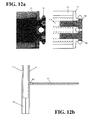
- FIG. 12 a is a cross sectional view of two frame members secured together in a perpendicular configuration with two fasteners.
- FIG. 12 b is a top view of two parallel frame members and a third frame member secured perpendicular to one of the parallel frame members.
- FIG. 12 c is a front top view of two parallel frame members secured to a clamping mechanism, wherein third and fourth frame members are secured perpendicular to one of the parallel frame members.
- FIG. 12 d is a rear top view of two parallel frame members secured to a clamping mechanism, wherein third and fourth frame members are secured perpendicular to one of the parallel frame members.
- FIG. 13 a is a side view of two table legs, wherein each table leg has a clamping mechanism secured to a first and second horizontal frame member.
- FIG. 13 b is a front view of the assembly of FIG. 13 a.
- FIG. 14 a side cut out view of a table leg secured to a frame member through a clamping mechanism.
- FIG. 14 b is a perspective view of the assembly of FIG. 14 a.
- FIG. 14 c is a side view of the assembly of FIG. 14 a.
- FIG. 14 d is a partial cutout view of the assembly of FIG. 14 a.
- FIG. 15 shows two vertical leg cross sections.
- FIG. 16 illustrates a height adjustment mechanism for a table leg.
- FIG. 17 a shows a cutout view of a height adjustment mechanism within a table leg.
- FIG. 17 b illustrates a table leg enclosing a height adjustment mechanism.
- FIG. 18 a illustrates a slanted table leg with a height adjustment mechanism fully extended.
- FIG. 18 b illustrates a slanted table leg with a height adjustment mechanism fully retracted.
- FIG. 18 c illustrates a slanted table leg without a height adjustment mechanism.
- FIG. 19 is a side view of the desk system of FIG. 1 .
- FIG. 20 is a top view of the desk system of FIG. 1 .
- FIG. 21 is a top view of the desk system of FIG. 1 without the table tops.
- FIG. 22 is an upper perspective view of a table system with an integral storage compartment and a divider.
- FIG. 23 is a lower perspective view of a table system with two storage compartments, a table top and a divider.
- FIG. 24 is a top view of a table system with three sections intersecting at a central location.
- FIG. 25 is a lower perspective view of a table system having spacers attached to cross members for supporting the table top.
- FIG. 26 is a perspective view of a table frame system having U-shaped braces and spacers integrally formed into the table legs for supporting a table top.
- FIG. 27 is a top view of a table having four angled table legs and two bent frame sections extending from each table leg.
- FIG. 28 is a perspective view of a table having four angled table legs, two bent frame sections extending from each table leg, and support structures connecting to the legs and frame sections for supporting the table top.
- FIG. 29 is a perspective view of a table frame having three angled table legs and two bent frame sections extending from each table leg.
- FIG. 30 is a perspective view of a disassembled table frame with four table legs and frame sections perpendicularly intersecting.
- FIG. 31 is a perspective view of a disassembled table frame with four table legs and bent frame sections.
- FIG. 32 is an underside perspective view of a table system with six table legs.
- FIG. 33 is a side sectional view of the table system of FIG. 32 .
- FIG. 34 is an exploded perspective view of a straight leg shown in FIG. 23 .
- FIG. 35 is a side view of the intermediate support leg of FIG. 34 .
- FIG. 36 is a cross sectional view of the intermediate support leg of FIG. 34 .
- FIG. 37 is a top view of the intermediate support leg of FIG. 34 .
- FIG. 38 is an underside perspective view of a table system with four table legs and support structures clamped to the table top.
- FIG. 39 is a perspective view of a straight leg end cap.
- FIG. 40 is a perspective view of an inclined leg.
- FIG. 41 is a side cross sectional view of an inclined leg.
- the present invention may be used with any type of top surface and is particularly suited for tables and applications requiring a lightweight, rigid, and robust frame that may be used in multiple configurations.
- the improved modular frame may be used with various objects such as chairs, stools, benches, and tables. However, for descriptive purposes, the present invention will be described in use with a table.
- FIG. 1 shows a table system 1 with a table frame 3 on which two rectangular table tops 2 a , and two round table tops 2 b are attached using fasteners on the top of the table frame 3 .
- the table frame is constructed of a frame with a first cross brace 6 and a second cross brace 7 as well as longitudinal struts to the frame-mounted inclined legs 4 and four vertical legs 5 .
- a vertical construction 9 with two vertical panels and a vertical plate is attached to the top side by retaining elements such as those shown in FIGS. 2 and 3 .
- the vertical legs 5 and the inclined legs 4 are equipped with height adjustment units 8 in their lower sections to adjust the height of the table legs.
- the table legs also include a foot plate 85 at the bottom edge of the height adjustment units to prevent damage to the floor surface below the table.
- a foot plate 85 at the bottom edge of the height adjustment units to prevent damage to the floor surface below the table.
- the vertical legs 5 are releasably secured to separate clamping mechanisms that connect to the horizontal cross braces.
- the second cross braces 7 extend along the length of the table while first cross braces 6 extend along the width of the table and are secured to the clamping mechanisms and the second cross braces.
- FIGS. 1-3 A notable feature of the table system shown in FIGS. 1-3 is that the cross bars are constructed from an assembly 10 of two frame sections 11 or structural bands that are held together by a clamping mechanism having two clamp sections 13 as shown in the cross-sectional views in FIGS. 4 , 5 , 7 a - 7 c .
- FIG. 6 shows a frame spacer 12 section that is highlighted in FIGS. 8 a and 8 b .
- the frame spacer 12 may be used to join two adjacent inclined legs.
- the frame sections 11 (structural bands) have a flat profile with a first flat side 112 that is parallel to and slightly shorter than a second flat side 114 with terminal portions 110 that are formed in the transition between the first and second flat sides ( 112 , 114 ).
- the longitudinal channels in the frame sections may be used solely to reduce the weight of the frame sections.
- the frame sections 11 are symmetrical about a plane extending perpendicular to the first and second flat sides ( 112 , 114 ).
- the terminal portions 110 of the frame sections 11 include asymmetrical V-shaped grooves 117 that are less steep and shorter towards the first flat side 112 and longer and steeper towards the second flat side 114 .
- the longitudinal groove 117 and the first flat side 112 results in a projection 118 that is shorter than a longitudinal groove 117 between the second flat side 114 .
- the steeper slope includes a transition area 115 that extends further away from the plane of symmetry than the projection 118 .
- the projection 118 includes a bevel 111 towards the first flat side 112 such that the projection has a substantially conical cross section.
- the thickness of the frame section 11 between the first and second flat sides ( 112 , 114 ) is typically between one third and one sixth of the length of the longer second flat side 114 , however other thicknesses are within the scope of the present invention.
- the frame sections With this aspect ratio of height to width, the frame sections are relatively easy to bend in the horizontal plane, however they provide a high degree of rigidity and mechanical stability in the vertical direction.
- FIG. 5 Shown in FIG. 5 is a cross-section of a clamp section 13 having a substantially T-shaped cross section.
- the end portions 130 of the clamp section have a protrusion 135 and a valley 136 that are configured to interlock with the projections 118 and grooves of the frame sections 11 .
- the narrow end sides 133 of the end portions have a shape that is substantially defined by the transition area 115 of the frame sections 11 .
- the clamp section 13 has a flat longer side 134 that is parallel to a flat upper shorter side 132 and perpendicular to the flat side surfaces 131 .
- a longitudinal channel 137 that may include threading for securing fasteners through to the clamp section 13 .
- the longitudinal channel may also be used to reduce the weight and about of material used in the construction of the clamp section 13 .
- FIGS. 7 a , 7 b , and 7 c show two parallel frame sections 11 and two clamp sections 13 cooperating to form a clamping mechanism. Both the upper and lower clamping sections have T-shaped cross sections. Between the first flat sides of the frame sections is a gap 14 . The protrusions 135 of the clamp sections interlock with the grooves 117 of the frame sections while the projections of the frame 118 interlock with the valleys of the clamp sections. Additionally, the shorter first sides of the frame sections are adapted to be pressed against the flat side surfaces of the clamp sections. Apertures through the flat longer side 134 and flat shorter side 134 may also be provided through which fasteners may secure two clamping sections together to form a clamping mechanism.
- the clamping sections 13 are sized so that when the clamping mechanism has locked in a frame section, the flat shorter sides 132 of the clamping sections are in close proximity, but not touching.
- two clamping sections 13 and two frame sections 11 combine can combine into a base unit 10 that has a substantially rectangular cross section.
- the upper clamping section has a top side 202 that is at the same elevation as the zeniths 203 of the flat sides of the frame sections. Due to the tight fit of the narrow sides 133 of the clamping sections against the transition areas 115 of the frame sections, the base unit 10 may have the appearance of a single continuous unit.
- the upper and lower clamping sections of the base unit may have a substantially equal length, however it is within the scope of the present invention to use clamping sections of unequal size. Using multiple lower clamping sections with a single upper clamping section is contemplated by the inventor.
- FIG. 6 Shown in FIG. 6 is a frame spacer 12 that has twice the thickness of a frame section and a cross section with an outer contour that is similar to the inner contours of frame sections in a base unit.
- the frame spacer is configured to be secured to two separated clamping mechanisms.
- the frame spacer has parallel flat sides 122 , grooves 123 , and projections 125 similar to the frame sections.
- the frame spacer also has a longitudinal cavity 124 that may be adapted to receive fasteners, or may be structured to reduce the weight of the frame spacer while maintaining the structural rigidity of the frame spacer.
- the base units 10 of the table system may be constructed from a various combinations of frame spacers 12 , clamping sections 13 , and frame sections 11 .
- the use of multiple clamping sections secured to multiple table legs may be used when it is desired to link two or more tables together.
- two adjacent table legs with two adjacent clamping sections may be used for a single table top that is expected to carry a substantial load.
- FIGS. 9 a and 9 b are shown two base units.
- the frame sections 11 and clamping sections 13 are uncoated, while in FIG. 9 b the frame sections and clamping sections have been powder-coated.
- the additional thickness provided by the power-coating results in the upper and lower surfaces of the base unit being substantially flat.
- the clamping sections are slightly depressed into the base unit, however the unevenness of the unit is only detectable under close inspection.
- the clamping mechanism and two parallelly extending frame sections cooperate to have a rectangular cross-section.
- each clamping section has a protrusion located within one of the grooves of the first frame section and one of the grooves of the second frame section.
- FIGS. 10 a through 10 f show various views of slanted table legs 4 that have a bent upper area 41 that extends to an integrally formed clamping section 411 .
- the bottom of the base unit is a clamping section 13 that is comprised of a separate clamping plate through which screws 60 may be used to secure the clamping plate to the integrally forced clamping section. Since the clamping plate is flush with the frame sections or depressed into the base unit, the clamping plate is not readily visible from above the frame structure. In the illustrated example the clamping plate is located below the integrally formed clamping section of the table leg, however the inventor contemplates other embodiments of the invention wherein the clamping plate is located above the integrally formed clamping section that is part of a table leg.
- FIGS. 11 a , 11 b , and 11 c illustrate an example of a base unit secured to a vertical table leg.
- the lower clamping section 13 of the base unit may be integrally formed as part of the table leg, or alternatively, the table leg may be separable from all parts of the base unit.
- the upper clamping section 13 is comprised of a clamping plate having apertures through which screws may be passed to secure the upper clamping section to the lower clamping section.
- FIG. 11 a illustrates a first frame section 200 that extends parallel to a second frame section 201 wherein the frame sections are clamped together.
- FIGS. 14 a and 14 b bolts and other fasteners may be used to secure the lower clamping section to the vertical table leg as shown in FIGS. 14 a and 14 b .
- multiple frame sections may be used as a single supported cross bar that has a length greater than the length of the individual frame sections.
- FIGS. 11 a through 11 c while the frame sections are parallel to each other in the base unit, they may bend away from each other at various angles such as 90 degrees shown in FIGS. 11 b and 11 c , or 180 degrees as shown in FIG. 11 a.
- FIGS. 12 a through 12 d show frame sections 11 perpendicularly connected to other frame sections 11 to form cross braces.
- FIG. 12 a illustrates a cross section of two intersecting frame sections that have held together with screws 60 .
- One of the frame sections includes longitudinal channels 116 that have been threaded so that the screws may be securely fastened into the channels.
- the inner frame section of the cross brace includes apertures through which the screws are threaded. By hiding the screws with an outer frame section, the frame structure presents a more refined appearance.
- a third frame section is perpendicularly secured to the first frame section by a fastener.
- FIGS. 13 a and 13 b show slanted legs 4 that are equipped with height adjustment units 8 .
- FIG. 13 a shows the connections between two slanted legs with a cross brace 6 .
- FIG. 13 b is a front view of the assembly of FIG. 13 a.
- FIGS. 14 a through 14 d show various representations of a vertical leg 5 secured to a frame section 11 through a base unit.
- the vertical leg includes a receiving channel 50 for receiving the height adjustment unit.
- the vertical leg also includes screw channels 51 for receiving screws 60 from the base unit.
- FIG. 15 shows a cross section of the vertical leg 5 , with the receiving channel 50 and the screw channels 51 .
- FIG. 16 shows an isolated view of the height adjustment mechanism.
- the height adjustment mechanism includes a sliding guide 83 adapted to slide through the receiving channel of the vertical leg.
- the adjustment mechanism includes a threaded arm 81 configured to pass through a lower section 80 .
- a stopper 82 near the top of the lower portion 80 is configured to interconnect with the vertical or slanted legs.
- the stopper 82 is firmly pressed against the receiving channel and acts to transmit the weight of the table to the floor.
- the height adjustment mechanism passes through a lower opening 86 of the table leg and a ball joint 84 is used to position the floor plate 85 at an orientation to match the floor surface.
- FIGS. 18 a , 18 b , and 18 c show a cross section of the slanted table leg 4 with a height adjustment mechanism 8 which is similar to the mechanism shown in FIGS. 16 and 17 a.
- FIG. 19 show a side view of the desk system 1 of FIG. 1 with longitudinal struts 7 and cross braces 6 in a structured framework connected to slanted legs 4 and vertical legs 5 .
- FIG. 20 shows the table system of FIG. 1 from a top view while FIG. 21 shows the table system of FIG. 1 without the tops.
- two slanted legs having integrally formed clamping sections are arranged at a 120° angle to each other.
- a frame section is bent at 120° to match the alignment of the legs and extend between the base units at the legs.
- the individual frame sections may be bent at a plurality of angles to create various frame profiles such as a branched profile or a honeycomb profile.
- FIGS. 22 and 23 show perspective views of table systems with storage compartments 400 and dividers 410 .
- the inclined table legs may include integrally formed apertures in their bent upper areas and integrally formed clamping sections for securing the storage compartments 400 to the table frame.
- a single clamping section 13 distant from a table leg, is positioned between two frame sections 11 to provide another point to secure the storage compartment to the table frame.
- the table top is supported by support structures 420 clamped onto the frame sections.
- FIG. 24 illustrates an example of a table system with multiple table tops connected at a triangular intersection. Having multiple table tops converge at a single location allows a single electrical and communication hub to serve multiple areas without extensive wiring.
- FIG. 25 illustrates an example of linear frame sections perpendicularly secured to bent frame sections. Multiple unique configurations and styles may be created by utilizing bent and linear frame sections in a single table frame.
- FIG. 26 shows a table frame having table legs with integrally formed supports 430 for supporting a table top.
- U-shaped frame structures 440 are perpendicularly secured to linear frame structures 450 extending between the table legs.
- the U-shaped frame structures provide for additional locations for a table top to be supported and may increase the maximum length of table that may be supported by only four legs.
- FIGS. 27 and 28 show tables with four bent frame structures secured to four inclined table legs.
- FIG. 27 shows a first, second, third and fourth plane ( 401 - 404 ).
- the portions of the frame sections secured in the clamping mechanism 405 are aligned with parallel planes 401 and 402 .
- portions of the frame sections are aligned with oblique planes 403 and 404 .
- Portions of frame structures located in the fifth plane 406 are secured to a second table leg and oblique to the first through fourth planes.
- the top frame section 407 has a first flat side in the first plane 401 , a second flat side in the fourth plane 404 , and a third flat side in the fifth plane 406 .
- Oblique is herein defined to mean slanting or inclined in direction or course or position, not parallel. Obtuse, acute and right angles are herein defined to be oblique angles.
- support structures 420 are secured to the table legs and the frame structures to support the weight of the table top.
- the tables of FIGS. 27 and 28 use a minimal number of frame sections to create a table with a refined appearance and a high degree of symmetry.
- FIG. 29 shows a frame comprising three identical bent frame sections secured to three table legs.
- the frame may be used for a plurality of different applications such as for a stool, a coffee table, or to support a round table top.
- identical frame sections are shown in FIG. 29 , other larger numbers of identical frame sections may be used to create circular frame structures.
- FIGS. 30 and 31 illustrate examples of disassembled frame structures with four inclined lined and linear frame sections or bent frame sections.
- the integrally formed clamping mechanisms in the table legs reduce the number of individual pieces required to complete a table frame and also reduce the amount of time needed to assemble the table frame. If the end user decides to disassemble the table frame, the integrally formed clamping mechanisms in the table legs reduce the likelihood that a piece of the table frame will be lost or misplaced while in table frame is in storage.
- FIGS. 32 and 33 illustrate inclined legs connecting to straight frame sections.
- FIGS. 34 through 37 illustrate straight table legs that may be incorporated into the table system.
- FIG. 38 shows a table system with inclined legs connecting to bent frame members.
- FIG. 39 shows a end cap for a straight leg. Inclined legs are shown in FIGS. 40 and 41 .
- the inventor contemplates several alterations and improvements to the disclosed invention.
- the frame may further include protective and/or decorative coatings such as paint.
- Other alterations, variations, and combinations are possible that fall within the scope of the present invention.
- various embodiments of the present invention have been described, those skilled in the art will recognize more modifications that may be made that would nonetheless fall within the scope of the present invention. Therefore, the present invention should not be limited to the apparatus described. Instead, the scope of the present invention should be consistent with the invention claimed below.
Landscapes
- Engineering & Computer Science (AREA)
- General Engineering & Computer Science (AREA)
- Mechanical Engineering (AREA)
- Tables And Desks Characterized By Structural Shape (AREA)
- Furniture Connections (AREA)
Priority Applications (1)
| Application Number | Priority Date | Filing Date | Title |
|---|---|---|---|
| US14/603,983 US9635930B2 (en) | 2010-09-29 | 2015-01-23 | Table system |
Applications Claiming Priority (3)
| Application Number | Priority Date | Filing Date | Title |
|---|---|---|---|
| DE20100929104856000 | 2010-09-29 | ||
| DE102010037837.2A DE102010037837B4 (de) | 2010-09-29 | 2010-09-29 | Tischsystem |
| DE102010037837 | 2010-09-29 |
Related Child Applications (1)
| Application Number | Title | Priority Date | Filing Date |
|---|---|---|---|
| US14/603,983 Continuation-In-Part US9635930B2 (en) | 2010-09-29 | 2015-01-23 | Table system |
Publications (2)
| Publication Number | Publication Date |
|---|---|
| US20120073480A1 US20120073480A1 (en) | 2012-03-29 |
| US8939092B2 true US8939092B2 (en) | 2015-01-27 |
Family
ID=45372901
Family Applications (1)
| Application Number | Title | Priority Date | Filing Date |
|---|---|---|---|
| US13/248,384 Active 2032-07-01 US8939092B2 (en) | 2010-09-29 | 2011-09-29 | Table system |
Country Status (3)
| Country | Link |
|---|---|
| US (1) | US8939092B2 (de) |
| CH (1) | CH703882B1 (de) |
| DE (1) | DE102010037837B4 (de) |
Cited By (1)
| Publication number | Priority date | Publication date | Assignee | Title |
|---|---|---|---|---|
| US20150150370A1 (en) * | 2010-09-29 | 2015-06-04 | Dsa International, Llc | Table System |
Families Citing this family (9)
| Publication number | Priority date | Publication date | Assignee | Title |
|---|---|---|---|---|
| DE102012109976B4 (de) | 2012-10-19 | 2015-12-03 | Korb & Korb | Baugruppe mit einer Koppeleinheit und zwei Tragstreben |
| FR3007263B1 (fr) * | 2013-06-21 | 2015-07-10 | Christophe Lafontaine | Module pied de table stabilise a bras articule pour assise autoportee |
| NL2011589C2 (en) * | 2013-10-11 | 2015-04-14 | Konink Ahrend N V | System of connected or connectable office desks, and an office desk for such a system. |
| MX377455B (es) * | 2014-06-21 | 2025-03-10 | Unitec Spa | Maquina para llenar contenedores con fruta o productos vegetales. |
| CN107477056B (zh) * | 2016-06-08 | 2019-05-07 | 辜耀南 | 家具脚连接构件 |
| FR3109713B1 (fr) * | 2020-04-29 | 2025-09-26 | Cornilleau Sas | Table de jeu comprenant au moins un pied de stabilisation |
| RU209859U1 (ru) * | 2021-11-30 | 2022-03-23 | Александр Владимирович Малиновский | Металлический каркас стола |
| US12622510B2 (en) | 2022-08-12 | 2026-05-12 | Qidong Vision Mounts Manufacturing Co., Ltd. | Electric height-adjustable desk |
| US12616297B2 (en) * | 2023-11-08 | 2026-05-05 | Agio International Company, Limited | Hard and frangible material tabletop system |
Citations (22)
| Publication number | Priority date | Publication date | Assignee | Title |
|---|---|---|---|---|
| DE1464058U (de) | ||||
| US2380379A (en) * | 1942-11-04 | 1945-07-31 | Charles W Attwood | Table |
| DE1936645U (de) | 1966-02-22 | 1966-04-14 | Fritz Ulrich Fa | Befestigungsvorrichtung fuer tischbeine, insbesondere metallrohrbeine. |
| US4163537A (en) * | 1976-07-12 | 1979-08-07 | Societe Anonyme Des Ateliers Marcadet Mobilier | Bearer structure for assembling modular elements |
| DE3438853A1 (de) | 1984-10-24 | 1986-04-24 | Gesika Büromöbelwerk GmbH & Co KG, 4787 Geseke | Bueromoebel mit metallgestell |
| DE8513857U1 (de) | 1985-05-10 | 1987-01-22 | Rittel, Johannes, 7950 Biberach | Bildschirmtisch |
| US4848245A (en) * | 1987-09-10 | 1989-07-18 | B&B Italia S.P.A. | Table with separable legs |
| DE4026750A1 (de) | 1990-08-24 | 1992-02-27 | Koenig & Neurath Kg | Traeger, insbesondere fuer bueroarbeitstische |
| EP0669092A1 (de) | 1994-02-25 | 1995-08-30 | Dyes Gmbh Büromöbelwerk | Tisch |
| US5715760A (en) * | 1994-03-04 | 1998-02-10 | Castelli S.P.A. | Modular furniture system, particularly for offices, comprising self-supporting, multifunctional columns |
| DE19725060A1 (de) | 1997-06-13 | 1998-12-24 | Dlw Bueroeinrichtungen Gmbh | Tragprofil für ein Büromöbel |
| DE19725045A1 (de) | 1997-06-13 | 1998-12-24 | Dlw Bueroeinrichtungen Gmbh | Tisch mit einem Rahmen aus Tragstreben und Querbrücke |
| US5899423A (en) * | 1996-09-11 | 1999-05-04 | Coopsette S.C.R.L. | Supporting structure for furniture and the like comprising an upright with lobes |
| US6024024A (en) * | 1998-04-02 | 2000-02-15 | Favaretto; Paolo | Table structure |
| DE20102791U1 (de) | 2001-02-14 | 2001-05-03 | Portuleiter - Produtos Metalicos, Limitada, Foros de Salvaterra | Zusammenklappbarer Werktisch |
| EP1330969A1 (de) | 2002-01-24 | 2003-07-30 | Work Corporation Inc. S.r.l. | Anschlusssystem für modulare Möbelstrukturen, insbesondere Tische und/oder Schreibtische, bildende elemente |
| US20030167982A1 (en) * | 2002-03-05 | 2003-09-11 | Ching-Yuan Yang | Table having pivotable leg sets |
| US6725784B2 (en) * | 2001-10-17 | 2004-04-27 | Incrion Limited-Asset “A” Design Division | Multiple work station table |
| US6729244B2 (en) * | 2001-02-22 | 2004-05-04 | Leonardo S.R.L. | Tubular-frame structure for supporting surfaces |
| US20060278139A1 (en) * | 2003-06-13 | 2006-12-14 | Daniel Korb | Table |
| US7703398B2 (en) * | 2002-09-03 | 2010-04-27 | Vitra Patente Ag | Table, especially conference and office table |
| US7765937B2 (en) * | 2006-05-09 | 2010-08-03 | Sedus Stoll Ag | Table system |
-
2010
- 2010-09-29 DE DE102010037837.2A patent/DE102010037837B4/de not_active Expired - Fee Related
-
2011
- 2011-09-28 CH CH01597/11A patent/CH703882B1/de not_active IP Right Cessation
- 2011-09-29 US US13/248,384 patent/US8939092B2/en active Active
Patent Citations (22)
| Publication number | Priority date | Publication date | Assignee | Title |
|---|---|---|---|---|
| DE1464058U (de) | ||||
| US2380379A (en) * | 1942-11-04 | 1945-07-31 | Charles W Attwood | Table |
| DE1936645U (de) | 1966-02-22 | 1966-04-14 | Fritz Ulrich Fa | Befestigungsvorrichtung fuer tischbeine, insbesondere metallrohrbeine. |
| US4163537A (en) * | 1976-07-12 | 1979-08-07 | Societe Anonyme Des Ateliers Marcadet Mobilier | Bearer structure for assembling modular elements |
| DE3438853A1 (de) | 1984-10-24 | 1986-04-24 | Gesika Büromöbelwerk GmbH & Co KG, 4787 Geseke | Bueromoebel mit metallgestell |
| DE8513857U1 (de) | 1985-05-10 | 1987-01-22 | Rittel, Johannes, 7950 Biberach | Bildschirmtisch |
| US4848245A (en) * | 1987-09-10 | 1989-07-18 | B&B Italia S.P.A. | Table with separable legs |
| DE4026750A1 (de) | 1990-08-24 | 1992-02-27 | Koenig & Neurath Kg | Traeger, insbesondere fuer bueroarbeitstische |
| EP0669092A1 (de) | 1994-02-25 | 1995-08-30 | Dyes Gmbh Büromöbelwerk | Tisch |
| US5715760A (en) * | 1994-03-04 | 1998-02-10 | Castelli S.P.A. | Modular furniture system, particularly for offices, comprising self-supporting, multifunctional columns |
| US5899423A (en) * | 1996-09-11 | 1999-05-04 | Coopsette S.C.R.L. | Supporting structure for furniture and the like comprising an upright with lobes |
| DE19725060A1 (de) | 1997-06-13 | 1998-12-24 | Dlw Bueroeinrichtungen Gmbh | Tragprofil für ein Büromöbel |
| DE19725045A1 (de) | 1997-06-13 | 1998-12-24 | Dlw Bueroeinrichtungen Gmbh | Tisch mit einem Rahmen aus Tragstreben und Querbrücke |
| US6024024A (en) * | 1998-04-02 | 2000-02-15 | Favaretto; Paolo | Table structure |
| DE20102791U1 (de) | 2001-02-14 | 2001-05-03 | Portuleiter - Produtos Metalicos, Limitada, Foros de Salvaterra | Zusammenklappbarer Werktisch |
| US6729244B2 (en) * | 2001-02-22 | 2004-05-04 | Leonardo S.R.L. | Tubular-frame structure for supporting surfaces |
| US6725784B2 (en) * | 2001-10-17 | 2004-04-27 | Incrion Limited-Asset “A” Design Division | Multiple work station table |
| EP1330969A1 (de) | 2002-01-24 | 2003-07-30 | Work Corporation Inc. S.r.l. | Anschlusssystem für modulare Möbelstrukturen, insbesondere Tische und/oder Schreibtische, bildende elemente |
| US20030167982A1 (en) * | 2002-03-05 | 2003-09-11 | Ching-Yuan Yang | Table having pivotable leg sets |
| US7703398B2 (en) * | 2002-09-03 | 2010-04-27 | Vitra Patente Ag | Table, especially conference and office table |
| US20060278139A1 (en) * | 2003-06-13 | 2006-12-14 | Daniel Korb | Table |
| US7765937B2 (en) * | 2006-05-09 | 2010-08-03 | Sedus Stoll Ag | Table system |
Cited By (2)
| Publication number | Priority date | Publication date | Assignee | Title |
|---|---|---|---|---|
| US20150150370A1 (en) * | 2010-09-29 | 2015-06-04 | Dsa International, Llc | Table System |
| US9635930B2 (en) * | 2010-09-29 | 2017-05-02 | Dsa International, Llc | Table system |
Also Published As
| Publication number | Publication date |
|---|---|
| CH703882A2 (de) | 2012-03-30 |
| DE102010037837B4 (de) | 2020-12-24 |
| US20120073480A1 (en) | 2012-03-29 |
| DE102010037837A1 (de) | 2012-03-29 |
| CH703882B1 (de) | 2015-09-15 |
Similar Documents
| Publication | Publication Date | Title |
|---|---|---|
| US20120073480A1 (en) | Table System | |
| US9635930B2 (en) | Table system | |
| CA2856900C (en) | Storage rack with improved tie support | |
| US10415613B2 (en) | Set of panel-shaped elements for a composed element | |
| US9375102B2 (en) | Portion of shelf and support for shelving unit | |
| US9750344B2 (en) | Table benching apparatus and methods of using the same | |
| US8720839B2 (en) | Connector for panel members | |
| US9976301B2 (en) | Construction kit consisting of wall elements and connectors to be inserted therebetween in order to erect room dividers | |
| CA2799938C (en) | Frame type table assemblies | |
| US4726701A (en) | Modular shelf assembly | |
| US20020178979A1 (en) | Slot-to-slot interlocking shelving | |
| IL30946A (en) | Foot structure for furniture | |
| US20140165289A1 (en) | Modular interlocking furniture system | |
| US20070261614A1 (en) | Table system | |
| US5984417A (en) | Beam member for furniture | |
| KR200492567Y1 (ko) | 테이블 프레임 결합 구조체 | |
| US10595632B2 (en) | Furniture frame structural system with interlocking members | |
| JP7306744B2 (ja) | モジュール式接続装置 | |
| US10244866B2 (en) | Modular storage rack | |
| USD623445S1 (en) | Leg for workstation | |
| US20080023997A1 (en) | Chair with adjustable seat height | |
| US9717341B1 (en) | Chair frame | |
| CN103300599A (zh) | 桌子系统 | |
| US20030136316A1 (en) | Connecting system for elements forming modular furniture structures, in particular tables and/or desks | |
| JP6654816B2 (ja) | 什器 |
Legal Events
| Date | Code | Title | Description |
|---|---|---|---|
| AS | Assignment |
Owner name: DSA INTERNATIONAL, INC., MICHIGAN Free format text: ASSIGNMENT OF ASSIGNORS INTEREST;ASSIGNOR:KORB, DANIEL;REEL/FRAME:030038/0600 Effective date: 20130319 |
|
| STCF | Information on status: patent grant |
Free format text: PATENTED CASE |
|
| MAFP | Maintenance fee payment |
Free format text: PAYMENT OF MAINTENANCE FEE, 4TH YR, SMALL ENTITY (ORIGINAL EVENT CODE: M2551) Year of fee payment: 4 |
|
| MAFP | Maintenance fee payment |
Free format text: PAYMENT OF MAINTENANCE FEE, 8TH YR, SMALL ENTITY (ORIGINAL EVENT CODE: M2552); ENTITY STATUS OF PATENT OWNER: SMALL ENTITY Year of fee payment: 8 |