US8990785B2 - System and method for efficiently deploying massively diverse program instances to resist differential attacks - Google Patents
System and method for efficiently deploying massively diverse program instances to resist differential attacks Download PDFInfo
- Publication number
- US8990785B2 US8990785B2 US13/812,404 US201013812404A US8990785B2 US 8990785 B2 US8990785 B2 US 8990785B2 US 201013812404 A US201013812404 A US 201013812404A US 8990785 B2 US8990785 B2 US 8990785B2
- Authority
- US
- United States
- Prior art keywords
- code
- instances
- code portion
- diverse
- computing devices
- Prior art date
- Legal status (The legal status is an assumption and is not a legal conclusion. Google has not performed a legal analysis and makes no representation as to the accuracy of the status listed.)
- Active, expires
Links
Images




Classifications
-
- G—PHYSICS
- G06—COMPUTING OR CALCULATING; COUNTING
- G06F—ELECTRIC DIGITAL DATA PROCESSING
- G06F8/00—Arrangements for software engineering
- G06F8/30—Creation or generation of source code
-
- G—PHYSICS
- G06—COMPUTING OR CALCULATING; COUNTING
- G06F—ELECTRIC DIGITAL DATA PROCESSING
- G06F21/00—Security arrangements for protecting computers, components thereof, programs or data against unauthorised activity
- G06F21/10—Protecting distributed programs or content, e.g. vending or licensing of copyrighted material ; Digital rights management [DRM]
- G06F21/12—Protecting executable software
- G06F21/14—Protecting executable software against software analysis or reverse engineering, e.g. by obfuscation
-
- G—PHYSICS
- G06—COMPUTING OR CALCULATING; COUNTING
- G06F—ELECTRIC DIGITAL DATA PROCESSING
- G06F8/00—Arrangements for software engineering
- G06F8/60—Software deployment
- G06F8/61—Installation
Definitions
- the present invention relates generally to software that is resistant to unauthorized analysis. More particularly, the present invention relates to systems and methods for the production of software code that increase build-time diversity by constructing differing programs to resist an attacker's efforts through differential attacks, collusion, and automated exploits.
- an algorithm in this scenario is a sequence of computational steps that carries out a task or a set of tasks.
- An algorithm can have various sizes. It can be very large, or it can be as small as a set of a few instructions.
- An algorithm can contain smaller algorithms, which in turn can contain even smaller algorithms. This hierarchy may have any number of levels.
- Such additional attacks are not limited to differential attacks of software revisions for the identification of assets, but may also include collusion between parties which itself may lead to key sharing schemes, or may also include code-lifting attacks that might identify important modules such as code used to generate device keys or roots-of-trust. Code-lifting can lead to rogue systems where some of the real application is reused together with an attacker's code. In such instances, damage can spread very quickly, as exploits are often posted at various places on the Internet.
- layered defenses are often presented as a high entry barrier to a system.
- applying layered protection against such new class of attacks is often a trade-off between the performance and size of an application.
- Existing efforts to reduce the window of opportunity to exploit vulnerabilities exposed by this trade-off include relying upon the capability for build-time diversity.
- One way to reduce the risk of differential attacks across several clients is to make individual differing instances of the software.
- software can be upgraded (e.g., to support new features, enhance performance, or to patch vulnerabilities) using build-time diversity capability to renew the software as well as to distribute the new protection of the vulnerable module.
- This allows the full software revision to be diverse with respect to the former revision, preventing obvious differential attacks.
- diversity can also play a part in enabling revocation schemes by creating a data diversity capability. This is a useful feature for disallowing clients to connect to a server if, for example, they do not comply with company policies (e.g. don't pay the bills).
- company policies e.g. don't pay the bills
- the present invention provides a system and method embodied in software to produce massively diverse program instances to resist attacks.
- software is characteristically modular.
- code portions of a program e.g., function definitions, basic-blocks, variable definitions, bodies of functions, sets of instructions
- each instance of a code portion variation is enclosed in a conditional compilation command. From this arrangement, combinations of code portions can be quickly constructed by changing conditional compilation definitions and re-invoking the target compiler.
- a minimal set of full programs can be constructed guaranteeing that all code portions are used. This provides reasonable test coverage of all code portions. Moreover, this is accomplished without requiring the testing of all combinations of code portions which is unfeasible in terms of required testing time. In effect, the present invention increases the confidence that all code in the software has been covered, while minimizing the time to test all instances.
- the present invention provides a method of providing build-time diversity in computer software source code, the method including: partitioning the code into code portions; identifying code portion interfaces of the code portions; generating diverse instances of the code portions and the code portion interfaces; creating test instances, the test instances being representative all the diverse instances of the code portions and the code portion interfaces; and forming deployment instances using varied combinations of the diverse instances of the code portions and the code portion interfaces, where operability of all the deployment instances is assured by confirming operability of the test instances.
- the present invention provides a system for providing build-time diversity in a computer software source code, the system including: a set of machine executable code segments operable to produce software code that assures build-time diversity in the computer software source code, the machine executable code executable to perform the steps of: partitioning the code into code portions; identifying code portion interfaces of the code portions; generating diverse instances of the code portions and the code portion interfaces; creating test instances, the test instances being representative all the diverse instances of the code portions and the code portion interfaces; and forming deployment instances using varied combinations of the diverse instances of the code portions and the code portion interfaces, where operability of all the deployment instances is assured by confirming operability of the test instances.
- the present invention provides an apparatus for providing build-time diversity in computer software source code, the apparatus including: means for partitioning the code into code portions; means for identifying code portion interfaces of the code portions; means for generating diverse instances of the code portions and the code portion interfaces; means for creating test instances, the test instances being representative all the diverse instances of the code portions and the code portion interfaces; and means for forming deployment instances using varied combinations of the diverse instances of the code portions and the code portion interfaces, where operability of all the deployment instances is assured by confirming operability of the test instances.
- the present invention provides a computer readable memory medium storing computer software code for providing build-time diversity in computer software source code, the computer software code executable to perform the steps of: partitioning the source code into code portions; identifying code portion interfaces of the code portions; generating diverse instances of the code portions and the code portion interfaces; creating test instances, the test instances being representative all the diverse instances of the code portions and the code portion interfaces; and forming deployment instances using varied combinations of the diverse instances of the code portions and the code portion interfaces, where operability of all the deployment instances is assured by confirming operability of the test instances.
- the build-time diversity provided for the computer software source code is substantially improved and increased build-time diversity than prior art mechanisms.
- FIG. 1 illustrates a known computer system in which the present invention may be embodied.
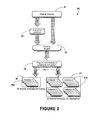
- FIG. 2 illustrates an overall process in accordance with the present invention.
- FIG. 3 is a flowchart showing steps for build-time diversity in accordance with the present invention illustrated in FIG. 2 .
- FIG. 4 illustrates physical partitioning into code portions based on the compilation unit in accordance with one embodiment of the present invention illustrated in FIG. 2 .
- FIG. 5 illustrates physical partitioning into code portions based on function definitions in accordance with another embodiment of the present invention.
- FIG. 6 illustrates program-flow partitioning based on function call sub-graphs in accordance with another embodiment of the present invention.
- FIG. 7 illustrates program-flow partitioning of a program based on basic blocks in accordance with another embodiment the present invention.
- FIG. 8 illustrates an example of partitioning code into one code portion by data-flow in accordance with another embodiment the present invention.
- FIG. 9 illustrates one exemplary method for generating diverse code portion combinations with a fixed interface in accordance with the present invention.
- FIG. 10 illustrates one exemplary method for generating diverse code portion interfaces together with diverse code portions in accordance with the present invention.
- FIG. 11 illustrates delineation of code portion instances through conditional compilation directives in accordance with the present invention.
- FIG. 12 illustrates aggregating program instances and deploying instantiated programs to target groups in accordance with the present invention.
- an algorithm is generally a sequence of computational steps that carries out a task or a set of tasks.
- the definition of algorithm should be understood to also encompass the implementations of algorithms. Therefore, an algorithm can be a set of computer instructions or a piece of high level software programming that carries out a task or a set of tasks on a computing device.
- the present invention provides a method and system for processing existing algorithms at the source code level in order to produce an implementation of algorithms that is resistant to differential attacks, collusion, and automated exploits.
- FIG. 1 A simplified example of a computer system upon which the invention may be performed is presented as a block diagram in FIG. 1 .
- This computer system 1100 includes a display 1120 , keyboard 1140 , computer 1160 and external devices 1180 .
- the computer 1160 may contain one or more processors or microprocessors, such as a central processing unit (CPU) 1200 .
- the CPU 1200 performs arithmetic calculations and control functions to execute software stored in an internal memory 1220 , preferably random access memory (RAM) and/or read only memory (ROM), and possibly additional memory 1240 .
- the additional memory 1240 may include, for example, mass memory storage, hard disk drives, floppy disk drives, magnetic tape drives, compact disk drives, program cartridges and cartridge interfaces such as those found in video game devices, removable memory chips such as EPROM or PROM, or similar storage media as known in the art.
- This additional memory 1240 may be physically internal to the computer 1160 , or external as in FIG. 1 .
- the computer system 1100 may also include other similar means for allowing computer programs or other instructions to be loaded.
- Such means can include, for example, a communications interface 1260 which allows software and data to be transferred between the computer system 1100 and external systems.
- communications interface 1260 can include a modem, a network interface such as an
- Ethernet card a serial or parallel communications port.
- Software and data transferred via communications interface 1260 are in the form of signals which can be electronic, electromagnetic, and optical or other signals capable of being received by communications interface 1260 .
- Multiple interfaces can be provided on a single computer system 1100 .
- I/O interface 1280 administers control of the display 1120 , keyboard 1140 , external devices 1180 and other such components of the computer system 1100 .
- Such systems would include all manner of appliances having computer or processor control including telephones, cellular telephones, televisions, television set top units, point of sale computers, automatic banking machines, lap top computers, servers, personal digital assistants and automobiles.
- code portion code portion instance, and code portion interface will be used.
- Code portions are the parts of a program that implement a cohesive piece of functionality. It should be readily apparent that such program parts include generally anything that can be written in a programming language. For example, this may include compilation units, function definitions, declaration statements, definition statements, operations, initializations, basic function block or body, class definitions, object declarations, template definitions, template specializations, partial specializations, array definitions and declarations, structure and aggregate definitions and declarations, system calls, library calls, assembly code, preprocessor directives, or the like.
- Code portion instances are one or more constructions of a code portion which executes a defined behavior. Two code portion instances may execute the same behavior according to their external interface. However, the internal make-up of code portion instances may have large variations.
- Code portion interfaces are the inter-dependencies of a code portion which allows one code portion to be compatible with one or more other code portions.
- the invention is implemented in terms of an intermediate compiler program running on a computer system 1100 .
- Standard compiler techniques are well known in the art, and will not be reviewed in detail herein.
- Two standard references which may provide necessary background are “Compilers Principles, Techniques, and Tools” 1988 by Alfred Aho, Ravi Sethi and Jeffrey Ullman (ISBN 0-201-1008-6), and “Advanced Compiler Design & Implementation” 1997 by Steven Muchnick (ISBN 1-55860-320-4).
- a software compiler is divided into three components, described as the front end, the middle, and the back end.
- the front end is responsible for language dependent analysis, while the back end handles the machine-dependent parts of code generation.
- a middle component may be included to perform optimizations that are independent of language and machine.
- each compiler family will have only one middle, with a front end for each high-level language and a back end for each machine-level language. All of the components in a compiler family can generally communicate in a common intermediate language so they are easily interchangeable.
- This intermediate language is generally in a form which exposes both control- and data-flow so that they are easily manipulated. Such an intermediate form may be referred to as flow-exposed form.
- it is the intermediate code that will be manipulated to make the desired areas of the input software tamper-resistant.
- the invention can most easily be applied to software code used by software compilers as a code representation for performing analyses and optimizations involving scalar variables.
- the method of the invention could be applied to software in its high level or low level forms, if such forms were augmented with the requisite control-flow and data-flow information. This flexibility will become clear from the description of the encoding techniques described hereinafter.
- the present invention is concerned with the creation of diversely built program instances.
- Diversity is a protection mechanism that enables creation of differently constructed programs, and the present invention uses diversity to prevent an attacker from writing an exploit that will work on the population of all program instances. This produces a high resistance to differential attacks, collusion, and automated exploits.
- FIG. 2 a simplified block diagram shows the overall system 20 to provide improved build-time diversity in accordance with the present invention.
- the present invention quickly and easily produces a very large number of full program instances.
- the present invention also provides a mechanism that allows the creation of a very large number of full program instances for distribution, while, in contrast, a minimal number of full program “covering” instances is needed for purposes of testing. The manner in which this minimal number of instances for testing is constructed provides high coverage of the code portions created, and therefore, high confidence of the diversification results.
- the original program application 21 in source form is the input to a diversity engine 23 .
- Code portions of the program are identified at 22 .
- diverse constructions of the program are created and encapsulated in conditional compilation directives at 24 .
- the native compiler 25 is then invoked many times with appropriate sets of directives (as described further herein below) to produce the final diverse instances 26 , 27 .
- a large number of diverse instances 27 a are available for deployment, while a smaller number of diverse instances 26 a are need for testing. Each of these steps is described in more detail below.
- the first step 31 of the process 30 is to break up the program into code portions. This step 31 may follow several different methods, which are later described herein below in detail.
- the interfaces to each code portion are identified at step 32 .
- This interface identification step 32 is significant due to the fact that interfaces may be kept constant, while the code portions may be diversified.
- a diversity creation step 33 occurs. Here, diverse instances for code portions are generated. Additionally, the diverse instances of the code portion interfaces are also generated at this time. The diverse instances of the code portions and interfaces are then aggregated at step 34 . It should be understood that the aggregation of compatible code portion instances allows full programs to be created.
- a test instance creation step occurs at 35 . This creates all test instances that serve to cover all the code portions under test. Each of these test instances are then tested at step 36 to ensure viability. Once the test instances are satisfactorily tested, step 37 then provides for the creation of all deployment instances. Because the test instances are only representative and serve to cover all the code portions, it should be therefore readily apparent that the number of deployment instances is typically much larger than the number of test instances. Lastly, the final step 38 is of course to deploy all instances of diverse code generated at step 37 . It should be understood that the large number of instances provides a greatly improved defense to the threats of differential attacks, collusion, as well as automated exploits.
- FIGS. 4 through 8 are an example of a specific method of partitioning of a program into code portions that are used in accordance with the present invention.
- three approaches to partitioning which result in different types of code portions are described herein below involving: 1) physical partitioning of a program, 2) program flow partitioning of a program, and 3) data flow partitioning of a program.
- FIG. 4 illustrates physical partitioning into code portions based on the compilation unit in accordance with one embodiment of the present invention illustrated in FIG. 2 .
- the original program 41 can be seen to include two compilation units 42 , 43 . It should be understood that, for clarity of illustration, only two compilation units are shown, though it should be readily apparent that many several compilation units may comprise any given program.
- Each compilation unit 42 , 43 can be used to generate diverse instances of the given compilation unit where compilation units 42 a , 42 b , and 42 c are diverse instances of compilation unit 42 and compilation units 43 a , 43 b , and 43 c are diverse instances of compilation unit 43 .
- diverse instances 41 a , 41 b , through 41 n can be formed from the original program 41 .
- FIG. 5 illustrates such physical partitioning into code portions based on function definitions in accordance with the present invention whereby function definitions 53 , 54 , 55 may form the granularity of code portions.
- the code portion interface 52 becomes the external dependencies of the function, which include the function signature itself, but also any global variables 51 and sub-functions (e.g., parameters, return value, . . . etc.) on which the function depends.
- Access between the global variables 51 and the function definitions 53 , 54 , 55 occurs in a first pathway shown by way of dotted lines.
- Access among and between the function definitions 53 , 54 , 55 occurs in a second pathway shown by way of solid lines.
- the code portion interface 52 resides in both the first and second pathways and allows, for example, code portion 53 to be compatible with code portions 54 and 55 .
- code portion 53 For clarity, only one code portion interface 52 is shown for function 53 . However, it should be understood that an interface corresponding to functions 54 and 55 would similarly be provided.
- partitioning that results in different types of code portions can alternatively involve either program flow or data flow partitioning of a program.
- Two types of program flow partitioning are shown and described further below with regard to FIGS. 6 and 7
- data flow partitioning of a program is shown and described in regard to FIG. 8 .
- FIG. 6 illustrates program-flow partitioning based on function call sub-graphs in accordance with the present invention.
- High-level programming languages typically have the concept of a program flow.
- the program flow is procedural and includes function calls and transfers to function definitions.
- the program flow includes the execution of individual instructions in a block and conditional or unconditional branches from block to block.
- FIG. 6 illustrates a program flow having several different functions being called.
- function 1 at 61 includes two calls 61 a and 61 b that, respectively, call function 2 at 62 and function 5 at 65 .
- function 2 at 62 includes two calls 62 a and 62 b that, respectively, call function 4 at 64 and function 3 at 63 .
- function 3 at 63 includes a call 63 a that calls function 5 at 65 .
- a call-graph represents the flow of functions that are called through a program such as the flow from 61 a to 62 b to 63 a to 65 .
- a sub-graph of the call-graph can be considered a code portion.
- such a sub-graph 67 is delineated by a dotted line box including the flow 63 a to 65 . It should therefore be readily apparent that a plurality of sub-graphs can become a set of code portion instances.
- FIG. 7 illustrates program-flow partitioning of a program based on basic blocks in accordance with the present invention.
- basic blocks 71 through 77 and their related conditions may form the granularity for code portions.
- conditions are the links between basic blocks.
- a basic block is a list of instructions that will be executed one after the other.
- Each time some “condition” e.g., an “if” occurs, there can be a jump to another basic block.
- which basic block to which the jump is made of course depends on the condition.
- a “branch” whereby each “branch” implies a choice of which basic block to go to depending on the given “condition.”
- any given basic block may be constructed as a variety of instances.
- the program construction can easily be designed to use a variation of block instances as it is put together.
- the code portion example as shown uses two basic blocks 71 and 72 (BB 1 and BB 2 ) which together form a defined code portion.
- the flow of control out of BB 2 is an example of a conditional branch or jump as mentioned above.
- a condition is evaluated in BB 2 which determines which direction to take (i.e., to BB 3 or BB 5 ).
- the program flow into the code portion i.e., the incoming jumps made into BB 1
- the program flow out of the code portion i.e., the outgoing jumps made out of BB 2
- FIG. 8 Yet another manner of partitioning a program into code portions is shown and described in regard to FIG. 8 .
- the concept of data variables and their usage is universal in programming languages. This includes local variables, global variables, static variables, class/structure fields, and constants which can simply be considered as read-only variables.
- Data may take on scalar forms or aggregate forms such as arrays or structures. Data typically flows from memory through loads to registers, then undergoes operations by way of instructions, and flows through stores back to memory. Accordingly, data flow in a program has somewhat different properties than the program flow. Data flow may also be considered as the basis to construct code portions.
- Known data encodings such as shown in U.S. Pat.
- the code portion interface is more complex than either physical or program flow partitioning. Isolating the stored data form requires knowledge of the program flow as well as all accesses to data locations. This information may be derived through the known compiler analysis phases, such as alias analysis, control-flow, and data-flow analysis.
- the code portion consists of all the code needed to form data accesses. That is to say, the code portion consists of all the code needed to access the data location, including all code that accesses the data location through aliasing.
- the code portion interface is then formed by all the connections to the rest of the program. This includes the program flow and accesses to all external data.
- blocks 83 , 84 , 85 , and 86 represent all the code necessary to access data location A at block 88 .
- the code portion interfaces 80 contain all the program and data-flow to all these pieces of code in white. This includes the program and data-flow coming in and going out of blocks 83 , 84 , and 85 in program segment 1 at 81 , the code needed in block 84 to access external data (i.e., other data B at 87 ), and the program and data-flow coming in and going out of block 86 in program segment 2 at 82 .
- data flow with regard to data location A at 88 is indicated by way of dotted lines, while data flow with regard to the other data B at 87 is indicated by way of solid lines.
- all dotted line data flow related to accessing data location A at 88 is contained within the code portion interfaces 80 thereby effectively partitioning the software code by way of data-flow partitioning.
- FIG. 9 there is shown one exemplary method for generating diverse code portion combinations with a fixed interface in accordance with the present invention.
- Creation of such variations in code portions can be accomplished according to known methods, or combinations of such methods, including those described in U.S. Pat. Nos. 6,594,761, 6,779,114, or 6,842,862 each issued to Chow et al. and incorporated herein by reference in their entireties.
- the variations in code portions are characterized both by their code portion interfaces and their inner construction.
- the code portion interfaces may have a different make-up.
- the general concept is the same such that the code portion interface may remain fixed while the internals of the code portion are made diverse. Additionally, the code portion interface may also be made diverse. With a plurality of code portions, code portion interfaces, and code portion types, the ability to create diverse program instances can grow very quickly.
- a fixed code portion interface A-B, 94 is shown in sub-procedures 90 , 91 which, respectively, include generating code instance portions and generating combinations of such code instance portions.
- code portions 92 and 93 shown as code portion A and code portion B, respectively may be written multiple times as code portions A 1 , A 2 , . . . An and B 1 , B 2 , . . . Bm where n and m are integers representative of the possible code portion variations for portions A and B, 92 , 93 .
- These multiple code portions 92 a , 92 b , . . . 92 n and 93 a , 93 b , . . . 93 m each include the identical code portion interface A-B, 94 .
- each code portion 92 and 93 is written multiple times 92 a through 92 n and 93 a through 93 m , respectively, and in at least two forms. It should be understood that the variations embodied in code portions 92 a , 92 b , . . . 92 n and 93 a , 93 b , . . . 93 m may be generated once and stored, for example, in a library for later use in sub-procedure 91 .
- combinations are generated using the previously generated code portion instances 92 a , 92 b , . . . 92 n and 93 a , 93 b , . . . 93 m .
- combinations shown include code portion instance combination A 1 /B 1 ( 92 a , 93 a ) code portion instance combination A 1 /B 2 ( 92 a , 93 b ), and code portion instance combination A 2 /B 2 ( 92 b , 93 b ), where each combination includes the fixed code portion A-B interface 94 .
- the total combinations may be made up to combination Ai/Bj ( 92 i , 93 j ) where i and j represents the number of combinational variations for a particular set of code portions.
- conditional compilation variables are defined such that the final compilation is resolved. It should therefore be readily apparent that this process can advantageously create a large number of potential diverse instances.
- FIG. 10 illustrates one exemplary method for generating diverse code portion interfaces together with diverse code portions in accordance with the present invention.
- FIG. 10 there are again shown two sub-procedures 100 , 101 which, respectively, illustrate both the generation of the code portion variations and code portion interface instances and the generation of the related combinations of these code portion variations and interface instances.
- Code portions 92 and 93 and interface 94 are shown in a similar as in FIG. 9 , however the variations and combinations differ slightly as described further herein below.
- code portions 92 and 93 shown as code portion A and code portion B, respectively may be written multiple times as a first set of code portions A 1 , A 2 , . . . Ak and B 1 , B 2 , . . . Bj where k and j are integers representative of the possible first set of variations for portions A and B, 92 , 93 . Further, code portions 92 and 93 are also written multiple times as a second set of code portions A 7 , A 8 , . . . An and B 7 , B 8 , . . .
- n and m are integers representative of the possible second set of variations for portions A and B, 92 , 93 .
- the first set of these multiple code portions 92 a , 92 b , . . . 92 k and 93 a , 93 b , . . . 93 i and the second set of these multiple code portions 92 a , 92 b , . . . 92 n and 93 a , 93 b , . . . 93 m each include a respective variation of code portion interface A-B.
- the first set includes a code portion interface A-B 1 ( 94 a ) only usable in first set combinations and the second set includes a code portion interface A-B 2 ( 94 b ) only usable in second set combinations.
- A-B 1 code portion interface A-B 1 ( 94 a ) only usable in first set combinations
- the second set includes a code portion interface A-B 2 ( 94 b ) only usable in second set combinations.
- FIG. 9 it should be understood that the variations embodied in code portions shown in FIG. 10 may be generated once and stored, for example, in a library for later use in sub-procedure 101 .
- combinations are generated using the previously generated first set of code portion instances 92 a , 92 b , . . . 92 k and 93 a , 93 b , . . . 93 i and second set of code portion instances 92 a , 92 b , . . . 92 n and 93 a , 93 b , . . . 93 m .
- code portion/interface combinations shown include code portion/interface instance combination A 1 /B 1 ( 92 a , 93 a ) with code portion interface A-B 1 ( 94 a ), code portion instance combination A 8 /B 8 ( 92 f , 93 f ) with code portion interface A-B 2 ( 94 b ), and code portion instance combination A 8 /B 7 ( 92 f , 93 e ) with code portion interface A-B 2 ( 94 b ).
- the total combinations may be made up to combination Ai/Bj ( 92 i , 93 j ) with code portion interface A-B k ( 94 k ) where i and j represents the number of combinational variations for a particular total set of code portions and k represents the number of combinational variations for the code portion interfaces.
- step 33 illustrated in FIG. 3 aggregation of code portion instances into full program instances
- step 34 in FIG. 3 can then be accomplished as further shown and described with regard to FIG. 11 .
- Full program instances are created by aggregating code portion instances and code portion interfaces together. The number and variety of full program instances is highly dependent on the previous step (i.e., step 33 illustrated in FIG. 3 ) of generating code portion instances described above in detail with regard to FIGS. 9 and 10 .
- the aggregation process can be a time-consuming task, especially for some types of partitioning such as data-flow and program-flow partitioning. This is because compiler analysis phases are required.
- the approach embodied in the present invention is to provide the generation of many diverse code portion instances at once, such that the process of aggregation is a simple post-process.
- the present invention uses an approach having the following steps to arrive at the final program instances.
- Step 1) Select the types of partitioning to be used on an input program.
- Step 2) Analyze the program for the purposes of step 3.
- Step 3 Select the code portions and interfaces for the program.
- Step 4) Create diverse instances of the code portions and interfaces.
- Step 5 Aggregate the appropriate code portions into full program instances.
- step 2 may be performed once for a particular program instead of taking the approach whereby step 1 and 2 are repeated.
- step 5 proposes an embodiment for step 5 where all the diverse code portion instances are collected in a very large mega-set, and delineated through conditional compilation directives.
- This allows aggregation of full program instances through a straight-forward approach of invoking the target compiler with a consistent set of defined macros. This is illustrated in FIG. 11 , where two sets of independent code (A 1 , A 2 and B 1 , B 2 seen in block 110 ) are delineated by conditional compilation directives, allowing four full program instances ( 111 , 112 , 113 , 114 ) to be created.
- the aggregation step is most effective when considering the attack landscape and security goal aimed, which is the resulting objective. For example, if there are high threats on the function boundaries of a system, then choosing code portion interfaces at the function interface is not preferable. It may be better to choose code portions physically at the compilation unit level or choose code portions at the data-flow level because diversification at this level resists comparisons at the function interface.
- Aggregation can also be set-up based on a combination of methods, to produce full program instances targeted for specific audiences. For example, if there is a threat of collusion among a specific or regional user-group of an application, the diversification efforts can target those groups to increase the level of resistance for particular threats. This is illustrated in the block diagram of FIG. 12 , where two different sets 126 , 127 of diversified program instances are targeted to two audiences where different threats are known to exist.
- the original application 121 is processed into diversified code portions 122 to produce a mega-set 123 of instantiated code portions. Selectivity may then be provided among the aggregation methods previously described based upon factors such as, but not limited to, the attack landscape or the security goals.
- control-flow and data-flow partitioning are used at 124 and data-flow and physical partitioning are used at 125 for the respective target audiences—e.g., university groups where known reverse engineering exploitation is available at 126 and countries with high-piracy rates and known function call exploitation has occurred at 127 .
- target audiences e.g., university groups where known reverse engineering exploitation is available at 126 and countries with high-piracy rates and known function call exploitation has occurred at 127 .
- FIG. 12 is but one example and various combinations of the methods described herein may be used given differing application scenarios.
- the input/output characteristics are formed such that it is possible to create at least j full program instances, where j is a bounded number, much less than the maximum number of code portion combinations.
- the number of program instances, j may be arrived at by using a covering array of code portion combinations.
- Covering arrays are known combinatorial designs useful in pair-wise or “t-wise” testing of systems and are not further detailed herein. Due to the reality that exhaustive testing is too expensive and random testing fails to guarantee coverage, a covering array provides balanced tradeoffs. More specifically, use of a covering array will detect errors coming from all pair-wise or “t-wise” interactions of parameter values, while minimizing the number of tests.
- the method steps of the invention may be embodied in sets of executable machine code stored in a variety of formats such as object code or source code.
- Such code has been described generically herein as algorithms, alternative algorithms, programming code, or a computer program for simplification.
- the executable machine code may be integrated with the code of other programs, implemented as subroutines, by external program calls or by other techniques as known in the art.
- the embodiments of the invention may be executed by a computer processor or similar device programmed in the manner of method steps, or may be executed by an electronic system which is provided with means for executing these steps.
- an electronic memory means such computer diskettes, CD-ROMs, Random Access Memory (RAM), Read Only Memory (ROM) or similar computer software storage media known in the art, may be programmed to execute such method steps.
- electronic signals representing these method steps may also be transmitted via a communication network.
Landscapes
- Engineering & Computer Science (AREA)
- Software Systems (AREA)
- Theoretical Computer Science (AREA)
- General Engineering & Computer Science (AREA)
- Physics & Mathematics (AREA)
- General Physics & Mathematics (AREA)
- Multimedia (AREA)
- Technology Law (AREA)
- Computer Hardware Design (AREA)
- Computer Security & Cryptography (AREA)
- Stored Programmes (AREA)
Applications Claiming Priority (1)
| Application Number | Priority Date | Filing Date | Title |
|---|---|---|---|
| PCT/CA2010/001168 WO2012012861A1 (fr) | 2010-07-29 | 2010-07-29 | Système et procédé de déploiement efficace d'instances de programme massivement différentes permettant de lutter contre les attaques différentielles |
Publications (2)
| Publication Number | Publication Date |
|---|---|
| US20130125090A1 US20130125090A1 (en) | 2013-05-16 |
| US8990785B2 true US8990785B2 (en) | 2015-03-24 |
Family
ID=45529299
Family Applications (1)
| Application Number | Title | Priority Date | Filing Date |
|---|---|---|---|
| US13/812,404 Active 2030-10-01 US8990785B2 (en) | 2010-07-29 | 2010-07-29 | System and method for efficiently deploying massively diverse program instances to resist differential attacks |
Country Status (5)
| Country | Link |
|---|---|
| US (1) | US8990785B2 (fr) |
| EP (1) | EP2598987B1 (fr) |
| CN (1) | CN103348319B (fr) |
| CA (1) | CA2806768C (fr) |
| WO (1) | WO2012012861A1 (fr) |
Families Citing this family (14)
| Publication number | Priority date | Publication date | Assignee | Title |
|---|---|---|---|---|
| WO2013116918A1 (fr) * | 2012-02-10 | 2013-08-15 | Irdeto Canada Corporation | Procédé et appareil destinés à un flux de programme dans une opération de logiciel |
| US11234105B2 (en) | 2014-09-29 | 2022-01-25 | Visa International Service Association | Methods and systems for asset obfuscation |
| WO2016118216A2 (fr) | 2014-11-06 | 2016-07-28 | Intertrust Technologies Corporation | Systèmes et procédés de distribution d'applications sécurisée |
| CN110663006B (zh) * | 2017-03-24 | 2023-04-04 | 西门子股份公司 | 对可编程逻辑控制器执行故障转移并控制物理系统的方法 |
| EP3665566A4 (fr) | 2017-08-08 | 2021-04-21 | Crypto4A Technologies Inc. | Procédé et système de déploiement et d'exécution de code exécutable par machine sécurisé |
| CN110134428B (zh) * | 2018-02-09 | 2024-02-06 | 中兴通讯股份有限公司 | 一种安全防护方法及装置 |
| CN112771554A (zh) * | 2018-09-26 | 2021-05-07 | 谷歌有限责任公司 | 编程中的预测变量 |
| US11263116B2 (en) * | 2019-01-24 | 2022-03-01 | International Business Machines Corporation | Champion test case generation |
| US11106567B2 (en) | 2019-01-24 | 2021-08-31 | International Business Machines Corporation | Combinatoric set completion through unique test case generation |
| US11099975B2 (en) | 2019-01-24 | 2021-08-24 | International Business Machines Corporation | Test space analysis across multiple combinatoric models |
| US11232020B2 (en) | 2019-06-13 | 2022-01-25 | International Business Machines Corporation | Fault detection using breakpoint value-based fingerprints of failing regression test cases |
| US11422924B2 (en) | 2019-06-13 | 2022-08-23 | International Business Machines Corporation | Customizable test set selection using code flow trees |
| IT202100005813A1 (it) | 2021-03-11 | 2022-09-11 | Iamhero S R L | Pedana stabilometrica per la stimolazione dell’equilibrio |
| IT202100026561A1 (it) | 2021-10-18 | 2023-04-18 | Atena S R L | Pedana stabilometrica dotata di fasce di supporto per la schiena |
Citations (21)
| Publication number | Priority date | Publication date | Assignee | Title |
|---|---|---|---|---|
| US5903761A (en) * | 1997-10-31 | 1999-05-11 | Preemptive Solutions, Inc. | Method of reducing the number of instructions in a program code sequence |
| US20020049698A1 (en) * | 1998-02-26 | 2002-04-25 | Toru Aoyama | Programming supporting method and programming support device |
| US20040031015A1 (en) * | 2001-05-24 | 2004-02-12 | Conexant Systems, Inc. | System and method for manipulation of software |
| US20040103404A1 (en) * | 2002-11-25 | 2004-05-27 | Gleb Naumovich | Class coalescence for obfuscation of object-oriented software |
| US6779114B1 (en) | 1999-08-19 | 2004-08-17 | Cloakware Corporation | Tamper resistant software-control flow encoding |
| US20040255185A1 (en) * | 2003-05-28 | 2004-12-16 | Nec Corporation | Fault tolerant multi-node computing system using periodically fetched configuration status data to detect an abnormal node |
| US20040268322A1 (en) * | 2001-11-26 | 2004-12-30 | Chow Stanley T. | Secure method and system for computer protection |
| US20050204348A1 (en) * | 1999-07-29 | 2005-09-15 | Inter Trust Technologies Corporation | Software self-defense systems and methods |
| US20060136867A1 (en) * | 2004-12-17 | 2006-06-22 | Manfred Schneider | Code diversification |
| US20070234296A1 (en) * | 2006-03-31 | 2007-10-04 | Microsoft Corporation | Software variation for robustness through randomized execution contexts |
| US20080127125A1 (en) * | 2006-10-27 | 2008-05-29 | Microsoft Corporation | Virtualization For Diversified Tamper Resistance |
| EP2009572A1 (fr) | 2007-06-29 | 2008-12-31 | Telefonaktiebolaget LM Ericsson (publ) | Dissimulation des traces d'exécution d'un code de programme informatique |
| WO2009010338A1 (fr) | 2007-07-13 | 2009-01-22 | Siemens Aktiengesellschaft | Procédé d'obfuscation assistée par ordinateur d'un programme logiciel et produit-programme informatique |
| US20090063867A1 (en) | 2007-09-05 | 2009-03-05 | Axel Aguado Granados | Method, System and Computer Program Product for Preventing Execution of Software Without a Dynamically Generated Key |
| US20090249492A1 (en) * | 2006-09-21 | 2009-10-01 | Hans Martin Boesgaard Sorensen | Fabrication of computer executable program files from source code |
| US7689969B1 (en) * | 2005-01-18 | 2010-03-30 | The Mathworks, Inc. | Obfuscation of automatically generated code |
| US20100095274A1 (en) | 2008-10-10 | 2010-04-15 | American Express Travel Related Services Company, Inc. | System, Computer Program, and Method for a Static Code Coverage Analyzer for Computer Programs |
| US20100180346A1 (en) | 2007-01-18 | 2010-07-15 | Nicolson Kenneth Alexander | Obfuscation assisting aparatus |
| US8020152B2 (en) * | 2005-02-24 | 2011-09-13 | Microsoft Corporation | Code morphing |
| US20110321021A1 (en) * | 2010-06-25 | 2011-12-29 | International Business Machines Corporation | Arranging Binary Code Based on Call Graph Partitioning |
| US8176337B2 (en) * | 2008-03-12 | 2012-05-08 | Apple Inc. | Computer object code obfuscation using boot installation |
Family Cites Families (1)
| Publication number | Priority date | Publication date | Assignee | Title |
|---|---|---|---|---|
| WO2009140774A1 (fr) * | 2008-05-23 | 2009-11-26 | Cloakware Corporation | Système et procédé de génération de mises en œuvre structurelle d'applications logicielles |
-
2010
- 2010-07-29 CA CA2806768A patent/CA2806768C/fr not_active Expired - Fee Related
- 2010-07-29 EP EP10855133.4A patent/EP2598987B1/fr active Active
- 2010-07-29 CN CN201080069313.2A patent/CN103348319B/zh not_active Expired - Fee Related
- 2010-07-29 WO PCT/CA2010/001168 patent/WO2012012861A1/fr not_active Ceased
- 2010-07-29 US US13/812,404 patent/US8990785B2/en active Active
Patent Citations (24)
| Publication number | Priority date | Publication date | Assignee | Title |
|---|---|---|---|---|
| US5903761A (en) * | 1997-10-31 | 1999-05-11 | Preemptive Solutions, Inc. | Method of reducing the number of instructions in a program code sequence |
| US20020049698A1 (en) * | 1998-02-26 | 2002-04-25 | Toru Aoyama | Programming supporting method and programming support device |
| US20050204348A1 (en) * | 1999-07-29 | 2005-09-15 | Inter Trust Technologies Corporation | Software self-defense systems and methods |
| US7779394B2 (en) * | 1999-07-29 | 2010-08-17 | Intertrust Technologies Corporation | Software self-defense systems and methods |
| US20050210275A1 (en) * | 1999-07-29 | 2005-09-22 | Intertrust Technologies Corporation | Software self-defense systems and methods |
| US6779114B1 (en) | 1999-08-19 | 2004-08-17 | Cloakware Corporation | Tamper resistant software-control flow encoding |
| US20040031015A1 (en) * | 2001-05-24 | 2004-02-12 | Conexant Systems, Inc. | System and method for manipulation of software |
| US20040268322A1 (en) * | 2001-11-26 | 2004-12-30 | Chow Stanley T. | Secure method and system for computer protection |
| US20040103404A1 (en) * | 2002-11-25 | 2004-05-27 | Gleb Naumovich | Class coalescence for obfuscation of object-oriented software |
| US20040255185A1 (en) * | 2003-05-28 | 2004-12-16 | Nec Corporation | Fault tolerant multi-node computing system using periodically fetched configuration status data to detect an abnormal node |
| US7870439B2 (en) * | 2003-05-28 | 2011-01-11 | Nec Corporation | Fault tolerant multi-node computing system using periodically fetched configuration status data to detect an abnormal node |
| US20060136867A1 (en) * | 2004-12-17 | 2006-06-22 | Manfred Schneider | Code diversification |
| US7689969B1 (en) * | 2005-01-18 | 2010-03-30 | The Mathworks, Inc. | Obfuscation of automatically generated code |
| US8020152B2 (en) * | 2005-02-24 | 2011-09-13 | Microsoft Corporation | Code morphing |
| US20070234296A1 (en) * | 2006-03-31 | 2007-10-04 | Microsoft Corporation | Software variation for robustness through randomized execution contexts |
| US20090249492A1 (en) * | 2006-09-21 | 2009-10-01 | Hans Martin Boesgaard Sorensen | Fabrication of computer executable program files from source code |
| US20080127125A1 (en) * | 2006-10-27 | 2008-05-29 | Microsoft Corporation | Virtualization For Diversified Tamper Resistance |
| US20100180346A1 (en) | 2007-01-18 | 2010-07-15 | Nicolson Kenneth Alexander | Obfuscation assisting aparatus |
| EP2009572A1 (fr) | 2007-06-29 | 2008-12-31 | Telefonaktiebolaget LM Ericsson (publ) | Dissimulation des traces d'exécution d'un code de programme informatique |
| WO2009010338A1 (fr) | 2007-07-13 | 2009-01-22 | Siemens Aktiengesellschaft | Procédé d'obfuscation assistée par ordinateur d'un programme logiciel et produit-programme informatique |
| US20090063867A1 (en) | 2007-09-05 | 2009-03-05 | Axel Aguado Granados | Method, System and Computer Program Product for Preventing Execution of Software Without a Dynamically Generated Key |
| US8176337B2 (en) * | 2008-03-12 | 2012-05-08 | Apple Inc. | Computer object code obfuscation using boot installation |
| US20100095274A1 (en) | 2008-10-10 | 2010-04-15 | American Express Travel Related Services Company, Inc. | System, Computer Program, and Method for a Static Code Coverage Analyzer for Computer Programs |
| US20110321021A1 (en) * | 2010-06-25 | 2011-12-29 | International Business Machines Corporation | Arranging Binary Code Based on Call Graph Partitioning |
Non-Patent Citations (9)
| Title |
|---|
| Cohen F B Ed-Weippl Edgar R: "Operating System Protection Through Program Evolution", Computers & Security, Elsevier Science Publishes, Amsterdam, NL, vol. 12, No. 6, Oct. 1, 1993. |
| Cohen F B Ed—Weippl Edgar R: "Operating System Protection Through Program Evolution", Computers & Security, Elsevier Science Publishes, Amsterdam, NL, vol. 12, No. 6, Oct. 1, 1993. |
| Extended European Search Report cited in corresponding European Application No. 10855133.4 dated Jul. 11, 2014. |
| Franz, M., E unibus pluram: Massive-Scale Software Diversity as a Defense Mechanism, Proceedings of the 2010 workshop on New security paradigms, 2010, pp. 7-16, [retrieved on Nov. 4, 2014], Retrieved from the Internet: . * |
| Franz, M., E unibus pluram: Massive-Scale Software Diversity as a Defense Mechanism, Proceedings of the 2010 workshop on New security paradigms, 2010, pp. 7-16, [retrieved on Nov. 4, 2014], Retrieved from the Internet: <URL:http://dl.acm.org/>. * |
| Liem, C., et al., A Compiler-Based Infrastructure for Software-Protection, Proceedings of the third ACM SIGPLAN workshop on Programming languages and analysis for security, 2008, pp. 33-44, [retrieved on Nov. 4, 2014], Retrieved from the Internet: . * |
| Liem, C., et al., A Compiler-Based Infrastructure for Software-Protection, Proceedings of the third ACM SIGPLAN workshop on Programming languages and analysis for security, 2008, pp. 33-44, [retrieved on Nov. 4, 2014], Retrieved from the Internet: <URL:http://d1.acm.org/>. * |
| Mont., M., et al., Reducing Risks of Widespread Faults and Attacks for Commercial Software Applications: Towards Diversity of Software Components, Proceedings of the 26th Annual International Computer Software and Applications Conference, 2002, pp. 271-276, [retrieved on Jun. 6, 2014], Retrieved from the Internet: . * |
| Mont., M., et al., Reducing Risks of Widespread Faults and Attacks for Commercial Software Applications: Towards Diversity of Software Components, Proceedings of the 26th Annual International Computer Software and Applications Conference, 2002, pp. 271-276, [retrieved on Jun. 6, 2014], Retrieved from the Internet: <URL:http://ieeexplore.ieee.org/>. * |
Also Published As
| Publication number | Publication date |
|---|---|
| CA2806768C (fr) | 2018-07-03 |
| EP2598987B1 (fr) | 2019-03-06 |
| EP2598987A4 (fr) | 2014-08-13 |
| WO2012012861A1 (fr) | 2012-02-02 |
| CN103348319A (zh) | 2013-10-09 |
| CA2806768A1 (fr) | 2012-02-02 |
| US20130125090A1 (en) | 2013-05-16 |
| EP2598987A1 (fr) | 2013-06-05 |
| CN103348319B (zh) | 2017-03-01 |
Similar Documents
| Publication | Publication Date | Title |
|---|---|---|
| US8990785B2 (en) | System and method for efficiently deploying massively diverse program instances to resist differential attacks | |
| Wohrer et al. | Smart contracts: security patterns in the ethereum ecosystem and solidity | |
| EP2962193B1 (fr) | Obscurcissement basé sur un compilateur | |
| WO2011120122A1 (fr) | Procédé d'édition de liens et de chargement pour protéger des applications | |
| CN101387956A (zh) | 可扩展地实现非功能逻辑的方法和设备及其系统 | |
| CN105117621A (zh) | 代码混淆的控制流平展化 | |
| Coppens et al. | Protecting your software updates | |
| CN113366474B (zh) | 用于通过将计算机程序的控制流表示为数据来混淆计算机程序的系统、方法和存储介质 | |
| Skowyra et al. | Systematic analysis of defenses against return-oriented programming | |
| US8010773B2 (en) | Hardware constrained software execution | |
| Barthe et al. | Mobius: Mobility, ubiquity, security: Objectives and progress report | |
| Haouari et al. | Vulnerabilities of smart contracts and mitigation schemes: A comprehensive survey | |
| Nguyen et al. | Detect abnormal behaviours in Ethereum smart contracts using attack vectors | |
| Patrignani et al. | The tome of secure compilation: Fully abstract compilation to protected modules architectures | |
| Liem et al. | A compiler-based infrastructure for software-protection | |
| Bouffard | A generic approach for protecting java card™ smart card against software attacks | |
| US10867032B2 (en) | Generating and executing protected items of software | |
| KR101845155B1 (ko) | 어플리케이션 패키지를 제공하는 방법 및 시스템, 그리고 어플리케이션을 실행하는 방법 및 시스템 | |
| KR101436741B1 (ko) | 프로그램 보안 솔루션 적용 방법 및 시스템 | |
| Verbeek et al. | Highly automated formal proofs over memory usage of assembly code | |
| Muntean et al. | itop: Automating counterfeit object-oriented programming attacks | |
| EP3522006A1 (fr) | Procédé de protection d'un code exécutable | |
| Bouffard et al. | The Next Smart Card Nightmare: Logical Attacks, Combined Attacks, Mutant Applications and Other Funny Things | |
| EP4524785A1 (fr) | Procédé de sécurisation d'un code logiciel | |
| Benedetti et al. | Shared Libraries Bloating in 3D Graphics Software |
Legal Events
| Date | Code | Title | Description |
|---|---|---|---|
| AS | Assignment |
Owner name: IRDETO CANADA CORPORATION, CANADA Free format text: ASSIGNMENT OF ASSIGNORS INTEREST;ASSIGNORS:DURAND, ROBERT;LIEM, CLIFFORD;EISEN, PHILIP ALLAN;SIGNING DATES FROM 20150212 TO 20150214;REEL/FRAME:035019/0326 |
|
| STCF | Information on status: patent grant |
Free format text: PATENTED CASE |
|
| AS | Assignment |
Owner name: IRDETO B.V., NETHERLANDS Free format text: ASSIGNMENT OF ASSIGNORS INTEREST;ASSIGNOR:IRDETO CANADA CORPORATION;REEL/FRAME:035186/0825 Effective date: 20130318 |
|
| CC | Certificate of correction | ||
| MAFP | Maintenance fee payment |
Free format text: PAYMENT OF MAINTENANCE FEE, 4TH YEAR, LARGE ENTITY (ORIGINAL EVENT CODE: M1551); ENTITY STATUS OF PATENT OWNER: LARGE ENTITY Year of fee payment: 4 |
|
| MAFP | Maintenance fee payment |
Free format text: PAYMENT OF MAINTENANCE FEE, 8TH YEAR, LARGE ENTITY (ORIGINAL EVENT CODE: M1552); ENTITY STATUS OF PATENT OWNER: LARGE ENTITY Year of fee payment: 8 |