US8991440B2 - Industrial two-layer fabric - Google Patents
Industrial two-layer fabric Download PDFInfo
- Publication number
- US8991440B2 US8991440B2 US13/836,292 US201313836292A US8991440B2 US 8991440 B2 US8991440 B2 US 8991440B2 US 201313836292 A US201313836292 A US 201313836292A US 8991440 B2 US8991440 B2 US 8991440B2
- Authority
- US
- United States
- Prior art keywords
- upper side
- lower side
- weft
- fabric
- warps
- Prior art date
- Legal status (The legal status is an assumption and is not a legal conclusion. Google has not performed a legal analysis and makes no representation as to the accuracy of the status listed.)
- Active, expires
Links
Images


Classifications
-
- D—TEXTILES; PAPER
- D03—WEAVING
- D03D—WOVEN FABRICS; METHODS OF WEAVING; LOOMS
- D03D11/00—Double or multi-ply fabrics not otherwise provided for
-
- D—TEXTILES; PAPER
- D21—PAPER-MAKING; PRODUCTION OF CELLULOSE
- D21F—PAPER-MAKING MACHINES; METHODS OF PRODUCING PAPER THEREON
- D21F1/00—Wet end of machines for making continuous webs of paper
- D21F1/0027—Screen-cloths
- D21F1/0036—Multi-layer screen-cloths
- D21F1/0045—Triple layer fabrics
-
- D—TEXTILES; PAPER
- D21—PAPER-MAKING; PRODUCTION OF CELLULOSE
- D21F—PAPER-MAKING MACHINES; METHODS OF PRODUCING PAPER THEREON
- D21F1/00—Wet end of machines for making continuous webs of paper
- D21F1/0027—Screen-cloths
- D21F1/0036—Multi-layer screen-cloths
-
- Y—GENERAL TAGGING OF NEW TECHNOLOGICAL DEVELOPMENTS; GENERAL TAGGING OF CROSS-SECTIONAL TECHNOLOGIES SPANNING OVER SEVERAL SECTIONS OF THE IPC; TECHNICAL SUBJECTS COVERED BY FORMER USPC CROSS-REFERENCE ART COLLECTIONS [XRACs] AND DIGESTS
- Y10—TECHNICAL SUBJECTS COVERED BY FORMER USPC
- Y10S—TECHNICAL SUBJECTS COVERED BY FORMER USPC CROSS-REFERENCE ART COLLECTIONS [XRACs] AND DIGESTS
- Y10S162/00—Paper making and fiber liberation
- Y10S162/903—Paper forming member, e.g. fourdrinier, sheet forming member
Definitions
- the present invention relates to an industrial fabric having uniform drainage characteristics throughout the fabric, which is obtained by reducing a water retention amount in the inner space of the fabric during papermaking without changing the thickness of a wire or fabric, thereby retaining required characteristics of the fabric such as drainage property, surface properties, and rigidity and at the same time, suppressing transfer of marks onto a paper made using the fabric, generation of splash, or the like.
- Fabrics obtained by weaving warps and wefts have conventionally been used widely as an industrial fabric. They are, for example, used in various fields including papermaking fabrics, conveyor belts, and filter cloths and are required to have fabric characteristics suited for the intended use or using environment. Of such fabrics, a papermaking fabric used in a papermaking step for removing water from raw materials by making use of the mesh openings of the fabric should satisfy a severe demand.
- papermaking fabrics are required to have a particularly excellent drainage property and surface smoothness.
- drainage characteristics which they are required to have are different with the type of a papermaking machine or the type of a product to be manufactured, a uniform drainage property is one of necessary conditions which any product should have.
- the fabric having an improved drainage property has conventionally been obtained mainly by providing a drainage trench on the lower surface side of a papermaking fabric.
- improvement of the drainage property has been achieved by decreasing the diameter of wefts to increase their density, thereby reducing loss of fibers and overlapping upper side warps with lower side warps in a perpendicular direction.
- FIGS. 13 and 14 are design diagrams showing one example of a currently used industrial fabric of a related art.
- the term “design diagram” as used herein means a minimum repeating unit (which may be called as a “complete design”) of a fabric pattern and this complete design is horizontally and perpendicularly connected to each other to form the entire fabric pattern.
- FIG. 14A is a schematic view of the related art showing the longitudinal section taken along an upper side warp ( 1 u ) and a lower side warp ( 1 d ) of FIG. 13 .
- FIG. 14B is a schematic view showing the longitudinal section taken along an upper side warp ( 2 u ) and a warp binding yarn ( 2 b ) of FIG. 13 .
- FIG. 14C is a schematic view showing a cross section taken along an upper side weft ( 1 ′ u ) and a lower side weft ( 1 ′ d ) of FIG. 13 .
- warps are indicated by Arabic numerals, for example, 1, 2, 3 . . . and 8.
- the warps are composed of an upper side warp and a lower side warp or in some places, an upper side warp and a warp binding yarn.
- upper side warps are indicated by numerals with u
- lower side warps are indicated by numerals with d
- warp binding yarns are indicated by numerals with b.
- the warp 1 is composed of an upper side warp ( 1 u ) and a lower side warp ( 1 d ).
- wefts are indicated by Arabic numerals with prime, for example, 1′, 2′, 3′ . . . 8′. Depending on the arrangement ratio of wefts, there are sites where an upper side weft and a lower side weft are placed perpendicularly and sites where only an upper side weft is placed. As shown in FIG. 14 , upper side wefts are indicated by numerals with u and lower side wefts are indicated by numerals with d. For example, weft 1 ′ is composed of an upper side weft 1 ′ u and a lower side weft 1 ′ d.
- the symbol “x” shows that an upper side warp (u) is located on an upper side weft (u) and forms a knuckle on the upper side surface of the upper side fabric;
- the symbol “ ⁇ ” shows that a warp binding yarn (b) interweaves with an upper side weft (u) and forms a knuckle on the upper side fabric;
- the symbol “ ⁇ ” shows that a lower side warp (d) is located below a lower side weft (d) and forms a knuckle on the lower side surface of the lower side fabric.
- upper side wefts (u) and lower side wefts (d) overlap in a perpendicular direction at (upper side weft (u)):(lower side weft (d)) arrangement ratio of 2:1.
- yarns are arranged perpendicularly while being overlapped exactly for convenience of the diagram, but they may be misaligned in actual fabrics.
- an upper side warp ( 1 u ) goes over one upper side weft ( 1 ′ u ), goes under three upper side wefts ( 2 ′ u to 4 ′ u ), goes over one upper side weft ( 5 ′ u ), and goes under three upper side wefts ( 6 to 8 ′ u ) and thus they are interwoven.
- a lower side warp ( 1 d ) goes under one lower side weft ( 1 ′ d ) and goes over three lower side wefts ( 3 ′ d , 5 ′ d , 7 ′ d ) and thus they are interwoven.
- Improvement in a drainage property has conventionally been achieved mainly by providing a drainage trench on the lower surface side of a papermaking fabric. Even if a trench is provided on the lower surface side, it is impossible to overcome the problem because when water to be removed is retained in the inner space of the industrial two-layer, it disturbs drainage and moreover, causes splash.
- An object of the invention is to provide an industrial two-layer fabric having a function of retaining required characteristics of the fabric such as drainage property and rigidity and suppressing transfer of marks to paper made using the fabric, generation of splash, or the like by reducing a water retention amount in the inner space of the fabric during papermaking without impairing surface smoothness and increasing the thickness of a wire or a fabric.
- the inventors With a view to decreasing the water retention amount in the inner space of a fabric during papermaking, the inventors have decided to form a long crimp or a long knuckle capable of keeping the surface smoothness of the fabric and having a knuckle in the inner space. Described specifically, the inventors have employed the following constitutions in order to overcome the above-mentioned problem.
- This invention relates to an industrial two-layer fabric that contains an upper side fabric and a lower side fabric that are interwoven and combined with a warp binding yarn or a weft binding yarn.
- the upper side warps and the upper side wefts are woven together and form the upper side fabric, whereas the lower side warps are woven with the lower side warps and form the lower side fabric.
- the upper side fabric and the lower side fabric are interwoven with a warp binding yarn or a weft binding yarn and thereby form an inner space between the upper side fabric and the lower side fabric.
- the upper side wefts include a secondary upper side weft.
- a number of the upper side warps passing on the secondary upper side weft is larger than a number of the upper side warps passing under the secondary upper side weft so that the secondary upper side weft forms a long crimp in the inner space.
- the lower side wefts include a secondary lower side weft.
- a number of the lower side warps passing under the secondary lower side weft is larger than a number of the lower side warps passing over the secondary lower side weft so that the secondary lower side weft forms a long crimp in the inner space.
- the upper side wefts may include both a primary upper side weft and the secondary upper side weft.
- a number of the upper side warps that pass under the primary upper side weft is larger than a number of the upper side warps that pass over the primary upper side weft so that the primary upper side weft forms a long crimp on an upper surface of the upper side fabric.
- the lower side wefts may be a primary lower side weft only and exclude the secondary lower side weft.
- a number of the lower side warps that pass over the primary lower side weft is larger than a number of the lower side warps that pass under the primary upper side weft so that the primary lower side weft forms a long crimp on a lower surface of the lower side fabric.
- the lower side wefts of the industrial two-layer fabric may include both the primary lower side weft and the secondary lower side weft.
- the secondary upper side weft may be excluded from the upper side wefts.
- the upper side wefts may include the primary upper side weft only. The primary lower side weft and the secondary lower side weft may be placed alternately.
- the upper side wefts of the industrial two-layer fabric may include the secondary upper side weft only.
- the secondary lower side weft may be eliminated from the lower side wefts.
- the upper side wefts may include the primary upper side weft only.
- the industrial two-layer fabric according to the invention has, as constituent yarns, upper side warps and upper side wefts constituting an upper side fabric and lower side warps and lower side wefts constituting a lower side fabric.
- upper side fabric and the lower side fabric either a warp binding yarn or a weft binding yarn is used.
- the warp binding yarn since some or all of the wefts are made up of the secondary upper or lower wefts, using the warp binding yarn is preferred.
- FIG. 1 is a design diagram showing the complete design of Embodiment 1 according to the invention.
- FIGS. 2A and 2B are schematic views showing the longitudinal sections taken along an upper side warp and a lower side warp and FIG. 2C is a schematic view showing the cross-section taken along an upper side weft and a lower side weft;
- FIG. 3 is a design diagram showing the complete design of Embodiment 2 according to the invention.
- FIGS. 4A and 4B are schematic views showing the longitudinal sections taken along an upper side warp and a lower side warp and FIG. 4C is a schematic view showing the cross-section taken along an upper side weft and a lower side weft;
- FIG. 5 is a design diagram showing the complete design of Embodiment 3 according to the invention.
- FIGS. 6A and 6B are schematic views showing the longitudinal sections taken along an upper side warp and a lower side warp and FIG. 6C is a schematic view showing the cross-section taken along an upper side weft and a lower side weft;
- FIG. 7 is a design diagram showing the complete design of Embodiment 4 according to the invention.
- FIGS. 8A and 8B are schematic views showing the longitudinal sections taken along an upper side warp and a lower side warp and FIG. 8C is a schematic view showing the cross-section taken along an upper side weft and a lower side weft;
- FIG. 9 is a design diagram showing the complete design of Embodiment 5 according to the invention.
- FIGS. 10A and 10B are schematic views showing the longitudinal sections taken along an upper side warp and a lower side warp and FIG. 10C is a schematic view showing the cross-section taken along an upper side weft and a lower side weft;
- FIG. 11 is a design diagram showing the complete design of Embodiment 6 according to the invention.
- FIG. 12A is a schematic view showing the longitudinal section taken along an upper side warp and a lower side warp and FIG. 12B is a schematic view showing the cross-section taken along an upper side weft and a lower side weft;
- FIG. 13 is a design diagram showing the complete design according to a related art.
- FIGS. 14A and 14B are schematic views showing the longitudinal sections taken along an upper side warp and a lower side warp and FIG. 14C is a schematic view showing the cross-section taken along an upper side weft and a lower side weft in FIG. 13 .
- inner space means a space formed between the upper side fabric and the lower side fabric. Water to be removed tend to be retained in this space during papermaking.
- a “primary weft” as used herein means a weft interwoven with warps so as to make a number of warps passing in an inner space side is greater than a number of warps passing on the upper surface side of the upper side fabric or the lower surface side of the lower side fabric.
- a “primary upper side weft” the number of warps that passes under the primary upper side weft on the inner space side of the upper side fabric is greater than the number of warps that pass over the primary upper side weft on the upper surface side.
- the number of warps that pass over the primary lower side weft on the inner space side of the lower side fabric is greater than the number of warps that pass under the secondary lower side weft on the lower surface side of the lower side fabric.
- the primary weft includes both the primary upper side weft and the primary lower side weft.
- a “secondary weft” as used herein means a weft interwoven so as to make the number of warps passing on the upper surface side of the upper side fabric or lower surface side of the lower side fabric is greater than the number of warps passing in the inner space side of the upper side fabric or lower side fabric.
- the number of warps that passes over the secondary upper side weft on the upper surface side of the upper side fabric is greater than the number of warps that pass under the secondary upper side weft on the inner space side of the upper side fabric.
- the number of warps that pass under the secondary lower side weft on the lower surface side of the lower side fabric is greater than the number of warps that pass over the secondary lower side weft on the inner space side of the lower side fabric.
- the secondary weft includes the secondary upper side weft and the secondary lower side weft.
- a long crimp having a knuckle in the inner space is formed with a secondary weft.
- the long crimp in the present application has at least one site where two or more warps have been interwoven successively per secondary weft in a complete design. It is particularly preferred that the long crimp in the invention has a site where two or more warps passing on the upper surface side or the lower surface side of the fabric are placed successively per secondary weft in a complete design.
- a long knuckle formed by two or more wefts or a knuckle formed by a single weft appears in the inner space of the fabric.
- the invention is characterized by introduction of a secondary weft to be substituted not for a warp but for a primary weft in order to decrease the inner space.
- the following are effects produced by substitution of a secondary weft not for a warp but for a primary weft.
- a tension is applied to the fabric in the longitudinal direction of the fabric so that warps tend to extend in a straight direction and wefts bend strongly. Also during papermaking or the like, a tension is applied in the longitudinal direction.
- An inner space decreasing ratio is presumed to be greater by forming a long crimp with a weft showing strong bending than by forming it with a warp showing weak bending.
- the constitution mode of the secondary weft in the invention is not limited insofar as it permits formation of a long crimp in the inner space.
- the secondary upper side weft may be placed only between primary upper side wefts.
- the secondary lower side weft may be placed only between primary lower side wefts.
- the secondary wefts may also be placed between primary upper side wefts and between primary lower side wefts.
- Two or more secondary upper side wefts may be placed between two primary upper side wefts.
- all the upper side wefts may be substituted by secondary upper side wefts without a primary upper side weft.
- a yarn to be used in the industrial two-layer fabric of the invention may be selected depending on its intended use.
- the yarns include, in addition to monofilaments, multi-filaments, spun yarns, finished yarns subjected to crimping or bulking such as so-called textured yarn, bulky yarn, and stretch yarn and yarns obtained by intertwining them.
- As the cross-section of the yarn not only circular shape but also square shape, short shape such as stellar shape, elliptical shape, or hollow shape can be used.
- the material of the yarn can be selected freely and usable examples of it include polyester, polyamide, polyphenylene sulfide, polyvinylidene fluoride, polypropylene, aramid, polyether ether ketone, polyethylene naphthalate, polytetrafluoroethylene, cotton, wool and metal.
- polyester polyamide
- polyphenylene sulfide polyvinylidene fluoride
- polypropylene polypropylene
- aramid polyether ether ketone
- polyethylene naphthalate polytetrafluoroethylene
- secondary wefts for forming a knuckle in the inner space of the fabric are preferably polyester and polyamide.
- polyester monofilament having rigidity and excellent dimensional stability for upper side warps, lower side warps, warp binding yarns, and upper side wefts.
- lower side wefts required to have wear resistance those obtained by alternately arranging a polyester monofilament and a polyamide monofilament are preferred. Interweaving them makes it possible to improve wear resistance while keeping rigidity.
- the diameter of upper side wefts is preferably smaller than that of lower side wefts from the standpoint of surface smoothness and fiber supporting property.
- the diameter of warps may be selected as needed and all the warps may be of the same diameter.
- the diameter of lower side warps may be made greater than that of another warp. It can be selected as needed.
- the industrial two-layer fabric according to the invention produces excellent effects of inhibiting transfer of marks to paper made using the fabric, generation of splash, or the like while maintaining properties which fabrics are required to have such as drainage property and rigidity as a result of reduction in a water retention amount in the inner space of the fabric during papermaking while keeping the surface smoothness and not increasing the mesh thickness.
- FIGS. 1 to 12 show examples of the industrial two-layer fabric of the invention.
- the industrial two-layer fabric according to the invention is characterized by that some or all of the upper side wefts and/or lower side wefts have been substituted by a secondary weft interwoven so as to make the number of warps passing on the surface or back side greater than the number of warps passing on the inner space side and a long crimp having a knuckle in the inner space has been formed by the secondary weft.
- the upper side weave pattern may be any of plain weave, twill weave, broken twill weave, satin weave, and randomly shifted satin weave, and the like design. Complete designs obtained using it are connected longitudinally and laterally to obtain a design excellent in diagonal rigidity, running stability, and wear resistance.
- the upper side weave pattern may be an upper side complete design comprised of plural kinds of warp complete designs.
- the upper side weave pattern may be selected as needed, depending on the structure of the secondary wefts substituted for the primary wefts.
- a primary lower side weft goes over two successive lower side warps and/or warp binding yarns and then goes under two or more successive lower side warps and/or warp binding yarns to form a long crimp of the primary lower side weft on the lower side surface of the lower side fabric.
- the upper side weave pattern may be selected as needed, depending on the substitution structure of secondary wefts.
- the symbol “x” indicates that an upper side warp (u) lies over a primary upper side weft (u) or a secondary upper side weft (s) to form a knuckle or a crimp of the upper side warp on the upper surface of the upper side fabric;
- the symbol “A” indicates that a warp binding yarn (b) interweaves with a primary upper side weft (u) or a secondary upper side weft (s);
- the symbol “o” indicates that a lower side warp (d) lies under a primary lower side weft (d) or a secondary lower side weft (s) and forms a knuckle or a crimp on a lower surface of the lower side fabric.
- FIG. 1 is the design diagram of Embodiment 1 relating to the industrial two-layer fabric of the invention.
- a primary upper side weft and a secondary upper side weft are alternately arranged in the upper side fabric.
- No secondary lower side weft is arranged in the lower side fabric.
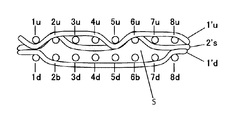
- FIG. 2A is a schematic view showing the longitudinal section taken along an upper side warp ( 1 u ) and a lower side warp ( 1 d ) of FIG. 1
- FIG. 2B is a schematic view showing the longitudinal section taken along an upper side warp ( 2 u ) and a lower side warp ( 2 d ) of FIG. 1 ;
- FIG. 1 is the design diagram of Embodiment 1 relating to the industrial two-layer fabric of the invention.
- a primary upper side weft and a secondary upper side weft are alternately arranged in the upper side fabric.
- No secondary lower side weft is arranged in the lower side fabric.
- FIG. 2A is a schematic view showing
- FIG. 2C is a schematic view showing the cross-section taken along an upper side weft ( 1 ′ u ) and a lower side weft ( 1 ′ d ) of FIG. 1 .
- Upper side wefts and lower side wefts are arranged at a ratio of 4:1.
- An upper side fabric has a 3/1-1/3 warp design in which an upper side warp goes over three upper side weft (secondary, primary and secondary upper side wefts) and then goes under one primary upper side wefts, thus forming a 3/1 design, and goes over one secondary upper weft and then goes under three upper wefts (primary, secondary and primary upper side wefts) thus forming a 1/3 design. As shown in FIG.
- the upper side warp ( 1 u ) goes over the primary upper side weft ( 1 ′ u ) and a secondary upper side weft ( 2 ′ s ), goes under a primary upper side weft ( 3 ′ u ), goes over a secondary upper side weft ( 4 ′ s ), goes under a primary upper side weft ( 5 ′ u ), a secondary upper side weft ( 6 ′ s ), and a primary upper side weft ( 7 ′ u ), goes over a secondary upper side weft ( 8 ′ s ), a primary upper side weft ( 9 ′ u ), and a secondary upper side weft ( 10 ′ s ), goes under a primary upper side weft ( 11 ′ u ), goes over a secondary upper side weft ( 12 ′ s ), goes under a primary upper side weft ( 13 ′ u ), a secondary upper side weft ( 14 ′ s
- the upper side warp ( 2 u ) placed adjacent to the upper side warp ( 1 u ) creates a similar design while shifting the upper side warp ( 1 u ) by two upper side wefts.
- the warp binding yarn ( 2 b ) functions as a binding yarn by weaving an upper side weft ( 13 ′ u ) from the inside where the upper side warp ( 2 u ) interweaves with it.
- An upper side warp ( 3 u ) creates a similar design to that of the upper side warp ( 1 u ) by shifting its design by one upper side weft from the upper side weft ( 2 u ).
- An upper side warp ( 4 u ) adjacent to the upper side warp ( 3 u ) creates a similar design by shifting its design by two upper side wefts.
- the upper side fabric and lower side fabric are bound by two warp binding yarns ( 2 b ) and ( 6 b ) which are arranged below the upper side warps ( 2 u ) and ( 6 u ), respectively, thereby form an inner space (S) between the upper side fabric and the lower side fabric.
- the fabric has a lower side weft long crimp of the lower side weft ( 1 ′ d ) between the lower side warps ( 1 d ) and ( 8 d ) as shown in FIG. 2C so that the two-layer fabric shows good wear resistance. Described specifically, as shown in FIG. 2A , the lower side warp ( 1 d ) goes under the primary lower side weft ( 1 ′ d ) and goes over other primary lower side wefts ( 5 ′ d , 9 ′ d , 13 ′ d ), thus creating a 3/1 design.
- the lower side warp and a lower side warp adjacent thereto are simultaneously interwoven, from the lower side, with the same lower side weft at the positions of the symbols “o” “o” adjacent to each other as shown in FIG. 1 (e.g. the lower side warps ( 1 d ), ( 8 d ) at the lower side weft ( 1 ′ d ), the lower side warps ( 4 d ), ( 5 d ) at the lower side weft ( 9 ′ d )) and these two lower side warps as a set create a 3/1 design of the lower side fabric.
- the warp binding yarn ( 2 b ) and a lower side warp ( 3 d ) create, as a set, a 3/1 design with the primary lower side weft ( 5 ′ d ).
- the warp binding yarn ( 6 b ) and a lower side warp ( 7 d ) create, as a set, a 3/1 design with the primary lower side weft ( 13 ′ d ) also.
- the secondary upper side weft ( 2 ′ s ) forms a long crimp in the inner space (S) between the upper side warps ( 2 u ) and ( 6 u ) and between the upper side warps ( 6 u ) and ( 2 u ) of an adjacent repeating unit.
- the number of the upper side warps that pass under the primary upper side weft ( 1 ′ u ) is six (6) which is larger than the number of the upper side warps that pass over the primary upper side weft ( 1 ′ u ) which is two (2) so that the primary upper side weft ( 1 ′ u ) forms a long crimp on an upper surface of the upper side fabric.
- the number of the upper side warps passing on the secondary upper side weft ( 2 ′ s ) is six (6), which is larger than a number of the upper side warps passing under the secondary upper side weft ( 2 ′ s ) which is two (2), so that the secondary upper side weft forms the long crimp in the inner space (S) as stated above.
- the industrial two-layer fabric having uniform drainage characteristics throughout the fabric can be provided according to the present embodiment by reducing a water retention amount in the inner space of the fabric during papermaking without increasing the thickness of a wire or fabric by using the secondary upper side wefts, thereby retaining required characteristics of the fabric such as drainage property, surface properties, and rigidity and at the same time, suppressing transfer of marks to paper made using the fabric, generation of splash, or the like.
- FIG. 3 is the design diagram of Embodiment 2 relating to the industrial two-layer fabric of the invention.
- FIG. 4A is a schematic view showing the longitudinal section taken along an upper side warp ( 1 u ) and a lower side warp ( 1 d ) of FIG. 3 ;
- FIG. 4B is a schematic view showing the longitudinal section taken along an upper side warp ( 2 u ) and a warp binding yarn ( 2 b ) of FIG. 3 ;
- FIG. 4C is a schematic view showing the cross-section taken along an upper side weft ( 1 ′ u ) and a lower side weft ( 1 ′ d ) of FIG. 3 .
- the upper side fabric design is a satin weave design obtained by irregularly shifting a 1/3 warp design in which an upper side warp goes over one primary upper side weft and then goes under three primary upper side wefts.
- a primary lower side weft and a secondary lower side weft are alternately arranged.
- the upper side wefts and the lower side wefts are arranged at a ratio of 1:1.
- One of four upper side warps ( 2 u ) or ( 6 u ) does not interweave with an upper side weft ( 7 ′ u ) or ( 3 ′ u ) at the site where it should interweave with the upper side weft ( 7 ′ u ) or ( 3 ′ u ) and a warp binding yarn ( 2 b ) or ( 6 b ) interweaves with the upper side weft ( 7 ′ u ) or ( 3 ′ u ) and functions as a binding yarn.
- the upper side fabric and lower side fabric are bound by the two warp binding yarns ( 2 b ) and ( 6 b ) which are arranged below the upper side warps ( 2 u ) and ( 6 u ), respectively, thereby form an inner space (S) between the upper side fabric and the lower side fabric.
- the lower side design of the primary lower side wefts is a 2/6 weft design in which primary lower side wefts ( 1 ′ d , 3 ′ d , 5 ′ d and 7 ′ d ) and secondary lower side wefts ( 2 ′ s , 4 ′ s , 6 ′ s and 8 ′ s ) are arranged alternately.
- a primary lower side weft ( 1 ′ d , 3 ′ d , 5 ′ d or 7 ′ d ) goes over two lower side warps and then goes under six lower side warps thereby forming a long crimp on the lower side surface of the lower fabric.
- a secondary lower side weft ( 4 ′ s and 8 ′ s ) goes under two lower side warps (as shown by two blank boxes), goes over three lower side warps (as shown by three “ ⁇ ” “ ⁇ ” “ ⁇ ”), goes under one lower side warp (as shown by a blank box) and goes over two lower side warps (as shown by a single “ ⁇ ”), thus creating a 2/2-3/1 weft design.
- Another secondary lower side weft ( 2 ′ s ) or ( 6 ′ s ) goes over two lower side warps (as shown by two adjacent “ ⁇ ” and “ ⁇ ”), under one lower side warp (as shown by one blank box), over two lower side warps (as shown by another two adjacent “ ⁇ ” and “ ⁇ ”), under one lower side warp (as shown by another one blank box), over one lower side warp (as shown by a single “ ⁇ ”), and under one lower side warp (as shown by one blank box), thus creating a 2/1-2/1-1/1 weft design.
- the secondary lower side warp of the 2/2-3/1 design and that of the 2/1-2/1-1/1 design are arranged alternately.
- the secondary lower side weft ( 2 ′ s ) goes over one lower side warp ( 1 d ) and one warp binding yarn ( 2 b ), forms a long crimp in the inner space (S) between the lower side warps ( 8 d ) and ( 3 d ), goes under one lower side warp ( 3 d ), goes over two lower side warps ( 4 d , 5 d ), forms a long crimp again in the inner space (S) between the lower side warps ( 3 d ) and ( 6 d ), goes under one warp binding yarn ( 6 b ), goes over one lower side warp ( 7 d ), and goes under one lower side warp ( 8 d ), and thus forming a long crimp of the secondary lower side weft.
- the number of the lower side warps passing under the secondary lower side weft is five (5) which is larger than the number of the lower side warps passing over the secondary lower side weft which is three (3) in the repeating unit in either the 2/2-3/1 design case or the 2/1-2/1-1/1 design case, so that the secondary lower side weft forms a long crimp in the inner space (S).
- the industrial two-layer fabric having uniform drainage characteristics throughout the fabric can be provided according to the present embodiment by reducing a water retention amount in the inner space of the fabric during papermaking without increasing the thickness of a wire or fabric, thereby retaining required characteristics of the fabric such as drainage property, surface properties, and rigidity and at the same time, suppressing transfer of marks to paper made using the fabric, generation of splash, or the like.
- FIG. 5 is the design diagram of Embodiment 3 relating to the industrial two-layer fabric of the invention.
- FIG. 6A is a schematic view showing the longitudinal section taken along an upper side warp ( 1 u ) and a lower side warp ( 1 d ) of FIG. 5 ;
- FIG. 6B is a schematic view showing the longitudinal section taken along an upper side warp ( 2 u ) and a warp binding yarn ( 2 b ) of FIG. 5 ;
- FIG. 6C is a schematic view showing the cross-section taken along an upper side weft ( 1 ′ u ) and a lower side weft ( 1 ′ d ) of FIG. 5 .
- the upper side fabric design is a design similar to that of Embodiment 1 in which primary upper side wefts ( 1 ′ u , 3 ′ u , 5 ′ u , 7 ′ u , 9 ′ u , 11 ′ u , 13 ′ u and 15 ′ u ) and secondary upper side wefts ( 2 ′ s , 4 ′ s , 6 ′ s , 8 ′ s , 10 ′ s , 12 ′ s , 14 ′ s and 16 ′ s ) are arranged alternately.
- the lower side design is a design similar to that of Embodiment 2 in which primary lower side wefts ( 1 ′ d , 5 ′ d , 9 ′ d and 13 ′ d ) have a 2/6 weft design and secondary lower side wefts ( 3 ′ s , 7 ′ s , 11 ′ s and 15 ′ s ) have the 2/2-3/1 design ( 7 ′ s and 15 ′ s ) and the 2/1-2/1-1/1 design ( 3 ′ s and 11 ′ s ), that are arranged alternately.
- the Primary lower side wefts and secondary lower side wefts are arranged alternately.
- Primary upper side wefts and secondary upper side wefts, and primary lower side wefts and secondary lower side wefts are arranged at a ratio of 2:1.
- the upper side fabric and lower side fabric are bound by two warp binding yarns ( 2 b ) and ( 6 b ) which are arranged below the upper side warps ( 2 u ) and ( 6 u ), respectively, thereby form an inner space (S) between the upper side fabric and the lower side fabric.
- a secondary upper side weft ( 2 ′ s ) goes over one upper side warp ( 2 u ), goes under three upper side warps ( 3 u to 5 u ) to form a long crimp or knuckle in the inner space (S) between the upper side warps ( 2 u ) and ( 6 u ), goes over one upper side warp ( 6 u ), goes under three upper side warps ( 7 u , 8 u , 1 u ) to form a long crimp or knuckle again between the upper side warps ( 6 u ) and ( 2 u ) of the adjacent repeating unit, and thereby forms a long crimp with the secondary upper side weft in the inner space (S).
- a secondary lower side weft ( 3 ′ s ) goes over one lower side warp ( 1 d ) and one warp binding yarns ( 2 b ) to form a long knuckle or crimp in the inner space between the lower side warps ( 8 d ) and ( 3 d ), goes under one lower side warp ( 3 d ), goes over two lower side warps ( 4 d , 5 d ) to form a long knuckle or crimp again between the lower side warp ( 3 d ) and warp binding yarn ( 6 b ), goes under one warp binding yarn ( 6 b ), goes over one lower side warp ( 7 d ), and goes under one lower side warp ( 8 d ).
- the number of the upper side warps passing on the secondary upper side weft ( 2 ′ s ) is six (6) which is larger than the number of the upper side warps passing under the secondary upper side weft ( 2 ′ s ) which is two (2) in a repeating unit, so that the secondary upper side weft ( 2 ′ s ) forms a long crimp in the inner space (S).
- the number of the lower side warps passing under the secondary lower side weft ( 3 ′ s ) is five (5) which is larger than the number of the lower side warps passing over the secondary lower side weft ( 3 ′ s ) which is three (3) in the repeating unit in either the 2/2-3/1 design case or the 2/1-2/1-1/1 design case, so that the secondary lower side weft forms a long crimp in the inner space (S).
- the industrial two-layer fabric having uniform drainage characteristics throughout the fabric can be provided according to the present embodiment by reducing a water retention amount in the inner space of the fabric during papermaking without increasing the thickness of a wire or fabric, thereby retaining required characteristics of the fabric such as drainage property, surface properties, and rigidity and at the same time, suppressing transfer of marks to paper made using the fabric, generation of splash, or the like.
- FIG. 7 is the design diagram of Embodiment 4 relating to the industrial two-layer fabric of the invention.
- FIG. 8A is a schematic view showing the longitudinal section taken along an upper side warp ( 1 u ) and a lower side warp ( 1 d ) of FIG. 7 ;
- FIG. 8B is a schematic view showing the longitudinal section taken along an upper side warp ( 2 u ) and a warp binding yarn ( 2 b ) of FIG. 7 ;
- FIG. 8C is a schematic view showing the cross-section taken along an upper side secondary yarn ( 1 ′ s ) and a lower side weft ( 1 ′ d ) of FIG. 7 .
- All the upper side wefts are secondary upper side wefts. No primary upper side weft is used in the upper side fabric.
- the secondary upper side wefts and primary lower side wefts are arranged at a ratio of 2:1.
- No secondary lower side weft is used in the lower side fabric.
- the upper side fabric and lower side fabric are bound by two warp binding yarns ( 2 b ) and ( 6 b ) which are arranged below the upper side warps ( 2 u ) and ( 6 u ), respectively, thereby form an inner space (S) between the upper side fabric and the lower side fabric.
- a secondary upper side weft ( 1 ′ s ) goes over one upper side warp ( 3 u ) and goes under three upper side warps ( 4 u to 6 u ) to form a long crimp or knuckle in the inner space (S) between the upper side warps ( 3 u ) and ( 7 u ), goes over one upper side warp ( 7 u ), goes under three upper side warps ( 8 u , 1 u , 2 u ) to form a long crimp or knuckle again in the inner space (S) between the upper side warps ( 7 u ) and ( 3 u ).
- the number of the upper side warps passing on the secondary upper side weft ( 1 ′ s ) is six (6) which is larger than the number of the upper side warps passing under the secondary upper side weft ( 2 ′ s ) which is two (2) in a repeating unit, so that the secondary upper side weft ( 2 ′ s ) forms a long crimp in the inner space (S).
- the industrial two-layer fabric having uniform drainage characteristics throughout the fabric can be provided according to the present embodiment by reducing a water retention amount in the inner space of the fabric during papermaking without increasing the thickness of a wire or fabric, thereby retaining required characteristics of the fabric such as drainage property, surface properties, and rigidity and at the same time, suppressing transfer of marks to paper made using the fabric.
- FIG. 9 is the design diagram of Embodiment 5 relating to the industrial two-layer fabric of the invention.
- FIG. 10A is a schematic view showing the longitudinal section taken along an upper side warp ( 1 u ) and a lower side warp ( 1 d );
- FIG. 10B is a schematic view showing the longitudinal section taken along an upper side warp ( 4 u ) and a warp binding yarn ( 4 b );
- FIG. 10C is a schematic view showing the cross-section taken along an upper side weft ( 1 ′ u ) and a lower side weft ( 1 ′ d ).
- One upper side weft and one upper side secondary weft are placed alternately and upper side wefts.
- Primary and secondary upper side wefts and lower side wefts are arranged at a ratio of 2:1.
- the upper side fabric design is a design similar to that of Embodiments 1 and 3 in which primary upper side wefts ( 1 ′ u , 3 ′ u , 5 ′ u , 7 ′ u , 9 ′ u , 11 ′ u , 13 ′ u , 15 ′ u , 17 ′ u , 19 ′ u , 21 ′ u and 23 ′ u ) and secondary upper side wefts ( 2 ′ s , 4 ′ s , 6 ′ s , 8 ′ s , 10 ′ s , 12 ′ s , 14 ′ s , 16 ′ s , 18 ′ s , 20 ′ s , 22 ′ s and 24 ′ s ) are arranged alternately.
- primary upper side wefts 1 ′ u , 3 ′ u , 5 ′ u , 7 ′ u , 9 ′ u
- the primary upper side weft goes over three upper side warps and then goes under one upper side warp, thus creating a 3/1 design.
- One secondary upper side weft goes over one upper side warp and then going under five upper side warps, thus forming a 1/5 design.
- the primary and secondary upper side wefts are placed alternately.
- the upper side fabric and lower side fabric are bound by three warp binding yarns ( 4 b ), ( 8 b ) and ( 12 b ) which are arranged below the upper side warps ( 4 u ), ( 8 u ) and ( 6 u ), respectively, thereby form an inner space (S) between the upper side fabric and the lower side fabric.
- a lower side warp goes over four primary lower side wefts, under one primary lower side weft, over six primary lower side wefts, and under one primary lower side weft, thus forming a 4/1-1/6 design.
- No secondary lower side weft is used in this embodiment.
- a lower side warp adjacent to it has a design obtained by shifting it by seven lower side wefts so that the two adjacent lower side warps are woven with the same lower side warp at a “ ⁇ ” “ ⁇ ” location as shown in FIG. 9 .
- the primary upper side weft ( 1 ′ u ) goes over three upper side warps ( 2 u , 3 u and 4 u , 6 u , 7 u and 8 u , or 10 u , 11 u and 12 u ) and then goes under one upper side warp ( 5 u , 9 u , or 1 u ), thus creating a 3/1 design.
- the secondary upper side weft ( 2 ′ s ) goes over one upper side warp ( 4 u or 10 u ) and then going under five upper side warps ( 5 u through 9 u or 11 u through 3 u ), thus forming a 1/5 design, so that the secondary upper side weft ( 2 ′ s ) forms a long crimp in the inner space (S).
- the number of the upper side warps passing on the secondary upper side weft ( 2 ′ s ) is ten (10) which is larger than the number of the upper side warps passing under the secondary upper side weft ( 2 ′ s ) which is two (2) in a repeating unit, so that the secondary upper side weft ( 2 ′ s ) forms a long crimp in the inner space (S).
- the industrial two-layer fabric having uniform drainage characteristics throughout the fabric can be provided according to the present embodiment by reducing a water retention amount in the inner space of the fabric during papermaking without increasing the thickness of a wire or fabric, thereby retaining required characteristics of the fabric such as drainage property, surface properties, and rigidity and at the same time, suppressing transfer of marks to paper made using the fabric, generation of splash, or the like.
- FIG. 11 is the design diagram of Embodiment 6 relating to the industrial two-layer fabric of the invention.
- FIG. 12A is a schematic view showing the longitudinal section taken along an upper side warp ( 1 u ) and a lower side warp ( 1 d );
- FIG. 12B is a schematic view showing the longitudinal section taken along an upper side weft ( 5 ′ s ) and a lower side weft ( 5 ′ d ). All the upper side wefts are secondary upper side wefts excepting for two weft binding yarns ( 6 ′ b and 14 ′ b ). All of the lower side wefts are primary lower side wefts.
- the upper side secondary wefts including two weft binding yarns and primary lower side wefts are arranged at a ratio of 2:1.
- the upper side fabric and lower side fabric are bound by two weft binding yarns ( 6 ′ b ) and ( 14 ′ b ) which are arranged below the upper side warps ( 6 u ) and ( 14 u ), respectively, thereby form an inner space (S) between the upper side fabric and the lower side fabric.
- an upper side warp goes over three upper side wefts and then goes under one upper side weft and thus forms a 3/1 design.
- Weft binding yarns ( 6 ′ b ) and ( 14 ′ b ) interweave with upper side warps ( 2 u ) and ( 6 u ) and lower side warps ( 4 d ) and ( 8 d ).
- the weft binding yarns ( 6 ′ b ) and ( 14 ′ b ) binds the upper side fabric and the lower side fabric thereby forming an inner space (S) between the upper side fabric and the lower side fabric.
- Embodiment 6 No limitation is imposed on the lower side design.
- a lower side warp goes over two lower side wefts, goes under one lower side weft, goes over four lower side wefts, and then goes under one lower side weft, thus forming a 2/1-4/1 design.
- a lower side warp adjacent to it is placed after shifting it by three lower side wefts so that the two adjacent lower side warps are woven with the same lower side warp at a “ ⁇ ” “ ⁇ ” location in FIG. 11 .
- the secondary upper side weft ( 5 ′ s ) goes over one upper side warp ( 1 u ), goes under three upper side warps ( 2 u to 4 u ) to form a long crimp or knuckle in the inner space (S) between the upper side wefts ( 1 u ) and ( 5 u ), goes over one upper side warp ( 5 u ) again, goes under three upper side warps ( 6 u to 8 u ) to form a long crimp or knuckle again in the inner space (S) between the upper side wefts ( 5 u ) and ( 1 u ).
- the number of the upper side warps passing on the secondary upper side weft ( 5 ′ s ) is six (6) which is larger than the number of the upper side warps passing under the secondary upper side weft ( 5 ′ s ) which is two (2) in a repeating unit, so that the secondary upper side weft ( 2 ′ s ) forms a long crimp in the inner space (S).
- the industrial two-layer fabric having uniform drainage characteristics throughout the fabric can be provided according to the present embodiment by reducing a water retention amount in the inner space of the fabric during papermaking without increasing the thickness of a wire or fabric, thereby retaining required characteristics of the fabric such as drainage property, surface properties, and rigidity and at the same time, suppressing transfer of marks to paper made using the fabric, generation of splash, or the like.
Landscapes
- Engineering & Computer Science (AREA)
- Textile Engineering (AREA)
- Woven Fabrics (AREA)
- Paper (AREA)
Applications Claiming Priority (2)
| Application Number | Priority Date | Filing Date | Title |
|---|---|---|---|
| JP2012100662A JP2013227701A (ja) | 2012-04-26 | 2012-04-26 | 工業用二層織物 |
| JP2012-100662 | 2012-04-26 |
Publications (2)
| Publication Number | Publication Date |
|---|---|
| US20130284305A1 US20130284305A1 (en) | 2013-10-31 |
| US8991440B2 true US8991440B2 (en) | 2015-03-31 |
Family
ID=48141758
Family Applications (1)
| Application Number | Title | Priority Date | Filing Date |
|---|---|---|---|
| US13/836,292 Active 2033-06-05 US8991440B2 (en) | 2012-04-26 | 2013-03-15 | Industrial two-layer fabric |
Country Status (4)
| Country | Link |
|---|---|
| US (1) | US8991440B2 (fr) |
| EP (1) | EP2657399A3 (fr) |
| JP (1) | JP2013227701A (fr) |
| CA (1) | CA2811652C (fr) |
Cited By (1)
| Publication number | Priority date | Publication date | Assignee | Title |
|---|---|---|---|---|
| EP4375416A4 (fr) * | 2021-07-21 | 2025-04-23 | Nippon Filcon Co., Ltd. | Tissu tissé industriel |
Families Citing this family (5)
| Publication number | Priority date | Publication date | Assignee | Title |
|---|---|---|---|---|
| JP2017089022A (ja) * | 2015-11-04 | 2017-05-25 | 日本フイルコン株式会社 | 工業用二層織物 |
| CN106133239A (zh) * | 2016-03-23 | 2016-11-16 | 许长云 | 一种纬线自绑定成形网 |
| US11149362B2 (en) | 2017-01-26 | 2021-10-19 | Nippon Filcon Co., Ltd. | Industrial two-layer fabric |
| JP7000272B2 (ja) * | 2018-07-31 | 2022-01-19 | 日本フイルコン株式会社 | 工業用二層織物 |
| JP7364441B2 (ja) * | 2019-11-26 | 2023-10-18 | 日本フエルト株式会社 | 製紙用2層織物 |
Citations (15)
| Publication number | Priority date | Publication date | Assignee | Title |
|---|---|---|---|---|
| DE3318990A1 (de) | 1983-05-25 | 1984-11-29 | Fa. F. Oberdorfer, 7920 Heidenheim | Mehrlagiges papiermaschinensieb |
| EP0672782A1 (fr) | 1994-03-18 | 1995-09-20 | Nippon Filcon Co., Ltd. | Tissu pour papeterie à deux couches de fils de chaîne et deux couches de fils de trame, comprenant des fils de chaîne auxiliaires tissés dans le côté papier |
| US5482567A (en) | 1994-12-06 | 1996-01-09 | Huyck Licensco, Inc. | Multilayer forming fabric |
| US5632310A (en) * | 1994-12-01 | 1997-05-27 | Nippon Filcon Co., Ltd. | Single layer woven fabric for paper-making |
| EP0794283A1 (fr) | 1996-03-04 | 1997-09-10 | Ronald H. Seabrook | Toile composite pour machine à papier contenant des paires de fils de trame de liaison intercouche |
| US5829489A (en) * | 1995-10-05 | 1998-11-03 | Nippon Filcon Co., Ltd | Two-layer paper-making fabric having auxiliary weft on the paper-making side |
| US6155308A (en) * | 1997-09-19 | 2000-12-05 | Nippon Filcon Co., Ltd. | Industrial fabric |
| JP2004068168A (ja) | 2002-08-01 | 2004-03-04 | Nippon Filcon Co Ltd | 工業用二層織物 |
| EP1502977A2 (fr) | 2003-07-12 | 2005-02-02 | Voith Fabrics Patent GmbH | Tissu de formage |
| EP1630271A2 (fr) | 2004-08-23 | 2006-03-01 | Nippon Filcon Co., Ltd. | Tissu technique à deux couches |
| US20070095417A1 (en) * | 2005-10-31 | 2007-05-03 | Nippon Filcon Co., Ltd. | Industrial two-layer fabric |
| US20100132825A1 (en) * | 2008-11-29 | 2010-06-03 | Nippon Filcon Co., Ltd. | Industrial two-layer fabric |
| US20100252137A1 (en) * | 2008-11-28 | 2010-10-07 | Nippon Filcon Co., Ltd. | Industrial two-layer fabric |
| US7882857B1 (en) * | 2008-11-28 | 2011-02-08 | Nippon Filcon Co., Ltd. | Industrial two-layer fabric |
| US7896035B2 (en) * | 2008-11-12 | 2011-03-01 | Nippon Filcon Co., Ltd. | Industrial multilayer fabric having a narrowing weft |
-
2012
- 2012-04-26 JP JP2012100662A patent/JP2013227701A/ja active Pending
-
2013
- 2013-03-15 US US13/836,292 patent/US8991440B2/en active Active
- 2013-04-05 CA CA2811652A patent/CA2811652C/fr active Active
- 2013-04-11 EP EP13163425.5A patent/EP2657399A3/fr not_active Withdrawn
Patent Citations (18)
| Publication number | Priority date | Publication date | Assignee | Title |
|---|---|---|---|---|
| DE3318990A1 (de) | 1983-05-25 | 1984-11-29 | Fa. F. Oberdorfer, 7920 Heidenheim | Mehrlagiges papiermaschinensieb |
| EP0672782A1 (fr) | 1994-03-18 | 1995-09-20 | Nippon Filcon Co., Ltd. | Tissu pour papeterie à deux couches de fils de chaîne et deux couches de fils de trame, comprenant des fils de chaîne auxiliaires tissés dans le côté papier |
| US5490543A (en) * | 1994-03-18 | 1996-02-13 | Nippon Filcon Co., Ltd. | Two-ply warp two-ply weft papermaking fabric having auxiliary weft yarns incorporated in papermaking side fabric |
| US5632310A (en) * | 1994-12-01 | 1997-05-27 | Nippon Filcon Co., Ltd. | Single layer woven fabric for paper-making |
| US5482567A (en) | 1994-12-06 | 1996-01-09 | Huyck Licensco, Inc. | Multilayer forming fabric |
| US5829489A (en) * | 1995-10-05 | 1998-11-03 | Nippon Filcon Co., Ltd | Two-layer paper-making fabric having auxiliary weft on the paper-making side |
| EP0794283A1 (fr) | 1996-03-04 | 1997-09-10 | Ronald H. Seabrook | Toile composite pour machine à papier contenant des paires de fils de trame de liaison intercouche |
| US6155308A (en) * | 1997-09-19 | 2000-12-05 | Nippon Filcon Co., Ltd. | Industrial fabric |
| JP2004068168A (ja) | 2002-08-01 | 2004-03-04 | Nippon Filcon Co Ltd | 工業用二層織物 |
| EP1502977A2 (fr) | 2003-07-12 | 2005-02-02 | Voith Fabrics Patent GmbH | Tissu de formage |
| EP1630271A2 (fr) | 2004-08-23 | 2006-03-01 | Nippon Filcon Co., Ltd. | Tissu technique à deux couches |
| US20070095417A1 (en) * | 2005-10-31 | 2007-05-03 | Nippon Filcon Co., Ltd. | Industrial two-layer fabric |
| US7464731B2 (en) * | 2005-10-31 | 2008-12-16 | Nippon Filcon Co. Ltd. | Industrial two-layer fabric |
| US7896035B2 (en) * | 2008-11-12 | 2011-03-01 | Nippon Filcon Co., Ltd. | Industrial multilayer fabric having a narrowing weft |
| US20100252137A1 (en) * | 2008-11-28 | 2010-10-07 | Nippon Filcon Co., Ltd. | Industrial two-layer fabric |
| US7819141B1 (en) * | 2008-11-28 | 2010-10-26 | Nippon Filcon Co., Ltd. | Industrial two-layer fabric |
| US7882857B1 (en) * | 2008-11-28 | 2011-02-08 | Nippon Filcon Co., Ltd. | Industrial two-layer fabric |
| US20100132825A1 (en) * | 2008-11-29 | 2010-06-03 | Nippon Filcon Co., Ltd. | Industrial two-layer fabric |
Non-Patent Citations (2)
| Title |
|---|
| Extended Search Report issued in EP Application No. 13163425.5, dated Oct. 25, 2013. |
| Partial European Search Report issued in EP Application No. 13163425.5, dated Jul. 23, 2013. |
Cited By (2)
| Publication number | Priority date | Publication date | Assignee | Title |
|---|---|---|---|---|
| EP4375416A4 (fr) * | 2021-07-21 | 2025-04-23 | Nippon Filcon Co., Ltd. | Tissu tissé industriel |
| US12344967B2 (en) | 2021-07-21 | 2025-07-01 | Nippon Filcon Co., Ltd. | Industrial fabric |
Also Published As
| Publication number | Publication date |
|---|---|
| US20130284305A1 (en) | 2013-10-31 |
| CA2811652A1 (fr) | 2013-10-26 |
| JP2013227701A (ja) | 2013-11-07 |
| EP2657399A2 (fr) | 2013-10-30 |
| EP2657399A3 (fr) | 2013-11-27 |
| CA2811652C (fr) | 2020-08-25 |
Similar Documents
| Publication | Publication Date | Title |
|---|---|---|
| EP2458086B1 (fr) | Structure industrielle à deux couches | |
| EP2305865B1 (fr) | Tissu technique à deux couches | |
| EP2213787B1 (fr) | Tissu double couche industriel | |
| EP1659212B1 (fr) | Tissu technique à deux couches | |
| CA2811652C (fr) | Tissu double couche industriel | |
| US7343938B2 (en) | Industrial two-layer fabric | |
| JP4563260B2 (ja) | 工業用二層織物 | |
| US20230257938A1 (en) | Industrial two-layer fabric | |
| US7426943B2 (en) | Industrial two-layer fabric | |
| EP2458048B1 (fr) | Structure industrielle à deux couches | |
| JP4573168B2 (ja) | 工業用二層織物 | |
| US9359699B2 (en) | Industrial two-layer fabric | |
| JP4570090B2 (ja) | 工業用二層織物 | |
| JP4841410B2 (ja) | 縦溝が形成された工業用二層織物 |
Legal Events
| Date | Code | Title | Description |
|---|---|---|---|
| AS | Assignment |
Owner name: NIPPON FILCON CO. LTD., JAPAN Free format text: ASSIGNMENT OF ASSIGNORS INTEREST;ASSIGNORS:UEDA, IKUO;EGAWA, TORU;KONDOU, YOSHIHISA;SIGNING DATES FROM 20130312 TO 20130314;REEL/FRAME:030017/0176 |
|
| STCF | Information on status: patent grant |
Free format text: PATENTED CASE |
|
| FEPP | Fee payment procedure |
Free format text: PAYOR NUMBER ASSIGNED (ORIGINAL EVENT CODE: ASPN); ENTITY STATUS OF PATENT OWNER: LARGE ENTITY |
|
| MAFP | Maintenance fee payment |
Free format text: PAYMENT OF MAINTENANCE FEE, 4TH YEAR, LARGE ENTITY (ORIGINAL EVENT CODE: M1551); ENTITY STATUS OF PATENT OWNER: LARGE ENTITY Year of fee payment: 4 |
|
| MAFP | Maintenance fee payment |
Free format text: PAYMENT OF MAINTENANCE FEE, 8TH YEAR, LARGE ENTITY (ORIGINAL EVENT CODE: M1552); ENTITY STATUS OF PATENT OWNER: LARGE ENTITY Year of fee payment: 8 |