US9006920B2 - Electrical system of a vehicle with electric propulsion and control method thereof - Google Patents
Electrical system of a vehicle with electric propulsion and control method thereof Download PDFInfo
- Publication number
- US9006920B2 US9006920B2 US13/081,697 US201113081697A US9006920B2 US 9006920 B2 US9006920 B2 US 9006920B2 US 201113081697 A US201113081697 A US 201113081697A US 9006920 B2 US9006920 B2 US 9006920B2
- Authority
- US
- United States
- Prior art keywords
- section
- auxiliaries
- storage section
- traction
- coupled
- Prior art date
- Legal status (The legal status is an assumption and is not a legal conclusion. Google has not performed a legal analysis and makes no representation as to the accuracy of the status listed.)
- Active, expires
Links
Images



Classifications
-
- H02J7/0016—
-
- H—ELECTRICITY
- H02—GENERATION; CONVERSION OR DISTRIBUTION OF ELECTRIC POWER
- H02J—ELECTRIC POWER NETWORKS; CIRCUIT ARRANGEMENTS OR SYSTEMS FOR SUPPLYING OR DISTRIBUTING ELECTRIC POWER; SYSTEMS FOR STORING ELECTRIC ENERGY
- H02J7/00—Circuit arrangements for charging or discharging batteries or for supplying loads from batteries
- H02J7/50—Circuit arrangements for charging or discharging batteries or for supplying loads from batteries acting upon multiple batteries simultaneously or sequentially
- H02J7/52—Circuit arrangements for charging or discharging batteries or for supplying loads from batteries acting upon multiple batteries simultaneously or sequentially for charge balancing, e.g. equalisation of charge between batteries
- H02J7/54—Passive balancing, e.g. using resistors or parallel MOSFETs
-
- B—PERFORMING OPERATIONS; TRANSPORTING
- B60—VEHICLES IN GENERAL
- B60K—ARRANGEMENT OR MOUNTING OF PROPULSION UNITS OR OF TRANSMISSIONS IN VEHICLES; ARRANGEMENT OR MOUNTING OF PLURAL DIVERSE PRIME-MOVERS IN VEHICLES; AUXILIARY DRIVES FOR VEHICLES; INSTRUMENTATION OR DASHBOARDS FOR VEHICLES; ARRANGEMENTS IN CONNECTION WITH COOLING, AIR INTAKE, GAS EXHAUST OR FUEL SUPPLY OF PROPULSION UNITS IN VEHICLES
- B60K6/00—Arrangement or mounting of plural diverse prime-movers for mutual or common propulsion, e.g. hybrid propulsion systems comprising electric motors and internal combustion engines
- B60K6/20—Arrangement or mounting of plural diverse prime-movers for mutual or common propulsion, e.g. hybrid propulsion systems comprising electric motors and internal combustion engines the prime-movers consisting of electric motors and internal combustion engines, e.g. HEVs
- B60K6/42—Arrangement or mounting of plural diverse prime-movers for mutual or common propulsion, e.g. hybrid propulsion systems comprising electric motors and internal combustion engines the prime-movers consisting of electric motors and internal combustion engines, e.g. HEVs characterised by the architecture of the hybrid electric vehicle
- B60K6/48—Parallel type
-
- B60L11/005—
-
- B60L11/14—
-
- B60L11/1866—
-
- B—PERFORMING OPERATIONS; TRANSPORTING
- B60—VEHICLES IN GENERAL
- B60L—PROPULSION OF ELECTRICALLY-PROPELLED VEHICLES; SUPPLYING ELECTRIC POWER FOR AUXILIARY EQUIPMENT OF ELECTRICALLY-PROPELLED VEHICLES; ELECTRODYNAMIC BRAKE SYSTEMS FOR VEHICLES IN GENERAL; MAGNETIC SUSPENSION OR LEVITATION FOR VEHICLES; MONITORING OPERATING VARIABLES OF ELECTRICALLY-PROPELLED VEHICLES; ELECTRIC SAFETY DEVICES FOR ELECTRICALLY-PROPELLED VEHICLES
- B60L15/00—Methods, circuits, or devices for controlling the traction-motor speed of electrically-propelled vehicles
- B60L15/007—Physical arrangements or structures of drive train converters specially adapted for the propulsion motors of electric vehicles
-
- B—PERFORMING OPERATIONS; TRANSPORTING
- B60—VEHICLES IN GENERAL
- B60L—PROPULSION OF ELECTRICALLY-PROPELLED VEHICLES; SUPPLYING ELECTRIC POWER FOR AUXILIARY EQUIPMENT OF ELECTRICALLY-PROPELLED VEHICLES; ELECTRODYNAMIC BRAKE SYSTEMS FOR VEHICLES IN GENERAL; MAGNETIC SUSPENSION OR LEVITATION FOR VEHICLES; MONITORING OPERATING VARIABLES OF ELECTRICALLY-PROPELLED VEHICLES; ELECTRIC SAFETY DEVICES FOR ELECTRICALLY-PROPELLED VEHICLES
- B60L3/00—Electric devices on electrically-propelled vehicles for safety purposes; Monitoring operating variables, e.g. speed, deceleration or energy consumption
- B60L3/0023—Detecting, eliminating, remedying or compensating for drive train abnormalities, e.g. failures within the drive train
- B60L3/0046—Detecting, eliminating, remedying or compensating for drive train abnormalities, e.g. failures within the drive train relating to electric energy storage systems, e.g. batteries or capacitors
-
- B—PERFORMING OPERATIONS; TRANSPORTING
- B60—VEHICLES IN GENERAL
- B60L—PROPULSION OF ELECTRICALLY-PROPELLED VEHICLES; SUPPLYING ELECTRIC POWER FOR AUXILIARY EQUIPMENT OF ELECTRICALLY-PROPELLED VEHICLES; ELECTRODYNAMIC BRAKE SYSTEMS FOR VEHICLES IN GENERAL; MAGNETIC SUSPENSION OR LEVITATION FOR VEHICLES; MONITORING OPERATING VARIABLES OF ELECTRICALLY-PROPELLED VEHICLES; ELECTRIC SAFETY DEVICES FOR ELECTRICALLY-PROPELLED VEHICLES
- B60L3/00—Electric devices on electrically-propelled vehicles for safety purposes; Monitoring operating variables, e.g. speed, deceleration or energy consumption
- B60L3/04—Cutting off the power supply under fault conditions
-
- B—PERFORMING OPERATIONS; TRANSPORTING
- B60—VEHICLES IN GENERAL
- B60L—PROPULSION OF ELECTRICALLY-PROPELLED VEHICLES; SUPPLYING ELECTRIC POWER FOR AUXILIARY EQUIPMENT OF ELECTRICALLY-PROPELLED VEHICLES; ELECTRODYNAMIC BRAKE SYSTEMS FOR VEHICLES IN GENERAL; MAGNETIC SUSPENSION OR LEVITATION FOR VEHICLES; MONITORING OPERATING VARIABLES OF ELECTRICALLY-PROPELLED VEHICLES; ELECTRIC SAFETY DEVICES FOR ELECTRICALLY-PROPELLED VEHICLES
- B60L50/00—Electric propulsion with power supplied within the vehicle
- B60L50/10—Electric propulsion with power supplied within the vehicle using propulsion power supplied by engine-driven generators, e.g. generators driven by combustion engines
- B60L50/16—Electric propulsion with power supplied within the vehicle using propulsion power supplied by engine-driven generators, e.g. generators driven by combustion engines with provision for separate direct mechanical propulsion
-
- B—PERFORMING OPERATIONS; TRANSPORTING
- B60—VEHICLES IN GENERAL
- B60L—PROPULSION OF ELECTRICALLY-PROPELLED VEHICLES; SUPPLYING ELECTRIC POWER FOR AUXILIARY EQUIPMENT OF ELECTRICALLY-PROPELLED VEHICLES; ELECTRODYNAMIC BRAKE SYSTEMS FOR VEHICLES IN GENERAL; MAGNETIC SUSPENSION OR LEVITATION FOR VEHICLES; MONITORING OPERATING VARIABLES OF ELECTRICALLY-PROPELLED VEHICLES; ELECTRIC SAFETY DEVICES FOR ELECTRICALLY-PROPELLED VEHICLES
- B60L50/00—Electric propulsion with power supplied within the vehicle
- B60L50/40—Electric propulsion with power supplied within the vehicle using propulsion power supplied by capacitors
-
- B—PERFORMING OPERATIONS; TRANSPORTING
- B60—VEHICLES IN GENERAL
- B60L—PROPULSION OF ELECTRICALLY-PROPELLED VEHICLES; SUPPLYING ELECTRIC POWER FOR AUXILIARY EQUIPMENT OF ELECTRICALLY-PROPELLED VEHICLES; ELECTRODYNAMIC BRAKE SYSTEMS FOR VEHICLES IN GENERAL; MAGNETIC SUSPENSION OR LEVITATION FOR VEHICLES; MONITORING OPERATING VARIABLES OF ELECTRICALLY-PROPELLED VEHICLES; ELECTRIC SAFETY DEVICES FOR ELECTRICALLY-PROPELLED VEHICLES
- B60L58/00—Methods or circuit arrangements for monitoring or controlling batteries or fuel cells, specially adapted for electric vehicles
- B60L58/10—Methods or circuit arrangements for monitoring or controlling batteries or fuel cells, specially adapted for electric vehicles for monitoring or controlling batteries
- B60L58/12—Methods or circuit arrangements for monitoring or controlling batteries or fuel cells, specially adapted for electric vehicles for monitoring or controlling batteries responding to state of charge [SoC]
-
- B—PERFORMING OPERATIONS; TRANSPORTING
- B60—VEHICLES IN GENERAL
- B60L—PROPULSION OF ELECTRICALLY-PROPELLED VEHICLES; SUPPLYING ELECTRIC POWER FOR AUXILIARY EQUIPMENT OF ELECTRICALLY-PROPELLED VEHICLES; ELECTRODYNAMIC BRAKE SYSTEMS FOR VEHICLES IN GENERAL; MAGNETIC SUSPENSION OR LEVITATION FOR VEHICLES; MONITORING OPERATING VARIABLES OF ELECTRICALLY-PROPELLED VEHICLES; ELECTRIC SAFETY DEVICES FOR ELECTRICALLY-PROPELLED VEHICLES
- B60L58/00—Methods or circuit arrangements for monitoring or controlling batteries or fuel cells, specially adapted for electric vehicles
- B60L58/10—Methods or circuit arrangements for monitoring or controlling batteries or fuel cells, specially adapted for electric vehicles for monitoring or controlling batteries
- B60L58/18—Methods or circuit arrangements for monitoring or controlling batteries or fuel cells, specially adapted for electric vehicles for monitoring or controlling batteries of two or more battery modules
- B60L58/22—Balancing the charge of battery modules
-
- H02J7/0054—
-
- H—ELECTRICITY
- H02—GENERATION; CONVERSION OR DISTRIBUTION OF ELECTRIC POWER
- H02J—ELECTRIC POWER NETWORKS; CIRCUIT ARRANGEMENTS OR SYSTEMS FOR SUPPLYING OR DISTRIBUTING ELECTRIC POWER; SYSTEMS FOR STORING ELECTRIC ENERGY
- H02J7/00—Circuit arrangements for charging or discharging batteries or for supplying loads from batteries
- H02J7/14—Circuit arrangements for charging or discharging batteries or for supplying loads from batteries for charging batteries from dynamo-electric generators driven at varying speed, e.g. on vehicle
- H02J7/1423—Circuit arrangements for charging or discharging batteries or for supplying loads from batteries for charging batteries from dynamo-electric generators driven at varying speed, e.g. on vehicle with multiple batteries
-
- H—ELECTRICITY
- H02—GENERATION; CONVERSION OR DISTRIBUTION OF ELECTRIC POWER
- H02J—ELECTRIC POWER NETWORKS; CIRCUIT ARRANGEMENTS OR SYSTEMS FOR SUPPLYING OR DISTRIBUTING ELECTRIC POWER; SYSTEMS FOR STORING ELECTRIC ENERGY
- H02J7/00—Circuit arrangements for charging or discharging batteries or for supplying loads from batteries
- H02J7/34—Parallel operation in networks using both storage and other DC sources, e.g. providing buffering
- H02J7/342—The other DC source being a battery actively interacting with the first one, i.e. battery to battery charging
-
- Y—GENERAL TAGGING OF NEW TECHNOLOGICAL DEVELOPMENTS; GENERAL TAGGING OF CROSS-SECTIONAL TECHNOLOGIES SPANNING OVER SEVERAL SECTIONS OF THE IPC; TECHNICAL SUBJECTS COVERED BY FORMER USPC CROSS-REFERENCE ART COLLECTIONS [XRACs] AND DIGESTS
- Y02—TECHNOLOGIES OR APPLICATIONS FOR MITIGATION OR ADAPTATION AGAINST CLIMATE CHANGE
- Y02T—CLIMATE CHANGE MITIGATION TECHNOLOGIES RELATED TO TRANSPORTATION
- Y02T10/00—Road transport of goods or passengers
- Y02T10/60—Other road transportation technologies with climate change mitigation effect
- Y02T10/62—Hybrid vehicles
-
- Y02T10/6221—
-
- Y—GENERAL TAGGING OF NEW TECHNOLOGICAL DEVELOPMENTS; GENERAL TAGGING OF CROSS-SECTIONAL TECHNOLOGIES SPANNING OVER SEVERAL SECTIONS OF THE IPC; TECHNICAL SUBJECTS COVERED BY FORMER USPC CROSS-REFERENCE ART COLLECTIONS [XRACs] AND DIGESTS
- Y02—TECHNOLOGIES OR APPLICATIONS FOR MITIGATION OR ADAPTATION AGAINST CLIMATE CHANGE
- Y02T—CLIMATE CHANGE MITIGATION TECHNOLOGIES RELATED TO TRANSPORTATION
- Y02T10/00—Road transport of goods or passengers
- Y02T10/60—Other road transportation technologies with climate change mitigation effect
- Y02T10/64—Electric machine technologies in electromobility
-
- Y—GENERAL TAGGING OF NEW TECHNOLOGICAL DEVELOPMENTS; GENERAL TAGGING OF CROSS-SECTIONAL TECHNOLOGIES SPANNING OVER SEVERAL SECTIONS OF THE IPC; TECHNICAL SUBJECTS COVERED BY FORMER USPC CROSS-REFERENCE ART COLLECTIONS [XRACs] AND DIGESTS
- Y02—TECHNOLOGIES OR APPLICATIONS FOR MITIGATION OR ADAPTATION AGAINST CLIMATE CHANGE
- Y02T—CLIMATE CHANGE MITIGATION TECHNOLOGIES RELATED TO TRANSPORTATION
- Y02T10/00—Road transport of goods or passengers
- Y02T10/60—Other road transportation technologies with climate change mitigation effect
- Y02T10/70—Energy storage systems for electromobility, e.g. batteries
-
- Y02T10/7005—
-
- Y02T10/7022—
-
- Y02T10/7055—
-
- Y02T10/7061—
-
- Y—GENERAL TAGGING OF NEW TECHNOLOGICAL DEVELOPMENTS; GENERAL TAGGING OF CROSS-SECTIONAL TECHNOLOGIES SPANNING OVER SEVERAL SECTIONS OF THE IPC; TECHNICAL SUBJECTS COVERED BY FORMER USPC CROSS-REFERENCE ART COLLECTIONS [XRACs] AND DIGESTS
- Y02—TECHNOLOGIES OR APPLICATIONS FOR MITIGATION OR ADAPTATION AGAINST CLIMATE CHANGE
- Y02T—CLIMATE CHANGE MITIGATION TECHNOLOGIES RELATED TO TRANSPORTATION
- Y02T10/00—Road transport of goods or passengers
- Y02T10/60—Other road transportation technologies with climate change mitigation effect
- Y02T10/7072—Electromobility specific charging systems or methods for batteries, ultracapacitors, supercapacitors or double-layer capacitors
-
- Y02T10/7077—
Definitions
- An embodiment relates to an electrical system of a vehicle with electric propulsion and to a control method thereof.
- An embodiment is advantageously applied to a road vehicle with hybrid propulsion, to which explicit reference will be made in the following description without therefore loosing in generality.
- a hybrid vehicle includes an internal combustion thermal engine, which transmits torque to the driving wheels by means of a transmission provided with a gearbox coupled to a clutch, and at least one electric machine, which is electrically coupled to an electric storage system and mechanically coupled to the driving wheels.
- the electrical power system of a hybrid vehicle includes a storage section, which is provided with at least one main automotive battery including a plurality of electrochemical cells which are coupled in series so that the voltage of the single cells is summed; the storage section works at an average voltage in the order of 200 Volts nominal. Furthermore, the electrical power system of a hybrid vehicle includes a section of traction which interacts with the electric machine and works at high voltage, in the order of 600-700 Volts nominal; the section of traction is coupled to the storage section by means of a two-way power electronic converter (i.e. that is either capable of absorbing electrical power from the storage section for powering the electric machine working as motor or capable of providing the electrical power generated by the electric machine working as generator to the storage section).
- a two-way power electronic converter i.e. that is either capable of absorbing electrical power from the storage section for powering the electric machine working as motor or capable of providing the electrical power generated by the electric machine working as generator to the storage section).
- the electrical power system of a hybrid vehicle includes a section of auxiliaries which powers all the auxiliary services of the vehicle requiring an electric supply and works at low voltage equal to 12 Volts nominal;
- the section of auxiliaries includes a buffer battery having a modest storage capacity (if compared to the main battery of the storage section) and is coupled to the storage section by means of a one-way power electronic converter which has the function of lowering the nominal voltage supplied by the storage section (200 Volts) to the nominal voltage (12 Volts) of the section of auxiliaries.
- the power electronic converter of the section of auxiliaries absorbs electrical power from the storage section at the power of 200 Volts for powering the auxiliary services and/or for recharging the buffer battery with a voltage of 12 Volts.
- the power electronic converter In modern hybrid vehicles, there are many auxiliary services which require electrical power and may absorb up to an overall high electrical power; consequently, the power electronic converter must be capable of providing a high electrical power (higher, even greatly, than 1000 Watts). However, a power electronic converter capable of providing high electrical power may be cumbersome and thus determines a non-negligible increase of total weight of the vehicle (currently, the tendency is to make the road vehicle as light as possible to reduce the energy consumption needed to move the road vehicle itself).
- Patent application EP2056422A1 which is incorporated by reference, describes a discharge control system of a battery including a plurality of cells, each of which is coupled in series to the other cells and is provided with a bypass branch which is coupled in parallel to the cell and has an electronically controlled bypass switch.
- the bypass switches are controlled (i.e. opened and closed) to obtain a “balanced” discharge of the cells so as to exploit in greater measure the cells having higher electric charge (consequently a higher voltage at their terminals).
- An embodiment is an electrical system of a vehicle with electric propulsion and control method thereof, which electrical system and control method are free from the drawbacks described above and are at the same time easy and cost-effective to make.
- FIG. 1 is a diagrammatic view of a road vehicle with hybrid propulsion
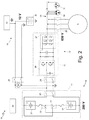
- FIG. 2 is a view of an electrical power system of the road vehicle in FIG. 1 , made in accordance with an embodiment
- FIG. 3 is a diagrammatic view of a battery including a plurality of cells coupled in series to the electrical power system in FIG. 2 .
- numeral 1 indicates as a whole an embodiment of a road vehicle with hybrid propulsion provided with two front wheels 2 and two rear drive wheels 3 , which receive torque from a hybrid propulsion system 4 .
- the hybrid propulsion system 4 includes an internal combustion engine 5 , which is arranged in frontal position and is provided with a drive shaft 6 , an automatic manual transmission 7 (commonly named “AMT”), which transmits the torque generated by the internal combustion engine 5 to the rear drive wheels 3 , and a reversible electric machine 8 (i.e. an electric machine which can work either as electric motor, using electricity and generating mechanical torque, or as electric generator, using mechanical energy and generating electrical energy), which is mechanically coupled to the transmission 7 .
- AMT automatic manual transmission 7
- a reversible electric machine 8 i.e. an electric machine which can work either as electric motor, using electricity and generating mechanical torque, or as electric generator, using mechanical energy and generating electrical energy
- Transmission 7 includes a transmission shaft 9 , which, at one end, is angularly integral with the drive shaft 6 , and at the other end is mechanically coupled to a twin-clutch gearbox 10 , which is arranged in rear position and transmits motion to the rear drive wheels 3 by means of two axles shafts 11 , which receive motion from a differential 12 .
- the reversible electric machine 8 is mechanically coupled to the twin-clutch gearbox 10 , and is driven by an power electronic converter 13 coupled to an electric storage system 14 , which is adapted to store electrical energy, and is provided with chemical batteries and/or supercapacitors.
- the chemical batteries have the advantage of providing a high amount of energy but the disadvantage of not being capable of delivering very high electrical power and thus allow the vehicle 1 to cover long distances in electric mode (high autonomy), but do not allow the vehicle 1 to reach high dynamic performance in electric mode; on the contrary, the supercapacitors display the advantage of being able to deliver a very high electrical power but on the contrary are not capable of providing a large amount of energy and thus allow the vehicle 1 to reach high dynamic performance in electric mode, but do not allow the vehicle 1 to cover considerable distances in electric mode.
- the proportion between chemical batteries and supercapacitors in the storage system 14 is chosen during the step of designing according to the desired ratio between autonomy and performance in electric mode.
- the vehicle 1 is provided with an electrical power system 15 including a storage section 16 , which includes the storage system 14 and works at average voltage equal to 200 Volts nominal. Furthermore, the electrical power system 15 of the vehicle 1 includes a section of traction 17 which interacts with the electric machine 8 and works at high voltage equal to 650 Volts nominal; the section of traction 17 is coupled to the storage section 16 by means of a two-way power electronic converter 13 (i.e. that is capable of absorbing electrical power from the storage section for powering the electric machine working as motor or is capable of providing to the storage section the electrical power generated by the electric machine working as generator).
- a two-way power electronic converter 13 i.e. that is capable of absorbing electrical power from the storage section for powering the electric machine working as motor or is capable of providing to the storage section the electrical power generated by the electric machine working as generator.
- the electrical system 15 of the vehicle 1 includes a section of auxiliaries 18 which supplies all the auxiliary services 19 (diagrammatically shown) of the vehicle 1 requiring an electric supply and works at low voltage equal to 12 Volts nominal;
- the section of auxiliaries 18 includes a buffer battery 20 having a modest storage capacity (when compared to that of the storage system 14 ) and is electrically powered by the storage section 16 according to the methods described hereinafter for powering the auxiliary services 19 and/or for recharging the buffer battery 20 .
- the buffer system 14 includes two reciprocally independent twin batteries 21 which are coupled to one another in series. Furthermore, the storage system 14 includes, for each battery 21 , a respective electronic or electromechanical bypass switch 22 , which is coupled in parallel to the battery 21 to form a bypass of the battery 21 ; in case of failure to a battery 21 , the battery 21 itself is cut off by closing the respective bypass switch 22 and the storage system 14 continues to work with the other battery 22 only. Furthermore, the storage system 14 includes an electronic or electromechanical separation switch 23 (which is also shaped as an electric disconnector) having, among other, the function of guaranteeing that the electrical system 15 of the vehicle 1 is free from voltage when a service intervention is required.
- the storage section 16 is coupled to the section of traction 17 by means of an electronic or electromechanical connector switch 24 and is coupled to section 18 of the auxiliary devices by means of an electronic or electromechanical connector switch 25 .
- the power electronic converter 13 is provided with a two-way DC-DC converter of the “Buck-Boost” type, which has the function of modifying the voltage to electrically couple the storage system 14 , which works at medium voltage (typically 200 Volts when both batteries 21 are working), to the power electronic converter 13 , which works at high voltage (typically 650 Volts). Furthermore, the power electronic converter 13 includes a three-phase inverter 27 , which on direct current side is coupled to the two-way converter 26 and on alternating current side is coupled to the three-phase bars 28 .
- a capacitor having the function of reducing the oscillations of the voltage
- a resistor having the function of discharging the capacitor when the circuit is not used to prevent voltage dangerous for technicians carrying out maintenance/repair operations from remaining in the circuit for a long time.
- the electric machine 8 is coupled to the three-phase bars 28 by means of an electronic or electromechanical three-phase switch 29 . Furthermore, the three-phase bars 28 are coupled to a three-phase connector 30 (i.e. provided with three terminals coupled to the three three-phase bars 28 , respectively) and a one-phase connector 31 (i.e. provided with two terminals coupled to one two of the three three-phase bars 28 , respectively).
- a three-phase connector 30 i.e. provided with three terminals coupled to the three three-phase bars 28 , respectively
- a one-phase connector 31 i.e. provided with two terminals coupled to one two of the three three-phase bars 28 , respectively.
- a control unit 32 is contemplated which has the function of superintending the operation of all components of the electrical power system 15 of vehicle 1 , controlling the bypass switches 22 , controlling the separation switches 23 and 29 , controlling the connector switches 24 and 25 , driving the converter 26 , and driving the inverter 27 .
- both batteries 21 are active and reciprocally coupled in series to output a voltage of 200 Volts from the storage system 14 (each battery 21 has a voltage of 100 Volts at its terminals).
- each battery 21 has a voltage of 100 Volts at its terminals.
- the battery 21 itself is excluded by closing the respective bypass switch 22 and the storage system 14 continues to work only with the other battery 21 ; thus a halved voltage with respect to the nominal value (100 Volts instead of 200 Volts) is provided at the output of the storage system 14 and such halving of the voltage is compensated by appropriately driving the converter 26 so that a nominal voltage equal to 650 Volts is always present at converter output 26 .
- the separation switch 29 is closed so that the inverter 27 can drive the electric machine 8 either as motor or as generator.
- the separation switch 29 is opened and the storage system 14 can be recharged by coupling the three-phase bars 28 to the electric mains either by means of the three-phase connector 30 or by means of a one-phase connector 31 ; all three branches of the inverter 27 are active when the three-phase connector 30 is used, while only two of the three branches of the inverter 27 are active when the one-phase connector 31 is used.
- the inverter 27 and the converter 26 are driven so that the input alternating voltage of the mains (normally 220 V between phase and ground and 380 Volts between two phases) is transformed into direct 200 Volts at the terminals of the storage system 14 (100 Volts, if one of the two batteries 21 has been cut off by means of the respective bypass switch 22 ).
- each battery 21 includes a plurality of electrochemical cells 33 (only a small part of which is shown in FIG. 1 ), which are used to convert storage chemical energy into electrical energy and vice versa and coupled in series so that the voltage of the single cells is summed.
- electrochemical cells 33 are used to convert storage chemical energy into electrical energy and vice versa and coupled in series so that the voltage of the single cells is summed.
- the battery 21 has at its terminals a nominal voltage of 100 Volts and includes twenty-five cells, which are coupled to one another in series and each have a nominal voltage of 4 Volts.
- a bypass branch 34 which includes an electronic or electromechanical bypass switch 35 coupled in series to a diode 36 and has the function of excluding the cell 33 from the electrical current which crosses the battery 21 when needed.
- the bypass switch 35 of a bypass branch 34 is open, the corresponding cell 33 is crossed by the electrical current which crosses the battery 21 ; instead, when the bypass switch 35 of a bypass branch 34 is closed, the corresponding cell 33 is not crossed by the electrical current which crosses the battery 21 because such a current flows through the bypass branch 34 .
- the diode 36 of the bypass branch 34 is used to avoid short-circuiting the cell 33 when the bypass switch 35 is closed.
- each sensor 38 is provided for each cell 33 which is coupled to the cell 33 to detect in use the state of the charge of the cell 33 itself.
- each sensor 37 is a voltmeter, is coupled in parallel to the corresponding cell 33 , and measures the voltage present at the terminals of the cells 33 itself; the charge state of the cell 33 itself can be accurately determined according to the voltage present at the terminal of a cell 33 and by applying a law which can be obtained experimentally.
- a temperature sensor which determines the temperature of the cell 33 is also provided; the measurement of a temperature of a cell 33 is used along with the measurement of the voltage present at the terminals of the cell 33 to determine the charge state of the cell 33 itself.
- bypass switches 35 of the bypass branches 34 of the batteries 21 By appropriately driving the bypass switches 35 of the bypass branches 34 of the batteries 21 it is possible to vary the voltage present at the terminals of the batteries 21 and, thus, the voltage present at the terminals of the storage system 14 .
- bypass switches 35 it is possible to vary the voltage present at the terminals of the storage system 14 : when the storage section 16 is coupled to the section of traction 17 , all the bypass switches 35 of the bypass branches 34 are open to have at the terminals of the storage system 14 a voltage equal to 200 Volts nominal, instead when the storage section 16 is coupled to the section of auxiliaries 18 only three (or four) bypass switches 35 of the bypass branches 34 are open to have at the terminals of the storage system 14 a voltage equal to 12 Volts (or 16 Volts) nominal (a nominal voltage also slightly higher than 12 Volts may be applied to the buffer battery 20 for recharging the buffer battery 20 itself).
- the connector switches 24 and 25 may be both open (typically in case of maintenance), but are never both closed, because the input voltage of the section of traction 17 (200 Volts nominal) is highly different from the input voltage of the section of auxiliaries 18 (12 Volts nominal); in other words, by closing both connector switches 24 and 25 , it is impossible to supply the corresponding nominal voltages to both sections 17 and 18 , thus by closing both connector switches 24 and 25 of the section of traction 17 a greatly insufficient voltage is applied to the section of traction and/or an excessively high voltage is applied to the section of auxiliaries 18 .
- the storage section 16 is coupled only to the section of traction 17 to exchange electrical energy with the section of traction 17
- the storage section 16 is coupled only to the section of auxiliaries 18 for providing electrical energy to the section of auxiliaries 18
- the storage section 16 is coupled at the same time to the section of traction 17 and to the section of auxiliaries 18 .
- the power electronic converter capacitors 13 are capable of compensating for the lack of coupling to the storage section 16 by supplying or absorbing electrical energy.
- the buffer battery 20 is capable of compensating for the lack of coupling with the storage section 16 by supplying electrical energy.
- the duration of the time intervals A and B is not normally constant and predetermined, but is determined from time to time according to the operating conditions by taking into account, on one hand, the electrical energy exchanging needs of sections 17 and 18 with storage section 16 and, on the other hand, the capacity of sections 17 and 18 to work well in the absence of the coupling with the storage section 16 .
- the duration of the time intervals B is extended, or when the electric machine 8 is close to full power then the duration of time intervals A is extended.
- the average duration of the time intervals A and B is approximately 0.5 to 2 seconds.
- the cells 33 including each battery 21 inevitably display differences related to constructive tolerances and to the dispersion of the components used for making the cells 33 themselves; consequently, the capacity (i.e. the amount of electrical charge which may be delivered and commonly expressed in Ampere-hour) of the cells 33 has significant differences which in the currently marketed batteries are of the order of ⁇ 10% with respect to nominal value.
- the capacity of each battery 21 i.e. the series of all the cells 33
- the capacity of each battery 21 i.e. the series of all the cells 33
- the lower capacity present i.e. to the lowest capacity of all the cells 33
- only the less performing cell 33 is used for the maximum of its performance, while all the other cells 33 are under-used.
- the charge state of each cell 33 is detected by means of the respective sensor 37 coupled to the cell 33 itself; typically, the charge state of a cell 33 is expressed as quantity of charge stored in the cell 33 , and such a quantity of charge may be absolute (i.e. measured for example in Ampere-hour) or relative (for example expressed as a percentage with respect to the amount of maximum or nominal charge).
- the charge states of the cells 33 it is determined which cells 33 have the highest charge state (i.e. the most charged cells 33 ) and thus which cells 33 are to be used to power the section of auxiliaries 18 .
- a safety voltmeter 38 which measures the electrical voltage upstream of the connector switch 25 and enables the closing of the connector switch 25 only if the electrical voltage upstream of the connector switch 25 is compatible with the nominal electrical voltage of the section of auxiliaries 18 is arranged upstream of the connector switch 25 . Furthermore, the safety voltmeter 38 determines the immediate opening of the connector switch 25 if the electrical voltage upstream of the connector switch 25 exceeds the maximum electrical voltage sustainable by the section of auxiliaries 18 . The function of the safety voltmeter 38 is to offer a further safety to avoid applying an electrical voltage higher than the maximum sustainable electric voltage the section of auxiliaries 18 .
- the two batteries 21 are coupled in series to output the voltage of 200 Volts nominal when the storage section 16 exchanges energy with the section of traction 17 ; instead, when the storage section 16 feeds the section of auxiliaries 18 the two batteries 21 are coupled in parallel so as to be able to use six cells 33 (instead of three cells 33 ) to output the voltage of 12 Volts nominal. In this manner, it is possible to feed double the electrical power from the storage section 16 to the section of auxiliaries 18 .
- the storage system 14 includes one or more series/parallel electronic or electromechanical switches, which are driven to vary the type of coupling of the two batteries 21 .
- An embodiment of the electrical system 15 described above may have many advantages.
- the electrical system 15 described above allows to supply a suitable electrical supply to the section of auxiliaries 18 without using a dedicated electronic converter with an evident saving of costs and, above all, of dimensions and weight.
- the electrical system 15 described above allows to equalize the charge between the cells 33 of each battery 21 without using a dedicated electrical energy management unit (also called equalization unit) which during the operation of the battery 21 has the task of transferring electrical energy between cells 33 ; in other words, the equalization of the charge of the cells 33 of each battery 21 is not implemented by transferring electrical energy from the most charged cells 33 to the least charged cells 33 , but by transferring the electrical energy from the most charged cells 33 to the section of auxiliaries 18 . In this manner, the energy efficiency of the batteries 21 is increased (the energy transfer in the cells 33 causes a given dissipation of energy) and the cost of the control unit of the electrical energy is saved.
- a dedicated electrical energy management unit also called equalization unit
Landscapes
- Engineering & Computer Science (AREA)
- Power Engineering (AREA)
- Transportation (AREA)
- Mechanical Engineering (AREA)
- Life Sciences & Earth Sciences (AREA)
- Sustainable Development (AREA)
- Sustainable Energy (AREA)
- Chemical & Material Sciences (AREA)
- Combustion & Propulsion (AREA)
- Electric Propulsion And Braking For Vehicles (AREA)
- Charge And Discharge Circuits For Batteries Or The Like (AREA)
Applications Claiming Priority (3)
| Application Number | Priority Date | Filing Date | Title |
|---|---|---|---|
| ITBO2010A000209A IT1399313B1 (it) | 2010-04-07 | 2010-04-07 | Impianto elettrico di un veicolo stradale con propulsione elettrica e relativo metodo di controllo |
| ITBO2010A000209 | 2010-04-07 | ||
| ITBO2010A0209 | 2010-04-07 |
Publications (2)
| Publication Number | Publication Date |
|---|---|
| US20120001480A1 US20120001480A1 (en) | 2012-01-05 |
| US9006920B2 true US9006920B2 (en) | 2015-04-14 |
Family
ID=43572186
Family Applications (1)
| Application Number | Title | Priority Date | Filing Date |
|---|---|---|---|
| US13/081,697 Active 2032-11-23 US9006920B2 (en) | 2010-04-07 | 2011-04-07 | Electrical system of a vehicle with electric propulsion and control method thereof |
Country Status (3)
| Country | Link |
|---|---|
| US (1) | US9006920B2 (fr) |
| EP (1) | EP2374651B1 (fr) |
| IT (1) | IT1399313B1 (fr) |
Cited By (3)
| Publication number | Priority date | Publication date | Assignee | Title |
|---|---|---|---|---|
| US20190039476A1 (en) * | 2017-08-02 | 2019-02-07 | Next-E Solutions Inc. | Management device, electric storage device, electric storage system and electric apparatus |
| US20190176729A1 (en) * | 2017-12-07 | 2019-06-13 | Audi Ag | Hv battery arrangement for a motor vehicle, onboard network, motor vehicle, and method for controlling an hv battery arrangement |
| US11223212B2 (en) * | 2018-10-26 | 2022-01-11 | Toyota Jidosha Kabushiki Kaisha | Battery control device for homogenizing battery cells |
Families Citing this family (22)
| Publication number | Priority date | Publication date | Assignee | Title |
|---|---|---|---|---|
| US20130088184A1 (en) * | 2011-10-06 | 2013-04-11 | Fu-Tzu HSU | Battery device utilizing oxidation and reduction reactions to produce electric potential |
| EP2802057B1 (fr) * | 2011-12-31 | 2018-08-22 | Shenzhen BYD Auto R&D Company Limited | Automobile électrique et système d'alimentation commutant entre des fonctions de charge/décharge et de propulsion |
| FR2986120B1 (fr) * | 2012-01-23 | 2015-08-21 | Commissariat Energie Atomique | Gestion combinee de deux sources de tension |
| CN104302497A (zh) * | 2012-04-27 | 2015-01-21 | 博格华纳扭矩输出系统公司 | 一种电动轴 |
| US9627999B2 (en) * | 2012-11-07 | 2017-04-18 | Volvo Truck Corporation | Power supply device |
| DE102012220549A1 (de) * | 2012-11-12 | 2014-05-15 | Siemens Aktiengesellschaft | Elektro-Transportmittel, zugehöriges Verfahren und zugehöriger Akkumulator |
| US10106038B2 (en) * | 2012-12-28 | 2018-10-23 | Johnson Controls Technology Company | Dual function battery system and method |
| JP2014131404A (ja) * | 2012-12-28 | 2014-07-10 | Suzuki Motor Corp | 車両用充電装置 |
| EP2810815A1 (fr) * | 2013-06-07 | 2014-12-10 | Flextronics International Kft. | Système d'accumulation d'énergie et procédé d'ajustement de la tension d'un accumulateur d'énergie |
| JP6118222B2 (ja) * | 2013-09-26 | 2017-04-19 | 富士重工業株式会社 | 車両用電源装置 |
| JP5730975B2 (ja) * | 2013-10-11 | 2015-06-10 | 富士重工業株式会社 | 電動車両 |
| EP2879266A1 (fr) * | 2013-11-28 | 2015-06-03 | Dialog Semiconductor GmbH | Procédé de gestion de puissance pour une batterie rechargeable à cellules empilées et batterie rechargeable à cellules empilées |
| DE102015004119A1 (de) * | 2015-03-31 | 2016-10-06 | Audi Ag | Kraftfahrzeug mit einem elektrischen Energiespeicher und zwei Ladeschnittstellen, Ladesystem sowie Verfahren |
| GB2541352B (en) * | 2015-04-30 | 2022-02-16 | Porsche Ag | Apparatus and method for an electric power supply |
| ITUB20153296A1 (it) * | 2015-08-17 | 2015-11-17 | Marco Algozzino | Cambio elettronico per veicoli elettrici |
| DE102019206502A1 (de) * | 2018-05-09 | 2019-11-14 | Robert Bosch Gmbh | Schalteinrichtung zum Laden der Batterie eines Elektrofahrzeuges an heutigen und zukünftigen DC-Lade-Infrastrukturen und ein Verfahren zum Betrieb der Schalteinrichtung |
| EP3799244A4 (fr) * | 2018-06-13 | 2021-08-18 | NR Electric Co., Ltd. | Convertisseur séparé d'unité de stockage d'énergie, système d'application associé et procédé de commande associé |
| US10766371B1 (en) * | 2019-02-22 | 2020-09-08 | Ford Global Technologies, Llc | System and method to improve range and fuel economy of electrified vehicles using life balancing |
| IT201900005664A1 (it) * | 2019-04-12 | 2020-10-12 | Ferrari Spa | Impianto elettrico di un veicolo stradale provvisto di un convertitore elettronico di potenza dc-dc |
| US12263798B2 (en) * | 2020-06-04 | 2025-04-01 | Transportation Ip Holdings, Llc | Plural bus arrangement for electrical supply in a vehicle |
| DE102020126989A1 (de) | 2020-10-14 | 2022-04-14 | Audi Aktiengesellschaft | Steuereinrichtung zum Steuern einer Batterie eines Bordnetzes für ein Kraftfahrzeug, Bordnetz, Kraftfahrzeug und Verfahren zum Steuern einer Batterie |
| CN117818383B (zh) * | 2024-03-06 | 2024-04-30 | 山东科技大学 | 一种车用复合电池系统及其能量控制方法 |
Citations (8)
| Publication number | Priority date | Publication date | Assignee | Title |
|---|---|---|---|---|
| JP2003189490A (ja) | 2001-12-14 | 2003-07-04 | Honda Motor Co Ltd | 蓄電装置の残容量均等化装置 |
| US20080190674A1 (en) | 2007-02-13 | 2008-08-14 | Panasonic Ev Energy Co., Ltd. | Discharging system and electric vehicle |
| US20090001926A1 (en) * | 2006-02-24 | 2009-01-01 | Toyota Jidosha Kabushiki Kaisha | Electrically Driven Vehicle |
| US20090091294A1 (en) * | 2007-10-09 | 2009-04-09 | O2Micro, Inc. | Battery cell balancing systems using current regulators |
| EP2056422A1 (fr) | 2007-11-01 | 2009-05-06 | Honda Motor Co., Ltd. | Système de commande de décharge d'une batterie |
| EP2157657A1 (fr) | 2007-06-08 | 2010-02-24 | Panasonic Corporation | Système d'alimentation et procédé de commande de batterie assemblée |
| US20100065349A1 (en) * | 2007-01-04 | 2010-03-18 | Toyota Jidosha Kabushiki Kaisha | Power supply system and vehicle including the same, and method of controlling the same |
| US8222866B2 (en) * | 2007-10-23 | 2012-07-17 | Toyota Jidosha Kabushiki Kaisha | Electrically-powered vehicle |
-
2010
- 2010-04-07 IT ITBO2010A000209A patent/IT1399313B1/it active
-
2011
- 2011-04-07 EP EP11161585.2A patent/EP2374651B1/fr active Active
- 2011-04-07 US US13/081,697 patent/US9006920B2/en active Active
Patent Citations (8)
| Publication number | Priority date | Publication date | Assignee | Title |
|---|---|---|---|---|
| JP2003189490A (ja) | 2001-12-14 | 2003-07-04 | Honda Motor Co Ltd | 蓄電装置の残容量均等化装置 |
| US20090001926A1 (en) * | 2006-02-24 | 2009-01-01 | Toyota Jidosha Kabushiki Kaisha | Electrically Driven Vehicle |
| US20100065349A1 (en) * | 2007-01-04 | 2010-03-18 | Toyota Jidosha Kabushiki Kaisha | Power supply system and vehicle including the same, and method of controlling the same |
| US20080190674A1 (en) | 2007-02-13 | 2008-08-14 | Panasonic Ev Energy Co., Ltd. | Discharging system and electric vehicle |
| EP2157657A1 (fr) | 2007-06-08 | 2010-02-24 | Panasonic Corporation | Système d'alimentation et procédé de commande de batterie assemblée |
| US20090091294A1 (en) * | 2007-10-09 | 2009-04-09 | O2Micro, Inc. | Battery cell balancing systems using current regulators |
| US8222866B2 (en) * | 2007-10-23 | 2012-07-17 | Toyota Jidosha Kabushiki Kaisha | Electrically-powered vehicle |
| EP2056422A1 (fr) | 2007-11-01 | 2009-05-06 | Honda Motor Co., Ltd. | Système de commande de décharge d'une batterie |
Non-Patent Citations (1)
| Title |
|---|
| Search Report for Italian Application Serial No. BO20100209, Ministero dello Sviluppo Economico, Munich, Feb. 21, 2011, pp. 2. |
Cited By (6)
| Publication number | Priority date | Publication date | Assignee | Title |
|---|---|---|---|---|
| US20190039476A1 (en) * | 2017-08-02 | 2019-02-07 | Next-E Solutions Inc. | Management device, electric storage device, electric storage system and electric apparatus |
| US11027614B2 (en) * | 2017-08-02 | 2021-06-08 | Next-E Solutions Inc. | Management device, electric storage device, electric storage system and electric apparatus for managing charging and discharging of a plurality of electric storage cells connected in series |
| US20190176729A1 (en) * | 2017-12-07 | 2019-06-13 | Audi Ag | Hv battery arrangement for a motor vehicle, onboard network, motor vehicle, and method for controlling an hv battery arrangement |
| US10919467B2 (en) * | 2017-12-07 | 2021-02-16 | Audi Ag | HV battery arrangement for a motor vehicle, onboard network, motor vehicle, and method for controlling an HV battery arrangement |
| US11223212B2 (en) * | 2018-10-26 | 2022-01-11 | Toyota Jidosha Kabushiki Kaisha | Battery control device for homogenizing battery cells |
| US11626742B2 (en) | 2018-10-26 | 2023-04-11 | Toyota Jidosha Kabushiki Kaisha | Battery control device for homogenizing battery cells |
Also Published As
| Publication number | Publication date |
|---|---|
| IT1399313B1 (it) | 2013-04-16 |
| US20120001480A1 (en) | 2012-01-05 |
| ITBO20100209A1 (it) | 2011-10-08 |
| EP2374651A3 (fr) | 2017-03-01 |
| EP2374651A2 (fr) | 2011-10-12 |
| EP2374651B1 (fr) | 2018-01-31 |
Similar Documents
| Publication | Publication Date | Title |
|---|---|---|
| US9006920B2 (en) | Electrical system of a vehicle with electric propulsion and control method thereof | |
| US8860359B2 (en) | Hybrid energy storage system | |
| US10128674B2 (en) | Apparatus and method for charging and discharging a multiple battery system | |
| CN101924380B (zh) | 容错模块化电池管理系统 | |
| US6127798A (en) | Electric power supply having two electrical battery storage means for vehicles and other applications | |
| US9643498B2 (en) | Method for recharging a pair of vehicle batteries of different nominal voltages, and associated system | |
| US7984776B2 (en) | Energy storage and control system for a vehicle electrified drivetrain | |
| US8330418B2 (en) | Power supply device capable of equalizing electrical properties of batteries | |
| US9935471B2 (en) | Drive apparatus and transporter | |
| CN104661856B (zh) | 用于机动车的耦合蓄能器设备 | |
| CN110678357B (zh) | 用于提供不同类型电压的具有分别与转换模块相关联的单体蓄电池组的电池 | |
| CN106394271B (zh) | 用于直流快速充电的高电压电池接触器布置 | |
| CN102832657B (zh) | 电池管理系统及电池管理方法 | |
| EP3232049B1 (fr) | Système de commande de démarrage de véhicule automobile et véhicule automobile | |
| US9944187B2 (en) | Wind based load isolated electrical charging system | |
| CN104254458B (zh) | 用于对电驱动装置供给电流的装置和方法 | |
| US10696181B2 (en) | Systems and methods for controlling charging of electrified vehicle auxiliary batteries | |
| US9356270B2 (en) | Multi-tier traction battery assembly with alignment feature | |
| KR20110133127A (ko) | 온도유지장치를 포함하는 배터리 팩 모듈 | |
| CN112740499A (zh) | 电动车辆的控制方法和电动车辆系统 | |
| CN118372703A (zh) | 具有混合能源智能调度的充电系统和电动汽车充电方法 | |
| CN110562055A (zh) | 一种新能源汽车用增程器及控制方法 | |
| HK1147851B (en) | Fault tolerant modular battery management system |
Legal Events
| Date | Code | Title | Description |
|---|---|---|---|
| AS | Assignment |
Owner name: FERRARI S.P.A., ITALY Free format text: ASSIGNMENT OF ASSIGNORS INTEREST;ASSIGNORS:FAVARETTO, FABRIZIO;STEFANI, GIOVANNI;REEL/FRAME:026937/0822 Effective date: 20110907 |
|
| STCF | Information on status: patent grant |
Free format text: PATENTED CASE |
|
| CC | Certificate of correction | ||
| MAFP | Maintenance fee payment |
Free format text: PAYMENT OF MAINTENANCE FEE, 4TH YEAR, LARGE ENTITY (ORIGINAL EVENT CODE: M1551); ENTITY STATUS OF PATENT OWNER: LARGE ENTITY Year of fee payment: 4 |
|
| MAFP | Maintenance fee payment |
Free format text: PAYMENT OF MAINTENANCE FEE, 8TH YEAR, LARGE ENTITY (ORIGINAL EVENT CODE: M1552); ENTITY STATUS OF PATENT OWNER: LARGE ENTITY Year of fee payment: 8 |