US9020548B2 - Other cell interference estimation - Google Patents
Other cell interference estimation Download PDFInfo
- Publication number
- US9020548B2 US9020548B2 US13/488,187 US201213488187A US9020548B2 US 9020548 B2 US9020548 B2 US 9020548B2 US 201213488187 A US201213488187 A US 201213488187A US 9020548 B2 US9020548 B2 US 9020548B2
- Authority
- US
- United States
- Prior art keywords
- circumflex over
- load
- estimate
- interference
- cell
- Prior art date
- Legal status (The legal status is an assumption and is not a legal conclusion. Google has not performed a legal analysis and makes no representation as to the accuracy of the status listed.)
- Expired - Fee Related, expires
Links
- 238000000034 method Methods 0.000 claims abstract description 62
- 230000005540 biological transmission Effects 0.000 claims abstract description 16
- 238000005259 measurement Methods 0.000 claims description 104
- 239000011159 matrix material Substances 0.000 claims description 91
- 230000000694 effects Effects 0.000 claims description 20
- 238000004364 calculation method Methods 0.000 claims description 15
- 238000005070 sampling Methods 0.000 claims description 10
- 238000004422 calculation algorithm Methods 0.000 abstract description 19
- 238000001914 filtration Methods 0.000 abstract description 7
- 230000008569 process Effects 0.000 description 16
- 238000005516 engineering process Methods 0.000 description 7
- 230000006870 function Effects 0.000 description 7
- 230000008901 benefit Effects 0.000 description 5
- 230000001413 cellular effect Effects 0.000 description 5
- 238000012545 processing Methods 0.000 description 5
- 108091006146 Channels Proteins 0.000 description 4
- 239000007787 solid Substances 0.000 description 4
- 230000001419 dependent effect Effects 0.000 description 3
- 230000006978 adaptation Effects 0.000 description 2
- 230000003750 conditioning effect Effects 0.000 description 2
- 238000007796 conventional method Methods 0.000 description 2
- 238000010586 diagram Methods 0.000 description 2
- 230000004048 modification Effects 0.000 description 2
- 238000012986 modification Methods 0.000 description 2
- 238000005295 random walk Methods 0.000 description 2
- 238000013179 statistical model Methods 0.000 description 2
- 241000760358 Enodes Species 0.000 description 1
- 108010003272 Hyaluronate lyase Proteins 0.000 description 1
- 241000255969 Pieris brassicae Species 0.000 description 1
- 230000009471 action Effects 0.000 description 1
- 238000004458 analytical method Methods 0.000 description 1
- 230000002301 combined effect Effects 0.000 description 1
- 238000012937 correction Methods 0.000 description 1
- 230000006735 deficit Effects 0.000 description 1
- 230000003111 delayed effect Effects 0.000 description 1
- 230000002708 enhancing effect Effects 0.000 description 1
- 230000014509 gene expression Effects 0.000 description 1
- 230000003993 interaction Effects 0.000 description 1
- 230000002452 interceptive effect Effects 0.000 description 1
- 230000008450 motivation Effects 0.000 description 1
- 230000008520 organization Effects 0.000 description 1
- 230000009467 reduction Effects 0.000 description 1
- 238000009877 rendering Methods 0.000 description 1
- 238000012552 review Methods 0.000 description 1
- 230000035945 sensitivity Effects 0.000 description 1
- 230000011664 signaling Effects 0.000 description 1
- 230000001629 suppression Effects 0.000 description 1
- 230000009897 systematic effect Effects 0.000 description 1
- 238000012360 testing method Methods 0.000 description 1
- 230000009466 transformation Effects 0.000 description 1
- 230000007704 transition Effects 0.000 description 1
Images
Classifications
-
- H04W72/1252—
-
- H—ELECTRICITY
- H04—ELECTRIC COMMUNICATION TECHNIQUE
- H04W—WIRELESS COMMUNICATION NETWORKS
- H04W72/00—Local resource management
- H04W72/50—Allocation or scheduling criteria for wireless resources
- H04W72/52—Allocation or scheduling criteria for wireless resources based on load
-
- H—ELECTRICITY
- H04—ELECTRIC COMMUNICATION TECHNIQUE
- H04W—WIRELESS COMMUNICATION NETWORKS
- H04W24/00—Supervisory, monitoring or testing arrangements
- H04W24/02—Arrangements for optimising operational condition
Definitions
- the technical field of the present disclosure generally relates to estimating other cell interferences in a wireless network.
- the technical field relates to apparatus(es), method(s), and/or system(s) for estimating other cell interferences using load utilization measurements.
- cellular networks are becoming more heterogeneous, with macro RBSs (radio base station) being supported by micro and pico RBSs at traffic hot spots.
- macro RBSs radio base station
- micro and pico RBSs at traffic hot spots.
- home base stations e.g., femto RBSs
- femto RBSs home base stations
- Such functionality may support interference management by automatic interference threshold setting and adaptation, for a subset of the nodes of the cellular network.
- the UEs may or may not utilize the power granted by the EUL (enhanced uplink) scheduler.
- EUL enhanced uplink
- the scheduler bases its scheduling decision on a prediction of the resulting air interface load of the traffic it schedules.
- the 3GPP standard has an inherent delay of about at least 5 TTIs (transmission time interval) from the scheduling decision until the interference power appears over the air interface.
- the WCDMA load prediction does not account for all imperfections in the modeling of an UL (uplink) radio receiver. This can lead to additional inaccuracies in the load prediction and estimation steps.
- the inventors are not aware of any practical other cell interference estimation algorithm available that can provide other cell interference estimates with an inaccuracy better than 10-20%, and does so with close to transmission time interval (TTI, typically 2 ms or 10 ms) bandwidth (typically 250 or 50 Hz) over interested power and load ranges. As a result, it is not possible to make optimal scheduling decisions since the exact origin of the interference power in the UL is unknown.
- TTI transmission time interval
- a load at the antenna connector is given by noise rise, also referred to as rise over thermal, RoT(t), defined by:
- RoT ⁇ ( t ) P R ⁇ ⁇ T ⁇ ⁇ W ⁇ ⁇ P ⁇ ( t ) P N ⁇ ( t ) , ( 1 )
- P N (t) is the thermal noise level as measured at the antenna connector.
- P RTWP (t) may be viewed as the total wideband power defined by:
- the total wideband power P RTWP (t) is unaffected by any de-spreading applied.
- P other (t) represents the power as received from one or more cells of the WCDMA system other than an own cell.
- the P i (t) are the powers of the individual users.
- One major difficulty of any RoT estimation technique is in the inherent inability to separate the thermal noise P N (t) from the interference P other (t) from other cells.
- the signal reference points are, by definition, at the antenna connectors.
- the measurements are however obtained after the analog signal conditioning chain, in the digital receiver.
- the analog signal conditioning chain introduces a scale factor error of about 1 dB (1-sigma) that is difficult to compensate for. Fortunately, all powers of (2) are equally affected by the scale factor error so when (1) is calculated, the scale factor error is cancelled as follows:
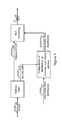
- FIG. 1 illustrates a conventional algorithm that estimates a noise floor.
- the illustrated algorithm is referred to as a sliding window algorithm, and estimates the RoT as given by equation (1).
- the main problem solved by this conventional estimation algorithm is that it can provide an accurate estimation of the thermal noise floor N(t). Since it is not possible to obtain exact estimates of this quantity due to the other cell interference, the estimator therefore applies an approximation, by consideration of a soft minimum as computed over a relative long window in time. It is important to understand that this estimation relies on the fact that the noise floor is constant over very long periods of time (disregarding the small temperature drift).
- the algorithm requires a large amount of storage memory. This becomes particularly troublesome in case a large number of instances of the algorithm is needed, as may be the case when base stations serve many cells and when techniques like 4-way receiver diversity is introduced in the WCDMA UL is introduced in the uplink.
- a recursive algorithm has been introduced to reduce the memory consumption. Relative to the sliding window algorithm, the recursive algorithm can reduce the memory requirement by a factor of more than one hundred.
- the scheduler uses this functionality.
- the scheduler tests different combinations of grants to determine the best combinations, e.g., maximizing the throughput.
- This scheduling decision will only affects the air interface load after a number of TTIs (each such TTI a predetermined time duration such as 2 or 10 ms), due to grant transmission latency and UE latency before the new grant takes effect over the air interface.
- the prediction of uplink load, for a tentative scheduled set of UEs and grants is based on the power relation defined by:
- L i (t) is the load factor of the i-th UE of the own cell.
- P other (t) denotes the other cell interference.
- the load factors of the own cell are computed as follows. First, note that:
- W i represents the spreading factor
- RxLoss represents the missed receiver energy
- G represents the diversity gain
- ⁇ :s represent the beta factors of the respective channels.
- inactive channels are assumed to have zero data beta factors.
- the UL load prediction then computes the uplink load of the own cell by a calculation of (6) and (7) for each UE of the own cell, followed by a summation:
- RoT ⁇ ( t + kT ) P othor ⁇ ( t ) / P N ⁇ ( t ) 1 - L own ⁇ ( t ) + 1 1 - L own ⁇ ( t ) . ( 10 )
- the load factor L i (t) is defined by (6).
- the load factor L i (t) can be defined by:
- An advantage of the power based load factor calculation is that the parameter dependency is reduced. But on the downside, a measurement of the UE power is needed.
- HetNets heterogeneous networks
- the cells are likely to have different radio properties in terms of (among others):
- HetNets An important factor in HetNets is that of the air interface load management, i.e., the issues associated with the scheduling of radio resources in different cells and the interaction between cells in terms of inter-cell interference.
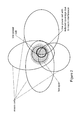
- FIG. 2 illustrates a low power cell with limited coverage intended to serve a hotspot.
- an interference suppressing receiver like the G-rake+ is used.
- the low power cell is located in the interior of and at the boundary of a specific macro cell.
- surrounding macro cells interfere with the low power cell rendering a high level of other cell interference in the low power cell which, despite the advanced receiver, reduces the coverage to levels that do not allow coverage of the hot spot.
- UEs of the hot spot are connected to the surrounding macro cells, which can further increase the other cell interference experienced by the low power cell.
- a non-limiting aspect of the disclosed subject matter is directed to a method performed in a radio network node of a wireless network for determining other cell interference applicable at a particular time.
- the method can also comprise the step of estimating an interference-and-noise sum P other (t 1 )+P N (t 1 ) based at least on the load utilization probability estimate ⁇ circumflex over (p) ⁇ load (t 0 ) and the interference-and-noise sum estimate ⁇ circumflex over (P) ⁇ other (t 0 )+ ⁇ circumflex over (P) ⁇ N (t 0 ) to obtain an interference-and-noise sum estimate ⁇ circumflex over (P) ⁇ other (t 1 )+ ⁇ circumflex over (P) ⁇ N (t 1 ) applicable at the time t 1 .
- the method can further comprise the step of estimating an other cell interference P other (t 1 ) based at least on the interference-and-noise sum estimate ⁇ circumflex over (P) ⁇ other (t 1 )+ ⁇ circumflex over (P) ⁇ N (t 1 ) and a thermal noise estimate ⁇ circumflex over (P) ⁇ N (t 1 ) to obtain an other cell interference estimate ⁇ circumflex over (P) ⁇ other (t 1 ) applicable at the time t 1 .
- Another non-limiting aspect of the disclosed subject matter is directed to a non-transitory computer-readable medium which has stored therein programming instructions.
- the computer executes the programming instructions, the computer executes the method performed in a radio network node of a wireless network as described above for determining other cell interference applicable at a particular time.
- the radio network node is structured to determine other cell interference applicable at a particular time.
- the radio network node can comprise a transceiver structured to transmit and receive wireless signals via one or more antennas from and to one or more cell terminals located within the cell of interest, a communicator structured to communicate with other network nodes, and a scheduler structured to schedule uplink transmissions from the cell terminals.
- the scheduler can further be structured to estimate an interference-and-noise sum P other (t 1 )+P N (t 1 ) based at least on the load utilization probability estimate ⁇ circumflex over (p) ⁇ load (t 0 ) and the interference-and-noise sum estimate ⁇ circumflex over (P) ⁇ other (t 0 )+ ⁇ circumflex over (P) ⁇ N (t 0 ) to obtain an interference-and-noise sum estimate ⁇ circumflex over (P) ⁇ other (t 1 )+ ⁇ circumflex over (P) ⁇ N (t 1 ) applicable at the time t 1 .
- the scheduler can yet further be structured to estimate an other cell interference P other (t 1 ) based at least on the interference-and-noise sum estimate ⁇ circumflex over (P) ⁇ other (t 1 )+ ⁇ circumflex over (P) ⁇ N (t 1 ) and a thermal noise estimate ⁇ circumflex over (P) ⁇ N (t 1 ) to obtain an other cell interference estimate ⁇ circumflex over (P) ⁇ other (t 1 ) applicable at the time t 1 .
- the load utilization probability p load (t) can express a relationships between radio resource grants scheduled to one or more cell terminals and radio resource grants used by the same cell terminals applicable at a time t.
- Each cell terminal can be a wireless terminal in the cell of interest, and ⁇ circumflex over (p) ⁇ load (t) can express an estimate of the load utilization probability p load (t).
- the interference-and-noise sum P other (t)+P N (t) can express a sum of undesired signals, other than an own cell load P own (t), applicable at the time t, and ⁇ circumflex over (P) ⁇ other (t)+ ⁇ circumflex over (P) ⁇ N (t) can express an estimate of the interference-and-noise sum estimate P other (t)+P N (t).
- the own cell load P own (t) can express a sum of signals due to wireless activities in the cell of interest.
- the other cell interference P other (t) can express a sum of interferences present in the cell of interest due to wireless activities applicable at the time t in one or more cells other than in the cell of interest, and P other (t) can express an estimate of the other cell interference P other (t).
- a thermal noise P N (t) can express a sum of undesired signals present in the cell of interest at the time t other than the own cell load P own (t) and other than the other cell interference P other (t), and ⁇ circumflex over (P) ⁇ N (t 1 ) can express an estimate of the thermal noise P N (t).
- FIG. 1 illustrates a conventional algorithm that estimates a noise floor.
- FIG. 2 illustrates an example scenario of a low power cell with limited coverage intended to serve a hotspot
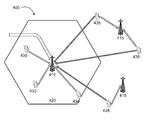
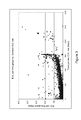
- FIG. 3 illustrates a plot of a grant utilization probability
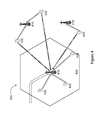
- FIG. 4 illustrates an example scenario in which other cell interference is determined
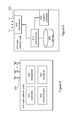
- FIGS. 5 and 6 respectively illustrate example embodiments of a radio network node
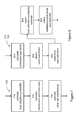
- FIG. 7 illustrates a flow chart of example method performed by a radio network node to determine an other cell interference
- FIG. 8 illustrates a flow chart of an example process performed by a radio network node to estimate the load utilization probability and to estimate the interference-and-noise sum
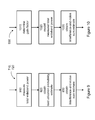
- FIG. 9 illustrates a flow chart of another example process performed by a radio network node to estimate the load utilization probability and to estimate the interference-and-noise sum
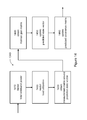
- FIG. 10 illustrates a flow chart of an example process performed by a radio network node to obtain an interference-and-noise sum estimate
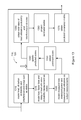
- FIG. 11 illustrates a flow chart of an example process performed by a radio network node to determine a gain factor
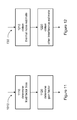
- FIG. 12 illustrates a flow chart of an example process performed by a radio network node to determine an other cell interference estimate
- FIG. 13 illustrates a flow chart of yet another example process performed by a radio network node to estimate the load utilization probability and to estimate the interference-and-noise sum
- FIG. 14 illustrates a flow chart of an example process performed by a radio network node to perform a Kalman filter update of a predicted state vector.
- block diagrams herein can represent conceptual views of illustrative circuitry embodying principles of the technology.
- any flow charts, state transition diagrams, pseudo code, and the like represent various processes which may be substantially represented in computer readable medium and executed by a computer or processor, whether or not such computer or processor is explicitly shown.
- processors may be provided through dedicated hardware as well as hardware capable of executing associated software.
- functions may be provided by a single dedicated processor, by a single shared processor, or by a plurality of individual processors, some of which may be shared or distributed.
- explicit use of term “processor” or “controller” should not be construed to refer exclusively to hardware capable of executing software, and may include, without limitation, digital signal processor (shortened to “DSP”) hardware, read only memory (shortened to “ROM”) for storing software, random access memory (shortened to RAM), and non-volatile storage.
- DSP digital signal processor
- ROM read only memory
- RAM random access memory
- 3GPP terminologies e.g., WCDMA, LTE—are used as examples for explanation purposes.
- the technology described herein can be applied to non-3GPP standards, e.g., WiMAX, cdma2000, 1xEVDO, etc.
- a base station e.g., RBS, NodeB, eNodeB, eNB, etc.
- RBS Radio Base Station
- NodeB NodeB
- eNodeB eNodeB
- eNB eNodeB
- the disclosed subject matter is applicable to any node, such as relay stations, that receive wireless signals.
- mobile terminals e.g., UE, mobile computer, PDA, etc.
- wireless terminals that communicate with the base station.
- the other cell interference P other (t) in this context may be viewed as a sum of interferences present in a cell of interest due to wireless activities applicable at time t in one or more cells other than in the cell of interest.
- the determination of the other cell interference P other (t) involves estimating the other cell interference.
- estimations of parameters are indicated with a “ ⁇ ” (caret) character. For example, ⁇ circumflex over (P) ⁇ other (t) may be read as an estimate of the other cell interference P other (t).
- the thermal noise floor N(t) is estimated as described above, i.e., ⁇ circumflex over (N) ⁇ (t) is determined followed by a subtraction to arrive at an estimate of the other cell interference ⁇ circumflex over (P) ⁇ other (t).
- the EUL utilizes a scheduler that aims to fill the load headroom of the air interface, so that the different UE requests for bitrates are met.
- the air-interface load in WCDMA is determined in terms of the noise rise over the thermal power level, i.e., the RoT(t), which is estimated at the base station.
- the scheduler When evaluating scheduling decisions, the scheduler predicts the load that results form the scheduled grants, to make sure that the scheduled load does not exceed the load thresholds for coverage and stability. This can be complicated since the grant given to a UE only expresses a limit on the UL power the UE is allowed to use. However, the UE may actually use only a portion of its grant.
- the conventional scheduler makes a worst case analysis, assuming that all UEs will use their grants at all times. But in reality, UEs in general have a relatively low utilization of grants. This is evident from field measurements as those depicted in FIG. 3 .
- the plot indicates a grant utilization of only about 25%. In other words, a significant amount (about 75%) of air-interface resources is wasted.
- Each of one or more aspects of the disclosed subject matter addresses one or more of the issues related to conventional techniques. For example, recall from above that in conventional scheduling techniques, there is a delay of some number of TTIs from the scheduling decision until the interference power appears over the air interface.
- the scheduler also bases its scheduling decisions on a prediction of the load of the traffic it schedules. Since the UEs do not always utilize power granted by the scheduler, the load prediction are likely to be inaccurate. The inaccuracy tends to increase as the delay increases.
- measurements of momentary load utilization may be made and accounted for in the estimation of other cell interferences.
- load factor bias may be estimated, e.g., when other cell interference is estimated.
- a general concept applicable to one or more inventive aspects includes a UL nonlinear interference model and an estimator.
- the UL nonlinear interference can be responsive to:
- the estimator can be responsive to:
- the estimator can also be responsive to a dynamic model for propagation of the estimated states.
- the estimated states can include:
- the estimator can further be responsive to an estimated thermal noise ⁇ circumflex over (P) ⁇ N (t), and provide an estimated other cell interference ⁇ circumflex over (P) ⁇ other (t).
- the other cell interference estimate ⁇ circumflex over (P) ⁇ other (t) may be arrived at by subtracting the thermal noise estimate ⁇ circumflex over (P) ⁇ N (t) from the interference-and-noise sum estimate ⁇ circumflex over (P) ⁇ other (t)+ ⁇ circumflex over (P) ⁇ N (t).
- the values of parameters are “estimated”, “measured”, “received” or “computed”.
- a measured value in essence can be viewed a number that expresses a value of a measured quantity.
- An estimated value is not a number that expresses a value of a measurement, at least not directly. Rather, an estimate can be viewed as a processed set of measurements, e.g., by some filtering operation.
- the processing to obtain estimates e.g., may combine measurements from different times to achieve e.g., noise suppression and bias reduction.
- the estimator can be a variant of an extended Kalman filter (EKF), arranged for processing using the nonlinear interference model.
- EKF extended Kalman filter
- One or more of the inventive aspects can be applied to both the sliding window and recursive RoT estimation algorithms. Either SIR or power based load factor calculation may be used. The power based calculation is preferred however.
- RNC radio network controller
- the surrounding RBSs can be informed of the interference situation and can take action as appropriate.
- admission control in the RNC or functionalities in the surrounding RBSs can be used to reduce the other cell interference and provide better management of the hot spot traffic, e.g., in terms of air interface load.
- the RBS can include capabilities to estimate the other cell interference.
- FIG. 4 illustrates an example scenario in which a radio network node 410 (e.g., eNB, eNode B, Node B, base station (BS), radio base station (RBS), and so on) can estimate the other cell interference.
- the radio network node 410 serves one or more wireless terminals 430 (e.g., user equipment, mobile terminal, laptops, M2M (machine-to-machine) terminals, etc.) located within a corresponding cell 420 .
- the radio network node 410 will be referred to as an own radio network node
- the cell 420 will be referred to as the cell of interest
- the terminals 430 within the cell of interest 420 will be referred to as own terminals.
- Uplink signaling and data traffic from the own terminals 430 to the own radio network node 410 are illustrated as solid white arrows.
- the scenario in FIG. 4 also includes other radio network nodes 415 serving other wireless terminals 435 as indicated by dashed white arrows.
- these signals are also received in the own radio network node 410 as indicated by shaded solid arrows.
- Such signals act as interferers within the cell of interest 420 .
- a sum of powers of these interfering signals experienced at the own radio network node 410 at time t will be denoted as P other (t).
- the other cell interference P other (t) may be viewed as expressing a sum of interferences present in the cell of interest due to wireless activities applicable at time t in one or more cells other than in the cell of interest 420 .
- FIG. 5 illustrates an example embodiment of a radio network node 410 .
- the radio network node 410 may comprise several devices including a controller 510 , a transceiver 520 , a communicator 530 and a scheduler 540 .
- the transceiver 520 may be structured to wirelessly communicate with wireless terminals 430 .
- the communicator 530 may be structured to communicate with other network nodes and with core network nodes.
- the controller 510 may be structured to control the overall operations of the radio network node 410 .
- FIG. 5 provides a logical view of the radio network node. It is not strictly necessary that each device be implemented as physically separate modules or circuits. Some or all devices may be combined in a physical module. Also, one or more devices may be implemented in multiple physical modules as illustrated in FIG. 6 .
- the radio network node 410 may include one or more central processing units 610 executing program instructions stored in a storage 620 such as non-transitory storage medium or firmware (e.g., ROM, RAM, Flash) to perform the functions of the devices.
- the radio network node 410 may also include a transceiver 520 structured to receive wireless signals from the wireless terminals 430 and to send signals to the wireless terminals 430 over one or more antennas 525 in one or more channels.
- the radio network node 410 may further include a network interface 630 to communicate with other network nodes such as the core network nodes.
- the radio network node 410 can be structured to implement a high performing estimator.
- the inventive estimator can perform a joint estimation of P othor (t)+P N (t), P N (t), P other (t) (note the upper case “P”) and the load utilization probability p load (t) (note the lower case “p”).
- An extended Kalman filter (EKF) can be used in one or more embodiments of the proposed estimator.
- the proposed estimator can use any one or more of the following information:
- Modeling in one aspect may be viewed as a form of state space modeling in which state space of a physical system is mathematically modeled as a set of input, output and state variables related by equations.
- the first state x 1 (t) should be delayed by an extra state to define the fact that the load utilization probability measurement is subject to an additional delay T for decoding.
- the fourth state x 4 (t) can be used for this purpose.
- the delay T can any positive integer multiple of the TTI. Typically the delay T is substantially equal to one TTI.
- ⁇ L own (t) represents a slowly varying load factor bias error in the measurement model.
- the estimated own cell load factor L own (t) may be introduced as the first state x 1 (t).
- P RTWP ⁇ ( t ) 1 1 - L own ⁇ ( t - T D ) ⁇ p load ⁇ ( t ) + ⁇ ⁇ ⁇ L _ own ⁇ ( t ) ⁇ ( P other ⁇ ( t ) + P N ⁇ ( t ) ) . ( 18 )
- y RTWP ⁇ ( t ) x 2 ⁇ ( t ) 1 - L own ⁇ ( t - T D ) ⁇ x 1 ⁇ ( t ) + x 3 ⁇ ( t ) ⁇ e RTWP ⁇ ( t ) , ( 19 )
- R 2 , RTWP ⁇ ( t ) E ⁇ [ e RTWP 2 ⁇ ( t ) ] . ( 20 )
- y RTWP (t) P RTWP (t) and R 2,RTWP (t) denotes the (scalar) covariance matrix of e RTWP (t). If the load of the own cell is computed using both EUL and R99 traffic, the delay can be valid for both. If the own cell load is estimated instead, L own (t ⁇ T D )x 1 (t) can be expressed by a state directly modeling the estimated load factor of the own cell. The own cell load factor appearing in (19) can be treated as a known time varying factor, not as an estimate.
- (19) can represents a nonlinear load curve, expressed in terms of the estimated load utilization probability (x 1 (t)), the estimated sum of neighbor cell interference and thermal noise power (x 2 (t)) and the estimated load factor bias (x 3 (t)). That is, (19) can represent a nonlinear curve expressed in terms of ⁇ circumflex over (x) ⁇ 1 (t), ⁇ circumflex over (x) ⁇ 2 (t) and ⁇ circumflex over (x) ⁇ 3 (t). Further the computed (“received”) load factor can be used in the nonlinear load curve. Equation (19) can be said to relate the momentary combined effect of the estimated quantities and received quantities to the left hand side of the equation, i.e. the momentary measurement of the wideband power.
- the thermal noise floor N(t) can be used to represent the thermal noise P N (t) and the thermal noise floor estimate ⁇ circumflex over (N) ⁇ (t) can be used to represent thermal noise estimate ⁇ circumflex over (P) ⁇ N (t) in these equations.
- Measurement of the load utilization probability p load (t) can be made available per cell.
- the decoded TFCIs and E-TFCISs show which grants the wireless terminal 430 actually used in the last TTI. This provides the information needed to compute the actual load factor of the last TTI, i.e. to compute:
- the transformation (21) can be view as essentially replacing the granted load factor, L own (t ⁇ T D ), with the load factor computed based on the received TFCIs and E-TFCIs,
- random walk models can be adapted for the first and second state variables x 1 (t) and x 2 (t).
- an autoregressive model can be used for the third state x 3 (t).
- the state can be expected to model errors that over an ensemble has a zero mean.
- the following state model can result from the states of (12)-(15).
- the delay T equals one TTI, but can be any positive integer multiple of the TTI.
- a 1
- a diagonal covariance matrix can be used.
- the last component of the system noise is preferably selected to be very small, reflecting the pure delay it is intended to model.
- x(t) denotes a state vector
- u(t) denotes an input vector (not used in the inventive filtering)
- y(t) denotes an output measurement vector comprising power measurements performed in a cell (i.e., the total received wideband power P RTWP (t))
- w(t) denotes the so called systems noise that represent the model error
- e(t) denotes the measurement error.
- the matrix A(t) is a system matrix describing the dynamic modes
- the matrix B(t) is the input gain matrix
- the vector c(x(t)) is the, possibly nonlinear, measurement vector which is a function of the states of the system.
- t represents the time and T represents the sampling period.
- the quantities introduced in the filter iterations (28) are different types of estimates ( ⁇ circumflex over (x) ⁇ (t
- R 1 (t) and R 2 (t) are often used as tuning variables of the filter.
- the bandwidth of the filter can be controlled by the matrix quotient of R 1 (t) and R 2 (t).
- FIG. 7 illustrates a flow chart of example method 700 performed by a radio network node 410 to implement a high performing estimator.
- the method 700 may be performed by the scheduler 540 , e.g., as load estimation functionality associated with the scheduler, to determine the other cell interference P other (t).
- the other cell interference estimate ⁇ circumflex over (P) ⁇ other (t) can be determined.
- the other cell interference P other (t) can express a sum of interferences present in the cell of interest 420 due to wireless activities applicable at the time t in one or more cells other than in the cell of interest.
- T can represent a duration between estimation times.
- T is a positive integer multiple of a transmission time interval, preferably one (e.g., for 10 ms TTI) but can be larger (e.g., 5 for 2 ms TTI).
- This estimation can be made based at least on the load utilization probability estimate ⁇ circumflex over (p) ⁇ load (t 0 ) and the interference-and-noise sum estimate ⁇ circumflex over (P) ⁇ other (t 0 )+ ⁇ circumflex over (P) ⁇ N (t 0 ).
- FIG. 8 illustrates a flow chart of an example process performed by the radio network node 410 to implement the steps 710 and 720 to obtain the load utilization probability estimate ⁇ circumflex over (p) ⁇ load (t 1 ) and to obtain the interference-and-noise sum estimate ⁇ circumflex over (P) ⁇ other (t 1 )+ ⁇ circumflex over (P) ⁇ N (t 1 ).
- a scheduled load factor L own (t 1 ⁇ T D ) can be calculated.
- T D can represent a delay between the calculation of the scheduled load factor and a time the schedule takes effect on an air interface.
- the scheduled load factor L own (t ⁇ T D ) can express an amount of the radio resource grants scheduled to be used by the cell terminals 430 for uplink transmissions at the time t.
- a used load factor L own (t 1 ⁇ T D ) can be obtained.
- the used load factor L own (t ⁇ T D ) can express an amount of the scheduled radio resource grants used by the cell terminals 430 for the uplink transmissions at the time t.
- step 830 a load utilization
- L _ own ⁇ ( t 1 - T D ) L own ⁇ ( t 1 - T D ) can be measured or otherwise determined. Based on the measured load utilization
- the load utilization probability estimate ⁇ circumflex over (p) ⁇ load (t 1 ) can be obtained in step 840 and the interference-and-noise sum estimate ⁇ circumflex over (P) ⁇ other (t 1 )+ ⁇ circumflex over (P) ⁇ N (t 1 ) can be obtained in step 850 .
- FIG. 9 illustrates a flow chart of another example process performed by the radio network node 410 to implement the steps 710 and 720 to obtain the load utilization probability estimate ⁇ circumflex over (p) ⁇ load (t 1 ) and to obtain the interference-and-noise sum estimate ⁇ circumflex over (P) ⁇ other (t 1 )+ ⁇ circumflex over (P) ⁇ N (t 1 ).
- a total wideband power y RTWP (t 1 ) can be measured.
- the load utilization probability estimate ⁇ circumflex over (p) ⁇ load (t 1 ) can be obtained in step 920 , and the interference-and-noise sum estimate ⁇ circumflex over (P) ⁇ other (t 1 )+ ⁇ circumflex over (P) ⁇ N (t 1 ) can be obtained in step 930 .
- FIG. 10 illustrates a flow chart of an example process performed by the radio network node 410 to implement the step 930 to obtain the interference-and-noise sum estimate ⁇ circumflex over (P) ⁇ other (t 1 )+ ⁇ circumflex over (P) ⁇ N (t 1 ).
- a gain factor g(t 1 ) can be determined based on the load utilization probability estimate ⁇ circumflex over (p) ⁇ load (t 1 ) and the scheduled load factor L own (t 0 ).
- the measured total wideband power y RTWP (t 1 ) can be modeled as a combination of the interference-and-noise sum estimate ⁇ circumflex over (P) ⁇ other (t 1 )+ ⁇ circumflex over (P) ⁇ N (t 1 ) weighted by the gain factor g(t 1 ) and a measurement uncertainty e RTWP (t 1 ). Based on the measured total wideband power y RTWP (t 1 ) and the modeling thereof, the interference-and-noise sum estimate ⁇ circumflex over (P) ⁇ other (t 1 )+ ⁇ circumflex over (P) ⁇ N (t 1 ) can be obtained.
- FIG. 11 illustrates a flow chart of an example process performed by the radio network node 410 to implement the step 1010 to determine the gain factor g(t 1 ).
- a load factor bias ⁇ L own (t 1 ) can be determined.
- the load factor bias ⁇ L own (t) can express an error of the scheduled load factor L own (t).
- the gain factor g(t 1 ) can be determined based on the based at least on the load utilization probability estimate ⁇ circumflex over (p) ⁇ load (t 1 ), the scheduled load factor L own (t 0 ), and the load factor bias ⁇ L own (t 1 ).
- the radio network node 410 can estimate the other cell interference P other (t 1 ) to obtain the other cell interference estimate ⁇ circumflex over (P) ⁇ other (t 1 ).
- the estimation can be based at least on the interference-and-noise sum estimate ⁇ circumflex over (P) ⁇ other (t 1 )+ ⁇ circumflex over (P) ⁇ N (t 1 ) and a thermal noise estimate ⁇ circumflex over (P) ⁇ N (t 1 ).
- the interference-and-noise sum P other (t)+P N (t) can express a sum of undesired signals, other than an own cell load P own (t).
- the interference-and-noise sum P other (t)+P N (t) are visually illustrated with shaded arrows (from the other terminals 435 ) and the large white arrow.
- FIG. 12 illustrates a flow chart of an example process performed by the radio network node 410 to implement the step 730 of estimating the other cell interference P other (t 1 ).
- the thermal noise estimate ⁇ circumflex over (P) ⁇ N (t 1 ) can be obtained.
- a thermal noise floor estimate ⁇ circumflex over (N) ⁇ (t 1 ) corresponding to the cell of interest 420 can be obtained as the thermal noise estimate ⁇ circumflex over (P) ⁇ N (t 1 ).
- thermal noise estimate ⁇ circumflex over (P) ⁇ N (t 1 ) can be subtracted from the interference-and-noise sum estimate ⁇ circumflex over (P) ⁇ other (t 1 )+ ⁇ circumflex over (P) ⁇ N (t 1 ) to obtain the other cell interference estimate ⁇ circumflex over (P) ⁇ other (t 1 ).
- FIG. 13 illustrates another flow chart of an example process performed by the radio network node 410 to implement the steps 710 and 720 to obtain the load utilization probability estimate ⁇ circumflex over (p) ⁇ load (t 1 ) and to obtain the interference-and-noise sum estimate ⁇ circumflex over (P) ⁇ other (t 1 )+ ⁇ circumflex over (P) ⁇ N (t 1 ).
- FIG. 13 may be viewed as a specific instance of the flow chart illustrated in FIG. 8 .
- the extended Kalman filtering adapted for estimation is used.
- x(t) represents the state vector
- u(t) represents an input vector
- y(t) represents the output measurement vector
- w(t) represents a model error vector
- e(t) represents a measurement error vector
- A(t) represents a system matrix describing dynamic modes of the system
- B(t) represents an input gain matrix
- c(x(t)) represents a measurement vector which is a function of the states of the system
- t represents the time
- T represents a sampling period.
- step 1320 the measured total wideband power y RTWP (t) and the measured load utilization y loadUtilization (t) can be modeled in the output measurement vector y(t) of the state space model.
- t 0 ) can be obtained.
- t 0 ) includes first and second predicted states ⁇ circumflex over (x) ⁇ 1 (t 1
- t ⁇ T) denotes a prediction of the state vector x(t) based on information available up to time t ⁇ T.
- t 1 ⁇ t 0 T>0.
- t 1 ) ⁇ circumflex over (x) ⁇ (t 1 ).
- the measurements can include the measured received total wideband power y RTWP (t 1 ) and the load utilization y load (t 1 ).
- the solid white arrow entering the step 1340 in FIG. 13 is to indicate that measurements may come into the step.
- step 1360 the estimated state vector ⁇ circumflex over (x) ⁇ (t 1 ) is projected based at least on dynamic modes corresponding to the cell of interest to obtain a predicted state vector ⁇ circumflex over (x) ⁇ (t 2
- t 1 ), t 2 ⁇ t 1 T.
- t 1 ) includes first and second predicted states ⁇ circumflex over (x) ⁇ 1 (t 2
- t 1 ) whose values are based on the load utilization probability estimate ⁇ circumflex over (p) ⁇ load (t 1 ) and the interference-and-noise sum estimate ⁇ circumflex over (x) ⁇ 2 (t 1 ) ⁇ circumflex over (P) ⁇ other (t 1 )+ ⁇ circumflex over (P) ⁇ N (t 1 ).
- This step corresponds to a predicting step of the Kalman filter algorithm in which future states are predicted based on current information. As seen, the steps in FIG. 13 can be iteratively performed.
- t 1 ) comprise performing a Kalman filter process to iteratively predict and update the state vector x(t) to obtain the estimated state vector ⁇ circumflex over (x) ⁇ (t).
- the estimated state vector ⁇ circumflex over (x) ⁇ (t) includes the first and second estimated states ⁇ circumflex over (x) ⁇ 1 (t) and ⁇ circumflex over (x) ⁇ 2 (t) corresponding to the load utilization probability estimate ⁇ circumflex over (p) ⁇ load (t) and the interference-and-noise sum estimate ⁇ circumflex over (P) ⁇ other (t)+ ⁇ circumflex over (P) ⁇ N (t).
- the step 1315 need not be performed if the third and fourth states are not used, and therefore, can be considered as optional. However, the third and fourth states are preferred to be used.
- FIG. 14 illustrates a flow chart of an example process performed by the radio network node 410 to implement the step 1340 to update predicted state vector ⁇ circumflex over (x) ⁇ (t 1
- T D can represent a delay between calculation of the schedule and a time the schedule takes effect on an air interface.
- e RTWP (t) can represent a measurement error.
- t 0 ) can be obtained.
- t 0 ) can include the first, second, third, and fourth predicted states ⁇ circumflex over (x) ⁇ 1 (t 1
- t 0 ) which are predicted based on data up to the time t t 0 .
- the measurement matrix C(t 1 ) can be obtained by determining the measurement matrix C(t 1 ) linearized around the predicted state vector ⁇ circumflex over (x) ⁇ (t 1
- a Kalman gain matrix K f (t 1 ) can be obtained based on at least the measurement matrix C(t 1 ), the measurement error vector e(t 1 ), and a predicted covariance matrix P(t 1
- t 0 ) can be updated based on at least the Kalman gain matrix K f (t 1 ), the output measurement vector y(t 1 ), and the measurement vector c(x(t 1 )) to obtain the estimated state vector ⁇ circumflex over (x) ⁇ (t 1
- t 1 ) ⁇ circumflex over (x) ⁇ (t 1 ).
- the estimated state vector ⁇ circumflex over (x) ⁇ (t 1 ) can include the first, second, third, and fourth estimated states ⁇ circumflex over (x) ⁇ 1 (t 1 ), ⁇ circumflex over (x) ⁇ 2 (t 1 ), ⁇ circumflex over (x) ⁇ 3 (t 1 ), ⁇ circumflex over (x) ⁇ 4 (t 1 ).
- t 1 ) ⁇ circumflex over (x) ⁇ ( t 1
- y(t 1 ) is the measurement vector, with components being the received total wideband power measurement and the load utilization measurement.
- t 0 ) can be updated based on at least the Kalman gain matrix K f (t 1 ) and the measurement matrix C(t 1 ) to obtain an updated covariance matrix P(t 1
- t 1 ) can be obtained through determining: P ( t 1
- t 1 ) P ( t 1
- the step 1360 of projecting the estimated state vector ⁇ circumflex over (x) ⁇ (t 1 ) can comprise projecting the estimated state vector ⁇ circumflex over (x) ⁇ (t 1 ) based on at least the system matrix A(t 1 ) to obtain the predicted state vector ⁇ circumflex over (x) ⁇ (t 2
- t 1 ) includes the first, second, third, and fourth predicted states ⁇ circumflex over (x) ⁇ 1 (t 2
- t 1 ) can be projected to obtain a predicted covariance matrix P(t 2
- t 1 ) can be obtained by determining ⁇ circumflex over (x) ⁇ (t 2
- t 1 ) A ⁇ circumflex over (x) ⁇ (t 1
- t 1 ) AP(t 1
- Another advantage is in providing estimates of load utilization probability and other cell interference that can enhance the performance of the scheduler and the overall HetNet interference management. This can lead to (among others):
Landscapes
- Engineering & Computer Science (AREA)
- Computer Networks & Wireless Communication (AREA)
- Signal Processing (AREA)
- Mobile Radio Communication Systems (AREA)
Priority Applications (6)
| Application Number | Priority Date | Filing Date | Title |
|---|---|---|---|
| US13/488,187 US9020548B2 (en) | 2012-06-04 | 2012-06-04 | Other cell interference estimation |
| US14/405,354 US9549408B2 (en) | 2012-06-04 | 2013-03-14 | Interference congestion control |
| PCT/SE2013/050252 WO2013184056A2 (fr) | 2012-06-04 | 2013-03-14 | Régulation de l'encombrement dû aux interférences |
| EP13800066.6A EP2856828A4 (fr) | 2012-06-04 | 2013-03-14 | Régulation de l'encombrement dû aux interférences |
| EP13800178.9A EP2856829B1 (fr) | 2012-06-04 | 2013-06-04 | Estimation de l'interférence d'autres cellules |
| PCT/SE2013/050643 WO2013184063A2 (fr) | 2012-06-04 | 2013-06-04 | Estimation de l'interférence d'autres cellules |
Applications Claiming Priority (1)
| Application Number | Priority Date | Filing Date | Title |
|---|---|---|---|
| US13/488,187 US9020548B2 (en) | 2012-06-04 | 2012-06-04 | Other cell interference estimation |
Related Child Applications (2)
| Application Number | Title | Priority Date | Filing Date |
|---|---|---|---|
| US14/405,354 Continuation-In-Part US9549408B2 (en) | 2012-06-04 | 2013-03-14 | Interference congestion control |
| US14/405,354 Continuation US9549408B2 (en) | 2012-06-04 | 2013-03-14 | Interference congestion control |
Publications (2)
| Publication Number | Publication Date |
|---|---|
| US20130324175A1 US20130324175A1 (en) | 2013-12-05 |
| US9020548B2 true US9020548B2 (en) | 2015-04-28 |
Family
ID=49670866
Family Applications (1)
| Application Number | Title | Priority Date | Filing Date |
|---|---|---|---|
| US13/488,187 Expired - Fee Related US9020548B2 (en) | 2012-06-04 | 2012-06-04 | Other cell interference estimation |
Country Status (3)
| Country | Link |
|---|---|
| US (1) | US9020548B2 (fr) |
| EP (2) | EP2856828A4 (fr) |
| WO (2) | WO2013184056A2 (fr) |
Cited By (3)
| Publication number | Priority date | Publication date | Assignee | Title |
|---|---|---|---|---|
| US20140112281A1 (en) * | 2011-06-10 | 2014-04-24 | Telefonaktiebolaget L M Ericsson (Publ) | Closed Control Loop for Uplink Scheduling |
| US20150195792A1 (en) * | 2012-07-16 | 2015-07-09 | Telefonaktiebolaget L M Ericsson (Publ) | Thermal Noise Floor Estimation Robustness Via Multi-Carrier Combining |
| US9888398B2 (en) * | 2013-03-22 | 2018-02-06 | Telefonaktiebolaget Lm Ericsson (Publ) | Interference estimation and devices therefore |
Families Citing this family (6)
| Publication number | Priority date | Publication date | Assignee | Title |
|---|---|---|---|---|
| US9301172B2 (en) * | 2012-10-19 | 2016-03-29 | Telefonaktiebolaget Lm Ericsson (Publ) | Method, apparatus, and system for interference and noise estimation |
| CN104854804B (zh) * | 2012-11-23 | 2017-05-31 | 瑞典爱立信有限公司 | 用于估计其他小区干扰的方法和无线网络节点 |
| US9007947B2 (en) * | 2013-02-25 | 2015-04-14 | Telefonaktiebolaget L M Ericsson (Publ) | Grant utilization based other cell interference estimation |
| US9480068B2 (en) | 2014-01-31 | 2016-10-25 | Telefonaktiebolaget L M Ericsson (Publ) | Scheduling in cellular communication systems |
| WO2015192909A1 (fr) * | 2014-06-19 | 2015-12-23 | Telefonaktiebolaget L M Ericsson (Publ) | Régulation d'un niveau de désensibilisation à appliquer sur un récepteur radio en liaison montante |
| CN113873570B (zh) * | 2020-06-30 | 2023-11-03 | 华为技术有限公司 | 干扰协同方法及相关设备 |
Citations (20)
| Publication number | Priority date | Publication date | Assignee | Title |
|---|---|---|---|---|
| US20040048587A1 (en) * | 2000-10-19 | 2004-03-11 | Xinxi Diao | Apparatus and method for implementing multi-traffic load monitoring and prediction |
| US20060209721A1 (en) * | 2005-03-15 | 2006-09-21 | Qualcomm Incorporated | Interference control in a wireless communication system |
| WO2007024166A1 (fr) | 2005-08-26 | 2007-03-01 | Telefonaktiebolaget Lm Ericsson (Publ) | Procedes et dispositifs d'evaluation d'augmentation de bruit |
| US20070105561A1 (en) * | 2005-11-10 | 2007-05-10 | Alcatel | Method and apparatus for uplink resource allocation in a cellular communication system |
| US20070155395A1 (en) * | 2005-12-29 | 2007-07-05 | Nandu Gopalakrishnan | Scheduling mobile users based on cell load |
| US20070177536A1 (en) | 2006-01-27 | 2007-08-02 | Stefan Brueck | Method of scheduling uplink resource in a wireless communication system |
| US7317897B2 (en) * | 2002-06-04 | 2008-01-08 | Nokia Corporation | Power based radio resource management |
| WO2008039123A1 (fr) | 2006-09-25 | 2008-04-03 | Telefonaktiebolaget Lm Ericsson (Publ) | Procédés et agencements d'estimation de bruit de fond à faible consommation de mémoire |
| US7599331B2 (en) * | 2006-11-03 | 2009-10-06 | Samsung Electronics Co., Ltd. | Apparatus and method for controlling data transfer rate on reverse link in mobile communication system |
| US20100135170A1 (en) * | 2007-01-18 | 2010-06-03 | Rui Fan | Load estimation for a cell in a wireless network |
| US20110009070A1 (en) | 2007-06-29 | 2011-01-13 | Telefonaktiebolaget Lm Ericsson (Publ) | Method for Noise Floor and Interference Estimation |
| US7912461B2 (en) | 2005-11-11 | 2011-03-22 | Telefonaktiebolaget L M Ericsson (Publ) | Complexity reduction in power estimation |
| US7920517B2 (en) * | 2006-04-28 | 2011-04-05 | Alcatel-Lucent Usa Inc. | Uplink load control including individual measurements |
| US20110098014A1 (en) | 2009-10-22 | 2011-04-28 | Anritsu Company | Dynamic spur avoidance for high speed receivers |
| WO2011119075A1 (fr) | 2010-03-23 | 2011-09-29 | Telefonaktiebolaget L M Ericsson (Publ) | Prédiction de charge de liaison montante à l'aide de filtres de kalman |
| US20120196589A1 (en) | 2006-07-05 | 2012-08-02 | Telefonaktiebolaget L M Ericsson (Publ) | Method and arrangement for noise floor estimation |
| WO2013043093A1 (fr) | 2011-09-23 | 2013-03-28 | Telefonaktiebolaget L M Ericsson (Publ) | Noeud de réseau radiocommunication, noeud de commande de réseau de radiocommunication et procédés de gestion de ressources radio dans un réseau de radiocommunications |
| US8676124B2 (en) * | 2007-09-28 | 2014-03-18 | Qualcomm Incorporated | Scheduling based on effective target load with interference cancellation in a wireless communication system |
| US20140112164A1 (en) * | 2012-10-19 | 2014-04-24 | Telefonaktiebolaget L M Ericsson (Publ) | Method, apparatus, and system for interference and noise estimation |
| US8712424B2 (en) * | 2006-10-31 | 2014-04-29 | Qualcomm Incorporated | Inter-cell power control in the presence of fractional frequency reuse |
-
2012
- 2012-06-04 US US13/488,187 patent/US9020548B2/en not_active Expired - Fee Related
-
2013
- 2013-03-14 WO PCT/SE2013/050252 patent/WO2013184056A2/fr not_active Ceased
- 2013-03-14 EP EP13800066.6A patent/EP2856828A4/fr not_active Withdrawn
- 2013-06-04 EP EP13800178.9A patent/EP2856829B1/fr not_active Not-in-force
- 2013-06-04 WO PCT/SE2013/050643 patent/WO2013184063A2/fr not_active Ceased
Patent Citations (21)
| Publication number | Priority date | Publication date | Assignee | Title |
|---|---|---|---|---|
| US20040048587A1 (en) * | 2000-10-19 | 2004-03-11 | Xinxi Diao | Apparatus and method for implementing multi-traffic load monitoring and prediction |
| US7317897B2 (en) * | 2002-06-04 | 2008-01-08 | Nokia Corporation | Power based radio resource management |
| US20060209721A1 (en) * | 2005-03-15 | 2006-09-21 | Qualcomm Incorporated | Interference control in a wireless communication system |
| WO2007024166A1 (fr) | 2005-08-26 | 2007-03-01 | Telefonaktiebolaget Lm Ericsson (Publ) | Procedes et dispositifs d'evaluation d'augmentation de bruit |
| US20070105561A1 (en) * | 2005-11-10 | 2007-05-10 | Alcatel | Method and apparatus for uplink resource allocation in a cellular communication system |
| US7912461B2 (en) | 2005-11-11 | 2011-03-22 | Telefonaktiebolaget L M Ericsson (Publ) | Complexity reduction in power estimation |
| US20070155395A1 (en) * | 2005-12-29 | 2007-07-05 | Nandu Gopalakrishnan | Scheduling mobile users based on cell load |
| US20070177536A1 (en) | 2006-01-27 | 2007-08-02 | Stefan Brueck | Method of scheduling uplink resource in a wireless communication system |
| US7920517B2 (en) * | 2006-04-28 | 2011-04-05 | Alcatel-Lucent Usa Inc. | Uplink load control including individual measurements |
| US20120196589A1 (en) | 2006-07-05 | 2012-08-02 | Telefonaktiebolaget L M Ericsson (Publ) | Method and arrangement for noise floor estimation |
| WO2008039123A1 (fr) | 2006-09-25 | 2008-04-03 | Telefonaktiebolaget Lm Ericsson (Publ) | Procédés et agencements d'estimation de bruit de fond à faible consommation de mémoire |
| US8712424B2 (en) * | 2006-10-31 | 2014-04-29 | Qualcomm Incorporated | Inter-cell power control in the presence of fractional frequency reuse |
| US7599331B2 (en) * | 2006-11-03 | 2009-10-06 | Samsung Electronics Co., Ltd. | Apparatus and method for controlling data transfer rate on reverse link in mobile communication system |
| US20100135170A1 (en) * | 2007-01-18 | 2010-06-03 | Rui Fan | Load estimation for a cell in a wireless network |
| US20110009070A1 (en) | 2007-06-29 | 2011-01-13 | Telefonaktiebolaget Lm Ericsson (Publ) | Method for Noise Floor and Interference Estimation |
| US8676124B2 (en) * | 2007-09-28 | 2014-03-18 | Qualcomm Incorporated | Scheduling based on effective target load with interference cancellation in a wireless communication system |
| US20110098014A1 (en) | 2009-10-22 | 2011-04-28 | Anritsu Company | Dynamic spur avoidance for high speed receivers |
| WO2011119075A1 (fr) | 2010-03-23 | 2011-09-29 | Telefonaktiebolaget L M Ericsson (Publ) | Prédiction de charge de liaison montante à l'aide de filtres de kalman |
| US20120314607A1 (en) * | 2010-03-23 | 2012-12-13 | Telefonaktiebolaget L M Ericsson (Publ) | Uplink load prediction using kalman filters |
| WO2013043093A1 (fr) | 2011-09-23 | 2013-03-28 | Telefonaktiebolaget L M Ericsson (Publ) | Noeud de réseau radiocommunication, noeud de commande de réseau de radiocommunication et procédés de gestion de ressources radio dans un réseau de radiocommunications |
| US20140112164A1 (en) * | 2012-10-19 | 2014-04-24 | Telefonaktiebolaget L M Ericsson (Publ) | Method, apparatus, and system for interference and noise estimation |
Non-Patent Citations (11)
| Title |
|---|
| International Search Report and Written Opinion mailed Jan. 27, 2014 in International Application No. PCT/SE2013/050643 (13 pages total). |
| International Search Report and Written Opinion with transmittal sheet dated Jan. 22, 2014 in International Application No. PCT/SE2013/050561 (12 pages total). |
| Inventor: Torbjörn Wigren, U.S. Appl. No. 13/656,581, filed Oct. 19, 2012, "Method, Apparatus, and System for Interference and Noise Estimation". |
| Inventor: Torbjörn Wigren, U.S. Appl. No. 13/776,328, filed Feb. 25, 2013, "Grant Utilization Based Other Cell Interference Estimation". |
| Inventor: Torbjörn Wigren, U.S. Appl. No. 13/853,369, filed Mar. 29, 2013, "Interference Estimation With TDM". |
| Inventor: Torbjörn Wigren, U.S. Appl. No. 13/993,429, filed Jun. 12, 2013, "Radio Base Station and Method Therein". |
| Kambiz Shoarinejad et al., "Integrated Predictive Power Control and Dynamic Channel Assignment in Mobile Radio Systems", IEEE Transactions on Wireless Communications, vol. 2, No. 5, Sep. 2003, pp. 976-988. |
| Torbjörn Wigren et al., "Estimation of uplink WCDMA load in a single RBS", Sweden (5 pages). |
| Torbjörn Wigren, "Low Complexity Kalman Filtering for Inter-Cell Interference and Power Based Load Estimation in the WCDMA Uplink", Signal Processing and Communication Systems (ICSPCS), 2011 5th International Conference on, Dec. 2011 (10 pages). |
| Torbjörn Wigren, "Recursive Noise Floor Estimation in WCDMA", IEEE Transactions on Vehicular Technology, vol. 59, No. 5, Jun. 2010, pp. 2615-2620. |
| Torbjörn Wigren, "Soft Uplink Load Estimation in WCDMA", IEEE Transactions on Vehicular Technology, vol. 58, No. 2, Feb. 2009, pp. 760-772. |
Cited By (5)
| Publication number | Priority date | Publication date | Assignee | Title |
|---|---|---|---|---|
| US20140112281A1 (en) * | 2011-06-10 | 2014-04-24 | Telefonaktiebolaget L M Ericsson (Publ) | Closed Control Loop for Uplink Scheduling |
| US9480078B2 (en) * | 2011-06-10 | 2016-10-25 | Telefonaktiebolaget Lm Ericsson (Publ) | Closed control loop for uplink scheduling |
| US20150195792A1 (en) * | 2012-07-16 | 2015-07-09 | Telefonaktiebolaget L M Ericsson (Publ) | Thermal Noise Floor Estimation Robustness Via Multi-Carrier Combining |
| US9332507B2 (en) * | 2012-07-16 | 2016-05-03 | Telefonaktiebolaget L M Ericsson (Publ) | Thermal noise floor estimation robustness via multi-carrier combining |
| US9888398B2 (en) * | 2013-03-22 | 2018-02-06 | Telefonaktiebolaget Lm Ericsson (Publ) | Interference estimation and devices therefore |
Also Published As
| Publication number | Publication date |
|---|---|
| WO2013184063A2 (fr) | 2013-12-12 |
| EP2856829A4 (fr) | 2015-11-11 |
| EP2856828A2 (fr) | 2015-04-08 |
| WO2013184056A3 (fr) | 2014-03-20 |
| WO2013184063A3 (fr) | 2014-03-20 |
| EP2856829A2 (fr) | 2015-04-08 |
| EP2856828A4 (fr) | 2015-05-27 |
| EP2856829B1 (fr) | 2016-08-24 |
| WO2013184056A2 (fr) | 2013-12-12 |
| US20130324175A1 (en) | 2013-12-05 |
Similar Documents
| Publication | Publication Date | Title |
|---|---|---|
| US9301172B2 (en) | Method, apparatus, and system for interference and noise estimation | |
| US9020548B2 (en) | Other cell interference estimation | |
| EP2923525B1 (fr) | Procédé, appareil et système pour signalisation de mesure d'interférence | |
| US9883518B2 (en) | Radio network node, a controlling radio network node, and methods therein for enabling management of radio resources in a radio communications network | |
| US9001686B2 (en) | Interference estimation with TDM | |
| US9007947B2 (en) | Grant utilization based other cell interference estimation | |
| US9578535B2 (en) | Other cell interference estimation | |
| US9888398B2 (en) | Interference estimation and devices therefore | |
| US9480068B2 (en) | Scheduling in cellular communication systems | |
| US9549408B2 (en) | Interference congestion control | |
| US20150350986A1 (en) | Method and Apparatus for Soft Handover Guidance in WCDMA TD Scheduling |
Legal Events
| Date | Code | Title | Description |
|---|---|---|---|
| AS | Assignment |
Owner name: TELEFONAKTIEBOLAGET LM ERICSSON (PUBL), SWEDEN Free format text: ASSIGNMENT OF ASSIGNORS INTEREST;ASSIGNOR:WIGREN, TORBJORN;REEL/FRAME:028395/0665 Effective date: 20120611 |
|
| STCF | Information on status: patent grant |
Free format text: PATENTED CASE |
|
| CC | Certificate of correction | ||
| FEPP | Fee payment procedure |
Free format text: MAINTENANCE FEE REMINDER MAILED (ORIGINAL EVENT CODE: REM.); ENTITY STATUS OF PATENT OWNER: LARGE ENTITY |
|
| LAPS | Lapse for failure to pay maintenance fees |
Free format text: PATENT EXPIRED FOR FAILURE TO PAY MAINTENANCE FEES (ORIGINAL EVENT CODE: EXP.); ENTITY STATUS OF PATENT OWNER: LARGE ENTITY |
|
| STCH | Information on status: patent discontinuation |
Free format text: PATENT EXPIRED DUE TO NONPAYMENT OF MAINTENANCE FEES UNDER 37 CFR 1.362 |
|
| FP | Lapsed due to failure to pay maintenance fee |
Effective date: 20190428 |