US9100714B2 - Audience-measuring method - Google Patents
Audience-measuring method Download PDFInfo
- Publication number
- US9100714B2 US9100714B2 US14/378,868 US201314378868A US9100714B2 US 9100714 B2 US9100714 B2 US 9100714B2 US 201314378868 A US201314378868 A US 201314378868A US 9100714 B2 US9100714 B2 US 9100714B2
- Authority
- US
- United States
- Prior art keywords
- peer
- neighboring
- peers
- list
- television channel
- Prior art date
- Legal status (The legal status is an assumption and is not a legal conclusion. Google has not performed a legal analysis and makes no representation as to the accuracy of the status listed.)
- Active
Links
Images


Classifications
-
- H—ELECTRICITY
- H04—ELECTRIC COMMUNICATION TECHNIQUE
- H04N—PICTORIAL COMMUNICATION, e.g. TELEVISION
- H04N21/00—Selective content distribution, e.g. interactive television or video on demand [VOD]
- H04N21/60—Network structure or processes for video distribution between server and client or between remote clients; Control signalling between clients, server and network components; Transmission of management data between server and client, e.g. sending from server to client commands for recording incoming content stream; Communication details between server and client
- H04N21/63—Control signaling related to video distribution between client, server and network components; Network processes for video distribution between server and clients or between remote clients, e.g. transmitting basic layer and enhancement layers over different transmission paths, setting up a peer-to-peer communication via Internet between remote STB's; Communication protocols; Addressing
- H04N21/632—Control signaling related to video distribution between client, server and network components; Network processes for video distribution between server and clients or between remote clients, e.g. transmitting basic layer and enhancement layers over different transmission paths, setting up a peer-to-peer communication via Internet between remote STB's; Communication protocols; Addressing using a connection between clients on a wide area network, e.g. setting up a peer-to-peer communication via Internet for retrieving video segments from the hard-disk of other client devices
-
- G—PHYSICS
- G06—COMPUTING OR CALCULATING; COUNTING
- G06Q—INFORMATION AND COMMUNICATION TECHNOLOGY [ICT] SPECIALLY ADAPTED FOR ADMINISTRATIVE, COMMERCIAL, FINANCIAL, MANAGERIAL OR SUPERVISORY PURPOSES; SYSTEMS OR METHODS SPECIALLY ADAPTED FOR ADMINISTRATIVE, COMMERCIAL, FINANCIAL, MANAGERIAL OR SUPERVISORY PURPOSES, NOT OTHERWISE PROVIDED FOR
- G06Q30/00—Commerce
- G06Q30/02—Marketing; Price estimation or determination; Fundraising
- G06Q30/0201—Market modelling; Market analysis; Collecting market data
-
- H—ELECTRICITY
- H04—ELECTRIC COMMUNICATION TECHNIQUE
- H04L—TRANSMISSION OF DIGITAL INFORMATION, e.g. TELEGRAPHIC COMMUNICATION
- H04L67/00—Network arrangements or protocols for supporting network services or applications
- H04L67/01—Protocols
- H04L67/10—Protocols in which an application is distributed across nodes in the network
- H04L67/104—Peer-to-peer [P2P] networks
- H04L67/1061—Peer-to-peer [P2P] networks using node-based peer discovery mechanisms
- H04L67/1063—Discovery through centralising entities
-
- H—ELECTRICITY
- H04—ELECTRIC COMMUNICATION TECHNIQUE
- H04L—TRANSMISSION OF DIGITAL INFORMATION, e.g. TELEGRAPHIC COMMUNICATION
- H04L67/00—Network arrangements or protocols for supporting network services or applications
- H04L67/01—Protocols
- H04L67/10—Protocols in which an application is distributed across nodes in the network
- H04L67/104—Peer-to-peer [P2P] networks
- H04L67/1074—Peer-to-peer [P2P] networks for supporting data block transmission mechanisms
- H04L67/1076—Resource dissemination mechanisms or network resource keeping policies for optimal resource availability in the overlay network
-
- H—ELECTRICITY
- H04—ELECTRIC COMMUNICATION TECHNIQUE
- H04L—TRANSMISSION OF DIGITAL INFORMATION, e.g. TELEGRAPHIC COMMUNICATION
- H04L67/00—Network arrangements or protocols for supporting network services or applications
- H04L67/01—Protocols
- H04L67/10—Protocols in which an application is distributed across nodes in the network
- H04L67/104—Peer-to-peer [P2P] networks
- H04L67/1087—Peer-to-peer [P2P] networks using cross-functional networking aspects
- H04L67/1093—Some peer nodes performing special functions
-
- H04L67/22—
-
- H—ELECTRICITY
- H04—ELECTRIC COMMUNICATION TECHNIQUE
- H04L—TRANSMISSION OF DIGITAL INFORMATION, e.g. TELEGRAPHIC COMMUNICATION
- H04L67/00—Network arrangements or protocols for supporting network services or applications
- H04L67/50—Network services
- H04L67/535—Tracking the activity of the user
-
- H—ELECTRICITY
- H04—ELECTRIC COMMUNICATION TECHNIQUE
- H04N—PICTORIAL COMMUNICATION, e.g. TELEVISION
- H04N21/00—Selective content distribution, e.g. interactive television or video on demand [VOD]
- H04N21/20—Servers specifically adapted for the distribution of content, e.g. VOD servers; Operations thereof
- H04N21/23—Processing of content or additional data; Elementary server operations; Server middleware
- H04N21/24—Monitoring of processes or resources, e.g. monitoring of server load, available bandwidth, upstream requests
- H04N21/2407—Monitoring of transmitted content, e.g. distribution time, number of downloads
-
- H—ELECTRICITY
- H04—ELECTRIC COMMUNICATION TECHNIQUE
- H04N—PICTORIAL COMMUNICATION, e.g. TELEVISION
- H04N21/00—Selective content distribution, e.g. interactive television or video on demand [VOD]
- H04N21/40—Client devices specifically adapted for the reception of or interaction with content, e.g. set-top-box [STB]; Operations thereof
- H04N21/41—Structure of client; Structure of client peripherals
- H04N21/426—Internal components of the client ; Characteristics thereof
- H04N21/42684—Client identification by a unique number or address, e.g. serial number, MAC address, socket ID
-
- H—ELECTRICITY
- H04—ELECTRIC COMMUNICATION TECHNIQUE
- H04N—PICTORIAL COMMUNICATION, e.g. TELEVISION
- H04N21/00—Selective content distribution, e.g. interactive television or video on demand [VOD]
- H04N21/40—Client devices specifically adapted for the reception of or interaction with content, e.g. set-top-box [STB]; Operations thereof
- H04N21/43—Processing of content or additional data, e.g. demultiplexing additional data from a digital video stream; Elementary client operations, e.g. monitoring of home network or synchronising decoder's clock; Client middleware
- H04N21/442—Monitoring of processes or resources, e.g. detecting the failure of a recording device, monitoring the downstream bandwidth, the number of times a movie has been viewed, the storage space available from the internal hard disk
- H04N21/44213—Monitoring of end-user related data
- H04N21/44222—Analytics of user selections, e.g. selection of programmes or purchase activity
- H04N21/44224—Monitoring of user activity on external systems, e.g. Internet browsing
Definitions
- the invention relates to a method for measuring the audience of a television channel broadcast in a continuous stream over a peer-to-peer network.
- Another subject of the invention is an information storage medium, a monitored peer and a counting terminal for implementing this method.
- Broadcasting in a continuous stream denotes a mode of transmission of a multimedia content wherein a client equipment item can play the multimedia content as it receives it. “Broadcasting in a continuous stream” is better known by the term “streaming” or “live” broadcasting.
- Streaming differs from “file downloading”.
- file downloading the client equipment item must first receive all the packets making up the multimedia content before it can start to play this multimedia content. There is no predetermined order or a predetermined time interval in which a fragment of the file must be received by its recipient.
- the stream fragments In streaming, on the contrary, the stream fragments must be received in a predetermined time interval around the instant of receiving of a previous fragment of this same stream. If the fragment has not been received in the predetermined time interval, it is eliminated and will not be read by the multimedia reader. To do this, typically, each fragment is associated with a lifetime. If the fragment has not reached its recipient before its lifetime has elapsed, the fragment is destroyed. Thus, the playing of a television channel can start before all the fragments that make it up have been received. To do this, all the fragments generally take the same route in the Internet. For example, a previously established routing table is constructed and used for this purpose.
- Terminal-to-terminal networks are better known by the term “Peer-to-peer” network.
- Such a peer-to-peer network is formed by a large number of computers, known as peers, interconnected by an information transmission network.
- the information transmission network is the world-wide web, better known by the term “Internet”.
- a peer can download a fragment or chunk of a television channel from the buffer memory of any other peer of the peer-to-peer network that receives the same television channel.
- the peer that downloads the chunk is known as the “child peer” and the peer from which the child peer downloads the chunk is known as the “parent peer”.
- each peer is able to play, generally at the same time, the roles of child peer and parent peer.
- a peer is capable of playing, at the same time, the roles of client, server and router to direct the chunks stored in its buffer memory toward the buffer memory of the child peers.
- a child peer contains a list of neighboring peers. This list contains identifiers of peers, called “neighboring peers”, of the peer-to-peer network that this peer knows and can therefore contact to try to download a chunk of the television channel.
- the identifier of a peer is its IP (Internet Protocol) address and a port number used to exchange information by way of the Internet with the computer application that manages the connection and the implementation of the peer-to-peer network. This application is called “peer-to-peer software program” here.
- Audience measurements constructed in this way are hardly exhaustive because of the necessarily limited number of peers equipped with the recorder.
- the aim of the invention is to remedy this drawback. Its subject is therefore a method for measuring the audience of a television channel streamed over a peer-to-peer network in accordance with claim 1 .
- the audience measurement constructed using the method above is simpler because it does not require each peer used for measuring the audience to be equipped with a recording device.
- the fact of using lists of neighboring peers transmitted by so-called “conventional” peers, i.e. peers not equipped with any particular recording device, to take the audience measurement makes it possible to collect the audience information from the conventional peers in a simple way. From that point, it is easier to collect a much larger quantity of information, which increases the exhaustiveness of the constructed audience measurement.
- the embodiments of this method can include one or more features of the dependent method claims.
- Another subject of the invention is a method for visualizing a television channel streamed over a peer-to-peer network in accordance with claim 9 .
- Another subject of the invention is an information storage medium in accordance with claim 10 .
- Another subject of the invention is a monitored peer for implementing the audience measurement method above.
- a final subject of the invention is a counting terminal for implementing the audience measurement method above.
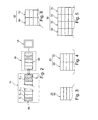
- FIG. 1 is a schematic illustration of a system for visualizing a television channel streamed over a peer-to-peer network
- FIG. 2 is a schematic illustration of various buffer memories of a peer of the peer-to-peer network in FIG. 1 ;
- FIGS. 3 to 6 are schematic illustrations of various lists and tables used in the system in FIG. 1 ;
- FIG. 7 is a block diagram of a method for visualizing a television channel using the system in FIG. 1 .
- FIG. 1 represents a system for visualizing television channels streamed over a peer-to-peer network formed by peers interconnected by an information transmission network 4 .
- the network 4 is the world-wide web.
- the system 2 is described in the special case where the peer-to-peer network uses the SopCast protocol. This protocol is for example described in the following articles:
- the system 2 comprises a server 5 for an initial list of neighboring peers.
- This server is known by the terms “broker” or “tracker”.
- the system 2 comprises a large number of conventional peers connected to each other by way of the network 4 .
- the system 2 comprises a large number of conventional peers connected to each other by way of the network 4 .
- FIG. 1 To simplify FIG. 1 , only two conventional peers 6 and 7 are represented. These peers 6 and 7 are for example identical and only the peer 6 is described in detail.
- the peer 6 is a computer equipped with a central unit 8 and a screen 10 .
- the central unit 8 comprises a programmable electronic computer 12 capable of executing instructions stored on an information storage medium.
- the computer 12 is connected to a memory 14 containing the instructions needed to execute the method in FIG. 7 .
- the memory 14 comprises in particular:
- the peer-to-peer software program 16 is a SopCast client module here.
- the peer 6 is connected to the network 4 .
- it has an IP (Internet Protocol) address and a port number associated with the SopCast client module. This IP address and this port number are used by the peer 6 to communicate with other peers of the peer-to-peer network.
- IP Internet Protocol
- the system 2 also comprises an appliance 26 for measuring the audience of a television channel streamed over the peer-to-peer network.
- This appliance 26 comprises a large number of monitored peers.
- the monitored peers of the appliance 26 are implemented on virtual machines executed on various servers distributed over various countries on various continents.
- the monitored peers have IP addresses corresponding to various countries on various continents according to the nomenclature of the IP addresses established by the IANA (Internet Assigned Numbers Authority).
- monitored peers are for example structurally identical to each other. To simplify FIG. 1 , only two monitored peers 28 and 30 are represented. These peers are implemented on different servers and therefore have different IP addresses.
- the peer 28 includes a programmable electronic computer 34 capable of executing instructions stored on an information storage medium.
- the peer 28 includes a memory 36 containing the instructions needed to execute the method in FIG. 7 .
- the memory 36 includes the instructions of a SopCast client module 38 .
- This client module 38 is identical to the module 16 , but also includes additional functions which will be described with reference to the method in FIG. 7 .
- the memory 36 also includes a list 40 of neighboring peers.
- the appliance 26 also includes a counting terminal 44 optionally connected to a screen 45 .
- the terminal 44 comprises a programmable electronic computer 46 capable of executing instructions stored on an information storage medium to execute the method in FIG. 7 .
- the computer 46 is connected to a memory 48 containing the instructions needed to execute the method in FIG. 7 .
- the memory 48 here includes:
- FIG. 2 represents in more detail the buffer memories of a conventional peer.
- the client module 16 implements a buffer memory 60 capable of containing a time period ⁇ T of the television channel broadcast at a given moment.
- the time period ⁇ T is below or equal to 1 min and above 15 s.
- the time period ⁇ T is equal to 40 s plus or minus 5 s.
- the television channel is divided into a large number of time segments S i immediately consecutive to each other. These time segments S i are known by the term “chunk”.
- the index i represents the order number of a chunk. This index i identifies the position of the chunk with respect to the other chunks in the same television channel. For example the chunks S i are classed by increasing order number.
- the buffer memory 60 is designed to contain “n” chunks S i to S i+n .
- the hatched chunks S i are chunks already received by the client module 16 and which can be downloaded by other peers of the peer-to-peer network. Conversely, the white chunks S i are chunks to be downloaded by the client module 16 from one or more parent peers.
- a chunk S i can be received in advance or delayed with respect to the chunks S i ⁇ 1 and S i+1 .
- the time window inside which the chunk S i must be received is a function of the time period ⁇ T. If the chunk S i is not received in this time window, it is eliminated and cannot be visualized on the screen 10 .
- the multimedia reader 18 also implements a buffer memory 62 wherein the various chunks S i of the television channel to be watched are transferred from the buffer memory 60 as the multimedia content is read and displayed on the screen 10 .
- FIG. 3 represents the list 20 of neighboring peers.
- This list 20 essentially comprises, for each instance of storage, a field 66 intended to contain the IP address and the port number of the client module 16 of the conventional “neighboring” peer of the peer 6 .
- the field 20 can contain the IP address and the port number of the client module of the peer 7 .
- FIG. 4 represents the list 40 of neighboring peers.
- This list 40 is identical to the list 20 , except that it also includes a field 70 intended to contain the instant of addition of the neighboring peer to the list 40 .
- This field 70 is associated with each field 66 containing an IP address and a port number.
- FIG. 5 represents the counting table 56 .
- This table 56 is identical to the list 40 , except that it also includes the fields 74 and 76 for each instance of storage.
- the field 74 is intended to contain the instant of disconnection of a neighboring peer.
- the field 76 is intended to contain an identifier of a geographical area corresponding to the IP address of the neighboring peer.
- the geographical area can be a continent, a group of countries, a country, a region of a country or a town.
- FIG. 6 represents the database 58 .
- This database essentially contains, for each instance of storage, a field 80 containing a fingerprint and a field 82 containing an identifier of the multimedia content corresponding to this fingerprint.
- the fingerprints are fingerprints of multimedia content. For example they are constructed in accordance with the method described in the application WO 2009 141 378.
- the identifier of the multimedia content can be a title of a film or of a program or of a sporting event or other content.
- the method includes a phase 86 of visualizing, by a conventional peer, a television channel streamed over the peer-to-peer network of the system 2 .
- This phase 86 is described in the special case where the peer 6 is a child peer and the peer 7 is a parent peer.
- the peer 6 connects to the peer-to-peer network.
- the peer 6 acquires the identifier of the television channel to be watched. For example, it can be the number of the television channel.
- the client module 16 of the peer 6 sends a request to the server 5 to obtain a first list of neighboring peers currently watching the same television channel.
- the client module 16 receives this list of neighboring peers.
- This list of neighboring peers contains the IP addresses and the port numbers of the client modules executed by the neighboring peers.
- the child peer sends a request to the peers contained in the received list to distinguish the active peers in this list apart from the inactive peers therein.
- the peer 6 updates the list 20 .
- This updating consists in adding to the list 20 the IP address and the port number of the client module of the neighboring peer that has replied.
- the list 20 contains the IP addresses and the port numbers of the client modules of the peers from which the peer 6 is likely to download a chunk of the television channel that it has selected.
- the peers polled by the child peer also add to their own list 20 of neighboring peers the IP address and the port number of the client module 16 of the peer 6 .
- a step 102 follows wherein the peer 6 sends a request to one of the neighboring peers, the address of which is contained in its own list 20 , to receive the list of the neighboring peers of this neighboring peer. For example the peer 6 sends the request to the peer 7 .
- the step 102 is then followed by the step 94 .
- the repetition of the steps 94 to 102 allows the peer 6 to complete its own list 20 and therefore to discover new neighboring peers.
- the peer 6 proceeds to download chunks of the television channel.
- it requests from a neighbor peer, whose IP address is contained in its list 20 , to provide the identifiers of the chunks S i that the buffer memory of this neighboring peer contains.
- the peer 6 receives from the neighboring peer the list of the chunks S i that it contains.
- this received list contains identifiers of chunks that the child peer does not possess, then, in an operation 114 , the child peer requests from this neighboring peer the transmission of one or more of the chunks that it lacks.
- the neighboring peer which is also from that point onward a parent peer, sends the requested chunks to the child peer.
- the child peer stores the downloaded chunk in its buffer memory 60 .
- the peer 6 repeats the steps 110 to 122 with the following neighboring peer identified in its list 20 .
- the peer 6 identifies one or more parent peers, generally less than five or less than three, from the buffer memory 60 from which it can download in time the chunks needed to fill its own memory 60 .
- the term “fill in time” indicates that the downloaded chunks are received in time to fill, above a predetermined threshold S 1 , the buffer memory 60 with immediately consecutive chunks.
- the threshold S 1 corresponds to two, three or over 10 consecutive chunks S i . From that moment, it is no longer necessary to repeat the steps 94 to 102 . Consequently, the peer 6 puts an end to the iteration of the steps 94 to 102 .
- a step 130 when the number of segments downloaded is above a predetermined threshold S 2 , the peer 6 launches the execution of the multimedia reader 18 .
- the multimedia reader 18 downloads the video chunks from the memory 60 to its own buffer memory 62 .
- the multimedia reader 18 plays the video chunks in order on the screen 10 .
- the peer 6 is a child peer for several peers of the peer-to-peer network and, also at the same time, a parent peer for one or more peers of this same peer-to-peer network.
- phase 140 of measuring the audience of the television channel streamed over this peer-to-peer network is executed.
- phase 140 is only described in the special case of the monitored peer 28 .
- the monitored peer 28 proceeds to the same steps 88 to 122 as a conventional peer except that the steps 98 and 100 are replaced, by steps 142 and 144 respectively.
- the step 142 is identical to the step 98 , except that the IP address and the port number of the neighboring peer are added to the list 40 and this IP address and this port number are associated with an instant of entry into this list 40 stored in the memory in the field 70 .
- the instant of entry is for example measured based on an internet clock of the peer 28 .
- the step 144 is executed when the peer 28 is polled by other conventional peers. It is identical to the step 100 except that the IP address and the port number are stored in the list 40 associated with an instant of entry into this list 40 .
- the monitored peer 28 does not execute the steps 130 to 134 .
- the monitored peer 28 differs from the conventional peer 6 in that it executes an infinite loop containing the steps 94 to 102 .
- the step 102 is systematically repeated in a loop for each new neighboring peer added to the list 40 .
- this iteration of the steps 94 to 102 is not stopped even if the list 40 already contains neighboring peers from the memory 60 from which the monitored peer 28 can download in time the chunks needed to fill its own memory 60 .
- the fact that the monitored peer downloads the chunks allows it to play the role of parent peer toward other child peers of the peer-to-peer network. This makes it possible to discover other neighboring peers than those contained in the list received in the step 94 .
- a step 150 the module 54 for constructing the audience measurement requests from each monitored peer its own list 40 of neighboring peers.
- each monitored peer transmits its list 40 to the counting terminal 44 .
- the construction module 54 establishes the table 56 on the basis of the various lists 40 received. To do this, in an operation 156 , it adds to this table 56 each new neighboring peer not already present in the table. For each neighboring peer added, the fields 66 and 70 are completed from the corresponding fields of the received list 40 .
- the module 54 continues with the geolocation of its IP address.
- the geolocation of the IP address consists in identifying a geographical area and typically a country, from the IP address stored in the field 66 of the table 56 .
- Geolocation of this type is known. For example it is performed by implementing the services accessible on Internet sites such as: www.localiser-ip.com or www.loc8ip.com.
- the identifier of the geographical area thus obtained is stored in the field 76 of the table 56 associated with the IP address of the added neighboring peer.
- the steps 150 to 154 are repeated in a loop, for example with a regular interval below 1 minute or below 15 seconds.
- the construction module 54 executes an infinite loop in which it polls each peer whose IP address features in the field 66 . For example, in the step 160 , the module 54 sends to the peer a “hello” command.
- the module 54 leaves the field 74 associated with this peer empty to indicate that this peer is still connected to the television channel.
- the module 54 indicates an instant of disconnection in the field 74 associated with the IP address of this neighboring peer.
- the instant of disconnection is here chosen to be equal to the date on which the absence of reply of this peer is discovered by the module 54 .
- the date is for example a time period in seconds expressed from a known origin.
- the module 54 constructs the audience measurement.
- the audience measurement consists in numbering the number of peers in the table 56 present in a selected geographical area and whose field 74 is empty. This makes it possible to obtain the number of peers currently watching the television channel on the peer-to-peer network in the selected geographical area.
- the geographical area can be the set of all the identifiable geographical areas or a more limited geographical area such as a country or a region or a town.
- step 170 other processes can be performed such as the measurement of the average time of connection to this television channel over the peer-to-peer network.
- This average connection time can be computed on the basis of the differences between the instants contained in the fields 70 and 74 .
- the step 170 is repeated in a loop with a frequency below 1 or 5 minutes to refresh the audience measurement in real time.
- the constructed audience measurement is displayed on the screen 45 .
- the screen 45 presents a map of the world and the audience measurement carried out for each country is displayed on this map of the world.
- the average connection time can also be displayed.
- the counting terminal 44 identifies the watched multimedia content. For this purpose, in an operation 182 , the terminal 44 downloads one or more chunks of the television channel from a conventional peer or a monitored peer.
- this fingerprint is constructed in accordance with the information in application WO 2009 141 378.
- the terminal 44 compares the constructed fingerprint with the fingerprints contained in the field 80 of the database 58 .
- the identifier of the multimedia content associated with this fingerprint is associated with the audience measurement constructed at the same instant for these chunks.
- no identifier of multimedia content is associated with these chunks.
- the identifier of the multimedia content is associated with an instant of broadcasting measured from the same origin as the instants stored in the field 74 .
- the peer-to-peer network can use other protocols than the SopCast protocol.
- the following protocols can be used: Coolstreaming, PPLive, PPStream, TVAnts, Veetle, BT Live, etc.
- the appliance 26 only includes a single monitored peer.
- the list 40 of neighboring peers and the table 56 are the same objects.
- the module 54 for constructing the audience measurement is also implemented in the monitored peer.
- the counting terminal and the monitored peer are combined in the same appliance.
- the distribution of the various monitored peers over various continents is not obligatory.
- the various monitored peers can also have IP addresses located in one and the same country or in one and the same region.
- the monitored peers are not necessarily implemented on virtual machines. In another embodiment each monitored peer is implemented on a conventional computer.
- the monitored peer can be devoid or not of a multimedia reader or of a function allowing the broadcast television channel to be played.
- the polling of the neighboring peers to verify that they are connected to the television channel is performed by the monitored peers rather than by the counting terminal.
- the monitored peer does not proceed to download the chunks of the television channel.
- the steps 108 , 120 and 122 are omitted.
- the geolocation of the IP addresses can be omitted. In this case, it is enough for the audience measurement to number all the peers in the whole world that have visualized the television channel. In this embodiment the field 76 is omitted.
- the field 74 is omitted and the steps 160 to 164 are also omitted. In this embodiment, only the number of peers that have visualized the television channel during the time interval during which the appliance 26 has been in operation are measured.
- alias In another embodiment, in the lists 40 transmitted to the counting terminal 44 , other identifiers of the neighboring peers than the IP address are used.
- This other identifier is typically called an alias. It is constructed on the basis of the IP address and, optionally, of the port number and identifies the neighboring peer in a unique way but does not allow the terminal 44 to retrieve the corresponding IP address solely from the information contained in the alias.
- the alias is also constructed in such a way that, no matter which monitored peer has constructed it, the alias obtained for the same IP address is the same. This makes it possible to mask the IP addresses from the sight of the counting terminal 44 .
- the geolocation is made by the monitored peers.
- the alias is for example obtained by encrypting the IP address of the neighboring peer with an encryption key.
- the identification of the multimedia contents broadcast over the television channel can be performed by other methods.
- the multimedia contents broadcast over this television channel may have been watermarked before broadcasting. This can for example involve methods developed by the companies DIGIMARC® or CIVOLUTION®.
- the identification of the broadcast multimedia contents can also be performed by the monitored peers.
- the list 40 transmitted by each monitored peer to the counting terminal is completed using the identifier of the multimedia content when it has been possible to identify the latter.
- the monitored peers construct the fingerprint or extract the watermark from the downloaded chunks. Next, they transmit the constructed fingerprint or the extracted watermark from the counting terminal. The counting terminal then proceeds to identify the multimedia content by executing, for example, the steps 186 to 190 .
- the monitored peers construct the fingerprint or extract the watermark then transmit the fingerprints or the watermark to the counting terminal for a subsequent comparison with the database 58 of the contents.
- the identification of the multimedia content can also be performed a posteriori, i.e. a long time after the chunks have been downloaded.
- the identification of the multimedia content is omitted.
- the database 58 can be omitted and the step 180 is omitted.
Landscapes
- Engineering & Computer Science (AREA)
- Signal Processing (AREA)
- Business, Economics & Management (AREA)
- Computer Networks & Wireless Communication (AREA)
- Strategic Management (AREA)
- Development Economics (AREA)
- Finance (AREA)
- Accounting & Taxation (AREA)
- Multimedia (AREA)
- Entrepreneurship & Innovation (AREA)
- General Health & Medical Sciences (AREA)
- Health & Medical Sciences (AREA)
- Social Psychology (AREA)
- Economics (AREA)
- Theoretical Computer Science (AREA)
- General Physics & Mathematics (AREA)
- General Business, Economics & Management (AREA)
- Physics & Mathematics (AREA)
- Marketing (AREA)
- Game Theory and Decision Science (AREA)
- Data Mining & Analysis (AREA)
- Power Engineering (AREA)
- Databases & Information Systems (AREA)
- Computing Systems (AREA)
- Computer Hardware Design (AREA)
- General Engineering & Computer Science (AREA)
- Two-Way Televisions, Distribution Of Moving Picture Or The Like (AREA)
- Information Transfer Between Computers (AREA)
- Data Exchanges In Wide-Area Networks (AREA)
- Computer And Data Communications (AREA)
Applications Claiming Priority (3)
| Application Number | Priority Date | Filing Date | Title |
|---|---|---|---|
| FR1251573 | 2012-02-21 | ||
| FR1251573A FR2987147B1 (fr) | 2012-02-21 | 2012-02-21 | Procede de mesure d'audience |
| PCT/EP2013/052401 WO2013124159A1 (fr) | 2012-02-21 | 2013-02-07 | Procede de mesure d'audience |
Publications (2)
| Publication Number | Publication Date |
|---|---|
| US20150058876A1 US20150058876A1 (en) | 2015-02-26 |
| US9100714B2 true US9100714B2 (en) | 2015-08-04 |
Family
ID=47666148
Family Applications (1)
| Application Number | Title | Priority Date | Filing Date |
|---|---|---|---|
| US14/378,868 Active US9100714B2 (en) | 2012-02-21 | 2013-02-07 | Audience-measuring method |
Country Status (8)
| Country | Link |
|---|---|
| US (1) | US9100714B2 (es) |
| EP (1) | EP2817775B1 (es) |
| CN (1) | CN104137133B (es) |
| ES (1) | ES2559611T3 (es) |
| FR (1) | FR2987147B1 (es) |
| PL (1) | PL2817775T3 (es) |
| RU (1) | RU2582857C2 (es) |
| WO (1) | WO2013124159A1 (es) |
Cited By (1)
| Publication number | Priority date | Publication date | Assignee | Title |
|---|---|---|---|---|
| US20210168199A1 (en) * | 2019-02-22 | 2021-06-03 | Verizon Patent And Licensing Inc. | Peer to peer communications for repairing wireless multicast/broadcast delivered content |
Families Citing this family (13)
| Publication number | Priority date | Publication date | Assignee | Title |
|---|---|---|---|---|
| WO2015096745A1 (zh) * | 2013-12-24 | 2015-07-02 | 乐视网信息技术(北京)股份有限公司 | 一种内容传送网络的数据处理方法与装置 |
| EP3105884A4 (en) | 2014-02-11 | 2018-03-21 | Yaana Technologies, LLC | Mathod and system for metadata analysis and collection with privacy |
| US10447503B2 (en) | 2014-02-21 | 2019-10-15 | Yaana Technologies, LLC | Method and system for data flow management of user equipment in a tunneling packet data network |
| US10334037B2 (en) * | 2014-03-31 | 2019-06-25 | Yaana Technologies, Inc. | Peer-to-peer rendezvous system for minimizing third party visibility and method thereof |
| US10285038B2 (en) | 2014-10-10 | 2019-05-07 | Yaana Technologies, Inc. | Method and system for discovering user equipment in a network |
| US10542426B2 (en) | 2014-11-21 | 2020-01-21 | Yaana Technologies, LLC | System and method for transmitting a secure message over a signaling network |
| WO2016176661A1 (en) | 2015-04-29 | 2016-11-03 | Yaana Technologies, Inc. | Scalable and iterative deep packet inspection for communications networks |
| US10135930B2 (en) | 2015-11-13 | 2018-11-20 | Yaana Technologies Llc | System and method for discovering internet protocol (IP) network address and port translation bindings |
| CN105656986A (zh) * | 2015-11-26 | 2016-06-08 | 乐视云计算有限公司 | 一种直播视频的播放方法、装置及系统 |
| US11544726B2 (en) * | 2020-06-22 | 2023-01-03 | The Nielsen Company (Us), Llc | Methods, systems, articles of manufacture, and apparatus to estimate audience population |
| US11095940B1 (en) * | 2020-06-22 | 2021-08-17 | The Nielsen Company (Us), Llc | Methods, systems, articles of manufacture, and apparatus to estimate audience population |
| US12489811B1 (en) * | 2024-06-04 | 2025-12-02 | Bank Of America Corporation | Peer-to-peer network transmission verification system |
| TWI908376B (zh) * | 2024-10-07 | 2025-12-11 | 農業部茶及飲料作物改良場 | 一茶葉產地鑑別檢驗方法 |
Citations (6)
| Publication number | Priority date | Publication date | Assignee | Title |
|---|---|---|---|---|
| US20040215698A1 (en) | 2001-07-13 | 2004-10-28 | Christian Bertin | Method of delivering content to destination terminals and collection server |
| US20080163303A1 (en) * | 2006-12-29 | 2008-07-03 | Goosean Media Inc. | Video playback device for channel browsing |
| WO2009141378A1 (fr) | 2008-05-23 | 2009-11-26 | Advestigo | Procede et systeme d'indexation et de recherche de documents video |
| WO2009147163A1 (fr) | 2008-06-03 | 2009-12-10 | Groupe Des Ecoles Des Telecommunications - Ecole Nationale Superieure Des Telecommunications | Procède de traçabilité et de résurgence de flux pseudonymises sur des réseaux de communication, et procède d'émission de flux informatif apte a sécuriser le trafic de données et ses destinataires |
| US20100146138A1 (en) * | 2008-12-09 | 2010-06-10 | Hong Kong Applied Science And Technology Research Institute Co., Ltd. | Method of data request scheduling in peer-to-peer sharing networks |
| US20110153391A1 (en) * | 2009-12-21 | 2011-06-23 | Michael Tenbrock | Peer-to-peer privacy panel for audience measurement |
Family Cites Families (4)
| Publication number | Priority date | Publication date | Assignee | Title |
|---|---|---|---|---|
| CN1937503A (zh) * | 2005-09-23 | 2007-03-28 | 千橡世纪科技发展(北京)有限公司 | 一种加速网页内容下载的系统和方法 |
| RU2008137726A (ru) * | 2006-03-03 | 2010-04-10 | Вериматрикс, Инк. (Us) | Сетевая система и способ дистрибуции на базе киностудии |
| CN1937554A (zh) * | 2006-09-30 | 2007-03-28 | 南京信风软件有限公司 | 一种使p2p文件下载流量本地化的方法 |
| US20110225312A1 (en) * | 2010-03-10 | 2011-09-15 | Thomson Licensing | Unified cache and peer-to-peer method and apparatus for streaming media in wireless mesh networks |
-
2012
- 2012-02-21 FR FR1251573A patent/FR2987147B1/fr not_active Expired - Fee Related
-
2013
- 2013-02-07 WO PCT/EP2013/052401 patent/WO2013124159A1/fr not_active Ceased
- 2013-02-07 RU RU2014138126/08A patent/RU2582857C2/ru active
- 2013-02-07 US US14/378,868 patent/US9100714B2/en active Active
- 2013-02-07 ES ES13702813.0T patent/ES2559611T3/es active Active
- 2013-02-07 CN CN201380010159.5A patent/CN104137133B/zh not_active Expired - Fee Related
- 2013-02-07 EP EP13702813.0A patent/EP2817775B1/fr active Active
- 2013-02-07 PL PL13702813T patent/PL2817775T3/pl unknown
Patent Citations (7)
| Publication number | Priority date | Publication date | Assignee | Title |
|---|---|---|---|---|
| US20040215698A1 (en) | 2001-07-13 | 2004-10-28 | Christian Bertin | Method of delivering content to destination terminals and collection server |
| US20080163303A1 (en) * | 2006-12-29 | 2008-07-03 | Goosean Media Inc. | Video playback device for channel browsing |
| WO2009141378A1 (fr) | 2008-05-23 | 2009-11-26 | Advestigo | Procede et systeme d'indexation et de recherche de documents video |
| WO2009147163A1 (fr) | 2008-06-03 | 2009-12-10 | Groupe Des Ecoles Des Telecommunications - Ecole Nationale Superieure Des Telecommunications | Procède de traçabilité et de résurgence de flux pseudonymises sur des réseaux de communication, et procède d'émission de flux informatif apte a sécuriser le trafic de données et ses destinataires |
| US20100146138A1 (en) * | 2008-12-09 | 2010-06-10 | Hong Kong Applied Science And Technology Research Institute Co., Ltd. | Method of data request scheduling in peer-to-peer sharing networks |
| US20110153391A1 (en) * | 2009-12-21 | 2011-06-23 | Michael Tenbrock | Peer-to-peer privacy panel for audience measurement |
| WO2011084779A1 (en) | 2009-12-21 | 2011-07-14 | Arbitron Inc. | Distributed audience measurement systems and methods |
Non-Patent Citations (21)
| Title |
|---|
| Ali et al., "Measurement of Commercial Peer-To-Peer Live Video Streaming," In Proceedings of the Workshop in Recent Advances in Peer-to-Peer Streaming (2006). |
| Cholez et al., "Etat de l'art: Réseaux pair à pair, supervision, sécurité et approches collaboratives," (2010). |
| Cholez et al., "Une architecture de honeypots distribués pour superviser le réseau P2P KAD," 9e Conférence Internationale sur Les Nouvelles Technologies de la Repartition pp. 76-82 (2009). |
| Daswani, "Denial-Of-Service (DOS) Attacks and Commerce Infrastructure in Peer-To-Peer Networks," Stanford University Doctoral Dissertation (2004). |
| Dhungel et al., "The Pollution Attack in P2P Live Video Streaming: Measurement Results and Defenses," Proceedings of the 2007 workshop on Peer-to-peer streaming and IP-TV pp. 323-328 (2007). |
| Douceur , "The Sybil Attack," PS '01 Revised Papers from the First International Workshop on Peer-to-Peer Systems pp. 251-260 (2002). |
| Eittenberger et al., "Measurement and Analysis of Live-Streamed P2PTV Traffic," HET-NETs pp. 195-212 (2010). |
| Engle et al., "Vulnerabilities of P2P Systems and a Critical Look at their Solutions," Networking and Media Communications Research Laboratories Computer Science Dept., Kent State University Technical Report (2006). |
| Fallica et al., "On the Quality of Experience of SopCast," NGMAST '08, The Second International Conference on Next Generation Mobile Applications, Services and Technologies pp. 501-506 (2008). |
| Gheorghe, et al., "Security and Privacy Issues in P2P Streaming Systems: A Survey," University of Trento Technical Report (2009). |
| Haridasan et al., "SecureStream: An Intrusion-Tolerant Protocol for Live-Streaming Dissemination," Computer Communications 31:3, pp. 563-575 (2008). |
| Lesniewski-Laas, "A Sybil-proof one-hop DHT," SocialNets'08 (2008). |
| Lesueur et al., "Gestion distribuée d'identités résistante à la Sybil attack pour un réseau pair-á-pair," Sixth Conference on Security and Network Architectures (SARSSI) (2007). |
| Nicolosi et al., "P2PCast: A Peer-to-Peer Multicast Scheme for Streaming Data," 1st IRIS Student Workshop (2003). |
| Prêtre, "Attacks on Peer-to-Peer Networks," Swiss Federal Institute of Technology (ETH) Zurich Thesis (2005). |
| Seibert et al., "'Won't You Be My Neighbor?' Neighbor Selection Attacks in Mesh-based Peer-to-Peer Streaming," Computer Science Technical Reports. Paper 1694 (2008). |
| Shahzad Ali et al., "Measurement of commercial peer-to-peer live video streaming," School of Computer Science Carnegie Mellon University (Jan. 2, 2006). |
| Sirui et al., "The Content Pollution in Peer-to-Peer Live Streaming Systems: Analysis and Implications," ICPP '08 37th International Conference on Parallel Processing, pp. 652,659, 9-12 (2008). |
| Tangpong, "Managing Sybil Identities in Distributed Networks," The Pennsylvania State University The Graduate School Doctoral Dissertation (2010). |
| Wang, "Attacks Against Peer-to-peer Networks and Countermeasures," Helsinki University of Technology Seminar on Network Security (2006). |
| Xie et al., "Coolstreaming: Design, Theory, and Practice," IEEE Transactions on Multimedia, vol. 9, No. 8 (2007). |
Cited By (2)
| Publication number | Priority date | Publication date | Assignee | Title |
|---|---|---|---|---|
| US20210168199A1 (en) * | 2019-02-22 | 2021-06-03 | Verizon Patent And Licensing Inc. | Peer to peer communications for repairing wireless multicast/broadcast delivered content |
| US11588887B2 (en) * | 2019-02-22 | 2023-02-21 | Verizon Patent And Licensing Inc. | Peer to peer communications for repairing wireless multicast/broadcast delivered content |
Also Published As
| Publication number | Publication date |
|---|---|
| FR2987147A1 (fr) | 2013-08-23 |
| RU2014138126A (ru) | 2016-04-10 |
| FR2987147B1 (fr) | 2014-03-28 |
| RU2582857C2 (ru) | 2016-04-27 |
| US20150058876A1 (en) | 2015-02-26 |
| EP2817775B1 (fr) | 2015-11-04 |
| ES2559611T3 (es) | 2016-02-15 |
| CN104137133A (zh) | 2014-11-05 |
| EP2817775A1 (fr) | 2014-12-31 |
| PL2817775T3 (pl) | 2016-04-29 |
| CN104137133B (zh) | 2017-11-10 |
| WO2013124159A1 (fr) | 2013-08-29 |
Similar Documents
| Publication | Publication Date | Title |
|---|---|---|
| US20150058876A1 (en) | Audience-measuring method | |
| JP5974392B2 (ja) | Isoベースメディアファイルフォーマットに基づく適応ストリーミングについてのセキュアな非同期イベント通知のためのシステム及び方法 | |
| CN104426853B (zh) | 一种多媒体同步播放方法、服务器、终端以及系统 | |
| JP5902820B2 (ja) | ピアツーピアコンテンツ配信システムにおけるピアによって受信されたコンテンツの完全性の確認 | |
| FR2811848A1 (fr) | Systeme, procede et dispositif d'horodatage et de verification de la validite d'horodate dans un environnement de diffusion numerique | |
| Coileain et al. | Accounting and accountability in content distribution architectures: a survey | |
| MX2014012335A (es) | Metodo y sistema para marcar e identificar de manera uniforme lugares de oportunidad de colocacion para facilitar decision de resolucion acelerada. | |
| US20180287878A1 (en) | Monitoring a peer-to-peer network | |
| MX2014012332A (es) | Metodo para ingerir multiples señales de la misma relevancia. | |
| CN110213671A (zh) | 一种热点短视频确定方法和装置 | |
| CN116600153B (zh) | 设备管理方法和装置、存储介质及电子设备 | |
| CN110290192B (zh) | 基于区块链的数据分布式存储以及数据获取方法、装置 | |
| CN102026028A (zh) | 收视率调查方法和相关终端及系统 | |
| CN102739701A (zh) | 媒体流访问控制方法与对等流媒体系统 | |
| MX2014015107A (es) | Metodo y sistema para manipulacion eficiente de manifiestos. | |
| EP4221086B1 (en) | Computing system with device attestation feature | |
| CN106231371A (zh) | 时间同步方法、电视及epg服务器 | |
| JP2005167907A (ja) | テレビ視聴率調査システム及び視聴状況データ収集方法並びにそのコンピュータプログラム | |
| Quadrio et al. | Network analysis of the sony remote play system | |
| CN101521666A (zh) | 用于内容的实况传送的方法、以及控制设备和关联的设备 | |
| JP6016773B2 (ja) | プッシュ−プルベースのコンテンツ配信システム | |
| CN102387415A (zh) | 一种ipqam资源分配的方法、装置和系统 | |
| US9167316B2 (en) | Reusable media sources for online broadcast data | |
| CN108574864A (zh) | 用于收视行为数据采集系统的检测方法及检测装置 | |
| US20210058651A1 (en) | Method for distributing content |
Legal Events
| Date | Code | Title | Description |
|---|---|---|---|
| AS | Assignment |
Owner name: VIACCESS, FRANCE Free format text: ASSIGNMENT OF ASSIGNORS INTEREST;ASSIGNOR:GASNIER, JEAN-MARC;REEL/FRAME:033960/0411 Effective date: 20140825 |
|
| STCF | Information on status: patent grant |
Free format text: PATENTED CASE |
|
| MAFP | Maintenance fee payment |
Free format text: PAYMENT OF MAINTENANCE FEE, 4TH YEAR, LARGE ENTITY (ORIGINAL EVENT CODE: M1551); ENTITY STATUS OF PATENT OWNER: LARGE ENTITY Year of fee payment: 4 |
|
| FEPP | Fee payment procedure |
Free format text: 7.5 YR SURCHARGE - LATE PMT W/IN 6 MO, LARGE ENTITY (ORIGINAL EVENT CODE: M1555); ENTITY STATUS OF PATENT OWNER: LARGE ENTITY |
|
| MAFP | Maintenance fee payment |
Free format text: PAYMENT OF MAINTENANCE FEE, 8TH YEAR, LARGE ENTITY (ORIGINAL EVENT CODE: M1552); ENTITY STATUS OF PATENT OWNER: LARGE ENTITY Year of fee payment: 8 |