US9268559B2 - System for detecting call stack tampering - Google Patents
System for detecting call stack tampering Download PDFInfo
- Publication number
- US9268559B2 US9268559B2 US14/417,639 US201314417639A US9268559B2 US 9268559 B2 US9268559 B2 US 9268559B2 US 201314417639 A US201314417639 A US 201314417639A US 9268559 B2 US9268559 B2 US 9268559B2
- Authority
- US
- United States
- Prior art keywords
- subroutine
- stack
- address
- memory location
- initial value
- Prior art date
- Legal status (The legal status is an assumption and is not a legal conclusion. Google has not performed a legal analysis and makes no representation as to the accuracy of the status listed.)
- Active
Links
Images


Classifications
-
- G—PHYSICS
- G06—COMPUTING OR CALCULATING; COUNTING
- G06F—ELECTRIC DIGITAL DATA PROCESSING
- G06F21/00—Security arrangements for protecting computers, components thereof, programs or data against unauthorised activity
- G06F21/50—Monitoring users, programs or devices to maintain the integrity of platforms, e.g. of processors, firmware or operating systems
- G06F21/52—Monitoring users, programs or devices to maintain the integrity of platforms, e.g. of processors, firmware or operating systems during program execution, e.g. stack integrity ; Preventing unwanted data erasure; Buffer overflow
-
- G—PHYSICS
- G06—COMPUTING OR CALCULATING; COUNTING
- G06F—ELECTRIC DIGITAL DATA PROCESSING
- G06F8/00—Arrangements for software engineering
- G06F8/70—Software maintenance or management
-
- G—PHYSICS
- G06—COMPUTING OR CALCULATING; COUNTING
- G06F—ELECTRIC DIGITAL DATA PROCESSING
- G06F11/00—Error detection; Error correction; Monitoring
- G06F11/36—Prevention of errors by analysis, debugging or testing of software
- G06F11/3668—Testing of software
- G06F11/3672—Test management
- G06F11/3688—Test management for test execution, e.g. scheduling of test suites
-
- G—PHYSICS
- G06—COMPUTING OR CALCULATING; COUNTING
- G06F—ELECTRIC DIGITAL DATA PROCESSING
- G06F12/00—Accessing, addressing or allocating within memory systems or architectures
- G06F12/02—Addressing or allocation; Relocation
- G06F12/06—Addressing a physical block of locations, e.g. base addressing, module addressing, memory dedication
-
- G—PHYSICS
- G06—COMPUTING OR CALCULATING; COUNTING
- G06F—ELECTRIC DIGITAL DATA PROCESSING
- G06F21/00—Security arrangements for protecting computers, components thereof, programs or data against unauthorised activity
- G06F21/70—Protecting specific internal or peripheral components, in which the protection of a component leads to protection of the entire computer
- G06F21/71—Protecting specific internal or peripheral components, in which the protection of a component leads to protection of the entire computer to assure secure computing or processing of information
-
- G—PHYSICS
- G11—INFORMATION STORAGE
- G11C—STATIC STORES
- G11C29/00—Checking stores for correct operation ; Subsequent repair; Testing stores during standby or offline operation
- G11C29/56—External testing equipment for static stores, e.g. automatic test equipment [ATE]; Interfaces therefor
-
- G—PHYSICS
- G06—COMPUTING OR CALCULATING; COUNTING
- G06F—ELECTRIC DIGITAL DATA PROCESSING
- G06F2212/00—Indexing scheme relating to accessing, addressing or allocation within memory systems or architectures
- G06F2212/25—Using a specific main memory architecture
- G06F2212/251—Local memory within processor subsystem
Definitions
- the invention relates to the detection of unexpected changes of the contents of a subroutine call stack in a processor system, in particular to detect fraud attempts.
- a subroutine call stack is a reserved memory area in a processor system for storing a so-called “return” address, i.e. the address at which to continue the execution of a program when the execution of a subroutine ends.
- the term “stack” reflects a last in-first out (LIFO) management style of the memory area, which is particularly well suited for handling nested subroutines.
- LIFO last in-first out
- An unexpected change of the call stack may cause, when the subroutine ends, a program execution jump to an arbitrary location, identified by the changed value in the stack.
- the change may be due to a fraud attempt where a fraudster seeks to divert execution to a piece of pirate code or to bypass security checks.
- a modification of the stack may be achieved by a laser attack, i.e. directing a pulsed laser beam on the stack region of the memory, or on the data bus during a read transaction with the stack.
- the value conveyed on the bus may also be changed by generating pulses in the power supply voltage during the read transaction.
- FIG. 1 illustrates the execution of this pseudo-code.
- the content of the call stack is shown above each block illustrating the execution of a subroutine or function. It is assumed that the stack is filled from the bottom in this representation.
- function main( ) calls function func 1 ( ); the corresponding return address @ 1 is pushed on the stack, while function func 1 ( ) is executed.
- Function func 1 ( ) calls a function func 2 ( ); the corresponding return address @ 2 is pushed on the stack.
- Function func 2 ( ) calls a function func 3 ( ); a further return address @ 3 is pushed on the stack.
- function func 3 ( ) The end of execution of function func 3 ( ) is identified by the execution of the dedicated “return” instruction. This instruction causes the address @ 3 to be popped from the stack and execution to continue from that address, in this case the continuation of the execution of function func 2 ( ).
- Function func 2 ( ) then calls a VerifyPIN( ) function, whose role is, for example, to verify the entry of a PIN code. The corresponding return address @ 4 is pushed on the stack.
- a fraudster changes the last address of the stack @ 3 .
- the fraudster manages to replace that address by @ 4 , which is the return address of the VerifyPIN( ) function.
- @ 4 is the return address of the VerifyPIN( ) function.
- the fraudster does not need to know the exact return address @ 4 of the function he wants to bypass. He may simply find, by trial and error, an arbitrary address beyond the return address, which does not cause an error following the lack of execution of the code portion located between the return address and the arbitrary address.
- U.S. Pat. No. 7,581,089 suggests the use of two redundant call stacks. Each return address is pushed on the two stacks when calling subroutines. At the end of the execution of a subroutine, the system checks that the return address is present in both stacks. Even if a fraudster can change the addresses in both stacks, the chances of success of such changes are random: it is particularly difficult to change both stacks simultaneously in the same way.
- a method for detecting a subroutine call stack modification comprising the steps of, when calling a subroutine, placing a return address at the top of the stack; at the end of the subroutine, using the address at the top of the stack as the return address, and removing the address from the stack; when calling the subroutine, accumulating the return address in a memory location with a first operation; at the end of the subroutine, accumulating the address from the top of the stack in the memory location with a second operation, reciprocal of the first operation; and detecting a change when the content of the memory location is different from its initial value.
- the first and second operations may be a bitwise exclusive-OR.
- the first and second operations may be addition and subtraction.
- the return address and the address at the top of the stack may be values taken from a memory bus during access transactions to the stack.
- the initial value may be random.
- a device may be provided for detecting a subroutine call stack modification, comprising, associated with a processor, a memory location storing an initial value, readable and writable by program instructions; an operator configured to replace the value of the memory location by the result of an operation between the content of the memory location and a current value exchanged with the call stack; and a detection circuit configured to identify the currently executed instruction and, if the identified instruction is a subroutine call, configuring the operator to perform a first type of operation, and, if the identified instruction is a subroutine return, configuring the operator to perform a second type of operation, reciprocal of the first type.
- FIG. 1 previously described, illustrates an exemplary pseudo-code execution, showing the evolution of the contents of the call stack
- FIG. 2 previously described, illustrates a fraud attempt in the execution example of FIG. 1 ;
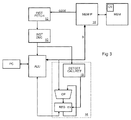
- FIG. 3 shows an embodiment of a call stack change detection device.
- pushing and popping sequences include the same addresses.
- the order of the popping sequence is not necessarily the reverse order of the pushing sequence, as shown by the addresses @ 3 and @ 4 , because several subroutines may be called in a same function.
- the property however remains that a same address appears twice on the stack bus, once in write mode, and once in read mode.
- a recursive operation performed at each push and pop for accumulating the successive addresses in a dedicated memory location, for instance a register.
- the recursive operation may be such that the second operation performed on one address cancels the effect of the first operation performed on the address.
- the first operation is for example addition, and the second subtraction.
- the register content would be:
- the first operation may be multiplication, and the second division.
- the initial value REG 0 may be random, and renewed at each call to the function to check. If the initial value were fixed, the fraudster could be tempted to change the contents of the register by laser attack, in order to restore it to its original value when the subroutine return occurs.
- the register REG may be accessible by software, allowing the programmer to insert, before a subroutine call to protect, initialization instructions of the register and, after the return of the subroutine, instructions to read the content of the register and check if it has changed.
- function func 2 ( ) should be protected (and therefore all functions nested in function func 2 ( ))
- FIG. 3 schematically shows an embodiment of a verification device associated with a processor.
- the processor may include an arithmetic and logic unit ALU that is controlled by an instruction decoder 10 .
- the decoder 10 may receive instruction codes through an instruction fetch unit 12 .
- a memory interface 14 may be provided for reading the instruction codes for unit 12 in a central memory MEM.
- the current instruction to fetch in memory may be identified by the address contained in a dedicated register called “program counter” or PC, address that the ALU unit communicates to the memory interface 14 through a bus B.
- the bus B may be used moreover for exchanging data between the ALU unit and memory MEM.
- the subroutine call stack CS may be embodied in a reserved area of the memory MEM.
- the data it stores are addresses that may point to an area of memory MEM containing instructions of the program to execute.
- a subroutine call is operated by executing a CALL instruction in the ALU unit.
- the ALU unit calculates the return address and pushes it on the stack.
- the return address is usually the address of the instruction immediately following the call, and it is defined, for example, by adding a fixed offset to the current value of the program counter PC.
- the CALL instruction may convey as a parameter the address of the first instruction of the subroutine—the ALU unit may then update the program counter PC with this address.
- a subroutine return may be operated by the execution of a RET instruction.
- the ALU unit then pops the last address from the stack and updates the program counter PC with this address.
- the address pushed on the stack upon execution of the CALL instruction and the address popped from the stack upon execution of the RET instruction are present in turn on the data lines of bus B, in a write transaction for the first and a read transaction for the second.
- the verification device 16 may include a register REG configured for accumulating these addresses that are pushed on, and popped from the call stack. The accumulation is performed using an operator OP, preferably configured to calculate a bitwise exclusive-OR between the content of the register REG and the value present on the data lines of bus B.
- a detection circuit 18 may be provided to identify whether the current instruction is a subroutine call or return. It receives for this purpose the instruction code available in the instruction decoder 10 . Each time that such an instruction is detected, the circuit 18 enables (EN) an accumulation in the register REG. If reciprocal operations other than exclusive-OR are used for the accumulation, the circuit 18 may also select the operation depending on whether the instruction is a call or a return.
- the content of the register REG may be writable and readable through the ALU unit, like the contents of working registers typically provided in a processor.
- the register REG thus becomes accessible by program instructions.
Landscapes
- Engineering & Computer Science (AREA)
- Theoretical Computer Science (AREA)
- Physics & Mathematics (AREA)
- Computer Security & Cryptography (AREA)
- Software Systems (AREA)
- General Engineering & Computer Science (AREA)
- Computer Hardware Design (AREA)
- General Physics & Mathematics (AREA)
- Mathematical Physics (AREA)
- Quality & Reliability (AREA)
- Executing Machine-Instructions (AREA)
- Debugging And Monitoring (AREA)
Applications Claiming Priority (3)
| Application Number | Priority Date | Filing Date | Title |
|---|---|---|---|
| FR1257635A FR2994290B1 (fr) | 2012-08-06 | 2012-08-06 | Systeme de detection de modification d'une pile d'appel de sous-programme |
| FR1257635 | 2012-08-06 | ||
| PCT/FR2013/051854 WO2014023894A1 (fr) | 2012-08-06 | 2013-07-31 | Systeme de detection de modification d'une pile d'appel de sous-programme |
Publications (2)
| Publication Number | Publication Date |
|---|---|
| US20150220328A1 US20150220328A1 (en) | 2015-08-06 |
| US9268559B2 true US9268559B2 (en) | 2016-02-23 |
Family
ID=47594871
Family Applications (1)
| Application Number | Title | Priority Date | Filing Date |
|---|---|---|---|
| US14/417,639 Active US9268559B2 (en) | 2012-08-06 | 2013-07-31 | System for detecting call stack tampering |
Country Status (5)
| Country | Link |
|---|---|
| US (1) | US9268559B2 (de) |
| EP (1) | EP2880588B1 (de) |
| CN (1) | CN104520868B (de) |
| FR (1) | FR2994290B1 (de) |
| WO (1) | WO2014023894A1 (de) |
Families Citing this family (8)
| Publication number | Priority date | Publication date | Assignee | Title |
|---|---|---|---|---|
| US9767272B2 (en) * | 2014-10-20 | 2017-09-19 | Intel Corporation | Attack Protection for valid gadget control transfers |
| CN109446798A (zh) * | 2018-09-21 | 2019-03-08 | 中国科学院信息工程研究所 | 检测堆栈中返回地址被篡改历史的装置 |
| CN109508539A (zh) * | 2018-09-21 | 2019-03-22 | 中国科学院信息工程研究所 | 检测堆栈中返回地址被篡改的链式堆栈结构 |
| CN109446797A (zh) * | 2018-09-21 | 2019-03-08 | 中国科学院信息工程研究所 | 检测堆栈中返回地址被篡改的装置 |
| CN109508538A (zh) * | 2018-09-21 | 2019-03-22 | 中国科学院信息工程研究所 | 一种检测堆栈中返回地址被篡改的堆栈结构 |
| US11314855B2 (en) * | 2018-12-05 | 2022-04-26 | Webroot Inc. | Detecting stack pivots using stack artifact verification |
| US11720471B2 (en) * | 2021-08-09 | 2023-08-08 | International Business Machines Corporation | Monitoring stack memory usage to optimize programs |
| EP4652539A1 (de) * | 2023-02-01 | 2025-11-26 | Huawei Technologies Co., Ltd. | Datenverarbeitungsvorrichtung und verfahren zur laufzeitintegritätsbescheinigung |
Citations (9)
| Publication number | Priority date | Publication date | Assignee | Title |
|---|---|---|---|---|
| US20030182572A1 (en) | 2001-12-06 | 2003-09-25 | Cowan Stanley Crispin | Pointguard: method and system for protecting programs against pointer corruption attacks |
| US20040168078A1 (en) * | 2002-12-04 | 2004-08-26 | Brodley Carla E. | Apparatus, system and method for protecting function return address |
| US20050198645A1 (en) * | 2004-03-01 | 2005-09-08 | Marr Michael D. | Run-time call stack verification |
| US20060161739A1 (en) * | 2004-12-16 | 2006-07-20 | International Business Machines Corporation | Write protection of subroutine return addresses |
| US20090038008A1 (en) * | 2007-07-31 | 2009-02-05 | Vmware, Inc. | Malicious code detection |
| US20090187396A1 (en) * | 2006-04-12 | 2009-07-23 | Ntt Docomo, Inc. | Software Behavior Modeling Apparatus, Software Behavior Monitoring Apparatus, Software Behavior Modeling Method, And Software Behavior Monitoring Method |
| US7581089B1 (en) * | 2006-04-20 | 2009-08-25 | The United States Of America As Represented By The Director Of The National Security Agency | Method of protecting a computer stack |
| US7669243B2 (en) | 2005-03-31 | 2010-02-23 | Texas Instruments Incorporated | Method and system for detection and neutralization of buffer overflow attacks |
| US20130013965A1 (en) * | 2011-07-08 | 2013-01-10 | Stmicroelectronics (Rousset) Sas | Microprocessor protected against stack overflow |
Family Cites Families (2)
| Publication number | Priority date | Publication date | Assignee | Title |
|---|---|---|---|---|
| CN1447244A (zh) * | 2003-04-03 | 2003-10-08 | 杭州中天微系统有限公司 | 一种设计在cpu里的侦测缓冲区溢出的方法 |
| CN101866406A (zh) * | 2010-06-18 | 2010-10-20 | 中国科学院软件研究所 | 一种栈溢出攻击防御方法 |
-
2012
- 2012-08-06 FR FR1257635A patent/FR2994290B1/fr not_active Expired - Fee Related
-
2013
- 2013-07-31 EP EP13756638.6A patent/EP2880588B1/de not_active Not-in-force
- 2013-07-31 WO PCT/FR2013/051854 patent/WO2014023894A1/fr not_active Ceased
- 2013-07-31 US US14/417,639 patent/US9268559B2/en active Active
- 2013-07-31 CN CN201380041553.5A patent/CN104520868B/zh not_active Expired - Fee Related
Patent Citations (9)
| Publication number | Priority date | Publication date | Assignee | Title |
|---|---|---|---|---|
| US20030182572A1 (en) | 2001-12-06 | 2003-09-25 | Cowan Stanley Crispin | Pointguard: method and system for protecting programs against pointer corruption attacks |
| US20040168078A1 (en) * | 2002-12-04 | 2004-08-26 | Brodley Carla E. | Apparatus, system and method for protecting function return address |
| US20050198645A1 (en) * | 2004-03-01 | 2005-09-08 | Marr Michael D. | Run-time call stack verification |
| US20060161739A1 (en) * | 2004-12-16 | 2006-07-20 | International Business Machines Corporation | Write protection of subroutine return addresses |
| US7669243B2 (en) | 2005-03-31 | 2010-02-23 | Texas Instruments Incorporated | Method and system for detection and neutralization of buffer overflow attacks |
| US20090187396A1 (en) * | 2006-04-12 | 2009-07-23 | Ntt Docomo, Inc. | Software Behavior Modeling Apparatus, Software Behavior Monitoring Apparatus, Software Behavior Modeling Method, And Software Behavior Monitoring Method |
| US7581089B1 (en) * | 2006-04-20 | 2009-08-25 | The United States Of America As Represented By The Director Of The National Security Agency | Method of protecting a computer stack |
| US20090038008A1 (en) * | 2007-07-31 | 2009-02-05 | Vmware, Inc. | Malicious code detection |
| US20130013965A1 (en) * | 2011-07-08 | 2013-01-10 | Stmicroelectronics (Rousset) Sas | Microprocessor protected against stack overflow |
Non-Patent Citations (2)
| Title |
|---|
| Feb. 10, 2015 International Preliminary Report on Patentability issued in International Application No. PCT/FR2013/051854. |
| Nov. 6, 2013 International Search Report issued in International Application No. PCT/FR2013/051854. |
Also Published As
| Publication number | Publication date |
|---|---|
| EP2880588A1 (de) | 2015-06-10 |
| FR2994290B1 (fr) | 2018-04-06 |
| FR2994290A1 (fr) | 2014-02-07 |
| EP2880588B1 (de) | 2020-10-28 |
| CN104520868A (zh) | 2015-04-15 |
| US20150220328A1 (en) | 2015-08-06 |
| WO2014023894A1 (fr) | 2014-02-13 |
| CN104520868B (zh) | 2017-08-08 |
Similar Documents
| Publication | Publication Date | Title |
|---|---|---|
| US9268559B2 (en) | System for detecting call stack tampering | |
| US9619233B2 (en) | Computer processor providing exception handling with reduced state storage | |
| JP4976854B2 (ja) | 放射またはそれ以外による攻撃に対抗したプログラムの実行を保証するための方法 | |
| US20080109614A1 (en) | Speculative data value usage | |
| US11036511B2 (en) | Processing of a temporary-register-using instruction including determining whether to process a register move micro-operation for transferring data from a first register file to a second register file based on whether a temporary variable is still available in the second register file | |
| US10223117B2 (en) | Execution flow protection in microcontrollers | |
| JP2019534504A (ja) | ベクトル命令のための要素間アドレス・ハザードの取扱い | |
| JP2006522968A (ja) | 携帯型データ・キャリアのバーチャル・マシン向けプログラムの制御実行 | |
| US20250348318A1 (en) | Verified Stack Trace Generation And Accelerated Stack-Based Analysis With Shadow Stacks | |
| CN108694094B (zh) | 用于处理存储器访问操作的装置和方法 | |
| EP1974272B1 (de) | Verfahren und vorrichtung zur erkennung eines fehlerzustands und zur behebung danach unter verwendung von benutzerkontextinformationen | |
| US8646092B2 (en) | Method of dynamic protection of data during the execution of a software code in intermediate language in a digital apparatus | |
| US20160171213A1 (en) | Apparatus and method for controlling instruction execution to prevent illegal accesses to a computer | |
| US8683178B2 (en) | Sharing a fault-status register when processing vector instructions | |
| US20090077415A1 (en) | Control flow protection mechanism | |
| GB2617300A (en) | Hardware mitigation for spectre and meltdown-like attacks | |
| JP2008513899A (ja) | コンピュータシステム上でコンピュータプログラムを処理する方法 | |
| US12554841B2 (en) | Electronic system and methods for dynamic activation of countermeasures | |
| US11966619B2 (en) | Background processing during remote memory access | |
| JP2009230479A (ja) | マイクロプロセッサ | |
| US12499226B2 (en) | Circuit and method for protecting an application against a side channel attack | |
| US20060265578A1 (en) | Detection of a sequencing error in the execution of a program | |
| EP4524788A1 (de) | Verfahren zum sicheren schutz der ausführung eines softwarecodes gegen fehlerinjektionsangriffe | |
| EP4524787A1 (de) | Verfahren zum sicheren schutz der ausführung eines softwarecodes gegen physische angriffe | |
| Savary et al. | Hardware/Software Runtime for GPSA Protection in RISC-V Embedded Cores |
Legal Events
| Date | Code | Title | Description |
|---|---|---|---|
| AS | Assignment |
Owner name: INSIDE SECURE, FRANCE Free format text: ASSIGNMENT OF ASSIGNORS INTEREST;ASSIGNOR:GALDO, FLORIAN;REEL/FRAME:034820/0746 Effective date: 20150115 |
|
| STCF | Information on status: patent grant |
Free format text: PATENTED CASE |
|
| AS | Assignment |
Owner name: GLAS SAS, AS SECURITY AGENT, FRANCE Free format text: SECURITY INTEREST;ASSIGNOR:INSIDE SECURE;REEL/FRAME:048449/0887 Effective date: 20190227 |
|
| MAFP | Maintenance fee payment |
Free format text: PAYMENT OF MAINTENANCE FEE, 4TH YEAR, LARGE ENTITY (ORIGINAL EVENT CODE: M1551); ENTITY STATUS OF PATENT OWNER: LARGE ENTITY Year of fee payment: 4 |
|
| AS | Assignment |
Owner name: VERIMATRIX, FRANCE Free format text: CHANGE OF NAME;ASSIGNOR:INSIDE SECURE;REEL/FRAME:050647/0428 Effective date: 20190624 |
|
| AS | Assignment |
Owner name: VERIMATRIX, FRANCE Free format text: CHANGE OF ADDRESS;ASSIGNOR:VERIMATRIX;REEL/FRAME:050733/0003 Effective date: 20190930 |
|
| AS | Assignment |
Owner name: INSIDE SECURE, FRANCE Free format text: PARTIAL RELEASE OF SECURITY INTEREST IN PATENT COLLATERAL;ASSIGNOR:GLAS SAS, AS AGENT;REEL/FRAME:051076/0306 Effective date: 20191112 |
|
| AS | Assignment |
Owner name: RAMBUS INC., CALIFORNIA Free format text: ASSIGNMENT OF ASSIGNORS INTEREST;ASSIGNOR:VERIMATRIX;REEL/FRAME:051262/0413 Effective date: 20191113 |
|
| MAFP | Maintenance fee payment |
Free format text: PAYMENT OF MAINTENANCE FEE, 8TH YEAR, LARGE ENTITY (ORIGINAL EVENT CODE: M1552); ENTITY STATUS OF PATENT OWNER: LARGE ENTITY Year of fee payment: 8 |