US9321007B2 - Blends of amines with piperazine for CO2 capture - Google Patents
Blends of amines with piperazine for CO2 capture Download PDFInfo
- Publication number
- US9321007B2 US9321007B2 US14/335,138 US201414335138A US9321007B2 US 9321007 B2 US9321007 B2 US 9321007B2 US 201414335138 A US201414335138 A US 201414335138A US 9321007 B2 US9321007 B2 US 9321007B2
- Authority
- US
- United States
- Prior art keywords
- amine
- aep
- mol
- solvent
- piperazine
- Prior art date
- Legal status (The legal status is an assumption and is not a legal conclusion. Google has not performed a legal analysis and makes no representation as to the accuracy of the status listed.)
- Expired - Fee Related
Links
- 0 *N.N.O=O.[H]C(=O)O Chemical compound *N.N.O=O.[H]C(=O)O 0.000 description 6
- CBTVGIZVANVGBH-UHFFFAOYSA-N CC(C)(N)CO Chemical compound CC(C)(N)CO CBTVGIZVANVGBH-UHFFFAOYSA-N 0.000 description 3
- VFFWMANZCKUKBI-UHFFFAOYSA-N CC(C)(N)CN1CCNCC1 Chemical compound CC(C)(N)CN1CCNCC1 VFFWMANZCKUKBI-UHFFFAOYSA-N 0.000 description 2
- HXKKHQJGJAFBHI-UHFFFAOYSA-N CC(O)CN Chemical compound CC(O)CN HXKKHQJGJAFBHI-UHFFFAOYSA-N 0.000 description 2
- NAQMVNRVTILPCV-UHFFFAOYSA-N NCCCCCCN Chemical compound NCCCCCCN NAQMVNRVTILPCV-UHFFFAOYSA-N 0.000 description 2
- UVLSCMIEPPWCHZ-UHFFFAOYSA-N NCCCN1CCNCC1 Chemical compound NCCCN1CCNCC1 UVLSCMIEPPWCHZ-UHFFFAOYSA-N 0.000 description 2
- WUGQZFFCHPXWKQ-UHFFFAOYSA-N NCCCO Chemical compound NCCCO WUGQZFFCHPXWKQ-UHFFFAOYSA-N 0.000 description 2
- IMUDHTPIFIBORV-UHFFFAOYSA-N NCCN1CCNCC1 Chemical compound NCCN1CCNCC1 IMUDHTPIFIBORV-UHFFFAOYSA-N 0.000 description 2
- HZAXFHJVJLSVMW-UHFFFAOYSA-N NCCO Chemical compound NCCO HZAXFHJVJLSVMW-UHFFFAOYSA-N 0.000 description 2
- IZXIZTKNFFYFOF-UHFFFAOYSA-N O=C1OCCN1 Chemical compound O=C1OCCN1 IZXIZTKNFFYFOF-UHFFFAOYSA-N 0.000 description 2
- GLUUGHFHXGJENI-UHFFFAOYSA-N C1CNCCN1 Chemical compound C1CNCCN1 GLUUGHFHXGJENI-UHFFFAOYSA-N 0.000 description 1
- LZHQJDJFEDKFRT-UHFFFAOYSA-N C1CNCCN1.C1CNCCN1.CC(C)(N)CN1CCN(CC(C)(C)N)CC1.CC(C)(N)CN1CCNCC1.CC(CN)N1CCN(C(C)CN)CC1.CC(CN)N1CCNCC1 Chemical compound C1CNCCN1.C1CNCCN1.CC(C)(N)CN1CCN(CC(C)(C)N)CC1.CC(C)(N)CN1CCNCC1.CC(CN)N1CCN(C(C)CN)CC1.CC(CN)N1CCNCC1 LZHQJDJFEDKFRT-UHFFFAOYSA-N 0.000 description 1
- SVVSAVGAKBNYGK-UHFFFAOYSA-N C1CNCCN1.C1CNCCN1.CC(C)(N)CN1CCNCC1.CC(C)(N)CO.CC(CN)N1CCNCC1.CC(O)CN.O.O Chemical compound C1CNCCN1.C1CNCCN1.CC(C)(N)CN1CCNCC1.CC(C)(N)CO.CC(CN)N1CCNCC1.CC(O)CN.O.O SVVSAVGAKBNYGK-UHFFFAOYSA-N 0.000 description 1
- IOYKIGRSDHOLHC-UHFFFAOYSA-N C1CNCCN1.CN1CCOC1=O.CNCCN1CCNCC1.O=C=O Chemical compound C1CNCCN1.CN1CCOC1=O.CNCCN1CCNCC1.O=C=O IOYKIGRSDHOLHC-UHFFFAOYSA-N 0.000 description 1
- IGNOZXCAYRFEQW-UHFFFAOYSA-N C1CNCCN1.NCCN1CCN(CCN)CC1.NCCN1CCNCC1 Chemical compound C1CNCCN1.NCCN1CCN(CCN)CC1.NCCN1CCNCC1 IGNOZXCAYRFEQW-UHFFFAOYSA-N 0.000 description 1
- FHNXRCLSCRVYEX-UHFFFAOYSA-N C1CNCCN1.NCCN1CCNCC1.O.O=C1NCCO1 Chemical compound C1CNCCN1.NCCN1CCNCC1.O.O=C1NCCO1 FHNXRCLSCRVYEX-UHFFFAOYSA-N 0.000 description 1
- JKBUXETUEXKFHN-UHFFFAOYSA-N CC(CN)N1CCNCC1 Chemical compound CC(CN)N1CCNCC1 JKBUXETUEXKFHN-UHFFFAOYSA-N 0.000 description 1
- SYARCRAQWWGZKY-UHFFFAOYSA-N CC1(C)COC(=O)N1 Chemical compound CC1(C)COC(=O)N1 SYARCRAQWWGZKY-UHFFFAOYSA-N 0.000 description 1
- HBRXQSHUXIJOKV-UHFFFAOYSA-N CC1CNC(=O)O1 Chemical compound CC1CNC(=O)O1 HBRXQSHUXIJOKV-UHFFFAOYSA-N 0.000 description 1
- VWIIJDNADIEEDB-UHFFFAOYSA-N CN1CCOC1=O Chemical compound CN1CCOC1=O VWIIJDNADIEEDB-UHFFFAOYSA-N 0.000 description 1
- HDSZRJMNBCRATE-UHFFFAOYSA-N CNCCN1CCNCC1 Chemical compound CNCCN1CCNCC1 HDSZRJMNBCRATE-UHFFFAOYSA-N 0.000 description 1
- OPKOKAMJFNKNAS-UHFFFAOYSA-N CNCCO Chemical compound CNCCO OPKOKAMJFNKNAS-UHFFFAOYSA-N 0.000 description 1
- KIDHWZJUCRJVML-UHFFFAOYSA-N NCCCCN Chemical compound NCCCCN KIDHWZJUCRJVML-UHFFFAOYSA-N 0.000 description 1
- PAOXFRSJRCGJLV-UHFFFAOYSA-N NCCN1CCN(CCN)CC1 Chemical compound NCCN1CCN(CCN)CC1 PAOXFRSJRCGJLV-UHFFFAOYSA-N 0.000 description 1
- LHIJANUOQQMGNT-UHFFFAOYSA-N NCCNCCO Chemical compound NCCNCCO LHIJANUOQQMGNT-UHFFFAOYSA-N 0.000 description 1
- NCRSHBVPFREDKX-UHFFFAOYSA-N NCCNCCO.NCCO.O=C1NCCO1.O=O Chemical compound NCCNCCO.NCCO.O=C1NCCO1.O=O NCRSHBVPFREDKX-UHFFFAOYSA-N 0.000 description 1
- PURUBGMJLZYKQR-UHFFFAOYSA-N NCCO.O.O=C1NCCO1.O=O Chemical compound NCCO.O.O=C1NCCO1.O=O PURUBGMJLZYKQR-UHFFFAOYSA-N 0.000 description 1
- GXVUZYLYWKWJIM-UHFFFAOYSA-N NCCOCCN Chemical compound NCCOCCN GXVUZYLYWKWJIM-UHFFFAOYSA-N 0.000 description 1
- GBHCABUWWQUMAJ-UHFFFAOYSA-N NNCCO Chemical compound NNCCO GBHCABUWWQUMAJ-UHFFFAOYSA-N 0.000 description 1
- OZJPLYNZGCXSJM-UHFFFAOYSA-N O=C1CCCCO1 Chemical compound O=C1CCCCO1 OZJPLYNZGCXSJM-UHFFFAOYSA-N 0.000 description 1
Images




Classifications
-
- B—PERFORMING OPERATIONS; TRANSPORTING
- B01—PHYSICAL OR CHEMICAL PROCESSES OR APPARATUS IN GENERAL
- B01D—SEPARATION
- B01D53/00—Separation of gases or vapours; Recovering vapours of volatile solvents from gases; Chemical or biological purification of waste gases, e.g. engine exhaust gases, smoke, fumes, flue gases, aerosols
- B01D53/14—Separation of gases or vapours; Recovering vapours of volatile solvents from gases; Chemical or biological purification of waste gases, e.g. engine exhaust gases, smoke, fumes, flue gases, aerosols by absorption
- B01D53/1456—Removing acid components
-
- B—PERFORMING OPERATIONS; TRANSPORTING
- B01—PHYSICAL OR CHEMICAL PROCESSES OR APPARATUS IN GENERAL
- B01D—SEPARATION
- B01D53/00—Separation of gases or vapours; Recovering vapours of volatile solvents from gases; Chemical or biological purification of waste gases, e.g. engine exhaust gases, smoke, fumes, flue gases, aerosols
- B01D53/34—Chemical or biological purification of waste gases
- B01D53/38—Removing components of undefined structure
- B01D53/40—Acidic components
-
- B—PERFORMING OPERATIONS; TRANSPORTING
- B01—PHYSICAL OR CHEMICAL PROCESSES OR APPARATUS IN GENERAL
- B01D—SEPARATION
- B01D53/00—Separation of gases or vapours; Recovering vapours of volatile solvents from gases; Chemical or biological purification of waste gases, e.g. engine exhaust gases, smoke, fumes, flue gases, aerosols
- B01D53/14—Separation of gases or vapours; Recovering vapours of volatile solvents from gases; Chemical or biological purification of waste gases, e.g. engine exhaust gases, smoke, fumes, flue gases, aerosols by absorption
- B01D53/1456—Removing acid components
- B01D53/1475—Removing carbon dioxide
-
- B—PERFORMING OPERATIONS; TRANSPORTING
- B01—PHYSICAL OR CHEMICAL PROCESSES OR APPARATUS IN GENERAL
- B01D—SEPARATION
- B01D53/00—Separation of gases or vapours; Recovering vapours of volatile solvents from gases; Chemical or biological purification of waste gases, e.g. engine exhaust gases, smoke, fumes, flue gases, aerosols
- B01D53/14—Separation of gases or vapours; Recovering vapours of volatile solvents from gases; Chemical or biological purification of waste gases, e.g. engine exhaust gases, smoke, fumes, flue gases, aerosols by absorption
- B01D53/1493—Selection of liquid materials for use as absorbents
-
- C—CHEMISTRY; METALLURGY
- C07—ORGANIC CHEMISTRY
- C07D—HETEROCYCLIC COMPOUNDS
- C07D241/00—Heterocyclic compounds containing 1,4-diazine or hydrogenated 1,4-diazine rings
- C07D241/02—Heterocyclic compounds containing 1,4-diazine or hydrogenated 1,4-diazine rings not condensed with other rings
- C07D241/04—Heterocyclic compounds containing 1,4-diazine or hydrogenated 1,4-diazine rings not condensed with other rings having no double bonds between ring members or between ring members and non-ring members
-
- B—PERFORMING OPERATIONS; TRANSPORTING
- B01—PHYSICAL OR CHEMICAL PROCESSES OR APPARATUS IN GENERAL
- B01D—SEPARATION
- B01D2252/00—Absorbents, i.e. solvents and liquid materials for gas absorption
- B01D2252/10—Inorganic absorbents
- B01D2252/103—Water
-
- B—PERFORMING OPERATIONS; TRANSPORTING
- B01—PHYSICAL OR CHEMICAL PROCESSES OR APPARATUS IN GENERAL
- B01D—SEPARATION
- B01D2252/00—Absorbents, i.e. solvents and liquid materials for gas absorption
- B01D2252/20—Organic absorbents
- B01D2252/204—Amines
- B01D2252/2041—Diamines
-
- B—PERFORMING OPERATIONS; TRANSPORTING
- B01—PHYSICAL OR CHEMICAL PROCESSES OR APPARATUS IN GENERAL
- B01D—SEPARATION
- B01D2252/00—Absorbents, i.e. solvents and liquid materials for gas absorption
- B01D2252/20—Organic absorbents
- B01D2252/204—Amines
- B01D2252/20415—Tri- or polyamines
-
- B—PERFORMING OPERATIONS; TRANSPORTING
- B01—PHYSICAL OR CHEMICAL PROCESSES OR APPARATUS IN GENERAL
- B01D—SEPARATION
- B01D2252/00—Absorbents, i.e. solvents and liquid materials for gas absorption
- B01D2252/20—Organic absorbents
- B01D2252/204—Amines
- B01D2252/20421—Primary amines
-
- B—PERFORMING OPERATIONS; TRANSPORTING
- B01—PHYSICAL OR CHEMICAL PROCESSES OR APPARATUS IN GENERAL
- B01D—SEPARATION
- B01D2252/00—Absorbents, i.e. solvents and liquid materials for gas absorption
- B01D2252/20—Organic absorbents
- B01D2252/204—Amines
- B01D2252/20426—Secondary amines
-
- B—PERFORMING OPERATIONS; TRANSPORTING
- B01—PHYSICAL OR CHEMICAL PROCESSES OR APPARATUS IN GENERAL
- B01D—SEPARATION
- B01D2252/00—Absorbents, i.e. solvents and liquid materials for gas absorption
- B01D2252/20—Organic absorbents
- B01D2252/204—Amines
- B01D2252/20431—Tertiary amines
-
- B—PERFORMING OPERATIONS; TRANSPORTING
- B01—PHYSICAL OR CHEMICAL PROCESSES OR APPARATUS IN GENERAL
- B01D—SEPARATION
- B01D2252/00—Absorbents, i.e. solvents and liquid materials for gas absorption
- B01D2252/20—Organic absorbents
- B01D2252/204—Amines
- B01D2252/20436—Cyclic amines
- B01D2252/20447—Cyclic amines containing a piperazine-ring
-
- B—PERFORMING OPERATIONS; TRANSPORTING
- B01—PHYSICAL OR CHEMICAL PROCESSES OR APPARATUS IN GENERAL
- B01D—SEPARATION
- B01D2257/00—Components to be removed
- B01D2257/30—Sulfur compounds
- B01D2257/304—Hydrogen sulfide
-
- B—PERFORMING OPERATIONS; TRANSPORTING
- B01—PHYSICAL OR CHEMICAL PROCESSES OR APPARATUS IN GENERAL
- B01D—SEPARATION
- B01D2257/00—Components to be removed
- B01D2257/30—Sulfur compounds
- B01D2257/306—Organic sulfur compounds, e.g. mercaptans
-
- B—PERFORMING OPERATIONS; TRANSPORTING
- B01—PHYSICAL OR CHEMICAL PROCESSES OR APPARATUS IN GENERAL
- B01D—SEPARATION
- B01D2257/00—Components to be removed
- B01D2257/30—Sulfur compounds
- B01D2257/308—Carbonoxysulfide COS
-
- B—PERFORMING OPERATIONS; TRANSPORTING
- B01—PHYSICAL OR CHEMICAL PROCESSES OR APPARATUS IN GENERAL
- B01D—SEPARATION
- B01D2257/00—Components to be removed
- B01D2257/50—Carbon oxides
- B01D2257/504—Carbon dioxide
-
- B—PERFORMING OPERATIONS; TRANSPORTING
- B01—PHYSICAL OR CHEMICAL PROCESSES OR APPARATUS IN GENERAL
- B01D—SEPARATION
- B01D2258/00—Sources of waste gases
- B01D2258/02—Other waste gases
- B01D2258/0283—Flue gases
-
- Y02C10/06—
-
- Y—GENERAL TAGGING OF NEW TECHNOLOGICAL DEVELOPMENTS; GENERAL TAGGING OF CROSS-SECTIONAL TECHNOLOGIES SPANNING OVER SEVERAL SECTIONS OF THE IPC; TECHNICAL SUBJECTS COVERED BY FORMER USPC CROSS-REFERENCE ART COLLECTIONS [XRACs] AND DIGESTS
- Y02—TECHNOLOGIES OR APPLICATIONS FOR MITIGATION OR ADAPTATION AGAINST CLIMATE CHANGE
- Y02C—CAPTURE, STORAGE, SEQUESTRATION OR DISPOSAL OF GREENHOUSE GASES [GHG]
- Y02C20/00—Capture or disposal of greenhouse gases
- Y02C20/40—Capture or disposal of greenhouse gases of CO2
-
- Y—GENERAL TAGGING OF NEW TECHNOLOGICAL DEVELOPMENTS; GENERAL TAGGING OF CROSS-SECTIONAL TECHNOLOGIES SPANNING OVER SEVERAL SECTIONS OF THE IPC; TECHNICAL SUBJECTS COVERED BY FORMER USPC CROSS-REFERENCE ART COLLECTIONS [XRACs] AND DIGESTS
- Y02—TECHNOLOGIES OR APPLICATIONS FOR MITIGATION OR ADAPTATION AGAINST CLIMATE CHANGE
- Y02P—CLIMATE CHANGE MITIGATION TECHNOLOGIES IN THE PRODUCTION OR PROCESSING OF GOODS
- Y02P20/00—Technologies relating to chemical industry
- Y02P20/151—Reduction of greenhouse gas [GHG] emissions, e.g. CO2
-
- Y02P20/152—
Definitions
- Monoethanolamine (MEA), diethanolamine (DEA), and the hindered amine aminomethylpropanol (AMP) are used alone in an aqueous solution.
- Typical solvent blends include a methyldiethanolamine (MDEA) solution promoted by piperazine or other secondary amines.
- MDEA methyldiethanolamine
- potassium carbonate solvents are commonly promoted by DEA or other reactive amines.
- Gas absorption is a process in which soluble components of a gas mixture are dissolved in a liquid. Stripping is essentially the inverse of absorption, as it involves the transfer of volatile components from a liquid mixture into a gas.
- absorption is used to remove CO 2 from a combustion gas, and stripping is subsequently used to regenerate the solvent and capture the CO 2 contained in the solvent.
- stripping is subsequently used to regenerate the solvent and capture the CO 2 contained in the solvent.
- the absorbent solution containing CO 2 (also called “rich solvent”) is drawn off and subjected to a stripping process to free it of the CO 2 and regenerate its absorbent properties.
- Other methods of using absorption/stripping process to remove CO 2 from gaseous stream are described in U.S. Patent Application Publication No. 2011/0171093, U.S. Pat. No. 7,938,887, and U.S. Provisional Patent Application Ser. No. 61/585,865, and U.S. patent application Ser. No. 13/740,874, the entireties of which are hereby incorporated by reference.
- the rich solvent drawn off from the bottom of the absorption column is introduced into the upper half of a stripping column, and the rich solvent is maintained at its boiling point under pressure in this column.
- the heat necessary for maintaining the boiling point is furnished by reboiling the absorbent solution contained in the stripping column.
- the reboiling process is effectuated by indirect heat exchange between part of the solution to be regenerated located in the lower half of the stripping column and a hot fluid at appropriate temperature, generally saturated water vapor.
- the CO 2 contained in the rich solvent is released and stripped by the vapors of the absorbent solution.
- Vapor containing the stripped CO 2 emerges at the top of the stripping column and is passed through a condenser system which returns to the stripping column the liquid phase resulting from the condensation of the vapors of the absorbent solution.
- the hot regenerated absorbent solution also called “lean solvent”
- the hot regenerated absorbent solution is drawn off and recycled to the absorption column after having used part of the heat content of the solution to heat, by indirect heat exchange, the rich solvent to be regenerated, before its introduction into the stripping column.
- aqueous rich solvent is regenerated at 100-160° C. in a simple, countercurrent, reboiled stripper operated at a single pressure, which is usually 1-10 atm.
- the rich solvent feed is preheated by cross-exchange with hot lean solvent to within 5-30° C. of the stripper bottoms.
- the overhead vapor is cooled to condense water, which is returned as reflux to the countercurrent stripper.
- the product CO 2 is compressed to 100-150 atm.
- amines that are used by themselves in water as absorbers include monoethanolamine, diethanolamine, methyldiethanolamine, diglycolamine, diisopropanolamine, some hindered amines, and others (Kohl and Nielsen (1997)). These amines are soluble or miscible with water at ambient temperature at high concentrations that are used in the process to maximize capacity and reduce sensible heat requirements. Other amines, including piperazine, are used in combination with methyldiethanolamine and other primary amines.
- certain blends of piperazine with other amines are known to have problems with solid precipitation. It is desirable to provide a blend of piperazine with another amine that does not suffer from solid precipitation.
- the present disclosure generally relates to the removal of acidic gases, including carbon dioxide and hydrogen sulfide, from flue gas or other gases through aqueous absorption and stripping processes. More particularly, in some embodiments, the present disclosure relates to methods and compositions for the removal of acidic gas from a gas mixture using an aqueous amine solvent blend.
- the present disclosure provides an aqueous amine solvent comprising piperazine and one or more amines selected from the group consisting of: hexamethylenediamine, putrescine, bis(aminoethyl)ether, and aminoethylpiperazine.
- the present disclosure provides an aqueous amine solvent comprising piperazine and a linear diamine, wherein the linear diamine comprises at least one of the following between the amine groups on the linear diamine: at least 4 carbon atoms and at least 4 oxygen atoms.
- the present disclosure provides a method comprising contacting an acidic gas with an aqueous amine solvent, wherein the aqueous amine solvent comprises piperazine and one or more amines selected from the group consisting of: hexamethylenediamine, putrescine, bis(aminoethyl)ether, and aminoethylpiperazine.
- the present disclosure provides a method comprising contacting an acidic gas with an aqueous amine solvent, wherein the aqueous amine solvent comprises piperazine and a linear diamine, wherein the linear diamine comprises at least one of the following between the amine groups on the linear diamine: at least 4 carbon atoms and at least 4 oxygen atoms.
- the present disclosure provides a method comprising contacting an acidic gas with a blend comprising piperazine and aminoethylpiperazine.
- the present disclosure provides a method comprising reacting monoethanolamine with piperazine and CO 2 in aqueous solution.
- the present disclosure provides a method comprising reacting piperazine with an alkanolamine at a temperature in the range of from about 100° C. to about 200° C.
- FIG. 1 is a drawing depicting the structures of various amines.
- FIG. 2 shows solid solubility limits for 8 m PZ (throughout loading range) denoted by blue lines.
- the solubility limit at room temperature solid-liquid transition
- FIG. 3 shows lower solubility limits for various piperazine/aminoethylpiperazine blends.
- FIG. 4 shows CO 2 Liquid Phase Mass Transfer Coefficient (k g ′) in 6 m PZ/2 m DAB
- FIG. 5 shows CO 2 Liquid Phase Mass Transfer Coefficient (kg′) in 6 m PZ/2 m BAE.
- FIG. 6 shows CO 2 Liquid Phase Mass Transfer Coefficient (k g ′) in 5 m PZ/2 m AEP
- FIG. 7 shows CO 2 solubility of 6 m PZ/2 m DAB.
- FIG. 8 shows CO 2 solubility of 6 m PZ/2 m BAE.
- FIG. 9 shows CO 2 solubility of 5 m PZ/2 m AEP
- FIG. 13 shows degradation of 8 m 1,4-diaminobutane at 175° C.
- the degradation of 8 m PZ is from Freeman (Freeman, 2011) and at a loading of 0.3 mol CO 2 /mol alkalinity.
- FIG. 14 is a chromatogram showing degradation products of 1,4-diaminobutane after one week. Temperature was held at 175° C. with initial loading equal to 0.4 mol CO 2 /mol alkalinity.
- FIG. 15 is a drawing depicting the structure of pyrrolidine.
- FIG. 16 is a drawing depicting a proposed degradation pathway of 1,4-diaminobutane to pyrrolidine and ammonia.
- FIG. 17 is a plot of the concentration of pyrrolidine over time and concentration of 1,4-diaminobutane over time at 175° C.
- FIG. 18 is a chart depicting the formation of free formate in 8 m DAB at 175° C.
- FIG. 19 is a chart depicting degradation of 8 m 3-oxapentane-1,5-diamine at 175° C.
- the degradation of 8 m PZ is from Freeman (Freeman, 2011).
- FIG. 20 is a chromatogram showing degradation products of 3-oxapentane-1,5-diamine after one week. Temperature was held at 175° C. with initial loading equal to 0.4 mol CO 2 /mol alkalinity.
- FIG. 21 is a drawing depicting the structure of morpholine.
- FIG. 22 is a drawing depicting a proposed degradation pathway of 3-oxapentane-1,5-diamine to morpholine and ammonia.
- FIG. 23 is a IC/MS chromatogram of a 7 m MEA/2 m piperazine aqueous solution with a loading of 0.4 moles of CO 2 per mole of alkalinity held at 135° C. for 8 weeks (Davis, 2009).
- FIG. 24 is a drawing depicting the structures of products formed from 1-(2-aminoethyl)piperazine with oxazolidone
- FIG. 25 is a drawing depicting the structure of methyl-substituted PZs.
- FIG. 26 shows MEA concentration over time in a 7 m MEA/2 m PZ aqueous solution with a loading of 0.4 moles CO 2 /mole of alkalinity at varying temperatures.
- FIG. 27 shows PZ concentration over time in a 7 m MEA/2 m PZ aqueous solution with a loading of 0.4 moles CO 2 /mole of alkalinity at varying temperatures.
- FIG. 28 shows an IC/MS chromatogram of a 2.33 m 1-(2-aminoethyl)piperazine aqueous solution with a loading of 0.4 moles of CO 2 per mole of alkalinity held at 135° C. for 4 weeks.
- FIG. 29 shows CO 2 absorption rate at 40° C. for concentrated PZ blends. Compared with 8 m PZ and 7 m MEA (solid and dashed black lines).
- FIG. 30 shows CO 2 absorption rate at 40° C. for other PZ blends. 7 m MDEA/2 m PZ, 5 m MDEA/5 m PZ, PZ/1MPZ/1,4DMPZ, 4 m 2MPZ/4 m PZ (Chen 2011); 7 m MDEA/2 m PZ (Dugas 2009); 4 m AMP/2 m PZ (Li et al., Characterization of piperazine/2-aminomethylpropanol).
- FIG. 31 shows the solid/liquid boundary of 8 m PZ and PZ blends.
- Solid lines transition temperature vs. loading. Dash lines: at proximity to transition boundary, within which the solvent is soluble. Empty points: the blends are soluble at this loading or higher. Solid points: the blends are not soluble at this loading or lower.
- FIG. 32 shows comparison of absorption rates and solvent capacity for PZ blends and other solvents for coal flue gas.
- Filled diamonds PZ blends; Empty diamonds: amine solvents; Empty circles: base case solvents 7 m MEA and 8 m PZ; Triangles: amino acid salts.
- FIG. 33 is a diagram of cross-exchanger temperatures.
- FIG. 34 shows liquid-solid transition temperature for PZ/AEP with different amine ratios, ⁇ : 8 m PZ/0 m AEP; ⁇ : 5 m PZ/2 m AEP; ⁇ : 4 m PZ/2.67 m AEP; ⁇ : 3 m PZ/3.33 m AEP.
- FIG. 35 is a comparison of PZ loss in 5 m PZ/2 m AEP and 8 m pure PZ in thermal degradation at 0.3 mol CO 2 /mol alkalinity.
- FIG. 36 shows a comparison of AEP loss in 5 m PZ/2 m AEP and 5.33 m pure AEP in thermal degradation at 0.3 mol CO 2 /mol alkalinity.
- FIG. 37 shows effect of CO 2 on the degradation of PZ and AEP in 5 m PZ/2 m AEP at 175° C. (Dashed line: 0.2 mol CO 2 /mol alkalinity; solid line: 0.3 mol CO 2 /mol alkalinity).
- FIG. 38 shows degradation products from thermal degradation of 5 m PZ/2 m AEP with 0.3 mol CO 2 /mol alkalinity at 175° C.
- FIG. 39 shows PZ, AEP, and CO 2 loss and generation of major degradation products for 5 m PZ/2 m AEP with 0.3 mol CO 2 /mol alkalinity at 175° C.
- FIG. 40 shows a comparison of total formate production in 8 m PZ with Mn 2+ , 8 m PZ without Mn 2+ , 2 m AEP and 7 m MEA at 70° C.
- FIG. 41 shows nitrosamines formation in 5 m PZ/2 m AEP at 100° C., compared to that in 8 m PZ and 2 m AEP.
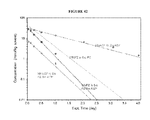
- FIG. 42 shows nitrosamine decomposition in 5 m PZ/2 m AEP at 150° C., compared to that in 8 m PZ [8] and 2 m AEP.
- FIG. 43 shows CO 2 solubility for 5 m PZ/2 m AEP (Solid lines: 5 m PZ/2 m AEP equation model; Solid circles: measured data for 5 m PZ/2 m AEP using WWC; Open circles: measured data for 5 m PZ/2 m AEP using SA; Dashed lines: 8 m PZ equation model from Xu (Xu Q. Thermodynamics of CO 2 Loaded Aqueous Amines. The University of Texas at Austin, Austin, Tex., 2011).
- FIG. 44 shows mass transfer coefficients (kg′) in 5 m PZ/2 m AEP (solid lines) from 20 to 80° C., compared to that in 8 m PZ (dashed line) at 40° C.
- FIG. 45 shows concentration of MAE over time at 150° C.
- FIG. 46 shows concentration of PZ-MAE Synthesis Product and Parent Amines, demonstrating thermal stability of synthesis product. Initial conditions were 7 m PZ/2 m MAE, 150° C., 0.3 mol CO 2 /mol N.
- FIG. 47 shows comparison of conversion Rates for Various Amines. Initial conditions were 7 m PZ/2 m amine, 0.3 mol CO 2 /mol N.
- the present disclosure generally relates to the removal of acidic gases, including carbon dioxide and hydrogen sulfide, from flue gas or other gases through aqueous absorption and stripping processes. More particularly, in some embodiments, the present disclosure relates to methods and compositions for the removal of acidic gas from a gas mixture using an aqueous amine solvent blend. In some embodiments, the compositions and methods of the present disclosure may be used for the removal of acidic gas from a gas mixture. In one embodiment, the methods of the present disclosure comprise using an aqueous amine solvent comprising a blend of piperazine and at least one diamine or triamine.
- the present disclosure describes a scrubbing process using a solvent comprising a blend of piperazine and another amine to capture acidic gases such as CO 2 .
- a scrubbing process using a solvent comprising a blend of piperazine and another amine to capture acidic gases such as CO 2 .
- PZ piperazine
- another amine such as hexamethylenediamine (HMDA), putrescine (DAB), 2-(2-aminoethoxy)ethanamine (also known as 3-oxapentane-1,5-diamine or as Bis(aminoethyl)ether, or BAE), or aminoethylpiperazine (AEP).
- HMDA hexamethylenediamine
- DAB putrescine
- 2-(2-aminoethoxy)ethanamine also known as 3-oxapentane-1,5-diamine or as Bis(aminoethyl)ether, or BAE
- AEP aminoethylpipe
- the amine blend has properties broadly similar to piperazine, with high CO 2 capacity, high heats of absorption, high CO 2 absorption rates, low volatility, and low rates of thermal and oxidative degradation.
- the wider solubility window may reduce the solid precipitation problems and issues encountered with using only piperazine as the amine solvent.
- blending piperazine enables the process to operate at lower temperatures, lower lean loading, and richer rich loading.
- the blends described in this disclosure are different from other conventional amine blends in that they avoid the problems of solid precipitation when blending together.
- the other conventional blends may comprise two dissimilar amines.
- the blended solvent system described herein may be used over a wider range of CO 2 loading than other solvents. For example, it could be used effectively to treat gas with lower or higher CO 2 concentration than typically seen in coal flue gas. It could also be used at lower absorber temperatures (for example 20° C.) with greater rich and lean loading. It can be used at lower lean CO 2 loading to increase CO 2 capacity and reduce the circulation rate of the solvent.
- amine that is to be blended with the piperazine may be more expensive than piperazine or available in lower quantities, some of these amines degrade at lower temperatures than piperazine and thus could be used in systems that do not have higher pressure steam available to take advantage of greater degradation.
- the present disclosure provides a solvent comprising a blend of piperazine and at least one other amine, such as hexamethylenediamine, putrescine, 2-(2-aminoethoxy)ethanamine, or aminoethylpiperazine.
- the piperazine and the other amines may be present in the aqueous amine solvent in any amount. In one embodiment, each of the piperazine and the other amines may be present in an amount sufficient to produce a thermal equilibrium ratio at 100° C. to 160° C. In another embodiment, each of the piperazine and the other amines may be present in amount sufficient to produce a blend with an equilibrium constant (K eq ) between 0.1 and 0.2. In another embodiment, the piperazine and the other amines may be present in amount sufficient to produce a blend with a K eq between 0.04 and 0.5. In other embodiments, the blend may comprise from about 0.01% to about 99.9% piperazine, from about 0.01% to about 99.9% other amines. In one embodiment, the blend ratio of piperzine:other amine of could be between 50 and 80% piperazine.
- the aqueous amine solvent may further comprise water in an amount from about 0.01% to about 99.9% by weight of the blend.
- the present disclosure provides an aqueous amine solvent comprising piperazine and a linear diamine.
- the linear diamine may contain at least 4 carbon atoms between the amine groups present on the linear diamine.
- the linear diamine may contain at least 4 oxygen atoms between the amine groups present on the linear diamine.
- the linear diamine may contain from about 4 to about 6 carbon atoms between the amine groups.
- the linear diamine may contain from about 4 to about 6 oxygen atoms between the amine groups.
- the linear diamine may be 3-oxapentane-1,5-diamine, hexamethylenediamine, 1,4-butanediamine, or 1,5-pentanediamine. In certain embodiments, the linear diamine may be 3-oxapentane-1,5-diamine present in the amine solvent at a concentration in the range of from about 4 to about 12 equivalents/kg water.
- the linear diamine may be present in the aqueous amine solvent in an amount sufficient to affect the solubility window of piperazine.
- the linear diamine may comprise 50 mol % or less of the amine in the solvent.
- the linear diamine comprises from about 10 mol % to about 50 mol % of the amine in the solvent.
- the linear diamine may comprise about 10 mol % of the amine in the solvent, in certain embodiments, about 15 mol % of the amine in the solvent, in certain embodiments, about 20 mol % of the amine in the solvent, in certain embodiments, about 25 mol % of the amine in the solvent, in certain embodiments, about 30 mol % of the amine in the solvent, in certain embodiments, about 35 mol % of the amine in the solvent, in certain embodiments, about 40 mol % of the amine in the solvent, in certain embodiments, about 45 mol % of the amine in the solvent, or in certain embodiment, about 50 mol % of the amine in the solvent.
- the linear diamine may be present in the solvent in the range of from about 10 mol % to about 15 mol % of the amine in the solvent, in certain embodiments, from about 15 mol % to about 20 mol %, in certain embodiments, from about 20 mol % to about 25 mol %, in certain embodiments, from about 25 mol % to about 30 mol %, in certain embodiments, from about 30 mol % to about 35 mol %, in certain embodiments, 35 mol % to about 40 mol %, in certain embodiments, 40 mol % to about 45 mol %, in certain embodiments, from about 45 mol % to about 50 mol %.
- the amine concentration of the aqueous amine solvent may be from about 4 to about 12 equivalents/kg water. In certain embodiments, the amine concentration of the aqueous amine solvent may be from about 8 to about 24 equivalents/kg water.
- the amine concentration may be from about 4 to about 5 equivalents/kg water, in certain embodiments, from about 5 to about 6 equivalents/kg water, in certain embodiments, from about 6 to about 7 equivalents/kg water, in certain embodiments, from about 7 to about 8 equivalents/kg water, in certain embodiments, from about 8 to about 9 equivalents/kg water, in certain embodiments, from about 9 to about 10 equivalents/kg water, in certain embodiments, from about 10 to about 11 equivalents/kg water, in certain embodiments, from about 11 equivalents/kg water to about 12 equivalents/kg water.
- the amine concentration of the aqueous amine solvent may be about 4, about 5, about 6, about 7, about 8, about 9, about 10, about 11, or about 12 equivalents/kg water.
- the present disclosure provides a blend comprising piperazine and aminoethylpiperazine.
- the blend may further comprise diaminoethylpiperazine.
- the blend may comprise 5 m piperazine and 2 m aminoethylpiperazine.
- the amine concentration of the blend may be in the range of from about 8 to about 24 equivalents/kg water.
- the amine concentration of the blend may be about 8 equivalents/kg water, in certain embodiments, about 9, about 10, about 11, about 12, about 13, about 14, about 15, about 16, about 17, about 18, about 19, about 20, about 21, about 22, about 23, or about 24 equivalents/kg water.
- the blend may be flowed to a stripper.
- the stripper may be operating at a temperature in the range of from about 120° C. to about 165° C.
- the blend composition may reach equilibrium at the operating temperature of the stripper.
- the aminoethylpiperazine may comprise from about 50 mol % or less of the amine in the blend. In certain embodiments, the aminoethylpiperazine may comprise from about 10 mol % to about 50 mol % of the amine in the blend.
- the aminoethylpiperazine may comprise about 10 mol % of the amine in the blend, in certain embodiments, about 15 mol % of the amine in the blend, in certain embodiments, about 20 mol % of the amine in the blend, in certain embodiments, about 25 mol % of the amine in the blend, in certain embodiments, the about 30 mol % of the amine in the blend, in certain embodiments, about 35 mol % of the amine in the blend, in certain embodiments, about 40 mol % of the amine in the blend, in certain embodiments, about 45 mol % of the amine in the blend, in certain embodiment about 50 mol % of the amine in the blend.
- the aminoethylpiperazine may be present in the range of from about 10 mol % to about 15 mol % of the amine in the blend, in certain embodiments, from about 15 mol % to about 20 mol %, in certain embodiments, from about 20 mol % to about 25 mol %, in certain embodiments, from about 25 mol % to about 30 mol %, in certain embodiments, from about 30 mol % to about 35 mol %, in certain embodiments, 35 mol % to about 40 mol %, in certain embodiments, 40 mol % to about 45 mol %, in certain embodiments, from about 45 mol % to about 50 mol %.
- the aqueous amine solvents of the present disclosure may be used for the removal of an acidic gas from a gas mixture.
- the aqueous amine solvents may be flowed to a stripper operating at a temperature in the range of from about 100 to about 200° C., in certain embodiments, from about 120° C. to about 180° C., in certain embodiments, from about 120° C. to about 165° C.
- any acidic gas capable of removal by the methods of the present invention is contemplated by the present disclosure.
- acidic gases may include, but are not limited to, hydrogen sulfide (H 2 S) or carbonyl sulfide (COS), CS 2 , and mercaptans.
- amines may be recovered following absorption of acidic gas. In certain embodiments, such recovery may occur through an evaporation process using a thermal reclaimer.
- the gas mixture may be any gas mixture comprising an acid gas for which acid gas removal is desired and which is compatible with (i.e., will not be adversely affected by, or will not adversely react with) the methods of the present disclosure.
- the gas mixture may comprise any gas mixture produced as the byproduct of a chemical process. Suitable gas mixtures may comprise one or more of flue gas, natural gas, hydrogen gas and other gases.
- the present disclosure provides a method for synthesizing aminoethylpiperazine from aqueous monoethanolamine and piperazine in the presence of CO 2 .
- the synthesis reaction may occur at a temperature in the range of from about 100° C. to about 200° C. In certain embodiments, the synthesis reaction may occur at a temperature in the range of from about 120° C. to about 165° C. The reaction may produce a blend comprising a dimer reaction product,
- dimer reaction product may comprise from about 10 mol % to about 50 mol % of the amine in the blend.
- a substituted piperazine may be formed by reacting piperazine with an alkanolamine at a temperature in the range of from about 100° C. to about 200° C., in certain embodiments, from about 120° C. to about 180° C. In certain embodiments, the reaction may occur within a stripper.
- the alkanolamine may comprise at least one of a methyl group and an ethyl group. In certain embodiments, the alkanolamine may be a primary or a secondary amine. In certain embodiments, the alkanolamine may be monoethanolamine, methylaminoethanol, monoisopropanolamine, 2-amino-2-methyl-1-propanol, or monopropanolamine.
- Amine blends were prepared gravimetrically. Solutions were loaded with CO 2 by sparging the gas in the solution and measuring the amount of CO 2 added gravimetrically. Samples of both the 6 m PZ/2 m HMDA and 6 m PZ/2 m DAB blends were prepared over a range of CO 2 loadings. Solubility (presence of solids) was measured at room temperature in the lab.
- Samples of 5 m PZ/2 m AEP, 4 m PZ/2.67 m AEP, and 3 m PZ/3.33 m AEP were prepared over a range of CO 2 loadings.
- the amine solution was placed in a jacketed cylinder; ethylene glycol was used to cool or heat the amine solution to the desired temperature. Transition from solid to liquid was measured over a range of temperatures.
- FIG. 2 shows the solubility limits for 8 m PZ (blue lines) through a range of CO 2 loading and temperature. 8 m PZ is a liquid between the blue lines.
- Table 1 gives the observed solid solubility behavior of 6 m PZ/2 m HMDA.
- 6 m PZ/2 m HMDA is soluble at a loading between 0.3-0.35 mol CO 2 /mol alkalinity and greater at room temperature (approx. 20° C.); at loading equal to or less than 0.3 and room temperature, solid precipitation does occur.
- the blend is soluble at loading beyond 0.46 (which is the upper solubility limit for 8 m PZ at room temperature).
- Table 2 gives observations on the solid solubility in 6 m PZ/2 m DAB at room temperature. There appears to be no precipitate at rich loading up to 0.5. At about 0.25 loading there appears to be a phase transition, probably involving solids.
- DAB and BAE are diamines whose structures are similar to HMDA but have significantly lower melting points than HMDA.
- the lower solubility limit is wider than 8 m piperazine, and like the 6 m PZ/2 m HMDA blend, do not have an upper solubility limit.
- AEP is a structural analog of PZ. Its solubility window is given in FIG. 3 . As with the other diamine blends, blending piperazine with aminoethylpiperazine eliminates the rich solubility window.
- the solvent blends were prepared by mixing chemicals gravimetrically. To achieve each CO 2 loading condition, CO 2 was added to the solvents by bubbling gaseous CO 2 (99.99%, Matheson Tri-Gas) into the liquid.
- the CO 2 content in the samples was measured using the total inorganic carbon method.
- the total alkalinity in the samples was measured using the acid titration method.
- the liquid film mass transfer coefficient (k g ′) was measured for 6 m PZ/2 m DAB (DAB) at five loadings across the lean and rich loading range ( FIG. 4 ). Four temperatures from 20° C. to 80° C. were tested. Data was not collected at 100° C. for this blend due to the high CO 2 partial pressure at high temperature which exceeded the measureable range of the apparatus. Compared at 40 C., the measured k g ′ of this blend is slightly lower than 8 m PZ at low loading. At rich loading the absorption rates of the blend is the same as 8 m PZ. The k g ′ of this blend has no temperature dependence at low loading and low temperature. Temperature dependence becomes significant as temperature and loading increase. Absorption rate decreases with increase in temperature.
- the absorption rates for 6 m PZ/2 m BAE were measured at five CO 2 loadings and five temperatures from 20° C. to 100° C. ( FIG. 5 ).
- the blend has similar k g ′ values to 8 m PZ at 40 C. across the CO 2 loading range of the experiment.
- amine BAE is likely to have similar rate performance to PZ.
- the absorption rate of the blend decreases with increase in temperature at all loadings except 0.362.
- the temperature dependence of k g ′ for this blend is more significant at rich loadings and at temperatures between 40° C. and 100 C.
- Equation 1 the parameter of k g ′ avg is used to simplify the dynamic behavior in a column into an average rate shown below (Equation 1).
- k g avg ′ ( Flux CO 2 , top - Flux CO 2 , bottom ) / ln ⁇ ( Flux CO 2 , top Flux CO 2 , bottom ) [ ( P CO 2 , top - P CO 2 , lean * ) - ( P CO 2 , bottom - P CO 2 , rich * ) / Ln ( ( P CO 2 , top - P CO 2 , lean * ) ( P CO 2 , bottom - P CO 2 , rich * ) ] Equation ⁇ ⁇ ( 1 )
- the approximation in the k g ′ avg assumes an isothermal absorber operating at 40° C. and log mean average between the top and bottom of the absorber column. The approximation is more accurate in the case where the CO 2 equilibrium curve is close to linear on a log scale. Nonetheless, the k g ′ avg concept is useful to compare rate performance of solvents on a first order basis.
- the calculated values of k g ′ avg for the four blends are listed in Table 5.
- Equation 2 The equilibrium CO 2 partial pressures (P CO2 *) for each PZ blend were measured at five CO 2 loadings and temperatures from 20° C. to 100° C. A semi-empirical vapor liquid equilibrium model is generated for each solvent by regressing the measured P CO2 * results using Equation 2.
- Equation 2 the solvent lean and rich loadings are first found using the VLE model (Equation 2).
- the lean and rich loadings corresponds to P CO2 * of 0.5 and 5 kPa at 40 C., respectively. These values are then used in Equation 3 to give the capacity of the solvent. A large difference between the rich and lean loading values will result in a high cyclic capacity.
- Equation 2 The semi-empirical VLE model (Equation 2) can also predict solvent heat of absorption. Theoretically, the heat of absorption of CO 2 is defined as the temperature dependence of the thermodynamic equilibrium of CO 2 in the solvent. This thermodynamic relationship is expressed is Equation 4.
- the measured P CO2 * and the regressed semi-empirical VLE model for 6 m PZ/2 m DAB are plotted in FIG. 7 and compared against 8 m PZ (dashed lines).
- CO 2 is more soluble in the blend than 8 m PZ at low loadings, but less soluble at rich loadings.
- the high CO 2 solubility at low loadings could be attributed to the free amine DAB in the blend, which has a high pKa value.
- free amine DAB is consumed by protonation and formation of carbamate.
- the second amine group on the carbamate of amine DAB and protonated amine DAB is likely the dominating CO 2 absorbing species.
- the CO 2 solubility results for 6 m PZ/2 m BAE exhibit similar trends to PZ/DAB but to a lesser extent.
- the first amine group of amine BAE has a lower pKa value than amine DAB, while the pKa of the second amine group is likely higher than that of amine DAB. Therefore, the CO 2 solubility curve of PZ/BAE is more similar to 8 m PZ than the PZ/DAB blend. Since the slope of the CO 2 solubility curve is lower for PZ/BAE than for PZ/DAB, PZ/BAE has higher cyclic capacity. Both of the amine groups in amine BAE react with CO 2 to form carbamates, which results in a high heat of absorption of the blend similar to PZ/DAB.
- the P CO2 * for 5 m PZ/2 m AEP is higher than 8 m PZ across the operating loading range and all temperatures ( FIG. 9 ).
- the low CO 2 solubility of the blend is because CO 2 is less soluble in amine AEP than in PZ.
- the measured P CO2 * for the blend is similar to 8 m PZ since a significant amount of PZ is available for CO 2 absorption.
- PZ is consumed by absorbed CO 2 , and amine AEP and derivatives become the active species in the blend, which results in much lower CO 2 solubility of the blend at high loadings.
- the large increase in P CO2 * at high loadings results in a steep slope for the CO 2 solubility curve, which contributes to a lower capacity for this blend than 8 m PZ.
- 5 m PZ/2 m AEP has a heat of absorption slightly higher than 7 m MEA, which is about 5% higher than 8 m PZ.
- the two new amine blends have higher absorption rates (60%), slightly higher capacities, and higher heats of absorption (18%).
- the various piperazine blends all have capacities somewhat less than that of piperazine (70-85%) but have generally similar absorption rates and higher (by 5-20%) heats of absorption.
- Amine blends were prepared gravimetrically. Solutions were loaded with CO 2 by sparging the gas in the solution and measuring the amount of CO 2 added gravimetrically.
- Samples were analyzed using cation chromatography (Dionex ICS2100) and anion chromatography (Dionex ICS3000) to determine amine loss over time. Samples were diluted to 10000 ⁇ prior to analysis in the cation chromatography column and 100 ⁇ prior to analysis in the anion chromatography column.
- First-order rate models were used to analyze degradation rates. This model can reasonably represent degradation rates and is helpful for comparing degradation rates of different amine solvents as well as individual amines in a blend.
- the first rate order equation is given as follows:
- the model degradation rate constant estimates are 1.60*10 ⁇ 7 seconds ⁇ 1 for PZ and 1.78*10 ⁇ 6 seconds ⁇ 1 for amine DAB.
- the 6 m PZ/2 m amine BAE blend shows little blend synergism from a degradation standpoint.
- the degradation rate of the PZ in the blend is identical to straight-run 8 m PZ.
- the degradation rate of amine BAE is nearly identical to PZ, as shown in FIG. 12 .
- the model rate constant estimates are 1.29*10 ⁇ 7 seconds ⁇ 1 for PZ and 1.33*10 ⁇ 7 seconds ⁇ 1 for amine BAE.
- the degradation of DAB is fairly rapid; using first order kinetics, it has a degradation rate constant of 750*10 ⁇ 9 1/sec, compared to 130*10 ⁇ 9 1/sec for PZ. Only the data for the first two weeks are considered for the degradation analysis as the concentration of DAB appears to reach a constant value after two weeks at 175° C. This behavior was not seen when 1,4-diaminobutane was blended with PZ; all of the DAB degraded after two weeks when blended with piperazine.
- the chromatogram of a sample after 1 week at 175° C. is presented in FIG. 14 .
- FIG. 15 is a drawing of the structure of pyrrolidine.
- a proposed degradation pathway is given in FIG. 16 , in which the nitrogen on one end of the molecule attacks the alpha carbon of the amino group on the other end of the molecule, creating a cyclic amine and forming ammonia in the process.
- FIG. 17 shows a plot of the concentration of pyrrolidine over time and concentration of 1,4-diaminobutane over time. It appears that after about two weeks the concentrations of 1,4-diaminobutane and pyrrolidine stabilize and approach an equilibrium.
- FIG. 18 shows the concentration of free formate over time.
- Other salts oxalates, nitrates
- the samples were not hydrolyzed with sodium hydroxide prior to analysis. There is scatter in the data, but the free formate seems to increase steadily with time. At a maximum value of 12 mmol/kg solution, it does not represent a significant fraction of the degraded DAB, 3500 mmol/kg.
- BAE is resistant to thermal degradation with a first order degradation rate constant of about 200*10 ⁇ 9 1/sec.
- the first order degradation rate constant of 8 m PZ is about 130*10 ⁇ 9 1/sec.
- the first order degradation rates of PZ and BAE when in a 6 m PZ/2 m BAE blend were about 130*10 ⁇ 9 1/sec and 130*10 ⁇ 9 1/sec respectively, which suggests that blend synergism is not taking place.
- degradation products likely consist of morpholine, ammonia, an unknown triamine, and an unknown tetramine. Like 1,4-diaminobutane, these degradation products might be between BAE and itself, BAE and morpholine, or morpholine and itself. The elution times of these products are presented in the chromatogram in FIG. 20 .
- Morpholine might be formed from the ring closing of BAE in a manner similar to how 1,4-diaminobutane ring closes to form pyrrolidine.
- FIG. 21 shows the structure of morpholine.
- FIG. 22 shows a pathway for forming morpholine.
- Table 5 shows the first order rate constants for the thermal degradation rates of the various piperazine blends at a temperature of 175 degrees C. It is important to note that the presence of the other amine does not significantly increase the degradation rate of the piperazine.
- Viscosity was measured using a cone and plate rheometer (Anton Parr Physica MCR301).
- Viscosity measurements of 5 m PZ/2 m AEP with CO 2 loading of 0.2 and 0.3 mol/mol alkalinity were conducted at 20° C., 40° C. and 60° C. (presented in Table 6).
- the primary result suggests that the viscosity of the blend is comparable to that of pure 8 m PZ (i.e., 11.96 cP for 5 PZ/2 AEP vs. 9.99 cP for 8 m PZ at 0.3 loading and 40° C.).
- the data also demonstrate the expected trend that viscosity increases with increasing CO 2 concentration and decreasing temperature.
- AEP is readily synthesized from aqueous monoethanolamine and piperazine in the presence of CO 2 .
- FIG. 23 shows a IC/MS chromatogram of a 7 m MEA/2 m piperazine aqueous solution with a loading of 0.4 moles of CO 2 per mole of alkalinity held at 135° C. for 8 weeks.
- the peak at 13.1 min is MEA and the peak at 33.8 min is PZ.
- the next largest peak at 36.9 minutes is the primary product that we want to make, 1-(2-aminoethyl)piperazine, with a mass of 129.
- the next largest product peak is at 39.0 min with a molecular weight of 172 corresponds to 1,4-piperazinediethanamine (DAEP) which would be made that the reaction of AEP with oxazolidinone.
- DAEP 1,4-piperazinediethanamine
- AEP will disproportionate at elevated temperature to make an equilibrium mixture of AEP, PZ, and DAEP:
- the peak at 32.5 minutes is HEEDA, the dimer of MEA found in MEA only systems, and the peak at 20.7 minutes corresponds to triHEIA also from the MEA only system.
- HPLC also showed the appearance of HEIA which is the largest degradation product found in the MEA only system.
- a mixture of degradation products has been detected from the interaction of MEA and PZ as well as from the reactions seen in a MEA only system.
- FIG. 26 shows the concentration of MEA over time at a variety of temperatures.
- the amount of MEA loss behaves very similarly to an MEA only system with small losses at 100 and 120° C. and substantial losses at 135 and 150° C.
- FIG. 27 shows the loss of PZ for the same time points.
- Piperazine shows more substantial losses as a percentage of the initial amine than MEA with measurable losses even at 100° C. When concentration is taken into account, piperazine reacts with oxazolidone over 5 times faster than MEA. This is expected from the comparison of the species rate constants with CO 2 .
- AEP will disproportionate at elevated temperature to make an equilibrium mixture of AEP, PZ, and DAEP as follows:
- FIG. 28 shows the IC/MS chromatogram of a 2.33 m 1-(2-aminoethyl)piperazine aqueous solution with a loading of 0.4 moles of CO 2 per mole of alkalinity held at 135° C. for 4 weeks.
- the peak at 36.7 minutes corresponds to AEP with a mass of 129.
- the peak at 33.7 min has a mass of 86 and corresponds to piperazine which was also found in the original solution, but the amount of PZ has increased in the sample.
- the peak at 39.1 min corresponds to the addition of an aminoethyl group onto AEP to make 1,4-piperazinediethanamine.
- the synthesis of AEP in the solvent blend can be achieved by feeding MEA batchwise or continuously to the circulating solvent while maintaining an MEA concentration less than 2.7 m.
- the solvent system could be charged with 7 m PZ and 2.0 m MEA. If 20% of the solvent inventory is at 150° C., half of the MEA in the total inventory will react to AEP and DAEP in about 5 weeks. After 10 weeks the solvent will contain about 5.5 m PZ, 1.5 m AEP, and 0.5 m MEA. After another 10 weeks the solvent will be about 5.1 m PZ, 1.9 m AEP, and 0.1 m MEA.
- This in situ method may also be prepare useful solvent blends from PZ and aminomethylpropanol (AMP) or mono isopropanolamine (MIPA). These primary amines degrade in the same way as MEA. Their respective oxazolidinones will react with PZ to produce molecules analogous to AEP:
- R 1 to R 7 may be —H, —CH 3 , or —C 2 H 5 .
- 8 m piperazine 40 wt % PZ
- 7 m monoethanolamine 30 wt % MEA
- 8 m PZ has double the absorption rate and cyclic CO 2 capacity of 7 m MEA.
- PZ is more stable at high temperature and less prone to oxidation.
- 8 m PZ has lower volatility than 7 m MEA.
- 8 m PZ The major disadvantage of 8 m PZ is limited solvent solubility, where solid precipitation occurs at both low and high CO 2 loading. While 8 m PZ can be safely used as an aqueous solvent at its optimum loading range (between 0.26 and 0.42 mol CO 2 /equivPZ) above 20° C., it can be problematic in case of process upsets and temperature fluctuation. Advanced control mechanisms can help ensure proper operation, though these would incur additional cost and demand advanced handling techniques. Due to its solubility limitations, historically PZ has been mainly used at low concentration ( ⁇ 10 wt %) as a promoter for amines with slow reaction rates. However, most of these PZ-promoted solvents lose one or more other performance advantages of 8 m PZ because the amount of PZ present is too low.
- This example evaluates the performance of amine blends using concentrated PZ (25-35 wt %). Using a larger amount of PZ is expected to maximize the advantages of PZ. Since the solid solubility window for PZ solvents becomes more limited with increased PZ, slightly reducing the PZ from 8 m by replacing it with other highly performing amines will improve or eliminate the precipitation problem.
- the characterized blends are 6 m PZ/2 m hexamethylenediamine (HMDA), 6 m PZ/2 m diaminobutane (DAB), 6 m PZ/2 m bis(aminoethyl)ether (BAE), 5 m PZ/2 m N-2(aminoethyl)piperazine (AEP), and 5 m PZ/2.3 m 2-amino 2-methyl-propanol (AMP).
- HMDA hexamethylenediamine
- DAB diaminobutane
- BAE bis(aminoethyl)ether
- AEP 5 m PZ/2 m N-2(aminoethyl)piperazine
- AMP 2-amino 2-methyl-propanol
- the new PZ blends are compared against 1) base case amine solvents such as 8 m PZ and 7 m MEA, 2) blends with less PZ concentration (20 wt %) including 4 m PZ/4 m 2-methylpiperazine (2MPZ), 3.75 m 1-methylpiperazine (1MPZ)/3.75 m PZ/0.5 m 1,4-dimethylpiperazine (1,4-DMPZ), 5 m MDEA/5 m PZ, and 3) blends with low PZ concentrations (10 wt %) such as 7 m methydiethylamine (MDEA)/2 m PZ, 7 m MEA/2 m PZ, and 4 m AMP/2 m PZ.
- base case amine solvents such as 8 m PZ and 7 m MEA
- PZ base case amine solvents
- 20 wt %) including 4 m PZ/4 m 2-methylpiperazine (2MPZ), 3.75 m 1-methylpiperazine (1MPZ)/3.75 m P
- the absorption rate of CO 2 was measured at 40° C. and variable CO 2 loading ( ⁇ CO2 ) using a bench scale wetted wall column.
- the experimental apparatus and methods are identical to those used by Chen et al. (Energy Procedia 2011).
- the measured rate is reported as k g ′, which is the liquid side mass transfer coefficient, defined as the ratio of the CO 2 mass transfer flux over the liquid side driving force expressed in partial pressure units (Equation 1).
- the measured rate at 40° C. for the concentrated PZ blends and other PZ blends is shown in FIGS. 29 and 30 .
- k g ′ is plotted against P CO2 * between 0.5 and 5 kPa, which represents solvent loading at the top and bottom of a typical absorber.
- the results for the blends are compared against 8 m PZ and 7 m MEA (Dugas R. 2009).
- Concentrated PZ blends have similar k g ′ to 8 m PZ, with the exception of 6 m PZ/2 m HMDA, which is slower than 8 m PZ and close to 7 m MEA at rich loading.
- the low rate of 6 m HMDA/2 m PZ is due to its high viscosity and higher lean loading (Table 8). High viscosity leads to lower D CO2 ; and a higher lean loading corresponds to liquid speciation with less free amine for reaction, both contribute to a lower value of k g ′ (Equation 2).
- the rates of blends with less PZ are in the same range as 8 m PZ and most of the concentrated PZ blends ( FIG. 30 ).
- b Estimation based on measurements of PZ/AMP blends at other concentrations (Li H, Li L, Nguyen T, Rochelle GT, Chen J. Characterization of piperazine/2-aminomethylpropanol. Energy Procedia 2013; Presented at GHGT-11, Kyoto, Japan, Nov. 18-22, 2012. Energy Procedia, 2013).
- c Lowest/highest loading where no precipitation was observed, solubility window at least reaches to this point
- d The average viscosity between lean and rich loading at 40° C., also see Table 11.
- the measured k g ′ values can be used to predict rate performance in a real absorber.
- the log mean average absorption rate (k g ′ avg ) can be calculated using Equation 3:
- k g ′ avg is calculated for an isothermal absorber at 40° C. for coal flue gas and 90% CO 2 removal.
- the P CO2 at the bottom and top of the absorber are 12 and 1.2 kPa
- the rich and lean P CO2 * are 5 and 0.5 kPa.
- Experimental values at 40° C. are used to interpolate k g ′ that corresponds to P CO2 * at 5 and 0.5 kPa, which are then used to calculate the corresponding flux.
- k g ′ avg is a simple approach to account for the variation in k g ′ between the top and bottom of the absorber as the result of change in CO 2 loading.
- Equation 4 A linear profile of CO 2 driving force between the top and bottom of the column are assumed in the derivation of k g ′ avg . Also, the gas film resistance is assumed to be negligible, and the overall gas side mass transfer coefficient (K G ) is equal to the liquid film coefficient (k g ′). k g ′ avg is a useful parameter because it allows for simple comparison of absorption rate of solvents. Also, the k g ′ avg for each solvent can be used to calculate the required packing area (A p ) per volumetric unit of flue gas rate (V g ) using Equation 4:
- Blends with different PZ concentration have about the same rate performance as 8 m PZ, and are about 1.5 to 2 times that of 7 m MEA.
- the amount of PZ in the solvent and the reaction kinetics of the other amine have little effect on the k g ′ of the blend. Instead, the variation in k g ′ strongly depends on solvent lean loading and viscosity.
- the solid solubility limits for 8 m PZ were determined by measuring the transition temperatures of the solvent at various CO 2 loading. The same method was used to find the solubility limits for 5 m PZ/2 m AEP (Du Y, et al. Aqueous piperazine/N-(2-aminoethyl)piperazine for CO 2 capture. Energy Procedia 2013; Presented at GHGT-11, Kyoto, Japan, Nov. 18-22, 2012. Energy Procedia, 2013) and 4 m PZ/4 m 2MPZ (Rochelle G T, et al. Acidic gas removal by aqueous amine solvents. US Patent 2011/0171093 A1. Jul. 14, 2011).
- PZ blends None of the PZ blends have solubility limitations at rich loading, which is an advantage over 8 m PZ which precipitates at CO 2 loading of 0.45 mol/mol N up to 40° C. At room temperature, 6 m PZ/2 m HMDA precipitates at CO 2 loading lower than 0.3, which is more limiting than 8 m PZ. Other PZ blends have either less restricting solubility boundaries in the low loading range than 8 m PZ or no precipitation.
- the equilibrium partial pressure of CO 2 (P CO2 *) is measured at low temperature (20-100° C.) using the WWC (Chen X, Closmann F, Rochelle G T. Accurate Screening of Amines by the Wetted Wall Column. Energy Procedia. 2011; 4: 101-108), and high temperature (100-160° C.) using a total pressure apparatus.
- the apparatus and method of the total pressure experiment are identical to those used by Xu (Xu Q. Thermodynamics of CO2 loaded aqueous amines. The University of Texas at Austin, Austin, Tex., 2011). The results from both experiments are regressed together using a semi-empirical model which expresses P CO2 * as a function of temperature and CO 2 loading (Equation 5).
- k 1 values can be measured for each amine and also for the total amines (TA) in the solvent.
- the degradation reactions are assumed to be first order with amine concentration.
- E act the activation energy for degradation can be calculated using the Arrhenius equation for reaction rate constants:
- E act can be calculated for each amine species and for the total amine.
- T max the optimum stripper operating temperature for each solvent is defined as the temperature which corresponds to an overall amine degradation rate of 2.9 ⁇ 10 ⁇ 8 s ⁇ 1 .
- T max can be calculated using k 1 and E act measured at the practical amine concentration and CO 2 loading, which is important as k 1 depends strongly on these conditions (Freeman S A. Thermal degradation and oxidation of aqueous piperazine for carbon dioxide capture. PhD Dissertation, The University of Texas at Austin, Austin, Tex., 2010.). In cases where E act is not available, the E act of other amines with similar structures and degradation mechanisms is used. This approximation is acceptable since the E act does not change significantly between amines with similar degradation characteristics.
- ⁇ C solv is the difference in CO 2 concentration between lean and rich loading, it represents the amount of CO 2 removed per unit mass of solvent (amine and H 2 O). With higher ⁇ C solv , less solvent is required to remove the same amount of CO 2 . ⁇ C solv directly relates to the sensible heat requirement, pump work, and the optimum design of the cross-exchanger.
- the ⁇ C solv for concentrated PZ blends are about 20% lower than 8 m PZ and 15% higher than 7 m MEA. 6 m PZ/2 m HMDA has ⁇ C solv (13%) lower than all other concentrated PZ blends and only slightly higher than 7 m MEA. ⁇ C solv depends on delta loading, total concentration of alkalinity, and amine mass (Equation 7). Thus, it is sensitive to the molecular structure of the other amine in the blend and the total amine concentration. Blends using primary diamines (HMDA, DAB, BAE) and AEP have lower delta loading which results in lower ⁇ C solv .
- PZ blends using large amounts of hindered amines (2 m PZ/4 m AMP) or tertiary amines (MDEA) have large delta loading.
- 2 m PZ/4 m AMP hindered amines
- MDEA tertiary amines
- the absorption rate and ⁇ C solv of the PZ blends are compared in FIG. 32 . Also plotted are results for the amines used in the blends and amino acids. In general, the absorption rate of the PZ blend (solid diamond) is better than that of the amines (empty diamonds). For the PZ/AMP blends, a higher ratio of amine/PZ resulted in higher rate and ⁇ C solv . The opposite was observed for PZ/MDEA, where a higher ratio of amine/PZ produced lower rates and ⁇ C solv . The PZ blend with the best properties is 5 m PZ/5 m MDEA, and the least attractive blend is 6 m PZ/2 m HMDA.
- Equation 8 requires constant pressure and composition of the system, which can be assumed to be valid as the changes in these values are small within the relevant range of process conditions.
- Xu Q Thermodynamics of CO 2 loaded aqueous amines . The University of Texas at Austin, Austin, Tex., 2011. At constant stripper temperature, solvents with higher heat of absorption are expected to have lower overall energy requirement.
- Oyenekan B A, Rochelle G T Energy performance of stripper configurations for CO 2 capture by aqueous amines. Industrial & Engineering Chemistry Research 2006; 45(8): 2457-2464.
- the variation in the measured value of practical ⁇ H abs for the PZ blends is less than 10 kJ/mol. 5 m PZ/2 m AEP, 6 m PZ/2 m BAE, 2 m PZ/7 m MEA, and the two PZ/AMP blends have higher practical ⁇ H abs than 8 m PZ and competitive with 7 m MEA.
- the practical ⁇ H abs is measured at the midpoint between the lean and rich loading of the solvent. Since ⁇ H abs decreases with increased CO 2 loading, the practical ⁇ H abs depends both on the pKa of the amine and the loading range of the solvent. Hindered primary amines (AMP) and their blends have good practical ⁇ H abs , as they typically have high pKa and low lean loading.
- T max P′ CO 2 ,lean
- the vapor pressure of water is calculated using data from the DIPPR database (DIPPR, 1998-Provo, Utah: BYU DIPPR, Thermophysical Properties Laboratory, 1998-Version 13.0.), and the partial pressure of water is assumed to follow Raoult's law.
- the partial pressure of CO 2 in the stripper is assumed to be at equilibrium with the lean loading of the solvent at Tmax, which can be calculated by integrating the thermodynamic relationship in Equation 8 from a standard temperature (40° C.) to Tmax:
- P CO2,lean * can be calculated using a semi-empirical model at solvent lean loading and Tmax.
- Solvent P max depends most significantly on thermal stability (T max ). All thermally stable PZ blends have high P max (above 10 bar), whereas the alkanolamine blends (MEA, MDEA, AMP), which are thermally unstable with low T max , have P max about 50-80% lower than the other blends. Solvent P max depends, to a lesser degree, on solvent ⁇ Habs at lean loading. While 6 m/PZ 2 m BAE, 6 m PZ/2 m DAB, and 5 m PZ/2 m AEP, all have similar T max , 5 m PZ/2 m AEP and 6 m PZ/2 m BAE have higher P max because of their high Habs.
- P CO2 and P H2O exiting the stripper represents the amount of CO 2 removed relative to heat loss through stripping steam.
- a high ratio of P CO2 /P H2O corresponds to more efficient stripping and better energy performance.
- P CO2 /P H2O increases with increase in solvent ⁇ H abs and T max .
- Solvents with high P max also have high P CO2 /P H2O , but P CO2 /P H2O is more sensitive to variations in ⁇ H abs .
- Cross-exchanger optimization involves evaluating the trade-off between the capital cost of the exchanger and the value of sensible heat requirement.
- the capital cost of the exchanger is a function of the cost per unit area (A$), solvent heat capacity (C p ), temperature difference between two solvent streams (A ⁇ T), the liquid film heat transfer coefficient (h), solvent capacity ( ⁇ C solv ), and the temperature gain by the rich solvent (Equation 13).
- HX ⁇ ⁇ cost mol ⁇ ⁇ CO 2 A ⁇ ⁇ $ ⁇ ( T rich , out - T rich , in ) ⁇ C p h ⁇ ⁇ ⁇ ⁇ T ⁇ ⁇ ⁇ ⁇ C solv ( 13 )
- the sensible heat requirement is the result of cross-exchanger inefficiency, which increases with increase in ⁇ T and also depends on C p and capacity (Equation 14).
- Sensible ⁇ ⁇ heat ⁇ ⁇ cost mol ⁇ ⁇ CO ⁇ ⁇ 2 W ⁇ ⁇ $ ⁇ 0.75 ⁇ T steam - T sink T steam ⁇ Q sensible ( 15 )
- Total ⁇ ⁇ cost mol ⁇ ⁇ CO ⁇ ⁇ 2 A ⁇ ⁇ $ ⁇ ( T rich , out - T rich , in ) ⁇ C p h ⁇ ⁇ ⁇ ⁇ T ⁇ ⁇ ⁇ ⁇ C solv + W ⁇ ⁇ $ ⁇ 0.75 ⁇ T steam - T sink T steam ⁇ C p ⁇ ⁇ ⁇ C solv ⁇ ⁇ ⁇ ⁇ T ( 16 )
- Equation 16 assumes constant ⁇ T, h, and C p across the exchanger. ⁇ T opt for the cross exchanger can be solved, which minimize the total work.
- T rich,out ⁇ T rich,in is assumed to have negligible dependence on ⁇ T and treated as a constant.
- ⁇ ⁇ ⁇ T opt ( T rich , out - T rich , in ) ⁇ T steam 0.75 ⁇ ( T steam - T sink ) ⁇ A ⁇ ⁇ $ W ⁇ ⁇ $ ⁇ 1 h ( 17 )
- ⁇ T opt depends on the cost per unit area relative to the cost of electric work, Carnot efficiency, temperature change across the exchanger, and the heat transfer coefficient of the solvent (Equation 17).
- An empirical correlation for liquid heat exchangers by Colburn [18] relates the liquid film heat transfer coefficient (h) to the liquid velocity (G), heat capacity (C p ), heat conductivity (k), viscosity ( ⁇ ), and the diameter of the exchanger (Equation 18).
- the minimum cost of heating with optimum exchanger design is inversely proportional to ⁇ C solv and scales to solvent viscosity to the 0.25 power (Equation 20).
- ⁇ ⁇ ⁇ C ⁇ ⁇ ⁇ ⁇ C solv ( ⁇ ⁇ mid / 10 ⁇ ⁇ cP ) 0.25
- ⁇ C ⁇ normalizes solvent capacity by viscosity of CO 2 -loaded solvent relative to a standard viscosity value (10 cP, ⁇ of loaded 8 m PZ).
- ⁇ C ⁇ is a more direct representation of relative energy performance than mass-based capacity ( ⁇ C solv , Equation 7).
- 2 m PZ/4 m AMP has ⁇ C solv less than 8 m PZ, but also viscosity that is about 50% of 8 m PZ.
- the ⁇ C ⁇ for 2 m PZ/4 m AMP is about 10% better than 8 m PZ.
- the effect of pressure drop on heat exchanger performance was not included in this optimization.
- the velocity of the liquids (G) and the geometry of the exchanger are assumed to be constant.
- H amine for new amines can be predicted using Equation 23.
- the measured or predicted H amine for the amines used in the PZ blends at 40° C. are summarized in Table 13.
- High amine volatility leads to higher amine loss with the exit flue gas at the top of the absorber.
- BAE and AEP have lower H amine than PZ.
- HMDA and DAB have H amine slightly higher than PZ, but still lower than MEA.
- AMP is a volatile amine, with H amine about 3.5 times that of MEA.
- HMDA and DAB While Henry's constant represents intrinsic volatility of the amine, the practical volatility of the solvent in the absorber also depends on the concentration of the amine in solution and solvent CO 2 loading. At zero CO 2 loading, the expected P amine over the solvent equals to H amine multiplied by the mole fraction of the amine in the liquid (Table 13). HMDA and DAB have high H amine , but the volatility for 6 m/PZ 2 m HMDA and 6 m PZ/2 m DAB is not high due to the low concentration of the volatile amines.
- CO 2 loading further reduces solvent volatility by reacting with free amine molecules and producing nonvolatile products.
- Experiments were performed for CO 2 -water-amine systems and the P amine at absorber temperature was measured. P amine for CO 2 loaded solvents is much lower than P amine at zero loading for all solvents. P amine of AMP in loaded 5 m PZ/2.3 m AMP is still significantly higher than amines in other solvents. Comp o Comparisons should also be made for P amine against the environmental toxicity limit of the amine.
- Oxidation of amines at absorber conditions was studied in the high-gas flow (HGF) and low-gas flow (HGF) apparatuses.
- the experimental conditions were 55-70° C. with 2% CO 2 in air (HGF) or oxygen (LGF) in most experiments.
- Oxygen mass transfer was provided by vigorous agitation (LGF) or sparging the liquid with a high gas rate of 7-8 L/min (HGF).
- LGF vigorous agitation
- HGF high gas rate of 7-8 L/min
- Amine oxidation by molecular oxygen produces ammonia, heat-stable salts (primarily formate), and other products. Changes in amine concentration are often too low for precise quantification of the rate; therefore ammonia or total formate (formate+formamides) production is used to estimate the oxidation rate from amine solutions.
- the ratio of amine loss to formate (0.1-0.4) or ammonia (0.7-1) production was determined experimentally for MEA and PZ under a variety of conditions.
- Aqueous piperazine/N-(2-aminoethyl)piperazine for CO2 capture Energy Procedia 2013; Presented at GHGT-11, Kyoto, Japan, Nov. 18-22, 2012. Energy Procedia, 2013.; b Closmann FB. Oxidation and thermal degradation of methyldiethanolamine/piperazine in CO2 capture. The University of Texas at Austin. Ph.D. Dissertation. 2011.; c Sherman B, et al. Carbon capture with 4 m piperazine/4 m 2-methylpiperazine. Presented at GHGT-11, Kyoto, Japan, Nov. 18-22, 2012. Energy Procedia, 2013; d Freeman SA. Thermal degradation and oxidation of aqueous piperazine for carbon dioxide capture. PhD Dissertation, The University of Texas at Austin, Austin, Texas, 2010.
- MEA, BAE, and AEP all showed significant ammonia production in the presence of iron only, whereas AMP, HMDA, PZ, 1MPZ, and 2PE produced very little or no ammonia.
- 8 m PZ was the most stable to oxidation.
- Results from the LGF are similar to those from the HGF.
- the total formate rate for each experiment was calculated from the final sample only for consistency. Production of total formate in MEA was much greater than in straight PZ or any of the PZ blends tested. In both experiments, AEP and HMDA showed greater susceptibility to oxidation than straight PZ or PZ/2MPZ. Manganese, which is a strong catalyst of MEA oxidation, had little effect on the total formate rate in 8 m PZ.
- 6 m PZ/2 m HMDA all PZ blends have either less restricting solubility boundary at lean loading (0.2 mol/mol) or no limitations.
- 6 m HMDA/2 m PZ, 6 m PZ/2 m DAB, 6 m PZ/2 m BAE, 5 m PZ/2 m AEP, 4 m PZ/4 m 2MPZ, and 3.75 m PZ/3.75 m 1MPZ/0.5 m 1,4DMPZ are thermally stable and have overall degradation rate (k 1 ) competitive with 8 m PZ.
- Blends using PZ and its identified stable degradation products (AEP) tend to have reduced degradation rates as the amines reach reaction equilibrium.
- Blends using PZ and alkanolamines (MEA, MDEA, AMP) are thermally unstable, as PZ will react with the amine at a high rate.
- Concentrated PZ blends have capacity 20% lower than 8 m PZ, and 15% higher than 7 m MEA.
- the H abs of blends using AMP, BAE, and AEP are higher than 8 m PZ by about 5 kJ/mol.
- Solvents with the best energy performance have high H abs , T max , P max , and P CO2 /P H2O , which are as 6 m PZ/2 m HMDA, 6 m PZ/2 m BAE, and 5 m PZ/2 m AEP.
- the cost of heating the solvent, with optimized exchanger design depends on the solvent capacity and viscosity to the 0.25 power. Comparing solvents based on performance of the cross exchanger shows 5 m PZ/5 m MDEA and 2 m PZ/4 m AMP as the best solvents. 6 m PZ/2 m HMDA and 6 m PZ/2 m DAB have similar performance to 7 m MEA.
- AMP has the highest intrinsic volatility, with H amine about 3.5 times MEA.
- HMDA and DAB have similar H amine as MEA, and BAE and AEP are non-volatile.
- the volatility of a solvent depends on the concentration of the volatile amine and CO 2 loading.
- 6 m PZ/2 m HMDA and 6 m PZ/2 m DAB are expected to have similar volatility as 8 m PZ because the concentration of the volatile amines are low.
- CO 2 loading reduces solvent volatility.
- 5 m PZ/2.3 m AMP at loaded conditions still has significant volatility relative to other solvents.
- MEA, BAE, and AEP are easily oxidized, with significant ammonia production in the presence of iron only; whereas AMP and HMDA produced very little or no ammonia.
- Liquid phase analysis on formate production confirms the relative oxidation rate of AEP and HMDA. 8 m PZ is still the most stable solvent, with low oxidation rate in the presence of iron and copper
- Blends using concentrated (25-35 wt %) piperazine (PZ) were characterized as solvents for CO 2 capture at typical coal flue gas conditions.
- the new blends are 6 m PZ/2 m hexamethylenediamine (HMDA), 6 m PZ/2 m diaminobutane (DAB), 6 m PZ/2 m bis(aminoethyl)ether (BAE), 5 m PZ/2 m aminoethylpiperazine (AEP), and 5 m PZ/2.3 m 2-amino 2-methyl-propanol (AMP).
- HMDA hexamethylenediamine
- DAB diaminobutane
- BAE 6 m PZ/2 m bis(aminoethyl)ether
- AEP aminoethylpiperazine
- AMP 2-amino 2-methyl-propanol
- Amine vapor pressure measurements are reported to show potential volatility at practical conditions.
- the rate of thermal degradation was measured from 135 to 175° C.
- Oxidative degradation was measured in two semi-batch experiments with different O 2 rate at absorber conditions.
- Advanced parameters are introduced to demonstrate the overall rate and energy performance of the solvents in a real process.
- the performance of 7 m MEA, 8 m PZ, and six other competitive PZ blends are evaluated based on previous results and presented as basis of comparison.
- All of the PZ blends have better solubility window than 8 m PZ, with no precipitation at rich loading.
- the absorption rate of the concentrated PZ blends is similar to that of 8 m PZ and 1.5-2 times higher than 7 m MEA; the solvent capacity is about 20% lower than 8 m PZ and 15% higher than 7 m MEA.
- 5 m PZ/5 m MDEA has the best combination of rate and capacity.
- Blends using HMDA, AEP, BAE, AMP, and MEA have a high heat of CO 2 absorption.
- Blends using MEA, MDEA, and AMP are not thermally stable, while other blends have good thermal stability.
- PZ blends using low viscosity amines will have high absorption rate, and tertiary and hindered amines will contribute to high capacity. Amines with high pKa will improve the blend H abs . For thermal stability, alkanolamines should not be used together with PZ. Highly viscous blends such as 6 m PZ/2 m HMDA are expected to have 10-20% higher cost associated with cross-exchanger design and operation than solvents with low viscosity.
- Aqueous monoethanolamine (MEA) with a concentration between 15-30% has been previously used in similar applications such as CO 2 removal from natural gas and hydrogen, and is currently considered the state-of-the-art technology for CO 2 absorption/stripping because of its effectiveness for CO 2 capture and low cost of production.
- MEA monoethanolamine
- the low resistance to degradation, and low CO 2 capacity and CO 2 absorption rates of MEA lead to high capital and energy cost when MEA is used for CO 2 capture from coal-fired flue gas.
- PZ Concentrated piperazine
- Blending solvents already in use is one approach to combine desirable characteristics.
- a novel PZ-based blend, piperazine/N-(2-aminoethyl) piperazine (PZ/AEP) was investigated to remediate the precipitation of concentrated PZ without sacrificing its CO 2 capacity and absorption rate, resistance to degradation, and other desirable characteristics.
- Aqueous PZ/AEP was prepared by melting anhydrous PZ (99%, Alfa Aesar, Ward Hill, Mass.) in water and AEP (99%, Alfa Aesar, Ward Hill, Mass.) mixture, and gravimetrically sparging CO 2 (99.5%, Matheson Tri Gas, Basking Ridge, N.J.) to achieve the desired CO 2 concentration.
- the concentration of CO 2 was determined by total inorganic carbon (TIC) analysis, described by Hilliard (Hilliard M D. A Predictive Thermodynamic Model for an Aqueous Blend of Potassium Carbonate, piperazine, and Monoethanolamine for Carbon Dioxide Capture from Flue Gas. The University of Texas at Austin, Austin, Tex., 2008.)
- the solid solubility of PZ/AEP with a total N concentration of 16 m was measured in a water bath over a range of PZ/AEP molar ratio (5/2, 4/2.67, 3/3.33), CO 2 loading (from 0 to 0.4 mol CO 2 /mol alkalinity), and temperature (from 0 to 50° C.).
- the solid solubility measurements were based on visual observations and the method was described in detail by Freeman [5]. Solutions with desired properties were heated up to 50° C. in a water bath to melt precipitates in solution with lean CO 2 loading. While cooling slowly, the temperature at which the solution first began to crystallize or precipitate was regarded as the crystallizing transition temperature.
- the difference between crystallizing and melting transition temperature which is also called hysteresis, was minimized to 1° C. or less for most of the measured points by giving enough equilibrium time and repeating the melting-crystallizing process at transition temperatures.
- Viscosity of 5 m PZ/2 m AEP was measured using a Physica MCR 300 cone and plate rheometer (Anton Paar GmbH, Graz, Austria). The method was also described by Freeman (Freeman S A. Thermal Degradation and Oxidation of Aqueous piperazine for Carbon Dioxide Capture. The University of Texas at Austin, Austin, Tex., 2011). The average value and standard deviation calculated from 10 individual measurements for each sample was reported.
- Thermal degradation was measured in 1 ⁇ 2-inch OD 316 stainless steel thermal cylinders. Cylinders were filled with 7 mL of amine solution with around 3 mL of headspace, sealed with two Swagelok® end caps, and placed in forced convection ovens maintained at the target temperature. Individual cylinders were removed from the ovens at each sampling point and then analyzed for degradation products, degradation rate, and CO 2 loading, using a Dionex ICS-2500 cation ion chromatograph, a Dionex ICS-3000 modular Dual Reagent-Free anion ion chromatograph (Dionex Corporation) and an infrared CO 2 analyzer (Horiba Instruments Inc., Spring, Tex.).
- Freeman S A Thermal Degradation and Oxidation of Aqueous piperazine for Carbon Dioxide Capture. The University of Texas at Austin, Austin, Tex., 2011; Freeman S A, Rochelle G T. Thermal Degradation of Aqueous piperazine for CO 2 Capture: 2. Product Types and Generation Rates. Ind Eng Chem Res 2012; 51(22):7726-35.)
- Oxidative degradation experiments for 8 m PZ and 2 m AEP spiked with 0.05 mM Cr 3+ , 01 mM Ni 2+ , 0.4 mM Fe 2+ and 0.1 mM Mn 2+ were conducted in a low gas flow agitated reactor with 100 mL/min of a saturated 98%/2% O 2 /CO 2 gas mixture fed into the reactor headspace. The duration of the experiment is 2 weeks and 3 ml samples were taken every two to three days and water was added periodically to maintain the water balance of the reactor contents. The liquid samples were analyzed for PZ, AEP, and degradation products using ion chromatography. The details of the experimental apparatus, procedure, and analytical methods are described by Sexton (Sexton A J. Amine oxidation in CO 2 capture processes. The University of Texas at Austin, Austin, Tex., 2008).
- Nitrosamine formation and decomposition experiments were conducted in %-inch Swagelok thermal cylinders using a similar method to thermal degradation experiments.
- 5 m PZ/2 m AEP or 2 m AEP solutions with 0.3 mol CO 2 /mol alkalinity were prepared and spiked gravimetrically with 40 mmol/kg of sodium nitrite (NaNO 2 ) immediately before being placed into convection ovens at 100° C. and 150° C.
- the details of the experimental apparatus, procedure, and analytical methods are described by Fine (Fine N A, Rochelle G T. Managing n-nitrosopiperazine in amine scrubbing. Presented at GHGT-11, Kyoto, Japan, Nov. 18-22, 2012 . Energy Procedia, 2013).
- CO 2 absorption rate and equilibrium partial pressure in 5 m PZ/2 m AEP were measured from 20 to 100° C. using a wetted wall column (WWC), which countercurrently contacted an aqueous 5 m PZ/2 m AEP solution with a saturated N 2 /CO 2 stream on the surface of a stainless steel rod with a known surface area to simulate the situation of CO 2 absorption in a absorber.
- WWC wetted wall column
- Li Li L, et al. Amine blends using concentrated piperazine. Presented at GHGT-11, Kyoto, Japan, Nov. 18-22, 2012. Energy Procedia, 2013).
- the total pressure of 5 m PZ/2 m AEP loaded with CO 2 was measured from 100 to 160° C. using a sealed autoclave (SA).
- the partial pressure of CO 2 was calculated by subtracting the partial pressure of N 2 and water from the measured total pressure. The pressure of water was assumed to follow Raoult's Law and the pressure of amine was neglected.
- the experimental method and calculation of CO 2 partial pressure are described in detail by Xu (Xu Q. Thermodynamics of CO 2 Loaded Aqueous Amines. The University of Texas at Austin, Austin, Tex., 2011.)
- N-(2-aminoethyl) piperazine from PZ and MEA in the presence of CO 2 was conducted using a method similar to that of thermal degradation experiments. 7 m PZ/2 m MEA with 0.3 mol CO 2 /mol alkalinity was placed in 1 ⁇ 2-inch OD 316 stainless steel thermal cylinders, which were then sealed and placed in a convection oven held at 150° C. Cylinders were removed periodically and samples were analyzed using ion chromatography.
- the melting transition temperature of PZ/AEP with variable amine concentration ratio (5/2, 4/2.67, 3/3.33) over a range of CO 2 loading from 0 to 0.4 mol/mol alkalinity is shown in FIG. 34 .
- the transition temperature for non-blended 8 m PZ from Freeman Freeman S A, Dugas R E, Van Wagener D H, Nguyen T, Rochelle G T. Carbon dioxide capture with concentrated, aqueous piperazine. Int J Greenh Gas Con 2010; 4(2):119-24) is also shown in FIG. 34 for comparison. As the proportion of PZ in the blend decreases, the transition temperature decreases.
- Viscosity of 5 m PZ/2 m AEP with 0.2 and 0.3 mol CO 2 /mol alkalinity was measured at 20° C., 40° C., and 60° C. (Table 16). The results suggests that the viscosity of this blend is comparable to that of non-blended 8 m PZ (Freeman S A, Dugas R E, Van Wagener D H, Nguyen T, Rochelle G T. Carbon dioxide capture with concentrated, aqueous piperazine. Int J Greenh Gas Con 2010; 4(2):119-24) (i.e., 11.96 cP for 5 PZ/2 AEP compared to 9.99 cP for 8 m PZ at 0.30 mol CO 2 /mol alkalinity and 40° C.). The data also demonstrate the expected trend that viscosity increases with increasing CO 2 concentration and decreasing temperature.
- this blend produced less protonated AEP, which is likely to be the initiating species required for the initial reactions of thermal degradation; 2) as PZ is one of the major products for AEP thermal degradation, its presence may inhibit the degradation of AEP.
- the overall amine degradation rate of this blend is on the same scale as that of 8 m PZ, while much smaller than that of 5.33 m AEP and 7 m MEA.
- the thermal degradation products of 5 m PZ/2 m AEP at 175° C. are shown in FIG. 38 . It can be seen that NH 4 + and total formate, the sum of formate and N-Formyl PZ, were the two major products for the thermal degradation, while 1,1′-(1,2-ethanediyl)bis-PZ (PEP), 1-Ethyl PZ, Triethylenediamine (TEDA), total 1-[2-[(2-aminoethyl)amino]ethyl] PZ (AEAEPZ), the sum of AEAEPZ and AEAEPZ Urea, and N,N′′-di(2-aminoethyl) piperazine (DAEP) were the minor ones.
- PEP 1,1′-(1,2-ethanediyl)bis-PZ
- TDA Triethylenediamine
- AEAEPZ total 1-[2-[(2-aminoethyl)amino]ethyl] PZ
- PZ, AEP, and CO 2 loss are compared to the production of NH 4 + and total formate during thermal degradation of 5 m PZ/2 m AEP with 0.3 mol CO 2 /mol alkalinity at 175° C. ( FIG. 39 ).
- the rate of PZ/AEP decrease is much larger than the rate of NH 4 + increase in the first week, indicating some degradation pathways that do not produce NH 4 + may also occur in the first week.
- This non-NH 4 + production pathway could be the reaction between two PZ molecules to produce AEAEPZ and AEAEPZ urea.
- Nitrosamines which are likely to be carcinogenic and can be formed through nitrosation of secondary amines (Fine N A, Rochelle G T. Managing n-nitrosopiperazine in amine scrubbing. Presented at GHGT-11, Kyoto, Japan, Nov. 18-22, 2012. Energy Procedia, 2013), may be important when using amines containing secondary amine nitrogens in CO 2 capture.
- the formation of nitrosamines in 5 m PZ/2 m AEP was compared to that in 8 m PZ and 2 m AEP at 0.3 mol CO 2 /mol alkalinity and 100° C. ( FIG. 41 ). As can be seen from FIG.
- the formation rate of total nitrosamine (mono-nitroso-PZ (MNPZ) and mono-nitroso-AEP (MNAEP)) in 5 m PZ/2 m AEP is similar to the formation rate of MNPZ in 8 m PZ.
- MNPZ mono-nitroso-PZ
- MNAEP mono-nitroso-AEP
- the formation of MNAEP in this blend is slower than that in 2 m AEP. This can be ascribed to the competition between PZ and AEP for CO 2 in blend. Compared to 2 m AEP, this blend produced less AEP carbamate species, which are likely to be the initiating species required for the initial reactions of nitrosation and first order to the formation rate of MNAEP.
- the decomposition of nitrosamines in 5 m PZ/2 m AEP was investigated at 0.3 mol CO 2 /mol alkalinity and 150° C., compared to that in 8 m PZ and 2 m AEP under similar conditions ( FIG. 42 ).
- the decomposition of MNPZ and MNAEP in 5 m PZ/2 m AEP is on the same scale as that of that of MNPZ in 8 m PZ.
- the decomposition of MNAEP in 5 m PZ/2 m AEP is much faster than that of MNAEP in 2 m AEP.
- CO 2 solubility in loaded 5 m PZ/2 m AEP was measured from 40 to 160° C. ( FIG. 43 ).
- CO 2 equilibrium partial pressure, P CO2 (Pa) was regressed using the following empirical model Eq. 1 as a function of temperature, T (K), and CO 2 loading, ⁇ (mol CO 2 /mol alkalinity), in the liquid phase.
- the CO 2 partial pressure of 8 m PZ is also given in FIG. 43 for comparison. From FIG. 43 , we can see that CO 2 partial pressure of 5 m PZ/2 m AEP is consistently higher than that of 8 m PZ from 40 to 160° C., indicating a lower CO 2 solubility in this blend. Based on the difference in the equilibrium CO 2 partial pressure from 5 to 0.5 kPa at 40° C., the working capacity of 5 m PZ/2 m AEP (0.67 mole per kg amines+water) is lower than that of 8 m PZ (0.79 mole per kg amines+water), but still much higher than that of 7 m MEA (0.47 mole per kg amines+water).
- CO 2 absorption rate into 5 m PZ/2 m AEP were studied in a wetted wall column from 20 to 100° C. with loading from 0.25 to 0.39 mol CO 2 /mol alkalinity.
- the liquid-film mass coefficients (k g ′) of CO 2 absorption into 5 m PZ/2 m AEP are shown in FIG. 44 .
- the rate data are plotted against partial pressure of CO 2 instead of CO 2 loading.
- T compare kg′ at variable temperature, the rate data of 5 m PZ/2 m AEP at 20 to 100° C. are plotted as a function of the equilibrium partial pressure of CO 2 at 40° C.
- the blend has similar rate. Similar to other amines studied in CO 2 capture, temperature has a negative effect on CO 2 absorption rate into 5 m PZ/2 m AEP, especially at rich CO 2 loading.
- AEP is the dominant thermal degradation product in 7 m MEA/2 m PZ
- the synthesis of AEP was studied at 150° C. with an initial loading of 0.3 mol CO 2 /mol alkalinity with two blends: 7 m PZ/2 m MEA and 6 m PZ/4 m MEA.
- a combined AEP/DAEP yield of 68% was obtained with 89% of the total alkalinity present as PZ, AEP, or DAEP over 840 hours in 7 m PZ/2 m MEA.
- a combined AEP/DAEP yield of 52% was obtained with 77% of the total alkalinity present as PZ, AEP, or DAEP in 6 m PZ/4 m MEA.
- Ureas appear to be the greatest contributor to alkalinity loss.
- the blend 5 m PZ/2 m AEP has a larger solid solubility window than 8 m PZ.
- a CO 2 loading of 0.20 mol/mol alkalinity is required to avoid precipitation at 22° C., which is lower than 0.25 mol/mol alkalinity required for 8 m PZ.
- No precipitate was observed in PZ/AEP at rich CO 2 loading.
- the viscosity of 5 m PZ/2 m AEP is comparable to 8 m PZ.
- 5 m PZ/2 m AEP is thermally stable up to 150° C. but not 175° C. Thermal degradation of this blend is comparable to 8 m PZ, but significantly slower than 7 m MEA. In terms of the production of total formate, the oxidation of 5 m PZ/2 m AEP is comparable to that of 8 m PZ, but significantly slower than that of 7 m MEA, and Mn 2+ does not have a significant catalytic effect on the oxidation of PZ.
- a novel blend of piperazine (PZ) with N-(2-aminoethyl) piperazine (AEP) has been proposed as a superior solvent for CO 2 capture from coal-fired flue gas. Blending PZ with AEP can remediate the precipitation issue of concentrated PZ while maintaining its high CO 2 absorption rate, and high resistance to degradation. Although PZ/AEP has a lower CO 2 capacity than concentrated piperazine, its higher heat of absorption may offset the negative effect on energy consumption. PZ/AEP also shows a milder nitrosamine issue than concentrated piperazine.
- a novel method for synthesizing AEP using PZ and monoethanolamine (MEA) was also developed to lower the solvent cost in industry application.
- piperazine can rapidly and selectively react with oxazolidinone to form substituted piperazines
- piperazine is considered to be the state of the art. It has a fast CO 2 absorption rate, resistance to degradation, reduced parasitic energy loss in capture plant, and limited solid solubility ranges. Substituted piperazines maintain positive characteristics of piperazine and have improved solid solubility characteristics. Most are hard to obtain in commercial quantities, but they can be made in-situ in the CO 2 stripping column.
- Reagents measured gravimetrically. A solution was sparged with CO 2 , measured gravimetrically. The initial concentration used was 7 m piperazine/2 m oxazolidinone-forming amine, 0.3 mol CO 2 /mol N. Sealed Swagelok® stainless-steel batch reactors, convection ovens held at constant temperature, Cation Chromatography (Dionex ICS-2100), Potentiometric Titration (Metrohm Titrando) were used in these experiments. The following table lists the amines tested.
- FIG. 45 shows the concentration of MAE over time, which indicates first order conversion behavior at 150° C.
- the initial conditions were 7 m PZ/2 m MAE amine, 0.3 mol CO 2 /mol N.
- FIG. 46 shows the concentration of PZ-MAE synthesis product and parent amines under initial conditions 7 m PZ/2 m MAE, 150° C., 0.3 mol CO 2 /mol N.
- FIG. 46 demonstrates thermal stability of synthesis product.
- FIG. 47 shows comparison of conversion Rates for Various Amines. Initial conditions were 7 m PZ/2 m amine, 0.3 mol CO 2 /mol N. Table 19 summarizes the results of these experiments.
- piperazine can rapidly and selectively react with oxazolidinones to form substituted piperazines.
- Substituted piperazines formed via synthesis are thermally stable.
- Increased steric hindrance or chain length of oxazolidinone-former reduces synthesis rate.
- Increased steric hindrance increases selectivity to synthesis products.
- Secondary oxazolidinone-forming amines have greater conversion rates compared to primary oxazolidinone-forming amines.
Landscapes
- Chemical & Material Sciences (AREA)
- Engineering & Computer Science (AREA)
- Analytical Chemistry (AREA)
- General Chemical & Material Sciences (AREA)
- Oil, Petroleum & Natural Gas (AREA)
- Chemical Kinetics & Catalysis (AREA)
- Organic Chemistry (AREA)
- Health & Medical Sciences (AREA)
- Biomedical Technology (AREA)
- Environmental & Geological Engineering (AREA)
- Gas Separation By Absorption (AREA)
- Treating Waste Gases (AREA)
Priority Applications (1)
| Application Number | Priority Date | Filing Date | Title |
|---|---|---|---|
| US14/335,138 US9321007B2 (en) | 2012-01-20 | 2014-07-18 | Blends of amines with piperazine for CO2 capture |
Applications Claiming Priority (3)
| Application Number | Priority Date | Filing Date | Title |
|---|---|---|---|
| US201261589092P | 2012-01-20 | 2012-01-20 | |
| PCT/US2013/022603 WO2013110092A1 (fr) | 2012-01-20 | 2013-01-22 | Mélanges d'amines avec de la pipérazine pour la capture de co2 |
| US14/335,138 US9321007B2 (en) | 2012-01-20 | 2014-07-18 | Blends of amines with piperazine for CO2 capture |
Related Parent Applications (1)
| Application Number | Title | Priority Date | Filing Date |
|---|---|---|---|
| PCT/US2013/022603 Continuation WO2013110092A1 (fr) | 2012-01-20 | 2013-01-22 | Mélanges d'amines avec de la pipérazine pour la capture de co2 |
Publications (2)
| Publication Number | Publication Date |
|---|---|
| US20150073150A1 US20150073150A1 (en) | 2015-03-12 |
| US9321007B2 true US9321007B2 (en) | 2016-04-26 |
Family
ID=48799759
Family Applications (1)
| Application Number | Title | Priority Date | Filing Date |
|---|---|---|---|
| US14/335,138 Expired - Fee Related US9321007B2 (en) | 2012-01-20 | 2014-07-18 | Blends of amines with piperazine for CO2 capture |
Country Status (5)
| Country | Link |
|---|---|
| US (1) | US9321007B2 (fr) |
| EP (1) | EP2812280A4 (fr) |
| CN (1) | CN104203818A (fr) |
| AU (2) | AU2013209428B2 (fr) |
| WO (1) | WO2013110092A1 (fr) |
Cited By (7)
| Publication number | Priority date | Publication date | Assignee | Title |
|---|---|---|---|---|
| US10428011B2 (en) | 2016-02-12 | 2019-10-01 | Nouryon Chemicals International B.V. | Process to prepare higher ethylene amines and ethylene amine derivatives |
| US10844001B2 (en) | 2016-02-12 | 2020-11-24 | Nouryon Chemicals International B.V. | Process to prepare higher ethylene amines and ethylene amine derivatives |
| US10995077B2 (en) | 2016-02-12 | 2021-05-04 | Nouryon Chemicals International B.V. | Process to prepare higher ethylene amines and ethylene amine derivatives |
| US11090603B2 (en) * | 2018-05-25 | 2021-08-17 | Kabushiki Kaisha Toshiba | Acidic gas absorbent, acidic gas removal method and acidic gas removal apparatus |
| US11136434B2 (en) * | 2017-06-09 | 2021-10-05 | IFP Energies Nouvelles | Polyamines, synthesis method thereof and use thereof for the selective elimination of H2S from a gaseous effluent comprising CO2 |
| US11473026B2 (en) | 2018-05-31 | 2022-10-18 | Foremark Performance Chemicals | Use of aminals to remove acid gases from fluid gas streams |
| US12544708B2 (en) | 2023-02-21 | 2026-02-10 | International Business Machines Corporation | Amine solvent-based carbon capture compositions |
Families Citing this family (9)
| Publication number | Priority date | Publication date | Assignee | Title |
|---|---|---|---|---|
| EP2481466A1 (fr) * | 2011-01-31 | 2012-08-01 | Siemens Aktiengesellschaft | Dispositif et procédé de nettoyage d'un produit d'une installation de processus contaminé par de la nitrosamine |
| EP3148678A4 (fr) * | 2014-06-02 | 2018-04-25 | Board of Regents, The University of Texas System | Amines thermiquement stable pour la capture de co2 |
| US9533253B2 (en) * | 2014-06-05 | 2017-01-03 | Phillips 66 Company | Amine solvent blends |
| TWI762669B (zh) | 2017-07-10 | 2022-05-01 | 荷蘭商安科智諾貝爾化學國際公司 | 製造較高分子量伸乙基胺之方法 |
| KR102564338B1 (ko) * | 2017-08-11 | 2023-08-04 | 누리온 케미칼즈 인터내셔널 비.브이. | 프로필렌 아민 및 프로필렌 아민 유도체의 제조 방법 |
| CN111603894A (zh) * | 2020-05-29 | 2020-09-01 | 中国华电科工集团有限公司 | 一种基于低共熔溶剂的co2吸收液及其制备方法和应用 |
| US11229875B1 (en) * | 2020-09-25 | 2022-01-25 | Ineos Americas, Llc | Scrubbing fluid and methods for using same |
| CN118454413B (zh) * | 2024-05-28 | 2024-11-22 | 苏州优碳科技有限公司 | 二氧化碳吸收剂及二氧化碳捕集系统及应用方法 |
| CN120860793B (zh) * | 2025-09-29 | 2025-12-23 | 淄博凯美可工贸有限公司 | 一种选择性脱硫脱碳剂及其制备方法 |
Citations (8)
| Publication number | Priority date | Publication date | Assignee | Title |
|---|---|---|---|---|
| US20080125314A1 (en) | 2006-11-29 | 2008-05-29 | Jae Goo Shim | Absorbent For Separation Of Carbon Dioxide |
| US20090068078A1 (en) | 2006-03-16 | 2009-03-12 | Basf Se | Process for contacting two phases whose contact is accompanied by heat evolution |
| US20090211446A1 (en) | 2008-01-08 | 2009-08-27 | Gary Rochelle | Acidic Gas Capture by Diamines |
| US20100204042A1 (en) | 2006-05-19 | 2010-08-12 | Basf Se | Premixture for preparing an absorbent for removing acidic gases from fluid streams |
| US20100326277A1 (en) | 2009-06-29 | 2010-12-30 | Hyundai Motor Company | Piperazinium trifluoroacetate compound and carbon dioxide absorbent using the same |
| US20110171093A1 (en) * | 2010-01-12 | 2011-07-14 | Gary Rochelle | Acidic gas removal by aqueous amine solvents |
| US20110232489A1 (en) | 2008-12-08 | 2011-09-29 | Huntsman Petrochemical Llc | Method to decrease decomposition products in solutions that absorb acidic gases such as carbon dioxide and the like in the presence of oxygen |
| US8070856B2 (en) * | 2003-04-04 | 2011-12-06 | The Board Of Regents Of The University Of Texas System | Polyamine/alkali salt blends for carbon dioxide removal from gas streams |
Family Cites Families (7)
| Publication number | Priority date | Publication date | Assignee | Title |
|---|---|---|---|---|
| US4096085A (en) * | 1976-10-29 | 1978-06-20 | The Dow Chemical Company | Gas scrubbing system |
| US4152217A (en) | 1978-06-30 | 1979-05-01 | Exxon Research & Engineering Co. | Amine regeneration process |
| FR2479021A1 (fr) | 1980-03-31 | 1981-10-02 | Elf Aquitaine | Procede pour regenerer une solution absorbante chargee d'un ou plusieurs composes gazeux susceptibles d'etre liberes par chauffage et/ou entraines par stripage, et installation pour sa mise en oeuvre |
| US4477419A (en) | 1983-03-03 | 1984-10-16 | The Dow Chemical Company | Process for the recovery of CO2 from flue gases |
| CA2861539C (fr) * | 2006-05-18 | 2016-01-12 | Norbert Asprion | Agent d'absorption de dioxyde de carbone ayant des besoins en energie de regeneration limites |
| JP5215595B2 (ja) * | 2007-06-18 | 2013-06-19 | 三菱重工業株式会社 | 吸収液、吸収液を用いたco2又はh2s除去装置及び方法 |
| WO2010100100A1 (fr) * | 2009-03-05 | 2010-09-10 | Basf Se | Procédé de séparation de dioxyde de carbone |
-
2013
- 2013-01-22 WO PCT/US2013/022603 patent/WO2013110092A1/fr not_active Ceased
- 2013-01-22 CN CN201380015362.1A patent/CN104203818A/zh active Pending
- 2013-01-22 EP EP13738558.9A patent/EP2812280A4/fr not_active Withdrawn
- 2013-01-22 AU AU2013209428A patent/AU2013209428B2/en not_active Ceased
-
2014
- 2014-07-18 US US14/335,138 patent/US9321007B2/en not_active Expired - Fee Related
-
2016
- 2016-09-23 AU AU2016231637A patent/AU2016231637A1/en not_active Abandoned
Patent Citations (8)
| Publication number | Priority date | Publication date | Assignee | Title |
|---|---|---|---|---|
| US8070856B2 (en) * | 2003-04-04 | 2011-12-06 | The Board Of Regents Of The University Of Texas System | Polyamine/alkali salt blends for carbon dioxide removal from gas streams |
| US20090068078A1 (en) | 2006-03-16 | 2009-03-12 | Basf Se | Process for contacting two phases whose contact is accompanied by heat evolution |
| US20100204042A1 (en) | 2006-05-19 | 2010-08-12 | Basf Se | Premixture for preparing an absorbent for removing acidic gases from fluid streams |
| US20080125314A1 (en) | 2006-11-29 | 2008-05-29 | Jae Goo Shim | Absorbent For Separation Of Carbon Dioxide |
| US20090211446A1 (en) | 2008-01-08 | 2009-08-27 | Gary Rochelle | Acidic Gas Capture by Diamines |
| US20110232489A1 (en) | 2008-12-08 | 2011-09-29 | Huntsman Petrochemical Llc | Method to decrease decomposition products in solutions that absorb acidic gases such as carbon dioxide and the like in the presence of oxygen |
| US20100326277A1 (en) | 2009-06-29 | 2010-12-30 | Hyundai Motor Company | Piperazinium trifluoroacetate compound and carbon dioxide absorbent using the same |
| US20110171093A1 (en) * | 2010-01-12 | 2011-07-14 | Gary Rochelle | Acidic gas removal by aqueous amine solvents |
Cited By (7)
| Publication number | Priority date | Publication date | Assignee | Title |
|---|---|---|---|---|
| US10428011B2 (en) | 2016-02-12 | 2019-10-01 | Nouryon Chemicals International B.V. | Process to prepare higher ethylene amines and ethylene amine derivatives |
| US10844001B2 (en) | 2016-02-12 | 2020-11-24 | Nouryon Chemicals International B.V. | Process to prepare higher ethylene amines and ethylene amine derivatives |
| US10995077B2 (en) | 2016-02-12 | 2021-05-04 | Nouryon Chemicals International B.V. | Process to prepare higher ethylene amines and ethylene amine derivatives |
| US11136434B2 (en) * | 2017-06-09 | 2021-10-05 | IFP Energies Nouvelles | Polyamines, synthesis method thereof and use thereof for the selective elimination of H2S from a gaseous effluent comprising CO2 |
| US11090603B2 (en) * | 2018-05-25 | 2021-08-17 | Kabushiki Kaisha Toshiba | Acidic gas absorbent, acidic gas removal method and acidic gas removal apparatus |
| US11473026B2 (en) | 2018-05-31 | 2022-10-18 | Foremark Performance Chemicals | Use of aminals to remove acid gases from fluid gas streams |
| US12544708B2 (en) | 2023-02-21 | 2026-02-10 | International Business Machines Corporation | Amine solvent-based carbon capture compositions |
Also Published As
| Publication number | Publication date |
|---|---|
| CN104203818A (zh) | 2014-12-10 |
| WO2013110092A1 (fr) | 2013-07-25 |
| AU2016231637A1 (en) | 2016-10-20 |
| EP2812280A1 (fr) | 2014-12-17 |
| AU2013209428B2 (en) | 2016-07-28 |
| AU2013209428A1 (en) | 2014-08-14 |
| EP2812280A4 (fr) | 2016-03-30 |
| US20150073150A1 (en) | 2015-03-12 |
Similar Documents
| Publication | Publication Date | Title |
|---|---|---|
| US9321007B2 (en) | Blends of amines with piperazine for CO2 capture | |
| US4471138A (en) | Severely sterically hindered secondary aminoether alcohols | |
| EP2448667B1 (fr) | Composition et procédé pour le lavage de gaz acides | |
| US20090291874A1 (en) | Ionic liquids and methods for using the same | |
| CN102481518B (zh) | 酸性气体洗涤组合物 | |
| US8765083B2 (en) | Acid gas absorbent composition | |
| US20090291872A1 (en) | Ionic Liquids and Methods For Using the Same | |
| Islam et al. | Degradation studies of amines and alkanolamines during sour gas treatment process | |
| US8816078B2 (en) | Acidic gas removal by aqueous amine solvents | |
| Kim et al. | Comparison of the CO2 absorption characteristics of aqueous solutions of diamines: absorption capacity, specific heat capacity, and heat of absorption | |
| JP7703421B2 (ja) | 酸性ガスからの硫化水素の捕捉についての選択率及び能力を増大させる方法 | |
| Du et al. | Aqueous piperazine/N-(2-aminoethyl) piperazine for CO2 capture | |
| EP2283911A1 (fr) | Procédé pour l'élimination de CO2 et/ou de H2S d'un gaz comprenant du CO2 et/ou du H2S | |
| US20130327983A1 (en) | Acid gas scrubbing composition | |
| Islam et al. | Degradation studies of amines and alkanolamines during CO2 absorption and stripping system | |
| US4665234A (en) | Severely sterically hindered secondary aminoether alcohols | |
| US9233338B2 (en) | Composition for treating acid gas | |
| AU2009346379A1 (en) | Acidic gas capture by diamines | |
| Yamada et al. | Experimental study into carbon dioxide solubility and species distribution in aqueous alkanolamine solutions | |
| US9409125B2 (en) | Method of increasing mass transfer rate of acid gas scrubbing solvents | |
| US20150352484A1 (en) | Novel amine solvent blends | |
| Foo | Study on C02 Absorption in Single MEA and Mixed MEA & DEA | |
| Lian | Study on C02 Absorption in Single MEA and Mixed MEA & DEA | |
| BR122022022807B1 (pt) | Método para aumentar a seletividade de um processo para separar seletivamente h2s de mistura de gás que também compreende co2, possuindo solução absorvente com uma ou mais amina(s) |
Legal Events
| Date | Code | Title | Description |
|---|---|---|---|
| STCF | Information on status: patent grant |
Free format text: PATENTED CASE |
|
| FEPP | Fee payment procedure |
Free format text: MAINTENANCE FEE REMINDER MAILED (ORIGINAL EVENT CODE: REM.); ENTITY STATUS OF PATENT OWNER: LARGE ENTITY |
|
| LAPS | Lapse for failure to pay maintenance fees |
Free format text: PATENT EXPIRED FOR FAILURE TO PAY MAINTENANCE FEES (ORIGINAL EVENT CODE: EXP.); ENTITY STATUS OF PATENT OWNER: LARGE ENTITY |
|
| STCH | Information on status: patent discontinuation |
Free format text: PATENT EXPIRED DUE TO NONPAYMENT OF MAINTENANCE FEES UNDER 37 CFR 1.362 |
|
| FP | Lapsed due to failure to pay maintenance fee |
Effective date: 20200426 |