US9322857B2 - Determining the energy yield loss of a wind turbine - Google Patents
Determining the energy yield loss of a wind turbine Download PDFInfo
- Publication number
- US9322857B2 US9322857B2 US14/184,080 US201414184080A US9322857B2 US 9322857 B2 US9322857 B2 US 9322857B2 US 201414184080 A US201414184080 A US 201414184080A US 9322857 B2 US9322857 B2 US 9322857B2
- Authority
- US
- United States
- Prior art keywords
- wind
- wind turbine
- energy yield
- energy
- turbines
- Prior art date
- Legal status (The legal status is an assumption and is not a legal conclusion. Google has not performed a legal analysis and makes no representation as to the accuracy of the status listed.)
- Active, expires
Links
Images



Classifications
-
- G—PHYSICS
- G01—MEASURING; TESTING
- G01R—MEASURING ELECTRIC VARIABLES; MEASURING MAGNETIC VARIABLES
- G01R21/00—Arrangements for measuring electric power or power factor
- G01R21/133—Arrangements for measuring electric power or power factor by using digital technique
-
- F03D11/0091—
-
- F—MECHANICAL ENGINEERING; LIGHTING; HEATING; WEAPONS; BLASTING
- F03—MACHINES OR ENGINES FOR LIQUIDS; WIND, SPRING, OR WEIGHT MOTORS; PRODUCING MECHANICAL POWER OR A REACTIVE PROPULSIVE THRUST, NOT OTHERWISE PROVIDED FOR
- F03D—WIND MOTORS
- F03D17/00—Monitoring or testing of wind motors, e.g. diagnostics
-
- F—MECHANICAL ENGINEERING; LIGHTING; HEATING; WEAPONS; BLASTING
- F03—MACHINES OR ENGINES FOR LIQUIDS; WIND, SPRING, OR WEIGHT MOTORS; PRODUCING MECHANICAL POWER OR A REACTIVE PROPULSIVE THRUST, NOT OTHERWISE PROVIDED FOR
- F03D—WIND MOTORS
- F03D7/00—Controlling wind motors
- F03D7/02—Controlling wind motors the wind motors having rotation axis substantially parallel to the air flow entering the rotor
- F03D7/04—Automatic control; Regulation
- F03D7/042—Automatic control; Regulation by means of an electrical or electronic controller
- F03D7/048—Automatic control; Regulation by means of an electrical or electronic controller controlling wind farms
-
- G—PHYSICS
- G01—MEASURING; TESTING
- G01M—TESTING STATIC OR DYNAMIC BALANCE OF MACHINES OR STRUCTURES; TESTING OF STRUCTURES OR APPARATUS, NOT OTHERWISE PROVIDED FOR
- G01M15/00—Testing of engines
-
- F—MECHANICAL ENGINEERING; LIGHTING; HEATING; WEAPONS; BLASTING
- F05—INDEXING SCHEMES RELATING TO ENGINES OR PUMPS IN VARIOUS SUBCLASSES OF CLASSES F01-F04
- F05B—INDEXING SCHEME RELATING TO WIND, SPRING, WEIGHT, INERTIA OR LIKE MOTORS, TO MACHINES OR ENGINES FOR LIQUIDS COVERED BY SUBCLASSES F03B, F03D AND F03G
- F05B2270/00—Control
- F05B2270/10—Purpose of the control system
- F05B2270/20—Purpose of the control system to optimise the performance of a machine
-
- F—MECHANICAL ENGINEERING; LIGHTING; HEATING; WEAPONS; BLASTING
- F05—INDEXING SCHEMES RELATING TO ENGINES OR PUMPS IN VARIOUS SUBCLASSES OF CLASSES F01-F04
- F05B—INDEXING SCHEME RELATING TO WIND, SPRING, WEIGHT, INERTIA OR LIKE MOTORS, TO MACHINES OR ENGINES FOR LIQUIDS COVERED BY SUBCLASSES F03B, F03D AND F03G
- F05B2270/00—Control
- F05B2270/10—Purpose of the control system
- F05B2270/20—Purpose of the control system to optimise the performance of a machine
- F05B2270/204—Purpose of the control system to optimise the performance of a machine taking into account the wake effect
-
- Y—GENERAL TAGGING OF NEW TECHNOLOGICAL DEVELOPMENTS; GENERAL TAGGING OF CROSS-SECTIONAL TECHNOLOGIES SPANNING OVER SEVERAL SECTIONS OF THE IPC; TECHNICAL SUBJECTS COVERED BY FORMER USPC CROSS-REFERENCE ART COLLECTIONS [XRACs] AND DIGESTS
- Y02—TECHNOLOGIES OR APPLICATIONS FOR MITIGATION OR ADAPTATION AGAINST CLIMATE CHANGE
- Y02E—REDUCTION OF GREENHOUSE GAS [GHG] EMISSIONS, RELATED TO ENERGY GENERATION, TRANSMISSION OR DISTRIBUTION
- Y02E10/00—Energy generation through renewable energy sources
- Y02E10/70—Wind energy
- Y02E10/72—Wind turbines with rotation axis in wind direction
-
- Y02E10/722—
-
- Y02E10/723—
Definitions
- the invention relates to a method for determining an energy yield loss of a first wind turbine of a wind farm comprising a plurality of wind turbines.
- the lost energy yield is the difference between the actual possible energy yield in the case of an energy-optimized normal operating mode and the actual energy yield of a wind turbine, which is operated in a reduced energy yield mode or even fails, or respectively is operated without energy yield. It is, however, difficult to determine the actual energy yield that would be possible in an energy-optimized normal operating mode.
- the energy yield can be calculated with the assumption that the wind in the rotor plane corresponds to the wind at the measurement mast.
- This method is however based on the assumption that does not correspond to reality, and in particular in the case of wind farms, is also too imprecise.
- the approach to use the nacelle anemometer of the wind turbine operated in reduced energy yield mode is too imprecise, because the anemometer measurement is strongly distorted by the nacelle and possibly also the rotor blades of wind turbines, which are present in close proximity.
- This object is solved by a method for determining an energy yield loss of a first wind turbine of a wind farm comprising a plurality of wind turbines, wherein the first wind turbine is operated in a reduced energy yield mode that is outside an energy-optimized normal operating mode, wherein a reduced energy yield of the first wind turbine is determined, wherein at least one second wind turbine is selected according to a pre-determinable criterion, wherein the energy yield of the at least one second wind turbine is determined, wherein depending upon the energy yield of the at least one second wind turbine an energy yield potential of the first wind turbine is determined and the difference between the energy yield potential of the first wind turbine and the determined reduced energy yield is formed.
- the energy yield loss of the first wind turbine is then the difference between the energy yield potential of the first wind turbine and the determined reduced energy yield, thus in particular, the measured energy yield of the first wind turbine.
- An energy-optimized normal operating mode is understood to be an operating mode of a wind turbine which aims to generate an optimal quantity of energy, or respectively optimal power of the wind turbine. This is then, above a rated wind speed, the operating mode of the wind turbine at rated power, and below the rated wind speed is usually an operating mode in which the energy yield, or respectively the generated power, increases with increasing wind strength.
- a full load mode is attained, and before attaining the rated power, or respectively the rated wind speed, a partial load operating mode is attained, wherein the partial load operating mode also represents an energy-optimized normal operating mode.
- Customary characteristic curves are shown for example in image 14.5 on page 546 of the textbook by Erich Hau, entitled “Windkraftanlagen” (Wind Power Plants), 4th edition, Springer-Verlag, Berlin, Heidelberg.
- the image 14.5 on page 546 of the textbook by Erich Hau shows multiple operating mode characteristic curves for the partial load and full load operating range in the rotor power characteristic diagram of a wind turbine.
- the rotor power coefficient is plotted over the tip speed ratio.
- an operating characteristic curve is followed in which the pitch angle of the rotor blades of the wind turbine is set to 5° initially at high tip speed ratio, that is, at low wind speed (see the thick dotted line). From a certain tip speed ratio of approximately 12.5 onwards, the generator is switched on, that is, the wind turbine is then in partial load operating mode.
- an energy-optimized normal operating mode is therefore the example progression shown in the image 14.5 on page 546 in the textbook by Erich Hau.
- a reduced energy yield mode is a progression that lies below this characteristic curve, thus producing less energy, or respectively power, typically because a higher blade angle, or respectively pitch angle, is set.
- At least two second wind turbines are selected or are respectively selected, wherein the energy yield of the at least two second wind turbines is determined, wherein depending on the energy yields of the at least two second wind turbines an energy yield potential of the first wind turbine is determined. If the method is correspondingly expanded with at least two second wind turbines, a more accurate result of the determination of the energy yield potential of the first wind turbine is expected.
- the at least one second wind turbine or the at least two second wind turbines is, or are, preferably operated in an energy-optimized normal operating mode.
- FIG. 1 shows characteristic curves which serve to specify for the operating control how to run, for instance, the power curve over the wind speed.
- FIG. 1 shows characteristic curves which serve to specify for the operating control how to run, for instance, the power curve over the wind speed.
- this is also an energy-optimized normal operating mode.
- an operating mode of the first wind turbine which has a reduced energy yield mode, an operating mode would be provided which would be below the characteristic curve of the power over the wind speed.
- this can preferably be a standstill or a powerless operation of the first wind turbine.
- the method is in particular efficient when the energy yields of the at least two second wind turbines are interpolated, extrapolated, or averaged for the determination of the energy yield potential of the first wind turbine.
- averaging provides a realistic value for the energy yield potential of the first wind turbine.
- a weighted average value can also be used, when for example, a projection of the energy yield of the respective second wind turbines is known based on stored empirical values with determined environmental parameters, for instance the wind direction and/or the wind strength, which leads to an exact determination of energy yield potential of the first wind turbine.
- a projection can be preferably performed when it is known that with a predetermined environmental parameter, the energy yield of a second wind turbine is more similar than a further second wind turbine.
- a determination of the energy yield potential can be made particularly simply using interpolation. It can also make sense to extrapolate the corresponding energy yields of the at least two second wind turbines, in particular, when for certain environmental parameters, or respectively with at least one environmental parameter, a ratio of the energy yields of the at least two second wind turbines to the first wind turbine is known or respectively determined and/or saved.
- the method is particularly preferred when this is performed automatically, in particular completely automatically.
- completely automatically is understood to mean that the method is initiated completely automatically as soon as a first wind turbine is operated outside of an energy-optimized normal operating mode, i.e. in a reduced energy yield mode.
- Automatic comprises that the method is performed automatically after initiation by an operator.
- the operation of the first wind turbine in a reduced energy yield mode is at standstill or powerless operation, for example rolling operation of the first wind turbine.
- the wind farm is divided into at least a first and a second group of wind turbines, wherein the first wind turbine and the at least one second wind turbine are in the same group, or the first wind turbine and the at least two second wind turbines are in the same group.
- the criterion for the selection of the at least two second wind turbines is that the second wind turbines belong to the group to which the first wind turbine belongs.
- the first group of wind turbines comprises wind turbines with freely inflowing wind and the second group of wind turbines comprises wind turbines with disrupted inflowing wind.
- the wind turbines with disrupted inflowing wind are wind turbines that are disrupted by further wind turbines with respect to the inflowing wind. A disruption arises for example due to a wake flow or wake turbulence of further wind turbines.
- Wind turbines with freely inflowing wind are for example those which, based on a predetermined wind direction, are the first wind turbines that are encountered by the wind.
- the wind turbines arranged behind these are typically wind turbines with disrupted inflowing wind because these lie in the turbulence zone of the wind turbines with freely inflowing wind.
- the first wind turbine belongs to the group of the wind turbines with freely inflowing wind
- at least one second wind turbine, or the at least two second wind turbines also belong to this group.
- the second wind turbines belong to the group of the wind turbines with disrupted inflowing wind, when the first wind turbine also belongs to the group of wind turbines with disrupted inflowing wind.
- wind turbine belongs to the wind turbines with disrupted inflowing wind, and which belongs to the wind turbines with undisrupted inflowing wind, or respectively freely inflowing wind, depending on the wind direction, can be calculated according to a formula, which is specified in the scope of the following description of the figures.
- all second wind turbines of the corresponding group are used for the determination of an average value of the energy yield in order to determine the energy yield potential of the first wind turbine.
- an energy yield ranking list of the wind turbines of the wind farm can be or has been formed.
- the energy yield ranking list concerns the energy yield, or respectively power yield, of the respective wind turbine in the energy-optimized normal operating mode, in order to be able to provide a respective comparison.
- the energy yield ranking list can be formed, or respectively measured, as a multidimensional matrix, in particular depending on different wind directions and/or different wind strengths.
- an energy yield ranking list it is possible in a particularly simple manner to determine an energy yield potential of the first wind turbine, for example in that the energy yield of one, or at least two, second wind turbines is considered in order to specify the energy yield potential of the first wind turbine.
- the at least one second wind turbine or the at least two second wind turbines considered in the energy yield ranking list is or are neighboring the energy yield of the first wind turbine.
- immediate neighbors can be considered as well as neighbors lying more remotely.
- the energy yield potential of the first wind turbine can also simply be an average value of the wind yields of the neighboring second wind turbines, for example.
- the criterion for selecting the at least two second wind turbines is that they are energy yield neighbors to the first wind turbine.
- the energy yield ranking list preferably all wind turbines of the wind farm are not operated in a reduced energy yield load, but rather in an energy-optimized normal operating mode.
- the ranking list is preferably stored in the respective operating control system of the wind turbine, or respectively in a higher order control system for the wind farm.
- the energy yield potential of the first wind turbine depends on at least one environmental parameter.
- the environmental parameter can be the wind direction, wind strength, air density, a predominant turbulence and/or a wind gradient.
- a comparatively low standard deviation of the determined effective power of the second wind turbine compared to at least one further second wind turbine is provided as a criterion for the selection of a second wind turbine, in particular an additional criterion.
- the corresponding second wind turbines which have a standard deviation in energy yield, or respectively power yield, that is too large, are excluded for the determination of the energy yield potential of the first wind turbine, in order to correspondingly increase the accuracy of the determination of the energy yield potential of the first wind turbine.
- a matrix is or will be created which specifies the energy yield ranking list depending on the wind direction.
- a matrix is or will be created which specifies the energy yield ranking list depending on a further environmental parameter.
- the matrix can have for example an energy yield ranking list for different wind directions in 5° intervals, or larger or smaller degree intervals.
- the matrix can additionally have the energy yield ranking list depending on the wind strengths in intervals of 1 m/s or more or less larger intervals.
- the air density can be added as a further parameter in the matrix.
- the thusly resulting measured values are then respectively stored and can be adaptively and continuously modified and optimized depending on the prevailing environmental parameters.
- a continuously improving learning system results, with which very accurate an energy yield loss of a first wind turbine can be determined, or respectively calculated, based on neighboring wind turbines in terms of the energy yield.
- the group division can also be performed depending on environmental parameters, such as the wind direction, wind strength, air temperature, wind gradients and/or wind turbulence, and possibly also atmospheric pressure, and the results can be stored in order to determine, or respectively to calculate, thusly adaptively and further refining a result that is as accurate as possible for the energy yield potential for the first wind turbine.
- Embodiments according to the invention can fulfill individual characteristics or a combination of several characteristics.
- FIG. 1 is a plan view of a wind farm with 48 wind turbines with a specific wind direction;
- FIG. 2 is a plan view of a wind farm with 48 wind turbines with a wind direction different than that illustrated in FIG. 1 ;
- FIG. 3 is a schematic plan view of a further wind farm with 16 wind turbines
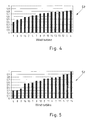
- FIG. 4 is a schematic illustration of the energy yield ranking list of the wind farm of FIG. 3 with a wind direction of 123°;
- FIG. 5 is a schematic illustration of the energy yield ranking list of the wind farm of FIG. 3 with a wind direction of 340°;
- FIG. 6 is a simplified flowchart for forming an energy yield ranking list of wind turbines of a wind farm.
- FIGS. 1 and 2 schematically show a top view of a wind farm 51 with 48 wind turbines.
- a wind 50 is shown with a corresponding schematically represented wind direction.
- the wind turbines which are provided with a black dot are wind turbines with freely incoming wind 50
- the wind turbines which are provided with a gray triangle are wind turbines with disrupted incoming wind.
- FIG. 1 with a wind direction from the left in FIG.
- the wind turbines 1 , 2 , 3 , 4 , 5 , 7 , 9 , 11 and 13 encounter freely inflowing wind, and the other wind turbines in the wake turbulence of those wind turbines encountering freely inflowing wind and also the further wind turbines, are thus exposed to disrupted inflowing wind.
- the wind turbines 1 , 6 , 7 , 20 , 21 , 29 , 36 , 41 , 42 , 46 , 47 and 48 in FIG. 2 with the wind direction of the wind 50 of the FIG. 2 encounter freely inflowing wind, and the further wind turbines encounter disrupted inflowing wind, i.e. disrupted by further wind turbines.
- the wind farm 51 according to FIGS. 1 and 2 is divided into two different groups of wind turbines depending on the wind direction. These are wind turbines which are not influenced by other wind turbines, and wind turbines which are influenced by other wind turbines. According to the invention, it is calculated for each wind direction, for example in increments of 1°, or larger or smaller increments, which wind turbines belong to which group. This can be specified in a first step according to the formula given in the document IEC 6140012-1:
- ⁇ 1 , 3 * arctan ⁇ ( 2 , 5 * D n L n + 0 , 15 ) + 10
- ⁇ is an angle of a disrupted sector
- D n is the rotor diameter of neighboring wind turbines that are operating
- L n is the distance between the wind turbine to be determined and the neighboring turbine that is also in operation.
- ⁇ ⁇ 90 - arctan ⁇ ( d y d x ) ⁇ f ⁇ u ⁇ ⁇ r x 0 > x ⁇ ⁇ und ⁇ ⁇ y 0 > y 90 + arctan ⁇ ( d y d x ) ⁇ f ⁇ u ⁇ ⁇ r x 0 > x ⁇ ⁇ und ⁇ ⁇ y 0 ⁇ y 270 - arctan ⁇ ( d y d x ) ⁇ f ⁇ u ⁇ ⁇ r x 0 ⁇ x ⁇ ⁇ und ⁇ ⁇ y 0 ⁇ y 270 + arctan ⁇ ( d y d x ) ⁇ f ⁇ u ⁇ ⁇ r x 0 ⁇ x ⁇ ⁇ und ⁇ ⁇ y 0 > y
- x 0 is the x-coordinate of the neighboring
- the x-coordinate is the abscissa and the y-coordinate is the ordinate.
- x and y are the x-coordinate, or respectively the y-coordinate, of the wind turbine for which it is to be determined whether this wind turbine is disrupted by other wind turbines.
- dx is the distance along the abscissa between the wind turbine to be determined and the neighboring and operating wind turbine, and correspondingly dy is the distance along the ordinate in this regard.
- ⁇ is the angle between the wind turbine to be determined and the neighboring wind turbine compared to the north direction.
- ⁇ ⁇ ⁇ - ⁇ dir ⁇ - ⁇ 2 it can be determined whether the respective wind turbine belongs to the disrupted wind turbines. This is the case if ⁇ has a negative value.
- ⁇ is the disruption indication angle
- v dir is the wind direction.
- the respective group division is performed, for example in a 10 minute average value of a wind direction, and the yield deficit of the nonoperational wind turbine, or respectively the wind turbine which is operated in a reduced energy yield mode, is specified as the average value of the energy yield of the further turbines of the corresponding group.
- a 10 minute time interval can also be considered.
- an average value of the energy yield of the wind turbines 1 , 3 , 4 , 5 , 7 , 9 , 11 and 13 is thus formed, and correspondingly the average value of the energy yields, or respectively the effective power, of these wind turbines over a 10 minute interval for example, is the energy yield potential for the wind turbine 2 .
- the difference between the possible power and the power actually created is calculated.
- the wind turbine operated in a reduced energy yield mode can be a wind turbine from the group of wind turbines with disrupted inflowing wind, so that the energy yield potential of this first wind turbine is formed, for example, by an average value of the determined energy yields of the further wind turbines from this group.
- a group 3 can be provided which provides for multiple disruptions.
- a group 1 can be provided for example, which are the wind turbines which are represented as circles
- a group 2 can be provided which includes the wind turbines 6 , 8 , 10 , 12 , 14 , 15 , 16 , 18 and 19
- the group 3 represents the further wind turbines. It is possible that this can lead to improved and more accurate results.
- this is not necessarily the case because the complex disruption behavior in the wake of wind turbines, or respectively wind rotors, can also lead to contrary effects, which however depend on the wind direction and the design of the wind farm 51 .
- FIG. 3 schematically shows a further wind farm in a schematic top view with an abscissa x and an ordinate y represented.
- two wind arrows 50 are shown which are arranged at different angles, namely an angle of 123° and an angle of 340°, each relative to the wind direction from the north.
- a ranking list of all wind turbines in the wind farm is to be created depending on their power, or respectively the energy yield and these are shown again depending on the wind direction.
- This ranking list serves in the case of a failure or a reduction of the energy yield of a wind turbine in order to determine possible energy partners from whose average value, or respectively weighted average value, or respectively by interpolation or extrapolation of the production power, the lost energy quantity can be derived.
- the lost quantity of energy is the energy yield potential of a wind turbine at standstill, or respectively the difference of the energy yield potential to the reduced energy yield of this wind turbine, if this turbine is operated in a reduced energy yield mode.
- fixed local wind turbines are not used as reference, thus wind turbines locally neighboring wind turbines, but rather wind turbines which are the closest in the energy production with given boundary conditions, i.e. given environmental parameters, for instance the wind direction or the wind strength, of the non-producing wind turbine, or respectively the wind turbine operated in the reduced energy yield mode.
- This embodiment of the invention has the advantage that it is very exact.
- the ranking list can also be used for prioritizing maintenance work because only systems with lower yield at a correspondingly present wind direction for example can be serviced.
- an energy yield ranking list is created for each wind direction. This can be performed once and be continuously adapted for corresponding wind directions and/or wind strengths and/or other environmental parameters, such that in the case of changes to the wind turbines, for instance software updates, contamination of rotor blades, changes at the site for instance the felling of large trees, the energy yield ranking list 52 is respectively adapted.
- the following data can be measured, or respectively provided, for instance the wind vane position which is made available, or respectively stored, preferably averaged for all wind vanes of each wind turbine from the energy farm 51 , the nacelle position of the respective wind turbine, an effective power, or respectively an energy yield of the respective wind turbine, and the status of the wind turbine whether this is in working or nonworking order.
- average values for example a 10 minute average value, can be used.
- a method for determining an energy yield ranking list 52 is shown schematically for example in FIG. 6 .
- it is checked whether all wind turbines 1 to 16 are producing power, or respectively delivering an energy yield.
- the averaged value of all wind vane positions is calculated.
- the effective power of each wind turbine is measured in 10 minute averages; at 130 , the effective power of each wind turbine is normalized with the greatest effective power in the wind farm.
- the greatest effective power in the wind farm is an effective power not determined over 10 minutes, but rather a currently measured effective power.
- An effective power over a time average can also be provided, and also over a 10 minute average. The normalization occurs for each wind turbine in the wind farm.
- the values corresponding to an n-tuple are stored in a corresponding, in particular dynamic, matrix, for example a tuple comprising the wind direction, the number of the wind turbine, the normalized effective power and the number of the measurement, for example the n-th measurement, wherein n is an integer.
- a query is made whether the measurement method was performed n-times.
- the number n can be preset, and is, for example the number 5. However, n can also be 10 or 20. If the response to the question is that this is not the case (n), then the method restarts at 100 , and when the question is answered with yes (y), then at 160 the average value of each normalized effective power of each wind turbine and a corresponding standard deviation is formed.
- the ranking list is formed, which is represented for example in FIGS. 4 and 5 .
- the normalized effective power is plotted on the ordinate and the number of respective wind turbines is plotted on the abscissa, wherein the sequence of the wind turbines is given by the energy yield, or respectively power yield. If a wind turbine has a standard deviation of the normalized effective power for the n-measurements that is too large, this wind turbine can be excluded from the ranking list.
- the sorting of the ranking list 52 is according to the value of the normalized and averaged effective power.
- the standard deviation reflects the reliability of the sequence. If the standard deviation values are above a limit value, the scattering is too large, and alternatively the next best reference system, or respectively neighboring wind turbine, should be selected if the standard deviation there is significantly lower.
- FIG. 4 schematically shows an energy yield ranking list 52 with a wind direction of 123°
- FIG. 5 schematically shows an energy yield ranking list 52 with a wind direction of 340°. Both of these wind directions are indicated in FIG. 3 .
- a one-year evaluation of the respectively measured data for the wind farm of FIG. 3 provided the respective energy yield ranking list for the different wind directions.
- FIG. 4 and FIG. 5 are shown as an example.
- the energy neighbors 4 and 8 and possibly also 2 and 11 can be used for determining the energy yield deficit, or respectively the energy yield potential.
- the energy yields, or respectively effective powers, of these producing wind turbines can then be used in order to determine the energy yield potential of the wind turbine 7 . This can occur for example by forming an average value, or respectively interpolating or forming a weighted average value. With forming a weighted average value, for example, the energy yield of the wind turbines 4 and 8 would be evaluated as twice the strength of the energy yield of the wind turbines 2 and 11 .
- the immediate energy neighbors of wind turbine 7 are the wind turbines 6 and 13 , and the correspondingly somewhat further distanced energy neighbors, the wind turbines 11 and 5 .
- the energy yield potential of the wind turbine 7 can be determined using the energy yields of these wind turbines ( 11 and 5 , as well as 6 and 13 ).
- the average value of the effective powers of the energy neighbors can be referred to for the relevant time of the standstill of a first wind turbine, in order to determine the energy quantity which the wind turbine 7 would have produced for example.
- Energy neighbors are preferably up to a maximum of 5 neighboring wind turbines in one direction.
- a particularly advantageous method further provides that for the determination of the energy neighbors it is additionally checked whether the energy neighbor lies in the wake turbulence, or respectively the wake, of the first wind turbine (here turbine 7 ).
- This check can be performed analogously to the formulas which were specified above for determining the wind turbines of the group 2 . If the energy neighbor lies in the immediate wake, it is excluded from the calculation because it is to be expected that the energy yield changes significantly due to the failure of the first wind turbine. The next energy neighbor then is referred to for the method, possibly with consideration of a weighting factor.
- This embodiment significantly increases the method accuracy for wind farms in a level site. For wind farms at hilly sites, the result can also be more accurate, even without this additional check.
- Planned standstill times for instance, an annual maintenance or an oil change, can be performed, for example with wind 340°, preferably for turbine 4 or 8 , and not for turbine 12 or 14 .
Landscapes
- Engineering & Computer Science (AREA)
- Life Sciences & Earth Sciences (AREA)
- Sustainable Development (AREA)
- Sustainable Energy (AREA)
- Chemical & Material Sciences (AREA)
- Combustion & Propulsion (AREA)
- Mechanical Engineering (AREA)
- General Engineering & Computer Science (AREA)
- Physics & Mathematics (AREA)
- General Physics & Mathematics (AREA)
- Power Engineering (AREA)
- Wind Motors (AREA)
Applications Claiming Priority (4)
| Application Number | Priority Date | Filing Date | Title |
|---|---|---|---|
| DE102011081241 | 2011-08-19 | ||
| DE102011081241A DE102011081241A1 (de) | 2011-08-19 | 2011-08-19 | Energieertragsverlustbestimmung einer Windenergieanlage |
| DE102011081241.5 | 2011-08-19 | ||
| PCT/EP2012/003447 WO2013026538A2 (fr) | 2011-08-19 | 2012-08-13 | Détermination de la perte de rendement énergétique d'une éolienne |
Related Parent Applications (1)
| Application Number | Title | Priority Date | Filing Date |
|---|---|---|---|
| PCT/EP2012/003447 Continuation WO2013026538A2 (fr) | 2011-08-19 | 2012-08-13 | Détermination de la perte de rendement énergétique d'une éolienne |
Publications (2)
| Publication Number | Publication Date |
|---|---|
| US20140172330A1 US20140172330A1 (en) | 2014-06-19 |
| US9322857B2 true US9322857B2 (en) | 2016-04-26 |
Family
ID=46832330
Family Applications (1)
| Application Number | Title | Priority Date | Filing Date |
|---|---|---|---|
| US14/184,080 Active 2033-01-30 US9322857B2 (en) | 2011-08-19 | 2014-02-19 | Determining the energy yield loss of a wind turbine |
Country Status (6)
| Country | Link |
|---|---|
| US (1) | US9322857B2 (fr) |
| EP (1) | EP2745007B2 (fr) |
| DE (1) | DE102011081241A1 (fr) |
| DK (1) | DK2745007T4 (fr) |
| ES (1) | ES2731211T5 (fr) |
| WO (1) | WO2013026538A2 (fr) |
Families Citing this family (6)
| Publication number | Priority date | Publication date | Assignee | Title |
|---|---|---|---|---|
| DE102013205838A1 (de) * | 2013-04-03 | 2014-10-09 | Senvion Se | Effizienzüberwachungsverfahren eines Windenergieanlagenparks |
| DE102013210090A1 (de) | 2013-05-29 | 2014-12-04 | Senvion Se | Verfahren zum Betreiben eines Windenergieanlagenparks |
| US9551322B2 (en) | 2014-04-29 | 2017-01-24 | General Electric Company | Systems and methods for optimizing operation of a wind farm |
| US10385829B2 (en) | 2016-05-11 | 2019-08-20 | General Electric Company | System and method for validating optimization of a wind farm |
| WO2018203891A1 (fr) * | 2017-05-03 | 2018-11-08 | Siemens Energy, Inc. | Système de commande pour une catégorie d'éoliennes et son procédé d'utilisation |
| CN109899233B (zh) * | 2019-01-30 | 2020-06-19 | 中国能源建设集团江苏省电力设计院有限公司 | 一种风力发电机群的分散协调控制方法 |
Citations (9)
| Publication number | Priority date | Publication date | Assignee | Title |
|---|---|---|---|---|
| EP0847496A1 (fr) | 1995-09-01 | 1998-06-17 | Aloys Wobben | Procede permettant d'actionner une centrale eolienne |
| DE102004056254A1 (de) | 2004-11-22 | 2006-06-01 | Repower Systems Ag | Verfahren zum Optimieren des Betriebs von Windenergieanlagen |
| US20060119105A1 (en) * | 2002-12-27 | 2006-06-08 | Junkoo Kang | Power generating system and its control method |
| US20080001409A1 (en) * | 2006-06-30 | 2008-01-03 | Vincent Schellings | Wind energy system and method of operation thereof |
| EP1944509A1 (fr) | 2001-07-31 | 2008-07-16 | Aloys Wobben | Préalerte de système pour des turbines d'énergie éolienne avec Sodar |
| EP2028368A2 (fr) | 2007-08-02 | 2009-02-25 | Nordex Energy GmbH | Ferme à vent dotée d'un grand nombre d'éoliennes ainsi que procédé de fonctionnement d'une ferme à vent |
| US20090066089A1 (en) * | 2006-02-28 | 2009-03-12 | Mitsubishi Heavy Industries, Ltd. | Wind Power Generator System and Control Method of the Same |
| US20100115951A1 (en) | 2007-04-27 | 2010-05-13 | Lm Glasfiber A/S | Design of a group of wind power plants |
| EP2354541A1 (fr) | 2010-01-20 | 2011-08-10 | Siemens Aktiengesellschaft | Contrôle d'alimentation de parc éolien basée sur une matrice reflétant une distribution de charge à alimentation entre des éoliennes individuelles |
Family Cites Families (3)
| Publication number | Priority date | Publication date | Assignee | Title |
|---|---|---|---|---|
| DE102004057320A1 (de) † | 2004-11-27 | 2006-06-01 | Karl-Heinz Best | Verfahren und Vorrichtung zum Überwachen wenigstens einer Windenergieanlage |
| DE102007036447A1 (de) † | 2007-08-02 | 2009-02-05 | Nordex Energy Gmbh | Verfahren und Vorrichtung zum Bestimmen einer Kennlinie für eine elektrische Größe einer Windenergieanlage |
| DE102011003799C5 (de) † | 2011-02-08 | 2017-10-26 | Wobben Properties Gmbh | Verfahren zum Bestimmen entgangener Energie |
-
2011
- 2011-08-19 DE DE102011081241A patent/DE102011081241A1/de not_active Ceased
-
2012
- 2012-08-13 EP EP12758399.5A patent/EP2745007B2/fr active Active
- 2012-08-13 DK DK12758399.5T patent/DK2745007T4/da active
- 2012-08-13 WO PCT/EP2012/003447 patent/WO2013026538A2/fr not_active Ceased
- 2012-08-13 ES ES12758399T patent/ES2731211T5/es active Active
-
2014
- 2014-02-19 US US14/184,080 patent/US9322857B2/en active Active
Patent Citations (9)
| Publication number | Priority date | Publication date | Assignee | Title |
|---|---|---|---|---|
| EP0847496A1 (fr) | 1995-09-01 | 1998-06-17 | Aloys Wobben | Procede permettant d'actionner une centrale eolienne |
| EP1944509A1 (fr) | 2001-07-31 | 2008-07-16 | Aloys Wobben | Préalerte de système pour des turbines d'énergie éolienne avec Sodar |
| US20060119105A1 (en) * | 2002-12-27 | 2006-06-08 | Junkoo Kang | Power generating system and its control method |
| DE102004056254A1 (de) | 2004-11-22 | 2006-06-01 | Repower Systems Ag | Verfahren zum Optimieren des Betriebs von Windenergieanlagen |
| US20090066089A1 (en) * | 2006-02-28 | 2009-03-12 | Mitsubishi Heavy Industries, Ltd. | Wind Power Generator System and Control Method of the Same |
| US20080001409A1 (en) * | 2006-06-30 | 2008-01-03 | Vincent Schellings | Wind energy system and method of operation thereof |
| US20100115951A1 (en) | 2007-04-27 | 2010-05-13 | Lm Glasfiber A/S | Design of a group of wind power plants |
| EP2028368A2 (fr) | 2007-08-02 | 2009-02-25 | Nordex Energy GmbH | Ferme à vent dotée d'un grand nombre d'éoliennes ainsi que procédé de fonctionnement d'une ferme à vent |
| EP2354541A1 (fr) | 2010-01-20 | 2011-08-10 | Siemens Aktiengesellschaft | Contrôle d'alimentation de parc éolien basée sur une matrice reflétant une distribution de charge à alimentation entre des éoliennes individuelles |
Non-Patent Citations (2)
| Title |
|---|
| Citation of Erich Hau "Windkraftanlagen", p. 546, picture 14.5 (discussed in Specification). |
| International Search Report filed in PCT/EP2012/003447. |
Also Published As
| Publication number | Publication date |
|---|---|
| WO2013026538A2 (fr) | 2013-02-28 |
| ES2731211T3 (es) | 2019-11-14 |
| ES2731211T5 (es) | 2023-02-16 |
| DK2745007T3 (da) | 2019-06-24 |
| EP2745007B1 (fr) | 2019-03-13 |
| DK2745007T4 (da) | 2022-12-19 |
| US20140172330A1 (en) | 2014-06-19 |
| WO2013026538A3 (fr) | 2013-11-07 |
| DE102011081241A1 (de) | 2013-02-21 |
| EP2745007A2 (fr) | 2014-06-25 |
| EP2745007B2 (fr) | 2022-10-05 |
Similar Documents
| Publication | Publication Date | Title |
|---|---|---|
| US9322857B2 (en) | Determining the energy yield loss of a wind turbine | |
| EP3224474B1 (fr) | Détermination de configuration de turbine éolienne | |
| US9957951B2 (en) | Wind turbine | |
| EP1939445B1 (fr) | Procédé pour prédire une courbe de puissance dans une éolienne | |
| EP3607198B1 (fr) | Fonctionnement de turbine dépendant de la densité d'air | |
| CN101881254B (zh) | 风轮机 | |
| US10422319B2 (en) | Control method and system for wind turbines | |
| EP2878809B1 (fr) | Procédés d'exploitation d'une éolienne, éolienne et parc éolien | |
| US10760548B2 (en) | Extreme load control | |
| US9562515B2 (en) | Method and apparatus for wind turbine noise reduction | |
| EP2719895B1 (fr) | Procédé de supervision d'une éolienne | |
| CN108488038A (zh) | 一种风力发电机组的偏航控制方法 | |
| CN114294161B (zh) | 一种风力发电机确保安全净空的方法、设备 | |
| US9903340B2 (en) | System and method of controlling a wind turbine | |
| EP3364022A1 (fr) | Organe de commande pour plusieurs générateurs d'énergie éolienne, parc éolien ou procédé de commande pour une pluralité de générateurs d'énergie éolienne | |
| Bao et al. | A data-driven approach for identification and compensation of wind turbine inherent yaw misalignment | |
| EP4459124A1 (fr) | Éolienne, procédés d'optimisation du fonctionnement d'une éolienne, dispositif de commande pour commander le fonctionnement d'une éolienne et programme informatique | |
| CN120042751A (zh) | 用于确定尾流行为的方法和控制器 | |
| Boorsma | Analysis of field measurements |
Legal Events
| Date | Code | Title | Description |
|---|---|---|---|
| AS | Assignment |
Owner name: REPOWER SYSTEMS SE, GERMANY Free format text: ASSIGNMENT OF ASSIGNORS INTEREST;ASSIGNORS:SCHUBERT, ALEXANDER;MITTELMEIER, NIKO;BLODAU, TOMAS;AND OTHERS;SIGNING DATES FROM 20140203 TO 20140218;REEL/FRAME:032309/0923 |
|
| AS | Assignment |
Owner name: SENVION SE, GERMANY Free format text: CHANGE OF NAME;ASSIGNOR:REPOWER SYSTEMS SE;REEL/FRAME:034806/0074 Effective date: 20140120 |
|
| STCF | Information on status: patent grant |
Free format text: PATENTED CASE |
|
| MAFP | Maintenance fee payment |
Free format text: PAYMENT OF MAINTENANCE FEE, 4TH YEAR, LARGE ENTITY (ORIGINAL EVENT CODE: M1551); ENTITY STATUS OF PATENT OWNER: LARGE ENTITY Year of fee payment: 4 |
|
| MAFP | Maintenance fee payment |
Free format text: PAYMENT OF MAINTENANCE FEE, 8TH YEAR, LARGE ENTITY (ORIGINAL EVENT CODE: M1552); ENTITY STATUS OF PATENT OWNER: LARGE ENTITY Year of fee payment: 8 |
|
| AS | Assignment |
Owner name: SENVION AG, GERMANY Free format text: CHANGE OF NAME;ASSIGNOR:SENVION SE;REEL/FRAME:069849/0638 Effective date: 20150622 |
|
| AS | Assignment |
Owner name: SENVION GMBH, GERMANY Free format text: CHANGE OF NAME;ASSIGNOR:SENVION AG;REEL/FRAME:069924/0352 Effective date: 20150626 |
|
| AS | Assignment |
Owner name: SENVION DEUTSCHLAND GMBH, GERMANY Free format text: CHANGE OF NAME;ASSIGNOR:SENVION GMBH;REEL/FRAME:069986/0450 Effective date: 20190911 |
|
| AS | Assignment |
Owner name: SIEMENS GAMESA RENEWABLE ENERGY SERVICE GMBH, GERMANY Free format text: CHANGE OF NAME;ASSIGNOR:SENVION DEUTSCHLAND GMBH;REEL/FRAME:070031/0577 Effective date: 20200624 |
|
| AS | Assignment |
Owner name: SIEMENS GAMESA RENEWABLE ENERGY SERVICE GMBH, GERMANY Free format text: REQUEST FOR ASSIGNEE ADDRESS CHANGE;ASSIGNOR:SIEMENS GAMESA RENEWABLE ENERGY SERVICE GMBH;REEL/FRAME:072597/0865 Effective date: 20230831 |