US9486416B2 - Emulsion-based process for preparing microparticles and workhead assembly for use with same - Google Patents
Emulsion-based process for preparing microparticles and workhead assembly for use with same Download PDFInfo
- Publication number
- US9486416B2 US9486416B2 US12/968,708 US96870810A US9486416B2 US 9486416 B2 US9486416 B2 US 9486416B2 US 96870810 A US96870810 A US 96870810A US 9486416 B2 US9486416 B2 US 9486416B2
- Authority
- US
- United States
- Prior art keywords
- solvent
- screen
- polymer
- emulsion
- phase
- Prior art date
- Legal status (The legal status is an assumption and is not a legal conclusion. Google has not performed a legal analysis and makes no representation as to the accuracy of the status listed.)
- Active, expires
Links
Images




Classifications
-
- B—PERFORMING OPERATIONS; TRANSPORTING
- B01—PHYSICAL OR CHEMICAL PROCESSES OR APPARATUS IN GENERAL
- B01J—CHEMICAL OR PHYSICAL PROCESSES, e.g. CATALYSIS OR COLLOID CHEMISTRY; THEIR RELEVANT APPARATUS
- B01J13/00—Colloid chemistry, e.g. the production of colloidal materials or their solutions, not otherwise provided for; Making microcapsules or microballoons
- B01J13/02—Making microcapsules or microballoons
- B01J13/06—Making microcapsules or microballoons by phase separation
- B01J13/14—Polymerisation; cross-linking
-
- A—HUMAN NECESSITIES
- A61—MEDICAL OR VETERINARY SCIENCE; HYGIENE
- A61K—PREPARATIONS FOR MEDICAL, DENTAL OR TOILETRY PURPOSES
- A61K9/00—Medicinal preparations characterised by special physical form
- A61K9/48—Preparations in capsules, e.g. of gelatin, of chocolate
- A61K9/50—Microcapsules having a gas, liquid or semi-solid filling; Solid microparticles or pellets surrounded by a distinct coating layer, e.g. coated microspheres, coated drug crystals
- A61K9/5005—Wall or coating material
- A61K9/5021—Organic macromolecular compounds
- A61K9/5031—Organic macromolecular compounds obtained otherwise than by reactions only involving carbon-to-carbon unsaturated bonds, e.g. polyethylene glycol, poly(lactide-co-glycolide)
-
- A—HUMAN NECESSITIES
- A61—MEDICAL OR VETERINARY SCIENCE; HYGIENE
- A61K—PREPARATIONS FOR MEDICAL, DENTAL OR TOILETRY PURPOSES
- A61K8/00—Cosmetics or similar toiletry preparations
- A61K8/02—Cosmetics or similar toiletry preparations characterised by special physical form
- A61K8/11—Encapsulated compositions
-
- A—HUMAN NECESSITIES
- A61—MEDICAL OR VETERINARY SCIENCE; HYGIENE
- A61K—PREPARATIONS FOR MEDICAL, DENTAL OR TOILETRY PURPOSES
- A61K9/00—Medicinal preparations characterised by special physical form
- A61K9/14—Particulate form, e.g. powders, Processes for size reducing of pure drugs or the resulting products, Pure drug nanoparticles
- A61K9/16—Agglomerates; Granulates; Microbeadlets ; Microspheres; Pellets; Solid products obtained by spray drying, spray freeze drying, spray congealing,(multiple) emulsion solvent evaporation or extraction
-
- A—HUMAN NECESSITIES
- A61—MEDICAL OR VETERINARY SCIENCE; HYGIENE
- A61K—PREPARATIONS FOR MEDICAL, DENTAL OR TOILETRY PURPOSES
- A61K9/00—Medicinal preparations characterised by special physical form
- A61K9/48—Preparations in capsules, e.g. of gelatin, of chocolate
- A61K9/50—Microcapsules having a gas, liquid or semi-solid filling; Solid microparticles or pellets surrounded by a distinct coating layer, e.g. coated microspheres, coated drug crystals
- A61K9/5089—Processes
-
- B01F13/1033—
-
- B—PERFORMING OPERATIONS; TRANSPORTING
- B01—PHYSICAL OR CHEMICAL PROCESSES OR APPARATUS IN GENERAL
- B01F—MIXING, e.g. DISSOLVING, EMULSIFYING OR DISPERSING
- B01F23/00—Mixing according to the phases to be mixed, e.g. dispersing or emulsifying
- B01F23/40—Mixing liquids with liquids; Emulsifying
- B01F23/41—Emulsifying
-
- B—PERFORMING OPERATIONS; TRANSPORTING
- B01—PHYSICAL OR CHEMICAL PROCESSES OR APPARATUS IN GENERAL
- B01F—MIXING, e.g. DISSOLVING, EMULSIFYING OR DISPERSING
- B01F25/00—Flow mixers; Mixers for falling materials, e.g. solid particles
- B01F25/40—Static mixers
- B01F25/45—Mixers in which the materials to be mixed are pressed together through orifices or interstitial spaces, e.g. between beads
- B01F25/452—Mixers in which the materials to be mixed are pressed together through orifices or interstitial spaces, e.g. between beads characterised by elements provided with orifices or interstitial spaces
- B01F25/4523—Mixers in which the materials to be mixed are pressed together through orifices or interstitial spaces, e.g. between beads characterised by elements provided with orifices or interstitial spaces the components being pressed through sieves, screens or meshes which obstruct the whole diameter of the tube
-
- B—PERFORMING OPERATIONS; TRANSPORTING
- B01—PHYSICAL OR CHEMICAL PROCESSES OR APPARATUS IN GENERAL
- B01F—MIXING, e.g. DISSOLVING, EMULSIFYING OR DISPERSING
- B01F25/00—Flow mixers; Mixers for falling materials, e.g. solid particles
- B01F25/60—Pump mixers, i.e. mixing within a pump
-
- B—PERFORMING OPERATIONS; TRANSPORTING
- B01—PHYSICAL OR CHEMICAL PROCESSES OR APPARATUS IN GENERAL
- B01F—MIXING, e.g. DISSOLVING, EMULSIFYING OR DISPERSING
- B01F27/00—Mixers with rotary stirring devices in fixed receptacles; Kneaders
- B01F27/05—Stirrers
- B01F27/11—Stirrers characterised by the configuration of the stirrers
- B01F27/111—Centrifugal stirrers, i.e. stirrers with radial outlets; Stirrers of the turbine type, e.g. with means to guide the flow
-
- B01F3/0807—
-
- B—PERFORMING OPERATIONS; TRANSPORTING
- B01—PHYSICAL OR CHEMICAL PROCESSES OR APPARATUS IN GENERAL
- B01F—MIXING, e.g. DISSOLVING, EMULSIFYING OR DISPERSING
- B01F33/00—Other mixers; Mixing plants; Combinations of mixers
- B01F33/80—Mixing plants; Combinations of mixers
- B01F33/82—Combinations of dissimilar mixers
- B01F33/822—Combinations of dissimilar mixers with moving and non-moving stirring devices in the same receptacle
-
- B01F5/0693—
-
- B01F7/00241—
-
- B—PERFORMING OPERATIONS; TRANSPORTING
- B01—PHYSICAL OR CHEMICAL PROCESSES OR APPARATUS IN GENERAL
- B01J—CHEMICAL OR PHYSICAL PROCESSES, e.g. CATALYSIS OR COLLOID CHEMISTRY; THEIR RELEVANT APPARATUS
- B01J13/00—Colloid chemistry, e.g. the production of colloidal materials or their solutions, not otherwise provided for; Making microcapsules or microballoons
- B01J13/02—Making microcapsules or microballoons
- B01J13/06—Making microcapsules or microballoons by phase separation
- B01J13/12—Making microcapsules or microballoons by phase separation removing solvent from the wall-forming material solution
-
- B—PERFORMING OPERATIONS; TRANSPORTING
- B01—PHYSICAL OR CHEMICAL PROCESSES OR APPARATUS IN GENERAL
- B01J—CHEMICAL OR PHYSICAL PROCESSES, e.g. CATALYSIS OR COLLOID CHEMISTRY; THEIR RELEVANT APPARATUS
- B01J13/00—Colloid chemistry, e.g. the production of colloidal materials or their solutions, not otherwise provided for; Making microcapsules or microballoons
- B01J13/02—Making microcapsules or microballoons
- B01J13/06—Making microcapsules or microballoons by phase separation
- B01J13/12—Making microcapsules or microballoons by phase separation removing solvent from the wall-forming material solution
- B01J13/125—Making microcapsules or microballoons by phase separation removing solvent from the wall-forming material solution by evaporation of the solvent
Definitions
- Microparticles are particles generally less than 2 millimeters in diameter and are typically spherical. Common microparticles generally comprise a matrix forming material, such as a polymer. A variety of substances can be encapsulated by microparticles. These substances can be released from the microparticle through various mechanisms, including controlled-release mechanisms wherein the substance passes through the microparticle matrix over time and also including rupture-release or degradation mechanisms wherein the microparticle matrix ruptures, degrades, or erodes over time to release the substance.
- Emulsion-based processes for making microparticles usually begin with the preparation of two separate phases: a first phase, typically referred to as a dispersed phase, which generally comprises a dispersion or solution of an agent, which is the substance to be encapsulated, in a dispersion or solution of polymer in a first solvent, and a second phase, typically referred to as a continuous phase, which generally comprises a second solvent that is at least partially immiscible with the first solvent of the dispersed phase.
- a first phase typically referred to as a dispersed phase
- a continuous phase which generally comprises a second solvent that is at least partially immiscible with the first solvent of the dispersed phase.
- the first and second phases are prepared, they are combined using dynamic or static mixing to form an emulsion, wherein microdroplets of the first phase are dispersed in the continuous phase.
- the microdroplets then are hardened to form microparticles that contain the agent.
- the hardening step is carried out by removal of
- a mixing device comprises a rotor/stator workhead assembly 1100 having an inlet port 1101 for introducing liquid and solid 1104 a materials, which constitute the combined dispersed and continuous phases, into the workhead assembly 1100 .
- Liquid and solid 1104 a materials are drawn into the workhead assembly 1100 by powerful suction created by a rotor element 1106 comprising rotor blades that is rotated by a shaft 1102 .
- the rotor blades are positioned substantially perpendicular to a stator element 1107 . Materials exit the workhead assembly at exit port 1103 .
- centrifugal force created by the rotor element 1106 drives the materials toward the stator element 1107 .
- the materials then pass through perforations in the stator element 1107 and are driven toward the periphery of the workhead assembly 1100 .
- the materials are forced through the perforations of the stator element 1107 at a velocity that subjects the materials to intense hydraulic shear.
- the material then exits the workhead assembly at exit port 1103 .
- the mixing action of the workhead assembly forces the dispersed phase into the continuous phase to form an emulsion comprising microdroplets of the dispersed phase in the continuous phases.
- a process for making microparticles comprising: (a) providing a process stream comprising (i) a dispersed phase comprising a first solvent having a polymer and an agent dissolved or dispersed therein; and (ii) a continuous phase comprising a second solvent that is partially or totally immiscible in the first solvent; (b) passing the process stream through a screen and into a mixing environment; such that during steps (a) or (b), microdroplets of the dispersed phase form in the continuous phase; and (c) at least substantially removing the first solvent from the microdroplets to form the microparticles.
- a process for making microparticles comprising: (a) providing a process stream comprising: a primary emulsion comprising microdroplets of (i) a first dispersed phase comprising a first solvent having an agent dissolved or dispersed therein, and (ii) a second dispersed phase comprising a second solvent that is partially or totally immiscible in the first solvent and having a polymer dissolved or dispersed therein; and a continuous phase comprising a third solvent that is partially or totally immiscible in the second solvent; (b) passing the process stream through a screen and into a mixing environment; such that during step (a) or (b), a double-emulsion forms; and (c) at least substantially removing the second solvent from the double-emulsion to form the microparticles.
- a workhead assembly for a non-static flow through mixer, comprising: a housing forming a mixing chamber and defining a fluid inlet port in communication with the mixing chamber and a fluid outlet port in communication with the mixing chamber; a screen mesh extending across the inlet port; and a rotor positioned within the housing between the screen and the fluid outlet port such that when the rotor is rotated, fluid is directed from the inlet port, through the screen mesh, to the outlet port.
- FIGS. 1A-C are drawings of a mixing process as performed using a conventional mixing head on a rotor/stator mixer.
- FIG. 2A is a drawing of an exemplary workhead assembly according to the present invention.
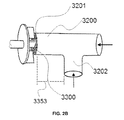
- FIG. 2B is a drawing of a portion of the workhead, which is connected to an inlet pipe.
- FIG. 2C is a drawing of an alternate embodiment of a portion of the workhead, which is connected to an inlet pipe configured as a tube-in-tube.
- FIG. 3 is a plot of particle diameter distribution derived from data obtained from a microparticle batch of Example 2 described below.
- FIG. 4 is a plot of particle diameter distribution derived from data obtained from a microparticle batch of Example 4 described below.
- FIGS. 5-12 are plots of particle diameter distribution derived from data obtained from microparticle batches of Example 7 described below.
- Ranges may be expressed herein as from “about” one particular value, and/or to “about” another particular value. When such a range is expressed, another aspect includes from the one particular value and/or to the other particular value. Similarly, when values are expressed as approximations, by use of the antecedent “about,” it will be understood that the particular value forms another aspect. It will be further understood that the endpoints of each of the ranges are significant both in relation to the other endpoint, and independently of the other endpoint.
- These and other materials are disclosed herein, and it is understood that when combinations, subsets, interactions, groups, etc. of these materials are disclosed that while specific reference of each various individual and collective combinations and permutation of these compounds may not be explicitly disclosed, each is specifically contemplated and described herein. For example, if a number of different polymers and agents are disclosed and discussed, each and every combination and permutation of the polymer and agent are specifically contemplated unless specifically indicated to the contrary.
- the sub-group of A-E, B-F, and C-E are specifically contemplated and should be considered disclosed from disclosure of A, B, and C; D, E, and F; and the example combination A-D.
- This concept applies to all aspects of this disclosure including, but not limited to, steps in methods of making and using the disclosed compositions.
- steps in methods of making and using the disclosed compositions are a variety of additional steps that can be performed it is understood that each of these additional steps can be performed with any specific embodiment or combination of embodiments of the disclosed methods, and that each such combination is specifically contemplated and should be considered disclosed.
- a “screen” refers to a porous material through which the process stream of the invention can pass.
- the porosity of the screen can vary widely depending on the particular process, as will be discussed below.
- mixing environment refers to mixing conditions in which two or more fluids are mixed to blend the fluids in the process stream, for example to force a dispersed phase into a continuous phase to form an emulsion.
- non-static flow through mixer refers to a mixer having elements that move within a flowing stream of fluids and/or solids.
- the process of the invention comprises (a) providing a process stream comprising (i) a dispersed phase comprising a first solvent having a polymer and an agent dissolved or dispersed therein; and (ii) a continuous phase comprising a second solvent that is partially or totally immiscible in the first solvent; (b) passing the process stream through a screen and into a mixing environment such that microdroplets comprised of the dispersed phase dispersed in the continuous phase are formed either during step (a) or (b), or both; and (c) removing the first solvent from the microdroplets to form the microparticles.
- the process of the invention comprises (a) providing a process stream comprising: a primary emulsion comprising microdroplets of (i) a first dispersed phase comprising a first solvent having a polymer and an agent dissolved or dispersed therein, and (ii) a second dispersed phase comprising a second solvent that is partially or totally immiscible in the first solvent; and a continuous phase comprising a third solvent that is partially or totally immiscible in the second solvent; (b) passing the process stream through a screen and into a mixing environment such that a double-emulsion forms during step (a) or (b) that comprises the first and second dispersed phases in the continuous phase; and (c) removing the first solvent from the double-emulsion to form the microparticles.
- the process of the invention can be used in both emulsion-based and double-emulsion based microencapsulation methods.
- a process stream first enters a mixing environment without having first been screened and then is propelled by centrifugal force created by a rotor in the mixing device toward a stator and then passes through perforations in the stator (typically macro-perforations), as discussed above with reference to FIGS. 1A-C .
- the processes of the invention reduce the energetics of the mixing process by producing a smaller population of very fine particles along with very large particles.
- the process is useful in providing a more narrow overall particle size distribution of the final microparticles.
- the process of the invention also provides better yields relative to conventional mixing.
- the mixing environment of the present invention is believed to cause less shear than the typical high-shear mixing environment created with mixers such as those depicted in FIGS. 1A-C .
- a process stream is first provided that comprises either the dispersed phase together with the continuous phase or a primary emulsion together with the continuous phase.
- the process stream is prepared by combining the dispersed phase or emulsion together with the continuous phase. Once combined, the mixture of dispersed phase or primary emulsion and the continuous phase may or may not be mixed. Likewise, upon providing the process stream, an emulsion may begin to form, prior to mixing.
- the process stream is then passed through a screen, which is porous.
- a screen which is porous.
- a variety of screens can be used, which generally will have a pore size ranging from 0.1 to 1000 ⁇ m or even larger, but preferably from about 1 to 400 ⁇ m.
- the screen can comprise a range of nominal pore sizes, for example, a screen having a mesh size 14 (1.4 mm) to mesh size 500 (25 microns) to even higher mesh sizes (smaller nominal pore sizes).
- the screen can comprise a variety of materials.
- the screen is a stainless steel mesh cloth or fabric having the desired pore size.
- a filter screen material can be cut out from a desired pore size, such as a 75 micron (200 mesh) test sieve that is typically used for sieving particles.
- a desired pore size such as a 75 micron (200 mesh) test sieve that is typically used for sieving particles.
- An example of such a material is a FISHERBRAND U.S. Standard Stainless Steel Test Sieve.
- a similar stainless steel mesh fabric can be obtained commercially from Small Parts, Inc. (Miami Lakes, Fla.), which is a stainless steel mesh filter, (120 mesh or 200 mesh) and is of a plain weave design.
- Screens include a variety of types of glass, metal, polymers, and inorganic materials, such as silica and alumina. Specific examples of such screens include sintered glass screens or plates, sintered metal screens or plates, and porous silica screens. Screens can also be prepared from porous filter membranes such as those made from hydrophobic or hydrophilic membrane materials, such as those comprising fluoropolymers, polytetrafluoroethylene, polyethylene, PVDF (polyvinylidene fluoride), PCTE, cellulose ester, mixed cellulose ester, nitrocellulose, nylon, polycarbonate, metals, silver, gold, stainless, silica, and alumina materials.
- porous filter membranes such as those made from hydrophobic or hydrophilic membrane materials, such as those comprising fluoropolymers, polytetrafluoroethylene, polyethylene, PVDF (polyvinylidene fluoride), PCTE, cellulose ester, mixed cellulose ester, nitrocellulose, nylon, polycarbonate, metals
- the screen comprises a metal material having a pore size ranging from about 1 to about 500 ⁇ m or higher, more preferably from about 10 to about 200 ⁇ m.
- the screen can have an average pore size of from about 50 to about 150 for example, 75 or 125 ⁇ m.
- the screen can be selected based on the desired end-use of the microparticle. For example, for a microparticle that can be injected into a living subject, smaller particle sizes can be desirable, and thus a smaller screen can be used.
- the screen can be prepared from a tortuous matrix, such as in a mixed fibrous membrane of cellulose ester or nylon, a nonwoven matrix, or a sintered metal, or glass disk, or can be prepared from an etched design having relatively consistent diameter pores through a membrane surface such as precision-drilled organic and inorganic membranes, laser-drilled membranes, inorganic pores (for example, ANOPORE alumina membrane), and track-etched membranes (for example, NUCLEPORE membrane).
- a tortuous matrix such as in a mixed fibrous membrane of cellulose ester or nylon, a nonwoven matrix, or a sintered metal, or glass disk
- an etched design having relatively consistent diameter pores through a membrane surface such as precision-drilled organic and inorganic membranes, laser-drilled membranes, inorganic pores (for example, ANOPORE alumina membrane), and track-etched membranes (for example, NUCLEPORE membrane).
- the process stream enters a mixing environment wherein the dispersed phase or the primary emulsion is mixed with the continuous phase.
- the dispersed phase or the primary emulsion is driven into the continuous phase to form microdroplets of the dispersed phase or to form a double-emulsion.
- Microdroplet formation is aided by the screening step, as discussed above.
- Suitable devices that can be used in the mixing step include but are not limited to static mixers and dynamic mixers. Such mixers include, for example, agitators, homogenizers, sonication devices, and other process equipment known in the art.
- mixing can be performed by pumping together the dispersed phase or the primary emulsion and the continuous phase through a length of pipe or tubing at conditions sufficient to create adequate mixing, i.e. enough turbulence to induce or enhance emulsion formation.
- Restriction plates (flow constrictors) and filters can also be used to create the required mixing environment.
- suitable mixers include non-motorized turbines and flow indicators, such as a ball indicator.
- Another example is the workhead of a flow-through mixer, such as those on commercially available mixers, e.g., a SILVERSON mixer (SILVERSON Machines Inc., East Longmeadow, Mass., U.S.A.), or more preferably the disclosed workhead of the invention, which is described below.
- the SILVERSON mixer can be a standard commercially-available mixer without a screen and with a stator after the rotor, or one that has been modified by removing the stator and placing a screen across the inlet port, as will be discussed below.
- the process stream once the process stream first passes through a screen, it does not pass through a subsequent screen after the mixing environment, or in the mixing environment but after the first screening step. In further aspects, the process stream is passed through two or more screens, which can be same or different, prior to entering the mixing environment.
- the primary emulsion can be formed analogously, i.e., by mixing a dispersed phase and a continuous phase together.
- the primary emulsion can first be formed using the disclosed process, and then a double emulsion can be formed using the same disclosed process.
- the primary and double-emulsions can be created using different mixing methods.
- the mixing environment does not comprise a subsequent screen or a perforated stator such as the one shown in the mixing devices depicted in FIGS. 1A-C .
- the process stream is first screened, then enters a mixing environment, and is not screened or passed through a perforated stator in the mixing environment itself, in contrast to mixing environments created with rotor/stator type mixing devices, wherein a process stream enters the mixing environment without having been screened and then is propelled through a perforated stator through centrifugal force created by the rotor.
- the solvent for the polymer (first solvent in single emulsion and second solvent in double-emulsion) is removed to provide the microparticles.
- Suitable methods include, but are not limited to, spray drying, freeze drying, air drying, vacuum drying, fluidized-bed drying, milling, co-precipitation, solvent extraction, or a combination thereof.
- spray drying freeze drying, air drying, vacuum drying, fluidized-bed drying and critical fluid extraction.
- milling the components are mixed in the dried form and milled by any method known in the art.
- the components are mixed in organic conditions and processed as described below.
- the components are mixed and dried using precision nozzles to produce extremely uniform droplets in a drying chamber.
- Suitable spray drying machines include, but are not limited to, Buchi, NIRO, APV and Lab-plant spray driers.
- the nature of the solvent-removal step will vary widely depending on whether or not the process is a batch process, continuous process, or a combination batch-continuous process and whether the process involves a single-emulsion or a double-emulsion.
- solvent removal is accomplished by extraction, evaporation, or a combination extraction and evaporation protocol, as discussed below.
- the solvent can be removed by extraction followed by evaporation.
- a portion of the first solvent is removed by extraction, and then evaporation is used to remove substantially all of the remaining solvent from the microdroplets or double-emulsion to provide the microparticles.
- the process involves adding the emulsion or double-emulsion to an extraction phase to concentrate the dispersed phase or phases or to induce skin formation at the interface between the dispersed phase and continuous phase to form microspheres, preferably by injecting the emulsion or double-emulsion into a flowing stream of the extraction phase.
- the extraction phase generally comprises a non-solvent for the polymer and a solvent for the continuous phase components; and a limited solvent for the dispersed phase solvent.
- the dispersed phase solvent has a solubility of 0.1% to 25% by weight in the extraction phase.
- the process then involves further removing the first solvent from the microspheres using an evaporative process, preferably while the microspheres remain in the extraction phase.
- the formed microspheres can then be collected, washed, dried, and packaged using techniques known in the art.
- the process also can include using separation, or sizing, techniques known in the art for classifying microparticles by size.
- the process can control the rate of solvent removal from the dispersed phase droplets in such a manner that the surface and internal structure of the resulting microparticles provides the desired release properties.
- the process can provide the desired microparticle properties while minimizing the amount of extraction phase needed and therefore the cost of the total process.
- solvent can be partition from the dispersed phase droplet or double-emulsion into the surrounding medium.
- the rate of partitioning is proportional to the concentration gradient of the dispersed phase solvent across the interface that exists between the dispersed phase and extraction phase solvent, and can therefore be controlled by controlling the concentration of the dispersed phase solvent in the extraction phase throughout the process. This can be controlled by adjusting the total volume of extraction phase, by further addition of extraction phase.
- Control of the solvent removal rate can also be achieved by evaporating solvent from the extraction phase at a rate that is matched to the desired rate of solvent removal during the latter stage of the encapsulation process.
- a slow rate of solvent removal will produce microparticles having a dense internal structure
- a fast rate of solvent removal will produce microparticles having a porous internal structure.
- the relationship between internal structure and the rate of solvent removal depends on factors such as the physicochemical properties of the agent, the polymer (composition and molecular weight), the dispersed phase solvent or solvents, and the concentration of agent and polymer in the dispersed phase.
- the object of the extraction step of this aspect is to affect an initial rapid reduction in solvent in the dispersed phase to establish the desired skin and internal structure.
- the minimum amount of extraction phase needed to achieve the desired extent of extraction within the desired extraction time frame and under a given set of conditions can be determined empirically or calculated using known mathematical models.
- the object of the evaporation step is to maintain a relatively high driving force for partitioning of dispersed phase solvent, thereby minimizing the overall process time.
- the rate of evaporation needed to accomplish this objective can be determined by empirical methods or through the use of mathematical models. In a preferred aspect, between about 10% and about 90%, and more preferably between about 20% and 70%, of the solvent is removed by extraction.
- the evaporation step can be performed using techniques known in the art. Evaporation can be performed under atmospheric or reduced pressure conditions, and at ambient temperatures, or higher temperatures that do not harm the agent.
- An example of a continuous evaporation process is one in which the process stream exiting the extraction step is passed through a falling-film or wiped-film evaporator.
- solvent removal can be performed using a continuous evaporation process.
- the solvent is removed using only evaporation in a continuous process following a continuous emulsification process. No extraction is required, and consequently less process streams and process equipment are required than those including extraction.
- the dispersed phase or phases and continuous phase are prepared as described above.
- the emulsion or double-emulsion is transferred directly to an evaporative process.
- the emulsion flows into a large tank that is maintained under vacuum or reduced pressure, drawing off the solvent vapor.
- the tank may be heated, for example using an internal steam coil or external jacketing, in order to increase the rate of evaporation.
- the pressure and/or temperature selected depends on the solvent, polymer, and agent selected, as well as the relative amounts of these materials.
- the solvent removal step can be performed using a solvent extraction by membrane separation method.
- emulsification is followed first by extraction then by a membrane separation step to remove the remainder of the solvent after the skin-forming extraction step.
- a semipermeable membrane selective for the dispersed phase solvent an ultrafiltration membrane with an appropriate molecular weight cut-off, or a microfiltration membrane of suitable pore size can be used in place of a portion of pipe downstream from the point of injection of the extraction phase, i.e. the extraction lag tube.
- the rate of solvent removal is controlled by the properties of the membrane and the capacity of the fluid phase to hold the solvent.
- This solvent removal process preferably is performed on a continuous basis.
- the membrane separation process also provides fine control over the rate of solvent extraction, enabling one of skill in the art to create a microencapsulation process having a precise extraction profile, which, for example, can be computer controlled and adjusted during continuous operation, for instance, by adjusting the flow rate of the surrounding extraction fluid.
- the solvent removal step can be performed using incremental extraction.
- the solvent removal process involves introducing the extraction phase into the emulsion or double-emulsion through multiple feed streams rather than a single feed stream.
- the extraction phase is thereby combined with the emulsion at two or more locations along the extraction lag tube rather than in one location, preferably in a continuous process.
- each incremental addition of extraction phase can be equal in its capacity to hold dispersed phase solvent, or the increments can differ. Furthermore, the position along the extraction lag tube at which the incremental additions are made can be controlled so that the extraction profile can be carefully programmed. With a sufficient number of extraction phase inlets, the extraction process effectively becomes a continuous process in which the rate of extraction is determined by the rate of addition of extraction phase, i.e. dilution of the emulsion.
- the incremental extraction can be used to remove all the solvent to be removed from the microparticle, or a partial extraction process can be followed by an evaporation step to remove the solvent remaining after incremental extraction.
- the desired extent of extraction within the desired extraction time frame for a given set of conditions can be determined empirically or calculated using mathematical models.
- the solvent removal process can be performed using a two-phase solvent extraction.
- This solvent extraction process uses only two phases, rather than the typical three phases. The same phase is used both to form the emulsion or double-emulsion and to extract the solvent.
- This process requires less process equipment than a three phase continuous process for microencapsulation. While inherently simpler, the process requires careful control of the process variables, since there generally is only a narrow operating window at which the emulsion or double-emulsion is stable enough to form spherical disperse phase droplets before extraction precipitates the polymer.
- the first condition is to operate at saturation levels of solvent, producing a solvent evaporation condition, rather than solvent extraction.
- the solvent is removed from a quench tank, possibly using a vacuum assist.
- the second condition is to operate at below solvent saturation levels, producing a solvent extraction condition.
- Process variables for this condition must be carefully adjusted to provide a metastable emulsion or double-emulsion, in order to form dispersed phase droplets having desired diameters and surface characteristics.
- the extraction phase generally comprises a solvent for the continuous phase components, a limited solvent for the dispersed phase solvent, and a nonsolvent for the polymer.
- the first solvent (or the first solvent component of greatest proportion if a mixture of solvents are used for the first solvent) should generally have a solubility in the extraction phase of from about 0.1% and 25% by weight.
- the extraction phase preferably is deionized water.
- the extraction phase can contain buffers to limit agent solubility in the extraction phase.
- any of the common buffers such as phosphate, acetate, or tris, are suitable for use with the extraction phase, provided that they are compatible with the surfactant system chosen. Salts can also be used, such as sodium chloride, potassium chloride, and the like. When making microparticles for pharmaceutical or biomedical applications, the buffer also should be pharmaceutically acceptable.
- the buffering system should be selected to provide a pH in the extraction phase which provides minimum solubility of the active agent.
- solvent removal can be performed entirely or partially using a cryogenic extraction step.
- a cryogenic extraction step This is a process in which a cold extraction medium is used to freeze the polymer, the solvent for the polymer, or both in the emulsion or double-emulsion.
- the cryogenic process provides an enhanced ability to control the mobility of the agent, keeping it in the microparticle based on the appropriate selection of solvent and temperatures. The lower temperatures also can stabilize the agent, particularly bioactive agents.
- the selection of the solvent for the dispersed phase which includes the third solvent in the case of a double-emulsion process, used in the process generally depends on the polymer and agent chosen, as well as the particular means of solvent removal to be employed. More than one solvent can be used in the dispersed phase, including for example, the first and third solvent, which can be the same or different.
- Organic solvents such as acetone, methyl ethyl ketone, ethyl lactate, ethyl acetate, dichloromethane, and ethyl acetate/alcohol blends
- polyesters such as poly(lactide), poly(glycolide), poly(lactide-co-glycolide), poly(caprolactone), or combinations thereof, and cellulose ethers, cellulose esters, and acrylics.
- polymers such as polyethylene glycol, poly(vinyl alcohol), and carboxymethylcellulose
- water can be preferred as the first solvent.
- the polymer of the dispersed phase can be a wide variety of different polymers.
- the polymers can be homopolymers or copolymers, including block or blocky co- or ter-polymers, random co- or ter-polymers, star polymers, or dendrimers. Any desired molecular weight polymer can be used, depending on the desired properties of the microparticle. If a high strength polymer is desired, then high molecular weight polymers can be used, for example, to meet strength requirements. In other aspects, low or medium molecular weight polymers can be used when, for example, when resorption time of the polymer, rather than microparticle strength is desired.
- polymers used in the process are both biocompatible and biodegradable.
- the molecular weight of the polymer can be important for degradable microparticles given that molecular weight influences the degradation rate of the polymer.
- the polymer should remain intact until all of the agent is released from the polymer and then degrade.
- the agent can also be released from the polymer as the polymer erodes.
- a polymer formulation can be made such that the resulting polymer exhibits both diffusional release and degradation release properties.
- Molecular weights can be measured by methods known in the art, including gel permeation chromatography, viscosity, light-scattering, among other methods.
- the polymer can be formulated so as to degrade within a desired time interval, once present in a particularly medium.
- the time interval can be from about less than one day to about 1 month.
- Longer time intervals can extend to 6 months, including for example, polymers that degrade from about ⁇ 0 to about 6 months, or from about 1 to about 6 months.
- the polymer can degrade in longer time intervals, up to 2 years or longer, including, for example, from about ⁇ 0 to about 2 years, or from about 1 month to about 2 years.
- a sustained release formulation of the microparticle and agent can release the agent over any of these time periods and under a wide variety of release profiles.
- the desired agent release mechanism can influence the selection of the polymer.
- a biocompatible polymer for example, can be selected so as to release or allow the release of a agent therefrom at a desired lapsed time after the microparticle has been administered to a subject.
- the polymer can be selected to release or allow the release of the agent prior to the agent beginning to diminish its activity, as the agent begins to diminish in activity, when the agent is partially diminished in activity, for example at least 25%, at least 50% or at least 75% diminished, when the agent is substantially diminished in activity, or when the agent is completely gone or no longer has activity.
- suitable polymers include one or more of a poly(lactide), a poly(glycolide), a poly(lactide-co-glycolide), a poly(caprolactone), a poly(orthoester), a poly(phosphazene), a poly(hydroxybutyrate) or a copolymer containing a poly(hydroxybutyrate), a poly(lactide-co-caprolactone), a polycarbonate, a polyesteramide, a polyanhydride, a poly(dioxanone), a poly(alkylene alkylate), a copolymer of polyethylene glycol and a polyorthoester, a biodegradable polyurethane, a poly(amino acid), a polyamide, a polyesteramide, a polyetherester, a polyacetal, a polycyanoacrylate, a poly(oxyethylene)/poly(oxypropylene) copolymer, polyacetals, polyketals
- Lactide-based polymers can comprise any lactide residue, including all racemic and stereospecific forms of lactide, including, but not limited to, L-lactide, D-lactide, and D,L-lactide, or a mixture thereof.
- Useful polymers comprising lactide include, but are not limited to poly(L-lactide), poly(D-lactide), and poly(DL-lactide); and poly(lactide-co-glycolide), including poly(L-lactide-co-glycolide), poly(D-lactide-co-glycolide), and poly(DL-lactide-co-glycolide); or copolymers, terpolymers, combinations, or blends thereof.
- Lactide/glycolide polymers can be conveniently made by melt polymerization through ring opening of lactide and glycolide monomers. Additionally, racemic DL-lactide, L-lactide, and D-lactide polymers are commercially available. The L-polymers are more crystalline and resorb slower than DL-polymers. In addition to copolymers comprising glycolide and DL-lactide or L-lactide, copolymers of L-lactide and DL-lactide are commercially available. Homopolymers of lactide or glycolide are also commercially available.
- the biodegradable polymer is poly(lactide-co-glycolide), or a mixture of poly(lactide) and poly(glycolide), the amount of lactide and glycolide in the polymer can vary.
- the biodegradable polymer contains 0 to 100 mole %, 40 to 100 mole %, 50 to 100 mole %, 60 to 100 mole %, 70 to 100 mole %, or 80 to 100 mole % lactide and from 0 to 100 mole %, 0 to 60 mole %, 10 to 40 mole %, 20 to 40 mole %, or 30 to 40 mole % glycolide, wherein the amount of lactide and glycolide is 100 mole %.
- the biodegradable polymer can be poly(lactide), 95:5 poly(lactide-co-glycolide) 85:15 poly(lactide-co-glycolide), 75:25 poly(lactide-co-glycolide), 65:35 poly(lactide-co-glycolide), or 50:50 poly(lactide-co-glycolide), where the ratios are mole ratios.
- a poly(lactide-co-caprolactone) can be 0: 100 mole %, 40 to 100 mole %, 50 to 100 mole %, 60 to 100 mole %, 70 to 100 mole %, or 80 to 100 mole % lactide and from 0 to 100 mole %, 0 to 60 mole %, 10 to 40 mole %, 20 to 40 mole %, or 30 to 40 mole % caprolactone.
- Biodegradable means the polymer will degrade or erode in vivo to form smaller chemical species, wherein the degradation can result, for example, from enzymatic, chemical, and physical processes.
- biocompatible is used herein to refer to a polymer and any degradation products of the polymer that are non-toxic to a recipient and present no significant deleterious effects on the recipient's body.
- suitable biocompatible, biodegradable polymers include many of those discussed above, such as polyesters (polyhydroxy acids), such as poly(lactide)s, poly(glycolide)s, poly(lactide-co-glycolide)s, poly(lactic acid)s, poly(glycolic acid)s, poly(lactic acid-co-glycolic acid)s, poly(lactide-co-caprolactone)s, poly(lactide-co-glycolide-caprolactone)s, polyanhydrides, polyorthoesters, polyetheresters, polycaprolactone, polyesteramides, polyphosphazines, polycarbonates, polyamides, and copolymers and blends thereof.
- polyesters polyhydroxy acids
- poly(lactide)s such as poly(lactide)s, poly(glycolide)s, poly(lactide-co-glycolide)s, poly(lactic acid)s, poly(glycolic acid)s, poly(lactic acid-co-
- Biocompatible, non-biodegradable polymers suitable for use in the processes described herein include polyacrylates, ethylene-vinyl acetate copolymers, modified celluloses such as cellulose ethers and cellulose esters, non-degradable polyurethanes, polystyrenes, polyvinyl chloride, polyvinyl fluoride, poly(vinyl alcohol), poly(vinyl imidazole), chlorosulphonate polyolefins, polyethylene oxide, and copolymers and blends thereof. Specific examples of such polymers are discussed above.
- agent which can be released from a microparticle can be used with the invention.
- the agent can be a bioactive agent or non-bioactive agent.
- non-bioactive agents that can be encapsulated by this method include, but are not limited to, adhesives, pesticides, fragrances, antifoulants, dyes, salts, oils, inks, cosmetics, catalysts, detergents, curing agents, flavors, foods, fuels, herbicides, metals, paints, photographic agents, biocides, pigments, plasticizers, propellents, solvents, stabilizers, polymer additives, and the like.
- bioactive agents can be used, which are capable of being released from polymer into a medium, for example a subject.
- a “bioactive agent” refers to an agent that has biological activity.
- the biological agent can be used to treat, diagnose, cure, mitigate, prevent (i.e., prophylactically), ameliorate, modulate, or have an otherwise favorable effect on a disease, disorder, or infection that is present in a subject.
- a liquid or solid bioactive agent can be used.
- the bioactive agents can be water soluble or water-insoluble, depending on the nature of the disclosed process. In some aspects, the bioactive agent is at least very slightly water soluble, and preferably moderately water soluble.
- the bioactive agents can include salts of the active ingredient.
- the bioactive agents can be acidic, basic, or amphoteric salts. They can be nonionic molecules, polar molecules, or molecular complexes capable of hydrogen bonding.
- the bioactive agent can be included in the compositions in the form of, for example, an uncharged molecule, a molecular complex, a salt, an ether, an ester, an amide, polymer drug conjugate, or other form to provide the effective biological or physiological activity.
- bioactive agents examples include, but are not limited to, small molecules, peptides, proteins such as hormones, enzymes, antibodies, antibody fragments, antibody conjugates, nucleic acids such as aptamers, iRNA, siRNA, DNA, RNA, antisense nucleic acid or the like, antisense nucleic acid analogs or the like, VEGF inhibitors, macrocyclic lactones, dopamine agonists, dopamine antagonists, low-molecular weight compounds, high-molecular-weight compounds, or conjugated bioactive agents.
- nucleic acids such as aptamers, iRNA, siRNA, DNA, RNA, antisense nucleic acid or the like, antisense nucleic acid analogs or the like
- VEGF inhibitors macrocyclic lactones
- dopamine agonists dopamine antagonists
- low-molecular weight compounds high-molecular-weight compounds, or conjugated bioactive agents.
- Bioactive agents contemplated for use in the disclosed compositions include anabolic agents, antacids, anti-asthmatic agents, anti-cholesterolemic and anti-lipid agents, anti-coagulants, anticonvulsants, anti-diarrheals, anti-emetics, anti-infective agents including antibacterial and antimicrobial agents, anti-inflammatory agents, anti-manic agents, antimetabolite agents, anti-nauseants, anti-neoplastic agents, anti-obesity agents, anti-pyretic and analgesic agents, anti-spasmodic agents, anti-thrombotic agents, anti-tussive agents, anti-uricemic agents, anti-anginal agents, antihistamines, appetite suppressants, biologicals, cerebral dilators, coronary dilators, bronchiodilators, cytotoxic agents, decongestants, diuretics, diagnostic agents, erythropoietic agents, expectorants, gastrointestinal sedatives, hyperglycemic agents, hyp
- bioactive agents include androgen inhibitors, polysaccharides, growth factors, hormones, anti-angiogenesis factors, dextromethorphan, dextromethorphan hydrobromide, noscapine, carbetapentane citrate, chlophedianol hydrochloride, chlorpheniramine maleate, phenindamine tartrate, pyrilamine maleate, doxylamine succinate, phenyltoloxamine citrate, phenylephrine hydrochloride, phenylpropanolamine hydrochloride, pseudoephedrine hydrochloride, ephedrine, codeine phosphate, codeine sulfate morphine, mineral supplements, cholestyramine, N-acetylprocainamide, acetaminophen, aspirin, ibuprofen, phenyl propanolamine hydrochloride, caffeine, guaifenesin, aluminum hydroxide, magnesium hydroxide, peptide
- bioactive agents include, but are not limited to, peptide drugs, protein drugs, therapeutic antibodies, desensitizing materials, antigens, anti-infective agents such as antibiotics, antimicrobial agents, antiviral, antibacterial, antiparasitic, antifungal substances and combination thereof, antiallergenics, androgenic steroids, decongestants, hypnotics, steroidal anti-inflammatory agents, anti-cholinergics, sympathomimetics, sedatives, miotics, psychic energizers, tranquilizers, vaccines, estrogens, progestational agents, humoral agents, prostaglandins, analgesics, antispasmodics, antimalarials, antihistamines, cardioactive agents, nonsteroidal anti-inflammatory agents, antiparkinsonian agents, antihypertensive agents, ⁇ -adrenergic blocking agents, nutritional agents, and the benzophenanthridine alkaloids.
- the agent can further be a substance capable of acting as a stimulant, sed
- bioactive agents include but are not limited to analgesics such as acetaminophen, acetylsalicylic acid, and the like; anesthetics such as lidocaine, xylocaine, and the like; anorexics such as dexadrine, phendimetrazine tartrate, and the like; antiarthritics such as methylprednisolone, ibuprofen, and the like; antiasthmatics such as terbutaline sulfate, theophylline, ephedrine, and the like; antibiotics such as sulfisoxazole, penicillin G, ampicillin, cephalosporins, amikacin, gentamicin, tetracyclines, chloramphenicol, erythromycin, clindamycin, isoniazid, rifampin, and the like; antifungals such as amphotericin B, nystatin, ketoconazole, and the
- Neisseria meningitides Neisseria gonorrhoeae, Streptococcus mutans.
- Pseudomonas aeruginosa Salmonella typhi, Haemophilus parainfluenzae, Bordetella pertussis, Francisella tularensis, Yersinia pestis, Vibrio cholerae, Legionella pneumophila, Mycobacterium tuberculosis, Mycobacterium leprae, Treponema pallidum, Leptspirosis interrogans, Borrelia burgddorferi, Campylobacter jejuni , and the like; antigens of such viruses as smallpox, influenza A and B, respiratory synctial, parainfluenza, measles, HIV, SARS, varicella-zoster, herpes simplex 1 and 2, cytomeglavirus, Epstein-Barr, rotavirus, rhinovirus, adenovirus, papillo
- compositions are prepared by uniformly and intimately bringing the microparticle into association with a carrier or a finely divided solid carrier, or both, if necessary.
- the microparticle itself can be the carrier and/or can be combined with other carriers or additives.
- Other pharmaceutical carriers can also be used.
- solid carriers, other than the polymer (if solid) include lactose, terra alba, sucrose, talc, gelatin, agar, pectin, acacia, magnesium stearate, and stearic acid.
- liquid carriers, other than the polymer (if liquid) are sugar syrup, peanut oil, olive oil, and water.
- gaseous carriers include carbon dioxide and nitrogen.
- Other pharmaceutically acceptable carriers or components that can be mixed with the bioactive agent can include, for example, a fatty acid, a sugar, or a salt.
- the continuous phase can in some aspects be aqueous and can further comprise at least one surfactant or emulsifying agent.
- Polyvinyl alcohol (PVA) is a preferred surfactant when water is used as the continuous phase solvent.
- Other emulsifiers or surfactants which can be used include many emulsifiers, for instance egg lecithin or soya bean lecithin, or synthetic lecithins such as saturated synthetic lecithins, for example, dimyristoyl phosphatidyl choline, dipalmitoyl phosphatidyl choline or distearoyl phosphatidyl choline or unsaturated synthetic lecithins, such as dioleyl phosphatidyl choline or dilinoleyl phosphatidyl choline.
- Emulsifiers also include surfactants such as free fatty acids, esters of fatty acids with polyoxyalkylene compounds like polyoxypropylene glycol and polyoxyethylene glycol; ethers of fatty alcohols with polyoxyalkylene glycols; esters of fatty acids with polyoxyalkylated sorbitan; soaps; glycerol-polyalkylene stearate; glycerol-polyoxyethylene ricinoleate; homo- and co-polymers of polyalkylene glycols; polyethoxylated soya-oil and castor oil as well as hydrogenated derivatives; ethers and esters of sucrose or other carbohydrates with fatty acids, fatty alcohols, these being optionally polyoxyalkylated; mono-, di-, and tri-glycerides of saturated or unsaturated fatty acids, glycerides or soya-oil and sucrose.
- Other emulsifiers include natural and synthetic forms of bile salts or bile
- the continuous phase also preferably includes dispersed phase solvent, which reduces or eliminates partitioning of the solvent from the dispersed phase into the continuous phase during emulsification.
- the amount of dispersed phase solvent added to the continuous phase may vary depending on the specific polymer/agent combination used. Generally, the amount of dispersed phase solvent is between about 5% and 100% of the amount needed to saturate the continuous phase, for example about 7.5%.
- the continuous phase like the extraction phase, can optionally further comprise buffers or salts, as discussed above.
- the continuous phase can further be manipulated by an adjustment of pH of the phase.
- the screen mesh 3300 can be made from any desirable material, as discussed above, but is preferably a material that will not corrode when it encounters the incoming fluid. Thus, a variety of types of materials can be used in the screen but generally will be limited by the particular mixing process.
- the screen of the workhead can comprise any of those materials discussed above in reference to the screening step of the process.
- the spinning rotor 3350 In operation, referring again to FIG. 2A , as fluid enters the fluid inlet port 3201 , and passes through the screen 3300 extending across the inlet port 3201 , it encounters the spinning rotor 3350 which will generally have rotor blades.
- the rotor 3350 functions to create suction through the inlet port 3201 , mixes the fluid, and drives the fluid toward the exit port 3250 .
- the rotor can comprise a rotatable shaft 3351 for rotating the rotor at a desired speed.
- Such a rotor 3350 can generally operate at a high number of revolutions per minute depending on the source that drives the rotor.
- the location of the side inlet pipe 3202 can be important, inasmuch as the location of side inlet pipe 3202 affects when and how two or more fluids will be combined with the fluid flowing through the main inlet pipe 3200 .
- the side inlet pipe can be positioned at a distance 3353 ranging from about 0 to about 20 cm, preferably from about 0 to about 5.5 cm, and more preferably from about 0 to about 0.6 cm, including for example, 0.32 cm and 0.64 cm.
- Microparticle batches were prepared in a process using the workhead assemblies with a 125 ⁇ m screen as described in Example 1.
- the average dispersed phase (DP) flow-rate was about 25 g/min and the average continuous phase (CP) flow-rate was about 200 g/min, so that the total flow rate through the screen (DP+CP rate, g/min) was about 225 g/min.
- the total flow rate (DP+CP rate) was lowered to either 75% of initial (to about 170 g/min) or 50% of initial (to about 112 g/min) while maintaining a fixed ratio of the CP flow rate to the DP flow rate.
- the average extraction phase flow-rate was about 1500 g/min.
- Polymer concentration in the dispersed phase for all batches was 20% in ethyl acetate.
- the polymer used was poly(D,L-lactide) having an intrinsic viscosity (IV) of about 0.36 dL/g.
- the continuous phase was a 2 weight % polyvinyl alcohol (PVA) solution saturated at 7.5% ethyl acetate.
- PVA polyvinyl alcohol
- Particle size data shown in Table 1 were taken from a hardening bath. The microparticles were collected on a 20 ⁇ m screen, and then freeze-dried. Yields are based on initial input of polymer and the weight of the microparticles collected after sieving on a 20 micron screen and freeze drying. A 125 ⁇ m scalping screen was not used. Table 1 shows the results.
- Naltrexone-loaded microparticle batches were prepared in a process using the workhead assemblies with a 125 ⁇ m screen as described in Example 1. Naltrexone theoretical loading was 25 weight %, and the actual Naltrexone loading was 20 weight %.
- the average dispersed phase (DP) flow-rate was about 52 g/min.
- the average continuous phase (CP) flow-rate was about 249 g/min.
- the average extraction phase flow-rate was about 2500 g/min.
- Polymer concentration in the dispersed phase was 20% in ethyl acetate.
- the polymer used was poly(D,L-lactide) having an intrinsic viscosity (IV) of about 0.36 dL/g.
- the continuous phase was a 2 weight % polyvinyl alcohol (PVA) solution saturated at 7.5% ethyl acetate.
- PVA polyvinyl alcohol
- Particle size data were taken from a hardening bath. The microparticles were collected on a 20 ⁇ m screen, and then freeze-dried. Yields are based on initial input of polymer and the weight of the microparticles collected after sieving on a 20 micron screen and freeze drying. A 125 ⁇ m scalping screen was not used. Table 5 shows the results.
- Yields are based on initial input of polymer and the weight of the microparticles collected after sieving on a 20 micron screen and freeze drying. A 125 ⁇ m scalping screen was not used.
- the continuous phase flow rate, CP/DP ratio, rotor speed, screen pore size, dispersed phase tube diameter, and dispersed phase tube position, relative to the screen were all varied in different process runs.
- the process parameters are shown in Table 6 and 8, and the particle properties observed in particles prepared using these process parameters are shown in Tables 7 and 9, respectively.
- the screen used with process parameters shown in Table 6 was 125 ⁇ m.
- the screen used with process parameters shown in Table 8 was 75 ⁇ m.
- the dispersed phase tube position was placed at a short distance from the screen.
- FIGS. 5 and 6 Plots of particle size distribution for Lot #s 00339-006 and 00339-027 are shown in FIGS. 5 and 6 , respectively. These lots were prepared with the dispersed phase tube 0.25 inches away from the screen. Plots of particle size distribution for Lot #s 00339-033 and 00339-143 are shown in FIGS. 7 and 8 , respectively. These lots were prepared with the dispersed phase tube roughly at the position of the screen, or about 0 cm away from the screen.
- Results from Table 7 show that by using a screen size of 125 microns while changing CP flowrate, tube position, tube diameter, rotor speed and CP/DP ratio, a number of particle sizes could be generated. In general, faster speeds flowrates and smaller tube diameters generated smaller particle sizes. In 4 of the 8 formulations, particle sizes of less than 130 microns were generated with the 125 micron screen. All batches showed exceptionally high yields of greater than 80%.
- FIGS. 9 and 10 Plots of particle size distribution for Lot #s 00339-107 and 00339-063 are shown in FIGS. 9 and 10 , respectively. These lots were prepared with the dispersed phase tube 0.25 inches away from the screen. Plots of particle size distribution for Lot #s 00339-116 and 00339-069 are shown in FIGS. 11 and 12 , respectively. These lots were prepared with the dispersed phase tube roughly at the position of the screen, or about 0.125 inches away from the screen.
- microparticle product yields were in excess of 75%. In some instances, yields of greater than 90% were obtained while having acceptable particle size. In no case in the collection was a 125 micron screening step used to remove larger size particles. Particle size analysis showed in some cases an absence of particles greater than 125 microns while an exceptionally high yield was obtained, e.g. Lot #00339-063.
Landscapes
- Chemical & Material Sciences (AREA)
- Health & Medical Sciences (AREA)
- Chemical Kinetics & Catalysis (AREA)
- Life Sciences & Earth Sciences (AREA)
- Public Health (AREA)
- Epidemiology (AREA)
- Animal Behavior & Ethology (AREA)
- General Health & Medical Sciences (AREA)
- Engineering & Computer Science (AREA)
- Veterinary Medicine (AREA)
- Bioinformatics & Cheminformatics (AREA)
- Pharmacology & Pharmacy (AREA)
- Medicinal Chemistry (AREA)
- Dispersion Chemistry (AREA)
- Organic Chemistry (AREA)
- Birds (AREA)
- Medicinal Preparation (AREA)
- Manufacturing Of Micro-Capsules (AREA)
- Colloid Chemistry (AREA)
- Accessories For Mixers (AREA)
- Medicines That Contain Protein Lipid Enzymes And Other Medicines (AREA)
- Physical Or Chemical Processes And Apparatus (AREA)
- Processes Of Treating Macromolecular Substances (AREA)
Priority Applications (1)
| Application Number | Priority Date | Filing Date | Title |
|---|---|---|---|
| US12/968,708 US9486416B2 (en) | 2009-12-22 | 2010-12-15 | Emulsion-based process for preparing microparticles and workhead assembly for use with same |
Applications Claiming Priority (2)
| Application Number | Priority Date | Filing Date | Title |
|---|---|---|---|
| US28897309P | 2009-12-22 | 2009-12-22 | |
| US12/968,708 US9486416B2 (en) | 2009-12-22 | 2010-12-15 | Emulsion-based process for preparing microparticles and workhead assembly for use with same |
Publications (2)
| Publication Number | Publication Date |
|---|---|
| US20110204533A1 US20110204533A1 (en) | 2011-08-25 |
| US9486416B2 true US9486416B2 (en) | 2016-11-08 |
Family
ID=44304875
Family Applications (1)
| Application Number | Title | Priority Date | Filing Date |
|---|---|---|---|
| US12/968,708 Active 2031-01-23 US9486416B2 (en) | 2009-12-22 | 2010-12-15 | Emulsion-based process for preparing microparticles and workhead assembly for use with same |
Country Status (10)
| Country | Link |
|---|---|
| US (1) | US9486416B2 (fr) |
| EP (1) | EP2516053B1 (fr) |
| JP (2) | JP5791629B2 (fr) |
| KR (1) | KR101862416B1 (fr) |
| CN (1) | CN102985175B (fr) |
| BR (1) | BR112012015200B1 (fr) |
| CA (1) | CA2784287C (fr) |
| ES (1) | ES2764971T3 (fr) |
| RU (1) | RU2562263C9 (fr) |
| WO (1) | WO2011087689A2 (fr) |
Cited By (2)
| Publication number | Priority date | Publication date | Assignee | Title |
|---|---|---|---|---|
| US12076146B2 (en) | 2018-06-07 | 2024-09-03 | Becton, Dickinson And Company | Biological fluid separation device |
| US12297148B2 (en) | 2021-11-02 | 2025-05-13 | Saudi Arabian Oil Company | Self-repairing cement including microcapsule-in-microcapsule material and designed swellable rubber and methods for fabricating same |
Families Citing this family (31)
| Publication number | Priority date | Publication date | Assignee | Title |
|---|---|---|---|---|
| US10092524B2 (en) | 2008-06-11 | 2018-10-09 | Edge Therapeutics, Inc. | Compositions and their use to treat complications of aneurysmal subarachnoid hemorrhage |
| US10011763B2 (en) | 2007-07-25 | 2018-07-03 | Schlumberger Technology Corporation | Methods to deliver fluids on a well site with variable solids concentration from solid slurries |
| US9040468B2 (en) | 2007-07-25 | 2015-05-26 | Schlumberger Technology Corporation | Hydrolyzable particle compositions, treatment fluids and methods |
| US9370729B2 (en) * | 2008-02-06 | 2016-06-21 | Proxeon Biosystems A/S | Flow control in high performance liquid chromatography |
| CA2784287C (fr) | 2009-12-22 | 2017-07-18 | Evonik Degussa Corporation | Procede a base d'emulsion pour preparer des microparticules et ensemble d'unite de travail destinee a etre utilisee dans le procede |
| RU2606169C2 (ru) | 2011-04-05 | 2017-01-10 | Эдж Терапьютикс | Система интравентрикулярной доставки лекарственного средства для улучшения исхода после повреждения головного мозга, нарушающего мозговое кровообращение |
| ITMI20110784A1 (it) * | 2011-05-09 | 2012-11-10 | Sipcam Spa | Processo per l'ottenimento di microcapsule |
| US9399019B2 (en) | 2012-05-09 | 2016-07-26 | Evonik Corporation | Polymorph compositions, methods of making, and uses thereof |
| GB2502577A (en) | 2012-05-31 | 2013-12-04 | Univ Dublin | Microparticles and a device and method for the production thereof |
| KR101543507B1 (ko) * | 2013-05-15 | 2015-08-11 | 씨제이헬스케어 주식회사 | 연속 공정의 미립구의 제조 방법 및 이로부터 제조된 미립구 |
| US9321899B1 (en) * | 2014-10-29 | 2016-04-26 | Xerox Corporation | Preparing latex using a biosolvent |
| JP2019510008A (ja) | 2016-02-23 | 2019-04-11 | バイオデリバリー サイエンシーズ インターナショナル インコーポレイティッド | 持続放出性ブプレノルフィンミクロスフェア(srbm)及びその使用方法 |
| WO2017199123A1 (fr) | 2016-05-17 | 2017-11-23 | Ecole Polytechnique Federale De Lausanne (Epfl) | Dispositif et procédés d'élimination de phase d'enveloppe de capsules de type noyau-enveloppe |
| KR101942449B1 (ko) * | 2016-12-13 | 2019-01-28 | 주식회사 삼양바이오팜 | 생분해성 고분자의 다공성 미립자, 및 이를 포함하는 고분자 필러 |
| SG11202000979SA (en) * | 2017-08-04 | 2020-02-27 | Shire Human Genetic Therapies | Antibody-resin coupling apparatus and methods |
| IL272943B2 (en) * | 2017-09-03 | 2024-07-01 | Evonik Operations Gmbh | Biocompatible polymer powders for additive manufacturing |
| US11179694B2 (en) | 2017-09-11 | 2021-11-23 | Basf Se | Method of forming porous metal oxide microspheres |
| MY202228A (en) | 2017-09-11 | 2024-04-18 | Basf Se | Microspheres comprising polydisperse polymer nanospheres and porous metal oxide microspheres |
| US11052046B2 (en) * | 2017-09-26 | 2021-07-06 | Nanomi B.V. | Method for preparing micro-particles by double emulsion technique |
| WO2020009439A1 (fr) * | 2018-07-03 | 2020-01-09 | 주식회사 엘지생활건강 | Procédé de préparation de microcapsule hybride organique/inorganique |
| KR102147113B1 (ko) * | 2018-07-23 | 2020-08-28 | 지효근 | 기능성첨가물 혼합수 발생장치 |
| CA3174213A1 (fr) | 2019-06-14 | 2020-12-17 | Daniela Oana Trambitas | Procede de microencapsulation d'ingredients naturels par mise en contact avec un gaz supercritique |
| EP3993898B1 (fr) * | 2019-07-01 | 2025-10-15 | Oakwood Laboratories, Llc | Système et procédé de fabrication de microsphères et d'émulsions |
| MX2022010150A (es) * | 2020-02-21 | 2022-09-12 | Basf Se | Polialquileniminas alcoxiladas o poliaminas alcoxiladas con biodegradabilidad mejorada. |
| CN113651989B (zh) * | 2020-05-12 | 2025-10-03 | 北京华龛生物科技有限公司 | 适用于细胞三维培养的微载体的制备方法及反应装置 |
| CN114534590B (zh) * | 2022-02-26 | 2023-06-09 | 四川大学 | 一种可控制备单分散双重乳液的旋转式套管微流控装置及方法 |
| KR102464808B1 (ko) * | 2022-04-13 | 2022-11-09 | (주)인벤티지랩 | 목시덱틴을 포함하는 마이크로 입자의 제조 방법 및 이의 제조 방법으로 제조된 마이크로 입자를 포함하는 서방형 주사제 조성물 |
| KR102464821B1 (ko) * | 2022-04-13 | 2022-11-09 | (주)인벤티지랩 | 목시덱틴을 포함하는 마이크로 입자 및 이를 포함하는 서방형 주사제 조성물 |
| WO2025014388A1 (fr) * | 2023-07-11 | 2025-01-16 | Saudi Arabian Oil Company | Production de microcapsules noyau-enveloppe pour applications de fond de trou |
| CN117959752A (zh) * | 2023-12-27 | 2024-05-03 | 上海东富龙拓溥科技有限公司 | 湿法微晶体析晶系统和方法 |
| WO2025221360A1 (fr) * | 2024-02-15 | 2025-10-23 | Recode Therapeutics, Inc. | Systèmes et procédés de génération de nanoparticules lipidiques |
Citations (40)
| Publication number | Priority date | Publication date | Assignee | Title |
|---|---|---|---|---|
| GB501675A (en) | 1937-10-30 | 1939-03-03 | Joe Lowe Food Products Company | Improvements in or relating to emulsifying apparatus |
| US2247439A (en) | 1937-10-30 | 1941-07-01 | Florence Frances Hawes | Emulsifying apparatus |
| US2578805A (en) | 1944-12-26 | 1951-12-18 | John E Johnson | Mixing apparatus |
| GB916757A (en) | 1960-10-05 | 1963-01-30 | Carpco Kewanee Inc | Treatment of liquids with corona wind discharge |
| US3501914A (en) | 1967-07-14 | 1970-03-24 | Exxon Research Engineering Co | Hydrocarbon fuel powered vehicle employing emulsified fuel |
| GB1231823A (fr) | 1967-07-14 | 1971-05-12 | ||
| US4476148A (en) | 1981-11-19 | 1984-10-09 | Peanut Research & Testing Labs, Inc. | Method of producing a slurry from crop products |
| GB2157744A (en) | 1984-04-24 | 1985-10-30 | Ici Plc | Fluid compositions |
| EP0172010A2 (fr) | 1984-08-15 | 1986-02-19 | Morinaga Milk Industry Co., Ltd. | Poudre de crème instantanée |
| WO1995005939A1 (fr) | 1993-08-25 | 1995-03-02 | Fmc Corporation | Microparticules hydrocolloidales non agglutinantes, leurs intermediaires et procedes de production et de preparation |
| US5407609A (en) | 1989-05-04 | 1995-04-18 | Southern Research Institute | Microencapsulation process and products therefrom |
| WO1995011009A1 (fr) | 1993-10-22 | 1995-04-27 | Genentech, Inc. | Procede de preparation de microspheres avec etape de sechage en lit fluidise |
| US5529392A (en) | 1993-11-15 | 1996-06-25 | O'donnell; Garry | Apparatus for emulsification of liquid polymeric solutions |
| US5540499A (en) | 1991-06-07 | 1996-07-30 | Ystral Gmbh Maschinenbau + Prozesstechnik | Device for dispersing, suspending or emulsifying gases, liquids and/or flowable solid substances, more particularly for wetting and dispersing powders in liquids |
| US5635216A (en) | 1993-12-16 | 1997-06-03 | Eli Lilly And Company | Microparticle compositions containing peptides, and methods for the preparation thereof |
| WO1998035654A1 (fr) | 1997-02-13 | 1998-08-20 | Oakwood Laboratories L.L.C. | Procede de production de microspheres en continu |
| US5843334A (en) | 1994-06-20 | 1998-12-01 | Nippon Shinyaku Co., Ltd. | Method of producing emulsions and an emulsification apparatus |
| US5852076A (en) | 1994-11-13 | 1998-12-22 | Minnesota Mining And Manufacturing Company | Process for preparing a dispersion of hard particles in solvent |
| EP0885615A1 (fr) | 1993-07-02 | 1998-12-23 | Molecular Biosystems, Inc. | Microsphères à gaz encapsulées par une protéine insoluble, leur préparation et application comme produits pour imagerie |
| US5869103A (en) | 1994-06-18 | 1999-02-09 | Danbiosyst Uk Limited | Polymer microparticles for drug delivery |
| JPH1157456A (ja) | 1997-08-20 | 1999-03-02 | Oki Electric Ind Co Ltd | マイクロカプセルの製造方法 |
| US6042792A (en) | 1997-09-18 | 2000-03-28 | International Flavors & Fragrances Inc. | Apparatus for preparing a solid phase microparticulate composition |
| EP1115317A1 (fr) | 1998-09-24 | 2001-07-18 | Jura Elektroapparate Ag | Dispositif de production d'ecume de lait pour capuccino |
| US6291013B1 (en) | 1999-05-03 | 2001-09-18 | Southern Biosystems, Inc. | Emulsion-based processes for making microparticles |
| JP2003005453A (ja) | 2001-06-27 | 2003-01-08 | Ricoh Co Ltd | 液体現像剤の製造方法及び液体現像剤 |
| US20030094715A1 (en) * | 2000-04-28 | 2003-05-22 | Takehiko Suzuki | Method for preparing microsphere |
| US20040152788A1 (en) | 2003-01-31 | 2004-08-05 | Wu Huey Shen | Uniform emulsion by membrane emulsification |
| US20050056170A1 (en) | 2003-08-27 | 2005-03-17 | Fuji Photo Film Co., Ltd. | Method and apparatus for emulsification |
| WO2005070046A2 (fr) | 2004-01-09 | 2005-08-04 | Clean Fuels Technology, Inc. | Appareil et procede de melange destine a la fabrication d'un combustible emulsifie |
| EP1560641A1 (fr) | 2002-11-14 | 2005-08-10 | K.U.Leuven Research & Development | Procede de preparation d'emulsions |
| US20060164912A1 (en) | 2002-10-15 | 2006-07-27 | Christophe Arnaud | Method and device for making a dispersion or an emulsion |
| WO2006123359A2 (fr) | 2005-03-01 | 2006-11-23 | Sun Pharmaceutical Industries Limited | Procede de fabrication de microspheres ou microcapsules |
| US20070071825A1 (en) | 2003-10-01 | 2007-03-29 | Catherine Curdy | Device and method for making particles |
| US20070207211A1 (en) | 2003-04-10 | 2007-09-06 | Pr Pharmaceuticals, Inc. | Emulsion-based microparticles and methods for the production thereof |
| US7287651B2 (en) | 2004-09-16 | 2007-10-30 | Vortox Company | Fuel and water separator |
| WO2008009623A1 (fr) | 2006-07-17 | 2008-01-24 | Nestec S.A. | Appareil à membrane cylindrique pour former de la mousse |
| US7344570B2 (en) | 2001-08-24 | 2008-03-18 | Clean Fuels Technology, Inc. | Method for manufacturing an emulsified fuel |
| WO2009044926A1 (fr) | 2007-10-05 | 2009-04-09 | Nippon Oil Corporation | Procédé et appareil pour réguler le diamètre de particules et la répartition du diamètre de particules pour des particules émulsifiés |
| US20090162407A1 (en) | 2007-12-20 | 2009-06-25 | Danielle Biggs | Process for preparing microparticles having a low residual solvent volume |
| CA2784287A1 (fr) | 2009-12-22 | 2011-07-21 | Evonik Degussa Corporation | Procede a base d'emulsion pour preparer des microparticules et ensemble d'unite de travail destinee a etre utilisee dans le procede |
Family Cites Families (6)
| Publication number | Priority date | Publication date | Assignee | Title |
|---|---|---|---|---|
| US4183681A (en) * | 1978-05-19 | 1980-01-15 | Exxon Research & Engineering Co. | Emulsion preparation method using a packed tube emulsifier |
| AU636481B2 (en) * | 1990-05-18 | 1993-04-29 | Bracco International B.V. | Polymeric gas or air filled microballoons usable as suspensions in liquid carriers for ultrasonic echography |
| JP3012608B1 (ja) * | 1998-09-17 | 2000-02-28 | 農林水産省食品総合研究所長 | マイクロチャネル装置及び同装置を用いたエマルションの製造方法 |
| ES2427092T3 (es) * | 2003-04-10 | 2013-10-28 | Evonik Corporation | Un método para la producción de micropartículas a base de emulsión |
| JP2008049598A (ja) * | 2006-08-25 | 2008-03-06 | Bridgestone Corp | シーリング剤注入装置 |
| CN100998597A (zh) * | 2007-01-12 | 2007-07-18 | 西北工业大学 | 二膦酸盐微球组合物及其制备方法 |
-
2010
- 2010-12-15 CA CA2784287A patent/CA2784287C/fr active Active
- 2010-12-15 CN CN201080064425.9A patent/CN102985175B/zh active Active
- 2010-12-15 KR KR1020127017983A patent/KR101862416B1/ko active Active
- 2010-12-15 RU RU2012130937/05A patent/RU2562263C9/ru active
- 2010-12-15 JP JP2012546038A patent/JP5791629B2/ja active Active
- 2010-12-15 ES ES10843487T patent/ES2764971T3/es active Active
- 2010-12-15 US US12/968,708 patent/US9486416B2/en active Active
- 2010-12-15 WO PCT/US2010/060473 patent/WO2011087689A2/fr not_active Ceased
- 2010-12-15 EP EP10843487.9A patent/EP2516053B1/fr active Active
- 2010-12-15 BR BR112012015200-9A patent/BR112012015200B1/pt active IP Right Grant
-
2014
- 2014-11-25 JP JP2014237959A patent/JP5984903B2/ja active Active
Patent Citations (49)
| Publication number | Priority date | Publication date | Assignee | Title |
|---|---|---|---|---|
| US2247439A (en) | 1937-10-30 | 1941-07-01 | Florence Frances Hawes | Emulsifying apparatus |
| GB501675A (en) | 1937-10-30 | 1939-03-03 | Joe Lowe Food Products Company | Improvements in or relating to emulsifying apparatus |
| US2578805A (en) | 1944-12-26 | 1951-12-18 | John E Johnson | Mixing apparatus |
| GB916757A (en) | 1960-10-05 | 1963-01-30 | Carpco Kewanee Inc | Treatment of liquids with corona wind discharge |
| US3501914A (en) | 1967-07-14 | 1970-03-24 | Exxon Research Engineering Co | Hydrocarbon fuel powered vehicle employing emulsified fuel |
| GB1231823A (fr) | 1967-07-14 | 1971-05-12 | ||
| US4476148A (en) | 1981-11-19 | 1984-10-09 | Peanut Research & Testing Labs, Inc. | Method of producing a slurry from crop products |
| GB2157744A (en) | 1984-04-24 | 1985-10-30 | Ici Plc | Fluid compositions |
| EP0172010A2 (fr) | 1984-08-15 | 1986-02-19 | Morinaga Milk Industry Co., Ltd. | Poudre de crème instantanée |
| US5407609A (en) | 1989-05-04 | 1995-04-18 | Southern Research Institute | Microencapsulation process and products therefrom |
| US5540499A (en) | 1991-06-07 | 1996-07-30 | Ystral Gmbh Maschinenbau + Prozesstechnik | Device for dispersing, suspending or emulsifying gases, liquids and/or flowable solid substances, more particularly for wetting and dispersing powders in liquids |
| EP0885615A1 (fr) | 1993-07-02 | 1998-12-23 | Molecular Biosystems, Inc. | Microsphères à gaz encapsulées par une protéine insoluble, leur préparation et application comme produits pour imagerie |
| WO1995005939A1 (fr) | 1993-08-25 | 1995-03-02 | Fmc Corporation | Microparticules hydrocolloidales non agglutinantes, leurs intermediaires et procedes de production et de preparation |
| WO1995011009A1 (fr) | 1993-10-22 | 1995-04-27 | Genentech, Inc. | Procede de preparation de microspheres avec etape de sechage en lit fluidise |
| US5529392A (en) | 1993-11-15 | 1996-06-25 | O'donnell; Garry | Apparatus for emulsification of liquid polymeric solutions |
| US5635216A (en) | 1993-12-16 | 1997-06-03 | Eli Lilly And Company | Microparticle compositions containing peptides, and methods for the preparation thereof |
| US5869103A (en) | 1994-06-18 | 1999-02-09 | Danbiosyst Uk Limited | Polymer microparticles for drug delivery |
| US5843334A (en) | 1994-06-20 | 1998-12-01 | Nippon Shinyaku Co., Ltd. | Method of producing emulsions and an emulsification apparatus |
| US5852076A (en) | 1994-11-13 | 1998-12-22 | Minnesota Mining And Manufacturing Company | Process for preparing a dispersion of hard particles in solvent |
| US5945126A (en) | 1997-02-13 | 1999-08-31 | Oakwood Laboratories L.L.C. | Continuous microsphere process |
| WO1998035654A1 (fr) | 1997-02-13 | 1998-08-20 | Oakwood Laboratories L.L.C. | Procede de production de microspheres en continu |
| JPH1157456A (ja) | 1997-08-20 | 1999-03-02 | Oki Electric Ind Co Ltd | マイクロカプセルの製造方法 |
| US6042792A (en) | 1997-09-18 | 2000-03-28 | International Flavors & Fragrances Inc. | Apparatus for preparing a solid phase microparticulate composition |
| US6499389B1 (en) | 1998-09-24 | 2002-12-31 | Jura Elekroapparate Ag | Device for producing milk froth for cappuccino |
| EP1115317A1 (fr) | 1998-09-24 | 2001-07-18 | Jura Elektroapparate Ag | Dispositif de production d'ecume de lait pour capuccino |
| US6291013B1 (en) | 1999-05-03 | 2001-09-18 | Southern Biosystems, Inc. | Emulsion-based processes for making microparticles |
| US6440493B1 (en) | 1999-05-03 | 2002-08-27 | Southern Biosystems, Inc. | Emulsion-based processes for making microparticles |
| US20030094715A1 (en) * | 2000-04-28 | 2003-05-22 | Takehiko Suzuki | Method for preparing microsphere |
| JP2003005453A (ja) | 2001-06-27 | 2003-01-08 | Ricoh Co Ltd | 液体現像剤の製造方法及び液体現像剤 |
| US7344570B2 (en) | 2001-08-24 | 2008-03-18 | Clean Fuels Technology, Inc. | Method for manufacturing an emulsified fuel |
| US20060164912A1 (en) | 2002-10-15 | 2006-07-27 | Christophe Arnaud | Method and device for making a dispersion or an emulsion |
| EP1560641A1 (fr) | 2002-11-14 | 2005-08-10 | K.U.Leuven Research & Development | Procede de preparation d'emulsions |
| US20040152788A1 (en) | 2003-01-31 | 2004-08-05 | Wu Huey Shen | Uniform emulsion by membrane emulsification |
| US20070207211A1 (en) | 2003-04-10 | 2007-09-06 | Pr Pharmaceuticals, Inc. | Emulsion-based microparticles and methods for the production thereof |
| US20050056170A1 (en) | 2003-08-27 | 2005-03-17 | Fuji Photo Film Co., Ltd. | Method and apparatus for emulsification |
| US20070071825A1 (en) | 2003-10-01 | 2007-03-29 | Catherine Curdy | Device and method for making particles |
| WO2005070046A2 (fr) | 2004-01-09 | 2005-08-04 | Clean Fuels Technology, Inc. | Appareil et procede de melange destine a la fabrication d'un combustible emulsifie |
| US20070294935A1 (en) | 2004-01-09 | 2007-12-27 | Waldron Jack L | Mixing apparatus and method for manufacturing an emulsified fuel |
| US7287651B2 (en) | 2004-09-16 | 2007-10-30 | Vortox Company | Fuel and water separator |
| WO2006123359A2 (fr) | 2005-03-01 | 2006-11-23 | Sun Pharmaceutical Industries Limited | Procede de fabrication de microspheres ou microcapsules |
| US20090104274A1 (en) * | 2005-03-01 | 2009-04-23 | Ajay Khopade | Process of making microspheres |
| WO2008009623A1 (fr) | 2006-07-17 | 2008-01-24 | Nestec S.A. | Appareil à membrane cylindrique pour former de la mousse |
| WO2009044926A1 (fr) | 2007-10-05 | 2009-04-09 | Nippon Oil Corporation | Procédé et appareil pour réguler le diamètre de particules et la répartition du diamètre de particules pour des particules émulsifiés |
| US20110135933A1 (en) * | 2007-10-05 | 2011-06-09 | Toshikatsu Shoko | Method and apparatus for controlling particle diameter and particle diameter distribution of emulsion particles in emulsion |
| US20090162407A1 (en) | 2007-12-20 | 2009-06-25 | Danielle Biggs | Process for preparing microparticles having a low residual solvent volume |
| CA2784287A1 (fr) | 2009-12-22 | 2011-07-21 | Evonik Degussa Corporation | Procede a base d'emulsion pour preparer des microparticules et ensemble d'unite de travail destinee a etre utilisee dans le procede |
| WO2011087689A2 (fr) | 2009-12-22 | 2011-07-21 | Surmodics Pharmaceuticals,Inc. | Procédé à base d'émulsion pour préparer des microparticules et ensemble d'unité de travail destinée à être utilisée dans le procédé |
| CN102985175A (zh) | 2009-12-22 | 2013-03-20 | 赢创德固赛有限公司 | 用于制备微粒的基于乳液的工艺以及供所述工艺使用的工作头组件 |
| RU2012130937A (ru) | 2009-12-22 | 2014-01-27 | Евоник Дегусса Корпорейшн | Способ и рабочий узел для приготовления микрочастиц с использованием эмульсии |
Non-Patent Citations (4)
| Title |
|---|
| Extended European Search Report, PCT/US2010060473, dated Jul. 24, 2013, six pages. |
| Freitas S et al, "Microencapsulation by solvent extraction/evaporation: reviewing the state of the art of microsphere preparation process technology", Journal of Controlled Release, Elsevier, Amsterdam, NL, vol. 102, No. 2, Feb. 2, 2005 (Feb. 2, 2005), pp. 313-332. |
| International Preliminary Report on Patentability issued on Jul. 5, 2012 for PCT/US2010/060473, filed Dec. 15, 2010 (Inventor-Winchester et al.; Applicant-Surmodics Pharmaceuticals, Inc.; pp. 1-6). |
| International Search Report with Written Opinion issued on Aug. 23, 2011 for Intl. App. No. PCT/US2010/060473, filed Dec. 15, 2010 (Inventor-Winchester et al.; Applicant-Surmodics Pharmaceuticals, Inc.). |
Cited By (2)
| Publication number | Priority date | Publication date | Assignee | Title |
|---|---|---|---|---|
| US12076146B2 (en) | 2018-06-07 | 2024-09-03 | Becton, Dickinson And Company | Biological fluid separation device |
| US12297148B2 (en) | 2021-11-02 | 2025-05-13 | Saudi Arabian Oil Company | Self-repairing cement including microcapsule-in-microcapsule material and designed swellable rubber and methods for fabricating same |
Also Published As
| Publication number | Publication date |
|---|---|
| CA2784287C (fr) | 2017-07-18 |
| BR112012015200B1 (pt) | 2021-07-20 |
| WO2011087689A2 (fr) | 2011-07-21 |
| ES2764971T3 (es) | 2020-06-05 |
| RU2562263C9 (ru) | 2016-04-27 |
| EP2516053A2 (fr) | 2012-10-31 |
| WO2011087689A3 (fr) | 2011-11-17 |
| JP5984903B2 (ja) | 2016-09-06 |
| JP2015037792A (ja) | 2015-02-26 |
| RU2012130937A (ru) | 2014-01-27 |
| BR112012015200A8 (pt) | 2018-06-26 |
| KR101862416B1 (ko) | 2018-05-29 |
| CN102985175B (zh) | 2016-03-09 |
| JP5791629B2 (ja) | 2015-10-07 |
| CA2784287A1 (fr) | 2011-07-21 |
| CN102985175A (zh) | 2013-03-20 |
| KR20120115302A (ko) | 2012-10-17 |
| JP2013515059A (ja) | 2013-05-02 |
| EP2516053A4 (fr) | 2013-08-21 |
| BR112012015200A2 (pt) | 2018-05-22 |
| EP2516053B1 (fr) | 2019-11-20 |
| RU2562263C2 (ru) | 2015-09-10 |
| US20110204533A1 (en) | 2011-08-25 |
Similar Documents
| Publication | Publication Date | Title |
|---|---|---|
| US9486416B2 (en) | Emulsion-based process for preparing microparticles and workhead assembly for use with same | |
| EP2389160B1 (fr) | Procédé continu par émulsion double de fabrication de particules | |
| WO2010085609A2 (fr) | Système à libération contrôlée de mélange polymères | |
| US20130059008A1 (en) | Drying methods for tuning microparticle properties | |
| HK1175739A (en) | Emulsion-based process for preparing microparticles and workhead assembly for use with same | |
| HK1175739B (en) | Emulsion-based process for preparing microparticles and workhead assembly for use with same | |
| AU2011308897B2 (en) | Emulsion method for preparing low residual solvent microparticles | |
| JP5808413B2 (ja) | 微粒子から残留有機溶剤を除去する方法 | |
| US20170290771A1 (en) | Biodegradable in situ forming microparticles and methods for producing the same | |
| JP6184508B2 (ja) | 微粒子特性を調整するための乾燥方法 |
Legal Events
| Date | Code | Title | Description |
|---|---|---|---|
| AS | Assignment |
Owner name: SURMODICS PHARMACEUTICALS, INC., ALABAMA Free format text: ASSIGNMENT OF ASSIGNORS INTEREST;ASSIGNORS:WINCHESTER, GARY;MARKLAND, PETER;SIGNING DATES FROM 20110126 TO 20110131;REEL/FRAME:025831/0296 |
|
| AS | Assignment |
Owner name: EVONIK DEGUSSA CORPORATION, NEW JERSEY Free format text: ASSIGNMENT OF ASSIGNORS INTEREST;ASSIGNOR:SURMODICS PHARMACEUTICALS, INC.;REEL/FRAME:029749/0880 Effective date: 20130116 |
|
| AS | Assignment |
Owner name: EVONIK CORPORATION, NEW JERSEY Free format text: CHANGE OF NAME;ASSIGNOR:EVONIK DEGUSSA CORPORATION;REEL/FRAME:030271/0887 Effective date: 20121214 |
|
| STCF | Information on status: patent grant |
Free format text: PATENTED CASE |
|
| FEPP | Fee payment procedure |
Free format text: PAYOR NUMBER ASSIGNED (ORIGINAL EVENT CODE: ASPN); ENTITY STATUS OF PATENT OWNER: LARGE ENTITY |
|
| MAFP | Maintenance fee payment |
Free format text: PAYMENT OF MAINTENANCE FEE, 4TH YEAR, LARGE ENTITY (ORIGINAL EVENT CODE: M1551); ENTITY STATUS OF PATENT OWNER: LARGE ENTITY Year of fee payment: 4 |
|
| MAFP | Maintenance fee payment |
Free format text: PAYMENT OF MAINTENANCE FEE, 8TH YEAR, LARGE ENTITY (ORIGINAL EVENT CODE: M1552); ENTITY STATUS OF PATENT OWNER: LARGE ENTITY Year of fee payment: 8 |
|
| AS | Assignment |
Owner name: EVONIK OPERATIONS GMBH, GERMANY Free format text: ASSIGNMENT OF ASSIGNORS INTEREST;ASSIGNOR:EVONIK CORPORATION;REEL/FRAME:071152/0488 Effective date: 20250212 |