US9487825B2 - Pooled adapter strategy for reducing bias in small RNA characterization - Google Patents
Pooled adapter strategy for reducing bias in small RNA characterization Download PDFInfo
- Publication number
- US9487825B2 US9487825B2 US13/470,872 US201213470872A US9487825B2 US 9487825 B2 US9487825 B2 US 9487825B2 US 201213470872 A US201213470872 A US 201213470872A US 9487825 B2 US9487825 B2 US 9487825B2
- Authority
- US
- United States
- Prior art keywords
- sequence
- adapter
- modified
- mixture
- modified adapter
- Prior art date
- Legal status (The legal status is an assumption and is not a legal conclusion. Google has not performed a legal analysis and makes no representation as to the accuracy of the status listed.)
- Active
Links
- 108091032955 Bacterial small RNA Proteins 0.000 title claims abstract description 56
- 238000012512 characterization method Methods 0.000 title claims abstract description 10
- 125000003729 nucleotide group Chemical group 0.000 claims abstract description 84
- 239000002773 nucleotide Substances 0.000 claims abstract description 83
- 239000000203 mixture Substances 0.000 claims abstract description 38
- 108091032973 (ribonucleotides)n+m Proteins 0.000 claims description 40
- 235000013902 inosinic acid Nutrition 0.000 claims description 7
- GRSZFWQUAKGDAV-KQYNXXCUSA-N IMP Chemical compound O[C@@H]1[C@H](O)[C@@H](COP(O)(O)=O)O[C@H]1N1C(NC=NC2=O)=C2N=C1 GRSZFWQUAKGDAV-KQYNXXCUSA-N 0.000 claims description 6
- UDMBCSSLTHHNCD-KQYNXXCUSA-N adenosine 5'-monophosphate Chemical compound C1=NC=2C(N)=NC=NC=2N1[C@@H]1O[C@H](COP(O)(O)=O)[C@@H](O)[C@H]1O UDMBCSSLTHHNCD-KQYNXXCUSA-N 0.000 claims description 6
- IERHLVCPSMICTF-XVFCMESISA-N cytidine 5'-monophosphate Chemical compound O=C1N=C(N)C=CN1[C@H]1[C@H](O)[C@H](O)[C@@H](COP(O)(O)=O)O1 IERHLVCPSMICTF-XVFCMESISA-N 0.000 claims description 6
- RQFCJASXJCIDSX-UUOKFMHZSA-N guanosine 5'-monophosphate Chemical compound C1=2NC(N)=NC(=O)C=2N=CN1[C@@H]1O[C@H](COP(O)(O)=O)[C@@H](O)[C@H]1O RQFCJASXJCIDSX-UUOKFMHZSA-N 0.000 claims description 6
- DJJCXFVJDGTHFX-XVFCMESISA-N uridine 5'-monophosphate Chemical compound O[C@@H]1[C@H](O)[C@@H](COP(O)(O)=O)O[C@H]1N1C(=O)NC(=O)C=C1 DJJCXFVJDGTHFX-XVFCMESISA-N 0.000 claims description 6
- KHWCHTKSEGGWEX-RRKCRQDMSA-N 2'-deoxyadenosine 5'-monophosphate Chemical class C1=NC=2C(N)=NC=NC=2N1[C@H]1C[C@H](O)[C@@H](COP(O)(O)=O)O1 KHWCHTKSEGGWEX-RRKCRQDMSA-N 0.000 claims description 5
- NCMVOABPESMRCP-SHYZEUOFSA-N 2'-deoxycytosine 5'-monophosphate Chemical class O=C1N=C(N)C=CN1[C@@H]1O[C@H](COP(O)(O)=O)[C@@H](O)C1 NCMVOABPESMRCP-SHYZEUOFSA-N 0.000 claims description 5
- LTFMZDNNPPEQNG-KVQBGUIXSA-N 2'-deoxyguanosine 5'-monophosphate Chemical class C1=2NC(N)=NC(=O)C=2N=CN1[C@H]1C[C@H](O)[C@@H](COP(O)(O)=O)O1 LTFMZDNNPPEQNG-KVQBGUIXSA-N 0.000 claims description 5
- PHNGFPPXDJJADG-RRKCRQDMSA-N 2'-deoxyinosine-5'-monophosphate Chemical compound O1[C@H](COP(O)(O)=O)[C@@H](O)C[C@@H]1N1C(N=CNC2=O)=C2N=C1 PHNGFPPXDJJADG-RRKCRQDMSA-N 0.000 claims description 5
- GYOZYWVXFNDGLU-XLPZGREQSA-N dTMP Chemical group O=C1NC(=O)C(C)=CN1[C@@H]1O[C@H](COP(O)(O)=O)[C@@H](O)C1 GYOZYWVXFNDGLU-XLPZGREQSA-N 0.000 claims description 5
- 230000006154 adenylylation Effects 0.000 claims description 4
- 238000003776 cleavage reaction Methods 0.000 claims description 4
- 108091008146 restriction endonucleases Proteins 0.000 claims description 4
- 230000007017 scission Effects 0.000 claims description 4
- VGONTNSXDCQUGY-RRKCRQDMSA-N 2'-deoxyinosine Chemical compound C1[C@H](O)[C@@H](CO)O[C@H]1N1C(N=CNC2=O)=C2N=C1 VGONTNSXDCQUGY-RRKCRQDMSA-N 0.000 claims 2
- VGONTNSXDCQUGY-UHFFFAOYSA-N desoxyinosine Natural products C1C(O)C(CO)OC1N1C(NC=NC2=O)=C2N=C1 VGONTNSXDCQUGY-UHFFFAOYSA-N 0.000 claims 2
- 239000005546 dideoxynucleotide Substances 0.000 claims 2
- 101100098973 Mus musculus Cct5 gene Proteins 0.000 claims 1
- 108091028664 Ribonucleotide Proteins 0.000 claims 1
- BFPSDSIWYFKGBC-UHFFFAOYSA-N chlorotrianisene Chemical compound C1=CC(OC)=CC=C1C(Cl)=C(C=1C=CC(OC)=CC=1)C1=CC=C(OC)C=C1 BFPSDSIWYFKGBC-UHFFFAOYSA-N 0.000 claims 1
- 239000002336 ribonucleotide Substances 0.000 claims 1
- 125000002652 ribonucleotide group Chemical group 0.000 claims 1
- 238000000034 method Methods 0.000 abstract description 29
- 238000012350 deep sequencing Methods 0.000 abstract description 21
- 150000007523 nucleic acids Chemical class 0.000 abstract description 20
- 102000039446 nucleic acids Human genes 0.000 abstract description 19
- 108020004707 nucleic acids Proteins 0.000 abstract description 19
- 239000002679 microRNA Substances 0.000 description 71
- 108700011259 MicroRNAs Proteins 0.000 description 47
- 108091070501 miRNA Proteins 0.000 description 32
- 238000012163 sequencing technique Methods 0.000 description 25
- 108020004414 DNA Proteins 0.000 description 23
- 210000004027 cell Anatomy 0.000 description 23
- 238000012986 modification Methods 0.000 description 22
- 230000004048 modification Effects 0.000 description 20
- 238000007792 addition Methods 0.000 description 19
- 238000012167 Small RNA sequencing Methods 0.000 description 16
- 108020004566 Transfer RNA Proteins 0.000 description 16
- 238000002474 experimental method Methods 0.000 description 16
- 239000000523 sample Substances 0.000 description 15
- 230000000694 effects Effects 0.000 description 13
- 239000000463 material Substances 0.000 description 12
- 238000002493 microarray Methods 0.000 description 12
- 108090000364 Ligases Proteins 0.000 description 11
- 102000003960 Ligases Human genes 0.000 description 11
- 101710086015 RNA ligase Proteins 0.000 description 11
- 238000003753 real-time PCR Methods 0.000 description 9
- 108091007412 Piwi-interacting RNA Proteins 0.000 description 8
- 101001095863 Enterobacteria phage T4 RNA ligase 1 Proteins 0.000 description 7
- 101710188535 RNA ligase 2 Proteins 0.000 description 7
- 101710204104 RNA-editing ligase 2, mitochondrial Proteins 0.000 description 7
- 238000013459 approach Methods 0.000 description 7
- 230000008859 change Effects 0.000 description 7
- 108091045790 miR-106b stem-loop Proteins 0.000 description 7
- 101001095872 Enterobacteria phage T4 RNA ligase 2 Proteins 0.000 description 6
- 230000003321 amplification Effects 0.000 description 6
- 230000001419 dependent effect Effects 0.000 description 6
- 108091091751 miR-17 stem-loop Proteins 0.000 description 6
- 108091069239 miR-17-2 stem-loop Proteins 0.000 description 6
- 108091049679 miR-20a stem-loop Proteins 0.000 description 6
- 238000003199 nucleic acid amplification method Methods 0.000 description 6
- 102000040650 (ribonucleotides)n+m Human genes 0.000 description 5
- 238000011529 RT qPCR Methods 0.000 description 5
- 108091012456 T4 RNA ligase 1 Proteins 0.000 description 5
- 230000008901 benefit Effects 0.000 description 5
- 230000001404 mediated effect Effects 0.000 description 5
- 238000002264 polyacrylamide gel electrophoresis Methods 0.000 description 5
- 108091007777 MIR106B Proteins 0.000 description 4
- 108010029485 Protein Isoforms Proteins 0.000 description 4
- 102000001708 Protein Isoforms Human genes 0.000 description 4
- 230000000295 complement effect Effects 0.000 description 4
- 239000002299 complementary DNA Substances 0.000 description 4
- 239000012634 fragment Substances 0.000 description 4
- 239000000499 gel Substances 0.000 description 4
- 238000005259 measurement Methods 0.000 description 4
- 108091041042 miR-18 stem-loop Proteins 0.000 description 4
- 108091062221 miR-18a stem-loop Proteins 0.000 description 4
- 238000002360 preparation method Methods 0.000 description 4
- HAEJPQIATWHALX-KQYNXXCUSA-N ITP Chemical compound O[C@@H]1[C@H](O)[C@@H](COP(O)(=O)OP(O)(=O)OP(O)(O)=O)O[C@H]1N1C(N=CNC2=O)=C2N=C1 HAEJPQIATWHALX-KQYNXXCUSA-N 0.000 description 3
- 108091034117 Oligonucleotide Proteins 0.000 description 3
- 238000004458 analytical method Methods 0.000 description 3
- 230000015572 biosynthetic process Effects 0.000 description 3
- 229910052799 carbon Inorganic materials 0.000 description 3
- 238000012545 processing Methods 0.000 description 3
- 230000002829 reductive effect Effects 0.000 description 3
- 230000002441 reversible effect Effects 0.000 description 3
- 230000035945 sensitivity Effects 0.000 description 3
- 210000000130 stem cell Anatomy 0.000 description 3
- 238000003786 synthesis reaction Methods 0.000 description 3
- YBJHBAHKTGYVGT-ZKWXMUAHSA-N (+)-Biotin Chemical compound N1C(=O)N[C@@H]2[C@H](CCCCC(=O)O)SC[C@@H]21 YBJHBAHKTGYVGT-ZKWXMUAHSA-N 0.000 description 2
- BAAVRTJSLCSMNM-CMOCDZPBSA-N (2s)-2-[[(2s)-2-[[(2s)-2-[[(2s)-2-amino-3-(4-hydroxyphenyl)propanoyl]amino]-4-carboxybutanoyl]amino]-3-(4-hydroxyphenyl)propanoyl]amino]pentanedioic acid Chemical compound C([C@H](N)C(=O)N[C@@H](CCC(O)=O)C(=O)N[C@@H](CC=1C=CC(O)=CC=1)C(=O)N[C@@H](CCC(O)=O)C(O)=O)C1=CC=C(O)C=C1 BAAVRTJSLCSMNM-CMOCDZPBSA-N 0.000 description 2
- 102100025570 Cancer/testis antigen 1 Human genes 0.000 description 2
- 101000856237 Homo sapiens Cancer/testis antigen 1 Proteins 0.000 description 2
- 102000004058 Leukemia inhibitory factor Human genes 0.000 description 2
- 108090000581 Leukemia inhibitory factor Proteins 0.000 description 2
- 108091069314 Mus musculus miR-294 stem-loop Proteins 0.000 description 2
- 206010028980 Neoplasm Diseases 0.000 description 2
- 108091028043 Nucleic acid sequence Proteins 0.000 description 2
- 239000013614 RNA sample Substances 0.000 description 2
- 230000033228 biological regulation Effects 0.000 description 2
- 239000000090 biomarker Substances 0.000 description 2
- 201000011510 cancer Diseases 0.000 description 2
- 238000010367 cloning Methods 0.000 description 2
- 238000010276 construction Methods 0.000 description 2
- 238000012937 correction Methods 0.000 description 2
- 210000001671 embryonic stem cell Anatomy 0.000 description 2
- 210000004602 germ cell Anatomy 0.000 description 2
- 238000011835 investigation Methods 0.000 description 2
- 210000003734 kidney Anatomy 0.000 description 2
- 108091032902 miR-93 stem-loop Proteins 0.000 description 2
- CJWXCNXHAIFFMH-AVZHFPDBSA-N n-[(2s,3r,4s,5s,6r)-2-[(2r,3r,4s,5r)-2-acetamido-4,5,6-trihydroxy-1-oxohexan-3-yl]oxy-3,5-dihydroxy-6-methyloxan-4-yl]acetamide Chemical compound C[C@H]1O[C@@H](O[C@@H]([C@@H](O)[C@H](O)CO)[C@@H](NC(C)=O)C=O)[C@H](O)[C@@H](NC(C)=O)[C@@H]1O CJWXCNXHAIFFMH-AVZHFPDBSA-N 0.000 description 2
- 108090000623 proteins and genes Proteins 0.000 description 2
- 230000008439 repair process Effects 0.000 description 2
- 238000013515 script Methods 0.000 description 2
- DAEPDZWVDSPTHF-UHFFFAOYSA-M sodium pyruvate Chemical compound [Na+].CC(=O)C([O-])=O DAEPDZWVDSPTHF-UHFFFAOYSA-M 0.000 description 2
- UCSJYZPVAKXKNQ-HZYVHMACSA-N streptomycin Chemical compound CN[C@H]1[C@H](O)[C@@H](O)[C@H](CO)O[C@H]1O[C@@H]1[C@](C=O)(O)[C@H](C)O[C@H]1O[C@@H]1[C@@H](NC(N)=N)[C@H](O)[C@@H](NC(N)=N)[C@H](O)[C@H]1O UCSJYZPVAKXKNQ-HZYVHMACSA-N 0.000 description 2
- 108010032276 tyrosyl-glutamyl-tyrosyl-glutamic acid Proteins 0.000 description 2
- 238000012935 Averaging Methods 0.000 description 1
- 241000894006 Bacteria Species 0.000 description 1
- 108091003079 Bovine Serum Albumin Proteins 0.000 description 1
- OKTJSMMVPCPJKN-UHFFFAOYSA-N Carbon Chemical compound [C] OKTJSMMVPCPJKN-UHFFFAOYSA-N 0.000 description 1
- 102000053602 DNA Human genes 0.000 description 1
- 241000255581 Drosophila <fruit fly, genus> Species 0.000 description 1
- 101100408379 Drosophila melanogaster piwi gene Proteins 0.000 description 1
- 239000006144 Dulbecco’s modified Eagle's medium Substances 0.000 description 1
- 108010010803 Gelatin Proteins 0.000 description 1
- 108091070490 Homo sapiens miR-18a stem-loop Proteins 0.000 description 1
- 108091070496 Homo sapiens miR-20a stem-loop Proteins 0.000 description 1
- ZDXPYRJPNDTMRX-VKHMYHEASA-N L-glutamine Chemical compound OC(=O)[C@@H](N)CCC(N)=O ZDXPYRJPNDTMRX-VKHMYHEASA-N 0.000 description 1
- 229930182816 L-glutamine Natural products 0.000 description 1
- 241001465754 Metazoa Species 0.000 description 1
- 108091030146 MiRBase Proteins 0.000 description 1
- 229930182555 Penicillin Natural products 0.000 description 1
- JGSARLDLIJGVTE-MBNYWOFBSA-N Penicillin G Chemical compound N([C@H]1[C@H]2SC([C@@H](N2C1=O)C(O)=O)(C)C)C(=O)CC1=CC=CC=C1 JGSARLDLIJGVTE-MBNYWOFBSA-N 0.000 description 1
- 244000203593 Piper nigrum Species 0.000 description 1
- 108010021757 Polynucleotide 5'-Hydroxyl-Kinase Proteins 0.000 description 1
- 102000008422 Polynucleotide 5'-hydroxyl-kinase Human genes 0.000 description 1
- 102100040160 Rabankyrin-5 Human genes 0.000 description 1
- 101710086049 Rabankyrin-5 Proteins 0.000 description 1
- 108020004459 Small interfering RNA Proteins 0.000 description 1
- 238000012233 TRIzol extraction Methods 0.000 description 1
- 230000004075 alteration Effects 0.000 description 1
- 238000003556 assay Methods 0.000 description 1
- 230000008436 biogenesis Effects 0.000 description 1
- 239000012472 biological sample Substances 0.000 description 1
- 229960002685 biotin Drugs 0.000 description 1
- 235000020958 biotin Nutrition 0.000 description 1
- 239000011616 biotin Substances 0.000 description 1
- 238000004364 calculation method Methods 0.000 description 1
- 238000004113 cell culture Methods 0.000 description 1
- 230000036978 cell physiology Effects 0.000 description 1
- 108091092328 cellular RNA Proteins 0.000 description 1
- 230000033077 cellular process Effects 0.000 description 1
- 238000006243 chemical reaction Methods 0.000 description 1
- 239000003153 chemical reaction reagent Substances 0.000 description 1
- 150000001875 compounds Chemical class 0.000 description 1
- 238000010205 computational analysis Methods 0.000 description 1
- 230000007423 decrease Effects 0.000 description 1
- 230000007547 defect Effects 0.000 description 1
- 238000009795 derivation Methods 0.000 description 1
- 238000001212 derivatisation Methods 0.000 description 1
- 238000003745 diagnosis Methods 0.000 description 1
- 230000004069 differentiation Effects 0.000 description 1
- 229940079593 drug Drugs 0.000 description 1
- 239000003814 drug Substances 0.000 description 1
- -1 e.g. Proteins 0.000 description 1
- 239000003797 essential amino acid Substances 0.000 description 1
- 235000020776 essential amino acid Nutrition 0.000 description 1
- 206010016256 fatigue Diseases 0.000 description 1
- 239000012091 fetal bovine serum Substances 0.000 description 1
- 210000002950 fibroblast Anatomy 0.000 description 1
- 239000008273 gelatin Substances 0.000 description 1
- 229920000159 gelatin Polymers 0.000 description 1
- 235000019322 gelatine Nutrition 0.000 description 1
- 235000011852 gelatine desserts Nutrition 0.000 description 1
- 230000030279 gene silencing Effects 0.000 description 1
- 230000002068 genetic effect Effects 0.000 description 1
- 239000008103 glucose Substances 0.000 description 1
- PCHJSUWPFVWCPO-UHFFFAOYSA-N gold Chemical compound [Au] PCHJSUWPFVWCPO-UHFFFAOYSA-N 0.000 description 1
- 210000002149 gonad Anatomy 0.000 description 1
- 238000012165 high-throughput sequencing Methods 0.000 description 1
- 238000009396 hybridization Methods 0.000 description 1
- 238000010348 incorporation Methods 0.000 description 1
- 238000002955 isolation Methods 0.000 description 1
- 230000000670 limiting effect Effects 0.000 description 1
- 238000012423 maintenance Methods 0.000 description 1
- 239000003550 marker Substances 0.000 description 1
- 108091050874 miR-19a stem-loop Proteins 0.000 description 1
- 108091086850 miR-19a-1 stem-loop Proteins 0.000 description 1
- 108091088468 miR-19a-2 stem-loop Proteins 0.000 description 1
- 108091037787 miR-19b stem-loop Proteins 0.000 description 1
- 108091085564 miR-25 stem-loop Proteins 0.000 description 1
- 108091080167 miR-25-1 stem-loop Proteins 0.000 description 1
- 108091083056 miR-25-2 stem-loop Proteins 0.000 description 1
- 108091034121 miR-92a stem-loop Proteins 0.000 description 1
- 108091041519 miR-92a-3 stem-loop Proteins 0.000 description 1
- 230000005257 nucleotidylation Effects 0.000 description 1
- 210000000056 organ Anatomy 0.000 description 1
- 229940049954 penicillin Drugs 0.000 description 1
- 230000002085 persistent effect Effects 0.000 description 1
- 229920002401 polyacrylamide Polymers 0.000 description 1
- 230000008488 polyadenylation Effects 0.000 description 1
- 238000011176 pooling Methods 0.000 description 1
- 230000008569 process Effects 0.000 description 1
- 238000011002 quantification Methods 0.000 description 1
- 230000002285 radioactive effect Effects 0.000 description 1
- 230000001105 regulatory effect Effects 0.000 description 1
- 230000004044 response Effects 0.000 description 1
- 238000010839 reverse transcription Methods 0.000 description 1
- 238000005464 sample preparation method Methods 0.000 description 1
- 238000011451 sequencing strategy Methods 0.000 description 1
- 238000004513 sizing Methods 0.000 description 1
- 229940054269 sodium pyruvate Drugs 0.000 description 1
- 238000001228 spectrum Methods 0.000 description 1
- 239000007858 starting material Substances 0.000 description 1
- 238000007619 statistical method Methods 0.000 description 1
- 229960005322 streptomycin Drugs 0.000 description 1
- 239000000126 substance Substances 0.000 description 1
- 239000000758 substrate Substances 0.000 description 1
- 230000009897 systematic effect Effects 0.000 description 1
- 238000012360 testing method Methods 0.000 description 1
- 230000001225 therapeutic effect Effects 0.000 description 1
- 238000002560 therapeutic procedure Methods 0.000 description 1
- 210000001519 tissue Anatomy 0.000 description 1
- 230000002103 transcriptional effect Effects 0.000 description 1
- 238000013519 translation Methods 0.000 description 1
- 230000003612 virological effect Effects 0.000 description 1
- DGVVWUTYPXICAM-UHFFFAOYSA-N β‐Mercaptoethanol Chemical compound OCCS DGVVWUTYPXICAM-UHFFFAOYSA-N 0.000 description 1
Images




Classifications
-
- C—CHEMISTRY; METALLURGY
- C12—BIOCHEMISTRY; BEER; SPIRITS; WINE; VINEGAR; MICROBIOLOGY; ENZYMOLOGY; MUTATION OR GENETIC ENGINEERING
- C12Q—MEASURING OR TESTING PROCESSES INVOLVING ENZYMES, NUCLEIC ACIDS OR MICROORGANISMS; COMPOSITIONS OR TEST PAPERS THEREFOR; PROCESSES OF PREPARING SUCH COMPOSITIONS; CONDITION-RESPONSIVE CONTROL IN MICROBIOLOGICAL OR ENZYMOLOGICAL PROCESSES
- C12Q1/00—Measuring or testing processes involving enzymes, nucleic acids or microorganisms; Compositions therefor; Processes of preparing such compositions
- C12Q1/68—Measuring or testing processes involving enzymes, nucleic acids or microorganisms; Compositions therefor; Processes of preparing such compositions involving nucleic acids
- C12Q1/6876—Nucleic acid products used in the analysis of nucleic acids, e.g. primers or probes
-
- C—CHEMISTRY; METALLURGY
- C12—BIOCHEMISTRY; BEER; SPIRITS; WINE; VINEGAR; MICROBIOLOGY; ENZYMOLOGY; MUTATION OR GENETIC ENGINEERING
- C12Q—MEASURING OR TESTING PROCESSES INVOLVING ENZYMES, NUCLEIC ACIDS OR MICROORGANISMS; COMPOSITIONS OR TEST PAPERS THEREFOR; PROCESSES OF PREPARING SUCH COMPOSITIONS; CONDITION-RESPONSIVE CONTROL IN MICROBIOLOGICAL OR ENZYMOLOGICAL PROCESSES
- C12Q1/00—Measuring or testing processes involving enzymes, nucleic acids or microorganisms; Compositions therefor; Processes of preparing such compositions
- C12Q1/68—Measuring or testing processes involving enzymes, nucleic acids or microorganisms; Compositions therefor; Processes of preparing such compositions involving nucleic acids
- C12Q1/6844—Nucleic acid amplification reactions
- C12Q1/6853—Nucleic acid amplification reactions using modified primers or templates
- C12Q1/6855—Ligating adaptors
-
- C—CHEMISTRY; METALLURGY
- C12—BIOCHEMISTRY; BEER; SPIRITS; WINE; VINEGAR; MICROBIOLOGY; ENZYMOLOGY; MUTATION OR GENETIC ENGINEERING
- C12N—MICROORGANISMS OR ENZYMES; COMPOSITIONS THEREOF; PROPAGATING, PRESERVING, OR MAINTAINING MICROORGANISMS; MUTATION OR GENETIC ENGINEERING; CULTURE MEDIA
- C12N2320/00—Applications; Uses
- C12N2320/10—Applications; Uses in screening processes
-
- C—CHEMISTRY; METALLURGY
- C12—BIOCHEMISTRY; BEER; SPIRITS; WINE; VINEGAR; MICROBIOLOGY; ENZYMOLOGY; MUTATION OR GENETIC ENGINEERING
- C12Q—MEASURING OR TESTING PROCESSES INVOLVING ENZYMES, NUCLEIC ACIDS OR MICROORGANISMS; COMPOSITIONS OR TEST PAPERS THEREFOR; PROCESSES OF PREPARING SUCH COMPOSITIONS; CONDITION-RESPONSIVE CONTROL IN MICROBIOLOGICAL OR ENZYMOLOGICAL PROCESSES
- C12Q2525/00—Reactions involving modified oligonucleotides, nucleic acids, or nucleotides
- C12Q2525/10—Modifications characterised by
- C12Q2525/117—Modifications characterised by incorporating modified base
-
- C—CHEMISTRY; METALLURGY
- C12—BIOCHEMISTRY; BEER; SPIRITS; WINE; VINEGAR; MICROBIOLOGY; ENZYMOLOGY; MUTATION OR GENETIC ENGINEERING
- C12Q—MEASURING OR TESTING PROCESSES INVOLVING ENZYMES, NUCLEIC ACIDS OR MICROORGANISMS; COMPOSITIONS OR TEST PAPERS THEREFOR; PROCESSES OF PREPARING SUCH COMPOSITIONS; CONDITION-RESPONSIVE CONTROL IN MICROBIOLOGICAL OR ENZYMOLOGICAL PROCESSES
- C12Q2525/00—Reactions involving modified oligonucleotides, nucleic acids, or nucleotides
- C12Q2525/10—Modifications characterised by
- C12Q2525/179—Modifications characterised by incorporating arbitrary or random nucleotide sequences
-
- C—CHEMISTRY; METALLURGY
- C12—BIOCHEMISTRY; BEER; SPIRITS; WINE; VINEGAR; MICROBIOLOGY; ENZYMOLOGY; MUTATION OR GENETIC ENGINEERING
- C12Q—MEASURING OR TESTING PROCESSES INVOLVING ENZYMES, NUCLEIC ACIDS OR MICROORGANISMS; COMPOSITIONS OR TEST PAPERS THEREFOR; PROCESSES OF PREPARING SUCH COMPOSITIONS; CONDITION-RESPONSIVE CONTROL IN MICROBIOLOGICAL OR ENZYMOLOGICAL PROCESSES
- C12Q2525/00—Reactions involving modified oligonucleotides, nucleic acids, or nucleotides
- C12Q2525/10—Modifications characterised by
- C12Q2525/191—Modifications characterised by incorporating an adaptor
-
- C—CHEMISTRY; METALLURGY
- C12—BIOCHEMISTRY; BEER; SPIRITS; WINE; VINEGAR; MICROBIOLOGY; ENZYMOLOGY; MUTATION OR GENETIC ENGINEERING
- C12Q—MEASURING OR TESTING PROCESSES INVOLVING ENZYMES, NUCLEIC ACIDS OR MICROORGANISMS; COMPOSITIONS OR TEST PAPERS THEREFOR; PROCESSES OF PREPARING SUCH COMPOSITIONS; CONDITION-RESPONSIVE CONTROL IN MICROBIOLOGICAL OR ENZYMOLOGICAL PROCESSES
- C12Q2525/00—Reactions involving modified oligonucleotides, nucleic acids, or nucleotides
- C12Q2525/10—Modifications characterised by
- C12Q2525/207—Modifications characterised by siRNA, miRNA
-
- C—CHEMISTRY; METALLURGY
- C12—BIOCHEMISTRY; BEER; SPIRITS; WINE; VINEGAR; MICROBIOLOGY; ENZYMOLOGY; MUTATION OR GENETIC ENGINEERING
- C12Q—MEASURING OR TESTING PROCESSES INVOLVING ENZYMES, NUCLEIC ACIDS OR MICROORGANISMS; COMPOSITIONS OR TEST PAPERS THEREFOR; PROCESSES OF PREPARING SUCH COMPOSITIONS; CONDITION-RESPONSIVE CONTROL IN MICROBIOLOGICAL OR ENZYMOLOGICAL PROCESSES
- C12Q2600/00—Oligonucleotides characterized by their use
- C12Q2600/158—Expression markers
-
- C—CHEMISTRY; METALLURGY
- C12—BIOCHEMISTRY; BEER; SPIRITS; WINE; VINEGAR; MICROBIOLOGY; ENZYMOLOGY; MUTATION OR GENETIC ENGINEERING
- C12Q—MEASURING OR TESTING PROCESSES INVOLVING ENZYMES, NUCLEIC ACIDS OR MICROORGANISMS; COMPOSITIONS OR TEST PAPERS THEREFOR; PROCESSES OF PREPARING SUCH COMPOSITIONS; CONDITION-RESPONSIVE CONTROL IN MICROBIOLOGICAL OR ENZYMOLOGICAL PROCESSES
- C12Q2600/00—Oligonucleotides characterized by their use
- C12Q2600/178—Oligonucleotides characterized by their use miRNA, siRNA or ncRNA
Definitions
- sRNA-seq Small RNA sequencing
- RNA profiling through deep sequencing has become important for understanding the biology of these genes and for identifying miRNA markers for diagnostic and therapeutic uses.
- Real-time PCR (RT-PCR) and microarrays can be used to profile known small RNAs but a better approach to identifying differences between closely related microRNAs, and to the discovery of novel sequences, is deep sequencing.
- microarrays and RT-PCR also suffer from cross-hybridization artifacts. Deep sequencing is especially attractive for its sensitivity to low abundance transcripts. In light of these benefits of deep sequencing, a persistent mystery in the field of small RNA sequencing is the discrepancy between the results from deep sequencing, microarrays and qPCR.
- RNAs of a biological sample such as a cell.
- a need also continues to exist for deep sequencing techniques that show a reduced, or absent, bias in sequenced RNAs.
- RNA characterization such as microRNA (miRNA) or piwi RNA (piRNA) characterization
- sRNA e.g., miRNAs
- biases might also affect other profiling platforms, the potential presence of these biases in small RNA sequencing, or sRNA-seq, would undermine the immense sensitivity and accuracy made possible by deep sequencing.
- sequence features such as the Tbias at the 5′ end are obtained by profiling the nucleotide bias at each position of the sequence. This information can provide clues to the biogenesis of these piRNAs. A data set that is biased by collection methods can, therefore, lead to erroneous conclusions. Accordingly, the disclosure identifies the problem of bias in nucleic acid manipulation, e.g., nucleic acid derivatization with adapters and nucleic acid amplification, such as would be found in characterizing sRNA.
- the disclosed subject matter provides materials and methods for characterizing nucleic acids, including characterizing nucleic acid populations.
- the disclosure provides materials and methods for preparing nucleic acids to be deep-sequenced, such as by preparing cellular RNAs for deep sequencing.
- the materials and methods of the disclosure exhibit reduced or non-existent bias in terms of RNAs amenable to manipulation, including the ligation of terminal adapters to RNAs and the amplification of such RNAs by any means known in the art.
- the sequencing of small RNAs i.e., sRNA-seq
- sRNA-seq typically requires a series of isolation, ligation and amplification steps to prepare the sRNA of a cell or tissue into a library for sRNA-seq, or sequencing.
- Each of these steps involves some loss of material and, consequently, the sensitivity and accuracy of the sequencing decreases.
- a reproducible discrepancy can arise in the ligation or amplification steps.
- sRNA-seq The most widely used technique of sRNA-seq involves the addition of 3′ and 5′ adapters onto the ends of the small RNAs by direct RNA ligation using T4-RNA ligases (Rnl2 and Rnl1 respectively, FIG. 1 ), followed by an amplification step.
- T4-RNA ligases Rnl2 and Rnl1 respectively, FIG. 1
- Each of the steps in sample preparation results in some loss of material, but it has been assumed that these losses are non-specific. If there were any biases introduced in the ligation steps, however, it would result in errors that are not easy to correct, especially since RNA ligases are known to have biases that have not been explored in the context of their use in deep sequencing. Thus, disclosed herein is a systematic investigation of the presence and source of biases in sRNA-seq.
- RNAs from 293T human kidney-derived cells and mouse embryonic stem (mES) cells were deep sequenced, using strategies aimed at identifying the source(s) of bias(es).
- the data reveals that a reproducible discrepancy can arise in the ligation or amplification steps.
- the T4-RNA ligases used in sample preparation are the predominant causes of distortions arising during RNA ligase-mediated sequence-specific ligations.
- biases can be overcome using a pooled adapter strategy.
- the data provides a basis for new insight into the efficiency of RNA-ligases through deep sequencing, and provides an invaluable strategy to reduce biases in RNA libraries and thereby obtain a more accurate profile of the small RNA transcriptome.
- a set of pooled 5′ RNA adapters for small RNA characterization is composed of a plurality of adapter bases that are covalently extended at the 3′ ends by addition of a nucleotide (nt 1), wherein covalently bound nt1 is selected from the group consisting of guanylate, adenylate, uridylate, cytidylate, inosine monophosphate, and 5-bromouridylate, thereby yielding a set of pooled 5′ RNA adapters.
- the 3′ nucleotide is selected from the group consisting of guanylate, adenylate, uridylate and cytidylate.
- Each adapter of unique sequence may be present in about equimolar concentration relative to other adapters in the pool.
- the pooled 5′ RNA adapters also include a nucleotide 2 (nt2) covalently bound 3′ to nt1, wherein the covalently bound nt2 is a nucleotide selected from the group consisting of guanylate, adenylate, uridylate, cytidylate, inosine monophosphate, and 5-bromouridylate.
- nt2 nucleotide 2
- a nucleotide 3 may be covalently bound 3′ to nt2 and a nucleotide 4 (nt4) covalently bound 3′ to nt3, wherein each of covalently bound nt3 and nt4 is a nucleotide selected from the group consisting of guanylate, adenylate, uridylate, cytidylate, inosine monophosphate and 5-bromouridylate.
- each adapter comprises a PCR primer binding site.
- each adapter comprises a restriction endonuclease cleavage site.
- a set of pooled 3′ adapters for small RNA characterization is composed of a plurality of adapter bases that are covalently extended at the 5′ ends by addition of a nucleotide (nt 1), and wherein the covalently bound nt1 is selected from the group consisting of deoxyguanylate, deoxyadenylate, thymidylate, deoxycytidylate, guanylate, adenylate, uridylate, cytidylate, deoxyinosine monophosphate, inosine monophosphate, deoxy-5-bromouridylate and 5-bromouridylate.
- the pooled 3′ adapters may be pooled 3′ DNA adapters. Each adapter of unique sequence may be present in about equimolar concentration relative to other adapters in the pool.
- the pooled 3′ DNA may also include a nucleotide 2 (nt2) covalently bound 5′ to nt1 and wherein covalently bound nt2 is a nucleotide selected from the group consisting of deoxyguanylate, deoxyadenylate, thymidylate, deoxycytidylate, deoxyinosine monophosphate, and deoxy-5-bromouridylate.
- nt2 nucleotide 2
- a nucleotide 3 may be covalently bound 5′ to nt2 and a nucleotide 4 (nt4) may be covalently bound 5′ to nt3, wherein each of covalently bound nt3 and nt4 is a nucleotide selected from the group consisting of deoxyguanylate, deoxyadenylate, thymidylate, deoxycytidylate, deoxyinosine monophosphate and deoxy-5-bromouridylate.
- each adapter comprises a PCR primer binding site.
- each adapter comprises a restriction endonuclease cleavage site.
- a kit for amplifying small RNA includes a set of pooled 5′ DNA adapters and a set of pooled 3′ adapters, as described above.
- the set of pooled 3′ adapters is a set of pooled 3′ DNA adapters.
- the kit may also include a T4 RNA Ligase 1 (Rnl1) and a T4 RNA Ligase 2 (Rnl2).
- the kit may also include a truncated T4 RNA ligase 2.
- a method of profiling small RNA in a sample includes:
- the small RNAs in the sample are contacted separately by the pooled 5′ DNA adapters and pooled 3′ DNA adapters.
- the small RNAs may be contacted by the pooled 3′ DNA adapters in the absence of ATP.
- the 5′ RNA adapters may ligated to the small RNAs using Rnl1 RNA Ligase.
- the 3′ adapters may be ligated to the small RNAs using Rnl2 RNA Ligase. Ligating the 3′ adapter to small RNAs may be mediated by truncated T4 RNA Ligase 2.
- FIG. 1 depicts a protocol for preparing samples for small RNA sequencing
- FIG. 2A depicts a histogram of mi RNA abundance for miR-18a microRNAs
- FIG. 2B depicts a histogram of mi RNA abundance for miR-20a microRNAs
- FIG. 2C depicts a histogram of mi RNA abundance for miR-106b microRNAs
- FIG. 2D depicts an analysis of the effect of PCR cycles on the results
- FIGS. 3A and 3C depict the fraction of miRNA measured by each adapter type, in 293T and mES samples, respectively;
- FIGS. 3B and 3D depict the differences that arise from variations in the efficiencies that depend on the miRNA-adapter combination in 293T and mES, respectively;
- FIGS. 4A and 4B depict the effect of the two terminal 3′ nts of the 5′ adapter on T4-RNA ligase 1 (Rnl1) ligation efficiency;
- FIG. 5 shows that synthetic RNA ligation to a 3′ adapter is enhanced by using a pool of 3′ adapters with random NN at the 5′ end;
- FIG. 6 depicts fluctuation plots showing ligation efficiencies for different fNN (A, C panels) and eNN (B, D panels) adapters against the most abundant miRNAs from 293T (A, B panels) and mES (C, D panels) cells;
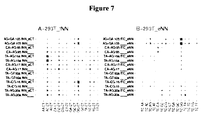
- FIG. 7 depicts a comparison of parameters inferred from fNN (left panel) and eNN (right panel) against fNN eNN data;
- FIG. 8 depicts a radar plot showing the performance of different adapter termini combinations (fNN eNN);
- FIG. 9 depicts a comparison of sequencing against microarray (panels A and B) and RT-PCR (panels C and D) for mES (panels A and C) and 293T (panels B and D);
- FIG. 10 shows a comparison of rankings between the standard adapters (noNN, ranks along x-axis) versus fNN eNN (ranks along y-axis) for 293T (left panel) and mES samples.
- the disclosure provides an approach to the characterization of nucleic acid samples, e.g., cell, tissue or organ small RNAs, that addresses the issue of bias in adapter ligation to small RNAs by providing a pool of adapters modified at the termini ligated or to be ligated to the small RNAs.
- the adapter modifications involve the covalent addition of at least two or more mixed nucleotides to the ligated or to be ligated terminus of each 5′ adapter base and each 3′ adapter base.
- An adapter base may be any adapter known in the art provided that the compound has not yet been modified by terminal addition of mixed nucleotides.
- the disclosure provides a set of pooled 5′ adapters containing at least two mixed nucleotides at the 3′ termini available for ligation to the 5′ end of small RNAs. Also provided is a set of 3′ adapters containing at least two mixed nucleotides at the 5′ termini available for ligation to the 3′ end of small RNAs.
- mixed nucleotide is meant more than one nucleotide available for incorporation into the set of adapters at a given position.
- the two nucleotide positions at the 3′ end of the adapter are added using mixed nucleotides, creating a set of 5′ adapters containing individual adapters having in common the sequence of the adapter base, but having at the 3′ end of the sequence any one of the mixed nucleotides at positions 1 and 2, where position 1 is at the 3′ terminus and position 2 is adjacent thereto.
- the mixed nucleotides typically will contain each of the four conventional nucleotides appropriate to the type of DNA adapter base (DNA or RNA), but the mixed nucleotides may instead contain, or contain in addition, any nucleotide analog known in the art, such as inosine monophosphate, deoxyinosine monophosphate, 5-bromouridylate or deoxy-5-bromouridylate.
- any nucleotide analog known in the art such as inosine monophosphate, deoxyinosine monophosphate, 5-bromouridylate or deoxy-5-bromouridylate.
- the 3′ adapter at least the two nucleotides at the 5′ end of the adapter are added using a set of the above-described mixed nucleotides appropriate to the adapter being modified (DNA or RNA).
- a pool of adapter bases may include between 1 and 25 nucleotide bases.
- randomized adapters refers to adapter bases whose ends are extended by 1 to 25 nucleotide bases that vary by nucleotide composition in a random or arbitrary manner. The ends of the randomized adapters may be composed of equal or weighted DNA, RNA nucleotides.
- the adapter modification i.e., the nucleotide addition to the adapter base, involves one, two, three, four or more nucleotides covalently bound to the 5′ end of a 3′ adapter or to the 3′ end of a 5′ adapter.
- modifications comprising one, two, three, four or more covalently bound nucleotides.
- nucleotide modifications are collectively fully mixed in that, for each added position in the adapter, each of the four conventional nucleotides (e.g., ribo- or deoxyribo-G, A, U/T and C, as appropriate depending on the nature of the adapter base (DNA or RNA)) are used in approximately equal amounts for synthesis using any technique known in the art. Also contemplated are additions to the 3′ terminus of a 5′ adapter and the 5′ terminus of a 3′ adapter that have equal or differing numbers of added mixed nucleotides. Beyond the use of nucleotide that are fully mixed at each position, the disclosure contemplates individual positions that are, collectively, partially mixed nucleotides or that are single nucleotides.
- each of the four conventional nucleotides e.g., ribo- or deoxyribo-G, A, U/T and C, as appropriate depending on the nature of the adapter base (DNA or RNA)
- RNA Ligases with respect to particular adapter base sequences such that the preferred terminal nucleotide(s) are known and can be engineered to be present in each adapter used in a ligation attaching the adapter to a small RNA.
- the disclosure also comprehends the use of unconventional nucleotides in nucleotide-based modifications by covalent addition to adapter bases.
- one or more added positions is occupied by (ribo- or deoxyribo-) IMP, 5-bromouridylate, and/or other unconventional nucleotides or nucleotide analogs known in the art.
- the additions to the adapter bases will be useful in modifying any of a wide variety of adapter bases and the modifications by covalent additions are not limited to particular adapter bases or adapter bases of particular nucleic acid sequence(s). It will be appreciated that the adapter bases disclosed herein, see, e.g., Table 1, are adapters of any useful or desired sequence, including adapters known in the art.
- an “adapter base” is a nucleic acid adapter with termini that have not been modified in accordance with the present disclosure.
- An “adapter” or “modified adapter” refers to an adapter base modified by addition of at least one nucleotide to at least one terminus of the adapter base.
- adapters or modified adapters will be covalently linked to sRNA, or the corresponding DNA molecule, or the DNA complement of the sRNA for use in manipulating the construct or characterizing the construct or sRNA sequence, or its DNA counterpart or complement.
- a nucleic acid “modification” is a chemical alteration to a nucleic acid molecule.
- a nucleic acid modification is the covalent addition to one of the two termini of an adapter base.
- the modification(s) occur at the 3′ terminus of the adapter base to yield the adapter.
- the modification(s) occur at the 5′ terminus of the adapter base to yield the adapter.
- a sRNA joined to adapters will have two bound adapters, and these adapters may be the same or different.
- the adapters typically provide functionality useful in sRNA manipulations to characterize the sRNA, such as including a PCR primer binding site, a restriction site(s) useful for sizing and/or cloning the sRNA or a product (e.g., cDNA) made therefrom.
- sRNA is a small RNA as that term is understood in the art and includes microRNA (miRNA) and piwiRNA (piRNA). Apparent from their use in context herein, these terms may be used interchangeably.
- miRNA microRNA
- piRNA piwiRNA
- sRNA molecules are involved in at least one aspect of regulating cell physiology, such as involvement in the regulation of the expression of one or more genes.
- Example 1 discloses the materials and methods used in the experiments described herein.
- Example 2 describes many of the experiments reported herein, including the construction of sRNA libraries using various modified adapter bases which may be 5′ or 3′ adapters.
- Example 3 addresses the biases revealed in the experiments and models for reducing or eliminating bias.
- This Example provides a disclosure of the materials and methods used in conducting the experiments disclosed in the remaining working examples.
- R1 mouse ES cell line was cultured feeder-free on 0.1% gelatin-coated plates in DMEM; Hi-Glucose, 15% fetal bovine serum, non-essential amino acids, L-glutamine, ⁇ -mercaptoethanol, penicillin/streptomycin, sodium pyruvate and leukemia inhibitory factor (LIF).
- LIF leukemia inhibitory factor
- Rnl1 T4 RNA ligase 1
- miRNA abundance was assessed in 293T and mES RNA samples by oligonucleotide microarray using Affymetrix GeneChip (miRNA 1.0).
- miRNA 1.0 One ⁇ g of total RNA was labeled using the FlashTag Biotin 3DNA kit (Genisphere), as follows: polyadenylation of RNA by polymerase, ligation to a biotinylated 3DNA molecule mediated by an oligonucleotide with 5′ polyd(T) and 3′ 3DNA complementary adapter. Labeled RNA was hybridized to the microarray using standard Affymetrix methods. Fluorescence intensities were extracted using the R statistical package, using methods from the BioConductor module.
- Quantitative real-time PCR was carried out using the Applied Biosystems (AB) microRNA specific reagents and a 7900HT thermocycler. Ten ng of total RNA were reverse transcribed with a miRNA-specific hairpin primer using the AB micoRNA Reverse Transcription kit. Specific forward primers and universal reverse primers were random with cDNA and AB Universal PCR Master Mix (no UNG) as recommended by the manufacturer. The following miRNAs were assayed: hsa-mir-18a, -20a, -106b, -92a, -103-2, -10, -16, -17 and hsa-let-7. Ct values were extracted from real-time data using the auto threshold setting.
- RNA sequencing In order to establish if the ligation of adapters to small RNAs was sequence dependent, libraries were constructed for small RNA sequencing, by customizing the standard protocol ( FIG. 1 ), using modified adapters.
- Total RNA is size fractionated by denaturing polyacrylamide gel electrophoresis (PAGE) and miRNAs are excised from the gel using radiolabeled markers as guides.
- Purified small RNAs are ligated, using a truncated T4 RNA ligase 2 (Rnl2) in an ATP-free buffer, to a 17 nt modified 3′ DNA adapter with a dideoxy nt at the 3′ end and an activated adenylation at the 5′ end.
- Rnl2 truncated T4 RNA ligase 2
- the dideoxy nt (more specifically, the deoxy 3′ carbon of the 3′-terminal nt) prevents selfligation of the adapter, while the truncated ligase prevents circularization of the small RNA inserts.
- the ligated fragment of 36-41 nt is then PAGE-purified to remove the unligated 3′ adapters.
- a 32 nt RNA adapter is ligated to the 5′ side of the product using T4 RNA ligase 1 (Rnl1).
- the 72-78 nt ligated fragment is PAGE-purified again to remove the unligated 5′ adapters.
- the product is reverse-transcribed using a specific primer and the resulting cDNA is amplified by PCR with primers that incorporate sequences compatible with a deep-sequencing platform.
- FIG. 2A, 2B and 2C show data for miR-18a, miR-20a and miR-106b microRNAs, respectively).
- FIG. 2C shows an extreme case where miR-106b is captured well by only one adapter, ending in AGCA, out of the 12 adapters constituting the pool. These data are consistently reproduced in other experiments shown in FIG. 4 .
- samples were prepared twice, using 25 (y-axis) and 18 (x-axis) cycles of PCR ( FIG. 2D ). Each point represents a miRNA.
- the correlation between the two sets of PCR conditions is high (coefficient of 0.95) and the best linear fit to the points is a line of slope 1, indicating that the data are reproducible and PCR is not responsible for the biases.
- Table 2 depicts correlations between samples prepared using individual 5′ adapters that differ only at the 3′ terminus.
- the spearman-rank correlation is based on the rankings of the miRNA sequences by abundance.
- the relatively low correlations, between biological replicates of 293T cells, in contrast to the numbers seen in Table 3, suggests that the efficiency of ligation of the adapters to different miRNA sequences is quite variable.
- the row and column names reflect the samples and the adapter termini used, so B25 TGAC refers to sample B25 which uses the adapter ending in TGAC.
- the x-axis shows different miRNAs, ranked by their overall occurrence, which is the sum over all adapters.
- the y-axis shows, of the miRNAs captured by a particular adapter, the fraction that each miRNA occupies. It is apparent there can be dramatic shifts in the rankings for the miRNAs (the profiles) between adapters.
- FIG. 4 shows that most of the ligation efficiency can be explained by the last two nucleotides. Only in one case, hsa-miR-106b, were the four nucleotides needed to pick out an abundant miRNA (see also FIG. 2 and FIG. 10 ).
- FIG. 5 shows that with the standard 3′ adapter, the 24-mer does not show good ligation, while the 19 mer shows good ligation, on the other hand, we have good ligation to both oligos with the eNN strategy.
- the 19 nt marker ligated efficiently, irrespective of the adapters used (lanes 5-8), while the ligated 24-mer product is low in abundance when the standard adapter is used (lanes 1-2), but is efficiently ligated (with abundant products) when the mixed-bases adapters are used (lanes 3-4).
- the 24 mer has good ligation only to certain members in the eNN pool, and that using a pool of adapters is better.
- the standard adapter ends (TC at the 3′ end in fNN and CT at the 5′ end in eNN, highlighted in gray boxes) are not efficiently ligated to the most abundant miRNAs. Even the most efficient adapters show variability, indicating that no single adapter can be expected to work well across all possible sequences. For the most abundant miRNAs, most of the variability comes from the 3′ adapter ligation (the eNN adapters, panels B, D). In mES cells, there are two isomers of mmu-miR-292-3p, the GT-ending 3′ adapter captures the GAGT-ending isomer more efficiently, while the GA-ending 3′ adapter captures the GAGTG-ending isomer more efficiently.
- Fij i and j each varying from 1 through 16 where 1 stands for AA, 2 for AC going on to 15 for TG and 16 for TT
- Emn m and n each varying from 1 through 16
- Mk the actual abundance of a miRNA labeled k in the sample.
- mmu-miR-290-5p was very high at rank 5 in the case of noNN, it was outside the range of the graph in fNN eNN, in accordance with the qPCR data. Thus, in every case in which a difference was detected between noNN and fNN eNN, fNN eNN was more accurate in reflecting the profiles.
Landscapes
- Chemical & Material Sciences (AREA)
- Life Sciences & Earth Sciences (AREA)
- Organic Chemistry (AREA)
- Health & Medical Sciences (AREA)
- Proteomics, Peptides & Aminoacids (AREA)
- Zoology (AREA)
- Wood Science & Technology (AREA)
- Engineering & Computer Science (AREA)
- Molecular Biology (AREA)
- Analytical Chemistry (AREA)
- Immunology (AREA)
- Microbiology (AREA)
- Biotechnology (AREA)
- Biochemistry (AREA)
- Bioinformatics & Cheminformatics (AREA)
- General Engineering & Computer Science (AREA)
- General Health & Medical Sciences (AREA)
- Genetics & Genomics (AREA)
- Biophysics (AREA)
- Physics & Mathematics (AREA)
- Chemical Kinetics & Catalysis (AREA)
- Measuring Or Testing Involving Enzymes Or Micro-Organisms (AREA)
Priority Applications (3)
| Application Number | Priority Date | Filing Date | Title |
|---|---|---|---|
| US13/470,872 US9487825B2 (en) | 2011-05-13 | 2012-05-14 | Pooled adapter strategy for reducing bias in small RNA characterization |
| US15/343,119 US10557169B2 (en) | 2011-05-13 | 2016-11-03 | Pooled adapter strategy for reducing bias in small RNA characterization |
| US16/784,848 US11293063B2 (en) | 2011-05-13 | 2020-02-07 | Pooled adapter strategy for reducing bias in small RNA characterization |
Applications Claiming Priority (2)
| Application Number | Priority Date | Filing Date | Title |
|---|---|---|---|
| US201161486214P | 2011-05-13 | 2011-05-13 | |
| US13/470,872 US9487825B2 (en) | 2011-05-13 | 2012-05-14 | Pooled adapter strategy for reducing bias in small RNA characterization |
Related Child Applications (1)
| Application Number | Title | Priority Date | Filing Date |
|---|---|---|---|
| US15/343,119 Continuation US10557169B2 (en) | 2011-05-13 | 2016-11-03 | Pooled adapter strategy for reducing bias in small RNA characterization |
Publications (2)
| Publication Number | Publication Date |
|---|---|
| US20120322691A1 US20120322691A1 (en) | 2012-12-20 |
| US9487825B2 true US9487825B2 (en) | 2016-11-08 |
Family
ID=47177583
Family Applications (3)
| Application Number | Title | Priority Date | Filing Date |
|---|---|---|---|
| US13/470,872 Active US9487825B2 (en) | 2011-05-13 | 2012-05-14 | Pooled adapter strategy for reducing bias in small RNA characterization |
| US15/343,119 Active 2033-06-28 US10557169B2 (en) | 2011-05-13 | 2016-11-03 | Pooled adapter strategy for reducing bias in small RNA characterization |
| US16/784,848 Active 2033-01-07 US11293063B2 (en) | 2011-05-13 | 2020-02-07 | Pooled adapter strategy for reducing bias in small RNA characterization |
Family Applications After (2)
| Application Number | Title | Priority Date | Filing Date |
|---|---|---|---|
| US15/343,119 Active 2033-06-28 US10557169B2 (en) | 2011-05-13 | 2016-11-03 | Pooled adapter strategy for reducing bias in small RNA characterization |
| US16/784,848 Active 2033-01-07 US11293063B2 (en) | 2011-05-13 | 2020-02-07 | Pooled adapter strategy for reducing bias in small RNA characterization |
Country Status (2)
| Country | Link |
|---|---|
| US (3) | US9487825B2 (fr) |
| WO (1) | WO2012158603A2 (fr) |
Families Citing this family (9)
| Publication number | Priority date | Publication date | Assignee | Title |
|---|---|---|---|---|
| GB201113214D0 (en) * | 2011-07-29 | 2011-09-14 | Univ East Anglia | Analysing sequencing bias |
| EP3305918B1 (fr) * | 2012-03-05 | 2020-06-03 | President and Fellows of Harvard College | Procédés de séquençage épigénétiques |
| US9422551B2 (en) * | 2013-05-29 | 2016-08-23 | New England Biolabs, Inc. | Adapters for ligation to RNA in an RNA library with reduced bias |
| US20150298091A1 (en) | 2014-04-21 | 2015-10-22 | President And Fellows Of Harvard College | Systems and methods for barcoding nucleic acids |
| CN105441429A (zh) * | 2014-08-08 | 2016-03-30 | 深圳华大基因科技有限公司 | 一种制备腺苷酰化接头的方法及腺苷酰化接头 |
| US11746367B2 (en) | 2015-04-17 | 2023-09-05 | President And Fellows Of Harvard College | Barcoding systems and methods for gene sequencing and other applications |
| AU2016356775A1 (en) | 2015-11-17 | 2018-05-31 | Bioo Scientific Corporation | Methods and kits for reducing adapter-dimer formation |
| WO2018157100A1 (fr) * | 2017-02-27 | 2018-08-30 | Bioo Scientific Corporation | Procédés et nécessaires d'appauvrissement d'acides nucléiques indésirables |
| US11390915B2 (en) * | 2019-04-26 | 2022-07-19 | New England Biolabs, Inc. | Polynucleotide adapter design for reduced bias |
Citations (10)
| Publication number | Priority date | Publication date | Assignee | Title |
|---|---|---|---|---|
| US5629179A (en) * | 1995-03-17 | 1997-05-13 | Novagen, Inc. | Method and kit for making CDNA library |
| US6194454B1 (en) * | 1999-03-01 | 2001-02-27 | Pfizer Inc. | Cyano containing oxamic acids and derivatives as thyroid receptor ligands |
| US7323305B2 (en) * | 2003-01-29 | 2008-01-29 | 454 Life Sciences Corporation | Methods of amplifying and sequencing nucleic acids |
| WO2008150377A1 (fr) | 2007-05-29 | 2008-12-11 | Ming-Sheng Lee | Procédés et kits de dépistage de mutation à capacité élevée |
| US20090004665A1 (en) * | 2007-06-29 | 2009-01-01 | Sydney Brenner | Methods and compositions for isolating nucleic acid sequence variants |
| US20090105959A1 (en) * | 2007-06-01 | 2009-04-23 | Braverman Michael S | System and method for identification of individual samples from a multiplex mixture |
| US20090170713A1 (en) * | 2005-09-29 | 2009-07-02 | Keygene N.V. | High throughput screening of mutagenized populations |
| US20090233802A1 (en) * | 2007-02-02 | 2009-09-17 | Helen Bignell | Methods for indexing samples and sequencing multiple polynucleotide templates |
| US20110104785A1 (en) * | 2009-11-05 | 2011-05-05 | Ramesh Vaidyanathan | Methods and kits for 3'-end-tagging of rna |
| US20120028814A1 (en) * | 2010-05-06 | 2012-02-02 | Toloue Masoud M | Oligonucleotide ligation, barcoding and methods and compositions for improving data quality and throughput using massively parallel sequencing |
Family Cites Families (4)
| Publication number | Priority date | Publication date | Assignee | Title |
|---|---|---|---|---|
| US20080312099A1 (en) * | 2006-02-15 | 2008-12-18 | University Of Louisville Research Foundation, Inc. | Microarray, System, and Method for Detecting, Identifying, and Quantitating Micro-Rnas |
| US20100062494A1 (en) * | 2008-08-08 | 2010-03-11 | President And Fellows Of Harvard College | Enzymatic oligonucleotide pre-adenylation |
| EP2419537B1 (fr) * | 2009-04-13 | 2014-01-29 | Somagenics, Inc. | Procédés et compositions pour la détection de petits arn |
| US8575071B2 (en) * | 2010-11-03 | 2013-11-05 | Illumina, Inc. | Reducing adapter dimer formation |
-
2012
- 2012-05-14 US US13/470,872 patent/US9487825B2/en active Active
- 2012-05-14 WO PCT/US2012/037746 patent/WO2012158603A2/fr not_active Ceased
-
2016
- 2016-11-03 US US15/343,119 patent/US10557169B2/en active Active
-
2020
- 2020-02-07 US US16/784,848 patent/US11293063B2/en active Active
Patent Citations (10)
| Publication number | Priority date | Publication date | Assignee | Title |
|---|---|---|---|---|
| US5629179A (en) * | 1995-03-17 | 1997-05-13 | Novagen, Inc. | Method and kit for making CDNA library |
| US6194454B1 (en) * | 1999-03-01 | 2001-02-27 | Pfizer Inc. | Cyano containing oxamic acids and derivatives as thyroid receptor ligands |
| US7323305B2 (en) * | 2003-01-29 | 2008-01-29 | 454 Life Sciences Corporation | Methods of amplifying and sequencing nucleic acids |
| US20090170713A1 (en) * | 2005-09-29 | 2009-07-02 | Keygene N.V. | High throughput screening of mutagenized populations |
| US20090233802A1 (en) * | 2007-02-02 | 2009-09-17 | Helen Bignell | Methods for indexing samples and sequencing multiple polynucleotide templates |
| WO2008150377A1 (fr) | 2007-05-29 | 2008-12-11 | Ming-Sheng Lee | Procédés et kits de dépistage de mutation à capacité élevée |
| US20090105959A1 (en) * | 2007-06-01 | 2009-04-23 | Braverman Michael S | System and method for identification of individual samples from a multiplex mixture |
| US20090004665A1 (en) * | 2007-06-29 | 2009-01-01 | Sydney Brenner | Methods and compositions for isolating nucleic acid sequence variants |
| US20110104785A1 (en) * | 2009-11-05 | 2011-05-05 | Ramesh Vaidyanathan | Methods and kits for 3'-end-tagging of rna |
| US20120028814A1 (en) * | 2010-05-06 | 2012-02-02 | Toloue Masoud M | Oligonucleotide ligation, barcoding and methods and compositions for improving data quality and throughput using massively parallel sequencing |
Non-Patent Citations (52)
| Title |
|---|
| Amitsur et al. "Bacteriophage t4 anticodon nuclease, polynucleotide kinase and RNA ligase reprocess the host lysine tRNA" The EMBO Journal 6, 8 (Aug. 1987), 2499-2503. PMID: 2444436. |
| Aravin et al. The Piwi-piRNA pathway provides an adaptive defense in the transposon arms race. Science (New York, N.Y.) 318, 5851 (Nov. 2007), 761-764. PMID:17975059. |
| Baccarini et al. "Kinetic analysis reveals the fate of a MicroRNA following target regulation in mammalian cells" Current Biology: CB 21, 5 (Mar. 2011), 369-376. PMID:21353554. |
| Baker "MicroRNA profiling: separating signal from noise" Nat Meth 7, 9 (2010), 687-692. |
| Bawankar et al. ""5' and 3' End Modifications of Spliceosomal RNAs in Plasmodium Falciparum Molecular Biology Reports, vol. 37, pp. 2125-2133 (Aug. 2009). |
| Bawankar et al. ""5′ and 3′ End Modifications of Spliceosomal RNAs in Plasmodium Falciparum Molecular Biology Reports, vol. 37, pp. 2125-2133 (Aug. 2009). |
| Berezikov et al. "Approaches to microRNA discovery" Nature Genetics 38 Suppl (Jun. 2006), S2-7. PMID: 16736019. |
| Berezikov et al. "Diversity of microRNAs in human and chimpanzee brain" Nature Genetics 38, 12 (Dec. 2006), 1375-1377. PMID:17072315. |
| Brennecke et al. "Discrete small RNA-generating loci as master regulators of transposon activity in Drosophila" Cell 128, 6 (Mar. 2007), 1089-1103. PMID: 17346786. |
| Brown et al. "Endogenous microRNA can be broadly exploited to regulate transgene expression according to tissue, lineage and differentiation state" Nature Biotechnology 25, 12 (Dec. 2007), 1457-1467. PMID:18026085. |
| Cerutti, H., and Casas-Mollano, J. A. On the origin and functions of RNA-mediated silencing: from protists to man. Current Genetics 50, 2 (Aug. 2006), 81-99. PMID: 16691418. |
| Chen et al. "Real-time quantification of microRNAs by stem-loop RT-PCR" Nucleic Acids Research 33, 20 (2005), e179. PMID: 16314309. |
| Chiang et al. "Mammalian microRNAs: experimental evaluation of novel and previously annotated genes" Genes & Development 24, 10 (May 2010), 992-1009. PMID: 20413612. |
| Craig et al. (Identification of genetic variants using bar-coded multiplexed sequencing, Nat Methods. Oct. 2008;5(10):887-93. Epub Sep. 14, 2008). * |
| Czech et al. "An endogenous small interfering RNA pathway in Drosophila" Nature 453, 7196 (Junv ce 2008), 798-802. PMID:18463631. |
| Elbashir et al. "RNA interference is mediated by 21- and 22-nucleotide RNAs" Genes & Development 15, 2 (Jan. 2001), 188-200. PMID: 11157775. |
| Farazi et al. "miRNAs in human cancer" The Journal of Pathology 223, 2 (Jan. 2011), 102-115. PMID: 21125669. |
| Git et al. "Systematic comparison of microarray profiling, real-time PCR, and next-generation sequencing technologies for measuring differential microRNA expression" RNA (New York, N.Y.) 16, 5 (May 2010), 991-1006. PMID:20360395. |
| Goff et al. "Rational probe optimization and enhanced detection strategy for microRNAs using microarrays" RNA Biology 2, 3 (Sep. 2005), 93-100. PMID:17114923. |
| Goff et al. Ago2 immunoprecipitation identifies predicted microRNAs in human embryonic stem cells and neural precursors. PloS One 4, 9 (2009), e7192. PMID: 19784364. |
| Hafner et al. Identification of microRNAs and other small regulatory RNAs using cDNA library sequencing. Methods (San Diego, Calif.) 44, 1 (Jan. 2008), 3-12. PMID: 18158127. |
| Hafner et al., "Identification of microRNAs and other small regulatory RNAs using cDNA library sequencing", Methods, vol. 44, p. 3-12 (2008). * |
| International Preliminary Report on Patentability for PCT Application No. PCT/US2012/037746 issued Nov. 19, 2013. |
| International Search Report/Written Opinion for PCT Application No. PCT/US2012/037746 issued Nov. 9, 2012. |
| Jeffrey "Cancer biomarker profiling with microRNAs" Nature Biotechnology 26, 4 (Apr. 2008), 400-401. PMID:18392022. |
| Jones et al. "Zcchc11-dependent uridylation of microRNA directs cytokine expression" Nature cell biology 11, 9 (Sep. 2009), 1157-1163. PMID: 19701194 PMCID:2759306. |
| Kozomara et al. miRBase: integrating microRNA annotation and deep-sequencing data. Nucleic Acids Research 39, Database issue (Jan. 2011), D152-157. PMID: 21037258. |
| Kuchenbauer et al. In-depth characterization of the microRNA transcriptome in a leukemia progression model. Genome Research 18, 11 (Nov. 2008), 1787-1797. PMID: 18849523. |
| Landgraf et al. "A mammalian microRNA expression atlas based on small RNA library sequencing" Cell 129, 7 (Jun. 2007), 1401-1414. PMID: 17604727. |
| Lau et al. "An abundant class of tiny RNAs with probable regulatory roles in caenorhabditis elegans" Science (New York, N.Y.) 294, 5543 (Oct. 2001), 858-862. PMID: 11679671. |
| Lee et al. Complexity of the microRNA repertoire revealed by next-generation sequencing. RNA (New York, N.Y.) 16, 11 (Nov. 2010), 2170-2180. PMID: 20876832. |
| Lennon et al. (A scalable, fully automated process for construction of sequence-ready barcoded libraries for 454, Genome Biol. 2010; 11(2): R15. Published online Feb. 5, 2010). * |
| Marson et al. "Connecting microRNA genes to the core transcriptional regulatory circuitry of embryonic stem cells" Cell 134, 3 (Aug. 2008), 521-533. PMID: 18692474. |
| Mencia et al. "Mutations in the seed region of human miR 96 are responsible for nonsyndromic progressive hearing loss" Nature Genetics 41, 5 (May 2009), 609-613. PMID: 19363479. |
| Meyer et al. (Parallel tagged sequencing on the 454 platform, Nat Protoc. 2008;3(2):267-78, Published online: Jan. 31, 2008). * |
| Meyer et al. (Targeted high-throughput sequencing of tagged nucleic acid samples, Nucleic Acids Res. 2007;35(15):e97. Epub Aug. 1, 2007). * |
| Morin et al. "Application of massively parallel sequencing to microRNA profiling and discovery in human embryonic stem cells" Genome Research 18, 4 (Apr. 2008), 610-621. PMID:18285502. |
| Nandakumar et al. "RNA ligase structures reveal the basis for RNA specificity and conformational changes that drive ligation forward" Cell 127, 1 (2006), 71-84. |
| Olson et al. "Analysis of large-scale sequencing of small RNA" Pacific Symposium on Biocomputing. Pacific Symposium on Biocomputing (2008), 126-136. PMID: 18229681. |
| Parameswaran et al. (A pyrosequencing-tailored nucleotide barcode design unveils opportunities for large-scale sample multiplexing, Nucleic Acids Res. 2007;35(19):e130. Epub Oct. 11, 2007). * |
| Pfeffer et al. "Cloning of small RNA molecules" Current Protocols in Molecular Biology / Edited by Frederick M. Ausubel . . . et a l Chapter 26 (Nov. 2005), Unit 26.4. PMID: 18265364. |
| Romaniuk et al. "The effect of acceptor oligoribonucleotide sequence on the t4 RNA ligase reaction" European Journal of Biochemistry / FEBS 125, 3(Jul. 1982), 639-643. PMID: 7117259. |
| Shekhtman et al. (Optimization of Transrenal DNA Analysis: Detection of Fetal DNA in Maternal Urine, Clin Chem. Apr. 2009;55(4):723-9. Epub Jan. 30, 2009). * |
| Shi et al. "Facile means for quantifying microRNA expression by real-time PCR" BioTechniques 39, 4 (Oct. 2005), 519-525. PMID:16235564. |
| Shi et al. "MicroRNA regulation of neural stem cells and neurogenesis" The Journal of Neuroscience: The Official Journal of the Society for Neuroscience 30, 45 (Nov. 2010), 14931-14936. PMID21068294. |
| Small et al. "Pervasive roles of microRNAs in cardiovascular biology" Nature 469, 7330 (Jan. 2011), 336-342. PMID: 21248840. |
| Starega-Roslan et al. (Structural basis of microRNA length variety, Nucleic Acids Res. Jan. 2011; 39(1): 257-268. Published online Aug. 25, 2010). * |
| Tam et al. "Pseudogene-derived small interfering RNAs regulate gene expression in mouse oocytes" Nature 453, 7194 (May 2008), 534-538. PMID: 18404147. |
| Wang et al. "Mutational analysis of bacteriophage t4 RNA ligase 1" Journal of Biological Chemistry 278, 32 (2003), 29454-29462. |
| Wang et al. "Oligoribonucleotide circularization by 'template-mediated' ligation with t4 RNA ligase: synthesis of circular hammerhead ribozymes" Nucleic Acids Research 26, 10 (May 1998), 2502-2504. PMID: 9580707. |
| Wang et al. (CLIP: construction of cDNA libraries for high-throughput sequencing from RNAs cross-linked to proteins in vivo, Methods. Jul. 2009;48(3):287-93. doi: 10.1016/j.ymeth.2009.02.021. Epub Mar. 9, 2009). * |
| Wang et al. (CLIP: Construction of cDNA libraries for high-throughput sequencing from RNAs cross-linked to proteins in vivo, Methods. Jul. 2009;48(3):287-93. Epub Mar. 9, 2009). * |
Also Published As
| Publication number | Publication date |
|---|---|
| US10557169B2 (en) | 2020-02-11 |
| US20200172972A1 (en) | 2020-06-04 |
| US20120322691A1 (en) | 2012-12-20 |
| US11293063B2 (en) | 2022-04-05 |
| WO2012158603A3 (fr) | 2013-01-10 |
| US20170051348A1 (en) | 2017-02-23 |
| WO2012158603A2 (fr) | 2012-11-22 |
Similar Documents
| Publication | Publication Date | Title |
|---|---|---|
| US11293063B2 (en) | Pooled adapter strategy for reducing bias in small RNA characterization | |
| US20260022372A1 (en) | Semi-random barcodes for nucleic acid analysis | |
| US10704091B2 (en) | Genotyping by next-generation sequencing | |
| CN110036118B (zh) | 用于识别核酸分子的组合物和方法 | |
| US8975019B2 (en) | Deducing exon connectivity by RNA-templated DNA ligation/sequencing | |
| ES2873850T3 (es) | Bibliotecas de secuenciación de próxima generación | |
| CN107002118B (zh) | 用于无细胞dna的定量遗传分析的方法 | |
| RU2565550C2 (ru) | Прямой захват, амплификация и секвенирование днк-мишени с использованием иммобилизированных праймеров | |
| US20120003657A1 (en) | Targeted sequencing library preparation by genomic dna circularization | |
| JP2022516446A (ja) | 相補的dnaを調製するための方法およびキット | |
| CN102409408A (zh) | 一种利用微量基因组dna进行全基因组甲基化位点精确检测的方法 | |
| CN111849965A (zh) | 用于减少偏向性的多核苷酸衔接子设计 | |
| CN113710815B (zh) | 用于多重拷贝数变异检测和等位基因比率定量的定量扩增子测序 | |
| US20180305683A1 (en) | Multiplexed tagmentation | |
| CN110582577B (zh) | 文库定量和鉴定 | |
| CA3237565A1 (fr) | Enrichissement et quantification cibles a l'aide de sondes a amplification lineaire isothermiques | |
| Jayaprakash | Towards Precision Medicine through Deep Sequencing | |
| HK1204337B (en) | Genotyping by next-generation sequencing |
Legal Events
| Date | Code | Title | Description |
|---|---|---|---|
| AS | Assignment |
Owner name: MOUNT SINAI SCHOOL OF MEDICINE, NEW YORK Free format text: ASSIGNMENT OF ASSIGNORS INTEREST;ASSIGNORS:SACHIDANANDAM, RAVI;JAYAPRAKASH, ANITHA D.;BROWN, BRIAN D.;REEL/FRAME:028877/0793 Effective date: 20120710 |
|
| STCF | Information on status: patent grant |
Free format text: PATENTED CASE |
|
| FEPP | Fee payment procedure |
Free format text: ENTITY STATUS SET TO UNDISCOUNTED (ORIGINAL EVENT CODE: BIG.); ENTITY STATUS OF PATENT OWNER: LARGE ENTITY |
|
| MAFP | Maintenance fee payment |
Free format text: PAYMENT OF MAINTENANCE FEE, 4TH YEAR, LARGE ENTITY (ORIGINAL EVENT CODE: M1551); ENTITY STATUS OF PATENT OWNER: LARGE ENTITY Year of fee payment: 4 |
|
| MAFP | Maintenance fee payment |
Free format text: PAYMENT OF MAINTENANCE FEE, 8TH YEAR, LARGE ENTITY (ORIGINAL EVENT CODE: M1552); ENTITY STATUS OF PATENT OWNER: LARGE ENTITY Year of fee payment: 8 |