US9536752B2 - Slurry for chemical mechanical polishing and polishing method for substrate using same - Google Patents
Slurry for chemical mechanical polishing and polishing method for substrate using same Download PDFInfo
- Publication number
- US9536752B2 US9536752B2 US13/508,924 US201013508924A US9536752B2 US 9536752 B2 US9536752 B2 US 9536752B2 US 201013508924 A US201013508924 A US 201013508924A US 9536752 B2 US9536752 B2 US 9536752B2
- Authority
- US
- United States
- Prior art keywords
- slurry
- polishing
- mass
- compound
- water
- Prior art date
- Legal status (The legal status is an assumption and is not a legal conclusion. Google has not performed a legal analysis and makes no representation as to the accuracy of the status listed.)
- Expired - Fee Related, expires
Links
Images


Classifications
-
- H01L21/31053—
-
- H—ELECTRICITY
- H10—SEMICONDUCTOR DEVICES; ELECTRIC SOLID-STATE DEVICES NOT OTHERWISE PROVIDED FOR
- H10P—GENERIC PROCESSES OR APPARATUS FOR THE MANUFACTURE OR TREATMENT OF DEVICES COVERED BY CLASS H10
- H10P52/00—Grinding, lapping or polishing of wafers, substrates or parts of devices
-
- H—ELECTRICITY
- H10—SEMICONDUCTOR DEVICES; ELECTRIC SOLID-STATE DEVICES NOT OTHERWISE PROVIDED FOR
- H10P—GENERIC PROCESSES OR APPARATUS FOR THE MANUFACTURE OR TREATMENT OF DEVICES COVERED BY CLASS H10
- H10P95/00—Generic processes or apparatus for manufacture or treatments not covered by the other groups of this subclass
- H10P95/06—Planarisation of inorganic insulating materials
- H10P95/062—Planarisation of inorganic insulating materials involving a dielectric removal step
-
- B—PERFORMING OPERATIONS; TRANSPORTING
- B24—GRINDING; POLISHING
- B24B—MACHINES, DEVICES, OR PROCESSES FOR GRINDING OR POLISHING; DRESSING OR CONDITIONING OF ABRADING SURFACES; FEEDING OF GRINDING, POLISHING, OR LAPPING AGENTS
- B24B37/00—Lapping machines or devices; Accessories
-
- C—CHEMISTRY; METALLURGY
- C09—DYES; PAINTS; POLISHES; NATURAL RESINS; ADHESIVES; COMPOSITIONS NOT OTHERWISE PROVIDED FOR; APPLICATIONS OF MATERIALS NOT OTHERWISE PROVIDED FOR
- C09G—POLISHING COMPOSITIONS; SKI WAXES
- C09G1/00—Polishing compositions
- C09G1/02—Polishing compositions containing abrasives or grinding agents
-
- C—CHEMISTRY; METALLURGY
- C09—DYES; PAINTS; POLISHES; NATURAL RESINS; ADHESIVES; COMPOSITIONS NOT OTHERWISE PROVIDED FOR; APPLICATIONS OF MATERIALS NOT OTHERWISE PROVIDED FOR
- C09K—MATERIALS FOR MISCELLANEOUS APPLICATIONS, NOT PROVIDED FOR ELSEWHERE
- C09K3/00—Materials not provided for elsewhere
- C09K3/14—Anti-slip materials; Abrasives
-
- C—CHEMISTRY; METALLURGY
- C09—DYES; PAINTS; POLISHES; NATURAL RESINS; ADHESIVES; COMPOSITIONS NOT OTHERWISE PROVIDED FOR; APPLICATIONS OF MATERIALS NOT OTHERWISE PROVIDED FOR
- C09K—MATERIALS FOR MISCELLANEOUS APPLICATIONS, NOT PROVIDED FOR ELSEWHERE
- C09K3/00—Materials not provided for elsewhere
- C09K3/14—Anti-slip materials; Abrasives
- C09K3/1454—Abrasive powders, suspensions and pastes for polishing
- C09K3/1463—Aqueous liquid suspensions
-
- H01L21/76224—
-
- H—ELECTRICITY
- H10—SEMICONDUCTOR DEVICES; ELECTRIC SOLID-STATE DEVICES NOT OTHERWISE PROVIDED FOR
- H10W—GENERIC PACKAGES, INTERCONNECTIONS, CONNECTORS OR OTHER CONSTRUCTIONAL DETAILS OF DEVICES COVERED BY CLASS H10
- H10W10/00—Isolation regions in semiconductor bodies between components of integrated devices
- H10W10/01—Manufacture or treatment
- H10W10/011—Manufacture or treatment of isolation regions comprising dielectric materials
- H10W10/014—Manufacture or treatment of isolation regions comprising dielectric materials using trench refilling with dielectric materials, e.g. shallow trench isolations
-
- H—ELECTRICITY
- H10—SEMICONDUCTOR DEVICES; ELECTRIC SOLID-STATE DEVICES NOT OTHERWISE PROVIDED FOR
- H10W—GENERIC PACKAGES, INTERCONNECTIONS, CONNECTORS OR OTHER CONSTRUCTIONAL DETAILS OF DEVICES COVERED BY CLASS H10
- H10W10/00—Isolation regions in semiconductor bodies between components of integrated devices
- H10W10/10—Isolation regions comprising dielectric materials
- H10W10/17—Isolation regions comprising dielectric materials formed using trench refilling with dielectric materials, e.g. shallow trench isolations
Definitions
- the present invention relates to a slurry for chemical mechanical polishing, which is preferable for the production of a semiconductor substrate, and a polishing method for substrate using the slurry.
- a semiconductor circuit is made to show a high performance by high densification achieved by miniaturization of transistor, resistance, wiring and the like constituting a circuit, as well as high-speed responses.
- lamination of wirings has enabled higher densification and higher integration of semiconductor circuits.
- the semiconductor production techniques that have enabled the above include shallow trench isolation, metal plug and damascene process.
- the “shallow trench isolation” means transistor element isolation
- the “metal plug” means three-dimensional wiring using a metal having a structure penetrating an interlayer dielectric film
- the “damascene process” means an embedding technique of copper wiring.
- the technique essential for each step such as shallow trench isolation and the like is chemical mechanical polishing.
- CMP chemical mechanical polishing
- CMP is used for removing a redundant insulating film made from silicon oxide etc. formed on a substrate, and a stopper film is formed beneath the aforementioned insulating film to stop polishing.
- a stopper film silicon nitride and the like are generally used, and the polishing end point can be easily determined by increasing the polishing rate ratio of the aforementioned insulating film and the stopper film. It is desirable to obtain a flat polished film by polishing to eliminate the difference between the levels of the insulating film and stopper film. To obtain a flat polished film, it is further desirable that the polishing should stop on the stopper film even when polished excessively and polishing of the insulating film and stopper film should not proceed.
- a slurry for CMP comprised of at least one kind of water-soluble polymer selected from the group consisting of a polyacrylic acid having a weight average molecular weight of not less than 1 million and not more than 10 million and a salt thereof, ⁇ -cyclodextrin and colloidal silica is known (see patent document 4).
- a shallow trench isolation region can be generally formed by the following steps.
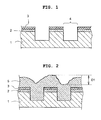
- FIG. 1 - FIG. 5 are schematic sectional views stepwisely showing formation steps of a shallow trench isolation region in a production process of a semiconductor device.
- FIGS. 1-5 show that one part of a semiconductor device is formed in a substrate (wafer).
- plural semiconductor devices having a shallow trench isolation region are prepared for one substrate, and separated into individual semiconductor devices (chips) by dicing.
- the size of each part in the drawings was set to facilitate understanding and the size ratio between each part and each part does not necessarily match the actual ratio.
- a stopper film 3 is laminated on an oxidized insulating film 2 (silicon oxide and the like) on the surface of substrate 1 .
- a resist film (not shown) is laminated by photolithography on the substrate 1 on which oxidized insulating film 2 and stopper film 3 are laminated and, after etching, the resist film is removed to form a trench 4 (etched part) ( FIG. 1 ).
- An insulating film 5 (silicon oxide and the like) is laminated by CVD and the like to fill the trench 4 ( FIG. 2 ). In CMP of substrate 1 on which the insulating film 5 is laminated, it is ideal to flatly polish stopper film 3 and insulating film 5 to form a flat shallow trench isolation region 6 ( FIG. 3 ).
- a slurry for CMP containing a water-soluble organic compound such as polyacrylic acid, a salt thereof and the like, which is described in patent documents 1-3, and a slurry for CMP further containing polyvinylpyrrolidone and the like in combination are not necessarily satisfactory to minimize difference between levels of an insulating film and a stopper film.
- a slurry for CMP described in patent document 4 no suggestion is given as to minimization of difference between levels of an insulating film and a stopper film and, as far as the present inventors have confirmed, these slurries for CMP cannot minimize difference between levels of an insulating film and a stopper film.
- the present invention aims to provide a slurry for CMP, which is superior in the planarization property of a polished film, and does not damage a polished film, particularly, a slurry for CMP, which can provide an extremely small difference between the levels of an insulating film formed from silicon oxide etc. and a stopper film formed from silicon nitride etc., in a shallow trench isolation region formation step, and a polishing method of a substrate.
- the present inventors have conducted intensive studies in an attempt to solve the above-mentioned problem and found that the planarization property of a polished film is improved by using, as a slurry for CMP, a composition containing a polishing abrasive grain (c), as well as a water-soluble clathrate compound (a) and a polymer compound (b) having an acidic group optionally in a salt form as a side chain and a specific molecular weight in specific amounts and, particularly, a polished film having an extremely small difference between the levels of an insulating film and a stopper film can be obtained in a shallow trench isolation region formation step.
- polymer compound (b) having an acidic group as a side chain means that “polymer compound (b) has an acidic group as a pendant group”.
- the present invention relates to [1]-[12] below.
- the content of the water-soluble clathrate compound (a) is 0.001 mass %-3 mass % of the total amount of the slurry
- the polymer compound (b) has a weight average molecular weight of not less than 1,000 and less than 1,000,000,
- the content of the polymer compound (b) is 0.12 mass %-3 mass % of the total amount of the slurry.
- the slurry for CMP of the present invention is superior in the planarization property of the polished film on the substrate, can particularly afford a polished film having an extremely small difference between the levels of the insulating film and the stopper film by polishing an insulating film or an interlayer dielectric in the formation of a shallow trench isolation region, and can improve the yield of substrate production.
- FIG. 1 is a schematic sectional view of a substrate having a trench formed by etching.
- FIG. 2 is a schematic sectional view of a substrate having an insulating film laminated by CVD.
- FIG. 3 is a schematic sectional view of a substrate having an insulating film polished by ideal CMP.
- FIG. 4 is a schematic sectional view of a substrate having an insulating film polished by actual CMP.
- FIG. 5 is a schematic sectional view of a substrate polished excessively.
- the slurry for CMP of the present invention contains a water-soluble clathrate compound (a), a polymer compound (b) having an acidic group optionally in a salt form as a side chain, a polishing abrasive grain (c) and water (d).
- the component contained in the slurry for CMP of the present invention may be one kind only or a combination of two or more kinds thereof.
- the “water-soluble clathrate compound” a compound having solubility in water at 25° C. of not less than 0.01 g/L is preferable.
- the solubility in water at 25° C. is less than 0.01 g/L, the effects of reduction of the difference between the levels of the insulating film and the stopper film and suppression of increased level difference due to excessive polishing cannot be achieved.
- the solubility in water at 25° C. is preferably not less than 0.1 g/L, more preferably not less than 0.5 g/L.
- the “clathrate compound” is a molecule having a cavity, and a generic term of compounds capable of incorporating other molecules (guest) in molecules thereof (host).
- host compound tubular or cyclic compounds such as cyclodextrin, crown ether and the like are well known. These compounds are known to be able to control the size of the guest molecule to be incorporated by the size of the cavity.
- a cyclic compound is preferable.
- Examples of the aforementioned water-soluble clathrate compound (a) include cyclic oligosaccharide and a derivative thereof, water-soluble porphyrin, water-soluble phthalocyanine, crown ether, water-soluble cyclophane, water-soluble calixarene and the like.
- a polymer containing the aforementioned cyclic oligosaccharide or a derivative thereof or the like as a unit can also be used as a water-soluble clathrate compound (a).
- cyclic oligosaccharide or a derivative thereof is preferable from the aspects of industrial availability and the like.
- One kind of the aforementioned cyclic oligosaccharide and a derivative thereof may be selected and used alone, or two or more kinds thereof may be selected and used in combination.
- cyclic oligosaccharide and a derivative thereof a compound wherein 5-20 monosaccharides are cyclized, irrespective of the binding positions, and a derivative thereof can be mentioned.
- Monosaccharides having a pyranose skeleton and/or a furanose skeleton can be used irrespective of the stereoisomer in D-form or L-form.
- Examples of the monosaccharide include allose, talose, gulose, glucose, altrose, mannose, galactose, idose, rhamnose, erythrose, threose, ribose, lyxose, xylose, arabinose and the like.
- cyclic oligosaccharide and a derivative thereof include cyclodextrin, cyclomannin, cycloawaodorin, isocyclomaltopentaose, isocyclomaltohexaose and derivatives thereof.
- ⁇ -Cyclodextrin, ⁇ -cyclodextrin, ⁇ -cyclodextrin, and derivatives thereof are preferable from the aspects of industrial availability and the like, and ⁇ -cyclodextrin and a derivative thereof, a derivative of ⁇ -cyclodextrin, and ⁇ -cyclodextrin and a derivative thereof are more preferable from the aspects of water-solubility.
- an esterified derivative obtained by reacting hydroxy group of cyclic oligosaccharide with the carboxy group of carboxylic acid e.g., monocarboxylic acid such as formic acid, acetic acid, propionic acid, butyric acid, valeric acid, caproic acid, enanthic acid, caprylic acid, pelargric acid, capric acid and the like; dicarboxylic acid such as oxalic acid, malonic acid, succinic acid, fumaric acid, glutaric acid, adipic acid, pimelic acid, suberic acid, azelaic acid, sebacic acid, phthalic acid, isophthalic acid, terephthalic acid and the like; hydroxycarboxylic acid such as tartaric acid, citric acid, isocitric acid and the like), and the like.
- monocarboxylic acid such as formic acid, acetic acid, propionic acid, butyric acid, valeric acid, caproic acid,
- the aforementioned water-soluble clathrate compound (a) needs to be contained in a proportion of 0.001 mass %-3 mass % of the total amount of the slurry.
- the content of the aforementioned water-soluble clathrate compound (a) is less than 0.001 mass % of the total amount of the slurry, the difference between the levels of the insulating film and the stopper film cannot be reduced, and the amount of increase in level difference due to excessive polishing increases.
- the polishing abrasive grain (c) tends to coagulate in the slurry for CMP.
- the content of the water-soluble clathrate compound (a) is more preferably 0.01 mass %-2.5 mass %, further preferably 0.05 mass %-2 mass %, of the total amount of the slurry.
- the aforementioned water-soluble clathrate compound (a) preferably has a weight average molecular weight of 200-1,000,000.
- the aforementioned molecular weight is less than 200, the difference between the levels of the insulating film and the stopper film cannot be reduced, and when it exceeds 1,000,000, the viscosity of the slurry for CMP increases and the inflow property of the slurry for CMP decreases during polishing, thus sometimes resulting in low polishing uniformity.
- the weight average molecular weight of water-soluble clathrate compound (a) is more preferably 500-400,000, further preferably 700-50,000, to provide good action and effect as a slurry for CMP, from the aspects of reduction of difference between the levels of the insulating film and the stopper film and polishing uniformity.
- the aforementioned weight average molecular weight is a value obtained by connecting GPC column (“GMPWXL” manufactured by Tosoh Corporation) with a GPC apparatus (“150C” manufactured by Waters), measuring by using 200 mM aqueous phosphate solution as a mobile phase, converting the value based on the polyethylene glycol standard.
- the aforementioned polymer compound (b) needs to have a weight average molecular weight of not less than 1,000 and less than 1,000,000.
- the weight average molecular weight of the aforementioned polymer compound (b) is less than 1,000, the difference between the levels of the insulating film and the stopper film can not be reduced, and the amount of increase in level difference due to excessive polishing increases.
- the weight average molecular weight of the aforementioned polymer compound (b) is not less than 1,000,000, the polishing rate and polishing uniformity decrease.
- the weight average molecular weight of the aforementioned polymer compound (b) is more preferably 2,000-700,000, further preferably 3,000-400,000, from the aspects of polishing rate and polishing uniformity.
- the weight average molecular weight is a value obtained by connecting GPC column (“GMPWXL” manufactured by Tosoh Corporation) with a GPC apparatus (“150C” manufactured by Waters), measuring by using 200 mM aqueous phosphate solution as a mobile phase, converting the value based on the polyethylene glycol standard.
- the aforementioned polymer compound (b) needs to be contained in a proportion of 0.12 mass %-3 mass % of the total amount of the slurry.
- the content of the aforementioned polymer compound (b) is less than 0.12 mass % of the total amount of the slurry, the difference between the levels of the insulating film and the stopper film cannot be reduced, and the amount of increase in level difference due to excessive polishing increases.
- the content of the aforementioned polymer compound (b) exceed 3 mass % of the total amount of the slurry, the polishing abrasive grain (c) tends to coagulate in the slurry for CMP.
- the content of the aforementioned polymer compound (b) is more preferably 0.14 mass %-1 mass %, further preferably 0.16 mass %-0.8 mass %, of the total amount of the slurry.
- Examples of the acidic group of the aforementioned polymer compound (b) include a phosphono group (—P(O)(OH) 2 , also referred to as a “phosphoric acid group”), a sulfo group (—SO 3 H, also referred to as a “sulfonic acid group”), a carboxy group (—COOH) and the like.
- the acidic group may be in a salt form. Since interaction with the water-soluble clathrate compound (a) is superior, the aforementioned polymer compound (b) is preferably one having a carboxy group optionally in a salt form as a side chain.
- Examples of the salt of the acidic group that the aforementioned polymer compound (b) has as a side chain include alkali metal salts such as sodium salt, potassium salt, lithium salt and the like; alkaline earth metal salts such as magnesium salt, calcium salt and the like; amine salt; and ammonium salt.
- alkali metal salts such as sodium salt, potassium salt, lithium salt and the like
- alkaline earth metal salts such as magnesium salt, calcium salt and the like
- amine salt and ammonium salt.
- amine salt and ammonium salt are preferable.
- primary amine, secondary amine and tertiary amine can be used, and more specifically, methylamine, dimethylamine, trimethylamine, ethylamine, diethylamine, triethylamine, n-butylamine, di-n-butylamine, tri-n-butylamine, isopropylamine and the like can be mentioned.
- the aforementioned polymer compound (b) preferably contains polymer (b-1) wherein the unit amount of (meth)acrylic acid and/or a salt thereof (hereinafter sometimes abbreviated as “(meth)acrylic acid (salt)”) in the polymer is not less than 25 mass %, and the aforementioned polymer compound (b) is more preferably the aforementioned polymer (b-1).
- the polymer (b-1) wherein the unit amount of (meth)acrylic acid (salt) is not less than 25 mass % can show a good interaction with the aforementioned water-soluble clathrate compound (a).
- the unit amount of (meth)acrylic acid (salt) in the polymer (b-1) is preferably not less than 50 mass %, more preferably not less than 75 mass %, further preferably not less than 85 mass %, most preferably 100 mass %.
- the polymer compound (b) is preferably one or more kinds selected from the group consisting of them.
- the aforementioned polymer (b-1) can contain a unit other than (meth)acrylic acid (salt) (abbreviated as “other unit”) in an amount of 75 mass % or below of the polymer.
- salt salt
- other unit those derived from a monomer having an unsaturated double bond can be mentioned.
- Examples of the aforementioned monomer having the unsaturated double bond include vinyl acetate, carboxylic acids such as itaconic acid, fumaric acid, maleic acid and the like and the salts thereof; acrylic esters such as methyl acrylate, ethyl acrylate, propyl acrylate, butyl acrylate, pentyl acrylate, hexyl acrylate, heptyl acrylate, octyl acrylate and the like; methacrylic esters such as methyl methacrylate, ethyl methacrylate, propyl methacrylate, butyl methacrylate, pentyl methacrylate, hexyl methacrylate, heptyl methacrylate, octyl methacrylate, 2-hydroxyethyl methacrylate and the like; sulfonic acids such as vinyl sulfonic acid, styrene sulfonic acid and the like and the salts thereof
- the aforementioned polymer compound (b) is preferably a polymer consisting of (meth)acrylic acid and/or a salt thereof alone.
- an arbitrarily proportion of one or more kinds selected from (meth)acrylic acid and the salts thereof can be polymerized.
- the aforementioned polymer compound (b) is preferably one or more kinds selected from the group consisting of polyacrylic acid, salt of polyacrylic acid with ammonium, salt of polyacrylic acid with amine, polymethacrylic acid, salt of polymethacrylic acid with ammonium and salt of polymethacrylic acid with amine, more preferably one or more kinds selected from the group consisting of salt of polyacrylic acid with ammonium and salt of polyacrylic acid with amine.
- the aforementioned polishing abrasive grain (c) is preferably fine particles having an average particle size of 0.5 nm-1,000 nm.
- the average particle size of the aforementioned polishing abrasive grain (c) is less than 0.5 nm, the polishing rate may decrease, and when the average particle size exceeds 1,000 nm, the polishing flaw tends to develop.
- the average particle size of the aforementioned polishing abrasive grain (c) is more preferably 1 nm-700 nm, further preferably 5 nm-500 nm.
- the average particle size of the aforementioned polishing abrasive grain (c) can be measured by dynamic light scattering by using a particle size measuring apparatus (“Zeta-potential & Particle-size Analyzer ELSZ-2” manufactured by Otsuka Electronics Co., Ltd. etc.).
- an organic compound As the aforementioned polishing abrasive grain (c), an organic compound, a polymer compound, an inorganic compound and an organic-inorganic composite material can be used.
- organic compound and polymer compound are not particularly limited, for example, a fullerene derivative, and polymer compound particles obtained by polymerizing one or a combination of plural monomers having an unsaturated double bond, such as polystyrene particles, polyethylene particles, polyacrylic acid particles, polymethacrylic acid particles, polyacrylamide particles, polymethacrylamide particles and the like, and the like can be mentioned.
- Examples of the aforementioned inorganic compound include compounds such as fullerene, nanodiamond, silicon, germanium, silicon oxide, germanium oxide, metal, metal compound (e.g., metal oxide, metal sulfide, metal chloride, metal carbonate, metal sulfate, metal nitrate, metal fluoride, metal bromide, metal nitride, metal iodide), gallium arsenide, zinc selenide, cadmium tellurium and the like.
- metal compound e.g., metal oxide, metal sulfide, metal chloride, metal carbonate, metal sulfate, metal nitrate, metal fluoride, metal bromide, metal nitride, metal iodide
- gallium arsenide zinc selenide, cadmium tellurium and the like.
- lithium, sodium, potassium, magnesium, calcium, aluminum, gallium, indium, zinc, cadmium, copper, silver, gold, nickel, palladium, cobalt, rhodium, iron, manganese, chrome, molybdenum, tungsten, vanadium, niobium, tantalum, titanium, cerium, lanthanum, yttrium, iridium, zirconium, tin and the like can be mentioned. They can be used alone or a combination of plural kinds thereof.
- organic-inorganic composite material examples include inorganic compound particles coated with an organic compound, organic compound particles coated with an inorganic compound, inorganic compound particles dispersed in organic compound particles, organic polysiloxane compound and the like.
- the aforementioned inorganic compound particles are preferably used as the polishing abrasive grain (c).
- Respective particles of aluminum oxide, cerium oxide, fumed silica, colloidal silica, zirconium oxide, titanium oxide, tin oxide, germanium oxide, magnesium oxide and manganese oxide are more preferable, and cerium oxide particles are more preferable, from among the aforementioned inorganic compound particles, since they have a high polishing rate and are superior in the reduction of polishing flaws.
- the content of the polishing abrasive grain (c) is preferably 0.1 mass %-30 mass %, more preferably 0.2 mass %-25 mass %, particularly preferably 0.3 mass %-20 mass %, of the total amount of the slurry.
- the polishing rate tends to decrease, and when it exceeds 30 mass %, the polishing abrasive grain tends to coagulate.
- the content of the aforementioned polishing abrasive grain (c) is most preferably 0.5 mass %-15 mass %.
- the slurry for CMP of the present invention can contain a known dispersant to improve the dispersion stability of a polishing abrasive grain.
- Examples of the aforementioned dispersant include water-soluble anionic dispersant, water-soluble nonionic dispersant, water-soluble cationic dispersant, water-soluble ampholytic dispersant and the like.
- Examples of the aforementioned water-soluble anionic dispersant include polyacrylic acid, polymethacrylic acid, polystyrene sulfonic acid, polysulfonic acid etc., and the salts thereof, which do not fall under the aforementioned polymer compound (b).
- Examples of the aforementioned water-soluble nonionic dispersant include polyvinyl alcohol, polyvinyl butyral, polyethylene glycol, polyvinylpyrrolidone, polyacrylamide, polymethacrylamide, N-substituted polyacrylamide, N,N-substituted polyacrylamide and the like, and examples of the water-soluble cationic dispersant include polyethyleneimine, polyallylamine and the like.
- Examples of the aforementioned water-soluble ampholytic dispersant include a copolymer obtained by polymerizing a cationic monomer having an unsaturated double bond and an anionic monomer having an unsaturated double bond, betaine having an anion and a cation on each terminal and the like. In the present invention, one or more kinds of dispersants selected from those can be used.
- the slurry for CMP of the present invention may contain an anionic polymer compound, a nonionic polymer compound, a cationic polymer compound, an ampholytic polymer compound and polysaccharides as long as the effect of the present invention is not inhibited.
- polyacrylic acid polymethacrylic acid, polystyrene sulfonic acid, polysulfonic acid etc., and salts thereof and the like, which do not fall under the aforementioned polymer compound (b)
- nonionic polymer compound polyvinyl alcohol, polyvinyl butyral, polyethylene glycol, polyvinylpyrrolidone, polyacrylamide, polymethacrylamide, N-substituted polyacrylamide, N,N-substituted polyacrylamide, polyoxyethylenelauryl ether, polyoxyethylenecetyl ether, polyoxyethylenestearyl ether, polyoxyethyleneoleyl ether and the like can be mentioned.
- aforementioned cationic polymer compound polyethyleneimine, polyallylamine and the like can be mentioned and, as the aforementioned ampholytic polymer compound, a copolymer obtained by polymerizing a cationic monomer having an unsaturated double bond and an anionic monomer having an unsaturated double bond and the like can be mentioned.
- the aforementioned polysaccharides include dextran, glycogen, amylose, amylopectin, heparin, agarose and the like.
- the slurry for CMP of the present invention may contain a low-molecular-weight compound having a molecular weight of 10-1,000 as long as the effect of the present invention is not inhibited.
- the low-molecular-weight compound include amines such as ethylamine, diethylamine, triethylamine, pyridine, piperazine, imidazole, butylamine, dibutylamine, isopropylamine, N,N-dimethylethanolamine, N,N-diethylethanolamine, aminoethylethanolamine and the like; alcohols such as methanol, ethanol, 1-propanol, 2-propanol, ethylene glycol and the like; carboxylic acids such as formic acid, acetic acid, butyric acid, propionic acid, malonic acid, succinic acid, fumaric acid, maleic acid, phthalic acid, salicylic acid, acrylic acid, methacrylic acid and the like; amino acids such as glycine,
- a composite of the aforementioned water-soluble clathrate compound (a) and the aforementioned polymer compound (b) can be formed by using them in combination.
- the aforementioned composite has high adsorptivity to a substrate, and can effectively form an adsorption film on a substrate.
- the adsorption film shows an improved protective action on the concave part of the substrate as compared to the use of polymer compound (b) alone, and therefore, only the convex part is effectively polished.
- the slurry for CMP of the present invention is considered to achieve good planarization property.
- the convex part can be selectively polished and good reduction of the level difference can be achieved by using the slurry for CMP of the present invention containing both the aforementioned water-soluble clathrate compound (a) and the aforementioned polymer compound (b).
- water-soluble polymer compounds e.g., polyacrylic acid etc.
- water (d) is not particularly limited, and distilled water, deionized water and the like can be preferably used.
- the content of water (d) is the amount obtained by subtracting the content of essential components (water-soluble clathrate compound (a), polymer compound (b), and polishing abrasive grain (c)), and optional component (for example, dispersant) from the slurry for CMP.
- the slurry for CMP of the present invention is preferably adjusted to a desired pH and used for polishing.
- the pH adjuster an acid or a base can be used.
- the acid hydrochloric acid and the like can be mentioned.
- a base aqueous ammonia or organic amine is preferably used rather than alkali metal hydroxide, thereby to prevent metal contamination in semiconductor polishing.
- the slurry for CMP of the present invention preferably has pH 3-12.5.
- the pH of the slurry for CMP is less than 3, the polishing rate decreases, and when it exceeds 12.5, the flatness of the insulating film on a substrate tends to decrease.
- the pH of the slurry for CMP of the present invention is more preferably 3.3-12, further preferably 3.5-11.7.
- the pH of a slurry for CMP can be measured, for example, by a pH meter (“pH meter F 22 ” manufactured by Horiba, Ltd., etc.) according to a conventional method.
- the slurry for CMP of the present invention can be prepared, for example, as a three-liquid type slurry for CMP consisting of an aqueous solution of a water-soluble clathrate compound (a), an aqueous solution of a polymer compound (b), and a slurry of polishing abrasive grain (c).
- it can also be prepared as a two-liquid type slurry for CMP consisting of a slurry containing polished abrasive grain (c) or a slurry obtained by mixing aqueous solution of water-soluble clathrate compound (a) and polishing abrasive grain (c), and an aqueous mixed solution water-soluble clathrate compound (a) and polymer compound (b); a two-liquid type slurry for CMP consisting of a slurry of a mixture of polishing abrasive grain (c) and water-soluble clathrate compound (a), and an aqueous solution of polymer compound (b); or a two-liquid type slurry for CMP consisting of a slurry of a mixture of polishing abrasive grain (c) and polymer compound (b), and an aqueous solution of water-soluble clathrate compound (a).
- it can also be prepared as a one-liquid type slurry for CMP consisting of an aqueous solution of a mixture of water-soluble clathrate compound (a), polymer compound (b) and polishing abrasive grain (c).
- a water-soluble clathrate compound
- b polymer compound
- c polishing abrasive grain
- the formulation of each component can be freely changed when in use, and therefore, the planarization property, polishing rate and level difference elimination property can be easily controlled.
- a method including feeding a slurry containing polishing abrasive grain (c), and an aqueous mixed solution of water-soluble clathrate compound, (a) and polymer compound (b) through separate pipings, joining these pipings to mix them immediately before the outlet of the supply piping and supplying the mixture on a polishing pad a method including mixing a slurry containing polishing abrasive grain (c), with an aqueous mixed solution of water-soluble clathrate compound (a) and polymer compound (b) immediately before polishing and the like are employed.
- polishing is performed with a two-liquid type or three-liquid type s
- the polishing method of the present invention is characterized by pressing a substrate with a film formed thereon to be polished against a polishing pad adhered onto a polishing surface plate with a double sided tape, a hook-and-loop fastener and the like, applying a pressure thereon, and relatively moving the substrate and the polishing pad while supplying the slurry for CMP of the present invention between the substrate and the polishing pad to polish the film to be polished.
- the polishing method of a substrate of the present invention is explained below by referring to a semiconductor substrate having a silicon oxide film, which is an inorganic insulating film, formed thereon.
- a general polishing apparatus having a polishing surface plate to which a polishing pad can be attached, and equipped with a motor whose rotation number can be changed, and the like, and a holder capable of holding a substrate having a film to be polished and the like can be used.
- the polishing condition is not particularly limited, for efficiently polishing, a surface plate and a substrate each preferably show a low rotation number of 300 rpm or below
- the pressure to be applied to a substrate is preferably not more than 150 kPa to prevent development of flaw after polishing.
- a semiconductor substrate after the completion of polishing is preferably washed well with running water, and dried by removing water drops attached to a semiconductor substrate by a spin dryer and the like.
- an aluminum wiring or copper wiring is formed on the inorganic insulating film, an inorganic insulating film is formed between and on the wirings by the below-mentioned method, and the film is similarly polished with a slurry for CMP to give a flat surface. This step is repeated a given number of times, whereby a semiconductor substrate having a desired number of layers can be produced.
- polishing pad that can be used in the present invention is not particularly limited, for example, general non-woven fabric, woven fabric, artificial leather, synthetic resin and the like can be mentioned. Of these, a synthetic resin is preferably used.
- thermosetting polyurethane resin examples include thermosetting polyurethane resin; thermoplastic polyurethane resin; epoxy resin; fluorine resin; polyolefin resins such as polyethylene resin, polypropylene resin and the like; crosslinked rubbers such as polybutadiene resin, polystyrene butadiene resin and the like; acrylic resins such as polyacrylic acid resin, polymethacrylic acid resin, polymethyl methacrylate resin and the like; vinyl resins such as polyvinyl alcohol resin, polyvinyl butyral resin, ethylene-vinyl acetate copolymer resin and the like; and the like.
- the aforementioned synthetic resins may be used alone, or plural kinds thereof may be used in combination, with addition of additives and the like. In view of abrasive resistance, a polyurethane resin is preferable.
- the aforementioned synthetic resin is not particularly limited, it may be a porous material.
- the production method of a porous material include a method of dispersing a fine hollow body in a synthetic resin, a method of forming, a substantially porous material by dispersing a water-soluble polymer compound alone or plural kinds thereof in combination in a synthetic resin to allow elution of the aforementioned water-soluble polymer compound by a slurry for CMP during polishing, a method using supercritical foam molding, a method of sintering fine particles of a polymer compound to form a continuous pore structure and the like.
- the structure of the aforementioned polishing pad is not particularly limited, and it may be a single layer structure or a multi layer structure having a cushion layer.
- the aforementioned polishing pad is preferably processed to have a hole structure and/or a groove structure to pool a slurry for CMP.
- the groove structure is not subject to any particular limitation, it may have a grid shape, a radial shape, a helicoid shape, a concentric shape or the like.
- the aforementioned groove structure and hole structure may be alone or plural kinds thereof may be used in combination.
- the aforementioned polishing pad may have a structure wherein an abrasive grain is contained in a polishing pad.
- a method including mixing an abrasive grain, a synthetic resin and a solvent, injecting the mixture in a molding tool and drying same, or a method including mixing molten synthetic resin and an abrasive grain, injecting the mixture in a molding tool and cooling same can be used.
- a conditioner for CMP wherein diamond particles are fixed on the surface of a carrier by nickel electrodeposition and the like is attached to a polishing apparatus, the aforementioned conditioner is pressed against the polishing pad, and the surface of the aforementioned polishing pad can be controlled to have a surface roughness preferable for polishing an insulating film which is a film to be polished.
- the slurry for CMP of the present invention can be applied not only to a silicon oxide film formed on a semiconductor substrate but also production processes of various semiconductor devices, MEMS (Micro Electro Mechanical Systems) and the like, and the like.
- the slurry for CMP of the present invention can be used for polishing an inorganic insulating film such as silicon oxide film, glass film, silicon nitride film and the like, which is foLmed on a wiring board having a given wiring; a film mainly containing polysilicon, aluminum, copper, titanium, titanium nitride, tungsten, tantalum; tantalum nitride and the like; optical glass such as photomask, lens, prism and the like; an inorganic conductive film such as tin-doped indium oxide (ITO) and the like; optical monocrystal for an optical integrated circuit composed of glass and crystal materials, optical switching element, optical waveguide, end face of optical fiber, scintillator and the like; solid laser monocrystal; sapphi
- the slurry for CMP of the present invention can be preferably used for polishing of, particularly, an insulating film in the formation of a shallow trench isolation region.
- Cerium oxide abrasive grain slurry (abrading agent “GPL-C1010” manufactured by Showa Denko K.K., content of cerium oxide abrasive grain in slurry 10 mass %, 50 g), ⁇ -cyclodextrin (manufactured by Wako Pure Chemical Industries, Ltd., 0.5 g), polyacrylic acid (manufactured by Wako Pure Chemical Industries, Ltd., weight average molecular weight 5,000, 2.5 g) and distilled water were mixed in a 1 L measuring cylinder. While stirring with a magnetic stirrer, 28 mass % aqueous ammonia (manufactured by Wako Pure Chemical Industries, Ltd.) was added to adjust the mixture to pH 5.0.
- abrading agent “GPL-C1010” manufactured by Showa Denko K.K., content of cerium oxide abrasive grain in slurry 10 mass %, 50 g
- ⁇ -cyclodextrin manufactured by Wa
- Distilled water was added to the total amount of 1,000 g to give a slurry for CMP (abrasive grain content 0.5 mass %, ⁇ -cyclodextrin content 0.05 mass %, polyacrylic acid content 0.25 mass %).
- Example 2 In the same manner as in Example 1 except that ⁇ -cyclodextrin (manufactured by Wako Pure Chemical Industries, Ltd., 1.5 g) (content 0.15 mass %) was used, a slurry for CMP was prepared.
- Example 2 In the same manner as in Example 1 except that ⁇ -cyclodextrin (manufactured by Wako Pure Chemical Industries, Ltd., 3.0 g) (content 0.3 mass %) was used, a slurry for CMP was prepared.
- Example 2 In the same manner as in Example 1 except that ⁇ -cyclodextrin (manufactured by Wako Pure Chemical Industries, Ltd., 3.0 g) (content 0.3 mass %) and polyacrylic acid (manufactured by Wako Pure Chemical Industries, Ltd., weight average molecular weight 25,000, 2.5 g) (content 0.25 mass %) as a polymer compound were used, a slurry for CMP was prepared.
- Example 2 In the same manner as in Example 1 except that ⁇ -cyclodextrin (manufactured by Wako Pure Chemical Industries, Ltd., 3.0 g) (content 0.3 mass %) and polyacrylic acid (manufactured by Wako Pure Chemical Industries, Ltd., weight average molecular weight 250,000, 2.5 g) (content 0.25 mass %) as a polymer compound were used, a slurry for CMP was prepared.
- Example 2 In the same manner as in Example 1 except that ⁇ -cyclodextrin (manufactured by Wako Pure Chemical Industries, Ltd., 3.0 g) (content 0.3 mass %) and polymethacrylic acid (manufactured by polyscience, weight average molecular weight 100,000, 2.5 g) (content 0.25 mass %) as a polymer compound were used, a slurry for CMP was prepared.
- ⁇ -cyclodextrin manufactured by Wako Pure Chemical Industries, Ltd., 3.0 g
- polymethacrylic acid manufactured by polyscience, weight average molecular weight 100,000, 2.5 g
- Example 2 In the same manner as in Example 1 except that ⁇ -cyclodextrin (manufactured by Wako Pure Chemical Industries, Ltd., 3.0 g) (content 0.3 mass %) was used as a water-soluble clathrate compound, a slurry for CMP was prepared.
- ⁇ -cyclodextrin manufactured by Wako Pure Chemical Industries, Ltd., 3.0 g
- Example 2 In the same manner as in Example 1 except that ⁇ -cyclodextrin (manufactured by Wako Pure Chemical Industries, Ltd., 3.0 g) (content 0.3 mass %) was used as a water-soluble clathrate compound, a slurry for CMP was prepared.
- ⁇ -cyclodextrin manufactured by Wako Pure Chemical Industries, Ltd., 3.0 g
- Example 2 In the same manner as in Example 1 except that methyl- ⁇ -cyclodextrin (manufactured by Wako Pure Chemical Industries, Ltd., 4.5 g) (content 0.45 mass %) was used as a water-soluble clathrate compound, a slurry for CMP was prepared.
- Example 2 In the same manner as in Example 1 except that ⁇ -cyclodextrin (manufactured by Wako Pure Chemical Industries, Ltd., 1.5 g) (content 0.15 mass %), polyacrylic acid (manufactured by Wako Pure Chemical Industries, Ltd., weight average molecular weight 5,000, 1.5 g) (content 0.15 mass %) and cerium oxide abrasive grain slurry (the aforementioned GPL-C1010, 1.5 g) (content 0.15 mass %) were used, a slurry for CMP was prepared.
- ⁇ -cyclodextrin manufactured by Wako Pure Chemical Industries, Ltd., 1.5 g
- polyacrylic acid manufactured by Wako Pure Chemical Industries, Ltd., weight average molecular weight 5,000, 1.5 g) (content 0.15 mass %)
- cerium oxide abrasive grain slurry the aforementioned GPL-C1010, 1.5 g) (content 0.15 mass %)
- Example 2 In the same manner as in Example 1 except that ⁇ -cyclodextrin (manufactured by Wako Pure Chemical Industries, Ltd.) was not added, a slurry for CMP was prepared.
- ⁇ -cyclodextrin manufactured by Wako Pure Chemical Industries, Ltd.
- Example 2 In the same manner as in Example 1 except that ⁇ -cyclodextrin (manufactured by Wako Pure Chemical Industries, Ltd.) was not added, and polyacrylic acid (manufactured by Wako Pure Chemical Industries, Ltd., weight average molecular weight 25,000, 2.5 g) (content 0.25 mass %) was used as a polymer compound, a slurry for CMP was prepared.
- ⁇ -cyclodextrin manufactured by Wako Pure Chemical Industries, Ltd.
- polyacrylic acid manufactured by Wako Pure Chemical Industries, Ltd., weight average molecular weight 25,000, 2.5 g
- Example 2 In the same manner as in Example 1 except that ⁇ -cyclodextrin (manufactured by Wako Pure Chemical Industries, Ltd.) was not added, and polyacrylic acid (manufactured by Wako Pure Chemical Industries, Ltd., weight average molecular weight 250,000, 2.5 g) (content 0.25 mass %) was used as a polymer compound, a slurry for CMP was prepared.
- ⁇ -cyclodextrin manufactured by Wako Pure Chemical Industries, Ltd.
- polyacrylic acid manufactured by Wako Pure Chemical Industries, Ltd., weight average molecular weight 250,000, 2.5 g
- Example 2 In the same manner as in Example 1 except that ⁇ -cyclodextrin (manufactured by Wako Pure Chemical Industries, Ltd., 1.0 g) (content 0.1 mass %) and polyacrylic acid (manufactured by Wako Pure Chemical Industries, Ltd., weight average molecular weight 5,000, 1.0 g) (content 0.1 mass %) were used, a slurry for CMP was prepared.
- Example 2 In the same manner as in Example 1 except that ⁇ -cyclodextrin (manufactured by Wako Pure Chemical Industries, Ltd., 1.0 g) (content 0.1 mass %) and polyacrylic acid (manufactured by Wako Pure Chemical Industries, Ltd., weight average molecular weight 250,000, 1.0 g) (content 0.1 mass %) as a polymer compound were used, a slurry for CMP was prepared.
- Example 2 In the same manner as in Example 1 except that dextran (manufactured by Wako Pure Chemical Industries, Ltd., 3.0 g) (content 0.3 mass %) was used instead of ⁇ -cyclodextrin, a slurry for CMP was prepared.
- Example 2 In the same manner as in Example 1 except that ⁇ -cyclodextrin (manufactured by Wako Pure Chemical Industries, Ltd., 3.0 g) (content 0.3 mass %) and polyacrylamide (manufactured by Wako Pure Chemical Industries, Ltd., weight average molecular weight 5,000, 2.5 g) (content 0.25 mass %) as a polymer compound were used, a slurry for CMP was prepared.
- Example 7 In the same manner as in Example 7 except that polyacrylic acid (manufactured by KANTO CHEMICAL CO., INC., weight average molecular weight 1,080,000, 2.5 g) (content 0.25 mass %) was used as a polymer compound, a slurry for CMP was prepared.
- polyacrylic acid manufactured by KANTO CHEMICAL CO., INC., weight average molecular weight 1,080,000, 2.5 g
- the average particle size of the polishing abrasive grain (c) used for respective slurries for CMP of the aforementioned Examples and Comparative Examples was measured.
- pH of each slurry for CMP was measured.
- an insulating film was polished, and the difference between the levels of the insulating film and the stopper film was measured.
- the measurement method for the average particle size of polishing abrasive grain (c), the measurement method for slurry for CMP, and the measurement method for the difference between the levels of an insulating film and a stopper film are described below.
- pH meter F 22 manufactured by Horiba, Ltd. and a standard buffer (phthalate pH buffer; pH 4.00 (25° C.), neutral phosphate pH buffer; pH 7.00 (25° C.), borate pH buffer; pH 9.00 (25° C.)
- a standard buffer phthalate pH buffer; pH 4.00 (25° C.), neutral phosphate pH buffer; pH 7.00 (25° C.), borate pH buffer; pH 9.00 (25° C.)
- a patterned wafer “SKW3-2” manufactured by SKW was used as a test substrate.
- the aforementioned wafer includes, as shown in FIG. 2 , oxidized insulating film 2 (silicon oxide), stopper film 3 (silicon nitride), trench 4 and insulating film 5 (silicon oxide) formed therein (thickness of oxidized insulating film 2 : 10 nm, thickness of stopper film 3 : 150 nm, width of stopper film 3 : 100 ⁇ m, depth of trench 4 (distance from the surface of stopper film 3 to the bottom of trench 4 ): 500 nm, width of trench 4 : 100 ⁇ m, average thickness of insulating film 5 : 600 nm).
- the aforementioned wafer was fixed on a substrate-holding part of a polishing apparatus (“BC-15” manufactured by MAT).
- a 380 mm ⁇ polishing pad (“IC1400” manufactured by Rohm & Haas, concentric circular groove) was adhered to a polishing surface plate with a double-sided tape.
- a conditioner manufactured by A.L.M.T.
- the polishing surface plate was rotated at 100 rpm, the aforementioned wafer was rotated at 99 rpm in the same direction while supplying each slurry for CMP of the Examples and Comparative Examples on the aforementioned polishing pad at a flow rate of 120 mL/min, and the aforementioned wafer was pressed against the aforementioned polishing pad at load of 23.4 kPa to polish the aforementioned wafer.
- the time point when the insulating film 5 (silicon oxide) on the stopper film 3 (silicon nitride) disappeared to expose the stopper film 3 was taken as a “just polishing”, at which the polishing was stopped.
- the wafer was washed with distilled water and dried.
- the thickness of the stopper film 3 and the insulating film 5 was measured.
- a surface-roughness measuring apparatus small surface roughness measuring apparatus “SJ-400” manufactured by Mitutoyo Corporation
- the wafer after just polishing was further polished excessively as shown in FIG. 5 , and the amount of increase in the level difference D 3 was measured.
- the wafer after just polishing was further polished for the time corresponding to 15% of the polishing time from the start of the polishing to the just polishing, and the film thickness and level difference were measured in the same manner as in the above.
- Example 1 2 3 4 5 6 water-soluble component ⁇ -cyclodextrin clathrate compound (a) content (mass %) 0.05 0.15 0.3 0.3 0.3 0.3 0.3 polymer compound (b) component polyacrylic acid polymethacrylic acid weight average molecular 5000 5000 5000 25000 250000 100000 weight content (mass %) 0.25 0.25 0.25 0.25 0.25 0.25 0.25 0.25 0.25 polishing abrasive component cerium oxide grain (c) content (mass %) 0.5 pH 5.0 5.0 4.9 5.0 5.0 polishing time (sec) 213 199 205 218 231 225 just polishing level difference D2 (nm) 25 25 20 30 40 30 15%-over polishing level difference (nm) 39 31 23 36 46 40 amount of increase in level 14 6 3 6 6 10 difference D3 (nm)
- Example 7 8 9 10 11 water-soluble component ⁇ -cyclodextrin ⁇ -cyclodextrin methyl- ⁇ - 2-hydroxyethyl- ⁇ -cyclodextrin clathrate compound (a) cyclodextrin ⁇ -cyclodextrin content (mass %) 0.3 0.3 0.45 0.45 0.15 polymer compound (b) component polyacrylic acid weight average molecular 5000 weight content (mass %) 0.25 0.25 0.25 0.25 0.25 0.15 polishing abrasive component cerium oxide grain (c) content (mass %) 0.5 0.5 0.5 0.5 0.5 0.15 pH 5.0 5.0 5.0 5.0 polishing time (sec) 249 176 238 195 260 just polishing level difference D2 (nm) 35 20 40 30 35 15%-over polishing level difference (nm) 43 23 45 34 46 amount of increase in level 8 3 5 4 11 difference D3 (nm)
- the present invention provides a slurry for CMP applicable to silicon oxide film formed on a semiconductor substrate, and production processes of various semiconductor devices, and a polishing method of a substrate.
- the slurry for CMP of the present invention is particularly suitable for polishing an insulating film and an interlayer dielectric in the formation of a shallow trench isolation region, can afford, in the aforementioned steps, a polished film having an extremely small difference between the levels of the insulating film and the stopper film, and can improve the yield of substrate production.
Landscapes
- Chemical & Material Sciences (AREA)
- Organic Chemistry (AREA)
- Engineering & Computer Science (AREA)
- Materials Engineering (AREA)
- Mechanical Engineering (AREA)
- Mechanical Treatment Of Semiconductor (AREA)
- Finish Polishing, Edge Sharpening, And Grinding By Specific Grinding Devices (AREA)
Applications Claiming Priority (3)
| Application Number | Priority Date | Filing Date | Title |
|---|---|---|---|
| JP2009258444 | 2009-11-11 | ||
| JP2009-258444 | 2009-11-11 | ||
| PCT/JP2010/069851 WO2011058952A1 (ja) | 2009-11-11 | 2010-11-08 | 化学的機械的研磨用スラリー並びにそれを用いる基板の研磨方法 |
Publications (2)
| Publication Number | Publication Date |
|---|---|
| US20120270400A1 US20120270400A1 (en) | 2012-10-25 |
| US9536752B2 true US9536752B2 (en) | 2017-01-03 |
Family
ID=43991611
Family Applications (1)
| Application Number | Title | Priority Date | Filing Date |
|---|---|---|---|
| US13/508,924 Expired - Fee Related US9536752B2 (en) | 2009-11-11 | 2010-11-08 | Slurry for chemical mechanical polishing and polishing method for substrate using same |
Country Status (8)
| Country | Link |
|---|---|
| US (1) | US9536752B2 (de) |
| EP (1) | EP2500929B1 (de) |
| JP (1) | JP5878020B2 (de) |
| KR (1) | KR101359092B1 (de) |
| CN (1) | CN102666760B (de) |
| IL (1) | IL219703A (de) |
| TW (1) | TWI570226B (de) |
| WO (1) | WO2011058952A1 (de) |
Cited By (1)
| Publication number | Priority date | Publication date | Assignee | Title |
|---|---|---|---|---|
| US20180086943A1 (en) * | 2015-03-30 | 2018-03-29 | Jsr Corporation | Treatment composition for chemical mechanical polishing, chemical mechanical polishing method, and cleaning method |
Families Citing this family (57)
| Publication number | Priority date | Publication date | Assignee | Title |
|---|---|---|---|---|
| SG188621A1 (en) * | 2010-10-21 | 2013-04-30 | Moresco Corp | Lubricant composition for polishing glass substrates and polishing slurry |
| KR20140034231A (ko) * | 2011-05-24 | 2014-03-19 | 가부시키가이샤 구라레 | 화학 기계 연마용 부식 방지제, 화학 기계 연마용 슬러리, 및 화학 기계 연마 방법 |
| JP2012248594A (ja) * | 2011-05-26 | 2012-12-13 | Kyushu Institute Of Technology | 研磨剤 |
| JP2013074036A (ja) * | 2011-09-27 | 2013-04-22 | Toshiba Corp | Cmp用スラリーおよび半導体装置の製造方法 |
| JP5882024B2 (ja) * | 2011-11-01 | 2016-03-09 | 花王株式会社 | 研磨液組成物 |
| CN102585708A (zh) * | 2012-03-13 | 2012-07-18 | 上海华明高纳稀土新材料有限公司 | 稀土抛光材料及其制备方法 |
| US8916061B2 (en) * | 2012-03-14 | 2014-12-23 | Cabot Microelectronics Corporation | CMP compositions selective for oxide and nitride with high removal rate and low defectivity |
| JP5822356B2 (ja) * | 2012-04-17 | 2015-11-24 | 花王株式会社 | シリコンウェーハ用研磨液組成物 |
| JP5957292B2 (ja) * | 2012-05-18 | 2016-07-27 | 株式会社フジミインコーポレーテッド | 研磨用組成物並びにそれを用いた研磨方法及び基板の製造方法 |
| JP5840567B2 (ja) * | 2012-05-30 | 2016-01-06 | 株式会社クラレ | 化学機械研磨用エロージョン防止剤、化学機械研磨用スラリーおよび化学機械研磨方法 |
| KR102105844B1 (ko) | 2012-08-24 | 2020-04-29 | 에코랍 유에스에이 인코퍼레이티드 | 사파이어 표면 폴리싱 방법 |
| JP6015259B2 (ja) * | 2012-09-06 | 2016-10-26 | 旭硝子株式会社 | 情報記録媒体用ガラス基板の製造方法および磁気ディスクの製造方法 |
| CN105189043B (zh) | 2013-03-15 | 2019-11-08 | 艺康美国股份有限公司 | 抛光蓝宝石表面的方法 |
| KR102239045B1 (ko) * | 2013-06-07 | 2021-04-12 | 가부시키가이샤 후지미인코퍼레이티드 | 실리콘 웨이퍼 연마용 조성물 |
| KR20160054466A (ko) | 2013-09-10 | 2016-05-16 | 히타치가세이가부시끼가이샤 | 슬러리, 연마액 세트, 연마액, 기체의 연마 방법 및 기체 |
| CN103756571A (zh) * | 2013-12-25 | 2014-04-30 | 上海华明高纳稀土新材料有限公司 | 稀土抛光粉及其制备方法 |
| CN104745092A (zh) * | 2013-12-26 | 2015-07-01 | 安集微电子(上海)有限公司 | 一种应用于sti领域的化学机械抛光液及其使用方法 |
| JP6389630B2 (ja) | 2014-03-31 | 2018-09-12 | ニッタ・ハース株式会社 | 研磨用組成物 |
| JP2015203080A (ja) * | 2014-04-15 | 2015-11-16 | 株式会社フジミインコーポレーテッド | 研磨用組成物 |
| TWI563073B (en) * | 2014-06-03 | 2016-12-21 | Cabot Microelectronics Corp | Cmp compositions and methods for polishing rigid disk surfaces |
| KR101686986B1 (ko) | 2014-07-28 | 2016-12-16 | 에스케이케미칼주식회사 | 류프로라이드를 포함하는 속효성과 지속성을 동시에 갖는 약제학적 조성물 |
| KR20160058342A (ko) * | 2014-11-14 | 2016-05-25 | 삼성전자주식회사 | 슬러리 화합물 |
| CN105802506B (zh) * | 2014-12-29 | 2020-06-09 | 安集微电子(上海)有限公司 | 一种化学机械抛光液 |
| TWI654288B (zh) * | 2015-01-12 | 2019-03-21 | 美商慧盛材料美國責任有限公司 | 用於化學機械平坦化組合物之複合硏磨粒及其使用方法 |
| JP6638208B2 (ja) * | 2015-04-02 | 2020-01-29 | 日立化成株式会社 | 研磨剤、研磨剤用貯蔵液及び研磨方法 |
| JP2016199659A (ja) * | 2015-04-09 | 2016-12-01 | 日立化成株式会社 | 研磨液、研磨液セット及び基体の研磨方法 |
| KR101682085B1 (ko) * | 2015-07-09 | 2016-12-02 | 주식회사 케이씨텍 | 텅스텐 연마용 슬러리 조성물 |
| KR102463863B1 (ko) * | 2015-07-20 | 2022-11-04 | 삼성전자주식회사 | 연마용 조성물 및 이를 이용한 반도체 장치의 제조 방법 |
| JP2017037178A (ja) | 2015-08-10 | 2017-02-16 | ルネサスエレクトロニクス株式会社 | 半導体装置およびその製造方法 |
| JP6510946B2 (ja) * | 2015-10-01 | 2019-05-08 | 豊田合成株式会社 | ポリロタキサンを含む組成物及びその利用物 |
| KR102605140B1 (ko) | 2015-12-17 | 2023-11-24 | 솔브레인 주식회사 | 화학 기계적 연마 슬러리 조성물 및 이를 이용한 연마 방법 |
| KR102574842B1 (ko) | 2015-12-17 | 2023-09-06 | 솔브레인 주식회사 | 화학 기계적 연마 슬러리 조성물 및 이를 이용한 연마 방법 |
| CN108699396B (zh) * | 2015-12-29 | 2021-01-26 | 嘉柏微电子材料股份公司 | 包含烷基胺及环糊精的化学机械抛光加工组合物 |
| JP6697362B2 (ja) * | 2016-09-23 | 2020-05-20 | 株式会社フジミインコーポレーテッド | 表面処理組成物、ならびにこれを用いた表面処理方法および半導体基板の製造方法 |
| TWI673357B (zh) | 2016-12-14 | 2019-10-01 | Cabot Microelectronics Corporation | 自化學機械平坦化基板移除殘留物之組合物及方法 |
| US10955332B2 (en) | 2016-12-22 | 2021-03-23 | Illumina, Inc. | Flow cell package and method for making the same |
| US10377014B2 (en) | 2017-02-28 | 2019-08-13 | Ecolab Usa Inc. | Increased wetting of colloidal silica as a polishing slurry |
| SG11201909702YA (en) * | 2017-04-17 | 2019-11-28 | Nissan Chemical Corp | Polishing composition containing amphoteric surfactant |
| CN107353833B (zh) * | 2017-07-24 | 2020-05-12 | 包头天骄清美稀土抛光粉有限公司 | 高选择性浅槽隔离化学机械抛光浆料的制备工艺 |
| JP7045171B2 (ja) * | 2017-11-28 | 2022-03-31 | 花王株式会社 | 研磨液組成物 |
| KR102543679B1 (ko) * | 2017-11-30 | 2023-06-16 | 솔브레인 주식회사 | 화학적 기계적 연마 슬러리 조성물 및 이를 이용한 반도체 소자의 제조방법 |
| US10961487B2 (en) * | 2017-11-30 | 2021-03-30 | Taiwan Semiconductor Manufacturing Company, Ltd. | Semiconductor device cleaning solution, method of use, and method of manufacture |
| KR102665321B1 (ko) * | 2018-03-20 | 2024-05-14 | 삼성디스플레이 주식회사 | 연마 슬러리 및 이를 이용한 기판 연마 방법 |
| US11078417B2 (en) * | 2018-06-29 | 2021-08-03 | Versum Materials Us, Llc | Low oxide trench dishing chemical mechanical polishing |
| KR20200010806A (ko) * | 2018-07-23 | 2020-01-31 | 삼성전자주식회사 | 연마 슬러리 및 그 제조 방법과 반도체 소자의 제조 방법 |
| KR102782857B1 (ko) | 2019-03-13 | 2025-03-14 | 삼성전자주식회사 | 연마 슬러리 및 반도체 소자의 제조 방법 |
| JP7375450B2 (ja) * | 2019-10-17 | 2023-11-08 | Jsr株式会社 | 半導体処理用組成物及び処理方法 |
| KR102939760B1 (ko) * | 2019-11-15 | 2026-03-13 | 삼성전자주식회사 | 연마 슬러리 및 반도체 소자의 제조 방법 |
| CN113249035B (zh) * | 2020-02-10 | 2024-05-24 | 长春长光圆辰微电子技术有限公司 | 化学机械抛光液及其应用 |
| CN114686115A (zh) * | 2020-12-30 | 2022-07-01 | 安集微电子科技(上海)股份有限公司 | 一种化学机械抛光液及其使用方法 |
| US20220396715A1 (en) * | 2021-06-14 | 2022-12-15 | Entegris, Inc. | Grinding of hard substrates |
| US20230060999A1 (en) * | 2021-09-01 | 2023-03-02 | Fujifilm Electronic Materials U.S.A., Inc. | Polishing compositions and methods of using the same |
| US20240002696A1 (en) * | 2022-06-30 | 2024-01-04 | Fujifilm Electronic Materials U.S.A., Inc. | Polishing compositions and methods of use thereof |
| CN115011257B (zh) * | 2022-06-30 | 2023-12-19 | 万华化学集团电子材料有限公司 | 一种具有改善pou寿命的钨抛光液及其应用 |
| CN116875194A (zh) * | 2023-05-18 | 2023-10-13 | 万华化学集团电子材料有限公司 | 一种钨化学机械抛光液及其应用 |
| KR20240177123A (ko) * | 2023-06-19 | 2024-12-27 | 삼성전자주식회사 | 화학적 기계적 연마용 슬러리 조성물 및 반도체 소자의 제조 방법 |
| CN117683468A (zh) * | 2023-11-16 | 2024-03-12 | 江苏山水半导体科技有限公司 | 一种用于sti结构的化学机械抛光液及其制备方法和应用 |
Citations (26)
| Publication number | Priority date | Publication date | Assignee | Title |
|---|---|---|---|---|
| EP0853110A1 (de) | 1997-01-10 | 1998-07-15 | Texas Instruments Incorporated | CMP Suspension mit hoher Selektivität |
| US6019806A (en) | 1998-01-08 | 2000-02-01 | Sees; Jennifer A. | High selectivity slurry for shallow trench isolation processing |
| EP1148538A1 (de) | 1998-12-25 | 2001-10-24 | Hitachi Chemical Company, Ltd. | Cmp-schleifmittel, flüssigzusatz für dasselbe und substratpoliermethode |
| US20020039875A1 (en) * | 2000-10-02 | 2002-04-04 | Mitsubishi Denki Kabushiki Kaisha | Polishing agent for processing semiconductor, dispersant used therefor and process for preparing semiconductor device using above polishing agent for processing semiconductor |
| US20020045350A1 (en) | 1998-02-24 | 2002-04-18 | Showa Denko K.K. | Composition for polishing a semiconductor device and process for manufacturing a semiconductor device using the same |
| CN1854225A (zh) | 2005-04-28 | 2006-11-01 | 株式会社东芝 | 用于金属膜的cmp浆料、抛光方法以及制造半导体器件的方法 |
| JP2007013059A (ja) | 2005-07-04 | 2007-01-18 | Adeka Corp | Cmp用研磨組成物 |
| CN1919955A (zh) | 2005-08-24 | 2007-02-28 | 捷时雅株式会社 | 化学机械研磨用水性分散质、配制该分散质的工具、化学机械研磨方法及半导体装置的制造方法 |
| US20070167116A1 (en) * | 2004-03-22 | 2007-07-19 | Hiroyuki Yoshida | Polishing composition |
| US20070210278A1 (en) | 2006-03-08 | 2007-09-13 | Lane Sarah J | Compositions for chemical mechanical polishing silicon dioxide and silicon nitride |
| JP2007242839A (ja) | 2006-03-08 | 2007-09-20 | Adeka Corp | 金属cmp用研磨組成物 |
| US20070254485A1 (en) * | 2006-04-28 | 2007-11-01 | Daxin Mao | Abrasive composition for electrochemical mechanical polishing |
| US20080003924A1 (en) * | 2002-04-30 | 2008-01-03 | Hitachi Chemical Co., Ltd. | Polishing slurry and polishing method |
| WO2008044477A1 (en) | 2006-10-06 | 2008-04-17 | Jsr Corporation | Aqueous dispersion for chemical mechanical polishing and chemical mechanical polishing method for semiconductor device |
| JP2008118104A (ja) | 2006-10-11 | 2008-05-22 | Hitachi Chem Co Ltd | 金属用研磨液とその製造方法及び金属用研磨液を用いた被研磨膜の研磨方法 |
| JP2008539581A (ja) | 2005-04-28 | 2008-11-13 | テクノ セミケム シーオー., エルティーディー. | 高段差酸化膜の平坦化のための自動研磨停止機能を有する化学機械的研磨組成物 |
| WO2009031389A1 (ja) | 2007-09-03 | 2009-03-12 | Jsr Corporation | 化学機械研磨用水系分散体およびその調製方法、化学機械研磨用水系分散体を調製するためのキット、ならびに半導体装置の化学機械研磨方法 |
| US20090176372A1 (en) * | 2007-12-27 | 2009-07-09 | Gaku Minamihaba | Chemical mechanical polishing slurry and semiconductor device manufacturing method |
| WO2009104517A1 (ja) | 2008-02-18 | 2009-08-27 | Jsr株式会社 | 化学機械研磨用水系分散体および化学機械研磨方法 |
| TW200938604A (en) | 2008-02-27 | 2009-09-16 | Jsr Corp | Aqueous dispersion for chemical mechanical polishing, chemical mechanical polishing method using the same, and method for regenerating aqueous dispersion for chemical mechanical polishing |
| JP2009224771A (ja) | 2008-02-18 | 2009-10-01 | Jsr Corp | 化学機械研磨用水系分散体およびその製造方法、ならびに化学機械研磨方法 |
| WO2009119178A1 (ja) | 2008-03-24 | 2009-10-01 | 株式会社Adeka | 表面改質コロイダルシリカおよびこれを含有するcmp用研磨組成物 |
| US20090246699A1 (en) * | 2008-03-26 | 2009-10-01 | Koji Sonokawa | Plate-making method of lithographic printing plate precursor |
| JP2009302255A (ja) | 2008-06-12 | 2009-12-24 | Fujifilm Corp | 研磨液 |
| US20100009540A1 (en) * | 2002-09-25 | 2010-01-14 | Asahi Glass Company Limited | Polishing compound, its production process and polishing method |
| JP2012109287A (ja) | 2009-03-13 | 2012-06-07 | Asahi Glass Co Ltd | 半導体用研磨剤、その製造方法及び研磨方法 |
-
2010
- 2010-11-08 KR KR1020127014821A patent/KR101359092B1/ko not_active Expired - Fee Related
- 2010-11-08 CN CN201080051174.0A patent/CN102666760B/zh not_active Expired - Fee Related
- 2010-11-08 US US13/508,924 patent/US9536752B2/en not_active Expired - Fee Related
- 2010-11-08 WO PCT/JP2010/069851 patent/WO2011058952A1/ja not_active Ceased
- 2010-11-08 JP JP2011540500A patent/JP5878020B2/ja not_active Expired - Fee Related
- 2010-11-08 EP EP10829911.6A patent/EP2500929B1/de not_active Not-in-force
- 2010-11-11 TW TW099138787A patent/TWI570226B/zh not_active IP Right Cessation
-
2012
- 2012-05-09 IL IL219703A patent/IL219703A/en active IP Right Grant
Patent Citations (43)
| Publication number | Priority date | Publication date | Assignee | Title |
|---|---|---|---|---|
| JPH10233378A (ja) | 1997-01-10 | 1998-09-02 | Texas Instr Inc <Ti> | 浅い溝埋込み分離処理のための高選択性スラリー |
| EP0853110A1 (de) | 1997-01-10 | 1998-07-15 | Texas Instruments Incorporated | CMP Suspension mit hoher Selektivität |
| US6019806A (en) | 1998-01-08 | 2000-02-01 | Sees; Jennifer A. | High selectivity slurry for shallow trench isolation processing |
| US20020045350A1 (en) | 1998-02-24 | 2002-04-18 | Showa Denko K.K. | Composition for polishing a semiconductor device and process for manufacturing a semiconductor device using the same |
| US6436835B1 (en) | 1998-02-24 | 2002-08-20 | Showa Denko K.K. | Composition for polishing a semiconductor device and process for manufacturing a semiconductor device using the same |
| US20060197054A1 (en) | 1998-12-25 | 2006-09-07 | Hitachi Chemical Co., Ltd. | CMP abrasive, liquid additive for CMP abrasive and method for polishing substrate |
| US20040147206A1 (en) | 1998-12-25 | 2004-07-29 | Hitachi Chemical Company Ltd. | CMP abrasive, liquid additive for CMP abrasive and method for polishing substrate |
| US6783434B1 (en) | 1998-12-25 | 2004-08-31 | Hitachi Chemical Company, Ltd. | CMP abrasive, liquid additive for CMP abrasive and method for polishing substrate |
| US20050118820A1 (en) | 1998-12-25 | 2005-06-02 | Hitachi Chemical Company Ltd. | CMP abrasive, liquid additive for CMP abrasive and method for polishing substrate |
| US20050269295A1 (en) | 1998-12-25 | 2005-12-08 | Hitachi Chemical Company Ltd. | CMP abrasive, liquid additive for CMP abrasive and method for polishing substrate |
| US20060186372A1 (en) | 1998-12-25 | 2006-08-24 | Hitachi Chemical Co., Ltd. | CMP abrasive, liquid additive for CMP abrasive and method for polishing substrate |
| EP1148538A1 (de) | 1998-12-25 | 2001-10-24 | Hitachi Chemical Company, Ltd. | Cmp-schleifmittel, flüssigzusatz für dasselbe und substratpoliermethode |
| US20020039875A1 (en) * | 2000-10-02 | 2002-04-04 | Mitsubishi Denki Kabushiki Kaisha | Polishing agent for processing semiconductor, dispersant used therefor and process for preparing semiconductor device using above polishing agent for processing semiconductor |
| US20080003924A1 (en) * | 2002-04-30 | 2008-01-03 | Hitachi Chemical Co., Ltd. | Polishing slurry and polishing method |
| US20100009540A1 (en) * | 2002-09-25 | 2010-01-14 | Asahi Glass Company Limited | Polishing compound, its production process and polishing method |
| US20070167116A1 (en) * | 2004-03-22 | 2007-07-19 | Hiroyuki Yoshida | Polishing composition |
| US20110062374A1 (en) | 2005-04-28 | 2011-03-17 | Gaku Minamihaba | CMP slurry for metallic film, polishing method and method of manufacturing semiconductor device |
| US20060243702A1 (en) | 2005-04-28 | 2006-11-02 | Gaku Minamihaba | CMP slurry for metallic film, polishing method and method of manufacturing semiconductor device |
| US20110045741A1 (en) | 2005-04-28 | 2011-02-24 | Techno Semichem Co., Ltd. | Auto-Stopping Abrasive Composition for Polishing High Step Height Oxide Layer |
| CN1854225A (zh) | 2005-04-28 | 2006-11-01 | 株式会社东芝 | 用于金属膜的cmp浆料、抛光方法以及制造半导体器件的方法 |
| JP2008539581A (ja) | 2005-04-28 | 2008-11-13 | テクノ セミケム シーオー., エルティーディー. | 高段差酸化膜の平坦化のための自動研磨停止機能を有する化学機械的研磨組成物 |
| JP2007013059A (ja) | 2005-07-04 | 2007-01-18 | Adeka Corp | Cmp用研磨組成物 |
| CN1919955A (zh) | 2005-08-24 | 2007-02-28 | 捷时雅株式会社 | 化学机械研磨用水性分散质、配制该分散质的工具、化学机械研磨方法及半导体装置的制造方法 |
| US20070049180A1 (en) | 2005-08-24 | 2007-03-01 | Jsr Corporation | Aqueous dispersion for chemical mechanical polishing, kit for preparing the aqueous dispersion, chemical mechanical polishing process, and process for producing semiconductor devices |
| JP2007242839A (ja) | 2006-03-08 | 2007-09-20 | Adeka Corp | 金属cmp用研磨組成物 |
| US20070210278A1 (en) | 2006-03-08 | 2007-09-13 | Lane Sarah J | Compositions for chemical mechanical polishing silicon dioxide and silicon nitride |
| US20070254485A1 (en) * | 2006-04-28 | 2007-11-01 | Daxin Mao | Abrasive composition for electrochemical mechanical polishing |
| WO2008044477A1 (en) | 2006-10-06 | 2008-04-17 | Jsr Corporation | Aqueous dispersion for chemical mechanical polishing and chemical mechanical polishing method for semiconductor device |
| US20090221213A1 (en) | 2006-10-06 | 2009-09-03 | Jrs Corporation | Aqueous dispersion for chemical mechanical polishing and chemical mechanical polishing method for semiconductor device |
| JP2008118104A (ja) | 2006-10-11 | 2008-05-22 | Hitachi Chem Co Ltd | 金属用研磨液とその製造方法及び金属用研磨液を用いた被研磨膜の研磨方法 |
| US20100221918A1 (en) * | 2007-09-03 | 2010-09-02 | Jsr Corporation | Aqueous dispersion for chemical mechanical polishing and method for preparing the same, kit for preparing aqueous dispersion for chemical mechanical polishing, and chemical mechanical polishing method for semiconductor device |
| WO2009031389A1 (ja) | 2007-09-03 | 2009-03-12 | Jsr Corporation | 化学機械研磨用水系分散体およびその調製方法、化学機械研磨用水系分散体を調製するためのキット、ならびに半導体装置の化学機械研磨方法 |
| US20090176372A1 (en) * | 2007-12-27 | 2009-07-09 | Gaku Minamihaba | Chemical mechanical polishing slurry and semiconductor device manufacturing method |
| JP2009224771A (ja) | 2008-02-18 | 2009-10-01 | Jsr Corp | 化学機械研磨用水系分散体およびその製造方法、ならびに化学機械研磨方法 |
| TW200944583A (en) | 2008-02-18 | 2009-11-01 | Jsr Corp | Aqueous dispersion for chemical mechanical polishing and chemical mechanical polishing method |
| WO2009104517A1 (ja) | 2008-02-18 | 2009-08-27 | Jsr株式会社 | 化学機械研磨用水系分散体および化学機械研磨方法 |
| US20110081780A1 (en) * | 2008-02-18 | 2011-04-07 | Jsr Corporation | Aqueous dispersion for chemical mechanical polishing and chemical mechanical polishing method |
| TW200938604A (en) | 2008-02-27 | 2009-09-16 | Jsr Corp | Aqueous dispersion for chemical mechanical polishing, chemical mechanical polishing method using the same, and method for regenerating aqueous dispersion for chemical mechanical polishing |
| US20110117821A1 (en) * | 2008-02-27 | 2011-05-19 | Jsr Corporation | Chemical mechanical polishing aqueous dispersion, chemical mechanical polishing method using the same, and method of recycling chemical mechanical polishing aqueous dispersion |
| WO2009119178A1 (ja) | 2008-03-24 | 2009-10-01 | 株式会社Adeka | 表面改質コロイダルシリカおよびこれを含有するcmp用研磨組成物 |
| US20090246699A1 (en) * | 2008-03-26 | 2009-10-01 | Koji Sonokawa | Plate-making method of lithographic printing plate precursor |
| JP2009302255A (ja) | 2008-06-12 | 2009-12-24 | Fujifilm Corp | 研磨液 |
| JP2012109287A (ja) | 2009-03-13 | 2012-06-07 | Asahi Glass Co Ltd | 半導体用研磨剤、その製造方法及び研磨方法 |
Non-Patent Citations (9)
| Title |
|---|
| "Cyclodextrins", Magnusdottir et al., J. Incl. Phenom. Macro. Chem. 44. 213-218.2002). * |
| "Gelatin2", webpage by Sigma-Aldrich, No date found. * |
| Decision to grant patent dated Jan. 5, 2016 as received in the corresponding Japanese Patent Application No. 2011-540500. |
| European Search Report issued Jul. 4, 2013 in Patent Application No. 10 82 9911. |
| Japanese Patent Office, International Search Report in International Patent Application No. PCT/JP2010/069851 (Jan. 18, 2011). |
| Mold Manufacturing Technology and Equipment, Sun Fengqin, China Machine Press, p. 135, Oct. 1999 (No English Translation available). |
| Office Action as received in the corresponding Chinese Patent Application No. 201080051174.0 dated Feb. 28, 2014 w/English Translation. |
| Office Action as received in the corresponding Japanese Patent Application No. 2011-540500 dated Mar. 10, 2015. |
| Office Action as received in the corresponding Taiwanese Patent Application No. 99138787 dated Mar. 2, 2015. |
Cited By (1)
| Publication number | Priority date | Publication date | Assignee | Title |
|---|---|---|---|---|
| US20180086943A1 (en) * | 2015-03-30 | 2018-03-29 | Jsr Corporation | Treatment composition for chemical mechanical polishing, chemical mechanical polishing method, and cleaning method |
Also Published As
| Publication number | Publication date |
|---|---|
| KR20120080253A (ko) | 2012-07-16 |
| JP5878020B2 (ja) | 2016-03-08 |
| CN102666760A (zh) | 2012-09-12 |
| EP2500929B1 (de) | 2018-06-20 |
| TW201124515A (en) | 2011-07-16 |
| KR101359092B1 (ko) | 2014-02-05 |
| CN102666760B (zh) | 2015-11-25 |
| WO2011058952A1 (ja) | 2011-05-19 |
| IL219703A0 (en) | 2012-07-31 |
| US20120270400A1 (en) | 2012-10-25 |
| EP2500929A4 (de) | 2013-08-14 |
| TWI570226B (zh) | 2017-02-11 |
| EP2500929A1 (de) | 2012-09-19 |
| JPWO2011058952A1 (ja) | 2013-04-04 |
| IL219703A (en) | 2015-09-24 |
Similar Documents
| Publication | Publication Date | Title |
|---|---|---|
| US9536752B2 (en) | Slurry for chemical mechanical polishing and polishing method for substrate using same | |
| JP5481166B2 (ja) | 化学的機械的研磨用スラリー | |
| CN104471684B (zh) | 用于化学机械抛光的浆料和化学机械抛光方法 | |
| JP5725832B2 (ja) | 化学的機械的研磨法およびそれに用いられるスラリー | |
| TWI542678B (zh) | 化學機械研磨用侵蝕防止劑、化學機械研磨用漿液及化學機械研磨方法 | |
| US6641631B2 (en) | Polishing of semiconductor substrates | |
| WO2017114301A1 (zh) | 金属化学机械抛光浆料 | |
| CN1793274A (zh) | 化学机械抛光用的选择性浆料 | |
| KR20170063563A (ko) | 연마용 조성물 및 그것을 사용한 연마 방법 | |
| JP5551042B2 (ja) | 化学的機械的研磨法およびそれに用いられるスラリー | |
| WO2015096630A1 (zh) | 一种用于钴阻挡层抛光的化学机械抛光液 | |
| TWI744696B (zh) | 於淺溝槽隔離(sti)化學機械平坦化研磨(cmp)的氧化物相對氮化物的高選擇性、低及均一的氧化物溝槽淺盤效應 | |
| HK1175309A (en) | Slurry for chemical mechanical polishing and polishing method for substrate using same | |
| TW201400598A (zh) | 研磨組成物、研磨組成物之製造方法及基板之製造方法 | |
| HK1175309B (en) | Slurry for chemical mechanical polishing and polishing method for substrate using same | |
| CN111378376A (zh) | 一种化学机械抛光液及其应用 | |
| KR20130113375A (ko) | 연마 조성물, 연마 조성물의 제조 방법 및 기판의 제조 방법 | |
| JP2011146423A (ja) | 基板の研磨方法 |
Legal Events
| Date | Code | Title | Description |
|---|---|---|---|
| AS | Assignment |
Owner name: KURARAY CO., LTD., JAPAN Free format text: ASSIGNMENT OF ASSIGNORS INTEREST;ASSIGNORS:TAKEGOSHI, MINORI;KATO, MITSURU;OKAMOTO, CHIHIRO;AND OTHERS;SIGNING DATES FROM 20120525 TO 20120606;REEL/FRAME:028462/0892 |
|
| STCF | Information on status: patent grant |
Free format text: PATENTED CASE |
|
| MAFP | Maintenance fee payment |
Free format text: PAYMENT OF MAINTENANCE FEE, 4TH YEAR, LARGE ENTITY (ORIGINAL EVENT CODE: M1551); ENTITY STATUS OF PATENT OWNER: LARGE ENTITY Year of fee payment: 4 |
|
| FEPP | Fee payment procedure |
Free format text: MAINTENANCE FEE REMINDER MAILED (ORIGINAL EVENT CODE: REM.); ENTITY STATUS OF PATENT OWNER: LARGE ENTITY |
|
| LAPS | Lapse for failure to pay maintenance fees |
Free format text: PATENT EXPIRED FOR FAILURE TO PAY MAINTENANCE FEES (ORIGINAL EVENT CODE: EXP.); ENTITY STATUS OF PATENT OWNER: LARGE ENTITY |
|
| STCH | Information on status: patent discontinuation |
Free format text: PATENT EXPIRED DUE TO NONPAYMENT OF MAINTENANCE FEES UNDER 37 CFR 1.362 |
|
| FP | Lapsed due to failure to pay maintenance fee |
Effective date: 20250103 |