US9537149B2 - Method for manufacturing a lithium transition metal phosphate - Google Patents
Method for manufacturing a lithium transition metal phosphate Download PDFInfo
- Publication number
- US9537149B2 US9537149B2 US13/695,342 US201113695342A US9537149B2 US 9537149 B2 US9537149 B2 US 9537149B2 US 201113695342 A US201113695342 A US 201113695342A US 9537149 B2 US9537149 B2 US 9537149B2
- Authority
- US
- United States
- Prior art keywords
- source material
- transition metal
- reactor
- lithium
- reactants
- Prior art date
- Legal status (The legal status is an assumption and is not a legal conclusion. Google has not performed a legal analysis and makes no representation as to the accuracy of the status listed.)
- Active, expires
Links
Images




Classifications
-
- H—ELECTRICITY
- H01—ELECTRIC ELEMENTS
- H01M—PROCESSES OR MEANS, e.g. BATTERIES, FOR THE DIRECT CONVERSION OF CHEMICAL ENERGY INTO ELECTRICAL ENERGY
- H01M4/00—Electrodes
- H01M4/02—Electrodes composed of, or comprising, active material
- H01M4/36—Selection of substances as active materials, active masses, active liquids
- H01M4/58—Selection of substances as active materials, active masses, active liquids of inorganic compounds other than oxides or hydroxides, e.g. sulfides, selenides, tellurides, halogenides or LiCoFy; of polyanionic structures, e.g. phosphates, silicates or borates
- H01M4/5825—Oxygenated metallic salts or polyanionic structures, e.g. borates, phosphates, silicates, olivines
-
- B—PERFORMING OPERATIONS; TRANSPORTING
- B01—PHYSICAL OR CHEMICAL PROCESSES OR APPARATUS IN GENERAL
- B01J—CHEMICAL OR PHYSICAL PROCESSES, e.g. CATALYSIS OR COLLOID CHEMISTRY; THEIR RELEVANT APPARATUS
- B01J8/00—Chemical or physical processes in general, conducted in the presence of fluids and solid particles; Apparatus for such processes
- B01J8/08—Chemical or physical processes in general, conducted in the presence of fluids and solid particles; Apparatus for such processes with moving particles
- B01J8/10—Chemical or physical processes in general, conducted in the presence of fluids and solid particles; Apparatus for such processes with moving particles moved by stirrers or by rotary drums or rotary receptacles or endless belts
-
- C—CHEMISTRY; METALLURGY
- C01—INORGANIC CHEMISTRY
- C01B—NON-METALLIC ELEMENTS; COMPOUNDS THEREOF; METALLOIDS OR COMPOUNDS THEREOF NOT COVERED BY SUBCLASS C01C
- C01B25/00—Phosphorus; Compounds thereof
- C01B25/16—Oxyacids of phosphorus; Salts thereof
- C01B25/26—Phosphates
- C01B25/45—Phosphates containing plural metal, or metal and ammonium
-
- C—CHEMISTRY; METALLURGY
- C01—INORGANIC CHEMISTRY
- C01P—INDEXING SCHEME RELATING TO STRUCTURAL AND PHYSICAL ASPECTS OF SOLID INORGANIC COMPOUNDS
- C01P2002/00—Crystal-structural characteristics
- C01P2002/70—Crystal-structural characteristics defined by measured X-ray, neutron or electron diffraction data
- C01P2002/72—Crystal-structural characteristics defined by measured X-ray, neutron or electron diffraction data by d-values or two theta-values, e.g. as X-ray diagram
-
- C—CHEMISTRY; METALLURGY
- C01—INORGANIC CHEMISTRY
- C01P—INDEXING SCHEME RELATING TO STRUCTURAL AND PHYSICAL ASPECTS OF SOLID INORGANIC COMPOUNDS
- C01P2004/00—Particle morphology
- C01P2004/01—Particle morphology depicted by an image
- C01P2004/04—Particle morphology depicted by an image obtained by TEM, STEM, STM or AFM
-
- C—CHEMISTRY; METALLURGY
- C01—INORGANIC CHEMISTRY
- C01P—INDEXING SCHEME RELATING TO STRUCTURAL AND PHYSICAL ASPECTS OF SOLID INORGANIC COMPOUNDS
- C01P2004/00—Particle morphology
- C01P2004/60—Particles characterised by their size
-
- Y—GENERAL TAGGING OF NEW TECHNOLOGICAL DEVELOPMENTS; GENERAL TAGGING OF CROSS-SECTIONAL TECHNOLOGIES SPANNING OVER SEVERAL SECTIONS OF THE IPC; TECHNICAL SUBJECTS COVERED BY FORMER USPC CROSS-REFERENCE ART COLLECTIONS [XRACs] AND DIGESTS
- Y02—TECHNOLOGIES OR APPLICATIONS FOR MITIGATION OR ADAPTATION AGAINST CLIMATE CHANGE
- Y02E—REDUCTION OF GREENHOUSE GAS [GHG] EMISSIONS, RELATED TO ENERGY GENERATION, TRANSMISSION OR DISTRIBUTION
- Y02E60/00—Enabling technologies; Technologies with a potential or indirect contribution to GHG emissions mitigation
- Y02E60/10—Energy storage using batteries
Definitions
- the present invention relates to a method of preparing lithium transition metal phosphate, and in particular, to a method of preparing lithium transition metal phosphate, wherein the method includes: feeding reactants including lithium, a transition metal, and phosphoric acid into a reactor, mixing the reactants at a molecular level in the reactor; and generating a crystal nucleus by chemically reacting the reactants in the reactor.
- Lithium transition metal phosphate (LiMPO 4 , where M denotes a transition metal; hereinafter referred to as LMP) is a promising cathode active material for lithium secondary batteries.
- a method of preparing LMP for example, a solid phase method and a sol-gel method are used.
- the solid phase method involves thermal treatment in a reducing condition, which requires particular attention. Due to a low electric conductivity of LMP, to realize battery characteristics, surfaces of LMP particles need to be coated with a conductive material. However, this surface coating is difficult to be implemented with the solid phase method.
- a metal alkoxide source material is transformed into a sol state and then gelled through condensation reaction, followed by drying and heating to prepare LMP.
- reactants used in this method are expensive and also, this method is based on an organic solvent. Accordingly, manufacturing costs are high.
- the present invention provides a method of preparing a lithium transition metal phosphate, wherein the method includes: feeding reactants including lithium, a transition metal, and phosphoric acid into a reactor, followed by mixing the reactants at a molecular level in the reactor; and generating a crystal nucleus by chemically reacting the reactants in the reactor.
- a method of preparing lithium transition metal phosphate including: feeding reactants comprising lithium, a transition metal, and phosphoric acid into a reactor, and mixing the reactants at a molecular level in the reactor; and generating a crystal nucleus by chemically reacting the reactants in the reactor.
- the transition metal may include at least one selected from the group consisting of Fe, Mn, Co, and Ni.
- the chemical reaction may be an acid-base reaction.
- the reactants may be fed in at least one of a solution form and a suspension form into the reactor.
- the reactants may include an acidic source material and a basic source material, wherein the acidic source material may be fed into the reactor through a first source material feeding line, and the basic source material may be fed into the reactor through a second source material feeding line.
- the acidic source material may include lithium, a transition metal, and phosphoric acid
- the basic source material may include an inorganic base.
- the acidic source material may include a transition metal and phosphoric acid, and the basic source material may include lithium.
- the acidic source material may include lithium and phosphoric acid, and the basic source material may include a transition metal.
- the basic source material may include lithium and a transition metal
- the acidic source material may include phosphoric acid
- a time (T M ) taken to mix the reactant at the molecular level may be shorter than a time (T N ) taken to generate the crystal nucleus.
- the time (T M ) may be in a range of 10 to 100 ⁇ s, and the time (T N ) may be 1 ms or less.
- An inner temperature of the reactor may be maintained in a range of 0 to 90° C.
- a molar ratio of lithium and the transition metal to the phosphoric acid ((Li+M)/phosphoric acid) in the reactants may be in a range of about 1.5 to about 2.5.
- a retention time of the reactants in the reactor may be in a range of 1 ms to 10 s.
- the reactor may be a high gravity rotating packed bed reactor including: a chamber that defines an inner space; a permeable packed bed that is rotatable, is disposed inside the chamber, and is filled with a porous filler; at least one source material feeding line through which the reactants are fed into the inner space; and a slurry outlet through which a slurry is discharged from the inner space.
- the reaction may further include a gas outlet for discharging gas from the inner space.
- the porous filler may include titanium.
- a centrifugal acceleration of the permeable packed bed may be in a range of 10 to 100,000 m/s 2 .
- the lithium transition metal phosphate may have an olivine type crystal structure.
- a lithium transition metal phosphate preparation method may produce LMP with uniform particle size distribution and high purity in large quantities at low-costs, the method including feeding reactants including lithium, a transition metal, and phosphoric acid into a reactor and mixing the reactants at a molecular level in the reactor; and generating a crystal nucleus by chemically reacting the reactants in the reactor.
- FIG. 1 is a schematic cross-sectional view of a high gravity rotating packed bed reactor that is used in a method of preparing a lithium transition metal phosphate according to an embodiment of the present invention.
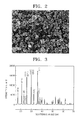
- FIG. 2 shows a transmission electron microscope (TEM) image of lithium transition metal phosphate nanoparticles prepared according to Example 1.
- FIG. 3 illustrates an X-ray diffraction (XRD) pattern of the lithium transition metal phosphate nanoparticles prepared according to Example 1.
- FIG. 4 is a TEM image of lithium transition metal phosphate nanoparticles prepared according to Example 2.
- FIG. 5 illustrates an X-ray diffraction pattern of lithium transition metal phosphate nanoparticles prepared according to Example 2.
- FIG. 6 is a TEM image of lithium transition metal phosphate nanoparticles prepared according to Example 3.
- FIG. 7 illustrates an X-ray diffraction pattern of lithium transition metal phosphate nanoparticles prepared according to Example 3.
- FIG. 8 shows a TEM image of lithium transition metal phosphate nanoparticles prepared according to Example 4.
- FIG. 9 illustrates an X-ray diffraction pattern of lithium transition metal phosphate nanoparticles prepared according to Example 4.
- a method of preparing lithium transition metal phosphate according to an embodiment of the present invention includes: feeding reactants including lithium, a transition metal, and phosphoric acid into a reactor and mixing the reactants at a molecular level in the reactor; and generating a crystal nucleus by chemically reacting the reactants in the reactor, followed by growing the crystal nucleus into a nano-sized crystal. Thereafter, the resultant slurry obtained from the reaction described above is filtered, washed, dried, and/or heated to prepare nano-sized lithium transition metal phosphate (LMP).
- LMP lithium transition metal phosphate
- lithium used herein refers to a lithium compound, a lithium atom, and/or a lithium ion depending on the context
- transition metal used herein refers to a transition metal compound, a titanium metal atom, and/or a transition metal ion depending on the context.
- the transition metal may include at least one selected from the group consisting of Fe, Mn, Co, and Ni.
- the term ‘mixing at a molecular level’ refers to mixing at a level at which the respective molecules are mixed.
- ‘mixing’ can be classified into as ‘macro-mixing’ and ‘micro-mixing.’
- the ‘macro-mixing’ refers to mixing at a vessel scale
- the ‘micro-mixing’ refers to mixing at a molecular level.
- the reactants may be fed in at least one of a solution form and a suspension form into the reactor.
- the reactants may include an acidic source material and a basic source material.
- the acidic source material may be fed into the reactor through a first source material feeding line and the basic source material may be fed into the reactor through a second source material feeding line.
- the acidic source material and the basic source material are respectively mixed at the molecular level in the reactor and then subjected to a chemical reaction, such as an acid-base reaction, to form LMP nanoparticles.
- the acidic source material may include lithium, a transition metal, and phosphoric acid.
- the acidic source material may include lithium chloride, a transition metal chloride, and H 3 PO 4 .
- the acidic source material may be, for example, a LiCl/FeCl 2 /H 3 PO 4 aqueous solution or an aqueous suspension.
- the basic source material may include an inorganic base, such as NH 4 OH.
- the acidic source material may include a transition metal and phosphoric acid.
- the basic source material may include lithium.
- the acidic source material may include transition metal chloride, such as FeCl 2 , and H 3 PO 4 , and the basic source material may include lithium hydroxide, such as LiOH.
- the acidic source material may include lithium and phosphoric acid.
- the basic source material may include a transition metal.
- the acidic source material may include lithium chloride, such as LiCl, and H 3 PO 4 .
- the basic source material may include a transition metal hydroxide, such as Fe(OH) 2 .
- the basic source material may include lithium and a transition metal.
- the basic source material may include lithium hydroxide and a transition metal hydroxide.
- the basic source material may be, for example, a LiOH/Fe(OH) 2 aqueous solution or an aqueous suspension.
- the acidic source material may include phosphoric acid, such as H 3 PO 4 , and optionally, another inorganic acid and/or organic acid.
- lithium chloride, transition metal chloride, lithium hydroxide, transition metal hydroxide, and phosphoric acid are relatively inexpensive, and thus may reduce preparation costs of lithium transition metal phosphate nanoparticles.
- the chemical reaction may be an acid-base reaction during which one equivalent of an acid is reacted with one equivalent of a base in the reactants and thus the acid and the base in the reactants lose their acidic or basic properties.
- a time (T M ) taken to mix the reactants at the molecular level may be shorter than a time (T N ) taken to generate the crystal nucleus.
- T M refers to a period of time from when the mixing begins to when a composition of the mixture becomes spatially uniform
- T N refers to a period of time from when the generating the crystal nucleus begins to when the crystal nucleus generation rate reaches an equilibrium, thereby remaining constant.
- T M may be in a range of 10 to 100 ⁇ s and T N may be 1 ms or less. If T M is less than 10 ⁇ s, manufacturing costs may be increased, and if T M is greater than 100 ⁇ s, uniformity of particle sizes may be reduced. Also, if T N is greater than 1 ms, an appropriate level of reaction may not occur and thus a product yield may become low.
- an inner temperature of the reactor may be in a range of 0 to 90° C., for example, 20 to 80° C. If the inner temperature is lower than 0° C., an appropriate product yield may not be obtained. If the inner temperature is higher than 90° C., T N may not be controllable.
- a molar ratio of a total of lithium and transition metal (i.e. Li+M) to phosphoric acid ((Li+M)/phosphoric acid) among the reactants may be in a range of 1.5 to 2.5. If the molar ratio ((Li+M)/phosphoric acid) is less than 1.5, a metal phosphate secondary phase such as LiFeP 2 O 7 and Fe 4 (P 2 O 7 ) 3 may be deposited on the surfaces of the LMP nanoparticles.
- secondary phases such as Li 2 O, Fe 2 O 3 , Fe 2 P, Li 3 PO 4 , and Li 4 P 2 O 7 may be deposited on the surfaces of the LMP nanoparticles.
- a retention time of the reactants in the reactor may be in a range of 1 ms to 10 s, for example, 10 ms to 5 s. If the retention time of the reactants is less than 1 ms, an appropriate level of reaction may not occur, and if the retention time of the reactants is greater than 10 s, controlling a particle size of LMP may be difficult and manufacturing costs may be increased.
- FIG. 1 is a schematic cross-sectional view of a high gravity rotating packed bed reactor 10 that is used in a method of preparing lithium transition metal phosphate according to an embodiment of the present invention.
- the high gravity rotating packed bed reactor 10 may include a chamber 11 delimiting an inner space, a permeable packed bed 12 that is rotatable, is disposed inside the chamber 10 , and is filled with a porous filler 12 a , at least one source material feeding line through which the reactants are fed into the inner space, and a slurry outlet 15 through which a slurry is discharged from the inner space.
- the reactor 10 may further include a gas outlet 16 for discharging a gas from the inner space.
- the porous filler 12 a may include titanium, which is a strong corrosion-resistant material.
- the porous filler 12 a may be a titanium foam.
- the permeable packed bed 12 may be filled with the porous filler 12 a therein and may allow the reactants fed in a solution or suspension form into the reactor 10 to permeate therethrough, and may be rotatable by a driving axis 13 .
- a centrifugal acceleration of the permeable packed bed 12 may be maintained in a range of 10 to 100,000 m/s 2 . If the centrifugal acceleration of the permeable packed bed 12 is less than 10 m/s 2 , an appropriate level of reaction may not occur. Meanwhile, the centrifugal acceleration of the permeable packed bed 12 cannot exceed 100,000 m/s 2 in terms of reactor design technology
- the reactor 10 having such a structure operates in an atmospheric condition, because the reactants can be mixed at the molecular level by a high centrifugal force by controlling the rotational speed of the permeable packed bed 12 , the reaction may be smoothly performed even at low temperature. That is, because micro droplets of the reactants are well mixed before growth of LMP particles, uniform LMP nanoparticles may be obtained even at low temperature. Use of the continuous reactor 10 ensures production of LMP on a mass scale.
- LMP prepared by the method of preparing lithium transition metal phosphate according to any of the embodiments described above may have an olivine-type crystal structure with an average particle size of from about 0.01 ⁇ m to about 10 ⁇ m, and in some embodiments, from about 0.05 ⁇ m to about 0.8 ⁇ m. Accordingly, the obtained lithium transition metal phosphate may be used as a cathode active material for a lithium secondary battery.
- the reactor 10 of FIG. 1 was manufactured by the inventors of the present invention.
- the reactor 10 has the following specification.
- the driving axis 13 of the reactor 10 was rotated to make the permeable packed bed 12 rotate at a rotational speed of 1440 rpm (centrifugal acceleration: 60,000 m/s 2 ) while the inner temperature of the reactor 10 was maintained at a temperature of 80° C.
- LMP nanoparticles were prepared in the same manner as in Example 1, except that after preparation of 4.0 mol/L of a LiOH aqueous solution, 2.0 mol/L of a FeCl 2 aqueous solution, and 2.0 mol/L H 3 PO 4 aqueous solution, the FeCl 2 aqueous solution and the H 3 PO 4 aqueous solution were mixed in a volume ratio of about 1:1 to obtain a FeCl 2 /H 3 PO 4 mixed solution, and while the inner temperature of the reactor was maintained at about 60° C., the FeCl 2 /H 3 PO 4 mixed solution and the LiOH aqueous solution were continuously fed into the reactor 10 through the first source material feeding line 14 - 1 and second source material feeding line 14 - 2 at a flow rate of 40 L/min and 10 L/min, respectively, to obtain LMP nanoparticles, which were then subjected to filtration, washing, and drying.
- a molar ratio of the reactant components fed into the reactor 10 i.e., a molar ratio of (Li+Fe) to H 3 PO 4 ((Li+Fe)/H 3 PO 4 ) was about 2.
- LMP nanoparticles were prepared in the same manner as in Example 1, except that after preparation of 2.0 mol/L of a LiCl aqueous solution, 2.0 mol/L of a H 3 PO 4 aqueous solution, and 2.0 mol/L of a Fe(OH) 2 aqueous solution, the LiCl aqueous solution and the H 3 PO 4 aqueous solution were mixed in a volume ratio of about 1:1 to obtain a LiCl/H 3 PO 4 mixed solution, and while the inner temperature of the reactor was maintained at about 70° C., the LiCl/H 3 PO 4 mixed solution and the Fe(OH) 2 aqueous solution were continuously fed into the reactor 10 through the first source material feeding line 14 - 1 and second source material feeding line 14 - 2 at a flow rate of 40 L/min and 20 L/min, respectively, to obtain LMP nanoparticles, which were then subjected to filtration, washing, and drying.
- a molar ratio of the reactant components fed into the reactor 10 i.e., a molar ratio of (Li+Fe) to H 3 PO 4 ((Li+Fe)/H 3 PO 4 ) was about 2.0.
- LMP nanoparticles were prepared in the same manner as in Example 1, except that after preparation of 4.0 mol/L of a H 3 PO 4 aqueous solution, 2.0 mol/L of a LiOH aqueous solution, and 2.0 mol/L of a Fe(OH) 2 aqueous solution, the LiOH aqueous solution and the Fe(OH) 2 aqueous solution were mixed in a 1:1 volume ratio to obtain a LiOH/Fe(OH) 2 mixed solution, and while the inner temperature of the reactor was maintained at about 60° C., the H 3 PO 4 aqueous solution and the LiOH/Fe(OH) 2 mixed solution were continuously fed into the reactor 10 through the first source material feeding line 14 - 1 and the second source material feeding line 14 - 2 , at a flow rate of 10 L/min and 40 L/min, respectively, to obtain LMP nanoparticles, which were then subjected to filtration, washing, and drying.
- a molar ratio of the reactant elements fed into the reactor 10 i.e., a molar ratio of (Li+Fe) to H 3 PO 4 ((Li+Fe)/H 3 PO 4 ) was about 2.0.
- LMP particles according to the present invention are found to have relatively uniform particle size distributions and nano-sizes.
- the LMP particles of Examples 1 to 4 have nano-sizes and uniform particle size distributions.
- the obtained particles are LMP (LiMPO 4 ).
- the respective numerals for example, 100 nm in FIG. 2
- ad 8 denote lengths of bold bars in the respective images
- the respective numerals for example, ( 111 ) of FIG. 3
- FIGS. 3, 5, 7, and 9 indicate facial indices.
Landscapes
- Chemical & Material Sciences (AREA)
- Organic Chemistry (AREA)
- Chemical Kinetics & Catalysis (AREA)
- Inorganic Chemistry (AREA)
- Crystallography & Structural Chemistry (AREA)
- Electrochemistry (AREA)
- General Chemical & Material Sciences (AREA)
- Battery Electrode And Active Subsutance (AREA)
Applications Claiming Priority (3)
| Application Number | Priority Date | Filing Date | Title |
|---|---|---|---|
| KR10-2010-0040797 | 2010-04-30 | ||
| KR1020100040797A KR101698762B1 (ko) | 2010-04-30 | 2010-04-30 | 리튬 전이금속 인산염의 제조방법 |
| PCT/KR2011/002816 WO2011136497A2 (fr) | 2010-04-30 | 2011-04-20 | Procédé pour la fabrication d'un lithium-métal de transition-phosphate |
Publications (2)
| Publication Number | Publication Date |
|---|---|
| US20130045153A1 US20130045153A1 (en) | 2013-02-21 |
| US9537149B2 true US9537149B2 (en) | 2017-01-03 |
Family
ID=44862007
Family Applications (1)
| Application Number | Title | Priority Date | Filing Date |
|---|---|---|---|
| US13/695,342 Active 2032-01-21 US9537149B2 (en) | 2010-04-30 | 2011-04-20 | Method for manufacturing a lithium transition metal phosphate |
Country Status (7)
| Country | Link |
|---|---|
| US (1) | US9537149B2 (fr) |
| EP (1) | EP2565158B1 (fr) |
| JP (1) | JP5796260B2 (fr) |
| KR (1) | KR101698762B1 (fr) |
| CN (1) | CN102869606B (fr) |
| CA (1) | CA2797831C (fr) |
| WO (1) | WO2011136497A2 (fr) |
Families Citing this family (6)
| Publication number | Priority date | Publication date | Assignee | Title |
|---|---|---|---|---|
| KR20140021843A (ko) * | 2012-08-10 | 2014-02-21 | 삼성정밀화학 주식회사 | 나노사이즈 철인산염 입자의 제조 방법 |
| CN105000541B (zh) * | 2015-07-31 | 2017-12-19 | 浙江大学宁波理工学院 | 一种纳米羟基磷灰石的制备方法 |
| CN105344125A (zh) * | 2015-12-08 | 2016-02-24 | 山西长林环保机械设备有限公司 | 一种卧式双进口增压旋转填料床 |
| CN116374986B (zh) * | 2023-04-14 | 2024-08-02 | 河南佰利新能源材料有限公司 | 一种磷酸铁锂正极材料及其制备方法和应用 |
| KR20250092855A (ko) * | 2023-12-15 | 2025-06-24 | 포스코홀딩스 주식회사 | 인산리튬의 제조 방법 |
| WO2025137961A1 (fr) * | 2023-12-27 | 2025-07-03 | 北京当升材料科技股份有限公司 | Matériau d'électrode positive au lithium fer phosphate et son procédé de préparation, batterie lithium-ion |
Citations (18)
| Publication number | Priority date | Publication date | Assignee | Title |
|---|---|---|---|---|
| JPH07130357A (ja) | 1993-11-02 | 1995-05-19 | Mitsubishi Cable Ind Ltd | リチウム電池用正極材及びその製造方法 |
| WO2002070409A1 (fr) | 2001-03-07 | 2002-09-12 | Anshan University Of Science And Technology | Procede pour produire des poudres de l'ordre du nanometre |
| WO2003011761A1 (fr) | 2001-07-27 | 2003-02-13 | Anshan University Of Science And Technology | Procede de production de nanopoudres et de poudres d'agregat nanoparticulaire libre |
| JP2003062440A (ja) | 2001-08-27 | 2003-03-04 | Nakamura Sogo Kenkyusho:Kk | 複数物質を含有する液状物の超混合方法 |
| JP2004095386A (ja) | 2002-08-30 | 2004-03-25 | Sumitomo Osaka Cement Co Ltd | リチウムイオン電池用正極材料の製造方法およびリチウムイオン電池 |
| CN1524792A (zh) | 2003-02-28 | 2004-09-01 | 新加坡纳米材料科技有限公司 | 一种制备各种晶态钙钛矿类化合物粉体的方法 |
| KR20040094762A (ko) | 2002-03-06 | 2004-11-10 | 발렌스 테크놀로지 (네바다), 인크. | 알칼리/전이금속 인산염 및 관련 전극 활물질 |
| KR20040096773A (ko) | 2003-05-09 | 2004-11-17 | 산요덴키가부시키가이샤 | 리튬 2차 전지용 양극 및 리튬 2차 전지 |
| CN1788836A (zh) | 2004-12-16 | 2006-06-21 | 财团法人工业技术研究院 | 使用旋转填充床反应器的纳米流体制备法 |
| DE102005012640A1 (de) | 2005-03-18 | 2006-09-21 | Süd-Chemie AG | Kreisprozess zur nasschemischen Herstellung von Lithiummetallphosphaten |
| WO2007034821A1 (fr) * | 2005-09-21 | 2007-03-29 | Kanto Denka Kogyo Co., Ltd. | Matériau actif pour électrode positive, son procédé de production, et batterie à électrolyte non aqueux comportant une électrode positive contenant le matériau actif pour électrode positive |
| WO2008061632A1 (fr) | 2006-11-21 | 2008-05-29 | Bayer Technology Services Gmbh | Procédé de synthèse de nanoparticules à nanoéchelle contenant des métaux et dispersions de nanoparticules |
| WO2008077448A1 (fr) | 2006-12-22 | 2008-07-03 | Umicore | SYNTHÈSE DE LiFeMPO4....NANOMÉTRIQUE CRISTALLINE |
| US20090117020A1 (en) * | 2007-11-05 | 2009-05-07 | Board Of Regents, The University Of Texas System | Rapid microwave-solvothermal synthesis and surface modification of nanostructured phospho-olivine cathodes for lithium ion batteries |
| WO2009071332A2 (fr) | 2007-12-06 | 2009-06-11 | Süd-Chemie AG | Composition nanoparticulaire et son procédé de préparation |
| US20100028236A1 (en) * | 2006-10-02 | 2010-02-04 | Nanomaterials Technology Pte Ltd | Process For Making Nano-Sized and Micro-Sized Precipitate Particles |
| CN101693531A (zh) | 2009-10-16 | 2010-04-14 | 清华大学 | 一种纳米磷酸铁的制备方法 |
| WO2011019171A2 (fr) | 2009-08-11 | 2011-02-17 | 삼성정밀화학(주) | Procédé de production de particules de titanate de lithium nanoscopiques |
Family Cites Families (2)
| Publication number | Priority date | Publication date | Assignee | Title |
|---|---|---|---|---|
| WO2006096906A1 (fr) * | 2005-03-18 | 2006-09-21 | Nanomaterials Technology Pte Ltd | Medicament inhalable |
| SG128490A1 (en) * | 2005-06-07 | 2007-01-30 | Nanomaterials Tech Pte Ltd | Process for forming dispersant-coated carbon particles |
-
2010
- 2010-04-30 KR KR1020100040797A patent/KR101698762B1/ko active Active
-
2011
- 2011-04-20 EP EP11775202.2A patent/EP2565158B1/fr active Active
- 2011-04-20 CA CA2797831A patent/CA2797831C/fr active Active
- 2011-04-20 CN CN201180021860.8A patent/CN102869606B/zh active Active
- 2011-04-20 JP JP2013507869A patent/JP5796260B2/ja active Active
- 2011-04-20 WO PCT/KR2011/002816 patent/WO2011136497A2/fr not_active Ceased
- 2011-04-20 US US13/695,342 patent/US9537149B2/en active Active
Patent Citations (34)
| Publication number | Priority date | Publication date | Assignee | Title |
|---|---|---|---|---|
| EP0680106A1 (fr) | 1993-11-02 | 1995-11-02 | Mitsubishi Cable Industries, Ltd. | Materiau d'electrode positive pour pile au lithium et procede de production |
| JPH07130357A (ja) | 1993-11-02 | 1995-05-19 | Mitsubishi Cable Ind Ltd | リチウム電池用正極材及びその製造方法 |
| WO2002070409A1 (fr) | 2001-03-07 | 2002-09-12 | Anshan University Of Science And Technology | Procede pour produire des poudres de l'ordre du nanometre |
| JP2004533912A (ja) | 2001-03-07 | 2004-11-11 | アンシャン ユニバーシティ オブ サイエンス アンド テクノロジー | ナノメートルサイズの微粒子の製造方法 |
| JP2004535930A (ja) | 2001-07-27 | 2004-12-02 | アンシャン ユニバーシティ オブ サイエンス アンド テクノロジー | ナノメートルサイズの粉末及びナノメートルサイズの粒子疎集合体粉末の製造方法 |
| WO2003011761A1 (fr) | 2001-07-27 | 2003-02-13 | Anshan University Of Science And Technology | Procede de production de nanopoudres et de poudres d'agregat nanoparticulaire libre |
| US20040253170A1 (en) * | 2001-07-27 | 2004-12-16 | Yingyan Zhou | Process for producing nano-powders and poeders of nano-particles loose aggregate |
| JP2003062440A (ja) | 2001-08-27 | 2003-03-04 | Nakamura Sogo Kenkyusho:Kk | 複数物質を含有する液状物の超混合方法 |
| KR20040094762A (ko) | 2002-03-06 | 2004-11-10 | 발렌스 테크놀로지 (네바다), 인크. | 알칼리/전이금속 인산염 및 관련 전극 활물질 |
| JP2004095386A (ja) | 2002-08-30 | 2004-03-25 | Sumitomo Osaka Cement Co Ltd | リチウムイオン電池用正極材料の製造方法およびリチウムイオン電池 |
| CN1524792A (zh) | 2003-02-28 | 2004-09-01 | 新加坡纳米材料科技有限公司 | 一种制备各种晶态钙钛矿类化合物粉体的方法 |
| KR20040096773A (ko) | 2003-05-09 | 2004-11-17 | 산요덴키가부시키가이샤 | 리튬 2차 전지용 양극 및 리튬 2차 전지 |
| CN1788836A (zh) | 2004-12-16 | 2006-06-21 | 财团法人工业技术研究院 | 使用旋转填充床反应器的纳米流体制备法 |
| WO2006097324A3 (fr) | 2005-03-18 | 2007-04-12 | Sued Chemie Ag | Cycle de production par voie humide de phosphates metalliques de lithium |
| DE102005012640A1 (de) | 2005-03-18 | 2006-09-21 | Süd-Chemie AG | Kreisprozess zur nasschemischen Herstellung von Lithiummetallphosphaten |
| KR20070112278A (ko) | 2005-03-18 | 2007-11-22 | 쉬드-케미아크티엔게젤샤프트 | 리튬 금속 인산염을 습식 화학법으로 제조하기 위한 순환식방법 |
| CN101142138A (zh) | 2005-03-18 | 2008-03-12 | 南方化学股份公司 | 湿化学生产锂金属磷酸盐的循环法 |
| WO2006097324A2 (fr) | 2005-03-18 | 2006-09-21 | Süd-Chemie AG | Cycle de production par voie humide de phosphates metalliques de lithium |
| JP2008532910A (ja) | 2005-03-18 | 2008-08-21 | ジュート−ヒェミー アクチェンゲゼルシャフト | リチウム金属リン酸塩をウェットケミカル方式にて製造する循環方法 |
| WO2007034821A1 (fr) * | 2005-09-21 | 2007-03-29 | Kanto Denka Kogyo Co., Ltd. | Matériau actif pour électrode positive, son procédé de production, et batterie à électrolyte non aqueux comportant une électrode positive contenant le matériau actif pour électrode positive |
| US20100148114A1 (en) * | 2005-09-21 | 2010-06-17 | Kanto Denka Kogyo Co., Ltd. | Positive electrode active material and method of producing the same and nonaqueous electrolyte battery having positive electrode containing positive electrode active material |
| US20100028236A1 (en) * | 2006-10-02 | 2010-02-04 | Nanomaterials Technology Pte Ltd | Process For Making Nano-Sized and Micro-Sized Precipitate Particles |
| WO2008061632A1 (fr) | 2006-11-21 | 2008-05-29 | Bayer Technology Services Gmbh | Procédé de synthèse de nanoparticules à nanoéchelle contenant des métaux et dispersions de nanoparticules |
| JP2010510056A (ja) | 2006-11-21 | 2010-04-02 | バイエル・テクノロジー・サービシーズ・ゲゼルシャフト・ミット・ベシュレンクテル・ハフツング | ナノサイズ金属含有ナノ粒子およびナノ粒子分散体の合成方法 |
| JP2010513193A (ja) | 2006-12-22 | 2010-04-30 | ユミコア ソシエテ アノニム | 結晶性ナノLiFeMPO4の合成 |
| WO2008077448A1 (fr) | 2006-12-22 | 2008-07-03 | Umicore | SYNTHÈSE DE LiFeMPO4....NANOMÉTRIQUE CRISTALLINE |
| US20090117020A1 (en) * | 2007-11-05 | 2009-05-07 | Board Of Regents, The University Of Texas System | Rapid microwave-solvothermal synthesis and surface modification of nanostructured phospho-olivine cathodes for lithium ion batteries |
| WO2009071332A2 (fr) | 2007-12-06 | 2009-06-11 | Süd-Chemie AG | Composition nanoparticulaire et son procédé de préparation |
| WO2009071332A3 (fr) | 2007-12-06 | 2009-10-15 | Süd-Chemie AG | Composition nanoparticulaire et son procédé de préparation |
| JP2011505332A (ja) | 2007-12-06 | 2011-02-24 | ジュート−ヒェミー アクチェンゲゼルシャフト | ナノ粒子組成物及びその製造方法 |
| WO2011019171A2 (fr) | 2009-08-11 | 2011-02-17 | 삼성정밀화학(주) | Procédé de production de particules de titanate de lithium nanoscopiques |
| WO2011019171A3 (fr) | 2009-08-11 | 2011-05-19 | 삼성정밀화학(주) | Procédé de production de particules de titanate de lithium nanoscopiques |
| JP2013501704A (ja) | 2009-08-11 | 2013-01-17 | 三星精密化学株式会社 | チタン酸リチウムナノ粒子の製造方法 |
| CN101693531A (zh) | 2009-10-16 | 2010-04-14 | 清华大学 | 一种纳米磷酸铁的制备方法 |
Non-Patent Citations (5)
| Title |
|---|
| Chinese Office Action with English Translation for Application No. 201180021860.8 dated Apr. 11, 2014, citing the above enumerated references. |
| Extended European Search Report dated Mar. 15, 2016 in Corresponding European Patent Application No. 11775202.2. |
| Google machine translation of CN101693531. * |
| International Search Report with English Translation for International Application No. PCT/KR2011/002816 dated Dec. 27, 2011. |
| Written Opinion for International Application No. PCT/KR2011/002816 dated Dec. 27, 2011. |
Also Published As
| Publication number | Publication date |
|---|---|
| JP5796260B2 (ja) | 2015-10-21 |
| EP2565158A2 (fr) | 2013-03-06 |
| US20130045153A1 (en) | 2013-02-21 |
| CN102869606A (zh) | 2013-01-09 |
| WO2011136497A3 (fr) | 2012-03-01 |
| EP2565158A4 (fr) | 2016-04-13 |
| KR20110121272A (ko) | 2011-11-07 |
| WO2011136497A9 (fr) | 2011-12-29 |
| CA2797831C (fr) | 2018-06-12 |
| CN102869606B (zh) | 2016-03-02 |
| JP2013530112A (ja) | 2013-07-25 |
| CA2797831A1 (fr) | 2011-11-03 |
| KR101698762B1 (ko) | 2017-01-23 |
| EP2565158B1 (fr) | 2019-07-31 |
| WO2011136497A2 (fr) | 2011-11-03 |
Similar Documents
| Publication | Publication Date | Title |
|---|---|---|
| JP6271599B2 (ja) | 電池用途の層状リチウム混合酸化物の微細粉体及び超微細粉体、並びにナノ粉体の工業生産に関する錯形成前駆体配合方法論 | |
| US8398953B2 (en) | Method of preparing lithium titanate nanoparticles | |
| JP2019023159A (ja) | 電池用途のリチウム金属酸化物の微細粉体及び超微細粉体、並びにナノ粉体の工業生産に関する錯形成前駆体配合方法論 | |
| EP2883838B1 (fr) | Procédé pour préparer du lithium-métal-oxyde de phosphore | |
| CA2905984C (fr) | Methodologie de formulation de precurseur complexometrique pour la production industrielle de poudres fines et ultrafines et de nanopoudres d'oxydes de metal lithium pour des applications de batterie | |
| US9537149B2 (en) | Method for manufacturing a lithium transition metal phosphate | |
| US9136534B2 (en) | Complexometric precursors formulation methodology for industrial production of high performance fine and ultrafine powders and nanopowders for specialized applications | |
| TW201512079A (zh) | 用於製備電池單元材料的方法和系統 | |
| TW201822392A (zh) | 以磷酸鹽穩化的鋰離子電池陰極 | |
| KR101825914B1 (ko) | 리튬 망간 산화물의 제조방법 | |
| KR20110121274A (ko) | 리튬 전이금속 산화물의 제조방법 |
Legal Events
| Date | Code | Title | Description |
|---|---|---|---|
| AS | Assignment |
Owner name: SAMSUNG FINE CHEMICALS CO., LTD., KOREA, REPUBLIC Free format text: ASSIGNMENT OF ASSIGNORS INTEREST;ASSIGNORS:KIM, CHUN JOONG;PARK, YUN JUNG;CHANG, DONG GYU;AND OTHERS;REEL/FRAME:029212/0109 Effective date: 20121009 |
|
| AS | Assignment |
Owner name: SAMSUNG SDI CO., LTD, KOREA, REPUBLIC OF Free format text: ASSIGNMENT OF ASSIGNORS INTEREST;ASSIGNOR:SAMSUNG FINE CHEMICALS CO., LTD;REEL/FRAME:036599/0620 Effective date: 20150914 |
|
| STCF | Information on status: patent grant |
Free format text: PATENTED CASE |
|
| MAFP | Maintenance fee payment |
Free format text: PAYMENT OF MAINTENANCE FEE, 4TH YEAR, LARGE ENTITY (ORIGINAL EVENT CODE: M1551); ENTITY STATUS OF PATENT OWNER: LARGE ENTITY Year of fee payment: 4 |