US9615078B2 - Multi-view video encoding/decoding apparatus and method - Google Patents
Multi-view video encoding/decoding apparatus and method Download PDFInfo
- Publication number
- US9615078B2 US9615078B2 US13/994,402 US201113994402A US9615078B2 US 9615078 B2 US9615078 B2 US 9615078B2 US 201113994402 A US201113994402 A US 201113994402A US 9615078 B2 US9615078 B2 US 9615078B2
- Authority
- US
- United States
- Prior art keywords
- current block
- view
- skip mode
- frame
- encoding
- Prior art date
- Legal status (The legal status is an assumption and is not a legal conclusion. Google has not performed a legal analysis and makes no representation as to the accuracy of the status listed.)
- Expired - Fee Related, expires
Links
Images




Classifications
-
- H—ELECTRICITY
- H04—ELECTRIC COMMUNICATION TECHNIQUE
- H04N—PICTORIAL COMMUNICATION, e.g. TELEVISION
- H04N13/00—Stereoscopic video systems; Multi-view video systems; Details thereof
- H04N13/10—Processing, recording or transmission of stereoscopic or multi-view image signals
- H04N13/106—Processing image signals
- H04N13/161—Encoding, multiplexing or demultiplexing different image signal components
-
- H—ELECTRICITY
- H04—ELECTRIC COMMUNICATION TECHNIQUE
- H04N—PICTORIAL COMMUNICATION, e.g. TELEVISION
- H04N19/00—Methods or arrangements for coding, decoding, compressing or decompressing digital video signals
- H04N19/10—Methods or arrangements for coding, decoding, compressing or decompressing digital video signals using adaptive coding
- H04N19/102—Methods or arrangements for coding, decoding, compressing or decompressing digital video signals using adaptive coding characterised by the element, parameter or selection affected or controlled by the adaptive coding
- H04N19/103—Selection of coding mode or of prediction mode
-
- H04N13/0048—
-
- H—ELECTRICITY
- H04—ELECTRIC COMMUNICATION TECHNIQUE
- H04N—PICTORIAL COMMUNICATION, e.g. TELEVISION
- H04N13/00—Stereoscopic video systems; Multi-view video systems; Details thereof
-
- H—ELECTRICITY
- H04—ELECTRIC COMMUNICATION TECHNIQUE
- H04N—PICTORIAL COMMUNICATION, e.g. TELEVISION
- H04N19/00—Methods or arrangements for coding, decoding, compressing or decompressing digital video signals
- H04N19/10—Methods or arrangements for coding, decoding, compressing or decompressing digital video signals using adaptive coding
- H04N19/102—Methods or arrangements for coding, decoding, compressing or decompressing digital video signals using adaptive coding characterised by the element, parameter or selection affected or controlled by the adaptive coding
- H04N19/132—Sampling, masking or truncation of coding units, e.g. adaptive resampling, frame skipping, frame interpolation or high-frequency transform coefficient masking
-
- H—ELECTRICITY
- H04—ELECTRIC COMMUNICATION TECHNIQUE
- H04N—PICTORIAL COMMUNICATION, e.g. TELEVISION
- H04N19/00—Methods or arrangements for coding, decoding, compressing or decompressing digital video signals
- H04N19/10—Methods or arrangements for coding, decoding, compressing or decompressing digital video signals using adaptive coding
- H04N19/134—Methods or arrangements for coding, decoding, compressing or decompressing digital video signals using adaptive coding characterised by the element, parameter or criterion affecting or controlling the adaptive coding
- H04N19/146—Data rate or code amount at the encoder output
- H04N19/147—Data rate or code amount at the encoder output according to rate distortion criteria
-
- H—ELECTRICITY
- H04—ELECTRIC COMMUNICATION TECHNIQUE
- H04N—PICTORIAL COMMUNICATION, e.g. TELEVISION
- H04N19/00—Methods or arrangements for coding, decoding, compressing or decompressing digital video signals
- H04N19/10—Methods or arrangements for coding, decoding, compressing or decompressing digital video signals using adaptive coding
- H04N19/169—Methods or arrangements for coding, decoding, compressing or decompressing digital video signals using adaptive coding characterised by the coding unit, i.e. the structural portion or semantic portion of the video signal being the object or the subject of the adaptive coding
- H04N19/17—Methods or arrangements for coding, decoding, compressing or decompressing digital video signals using adaptive coding characterised by the coding unit, i.e. the structural portion or semantic portion of the video signal being the object or the subject of the adaptive coding the unit being an image region, e.g. an object
- H04N19/176—Methods or arrangements for coding, decoding, compressing or decompressing digital video signals using adaptive coding characterised by the coding unit, i.e. the structural portion or semantic portion of the video signal being the object or the subject of the adaptive coding the unit being an image region, e.g. an object the region being a block, e.g. a macroblock
-
- H—ELECTRICITY
- H04—ELECTRIC COMMUNICATION TECHNIQUE
- H04N—PICTORIAL COMMUNICATION, e.g. TELEVISION
- H04N19/00—Methods or arrangements for coding, decoding, compressing or decompressing digital video signals
- H04N19/50—Methods or arrangements for coding, decoding, compressing or decompressing digital video signals using predictive coding
- H04N19/597—Methods or arrangements for coding, decoding, compressing or decompressing digital video signals using predictive coding specially adapted for multi-view video sequence encoding
-
- H—ELECTRICITY
- H04—ELECTRIC COMMUNICATION TECHNIQUE
- H04N—PICTORIAL COMMUNICATION, e.g. TELEVISION
- H04N19/00—Methods or arrangements for coding, decoding, compressing or decompressing digital video signals
- H04N19/60—Methods or arrangements for coding, decoding, compressing or decompressing digital video signals using transform coding
- H04N19/61—Methods or arrangements for coding, decoding, compressing or decompressing digital video signals using transform coding in combination with predictive coding
Definitions
- Exemplary embodiments relate to a multi-view video encoding and decoding apparatus and method, and more particularly to an apparatus and method for encoding and decoding an input image according to a skip mode that uses a frame of a same view or a skip mode that uses a frame of a different view with respect to a current block.
- a stereoscopic image refers to a 3-dimensional (3D) image that simultaneously provides depth information and spatial information. Different from a stereo image that simply provides images of different views to left and right eyes of a viewer, respectively, the stereoscopic image provides different images according to a view of an observer.
- the images taken from the plurality of views need to be encoded by a multi-view video coding method.
- the multi-view video coding method needs to be improved to be more efficient.
- aspects of one or more exemplary embodiments provide a current block which is encoded according to not only a skip mode based on a frame of a same view but also a skip mode based on a frame of a different view. Therefore, encoding efficiency may be increased by expanding the skip mode.
- a multi-view video encoding apparatus including an encoding mode determination unit configured to determine whether to encode a current block included in a frame of a first view according to a skip mode that uses a frame of a second view, and a bitstream generation unit configured to generate a bitstream by encoding an index indicating the skip mode when the current block is to be encoded according to the skip mode.
- a multi-view video encoding apparatus including an encoding mode determination unit configured to determine whether to use a first skip mode using a frame of a first view or a second skip mode using a frame of a second view for encoding a current block included in the frame of the first view, and a bitstream generation unit configured to generate a bitstream by encoding an index indicating the skip mode determined with respect to the current block.
- a multi-view video decoding apparatus including an index decoding unit configured to decode an encoded index indicating a skip mode of a current block included in a frame of a first view, and a block restoration unit configured to restore the current block by extracting a prediction block of the current block in a frame of a second view according to the skip mode of the current block.
- a multi-view video decoding apparatus including an index decoding unit configured to decode an encoded index indicating whether a current block included in a frame of a first view is encoded according to a first skip mode or a second skip mode, and a block restoration unit configured to restore the current block based on a skip mode of the current block determined by the decoded index, wherein the first skip mode determines a prediction block of the current block in the frame of the first view, and the second skip mode determines the prediction block of the current block in the frame of the second view.
- a multi-view video encoding method including determining whether to encode a current block included in a frame of a first view according to a skip mode that uses a frame of a second view, and generating a bitstream by encoding an index indicating the skip mode when the current block is to be encoded according to the skip mode.
- a multi-view video encoding method including determining whether to use a first skip mode using a frame of a first view or a second skip mode using a frame of a second view for encoding a current block included in the frame of the first view, and generating a bitstream by encoding an index indicating the skip mode determined with respect to the current block.
- a multi-view video decoding method including decoding an encoded index indicating a skip mode of a current block included in a frame of a first view, and restoring the current block by extracting a prediction block of the current block in a frame of a second view according to the skip mode of the current block.
- a multi-view video decoding method including decoding an encoded index indicating whether a current block included in a frame of a first view is encoded according to a first skip mode or a second skip mode, and restoring the current block based on a skip mode of the current block determined by the decoded index, wherein the first skip mode determines a prediction block of the current block in the frame of the first view, and the second skip mode determines the prediction block of the current block in the frame of the second view.
- FIG. 1 is a diagram illustrating operation of a multi-view video encoding apparatus and a multi-view video decoding apparatus according to an exemplary embodiment.
- FIG. 2 is a block diagram illustrating a detailed configuration of the multi-view video encoding apparatus, according to an exemplary embodiment.
- FIG. 3 is a block diagram illustrating a detailed configuration of a multi-view video decoding apparatus, according to an exemplary embodiment.
- FIG. 4 is a diagram illustrating a configuration of multi-view video, according to an exemplary embodiment.
- FIG. 5 is a diagram illustrating a frame used for encoding a current block, according to an exemplary embodiment.
- FIG. 6 is a diagram illustrating a skip mode of when a current block is encoded, according to an exemplary embodiment.
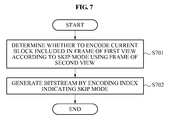
- FIG. 7 is a flowchart illustrating a multi-view video encoding method according to a first exemplary embodiment.
- FIG. 8 is a flowchart illustrating a multi-view video encoding method according to a second exemplary embodiment.
- FIG. 9 is a flowchart illustrating a multi-view video decoding method according to the first exemplary embodiment.
- FIG. 10 is a flowchart illustrating a multi-view video decoding method according to the second exemplary embodiment.
- FIG. 1 is a diagram illustrating operation of a multi-view video encoding apparatus 101 and a multi-view video decoding apparatus 102 according to an exemplary embodiment.
- the multi-view video encoding apparatus 101 may efficiently encode an image in consideration of redundancy among images taken from a plurality of views. Specifically, the multi-view video encoding apparatus 101 may perform encoding according to a multi-view video encoding method.
- the multi-view video encoding method may encode images in various encoding modes. Out of the various encoding modes, a skip mode does not encode blocks constituting an image but transmits only a 1 bit index indicating the skip mode to the multi-view video decoding apparatus 102 . Therefore, encoding efficiency of the skip mode is relatively high. That is, in encoding of an image, as a number of current blocks being encoded in the skip mode increases, the encoding efficiency may be increased.
- a direct mode is distinguished from the skip mode, the skip mode according to the exemplary embodiments will be described as including the direct mode.
- the multi-view video encoding apparatus 101 may separate the skip mode into a first skip mode and a second skip mode.
- the first skip mode encodes a current block using a frame of a same view but of a different time from a frame of the current block to be encoded.
- the second skip mode encodes the current block using a frame of a different view but of a same time as the frame of the current block to be encoded.
- the first skip mode may be defined as an inter skip mode while the second skip mode may be defined as an inter view skip mode.
- the exemplary embodiments may include any skip mode performing the same operations and are not limited to the foregoing definitions.
- a frame may be referred to as a reference image.
- the skip mode may be applied to more current blocks being encoded.
- the multi-view video encoding apparatus 101 may encode the current block using the second skip mode.
- the multi-view video encoding apparatus 101 may determine which one of the first skip mode and the second skip mode more efficiently encodes the current block, and transmit the determined skip mode to the multi-view video decoding apparatus 102 . Therefore, the multi-view video decoding apparatus 102 may decode the current block according to the transmitted skip mode.
- FIG. 2 is a block diagram illustrating a detailed configuration of the multi-view video encoding apparatus 101 , according to an exemplary embodiment.
- the multi-view video encoding apparatus 101 may include an encoding mode determination unit 201 and a bitstream generation unit 202 .
- the multi-view video encoding apparatus 101 may encode the current block according to an inter mode or an intra mode, such as inter 2N ⁇ 2N, inter 2N ⁇ N, inter N ⁇ 2N, inter N ⁇ N, intra 2N ⁇ 2N, intra N ⁇ N, and the like, encoding according to the skip mode will be mainly described hereinafter.
- the encoding mode is not limited to the foregoing definition and other encoding modes may be added.
- the encoding mode determination unit 201 may determine whether to use a skip mode that uses a frame of a second view for encoding the current block included in a frame of a first view. That is, the multi-view video encoding apparatus 101 may determine whether to encode the current block by the inter view skip mode. Otherwise, the encoding mode determination unit 201 may encode the current block included in the frame of the first view by an inter mode or an intra mode that uses a residual signal of the current block.
- a multi-view video decoding apparatus 102 may determine a prediction disparity vector (PDV) of the current block included in the frame of the first view, using a disparity vector (DV) of a peripheral block referencing the frame of the second view among peripheral blocks of the current block.
- the PDV may be deduced by applying a median filter to a DV of at least one peripheral block. Therefore, the multi-view video decoding apparatus 102 may extract a prediction block of the current block in the frame of the second view using the PDV, and restore the current block by compensating the current block using the prediction block.
- the multi-view video decoding apparatus 102 may determine the PDV of the current block, using a DV of a target block corresponding to a location of the current block in a frame of a different time from a frame including the current block among frames of the first view. Therefore, the multi-view video decoding apparatus 102 may extract the prediction block of the current block in the frame of the first view using the PDV, and restore the current block by compensating the current block using the prediction block.
- the multi-view video decoding apparatus 102 may determine the PDV of the current block, using a DV of a target block corresponding to locations of the peripheral blocks of the current block in the frame of the different time from the frame including the current block among the frames of the first view. Therefore, the multi-view video decoding apparatus 102 may extract the prediction block of the current block in the frame of the first view using the PDV of the current block, and restore the current block by compensating the current block using the prediction block.
- the bitstream generation unit 202 may encode an index indicating the skip mode and generate the bitstream.
- the index may be set to 1 when the current block is encoded according to the skip mode and to 0 when the current block is encoded not according to the skip mode. Therefore, only 1 bit is necessary in actual encoding of the index.
- the skip mode does not transmit the residual signal between the current block and a prediction block of the current block. Therefore, the bitstream may include an index only related to whether the current bock is encoded according the skip mode.
- peripheral blocks of the current block may include at least one block selected from a block adjoining a left side of the current block, a block adjoining an upper side of the current block, and a block adjoining an upper left end of the current block.
- the encoding mode determination unit 201 may determine whether to use the first skip mode that uses the frame of the first view or the second skip mode that uses the frame of the second view for encoding the current block included in the frame of the first view. For example, the encoding mode determination unit 201 may determine, as the encoding mode for encoding the current block, the skip mode having a smaller cost function among cost functions resulting from encoding according to the first skip mode and the second skip mode.
- the first skip mode refers to an encoding mode which determines a prediction motion vector (PMV) of the current block using a motion vector (MV) of a peripheral block referencing the frame of the first view, which indicates a different time from the frame including the current block, among the peripheral blocks of the current block, and restores the current block using the PMV. Since the second skip mode is described in detail with reference to the first exemplary embodiment, a description of the second skip mode will be omitted.
- the bitstream generation unit 202 may generate a bitstream by encoding an index indicating a skip mode determined with respect to the current block.
- FIG. 3 is a block diagram illustrating a detailed configuration of the multi-view video decoding apparatus 102 , according to an exemplary embodiment.
- the multi-view video decoding apparatus 102 includes an index decoding unit 301 and a block restoration unit 302 .
- the multi-view video decoding apparatus 102 according to two exemplary embodiments will be described.
- the index decoding unit 301 may decode an encoded index indicating the skip mode of the current block included in the frame of the first view.
- the encoded index may be transmitted using the bitstream generated by the multi-view video encoding apparatus 101 and deduced from the bitstream through demultiplexing.
- the block restoration unit 302 may restore the current block by extracting a prediction block of the current block in the frame of the second view according to the skip mode of the current block. For example, the block restoration unit 302 may determine a PDV of the current block using the DV of the peripheral block referencing the frame of the second view among the peripheral blocks of the current block. Additionally, the block restoration unit 302 may determine a prediction vector of the current block in the frame of the second view using the PDV, and restore the current block by compensating the current block using the prediction block.
- the block restoration unit 302 may determine the PDV of the current block, using the current block of the target block corresponding to the locations of the peripheral blocks of the current block in the frame of the different time from the frame including the current block among the frames of the first view. Additionally, the block restoration unit 302 may determine the prediction vector of the current block in the frame of the second view using the PDV.
- the index decoding unit 301 may decode an encoded index indicating whether the current block included in the frame of the first view is encoded according to the first skip mode or the second skip mode.
- the first skip mode may refer to an encoding mode that determines the prediction block of the current block in the frame of the first view which is the same as a view of the frame including the current block.
- the second skip mode may refer to an encoding mode that determines the prediction block of the current block in the frame of the second view which is different from the view of the frame including the current block.
- the block restoration unit 302 may determine the PMV of the current block, using the MV of the peripheral block referencing the frame of the first view, which indicates the different time from the frame including the current block among the peripheral blocks of the current block. Therefore, the block restoration unit 302 may determine the prediction block of the current block in the frame of the first view using the PMV, and restore the current block by compensating the current block using the prediction block.
- the block restoration unit 302 may determine the PDV of the current block using the DV of the peripheral block referencing the frame of the second view among the peripheral blocks of the current block. Therefore, the block restoration unit 302 may determine the prediction block of the current block using the PDV, and restore the current block by compensating the current block using the prediction block.
- the restoration unit 302 may determine the PDV of the current block using the DV of the target block corresponding to the location of the current block in the frame of the first view, which indicates the different time from the frame including the current block among frames of the first view. Therefore, the block restoration unit 302 may determine the prediction block of the current block using the PDV, and restore the current block by compensating the current block using the prediction block.
- FIG. 4 is a diagram illustrating a configuration of multi-view video, according to an exemplary embodiment.
- FIG. 4 shows a multi-view video encoding method which encodes input images of three views, that is, left, center, and right views, by Group of Picture (GOP).
- GOP Group of Picture
- the configuration of FIG. 1 may first encode the left-view image, then encode the right-view image, and then encode the center-view image (i.e., sequentially).
- the left-view image may be encoded through motion estimation that searches for a similar area from previous images and removes temporal redundancy.
- the right-view image since the left-view image already encoded is used as a reference image, not only is the temporal redundancy removed by the motion estimation, but also inter-view redundancy generated between views may be removed through disparity estimation.
- both the left-view image and the right-view image may be used as reference images. Therefore, the disparity estimation may be performed in both directions, thereby removing the inter-view redundancy.
- an I-view refers to an image encoded without using an image of another view, e.g., the left-view image).
- a P-view refers to an image encoded by prediction in one direction from an image of another view, e.g., the right-view image.
- a B-view refers to a bi-directionally predicted view image encoded in both directions from a left-view image and a right-view image, e.g., the center-view image.
- FIG. 5 is a diagram illustrating a frame used for encoding a current block, according to an exemplary embodiment.
- the multi-view video encoding method may search for a prediction block most similar to the current block among peripheral blocks adjoining a current image 501 that includes the current block, and encodes a residual signal between the current block and the prediction block.
- the encoding efficiency of the skip mode is relatively high because the skip mode does not transmit encoding information of the current block to the multi-view video decoding apparatus 102 .
- the skip mode may be divided into a first skip mode that uses a frame 1 502 and a frame 2 503 , of which the views are same but the times are different, and a second skip mode that uses a frame 3 504 and a frame 4 505 , of which the views are different but the times are same, with respect to the current block 501 .
- sum of square difference is obtained by squaring a differentiation value of a current block s and a prediction block r.
- ⁇ denotes the Lagrangian coefficient
- R denotes a number of bits necessary when encoding is performed according to the first skip mode or the second skip mode.
- the multi-view video decoding apparatus 102 may determine a PMV of the current block based on MVs of peripheral blocks using frames of the same views among the peripheral blocks of the current block.
- the multi-view video decoding apparatus 102 may determine the PMV by applying a median filter to the MVs of the peripheral blocks.
- the multi-view video decoding apparatus 102 may determine a prediction block of the current block in a frame of a same view as a frame including the current block, so as to restore the current block based on the PMV.
- the multi-view video decoding apparatus 102 may determine a PDV of the current block based on DVs of peripheral blocks using frames of different views among the peripheral blocks of the current block.
- the multi-view video decoding apparatus 102 may extract the PDV by applying the median filter to the DVs of the peripheral blocks.
- the multi-view video decoding apparatus 102 may determine the prediction block of the current block in a frame of a different view from a frame including the current block, so as to restore the current block based on the PDV.
- the multi-view video decoding apparatus 102 may restore the current block based on the prediction block deduced by the first skip mode and the prediction block deduced by the second skip mode.
- FIG. 6 is a diagram illustrating a skip mode of when a current block is encoded, according to an exemplary embodiment.
- Two skip modes may be applied to encode a current block included in a frame 601 .
- a first skip mode compensates the current block by extracting the prediction block from a frame 603 of a same view as a view of the frame 601 .
- a second skip mode compensates the current block by extracting the prediction block from a frame 602 of a different view from the view of the frame 601 .
- the first skip mode may generate a PMV by applying a median filter to an MV of peripheral blocks b 1 to b 5 of the current block, and determine the prediction block in the frame 603 using the PMV.
- the second skip mode may generate a PDV by applying the median filter to DVs of the peripheral blocks b 1 to b 5 of the current block, and determine the prediction block in the frame 602 using the PDV. Also, the second skip mode may generate the PDV using a DV of a target block of the frame 603 being in a same location as the current block, and determine the prediction block in the frame 602 using the PDV. Alternatively, the second skip mode may generate the PDV by applying the median filter to the DV of peripheral blocks of the target block of the frame 603 , and determine the prediction block in the frame 602 using the PDV.
- a highest priority may be given to a DV indicating a most similar prediction block to the current block.
- FIG. 7 is a flowchart illustrating a multi-view video encoding method according to a first exemplary embodiment.
- the multi-view video encoding apparatus 101 may determine whether to encode the current block included in the frame of the first view using the skip mode that uses the frame of the second view.
- the skip mode may refer to an encoding mode that determines the PDV of the current block using the DV of the peripheral block referencing the frame of the second view among the peripheral blocks of the current block, and restores the current block using the PDV.
- the skip mode may refer to an encoding mode that determines the PDV of the current block using the DV of the target block corresponding to the location of the current block in the frame of the different time from the frame including the current block among the frames of the first view, and restores the current block using the PDV.
- the skip mode may refer to an encoding mode that determines the PDV of the current block using the DV of the target block corresponding to locations of the peripheral blocks of the current block in the frame of the different time from the frame including the current block among the frames of the first view, and restores the current block using the PDV.
- the multi-view video encoding apparatus 101 may generate a bitstream by encoding the index indicating the skip mode.
- FIG. 8 is a flowchart illustrating a multi-view video encoding method according to a second exemplary embodiment.
- the multi-view video encoding apparatus 101 may determine whether to use the first skip mode that uses the frame of the first view or the second skip mode that uses the frame of the second view, for encoding the current block included in the frame of the first view. For example, the multi-view video encoding apparatus 101 may determine, as the encoding mode for encoding the current block, the skip mode having a smaller cost function among cost functions resulting from encoding according to the first skip mode and the second skip mode.
- the first skip mode may refer to an encoding mode which determines the PMV of the current block using the MV of the peripheral block referencing the frame of the first view, which indicates the different time from the frame including the current block among the peripheral blocks of the current block, and restores the current block using the PMV.
- the second skip mode may refer to an encoding mode which determines the PDV of the current block using the DV of the peripheral block referencing the frame of the second view among the peripheral blocks of the current block, and restores the current block using the PDV.
- the second skip mode may determine the PDV of the current block using the DV of the target block corresponding to the location of the current block in the frame of the first view, which indicates the different time from the frame including the current block, among the peripheral blocks of the current block, and restores the current block using the PDV.
- the multi-view video encoding apparatus 101 may generate the bitstream by encoding the index indicating the skip mode determined with respect to the current block.
- FIG. 9 is a flowchart illustrating a multi-view video decoding method according to the first exemplary embodiment.
- the multi-view video decoding apparatus may decode the encoded index indicating the skip mode of the current block included in the frame of the first view.
- the skip mode of FIG. 9 has already been described in detail with reference to FIG. 7 .
- the multi-view video decoding apparatus 102 may restore the current block by extracting the prediction block of the current block in the frame of the second view according to the skip mode of the current block.
- FIG. 10 is a flowchart illustrating a multi-view video decoding method according to the second exemplary embodiment.
- the multi-view video decoding apparatus 102 may decode the encoded index indicating whether the current block included in the frame of the first view is encoded according to the first skip mode or the second skip mode.
- the skip mode of FIG. 10 has already been described in detail with reference to FIG. 8 .
- the multi-view video decoding apparatus 102 may restore the current block based on the skip mode of the current block determined by the decoded index.
- the above-described exemplary embodiments may be recorded, stored, or fixed in one or more non-transitory computer-readable media that includes program instructions to be implemented by a computer to cause a processor to execute or perform the program instructions.
- the media may also include, alone or in combination with the program instructions, data files, data structures, and the like.
- the program instructions recorded on the media may be those specially designed and constructed, or they may be of the kind well-known and available to those having ordinary skill in the art.
Landscapes
- Engineering & Computer Science (AREA)
- Multimedia (AREA)
- Signal Processing (AREA)
- Compression Or Coding Systems Of Tv Signals (AREA)
- Compression, Expansion, Code Conversion, And Decoders (AREA)
- Testing, Inspecting, Measuring Of Stereoscopic Televisions And Televisions (AREA)
Applications Claiming Priority (5)
| Application Number | Priority Date | Filing Date | Title |
|---|---|---|---|
| KR10-2010-0127456 | 2010-12-14 | ||
| KR20100127456 | 2010-12-14 | ||
| KR1020110110588A KR101893559B1 (ko) | 2010-12-14 | 2011-10-27 | 다시점 비디오 부호화/복호화 장치 및 방법 |
| KR10-2011-0110588 | 2011-10-27 | ||
| PCT/KR2011/009559 WO2012081877A2 (fr) | 2010-12-14 | 2011-12-13 | Appareil et procédé d'encodage/de décodage vidéo à vues multiples |
Publications (2)
| Publication Number | Publication Date |
|---|---|
| US20130335526A1 US20130335526A1 (en) | 2013-12-19 |
| US9615078B2 true US9615078B2 (en) | 2017-04-04 |
Family
ID=46685914
Family Applications (1)
| Application Number | Title | Priority Date | Filing Date |
|---|---|---|---|
| US13/994,402 Expired - Fee Related US9615078B2 (en) | 2010-12-14 | 2011-12-13 | Multi-view video encoding/decoding apparatus and method |
Country Status (6)
| Country | Link |
|---|---|
| US (1) | US9615078B2 (fr) |
| EP (2) | EP3024230A1 (fr) |
| JP (1) | JP2014505398A (fr) |
| KR (1) | KR101893559B1 (fr) |
| CN (1) | CN103370934A (fr) |
| WO (1) | WO2012081877A2 (fr) |
Cited By (2)
| Publication number | Priority date | Publication date | Assignee | Title |
|---|---|---|---|---|
| US20160198139A1 (en) * | 2013-10-17 | 2016-07-07 | Mediatek Inc. | Method of Motion Information Prediction and Inheritance in Multi-View and Three-Dimensional Video Coding |
| US9743066B2 (en) | 2013-07-18 | 2017-08-22 | Hfi Innovation Inc. | Method of fast encoder decision in 3D video coding |
Families Citing this family (8)
| Publication number | Priority date | Publication date | Assignee | Title |
|---|---|---|---|---|
| MX340482B (es) * | 2012-07-11 | 2016-07-08 | Lg Electronics Inc | Metodo y aparato para el procesamiento de señal de video. |
| KR102186605B1 (ko) | 2012-09-28 | 2020-12-03 | 삼성전자주식회사 | 다시점 영상 부호화/복호화 장치 및 방법 |
| CN104718760B (zh) * | 2012-10-05 | 2019-04-05 | 寰发股份有限公司 | 用于三维和多视图视频编码的方法和装置 |
| WO2014065546A1 (fr) * | 2012-10-22 | 2014-05-01 | (주)휴맥스 | Procédé destiné à la prédiction de mouvement inter-vue et procédé conçu pour la détermination de candidats à la fusion inter-vue dans la vidéo 3d |
| US9900576B2 (en) * | 2013-03-18 | 2018-02-20 | Qualcomm Incorporated | Simplifications on disparity vector derivation and motion vector prediction in 3D video coding |
| US9609347B2 (en) * | 2013-04-04 | 2017-03-28 | Qualcomm Incorporated | Advanced merge mode for three-dimensional (3D) video coding |
| WO2015188297A1 (fr) * | 2014-06-08 | 2015-12-17 | 北京大学深圳研究生院 | Procédé et dispositif de codage/décodage arithmétique pour la compression de blocs d'image vidéo d'un modèle de saut pondéré |
| US12598320B2 (en) | 2024-01-08 | 2026-04-07 | Qualcomm Incorporated | Inter-eye prediction models for XR |
Citations (9)
| Publication number | Priority date | Publication date | Assignee | Title |
|---|---|---|---|---|
| US20080170618A1 (en) | 2007-01-11 | 2008-07-17 | Samsung Electronics Co., Ltd. | Method and apparatus for encoding and decoding multi-view images |
| US20080273599A1 (en) | 2007-05-02 | 2008-11-06 | Samsung Electronics Co., Ltd. | Method and apparatus for encoding and decoding multi-view video data |
| CN101415115A (zh) | 2007-10-15 | 2009-04-22 | 华为技术有限公司 | 基于运动跳跃模式的视频编解码方法及其编解码器 |
| US20090168874A1 (en) | 2006-01-09 | 2009-07-02 | Yeping Su | Methods and Apparatus for Multi-View Video Coding |
| WO2009088195A2 (fr) | 2008-01-10 | 2009-07-16 | Samsung Electronics Co., Ltd. | Procédé et appareil de codage vidéo multivue utilisant la compensation de différence de chrominance et procédé et appareil de décodage vidéo multivue utilisant la compensation de différence de chrominance |
| WO2009131688A2 (fr) | 2008-04-25 | 2009-10-29 | Thomson Licensing | Modes de saut intervues avec profondeur |
| US20090290643A1 (en) * | 2006-07-12 | 2009-11-26 | Jeong Hyu Yang | Method and apparatus for processing a signal |
| US20100135391A1 (en) * | 2007-08-06 | 2010-06-03 | Thomson Licensing | Methods and apparatus for motion skip move with multiple inter-view reference pictures |
| WO2010068020A2 (fr) | 2008-12-08 | 2010-06-17 | 한국전자통신연구원 | Appareil et procédé de décodage/codage de vidéo multivue |
Family Cites Families (3)
| Publication number | Priority date | Publication date | Assignee | Title |
|---|---|---|---|---|
| KR100667830B1 (ko) * | 2005-11-05 | 2007-01-11 | 삼성전자주식회사 | 다시점 동영상을 부호화하는 방법 및 장치 |
| CN101647279A (zh) * | 2007-01-24 | 2010-02-10 | Lg电子株式会社 | 用于处理视频信号的方法和装置 |
| KR20090129412A (ko) * | 2007-03-02 | 2009-12-16 | 엘지전자 주식회사 | 비디오 신호 디코딩/인코딩 방법 및 장치 |
-
2011
- 2011-10-27 KR KR1020110110588A patent/KR101893559B1/ko not_active Expired - Fee Related
- 2011-12-13 EP EP15197392.2A patent/EP3024230A1/fr not_active Withdrawn
- 2011-12-13 JP JP2013544387A patent/JP2014505398A/ja active Pending
- 2011-12-13 EP EP11847908.8A patent/EP2654295A4/fr not_active Withdrawn
- 2011-12-13 WO PCT/KR2011/009559 patent/WO2012081877A2/fr not_active Ceased
- 2011-12-13 CN CN2011800675567A patent/CN103370934A/zh active Pending
- 2011-12-13 US US13/994,402 patent/US9615078B2/en not_active Expired - Fee Related
Patent Citations (14)
| Publication number | Priority date | Publication date | Assignee | Title |
|---|---|---|---|---|
| US20090168874A1 (en) | 2006-01-09 | 2009-07-02 | Yeping Su | Methods and Apparatus for Multi-View Video Coding |
| US20090290643A1 (en) * | 2006-07-12 | 2009-11-26 | Jeong Hyu Yang | Method and apparatus for processing a signal |
| JP2009543508A (ja) | 2006-07-12 | 2009-12-03 | エルジー エレクトロニクス インコーポレイティド | 信号処理方法及び装置 |
| US20080170618A1 (en) | 2007-01-11 | 2008-07-17 | Samsung Electronics Co., Ltd. | Method and apparatus for encoding and decoding multi-view images |
| CN101601304A (zh) | 2007-01-11 | 2009-12-09 | 三星电子株式会社 | 用于对多视图图像进行编码和解码的方法和设备 |
| JP2010516158A (ja) | 2007-01-11 | 2010-05-13 | サムスン エレクトロニクス カンパニー リミテッド | 多視点映像の符号化、復号化方法及び装置 |
| US20080273599A1 (en) | 2007-05-02 | 2008-11-06 | Samsung Electronics Co., Ltd. | Method and apparatus for encoding and decoding multi-view video data |
| US20100135391A1 (en) * | 2007-08-06 | 2010-06-03 | Thomson Licensing | Methods and apparatus for motion skip move with multiple inter-view reference pictures |
| JP2010536242A (ja) | 2007-08-06 | 2010-11-25 | トムソン ライセンシング | 複数のインタービュー参照ピクチャを用いたモーションスキップモードのための方法及び装置 |
| CN101415115A (zh) | 2007-10-15 | 2009-04-22 | 华为技术有限公司 | 基于运动跳跃模式的视频编解码方法及其编解码器 |
| WO2009088195A2 (fr) | 2008-01-10 | 2009-07-16 | Samsung Electronics Co., Ltd. | Procédé et appareil de codage vidéo multivue utilisant la compensation de différence de chrominance et procédé et appareil de décodage vidéo multivue utilisant la compensation de différence de chrominance |
| WO2009131688A2 (fr) | 2008-04-25 | 2009-10-29 | Thomson Licensing | Modes de saut intervues avec profondeur |
| WO2010068020A2 (fr) | 2008-12-08 | 2010-06-17 | 한국전자통신연구원 | Appareil et procédé de décodage/codage de vidéo multivue |
| WO2010068020A9 (fr) | 2008-12-08 | 2010-08-05 | 한국전자통신연구원 | Appareil et procédé de décodage/codage de vidéo multivue |
Non-Patent Citations (7)
| Title |
|---|
| Communicated dated Jan. 5, 2016, issued by the Japanese Patent Office in counterpart Japanese Application No. 2013-544387. |
| Communication dated Feb. 1, 2016, issued by the State Intellectual Property Office of People's Republic of China in counterpart Chinese Application No. 201180067556.7. |
| Communication dated Mar. 30, 2016, issued by the European Patent Office in counterpart European Application No. 15197392.2. |
| Communication dated May 13, 2015 issued by the European Patent Office in counterpart European Patent Application No. 11847908.8. |
| Han-Suh Koo et al., "Motion Skip Mode for MVC", Joint Video Team (JVT) of ISO/IEC MPEG & ITU-T VCEG (ISO/IEC JTC1/SC29/WG11 and ITU-T SG16 Q.6), 21th Meeting: Hangzhou, China, Oct. 23-27, 2006, Document: JVT-U091-L, Filename: JVT-U091-L.doc (7 Pages Total). |
| International Search Report (PCT/ISA/210) dated May 29, 2012, issued in International Application No. PCT/KR2011/009559. |
| Jacek Konieczny, et al; "Depth-Based Inter-View Prediction of Motion Vectors for Improved Multiview Video Coding"; Transmission and Display of 3D Video; Jun. 1, 2010; XP055187553; pp. 1-4. |
Cited By (3)
| Publication number | Priority date | Publication date | Assignee | Title |
|---|---|---|---|---|
| US9743066B2 (en) | 2013-07-18 | 2017-08-22 | Hfi Innovation Inc. | Method of fast encoder decision in 3D video coding |
| US20160198139A1 (en) * | 2013-10-17 | 2016-07-07 | Mediatek Inc. | Method of Motion Information Prediction and Inheritance in Multi-View and Three-Dimensional Video Coding |
| US10075690B2 (en) * | 2013-10-17 | 2018-09-11 | Mediatek Inc. | Method of motion information prediction and inheritance in multi-view and three-dimensional video coding |
Also Published As
| Publication number | Publication date |
|---|---|
| EP3024230A1 (fr) | 2016-05-25 |
| CN103370934A (zh) | 2013-10-23 |
| US20130335526A1 (en) | 2013-12-19 |
| EP2654295A2 (fr) | 2013-10-23 |
| KR20120066579A (ko) | 2012-06-22 |
| WO2012081877A3 (fr) | 2012-08-09 |
| WO2012081877A2 (fr) | 2012-06-21 |
| JP2014505398A (ja) | 2014-02-27 |
| EP2654295A4 (fr) | 2015-06-10 |
| KR101893559B1 (ko) | 2018-08-31 |
Similar Documents
| Publication | Publication Date | Title |
|---|---|---|
| US9615078B2 (en) | Multi-view video encoding/decoding apparatus and method | |
| JP5268645B2 (ja) | カメラパラメータを利用して視差ベクトルを予測する方法、その方法を利用して多視点映像を符号化及び復号化する装置、及びそれを行うためのプログラムが記録された記録媒体 | |
| KR101753171B1 (ko) | 3d 비디오 코딩에서의 간략화된 뷰 합성 예측 방법 | |
| US20140002599A1 (en) | Competition-based multiview video encoding/decoding device and method thereof | |
| JP6042536B2 (ja) | 3dビデオ符号化におけるビュー間候補導出の方法と装置 | |
| CN102308585B (zh) | 多视点视频编码/解码方法和设备 | |
| US20120189060A1 (en) | Apparatus and method for encoding and decoding motion information and disparity information | |
| KR101638752B1 (ko) | 3d 비디오 코딩에서 변이 벡터 도출을 제한하는 방법 | |
| AU2013284038B2 (en) | Method and apparatus of disparity vector derivation in 3D video coding | |
| KR101747434B1 (ko) | 움직임 정보 및 변이 정보를 부호화/복호화하는 영상 처리 장치 및 방법 | |
| US20140002594A1 (en) | Hybrid skip mode for depth map coding and decoding | |
| JP2015525997A5 (fr) | ||
| EP2839664A1 (fr) | Procédé et appareil pour la prédiction d'une sous-division inter-vue dans un codage vidéo en 3d | |
| JP2016513925A (ja) | 3dビデオ符号化におけるビュー合成予測の方法と装置 | |
| EP2936815A1 (fr) | Procede et appareil de derivation de vecteur de disparite dans un codage video 3d | |
| KR20130046534A (ko) | 영상 부호화 방법 및 장치 그리고 영상 복호화 방법 및 장치 | |
| US9900620B2 (en) | Apparatus and method for coding/decoding multi-view image | |
| KR100738867B1 (ko) | 다시점 동영상 부호화/복호화 시스템의 부호화 방법 및시점간 보정 변이 추정 방법 | |
| US20130100245A1 (en) | Apparatus and method for encoding and decoding using virtual view synthesis prediction | |
| US20140301455A1 (en) | Encoding/decoding device and method using virtual view synthesis and prediction | |
| KR20120084628A (ko) | 다시점 영상 부호화/복호화 장치 및 방법 | |
| RU2828826C2 (ru) | Способ декодирования изображения, способ кодирования изображения и машиночитаемый носитель информации | |
| KR102133936B1 (ko) | 3d 비디오 부호화/복호화 장치 및 부호화/복호화 방법 | |
| KR20140072939A (ko) | 다시점 잔차 신호 예측 방법 및 장치 | |
| KR101356890B1 (ko) | 다시점 비디오에 대한 이종 코덱에서의 비디오 시점간 부호화 및 복호화 방법 및 그 장치 |
Legal Events
| Date | Code | Title | Description |
|---|---|---|---|
| AS | Assignment |
Owner name: SAMSUNG ELECTRONICS CO., LTD., KOREA, REPUBLIC OF Free format text: ASSIGNMENT OF ASSIGNORS INTEREST;ASSIGNORS:LEE, JIN YOUNG;PARK, DU SIK;WEY, HO CHEON;REEL/FRAME:031128/0280 Effective date: 20130902 |
|
| FEPP | Fee payment procedure |
Free format text: PAYOR NUMBER ASSIGNED (ORIGINAL EVENT CODE: ASPN); ENTITY STATUS OF PATENT OWNER: LARGE ENTITY |
|
| STCF | Information on status: patent grant |
Free format text: PATENTED CASE |
|
| MAFP | Maintenance fee payment |
Free format text: PAYMENT OF MAINTENANCE FEE, 4TH YEAR, LARGE ENTITY (ORIGINAL EVENT CODE: M1551); ENTITY STATUS OF PATENT OWNER: LARGE ENTITY Year of fee payment: 4 |
|
| FEPP | Fee payment procedure |
Free format text: MAINTENANCE FEE REMINDER MAILED (ORIGINAL EVENT CODE: REM.); ENTITY STATUS OF PATENT OWNER: LARGE ENTITY |
|
| LAPS | Lapse for failure to pay maintenance fees |
Free format text: PATENT EXPIRED FOR FAILURE TO PAY MAINTENANCE FEES (ORIGINAL EVENT CODE: EXP.); ENTITY STATUS OF PATENT OWNER: LARGE ENTITY |
|
| STCH | Information on status: patent discontinuation |
Free format text: PATENT EXPIRED DUE TO NONPAYMENT OF MAINTENANCE FEES UNDER 37 CFR 1.362 |
|
| FP | Lapsed due to failure to pay maintenance fee |
Effective date: 20250404 |