US9633562B2 - Automotive telemetry protocol - Google Patents
Automotive telemetry protocol Download PDFInfo
- Publication number
- US9633562B2 US9633562B2 US14/014,851 US201314014851A US9633562B2 US 9633562 B2 US9633562 B2 US 9633562B2 US 201314014851 A US201314014851 A US 201314014851A US 9633562 B2 US9633562 B2 US 9633562B2
- Authority
- US
- United States
- Prior art keywords
- vehicle
- node
- nodes
- operable
- stationary
- Prior art date
- Legal status (The legal status is an assumption and is not a legal conclusion. Google has not performed a legal analysis and makes no representation as to the accuracy of the status listed.)
- Expired - Fee Related, expires
Links
- 238000004891 communication Methods 0.000 claims abstract description 35
- 230000000737 periodic effect Effects 0.000 claims abstract description 9
- 238000012544 monitoring process Methods 0.000 claims description 41
- 230000006855 networking Effects 0.000 claims description 21
- 230000006870 function Effects 0.000 claims description 16
- 230000008859 change Effects 0.000 claims description 13
- 238000001228 spectrum Methods 0.000 claims description 9
- 230000007704 transition Effects 0.000 claims description 5
- 230000001133 acceleration Effects 0.000 claims description 2
- 108700026140 MAC combination Proteins 0.000 claims 2
- 238000000034 method Methods 0.000 abstract description 42
- 230000004044 response Effects 0.000 description 24
- 230000027455 binding Effects 0.000 description 18
- 238000009739 binding Methods 0.000 description 18
- 230000007246 mechanism Effects 0.000 description 18
- 230000005540 biological transmission Effects 0.000 description 15
- 239000000523 sample Substances 0.000 description 12
- 238000005516 engineering process Methods 0.000 description 8
- 230000001105 regulatory effect Effects 0.000 description 8
- 230000008901 benefit Effects 0.000 description 6
- 238000003860 storage Methods 0.000 description 6
- 238000012423 maintenance Methods 0.000 description 5
- 238000004806 packaging method and process Methods 0.000 description 5
- 230000000295 complement effect Effects 0.000 description 4
- 238000012790 confirmation Methods 0.000 description 4
- 230000008569 process Effects 0.000 description 4
- 230000007723 transport mechanism Effects 0.000 description 4
- 101150042248 Mgmt gene Proteins 0.000 description 3
- 238000013475 authorization Methods 0.000 description 3
- 238000010295 mobile communication Methods 0.000 description 3
- 230000000644 propagated effect Effects 0.000 description 3
- 230000006835 compression Effects 0.000 description 2
- 238000007906 compression Methods 0.000 description 2
- 238000004590 computer program Methods 0.000 description 2
- 230000001419 dependent effect Effects 0.000 description 2
- 238000001914 filtration Methods 0.000 description 2
- 230000010365 information processing Effects 0.000 description 2
- 238000007689 inspection Methods 0.000 description 2
- 238000012986 modification Methods 0.000 description 2
- 230000004048 modification Effects 0.000 description 2
- 230000008520 organization Effects 0.000 description 2
- 238000012545 processing Methods 0.000 description 2
- 230000008439 repair process Effects 0.000 description 2
- 238000011160 research Methods 0.000 description 2
- 101100172132 Mus musculus Eif3a gene Proteins 0.000 description 1
- 230000002776 aggregation Effects 0.000 description 1
- 238000004220 aggregation Methods 0.000 description 1
- 210000001367 artery Anatomy 0.000 description 1
- 230000009286 beneficial effect Effects 0.000 description 1
- 230000015556 catabolic process Effects 0.000 description 1
- 230000001413 cellular effect Effects 0.000 description 1
- 230000001276 controlling effect Effects 0.000 description 1
- 238000006731 degradation reaction Methods 0.000 description 1
- 238000009795 derivation Methods 0.000 description 1
- 238000013461 design Methods 0.000 description 1
- 238000001514 detection method Methods 0.000 description 1
- 238000011161 development Methods 0.000 description 1
- 230000018109 developmental process Effects 0.000 description 1
- 238000002405 diagnostic procedure Methods 0.000 description 1
- 238000009826 distribution Methods 0.000 description 1
- VJYFKVYYMZPMAB-UHFFFAOYSA-N ethoprophos Chemical compound CCCSP(=O)(OCC)SCCC VJYFKVYYMZPMAB-UHFFFAOYSA-N 0.000 description 1
- 239000012530 fluid Substances 0.000 description 1
- 238000012905 input function Methods 0.000 description 1
- 230000010354 integration Effects 0.000 description 1
- 230000009545 invasion Effects 0.000 description 1
- 230000001788 irregular Effects 0.000 description 1
- 238000005259 measurement Methods 0.000 description 1
- 230000008447 perception Effects 0.000 description 1
- 230000002085 persistent effect Effects 0.000 description 1
- 239000000047 product Substances 0.000 description 1
- 230000035484 reaction time Effects 0.000 description 1
- 230000002441 reversible effect Effects 0.000 description 1
- 230000007480 spreading Effects 0.000 description 1
- 238000003892 spreading Methods 0.000 description 1
- 239000013589 supplement Substances 0.000 description 1
- 230000001360 synchronised effect Effects 0.000 description 1
- 230000033772 system development Effects 0.000 description 1
- 238000012546 transfer Methods 0.000 description 1
- 230000001052 transient effect Effects 0.000 description 1
- 230000001960 triggered effect Effects 0.000 description 1
- 238000010200 validation analysis Methods 0.000 description 1
Images




Classifications
-
- G—PHYSICS
- G08—SIGNALLING
- G08G—TRAFFIC CONTROL SYSTEMS
- G08G1/00—Traffic control systems for road vehicles
- G08G1/09—Arrangements for giving variable traffic instructions
- G08G1/0962—Arrangements for giving variable traffic instructions having an indicator mounted inside the vehicle, e.g. giving voice messages
- G08G1/0965—Arrangements for giving variable traffic instructions having an indicator mounted inside the vehicle, e.g. giving voice messages responding to signals from another vehicle, e.g. emergency vehicle
-
- G—PHYSICS
- G08—SIGNALLING
- G08G—TRAFFIC CONTROL SYSTEMS
- G08G1/00—Traffic control systems for road vehicles
-
- G—PHYSICS
- G07—CHECKING-DEVICES
- G07C—TIME OR ATTENDANCE REGISTERS; REGISTERING OR INDICATING THE WORKING OF MACHINES; GENERATING RANDOM NUMBERS; VOTING OR LOTTERY APPARATUS; ARRANGEMENTS, SYSTEMS OR APPARATUS FOR CHECKING NOT PROVIDED FOR ELSEWHERE
- G07C5/00—Registering or indicating the working of vehicles
- G07C5/008—Registering or indicating the working of vehicles communicating information to a remotely located station
-
- G—PHYSICS
- G07—CHECKING-DEVICES
- G07C—TIME OR ATTENDANCE REGISTERS; REGISTERING OR INDICATING THE WORKING OF MACHINES; GENERATING RANDOM NUMBERS; VOTING OR LOTTERY APPARATUS; ARRANGEMENTS, SYSTEMS OR APPARATUS FOR CHECKING NOT PROVIDED FOR ELSEWHERE
- G07C5/00—Registering or indicating the working of vehicles
- G07C5/08—Registering or indicating performance data other than driving, working, idle, or waiting time, with or without registering driving, working, idle or waiting time
- G07C5/0808—Diagnosing performance data
-
- G—PHYSICS
- G08—SIGNALLING
- G08G—TRAFFIC CONTROL SYSTEMS
- G08G1/00—Traffic control systems for road vehicles
- G08G1/01—Detecting movement of traffic to be counted or controlled
- G08G1/0104—Measuring and analyzing of parameters relative to traffic conditions
- G08G1/0108—Measuring and analyzing of parameters relative to traffic conditions based on the source of data
- G08G1/0112—Measuring and analyzing of parameters relative to traffic conditions based on the source of data from the vehicle, e.g. floating car data [FCD]
-
- G—PHYSICS
- G08—SIGNALLING
- G08G—TRAFFIC CONTROL SYSTEMS
- G08G1/00—Traffic control systems for road vehicles
- G08G1/09—Arrangements for giving variable traffic instructions
- G08G1/091—Traffic information broadcasting
-
- G—PHYSICS
- G08—SIGNALLING
- G08G—TRAFFIC CONTROL SYSTEMS
- G08G1/00—Traffic control systems for road vehicles
- G08G1/09—Arrangements for giving variable traffic instructions
- G08G1/0962—Arrangements for giving variable traffic instructions having an indicator mounted inside the vehicle, e.g. giving voice messages
- G08G1/0967—Systems involving transmission of highway information, e.g. weather, speed limits
- G08G1/096766—Systems involving transmission of highway information, e.g. weather, speed limits where the system is characterised by the origin of the information transmission
- G08G1/096775—Systems involving transmission of highway information, e.g. weather, speed limits where the system is characterised by the origin of the information transmission where the origin of the information is a central station
-
- G—PHYSICS
- G08—SIGNALLING
- G08G—TRAFFIC CONTROL SYSTEMS
- G08G1/00—Traffic control systems for road vehicles
- G08G1/09—Arrangements for giving variable traffic instructions
- G08G1/0962—Arrangements for giving variable traffic instructions having an indicator mounted inside the vehicle, e.g. giving voice messages
- G08G1/0967—Systems involving transmission of highway information, e.g. weather, speed limits
- G08G1/096766—Systems involving transmission of highway information, e.g. weather, speed limits where the system is characterised by the origin of the information transmission
- G08G1/096791—Systems involving transmission of highway information, e.g. weather, speed limits where the system is characterised by the origin of the information transmission where the origin of the information is another vehicle
-
- G—PHYSICS
- G08—SIGNALLING
- G08G—TRAFFIC CONTROL SYSTEMS
- G08G1/00—Traffic control systems for road vehicles
- G08G1/16—Anti-collision systems
- G08G1/161—Decentralised systems, e.g. inter-vehicle communication
-
- G—PHYSICS
- G08—SIGNALLING
- G08G—TRAFFIC CONTROL SYSTEMS
- G08G1/00—Traffic control systems for road vehicles
- G08G1/16—Anti-collision systems
- G08G1/161—Decentralised systems, e.g. inter-vehicle communication
- G08G1/162—Decentralised systems, e.g. inter-vehicle communication event-triggered
-
- G—PHYSICS
- G08—SIGNALLING
- G08G—TRAFFIC CONTROL SYSTEMS
- G08G1/00—Traffic control systems for road vehicles
- G08G1/16—Anti-collision systems
- G08G1/161—Decentralised systems, e.g. inter-vehicle communication
- G08G1/163—Decentralised systems, e.g. inter-vehicle communication involving continuous checking
-
- G—PHYSICS
- G08—SIGNALLING
- G08G—TRAFFIC CONTROL SYSTEMS
- G08G1/00—Traffic control systems for road vehicles
- G08G1/22—Platooning, i.e. convoy of communicating vehicles
-
- H04L29/06—
-
- H—ELECTRICITY
- H04—ELECTRIC COMMUNICATION TECHNIQUE
- H04L—TRANSMISSION OF DIGITAL INFORMATION, e.g. TELEGRAPHIC COMMUNICATION
- H04L41/00—Arrangements for maintenance, administration or management of data switching networks, e.g. of packet switching networks
- H04L41/02—Standardisation; Integration
- H04L41/0213—Standardised network management protocols, e.g. simple network management protocol [SNMP]
-
- H—ELECTRICITY
- H04—ELECTRIC COMMUNICATION TECHNIQUE
- H04L—TRANSMISSION OF DIGITAL INFORMATION, e.g. TELEGRAPHIC COMMUNICATION
- H04L41/00—Arrangements for maintenance, administration or management of data switching networks, e.g. of packet switching networks
- H04L41/04—Network management architectures or arrangements
- H04L41/046—Network management architectures or arrangements comprising network management agents or mobile agents therefor
- H04L41/048—Network management architectures or arrangements comprising network management agents or mobile agents therefor mobile agents
-
- H—ELECTRICITY
- H04—ELECTRIC COMMUNICATION TECHNIQUE
- H04L—TRANSMISSION OF DIGITAL INFORMATION, e.g. TELEGRAPHIC COMMUNICATION
- H04L41/00—Arrangements for maintenance, administration or management of data switching networks, e.g. of packet switching networks
- H04L41/12—Discovery or management of network topologies
-
- H—ELECTRICITY
- H04—ELECTRIC COMMUNICATION TECHNIQUE
- H04L—TRANSMISSION OF DIGITAL INFORMATION, e.g. TELEGRAPHIC COMMUNICATION
- H04L63/00—Network architectures or network communication protocols for network security
- H04L63/08—Network architectures or network communication protocols for network security for authentication of entities
-
- H—ELECTRICITY
- H04—ELECTRIC COMMUNICATION TECHNIQUE
- H04L—TRANSMISSION OF DIGITAL INFORMATION, e.g. TELEGRAPHIC COMMUNICATION
- H04L63/00—Network architectures or network communication protocols for network security
- H04L63/16—Implementing security features at a particular protocol layer
- H04L63/166—Implementing security features at a particular protocol layer at the transport layer
-
- H—ELECTRICITY
- H04—ELECTRIC COMMUNICATION TECHNIQUE
- H04L—TRANSMISSION OF DIGITAL INFORMATION, e.g. TELEGRAPHIC COMMUNICATION
- H04L67/00—Network arrangements or protocols for supporting network services or applications
- H04L67/01—Protocols
-
- H—ELECTRICITY
- H04—ELECTRIC COMMUNICATION TECHNIQUE
- H04L—TRANSMISSION OF DIGITAL INFORMATION, e.g. TELEGRAPHIC COMMUNICATION
- H04L67/00—Network arrangements or protocols for supporting network services or applications
- H04L67/01—Protocols
- H04L67/02—Protocols based on web technology, e.g. hypertext transfer protocol [HTTP]
- H04L67/025—Protocols based on web technology, e.g. hypertext transfer protocol [HTTP] for remote control or remote monitoring of applications
-
- H—ELECTRICITY
- H04—ELECTRIC COMMUNICATION TECHNIQUE
- H04L—TRANSMISSION OF DIGITAL INFORMATION, e.g. TELEGRAPHIC COMMUNICATION
- H04L67/00—Network arrangements or protocols for supporting network services or applications
- H04L67/01—Protocols
- H04L67/12—Protocols specially adapted for proprietary or special-purpose networking environments, e.g. medical networks, sensor networks, networks in vehicles or remote metering networks
-
- H—ELECTRICITY
- H04—ELECTRIC COMMUNICATION TECHNIQUE
- H04L—TRANSMISSION OF DIGITAL INFORMATION, e.g. TELEGRAPHIC COMMUNICATION
- H04L69/00—Network arrangements, protocols or services independent of the application payload and not provided for in the other groups of this subclass
- H04L69/04—Protocols for data compression, e.g. ROHC
-
- H—ELECTRICITY
- H04—ELECTRIC COMMUNICATION TECHNIQUE
- H04L—TRANSMISSION OF DIGITAL INFORMATION, e.g. TELEGRAPHIC COMMUNICATION
- H04L69/00—Network arrangements, protocols or services independent of the application payload and not provided for in the other groups of this subclass
- H04L69/16—Implementation or adaptation of Internet protocol [IP], of transmission control protocol [TCP] or of user datagram protocol [UDP]
- H04L69/164—Adaptation or special uses of UDP protocol
-
- H—ELECTRICITY
- H04—ELECTRIC COMMUNICATION TECHNIQUE
- H04L—TRANSMISSION OF DIGITAL INFORMATION, e.g. TELEGRAPHIC COMMUNICATION
- H04L69/00—Network arrangements, protocols or services independent of the application payload and not provided for in the other groups of this subclass
- H04L69/22—Parsing or analysis of headers
-
- H—ELECTRICITY
- H04—ELECTRIC COMMUNICATION TECHNIQUE
- H04L—TRANSMISSION OF DIGITAL INFORMATION, e.g. TELEGRAPHIC COMMUNICATION
- H04L69/00—Network arrangements, protocols or services independent of the application payload and not provided for in the other groups of this subclass
- H04L69/30—Definitions, standards or architectural aspects of layered protocol stacks
- H04L69/32—Architecture of open systems interconnection [OSI] 7-layer type protocol stacks, e.g. the interfaces between the data link level and the physical level
- H04L69/322—Intralayer communication protocols among peer entities or protocol data unit [PDU] definitions
- H04L69/327—Intralayer communication protocols among peer entities or protocol data unit [PDU] definitions in the session layer [OSI layer 5]
-
- H—ELECTRICITY
- H04—ELECTRIC COMMUNICATION TECHNIQUE
- H04L—TRANSMISSION OF DIGITAL INFORMATION, e.g. TELEGRAPHIC COMMUNICATION
- H04L9/00—Cryptographic mechanisms or cryptographic arrangements for secret or secure communications; Network security protocols
- H04L9/40—Network security protocols
-
- G—PHYSICS
- G08—SIGNALLING
- G08G—TRAFFIC CONTROL SYSTEMS
- G08G1/00—Traffic control systems for road vehicles
- G08G1/16—Anti-collision systems
- G08G1/164—Centralised systems, e.g. external to vehicles
-
- H—ELECTRICITY
- H04—ELECTRIC COMMUNICATION TECHNIQUE
- H04L—TRANSMISSION OF DIGITAL INFORMATION, e.g. TELEGRAPHIC COMMUNICATION
- H04L69/00—Network arrangements, protocols or services independent of the application payload and not provided for in the other groups of this subclass
- H04L69/16—Implementation or adaptation of Internet protocol [IP], of transmission control protocol [TCP] or of user datagram protocol [UDP]
-
- H—ELECTRICITY
- H04—ELECTRIC COMMUNICATION TECHNIQUE
- H04W—WIRELESS COMMUNICATION NETWORKS
- H04W24/00—Supervisory, monitoring or testing arrangements
-
- H04W76/02—
-
- H—ELECTRICITY
- H04—ELECTRIC COMMUNICATION TECHNIQUE
- H04W—WIRELESS COMMUNICATION NETWORKS
- H04W76/00—Connection management
- H04W76/10—Connection setup
-
- H—ELECTRICITY
- H04—ELECTRIC COMMUNICATION TECHNIQUE
- H04W—WIRELESS COMMUNICATION NETWORKS
- H04W8/00—Network data management
- H04W8/22—Processing or transfer of terminal data, e.g. status or physical capabilities
- H04W8/24—Transfer of terminal data
- H04W8/245—Transfer of terminal data from a network towards a terminal
-
- H—ELECTRICITY
- H04—ELECTRIC COMMUNICATION TECHNIQUE
- H04W—WIRELESS COMMUNICATION NETWORKS
- H04W84/00—Network topologies
- H04W84/18—Self-organising networks, e.g. ad-hoc networks or sensor networks
Definitions
- the present invention relates to automotive telemetry protocols and their use in Intelligent Transportation Systems.
- vehicles have been known to exchange data with a diagnostic computer system (such as in a repair garage) over a hardwired or infrared data link, or a regulatory computer system (such as an electronic toll highway) by a data link using a low power transponder.
- a diagnostic computer system such as in a repair garage
- a regulatory computer system such as an electronic toll highway
- vehicular telemetry for commercial fleets has been made possible in the last several years through both terrestrial and satellite RF packet networks.
- vehicle sensor data can be transported over wireless data links to a computer that is programmed to monitor and record automotive phenomena and to support database systems for vehicular maintenance, without the need for the vehicle to be in a particular service bay for example.
- these systems are relatively expensive to operate.
- IVHS Intelligent Vehicle Highway Systems
- CARB California Air Resources Board
- OBD-III The California Air Resources Board
- OBD-III is the third generation of on-board diagnostic requirements, calling for an emissions regulatory agency to retrieve, remotely, diagnostic data from vehicles, thereby avoiding the need for a visit to a clean air inspection station.
- a low-power transponder was used on each vehicle, capable of transferring data between the vehicle and a roadside receiver.
- OBD-III proposal to proceed, each vehicle must have a system capable of collecting and dispatching the requested data through the transponder.
- CARB is actively reviewing currently available technologies and is surveying the telecommunications industry to see what future equipment is planned.
- the operating platforms tested thus far by CARB have been relatively cumbersome and have limited capability to be used for other data exchange needs in the future. There is interest in finding a platform that will be economical to operate in order to minimize the financial burden placed on the consumer to implement the proposal.
- Vehicular traffic has become a major problem for urban planners. With land values skyrocketing and land-use issues becoming more of a concern, planners are looking for ways of getting more vehicles through existing commuter arteries as an alternative to expanding them. It is also known that the actual volume of traffic handled by a thoroughfare plummets when traffic becomes congested. Therefore, it would be desirable to have vehicles which are capable of exchanging data with themselves as a way to control such things as safe driving distances to avoid collisions and exchanging data with traffic monitoring systems to control such things as driving speeds.
- the present invention provides a method of conveying vehicle operation data from a vehicle to a remote monitoring recipient, comprising the steps of:
- the present invention provides a method of conveying vehicle operation data from a vehicle server to a remote monitoring client, comprising the steps of:
- the present invention provides a method of collecting vehicle operation data from a vehicle for later transmission to a remote monitoring recipient in a manner to minimize the bandwidth requirements for the later transmission, comprising the steps of:
- the operating characteristics include such things as GPS position, engine speed, road speed, odometer, or engine temperature, or an OBD-II parameter related to vehicle emissions.
- OBD-II parameter is misfire detection, though others are also applicable, such as the O 2 sensor.
- the present invention further comprises the step of enabling the vehicle on-board computing device to:
- the collecting and packaging and conveying steps may occur at the same or they may occur at different times.
- the computing device in this case, may be enabled to collect data at regular or irregular intervals and accumulate some types of data for later transmission, such as distance travelled, or other types of data for immediate transmission, such as a current GPS position or an exceeded regulatory threshold. Alternatively, there may be some instances where the computing device is enabled to convey the protocol data unit over a wired or other data link.
- the method includes the step of enabling the remote monitoring recipient to issue a GET protocol data unit to retrieve the current values for a specific set of managed objects from the vehicle on-board computing device.
- the remote monitoring recipient is enabled to wait for an acknowledgement to the GET protocol data unit by the vehicle on-board computing device.
- the method includes the step of enabling the vehicle on-board computing device to issue a TRAP protocol data unit to report a vehicular event.
- the method includes the step of enabling the vehicle on-board computing device to:
- the TRAP protocol data unit may report such vehicle reports as GPS position and the like.
- the method includes the step of issuing an INFORM protocol data unit from the vehicle to report an exceptional vehicular event.
- the method in this case, preferably includes the step of enabling the vehicle on-board computing device to:
- the diagnostic information base contains a specification of what constitutes the occurrence of an “event” and not the event itself.
- a record of the event is made in a transmission queue and remains there until an acknowledgement message (in this case a RESP message) is received by the onboard computing device.
- the method provides, in one embodiment, for a storage of vehicular events in a register or other temporary storage module, the events being specified in the diagnostic information base.
- the managed object may be ENGINE TEMPERATURE, and the conditions for that managed object may be a MAXIMUM THRESHOLD, CURRENT VALUE, and a TIME COUNT for recording when the current value is to be measured.
- the INFORM protocol data unit is sent as a result of a regulatory threshold level being exceeded.
- the method includes the step of enabling the vehicular onboard computing device to wait for a confirmation that a previous INFORM protocol data unit has been logged in a data base by the remote monitoring recipient.
- the method preferably also includes the step of re-transmitting the INFORM protocol data unit in the absence of a confirmation that a previous INFORM protocol data unit has been logged in a database by the remote monitoring recipient.
- the method includes the step of enabling the remote monitoring recipient to issue a SET protocol data unit to the vehicle on-board computing device to set one or more of the managed objects.
- the wireless data link may be a radio frequency band under the IEEE 802.11 standard, a satellite RF packet network or a terrestrial RF packet network, or others.
- the protocol data unit is a “request”-type (GET, SET or INFORM) protocol data unit, the protocol data unit excluding the ERROR STATUS and ERROR INDEX fields of the SNMP protocol.
- the protocol data unit excludes the LENGTH field of each variable binding of the SNMP protocol.
- the present invention provides a method of conveying vehicle operation data from a vehicle to a remote monitoring recipient, comprising the steps of:
- the present invention provides a method of collecting vehicle operation data from a vehicle for later transmission to a remote monitoring recipient in a manner to minimize the bandwidth requirements for the later transmission, comprising the steps of:
- the protocol data unit includes a header having a PDU TYPE data element with a value corresponding to one of a set of values, the set including a GET value, a SET value, a TRAP value, an INFORM value and a RESPONSE value.
- the present invention provides a computer implemented system for conveying vehicle operation data from a vehicle to a remote monitoring recipient, comprising:
- the present invention provides a computer-readable data structure for collecting and conveying vehicle operation data from a vehicle to a remote monitoring recipient, comprising:
- the present invention provides a computer program product encoded in a computer readable medium including a plurality of computer executable steps for a computer on-board a vehicle for collecting and conveying vehicle operation data from the vehicle to a remote monitoring recipient, comprising:
- the present invention provides a signal propagated on a carrier medium, the signal including a packaged protocol data unit containing a payload encoding predetermined operational data of an automotive vehicle, according to a protocol derived from SNMP.
- the payload includes a plurality of VARIABLE BINDING fields, each VARIABLE BINDING field having an OBJECT IDENTIFIER field of two bytes, a VALUE TYPE field of one byte and a VARIABLE BINDING value of a size according to the VALUE TYPE field data unit.
- the payload includes a GPS position segment, a GPS heading segment, a vehicle speed segment or an OBDII vehicle emissions segment.
- the present invention provides a system for conveying vehicle operation data from a vehicle to a remote monitoring recipient, comprising:
- the present invention provides a method of conveying vehicle operation data from a vehicle to a remote monitoring recipient, comprising:
- a computer-readable data structure for collecting and conveying vehicle operation data from a vehicle to a remote monitoring recipient, comprising:
- the present invention provides a communications network for exchanging data between a plurality of vehicles, comprising a computing unit onboard a corresponding vehicle, wherein the computing unit in a given vehicle is operable to broadcast identity messages and to receive equivalent identity messages from other vehicles in an adjacent region, where said messages are used to identify the neighbouring vehicles in the network for exchanging data with selected ones of the vehicles therein.
- the computing unit is operable to update a list of neighbouring vehicles.
- the computing unit may add new neighbour vehicles to the list as identity messages are received from new vehicles entering the region.
- the computing unit may delete a given neighbour vehicle from the list when identity messages are not received from the given neighbour vehicle after a predetermined period of time.
- the computing unit deletes a given neighbour vehicle vehicles from the neighbour database when the lack of identity messages received from the given neighbour vehicle indicate that the neighbour vehicle has left the adjacent region.
- the medium of communications is a high frequency channelized RF band and its use by each of said computing units is controlled according to the IEEE 802.11 Medium Access Control (MAC) protocol.
- MAC Medium Access Control
- the computing units are Internet addressable.
- the computing units are IPv6 addressable.
- the computing units exchange data using an SNMP-derived protocol.
- the identity messages include GPS information and the IEEE 802.11 MAC address of the sender, wherein the GPS information includes latitude, longitude, speed and heading information.
- all vehicles in the neighborhood broadcast their identity messages over a discovery time period that is sufficient to allow any given vehicle to recognize all its neighbours.
- Both the length of the discovery period and the geographic size of the region may be adjusted in proportion to the average speed of the vehicles in the neighborhood.
- the channel selection for transmission of at least some messages may be based on GPS heading.
- each of the computing units further comprises a transmitter and receiver capable of transmitting and receiving messages under an SNMP protocol.
- the present invention provides an automotive vehicle as above.
- the present invention provides a data structure comprising a speed segment, a heading segment and position segment.
- the position segment includes a longitude portion and a latitude portion.
- the present invention provides a signal propagated on a carrier medium, the signal including a speed segment, a heading segment and a position segment.
- the position segment includes a longitude portion and a latitude portion.
- the present invention provides a vehicle comprising an onboard computing unit operable to receive messages from other vehicles in an adjacent region for assembling a neighbourhood list for exchanging data with selected ones of the vehicles listed therein.
- the present invention provides computer program product for operating a programmable computer system on board a motor vehicle, comprising a computer readable medium including the computer executable steps of receiving messages from other vehicles in an adjacent region and of assembling a neighbourhood list for exchanging data with selected ones of the vehicles listed therein.
- the present invention provides a motor vehicle comprising an onboard general purpose computer and a spread spectrum radio, the spread spectrum radio operable to establish a data link with a radio in at least one other neighbouring vehicle, wherein the computer is operable to record messages from at least one other vehicle in an adjacent region for assembling a neighbourhood list, and to identify at least one vehicular event from data received on the data link.
- the present invention provides a computer-readable data structure for collecting and conveying vehicle operation data from a vehicle on-board computing device and a remote monitoring recipient, comprising:
- the data structure further comprises a module for indexing an identity for each remote monitoring recipient.
- the data structure also includes a module for indexing a list of one or more authorization levels for each remote monitoring recipient.
- authorization levels may be used to impose conditions on the managed object values being conveyed to the recipient. Some recipients may be entitled to all of the managed object values, others to only some of the them, and still other requesting entities (those not in the list) entitled to none at all.
- FIG. 1 is a schematic view of a protocol stack
- FIG. 2 is a schematic view of a UDP based protocol
- FIG. 3 is a schematic view of a TCP based protocol
- FIG. 4 is a schematic view of a header in a UDP based protocol
- FIGS. 5( a ) and ( b ) are perspective schematic views of two network arrangements
- FIG. 6 is a schematic view of an SNMP protocol data unit
- FIG. 7 is a schematic sequential view of a data gram exchange
- FIG. 8 is a schematic view of a GET protocol data unit example
- FIG. 9 is a schematic view of an MIB hierarchy for SNMP
- FIG. 10 is a schematic view of a portion of a DIB hierarchy
- FIG. 11 is a schematic view of a message sequence
- FIG. 12 is a schematic view of a network
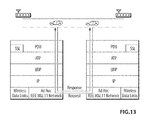
- FIG. 13 is a schematic view of a protocol stack for exchanging data using the network of FIG. 12 ;
- FIG. 14 is a schematic view of another network
- FIG. 15 is a time plot of beacon frame sequence
- FIG. 16 a is a schematic view of a portion of an adhoc network
- FIG. 16 b is a time plot of beacon frames issued by vehicles in network of FIG. 16 a;
- FIG. 17 is a schematic view of another adhoc network
- FIG. 18 is a schematic view of another protocol stack
- FIG. 19 is a schematic view of another protocol data unit
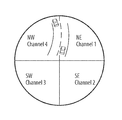
- FIG. 20 is a schematic view of a quadrant divided highway segment
- FIG. 21 is a schematic view of a data exchange during a driving manoeuvre.
- FIG. 22 is a schematic view of data exchange during another driving manoeuvre.
- Described herein below is a system and method which implements a peer-to-peer Internet-based protocol stack for vehicular diagnostic telemetry.
- This stack is intended to reside in on-board vehicular embedded systems and to enable remote PC workstations to interact with these systems using standard communications API's such as Winsock.
- ATP Automotive Telemetry Protocol
- CARB California Air Resources Board
- ECM's Engine Control Modules
- Session and Presentation layers are derived from the specifications for Simple Network Management Protocol (SNMP).
- SNMP Simple Network Management Protocol
- the underlying transport mechanism is a UDP/IP stack with the UDP header compressed in the interest of bandwidth efficiency.
- SSL Secure Socket Layer
- the protocol stack is applied to the exchange of operational data between vehicles on the road. This is based on the concept of an “ad-hoc network” established within a “neighborhood” surrounding any given vehicle.
- the ad-hoc network can co-exist with a data link to the Internet, using the same RF medium, provided that a roadside infrastructure is deployed.
- the potential of this technology to improve highway safety is illustrated with various examples of vehicle-to-vehicle exchange of operational information.
- the IEEE 802.11 specification is a relatively new standard for high-speed wireless Local Area Networks (LAN). It uses a method of RF transmission known as spread spectrum for which the 2.4 GHz range has been made available as an unlicensed band. This technology is also identified under the commercial banner Wi-Fi (Wireless Fidelity). Its potential for application in the area of ITS is based on its commercial potential.
- Wi-Fi products commercially available that make it possible to create network infrastructures supporting mobility for computer devices.
- Network interface cards (NIC's) are available enabling personal computers, including laptops and notebooks, to use Wi-Fi. As the popularity of Wi-Fi grows, it is expected that more mobile wireless appliances (e.g. PDA's, cell phones) will appear in the marketplace that exploit a growing infrastructure of access points through which users can connect to the Internet wirelessly at bit transfer rates that currently reach 11 Mbps.
- IEEE 802.11 One feature of IEEE 802.11 is the notion of ad hoc networking, which enables two or more devices to communicate directly with one another without requiring a fixed access point. In other words, the network infrastructure is not a necessary condition for connectivity between mobile devices. As a result, IEEE 802.11 can support concurrent vehicle-to-vehicle and vehicle-to-infrastructure communications in novel and unexpected ways. This combination of flexibility, from a technical perspective, and commercial appeal, is the essential rationale for using IEEE 802.11 in ITS.
- the method described in this document adheres to the principle of implementing fully-compliant 802.11 nodes, without modification of the specification, to meet the requirements of ad hoc networking for ITS.
- ATP Automotive Telemetry Protocol
- SNMP Session Management Protocol
- ATP is a session level protocol derived from SNMP that enables a bi-directional client-server relationship to be established between the two end points of the mobile communications [1].
- SNMP Session Management Protocol
- ATP allows a “client” vehicle to send an asynchronous notification to specified “server” vehicle requiring acknowledgement. This request-response mechanism has applications described later in this document.
- FIG. 1 illustrates the complete protocol stack that is required for OBD III, using the OSI (Open Systems Interconnect) reference model.
- OSI Open Systems Interconnect
- the protocol stack is intended to meet one or more of the following objectives:
- Mobile devices should be able to use packet cellular, RF packet networks, wireless LAN (Wi-Fi), satellite or any combination thereof.
- UDP User Datagram Protocol
- TCP Transmission Control Protocol
- the basic protocol data unit (PDU) of the Internet is called a datagram.
- the datagram header contains a field that is used to designate the protocol at the next level of the stack.
- the IANA 2 f values for UDP and TCP are, respectively, 17 and 6.
- the figures below show how the payload of different datagrams can be intended for UDP and TCP, depending on the value of the “protocol” field in the datagram header. 2 IANA (Internet Assigned Numbers Authority)
- the standard UDP header is eight (8) bytes in length, consisting of:
- the source and destination ports are IANA-approved numbers associated with processes executing within the sender's and the receiver's address spaces, respectively. There is currently no assigned number for the present automotive telemetry application.
- the present system uses the number 0x0A (integer 10) to specify the ATP port. 3 3 This number is, as yet, unassigned by IANA.
- the overhead of the UDP header would consume wireless bandwidth without providing any significant advantage to the protocol in terms of flexibility or reliability.
- Both the source and destination ports can be constrained to use the same number.
- the payload length can be derived from fields in the underlying network packet or data link frame in which the UDP segment is encapsulated.
- the checksum can be viewed as redundant, since the underlying data link protocol(s) should incorporate an integrity check of the data stream anyway. 4 4 If any of the data links traversed from source to destination do not incorporate integrity checks in the protocol, then the data integrity of ATP can be called into question. However, it is difficult to envision such a case.
- the UDP header is, in one embodiment, reduced to 1 byte in the implementation herein of the mobile communications protocol stack, which is illustrated in FIG. 4 .
- the value in this byte (0x0A or integer 10) identifies the ATP port at both the source and destination.
- ATP resides conceptually at the Session Layer. It is a request/response mechanism, similar to Simple Network Management Protocol (SNMP), which ensures that for every message from either a mobile unit to the base location or vice versa, there is always an acknowledgement. As such, exception reports from vehicles cannot be discarded by the mobile computing platform until the base system has confirmed that they have been logged to a “persistent storage” database.
- SNMP Simple Network Management Protocol
- ATP ATP based on Simple Network Management Protocol (SNMP) which enables remote diagnostics and configuration of communications devices and is the de-facto standard with which elements of the Internet infrastructure must comply.
- SNMP Simple Network Management Protocol
- FIGS. 5( a ) and ( b ) A comparison can be made between remote diagnostics of communications devices and mobile vehicles. This is illustrated graphically in FIGS. 5( a ) and ( b ) .
- the “managed entity” is typically a communication switching device such as a bridge or router.
- This managed entity implements an “agent”, which is a software module responsible for retrieving requested information and interacting with the remote “manager” through an interface to the communications protocol stack.
- FIG. 5( a ) shows that the top level of this stack is SNMP, which is essentially a combination of the Session and Presentation Layers.
- the information that a remote manager may request resides in the Management Information Base (MIB), which is a local repository for operational data collected by the device drivers controlling the hardware interfaces to the external world (“Communications Modules”).
- MIB Management Information Base
- a router with an Ethernet adapter maintains statistics reporting the number of inbound and outbound frames transiting the Ethernet interface. This information is cached in the MIB and is retrieved by the Agent on behalf of a remote Manager which has issued a request.
- the entity equivalent to the SNMP Manager is called a Monitor
- the managed entity is a vehicular on-board computing device interfaced to various data acquisition modules 5 .
- This is called the local data repository a Diagnostic Information Base (DIB).
- DIB Diagnostic Information Base
- the information cached in the DIB originates from various sources such as the ECU diagnostic port, analog and digital sensors, GPS receiver, and so on.
- the three examples shown in the figure are: 5
- the present version of such a device is called a Universal On-Board Diagnostic Server (U-OBD).
- U-OBD Universal On-Board Diagnostic Server
- the SNMP message consists of a header 6 and a Protocol Data Unit (PDU).
- the header contains two fields: 6 This describes the message header format of the initial version of SNMP.
- SNMPv3 specifies a more complex format. This will become useful as a reference point when security mechanism is specified for ATP.
- Managers belonging to a community are said to exist within the same administrative domain.
- a management agent receives an SNMP message from a manager containing a community name that it does not recognize, it does not participate in the SNMP operation.
- the rest of the SNMP message is the Protocol Data Unit (PDU).
- PDU Protocol Data Unit
- the document in reference [1] is the most recent RFC (Request for Comment) for the initial version of SNMP.
- the full complement of specifications for SNMP also includes a set of RFC's for SNMPv2, which extends the functionality of SNMP, and a set of RFC's for SNMPv3, which provides security features.
- the term “SNMP specifications” is used in this document to refer to the full complement of specifications provided in the RFC's published by the Internet Engineering Task Force (IETF).
- a manager uses a Get PDU to retrieve an item from an agent's MIB
- a Set PDU is used by a manager to set a value in an agent's MIB.
- An agent uses a Trap PDU to send asynchronous notifications or “alerts” to a manager. The manager does not acknowledge these notifications.
- An Inform PDU is similar to a Trap PDU. Any SNMP entity (either an agent or a manager communicating with another manager) may use an Inform PDU to send asynchronous notifications. In contrast to a Trap PDU, the receiving manager must acknowledge an Inform PDU.
- FIG. 6 illustrates the format for Get, Set and Response PDU's: 8
- the types of request PDU previously described are categories, within which several sub-types are defined by
- the receiver of a request PDU uses this in the response PDU so that the sender can match the response with a previously transmitted request. It also ensures that the receiver can filter out duplicate messages. This is particularly important in mobile wireless networking environments, where transient conditions render mobile nodes frequently “unreachable”, which causes the sender to attempt retries. In this kind of scenario, the probability of duplicate messages arriving at the destination is very high.
- a request PDU encapsulated in a datagram, is routed to a mobile agent through a gateway to a mobile network. It is then wrapped in a mobile network packet and routed to the mobile agent through a wireless link from the closest RF base station. Whereas the mobile agent may receive the airlink frame containing the packet, the RF base station may not “hear” the acknowledgement that is transmitted in response. After the requisite timeout period, the RF base reports back to the mobile network gateway that the mobile agent is “unreachable”. When this report is propagated back to the sender (ATP monitor), the message is re-transmitted.
- This field is used only in response PDU's. It indicates one of a number of errors and error types.
- This field is used only in response PDU's. It associates the error (if applicable) with one of the “variable bindings” encapsulated in the remainder of the PDU.
- Each variable binding is an association of a particular instance of a managed object, which is part of the MIB, with its current value (with the exception of Get request PDU's, for which the value is ignored).
- the Object Identifier (OID) field identifies the object instance.
- the value of the variable is encoded according to the triple TLV (type, length, value), where type specifies the data type, length is the number of bytes in which the value is represented in the subsequent stream and value contains the value in length byte.
- TLV type, length, value
- ASN.1 is an ISO-specified language that is often used to define data exchange protocols at the presentation and applications layers of the OSI model. Its abstract quality enables it to be independent of the different data representation techniques that can be encountered on different computing platforms. Of course, the more abstract the syntax for expressing data structure, the more overhead is required when these structures are serialized in a data stream over a communications network. For this reason, SNMP uses only a subset of ASN.1 (specifically a subset of the BER) in order to restrict the overhead associated with the encoding scheme and therefore preserving bandwidth on the Internet. [2], [3]
- the lengths of all fields in the PDU's, including the OID and value fields in the variable bindings (excluding character strings), are implicit; i.e. they are not explicitly encoded in the data stream as specified by ASN.1.
- the lengths of all the header fields are restricted to one byte.
- the length of OID fields is two bytes and the lengths of the variable binding values are dependent on the value type, which is encoded in one byte.
- the SNMP PDU's are applicable to the protocol requirements of ATP.
- Get PDU's are needed when an ATP Monitor wants to retrieve the current values for a specific set of managed objects from a vehicle.
- An example is illustrated in the FIG. 8 .
- a vehicle owner could obtain, from a fixed-location workstation, the vehicle's GPS location, engine speed, road speed and engine temperature. Both the request for all of this data and the response from the vehicle containing all the requested values would be encapsulated within a single ATP message and a unfragmented network packet.
- the Trap PDU can be used to send event reports from the vehicle for which acknowledgements are not required.
- a typical example would be a recurring GPS position report.
- Application software in the on-board device 9 could generate a 9
- the SNMP specifications for agent software architecture call this the Notification Originator Application.
- the peer software in the manager entity is called the Notification Receiver Application.
- the Inform PDU which requires acknowledgements, is the mechanism that is used more commonly in ATP to send a synchronous event report from the vehicle. These events can correspond to:
- the on-board monitoring agent Since an acknowledgement is required for this PDU, the on-board monitoring agent has a means of determining whether the event report has been logged in a database. 10 It is the responsibility of the Notification Receiver Application to ensure that these reports are committed to a database before the acknowledgement PDU is returned to the agent.
- the Set PDU is used to remotely change the operating parameters of the on-board device. This could be, for instance, the threshold level at which a regulatory exception occurs or the interval of unsolicited GPS position reports (for a tracking application with Trap PDU's).
- the MIB to which SNMP provides access is a collection of managed objects which are organized hierarchically, as shown in FIG. 9 .
- a managed object 11 is one of any number of specific characteristics of a managed device. Managed objects are comprised of one or more object instances, which are essentially variables. 11
- MIB object, object, or simply MIB are used interchangeably with the term managed object.
- FIG. 9 illustrates the MIB hierarchy as a tree, the levels of which are assigned by different organizations.
- An object identifier (OID) uniquely identifies a managed object in this hierarchy.
- the top-level OID's belong to different standards organizations, while lower-level OID's are allocated by associated organizations.
- the OID is formed from the sequence of numbers corresponding to the nodes through which a managed object can be reached from the root of the tree. For example, the sequence:
- MIB-2 object which is the MIB for entities that comply with the specifications of the TCP/IP protocol stack.
- the full object name is:
- this MIB is maintained on a remote router with interfaces to several networks.
- the objects representing these interfaces are maintained in a table, each of whose entries is a collection of variables associated with network interfaces.
- an SNMP manager wanted to retrieve the number of octets received (since the last start-up) on the first network interface.
- the OID identifying this object would be: 3 6 1 2 1 2 1 10 and the object name would be iso.identified-organization.dod.internet.mgmt.mib-2.interfaces.iftable.ifentry-1.ifoctets
- DIB sub-tree should branch out from the Internet node or whether an SAE sub-tree should branch out from the Identified Organization. It is evident that these two options would appear as shown in FIG. 10 .
- the illustration makes the root of the new sub-tree should be the DIB node.
- ATP is a (proposed) protocol which operates at the same level as SNMP within the Internet suite of protocols, it is also clear that the DIB should exist with the sub-tree starting at the Internet node.
- the OID's in the variable binding of ATP PDU's are encoded in a fixed length of two bytes. This means that the entire parent hierarchy of the object is not included to which the OID refers.
- the agent should have the authority to accept or reject requests from the monitor, based on the nature of the request and the identity of the monitor. For instance, a request from a remote monitor to report the current GPS location may be considered an invasion of privacy if it originates from a location not controlled by the vehicle owner. Similarly, a request for OBD information (SAE J-1979) could also be rejected, unless it originates from the monitor(s) authorized according to the User Configuration.
- SAE J-1979 OBD information
- SSL Secure Socket Layer
- SSL operates on top of TCP/IP, which constitutes the underlying transport mechanism for Web traffic.
- ATP uses the UDP/IP stack.
- the lower edge of the SSL record layer must therefore be adapted to interface to the UDP transport mechanism.
- FIG. 11 shows the security mechanism of SSL introduced between the ATP layer and the presentation layer, where the Protocol Data Unit (PDU) is parsed into individual requests for specific sources of data.
- the security layer acts as an effective “firewall” against unauthorized intruders. It authenticates the remote monitor and maintains privacy for the contents of the subsequent PDU's that are exchanged across the session.
- the interface between the SSL handshaking protocol and the presentation layer should provide a mechanism for SSL to precede the announcement of a received PDU with an identification of an authenticated monitor requesting information.
- the Monitor's presentation layer notifies its security layer that it wants to issue a request to the Mobile Agent.
- the SSL handshake layer asks the SSL Record Layer to encapsulate the requisite handshake message.
- the SSL Record Layer sends an asymmetrically encrypted message (public key cryptography) to the other side.
- the SSL Record Layer delivers a decrypted message to the SSL Handshake layer.
- Steps 2-4 are repeated in both directions until the authentication of the client has been established.
- SSL reports its identity to the presentation layer, so that subsequent requests for information can be accepted or rejected according to the User Configuration.
- the security layer on the Monitor side reports to the presentation layer that the authentication has been confirmed.
- the Monitor's presentation layer sends the PDU to the security layer for session privacy encryption.
- the encryption is carried out with a symmetrical one-time key exchanged between the parties during the SSL handshaking (and which ensures the privacy of the exchange).
- the encrypted PDU is “transmitted” to the Mobile Agent. In other words, it is passed on down through the Session Layer of the Monitor's protocol stack.
- the response from the Presentation Layer is sent to the SSL Record Layer. This response may be:
- the SSL Record Layer encrypts the response with the symmetrical session key and transmits back to the Monitor (i.e. through the protocol stack starting with the Mobile Agent's Session Layer.
- the Monitor's SSL Record Layer decrypts the PDU and hands it off to the Presentation Layer.
- the Monitor represents an emissions control regulatory agency and that a Mobile Agent receives a request every year from this Monitor to report all non-compliance events.
- the Mobile Agent may respond with a positive acknowledgement at the presentation layer, i.e. an acceptance of the request.
- all exception conditions will cause the Mobile Agent to initiate communications to report these conditions.
- the request will therefore emanate from the Mobile Agent whereas the response from the Monitor will indicate that the exception report has been noted and logged to permanent storage.
- the U-OBD can be configured to keep these exception reports in Flash memory until an acknowledgement is received from the Monitor. This ensures that exceptions that occur while the vehicle is not within coverage range are not “forgotten”).
- OBD-III is an example of telemetry consisting of a mobile server and a fixed-location client. Also envisioned is the case of a client-server relationship between two mobile vehicles. A data link between two vehicles can be established using the ad-hoc networking capability of the IEEE 802.11 specification for wireless LAN. Ad-hoc networks in wireless LAN's are created without a central coordinating node, called an access point. FIG. 12 illustrates the distinction between an ad-hoc wireless LAN and one with an access point.
- the access point provides the vehicle with connectivity to a Wide Area Network (i.e. the Internet) but is not required for an ad hoc network.
- the ad hoc network enables vehicles to establish logical links with their neighbors, which can be used to exchange critical operational information between vehicles.
- Ad hoc networks can be created using a scheme embodied herein that permits each vehicle to maintain a real-time image of its “neighborhood”. This neighborhood can include vehicles up to five hundred yards in both the forward and rear directions. The image maintained within each vehicle changes dynamically with changes in the surrounding conditions.
- the ATP protocol stack can be used for vehicle-to-vehicle messaging in almost the same manner as it is used to interact with remote diagnostic clients. The difference is that security restrictions cannot apply in this case since all vehicles must necessarily and freely exchange information. This is illustrated in FIG. 13 .
- Cluster intelligence On the road.
- a cluster is the aggregation of vehicles within a neighborhood. Since the neighborhood of any vehicle constitutes a fluid network topology surrounding it, the membership of the associated cluster is dynamic.
- the exchange (or the broadcasting) of information within a cluster has value in terms of both road safety as well as traffic management aimed at reducing congestion. In some respects, there is an artificial distinction between these areas. Better traffic management should result in better safety and vice versa. The descriptions of the following application areas do not distinguish between these two purposes.
- Vehicle on-board systems such as cruise control or cockpit electronic information systems can benefit from a variety of inputs, including forward collision avoidance radar as well as vehicle-to-vehicle information exchange facilitated by ATP with ad hoc networking.
- Ad hoc networking is therefore seen as providing a supplementary set of inputs/services to control/information systems.
- these inputs/services may be complementary to one another whereas in other instances they would overlap.
- radar can complement ad hoc networking by providing neighbor information for immediate adjacent vehicles.
- this functionality overlaps that of radar. This provides a degree of redundancy that can only be beneficial to the objective of enhanced safety, particularly since the marginal cost of providing services based on IEEE 802.11 is insignificant 13 . 13 Assuming that the vehicle is IEEE 802.11-enabled for Wide Area Networking purposes.
- ATP operates in an open Internet environment that enables client-server relationships between on-board diagnostic “agents” and “monitors” located anywhere in the network.
- the SSL protocol is layered above this to provide security.
- the same protocol architecture, minus the security, can be layered on top of IEEE 802.11-based ad hoc networks for application in intelligent transport systems (ITS).
- ITS intelligent transport systems
- FIG. 14 depicts two data links connected via a bridge.
- the data link on the right is defined by the IEEE 802.3 (Ethernet) specification, which is commonly used for wired Local Area Networks (LAN).
- the data link on the left is specified by IEEE 802.11 which is wireless LAN.
- A, B and C are neighbours on the wireless LAN, whereas D, E, F and G are neighbours on the wired LAN.
- the neighbourhoods of both the wireless and wired LAN's are defined by topological relationships between the nodes, not by physical distance. If two nodes share the same medium and the quality of the signals between them is acceptable (in terms of error levels), then they are topologically in the same neighbourhood or adjacent.
- an additional geographic criterion can be added, if desired, to the determination of adjacency.
- each node can filter out other nodes which are outside of a specified geographical threshold and therefore not relevant to the operation of the vehicle.
- An ITS Wi-Fi neighbourhood is a collection of surrounding IEEE 802.11 nodes, sharing a common physical medium (i.e. a specified direct sequence spread spectrum channel) as well as the timing parameters for medium access control, and within a relative geographic position that is significant to the safe operation of a vehicle on any type of public roadway.
- a common physical medium i.e. a specified direct sequence spread spectrum channel
- the IEEE 802.11 specification defines timing parameters that are used in conjunction with a timing synchronization function to coordinate access to the medium; i.e. to minimize contention for the channel and to reduce the possibility of collisions.
- Nodes cannot use the medium to transport data until they have received the appropriate “registration” frames from nodes that are already part of the network. Registration frames contain the information needed to correctly operate on the medium, including a time stamp allowing the new entry to synchronize with the existing nodes.
- CSMA/CA Carrier Sense Multiple Access with Collision Avoidance
- 802.3 the method used in 802.11, the method used to coordinate access to the medium is called Carrier Sense Multiple Access with Collision Avoidance (CSMA/CA) which is similar to the method used in 802.3 (Ethernet). It is based on the idea of “sniffing” the channel for a carrier prior to transmission. If the medium is busy, the node with data to send enters a randomly-computed waiting period before retrying, which minimizes the likelihood of simultaneous retries by multiple nodes waiting for the channel (and the resulting “gridlock” that this would create).
- CSMA/CA Carrier Sense Multiple Access with Collision Avoidance
- the 802.11 specification calls this a distributed coordination function (DCF). It also defines a contention-free mechanism which is called point coordination function (PCF). Whereas DCF is the default mode of operation, PCF has been made available to handle special scenarios, as in the case of time-critical traffic such as audio and video. Typically PCF is provided through a fixed access point, which, in the case of ITS, would take the form of a roadside base station.
- DCF distributed coordination function
- PCF point coordination function
- PCF point coordination function
- Vehicles wishing to have access to the Internet will register with roadside access points using the channel(s) allocated for this application 14 .
- the performance criteria for streaming audio and video, or for VoIP (Voice Over IP), may require the PCF method of channel management.
- the ad hoc network of vehicles sharing the same neighbourhood will use DCF to manage its channel(s). Since DCF does not rely on the presence of a “master” station to coordinate access to the medium, the ad hoc network does not require a roadside infrastructure in order to function properly. 14 See the section entitled Wi-Fi Channel Selection for a discussion of the distribution of channels between ITS and Internet functions.
- base stations may still be required for a variety of ancillary ITS functions, including differential GPS beacons, geographic orientation with respect to the highway system 15 , electronic toll collection, electronic road signage and travel information. 15 See Wi-Fi Channel Selection.
- the registration mechanism itself can be operated in either a passive or an active mode. Both of these methods are described below.
- a candidate node listens for a beacon frame from an existing node.
- all existing nodes transmit beacon frames periodically, allowing nodes entering the network to synchronize with the existing nodes for channel management.
- a beacon frame signals the start of a contention-free period, during which all other nodes in the neighbourhood defer transmissions so that new nodes wishing to announce their presence can do so.
- Both the interval between beacon frames and the subsequent contention-free period are configurable parameters that are typically set in the ranges of 1-2 seconds, and 100 ms-0.5 seconds, respectively. However, as will be seen in the next section, there may be several hundred vehicles in the same neighbourhood, particularly in congested highway conditions, which would render these settings impossible.
- FIG. 15 illustrates that if every one of 100 vehicles were to transmit beacon frames at intervals of 10 seconds, each announcing the start of a 100 ms contention-free period, there would be no time left during the 10 second period to transmit any user data.
- the complete solution lies in the fact that the ITS ad hoc network nodes do not need to negotiate any of the logical management functions of association and authentication, specified in the medium access control (MAC) layer of 802.11.
- Association is the mechanism whereby one node requests explicit recognition from another node.
- requests are sent to an access point, which stores the address of the requesting node in a local table and sends a response frame.
- the address table maintained by the access point controls whether packets destined for specific addresses are actually transmitted. If no association has been established for an address, no user data will be sent to it.
- Authentication is the process whereby the requesting node is granted permission to communicate using a symmetrical encryption key.
- authentication is not only not required, it is anti-thetical to the concept of vehicle platooning or “cluster intelligence” because all parties must necessarily and freely exchange information without restriction.
- the active registration method enables the candidate node to send probe frames, which are essentially “ping” requests for some other node to respond.
- probe frames In the ad hoc network topology, probes must be broadcast to all listeners, as there is no single node that can be relied upon to always be present (i.e. fixed access point).
- the IEEE 802.11 rule is that the response to a probe is sent by the node which transmitted the most recent beacon frame.
- the facility of active registration enables us to minimize the use of bandwidth by the transmission of beacon frames.
- the interval between beacon frames is configured to 60 seconds.
- a contention-free period of only 1 ms after each beacon frame a platoon of 5 vehicles would use roughly 0.01% of the available time for beacon frame broadcasts, and a platoon of 500 vehicles would use only 1%.
- FIGS. 16 a and 16 b The scenario with 5 vehicles is shown in FIGS. 16 a and 16 b .
- the average time between beacon frames is 12 seconds.
- Each vehicle in the platoon is numbered according to its sequence position for transmitting beacon frames.
- Vehicle 6 entering on the access ramp, begins transmitting probe request frames after vehicle 4 transmits its beacon frame, in order to discover a new ad hoc network 16 .
- Vehicle 4 responds almost immediately with a probe response 17 .
- the new vehicle entering the expressway must know when to try to switch to a new ad hoc network.
- Wi-Fi Channel Selection specific channels are allocated to vehicular flows on divided highways based on heading. We assume that vehicles are not equipped with accurate digital maps and therefore not able to use GPS to determine whether they are entering divided highways.
- the neighbor discovery mechanism is comparable to the concept of neighbor discovery protocols used for routing data traffic in network environments with dynamic topologies.
- the method is based on unsolicited neighbor advertisements that incorporate, as explained previously, a geographic component. These are periodic messages that each node broadcasts containing its GPS information, including latitude, longitude, speed and heading 18 . 18 Elevation may also be required. This would enable receiving vehicles to distinguish vehicles on elevated expressways from those at grade level.
- the neighbour advertisements are used by each node in the ad hoc network to establish an “image”, in memory, of the current configuration of the neighbourhood.
- FIG. 17 illustrates this concept, showing the neighbourhood image formed by the second vehicle in the passing lane.
- the time interval between broadcasts must be frequent enough to maintain a picture of the neighbourhood that is accurate in terms of the relative position of each neighbour.
- the accuracy of GPS reports in terms of the relative location of two nodes in geographic proximity to one another, is much higher than the accuracy of absolute GPS reports, since the error inherent in the processing of the satellite signals should affect all nodes equally. Therefore, the relative position of each node with respect to the other should, theoretically, contain essentially no error, enabling vehicles to judge the distances between them with a level of precision that is effective for the tasks of collision avoidance and platooning. For instance, the position of a vehicle travelling at 70 mph changes by more than 100 ft/sec. This would suggest a requirement for several updates per second in order to maintain accuracy. However, the frequency of updates is constrained by the amount of data traffic that is generated during the discovery cycle, in order to avoid channel contention. This, in turn, is a function of the number of vehicles that are within RF range, i.e. the neighborhood population.
- the neighbourhood population is a function of the average speed of the surrounding vehicles. The greater the speed, the smaller the neighbourhood population; therefore the smaller the amount of data traffic in the discovery cycle which allows for a greater frequency of updates.
- the safe stopping distance is roughly 200 feet. Assuming all vehicles respect the recommended stopping distance 19 , a maximum RF range of 3000 ft 20 and a maximum of four lanes in the same direction 21 , the surrounding neighbourhood can contain a maximum of 60 vehicles. 19 This is, of course, one of the ultimate objectives of this technology. 20 Based on a maximum range of 0.5 kilometers for each transmitter, each node can hear transmissions within this radius. The “width” of the neighborhood is therefore 1 kilometer or approximately 3000 ft. 21 Vehicles travelling in the opposite direction or in adjacent “collector” or “express” streams, do not transmit discovery frames on the same channel. See Wi-Fi Channel Selection.
- PLCP Physical Layer Convergence Procedure
- the data rate of the spread spectrum channel should be able to support several discovery cycles within an interval of one second, even allowing for some degradation of throughput due to channel contention with such a relatively large number of nodes. 22 For Reasons explained in Channel Selection, the data rate of channels using ad hoc networking would more likely be 2 Mbps, which is still expected to be sufficient for several discovery cycles per second.
- the event queue of the “cluster intelligence” process should include a periodic timer that drives an update of the position of all vehicles in the neighbourhood, based on the speed and heading reported in their last broadcasts.
- Each node can limit the population of its neighbourhood such that only those neighbours that are close enough to have a potential impact on the safe operation of the vehicle are included. By filtering out node beyond this boundary, the size of the collections of neighbour “objects” in memory are restricted and the amount of processing necessary to periodically update any state variables belonging to these objects are limited.
- the GPS discovery message can be compressed into 8 bytes. This is accomplished by incorporating only the least significant 2 bytes of both the latitude and longitude 23 . These 2 bytes represent the fractional part of the minutes portion of the reading. This is sufficient since one minute of latitude or longitude is greater than one mile, which is well beyond the maximum RF range of 0.5 kilometers. Therefore, a receiving node can easily reconstruct the GPS position of the transmitting node by substituting the degrees and minutes of its own GPS position for both latitude and longitude. It must also increment or decrement these values where appropriate near measurement boundaries.
- the minutes value substituted should be 57 instead of 56. 23
- the size of this message increases to 10 bytes if elevation is included.
- FIG. 19 illustrates the format of the complete GPS discovery message.
- the speed is an integer value from 0 to 255 (one byte) and the heading is from 0-360 (9 bits) with 7 bits of fractional degrees.
- the leading byte indicates, in the most significant bits, the channel to be used by the sender for broadcast on the next discovery cycle. This is explained in the following section. The other bits of the leading byte are reserved for future use.
- Wi-Fi Channel Selection 24 24 This section describes the use of the channels available under the specification for the unlicensed 2.4 GHz band. This specification is entitled IEEE 802.11(b). The use of the IEEE 802.11 MAC with other frequency bands, such as the 5.9 GHz band allocated by the FCC for intelligent highways, may prescribe different modulation and channelization techniques such that the number of channels available may be different. However, the notion of allocating the channels available to various IVHS functions would not change.
- the 802.11 specification for mobile applications calls for at least 3 channels of direct sequence spreading (DSS) which can operate concurrently without interference.
- DSS direct sequence spreading
- more channels can be obtained at lower data rates. For instance, by allocating a single 11 Mbps channel for high speed internet access, a larger number of at least six 2 Mbps channels can be obtained from the remaining bandwidth.
- This allows mobile nodes to separate ad hoc networking data traffic from infrastructure-based data traffic that uses roadside access points. Since there is no need for communications between vehicles on opposite sides of a median, it suffices for each node to monitor the channel used to broadcast discovery messages by all other nodes travelling in the same direction.
- the channel selection for discovery broadcasts can be determined on the basis of heading.
- a simple scheme would be to allocate 4 of the 10 channels for ad hoc networking and to divide the compass into four quadrants 25 .
- FIG. 20 shows, this would not handle the case where a slight curvature of the roadway would result in a following vehicle listening to a channel on which the leading vehicle is no longer transmitting. This can be resolved by flagging the discovery message in a way that indicates to neighbours on what channel the next message will be transmitted.
- An additional channel should be allocated for use by all vehicles on non-divided highways and city streets.
- a vehicle when a vehicle detects that its heading has shifted into a different quadrant, it should not immediately begin transmitting on the corresponding channel. The next message is transmitted on the current channel but all listeners are advised of the channel that will be used on the subsequent message 26 . Only the following vehicle should switch to monitoring the new channel. It should also switch if it detects the heading change before it receives the change of channel flag from the vehicle ahead. 26 Note also that the subsequent message cannot be transmitted until registration on the new channel has taken place using probe frames.
- This vehicle enters a transitional phase where it may monitor a different channel than the one on which it transmits. During this period, the next following vehicle will receive messages only from neighbours transmitting on the “old” channel (i.e. prior to the curvature in the road). It will not receive any Discovery messages. More importantly, it will not receive any asynchronous event reports from several vehicles ahead in the platoon. In order to compensate for this, it needs to continuously scan both the “old” and the “new” channels until it receives a “next channel” flag from the vehicle ahead of it.
- the neighbourhood changes when there is a change in the shared medium.
- An example of such a change has already been described, when the roadway heading shifts to a new compass quadrant and there is a staged transition of the platoon to a new Wi-Fi channel.
- the answer is provided by the mechanism for active network registration using probe frames.
- a vehicle detects that it has no one ahead of it, it must begin to probe whichever of the four channels allocated to the quadrants of the compass in which the vehicle's current heading falls. Until it receives a response from some node on the new channel, it should continue to monitor the existing channel used for undivided highways and city roads. One of two possibilities will occur.
- nodes may provide streams of information that would be costly, in terms of bandwidth, to broadcast in an unsolicited fashion. Instead, these nodes can advertise the availability of such services by periodically broadcasting a message notifying all listeners that the service is available upon request. Examples of this would be a digital video camera mounted on board a vehicle or on a traffic signalization light.
- All nodes participating in an ad hoc ITS network are required to inform their neighbours of any operational events that may be significant to a neighbouring vehicle, such as acceleration, brake application, turn or lane change, etc. These events should be reported as asynchronous notifications sent to the broadcast address. In other words, any neighbour that is listening should receive a real-time notification of the event.
- application of the foot brake would be reported not only to the following vehicle behind but to every other vehicle in the following platoon.
- the reaction time to a brake light (if it is working) is typically in the range of 0.5 seconds. Therefore, if the vehicle at the head of a platoon of seven vehicles applies the foot brake, the vehicle at the end of the platoon could receive notification as much as 3 seconds before seeing the brake lights of the vehicle in front of it.
- n is a configurable parameter of the IEEE 802.11 MIB (Management Information Base). Repetition of event notifications will ensure that following neighbours required to listen to more than one channel (during the transition phase described in Wi_Fi Channel Selection) will have an opportunity to hear the message.
- MIB Management Information Base
- the ad hoc network provides the means for vehicle-to-vehicle notification of intention with respect to driving maneouvres.
- a class of such notifications can be specified that require explicit acknowledgements from the receiver of the notification. (Acknowledged Connectionless Service of the LLC layer) These correspond to Set commands that can be issued through the use of an ATP client service. By acknowledging these notifications, the receiver informs the sender that it is “aware” of the sender's intentions. The state of knowledge of both parties can then become inputs to their respective control or cockpit electronic information systems.
- FIG. 21 demonstrates an example of a driving maneouvre that can be assisted by ad hoc networking.
- the speed of vehicle A in the passing lane is greater than that of vehicle B in the slow lane.
- A can determine how much time remains before it passes B, using its own speed and the neighborhood position of B. When the remaining time equals the time interval required for advance notification ( ⁇ ), A sends a unicast frame to B containing a notification of intention to pass on the left. If B responds with an acknowledgement, A is therefore able to provide the appropriate control or driver information system with a confirmation that the vehicle to be passed is “aware” of the intentions.
- the intention to change lanes can be announced and acknowledged in a manner similar to the intention to pass.
- the vehicle preparing to change lanes issues its notification to the closest following vehicle in the lane to which it intends to change. Again, both parties are aware and prepared for the manoeuvre.
- an intelligent traffic light could, for example:
- highway information systems electronic signage, automated toll collection, etc
- vehicles could monitor these infrastructure channels as initiated and terminated by driver input functions.
- One embodiment of the method described is differentiated from the prior art in terms of what it does not incorporate, in contrast to what it does incorporate.
- a packet fails to traverse a segment of the path to an Internet destination, it is the responsibility of the last router, prior to the failed segment, to report the error back to the source (as specified in Internet Engineering Task Force RFC 792).
- RFC 792 Internet Engineering Task Force
- the use of ICMP, as foreseen in RFC 792, is all the more important for wireless extensions to the Internet in that failures to reach mobile nodes are expected to be a common occurrence, in contrast to the wired portion of the Internet, where failures indicate an unanticipated problem. Therefore the system described in the disclosure complies with RFC 792.
- the router i.e. the Hybrid Gateway
- the router returns an ICMP “Unreachable” error to the source. It is the responsibility of the source host to attempt re-transmissions of the IP datagram. In the interim, the Hybrid Gateway will have raised the impedance along the wireless data link used on the first attempt. Therefore, when the re-transmitted datagram arrives from the source host, the routing function will take into account the increased impedance and forward the datagram along a less expensive path.
- This embodiment enables the system to “scale” to a level where the data traffic for large numbers of mobile nodes (10,000-100,000 or greater) can be effectively supported by the Hybrid Gateway, without having to allocate memory and system resources (e.g. timers) to keep track of failed packets and re-transmission attempts.
- An analogy can be drawn between this scenario and a letter that is mailed to an incorrect address. Suppose the addressee no longer lives at that location. The Post Office can not take the responsibility of trying to find the addressee and to deliver the letter, because this would be too costly. The letter is simply returned to the sender.
- the disclosure describes a similar methodology, which adheres to IETF principles and minimizes cost, whereas the prior art implies that the entity responsible for routing has unlimited resources with which to assume responsibility for delivering failed packets.
Landscapes
- Engineering & Computer Science (AREA)
- Computer Networks & Wireless Communication (AREA)
- Signal Processing (AREA)
- Physics & Mathematics (AREA)
- General Physics & Mathematics (AREA)
- Computer Security & Cryptography (AREA)
- Computing Systems (AREA)
- General Engineering & Computer Science (AREA)
- Computer Hardware Design (AREA)
- Atmospheric Sciences (AREA)
- Life Sciences & Earth Sciences (AREA)
- General Health & Medical Sciences (AREA)
- Medical Informatics (AREA)
- Health & Medical Sciences (AREA)
- Multimedia (AREA)
- Analytical Chemistry (AREA)
- Chemical & Material Sciences (AREA)
- Emergency Management (AREA)
- Business, Economics & Management (AREA)
- Mobile Radio Communication Systems (AREA)
- Small-Scale Networks (AREA)
- Telephonic Communication Services (AREA)
- Selective Calling Equipment (AREA)
- Communication Control (AREA)
- Arrangements For Transmission Of Measured Signals (AREA)
- Diaphragms For Electromechanical Transducers (AREA)
- Traffic Control Systems (AREA)
Priority Applications (2)
| Application Number | Priority Date | Filing Date | Title |
|---|---|---|---|
| US14/014,851 US9633562B2 (en) | 2000-10-13 | 2013-08-30 | Automotive telemetry protocol |
| US15/495,518 US9922557B2 (en) | 2000-10-13 | 2017-04-24 | Automotive telemetry protocol |
Applications Claiming Priority (9)
| Application Number | Priority Date | Filing Date | Title |
|---|---|---|---|
| US23992000P | 2000-10-13 | 2000-10-13 | |
| US25288500P | 2000-11-27 | 2000-11-27 | |
| US25589600P | 2000-12-18 | 2000-12-18 | |
| PCT/CA2001/001420 WO2002031793A2 (fr) | 2000-10-13 | 2001-10-15 | Protocole de telemesure pour vehicules |
| US10/014,889 US20020150050A1 (en) | 1999-06-17 | 2001-12-14 | Automotive telemetry protocol |
| US11/616,203 US7593999B2 (en) | 1997-08-26 | 2006-12-26 | Automotive telemetry protocol |
| US12/535,502 US20100030423A1 (en) | 1999-06-17 | 2009-08-04 | Automotive telemetry protocol |
| US13/022,101 US8560609B2 (en) | 1997-08-26 | 2011-02-07 | Automotive telemetry protocol |
| US14/014,851 US9633562B2 (en) | 2000-10-13 | 2013-08-30 | Automotive telemetry protocol |
Related Parent Applications (1)
| Application Number | Title | Priority Date | Filing Date |
|---|---|---|---|
| US13/022,101 Continuation US8560609B2 (en) | 1997-08-26 | 2011-02-07 | Automotive telemetry protocol |
Related Child Applications (1)
| Application Number | Title | Priority Date | Filing Date |
|---|---|---|---|
| US15/495,518 Continuation US9922557B2 (en) | 2000-10-13 | 2017-04-24 | Automotive telemetry protocol |
Publications (2)
| Publication Number | Publication Date |
|---|---|
| US20130342368A1 US20130342368A1 (en) | 2013-12-26 |
| US9633562B2 true US9633562B2 (en) | 2017-04-25 |
Family
ID=27399290
Family Applications (2)
| Application Number | Title | Priority Date | Filing Date |
|---|---|---|---|
| US14/014,851 Expired - Fee Related US9633562B2 (en) | 2000-10-13 | 2013-08-30 | Automotive telemetry protocol |
| US15/495,518 Expired - Fee Related US9922557B2 (en) | 2000-10-13 | 2017-04-24 | Automotive telemetry protocol |
Family Applications After (1)
| Application Number | Title | Priority Date | Filing Date |
|---|---|---|---|
| US15/495,518 Expired - Fee Related US9922557B2 (en) | 2000-10-13 | 2017-04-24 | Automotive telemetry protocol |
Country Status (8)
| Country | Link |
|---|---|
| US (2) | US9633562B2 (fr) |
| EP (1) | EP1327233A2 (fr) |
| JP (1) | JP2004511188A (fr) |
| KR (1) | KR20030070010A (fr) |
| CN (1) | CN1218537C (fr) |
| AU (1) | AU2001295325A1 (fr) |
| CA (1) | CA2425985C (fr) |
| WO (1) | WO2002031793A2 (fr) |
Cited By (9)
| Publication number | Priority date | Publication date | Assignee | Title |
|---|---|---|---|---|
| US20170221357A1 (en) * | 2000-10-13 | 2017-08-03 | Paxgrid Telemetric Systems, Inc. | Automotive telemetry protocol |
| US10118576B2 (en) | 2002-06-11 | 2018-11-06 | Intelligent Technologies International, Inc. | Shipping container information recordation techniques |
| US10187767B2 (en) | 2016-07-01 | 2019-01-22 | Paxgrid Cdn Inc. | System for authenticating and authorizing access to and accounting for wireless access vehicular environment consumption by client devices |
| US20190165996A1 (en) * | 2017-11-27 | 2019-05-30 | Dspace Digital Signal Processing And Control Engineering Gmbh | Method for operating a real -time-capable simulation network having multiple network nodes for computing a simulation model, also computer program product relating thereto, and computer-readable storage medium |
| US20200068527A1 (en) * | 2018-08-24 | 2020-02-27 | Boe Technology Group Co., Ltd. | Method and system for allocating channel |
| US10630723B1 (en) | 2015-12-03 | 2020-04-21 | United Services Automobile Association (Usaa) | Determining policy characteristics based on route similarity |
| USRE48747E1 (en) * | 2012-09-28 | 2021-09-21 | Panasonic Intellectual Property Management Co., Ltd. | Notification device and vehicle using same |
| US11410555B2 (en) * | 2017-12-22 | 2022-08-09 | Orange | Method for monitoring the area surrounding a first element located on a circulation route, and associated system |
| WO2022216942A1 (fr) | 2021-04-07 | 2022-10-13 | Dana-Farber Cancer Institute, Inc. | Compositions et procédés pour le traitement du cancer |
Families Citing this family (85)
| Publication number | Priority date | Publication date | Assignee | Title |
|---|---|---|---|---|
| AU2003253585A1 (en) * | 2002-03-14 | 2003-11-11 | Eices Research, Inc. | A cooperative vehicular identification system |
| USRE49644E1 (en) | 2002-03-14 | 2023-09-05 | Odyssey Wireless, Inc. | Systems and/or methods of data acquisition from a transceiver |
| JP4125173B2 (ja) | 2003-04-23 | 2008-07-30 | キヤノン株式会社 | 情報処理装置の接続制御方法、情報処理装置、及びコンピュータプログラム |
| JP4136771B2 (ja) | 2003-04-23 | 2008-08-20 | キヤノン株式会社 | 通信システム、通信装置、及びその制御方法、並びにコンピュータプログラム |
| KR100520157B1 (ko) | 2003-06-18 | 2005-10-10 | 삼성전자주식회사 | 임시 무선 네트워크를 이용한 교통정보 시스템 및 방법 |
| FR2860895B1 (fr) * | 2003-10-14 | 2006-05-12 | Johnson Controls Tech Co | Systeme de diagnostic predictif des dysfonctionnements d'un vehicule automobile et son dispositif de diagnostic embarque |
| US20050097201A1 (en) * | 2003-10-30 | 2005-05-05 | Alcatel | Method and apparatus for securing network management communications |
| GB0411319D0 (en) * | 2004-05-21 | 2004-06-23 | Koninkl Philips Electronics Nv | A wireless system |
| JP4259456B2 (ja) * | 2004-11-11 | 2009-04-30 | トヨタ自動車株式会社 | データ記録装置及びデータ記録方法 |
| KR100692726B1 (ko) * | 2005-11-10 | 2007-03-09 | 현대자동차주식회사 | 텔레매틱스 시스템 장애 감지 장치 및 방법 |
| US8676958B1 (en) * | 2006-02-10 | 2014-03-18 | Open Invention Network, Llc | System and method for monitoring the status of multiple servers on a network |
| DE102006009098A1 (de) * | 2006-02-28 | 2007-08-30 | Daimlerchrysler Ag | Kraftfahrzeugdiagnose und Fahrzeugannahme |
| CN101141782B (zh) * | 2006-09-07 | 2012-08-29 | 日电(中国)有限公司 | 接入点辅助快速越区切换方法、设备和系统 |
| KR100808445B1 (ko) * | 2006-09-15 | 2008-02-29 | 한국전력공사 | 전력량계 원격 검침 및 관리 시스템 |
| US9331928B2 (en) * | 2006-10-16 | 2016-05-03 | Qualcomm Incorporated | Diagnostic agent in device that retrieves key performance indicators |
| JP4886463B2 (ja) | 2006-10-20 | 2012-02-29 | キヤノン株式会社 | 通信パラメータ設定方法、通信装置及び通信パラメータを管理する管理装置 |
| US7363129B1 (en) * | 2007-01-05 | 2008-04-22 | Moon Valley Software | Apparatus, system and method that interfaces with an automobile engine control unit |
| US20090079560A1 (en) * | 2007-09-26 | 2009-03-26 | General Electric Company | Remotely monitoring railroad equipment using network protocols |
| US9237599B2 (en) * | 2009-05-11 | 2016-01-12 | Continental Teves Ag & Co. Ohg | Controller in bidirectional adhoc network radio communication |
| DE102010002093B4 (de) | 2009-06-03 | 2024-03-14 | Continental Automotive Technologies GmbH | C2X-Kommunikation mit reduzierter Datenmenge |
| DE102009039256A1 (de) * | 2009-08-28 | 2011-03-03 | Airbus Operations Gmbh | Fernmesssystem und Verfahren zum Durchführen eines Prüfverfahrens an einem entfernten Objekt |
| FR2960375B1 (fr) * | 2010-05-21 | 2012-07-27 | Thales Sa | Architecture pour reseau ad-hoc multi-formes d'onde |
| KR101786583B1 (ko) * | 2011-02-14 | 2017-10-19 | 주식회사 케이티 | 교통 영상을 제공하는 장치 |
| CN102291786B (zh) * | 2011-08-08 | 2015-01-28 | 上海通号轨道交通工程技术研究中心有限公司 | 一种高铁动车会车时车载传感数据交换处理方法 |
| US8983681B2 (en) | 2011-10-06 | 2015-03-17 | General Motors Llc | Method of communicating with a vehicle having a telematics unit |
| WO2013053579A1 (fr) * | 2011-10-10 | 2013-04-18 | Alcatel Lucent | Rapport et surveillance d'émission |
| US9008853B2 (en) * | 2011-12-07 | 2015-04-14 | GM Global Technology Operations LLC | Vehicle operator identification and operator-configured services |
| WO2013102466A1 (fr) * | 2012-01-02 | 2013-07-11 | Volvo Lastvagnar Ab | Procédé et système destinés à contrôler une distance de conduite |
| NZ605569A (en) * | 2012-02-02 | 2013-04-26 | Kapsch Trafficcom Ag | Factor VIII Formulations |
| DE102012211189A1 (de) * | 2012-06-27 | 2014-01-02 | Robert Bosch Gmbh | Verfahren zur Planung einer Fahrzeugdiagnose |
| CN103914460B (zh) * | 2012-12-31 | 2017-10-10 | 北京中交兴路信息科技有限公司 | 数据分配方法和基于数据分配的订阅器 |
| WO2014118647A2 (fr) | 2013-01-09 | 2014-08-07 | Nathanson Martin D | Communications dans des véhicules par l'intermédiaire d'un environnement de véhicule à accès sans fil |
| JP5797218B2 (ja) * | 2013-02-19 | 2015-10-21 | キヤノン株式会社 | 通信装置及びその制御方法及びコンピュータプログラム |
| JP2014230240A (ja) * | 2013-05-27 | 2014-12-08 | 株式会社デンソー | 車載通信装置およびプログラム |
| EP3018988A1 (fr) * | 2013-07-10 | 2016-05-18 | Agco Corporation | Automatisation de la mise en réseau d'un groupe de machines |
| EP3018987B1 (fr) * | 2013-07-10 | 2020-09-02 | Agco Corporation | Distribution automatisée du travail dans un champ |
| CN103391185B (zh) * | 2013-08-12 | 2017-06-16 | 北京泰乐德信息技术有限公司 | 一种轨道交通监测数据的云安全存储和处理方法及系统 |
| US10346389B2 (en) | 2013-09-24 | 2019-07-09 | At&T Intellectual Property I, L.P. | Facilitating determination of reliability of crowd sourced information |
| CN103747500A (zh) * | 2013-12-27 | 2014-04-23 | 哈尔滨工业大学 | 基于mspa算法的车联网信息容迟传输方法 |
| WO2015119547A1 (fr) * | 2014-02-06 | 2015-08-13 | Telefonaktiebolaget Lm Ericsson (Publ) | Procédés et appareils de gestion de communication dans un système de communication comportant un point d'accès et un nœud de réseau filaire connecté par ligne filaire au point d'accès |
| CN103825792B (zh) * | 2014-02-21 | 2015-02-25 | 株洲南车时代电气股份有限公司 | 一种基于组成强度的检测请求帧冲突消解的方法 |
| US9720410B2 (en) * | 2014-03-03 | 2017-08-01 | Waymo Llc | Remote assistance for autonomous vehicles in predetermined situations |
| US12510890B2 (en) | 2014-03-03 | 2025-12-30 | Waymo Llc | Remote assistance for autonomous vehicles in predetermined situations |
| JP6438209B2 (ja) * | 2014-04-07 | 2018-12-12 | 株式会社荏原製作所 | 検査装置において撮像装置用のタイミング信号を生成するための制御装置、撮像装置にタイミング信号を送出する方法 |
| CN104158667A (zh) * | 2014-09-03 | 2014-11-19 | 王书平 | 一种obd连接器 |
| KR102330380B1 (ko) * | 2014-10-28 | 2021-11-23 | 현대모비스 주식회사 | 차량 기반 통신 서비스 검증 시스템 |
| US9930608B2 (en) | 2015-02-27 | 2018-03-27 | Veniam Inc. | Method and system for operating a vehicular data network based on a layer-2 periodic frame broadcast, in particular a routing protocol |
| WO2016147623A1 (fr) * | 2015-03-18 | 2016-09-22 | 日本電気株式会社 | Dispositif de commande de conduite, procédé de de commande de conduite et système de communication de véhicule à véhicule |
| EP3136351B1 (fr) | 2015-08-26 | 2023-10-11 | Continental Automotive Technologies GmbH | Systeme de peage routier, unite embarquee et procede permettant de faire fonctionner une unite embarquee |
| US10217363B2 (en) * | 2015-10-29 | 2019-02-26 | Faraday&Future Inc. | Methods and systems for electronically assisted lane entrance |
| DE102015221439B3 (de) * | 2015-11-02 | 2017-05-04 | Continental Automotive Gmbh | Verfahren und Vorrichtung zur Auswahl und Übertragung von Sensordaten von einem ersten zu einem zweiten Kraftfahrzeug |
| DE102016205141A1 (de) * | 2015-11-04 | 2017-05-04 | Volkswagen Aktiengesellschaft | Verfahren und Fahrzeugkommunikationssystem zum Bestimmen einer Fahrintention für ein Fahrzeug |
| CN105391781B (zh) * | 2015-11-10 | 2018-06-29 | 长安大学 | 用于构建稳健车载网络的移动车载终端网络管理方法 |
| US10634781B2 (en) * | 2016-01-27 | 2020-04-28 | Board Of Regents, The University Of Texas System | Determining distance to a target object utilizing wireless devices operating as radar devices |
| JP6536445B2 (ja) | 2016-03-18 | 2019-07-03 | 株式会社デンソー | 車両用通信制御装置 |
| US10248871B2 (en) * | 2016-03-24 | 2019-04-02 | Qualcomm Incorporated | Autonomous lane detection |
| EP3236446B1 (fr) * | 2016-04-22 | 2022-04-13 | Volvo Car Corporation | Agencement et procédé de fourniture d'adaptation à la longueur de la file d'attente d'applications d'assistance pour feu de circulation |
| US10319224B2 (en) * | 2016-08-19 | 2019-06-11 | Veniam, Inc. | Adaptive road management in the network of moving things |
| US10650621B1 (en) | 2016-09-13 | 2020-05-12 | Iocurrents, Inc. | Interfacing with a vehicular controller area network |
| US10178531B2 (en) * | 2016-09-15 | 2019-01-08 | Qualcomm Incorporated | Methods and apparatus for efficient sensor data sharing in a vehicle-to-vehicle (V2V) network |
| SG10201609090XA (en) * | 2016-10-31 | 2018-05-30 | Huawei Int Pte Ltd | System and method for controlling access to encrypted vehicular data |
| US10171953B2 (en) * | 2016-12-15 | 2019-01-01 | At&T Mobility Ii Llc | Vehicle event notification via cell broadcast |
| US10372123B2 (en) * | 2016-12-30 | 2019-08-06 | Bendix Commercial Vehicle Systems Llc | “V” shaped and wide platoon formations |
| JP7307493B2 (ja) * | 2017-01-16 | 2023-07-12 | 株式会社パインベース | 移動体通信装置及び運行管理システム |
| KR101991562B1 (ko) * | 2017-04-14 | 2019-10-01 | 수상에스티(주) | 포지션 데이터 패킷 전송장치 및 방법 |
| US10373402B2 (en) * | 2017-04-25 | 2019-08-06 | TrueLite Trace, Inc. | Commercial driver electronic logging rule compliance and vehicle inspection voice assistant system |
| JP6822928B2 (ja) * | 2017-09-15 | 2021-01-27 | 本田技研工業株式会社 | テストグループ識別情報の自動生成方法、プログラム、電子制御装置、及び車両 |
| DE102018205199B4 (de) * | 2018-04-06 | 2021-03-18 | Volkswagen Aktiengesellschaft | Ermittlung und Verwendung von Haltepunkten für Kraftfahrzeuge |
| CN110443910B (zh) * | 2018-05-03 | 2022-04-26 | 北京京东乾石科技有限公司 | 无人驾驶装置的状态监控方法、系统、设备和存储介质 |
| US11688207B2 (en) * | 2018-07-26 | 2023-06-27 | Upstream Security, Ltd. | System and method for contextually monitoring vehicle state |
| CN108995614B (zh) * | 2018-09-29 | 2020-10-13 | 重庆西部汽车试验场管理有限公司 | 信息传输方法及信息传输装置 |
| US12276977B2 (en) * | 2018-10-23 | 2025-04-15 | Peloton Technology, Inc. | Systems and methods for platooning and automation safety |
| CN109448409A (zh) * | 2018-10-30 | 2019-03-08 | 百度在线网络技术(北京)有限公司 | 交通信息交互的方法、装置、设备和计算机存储介质 |
| KR20200104024A (ko) | 2019-02-26 | 2020-09-03 | 주식회사 만도 | 트랩 발생 진단 장치 및 트랩 발생 진단 방법 |
| US11454972B2 (en) | 2019-04-26 | 2022-09-27 | Honda Motor Co., Ltd. | Method and system for providing an equipped autonomous vehicle to a destination |
| US11403952B2 (en) | 2019-04-26 | 2022-08-02 | Honda Motor Co., Ltd. | Method and system for providing an equipped autonomous vehicle to a destination |
| FR3098317B1 (fr) * | 2019-07-03 | 2021-05-28 | Psa Automobiles Sa | Procédé et système pour gérer une tâche de maintenance d’un véhicule automobile |
| DE102020006328A1 (de) * | 2019-12-16 | 2021-06-17 | Deutz Aktiengesellschaft | CAN-Kommunikationsprotokollsystem zum Austausch von Kraftstoffverbrauch und/oder betriebsflüssigkeitsverbrauchs- und geräuschoptimierenden Botschaften zwischen An- und Abtriebskomponenten, welche gleichfalls dazu beitragen, die Gesamtverfügbarkeit des Systems zu erhöhen und Verfahren |
| FR3106921B1 (fr) * | 2020-01-31 | 2025-01-10 | Psa Automobiles Sa | Obtention de mesures d’équipements électroniques d’un système via une passerelle interne |
| DE112021001385T5 (de) * | 2020-03-04 | 2022-12-15 | Hyundai Motor Company | Verfahren und system zum sammeln und verwalten von fahrzeugdaten |
| KR102945144B1 (ko) * | 2020-07-31 | 2026-03-26 | 주식회사 엘지에너지솔루션 | 통신 시스템 및 방법 |
| US11546427B2 (en) | 2020-08-21 | 2023-01-03 | Geotab Inc. | Method and system for collecting manufacturer-specific controller-area network data |
| US11582060B2 (en) * | 2020-08-21 | 2023-02-14 | Geotab Inc. | Telematics system for identifying manufacturer-specific controller-area network data |
| US12195043B2 (en) * | 2021-01-14 | 2025-01-14 | Cavh Llc | Intelligent information conversion for automatic driving |
| US11843685B1 (en) * | 2022-10-26 | 2023-12-12 | GM Global Technology Operations LLC | Method and apparatus for embedded in-vehicle device-to-device cloud communications optimization |
Citations (12)
| Publication number | Priority date | Publication date | Assignee | Title |
|---|---|---|---|---|
| US5371780A (en) * | 1990-10-01 | 1994-12-06 | At&T Corp. | Communications resource assignment in a wireless telecommunications system |
| US5497508A (en) * | 1992-09-30 | 1996-03-05 | Uniden America Corporation | Method and apparatus for efficiently monitoring a plurality of radio channels to detect message signals |
| US5532702A (en) * | 1992-12-04 | 1996-07-02 | Mintz; Yosef | Method and system for obtaining information from a plurality of remote stations |
| US5629942A (en) * | 1991-07-08 | 1997-05-13 | U.S. Philips Corporation | Method and arrangement for channel allocation for data transmission between a main station and a plurality of substations |
| US6397149B1 (en) * | 1999-05-07 | 2002-05-28 | Honda Giken Kogyo Kabushiki Kaisha | Processional travel control apparatus |
| US6437743B1 (en) * | 1992-12-04 | 2002-08-20 | Yosef Mintz | Method and system for mapping and tracking information from a plurality of remote stations |
| US20020152115A1 (en) * | 2001-02-15 | 2002-10-17 | Kenichi Morita | Vehicle managing method |
| US20020190856A1 (en) * | 2001-06-04 | 2002-12-19 | Vehiclesense, Inc. | Wireless vehicle detection systems |
| US6587781B2 (en) * | 2000-08-28 | 2003-07-01 | Estimotion, Inc. | Method and system for modeling and processing vehicular traffic data and information and applying thereof |
| US6662099B2 (en) * | 2001-05-22 | 2003-12-09 | Massachusetts Institute Of Technology | Wireless roadway monitoring system |
| US7027773B1 (en) * | 1999-05-28 | 2006-04-11 | Afx Technology Group International, Inc. | On/off keying node-to-node messaging transceiver network with dynamic routing and configuring |
| US7653394B2 (en) * | 1999-05-28 | 2010-01-26 | Afx Technology Group International, Inc. | Node-to node messaging transceiver network with dynamic routing and configuring |
Family Cites Families (4)
| Publication number | Priority date | Publication date | Assignee | Title |
|---|---|---|---|---|
| US4804937A (en) * | 1987-05-26 | 1989-02-14 | Motorola, Inc. | Vehicle monitoring arrangement and system |
| GB8903123D0 (en) * | 1989-02-11 | 1989-03-30 | Lewis Roger W D | Vehicle monitoring system |
| GB2263376A (en) * | 1992-01-02 | 1993-07-21 | Leslie Keith Davies | Vehicle monitoring equipment |
| CA2425985C (fr) * | 2000-10-13 | 2013-01-08 | Paxgrid Telemetric Systems Inc. | Protocole de telemesure pour vehicules |
-
2001
- 2001-10-15 CA CA2425985A patent/CA2425985C/fr not_active Expired - Fee Related
- 2001-10-15 JP JP2002535097A patent/JP2004511188A/ja active Pending
- 2001-10-15 EP EP01975915A patent/EP1327233A2/fr not_active Withdrawn
- 2001-10-15 AU AU2001295325A patent/AU2001295325A1/en not_active Abandoned
- 2001-10-15 KR KR10-2003-7005236A patent/KR20030070010A/ko not_active Ceased
- 2001-10-15 CN CN018206166A patent/CN1218537C/zh not_active Expired - Fee Related
- 2001-10-15 WO PCT/CA2001/001420 patent/WO2002031793A2/fr not_active Ceased
-
2013
- 2013-08-30 US US14/014,851 patent/US9633562B2/en not_active Expired - Fee Related
-
2017
- 2017-04-24 US US15/495,518 patent/US9922557B2/en not_active Expired - Fee Related
Patent Citations (12)
| Publication number | Priority date | Publication date | Assignee | Title |
|---|---|---|---|---|
| US5371780A (en) * | 1990-10-01 | 1994-12-06 | At&T Corp. | Communications resource assignment in a wireless telecommunications system |
| US5629942A (en) * | 1991-07-08 | 1997-05-13 | U.S. Philips Corporation | Method and arrangement for channel allocation for data transmission between a main station and a plurality of substations |
| US5497508A (en) * | 1992-09-30 | 1996-03-05 | Uniden America Corporation | Method and apparatus for efficiently monitoring a plurality of radio channels to detect message signals |
| US5532702A (en) * | 1992-12-04 | 1996-07-02 | Mintz; Yosef | Method and system for obtaining information from a plurality of remote stations |
| US6437743B1 (en) * | 1992-12-04 | 2002-08-20 | Yosef Mintz | Method and system for mapping and tracking information from a plurality of remote stations |
| US6397149B1 (en) * | 1999-05-07 | 2002-05-28 | Honda Giken Kogyo Kabushiki Kaisha | Processional travel control apparatus |
| US7027773B1 (en) * | 1999-05-28 | 2006-04-11 | Afx Technology Group International, Inc. | On/off keying node-to-node messaging transceiver network with dynamic routing and configuring |
| US7653394B2 (en) * | 1999-05-28 | 2010-01-26 | Afx Technology Group International, Inc. | Node-to node messaging transceiver network with dynamic routing and configuring |
| US6587781B2 (en) * | 2000-08-28 | 2003-07-01 | Estimotion, Inc. | Method and system for modeling and processing vehicular traffic data and information and applying thereof |
| US20020152115A1 (en) * | 2001-02-15 | 2002-10-17 | Kenichi Morita | Vehicle managing method |
| US6662099B2 (en) * | 2001-05-22 | 2003-12-09 | Massachusetts Institute Of Technology | Wireless roadway monitoring system |
| US20020190856A1 (en) * | 2001-06-04 | 2002-12-19 | Vehiclesense, Inc. | Wireless vehicle detection systems |
Cited By (18)
| Publication number | Priority date | Publication date | Assignee | Title |
|---|---|---|---|---|
| US9922557B2 (en) * | 2000-10-13 | 2018-03-20 | Drivepath, Llc | Automotive telemetry protocol |
| US20170221357A1 (en) * | 2000-10-13 | 2017-08-03 | Paxgrid Telemetric Systems, Inc. | Automotive telemetry protocol |
| US10118576B2 (en) | 2002-06-11 | 2018-11-06 | Intelligent Technologies International, Inc. | Shipping container information recordation techniques |
| USRE49838E1 (en) | 2012-09-28 | 2024-02-13 | Panasonic Intellectual Property Management Co., Ltd. | Notification device and vehicle using same |
| USRE48926E1 (en) * | 2012-09-28 | 2022-02-08 | Panasonic Intellectual Property Management Co., Ltd. | Notification device and vehicle using same |
| USRE48747E1 (en) * | 2012-09-28 | 2021-09-21 | Panasonic Intellectual Property Management Co., Ltd. | Notification device and vehicle using same |
| US10630723B1 (en) | 2015-12-03 | 2020-04-21 | United Services Automobile Association (Usaa) | Determining policy characteristics based on route similarity |
| US11683347B1 (en) | 2015-12-03 | 2023-06-20 | United Services Automobile Association (Usaa) | Determining policy characteristics based on route similarity |
| US11330018B1 (en) | 2015-12-03 | 2022-05-10 | United Services Automobile Association (Usaa) | Determining policy characteristics based on route similarity |
| US11368491B1 (en) | 2015-12-03 | 2022-06-21 | United Services Automobile Association (Usaa) | Determining policy characteristics based on route similarity |
| US12375893B2 (en) | 2016-07-01 | 2025-07-29 | Paxgrid Cdn Inc. | System for authenticating and authorizing access to and accounting for wireless access vehicular environment consumption by client devices |
| US10187767B2 (en) | 2016-07-01 | 2019-01-22 | Paxgrid Cdn Inc. | System for authenticating and authorizing access to and accounting for wireless access vehicular environment consumption by client devices |
| US11812349B2 (en) | 2016-07-01 | 2023-11-07 | Paxgrid Cdn Inc. | System for authenticating and authorizing access to and accounting for wireless access vehicular environment consumption by client devices |
| US20190165996A1 (en) * | 2017-11-27 | 2019-05-30 | Dspace Digital Signal Processing And Control Engineering Gmbh | Method for operating a real -time-capable simulation network having multiple network nodes for computing a simulation model, also computer program product relating thereto, and computer-readable storage medium |
| US11410555B2 (en) * | 2017-12-22 | 2022-08-09 | Orange | Method for monitoring the area surrounding a first element located on a circulation route, and associated system |
| US10917876B2 (en) * | 2018-08-24 | 2021-02-09 | Boe Technology Group Co., Ltd. | Method and system for allocating channel |
| US20200068527A1 (en) * | 2018-08-24 | 2020-02-27 | Boe Technology Group Co., Ltd. | Method and system for allocating channel |
| WO2022216942A1 (fr) | 2021-04-07 | 2022-10-13 | Dana-Farber Cancer Institute, Inc. | Compositions et procédés pour le traitement du cancer |
Also Published As
| Publication number | Publication date |
|---|---|
| AU2001295325A1 (en) | 2002-04-22 |
| CN1218537C (zh) | 2005-09-07 |
| CA2425985C (fr) | 2013-01-08 |
| CA2425985A1 (fr) | 2002-04-18 |
| US20170221357A1 (en) | 2017-08-03 |
| KR20030070010A (ko) | 2003-08-27 |
| CN1481631A (zh) | 2004-03-10 |
| WO2002031793A2 (fr) | 2002-04-18 |
| WO2002031793A3 (fr) | 2002-12-12 |
| EP1327233A2 (fr) | 2003-07-16 |
| US9922557B2 (en) | 2018-03-20 |
| US20130342368A1 (en) | 2013-12-26 |
| JP2004511188A (ja) | 2004-04-08 |
Similar Documents
| Publication | Publication Date | Title |
|---|---|---|
| US9922557B2 (en) | Automotive telemetry protocol | |
| US7593999B2 (en) | Automotive telemetry protocol | |
| US8560609B2 (en) | Automotive telemetry protocol | |
| Wischhof et al. | Information dissemination in self-organizing intervehicle networks | |
| US6708107B2 (en) | Real-time ad hoc traffic alert distribution | |
| Karagiannis et al. | Vehicular networking: A survey and tutorial on requirements, architectures, challenges, standards and solutions | |
| Zhao et al. | Extending drive-thru data access by vehicle-to-vehicle relay | |
| KR102225642B1 (ko) | V2x 통신을 위한 장치 및 방법 | |
| Campolo et al. | Augmenting vehicle-to-roadside connectivity in multi-channel vehicular ad hoc networks | |
| CN110447246A (zh) | 用于v2x通信的装置和方法 | |
| Najafzadeh et al. | Broadcasting in connected and fragmented vehicular ad hoc networks | |
| CA2791268A1 (fr) | Protocole de telemesure pour vehicules | |
| Kenney | Standards and Regulations. | |
| Nathanson | Vehicle intelligence and remote wireless OBD | |
| Kathiriya et al. | Review on V2R Communication in VANET | |
| Nguyen-Minh | Contribution to the intelligent transportation system: security of safety applications in vehicle ad hoc networks | |
| Karagiannis et al. | Internet-wide geo-networking problem statement | |
| BONNIN et al. | Local Interactions for Cooperative ITS: Opportunities and Constraints | |
| KR101335280B1 (ko) | 유비쿼터스 차량센싱 통신망계층 라우팅 프로토콜 및 그 관리정보 베이스 설정방법 | |
| Rai et al. | Re-transmission strategy for broadcasting in VANETs | |
| Masahiro et al. | Remote Proxy V2V Messaging using IPv6 and GeoNetworking | |
| Morgan et al. | Detailed DSRC-WAVE Architecture | |
| Park et al. | Vehicular Traffic Event Transmission Method Using IPv4 Option Field in V2I Local Networks | |
| Lyu et al. | Mobility-Aware and Collision-Avoidance MAC Design | |
| Randazzo | LWSNR: A Single Channel Ad Hoc Networking Protocol for Vehicular Safety Systems |
Legal Events
| Date | Code | Title | Description |
|---|---|---|---|
| STCF | Information on status: patent grant |
Free format text: PATENTED CASE |
|
| AS | Assignment |
Owner name: DRIVEPATH, LLC, MICHIGAN Free format text: ASSIGNMENT OF ASSIGNORS INTEREST;ASSIGNOR:PAXGRID TELEMETRIC SYSTEMS INC.;REEL/FRAME:044568/0512 Effective date: 20170908 |
|
| LAPS | Lapse for failure to pay maintenance fees |
Free format text: PATENT EXPIRED FOR FAILURE TO PAY MAINTENANCE FEES (ORIGINAL EVENT CODE: EXP.); ENTITY STATUS OF PATENT OWNER: SMALL ENTITY |
|
| STCH | Information on status: patent discontinuation |
Free format text: PATENT EXPIRED DUE TO NONPAYMENT OF MAINTENANCE FEES UNDER 37 CFR 1.362 |
|
| FP | Lapsed due to failure to pay maintenance fee |
Effective date: 20210425 |