US9655092B2 - Method and system for self-adaptively transmitting communication signals - Google Patents
Method and system for self-adaptively transmitting communication signals Download PDFInfo
- Publication number
- US9655092B2 US9655092B2 US14/371,119 US201314371119A US9655092B2 US 9655092 B2 US9655092 B2 US 9655092B2 US 201314371119 A US201314371119 A US 201314371119A US 9655092 B2 US9655092 B2 US 9655092B2
- Authority
- US
- United States
- Prior art keywords
- host
- terminal
- terminals
- communication
- position information
- Prior art date
- Legal status (The legal status is an assumption and is not a legal conclusion. Google has not performed a legal analysis and makes no representation as to the accuracy of the status listed.)
- Active, expires
Links
- 238000004891 communication Methods 0.000 title claims abstract description 98
- 238000000034 method Methods 0.000 title claims abstract description 38
- 230000005236 sound signal Effects 0.000 claims description 17
- 230000005540 biological transmission Effects 0.000 abstract description 13
- 230000008054 signal transmission Effects 0.000 abstract description 4
- 230000003044 adaptive effect Effects 0.000 description 4
- 238000004364 calculation method Methods 0.000 description 4
- 238000005070 sampling Methods 0.000 description 2
- 230000004807 localization Effects 0.000 description 1
- 230000004048 modification Effects 0.000 description 1
- 238000012986 modification Methods 0.000 description 1
- 238000007781 pre-processing Methods 0.000 description 1
- 230000035807 sensation Effects 0.000 description 1
Images




Classifications
-
- H04W72/042—
-
- H—ELECTRICITY
- H04—ELECTRIC COMMUNICATION TECHNIQUE
- H04W—WIRELESS COMMUNICATION NETWORKS
- H04W72/00—Local resource management
- H04W72/20—Control channels or signalling for resource management
- H04W72/23—Control channels or signalling for resource management in the downlink direction of a wireless link, i.e. towards a terminal
-
- H—ELECTRICITY
- H04—ELECTRIC COMMUNICATION TECHNIQUE
- H04L—TRANSMISSION OF DIGITAL INFORMATION, e.g. TELEGRAPHIC COMMUNICATION
- H04L67/00—Network arrangements or protocols for supporting network services or applications
- H04L67/01—Protocols
- H04L67/10—Protocols in which an application is distributed across nodes in the network
- H04L67/104—Peer-to-peer [P2P] networks
-
- H—ELECTRICITY
- H04—ELECTRIC COMMUNICATION TECHNIQUE
- H04L—TRANSMISSION OF DIGITAL INFORMATION, e.g. TELEGRAPHIC COMMUNICATION
- H04L67/00—Network arrangements or protocols for supporting network services or applications
- H04L67/01—Protocols
- H04L67/10—Protocols in which an application is distributed across nodes in the network
- H04L67/104—Peer-to-peer [P2P] networks
- H04L67/1061—Peer-to-peer [P2P] networks using node-based peer discovery mechanisms
- H04L67/1063—Discovery through centralising entities
-
- H04L67/18—
-
- H—ELECTRICITY
- H04—ELECTRIC COMMUNICATION TECHNIQUE
- H04L—TRANSMISSION OF DIGITAL INFORMATION, e.g. TELEGRAPHIC COMMUNICATION
- H04L67/00—Network arrangements or protocols for supporting network services or applications
- H04L67/50—Network services
- H04L67/52—Network services specially adapted for the location of the user terminal
-
- H—ELECTRICITY
- H04—ELECTRIC COMMUNICATION TECHNIQUE
- H04W—WIRELESS COMMUNICATION NETWORKS
- H04W4/00—Services specially adapted for wireless communication networks; Facilities therefor
- H04W4/02—Services making use of location information
-
- H—ELECTRICITY
- H04—ELECTRIC COMMUNICATION TECHNIQUE
- H04W—WIRELESS COMMUNICATION NETWORKS
- H04W4/00—Services specially adapted for wireless communication networks; Facilities therefor
- H04W4/02—Services making use of location information
- H04W4/023—Services making use of location information using mutual or relative location information between multiple location based services [LBS] targets or of distance thresholds
-
- H—ELECTRICITY
- H04—ELECTRIC COMMUNICATION TECHNIQUE
- H04W—WIRELESS COMMUNICATION NETWORKS
- H04W4/00—Services specially adapted for wireless communication networks; Facilities therefor
- H04W4/02—Services making use of location information
- H04W4/029—Location-based management or tracking services
-
- H—ELECTRICITY
- H04—ELECTRIC COMMUNICATION TECHNIQUE
- H04W—WIRELESS COMMUNICATION NETWORKS
- H04W4/00—Services specially adapted for wireless communication networks; Facilities therefor
- H04W4/12—Messaging; Mailboxes; Announcements
-
- H—ELECTRICITY
- H04—ELECTRIC COMMUNICATION TECHNIQUE
- H04W—WIRELESS COMMUNICATION NETWORKS
- H04W4/00—Services specially adapted for wireless communication networks; Facilities therefor
- H04W4/20—Services signaling; Auxiliary data signalling, i.e. transmitting data via a non-traffic channel
-
- H04W72/048—
-
- H—ELECTRICITY
- H04—ELECTRIC COMMUNICATION TECHNIQUE
- H04W—WIRELESS COMMUNICATION NETWORKS
- H04W72/00—Local resource management
- H04W72/50—Allocation or scheduling criteria for wireless resources
- H04W72/51—Allocation or scheduling criteria for wireless resources based on terminal or device properties
-
- H—ELECTRICITY
- H04—ELECTRIC COMMUNICATION TECHNIQUE
- H04W—WIRELESS COMMUNICATION NETWORKS
- H04W8/00—Network data management
- H04W8/22—Processing or transfer of terminal data, e.g. status or physical capabilities
- H04W8/24—Transfer of terminal data
- H04W8/245—Transfer of terminal data from a network towards a terminal
-
- H—ELECTRICITY
- H04—ELECTRIC COMMUNICATION TECHNIQUE
- H04W—WIRELESS COMMUNICATION NETWORKS
- H04W84/00—Network topologies
- H04W84/18—Self-organising networks, e.g. ad-hoc networks or sensor networks
- H04W84/20—Leader-follower arrangements
-
- H—ELECTRICITY
- H04—ELECTRIC COMMUNICATION TECHNIQUE
- H04W—WIRELESS COMMUNICATION NETWORKS
- H04W92/00—Interfaces specially adapted for wireless communication networks
- H04W92/16—Interfaces between hierarchically similar devices
- H04W92/18—Interfaces between hierarchically similar devices between terminal devices
-
- H04W4/001—
-
- H—ELECTRICITY
- H04—ELECTRIC COMMUNICATION TECHNIQUE
- H04W—WIRELESS COMMUNICATION NETWORKS
- H04W4/00—Services specially adapted for wireless communication networks; Facilities therefor
- H04W4/50—Service provisioning or reconfiguring
-
- H—ELECTRICITY
- H04—ELECTRIC COMMUNICATION TECHNIQUE
- H04W—WIRELESS COMMUNICATION NETWORKS
- H04W64/00—Locating users or terminals or network equipment for network management purposes, e.g. mobility management
- H04W64/003—Locating users or terminals or network equipment for network management purposes, e.g. mobility management locating network equipment
-
- H04W76/02—
-
- H—ELECTRICITY
- H04—ELECTRIC COMMUNICATION TECHNIQUE
- H04W—WIRELESS COMMUNICATION NETWORKS
- H04W76/00—Connection management
- H04W76/10—Connection setup
Definitions
- the present invention relates to the technical field of signal transmission, in particular, to a method and system for self-adaptively transmitting communication signals.
- the traditional solution is to firstly define and deploy the terminal connection (wiring process) based on a specific model and then connect to a corresponding signal channel through wire plugging (wired access mode).
- wired connection is not difficult if there is a small number of terminals, but when there is a large number of terminals, e.g., a large-scale outdoor equipment or a live concert sound equipment in which dozens or even hundreds (e.g. a large LED outdoor screen) of signal terminals may be involved, it will be complicated, time-consuming and unreliable to connect to the corresponding audio terminal by wire plugging according to the output interface of the power amplifier.
- the present invention provides a method and system for self-adaptively transmitting communication signals.
- the complex wiring and wire plugging processes of wired transmission can be omitted, the self-adaptive transmission of signals is implemented, and the working efficiency is improved.
- the present invention discloses a method for self-adaptively transmitting communication signals, applied to a system comprising one host and a plurality of terminals, the method comprising:
- the present invention further discloses a system for self-adaptively transmitting communication signals, comprising: one host and a plurality of terminals;
- the host acquiring its own position information and the position information of each terminal and calculating to acquire a relative positional relationship between the host and each terminal according to the acquired positional information, and the host matching each communication signal to be transmitted with each terminal according to the relative positional relationship between the host and each terminal and wirelessly transmitting corresponding communication signals to each terminal according to the matched correspondence” of the present invention
- since wireless transmission is adopted between the host and each terminal the complex wiring and wire plugging processes are avoided.
- the host acquires a relative positional relationship between itself and each terminal, matches communication signals with the terminals according to the relative positional relationship, and then performs wireless transmission of the communication signals, the self-adaptive transmission of wireless signals can be achieved.
- FIG. 1 is a flowchart of a method for self-adaptively transmitting communication signals in an embodiment of the present invention.
- FIG. 2 is a schematic view of the calculation of the position information in an embodiment of the present invention.
- FIG. 3 is a schematic view of an automatic control relay used by the host for matching communication signals with terminals in an embodiment of the present invention.
- FIG. 4 is a schematic view of matching communication signals with terminals using a software matching mode in an embodiment of the present invention.
- FIG. 5 is a schematic view of an audio playing system in an embodiment of the present invention.
- FIG. 6 is a schematic view of a 5.1-channel system in an embodiment of the present invention.
- FIG. 7 is a schematic view of a signal light system in an embodiment of the present invention.
- FIG. 8 is a schematic view of the case where the positions of signal lights 2 and 3 of the embodiment shown in FIG. 7 have been exchanged.
- FIG. 9 is a schematic view of a signal light system in cinema in an embodiment of the present invention.
- FIG. 10 is a schematic view of a split-screen television in an embodiment of the present invention.
- FIG. 11 is a schematic view of a system for self-adaptively transmitting communication signals in an embodiment of the present invention.
- FIG. 1 is a flowchart of a method for self-adaptively transmitting communication signals in the embodiment of the present invention, the method being applied to a system comprising one host and a plurality of terminals. As shown in FIG. 1 , the method comprises:
- the host acquires its own position information and the position information of each terminal, and then calculates to acquire a relative positional relationship between the host and each terminal according to the acquired positional information;
- the host matches each communication signal to be transmitted with each terminal according to the relative positional relationship between the host and each terminal, and wirelessly transmits corresponding communication signals to each terminal according to the matched correspondence.
- the method shown in FIG. 1 can be applied to a system comprising a single host, where the host and the terminals in the method shown in FIG. 1 are different modules in a same device.
- the method shown in FIG. 1 can also be applied to a multi-component system, where the host and the terminals in the method shown in FIG. 1 are all separate devices.
- the host and the terminals are connected together in a wireless way such as Bluetooth, WiFi and so on.
- the host can send not only audio signals, but also control signals, video signals and so on.
- the terminals can be sound boxes, signal lights, split-screen TVs and so on.
- the specific implementation of acquiring its own position information and the position information of each terminal by the host in step 101 of FIG. 1 comprises:
- the locating modules of the host and each terminal may acquire and calculate the position information using any one of the locating methods in the prior art.
- a locating module may be: a GPS module, a microphone array, a 3G network receiver or the like.
- FIG. 2 is a schematic view of the calculation of the position information in the embodiment of the present invention.
- the position information acquired by the locating modules of the host and each terminal is formed into a coordinate point (Xn, Yn) in a two-dimensional coordinate system, wherein the position information of the host comprises two position points, whose coordinates are D 0 (X 0 , Y 0 ) and Dt (Xt, Yt) respectively, and the direction vector (D 0 ⁇ Dt) defined by these two points is used as a datum for determining the polar coordinate of the position point of each terminal, wherein D 0 is used as the pole in the polar coordinate.
- the directivity angle and the distance information ( ⁇ n, Rn) between each terminal and the host can be acquired, and by sorting based on the value of ⁇ , a deflection angle coordinate sequence is obtained and numbered as (1 . . . n).
- the serial number of each terminal coordinate is its communication position coordinate in the system.
- Step 102 “the host matches each communication signal to be transmitted with each terminal”, in FIG. 1 can be carried out in many ways. In the present invention, two ways are given, which are as shown in FIG. 3 and FIG. 4 respectively.
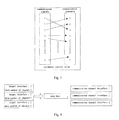
- FIG. 3 is a schematic view of an automatic control relay used by the host for matching communication signals with terminals in the embodiment of the present invention.
- the host firstly uses an automatic control relay to link each terminal to a communication channel of the automatic control relay, and then docks communication signals with the communication channels by switching the physical link in the automatic control relay.
- FIG. 4 is a schematic view of matching communication signals with terminals using a software matching mode in the embodiment of the present invention.
- the host firstly matches each terminal with each communication channel interface, the communication channel interfaces of different addresses transmit different data packets to achieve the correspondence of the addresses in software such that “software bus” control logic is achieved. Then, the host docks each communication signal with each communication channel interface by modifying the target communication channel interface address of each communication signal data packet.
- the method shown in FIG. 1 is applied to a system consisting of a plurality of pear-to-pear devices, then prior to all of the above steps, the method further comprises: selecting, in a preset way, one device from the plurality of peer-to-peer devices as the host, the other devices being the terminals.
- the predetermining way may be: artificially configuring and setting the role of host and the role of terminals, or determining the role of host and the role of terminals by negotiation between the peer-to-peer devices.
- This embodiment mainly achieves adaptive transmission of sound signals.
- the host is a device for playing audio signals, and the terminals are sound boxes.
- FIG. 5 is a schematic view of an audio playing system in the embodiment of the present invention.
- the audio playing system comprises one play host for playing music and two sound boxes.
- the play host and the sound boxes themselves all support a wireless communication protocol and can wirelessly communicate with each other. The specific steps are as follows:
- the play host automatically determines the relative position of each sound box and sends audio signals of the corresponding sound channel to each sound box so as to achieve adaptive transmission of sound signals.
- many unnecessary troubles in wire plugging can be reduced.
- FIG. 6 is a schematic view of a 5.1-channel system in the embodiment of the present invention. As shown in FIG. 6 , it is a 5.1-channel system.
- the position of 6 sound boxes relative to the host can also be determined by the above position-determining method.
- the play host will send audio signals of different channels to the corresponding sound boxes and the sound boxes will receive and output their own audio signals.
- This embodiment mainly achieves adaptive transmission of control signals.
- the host is a control host and the terminals are signal lights.
- control signals such as the switch of traffic lights and the state of ON/OFF of a device.
- FIG. 7 is a schematic view of a signal light system in the embodiment of the present invention.
- the signal light system comprises one control host and at least two signal lights, wherein each signal light can display in two states, i.e., red or green, and the control host and the signal lights are all equipped with a locating device.
- signal light 1 and signal light 2 are grouped into a group, and signal light 3 and signal light 4 are grouped into another group.
- the grouping of the signal lights can be changed according to the requirement.
- the grouping in this embodiment is only a possible case.
- the control host can determine the position of the four signal lights relative to itself by a predetermined method for calculating the position information.
- control host finds that signal light 1 is beside itself and signal light 2 is in the distance (opposite), signal lights 1 and 2 are grouped into one group, and signal lights 3 and 4 are in the left and right sides of the control host respectively, so signal lights 3 and 4 are grouped into another group.
- the control host After determining the position, the control host sends the control signals that need to be displayed to the two groups respectively in accordance with the grouping manner.
- the switch of the control signals and the communication channels can be achieved by an automatic control relay in the control host.
- FIG. 8 is a schematic view of the case where the positions of signal lights 2 and 3 of the embodiment shown in FIG. 7 have been exchanged.
- the control host re-locates the relative position of the signal lights and sends corresponding control signals to the four signal lights after having re-positioned the relative position of the signal lights.
- signal light 2 and signal light 4 form a group and share the same communication channel
- signal light 3 and signal light 1 form another group and share another communication channel. In this way, self-adaptation of control signals is realized.
- FIG. 9 is a schematic view of a signal light system in cinema in the embodiment of the present invention.
- This embodiment mainly achieves adaptive transmission of video signals.
- the host is a device for playing video signals, and the terminals are display screens.
- FIG. 10 is a schematic view of a split-screen television in the embodiment of the present invention.
- the split-screen television comprises one play host and nine screens.
- the play host and the nine screens all support a wireless communication protocol, and each of them is equipped with a locating device.
- the play host can determine the relative position of the nine screens through a predetermined method of calculating position information and then output signals of different screens to the corresponding screens through the wireless communication protocol, i.e., transmitting a signal corresponding to screen 1 to screen 1 , transmitting a signal corresponding to screen 2 to screen 2 , transmitting a signal corresponding to screen 3 to screen 3 , and so on.
- Each screen can receive its own signal through its own wireless receiving apparatus and display the signal.
- the play host determines the position of each screen relative to itself, it can output different video signals to the corresponding screens without need of correlating with each screen by wire plugging every time.
- FIG. 11 is schematic view of a system for self-adaptively transmitting communication signals in the embodiment of the present invention. As shown in FIG. 11 , the system comprises: one host 1101 and a plurality of terminals 1102 ;
- the host 1101 and the terminals 1102 each comprise a locating module 1103 .
- the host 1101 acquires its own position information and the position information of each terminal 1102 through the collaborative work between the locating modules 1103 .
- the locating module 1103 may be a GPS module, a microphone array, a 3G network receiver or the like.
- the host may comprise an automatic control relay (not shown in FIG. 10 ).
- the host 1101 is configured to firstly match each terminal with communication channels of the automatic control relay and then dock each communication signal with each communication channel by switching the physical link in the automatic control relay.
- the host in FIG. 11 may not comprise an automatic control relay.
- the host uses a software matching mode to firstly link the terminals with communication channel interfaces, and that modify the target communication channel interface address of each communication signal data packet so as to dock each communication signal with each communication channel interface, wherein the communication channel interfaces of different addresses transmit different data packets.
- the host 1101 is a device for playing audio signals, and the terminals 1102 are sound boxes;
- the system for self-adaptively transmitting communication signals consists of a plurality of peer-to-peer devices
- the plurality of peer-to-peer devices each comprise a negotiation module.
- the role of the host and the role of the terminals are determined by the negotiation communication between the negotiation modules.
- the host 1101 and the terminals 1102 are a plurality of peer-to-peer devices
- the host 1101 and the terminals 1102 each comprise a negotiation module 1104
- the role of the host and the role of terminals are determined by the negotiation communication between the negotiation modules 1104 .
- the host acquiring its own position information and the position information of each terminal and calculating to acquire a relative positional relationship between the host and each terminal according to the acquired positional information and the host matching each communication signal to be transmitted with each terminal according to the relative positional relationship between the host and each terminal and wirelessly transmitting corresponding communication signals to each terminal according to the matched correspondence” of the present invention
- since wireless transmission is adopted between the host and each terminal the complex wiring and wire plugging processes are avoided.
- the host acquires a relative positional relationship between itself and each terminal, matches communication signals with the terminals according to the relative positional relationship, and then performs wireless transmission of the communication signals, the self-adaptive transmission of wireless signals can be achieved.
Landscapes
- Engineering & Computer Science (AREA)
- Computer Networks & Wireless Communication (AREA)
- Signal Processing (AREA)
- Databases & Information Systems (AREA)
- Mobile Radio Communication Systems (AREA)
- Circuit For Audible Band Transducer (AREA)
Applications Claiming Priority (4)
| Application Number | Priority Date | Filing Date | Title |
|---|---|---|---|
| CN201210046257.1 | 2012-02-27 | ||
| CN201210046257 | 2012-02-27 | ||
| CN201210046257.1A CN102595317B (zh) | 2012-02-27 | 2012-02-27 | 一种通讯信号自适配传输方法和系统 |
| PCT/CN2013/071947 WO2013127340A1 (fr) | 2012-02-27 | 2013-02-27 | Procédé et système de transmission à auto-adaptation de signal de communication |
Publications (2)
| Publication Number | Publication Date |
|---|---|
| US20150245321A1 US20150245321A1 (en) | 2015-08-27 |
| US9655092B2 true US9655092B2 (en) | 2017-05-16 |
Family
ID=46483440
Family Applications (1)
| Application Number | Title | Priority Date | Filing Date |
|---|---|---|---|
| US14/371,119 Active 2033-05-02 US9655092B2 (en) | 2012-02-27 | 2013-02-27 | Method and system for self-adaptively transmitting communication signals |
Country Status (5)
| Country | Link |
|---|---|
| US (1) | US9655092B2 (fr) |
| JP (2) | JP2015503868A (fr) |
| KR (1) | KR101598315B1 (fr) |
| CN (1) | CN102595317B (fr) |
| WO (1) | WO2013127340A1 (fr) |
Families Citing this family (12)
| Publication number | Priority date | Publication date | Assignee | Title |
|---|---|---|---|---|
| CN102595317B (zh) * | 2012-02-27 | 2015-11-18 | 歌尔声学股份有限公司 | 一种通讯信号自适配传输方法和系统 |
| KR20140046980A (ko) * | 2012-10-11 | 2014-04-21 | 한국전자통신연구원 | 오디오 데이터 생성 장치 및 방법, 오디오 데이터 재생 장치 및 방법 |
| CN104185132B (zh) * | 2014-09-02 | 2019-02-01 | Oppo广东移动通信有限公司 | 声道配置方法、智能终端及相应系统 |
| JP6517623B2 (ja) * | 2015-08-04 | 2019-05-22 | 株式会社東芝 | 無線機器配置推定装置、無線機器配置推定方法、無線機器配置推定プログラム |
| CN107613503B (zh) * | 2016-07-12 | 2020-04-28 | 华为技术有限公司 | 波束通信的方法和装置 |
| CN107613434B (zh) * | 2017-09-27 | 2020-01-31 | 四川长虹电器股份有限公司 | 跨平台多端协调进行声场定位的方法 |
| CN107801132A (zh) * | 2017-11-22 | 2018-03-13 | 广东欧珀移动通信有限公司 | 一种智能音箱控制方法、移动终端及智能音箱 |
| CN108391222A (zh) * | 2018-02-05 | 2018-08-10 | 成都动视时代科技有限公司 | 一种网络化数字标牌的数据传输方法 |
| CN113747092A (zh) * | 2020-05-29 | 2021-12-03 | 深圳Tcl数字技术有限公司 | 一种声道播放方法、系统及存储介质 |
| CN113301480B (zh) * | 2021-06-24 | 2026-01-16 | 上海炉石信息科技有限公司 | 一种分布式音箱、音箱配对方法和分布式音响系统 |
| CN113852833B (zh) * | 2021-08-30 | 2024-03-22 | 阿里巴巴(中国)有限公司 | 多设备协同直播方法、装置及电子设备 |
| CN116684735B (zh) * | 2023-06-14 | 2024-04-09 | 广州市远知初电子科技有限公司 | 一种音视频采集系统 |
Citations (10)
| Publication number | Priority date | Publication date | Assignee | Title |
|---|---|---|---|---|
| US6188771B1 (en) * | 1998-03-11 | 2001-02-13 | Acentech, Inc. | Personal sound masking system |
| US6195022B1 (en) * | 1996-10-07 | 2001-02-27 | Casio Computer Co., Ltd. | Action analyzing/recording system |
| WO2004081602A2 (fr) | 2003-03-11 | 2004-09-23 | Menache, Llc | Systeme radiofrequence d'analyse du mouvement et procede a cet effet |
| US7231553B2 (en) * | 2002-11-26 | 2007-06-12 | Microsoft Corporation | System and method for testing computing devices |
| CN101574011A (zh) | 2006-12-27 | 2009-11-04 | 朗讯科技公司 | 用于在发射机和接收机处降低功率消耗的方法 |
| US8060626B2 (en) * | 2008-09-22 | 2011-11-15 | Sony Computer Entertainment America Llc. | Method for host selection based on discovered NAT type |
| US20110314168A1 (en) * | 2010-06-22 | 2011-12-22 | Microsoft Corporation | System for interaction of paired devices |
| CN102595317A (zh) | 2012-02-27 | 2012-07-18 | 歌尔声学股份有限公司 | 一种通讯信号自适配传输方法和系统 |
| CN202652529U (zh) | 2012-02-27 | 2013-01-02 | 歌尔声学股份有限公司 | 一种通讯信号自适配传输系统 |
| US20130045759A1 (en) * | 2011-08-18 | 2013-02-21 | Rivada Research LLC | Method and System for Providing Enhanced Location Based Information for Wireless Handsets |
Family Cites Families (13)
| Publication number | Priority date | Publication date | Assignee | Title |
|---|---|---|---|---|
| JPS56122555A (en) * | 1980-03-04 | 1981-09-26 | Nec Corp | Switching control system |
| US6548967B1 (en) * | 1997-08-26 | 2003-04-15 | Color Kinetics, Inc. | Universal lighting network methods and systems |
| JP2003061140A (ja) * | 2001-08-09 | 2003-02-28 | Sharp Corp | 携帯端末及び情報表示プログラムを記録した記録媒体 |
| CN1647582B (zh) * | 2002-04-17 | 2013-03-27 | 皇家飞利浦电子股份有限公司 | 带有gps接收器的扬声器 |
| JP2004088658A (ja) * | 2002-08-28 | 2004-03-18 | Nippon Telegr & Teleph Corp <Ntt> | パケット転送装置及びパケット処理方法 |
| JP4419801B2 (ja) * | 2004-10-29 | 2010-02-24 | ヤマハ株式会社 | マルチチャネルスピーカシステム |
| JP2006238371A (ja) * | 2005-02-28 | 2006-09-07 | Toshiba Lighting & Technology Corp | 照明制御システム |
| US9474134B2 (en) * | 2005-12-23 | 2016-10-18 | Koninklijke Philips N.V. | User interface with position awareness |
| CN201263151Y (zh) * | 2008-05-15 | 2009-06-24 | 杨树东 | 一种使用蓝牙进行数据传输的设备 |
| US8644757B2 (en) * | 2008-12-04 | 2014-02-04 | Nokia Corporation | Method and system for creation and control of virtual rendering devices |
| CN101574911B (zh) * | 2009-05-31 | 2012-05-09 | 广东铁将军防盗设备有限公司 | 轮胎压力监测系统及其信号匹配装置 |
| CN101931468B (zh) * | 2010-09-23 | 2013-06-12 | 武汉虹信通信技术有限责任公司 | 一种传输以太网信号和移动通信信号的接入系统和方法 |
| CN102857857B (zh) * | 2012-02-17 | 2015-01-28 | 东莞耳神电声科技有限公司 | 多通道无线音响系统的音箱通道匹配方法 |
-
2012
- 2012-02-27 CN CN201210046257.1A patent/CN102595317B/zh active Active
-
2013
- 2013-02-27 WO PCT/CN2013/071947 patent/WO2013127340A1/fr not_active Ceased
- 2013-02-27 KR KR1020147019120A patent/KR101598315B1/ko active Active
- 2013-02-27 US US14/371,119 patent/US9655092B2/en active Active
- 2013-02-27 JP JP2014550633A patent/JP2015503868A/ja active Pending
-
2017
- 2017-03-09 JP JP2017044788A patent/JP6465913B2/ja active Active
Patent Citations (10)
| Publication number | Priority date | Publication date | Assignee | Title |
|---|---|---|---|---|
| US6195022B1 (en) * | 1996-10-07 | 2001-02-27 | Casio Computer Co., Ltd. | Action analyzing/recording system |
| US6188771B1 (en) * | 1998-03-11 | 2001-02-13 | Acentech, Inc. | Personal sound masking system |
| US7231553B2 (en) * | 2002-11-26 | 2007-06-12 | Microsoft Corporation | System and method for testing computing devices |
| WO2004081602A2 (fr) | 2003-03-11 | 2004-09-23 | Menache, Llc | Systeme radiofrequence d'analyse du mouvement et procede a cet effet |
| CN101574011A (zh) | 2006-12-27 | 2009-11-04 | 朗讯科技公司 | 用于在发射机和接收机处降低功率消耗的方法 |
| US8060626B2 (en) * | 2008-09-22 | 2011-11-15 | Sony Computer Entertainment America Llc. | Method for host selection based on discovered NAT type |
| US20110314168A1 (en) * | 2010-06-22 | 2011-12-22 | Microsoft Corporation | System for interaction of paired devices |
| US20130045759A1 (en) * | 2011-08-18 | 2013-02-21 | Rivada Research LLC | Method and System for Providing Enhanced Location Based Information for Wireless Handsets |
| CN102595317A (zh) | 2012-02-27 | 2012-07-18 | 歌尔声学股份有限公司 | 一种通讯信号自适配传输方法和系统 |
| CN202652529U (zh) | 2012-02-27 | 2013-01-02 | 歌尔声学股份有限公司 | 一种通讯信号自适配传输系统 |
Non-Patent Citations (2)
| Title |
|---|
| CN 101574911 A-English Translation. * |
| CN 101574911 A—English Translation. * |
Also Published As
| Publication number | Publication date |
|---|---|
| US20150245321A1 (en) | 2015-08-27 |
| KR101598315B1 (ko) | 2016-02-26 |
| WO2013127340A1 (fr) | 2013-09-06 |
| JP2015503868A (ja) | 2015-02-02 |
| CN102595317A (zh) | 2012-07-18 |
| KR20140121404A (ko) | 2014-10-15 |
| CN102595317B (zh) | 2015-11-18 |
| JP2017163543A (ja) | 2017-09-14 |
| JP6465913B2 (ja) | 2019-02-06 |
Similar Documents
| Publication | Publication Date | Title |
|---|---|---|
| US9655092B2 (en) | Method and system for self-adaptively transmitting communication signals | |
| KR100956566B1 (ko) | Gps 수신기를 구비한 스피커 | |
| US20190116418A1 (en) | Distributed microphone array and sound source positioning system applicable thereto | |
| CN108780603A (zh) | 一种无人机系统及其通信方法、遥控装置 | |
| US20150055781A1 (en) | Wireless speaker device and wirelessly multi-channel audio system thereof | |
| KR101961008B1 (ko) | 광 버스트 전송망 노드의 타임슬롯 동기 트레이닝 방법, 노드 기기 및 네트워크 | |
| US20100220877A1 (en) | Array speaker system and array microphone system | |
| EP4304208A1 (fr) | Détection de mouvement d'unités de haut-parleur | |
| CN107950036A (zh) | 用于控制无线扬声器的音频棒 | |
| CN104936315A (zh) | 一种通过wifi传输数据的方法、主设备及模块设备 | |
| CN105830129A (zh) | 云台控制方法、装置及系统 | |
| CN202652529U (zh) | 一种通讯信号自适配传输系统 | |
| WO2016166687A1 (fr) | Positionnement d'un élément de sortie dans un environnement tridimensionnel | |
| EP3932018B1 (fr) | Unité de commande de communication de données | |
| US10887746B2 (en) | Method, apparatus and system of configuring wireless network node | |
| CN104349283A (zh) | 一种信息处理方法、终端及信息处理系统 | |
| US10897282B2 (en) | Systems and methods for determining cable end location | |
| CN204104122U (zh) | 无线音响系统及其适用的音响模块 | |
| KR101836867B1 (ko) | 전선 작업 기반 자동화 설비 통합 관리 시스템 및 방법 | |
| JP4575870B2 (ja) | 生産設備の制御システム | |
| CN104363158A (zh) | 一种capwap隧道传输数据的方法、装置和系统 | |
| JP2017017577A (ja) | 接続情報照合装置 | |
| CN207602220U (zh) | 一种远程智能音频系统切换系统 | |
| WO2020225997A1 (fr) | Dispositif audio, système audio et programme lisible par ordinateur | |
| Sladeczek et al. | Audio network based massive multichannel loudspeaker system for flexible use in spatial audio research |
Legal Events
| Date | Code | Title | Description |
|---|---|---|---|
| AS | Assignment |
Owner name: GOERTEK, INC., CHINA Free format text: ASSIGNMENT OF ASSIGNORS INTEREST;ASSIGNORS:JIANG, BINBIN;LIU, XIN'AI;WANG, CHONGLE;REEL/FRAME:033457/0116 Effective date: 20140718 |
|
| STCF | Information on status: patent grant |
Free format text: PATENTED CASE |
|
| MAFP | Maintenance fee payment |
Free format text: PAYMENT OF MAINTENANCE FEE, 4TH YEAR, LARGE ENTITY (ORIGINAL EVENT CODE: M1551); ENTITY STATUS OF PATENT OWNER: LARGE ENTITY Year of fee payment: 4 |
|
| MAFP | Maintenance fee payment |
Free format text: PAYMENT OF MAINTENANCE FEE, 8TH YEAR, LARGE ENTITY (ORIGINAL EVENT CODE: M1552); ENTITY STATUS OF PATENT OWNER: LARGE ENTITY Year of fee payment: 8 |