US9668013B2 - Display device - Google Patents
Display device Download PDFInfo
- Publication number
- US9668013B2 US9668013B2 US14/618,422 US201514618422A US9668013B2 US 9668013 B2 US9668013 B2 US 9668013B2 US 201514618422 A US201514618422 A US 201514618422A US 9668013 B2 US9668013 B2 US 9668013B2
- Authority
- US
- United States
- Prior art keywords
- program
- display device
- list
- display
- programs
- Prior art date
- Legal status (The legal status is an assumption and is not a legal conclusion. Google has not performed a legal analysis and makes no representation as to the accuracy of the status listed.)
- Expired - Fee Related, expires
Links
Images




Classifications
-
- H—ELECTRICITY
- H04—ELECTRIC COMMUNICATION TECHNIQUE
- H04N—PICTORIAL COMMUNICATION, e.g. TELEVISION
- H04N21/00—Selective content distribution, e.g. interactive television or video on demand [VOD]
- H04N21/40—Client devices specifically adapted for the reception of or interaction with content, e.g. set-top-box [STB]; Operations thereof
- H04N21/43—Processing of content or additional data, e.g. demultiplexing additional data from a digital video stream; Elementary client operations, e.g. monitoring of home network or synchronising decoder's clock; Client middleware
- H04N21/431—Generation of visual interfaces for content selection or interaction; Content or additional data rendering
- H04N21/4312—Generation of visual interfaces for content selection or interaction; Content or additional data rendering involving specific graphical features, e.g. screen layout, special fonts or colors, blinking icons, highlights or animations
- H04N21/4316—Generation of visual interfaces for content selection or interaction; Content or additional data rendering involving specific graphical features, e.g. screen layout, special fonts or colors, blinking icons, highlights or animations for displaying supplemental content in a region of the screen, e.g. an advertisement in a separate window
-
- H—ELECTRICITY
- H04—ELECTRIC COMMUNICATION TECHNIQUE
- H04N—PICTORIAL COMMUNICATION, e.g. TELEVISION
- H04N21/00—Selective content distribution, e.g. interactive television or video on demand [VOD]
- H04N21/40—Client devices specifically adapted for the reception of or interaction with content, e.g. set-top-box [STB]; Operations thereof
- H04N21/41—Structure of client; Structure of client peripherals
- H04N21/422—Input-only peripherals, i.e. input devices connected to specially adapted client devices, e.g. global positioning system [GPS]
- H04N21/42204—User interfaces specially adapted for controlling a client device through a remote control device; Remote control devices therefor
- H04N21/42206—User interfaces specially adapted for controlling a client device through a remote control device; Remote control devices therefor characterized by hardware details
- H04N21/42212—Specific keyboard arrangements
- H04N21/42213—Specific keyboard arrangements for facilitating data entry
- H04N21/42216—Specific keyboard arrangements for facilitating data entry for quick navigation, e.g. through an EPG
-
- H—ELECTRICITY
- H04—ELECTRIC COMMUNICATION TECHNIQUE
- H04N—PICTORIAL COMMUNICATION, e.g. TELEVISION
- H04N21/00—Selective content distribution, e.g. interactive television or video on demand [VOD]
- H04N21/40—Client devices specifically adapted for the reception of or interaction with content, e.g. set-top-box [STB]; Operations thereof
- H04N21/43—Processing of content or additional data, e.g. demultiplexing additional data from a digital video stream; Elementary client operations, e.g. monitoring of home network or synchronising decoder's clock; Client middleware
- H04N21/431—Generation of visual interfaces for content selection or interaction; Content or additional data rendering
- H04N21/4312—Generation of visual interfaces for content selection or interaction; Content or additional data rendering involving specific graphical features, e.g. screen layout, special fonts or colors, blinking icons, highlights or animations
-
- H—ELECTRICITY
- H04—ELECTRIC COMMUNICATION TECHNIQUE
- H04N—PICTORIAL COMMUNICATION, e.g. TELEVISION
- H04N21/00—Selective content distribution, e.g. interactive television or video on demand [VOD]
- H04N21/40—Client devices specifically adapted for the reception of or interaction with content, e.g. set-top-box [STB]; Operations thereof
- H04N21/43—Processing of content or additional data, e.g. demultiplexing additional data from a digital video stream; Elementary client operations, e.g. monitoring of home network or synchronising decoder's clock; Client middleware
- H04N21/433—Content storage operation, e.g. storage operation in response to a pause request, caching operations
- H04N21/4332—Content storage operation, e.g. storage operation in response to a pause request, caching operations by placing content in organized collections, e.g. local EPG data repository
-
- H—ELECTRICITY
- H04—ELECTRIC COMMUNICATION TECHNIQUE
- H04N—PICTORIAL COMMUNICATION, e.g. TELEVISION
- H04N21/00—Selective content distribution, e.g. interactive television or video on demand [VOD]
- H04N21/40—Client devices specifically adapted for the reception of or interaction with content, e.g. set-top-box [STB]; Operations thereof
- H04N21/43—Processing of content or additional data, e.g. demultiplexing additional data from a digital video stream; Elementary client operations, e.g. monitoring of home network or synchronising decoder's clock; Client middleware
- H04N21/433—Content storage operation, e.g. storage operation in response to a pause request, caching operations
- H04N21/4334—Recording operations
-
- H—ELECTRICITY
- H04—ELECTRIC COMMUNICATION TECHNIQUE
- H04N—PICTORIAL COMMUNICATION, e.g. TELEVISION
- H04N21/00—Selective content distribution, e.g. interactive television or video on demand [VOD]
- H04N21/40—Client devices specifically adapted for the reception of or interaction with content, e.g. set-top-box [STB]; Operations thereof
- H04N21/43—Processing of content or additional data, e.g. demultiplexing additional data from a digital video stream; Elementary client operations, e.g. monitoring of home network or synchronising decoder's clock; Client middleware
- H04N21/442—Monitoring of processes or resources, e.g. detecting the failure of a recording device, monitoring the downstream bandwidth, the number of times a movie has been viewed, the storage space available from the internal hard disk
- H04N21/44213—Monitoring of end-user related data
- H04N21/44222—Analytics of user selections, e.g. selection of programmes or purchase activity
-
- H—ELECTRICITY
- H04—ELECTRIC COMMUNICATION TECHNIQUE
- H04N—PICTORIAL COMMUNICATION, e.g. TELEVISION
- H04N21/00—Selective content distribution, e.g. interactive television or video on demand [VOD]
- H04N21/40—Client devices specifically adapted for the reception of or interaction with content, e.g. set-top-box [STB]; Operations thereof
- H04N21/45—Management operations performed by the client for facilitating the reception of or the interaction with the content or administrating data related to the end-user or to the client device itself, e.g. learning user preferences for recommending movies, resolving scheduling conflicts
- H04N21/4508—Management of client data or end-user data
- H04N21/4532—Management of client data or end-user data involving end-user characteristics, e.g. viewer profile, preferences
-
- H—ELECTRICITY
- H04—ELECTRIC COMMUNICATION TECHNIQUE
- H04N—PICTORIAL COMMUNICATION, e.g. TELEVISION
- H04N21/00—Selective content distribution, e.g. interactive television or video on demand [VOD]
- H04N21/40—Client devices specifically adapted for the reception of or interaction with content, e.g. set-top-box [STB]; Operations thereof
- H04N21/47—End-user applications
-
- H—ELECTRICITY
- H04—ELECTRIC COMMUNICATION TECHNIQUE
- H04N—PICTORIAL COMMUNICATION, e.g. TELEVISION
- H04N21/00—Selective content distribution, e.g. interactive television or video on demand [VOD]
- H04N21/40—Client devices specifically adapted for the reception of or interaction with content, e.g. set-top-box [STB]; Operations thereof
- H04N21/47—End-user applications
- H04N21/482—End-user interface for programme selection
-
- H—ELECTRICITY
- H04—ELECTRIC COMMUNICATION TECHNIQUE
- H04N—PICTORIAL COMMUNICATION, e.g. TELEVISION
- H04N21/00—Selective content distribution, e.g. interactive television or video on demand [VOD]
- H04N21/40—Client devices specifically adapted for the reception of or interaction with content, e.g. set-top-box [STB]; Operations thereof
- H04N21/47—End-user applications
- H04N21/482—End-user interface for programme selection
- H04N21/4821—End-user interface for programme selection using a grid, e.g. sorted out by channel and broadcast time
-
- H—ELECTRICITY
- H04—ELECTRIC COMMUNICATION TECHNIQUE
- H04N—PICTORIAL COMMUNICATION, e.g. TELEVISION
- H04N21/00—Selective content distribution, e.g. interactive television or video on demand [VOD]
- H04N21/40—Client devices specifically adapted for the reception of or interaction with content, e.g. set-top-box [STB]; Operations thereof
- H04N21/47—End-user applications
- H04N21/482—End-user interface for programme selection
- H04N21/4825—End-user interface for programme selection using a list of items to be played back in a given order, e.g. playlists
-
- H—ELECTRICITY
- H04—ELECTRIC COMMUNICATION TECHNIQUE
- H04N—PICTORIAL COMMUNICATION, e.g. TELEVISION
- H04N21/00—Selective content distribution, e.g. interactive television or video on demand [VOD]
- H04N21/40—Client devices specifically adapted for the reception of or interaction with content, e.g. set-top-box [STB]; Operations thereof
- H04N21/47—End-user applications
- H04N21/482—End-user interface for programme selection
- H04N21/4826—End-user interface for programme selection using recommendation lists, e.g. of programmes or channels sorted out according to their score
-
- H—ELECTRICITY
- H04—ELECTRIC COMMUNICATION TECHNIQUE
- H04N—PICTORIAL COMMUNICATION, e.g. TELEVISION
- H04N21/00—Selective content distribution, e.g. interactive television or video on demand [VOD]
- H04N21/80—Generation or processing of content or additional data by content creator independently of the distribution process; Content per se
- H04N21/85—Assembly of content; Generation of multimedia applications
- H04N21/858—Linking data to content, e.g. by linking an URL to a video object, by creating a hotspot
-
- H04N5/44543—
-
- H04N5/44591—
-
- H04N2005/44556—
Definitions
- the present invention relates to a display device for displaying a program list.
- Patent Literature 1 Japanese Laid-Open Patent Application Publication No. 2009-188923 relates to a display device, an electronic program list generator, and a computer program with which an electronic program list is displayed simply and in a way that is easier for the user to understand. Patent Literature 1 discloses that program information is displayed for only one of a plurality of programs on the same channel broadcast in the same time period and that each displayed program can be selected.
- Patent Literature 2 Japanese Laid-Open Patent Application Publication No. H10-262192 (Patent Literature 2) relates to a program guide display device in which a mark is displayed to indicate that there is a program that is not displayed.
- Patent Literature 2 discloses that the short duration program guide that is broadcast first out of continuous short duration program guides is displayed, and a more marker is displayed indicating that there are a plurality of short duration program guides that cannot be displayed.
- Patent Literature 3 Japanese Laid-Open Patent Application Publication No. 2008-005225 (Patent Literature 3) relates to a program information presentation method.
- Patent Literature 3 discloses that an EPG is produced for just those programs corresponding to preference information, and when a program box that is not being displayed is selected, program information is displayed and that for short duration programs, such as weather forecasts or news segments lasting about five minutes, the program name will sometimes not be displayed, and if the program selection cursor is used to select such a program, the program name and so forth will be displayed as a pop-up to allow that program to be checked.
- Patent Literature 4 Japanese Laid-Open Patent Application No. H09-182035 relates to an electronic device that omits information about programs with low viewing frequency. Patent Literature 4 discloses that display information is simplified for broadcast programs deemed to have a low reception frequency.
- a function that allows a plurality of channels to be designated and always be continuously recorded has come to be used. This is known by various names, such as “record everything,” “record all,” “time shift function,” and “loop recording,” and involves always receiving and recording the broadcast content of a plurality of channels.
- a recorder compatible with time shift function when a recorded program is displayed, it can be given in a program list format, and the user can select programs from this program list.
- this system is designed to record all programs, when a selection is made, programs of less than five minutes are also presented as a selection option so as to fill in the gaps between programs. If programs that the user does not actively want to see are given as selection options, this can make it harder to select the programs that the user does want to see.
- Patent Literatures relate to a future program list, and do not relate to a past program list as with a time shift function. Also, some do not display programs of short duration, and in addition to being program lists for searching for future programs, they also display short duration programs one by one when the cursor is actually moved over the program list and programs are selected.
- One aspect is to allow a program list to be displayed in a way that is easy to view, and makes it easier to select programs from a past program list that is compatible with a time shift function.
- a display device in view of the state of the known technology, includes a display portion, an input portion that receives an instruction to select a program in a program list such that the display portion displays the program in the program list with the distinguishable expression, and a controller that links a first program having a program duration shorter than a predetermined threshold with at least one second program arranged relative to the first program along a time axis of the program list as a linked program, and that controls the display portion to display the linked program with the distinguishable expression.
- FIG. 1 is a block diagram of a recording and reproduction device in accordance with a first embodiment
- FIG. 2 is a main flowchart of a program list processing procedure performed by the recording and reproduction device
- FIG. 3 is a sub-flowchart of the program list processing procedure performed by the recording and reproduction device
- FIG. 4 is a diagram showing a program list before and after processing
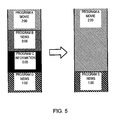
- FIG. 5 is a diagram showing a specific example of a program list integration
- FIG. 6 is a diagram showing a specific example of a program list integration
- FIG. 7 is a diagram showing a specific example of a program list integration
- FIG. 8 is a diagram showing a specific example of a program list integration
- FIG. 9 is a diagram showing a display example of a program list
- FIG. 10 is a flowchart of a processing procedure for a program list in a recording and reproduction device in accordance with a second embodiment
- FIG. 11 is a flowchart of a processing procedure for a program list in a recording and reproduction device in accordance with a third embodiment
- FIG. 12 is a diagram showing a display example of the program list
- FIG. 13 is a flowchart of a processing procedure for a program list in a recording and reproduction device in accordance with a fourth embodiment
- FIG. 14 is a diagram showing a display example of the program list
- FIG. 15 is a flowchart of a processing procedure for a program list in a recording and reproduction device in a fifth embodiment.
- FIG. 16 is a diagram showing a display example of the program list.
- FIG. 1 is a block diagram of a recording and reproduction device 10 (e.g., a display device or a program list display device) pertaining to a first embodiment.
- the present invention is applied to a recording and reproduction device, but from the standpoint of displaying a program list of television programs, it can also be applied to a television set or the like. Specifically, after an EPG program list is acquired, the following procedure is applied to the acquired program list.
- the recording and reproduction device 10 includes six tuners 11 (e.g., digital tuners 11 a 1 to 11 a 6 ). These tuners 11 each includes the functions of a digital terrestrial tuner, a BS tuner, and a CS tuner. Therefore, six television broadcasts can be received at the same time.
- the signals received by the tuners 11 are demodulated and subjected to error processing, and the resulting demodulated signals are individually inputted to a demultiplexer 12 .
- the tuners 11 include a demodulator.
- the demultiplexer 12 separates multiplexed signals, but also executes specific programs with a built-in CPU (Central Processing Unit), ROM (Read Only Memory), or RAM (Random Access Memory), and can receive, record, and reproduce television broadcasts by controlling the various components.
- the demultiplexer 12 can include a microcomputer or processor with a control program that controls the various components of the recording and reproduction device 10 .
- the demultiplexer 12 can also include other conventional components such as an input interface circuit, an output interface circuit, and storage devices such as a ROM and a RAM.
- the microcomputer is programmed to control the various components.
- the internal RAM stores statuses of operational flags and various control data.
- the internal ROM stores the programs for various operations.
- the demultiplexer 12 is capable of selectively controlling any of the components in accordance with the control program. It will be apparent to those skilled in the art from this disclosure that the precise structure and algorithms for the demultiplexer 12 can be any combination of hardware and software that will carry out the functions of the present invention. Also, in the illustrated embodiment, the demultiplexer 12 includes the CPU to control the various components. However, of course, the recording and reproduction device 10 can include a CPU separate from the demultiplexer 12 .
- a multiplexer 13 extracts and again multiplexes information necessary for recording from the content of the received digital broadcast, and records this to a HDD 14 as a recording region.
- the demultiplexer 12 reads the data directly from the HDD 14 .
- a database 14 a In addition to the content of digital broadcasts, a database 14 a , classification information 14 b , and reference time information 14 c (discussed below) are also recorded to the HDD 14 .
- the classification information 14 b includes genre names and so forth as classification information.
- Data read from the HDD 14 or a transport stream of the received digital broadcast is inputted to a decoder 15 , separated into video and audio signals, and decoded.
- the decoded video signals are inputted to a driver 16 and displayed as video on a display panel 17 .
- the decoded audio signals are amplified by an amplifier 18 and outputted as audio from a speaker 19 .
- the manipulation commands to the recording and reproduction device 10 are acquired via a control panel 21 by the demultiplexer 12 and reflected in specific control. Manipulation commands can also be similarly acquired via a remote control 22 .
- the remote control 22 has a cursor key 22 a , and is used in the selection of programs that are highlighted in the program list, for example.
- the tuners 11 correspond to a plurality of tuners that individually receive television broadcasts
- the HDD 14 corresponds to a recording means for recording and reproducing the content of television broadcasts
- the demultiplexer 12 corresponds to a full-time recording control means that continuously receives the broadcast content of a plurality of channels designed with the above-mentioned tuners, and records this content with the above-mentioned recording means.
- recording lists are not produced individually, and instead a program list is displayed in table format (a program list in which recorded programs are displayed in the order in which they have been recorded for each channel). The processing procedure when individual programs are displayed in this program list format will be described below.
- FIG. 2 is a main flowchart of a program list processing procedure performed by the recording and reproduction device 10
- FIG. 3 is a sub-flowchart.
- the CPU in the demultiplexer 12 (hereinafter referred to simply as CPU) confirms the end condition for loop processing, while performing subsequent processing for each of the broadcast stations (i.e., channels) that have been recorded.
- the end condition of loop processing for all of the programs is confirmed, and in S 104 program linking determination ( ⁇ A>) is performed.
- Program linking determination is a sub-routine, and in S 200 the CPU determines whether the simplification function is active.
- the simplification function can be switched on or off by a specific manipulation on the remote control 22 .
- connecting programs connecting programs in between two programs (hereinafter referred to as connecting programs) are also displayed in the program list, and when the cursor key 22 a is used to move a highlighted program, the connecting program also becomes a program, and there is no movement to the next program unless the cursor key 22 a is depressed.
- connecting programs connecting programs in between two programs
- the simplification function When the simplification function is on and active, in S 202 it is determined whether or not the program duration is 10 minutes or less.
- the program duration is the broadcast duration for each program, and is included in program information recorded along with content during the recording of a program. If it is not included in the program information, however, then the program start time and the start time of the program that follows in time order can be acquired, and the length of time between the two considered to be the broadcast duration.
- a reference duration with respect to the broadcast time is provided as a reference for determining whether or not a program is a connecting program, and if the broadcast duration is shorter than this reference duration, then it is given as a candidate to be artificially integrated or linked.
- the reference duration is not limited to being 10 minutes, and may be set either longer or shorter than this. Also, in the integration or link, only programs that are adjacent on a time line are considered.
- the CPU in S 204 acquires the genre of a program, and determines whether or not that genre is applicable to program linking.
- program information EPG information
- genre information can also be acquired, and this genre information can be recorded along with the content and used after recording.
- Genres based on broadcast standards can be broadly classified into the following main categories: news/reportage, sports, informational/tabloid shows, drama, music, variety, movies, animation/special effects, documentary/cultural, live theater/performance, hobby/educational, public service, and so forth. Genres that are often associated connecting programs in between main programs will be “news/reportage, informational/tabloid shows, etc.”
- a program is to be linked if it is no more than 10 minutes long and its genre is “news/reportage, informational/tabloid shows, etc.”
- genres that are further classified into sub-categories.
- the determination is made from the main category, but may instead be made from a sub-category. Also, the selection can be made by user settings.
- the CPU links it to the previous program in S 206 .
- This processing for linking does not involve linking the content itself, and instead information indicating “linking to the previous program” is added to the program information.
- the display indicates that artificial integration or link has been performed, and when the highlighted display is moved, the integrated or linked programs are moved all at once with a single operation of the cursor key 22 a .
- the processing in S 202 to S 206 corresponds to the program integration means.
- the simplification function is not active, or that the broadcast duration (the length of a program) is more than 10 minutes, or that the genre is not applicable to program linking, then in S 208 the program is processed as an independent program. That is, no processing is performed to add information of “linking to the previous program” to the program information.
- the CPU in S 106 determines whether or not the number of linked programs is no more than 50% of the original number.
- This function is switched by selecting a category in a setting menu, or by selecting a switch button in the display of a program list.
- the reference duration is 10 minutes.
- the program is of a specified genre
- the number of programs after linking processing is not less than 50% of the original number of programs.
- FIG. 4 is a diagram showing a program list before and after processing.
- the vertical axis is time (e.g., a time axis), and the horizontal axis is displayed in a table format for each broadcast station.
- recorded programs are displayed from an H1 broadcast station to an H6 broadcast station, and the time axis shows from 6:00 until 10:30 p.m.
- a program from 6:00 until 7:55 p.m. e.g., a second program
- a program from 7:55 until 8:00 p.m. e.g., a first program
- link programs there is only one program (e.g., a linked program) on the program list, from 6:00 until 8:00 p.m.
- FIGS. 5 to 8 show specific examples of a program list. Examples of what the display looks like when the flowcharts of FIGS. 2 and 3 are actually implemented to eliminate programs (program linking) will now be given.
- the broadcast durations of programs B and C are assumed to satisfy the condition for being eliminated (a reference duration of 10 minutes). Even so, since programs B and C are of different genres, the result of elimination (program linking) differs.
- the genre of program B is “news,” and the genre of program C is “information.” Since both of these meet the condition for elimination, they are linked to program A, which is the previous program. Thus, when program B is linked to and integrated or linked with the previous program A, if it is determined that the next program C is also to be linked, it is further linked to the previous, integrated program A.
- the genre of program B is “variety,” and the genre of program C is “information.” Since only program C meets the condition for elimination, program C is linked to program B. That is, a program that is shorter in length than the reference duration is a candidate for being linked to the previous program, but even so, it is also a linking object to which the following program will be linked. In the situation shown in the drawing, the five-minute program C is linked to the five-minute program B.
- S 112 the CPU gives a program display.
- the processing of S 112 corresponds to the program list production means.
- the simplification function is premised on the fact that there is a program that is linked and whose display has been eliminated in the displayed range, so it is helpful if there is some way to know that a portion of the displayed contents of the program list has been eliminated.
- FIG. 9 is a diagram showing the display of such a program list. If we assume that the display when there is no linking is shown on the left in the drawing, an icon indicating that a category has been eliminated from the ordinary program display is added to the display at the top right. How many programs have been eliminated is displayed by a numerical value in the display at the bottom right. Naturally, other display methods are also possible.
- the CPU receives operation of the cursor key 22 a (corresponds to cursor manipulation) in S 114 . More specifically, when the cursor key 22 a on the remote control 22 is operated, an infrared signal corresponding to this operation is sent to the control panel 21 , and this is detected by the CPU in the demultiplexer 12 .
- the operation of the cursor key 22 a corresponds to moving a program that is highlighted in the program list to a program that is adjacent on the top, bottom, left, or right side.
- the CPU temporarily stores information about which program is highlighted, and the highlighted program is changed according to operation of the cursor key 22 a .
- the highlighted display moves to the adjacent program. Two moves cannot be made at once.
- the processing of S 114 and S 116 corresponds to the program movement means.
- the processing to move the highlighted display (cursor movement) in S 116 corresponds to a case in which the program integration means causes the program movement means to move the highlighted display in artificially integrated program units.
- the CPU moves the highlighted display as an artificially integrated program. That is, if we assume that a subsequent program is linked to a previous program in S 206 , even though there were a plurality of programs to start with, they will be displayed as just one program in the program list, and when the cursor key 22 a is pressed one time, a plurality of programs will be treated as a unit in the movement of the highlighted display.
- the CPU determines that a selection has been made in S 118 , and in S 120 executes processing related to the reproduction of the highlighted program.
- the recording and reproduction device 10 (e.g., the display device) includes the display panel 17 (e.g., a display portion), the control panel 21 or the remote control 22 (e.g., an input portion), and the CPU (e.g., the controller).
- the display panel 17 is configured to display a particular program in the program list with highlight (e.g., a distinguishable expression).
- the control panel 21 or the remote control 22 is configured to receive an instruction to change a program that is displayed in the program list with the distinguishable expression from the particular program to an adjacent program adjacent to the particular program to display the adjacent program with the highlight.
- control panel 21 or the remote control 22 is configured to receive an instruction to select a program in the program list such that the display portion displays the program in the program list with the highlight.
- the CPU is configured to link a first program (in FIG. 4 , a program from 7:55 until 8:00 p.m., for example) having a program duration shorter than the reference duration (e.g., the predetermined threshold) with at least one second program (in FIG. 4 , a program from 6:00 until 7:55 p.m., for example) arranged relative to the first program along the time axis of the program list as one program (e.g., a linked program).
- the CPU is also configure to control the display panel 17 to display the one program (e.g., the linked program) with highlight.
- the CPU is further configured to link the first program with the at least one second program that is arranged directly or indirectly adjacent to the first program along the time axis of the program list, as shown in FIG. 4 , for example.
- the CPU is further configured to link the first program with the at least one second program that is arranged before the first program along the time axis of the program list, as shown in FIG. 4 , for example.
- the CPU can be further configured to link the first program with the at least one second program that is arranged after the first program along the time axis of the program list.
- the CPU is further configured to link the first program that has a specific genre such as news/reportage, informational/tabloid shows, etc. with the at least one second program, as shown in FIG. 3 , for example.
- the reference duration (e.g., the predetermined threshold) is settable to different value.
- the distinguishable expression includes the icon or the numerical value (e.g., a marker) indicating that the integration or link (e.g., the program link) has been performed, as shown in FIG. 9 , for example.
- the marker includes a program boarder between the first program and the at least one second program, for example, that is thicker than a program boarder of non-linked program.
- the display panel 17 can be further configured to display the linked program with a background color instead of the highlight. Also, the display panel 17 can be further configured to display the linked program with a bold text than that of another program instead of the highlight.
- the first program and the at least one second program are arbitrarily selectable.
- the first program and the at least one second program can be selectable even if the first program and the at least one second program are spaced apart in the program list.
- the CPU is further configured to link the first program with the at least one second program while a number of programs in the program list after linking the first program with the at least one second program is not less than a specific proportion relative to a number of programs in the program list before linking the first program with the at least one second program, as shown in FIG. 2 , for example.
- the specific proportion is 50%, as shown in FIG. 2 , for example.
- the recording and reproduction device 10 further includes the tuners 11 (e.g., at least one tuner), and the HDD 14 and the demultiplexer 12 (e.g., a record and reproduction portion).
- the tuners 11 are configured to receive television broadcast signals, respectively.
- the HDD 14 and the demultiplexer 12 are configured to record and reproduce the television broadcast signals.
- the display panel 17 is further configured to display program information of programs recorded by the HDD 14 and the demultiplexer 12 in accordance with channels and recording orders of the programs in the program list.
- the CPU is further configured to link the first program with the at least one second program by providing the first program with linking information.
- a recording and reproduction device e.g., a display device or a program list display device
- a recording and reproduction device e.g., a display device or a program list display device
- the parts of the second embodiment that are identical to the parts of the first embodiment will be given the same reference numerals as the parts of the first embodiment.
- the descriptions of the parts of the second embodiment that are identical to the parts of the first embodiment may be omitted for the sake of brevity.
- the above-mentioned initial values are used for the various determination criteria. Naturally, these can be varied according to user settings. In this embodiment, however, the viewing preferences (e.g., viewing history) of the user are automatically reflected in the changes to these criteria.
- FIG. 10 is a flowchart of a processing procedure for a program list in the recording and reproduction device in accordance with the second embodiment.
- the program to be reproduced is selected from the program list. Therefore, in S 300 the CPU determines whether a command has been issued to reproduce a program from the program list (corresponds to a reproduction operation), and if reproduction has been commanded, in S 302 the genre is acquired from the program information, and in S 304 the broadcast duration of the program is acquired. Then, in S 306 , the genre and the broadcast duration (minutes) are stored in the database 14 a of the HDD 14 . This procedure is repeated to steadily build up the genres and broadcast durations of programs selected by the user. Statistical processing of this information allows the user's preferences to be estimated.
- the CPU determines whether the number and ratio of reproductions of each genre have exceeded a threshold.
- a threshold There are a finite number of genres, since the main categories for genres of broadcast standards are employed. Therefore, the number of times each genre has been reproduced can be ascertained by referring to the database 14 a . During the period when little data has been accumulated, this is ignored since there are so few reproductions. As the number of reproductions increases, however, more data builds up and statistical processing becomes possible. Since the genres that are reproduced the most often are the genres preferred by the user, in S 310 those genres are excluded from genres to be integrated or linked.
- the genre of “news/reportage, informational/tabloid shows, etc.” is the genre to undergo program linking, but if news programs are frequency reproduced, they are excluded from the programs to be linked.
- Genres are stored in the classification information 14 b , and all genres as well as the genres to undergo program linking are recorded. When a genre is excluded from those to undergo program linking, it is excluded from the latter recording.
- the CPU determines whether the number and ratio of reproductions of each genre is at or below a threshold value. If the number or ratio of reproductions is extremely low, the program list will look cleaner if a lot of programs are quickly added to those that are linked. Therefore, if the number or ratio of reproductions of each genre is under a certain threshold value (ratio), in S 314 there will be additional genres to be integrated or linked that are recorded to the classification information 14 b.
- the reference duration for the broadcast duration is ten minutes, but this reference duration will vary.
- the CPU determines whether the number or ratio of reproductions of each broadcast duration (minutes) has exceeded a threshold value. Even with short programs, if the user actively selects them, then broadcast durations (minutes) of relatively short length will build up in the database 14 a . For instance, if programs with a broadcast duration of five minutes are reproduced frequently, the user is intentionally selecting those programs from the program list, so even though they only last five minutes, it is better for them not to be eliminated from the program list, so that the user can still select them. Accordingly, in S 318 , relatively short broadcast duration that is reproduced frequently is replaced for the reference duration that is not integrated, as the reference time information 14 c.
- the preferences of the user are automatically reflected.
- some users like for their preferences to be thus automatically reflected, and some do not, so the system allows the user to choose either way through the settings.
- the process can be facilitated by allowing the user to specify the genre and length of programs that will be subject to elimination, based on the viewing preferences up to that point, as discussed above.
- the processing of S 300 to S 318 corresponds to the preference acquisition means.
- the recording and reproduction device 10 further includes the HDD 14 (e.g., the memory) configured to store viewing preferences (e.g., program viewing history) according to program viewing instructions. Also, as shown in FIG. 10 , the CPU is further configured to link the first program with the at least one second program based on the viewing preferences.
- the HDD 14 e.g., the memory
- viewing preferences e.g., program viewing history
- the CPU is further configured to link the first program with the at least one second program based on the viewing preferences.
- the CPU e.g., the controller
- the CPU is further configured to link the first program that has a genre that is not included in a genre of the viewing preferences, as shown in S 308 to S 314 in FIG. 10 , for example.
- the CPU is further configured to link the first program that has the program duration that is shorter than the program duration of the viewing preferences, as shown in S 316 and S 318 in FIG. 10 , for example.
- the CPU uses the program duration of the viewing preferences as the reference duration.
- a recording and reproduction device e.g., a display device or a program list display device
- a recording and reproduction device e.g., a display device or a program list display device
- the parts of the third embodiment that are identical to the parts of the first embodiment will be given the same reference numerals as the parts of the first embodiment.
- the descriptions of the parts of the third embodiment that are identical to the parts of the first embodiment may be omitted for the sake of brevity.
- the recording and reproduction device In performing the simplification function, the recording and reproduction device also has a function that allows program information that is not originally eliminated to be easily displayed.
- FIG. 11 is a flowchart of a processing procedure for a program list in the recording and reproduction device in accordance with the third embodiment.
- the CPU determines whether a certain key has been operated on the remote control 22 , and if it has been operated, in S 352 the program list is switched between before and after integration. Specifically, the displayed is switched back and forth.
- FIG. 12 is a diagram showing a display of the program list.
- a program list that has undergone artificial integration or link of programs is shown on the left, and the original program list that has not undergone this artificial integration or link of programs is shown on the right.
- the display switches between these left and right displays every time a certain key on the remote control 22 is pressed.
- the program list shown on the left there are almost no short program boxes, and it can be seen that they have been eliminated.
- the program list shown on the right however, the short program boxes are displayed, without being eliminated.
- the program list on the left not only has a cleaner looking display, but the cursor key 22 a , which has to be pressed to move a highlighted program, is pressed fewer times.
- a simplified display is switched on and off by pressing a certain key, thereby switching between simplified display and ordinary display.
- the display panel 17 (e.g., the display portion) is further configured to switchably display program lists before and after linking the first program with the at least one second program.
- a recording and reproduction device e.g., a display device or a program list display device
- a recording and reproduction device e.g., a display device or a program list display device
- the parts of the fourth embodiment that are identical to the parts of the first embodiment will be given the same reference numerals as the parts of the first embodiment.
- the descriptions of the parts of the fourth embodiment that are identical to the parts of the first embodiment may be omitted for the sake of brevity.
- FIG. 13 is a flowchart of a processing procedure for a program list in the recording and reproduction device in accordance with the fourth embodiment.
- the CPU determines whether a certain key on the remote control 22 has been operated, and if it has been operated, in S 362 the content of the highlighted program prior to integration or link is displayed as a pop-up.
- FIG. 14 is a diagram showing a display of the program list.
- a program list that has undergone artificial integration or link of programs is shown on the left, and a program list in which there is a pop-up display of the content of a highlighted program prior to integration or link is shown on the right. More specifically, if a certain key is operated when a program on the H3 broadcast station starting at 6:00 p.m. is highlighted, a pop-up display is given to show the content of a plurality of programs (program A and program B) prior to integration or link, as shown on the right.
- the display panel 17 (e.g., the display portion) is further configured to show program information of the first program and the at least one second program while displaying the linked program with the highlight (e.g., the distinguishable expression).
- a recording and reproduction device e.g., a display device or a program list display device
- a recording and reproduction device e.g., a display device or a program list display device
- the parts of the fifth embodiment that are identical to the parts of the first embodiment will be given the same reference numerals as the parts of the first embodiment.
- the descriptions of the parts of the fifth embodiment that are identical to the parts of the first embodiment may be omitted for the sake of brevity.
- FIG. 15 is a flowchart of a processing procedure for a program list in the recording and reproduction device in accordance with the fifth embodiment.
- the CPU determines whether a certain key has been operated on the remote control 22 , and if it has been operated, in S 372 processing is performed to return the highlighted program temporarily to its state prior to integration or link. Even if information linked to the previous program has been attached, this information is temporarily ignored. Then, in S 374 the CPU displays the content of the highlighted program prior to being integrated linked.
- FIG. 16 is a diagram showing a display of the program list. If a certain key is operated when a program on the H3 broadcast station starting at 6:00 p.m. is highlighted, the program box from after integration or link is tentatively shown as on the right, and the display is switched so that the user can see the content of a plurality of programs (program A and program B) prior to integration or link. Even if the cursor key 22 a is operated in this state, the highlighted display will move one by one within the tentative program box.
- the display panel 17 (e.g., the display portion) is further configured to show the first program and the at least one second program in the program list while displaying the linked program with the highlight (e.g., the distinguishable expression).
- a program list display device acquires and displays a program list.
- the program list display device includes a program movement means for highlighting the display of a particular program in the program list, receiving cursor manipulation, and moving a program that is highlighted on the program list in the adjacent direction corresponding to the cursor manipulation, and a program integration means for artificially integrating programs that are adjacent on a time axis and moving a cursor with the program movement means.
- the program movement means highlights the display of a particular program on the program list, receives the cursor manipulation, and moves a program that is highlighted on the program list in the adjacent direction corresponding to the cursor manipulation.
- the program integration means artificially integrates the programs that are adjacent on the time axis and moves the cursor with the program movement means.
- the program integration means artificially integrates the programs that are adjacent on the time axis, when the user manipulates the cursor, with artificially integrated adjacent programs, the highlighted display is given as one program, and a single cursor movement moves from a plurality of integrated programs to the next program.
- the configuration may include a tuner for individually receiving a plurality of television broadcasts, a recording means for recording and reproducing content of television broadcasts by program, a full-time recording control means for full-time reception of the content of a designated plurality of channels with the tuners, and recording the content with the recording means, and a program list production means for producing a program list in a table format in the order in which the recorded programs are recorded on each channel, wherein the program movement means and the program integration means make use of the program list produced by the program list production means.
- the program movement means and the program integration means use the program list produced by the program list production means.
- programs that are adjacent on a time line can be artificially integrated and moved with a cursor by the program movement means, so the number of times the cursor has to be moved can be reduced.
- program information is checked in time order, programs are compared to the ones immediately before them, those that are of short duration are concluded to be connected programs, and when the display is changed to a past program list, that time is used for the immediately prior program, which reduces the number of programs on the program list. Doing this eliminates the display of minor selection options present between drama or sports programs, and affords a program list that looks cleaner overall and makes selection easier.
- the term “comprising” and its derivatives, as used herein, are intended to be open ended terms that specify the presence of the stated features, elements, components, groups, integers, and/or steps, but do not exclude the presence of other unstated features, elements, components, groups, integers and/or steps.
- the foregoing also applies to words having similar meanings such as the terms, “including”, “having” and their derivatives.
- the terms “part,” “section,” “portion,” “member” or “element” when used in the singular can have the dual meaning of a single part or a plurality of parts unless otherwise stated.
Landscapes
- Engineering & Computer Science (AREA)
- Multimedia (AREA)
- Signal Processing (AREA)
- Human Computer Interaction (AREA)
- Databases & Information Systems (AREA)
- Social Psychology (AREA)
- General Health & Medical Sciences (AREA)
- Health & Medical Sciences (AREA)
- Computer Networks & Wireless Communication (AREA)
- Software Systems (AREA)
- Business, Economics & Management (AREA)
- Marketing (AREA)
- Television Signal Processing For Recording (AREA)
- Two-Way Televisions, Distribution Of Moving Picture Or The Like (AREA)
Applications Claiming Priority (2)
| Application Number | Priority Date | Filing Date | Title |
|---|---|---|---|
| JP2014-026590 | 2014-02-14 | ||
| JP2014026590A JP6273884B2 (ja) | 2014-02-14 | 2014-02-14 | 番組表表示装置 |
Publications (2)
| Publication Number | Publication Date |
|---|---|
| US20150237392A1 US20150237392A1 (en) | 2015-08-20 |
| US9668013B2 true US9668013B2 (en) | 2017-05-30 |
Family
ID=52472209
Family Applications (1)
| Application Number | Title | Priority Date | Filing Date |
|---|---|---|---|
| US14/618,422 Expired - Fee Related US9668013B2 (en) | 2014-02-14 | 2015-02-10 | Display device |
Country Status (3)
| Country | Link |
|---|---|
| US (1) | US9668013B2 (fr) |
| EP (2) | EP3244624A1 (fr) |
| JP (1) | JP6273884B2 (fr) |
Families Citing this family (3)
| Publication number | Priority date | Publication date | Assignee | Title |
|---|---|---|---|---|
| KR20180100020A (ko) | 2017-02-28 | 2018-09-06 | 우석대학교 산학협력단 | 로컬푸드 기반 6차 산업 도농교류 체험 관광상품 제공 시스템 및 방법 |
| KR20190024931A (ko) | 2019-02-22 | 2019-03-08 | 우석대학교 산학협력단 | 로컬푸드 기반 6차 산업 도농교류 체험 관광상품 제공 시스템 및 방법 |
| KR102444677B1 (ko) | 2020-10-13 | 2022-09-16 | 우석대학교 산학협력단 | 온라인 상담 기능을 제공하는 도농교류 체험 로컬푸드 제공 시스템 |
Citations (10)
| Publication number | Priority date | Publication date | Assignee | Title |
|---|---|---|---|---|
| JPH09182035A (ja) | 1995-12-26 | 1997-07-11 | Sony Corp | 電子機器 |
| JPH10262192A (ja) | 1997-03-19 | 1998-09-29 | Sanyo Electric Co Ltd | 番組ガイド表示装置 |
| US20020047894A1 (en) * | 2000-06-27 | 2002-04-25 | David Steading | System and methods for subscribers to view, select and otherwise customize delivery of programming over a communication system |
| US20040148629A1 (en) | 2002-12-13 | 2004-07-29 | Canon Kabushiki Kaisha | Program information display control apparatus and method, remote control device, program, and storage medium |
| US20050286874A1 (en) * | 2004-06-28 | 2005-12-29 | Orion Electric Co., Ltd. | Method of displaying information on digital recording and reproducing device and digital recording and reproducing device provided therewith |
| US20060263040A1 (en) * | 2003-05-05 | 2006-11-23 | Mears Mark G | Method and apparatus for indicating whether sufficient space exists for recording a program |
| JP2008005225A (ja) | 2006-06-22 | 2008-01-10 | Hitachi Ltd | 番組情報提示方法 |
| JP2009188923A (ja) | 2008-02-08 | 2009-08-20 | Sharp Corp | 表示装置、電子番組表生成装置及びコンピュータプログラム |
| US20100205633A1 (en) * | 2007-09-18 | 2010-08-12 | Panasonic Corporation | Display apparatus, display method, and display program |
| EP2456196A1 (fr) | 2010-11-23 | 2012-05-23 | Pace Plc | Améliorations d'un guide de programme électronique et son procédé de mise en oeuvre |
Family Cites Families (4)
| Publication number | Priority date | Publication date | Assignee | Title |
|---|---|---|---|---|
| JP2006295806A (ja) * | 2005-04-14 | 2006-10-26 | Sharp Corp | 電子番組表表示装置 |
| JP5144954B2 (ja) * | 2007-04-27 | 2013-02-13 | シャープ株式会社 | デジタル放送受信装置 |
| JP2011029842A (ja) * | 2009-07-23 | 2011-02-10 | Sharp Corp | 電子番組表操作装置 |
| JP5132811B1 (ja) * | 2011-12-26 | 2013-01-30 | 株式会社東芝 | 録画装置および録画方法 |
-
2014
- 2014-02-14 JP JP2014026590A patent/JP6273884B2/ja not_active Expired - Fee Related
-
2015
- 2015-02-10 US US14/618,422 patent/US9668013B2/en not_active Expired - Fee Related
- 2015-02-12 EP EP17175878.2A patent/EP3244624A1/fr not_active Ceased
- 2015-02-12 EP EP15154890.6A patent/EP2908537A1/fr not_active Ceased
Patent Citations (10)
| Publication number | Priority date | Publication date | Assignee | Title |
|---|---|---|---|---|
| JPH09182035A (ja) | 1995-12-26 | 1997-07-11 | Sony Corp | 電子機器 |
| JPH10262192A (ja) | 1997-03-19 | 1998-09-29 | Sanyo Electric Co Ltd | 番組ガイド表示装置 |
| US20020047894A1 (en) * | 2000-06-27 | 2002-04-25 | David Steading | System and methods for subscribers to view, select and otherwise customize delivery of programming over a communication system |
| US20040148629A1 (en) | 2002-12-13 | 2004-07-29 | Canon Kabushiki Kaisha | Program information display control apparatus and method, remote control device, program, and storage medium |
| US20060263040A1 (en) * | 2003-05-05 | 2006-11-23 | Mears Mark G | Method and apparatus for indicating whether sufficient space exists for recording a program |
| US20050286874A1 (en) * | 2004-06-28 | 2005-12-29 | Orion Electric Co., Ltd. | Method of displaying information on digital recording and reproducing device and digital recording and reproducing device provided therewith |
| JP2008005225A (ja) | 2006-06-22 | 2008-01-10 | Hitachi Ltd | 番組情報提示方法 |
| US20100205633A1 (en) * | 2007-09-18 | 2010-08-12 | Panasonic Corporation | Display apparatus, display method, and display program |
| JP2009188923A (ja) | 2008-02-08 | 2009-08-20 | Sharp Corp | 表示装置、電子番組表生成装置及びコンピュータプログラム |
| EP2456196A1 (fr) | 2010-11-23 | 2012-05-23 | Pace Plc | Améliorations d'un guide de programme électronique et son procédé de mise en oeuvre |
Non-Patent Citations (1)
| Title |
|---|
| Extended European Search Report of the corresponding European Application No. 15154890.6, dated Apr. 7, 2015. |
Also Published As
| Publication number | Publication date |
|---|---|
| EP3244624A1 (fr) | 2017-11-15 |
| EP2908537A1 (fr) | 2015-08-19 |
| US20150237392A1 (en) | 2015-08-20 |
| JP2015154262A (ja) | 2015-08-24 |
| JP6273884B2 (ja) | 2018-02-07 |
Similar Documents
| Publication | Publication Date | Title |
|---|---|---|
| US7543322B1 (en) | Method for enhanced event specific features on personal video recorders | |
| CA2623427C (fr) | Systemes et procedes permettant l'enregistrement et la lecture de programmes dotes de proprietes d'enregistrement desirables | |
| JP4792842B2 (ja) | 情報処理装置,情報処理方法,およびコンピュータプログラム | |
| JP4490588B2 (ja) | プログラム受信装置 | |
| US9258512B2 (en) | Digital video recorder broadcast overlays | |
| US20030009757A1 (en) | Method for displaying channel listings in an electronic program guide and an electronic program guide implementing the method | |
| US20100257561A1 (en) | Surfer's Paradise | |
| US12395692B2 (en) | Apparatus, systems and methods for electronic program guide information presented on a display | |
| US20080062336A1 (en) | Smart Zapper | |
| US9668013B2 (en) | Display device | |
| EP1874049A2 (fr) | Procédé de commande d'un récepteur de télévision et récepteur de télévision utilisant celui-ci | |
| JP5158894B2 (ja) | 放送受信装置、プログラム、及び記録媒体 | |
| US20150373418A1 (en) | Reproduction device, display device, and display control method | |
| KR101361257B1 (ko) | 영상표시기기의 녹화목록 표시 장치 및 방법 | |
| US8645830B2 (en) | Method of creating a summary of a document based on user-defined criteria, and related audio-visual device | |
| JP2019176497A (ja) | 電子機器および映像再生方法 | |
| JP2009130502A (ja) | 番組録画装置 | |
| KR100860644B1 (ko) | 저장기능을 갖는 방송수신기 및 그 제어방법 | |
| JP2005354148A (ja) | 記録装置 | |
| JP2009302833A (ja) | 情報処理装置、情報編集方法 | |
| KR20080059534A (ko) | 저장기능을 갖는 방송수신기 및 그 제어방법 |
Legal Events
| Date | Code | Title | Description |
|---|---|---|---|
| AS | Assignment |
Owner name: FUNAI ELECTRIC CO., LTD., JAPAN Free format text: ASSIGNMENT OF ASSIGNORS INTEREST;ASSIGNOR:FUKUNAKA, KENICHI;REEL/FRAME:034929/0913 Effective date: 20150210 |
|
| STCF | Information on status: patent grant |
Free format text: PATENTED CASE |
|
| MAFP | Maintenance fee payment |
Free format text: PAYMENT OF MAINTENANCE FEE, 4TH YEAR, LARGE ENTITY (ORIGINAL EVENT CODE: M1551); ENTITY STATUS OF PATENT OWNER: LARGE ENTITY Year of fee payment: 4 |
|
| FEPP | Fee payment procedure |
Free format text: MAINTENANCE FEE REMINDER MAILED (ORIGINAL EVENT CODE: REM.); ENTITY STATUS OF PATENT OWNER: LARGE ENTITY |
|
| LAPS | Lapse for failure to pay maintenance fees |
Free format text: PATENT EXPIRED FOR FAILURE TO PAY MAINTENANCE FEES (ORIGINAL EVENT CODE: EXP.); ENTITY STATUS OF PATENT OWNER: LARGE ENTITY |
|
| STCH | Information on status: patent discontinuation |
Free format text: PATENT EXPIRED DUE TO NONPAYMENT OF MAINTENANCE FEES UNDER 37 CFR 1.362 |
|
| FP | Lapsed due to failure to pay maintenance fee |
Effective date: 20250530 |