US9683092B2 - Polymer fibres comprising aerogel and method for production - Google Patents
Polymer fibres comprising aerogel and method for production Download PDFInfo
- Publication number
- US9683092B2 US9683092B2 US14/773,453 US201414773453A US9683092B2 US 9683092 B2 US9683092 B2 US 9683092B2 US 201414773453 A US201414773453 A US 201414773453A US 9683092 B2 US9683092 B2 US 9683092B2
- Authority
- US
- United States
- Prior art keywords
- polymer
- aerogel
- aero gel
- particle
- range
- Prior art date
- Legal status (The legal status is an assumption and is not a legal conclusion. Google has not performed a legal analysis and makes no representation as to the accuracy of the status listed.)
- Expired - Fee Related
Links
- 239000004964 aerogel Substances 0.000 title claims abstract description 125
- 229920000642 polymer Polymers 0.000 title claims abstract description 102
- 238000004519 manufacturing process Methods 0.000 title claims description 10
- 239000002245 particle Substances 0.000 claims abstract description 79
- 239000000835 fiber Substances 0.000 claims description 56
- 239000002131 composite material Substances 0.000 claims description 46
- 239000002904 solvent Substances 0.000 claims description 31
- 239000000693 micelle Substances 0.000 claims description 27
- 238000000034 method Methods 0.000 claims description 21
- VYPSYNLAJGMNEJ-UHFFFAOYSA-N Silicium dioxide Chemical compound O=[Si]=O VYPSYNLAJGMNEJ-UHFFFAOYSA-N 0.000 claims description 20
- 238000002156 mixing Methods 0.000 claims description 11
- 239000000203 mixture Substances 0.000 claims description 11
- 238000009987 spinning Methods 0.000 claims description 11
- 238000001523 electrospinning Methods 0.000 claims description 10
- 239000004965 Silica aerogel Substances 0.000 claims description 7
- 239000011148 porous material Substances 0.000 claims description 5
- LFQSCWFLJHTTHZ-UHFFFAOYSA-N Ethanol Chemical compound CCO LFQSCWFLJHTTHZ-UHFFFAOYSA-N 0.000 description 21
- DKGAVHZHDRPRBM-UHFFFAOYSA-N Tert-Butanol Chemical compound CC(C)(C)O DKGAVHZHDRPRBM-UHFFFAOYSA-N 0.000 description 12
- 239000000523 sample Substances 0.000 description 11
- 239000000463 material Substances 0.000 description 10
- 239000011159 matrix material Substances 0.000 description 9
- XLYOFNOQVPJJNP-UHFFFAOYSA-N water Substances O XLYOFNOQVPJJNP-UHFFFAOYSA-N 0.000 description 9
- 238000000386 microscopy Methods 0.000 description 8
- 239000000843 powder Substances 0.000 description 7
- 239000000499 gel Substances 0.000 description 5
- 229920001600 hydrophobic polymer Polymers 0.000 description 5
- -1 actinide metal oxides Chemical class 0.000 description 4
- 239000012774 insulation material Substances 0.000 description 4
- 239000012488 sample solution Substances 0.000 description 4
- 239000000126 substance Substances 0.000 description 4
- 230000015572 biosynthetic process Effects 0.000 description 3
- 238000009835 boiling Methods 0.000 description 3
- 238000005538 encapsulation Methods 0.000 description 3
- 238000009413 insulation Methods 0.000 description 3
- 239000000377 silicon dioxide Substances 0.000 description 3
- NTHWMYGWWRZVTN-UHFFFAOYSA-N sodium silicate Chemical class [Na+].[Na+].[O-][Si]([O-])=O NTHWMYGWWRZVTN-UHFFFAOYSA-N 0.000 description 3
- 239000007787 solid Substances 0.000 description 3
- OKTJSMMVPCPJKN-UHFFFAOYSA-N Carbon Chemical compound [C] OKTJSMMVPCPJKN-UHFFFAOYSA-N 0.000 description 2
- UQSXHKLRYXJYBZ-UHFFFAOYSA-N Iron oxide Chemical compound [Fe]=O UQSXHKLRYXJYBZ-UHFFFAOYSA-N 0.000 description 2
- 239000004743 Polypropylene Substances 0.000 description 2
- IJOOHPMOJXWVHK-UHFFFAOYSA-N chlorotrimethylsilane Chemical compound C[Si](C)(C)Cl IJOOHPMOJXWVHK-UHFFFAOYSA-N 0.000 description 2
- 238000009826 distribution Methods 0.000 description 2
- 238000001704 evaporation Methods 0.000 description 2
- 230000008020 evaporation Effects 0.000 description 2
- 238000002474 experimental method Methods 0.000 description 2
- 239000007789 gas Substances 0.000 description 2
- 229920001519 homopolymer Polymers 0.000 description 2
- 229910052739 hydrogen Inorganic materials 0.000 description 2
- 239000001257 hydrogen Substances 0.000 description 2
- 230000003993 interaction Effects 0.000 description 2
- 229910044991 metal oxide Inorganic materials 0.000 description 2
- 239000000178 monomer Substances 0.000 description 2
- 239000002086 nanomaterial Substances 0.000 description 2
- 150000001282 organosilanes Chemical class 0.000 description 2
- 239000012071 phase Substances 0.000 description 2
- 229920001155 polypropylene Polymers 0.000 description 2
- 235000019353 potassium silicate Nutrition 0.000 description 2
- 238000002360 preparation method Methods 0.000 description 2
- 239000011343 solid material Substances 0.000 description 2
- DGXAGETVRDOQFP-UHFFFAOYSA-N 2,6-dihydroxybenzaldehyde Chemical compound OC1=CC=CC(O)=C1C=O DGXAGETVRDOQFP-UHFFFAOYSA-N 0.000 description 1
- 229920001817 Agar Polymers 0.000 description 1
- RYGMFSIKBFXOCR-UHFFFAOYSA-N Copper Chemical compound [Cu] RYGMFSIKBFXOCR-UHFFFAOYSA-N 0.000 description 1
- 239000004593 Epoxy Substances 0.000 description 1
- 108010010803 Gelatin Proteins 0.000 description 1
- 241000206672 Gelidium Species 0.000 description 1
- 239000004793 Polystyrene Substances 0.000 description 1
- 241000183024 Populus tremula Species 0.000 description 1
- 229910000831 Steel Inorganic materials 0.000 description 1
- 239000004809 Teflon Substances 0.000 description 1
- 229920006362 Teflon® Polymers 0.000 description 1
- 238000010521 absorption reaction Methods 0.000 description 1
- 229910052768 actinide Inorganic materials 0.000 description 1
- 235000010419 agar Nutrition 0.000 description 1
- 229920001400 block copolymer Polymers 0.000 description 1
- UHYPYGJEEGLRJD-UHFFFAOYSA-N cadmium(2+);selenium(2-) Chemical compound [Se-2].[Cd+2] UHYPYGJEEGLRJD-UHFFFAOYSA-N 0.000 description 1
- 239000003990 capacitor Substances 0.000 description 1
- 229910052799 carbon Inorganic materials 0.000 description 1
- 229910021393 carbon nanotube Inorganic materials 0.000 description 1
- 239000002041 carbon nanotube Substances 0.000 description 1
- 239000003054 catalyst Substances 0.000 description 1
- 229920001577 copolymer Polymers 0.000 description 1
- 229910052802 copper Inorganic materials 0.000 description 1
- 239000010949 copper Substances 0.000 description 1
- 238000001514 detection method Methods 0.000 description 1
- 230000000694 effects Effects 0.000 description 1
- 125000003700 epoxy group Chemical group 0.000 description 1
- 239000002360 explosive Substances 0.000 description 1
- 239000004744 fabric Substances 0.000 description 1
- 239000010419 fine particle Substances 0.000 description 1
- SLGWESQGEUXWJQ-UHFFFAOYSA-N formaldehyde;phenol Chemical compound O=C.OC1=CC=CC=C1 SLGWESQGEUXWJQ-UHFFFAOYSA-N 0.000 description 1
- 238000001891 gel spinning Methods 0.000 description 1
- 229920000159 gelatin Polymers 0.000 description 1
- 239000008273 gelatin Substances 0.000 description 1
- 235000019322 gelatine Nutrition 0.000 description 1
- 235000011852 gelatine desserts Nutrition 0.000 description 1
- PCHJSUWPFVWCPO-UHFFFAOYSA-N gold Chemical compound [Au] PCHJSUWPFVWCPO-UHFFFAOYSA-N 0.000 description 1
- 229910052737 gold Inorganic materials 0.000 description 1
- 239000010931 gold Substances 0.000 description 1
- 229920000140 heteropolymer Polymers 0.000 description 1
- 125000002887 hydroxy group Chemical group [H]O* 0.000 description 1
- 238000011065 in-situ storage Methods 0.000 description 1
- 239000012212 insulator Substances 0.000 description 1
- 238000009940 knitting Methods 0.000 description 1
- 229910052747 lanthanoid Inorganic materials 0.000 description 1
- 150000002602 lanthanoids Chemical class 0.000 description 1
- 238000002844 melting Methods 0.000 description 1
- 230000008018 melting Effects 0.000 description 1
- 229910052751 metal Inorganic materials 0.000 description 1
- 239000002184 metal Substances 0.000 description 1
- 150000004706 metal oxides Chemical class 0.000 description 1
- 150000002739 metals Chemical class 0.000 description 1
- 229920000620 organic polymer Polymers 0.000 description 1
- 239000003960 organic solvent Substances 0.000 description 1
- MMKQUGHLEMYQSG-UHFFFAOYSA-N oxygen(2-);praseodymium(3+) Chemical compound [O-2].[O-2].[O-2].[Pr+3].[Pr+3] MMKQUGHLEMYQSG-UHFFFAOYSA-N 0.000 description 1
- 235000010987 pectin Nutrition 0.000 description 1
- 229920001277 pectin Polymers 0.000 description 1
- 239000001814 pectin Substances 0.000 description 1
- 238000005191 phase separation Methods 0.000 description 1
- 229920001568 phenolic resin Polymers 0.000 description 1
- 229920000058 polyacrylate Polymers 0.000 description 1
- 229920000647 polyepoxide Polymers 0.000 description 1
- 229920001223 polyethylene glycol Polymers 0.000 description 1
- 229920002223 polystyrene Polymers 0.000 description 1
- 229920002635 polyurethane Polymers 0.000 description 1
- 239000004814 polyurethane Substances 0.000 description 1
- 229910003447 praseodymium oxide Inorganic materials 0.000 description 1
- 239000002096 quantum dot Substances 0.000 description 1
- 239000002901 radioactive waste Substances 0.000 description 1
- 239000004065 semiconductor Substances 0.000 description 1
- 239000008259 solid foam Substances 0.000 description 1
- 239000007790 solid phase Substances 0.000 description 1
- 238000000935 solvent evaporation Methods 0.000 description 1
- 239000011877 solvent mixture Substances 0.000 description 1
- 230000006641 stabilisation Effects 0.000 description 1
- 238000011105 stabilization Methods 0.000 description 1
- 239000010959 steel Substances 0.000 description 1
- 238000003756 stirring Methods 0.000 description 1
- 238000000352 supercritical drying Methods 0.000 description 1
- XOLBLPGZBRYERU-UHFFFAOYSA-N tin dioxide Chemical compound O=[Sn]=O XOLBLPGZBRYERU-UHFFFAOYSA-N 0.000 description 1
- 229910001887 tin oxide Inorganic materials 0.000 description 1
- 229910000314 transition metal oxide Inorganic materials 0.000 description 1
- 239000005051 trimethylchlorosilane Substances 0.000 description 1
- 238000010792 warming Methods 0.000 description 1
- 239000002699 waste material Substances 0.000 description 1
- 238000009941 weaving Methods 0.000 description 1
- 238000001238 wet grinding Methods 0.000 description 1
- 238000002166 wet spinning Methods 0.000 description 1
Images




Classifications
-
- C—CHEMISTRY; METALLURGY
- C08—ORGANIC MACROMOLECULAR COMPOUNDS; THEIR PREPARATION OR CHEMICAL WORKING-UP; COMPOSITIONS BASED THEREON
- C08K—Use of inorganic or non-macromolecular organic substances as compounding ingredients
- C08K7/00—Use of ingredients characterised by shape
- C08K7/22—Expanded, porous or hollow particles
- C08K7/24—Expanded, porous or hollow particles inorganic
- C08K7/26—Silicon- containing compounds
-
- D—TEXTILES; PAPER
- D01—NATURAL OR MAN-MADE THREADS OR FIBRES; SPINNING
- D01D—MECHANICAL METHODS OR APPARATUS IN THE MANUFACTURE OF ARTIFICIAL FILAMENTS, THREADS, FIBRES, BRISTLES OR RIBBONS
- D01D1/00—Treatment of filament-forming or like material
- D01D1/02—Preparation of spinning solutions
-
- D—TEXTILES; PAPER
- D01—NATURAL OR MAN-MADE THREADS OR FIBRES; SPINNING
- D01D—MECHANICAL METHODS OR APPARATUS IN THE MANUFACTURE OF ARTIFICIAL FILAMENTS, THREADS, FIBRES, BRISTLES OR RIBBONS
- D01D5/00—Formation of filaments, threads, or the like
- D01D5/0007—Electro-spinning
- D01D5/0015—Electro-spinning characterised by the initial state of the material
- D01D5/003—Electro-spinning characterised by the initial state of the material the material being a polymer solution or dispersion
-
- D—TEXTILES; PAPER
- D01—NATURAL OR MAN-MADE THREADS OR FIBRES; SPINNING
- D01F—CHEMICAL FEATURES IN THE MANUFACTURE OF ARTIFICIAL FILAMENTS, THREADS, FIBRES, BRISTLES OR RIBBONS; APPARATUS SPECIALLY ADAPTED FOR THE MANUFACTURE OF CARBON FILAMENTS
- D01F1/00—General methods for the manufacture of artificial filaments or the like
- D01F1/02—Addition of substances to the spinning solution or to the melt
- D01F1/10—Other agents for modifying properties
-
- D—TEXTILES; PAPER
- D01—NATURAL OR MAN-MADE THREADS OR FIBRES; SPINNING
- D01F—CHEMICAL FEATURES IN THE MANUFACTURE OF ARTIFICIAL FILAMENTS, THREADS, FIBRES, BRISTLES OR RIBBONS; APPARATUS SPECIALLY ADAPTED FOR THE MANUFACTURE OF CARBON FILAMENTS
- D01F6/00—Monocomponent artificial filaments or the like of synthetic polymers; Manufacture thereof
- D01F6/58—Monocomponent artificial filaments or the like of synthetic polymers; Manufacture thereof from homopolycondensation products
- D01F6/66—Monocomponent artificial filaments or the like of synthetic polymers; Manufacture thereof from homopolycondensation products from polyethers
Definitions
- the present invention relates to polymer fibres. More specifically, the invention relates to polymer fibres comprising aero gel particles.
- Aerogels are a special type of solid material with nanometre-scale pores. Porosity is often in excess of 90%, in some cases as high as 99.9%, and densities can be as low as 3 kg/m 3 .
- the unusual properties of the aerogels afford their suitability for many applications in commercial and high-tech fields, such as waste management (gas absorption, radioactive waste confinement), thermal insulation (cryogenic to high temperatures), super-insulating jackets, laser experiments, sensors (ultrasonic and gas), nuclear particle detection (Cherenkov), optics and light-guides, electronic devices, capacitors, high explosive research and catalysts.
- aero gel is vulnerable to moisture and tensile stress, and could be spoiled rapidly, if water or water vapour comes into contact with the material.
- a research group at the University of Akron has reinforced an aero gel by incorporating a fiber in the block of the aero gel, and thereby improving the elastic properties.
- the American company Aspen markets various products with aero gel in a polymer matrix under the name Space Loft, but these suffer from the weakness that binding of aero gel is weak, and the material thus loses its properties over time when aero gel through physical impact is released.
- KR20120082857 discloses a method for fabricating a sheet containing hydrophobic polymers and a dry gel of an organosilane surface modified water glass. The process is limited to a dry gel of water glass and hydrophobic polymers.
- Water glass is cross linked with an alcohol, and subsequently hydrophobically modified with an organosilane, such as trimethylchlorosilane.
- the produced hydrophobically modified silica gel is dissolved in an aprotic organic solvent and mixed with a hydrophobic polymer to form an electrospinning solution.
- the electrospinning solution is electrospun to form a fiber.
- the formed fiber comprises a hydrophobic polymer component and a porous component of the hydrophobically modified silica gel.
- the porous component of the hydrophobically modified silica gel is formed by phase separation caused by rapid evaporation of the solvent within the hydrophobically modified silica gel.
- Such a structure is referred to as a xerogel. This process results in a considerable shrinkage of the porous texture which the hydrophobically modified silica gel had in the wet stage.
- one object of the present invention is to stabilise aero gel to make it suitable for many applications in commercial and high-tech fields.
- a specific object of the present invention is to produce a material comprising aero gel, which can withstand mechanical stress, and at the same time protect the aero gel from climatic conditions.
- a composite fiber in which the aero gel particle is encapsulated by a polymer matrix. Since the aero gel particle retains its structure within the composite fiber, the good insulation properties are transferred to the composite fiber.
- the polymer component/matrix contributes with the mechanical properties.
- the material is designed in such a way that the aero gel particle is completely encapsulated by the polymer matrix. This encapsulation contributes to the protection against climatic conditions. This effect is not accomplished in KR20120082857, where the process results in a composite fiber with a degraded porous texture of the hydrophobically modified silica gel compared to the texture it had in the wet stage.
- the process does not secure that the hydrophobically modified silica gel is completely covered by the polymer matrix when processed into a composite fiber.
- This problem is solved by the present invention by forming a polymer micelle with a shell of polymer and a core of aero gel particle.
- One aspect of the invention relates to a composite fiber comprising one or more polymer(s) and aero gel particles, wherein the aero gel particles are encapsulated by the one or more polymer(s), and wherein the aero gel particles are positioned along at least a part of said composite fiber.
- a second aspect of the invention relates to an electrospin dope comprising a polymer micelle with a shell of polymer and a core of aero gel particle.
- a third aspect of the invention relates to a method for production of an electrospin dope comprising the steps of:
- a fourth aspect of the invention relates to a method for production of a composite fiber, comprising the steps of:
- a fifth aspect of the invention relates to a composite fiber prepared by a process comprising the steps of:
- a composite fiber according to the present invention can then be processed into a material, e.g. as a nonwoven material.
- FIG. 1 shows sample Nr. 1 (Table 2) under microscopy, at 10-times magnification. It can be seen that micelles are formed with aero gel particle(s) as core and polymer as shell,
- FIG. 2 shows sample Nr. 3 (Table 2) under microscopy, at 10-times magnification. It can be seen that micelles are formed with aero gel particle(s) as core and polymer as shell,
- FIG. 3 shows sample Nr. 4 (Table 2) under microscopy, at 10-times magnification. A composite fiber is shown, wherein the aero gel particle(s) are encapsulated by the polymer,
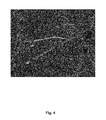
- FIG. 4 shows sample Nr. 10 (Table 2) under microscopy, at 10-times magnification. Several composite fibres are shown, wherein the aero gel particle(s) are encapsulated by the polymer,
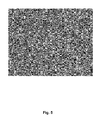
- FIG. 5 shows sample Nr. 11 (Table 2) under microscopy, at 10-times magnification.
- FIG. 6 shows sample Nr. 12 (Table 2) under microscopy, at 10-times magnification.
- FIG. 7 shows sample Nr. 13 (Table 2), electro-spun at 0.25 ml/h, imaged with SEM,
- FIG. 8 shows sample Nr. 13 (Table 2), electro-spun at 0.50 ml/h, imaged with SEM,
- FIG. 9 shows sample Nr. 13 (Table 2), electro-spun at 1.25 ml/h, imaged with SEM, and
- FIG. 10 shows sample Nr. 13 (Table 2), electro-spun at 1.50 ml/h, imaged with SEM.
- the fiber morphology is uniform and they are forming a network.
- the composite fibres are below 100 ⁇ m in diameter.
- One object of the present invention is to stabilise aero gel to make it suitable for many applications in commercial and high-tech fields.
- a specific object of the present invention is to produce an insulation material comprising aero gel particles, which can withstand mechanical stress, and at the same time protect the aero gel particles from climatic conditions.
- a composite fiber in which the aero gel particle(s) are encapsulated by a polymer matrix, as a material for producing products suitable for commercial and high-tech fields.
- a product could e.g. be an insulation material.
- an encapsulation of the aero gel particle is to be understood as the polymer matrix layer being disposed about the aero gel particle, thereby preventing the aero gel particle from being in contact with the surroundings.
- the term “fibre” refers to a unit of matter characterized by a high ratio of length-to-width.
- the fiber can be spun into yarn or made into fabric by interlacing (weaving), interloping (knitting), or interlocking (bonding).
- the term “aerogel” refers to an open-celled, mesoporous, solid foam that is composed of a network of interconnected nanostructures and that exhibit a porosity (non-solid volume) of no less than 50%.
- the term “mesoporous” refers to a material that contains pores ranging from 2 to 50 nm in diameter.
- Aerogel does not refer to a particular substance, but rather to a geometry which a substance can take on. Aerogels can be made of a wide variety of substances, including: Silica, transition metal oxides (for example, iron oxide), lanthanide and actinide metal oxides (for example, praseodymium oxide), main group metal oxides (for example, tin oxide), organic polymers (such as resorcinol-formaldehyde, phenol-formaldehyde, polyacrylates, polystyrenes, polyurethanes, and epoxies), biological polymers (such as gelatin, pectin, and agar agar), semiconductor nanostructures (such as cadmium selenide quantum dots), carbon, carbon nanotubes, and metals (such as copper and gold).
- transition metal oxides for example, iron oxide
- lanthanide and actinide metal oxides for example, praseodymium oxide
- main group metal oxides for example, tin oxide
- an aero gel is made using sol-gel chemistry to form a solvent filled high-porosity gel.
- the gel is then dried by removing the solvent without collapsing the tenuous solid phase through a process called supercritical drying.
- Other processes for the production of aerogels have been developed to lower the production costs.
- the aero gel is provided as particles of variable size, and the inventors have used an aero gel (silica based, and in powder form) supplied by Sensual Aero gel.
- the powder has a monodisperse particle distribution with a peak size of 80 ⁇ m, and a maximum particle size of 100 ⁇ m.
- the term “powder” is to be understod as a dry, bulk solid composed of a large number of very fine particles that may flow freely when shaken or tilted.
- the term “particle” is to be understood as a small localized object to which can be ascribed several physical or chemical properties such as volume or mass.
- the present invention is not limited to any specific particle size, which may range from 0.1 micrometers ( ⁇ m) to several mm.
- the particle size of the aero gel is within the range of 0.1-5000 ⁇ m, such as within the range of 0.5-4000 ⁇ m, e.g. within the range of 1-3000 ⁇ m, such as within the range of 2-2000 ⁇ m, e.g. within the range of 5-1000 ⁇ m, such as within the range of 10-950 ⁇ m, e.g.
- range of 20-900 ⁇ m such as within the range of 30-800 um, e.g. within the range of 40-750 ⁇ m, such as within the range of 50-700 ⁇ m, e.g. within the range of 60-650 ⁇ m, such as within the range of 70-600 ⁇ m, e.g. within the range of 80-550 ⁇ m, such as within the range of 90-500 ⁇ m, e.g. within the range of 100-450 ⁇ m.
- the particle size of the aero gel is below 200 ⁇ m. This may be an advantage when the composite fiber is used as an insulation material in order to prevent air to flow through the fiber.
- one aspect of the invention relates to a composite fiber comprising one or more polymer(s) and an aero gel, wherein the aero gel is encapsulated by the one or more polymer(s), and wherein the aero gel is positioned along at least a part of said composite fiber.
- Another aspect of the invention relates to a composite fiber comprising one or more polymer(s) and aero gel particles, wherein the aero gel particles are encapsulated by the one or more polymer(s), and wherein the aero gel particles are positioned along at least a part of said composite fiber.
- the inventors prepared an electrospin dope comprising a polymer micelle with a shell of polymer and a core of aero gel.
- the aero gel is in the form of a particle.
- polymer micelle refers to a well-defined spherical aggregate, having a core and a shell.
- the inventors of the present invention have prepared a new type of polymer micelle where the shell is of polymer, and the core is of aero gel.
- a second aspect of the invention relates to an electrospin dope comprising a polymer micelle with a shell of polymer and a core of aero gel.
- Another aspect of the invention relates to an electrospin dope comprising a polymer micelle with a shell of polymer and a core of aero gel particles.
- a micelle was achieved by using the right solvent to force the polymer(s) to self-assemble around the aero gel particle.
- the choice of solvent may differ depending on the type of aero gel and polymer(s).
- the polymer(s) and aero gel is not connected by covalent bonding.
- solvents are selected based on their tendency to induce the formation of a polymer micelle with a shell of polymer and a core of aero gel.
- the electrostatic attraction between the polymer(s) and the aero gel particle is only a minor driving force.
- the choice of solvent can force e.g. a hydrophobic polymer to form a micelle around a hydrophilic aero gel particle, such as a silica aero gel particle.
- the aero gel is a silica aero gel, such as a silica aero gel particle.
- the polymer(s) are homopolymer(s).
- the term “homopolymer” refers to a polymer which is formed from only one type of monomer. This is in contrast to a copolymer/heteropolymer where the polymer contains at least two different monomers.
- the polymer(s) are block co-polymer(s).
- a third aspect of the invention relates to a method for the production of an electrospin dope comprising the steps of:
- Another aspect of the invention relates to a method for the production of an electrospin dope comprising the steps of:
- the electrospin dope is then further processed by a fiber spinning technique, such as wet spinning, gel spinning, or electro-spinning.
- a fiber spinning technique such as wet spinning, gel spinning, or electro-spinning.
- the aero gel when the aero gel is a silica aero gel, it may enhance the blending or mixing with the polymer(s), when the polymer(s) comprises hydrogen bond acceptor atoms that can form hydrogen-bonding interactions with the hydroxyl groups of the silica aero gel.
- the aero gel is a silica aero gel
- the polymer comprises hydrogen bond acceptor atoms.
- the solvents of the electrospin dope should be volatile.
- the temperature of the electro-spinning step is usually performed within the range from room temperature to the melting temperature of the polymer. Temperatures lower than room temperature may also be used.
- the utilized pressure is typically about 1 bar under these conditions, but can be lowered in the case of a less volatile solvent to aid the evaporation process.
- solvents are selected based on their tendency to induce the formation of a polymer micelle with a shell of polymer and a core of aero gel.
- the selection of the solvents may in some embodiments be limited to solvents that have a relatively high vapour pressure, in order to promote the stabilization of an electro-spinning jet to create a fiber as the solvent evaporates.
- the solvent(s) has a boiling point below 120 degrees Celsius, such as within the range of 50-110 degrees Celsius, e.g. within the range of 55-105 degrees Celsius, such as within the range of 60-100 degrees Celsius, e.g. within the range of 65-95 degrees Celsius, such as within the range of 70-90 degrees Celsius.
- the solvent(s) are selected from the group consisting of an alcohol having a boiling point below 120 degrees Celsius, such as within the range of 50-110 degrees Celsius, e.g. within the range of 55-105 degrees Celsius, such as within the range of 60-100 degrees Celsius, e.g. within the range of 65-95 degrees Celsius, such as within the range of 70-90 degrees Celsius.
- the alcohol is mixed with water.
- a fourth aspect of the invention relates to a method for the production of a composite fiber, comprising the steps of:
- Another aspect of the invention relates to a method for the production of a composite fiber, comprising the steps of:
- a fifth aspect of the invention relates to a composite fiber prepared by a process comprising the steps of:
- Another aspect of the invention relates to a composite fiber prepared by a process comprising the steps of:
- the aero gel retains its structure within the composite fiber, the good insulation properties are transferred to the composite fiber.
- the polymer component/matrix contributes with the mechanical properties.
- the material is designed in such a way that the aero gel is completely encapsulated by the polymer matrix. This encapsulation contributes to the protection against climatic conditions.
- a composite fiber according to the present invention can then be processed into an insulation material, e.g. as a nonwoven material.
- nonwoven refers to a manufactured sheet, web or batt of directionally or randomly oriented fibres, bonded by friction, and/or cohesion and/or adhesion, excluding paper and products which are woven, knitted, tufted, stitch-bonded incorporating binding yarns or filaments or felted by wet-milling, whether or not additionally needled.
- the fibres may be of natural or man-made origin. They may be staple or continuous filaments or be formed in situ. In the present context, at least a part of the fibres, are fibres of the present invention.
- the main object of this study was to provide a composite fiber with aero gel particles encapsulated by polymer(s).
- the proof of concept was achieved, using an aero gel (silica based, and in powder form) supplied by Sensual Aero gel, and a poly(ethylene-glycol) with a chain length of 900 kea obtained from Sigma Aldrich.
- the aero gel powder has a monodisperse particle distribution with a peak size of 80 ⁇ m, and a maximum particle size of 100 ⁇ m.
- the electrospin dope comprising a polymer micelle with a shell of polymer and a core of aero gel
- water is added drop wise thereto. It is important that the water is added slowly, to avoid that the mixture does not separate into a water phase and a polymer phase.
- the method described above is used to mix 0.2 g, 1.5 g, 3 g, 4.5 g, 6 g and 12 g aero gel samples with 1.5 g polymer in a 50 ml solution. 20 ml ethanol or tert-butanol was added to each sample, and water was added until the total volume of each sample solution is 50 ml. The sample solutions were then wrapped with parafilm and stored for further experiments.
- Sample solutions with 0.2 g and 3 g aero gel were tested with tert-butanol and water as solvents; and sample solutions with 1.5 g, 3.0 g, 4.5 g, 6.0, and 12 g aero gel were tested with ethanol and water as solvents (Table 1).
- a representative image of both types can be seen in FIGS. 1 and 2 for tert-butanol and ethanol types, respectively. On both figures it can be seen that micelles are formed.
- Electro-spinning was performed with a syringe-pump, a high voltage supply and a grounded collector.
- a polypropylene syringe was placed in the pump, and connected with a Teflon tube to a 0.80 gauge steel needle. The distance between the tip of the needle and the grounded collector plate was measured. The high voltage supply was connected to the needle.
- the details are shown in Table 2, and examples of fibres formed by different processing parameters are shown in FIGS. 3-10 .
Landscapes
- Engineering & Computer Science (AREA)
- Chemical & Material Sciences (AREA)
- Textile Engineering (AREA)
- Mechanical Engineering (AREA)
- Chemical Kinetics & Catalysis (AREA)
- Dispersion Chemistry (AREA)
- General Chemical & Material Sciences (AREA)
- Manufacturing & Machinery (AREA)
- Organic Chemistry (AREA)
- Polymers & Plastics (AREA)
- Medicinal Chemistry (AREA)
- Health & Medical Sciences (AREA)
- Artificial Filaments (AREA)
- Spinning Methods And Devices For Manufacturing Artificial Fibers (AREA)
- Compositions Of Macromolecular Compounds (AREA)
- Nonwoven Fabrics (AREA)
Applications Claiming Priority (4)
| Application Number | Priority Date | Filing Date | Title |
|---|---|---|---|
| EP13158320 | 2013-03-08 | ||
| EP13158320.5 | 2013-03-08 | ||
| EP13158320.5A EP2775016A1 (en) | 2013-03-08 | 2013-03-08 | Polymer fibres comprising aerogel and method for production |
| PCT/EP2014/054257 WO2014135585A1 (en) | 2013-03-08 | 2014-03-05 | Polymer fibres comprising aerogel and method for production |
Publications (2)
| Publication Number | Publication Date |
|---|---|
| US20160024278A1 US20160024278A1 (en) | 2016-01-28 |
| US9683092B2 true US9683092B2 (en) | 2017-06-20 |
Family
ID=47843136
Family Applications (1)
| Application Number | Title | Priority Date | Filing Date |
|---|---|---|---|
| US14/773,453 Expired - Fee Related US9683092B2 (en) | 2013-03-08 | 2014-03-05 | Polymer fibres comprising aerogel and method for production |
Country Status (10)
| Country | Link |
|---|---|
| US (1) | US9683092B2 (pl) |
| EP (2) | EP2775016A1 (pl) |
| CA (1) | CA2941642A1 (pl) |
| DK (1) | DK2964816T3 (pl) |
| ES (1) | ES2631705T3 (pl) |
| LT (1) | LT2964816T (pl) |
| PL (1) | PL2964816T3 (pl) |
| PT (1) | PT2964816T (pl) |
| SI (1) | SI2964816T1 (pl) |
| WO (1) | WO2014135585A1 (pl) |
Cited By (2)
| Publication number | Priority date | Publication date | Assignee | Title |
|---|---|---|---|---|
| CN110143827A (zh) * | 2019-06-28 | 2019-08-20 | 东北大学 | 一种超轻弹性无机氧化物纤维气凝胶及其制备方法 |
| CN111534877A (zh) * | 2020-06-04 | 2020-08-14 | 广州市中诚新型材料科技有限公司 | 一种中药复方抗冠状病毒、流感病毒复合抗菌多功能纤维 |
Families Citing this family (14)
| Publication number | Priority date | Publication date | Assignee | Title |
|---|---|---|---|---|
| DE102015101282A1 (de) * | 2015-01-29 | 2016-08-04 | Rwth Aachen | Verfahren und Vorrichtung zur Herstellung anorganischer Aerogel-Fasern |
| JP7005490B2 (ja) * | 2015-11-17 | 2022-01-21 | プリマロフト,インコーポレイテッド | エアロゲル及びポリマー材料を含有する合成繊維並びにそれの製造方法及びそれを含む物品 |
| CN108035074B (zh) * | 2017-12-29 | 2019-05-03 | 厦门大学 | 一种二氧化硅气凝胶纳米纤维复合膜的制备方法 |
| CN110257946A (zh) * | 2019-05-28 | 2019-09-20 | 江苏康溢臣生命科技有限公司 | 一种气凝胶纤维及其制备方法 |
| CN111646816A (zh) * | 2020-05-11 | 2020-09-11 | 昆山柔维环境科技有限公司 | 一种氧化锆-氧化铝复合纤维气凝胶材料及其制备方法 |
| CN112981575A (zh) * | 2021-02-05 | 2021-06-18 | 纳诚(邢台)新材料科技有限公司 | 一种气凝胶复合纤维材料及其制备方法和应用 |
| CN113846393A (zh) * | 2021-09-07 | 2021-12-28 | 深圳中凝科技有限公司 | 一种具有皮芯结构的二氧化硅气凝胶与高聚物的杂化纤维及其制备方法和应用 |
| CN114210276B (zh) * | 2021-11-18 | 2023-05-23 | 中国安全生产科学研究院 | 兼具火灾预警与阻燃功能磁性碳基复合气凝胶及制备方法 |
| CN117089961A (zh) * | 2022-05-13 | 2023-11-21 | 际华三五四二纺织有限公司 | 一种涤纶基气凝胶纤维纯纺或混纺针织用纱制造工艺 |
| CN114892309B (zh) * | 2022-05-19 | 2023-05-12 | 华中科技大学 | 一种无源保暖多材料微结构纤维、织物及其制备方法 |
| CN116005286B (zh) * | 2023-02-03 | 2024-06-04 | 中国科学院苏州纳米技术与纳米仿生研究所 | 一种气凝胶纤维的制备方法及应用 |
| KR102931746B1 (ko) * | 2023-04-06 | 2026-02-25 | 삼성에스디아이 주식회사 | 리튬 이차 전지용 첨가제, 이를 포함하는 리튬 이차 전지용 전해액 및 리튬 이차 전지 |
| US20250084565A1 (en) * | 2023-04-27 | 2025-03-13 | Textime Manufacturing Limited | Thermally insulating aerogel composite fiber |
| CN117230571A (zh) * | 2023-09-04 | 2023-12-15 | 厦门点石新材料有限公司 | 一种气凝胶毡及其制备方法 |
Citations (2)
| Publication number | Priority date | Publication date | Assignee | Title |
|---|---|---|---|---|
| WO2012013812A1 (en) | 2010-07-30 | 2012-02-02 | Rockwool International A/S | Method for manufacturing an aerogel-containing composite and composite produced by that method |
| US20120171488A1 (en) | 2010-12-30 | 2012-07-05 | Korea Institute Of Energy Research | Sheets including fibrous aerogel and method for producing the same |
Family Cites Families (1)
| Publication number | Priority date | Publication date | Assignee | Title |
|---|---|---|---|---|
| KR101695628B1 (ko) | 2012-06-11 | 2017-01-13 | 한국에너지기술연구원 | 섬유 형태의 고분자/에어로겔을 포함하는 시트 및 그 제조방법 |
-
2013
- 2013-03-08 EP EP13158320.5A patent/EP2775016A1/en not_active Withdrawn
-
2014
- 2014-03-05 SI SI201430287T patent/SI2964816T1/sl unknown
- 2014-03-05 EP EP14709602.8A patent/EP2964816B1/en not_active Not-in-force
- 2014-03-05 DK DK14709602.8T patent/DK2964816T3/en active
- 2014-03-05 PT PT147096028T patent/PT2964816T/pt unknown
- 2014-03-05 WO PCT/EP2014/054257 patent/WO2014135585A1/en not_active Ceased
- 2014-03-05 CA CA2941642A patent/CA2941642A1/en not_active Abandoned
- 2014-03-05 PL PL14709602T patent/PL2964816T3/pl unknown
- 2014-03-05 LT LTEP14709602.8T patent/LT2964816T/lt unknown
- 2014-03-05 ES ES14709602.8T patent/ES2631705T3/es active Active
- 2014-03-05 US US14/773,453 patent/US9683092B2/en not_active Expired - Fee Related
Patent Citations (3)
| Publication number | Priority date | Publication date | Assignee | Title |
|---|---|---|---|---|
| WO2012013812A1 (en) | 2010-07-30 | 2012-02-02 | Rockwool International A/S | Method for manufacturing an aerogel-containing composite and composite produced by that method |
| US20130119294A1 (en) | 2010-07-30 | 2013-05-16 | Rockwool International A/S | Method for Manufacturing an Aerogel-Containing Composite and Composite Produced by that Method |
| US20120171488A1 (en) | 2010-12-30 | 2012-07-05 | Korea Institute Of Energy Research | Sheets including fibrous aerogel and method for producing the same |
Non-Patent Citations (2)
| Title |
|---|
| Extended European search report, dated Nov. 7, 2013, application No. EP13158320.5-1304, 4 pages. |
| Notification of Transmittal of the ISR and Written Opinion of the ISA (Form PCT/ISA/220), Int'l Search Report, and Written Opinion of the ISA, mailed May 30, 2014 by the ISA, for Int'l Application No. PCT/EP2014/054257, 7 pages. |
Cited By (3)
| Publication number | Priority date | Publication date | Assignee | Title |
|---|---|---|---|---|
| CN110143827A (zh) * | 2019-06-28 | 2019-08-20 | 东北大学 | 一种超轻弹性无机氧化物纤维气凝胶及其制备方法 |
| CN111534877A (zh) * | 2020-06-04 | 2020-08-14 | 广州市中诚新型材料科技有限公司 | 一种中药复方抗冠状病毒、流感病毒复合抗菌多功能纤维 |
| CN111534877B (zh) * | 2020-06-04 | 2021-01-15 | 广州市中诚新型材料科技有限公司 | 一种中药复方抗冠状病毒、流感病毒复合抗菌多功能纤维 |
Also Published As
| Publication number | Publication date |
|---|---|
| SI2964816T1 (sl) | 2017-08-31 |
| PT2964816T (pt) | 2017-08-11 |
| PL2964816T3 (pl) | 2017-10-31 |
| EP2964816A1 (en) | 2016-01-13 |
| CA2941642A1 (en) | 2014-09-12 |
| EP2964816B1 (en) | 2017-05-10 |
| DK2964816T3 (en) | 2017-08-07 |
| EP2775016A1 (en) | 2014-09-10 |
| LT2964816T (lt) | 2017-08-25 |
| US20160024278A1 (en) | 2016-01-28 |
| WO2014135585A1 (en) | 2014-09-12 |
| ES2631705T3 (es) | 2017-09-04 |
Similar Documents
| Publication | Publication Date | Title |
|---|---|---|
| US9683092B2 (en) | Polymer fibres comprising aerogel and method for production | |
| EP2990510A1 (en) | Composite polymer fibres comprising aerogel particles and method for production. | |
| Chen et al. | One-step electrospinning to produce nonsolvent-induced macroporous fibers with ultrahigh oil adsorption capability | |
| Guo et al. | Wet spinning technology for aerogel fiber: pioneering the frontier of high-performance and multifunctional materials | |
| Balgis et al. | Synthesis and evaluation of straight and bead-free nanofibers for improved aerosol filtration | |
| Sheng et al. | Thermal inter-fiber adhesion of the polyacrylonitrile/fluorinated polyurethane nanofibrous membranes with enhanced waterproof-breathable performance | |
| Rojas et al. | Electrospun nanocomposites from polystyrene loaded with cellulose nanowhiskers | |
| Chen et al. | Online fabrication of ultralight, three-dimensional, and structurally stable ultrafine fibre assemblies with a double-porous feature | |
| US8714776B2 (en) | Porous and non-porous nanostructures and application thereof | |
| Mi et al. | Instantaneous self-assembly of three-dimensional silica fibers in electrospinning: Insights into fiber deposition behavior | |
| US10584036B2 (en) | Method and device for producing inorganic aerogel fibers | |
| Yao et al. | Fabrication of electrospun meta-aramid nanofibers in different solvent systems | |
| Zhang et al. | Electrospinning and microwave absorption of polyaniline/polyacrylonitrile/multiwalled carbon nanotubes nanocomposite fibers | |
| KR101544538B1 (ko) | 단일 배향성 고밀도 탄소나노섬유펠트, 상기 탄소나노섬유펠트 제조방법 및 상기 탄소나노섬유펠트를 포함하는 탄소나노섬유펠트 응용제품 | |
| Ghelich et al. | Study on morphology and size distribution of electrospun NiO-GDC composite nanofibers | |
| Ding et al. | Investigation of silica nanoparticle distribution in nanoporous polystyrene fibers | |
| CN103590132A (zh) | 一种多孔结构静电纺丝纳米纤维的制备方法 | |
| Teng et al. | Zein/PVDF micro/nanofibers with improved mechanical property for oil adsorption | |
| Nie et al. | Interface hydrogen-bonded core-shell nanofibers by coaxial electrospinning | |
| Wang et al. | Preparation of flexible phenolic resin-based porous carbon fabrics by electrospinning | |
| CN108404823A (zh) | 一种静电纺丝制备高吸水3d纳米纤维气凝胶的方法及其所得材料 | |
| KR20130009465A (ko) | 다공성 시트 및 그 제조방법 | |
| Lyu et al. | Gas‐Blows‐Liquid Spinning Strategy Toward Mechanically Strong, Thermally Protective, Efficiently Hemostatic Aerogel Fibers/Fabrics | |
| Dadvar et al. | Fabrication of nanocomposite PAN nanofibers containing MgO and Al2O3 nanoparticles | |
| Zhang et al. | Ultrafine cellulose acetate fibers with nanoscale structural features |
Legal Events
| Date | Code | Title | Description |
|---|---|---|---|
| AS | Assignment |
Owner name: GABRIEL A/S, DENMARK Free format text: ASSIGNMENT OF ASSIGNORS INTEREST;ASSIGNORS:FRICKE, ANNA;FOJAN, PETER;SIGNING DATES FROM 20150914 TO 20150915;REEL/FRAME:036564/0633 |
|
| STCF | Information on status: patent grant |
Free format text: PATENTED CASE |
|
| CC | Certificate of correction | ||
| FEPP | Fee payment procedure |
Free format text: MAINTENANCE FEE REMINDER MAILED (ORIGINAL EVENT CODE: REM.); ENTITY STATUS OF PATENT OWNER: SMALL ENTITY |
|
| LAPS | Lapse for failure to pay maintenance fees |
Free format text: PATENT EXPIRED FOR FAILURE TO PAY MAINTENANCE FEES (ORIGINAL EVENT CODE: EXP.); ENTITY STATUS OF PATENT OWNER: SMALL ENTITY |
|
| STCH | Information on status: patent discontinuation |
Free format text: PATENT EXPIRED DUE TO NONPAYMENT OF MAINTENANCE FEES UNDER 37 CFR 1.362 |
|
| FP | Lapsed due to failure to pay maintenance fee |
Effective date: 20210620 |