US9706770B2 - Rodenticide bait comprising difenacoum and method for controlling target rodent pests - Google Patents
Rodenticide bait comprising difenacoum and method for controlling target rodent pests Download PDFInfo
- Publication number
- US9706770B2 US9706770B2 US15/318,195 US201515318195A US9706770B2 US 9706770 B2 US9706770 B2 US 9706770B2 US 201515318195 A US201515318195 A US 201515318195A US 9706770 B2 US9706770 B2 US 9706770B2
- Authority
- US
- United States
- Prior art keywords
- difenacoum
- bait
- trans
- amount
- proportion
- Prior art date
- Legal status (The legal status is an assumption and is not a legal conclusion. Google has not performed a legal analysis and makes no representation as to the accuracy of the status listed.)
- Expired - Fee Related
Links
- FVQITOLOYMWVFU-UHFFFAOYSA-N O=C1OC2=C(C=CC=C2)C(O)=C1C1CC(C2=CC=C(C3=CC=CC=C3)C=C2)CC2=CC=CC=C21 Chemical compound O=C1OC2=C(C=CC=C2)C(O)=C1C1CC(C2=CC=C(C3=CC=CC=C3)C=C2)CC2=CC=CC=C21 FVQITOLOYMWVFU-UHFFFAOYSA-N 0.000 description 1
Images


Classifications
-
- A—HUMAN NECESSITIES
- A01—AGRICULTURE; FORESTRY; ANIMAL HUSBANDRY; HUNTING; TRAPPING; FISHING
- A01N—PRESERVATION OF BODIES OF HUMANS OR ANIMALS OR PLANTS OR PARTS THEREOF; BIOCIDES, e.g. AS DISINFECTANTS, AS PESTICIDES OR AS HERBICIDES; PEST REPELLANTS OR ATTRACTANTS; PLANT GROWTH REGULATORS
- A01N25/00—Biocides, pest repellants or attractants, or plant growth regulators, characterised by their forms, or by their non-active ingredients or by their methods of application, e.g. seed treatment or sequential application; Substances for reducing the noxious effect of the active ingredients to organisms other than pests
- A01N25/002—Biocides, pest repellants or attractants, or plant growth regulators, characterised by their forms, or by their non-active ingredients or by their methods of application, e.g. seed treatment or sequential application; Substances for reducing the noxious effect of the active ingredients to organisms other than pests containing a foodstuff as carrier or diluent, i.e. baits
- A01N25/004—Biocides, pest repellants or attractants, or plant growth regulators, characterised by their forms, or by their non-active ingredients or by their methods of application, e.g. seed treatment or sequential application; Substances for reducing the noxious effect of the active ingredients to organisms other than pests containing a foodstuff as carrier or diluent, i.e. baits rodenticidal
-
- A—HUMAN NECESSITIES
- A01—AGRICULTURE; FORESTRY; ANIMAL HUSBANDRY; HUNTING; TRAPPING; FISHING
- A01N—PRESERVATION OF BODIES OF HUMANS OR ANIMALS OR PLANTS OR PARTS THEREOF; BIOCIDES, e.g. AS DISINFECTANTS, AS PESTICIDES OR AS HERBICIDES; PEST REPELLANTS OR ATTRACTANTS; PLANT GROWTH REGULATORS
- A01N43/00—Biocides, pest repellants or attractants, or plant growth regulators containing heterocyclic compounds
- A01N43/02—Biocides, pest repellants or attractants, or plant growth regulators containing heterocyclic compounds having rings with one or more oxygen or sulfur atoms as the only ring hetero atoms
- A01N43/04—Biocides, pest repellants or attractants, or plant growth regulators containing heterocyclic compounds having rings with one or more oxygen or sulfur atoms as the only ring hetero atoms with one hetero atom
- A01N43/14—Biocides, pest repellants or attractants, or plant growth regulators containing heterocyclic compounds having rings with one or more oxygen or sulfur atoms as the only ring hetero atoms with one hetero atom six-membered rings
- A01N43/16—Biocides, pest repellants or attractants, or plant growth regulators containing heterocyclic compounds having rings with one or more oxygen or sulfur atoms as the only ring hetero atoms with one hetero atom six-membered rings with oxygen as the ring hetero atom
-
- A—HUMAN NECESSITIES
- A23—FOODS OR FOODSTUFFS; TREATMENT THEREOF, NOT COVERED BY OTHER CLASSES
- A23K—FODDER
- A23K10/00—Animal feeding-stuffs
- A23K10/30—Animal feeding-stuffs from material of plant origin, e.g. roots, seeds or hay; from material of fungal origin, e.g. mushrooms
-
- A—HUMAN NECESSITIES
- A23—FOODS OR FOODSTUFFS; TREATMENT THEREOF, NOT COVERED BY OTHER CLASSES
- A23K—FODDER
- A23K50/00—Feeding-stuffs specially adapted for particular animals
- A23K50/50—Feeding-stuffs specially adapted for particular animals for rodents
Definitions
- the invention relates to a rodenticidal bait comprising difenacoum and a method of combating target rodent pests.
- the invention therefore relates to the technical field of combating excessive development of populations of target rodent pests.
- Rodenticidal baits and methods for combating rodent pests are already known.
- a rodenticidal bait comprises, for example, difenacoum in a proportion by mass of 50 mg per kilogram (0.005%, 50 ppm) of bait.
- WO 93/01712 describes rodenticidal baits comprising difenacoum in an amount of 0.0025% or 0.005% (by weight) in the form of granules known by the name “Klerat pellets” and packaged in a paper sachet and impregnated with denatonium benzoate as a bittering agent.
- rodenticidal baits may be ingested by predators—in particular birds—or carrion eaters of rodent pests and in particular rodent pests weakened by having eaten such a rodenticidal bait, this eating being liable to cause in the end the death of these animal predators or carrion eaters.
- the object of the invention is therefore to compensate these disadvantages by proposing a rodenticidal bait and a method of combating target rodent pests which are effective for controlling populations of rodent pests and which nevertheless allow limiting of the risks of poisoning of humans and non-target animals.
- the object of the invention in particular is such a rodenticidal bait and such a method of combating target rodent pests which allow limiting of the risks of poisoning of animal predators, such as, for example, domestic or wild mammals—in particular foxes—and bird predators or carrion eaters of rodent pests.
- animal predators such as, for example, domestic or wild mammals—in particular foxes—and bird predators or carrion eaters of rodent pests.
- the object of the invention is also such a rodenticidal bait and such a method of combating target rodent pests the implementation of which complies with the rules of good usage in particular with respect to protection of birds, and in particular birds of prey.
- the object of the invention is also such a rodenticidal bait and such a method of combating target rodent pests which allows limiting of the risks of poisoning of domestic animals and pets.
- the object of the invention is also in particular a method of combating target rodent pests which does not require the use of massive doses of rodenticidal agents and which is respectful of the environment, the health of humans and non-target animals.
- the invention relates to a rodenticidal bait comprising
- the invention thus relates to a bait that is rodenticidal towards a population of target rodent pests and comprising trans-difenacoum, in which the proportion of trans-difenacoum in the bait is greater than a minimum proportion of trans-difenacoum which is lethal to adult females of the target rodents and less than a minimum proportion of trans-difenacoum which is lethal to adult males of the target rodents, said minimum proportion which is lethal to adult females being less than the minimum proportion which is lethal to adult males.
- the invention thus relates to such a rodenticidal bait comprising difenacoum in the form of a configurational stereoisomer of difenacoum, called trans-difenacoum, said trans-difenacoum having the formula 3-(biphenyl-4-yl)-1-(4-hydroxycoumarin-3-yl)-1,2,3,4-tetrahydronaphthalene, carbon atoms 1 and 3 of the 1,2,3,4-tetrahydronaphthalene grouping of trans-difenacoum having the same absolute configuration, and an excipient which is edible for target rodent pests.
- the minimum proportion of trans-difenacoum which is lethal to adult females the population of target rodents is determined by measuring the mortality rate for adult females in batches of target rodent pests which eat baits over a predetermined period, the baits being provided to each of the batches in an amount sufficient to satisfy the appetite of the target rodents and comprising a predetermined proportion of trans-difenacoum.
- the minimum proportion of trans-difenacoum which is lethal to adult females is the proportion of trans-difenacoum of the baits which is made available to and ingested by the batch of target rodents and which has the lowest non-zero mortality rate by haemorrhage in females.
- the proportion of trans-difenacoum which is lethal to adult males of the population of target rodents is determined by measuring the mortality rate for adult males in batches of target rodent pests eating the baits over a predetermined period, the baits being made available to each of the batches in an amount sufficient to satisfy the appetite of the adult males of the target rodents and comprising a predetermined proportion of trans-difenacoum.
- the proportion of trans-difenacoum is termed non-lethal to the adult males if the baits provided to the batch of target rodents do not cause any death by haemorrhage in the target adult male rodents.
- the excipient which is edible comprises at least one food chosen from the group formed by cereal grains—in particular shelled cereal grains-, ground cereal grains, cereal grain flours, cereal grain flakes, cereal bran, non-cereal grains—for example alfalfa grains-, ground non-cereal grains, non-cereal grain flours, non-cereal grain flakes, and non-cereal plant bran.
- the excipient which is edible can comprise any food which is liable to be eaten by the target rodent pests.
- the excipient which is edible is chosen so as to be able to be eaten by target rodent pests.
- the invention thus relates to a rodenticidal bait which comprises a composition comprising trans-difenacoum in a majority in difenacoum and an excipient which is edible that is capable of stimulating target rodent pests to eat said bait.
- the excipient which is edible is non-lethal to target rodent pests.
- the excipient which is edible is not rodenticidal per se and is free of rodenticidal compounds.
- the excipient which is edible is chosen to stimulate the eating of the bait by target rodent pests and to allow eating of the bait by target rodent pests.
- the excipient which is edible comprises at least one food chosen from the group formed by foods of vegetable origin and foods of animal origin.
- the food is chosen from the group formed by grains of one or more cereals, shelled grains of one or more cereals, one or more ground cereals, flakes of one or more cereals, bran of one or more cereals and flours of one or more cereals.
- the food is chosen from the group formed by oat, wheat, barley, maize, soya and rice.
- the excipient which is edible comprises at least one sugary food.
- it may be a food comprising at least one sugar chosen from the group formed by sucrose, lactose, fructose and glucose.
- a sugar syrup for example a sugar syrup obtained by hydrolysis of starch—or a sugar syrup obtained by hydrolysis of sucrose (invert sugar syrup), or a beetroot sugar syrup, or a maple syrup, or a sugar cane syrup, or a syrup obtained from a plant of the Stevia genus.
- the excipient which is edible comprises at least one food for stimulation of the appetite of the target rodent pests chosen from the group formed by flakes and flour of coconut kernel albumen (copra).
- the excipient which is edible comprises at least one food for stimulation of the appetite of the target rodent pests chosen from the group formed by walnuts, hazelnuts and almonds—grated and/or in powder form.
- the excipient which is edible comprises at least one fatty substance chosen from the group formed by vegetable fats, vegetable oils (for example rapeseed oil, soya fat, sunflower oil, cacao butter, peanut oil, peanut butter, maize oil, palm oil), animal fats and animal oils (butter, lard, fish oil).
- vegetable oils for example rapeseed oil, soya fat, sunflower oil, cacao butter, peanut oil, peanut butter, maize oil, palm oil
- animal fats and animal oils (butter, lard, fish oil).
- the excipient which is edible comprises at least one food chosen from the group formed by animal proteins.
- animal proteins such as powdered milk—in particular skimmed milk powder—eggs—in particular powdered eggs—and hydrolysates of animal proteins.
- the rodenticidal bait is in the solid form.
- the rodenticidal bait according to the invention can be in the form of pellets, granules, a block or a paste liable to be eaten by the target rodent pests or a solid material liable to be gnawed by the target rodent pests.
- the solid rodenticidal bait according to the invention can be in the form of a rigid block, a semi-rigid block or a gel.
- the rodenticidal bait can be in the form of a powder.
- a rodenticidal bait in the form of a powder is suitable for being able to contaminate the fur of the target rodent pest(s) and for being able to be ingested by this(them) during its(their) grooming.
- the rodenticidal bait can also be in the liquid form.
- the rodenticidal bait is then a drink.
- the rodenticidal bait comprises at least one colouring agent.
- a colouring agent enables in particular said bait to be given a colour easily detectable and identifiable by a user of said rodenticidal bait.
- the rodenticidal bait comprises at least one preservative capable of ensuring it is preserved during its storage.
- the rodenticidal bait comprises at least one bittering agent—in particular an amount of denatonium benzoate.
- the rodenticidal bait comprises exclusively difenacoum as the rodenticidal substance.
- the rodenticidal bait according to the invention is free from any other anticoagulant substance for rodenticidal use.
- the rodenticidal bait can comprise another rodenticidal substance other than difenacoum and/or any other pesticidal substance, such as an insecticidal and/or acaricidal substance.
- the rodenticidal bait comprises a mass proportion of trans-difenacoum of between 1 ppm and 30 ppm—in particular between 5 ppm and 25 ppm, preferably between 5 ppm and 15 ppm.
- the rodenticidal bait according to the invention is thus a rodenticidal bait having a low dose of trans-difenacoum as the substance which inhibits vitamin K epoxide reductase complex subunit 1 (VKORC1).
- the proportion (in ppm) of trans-difenacoum in the bait is expressed by the amount—in particular by mass—of trans-difenacoum based on the amount—in particular a mass—of bait.
- the proportion of trans-difenacoum in the rodenticidal bait is a proportion by mass of between 4 ppm and 12 ppm.
- the difenacoum is in a majority in the form of trans-difenacoum.
- trans-difenacoum is in a majority in the difenacoum.
- the expression according to which trans-difenacoum is in a majority in the difenacoum indicates that the amount (by mass, molar or by volume) of trans-difenacoum is in a majority—greater than 50%—in the total difenacoum present in the bait (in all its configurational stereoisomeric forms) according to the invention.
- the rodenticidal bait comprises trans-difenacoum in a majority in the difenacoum, the trans-difenacoum being the configurational stereoisomer of difenacoum—named homostereoisomer of difenacoum—in which the two carbon atoms 1 and 3 of the 1,2,3,4-tetrahydronaphthalane grouping have the same absolute configuration.
- the bait comprises an amount of trans-difenacoum in a majority based on the total amount of difenacoum.
- the bait comprises trans-difenacoum in a majority based on all of the configurational stereoisomers—trans-difenacoum and cis-difenacoum—of the difenacoum.
- the bait comprises difenacoum in a majority in the form of trans-difenacoum.
- trans-difenacoum and cis-difenacoum do not have the same hepatic persistence in the target rodent pests and that trans-difenacoum is in fact the configurational stereoisomer of difenacoum which has a lower hepatic persistence in the target rodents, in particular in the target rodent pests. They have found that when it is ingested by a target rodent pest, the trans-difenacoum of a bait disappears from the liver of the target rodent pest which has eaten such a bait according to the invention more quickly than cis-difenacoum.
- the dead or alive target rodent pest which has ingested said bait is less dangerous to non-rodent mammals and birds which eat the target rodent pest and in particular to predators (non-rodent mammals and birds) which preferentially eat the internal organs of their prey and in particular their liver.
- Such a bait according to the invention comprising in a majority trans-difenacoum of lesser hepatic persistence in the target rodent pests in fact allows effective combating of target rodent pests.
- trans-difenacoum is present in the bait in an amount greater than 50%—in particular greater than 70%, preferably of between 80% and 100%, more preferably between 90% and 99%—based on the total amount of difenacoum.
- trans-difenacoum is present in the bait in an amount of between 92% and 98%, based on the total amount of difenacoum.
- the bait can comprise the other configurational stereoisomer of difenacoum, named cis-difenacoum, in which carbon atoms 1 and 3 of the 1,2,3,4-tetrahydronaphthalene grouping of difenacoum have different absolute configurations.
- said cis-difenacoum is present in the bait in an amount of less than 50%—in particular less than 30%, preferably between 0% and 20%, in particular less than 10%, more preferably of the order of 5%—based on the total amount of difenacoum.
- the bait can be free from cis-difenacoum.
- the cis-difenacoum is present in the bait in a proportion that is non-lethal to the target rodents.
- the cis-difenacoum and the trans-difenacoum are present in the bait in a cis-difenacoum/trans-difenacoum mole ratio that is within the range [0:1/19] (0 excluded, 1/19 included).
- the invention also relates to a method of selective combating of a population of target rodent pests by scattering a bait liable to be ingested by the target rodent pests and comprising trans-difenacoum, characterised in that the bait comprises an excipient which is edible for the target rodent pests and a proportion of trans-difenacoum in the bait which is greater than a minimum proportion which is lethal to adult females of the target rodents and less than a minimum proportion which is lethal to adult males of the target rodents, said minimum proportion which is lethal to adult females being less than the minimum proportion which is lethal to adult males, and in that these baits are scattered in an amount sufficient to be lethal to adult females of the target rodents.
- the invention thus relates to a method of selective combating of a population of target rodent pests by scattering a bait liable to be ingested by the target rodent pests, said bait comprising:
- the invention thus relates to such a method of selective combating of a population of target rodent pests by scattering a bait liable to be ingested by the target rodent pests, in which the bait comprises:
- an amount of rodenticidal bait liable to be ingested by the target rodent pests is made available to the target rodent pests, said amount of bait being sufficient to kill females of the target rodent pests, said bait comprising trans-difenacoum in a proportion which is greater than a minimum proportion which is lethal to adult females of the target rodents and less than a minimum proportion which is lethal to adult males of the target rodents.
- the proportion of trans-difenacoum in the bait and the amount of bait scattered are adjusted such that—in particular following eating during several days of at least some of the bait by the females—the females of the population of rodents are killed, without the intention being to kill the males of the rodent population.
- an amount of baits in particular an amount of baits having lower doses of trans-difenacoum than the known baits comprising difenacoum—and which are thus less toxic to the environment and to non-target animals liable to eat said bait only occasionally and accidentally is scattered.
- such bait which is less toxic to non-target animals (for example predators of the target rodents) liable to eat the target rodents—dead or alive—which have ingested an amount of said bait is scattered.
- the method according to the invention remains effective for combating the development of populations of target rodent pests by aiming selectively at the females of the target rodent pests.
- the inventors have found, totally surprisingly and unforeseeably, that the hepatic persistence of difenacoum in the adult females of target rodent pests which have eaten such a bait comprising trans-difenacoum—in particular a bait having a low dose of trans-difenacoum—is greater than the hepatic persistence of difenacoum in the adult males.
- the adult females of target rodent pests have an increased coagulation time compared with the coagulation time of the adult males and are more sensitive than the adult males to baits comprising trans-difenacoum—in particular to baits having low doses of trans-difenacoum.
- a method of selective combating according to the invention is a method of selective combating according to the invention:
- a method of selective combating according to the invention thus allows the female target rodent pests to be aimed at selectively, limiting the increase in the population of target rodent pests while limiting the risks of poisoning of a human being or non-target animals or predators and/or carrion eaters of the target rodent pests.
- the proportion of trans-difenacoum in the bait and the amount of bait scattered are adjusted to achieve:
- the proportion of trans-difenacoum in the bait is chosen in combination with the amount of bait scattered such that adult females of the target rodents eat during a single period of 24 consecutive hours an amount of bait that is sufficient to be lethal to said adult females of the target rodents consuming said bait.
- an amount of bait is scattered that is sufficient to be lethal to the females of target rodent pests eating said bait during a single period of 24 consecutive hours, without the intention being to kill the males of the population of rodents.
- a bait which is fatal in a single dose, or “one-shot” bait is scattered.
- a single eating of the bait by females of target rodent pests is sufficient to cause the death of females of target rodent pests.
- the proportion of trans-difenacoum in the bait is chosen in combination with the amount of bait scattered such that the adult females of target rodent pests eat an amount of difenacoum that is:
- an amount of bait is scattered which is sufficient to be lethal to the females of target rodent pests ingesting said baits during at least two consecutive days but which is insufficient to cause the death of target rodent pests or of non-target animals by accidental ingestion of a single ration of said baits.
- the proportion of trans-difenacoum in the bait is chosen in order to be able to achieve in the females of the target rodent pests which have eaten such a bait during at least two consecutive days a minimum amount of trans-difenacoum which is lethal to said adult females, and to achieve in the adult males of the target rodent pests which have eaten such a bait during at least two consecutive days an amount of trans-difenacoum which is non-lethal to said adult males.
- the proportion of trans-difenacoum in the bait and the amount of bait scattered are chosen in order to allow the adult female(s) to ingest a daily dose by mass of trans-difenacoum of between 0.2 and 10 mg—preferably between 0.2 and 2 mg—of trans-difenacoum per kilogram of adult female.
- the amount of trans-difenacoum which is lethal to the adult female(s) is achieved after ingestion of a plurality of daily doses of said bait by the adult female(s).
- the females of the target rodent pests are eliminated progressively after several successive ingestions of daily doses of bait having a low dose of trans-difenacoum.
- the proportion of trans-difenacoum in the bait and the amount of bait scattered are chosen in order to be able to achieve in the liver of the adult females on the day (D+4) following the third day (D+3) of a period of three consecutive days (D+1, D+2 and D+3), each day of said period comprising at least one ingestion of bait, an amount of trans-difenacoum of less than or equal to 10 ⁇ g—in particular between 3 ⁇ g and 8 ⁇ g—of trans-difenacoum per gram of liver of said adult females.
- the proportion of trans-difenacoum in the bait and the amount of bait scattered are chosen in order to be able to achieve in the liver of the adult females, on the day following a third ingestion of three successive daily ingestions, an amount of trans-difenacoum less than or equal to 10 ⁇ g of trans-difenacoum per gram of liver of said adult females.
- the period of three consecutive days during which a target rodent pest ingests the bait can start by counting from a first ingestion of bait by a target rodent pest. It can also start by counting from the start of scattering of the bait.
- the proportion of trans-difenacoum in the bait is adjusted in order to be able to achieve in the liver of the adult males on the day (D+4) following the third day (D+3) of a period of three consecutive days (D+1, D+2 and D+3), each day of said period comprising at least one ingestion of bait, an amount of trans-difenacoum less than or equal to 3 ⁇ g of trans-difenacoum per gram of liver of the adult males.
- a bait according to the invention in a method of selective combating of a population of target rodent pests, is used.
- a first independent aspect of a bait and a method of selective combating of a population of target rodent pests relates to a method of combating a population of target rodent pests by scattering baits liable to be ingested by the target rodent pests and comprising difenacoum, in which trans-difenacoum, which is the configurational stereoisomer of difenacoum which is less persistent in the liver of the target rodent pests, is in a majority in the difenacoum.
- an amount of rodenticidal bait that is to say a bait comprising a proportion in a majority of trans-difenacoum, said amount of bait being sufficient to be rodenticidal, is scattered.
- the method according to this first aspect thus allows limiting of the secondary poisoning of non-rodent mammals and birds liable to feed on poisoned rodents which are dead or alive but contain a rodenticidal amount of difenacoum.
- the method according to this first aspect also allows limiting of such a secondary poisoning of non-rodent mammals and birds liable to preferentially eat the internal organs—in particular the liver—of said poisoned rodents which are dead or alive.
- the bait comprises cis-difenacoum, but in a proportion that is non-lethal to the target rodents.
- the mole ratio of cis-difenacoum and of trans-difenacoum in the bait is within the range [0; 1/19] (0 excluded, 1/19 included).
- a second independent aspect of a bait and of a method of selective combating of a population of target rodent pests according to the invention relates to a method of combating target rodent pests in which:
- This second aspect thus relates in particular to a method of combating target rodent pests in which an amount of bait which is lethal to target rodent pests which persistently eat this bait and non-lethal to the non-target rodents or animals which accidentally eat this bait is scattered.
- This is thus referred to as a “multi-dose” or “multi-feeding” method of combating target rodent pests.
- eating of the bait by a target rodent pest for a duration of 24 hours is insufficient to cause the death of said rodent, whereas repeated eating of baits during at least two consecutive days allows the death of the target rodent pest to be caused.
- a single eating of baits is insufficient to cause the death of a target rodent pest, whereas repeated eating of baits for at least two consecutive days allows the death of the target rodent pest to be caused.
- difenacoum is in a mass proportion of less than 200 ppm in the bait, that is to say less than 200 mg of difenacoum per kilogram of bait.
- the mass proportion of difenacoum is between 1 ppm and 30 ppm. It may particularly be between 10 ppm and 100 ppm (10 mg to 100 mg of difenacoum per kilogram of bait), especially between 10 ppm and 50 ppm (10 mg to 50 mg of difenacoum per kilogram of bait).
- the mass proportion of difenacoum is between 5 ppm and 25 ppm, preferably between 5 ppm and 15 ppm, more preferentially about 15 ppm (15 mg of difenacoum per kg of bait).
- the mass proportion of difenacoum in the bait represents the mass of difenacoum based on the mass of the bait comprising difenacoum.
- the invention also relates to a rodenticidal bait, a method of combating and a method of selective combating of target rodent pests, characterised in combination by all or some of the characteristics mentioned above or below.
- FIG. 1 is a proton NMR spectrum of trans-difenacoum
- FIG. 2 is a proton NMR spectrum of cis-difenacoum
- FIG. 3 is a comparative graphical representation of the hepatic persistence of trans-difenacoum and of cis-difenacoum in the rat;
- FIG. 4 is a graphical representation of the hepatic persistence (in ⁇ g/g of liver) at D 4 and the Quick time (QT) of male rats which have received treatment with three doses (D 1 , D 2 and D 3 ) of a solution comprising trans-difenacoum administered in an amount of 0.6; 1.2 or 2.6 mg of difenacoum per kilogram of rat;
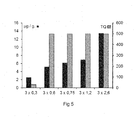
- FIG. 5 is a graphical representation of the hepatic persistence (in ⁇ g/g of liver) at D 4 and the Quick time (QT) of female rats which have received treatment with three doses (D 1 , D 2 and D 3 ) of a solution comprising trans-difenacoum administered in an amount of 0.3; 0.6; 0.75; 1.2 or 2.6 mg of difenacoum per kilogram of rat.
- a rodenticidal bait according to the invention comprises trans-difenacoum as the rodenticidal agent and at least one attractant substance for target rodent pests, said attractant substance being capable of stimulating the appetite of species of target rodent pests and the ingestion of said bait by the target rodent pests.
- trans-Difenacoum is obtained by any method allowing the separation of the cis/trans configurational stereoisomers of difenacoum.
- the document EP 0 175 466 discloses a method for the separation of the trans and cis configurational stereoisomers of difenacoum by selective precipitation of the cis configurational stereoisomer from a solution of the configurational stereoisomers in an alcohol such as ethanol.
- trans-difenacoum and cis-difenacoum configurational stereoisomers by chromatography, for example by high performance liquid chromatography (HPLC), and to form a mixture enriched in trans-difenacoum or a composition of trans-difenacoum essentially free from cis-difenacoum.
- HPLC high performance liquid chromatography
- Such an enrichment is carried out by HPLC, for example on a C8 (250 mm ⁇ 10 mm) column kept at the temperature of 30° C.
- the mobile phase is formed from 80% acetonitrile and 20% acid water.
- the flow rate of the mobile phase is kept at 2 ml/min.
- the trans-difenacoum and the cis-difenacoum are detected by spectrophotometric analysis at the wavelength of 258 nm.
- the reverse stationary phase has a particle size of 5 ⁇ m, a porosity of 80 ⁇ and a specific surface area of 500 m 2 /g.
- the mobile phase is made up of a mixture of acetonitrile (62%), isopropanol (3%) and ammonium acetate (35%) adjusted to pH 4 with acetic acid.
- the flow rate of the mobile phase is 1.5 ml/min and the detection is carried out by spectrophotometry at 260 nm.
- a “trans” configurational stereoisomer of which the retention time is of the order of 5.74 min and another “cis” configurational stereoisomer of which the retention time is of the order of 4.87 min are detected and collected.
- the separation of the “trans” and “cis” configurational stereoisomers of difenacoum can also be carried out by ultra-performance liquid chromatography (UPLC, Waters) on an Acquity Waters chain comprising an Acquity UPLC BEH C18 column of 1.7 ⁇ m particle size and dimensions of 2.1 ⁇ 50 mm at 35° C.
- the mobile phase is formed by a gradient of an aqueous solution of trifluoroacetic acid (TFA, 0.1%) and a solution of TFA, 0.1% in acetonitrile.
- the flow rate of the mobile phase is 0.6 ml/min.
- the retention time of the configurational stereoisomer retained the most (“trans”) is 8.2 min and that of the configurational stereoisomer retained the least (“cis”) is of the order of 7.3 min.
- the separation of the “trans” and “cis” configurational stereoisomers of difenacoum can also be carried out by high pressure liquid chromatography (HPLC) on an XBridge C18 column (dimensions of 4.6 ⁇ 150 mm and particle size of 5 ⁇ m) and with a mobile phase formed by 45% of an aqueous 0.1% solution of TFA and 55% of a solution of TFA at 0.1% in acetonitrile.
- the flow rate of the mobile phase is 1.2 ml/min.
- the retention time of the configurational stereoisomer retained the most (“trans”) is 23.7 min and that of the configurational stereoisomer retained the least (“cis”) is of the order of 21.0 min.
- the proton NMR spectrum of the “trans” configurational stereoisomer of difenacoum is shown in FIG. 1 and the proton NMR spectrum of the “cis” configurational stereoisomer of difenacoum is shown in FIG. 2 .
- the proton NMR spectrum of trans-difenacoum has a triplet (4.5399 ppm, 4.5644 ppm and 4.5876 ppm) characteristic of the proton carried by carbon atom 1 of the 1,2,3,4-tetrahydronaphathalene grouping.
- the proton NMR spectrum of cis-difenacoum has a quartet (4.8180 ppm, 4.8374 ppm, 4.8550 ppm and 4.8721 ppm) characteristic of the proton carried by carbon atom 1 of the 1,2,3,4-tetrahydronaphathalene grouping.
- trans-Difenacoum has a hepatic persistence significantly lower than that of cis-difenacoum.
- trans-difenacoum is dispersed in an amount of an attractant and nutritive substance for target rodent pests by any method known per se to the person skilled in the art.
- the amounts of trans-difenacoum and attractant substance are chosen such as to form a rodenticidal bait according to the invention comprising trans-difenacoum in a proportion greater than the minimum proportion which is lethal in less than 10 days to the adult females of the target rodent pests and non-lethal to the adult males of the target rodent pests.
- Such a proportion of trans-difenacoum in the rodenticidal bait is adjusted so that female target rodent pests eating the rodenticidal bait, the attractant substance and the trans-difenacoum, ingest an amount of trans-difenacoum which is sufficient to obtain the rodenticidal effect and to control the population of target rodent pests.
- the doses of cis-difenacoum and trans-difenacoum used are 2.6 mg of cis-difenacoum or trans-difenacoum per kilogram of rat.
- the dose of 2.6 mg of cis-difenacoum and trans-difenacoum per kilogram of rat corresponds to 4 times the median lethal dose (LD 50 ) of difenacoum for rats.
- the dose of 5.2 mg of cis-difenacoum or trans-difenacoum per kilogram of rat corresponds to 8 times the median lethal dose (LD 50 ) of difenacoum for rats.
- 3 ml blood samples are taken from the rats anaesthetised with isoflurane in sample tubes containing citrate (3.2%). The tubes are centrifuged at 2,000 g for 10 minutes and the plasma fraction is collected.
- the coagulation time (Quick time) of the plasma is analysed by means of the “Neoplastine CI Determination of Prothrombin Time” kit (Diagnostica Stago, Asimba, France) by measurement on a Thrombotimer option 2 plus (Behnk Electronik, Norderstedt, Germany).
- the normal value for the coagulation time of untreated rats is 10 to 20 seconds.
- the administration (D 0 ) per os of cis-difenacoum in an amount of 2.6 mg of cis-difenacoum per kilogram of rat or of trans-difenacoum in this same dosage of 2.6 mg/kg of rat causes a significant increase in the coagulation time of the rats at 1 day after the administration (D +1 ).
- the coagulation time (D +1 ) of the blood of rats treated with a dosage of 2.6 mg of cis-difenacoum or trans-difenacoum per kilogram of rat is 62 seconds.
- the administration per os of trans-difenacoum in this same dosage (2.6 mg/kg) or in double the dosage (5.2 mg/kg) certainly causes an increase in the coagulation time (62 s and 84 s) on D +1 , but leads to a value of the Quick time on D +3 which is low (10 to 20 s) and of the order of size of the Quick time of an untreated control. No indication was therefore given to the inventors to choose a rodenticidal bait comprising trans-difenacoum in a majority.
- a control composition of the prior art comprising a molar proportion of cis-difenacoum of 56% and a molar proportion of trans-difenacoum of 44% is administered per os to seven groups of four male laboratory rats (Sprague Dawley rats, Charles River, Saint germain sur l'Arbresle, France) weighing between 180 and 220 g in an amount of 5.2 mg of difenacoum per kilogram of rat.
- D +1 , D +3 , D +5 , D +7 , D +10 , D +14 and D +21 , 4 rats are sacrificed. The livers are removed and weighed.
- a liquid/solid extraction of difenacoum with acetone is performed.
- the difenacoum is analysed by HPLC on a C8 (250 mm ⁇ 10 mm) column kept at 30° C. with a mobile phase formed from 80% acetonitrile and 20% acid water.
- the flow rate of the mobile phase is kept at 2 ml/min and the trans-difenacoum and cis-difenacoum are detected by spectrophotometric analysis at the wavelength of 258 nm.
- the trans-difenacoum and cis-difenacoum are quantified by calibration with known amounts of trans-difenacoum and cis-difenacoum. The results are given in FIG.
- trans-difenacoum in which the hepatic persistence of trans-difenacoum is represented by solid squares ( ⁇ ) and the hepatic persistence of cis-difenacoum is represented by open diamonds ( ⁇ ).
- the molar proportion of trans-difenacoum administered to the rats is 46%
- the hepatic concentration (expressed in ⁇ g of difenacoum per g of liver) of trans-difenacoum at D +1 is only of the order of 1 ⁇ g/g, trans-difenacoum being almost undetectable from D +3 , only the cis-difenacoum remaining (4 ⁇ g/g).
- the concentration on D +1 of trans-difenacoum in the liver of the female rats (3.3 ⁇ g/g of liver) is greater than the concentration of trans-difenacoum in the liver of the male rats (0.9 ⁇ g/g of liver).
- the value of the concentration of trans-difenacoum in the liver is greater in the female rats in comparison with the male rats.
- the kinetics of the hepatic elimination of trans-difenacoum are slower in the female rats than in the male rats, in particular during the first 3 days. For the same dosage, the hepatic concentrations of trans-difenacoum are thus higher in the female at least up to three days after treatment (D 0 ).
- Multi-Feeding Treatment of Trans-Difenacoum to Male Rats, Multi-Dose Treatment (“Multi-Feeding”).
- trans-difenacoum in an amount of 0.6 mg/kg, 1.2 mg/kg or 2.6 mg/kg (mg of trans-difenacoum per kilogram of male rat) is administered daily to “Sprague Dawley” male rats weighing between 180 and 220 g.
- D +3 the coagulation time of these male rats is measured and the concentration of trans-difenacoum in the liver of these male rats (expressed in ⁇ g of trans-difenacoum per g of liver) is analysed. The results are given in FIG. 4 .
- Multi-Feeding Treatment
- trans-difenacoum in an amount of 0.3 mg/kg; 0.6 mg/kg; 0.75 mg/kg; 1.2 mg/kg or 2.6 mg/kg (mg of trans-difenacoum per kilogram of female rat) is administered to female “Sprague Dawley” rats in an amount of one dose per day.
- D +4 the coagulation time of these female rats is measured and the concentration of trans-difenacoum in the liver (expressed in ⁇ g of difenacoum per g of liver) of these female rats is analysed. The results are given in FIG. 5 .
- the administration for three days (D 0 , D +1 and D +2 ) in an amount of a dose of trans-difenacoum greater than 0.3 mg/kg/day to female rats achieves at D +4 a high value of the coagulation time (greater than or equal to 500 seconds) in these female rats and a moderate hepatic persistence of less than 10 ⁇ g of trans-difenacoum per gram of liver for a dose of less than 2.6 mg/kg.
- a rodenticidal bait comprising trans-difenacoum in a majority and a method of combating target rodent pests using such a rodenticidal bait according to the invention allows an anticoagulant effect to be obtained on repeated administration (multi-dose) of trans-difenacoum and very low hepatic concentrations in the male rats with a dosage of 3 times 2.6 mg/kg and in the female rats with a dosage of less than 2.6 mg/kg.
- the hepatic concentration of trans-difenacoum is of the order of 2 ⁇ g/g of liver of the male rat the day following the last dose of rodenticidal bait.
- the mass of a rat liver is of the order of 10 g
- the global amount of trans-difenacoum is 20 ⁇ g per liver
- the liver contains half the trans-difenacoum ingested by the rodent
- a rat corpse would contain about 40 ⁇ g of trans-difenacoum. Consequently, the corpses of rats killed by ingestion of a bait according to the invention present a reduced ecotoxicological risk with respect to corpses of rats killed by ingestion of a bait of the prior art.
- the hepatic concentration of trans-difenacoum of female rats treated with a bait allowing the administration of 2.6 mg of trans-difenacoum per day and per kilogram of rat for 3 days is of the order of 12 ⁇ g/g of liver. Since predators of rodents rapidly eliminate trans-difenacoum, a corpse of a female target rodent pest containing such a dose of trans-difenacoum is much less dangerous to the environment than a corpse of a female target rodent pest containing the same amount of the cis-difenacoum configurational stereoisomer.
- trans-difenacoum in a bait in which trans-difenacoum is in a majority is less dangerous to species exposed to the risk of primary intoxication (ingestion of the bait according to the invention by a non-target animal—by a dog, for example).
- Eating a bait according to the invention containing trans-difenacoum in a majority is liable to present problems to a non-target animal only if said non-target animal can have access to significant amounts of said rodenticidal bait repeatedly over time. The risk is thus reduced considerably with respect to the use of a commercial mixture which is liable to cause a fatal intoxication in the dog in a single dose.
- Rodenticidal baits are prepared by dispersing an amount of difenacoum in a paste based on flour and vegetable fat such that the bait contains 50 mg of difenacoum per kilogram of bait (50 ppm of difenacoum).
- Rodents (10 Sprague Dawley (SD) rats, 5 males and 5 females) are placed in individual cages. During 4 days (D1, D2, D3 and D4) each rat is supplied with an amount of bait sufficient to satisfy its appetite. At the end of these 4 days food free from bait is provided. The daily consumption of each bait is measured by weighing. On the death of the animal the liver of the dead animal is removed, frozen and stored until the hepatic content of configurational stereoisomers of difenacoum is analysed.
- the bait according to the invention (91/9) is eaten by the rats with the same mean daily amount as the baits (2/98 or 18/82) not enriched in trans-difenacoum.
- the time at which death occurs in the animals having eaten the bait according to the invention is shorter (D4-D8) than the time at which death occurs in the animals having eaten baits 38/62 (D4 to D9) and 4/96 (D5 to D9).
- trans-difenacoum/cis-difenacoum represents the amount (molar or by mass) of trans-difenacoum relative to the amount (molar or by mass) of cis-difenacoum in the bait made available to the rats
- Residue represents the percentage of difenacoum (trans-difenacoum and cis-difenacoum) detected in the liver of the rats relative to the total mean amount of difenacoum ingested by each rat.
- the mean content of difenacoum in the liver of the male rats is 8.4 ⁇ s (4.3 ⁇ s of trans-difenacoum and 4.1 ⁇ g of cis-difenacoum), 13.5 ⁇ s (1.4 ⁇ s of trans-difenacoum and 12.1 ⁇ s of cis-difenacoum) and 21.9 ⁇ s (0.2 ⁇ s of trans-difenacoum and 21.7 ⁇ s of cis-difenacoum) per male rat treated, respectively, with the baits (91/9), (38/62) and (4/96).
- the residues of difenacoum in the liver of the male rats are minimised with the use of the bait according to the invention.
- the mean content of difenacoum in the liver of the female rats is 14.9 ⁇ s (8.5 ⁇ s of trans-difenacoum and 6.4 ⁇ g of cis-difenacoum), 16.4 ⁇ s (1.1 ⁇ g of trans-difenacoum and 15.2 ⁇ g of cis-difenacoum) and 10.8 ⁇ g (10.7 ⁇ g of cis-difenacoum) per female rat treated with, respectively, the baits (91/9), (38/62) and (4/96).
- the residues of difenacoum in the liver of the female rats are minimised with the use of the bait according to the invention.
- the residues of difenacoum in the liver of the male rats are also minimised with respect to the residues of difenacoum in the liver of the female rats with the use of the bait (91/9) according to the invention.
- a bait (91/9) comprising trans-difenacoum in a majority thus allows limiting of the residues of difenacoum in the liver of rodents and their secondary toxicity to predators of rodents or carrion eaters of corpses of rodents.
- Rodenticidal baits are prepared by dispersing an amount of difenacoum in a paste based on flour and vegetable fat such that the bait contains 15 mg of difenacoum per kilogram of bait (15 ppm of difenacoum).
- the bait comprising 15 ppm of difenacoum according to the invention (essentially of the order of 100% trans-difenacoum in the difenacoum) is eaten by the rats with the same mean daily amount as the bait (100% cis-difenacoum).
- the time at which death occurs in the animals having eaten the bait according to the invention is comparable (D5-D8) to the time at which death occurs in the animals having eaten the bait having a low dose of trans-difenacoum (D4 to D9).
- a bait according to the invention comprising trans-difenacoum in a majority thus allows limiting of the residues of difenacoum in the liver of rodents and their secondary toxicity to predators of rodents or carrion eaters of corpses of rodents while preserving a rodenticidal efficacy of the order of 70% with a bait having a low dose of 15 ppm.
- a rodenticidal bait and a method of combating at least one species of target rodent pests are subject to an infinite number of variants both in the formulation of the bait and in the modes of implementation of the method.
Landscapes
- Life Sciences & Earth Sciences (AREA)
- Engineering & Computer Science (AREA)
- Health & Medical Sciences (AREA)
- Zoology (AREA)
- General Health & Medical Sciences (AREA)
- Polymers & Plastics (AREA)
- Chemical & Material Sciences (AREA)
- Food Science & Technology (AREA)
- Environmental Sciences (AREA)
- Dentistry (AREA)
- Wood Science & Technology (AREA)
- Agronomy & Crop Science (AREA)
- Plant Pathology (AREA)
- Pest Control & Pesticides (AREA)
- Animal Husbandry (AREA)
- Toxicology (AREA)
- Molecular Biology (AREA)
- Mycology (AREA)
- Physiology (AREA)
- Botany (AREA)
- Biotechnology (AREA)
- Birds (AREA)
- Catching Or Destruction (AREA)
- Agricultural Chemicals And Associated Chemicals (AREA)
Applications Claiming Priority (3)
| Application Number | Priority Date | Filing Date | Title |
|---|---|---|---|
| FR1455437 | 2014-06-13 | ||
| FR1455437A FR3022109B1 (fr) | 2014-06-13 | 2014-06-13 | Composition comprenant du difenacoum, appat rodonticide et procede de lutte contre des rongeurs cibles nuisibles |
| PCT/EP2015/063026 WO2015189319A1 (fr) | 2014-06-13 | 2015-06-11 | Appât rodonticide comprenant du difénacoum et procédé de lutte contre des rongeurs cibles nuisibles |
Publications (2)
| Publication Number | Publication Date |
|---|---|
| US20170105408A1 US20170105408A1 (en) | 2017-04-20 |
| US9706770B2 true US9706770B2 (en) | 2017-07-18 |
Family
ID=51570583
Family Applications (1)
| Application Number | Title | Priority Date | Filing Date |
|---|---|---|---|
| US15/318,195 Expired - Fee Related US9706770B2 (en) | 2014-06-13 | 2015-06-11 | Rodenticide bait comprising difenacoum and method for controlling target rodent pests |
Country Status (6)
| Country | Link |
|---|---|
| US (1) | US9706770B2 (fr) |
| EP (1) | EP3154341B1 (fr) |
| AR (1) | AR100834A1 (fr) |
| ES (1) | ES2710699T3 (fr) |
| FR (1) | FR3022109B1 (fr) |
| WO (1) | WO2015189319A1 (fr) |
Families Citing this family (1)
| Publication number | Priority date | Publication date | Assignee | Title |
|---|---|---|---|---|
| US11877576B2 (en) | 2018-06-22 | 2024-01-23 | Ideaz, Llc | Diphenyl tablets and methods of preparing the same |
Citations (3)
| Publication number | Priority date | Publication date | Assignee | Title |
|---|---|---|---|---|
| EP0147052A2 (fr) | 1983-12-14 | 1985-07-03 | Imperial Chemical Industries Plc | Agents rodenticides |
| WO1993001712A1 (fr) | 1991-07-16 | 1993-02-04 | Zeneca Limited | Emballage d'appats pour rongeurs |
| EP2090164A1 (fr) | 2008-02-15 | 2009-08-19 | Zapi Industrie Chimiche S.p.A. | Appât rodenticide basé sur une association synergique d'ingrédients actifs anticoagulants |
-
2014
- 2014-06-13 FR FR1455437A patent/FR3022109B1/fr not_active Expired - Fee Related
-
2015
- 2015-06-11 ES ES15727428T patent/ES2710699T3/es active Active
- 2015-06-11 EP EP15727428.3A patent/EP3154341B1/fr not_active Not-in-force
- 2015-06-11 US US15/318,195 patent/US9706770B2/en not_active Expired - Fee Related
- 2015-06-11 WO PCT/EP2015/063026 patent/WO2015189319A1/fr not_active Ceased
- 2015-06-12 AR ARP150101890A patent/AR100834A1/es unknown
Patent Citations (3)
| Publication number | Priority date | Publication date | Assignee | Title |
|---|---|---|---|---|
| EP0147052A2 (fr) | 1983-12-14 | 1985-07-03 | Imperial Chemical Industries Plc | Agents rodenticides |
| WO1993001712A1 (fr) | 1991-07-16 | 1993-02-04 | Zeneca Limited | Emballage d'appats pour rongeurs |
| EP2090164A1 (fr) | 2008-02-15 | 2009-08-19 | Zapi Industrie Chimiche S.p.A. | Appât rodenticide basé sur une association synergique d'ingrédients actifs anticoagulants |
Non-Patent Citations (3)
| Title |
|---|
| International Search Report, dated Aug. 21, 2015, from corresponding PCT Application. |
| M. J. WINN, J. A. D. CLEGG, B. K. PARK: "An investigation of sex-linked differences to the toxic and to the pharmacological actions of difenacoum: studies in mice and rats", JOURNAL OF PHARMACY AND PHARMACOLOGY, vol. 39, no. 3, 1 March 1987 (1987-03-01), pages 219 - 222, XP055148402, ISSN: 00223573, DOI: 10.1111/j.2042-7158.1987.tb06252.x |
| Winn, M.J., et al: "An investigation of sex-linked differences to the toxic and to the pharmacological actions of difenacoum: studies in mice and rats", Journal of Pharmacy and Pharmacology, vol. 39, No. 3, Mar. 1, 1987 (Mar. 1, 1987), pp. 219-222, XP055148402, ISSN: 0022-3573, DOI: 10.1111/j.2042-7158.1987.tb06252.x. |
Also Published As
| Publication number | Publication date |
|---|---|
| EP3154341B1 (fr) | 2018-11-07 |
| AR100834A1 (es) | 2016-11-02 |
| FR3022109B1 (fr) | 2017-10-20 |
| US20170105408A1 (en) | 2017-04-20 |
| FR3022109A1 (fr) | 2015-12-18 |
| WO2015189319A1 (fr) | 2015-12-17 |
| ES2710699T3 (es) | 2019-04-26 |
| EP3154341A1 (fr) | 2017-04-19 |
Similar Documents
| Publication | Publication Date | Title |
|---|---|---|
| US9992997B2 (en) | Composition comprising bromadiolone, rodenticide bait, and method for controlling target rodent pests | |
| US9706770B2 (en) | Rodenticide bait comprising difenacoum and method for controlling target rodent pests | |
| FR3022113A1 (fr) | Composition comprenant de la difethialone, appat rodonticide et procede de lutte contre des rongeurs cibles nuisibles | |
| Lazicka et al. | The characteristics of the chosen mycotoxins and their toxic influence on the human and animal metabolism | |
| RU2285404C2 (ru) | Родентицидный состав "изорат-1" | |
| US20230165242A1 (en) | Rodenticidal bait and method of controlling target harmful rodents | |
| US20180360037A1 (en) | Stereoisomer of bromadiolone, composition and rodenticide bait comprising same, and method for controlling target rodent pests | |
| EP3962509B1 (fr) | Composition contre les ectoparasites | |
| BE1029796B1 (fr) | Composition rodonticide | |
| US10791736B2 (en) | Configurational stereoisomer of difethialone, composition and rodenticidal bait comprising same, and process for controlling target rodent pests | |
| US10506808B2 (en) | Composition and rodenticide bait comprising difethialone and method for controlling target rodent pests | |
| US20180362487A1 (en) | Stereoisomer of bromadiolone, composition and rodenticidal bait comprising same, and process for controlling target rodent pests | |
| US10703736B2 (en) | Configurational stereoisomer of bromadiolone, composition and rodenticide bait comprising same, and method for controlling target rodent pests | |
| US10654822B2 (en) | Composition and rodenticidal bait comprising flocoumafen, and process for controlling target rodent pests | |
| US20180370941A1 (en) | Stereoisomer of flocoumafen, composition and rodenticide bait comprising same, and method for controlling target rodent pests | |
| US10501434B2 (en) | Configurational stereoisomer of difethialone, composition and rodenticidal bait comprising same, and process for controlling target rodent pests | |
| US20180362488A1 (en) | Stereoisomer of flocoumafen, composition and rodenticide bait comprising same, and method for controlling target rodent pests | |
| US20180362491A1 (en) | Stereoisomer of flocoumafen, composition and rodenticide bait comprising same, and method for controlling target rodent pests | |
| Moran | Toxicity of cholecalciferol wheat bait to the field rodents Microtus guentheri and Meriones tristrami | |
| WO2019081671A1 (fr) | Appâts rodenticides | |
| US20190002427A1 (en) | Stereoisomer of flocoumafen, composition and rodenticide bait comprising same, and method for controlling target rodent pests | |
| WO2007040271A1 (fr) | Retardateur de progression de décomposition de petits animaux nuisibles, préparation raticide, méthode de retard de progression de décomposition et méthode indirecte de contrôle d'un insecte nuisible |
Legal Events
| Date | Code | Title | Description |
|---|---|---|---|
| AS | Assignment |
Owner name: VETAGRO SUP, FRANCE Free format text: ASSIGNMENT OF ASSIGNORS INTEREST;ASSIGNORS:CARUEL, HERVE;ESPANA, BERNADETTE;BESSE, STEPHANE;AND OTHERS;SIGNING DATES FROM 20161206 TO 20161207;REEL/FRAME:040710/0096 Owner name: LIPHATECH, FRANCE Free format text: ASSIGNMENT OF ASSIGNORS INTEREST;ASSIGNORS:CARUEL, HERVE;ESPANA, BERNADETTE;BESSE, STEPHANE;AND OTHERS;SIGNING DATES FROM 20161206 TO 20161207;REEL/FRAME:040710/0096 |
|
| STCF | Information on status: patent grant |
Free format text: PATENTED CASE |
|
| AS | Assignment |
Owner name: VETAGRO SUP, FRANCE Free format text: ASSIGNMENT OF ASSIGNORS INTEREST;ASSIGNOR:LIPHATECH;REEL/FRAME:044608/0981 Effective date: 20180105 |
|
| FEPP | Fee payment procedure |
Free format text: MAINTENANCE FEE REMINDER MAILED (ORIGINAL EVENT CODE: REM.); ENTITY STATUS OF PATENT OWNER: LARGE ENTITY |
|
| FEPP | Fee payment procedure |
Free format text: SURCHARGE FOR LATE PAYMENT, LARGE ENTITY (ORIGINAL EVENT CODE: M1554); ENTITY STATUS OF PATENT OWNER: LARGE ENTITY |
|
| MAFP | Maintenance fee payment |
Free format text: PAYMENT OF MAINTENANCE FEE, 4TH YEAR, LARGE ENTITY (ORIGINAL EVENT CODE: M1551); ENTITY STATUS OF PATENT OWNER: LARGE ENTITY Year of fee payment: 4 |
|
| FEPP | Fee payment procedure |
Free format text: MAINTENANCE FEE REMINDER MAILED (ORIGINAL EVENT CODE: REM.); ENTITY STATUS OF PATENT OWNER: LARGE ENTITY |
|
| LAPS | Lapse for failure to pay maintenance fees |
Free format text: PATENT EXPIRED FOR FAILURE TO PAY MAINTENANCE FEES (ORIGINAL EVENT CODE: EXP.); ENTITY STATUS OF PATENT OWNER: LARGE ENTITY |
|
| STCH | Information on status: patent discontinuation |
Free format text: PATENT EXPIRED DUE TO NONPAYMENT OF MAINTENANCE FEES UNDER 37 CFR 1.362 |
|
| FP | Lapsed due to failure to pay maintenance fee |
Effective date: 20250718 |