US9777108B2 - Copolymer and organic solar cell comprising same - Google Patents
Copolymer and organic solar cell comprising same Download PDFInfo
- Publication number
- US9777108B2 US9777108B2 US15/022,121 US201415022121A US9777108B2 US 9777108 B2 US9777108 B2 US 9777108B2 US 201415022121 A US201415022121 A US 201415022121A US 9777108 B2 US9777108 B2 US 9777108B2
- Authority
- US
- United States
- Prior art keywords
- group
- substituted
- unsubstituted
- copolymer
- same
- Prior art date
- Legal status (The legal status is an assumption and is not a legal conclusion. Google has not performed a legal analysis and makes no representation as to the accuracy of the status listed.)
- Active
Links
- 0 C*CBC.C*CCBC Chemical compound C*CBC.C*CCBC 0.000 description 18
- RDAXZPUOIWTIQE-UHFFFAOYSA-N B=NS.CCCCC(CC)CN1C(=O)/C2=C(\C3=CC=C(Br)S3)N(CC(CC)CCCC)C(=O)C2=C1C1=CC=C(Br)S1.CCCCC(CC)CN1C(=O)/C2=C(\C3=CC=CS3)N(CC(CC)CCCC)C(=O)C2=C1C1=CC=CS1.CF.O=C1N/C(C2=CC=CS2)=C2/C(=O)NC(C3=CC=CS3)=C12 Chemical compound B=NS.CCCCC(CC)CN1C(=O)/C2=C(\C3=CC=C(Br)S3)N(CC(CC)CCCC)C(=O)C2=C1C1=CC=C(Br)S1.CCCCC(CC)CN1C(=O)/C2=C(\C3=CC=CS3)N(CC(CC)CCCC)C(=O)C2=C1C1=CC=CS1.CF.O=C1N/C(C2=CC=CS2)=C2/C(=O)NC(C3=CC=CS3)=C12 RDAXZPUOIWTIQE-UHFFFAOYSA-N 0.000 description 1
- XGJGIGRJVLKYEF-UHFFFAOYSA-N BrC1=CN=C(Br)S1.CCCCC(CC)CC1=CC=C(C2=C3C=C(C4=CC=C(/C5=C6\C(=O)N(CC(CC)CCCC)C(C7=CC=C(C8=CC9=C(S8)C(C8=CC=C(CC(CC)CCCC)S8)=C8C=C(C%10=NC=C(C)S%10)SC8=C9C8=CC=C(C(CC)CCCC)S8)S7)=C6C(=O)N5CC(CC)CCCC)S4)SC3=C(C3=CC=C(CC(CC)CCCC)S3)C3=C2SC(C)=C3)S1.CCCCC(CC)CN1C(=O)/C2=C(\C3=CC=C(Br)S3)N(CC(CC)CCCC)C(=O)C2=C1C1=CC=C(Br)S1.[CH2+][Sn](C)(C)C1=CC2=C(C3=CC=C(CC(CC)CCCC)S3)C3=C(C=C([Sn](C)(C)C)S3)C(C3=CC=C(CC(CC)CCCC)S3)=C2S1 Chemical compound BrC1=CN=C(Br)S1.CCCCC(CC)CC1=CC=C(C2=C3C=C(C4=CC=C(/C5=C6\C(=O)N(CC(CC)CCCC)C(C7=CC=C(C8=CC9=C(S8)C(C8=CC=C(CC(CC)CCCC)S8)=C8C=C(C%10=NC=C(C)S%10)SC8=C9C8=CC=C(C(CC)CCCC)S8)S7)=C6C(=O)N5CC(CC)CCCC)S4)SC3=C(C3=CC=C(CC(CC)CCCC)S3)C3=C2SC(C)=C3)S1.CCCCC(CC)CN1C(=O)/C2=C(\C3=CC=C(Br)S3)N(CC(CC)CCCC)C(=O)C2=C1C1=CC=C(Br)S1.[CH2+][Sn](C)(C)C1=CC2=C(C3=CC=C(CC(CC)CCCC)S3)C3=C(C=C([Sn](C)(C)C)S3)C(C3=CC=C(CC(CC)CCCC)S3)=C2S1 XGJGIGRJVLKYEF-UHFFFAOYSA-N 0.000 description 1
- XMFHIBIDJWGANX-UHFFFAOYSA-N BrC1=CN=C(Br)S1.CCCCC(CC)CN1C(=O)/C2=C(\C3=CC=C(Br)S3)N(CC(CC)CCCC)C(=O)C2=C1C1=CC=C(Br)S1.CCCCC(CC)COC1=C2C=C(C3=CC=C(/C4=C5\C(=O)N(CC(CC)CCCC)C(C6=CC=C(C7=CC8=C(S7)C(OCC(CC)CCCC)=C7C=C(C9=NC=C(C)S9)SC7=C8OCC(CC)CCCC)S6)=C5C(=O)N4CC(CC)CCCC)S3)SC2=C(OCC(CC)CCCC)C2=C1SC(C)=C2.[CH2+][Sn](C)(C)C1=CC2=C(OCC(CC)CCCC)C3=C(C=C([Sn](C)(C)C)S3)C(OCC(CC)CCCC)=C2S1 Chemical compound BrC1=CN=C(Br)S1.CCCCC(CC)CN1C(=O)/C2=C(\C3=CC=C(Br)S3)N(CC(CC)CCCC)C(=O)C2=C1C1=CC=C(Br)S1.CCCCC(CC)COC1=C2C=C(C3=CC=C(/C4=C5\C(=O)N(CC(CC)CCCC)C(C6=CC=C(C7=CC8=C(S7)C(OCC(CC)CCCC)=C7C=C(C9=NC=C(C)S9)SC7=C8OCC(CC)CCCC)S6)=C5C(=O)N4CC(CC)CCCC)S3)SC2=C(OCC(CC)CCCC)C2=C1SC(C)=C2.[CH2+][Sn](C)(C)C1=CC2=C(OCC(CC)CCCC)C3=C(C=C([Sn](C)(C)C)S3)C(OCC(CC)CCCC)=C2S1 XMFHIBIDJWGANX-UHFFFAOYSA-N 0.000 description 1
- VLSCCMDUPIAHOR-UHFFFAOYSA-N BrC1=CN=C(Br)S1.CCCCC(CC)CN1C(=O)C2=C(C3=CC=C(Br)S3)N(CC(CC)CCCC)C(=O)C2=C1C1=CC=C(Br)S1.CCCCCCC1=CC=C(C2=C3C=C(C4=CC=C(C5=C6C(=O)N(CC(CC)CCCC)C(C7=CC=C(C8=CC9=C(S8)C(C8=CC=C(CCCCCC)S8)=C8C=C(C%10=NC=C(C)S%10)SC8=C9C8=CC=C(CCCCCC)S8)S7)=C6C(=O)N5CC(CC)CCCC)S4)SC3=C(C3=CC=C(CCCCCC)S3)C3=C2SC(C)=C3)S1.CCCCCCC1=CC=C(C2=C3C=C([Sn](C)(C)C)SC3=C(C3=CC=C(CCCCCC)S3)C3=C2SC([Sn](C)(C)C)=C3)S1 Chemical compound BrC1=CN=C(Br)S1.CCCCC(CC)CN1C(=O)C2=C(C3=CC=C(Br)S3)N(CC(CC)CCCC)C(=O)C2=C1C1=CC=C(Br)S1.CCCCCCC1=CC=C(C2=C3C=C(C4=CC=C(C5=C6C(=O)N(CC(CC)CCCC)C(C7=CC=C(C8=CC9=C(S8)C(C8=CC=C(CCCCCC)S8)=C8C=C(C%10=NC=C(C)S%10)SC8=C9C8=CC=C(CCCCCC)S8)S7)=C6C(=O)N5CC(CC)CCCC)S4)SC3=C(C3=CC=C(CCCCCC)S3)C3=C2SC(C)=C3)S1.CCCCCCC1=CC=C(C2=C3C=C([Sn](C)(C)C)SC3=C(C3=CC=C(CCCCCC)S3)C3=C2SC([Sn](C)(C)C)=C3)S1 VLSCCMDUPIAHOR-UHFFFAOYSA-N 0.000 description 1
- IREPLKTZPHBZDO-UHFFFAOYSA-N C1=CC2=C(C=C1)C1(CCCC1)/C1=C/C=C/C=C\21.C1=CC=C(C2(C3=CC=CC=C3)C3=C(C=CC=C3)C3=C\C=C/C=C\32)C=C1.C1=CC=C2C(=C1)C1=C(C=CC=C1)C21C2=C(C=CC=C2)C2=C/C=C/C=C\21.CC1(C)C2=C(C=CC=C2)C2=C/C=C/C=C\21 Chemical compound C1=CC2=C(C=C1)C1(CCCC1)/C1=C/C=C/C=C\21.C1=CC=C(C2(C3=CC=CC=C3)C3=C(C=CC=C3)C3=C\C=C/C=C\32)C=C1.C1=CC=C2C(=C1)C1=C(C=CC=C1)C21C2=C(C=CC=C2)C2=C/C=C/C=C\21.CC1(C)C2=C(C=CC=C2)C2=C/C=C/C=C\21 IREPLKTZPHBZDO-UHFFFAOYSA-N 0.000 description 1
- NLRUXYIWARRWGF-UHFFFAOYSA-N CC(=O)N(C(C)=O)C(C)(C)C.CC(=O)N(C)C(=O)C(C)(C)C.CCC(=O)N(CC)C(=O)C(C)(C)C.CN(C(=O)C1=CC=CC=C1)C(=O)C(C)(C)C.CN(C(=O)C1CCCC1)C(=O)C(C)(C)C Chemical compound CC(=O)N(C(C)=O)C(C)(C)C.CC(=O)N(C)C(=O)C(C)(C)C.CCC(=O)N(CC)C(=O)C(C)(C)C.CN(C(=O)C1=CC=CC=C1)C(=O)C(C)(C)C.CN(C(=O)C1CCCC1)C(=O)C(C)(C)C NLRUXYIWARRWGF-UHFFFAOYSA-N 0.000 description 1
- CRSOQBOWXPBRES-UHFFFAOYSA-N CC(C)(C)C Chemical compound CC(C)(C)C CRSOQBOWXPBRES-UHFFFAOYSA-N 0.000 description 1
- NBXUEWMDAPYMLV-UHFFFAOYSA-N CC(C)(C)C(=O)N1CCCC1.CC(C)(C)C(=O)NC1=CC=CC=C1.CC(C)(C)C(=O)NC1CCCC1.CC(C)(C)C(N)=O.CC(C)C(=O)NCC1=CC=CC=C1.CC(C)NC(=O)C(C)(C)C.CCNC(=O)C(C)(C)C.CNC(=O)C(C)(C)C Chemical compound CC(C)(C)C(=O)N1CCCC1.CC(C)(C)C(=O)NC1=CC=CC=C1.CC(C)(C)C(=O)NC1CCCC1.CC(C)(C)C(N)=O.CC(C)C(=O)NCC1=CC=CC=C1.CC(C)NC(=O)C(C)(C)C.CCNC(=O)C(C)(C)C.CNC(=O)C(C)(C)C NBXUEWMDAPYMLV-UHFFFAOYSA-N 0.000 description 1
- UFRBNLFRVGNLKH-UHFFFAOYSA-N CCCCC(CC)CC.CCCCC(CC)CC1=CC=C(C2=C3SC([Sn](C)(C)C)=CC3=C(C3=CC=CS3)C3=C2C=C([Sn](C)(C)C)S3)S1.CCCCC(CC)CN1C(=O)C2=C(C3=CC=C(Br)S3)N(CC(CC)CCCC)C(=O)C2=C1C1=CC=C(Br)S1.CCCCCCCCCC1=C(Br)SC(C2=NC(CCCCCCCCC)=C(Br)S2)=N1.CCCCCCCCCC1=C(C)SC(C2=NC(CCCCCCCCC)=C(C3=CC4=C(C5=CC=C(CC(CC)CCCC)S5)C5=C(C=C(C6=CC=C(C7=C8C(=O)N(CC(CC)CCCC)C(C9=CC=C(C%10=CC%11=C(C%12=CC=C(CC(CC)CCCC)S%12)C%12=C(C=C(C)S%12)C(C%12=CC=C(CC(CC)CCCC)S%12)=C%11S%10)S9)=C8C(=O)N7CC(CC)CCCC)S6)S5)C(C5=CC=C(C(CC)CCCC)S5)=C4S3)S2)=N1 Chemical compound CCCCC(CC)CC.CCCCC(CC)CC1=CC=C(C2=C3SC([Sn](C)(C)C)=CC3=C(C3=CC=CS3)C3=C2C=C([Sn](C)(C)C)S3)S1.CCCCC(CC)CN1C(=O)C2=C(C3=CC=C(Br)S3)N(CC(CC)CCCC)C(=O)C2=C1C1=CC=C(Br)S1.CCCCCCCCCC1=C(Br)SC(C2=NC(CCCCCCCCC)=C(Br)S2)=N1.CCCCCCCCCC1=C(C)SC(C2=NC(CCCCCCCCC)=C(C3=CC4=C(C5=CC=C(CC(CC)CCCC)S5)C5=C(C=C(C6=CC=C(C7=C8C(=O)N(CC(CC)CCCC)C(C9=CC=C(C%10=CC%11=C(C%12=CC=C(CC(CC)CCCC)S%12)C%12=C(C=C(C)S%12)C(C%12=CC=C(CC(CC)CCCC)S%12)=C%11S%10)S9)=C8C(=O)N7CC(CC)CCCC)S6)S5)C(C5=CC=C(C(CC)CCCC)S5)=C4S3)S2)=N1 UFRBNLFRVGNLKH-UHFFFAOYSA-N 0.000 description 1
- KDGFWNZJYLLRTJ-UHFFFAOYSA-N CCCCC(CC)CC1=CC=C(C2=C3C=C(C4=CC=C(C5=C6C(=O)N(CC(CC)CCCC)C(C7=CC=C(C8=CC9=C(S8)C(C8=CC=C(CC(CC)CCCC)S8)=C8C=C(C%10=NC=C(C)S%10)SC8=C9C8=CC=C(C(CC)CCCC)S8)S7)=C6C(=O)N5CC(CC)CCCC)S4)SC3=C(C3=CC=C(CC(CC)CCCC)S3)C3=C2SC(C)=C3)S1.CCCCCCCCCC1=C(C)SC(C2=NC(CCCCCCCCC)=C(C3=CC4=C(C5=CC=C(CC(CC)CCCC)S5)C5=C(C=C(C6=CC=C(C7=C8C(=O)N(CC(CC)CCCC)C(C9=CC=C(C%10=CC%11=C(C%12=CC=C(CC(CC)CCCC)S%12)C%12=C(C=C(C)S%12)C(C%12=CC=C(CC(CC)CCCC)S%12)=C%11S%10)S9)=C8C(=O)N7CC(CC)CCCC)S6)S5)C(C5=CC=C(C(CC)CCCC)S5)=C4S3)S2)=N1 Chemical compound CCCCC(CC)CC1=CC=C(C2=C3C=C(C4=CC=C(C5=C6C(=O)N(CC(CC)CCCC)C(C7=CC=C(C8=CC9=C(S8)C(C8=CC=C(CC(CC)CCCC)S8)=C8C=C(C%10=NC=C(C)S%10)SC8=C9C8=CC=C(C(CC)CCCC)S8)S7)=C6C(=O)N5CC(CC)CCCC)S4)SC3=C(C3=CC=C(CC(CC)CCCC)S3)C3=C2SC(C)=C3)S1.CCCCCCCCCC1=C(C)SC(C2=NC(CCCCCCCCC)=C(C3=CC4=C(C5=CC=C(CC(CC)CCCC)S5)C5=C(C=C(C6=CC=C(C7=C8C(=O)N(CC(CC)CCCC)C(C9=CC=C(C%10=CC%11=C(C%12=CC=C(CC(CC)CCCC)S%12)C%12=C(C=C(C)S%12)C(C%12=CC=C(CC(CC)CCCC)S%12)=C%11S%10)S9)=C8C(=O)N7CC(CC)CCCC)S6)S5)C(C5=CC=C(C(CC)CCCC)S5)=C4S3)S2)=N1 KDGFWNZJYLLRTJ-UHFFFAOYSA-N 0.000 description 1
- OCFFMJYHZKHRKM-UHFFFAOYSA-N CCCCC(CC)CC1=CC=C(C2=C3C=C([Sn](C)(C)C)SC3=C(C3=CC=C(CC(CC)CCCC)S3)C3=C2SC([Sn](C)(C)C)=C3)S1 Chemical compound CCCCC(CC)CC1=CC=C(C2=C3C=C([Sn](C)(C)C)SC3=C(C3=CC=C(CC(CC)CCCC)S3)C3=C2SC([Sn](C)(C)C)=C3)S1 OCFFMJYHZKHRKM-UHFFFAOYSA-N 0.000 description 1
- NNYLWNRHYWIDOD-UHFFFAOYSA-N CCCCC(CC)COC1=C2C=C(C3=CC=C(C4=C5C(=O)N(CC(CC)CCCC)C(C6=CC=C(C7=CC8=C(S7)C(OCC(CC)CCCC)=C7C=C(C9=NC=C(C)S9)SC7=C8OCC(CC)CCCC)S6)=C5C(=O)N4CC(CC)CCCC)S3)SC2=C(OCC(CC)CCCC)C2=C1SC(C)=C2.CCCCCCC1=CC=C(C2=C3C=C(C4=CC=C(C5=C6C(=O)N(CC(CC)CCCC)C(C7=CC=C(C8=CC9=C(S8)C(C8=CC=C(CCCCCC)S8)=C8C=C(C%10=NC=C(C)S%10)SC8=C9C8=CC=C(CCCCCC)S8)S7)=C6C(=O)N5CC(CC)CCCC)S4)SC3=C(C3=CC=C(CCCCCC)S3)C3=C2SC(C)=C3)S1 Chemical compound CCCCC(CC)COC1=C2C=C(C3=CC=C(C4=C5C(=O)N(CC(CC)CCCC)C(C6=CC=C(C7=CC8=C(S7)C(OCC(CC)CCCC)=C7C=C(C9=NC=C(C)S9)SC7=C8OCC(CC)CCCC)S6)=C5C(=O)N4CC(CC)CCCC)S3)SC2=C(OCC(CC)CCCC)C2=C1SC(C)=C2.CCCCCCC1=CC=C(C2=C3C=C(C4=CC=C(C5=C6C(=O)N(CC(CC)CCCC)C(C7=CC=C(C8=CC9=C(S8)C(C8=CC=C(CCCCCC)S8)=C8C=C(C%10=NC=C(C)S%10)SC8=C9C8=CC=C(CCCCCC)S8)S7)=C6C(=O)N5CC(CC)CCCC)S4)SC3=C(C3=CC=C(CCCCCC)S3)C3=C2SC(C)=C3)S1 NNYLWNRHYWIDOD-UHFFFAOYSA-N 0.000 description 1
- VVNPIMNTYUZWNU-UHFFFAOYSA-M CCCCC(CC)COC1=C2C=C([Sn](C)(C)C)SC2=C(OCC(CC)CCCC)C2=C1SC([Sn](C)(C)C)=C2.CCCCC(CC)COC1=C2C=CSC2=C(OCC(CC)CCCC)C2=C1SC=C2.C[Sn](C)(C)Cl.O=C1C2=C(SC=C2)C(=O)C2=C1SC=C2 Chemical compound CCCCC(CC)COC1=C2C=C([Sn](C)(C)C)SC2=C(OCC(CC)CCCC)C2=C1SC([Sn](C)(C)C)=C2.CCCCC(CC)COC1=C2C=CSC2=C(OCC(CC)CCCC)C2=C1SC=C2.C[Sn](C)(C)Cl.O=C1C2=C(SC=C2)C(=O)C2=C1SC=C2 VVNPIMNTYUZWNU-UHFFFAOYSA-M 0.000 description 1
- XNALZHFVHVOUFD-UHFFFAOYSA-M CCCCCCC1=CC=C(C2=C3C=C([Sn](C)(C)C)SC3=C(C3=CC=C(CCCCCC)S3)C3=C2SC([Sn](C)(C)C)=C3)S1.CCCCCCC1=CC=C(C2=C3C=CSC3=C(C3=CC=C(CCCCCC)S3)C3=C2SC=C3)S1.CCCCCCC1=CC=CS1.C[Sn](C)(C)Cl.O=C1C2=C(SC=C2)C(=O)C2=C1SC=C2 Chemical compound CCCCCCC1=CC=C(C2=C3C=C([Sn](C)(C)C)SC3=C(C3=CC=C(CCCCCC)S3)C3=C2SC([Sn](C)(C)C)=C3)S1.CCCCCCC1=CC=C(C2=C3C=CSC3=C(C3=CC=C(CCCCCC)S3)C3=C2SC=C3)S1.CCCCCCC1=CC=CS1.C[Sn](C)(C)Cl.O=C1C2=C(SC=C2)C(=O)C2=C1SC=C2 XNALZHFVHVOUFD-UHFFFAOYSA-M 0.000 description 1
Images




Classifications
-
- C—CHEMISTRY; METALLURGY
- C08—ORGANIC MACROMOLECULAR COMPOUNDS; THEIR PREPARATION OR CHEMICAL WORKING-UP; COMPOSITIONS BASED THEREON
- C08G—MACROMOLECULAR COMPOUNDS OBTAINED OTHERWISE THAN BY REACTIONS ONLY INVOLVING UNSATURATED CARBON-TO-CARBON BONDS
- C08G61/00—Macromolecular compounds obtained by reactions forming a carbon-to-carbon link in the main chain of the macromolecule
- C08G61/12—Macromolecular compounds containing atoms other than carbon in the main chain of the macromolecule
- C08G61/122—Macromolecular compounds containing atoms other than carbon in the main chain of the macromolecule derived from five- or six-membered heterocyclic compounds, other than imides
- C08G61/123—Macromolecular compounds containing atoms other than carbon in the main chain of the macromolecule derived from five- or six-membered heterocyclic compounds, other than imides derived from five-membered heterocyclic compounds
- C08G61/126—Macromolecular compounds containing atoms other than carbon in the main chain of the macromolecule derived from five- or six-membered heterocyclic compounds, other than imides derived from five-membered heterocyclic compounds with a five-membered ring containing one sulfur atom in the ring
-
- C—CHEMISTRY; METALLURGY
- C08—ORGANIC MACROMOLECULAR COMPOUNDS; THEIR PREPARATION OR CHEMICAL WORKING-UP; COMPOSITIONS BASED THEREON
- C08G—MACROMOLECULAR COMPOUNDS OBTAINED OTHERWISE THAN BY REACTIONS ONLY INVOLVING UNSATURATED CARBON-TO-CARBON BONDS
- C08G61/00—Macromolecular compounds obtained by reactions forming a carbon-to-carbon link in the main chain of the macromolecule
- C08G61/12—Macromolecular compounds containing atoms other than carbon in the main chain of the macromolecule
- C08G61/122—Macromolecular compounds containing atoms other than carbon in the main chain of the macromolecule derived from five- or six-membered heterocyclic compounds, other than imides
- C08G61/123—Macromolecular compounds containing atoms other than carbon in the main chain of the macromolecule derived from five- or six-membered heterocyclic compounds, other than imides derived from five-membered heterocyclic compounds
-
- C—CHEMISTRY; METALLURGY
- C08—ORGANIC MACROMOLECULAR COMPOUNDS; THEIR PREPARATION OR CHEMICAL WORKING-UP; COMPOSITIONS BASED THEREON
- C08G—MACROMOLECULAR COMPOUNDS OBTAINED OTHERWISE THAN BY REACTIONS ONLY INVOLVING UNSATURATED CARBON-TO-CARBON BONDS
- C08G73/00—Macromolecular compounds obtained by reactions forming a linkage containing nitrogen with or without oxygen or carbon in the main chain of the macromolecule, not provided for in groups C08G12/00 - C08G71/00
- C08G73/06—Polycondensates having nitrogen-containing heterocyclic rings in the main chain of the macromolecule
-
- C—CHEMISTRY; METALLURGY
- C08—ORGANIC MACROMOLECULAR COMPOUNDS; THEIR PREPARATION OR CHEMICAL WORKING-UP; COMPOSITIONS BASED THEREON
- C08L—COMPOSITIONS OF MACROMOLECULAR COMPOUNDS
- C08L65/00—Compositions of macromolecular compounds obtained by reactions forming a carbon-to-carbon link in the main chain; Compositions of derivatives of such polymers
-
- H01L51/0035—
-
- H01L51/0036—
-
- H01L51/0043—
-
- H01L51/424—
-
- H01L51/4253—
-
- H—ELECTRICITY
- H10—SEMICONDUCTOR DEVICES; ELECTRIC SOLID-STATE DEVICES NOT OTHERWISE PROVIDED FOR
- H10K—ORGANIC ELECTRIC SOLID-STATE DEVICES
- H10K85/00—Organic materials used in the body or electrodes of devices covered by this subclass
- H10K85/10—Organic polymers or oligomers
- H10K85/111—Organic polymers or oligomers comprising aromatic, heteroaromatic, or aryl chains, e.g. polyaniline, polyphenylene or polyphenylene vinylene
-
- H—ELECTRICITY
- H10—SEMICONDUCTOR DEVICES; ELECTRIC SOLID-STATE DEVICES NOT OTHERWISE PROVIDED FOR
- H10K—ORGANIC ELECTRIC SOLID-STATE DEVICES
- H10K85/00—Organic materials used in the body or electrodes of devices covered by this subclass
- H10K85/10—Organic polymers or oligomers
- H10K85/111—Organic polymers or oligomers comprising aromatic, heteroaromatic, or aryl chains, e.g. polyaniline, polyphenylene or polyphenylene vinylene
- H10K85/113—Heteroaromatic compounds comprising sulfur or selene, e.g. polythiophene
-
- H—ELECTRICITY
- H10—SEMICONDUCTOR DEVICES; ELECTRIC SOLID-STATE DEVICES NOT OTHERWISE PROVIDED FOR
- H10K—ORGANIC ELECTRIC SOLID-STATE DEVICES
- H10K85/00—Organic materials used in the body or electrodes of devices covered by this subclass
- H10K85/10—Organic polymers or oligomers
- H10K85/151—Copolymers
-
- C—CHEMISTRY; METALLURGY
- C08—ORGANIC MACROMOLECULAR COMPOUNDS; THEIR PREPARATION OR CHEMICAL WORKING-UP; COMPOSITIONS BASED THEREON
- C08G—MACROMOLECULAR COMPOUNDS OBTAINED OTHERWISE THAN BY REACTIONS ONLY INVOLVING UNSATURATED CARBON-TO-CARBON BONDS
- C08G2261/00—Macromolecular compounds obtained by reactions forming a carbon-to-carbon link in the main chain of the macromolecule
- C08G2261/10—Definition of the polymer structure
- C08G2261/12—Copolymers
-
- C—CHEMISTRY; METALLURGY
- C08—ORGANIC MACROMOLECULAR COMPOUNDS; THEIR PREPARATION OR CHEMICAL WORKING-UP; COMPOSITIONS BASED THEREON
- C08G—MACROMOLECULAR COMPOUNDS OBTAINED OTHERWISE THAN BY REACTIONS ONLY INVOLVING UNSATURATED CARBON-TO-CARBON BONDS
- C08G2261/00—Macromolecular compounds obtained by reactions forming a carbon-to-carbon link in the main chain of the macromolecule
- C08G2261/10—Definition of the polymer structure
- C08G2261/12—Copolymers
- C08G2261/122—Copolymers statistical
-
- C—CHEMISTRY; METALLURGY
- C08—ORGANIC MACROMOLECULAR COMPOUNDS; THEIR PREPARATION OR CHEMICAL WORKING-UP; COMPOSITIONS BASED THEREON
- C08G—MACROMOLECULAR COMPOUNDS OBTAINED OTHERWISE THAN BY REACTIONS ONLY INVOLVING UNSATURATED CARBON-TO-CARBON BONDS
- C08G2261/00—Macromolecular compounds obtained by reactions forming a carbon-to-carbon link in the main chain of the macromolecule
- C08G2261/10—Definition of the polymer structure
- C08G2261/14—Side-groups
- C08G2261/141—Side-chains having aliphatic units
- C08G2261/1412—Saturated aliphatic units
-
- C—CHEMISTRY; METALLURGY
- C08—ORGANIC MACROMOLECULAR COMPOUNDS; THEIR PREPARATION OR CHEMICAL WORKING-UP; COMPOSITIONS BASED THEREON
- C08G—MACROMOLECULAR COMPOUNDS OBTAINED OTHERWISE THAN BY REACTIONS ONLY INVOLVING UNSATURATED CARBON-TO-CARBON BONDS
- C08G2261/00—Macromolecular compounds obtained by reactions forming a carbon-to-carbon link in the main chain of the macromolecule
- C08G2261/10—Definition of the polymer structure
- C08G2261/14—Side-groups
- C08G2261/142—Side-chains containing oxygen
- C08G2261/1424—Side-chains containing oxygen containing ether groups, including alkoxy
-
- C—CHEMISTRY; METALLURGY
- C08—ORGANIC MACROMOLECULAR COMPOUNDS; THEIR PREPARATION OR CHEMICAL WORKING-UP; COMPOSITIONS BASED THEREON
- C08G—MACROMOLECULAR COMPOUNDS OBTAINED OTHERWISE THAN BY REACTIONS ONLY INVOLVING UNSATURATED CARBON-TO-CARBON BONDS
- C08G2261/00—Macromolecular compounds obtained by reactions forming a carbon-to-carbon link in the main chain of the macromolecule
- C08G2261/10—Definition of the polymer structure
- C08G2261/14—Side-groups
- C08G2261/149—Side-chains having heteroaromatic units
-
- C—CHEMISTRY; METALLURGY
- C08—ORGANIC MACROMOLECULAR COMPOUNDS; THEIR PREPARATION OR CHEMICAL WORKING-UP; COMPOSITIONS BASED THEREON
- C08G—MACROMOLECULAR COMPOUNDS OBTAINED OTHERWISE THAN BY REACTIONS ONLY INVOLVING UNSATURATED CARBON-TO-CARBON BONDS
- C08G2261/00—Macromolecular compounds obtained by reactions forming a carbon-to-carbon link in the main chain of the macromolecule
- C08G2261/30—Monomer units or repeat units incorporating structural elements in the main chain
- C08G2261/32—Monomer units or repeat units incorporating structural elements in the main chain incorporating heteroaromatic structural elements in the main chain
- C08G2261/322—Monomer units or repeat units incorporating structural elements in the main chain incorporating heteroaromatic structural elements in the main chain non-condensed
- C08G2261/3223—Monomer units or repeat units incorporating structural elements in the main chain incorporating heteroaromatic structural elements in the main chain non-condensed containing one or more sulfur atoms as the only heteroatom, e.g. thiophene
-
- C—CHEMISTRY; METALLURGY
- C08—ORGANIC MACROMOLECULAR COMPOUNDS; THEIR PREPARATION OR CHEMICAL WORKING-UP; COMPOSITIONS BASED THEREON
- C08G—MACROMOLECULAR COMPOUNDS OBTAINED OTHERWISE THAN BY REACTIONS ONLY INVOLVING UNSATURATED CARBON-TO-CARBON BONDS
- C08G2261/00—Macromolecular compounds obtained by reactions forming a carbon-to-carbon link in the main chain of the macromolecule
- C08G2261/30—Monomer units or repeat units incorporating structural elements in the main chain
- C08G2261/32—Monomer units or repeat units incorporating structural elements in the main chain incorporating heteroaromatic structural elements in the main chain
- C08G2261/322—Monomer units or repeat units incorporating structural elements in the main chain incorporating heteroaromatic structural elements in the main chain non-condensed
- C08G2261/3229—Monomer units or repeat units incorporating structural elements in the main chain incorporating heteroaromatic structural elements in the main chain non-condensed containing nitrogen and sulfur as heteroatoms
-
- C—CHEMISTRY; METALLURGY
- C08—ORGANIC MACROMOLECULAR COMPOUNDS; THEIR PREPARATION OR CHEMICAL WORKING-UP; COMPOSITIONS BASED THEREON
- C08G—MACROMOLECULAR COMPOUNDS OBTAINED OTHERWISE THAN BY REACTIONS ONLY INVOLVING UNSATURATED CARBON-TO-CARBON BONDS
- C08G2261/00—Macromolecular compounds obtained by reactions forming a carbon-to-carbon link in the main chain of the macromolecule
- C08G2261/30—Monomer units or repeat units incorporating structural elements in the main chain
- C08G2261/32—Monomer units or repeat units incorporating structural elements in the main chain incorporating heteroaromatic structural elements in the main chain
- C08G2261/324—Monomer units or repeat units incorporating structural elements in the main chain incorporating heteroaromatic structural elements in the main chain condensed
- C08G2261/3241—Monomer units or repeat units incorporating structural elements in the main chain incorporating heteroaromatic structural elements in the main chain condensed containing one or more nitrogen atoms as the only heteroatom, e.g. carbazole
-
- C—CHEMISTRY; METALLURGY
- C08—ORGANIC MACROMOLECULAR COMPOUNDS; THEIR PREPARATION OR CHEMICAL WORKING-UP; COMPOSITIONS BASED THEREON
- C08G—MACROMOLECULAR COMPOUNDS OBTAINED OTHERWISE THAN BY REACTIONS ONLY INVOLVING UNSATURATED CARBON-TO-CARBON BONDS
- C08G2261/00—Macromolecular compounds obtained by reactions forming a carbon-to-carbon link in the main chain of the macromolecule
- C08G2261/30—Monomer units or repeat units incorporating structural elements in the main chain
- C08G2261/32—Monomer units or repeat units incorporating structural elements in the main chain incorporating heteroaromatic structural elements in the main chain
- C08G2261/324—Monomer units or repeat units incorporating structural elements in the main chain incorporating heteroaromatic structural elements in the main chain condensed
- C08G2261/3243—Monomer units or repeat units incorporating structural elements in the main chain incorporating heteroaromatic structural elements in the main chain condensed containing one or more sulfur atoms as the only heteroatom, e.g. benzothiophene
-
- C—CHEMISTRY; METALLURGY
- C08—ORGANIC MACROMOLECULAR COMPOUNDS; THEIR PREPARATION OR CHEMICAL WORKING-UP; COMPOSITIONS BASED THEREON
- C08G—MACROMOLECULAR COMPOUNDS OBTAINED OTHERWISE THAN BY REACTIONS ONLY INVOLVING UNSATURATED CARBON-TO-CARBON BONDS
- C08G2261/00—Macromolecular compounds obtained by reactions forming a carbon-to-carbon link in the main chain of the macromolecule
- C08G2261/30—Monomer units or repeat units incorporating structural elements in the main chain
- C08G2261/33—Monomer units or repeat units incorporating structural elements in the main chain incorporating non-aromatic structural elements in the main chain
- C08G2261/334—Monomer units or repeat units incorporating structural elements in the main chain incorporating non-aromatic structural elements in the main chain containing heteroatoms
-
- C—CHEMISTRY; METALLURGY
- C08—ORGANIC MACROMOLECULAR COMPOUNDS; THEIR PREPARATION OR CHEMICAL WORKING-UP; COMPOSITIONS BASED THEREON
- C08G—MACROMOLECULAR COMPOUNDS OBTAINED OTHERWISE THAN BY REACTIONS ONLY INVOLVING UNSATURATED CARBON-TO-CARBON BONDS
- C08G2261/00—Macromolecular compounds obtained by reactions forming a carbon-to-carbon link in the main chain of the macromolecule
- C08G2261/30—Monomer units or repeat units incorporating structural elements in the main chain
- C08G2261/34—Monomer units or repeat units incorporating structural elements in the main chain incorporating partially-aromatic structural elements in the main chain
- C08G2261/344—Monomer units or repeat units incorporating structural elements in the main chain incorporating partially-aromatic structural elements in the main chain containing heteroatoms
-
- C—CHEMISTRY; METALLURGY
- C08—ORGANIC MACROMOLECULAR COMPOUNDS; THEIR PREPARATION OR CHEMICAL WORKING-UP; COMPOSITIONS BASED THEREON
- C08G—MACROMOLECULAR COMPOUNDS OBTAINED OTHERWISE THAN BY REACTIONS ONLY INVOLVING UNSATURATED CARBON-TO-CARBON BONDS
- C08G2261/00—Macromolecular compounds obtained by reactions forming a carbon-to-carbon link in the main chain of the macromolecule
- C08G2261/30—Monomer units or repeat units incorporating structural elements in the main chain
- C08G2261/36—Oligomers, i.e. comprising up to 10 repeat units
- C08G2261/364—Oligomers, i.e. comprising up to 10 repeat units containing hetero atoms
-
- C—CHEMISTRY; METALLURGY
- C08—ORGANIC MACROMOLECULAR COMPOUNDS; THEIR PREPARATION OR CHEMICAL WORKING-UP; COMPOSITIONS BASED THEREON
- C08G—MACROMOLECULAR COMPOUNDS OBTAINED OTHERWISE THAN BY REACTIONS ONLY INVOLVING UNSATURATED CARBON-TO-CARBON BONDS
- C08G2261/00—Macromolecular compounds obtained by reactions forming a carbon-to-carbon link in the main chain of the macromolecule
- C08G2261/40—Polymerisation processes
- C08G2261/41—Organometallic coupling reactions
- C08G2261/414—Stille reactions
-
- C—CHEMISTRY; METALLURGY
- C08—ORGANIC MACROMOLECULAR COMPOUNDS; THEIR PREPARATION OR CHEMICAL WORKING-UP; COMPOSITIONS BASED THEREON
- C08G—MACROMOLECULAR COMPOUNDS OBTAINED OTHERWISE THAN BY REACTIONS ONLY INVOLVING UNSATURATED CARBON-TO-CARBON BONDS
- C08G2261/00—Macromolecular compounds obtained by reactions forming a carbon-to-carbon link in the main chain of the macromolecule
- C08G2261/50—Physical properties
- C08G2261/51—Charge transport
- C08G2261/514—Electron transport
-
- C—CHEMISTRY; METALLURGY
- C08—ORGANIC MACROMOLECULAR COMPOUNDS; THEIR PREPARATION OR CHEMICAL WORKING-UP; COMPOSITIONS BASED THEREON
- C08G—MACROMOLECULAR COMPOUNDS OBTAINED OTHERWISE THAN BY REACTIONS ONLY INVOLVING UNSATURATED CARBON-TO-CARBON BONDS
- C08G2261/00—Macromolecular compounds obtained by reactions forming a carbon-to-carbon link in the main chain of the macromolecule
- C08G2261/90—Applications
- C08G2261/91—Photovoltaic applications
-
- H—ELECTRICITY
- H10—SEMICONDUCTOR DEVICES; ELECTRIC SOLID-STATE DEVICES NOT OTHERWISE PROVIDED FOR
- H10K—ORGANIC ELECTRIC SOLID-STATE DEVICES
- H10K30/00—Organic devices sensitive to infrared radiation, light, electromagnetic radiation of shorter wavelength or corpuscular radiation
- H10K30/20—Organic devices sensitive to infrared radiation, light, electromagnetic radiation of shorter wavelength or corpuscular radiation comprising organic-organic junctions, e.g. donor-acceptor junctions
-
- H—ELECTRICITY
- H10—SEMICONDUCTOR DEVICES; ELECTRIC SOLID-STATE DEVICES NOT OTHERWISE PROVIDED FOR
- H10K—ORGANIC ELECTRIC SOLID-STATE DEVICES
- H10K30/00—Organic devices sensitive to infrared radiation, light, electromagnetic radiation of shorter wavelength or corpuscular radiation
- H10K30/30—Organic devices sensitive to infrared radiation, light, electromagnetic radiation of shorter wavelength or corpuscular radiation comprising bulk heterojunctions, e.g. interpenetrating networks of donor and acceptor material domains
-
- H—ELECTRICITY
- H10—SEMICONDUCTOR DEVICES; ELECTRIC SOLID-STATE DEVICES NOT OTHERWISE PROVIDED FOR
- H10K—ORGANIC ELECTRIC SOLID-STATE DEVICES
- H10K30/00—Organic devices sensitive to infrared radiation, light, electromagnetic radiation of shorter wavelength or corpuscular radiation
- H10K30/50—Photovoltaic [PV] devices
-
- H—ELECTRICITY
- H10—SEMICONDUCTOR DEVICES; ELECTRIC SOLID-STATE DEVICES NOT OTHERWISE PROVIDED FOR
- H10K—ORGANIC ELECTRIC SOLID-STATE DEVICES
- H10K85/00—Organic materials used in the body or electrodes of devices covered by this subclass
- H10K85/20—Carbon compounds, e.g. carbon nanotubes or fullerenes
- H10K85/211—Fullerenes, e.g. C60
- H10K85/215—Fullerenes, e.g. C60 comprising substituents, e.g. PCBM
-
- Y—GENERAL TAGGING OF NEW TECHNOLOGICAL DEVELOPMENTS; GENERAL TAGGING OF CROSS-SECTIONAL TECHNOLOGIES SPANNING OVER SEVERAL SECTIONS OF THE IPC; TECHNICAL SUBJECTS COVERED BY FORMER USPC CROSS-REFERENCE ART COLLECTIONS [XRACs] AND DIGESTS
- Y02—TECHNOLOGIES OR APPLICATIONS FOR MITIGATION OR ADAPTATION AGAINST CLIMATE CHANGE
- Y02E—REDUCTION OF GREENHOUSE GAS [GHG] EMISSIONS, RELATED TO ENERGY GENERATION, TRANSMISSION OR DISTRIBUTION
- Y02E10/00—Energy generation through renewable energy sources
- Y02E10/50—Photovoltaic [PV] energy
- Y02E10/549—Organic PV cells
Definitions
- the present specification relates to a copolymer and an organic solar cell including the same.
- An organic solar cell is a device that can directly convert solar energy into electric energy by applying a photoelectromotive effect.
- the solar cell may be divided into an inorganic solar cell and an organic solar cell according to a material constituting a thin film.
- a typical solar cell is manufactured by doping crystalline silicon (Si) that is an inorganic semiconductor to perform p-n conjunction. Electrons and holes generated by absorbing light are diffused to a p-n conjunction point, and are accelerated by an electric field thereof to move to an electrode. Electric power conversion efficiency of this process is defined by a ratio of electric power provided to an external circuit and solar power provided to the solar cell, and recently, has attained to about 24% when measured under a standardized virtual solar radiation condition.
- Si crystalline silicon
- the solar cell it is important to increase efficiency so as to outadded as much electric energy as possible from solar energy.
- One of the factors of the electric charge loss is extinction caused by recombination of the generated electrons and holes.
- Various methods have been proposed as a method for transporting the generated electrons or holes to an electrode without a loss, but most methods require an additional process, and thus manufacturing cost may be increased.
- An exemplary embodiment of the present specification provides a copolymer including a unit represented by the following Chemical Formula 1 or 2.
- l is a mol fraction and a real number of more than 0 and less than 1,
- n a mol fraction and a real number of more than 0 and less than 1,
- n is an integer of 1 to 10,000
- A is unit A including a substituted or unsubstituted 5-membered or 6-membered monocyclic nitrogen-containing hetero-cyclic group
- B and B′ are the same as or different from each other, and are each independently unit B including a substituted or unsubstituted monocyclic or polycyclic hetero-cyclic group,
- C is unit C including a substituted or unsubstituted monocyclic or polycyclic aryl group or a substituted or unsubstituted monocyclic or polycyclic hetero-cyclic group, and
- unit B and unit C includes a substituted or unsubstituted polycyclic aryl group or a substituted or unsubstituted polycyclic hetero-cyclic group.
- an organic solar cell including: a first electrode; a second electrode provided to face the first electrode; and one or more organic material layers provided between the first electrode and the second electrode and including a photoactive layer, in which one or more layers of the organic material layers include the copolymer.
- a copolymer according to an exemplary embodiment of the present specification has a large molecular weight and thus is economical in terms of time and/or costs in manufacturing an organic solar cell.
- a device including the copolymer having the large molecular weight has a structure other than a tandem structure, it is possible to provide the device that has sufficient efficiency using only one unit cell as compared to a device including a copolymer having a relatively small molecular weight.
- the device including the copolymer according to the exemplary embodiment of the present specification can provide a device having higher efficiency as compared to the copolymer having the relatively small molecular weight.
- the copolymer of the present specification can be used as a material of an organic material layer of the organic solar cell, and the organic solar cell using the same can have excellent properties in terms of an increase in open circuit voltage and efficiency.
- the copolymer according to the exemplary embodiment of the present specification can have a deep HOMO level, a small band gap, and high charge mobility and thus have excellent properties.
- the copolymer according to the exemplary embodiment of the present specification can be used alone or used while being mixed with other materials in the organic solar cell, and can improve efficiency and a life-span property of the device when thermal stability of a compound is maintained.
- FIG. 1 is a view illustrating an NMR spectrum of 2,5-diethylhexyl-3,6-dithiophene-2-ylpyrrolo[3,4-c]pyrrole-1,4-dione of Example 1.
- FIG. 2 is a view illustrating an NMR spectrum of 3,6-bis(5-bromo-2-thienyl)-2,5-bis(2-ethylhexyl)-2,5-dihydropyrrolo[3,4-c]pyrrole-1,4-dione of Example 1.
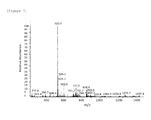
- FIG. 3 is a view illustrating an MS spectrum of 3,6-bis(5-bromo-2-thienyl)-2,5-bis(2-ethylhexyl)-2,5-dihydropyrrolo[3,4-c]pyrrole-1,4-dione of Example 1.
- FIG. 4 is a view illustrating an NMR spectrum of a compound of Example 2.
- FIG. 5 is a view illustrating an MS spectrum of the compound of Example 2.
- FIG. 6 illustrates an NMR spectrum of a compound of Example 3.
- FIG. 7 illustrates an MS spectrum of the compound of Example 3.
- FIG. 8 is a view illustrating a film-type UV-Vis light absorption spectrum obtained by heat treatment of a chlorobenzene solution of copolymer 1 of Example 5.
- FIG. 9 is a view illustrating an electrochemical measurement result (cyclic voltammetry) of copolymer 1 of Example 5.
- FIG. 10 is a view illustrating a film-type UV-Vis light absorption spectrum obtained by heat treatment of a chlorobenzene solution of copolymer 2 of Example 5.
- FIG. 11 is a view illustrating an electrochemical measurement result (cyclic voltammetry) of copolymer 2 of Example 6.
- FIG. 12 is a view illustrating a film-type UV-Vis light absorption spectrum obtained by heat treatment of a chlorobenzene solution of copolymer 3 of Example 7.
- FIG. 13 is a view illustrating an electrochemical measurement result (cyclic voltammetry) of copolymer 3 of Example 7.
- FIG. 14 is a view illustrating a film-type UV-Vis light absorption spectrum obtained by heat treatment of a chlorobenzene solution of copolymer 4 of Example 8.
- FIG. 15 is a view illustrating an electrochemical measurement result (cyclic voltammetry) of copolymer 4 of Example 8.
- FIG. 16 illustrates a current density according to a voltage of a solar cell of an organic solar cell device using copolymer 1 prepared according to Example 5.
- FIG. 17 illustrates a current density according to a voltage of a solar cell of an organic solar cell device using copolymer 2 prepared according to Example 6.
- FIG. 18 illustrates a current density according to a voltage of a solar cell of an organic solar cell device using copolymer 3 prepared according to Example 7.
- FIG. 19 illustrates a current density according to a voltage of a solar cell of an organic solar cell device using copolymer 4 prepared according to Example 8.
- FIG. 20 is a view illustrating an organic solar cell according to an exemplary embodiment of the present specification.
- unit is a repeating structure included in monomers of a copolymer, and means a structure where the monomers are bonded in the copolymer by polymerization.
- the term ‘including unit’ means inclusion in a main chain in a polymer.
- a polymer having a large molecular weight can be synthesized, and thus the copolymer positively serves to improve morphology.
- unit A is represented by any one of the following Chemical Formulas 3 to 5.
- X and Xa are the same as or different from each other, and are each independently selected from the group consisting of CRR′, NR, O, SiRR′, PR, S, GeRR′, Se, and Te,
- Y′ and Y′′ are the same as or different from each other, and are each independently selected from the group consisting of CR, N, SiR, P, and GeR,
- a is an integer of 1 to 3
- R1, R2, R2′, R, and R′ are the same as or different from each other, and are each independently selected from the group consisting of hydrogen; deuterium; a halogen group; a nitrile group; a nitro group; an imide group; an amide group; a hydroxy group; a substituted or unsubstituted alkyl group; a substituted or unsubstituted cycloalkyl group; a substituted or unsubstituted alkoxy group; a substituted or unsubstituted aryloxy group; a substituted or unsubstituted alkylthioxy group; a substituted or unsubstituted arylthioxy group; a substituted or unsubstituted alkylsulfoxy group; a substituted or unsubstituted arylsulfoxy group; a substituted or unsubstituted alkenyl group; a substituted or unsubstituted silyl group;
- a copolymer having a large molecular weight may be provided. Accordingly, the copolymer is economical in terms of time and/or costs of manufacturing an organic solar cell. Further, a device including the copolymer having the large molecular weight may provide a device having higher efficiency as compared to a device including a copolymer having a relatively small molecular weight.
- unit B is an electron donor and unit C is an electron acceptor.
- unit B includes one or two or more of the following Chemical Formulas.
- b and c are each an integer of 1 to 3
- d is an integer of 1 to 6
- f is an integer of 1 to 4,
- R10 to R13 are the same as or different from each other, and are each independently selected from the group consisting of hydrogen; deuterium; a halogen group; a nitrile group; a nitro group; an imide group; an amide group; a hydroxy group; a substituted or unsubstituted alkyl group; a substituted or unsubstituted cycloalkyl group; a substituted or unsubstituted alkoxy group; a substituted or unsubstituted aryloxy group; a substituted or unsubstituted alkylthioxy group; a substituted or unsubstituted arylthioxy group; a substituted or unsubstituted alkylsulfoxy group; a substituted or unsubstituted arylsulfoxy group; a substituted or unsubstituted alkenyl group; a substituted or unsubstituted silyl group; a substituted or unsubsti
- X1 to X4 are the same as or different from each other, and are each independently selected from the group consisting of CR′′R′′′, NR′′, O, SiR′′R′′′, PR′′, S, GeR′′R′′′, Se, and Te,
- Y1 and Y2 are the same as or different from each other, and are each independently selected from the group consisting of CR′′, N, SiR′′, P, and GeR′′, and
- R′′ and R′′′ are the same as or different from each other, and are each independently selected from the group consisting of hydrogen; deuterium; a halogen group; a nitrile group; a nitro group; an imide group; an amide group; a hydroxy group; a substituted or unsubstituted alkyl group; a substituted or unsubstituted cycloalkyl group; a substituted or unsubstituted alkoxy group; a substituted or unsubstituted aryloxy group; a substituted or unsubstituted alkylthioxy group; a substituted or unsubstituted arylthioxy group; a substituted or unsubstituted alkylsulfoxy group; a substituted or unsubstituted arylsulfoxy group; a substituted or unsubstituted alkenyl group; a substituted or unsubstituted silyl group; a substituted or unsub
- unit C includes one or two or more of the following Chemical Formulas.
- R14 to R17 are the same as or different from each other, and are each independently selected from the group consisting of hydrogen; deuterium; a halogen group; a nitrile group; a nitro group; an imide group; an amide group; a hydroxy group; a substituted or unsubstituted alkyl group; a substituted or unsubstituted cycloalkyl group; a substituted or unsubstituted alkoxy group; a substituted or unsubstituted aryloxy group; a substituted or unsubstituted alkylthioxy group; a substituted or unsubstituted arylthioxy group; a substituted or unsubstituted alkylsulfoxy group; a substituted or unsubstituted arylsulfoxy group; a substituted or unsubstituted alkenyl group; a substituted or unsubstituted silyl group; a substituted or unsubsti
- X′ and X′′ are the same as or different from each other, and are each independently O or S,
- X5 to X10 are the same as or different from each other, and are each independently selected from the group consisting of CR18R19, NR18, O, SiR18R19, PR18, S, GeR18R19, Se, and Te,
- Y3 to Y6 are the same as or different from each other, and are each independently selected from the group consisting of CR18, N, SiR18, P, and GeR18, and
- R18 and R19 are the same as or different from each other, and are each independently selected from the group consisting of hydrogen; deuterium; a halogen group; a nitrile group; a nitro group; an imide group; an amide group; a hydroxy group; a substituted or unsubstituted alkyl group; a substituted or unsubstituted cycloalkyl group; a substituted or unsubstituted alkoxy group; a substituted or unsubstituted aryloxy group; a substituted or unsubstituted alkylthioxy group; a substituted or unsubstituted arylthioxy group; a substituted or unsubstituted alkylsulfoxy group; a substituted or unsubstituted arylsulfoxy group; a substituted or unsubstituted alkenyl group; a substituted or unsubstituted silyl group; a substituted or unsubsti
- a content of unit A is 0.01 mol % to 30 mol % based on the total content of the copolymer
- a content of unit B is 50 mol % to 80 mol % based on the total content of the copolymer
- a content of unit C is 0.01 mol % to 30 mol % based on the total content of the copolymer.
- At least one of unit A, unit B, and unit C has a substituted or branch-chained alkoxy group or a substituted or unsubstituted branch-chained alkyl group. That is, the copolymer may include a branch-chained alkoxy group or a branch-chained alkyl group at side chains thereof.
- At least one of unit A, unit B, and unit C may be substituted by one or two or more substituent groups selected from the group consisting of a substituted or unsubstituted branch-chained alkoxy group; a substituted or unsubstituted branch-chained alkyl group; and a substituent group substituted by a branch-chained alkoxy group or a branch-chained alkyl group.
- R1, R2, R, R′, R′′, R′′′, and R10 to R23 may be substituted by a substituent group selected from the group consisting of a substituted or unsubstituted branch-chained alkoxy group; a substituted or unsubstituted branch-chained alkyl group; and a substituent group substituted by a branch-chained alkoxy group or a branch-chained alkyl group.
- the copolymer including the branch-chained alkyl group or the branch-chained alkoxy group may serve to prevent formation of an excimer by aggregation between polymer chains. Further, solubility for facilitating manufacturing the organic solar cell may be provided. Accordingly, the organic solar cell according to the exemplary embodiment of the present specification may provide high efficiency.
- substituted group examples include an alkyl group; an alkenyl group; an alkoxy group; a cycloalkyl group; a silyl group; an arylalkenyl group; an aryloxy group; an alkylthioxy group; an alkylsulfoxy group; an arylsulfoxy group; a boron group; an alkylamine group; an aralkylamine group; an arylamine group; a heteroaryl group; an arylamine group; an aryl group; a hetero-cyclic group, and the like, but are not limited thereto.
- X is S.
- Y′ is N.
- Xa is S.
- Y′′ is N.
- unit A is the following Chemical Formula 4-1 or 5-1.
- R2 and R2′ are the same as or different from each other, and are hydrogen; or a substituted or unsubstituted alkyl group.
- R2 is hydrogen
- R2 is a substituted or unsubstituted alkyl group.
- R2 is an alkyl group.
- R2 is a nonyl group.
- R2′ is hydrogen
- R2′ is a substituted or unsubstituted alkyl group.
- R2′ is an alkyl group.
- R2′ is a nonyl group.
- substituted or unsubstituted means that substitution is performed by one or two or more substituent groups selected from the group consisting of deuterium; a halogen group; an alkyl group; an alkenyl group; an alkoxy group; a cycloalkyl group; a silyl group; an arylalkenyl group; an aryloxy group; an alkylthioxy group; an alkylsulfoxy group; an arylsulfoxy group; a boron group; an alkylamine group; an aralkylamine group; an arylamine group; a heteroaryl group; an arylamine group; an aryl group; a nitrile group; a nitro group; a hydroxy group; and a hetero-cyclic group, substitution is performed by a substituent group where two or more substituent groups of the exemplified substituent groups are connected, or there is no substituent group.
- the “substituent group where two or more substituent groups are connected” may be a biphenyl group. That is, the biphenyl group may be an aryl group, or may be interpreted as a substituent group where two phenyl groups are connected.
- substituted or unsubstituted means that substitution is performed by the substituent group where two or more substituent groups of the exemplified substituent groups are connected or there is no substitution.
- the “substituent group where two or more substituent groups are connected” may be a biphenyl group. That is, the biphenyl group may be an aryl group, or may be interpreted as a substituent group where two phenyl groups are connected.
- substituted means that a hydrogen atom bonded to a carbon atom of a compound is changed into another substituent group, a substitution position is not limited as long as the substitution position is a position at which the hydrogen atom is substituted, that is, a position at which the substituent group can be substituted, and in the case where two or more atoms are substituted, two or more substituent groups may be the same as or different from each other.
- the number of carbon atoms of an imide group is not particularly limited but is preferably 1 to 25.
- the imide group may be compounds having the following structures, but is not limited thereto.
- one or two nitrogen atoms of an amide group may be substituted by hydrogen, a straight-chained, branch-chained, or cyclic-chained alkyl group having 1 to 25 carbon atoms, or an aryl group having 6 to 25 carbon atoms.
- the amide group may be compounds having the following Structural Formulas, but is not limited thereto.
- the alkyl group may be a straight or branch chain, and the number of carbon atoms thereof is not particularly limited but is preferably 1 to 50. Specific examples thereof include methyl, ethyl, propyl, n-propyl, isopropyl, butyl, n-butyl, isobutyl, tert-butyl, sec-butyl, 1-methyl-butyl, 1-ethyl-butyl, pentyl, n-pentyl, isopentyl, neopentyl, tert-pentyl, hexyl, n-hexyl, 1-methylpentyl, 2-methylpentyl, 4-methyl-2-pentyl, 3,3-dimethylbutyl, 2-ethylbutyl, heptyl, n-heptyl, 1-methylhexyl, cyclopentylmethyl, cyclohexylmethyl, octyl,
- a cycloalkyl group is not particularly limited, but the number of carbon atoms thereof is preferably 3 to 60, and specific examples thereof include cyclopropyl, cyclobutyl, cyclopentyl, 3-methylcyclopentyl, 2,3-dimethylcyclopentyl, cyclohexyl, 3-methylcyclohexyl, 4-methylcyclohexyl, 2,3-dimethylcyclohexyl, 3,4,5-trimethylcyclohexyl, 4-tert-butylcyclohexyl, cycloheptyl, cyclooctyl, and the like, but are not limited thereto.
- the alkoxy group may be a straight, branch, or cyclic chain.
- the number of carbon atoms of the alkoxy group is not particularly limited, but preferably 1 to 20. Specific examples thereof may include methoxy, ethoxy, n-propoxy, isopropoxy, i-propyloxy, n-butoxy, isobutoxy, tert-butoxy, sec-butoxy, n-pentyloxy, neopentyloxy, isopentyloxy, n-hexyloxy, 3,3-dimethylbutyloxy, 2-ethylbutyloxy, n-octyloxy, n-nonyloxy, n-decyloxy, benzyloxy, p-methylbenzyloxy, and the like, but are not limited thereto.
- the alkenyl group may be a straight or branch chain, and the number of carbon atoms thereof is not particularly limited but is preferably 2 to 40.
- Specific examples thereof include vinyl, 1-prophenyl, isoprophenyl, 1-butenyl, 2-butenyl, 3-butenyl, 1-pentenyl, 2-pentenyl, 3-pentenyl, 3-methyl-1-butenyl, 1,3-butadienyl, allyl, 1-phenylvinyl-1-yl, 2-phenylvinyl-1-yl, 2,2-diphenylvinyl-1-yl, 2-phenyl-2-(naphthyl-1-yl)vinyl-1-yl, 2,2-bis(diphenyl-1-yl)vinyl-1-yl, a stilbenyl group, a styrenyl group, and the like, but are not limited thereto.
- the aryl group may be a monocyclic aryl group or a polycyclic aryl group, and includes the case where an alkyl group having 1 to 25 carbon atoms or an alkoxy group having 1 to 25 carbon atoms is substituted. Further, in the present specification, the aryl group may mean an aromatic cycle.
- the aryl group is the monocyclic aryl group
- the number of carbon atoms thereof is not particularly limited but is preferably 6 to 25.
- Specific examples of the monocyclic aryl group may include a phenyl group, a biphenyl group, a terphenyl group, and the like, but are not limited thereto.
- the aryl group is the polycyclic aryl group
- the number of carbon atoms thereof is not particularly limited but is preferably 10 to 24.
- Specific examples of the polycyclic aryl group may include a naphthyl group, an anthracenyl group, a phenanthryl group, a pyrenyl group, a perylenyl group, a chrysenyl group, a fluorenyl group, and the like, but are not limited thereto.
- the fluorenyl group may be substituted, and the adjacent substituent groups may be bonded to each other to form a cycle.
- fluorenyl group is not limited thereto.
- silyl group examples include a trimethylsilyl group, a triethylsilyl group, a t-butyldimethylsilyl group, a vinyldimethylsilyl group, a propyldimethylsilyl group, a triphenylsilyl group, a diphenylsilyl group, a phenylsilyl group, and the like, but are not limited thereto.
- the number of carbon atoms of the amine group is not particularly limited, but preferably 1 to 30.
- Specific examples of the amine group include a methylamine group, a dimethylamine group, an ethylamine group, a diethylamine group, a phenylamine group, a naphthylamine group, a biphenylamine group, an anthracenylamine group, a 9-methyl-anthracenylamine group, a diphenylamine group, a phenylnaphthylamine group, a ditolylamine group, a phenyltolylamine group, a triphenylamine group, and the like, but are not limited thereto.
- examples of the arylamine group include a substituted or unsubstituted monoarylamine group, a substituted or unsubstituted diarylamine group, or a substituted or unsubstituted triarylamine group.
- the aryl group of the arylamine group may be a monocyclic aryl group or a polycyclic aryl group.
- the arylamine group including two or more aryl groups may include the monocyclic aryl group, the polycyclic aryl group, or both the monocyclic aryl group and the polycyclic aryl group.
- arylamine group examples include phenylamine, naphthylamine, biphenylamine, anthracenylamine, 3-methyl-phenylamine, 4-methyl-naphthylamine, 2-methyl-biphenylamine, 9-methyl-anthracenylamine, a diphenylamine group, a phenylnaphthylamine group, a ditolylamine group, a phenyltolylamine group, carbazole, a triphenylamine group, and the like, but are not limited thereto.
- the hetero-cyclic group includes an atom other than carbon, or one or more heteroatoms, and specifically, the heteroatom may include one or more atoms selected from the group consisting of O, N, Se, S, and the like.
- the number of carbon atoms of the hetero-cyclic group is not particularly limited, but preferably 2 to 60.
- hetero-cyclic group examples include a thiophene group, a furan group, a pyrrole group, an imidazole group, a triazole group, an oxazol group, an oxadiazol group, a triazol group, a pyridyl group, a bipyridyl group, a pyrimidyl group, a triazine group, a triazole group, an acridyl group, a pyridazine group, a pyrazinyl group, a quinolinyl group, a quinazoline group, a quinoxalinyl group, a phthalazinyl group, a pyridopyrimidinyl group, a pyridopyrazinyl group, a pyrazinopyrazinyl group, an isoquinoline group, an indole group, a carbazole group, a benzoxazole group, a
- the aryl group of an aryloxy group, an arylthioxy group, an arylsulfoxy group, and an aralkylamine group is the same as the aforementioned examples of the aryl group.
- Specific examples of the aryloxy group include phenoxy, p-tolyloxy, m-tolyloxy, 3,5-dimethyl-phenoxy, 2,4,6-trimethylphenoxy, p-tert-butylphenoxy, 3-biphenyloxy, 4-biphenyloxy, 1-naphthyloxy, 2-naphthyloxy, 4-methyl-1-naphthyloxy, 5-methyl-2-naphthyloxy, 1-anthryloxy, 2-anthryloxy, 9-anthryloxy, 1-phenanthryloxy, 3-phenanthryloxy, 9-phenanthryloxy, and the like
- specific examples of the arylthioxy group include a phenylthioxy group, a 2-methylphenyl
- heteroaryl group of the heteroarylamine group may be selected from the aforementioned examples of the hetero-cyclic group.
- the alkyl group of an alkylthioxy group and an alkylsulfoxy group is the same as the aforementioned examples of the alkyl group.
- Specific examples of the alkylthioxy group include a methylthioxy group, an ethylthioxy group, a tert-butylthioxy group, a hexylthioxy group, an octylthioxy group, and the like
- specific examples of the alkylsulfoxy group include mesyl, an ethylsulfoxy group, a propylsulfoxy group, a butylsulfoxy group, and the like, but the examples are not limited thereto.
- unit B is
- unit B is
- unit B is
- X1, X2, R10, and R11 are the same as those described in the above, and R20 and R21 are the same as or different from each other and definitions thereof are each independently the same as definitions of R10 and R11.
- unit C is
- X5 to X8, R14 to R17, X′, and X′′ are the same as those described in the above.
- the copolymer includes a unit represented by any one of the following Chemical Formulas 1-1 to 1-3.
- X and Xa are the same as or different from each other, and are each independently selected from the group consisting of CRR′, NR, O, SiRR′, PR, S, GeRR′, Se, and Te,
- Y′ and Y′′ are the same as or different from each other, and are each independently selected from the group consisting of CR, N, SiR, P, and GeR,
- l is a mol fraction and a real number of more than 0 and less than 1,
- n a mol fraction and a real number of more than 0 and less than 1,
- n is an integer of 1 to 10,000
- R2, R2′, R10, R11, R10′, R11′, R14 to R17, and R20 to R23 are the same as or different from each other, and are each independently selected from the group consisting of hydrogen; deuterium; a halogen group; a nitrile group; a nitro group; an imide group; an amide group; a hydroxy group; a substituted or unsubstituted alkyl group; a substituted or unsubstituted cycloalkyl group; a substituted or unsubstituted alkoxy group; a substituted or unsubstituted aryloxy group; a substituted or unsubstituted alkylthioxy group; a substituted or unsubstituted arylthioxy group; a substituted or unsubstituted alkylsulfoxy group; a substituted or unsubstituted arylsulfoxy group; a substituted or unsubstituted alkeny
- X′ and X′′ are the same as or different from each other, and are each independently O or S,
- X1, X2, X1′, and X2′ are the same as or different from each other, and are each independently selected from the group consisting of CR′′R′′′, NR′′, O, SiR′′R′′′, PR′′, S, GeR′′R′′′, Se, and Te,
- X5 to X8 are the same as or different from each other, and are each independently selected from the group consisting of CR18R19, NR18, O, SiR18R19, PR18, S, GeR18R19, Se, and Te, and
- R′′, R′′′, R18, and R19 are the same as or different from each other, and are each independently selected from the group consisting of hydrogen; deuterium; a halogen group; a nitrile group; a nitro group; an imide group; an amide group; a hydroxy group; a substituted or unsubstituted alkyl group; a substituted or unsubstituted cycloalkyl group; a substituted or unsubstituted alkoxy group; a substituted or unsubstituted aryloxy group; a substituted or unsubstituted alkylthioxy group; a substituted or unsubstituted arylthioxy group; a substituted or unsubstituted alkylsulfoxy group; a substituted or unsubstituted arylsulfoxy group; a substituted or unsubstituted alkenyl group; a substituted or unsubstituted silyl group;
- R10 is hydrogen
- R11 is hydrogen
- R10′ is hydrogen
- R11′ is hydrogen
- R14 is hydrogen
- R15 is hydrogen
- R16 is hydrogen
- R17 is hydrogen
- X1 is S.
- X2 is S.
- X1′ is S.
- X2′ is S.
- X′ is O.
- X′′ is O.
- Y1 is CR′′.
- Y2 is CR′′.
- X5 is NR18.
- X6 is NR18.
- R18 is a substituted or unsubstituted alkyl group.
- R18 is a substituted or unsubstituted branch-chained alkyl group.
- R18 is a branch-chained 2-ethylhexyl group.
- R′′ is a substituted or unsubstituted alkoxy group.
- R′′ is a substituted or unsubstituted branch-chained alkoxy group.
- R′′ is a branch-chained 2-ethylhexyloxy group.
- R′′ is a substituted or unsubstituted hetero-cyclic group.
- R′′ is a substituted or unsubstituted thiophene group.
- R′′ is a thiophene group substituted by an alkyl group.
- R′′ is a thiophene group substituted by a hexyl group.
- R′′ is a thiophene group substituted by an ethylhexyl group.
- X7 is S.
- X8 is S.
- the copolymer includes any one of the following copolymers 1 to 4.
- l is a mol fraction and a real number of more than 0 and less than 1,
- n a mol fraction and a real number of more than 0 and less than 1,
- n is an integer of 1 to 10,000.
- m is 0.5.
- 1 is 0.5.
- examples of an end group of the copolymer include a hetero-cyclic group or an aryl group.
- the end group of the copolymer is a 4-(trifluoromethyl)phenyl group.
- a number average molecular weight of the copolymer be 500 g/mol to 1,000,000 g/mol. It is preferable that the number average molecular weight of the copolymer be 10,000 to 100,000. In the exemplary embodiment of the present specification, the number average molecular weight of the copolymer is 30,000 to 100,000.
- the copolymer may have a molecular weight distribution of 1 to 100.
- the copolymer has the molecular weight distribution of 1 to 3.
- the number average molecular weight be 100,000 or less.
- copolymers may be prepared based on Preparation Examples as will be described later.
- the copolymer may be prepared by addedting a catalyst and a solvent into three kinds of monomers, reacting the resulting substances, performing end capping, precipitating a mixture in methanol, and extracting a solid.
- a copolymer including units A, B, and C may be prepared in addition to copolymers 1 and 2 by selecting three kinds of monomers according to physical properties required in the copolymer by a person with ordinary skill.
- the copolymer according to the present specification may be prepared by a multi-stage chemical reaction. After monomers are prepared through an alkylation reaction, a Grignard reaction, a Suzuki coupling reaction, a Stille coupling reaction, or the like, the final copolymers may be prepared through a carbon-carbon coupling reaction such as the Stille coupling reaction.
- a substituent group to be introduced is a boronic acid or boronic ester compound
- the copolymer may be prepared through the Suzuki coupling reaction
- the substituent group to be introduced is a tributyltin compound
- the copolymer may be prepared through the Stille coupling reaction, but the reaction is not limited thereto.
- An exemplary embodiment of the present specification provides an organic solar cell including a first electrode; a second electrode provided to face the first electrode; and one or more organic material layers provided between the first electrode and the second electrode and including a photoactive layer, in which one or more layers of the organic material layers include the copolymer.
- the organic solar cell according to the exemplary embodiment of the present specification includes the first electrode, the photoactive layer, and the second electrode.
- the organic solar cell may further include a substrate, a hole transport layer, and/or an electron transport layer.
- the organic solar cell accepts a photon from an external light source, electrons and holes are generated between an electron donor and an electron acceptor. The generated holes are transported through an electron donor layer to an anode.
- the organic material layer includes a hole transport layer, a hole injection layer, or a layer simultaneously transporting and injecting holes, and the hole transport layer, the hole injection layer, or the layer simultaneously transporting and injecting the holes includes the copolymer.
- the organic material layer includes an electron injection layer, an electron transport layer, or a layer simultaneously injecting and transporting electrons, and the electron injection layer, the electron transport layer, or the layer simultaneously injecting and transporting the electrons includes the copolymer.
- FIG. 20 is a view illustrating the organic solar cell according to the exemplary embodiment of the present specification.
- the organic solar cell accepts the photon from the external light source, the electrons and the holes are generated between the electron donor and the electron acceptor. The generated holes are transported through the electron donor layer to the anode.
- the organic solar cell may further include an additional organic material layer.
- the number of organic material layers may be reduced by using an organic material simultaneously having various functions.
- the first electrode is an anode
- the second electrode is a cathode
- the first electrode is the cathode
- the second electrode is the anode
- the cathode, the photoactive layer, and the anode may be disposed in order, or the anode, the photoactive layer, and the cathode may be disposed in order, but the order is not limited thereto.
- the anode, the hole transport layer, the photoactive layer, the electron transport layer, and the cathode may be disposed in order, or the cathode, the electron transport layer, the photoactive layer, the hole transport layer, and the anode may be disposed in order, but the order is not limited thereto.
- the organic solar cell has a normal structure.
- the organic solar cell has an inverted structure.
- the organic solar cell has a tandem structure.
- the organic solar cell according to the exemplary embodiment of the present specification may include one or two or more photoactive layers.
- a buffer layer may be provided between the photoactive layer and the hole transport layer or between the photoactive layer and the electron transport layer.
- the hole injection layer may be further provided between the anode and the hole transport layer.
- the electron injection layer may be further provided between the cathode and the electron transport layer.
- the photoactive layer includes one or two or more selected from the group consisting of the electron donor and the electron acceptor, and a material of the electron donor includes the copolymer.
- a material of the electron acceptor may be selected from the group consisting of fullerene, a fullerene derivative, bathocuproin, a semiconducting element, a semiconducting compound, and a combination thereof.
- the material is one or two or more compounds selected from the group consisting of fullerene, a fullerene derivative (PCBM ((6,6)-phenyl-C61-butyric acid-methylester) or PCBCR ((6,6)-phenyl-C61-butyric acid-cholesteryl ester), perylene, PBI (polybenzimidazole), and PTCBI (3,4,9,10-perylene-tetracarboxylic bis-benzimidazole).
- PCBM ((6,6)-phenyl-C61-butyric acid-methylester) or PCBCR ((6,6)-phenyl-C61-butyric acid-cholesteryl ester)
- perylene PBI (polybenzimidazole)
- PTCBI polybenzimidazole
- PTCBI polybenzimidazole
- the electron donor and the electron acceptor constitute a bulk hetero junction (BHJ).
- the material of the electron donor and the material of the electron acceptor are mixed at a ratio (w/w) of 1:10 to 10:1.
- the bulk hetero junction means a mixed state of the material of the electron donor and the material of the electron acceptor in the photoactive layer.
- the photoactive layer has a bilayered thin film structure including an n-type organic material layer and a p-type organic material layer, and the p-type organic material layer includes the copolymer.
- the substrate may be a glass substrate or a transparent plastic substrate having excellent transparency, surface flatness, easiness in handling, and water resistance, but is not limited thereto, and there is no limitation as long as the substrate is a substrate generally used in the organic solar cell.
- Specific examples thereof include glass, PET (polyethylene terephthalate), PEN (polyethylene naphthalate), PP (polypropylene), PI (polyimide), TAC (triacetyl cellulose), or the like, but are not limited thereto.
- the anode electrode may be a material having transparency and excellent conductivity, but is not limited thereto.
- Examples thereof include metal such as vanadium, chrome, copper, zinc, and gold, or an alloy thereof; metal oxides such as zinc oxides, indium oxides, indium tin oxides (ITO), and indium zinc oxides (IZO); a combination of metal and oxides, such as ZnO:Al or SnO 2 :Sb; conductive polymers such as poly(3-methylthiophene), poly[3,4-(ethylene-1,2-dioxy)thiophene] (PEDOT), polypyrole, and polyaniline, and the like, but are not limited thereto.
- a method of forming the anode electrode is not particularly limited, but for example, the anode electrode may be formed by application on one surface of the substrate or coating in a film form by using saddedtering, E-beam, thermal deposition, spin coating, screen printing, inkjet printing, doctor blade, or a gravure printing method.
- the anode electrode may be subjected to washing, water removing, and a hydrophilic reforming process.
- a patterned ITO substrate is sequentially washed by a cleaning agent, acetone, and isopropyl alcohol (IPA), and then dried on a hot plate at 100 to 150° C. for 1 to 30 minutes and preferably at 120° C. for 10 minutes in order to remove moisture, and if the substrate is completely washed, a surface of the substrate is subjected to hydrophilic reforming.
- a cleaning agent acetone, and isopropyl alcohol (IPA)
- IPA isopropyl alcohol
- a conjunction surface potential may be maintained at a level suitable for a surface potential of the photoactive layer through the aforementioned surface reforming. Further, while reforming is performed, it is possible to easily form a polymer thin film on the anode electrode, and the quality of the thin film may be improved.
- Examples of a pre-treatment technology of the anode electrode include a) a surface oxidizing method using parallel plate-type discharging, b) a method of oxidizing a surface through ozone generated by using ultraviolet rays in a vacuum state, c) a method of performing oxidizing by using oxygen radicals generated by a plasma, and the like.
- Any one of the aforementioned methods may be selected according to a state of the anode electrode or the substrate. However, whichever method is used, commonly, it is preferable to prevent leaving of oxygen from the surface of the anode electrode or the substrate and maximally suppress staying of moisture and the organic material. In this case, a substantial effect of pre-treatment may be maximized.
- Specific examples thereof may include the method of oxidizing the surface through ozone generated by using the ultraviolet rays.
- the patterned ITO substrate may be baked on the hot plate to be well dried, and then added into a chamber, and a UV lamp may be operated to wash the patterned ITO substrate by ozone generated by reacting oxygen gas and the ultraviolet rays.
- a method of reforming the surface of the patterned ITO substrate does not need to be particularly limited, and any method may be used as long as the method is a method of oxidizing the substrate.
- the cathode electrode may be metal having a small work function, but is not limited thereto. Specific examples thereof may include metal such as magnesium, calcium, sodium, potassium, titanium, indium, yttrium, lithium, gadolinium, aluminum, silver, tin, and lead, or an alloy thereof; and a material having a multilayered structure, such as LiF/Al, LiO 2 /Al, LiF/Fe, Al:Li, Al:BaF 2 , and Al:BaF 2 :Ba, but are not limited thereto.
- metal such as magnesium, calcium, sodium, potassium, titanium, indium, yttrium, lithium, gadolinium, aluminum, silver, tin, and lead, or an alloy thereof
- a material having a multilayered structure such as LiF/Al, LiO 2 /Al, LiF/Fe, Al:Li, Al:BaF 2 , and Al:BaF 2 :Ba, but are not limited thereto.
- the cathode electrode may be formed by being deposited in a thermal deposition machine having the degree of vacuum of 5 ⁇ 10 ⁇ 7 torr or less, but the forming method is not limited to this method.
- Hole transport layer and/or electron transport layer materials serve to efficiently transport the electrons and the holes separated from the photoactive layer to the electrode, and the materials are not particularly limited.
- the hole transport layer material may be PEDOT:PSS (poly(3,4-ethylenediocythiophene) doped with poly(styrenesulfonic acid)), molybdenum oxides (MoO x ); vanadium oxides (V 2 O 5 ); nickel oxides (NiO); tungsten oxides (WO x ), or the like, but is not limited thereto.
- PEDOT:PSS poly(3,4-ethylenediocythiophene) doped with poly(styrenesulfonic acid)
- MoO x molybdenum oxides
- V 2 O 5 vanadium oxides
- NiO nickel oxides
- WO x tungsten oxides
- the electron transport layer material may be electron-extracting metal oxides, and specific examples thereof may include a metal complex of 8-hydroxyquinoline; a complex including Alq 3 ; a metal complex including Liq; LiF; Ca; titanium oxides (TiO x ); zinc oxides (ZnO); cesium carbonate (Cs 2 CO 3 ), or the like, but are not limited thereto.
- the photoactive layer may be formed by a method where a photoactive material such as the electron donor and/or the electron acceptor is dissolved in an organic solvent and a solution is then subjected to spin coating, dip coating, screen printing, spray coating, doctor blade, brush painting, or the like, but the forming method is not limited to these methods.
- FIG. 1 is a view illustrating an NMR spectrum of 2,5-diethylhexyl-3,6-dithiophene-2-ylpyrrolo[3,4-c]pyrrole-1,4-dione of Example 1.
- FIG. 2 is a view illustrating an NMR spectrum of 3,6-bis(5-bromo-2-thienyl)-2,5-bis(2-ethylhexyl)-2,5-dihydropyrrolo[3,4-c]pyrrole-1,4-dione of Example 1.
- FIG. 3 is a view illustrating an MS spectrum of 3,6-bis(5-bromo-2-thienyl)-2,5-bis(2-ethylhexyl)-2,5-dihydropyrrolo[3,4-c]pyrrole-1,4-dione of Example 1.
- FIG. 4 is a view illustrating an NMR spectrum of a compound of Example 3.
- FIG. 5 is a view illustrating an MS spectrum of the compound of Example 3.
- the solution was poured on ice, extracted by diethyl ether two times, and washed by water two times, and the residual material was removed by magnesium sulfate (MgSO 4 ).
- the solvent was removed from the residual solution under reduced pressure, and the yellow liquid having the high density was obtained through the silica column (eluent; petroleum).
- the solution was poured on water, extracted by diethyl ether two times, and washed by water two times, and the residual material was removed by magnesium sulfate (MgSO 4 ).
- the solvent was removed from the residual solution under reduced pressure, and recrystallization was performed by ethanol to obtain the light yellow crystalline solid.
- FIG. 6 illustrates an NMR spectrum of a compound of Example 3.
- FIG. 7 illustrates an MS spectrum of the compound of Example 3.
- Monomer 4 was prepared by a method described in Kim, Ji-Hoon; Kim, Hee Un; Hwang, Do-Hoon; Kang, In-Nam; Lee, Sang Kyu; Moon, SangOJin; Shin, Won Suk., Macromolecules, 2012, 45, 8628-8638.
- 2,5-dibormothiazole was used by performing re-column of a material of Aldrich Corporation.
- Weight average molecular weight 104,100 g/mol
- FIG. 8 illustrates a film-type UV-Vis light absorption spectrum obtained by heat treatment of a chlorobenzene solution of copolymer 1 of Example 5.
- the film-type UV light absorption spectrum of FIG. 8 was analyzed by using the UV-Vis light absorption spectrum (UV-Vis absorption spectrometer) after the sample obtained by dissolving the compound in chlorobenzene at a concentration of 1 wt %, dripping the solution on the glass substrate, and performing spin coating at 1000 rpm for 60 seconds was subjected to heat treatment at 25° C., 100° C., 130° C., 150° C., and 190° C.
- FIG. 9 illustrates an electrochemical measurement result (cyclic voltammetry) of copolymer 1 of Example 5.
- Electrochemical (cyclic voltammetry) measurement of FIG. 9 was analyzed by addedting the glassy carbon working electrode, the Ag/Agcl reference electrode, and the Pt electrode into the electrolytic solution where Bu 4 NBF 4 was dissolved at a concentration of 0.1 M in acetonitrile, and using the three electrode method. The compound was applied on the working electrode by the drop casting method.
- Weight average molecular weight 125,071 g/mol
- FIG. 10 illustrates a film-type UV-Vis light absorption spectrum subjected to heat treatment by a chlorobenzene solution of copolymer 2 of Example 6.
- the film-type UV light absorption spectrum of FIG. 10 was analyzed by using the UV-Vis light absorption spectrum (UV-Vis absorption spectrometer) after the sample obtained by dissolving the compound in chlorobenzene at a concentration of 1 wt %, dripping the solution on the glass substrate, and performing spin coating at 1000 rpm for 60 seconds was subjected to heat treatment at 25° C., 100° C., 130° C., 150° C., and 190° C.
- FIG. 11 illustrates an electrochemical measurement result (cyclic voltammetry) of copolymer 2 of Example 6.
- Electrochemical (cyclic voltammetry) measurement of FIG. 11 was analyzed by addedting the glassy carbon working electrode, the Ag/Agcl reference electrode, and the Pt electrode into the electrolytic solution where Bu 4 NBF 4 was dissolved at a concentration of 0.1 M in acetonitrile, and using the three electrode method. The compound was applied on the working electrode by the drop casting method.
- FIG. 12 illustrates a film-type UV-Vis light absorption spectrum subjected to heat treatment by a chlorobenzene solution of copolymer 3 of Example 7.
- the film-type UV light absorption spectrum of FIG. 12 was analyzed by using the UV-Vis light absorption spectrum (UV-Vis absorption spectrometer) after the sample obtained by dissolving the compound in chlorobenzene at a concentration of 1 wt %, dripping the solution on the glass substrate, and performing spin coating at 1000 rpm for 60 seconds was subjected to heat treatment at 25° C. and 120° C.
- UV-Vis absorption spectrometer UV-Vis light absorption spectrometer
- FIG. 13 illustrates an electrochemical measurement result (cyclic voltammetry) of copolymer 3 of Example 7.
- Electrochemical (cyclic voltammetry) measurement of FIG. 13 was analyzed by addedting the glassy carbon working electrode, the Ag/Agcl reference electrode, and the Pt electrode into the electrolytic solution where Bu 4 NBF 4 was dissolved at a concentration of 0.1 M in acetonitrile, and using the three electrode method. The compound was applied on the working electrode by the drop casting method.
- Weight average molecular weight 127,530 g/mol
- FIG. 14 illustrates a subjected to heat treatment by a chlorobenzene solution of copolymer 4 of Example 8.
- the film-type UV light absorption spectrum of FIG. 14 was analyzed by using the UV-Vis light absorption spectrum (UV-Vis absorption spectrometer) after the sample obtained by dissolving the compound in chlorobenzene at a concentration of 1 wt %, dripping the solution on the glass substrate, and performing spin coating at 1000 rpm for 60 seconds was subjected to heat treatment at 25° C. and 120° C.
- UV-Vis absorption spectrometer UV-Vis light absorption spectrometer
- FIG. 15 illustrates an electrochemical measurement result (cyclic voltammetry) of copolymer 4 of Example 8.
- Electrochemical (cyclic voltammetry) measurement of FIG. 15 was analyzed by addedting the glassy carbon working electrode, the Ag/Agcl reference electrode, and the Pt electrode into the electrolytic solution where Bu 4 NBF 4 was dissolved at a concentration of 0.1 M in acetonitrile, and using the three electrode method. The compound was applied on the working electrode by the drop casting method.
- Copolymer 1 prepared in Example 5 and PCBM were dissolved at a ratio of 1:2 in chlorobenzene (CB) to prepare the composite solution.
- CB chlorobenzene
- the concentration was adjusted to 2.0 wt %, and the organic solar cell had the structure of ITO/PEDOT:PSS/photoactive layer/Al.
- the glass substrate on which ITO was applied was washed by the ultrasonic wave by using distilled water, acetone, or 2-propanol, the ITO surface was treated by ozone for 10 minutes, PEDOT:PSS (baytrom P) was subjected to spin coating in a thickness of 45 nm, and heat treatment was performed at 120° C. for 10 minutes.
- the compound-PCBM composite solution was filtered by the 0.45 ⁇ m PP syringe filter and then subjected to spin coating to deposit Al in a thickness of 200 nm by using the thermal evaporator under the vacuum of 3 ⁇ 10 ⁇ 8 torr and thus manufacture the organic solar cell.
- Copolymer 2 prepared in Example 6 and PCBM were dissolved at a ratio of 1:2 in chlorobenzene (CB) to prepare the composite solution.
- CB chlorobenzene
- the concentration was adjusted to 2.0 wt %, and the organic solar cell had the structure of ITO/PEDOT:PSS/photoactive layer/Al.
- the glass substrate on which ITO was applied was washed by the ultrasonic wave by using distilled water, acetone, or 2-propanol, the ITO surface was treated by ozone for 10 minutes, PEDOT:PSS (baytrom P) was subjected to spin coating in a thickness of 45 nm, and heat treatment was performed at 120° C. for 10 minutes.
- the compound-PCBM composite solution was filtered by the 0.45 ⁇ m PP syringe filter and then subjected to spin coating, and Al was deposited in a thickness of 200 nm by using the thermal evaporator under the vacuum of 3 ⁇ 10 ⁇ 8 torr to manufacture the organic solar cell.
- Copolymer 3 prepared in Example 7 and PCBM were dissolved at a ratio of 1:2 in chlorobenzene (CB) to prepare the composite solution.
- CB chlorobenzene
- the concentration was adjusted to 2.0 wt %, and the organic solar cell had the structure of ITO/PEDOT:PSS/photoactive layer/Al.
- the glass substrate on which ITO was applied was washed by the ultrasonic wave by using distilled water, acetone, or 2-propanol, the ITO surface was treated by ozone for 10 minutes, PEDOT:PSS (baytrom P) was subjected to spin coating in a thickness of 45 nm, and heat treatment was performed at 120° C. for 10 minutes.
- the compound-PCBM composite solution was filtered by the 0.45 ⁇ m PP syringe filter and then subjected to spin coating to deposit Al in a thickness of 200 nm by using the thermal evaporator under the vacuum of 3 ⁇ 10 ⁇ 8 torr and thus manufacture the organic solar cell.
- Copolymer 4 prepared in Example 8 and PCBM were dissolved at a ratio of 1:2 in chlorobenzene (CB) to prepare the composite solution.
- CB chlorobenzene
- the concentration was adjusted to 2.0 wt %, and the organic solar cell had the structure of ITO/PEDOT:PSS/photoactive layer/Al.
- the glass substrate on which ITO was applied was washed by the ultrasonic wave by using distilled water, acetone, or 2-propanol, the ITO surface was treated by ozone for 10 minutes, PEDOT:PSS (baytrom P) was subjected to spin coating in a thickness of 45 nm, and heat treatment was performed at 120° C. for 10 minutes.
- the compound-PCBM composite solution was filtered by the 0.45 ⁇ m PP syringe filter and then subjected to spin coating, and Al was deposited in a thickness of 200 nm by using the thermal evaporator under the vacuum of 3 ⁇ 10 ⁇ 8 torr to manufacture the organic solar cell.
- P3HT and PCBM were dissolved at a ratio of 1:1 in 1,2-dichlorobenzene (DCB) to prepare the composite solution.
- DCB 1,2-dichlorobenzene
- the concentration was adjusted to 1.0 to 2.0 wt %, and the organic solar cell had the structure of ITO/PEDOT:PSS/photoactive layer/LiF/Al.
- the glass substrate on which ITO was applied was washed by the ultrasonic wave by using distilled water, acetone, or 2-propanol, the ITO surface was treated by ozone for 10 minutes, PEDOT:PSS (baytrom P) was subjected to spin coating in a thickness of 45 cm, and heat treatment was performed at 120° C. for 10 minutes.
- the compound-PCBM composite solution was filtered by the 0.45 ⁇ m PP syringe filter and then subjected to spin coating, heat treatment was performed at 120° C. for 5 minutes, and LiF was deposited in a thickness of 7 ⁇ and Al was then deposited in a thickness of 200 nm by using the thermal evaporator under the vacuum of 3 ⁇ 10 torr to manufacture the organic solar cell.
- V oc means an open circuit voltage
- J sc means a short-circuit current
- FF means a fill factor
- PCE means energy conversion efficiency.
- the open circuit voltage and the short-circuit current are each intercepts of X and Y axes in fourth quadrants of a voltage-current density curve, and as these two values are increased, efficiency of the solar cell is preferably increased.
- the fill factor is a value obtained by dividing an area of a rectangle that may be drawn in the curve by the product of the short-circuit and the open circuit voltage. If these three values are divided by the intensity of radiated light, energy conversion efficiency may be obtained, and the higher the value is, the better the efficiency is.
- FIG. 16 illustrates a current density according to a voltage of a solar cell of an organic solar cell device using copolymer 1 prepared according to Example 5.
- FIG. 17 illustrates a current density according to a voltage of a solar cell of an organic solar cell device using copolymer 2 prepared according to Example 6.
- FIG. 18 illustrates a current density according to a voltage of a solar cell of an organic solar cell device using copolymer 3 prepared according to Example 7.
- FIG. 19 illustrates a current density according to a voltage of a solar cell of an organic solar cell device using copolymer 4 prepared according to Example 8.
Landscapes
- Chemical & Material Sciences (AREA)
- Health & Medical Sciences (AREA)
- Chemical Kinetics & Catalysis (AREA)
- Medicinal Chemistry (AREA)
- Polymers & Plastics (AREA)
- Organic Chemistry (AREA)
- Engineering & Computer Science (AREA)
- Materials Engineering (AREA)
- Photovoltaic Devices (AREA)
- Polyoxymethylene Polymers And Polymers With Carbon-To-Carbon Bonds (AREA)
Applications Claiming Priority (3)
| Application Number | Priority Date | Filing Date | Title |
|---|---|---|---|
| KR20130111394 | 2013-09-16 | ||
| KR10-2013-0111394 | 2013-09-16 | ||
| PCT/KR2014/008611 WO2015037966A1 (fr) | 2013-09-16 | 2014-09-16 | Copolymère et une cellule solaire organique le comprenant |
Publications (2)
| Publication Number | Publication Date |
|---|---|
| US20160237204A1 US20160237204A1 (en) | 2016-08-18 |
| US9777108B2 true US9777108B2 (en) | 2017-10-03 |
Family
ID=52665984
Family Applications (1)
| Application Number | Title | Priority Date | Filing Date |
|---|---|---|---|
| US15/022,121 Active US9777108B2 (en) | 2013-09-16 | 2014-09-16 | Copolymer and organic solar cell comprising same |
Country Status (7)
| Country | Link |
|---|---|
| US (1) | US9777108B2 (fr) |
| EP (1) | EP3048123B1 (fr) |
| JP (1) | JP6200096B2 (fr) |
| KR (1) | KR101638693B1 (fr) |
| CN (1) | CN105637009B (fr) |
| TW (1) | TWI535778B (fr) |
| WO (1) | WO2015037966A1 (fr) |
Families Citing this family (5)
| Publication number | Priority date | Publication date | Assignee | Title |
|---|---|---|---|---|
| KR20170003234A (ko) * | 2015-06-30 | 2017-01-09 | 주식회사 엘지화학 | 축합고리 및 이를 포함하는 유기 태양 전지 |
| KR102103060B1 (ko) * | 2017-05-24 | 2020-04-21 | 주식회사 엘지화학 | 화합물 및 이를 포함하는 유기 태양 전지 |
| KR102250385B1 (ko) * | 2017-10-18 | 2021-05-11 | 주식회사 엘지화학 | 유기 광 다이오드 및 이를 포함하는 유기 이미지 센서 |
| KR102644520B1 (ko) * | 2018-03-09 | 2024-03-07 | 주식회사 엘지화학 | 유기 태양 전지의 유기물층용 조성물 및 유기 태양 전지 |
| KR20240030495A (ko) * | 2022-08-31 | 2024-03-07 | 건국대학교 산학협력단 | 가시광 영역에서 고투과도를 갖는 유기 반도체 화합물 |
Citations (16)
| Publication number | Priority date | Publication date | Assignee | Title |
|---|---|---|---|---|
| US20090065766A1 (en) | 2007-09-06 | 2009-03-12 | Xerox Corporation. | Diketopyrrolopyrrole-based polymers |
| WO2010136535A1 (fr) | 2009-05-27 | 2010-12-02 | Justus-Liebig-Universität Giessen | Dispositif et procédé de préparation de produits sanguins |
| TW201114800A (en) | 2009-05-27 | 2011-05-01 | Basf Se | Diketopyrrolopyrrole polymers for use in organic semiconductor devices |
| CN102060982A (zh) | 2010-12-03 | 2011-05-18 | 华南理工大学 | 含萘[1,2-c:5,6-c]二[1,2,5]噻二唑的有机半导体材料及其应用 |
| KR20120022879A (ko) | 2009-04-08 | 2012-03-12 | 바스프 에스이 | 피롤로피롤 유도체, 그의 제조법 및 반도체로서의 용도 |
| US20120186652A1 (en) | 2010-11-24 | 2012-07-26 | Hualong Pan | Conjugated Polymers and Their Use in Optoelectronic Devices |
| WO2012135527A2 (fr) | 2011-03-29 | 2012-10-04 | The Regents Of The University Of California | Matériaux actifs pour dispositifs électro-optiques et dispositifs électro-optiques |
| KR20130016132A (ko) | 2011-08-03 | 2013-02-14 | 포항공과대학교 산학협력단 | 공중합체, 이를 이용한 유기 태양 전지 및 이의 제조방법 |
| WO2013035836A1 (fr) | 2011-09-09 | 2013-03-14 | 日本電気株式会社 | Dispositif à semi-conducteur et procédé de commande de celui-ci |
| WO2013065836A1 (fr) | 2011-11-02 | 2013-05-10 | 三菱化学株式会社 | Procédé de fabrication d'un composé aromatique à cycles fusionnés et polymère conjugué |
| WO2013065855A1 (fr) | 2011-11-02 | 2013-05-10 | 三菱化学株式会社 | Procédé de production d'un polymère conjugué, polymère conjugué, élément de conversion photoélectrique, photopile et module photovoltaïque |
| US20130137842A1 (en) * | 2011-11-25 | 2013-05-30 | Samsung Electronics Co., Ltd. | Organic semiconductor compound, and organic thin film including the organic semiconductor compound |
| CN103130988A (zh) | 2011-11-30 | 2013-06-05 | 海洋王照明科技股份有限公司 | 一种苯并二噻吩与联噻唑共聚物及其制备方法和包含其的太阳能电池 |
| US20130167929A1 (en) | 2010-09-02 | 2013-07-04 | Merck Patent Gmbh | Photovoltaic Cell Containing Novel Photoactive Polymer |
| US20130187134A1 (en) | 2012-01-20 | 2013-07-25 | Samsung Electronics Co., Ltd. | Organic electronic device |
| KR20130090821A (ko) | 2012-02-06 | 2013-08-14 | 주식회사 엘지화학 | 중합체 및 이를 포함하는 유기 태양 전지 |
Family Cites Families (2)
| Publication number | Priority date | Publication date | Assignee | Title |
|---|---|---|---|---|
| US5331183A (en) | 1992-08-17 | 1994-07-19 | The Regents Of The University Of California | Conjugated polymer - acceptor heterojunctions; diodes, photodiodes, and photovoltaic cells |
| KR101102079B1 (ko) * | 2009-04-08 | 2012-01-04 | 한국화학연구원 | 카바졸이 함유된 전도성 고분자 및 그를 이용한 유기 광기전력 장치 |
-
2014
- 2014-09-16 US US15/022,121 patent/US9777108B2/en active Active
- 2014-09-16 TW TW103132026A patent/TWI535778B/zh active
- 2014-09-16 KR KR1020140122966A patent/KR101638693B1/ko active Active
- 2014-09-16 JP JP2016544287A patent/JP6200096B2/ja active Active
- 2014-09-16 WO PCT/KR2014/008611 patent/WO2015037966A1/fr not_active Ceased
- 2014-09-16 CN CN201480056979.2A patent/CN105637009B/zh active Active
- 2014-09-16 EP EP14843839.3A patent/EP3048123B1/fr active Active
Patent Citations (28)
| Publication number | Priority date | Publication date | Assignee | Title |
|---|---|---|---|---|
| US20090065766A1 (en) | 2007-09-06 | 2009-03-12 | Xerox Corporation. | Diketopyrrolopyrrole-based polymers |
| TW200922963A (en) | 2007-09-06 | 2009-06-01 | Xerox Corp | Diketopyrrolopyrrole-based polymers |
| KR20120022879A (ko) | 2009-04-08 | 2012-03-12 | 바스프 에스이 | 피롤로피롤 유도체, 그의 제조법 및 반도체로서의 용도 |
| US20120095236A1 (en) | 2009-04-08 | 2012-04-19 | Basf Se | Pyrrolopyrrole derivatives, their manufacture and use as semiconductors |
| WO2010136535A1 (fr) | 2009-05-27 | 2010-12-02 | Justus-Liebig-Universität Giessen | Dispositif et procédé de préparation de produits sanguins |
| TW201114800A (en) | 2009-05-27 | 2011-05-01 | Basf Se | Diketopyrrolopyrrole polymers for use in organic semiconductor devices |
| US20120071617A1 (en) | 2009-05-27 | 2012-03-22 | Basf Se | Diketopyrrolopyrrole polymers for use in organic semiconductor devices |
| JP2012528215A (ja) | 2009-05-27 | 2012-11-12 | ビーエーエスエフ ソシエタス・ヨーロピア | 有機半導体装置で使用するためのジケトピロロピロールポリマー |
| US20130167929A1 (en) | 2010-09-02 | 2013-07-04 | Merck Patent Gmbh | Photovoltaic Cell Containing Novel Photoactive Polymer |
| US20120186652A1 (en) | 2010-11-24 | 2012-07-26 | Hualong Pan | Conjugated Polymers and Their Use in Optoelectronic Devices |
| CN102060982A (zh) | 2010-12-03 | 2011-05-18 | 华南理工大学 | 含萘[1,2-c:5,6-c]二[1,2,5]噻二唑的有机半导体材料及其应用 |
| WO2012135527A2 (fr) | 2011-03-29 | 2012-10-04 | The Regents Of The University Of California | Matériaux actifs pour dispositifs électro-optiques et dispositifs électro-optiques |
| US20130056073A1 (en) | 2011-08-03 | 2013-03-07 | Postech Academy-Industry Foundation | Copolymer, organic solar cell using the same and manufacturing method thereof |
| KR20130016130A (ko) | 2011-08-03 | 2013-02-14 | 포항공과대학교 산학협력단 | 공중합체, 이를 이용한 유기 태양 전지 및 이의 제조 방법 |
| US20130056072A1 (en) | 2011-08-03 | 2013-03-07 | Lg Chem, Ltd. | Copolymer, organic solar cell using the same and manufacturing method thereof |
| KR20130016132A (ko) | 2011-08-03 | 2013-02-14 | 포항공과대학교 산학협력단 | 공중합체, 이를 이용한 유기 태양 전지 및 이의 제조방법 |
| WO2013035836A1 (fr) | 2011-09-09 | 2013-03-14 | 日本電気株式会社 | Dispositif à semi-conducteur et procédé de commande de celui-ci |
| US20140233304A1 (en) | 2011-09-09 | 2014-08-21 | Nec Corporation | Semiconductor device and control method of the same |
| US20140243492A1 (en) * | 2011-11-02 | 2014-08-28 | Mitsubishi Chemical Corporation | Method for producing condensed polycyclic aromatic compound, and conjugated polymer |
| WO2013065836A1 (fr) | 2011-11-02 | 2013-05-10 | 三菱化学株式会社 | Procédé de fabrication d'un composé aromatique à cycles fusionnés et polymère conjugué |
| WO2013065855A1 (fr) | 2011-11-02 | 2013-05-10 | 三菱化学株式会社 | Procédé de production d'un polymère conjugué, polymère conjugué, élément de conversion photoélectrique, photopile et module photovoltaïque |
| EP2774931A1 (fr) | 2011-11-02 | 2014-09-10 | Mitsubishi Chemical Corporation | Procédé de fabrication d'un composé aromatique à cycles fusionnés et polymère conjugué |
| EP2774940A1 (fr) | 2011-11-02 | 2014-09-10 | Mitsubishi Chemical Corporation | Procédé de production d'un polymère conjugué, polymère conjugué, élément de conversion photoélectrique, photopile et module photovoltaïque |
| US20130137842A1 (en) * | 2011-11-25 | 2013-05-30 | Samsung Electronics Co., Ltd. | Organic semiconductor compound, and organic thin film including the organic semiconductor compound |
| CN103130988A (zh) | 2011-11-30 | 2013-06-05 | 海洋王照明科技股份有限公司 | 一种苯并二噻吩与联噻唑共聚物及其制备方法和包含其的太阳能电池 |
| US20130187134A1 (en) | 2012-01-20 | 2013-07-25 | Samsung Electronics Co., Ltd. | Organic electronic device |
| KR20130090821A (ko) | 2012-02-06 | 2013-08-14 | 주식회사 엘지화학 | 중합체 및 이를 포함하는 유기 태양 전지 |
| US20140290747A1 (en) | 2012-02-06 | 2014-10-02 | Lg Chem, Ltd. | Polymer and organic solar cell including same |
Non-Patent Citations (19)
| Title |
|---|
| Bao, et al.: "2,2′-Biimidazole-Based Conjugated Polymers as a Novel Fluorescent Sensing Platform for Pyrophosphate Anion", XP-055358371, Macromolecules, vol. 45, No. 8, Apr. 24, 2012, pp. 3394-3401. |
| Bao, et al.: "Conjugated polymers containing a 2,2′-biimidazole moiety-a novel fluorescent sensing platform", XP-055358368, Chemical Communications, vol. 48, No. 1, Jan. 2012, pp. 118-120. |
| Bronstein, et al.: "Thieno[3,2-b]thiophene-diketopyrrolopyrrole Containing Polymers for Inverted Solar Cells Devices with High Short Circuit Currents", XP-001588542, Advanced Functional Materials, vol. 23, No. 45, Jun. 17, 2013, pp. 5647-5654. |
| Carsten et al. (Macromolecules 2012, 45, 6390-6395). * |
| DHANANJAYA PATRA, DURYODHAN SAHU, HARIHARA PADHY, DHANANJAY KEKUDA, CHIH-WEI CHU, HONG-CHEU LIN: "Synthesis and applications of 2,7-carbazole-based conjugated main-chain copolymers containing electron deficient bithiazole units for organic solar cells", JOURNAL OF POLYMER SCIENCE, PART A: POLYMER CHEMISTRY, JOHN WILEY & SONS, INC., vol. 48, no. 23, 1 December 2010 (2010-12-01), pages 5479 - 5489, XP055358365, ISSN: 0887-624X, DOI: 10.1002/pola.24356 |
| Hou, et al: "Benzo[1,2-b:4,5-b′]dithiophene-based conjugated polymers: band gap and energy level control and their application in polymer solar cells", Polymer Chemistry, vol. 2, Aug. 10, 2011, pp. 2453-2461. |
| HU XIAOLIAN; FU WEIFEI; ZUO LIJIAN; SHI HANGQI; CHEN MEIRONG; LIU SHIYONG; PAN JUNYING; FU LEI; SHI MINMIN; CHEN HONGZHENG: "New –(D–A1–D–A2)n– type conjugated polymers for photovoltaic applications: consensus between low band-gap and low HOMO energy level", TETRAHEDRON, ELSEVIER SCIENCE PUBLISHERS, AMSTERDAM, NL, vol. 69, no. 16, 26 February 2013 (2013-02-26), AMSTERDAM, NL, pages 3419 - 3424, XP029002873, ISSN: 0040-4020, DOI: 10.1016/j.tet.2013.02.074 |
| Hu, et al.: "New -(D-A1-D-A2)n- type conjugated polymers for photovoltaic applications: consensus between low band-gap and low HOMO energy level", XP-029002873, Tetrahedron, Elsevier Science Publishers, vol. 69, No. 16, Feb. 26, 2013, pp. 3419-3424. |
| HUGO BRONSTEIN, ELISA COLLADO-FREGOSO, AFSHIN HADIPOUR, YING W. SOON, ZHENGGANG HUANG, STOICHKO D. DIMITROV, RAJA SHAHID ASHRAF, B: "Thieno[3,2-b]thiophene-diketopyrrolopyrrole Containing Polymers for Inverted Solar Cells Devices with High Short Circuit Currents", ADVANCED FUNCTIONAL MATERIALS, WILEY - V C H VERLAG GMBH & CO. KGAA, DE, vol. 23, no. 45, 5 December 2013 (2013-12-05), DE, pages 5647 - 5654, XP001588542, ISSN: 1616-301X, DOI: 10.1002/adfm.201300287 |
| Jiang et al. Polym. Chem., 2013, 4, 5321-5328. * |
| Kang, et al.: "Importance of Optimal Composition in Random Terpolymer-Based Polymer Solar Cells", Macromolecules, vol. 46, No. 17, Aug. 22, 2013, pp. 6806-6813. |
| MUTHALAGU VETRICHELVAN, RAJAGOPAL NAGARAJAN, SURESH VALIYAVEETTIL: "Carbazole-Containing Conjugated Copolymers as Colorimetric/Fluorimetric Sensor for Iodide Anion", MACROMOLECULES, AMERICAN CHEMICAL SOCIETY, US, vol. 39, no. 24, 1 November 2006 (2006-11-01), US, pages 8303 - 8310, XP055358378, ISSN: 0024-9297, DOI: 10.1021/ma0613537 |
| Patra, et al.: "Synthesis and Applications of 2,7-Carbazole-Based Conjugated Main-Chain Copolymers Containing Electron Deficient Bithiazole Units for Organic Solar Cells", XP-055358365, Journal of Polymer Science: Part A: Polymer Chemistry, vol. 48, No. 23, Dec. 2010, pp. 5479-5489. |
| Vetrichelvan, et al.: "Carbazole-Containing Conjugated Copolymers as ColorimetricfFluorimetric Sensor for Iodide Anion", XP-055358378, Macromolecules, vol. 39, No. 24, Nov. 2006, pp. 8303-8310. |
| YINYIN BAO, HU WANG, QIANBIAO LI, BIN LIU, QING LI, WEI BAI, BANGKUN JIN, RUKE BAI: "2,2′-Biimidazole-Based Conjugated Polymers as a Novel Fluorescent Sensing Platform for Pyrophosphate Anion", MACROMOLECULES, AMERICAN CHEMICAL SOCIETY, US, vol. 45, no. 8, 24 April 2012 (2012-04-24), US, pages 3394 - 3401, XP055358371, ISSN: 0024-9297, DOI: 10.1021/ma300361t |
| YINYIN BAO, QIANBIAO LI, BIN LIU, FANFAN DU, JIAO TIAN, HU WANG, YANXUE WANG, RUKE BAI: "Conjugated polymers containing a 2,2′-biimidazole moiety—a novel fluorescent sensing platform", CHEMICAL COMMUNICATIONS - CHEMCOM., vol. 48, no. 1, 1 January 2012 (2012-01-01), pages 118 - 120, XP055358368, ISSN: 1359-7345, DOI: 10.1039/C1CC15787F |
| Yuan, et al.: "Synthesis and Characterization of Pyrido[3,4-b]pyrazine-Based Low-Bandgap Copolymers for Bulk Heterojunction Solar Cells", Macromolecules, vol. 43, No. 15, Jul. 12, 2010, pp. 6270-6277. |
| Zhang, et al.: "Synthesis and characterization of thieno[3,4-c]pyrrole-4,6-dione and pyrrolo[3,4-c]pyrrole-1 ,4-dione-ased random polymers for photovoltaic application", Polymer, vol. 53, Aug. 10, 2012, pp. 4407-4412. |
| Zhou, et al.: "Introduction of a conjugated side chain as an effective approach to improving donor-acceptor photovoltaic polymers", Energy & Environmental Science, vol. 5, 2012, pp. 9756-9759. |
Also Published As
| Publication number | Publication date |
|---|---|
| CN105637009B (zh) | 2018-06-12 |
| KR101638693B1 (ko) | 2016-07-11 |
| TWI535778B (zh) | 2016-06-01 |
| EP3048123A4 (fr) | 2017-05-03 |
| KR20150032215A (ko) | 2015-03-25 |
| US20160237204A1 (en) | 2016-08-18 |
| WO2015037966A1 (fr) | 2015-03-19 |
| CN105637009A (zh) | 2016-06-01 |
| EP3048123B1 (fr) | 2026-02-25 |
| JP6200096B2 (ja) | 2017-09-20 |
| EP3048123A1 (fr) | 2016-07-27 |
| TW201525056A (zh) | 2015-07-01 |
| JP2016536441A (ja) | 2016-11-24 |
Similar Documents
| Publication | Publication Date | Title |
|---|---|---|
| EP3235847B1 (fr) | Polymère et cellule solaire organique comprenant ce polymère | |
| JP6174800B2 (ja) | 共重合体およびこれを含む有機太陽電池 | |
| US10355221B2 (en) | Heterocyclic compound and organic solar cell comprising the same | |
| EP3064500B1 (fr) | Molécule unique et cellule solaire organique la comprenant | |
| US10906922B2 (en) | Heterocyclic compound and organic solar cell comprising same | |
| US9680101B2 (en) | Copolymer and organic solar cell comprising same | |
| US20180026200A1 (en) | Heterocyclic compound and organic solar cell comprising same | |
| US9660194B2 (en) | Copolymer and organic solar cell comprising same | |
| US9777108B2 (en) | Copolymer and organic solar cell comprising same | |
| US10439153B2 (en) | Compound and organic solar cell comprising same | |
| JP6004090B2 (ja) | 共重合体およびこれを用いた有機太陽電池 | |
| US10270038B2 (en) | Fullerene derivative, organic solar cell using same, and preparation method therefor | |
| KR101638220B1 (ko) | 공중합체 및 이를 포함하는 유기 태양 전지 |
Legal Events
| Date | Code | Title | Description |
|---|---|---|---|
| AS | Assignment |
Owner name: LG CHEM, LTD., KOREA, REPUBLIC OF Free format text: ASSIGNMENT OF ASSIGNORS INTEREST;ASSIGNORS:CHO, KEUN;BAE, JAESOON;LEE, JAECHOL;AND OTHERS;REEL/FRAME:038014/0022 Effective date: 20150722 |
|
| STCF | Information on status: patent grant |
Free format text: PATENTED CASE |
|
| MAFP | Maintenance fee payment |
Free format text: PAYMENT OF MAINTENANCE FEE, 4TH YEAR, LARGE ENTITY (ORIGINAL EVENT CODE: M1551); ENTITY STATUS OF PATENT OWNER: LARGE ENTITY Year of fee payment: 4 |
|
| MAFP | Maintenance fee payment |
Free format text: PAYMENT OF MAINTENANCE FEE, 8TH YEAR, LARGE ENTITY (ORIGINAL EVENT CODE: M1552); ENTITY STATUS OF PATENT OWNER: LARGE ENTITY Year of fee payment: 8 |