US9794865B2 - Methods, devices, and systems for registering and discovering service - Google Patents
Methods, devices, and systems for registering and discovering service Download PDFInfo
- Publication number
- US9794865B2 US9794865B2 US14/587,213 US201414587213A US9794865B2 US 9794865 B2 US9794865 B2 US 9794865B2 US 201414587213 A US201414587213 A US 201414587213A US 9794865 B2 US9794865 B2 US 9794865B2
- Authority
- US
- United States
- Prior art keywords
- service
- sta
- service information
- query
- frame
- Prior art date
- Legal status (The legal status is an assumption and is not a legal conclusion. Google has not performed a legal analysis and makes no representation as to the accuracy of the status listed.)
- Active
Links
- 238000000034 method Methods 0.000 title claims abstract description 102
- 230000004044 response Effects 0.000 claims description 220
- 239000000523 sample Substances 0.000 claims description 70
- 238000004891 communication Methods 0.000 abstract description 30
- 238000012423 maintenance Methods 0.000 description 313
- 230000009471 action Effects 0.000 description 52
- 238000010586 diagram Methods 0.000 description 32
- 238000007639 printing Methods 0.000 description 21
- 238000005516 engineering process Methods 0.000 description 17
- 230000008569 process Effects 0.000 description 13
- 230000006870 function Effects 0.000 description 9
- 230000005540 biological transmission Effects 0.000 description 7
- 230000003993 interaction Effects 0.000 description 6
- 238000012545 processing Methods 0.000 description 5
- 101100059544 Arabidopsis thaliana CDC5 gene Proteins 0.000 description 2
- 101100244969 Arabidopsis thaliana PRL1 gene Proteins 0.000 description 2
- 102100039558 Galectin-3 Human genes 0.000 description 2
- 101100454448 Homo sapiens LGALS3 gene Proteins 0.000 description 2
- 101150115300 MAC1 gene Proteins 0.000 description 2
- 101150051246 MAC2 gene Proteins 0.000 description 2
- 238000004064 recycling Methods 0.000 description 2
- 238000010276 construction Methods 0.000 description 1
- 238000011161 development Methods 0.000 description 1
- 230000003287 optical effect Effects 0.000 description 1
- 238000011160 research Methods 0.000 description 1
- 230000001360 synchronised effect Effects 0.000 description 1
Images




Classifications
-
- H—ELECTRICITY
- H04—ELECTRIC COMMUNICATION TECHNIQUE
- H04W—WIRELESS COMMUNICATION NETWORKS
- H04W48/00—Access restriction; Network selection; Access point selection
- H04W48/16—Discovering, processing access restriction or access information
-
- H04L67/16—
-
- H—ELECTRICITY
- H04—ELECTRIC COMMUNICATION TECHNIQUE
- H04L—TRANSMISSION OF DIGITAL INFORMATION, e.g. TELEGRAPHIC COMMUNICATION
- H04L67/00—Network arrangements or protocols for supporting network services or applications
- H04L67/50—Network services
- H04L67/51—Discovery or management thereof, e.g. service location protocol [SLP] or web services
-
- H—ELECTRICITY
- H04—ELECTRIC COMMUNICATION TECHNIQUE
- H04L—TRANSMISSION OF DIGITAL INFORMATION, e.g. TELEGRAPHIC COMMUNICATION
- H04L67/00—Network arrangements or protocols for supporting network services or applications
- H04L67/50—Network services
- H04L67/56—Provisioning of proxy services
Definitions
- Embodiments of the present invention relate to the field of network communications, and in particular, to methods, devices, and systems for registering and discovering a service.
- a wireless local area network based on the Institute of Electrical and Electronics Engineers (IEEE) 802.11 is a local area network in which a radio frequency technology is adopted and a wireless channel is used as a transmission medium.
- a station (STA), an access point (AP), and the like are usually included in a WLAN.
- a STA refers to a device having a wireless local area network interface.
- an AP may further be connected to a distribution system through an interface provided to an associated STA by a wireless medium, and is responsible for implementing communication between STAs or between a STA and a wired network. Multiple STAs may be associated with a same AP.
- a STA Before accessing a WLAN, a STA first needs to search for a network in a region in which the STA is located, discovers an available AP, and is associated with the discovered available AP.
- An available AP is usually discovered in two manners: active scanning and passive scanning.
- a STA broadcasts a probe request frame on all channels and actively scans for an available AP on a channel, and receives a probe response frame returned by an available AP, to obtain information about the available AP.
- Passive scanning manner An AP periodically sends a beacon frame, and a STA performs listening channel by channel to capture a beacon frame sent by an AP, to obtain information about an available AP.
- a BSS may be identified by a basic service set identifier (BSSID).
- BSSID is usually a media access control (MAC) address of an AP.
- a wireless fidelity (Wi-Fi) technology is a short-range wireless communication technology. Based on advantages such as convenient use and a high transmission rate, the wireless fidelity technology is widely applied in aspects of both construction of a WLAN and access to a wide area network.
- Wi-Fi wireless fidelity
- a WLAN technology has become an important technology for industrial informatization, home informatization, and individual informatization, is widely applied to various sites such as enterprises, homes, campuses, and hospitals, and brings about various WLAN-related service requirements and user experience requirements.
- WLAN technology Current research focuses of the WLAN technology are as follows: For example, in a high-density service scenario with complex service classification and centralized deployment, one focus is how a user discovers a service that can be provided by a network and rapidly and effectively accesses a corresponding network according to a service, for example, printing, which the user requires. Further, another focus is how to discover a device capability such as support of Wi-Fi Direct and Bluetooth when the user discovers a required service and intends to perform direct interaction through Wi-Fi with a device providing the service.
- a device capability such as support of Wi-Fi Direct and Bluetooth
- Wi-Fi Direct technology Currently, device discovery and establishment of a point-to-point (P2P) direct association may be performed using a Wi-Fi Direct technology, and content and the like may be shared, presented, printed, and synchronized between devices.
- the core of the Wi-Fi Direct technology is that, required devices are discovered among devices in a P2P manner, so that devices construct or join a group and connections are established among the devices, and subsequently communication is performed inside the group.
- the Wi-Fi Direct technology provides near-field device discovery, in which only device-based discovery and search can be provided, and a device needs to periodically listen on a channel to respond to device discovery and information sharing. Therefore, limited by a distance between devices, the Wi-Fi Direct technology cannot provide service-based discovery and search, and a device needs to consume a lot of resources to listen on a channel.
- embodiments of the present invention provide methods, devices, and systems for registering and discovering a service, in which an AP receives and maintains service information declared by a STA, and serves as a proxy for the STA to discover service information in a network and also discover a direct association service and manage direct communication between STAs, thereby meeting a user's demand of selecting a network according to a service requirement.
- a method for discovering a service includes receiving, by a first AP, a service discovery request frame from a first STA, where the service discovery request frame includes M service query items, and M is an integer greater than or equal to 0; querying a service information table of the first AP according to the service discovery request frame, and obtaining a query result that meets the M service query items; and returning a service discovery response frame to the first STA, where the service discovery response frame includes the query result.
- the obtaining a query result that meets the M service query items includes obtaining the query result that meets the M service query items and is in the service information table of the first AP.
- the obtaining a query result that meets the M service query items includes obtaining all service information that meets the M service query items and is in the service information table of the first AP; and forwarding the service discovery request frame to a second AP, and receiving a service discovery response frame returned by the second AP, where the service discovery response frame returned by the second AP includes all service information that meets the M service query items and is in a service information table of the second AP; the query result includes all the service information that meets the M service query items and is in the service information table of the first AP, and the service information included in the service discovery response frame returned by the second AP.
- the obtaining a query result that meets the M service query items includes, when at least one piece of service information existing in the service information table of the first AP meets the M service query items, obtaining all service information that meets the M service query items and is in the service information table of the first AP; or when none of service information in the service information table of the first AP meets the M service query items, forwarding the service discovery request frame to a second AP, receiving a service discovery response frame returned by the second AP, where the service discovery response frame returned by the second AP includes all service information that meets the M service query items and is in a service information table of the second AP, and obtaining the service information included in the service discovery response frame returned by the second AP.
- the method before the receiving, by a first AP, a service discovery request frame from a first STA, the method further includes receiving, by the first AP, a probe request frame sent in a broadcast manner by the first STA, where the probe request frame includes a service information element; and returning a probe response frame to the first STA, where the probe response frame includes the service information element, and the service information element includes a service directory item.
- the method before the receiving, by a first AP, a service discovery request frame from a first STA, the method further includes sending, by the first AP, a beacon frame in a broadcast manner, where the beacon frame includes a service information element, and the service information element includes a service directory item.
- a method for discovering a service includes sending, by a first STA, a service discovery request frame to a first AP, where the service discovery request frame includes M service query items, and M is an integer greater than or equal to 0; and receiving a service discovery response frame returned by the first AP, where the service discovery response frame includes a query result that meets the M service query items.
- the method before the sending, by a first STA, a service discovery request frame to a first AP, the method further includes sending, by the first STA, a probe request frame in a broadcast manner, where the probe request frame includes a service information element; and receiving a probe response frame returned by the first AP, where the probe response frame includes the service information element, and the service information element includes a service directory item.
- the method before the sending, by a first STA, a service discovery request frame to a first AP, the method further includes receiving a beacon frame sent in a broadcast manner by the first AP, where the beacon frame includes a service information element, and the service information element includes a service directory item.
- a first AP for discovering a service includes a receiving unit configured to receive a service discovery request frame from a first STA, where the service discovery request frame includes M service query items, and M is an integer greater than or equal to 0; a query unit configured to query a service information table of the first AP according to the service discovery request frame, and obtain a query result that meets the M service query items; and a sending unit configured to return a service discovery response frame to the first STA, where the service discovery response frame includes the query result.
- the query unit includes a local subunit configured to query the service information table of the first AP according to the service discovery request frame, and obtain all service information that meets the M service query items and is in the service information table of the first AP; a remote subunit configured to forward the service discovery request frame to a second AP, receive a service discovery response frame returned by the second AP, where the service discovery response frame returned by the second AP includes all service information that meets the M service query items and is in a service information table of the second AP, and obtain the service information included in the service discovery response frame returned by the second AP; and a result obtaining subunit configured to obtain the query result that meets the M service query items, where the query result includes the service information obtained by the local subunit and the service information obtained by the remote subunit.
- the query unit includes a search subunit configured to query the service information table of the first AP according to the service discovery request frame; a remote subunit configured to, when a search result of the search subunit is that none of service information in the service information table of the first AP meets the M service query items, forward the service discovery request frame to a second AP, receive a service discovery response frame returned by the second AP, where the service discovery response frame returned by the second AP includes all service information that meets the M service query items and is in a service information table of the second AP, and obtain the service information included in the service discovery response frame returned by the second AP; and a local subunit configured to, when a search result of the search subunit is that at least one piece of service information existing in the service information table of the first AP meets the M service query items, obtain all service information that meets the M service query items and is in the service information table of the first AP.
- the first AP further includes a scanning unit, where the scanning unit is configured to send a beacon frame in a broadcast manner, where the beacon frame includes a service information element, and the service information element includes a service directory item; or, the scanning unit is configured to receive a probe request frame sent in a broadcast manner by the first STA, and return a probe response frame to the first STA, where the probe request frame includes a service information element, the probe response frame includes the service information element, and the service information element includes a service directory item.
- a first STA for discovering a service includes a sending unit configured to send a service discovery request frame to a first AP, where the service discovery request frame includes M service query items; and a receiving unit configured to receive a service discovery response frame returned by the first AP, where the service discovery response frame includes a query result that meets the M service query items.
- the first STA further includes a scanning unit, where the scanning unit is configured to receive a beacon frame sent in a broadcast manner by the first AP, where the beacon frame includes a service information element, and the service information element includes a service directory item; or, the scanning unit is configured to send a probe request frame in a broadcast manner, and receive a probe response frame returned by the first AP, where the probe request frame includes a service information element, the probe response frame includes the service information element, and the service information element includes a service directory item.
- a method for registering a service includes receiving, by a first AP, a service announcement request frame from a first STA, where the service announcement request frame includes a device address of the first STA and at least one service declaration item, and the service declaration item includes a service name; obtaining a device identifier of the first STA; obtaining, according to the at least one service declaration item, a service identifier corresponding to each of the at least one service declaration item; recording, in a service information table of the first AP, service information corresponding to each of the at least one service declaration item, where the service information includes a BSSID, a device identifier, a service identifier, and a service declaration item; and returning a service announcement response frame to the first STA, where the service announcement response frame includes the device identifier of the first STA and a service declaration acknowledgment item corresponding to each of the at least one service declaration item, and each of at least one service declaration acknowledgment item includes a service identifier and
- the obtaining a device identifier of the first STA includes querying an address correspondence table of the first AP according to the device address of the first STA, where the address correspondence table includes a correspondence between a device address and a device identifier; and when a device address in one existing address correspondence in the address correspondence table of the first AP is the same as the device address of the first STA, obtaining a device identifier in the existing address correspondence, that is, the device identifier of the first STA; or when a device address in any address correspondence in the address correspondence table of the first AP is different from the device address of the first STA, allocating the device identifier of the first STA from a device identifier pool, and recording, in the address correspondence table, an address correspondence between the device address of the first STA and the device identifier of the first STA.
- the service announcement request frame further includes the device identifier of the first STA; and correspondingly, the obtaining a device identifier of the first STA includes obtaining the device identifier of the first STA from the service announcement request frame.
- the obtaining, according to the at least one service declaration item, a service identifier corresponding to each of the at least one service declaration item includes querying, by the first AP, the service information table of the first AP according to a service name of a first service declaration item in the at least one service declaration item; and when a service name in any piece of service information in the service information table of the first AP is different from the service name of the first service declaration item, allocating a first service identifier according to the service name of the first service declaration item; or when a service name in existing service information existing in the service information table of the first AP is the same as the service name of the first service declaration item, obtaining a service identifier of the existing service information, that is, a first service identifier corresponding to the service name of the first service declaration item.
- the recording, in a service information table of the first AP, service information corresponding to each of the at least one service declaration item includes obtaining, by the first AP, first service information, where the first service information includes a BSSID of the first AP, the device identifier of the first STA, the first service identifier, and the first service declaration item; and recording the first service information in the service information table of the first AP.
- the method further includes sending, by the first AP, a first service maintenance frame to a second AP, where the first service maintenance frame includes a first maintenance state and the service information corresponding to each of the at least one service declaration item, so that the second AP updates a service information table of the second AP.
- the method further includes receiving, by the first AP, a second service maintenance frame from the first STA, where the second service maintenance frame includes a second maintenance state and at least one service maintenance item, and each of at least one service maintenance item includes a BSSID, a device identifier, and a service identifier; and updating, by the first AP, the service information table of the first AP according to the second service maintenance frame.
- the method further includes sensing, by the first AP, that the first STA is disassociated; and deleting, from the service information table of the first AP, all service information declared by the first STA.
- the method further includes receiving, by the first AP, a third service maintenance frame, where the third service maintenance frame includes a first maintenance state and at least one piece of service information, or a second maintenance state and at least one service maintenance item; and updating, by the first AP, the service information table of the first AP according to the third service maintenance frame.
- a method for registering a service includes sending, by a first STA, a service announcement request frame to a first AP, where the service announcement request frame includes a device address of the first STA and at least one service declaration item, and each of at least one service declaration item includes a service name; and receiving a service announcement response frame from the first AP, where the service announcement response frame includes a device identifier of the first STA and a service declaration acknowledgment item corresponding to each of the at least one service declaration item, and the service declaration acknowledgment item includes a service identifier and a service name.
- the method further includes sending, by the first STA, a service maintenance frame to the first AP, so that the first AP updates a service information table of the first AP according to the service maintenance frame, where the service maintenance frame includes a second maintenance state and at least one service maintenance item, and each of at least one service maintenance item includes a BSSID, the device identifier, and the service identifier.
- a first AP for registering a service includes a receiving unit configured to receive a service announcement request frame from a first STA, where the service announcement request frame includes a device address of the first STA and at least one service declaration item, and each of at least one service declaration item includes a service name; a first obtaining unit configured to obtain a device identifier of the first STA; a second obtaining unit configured to obtain, according to the at least one service declaration item, a service identifier corresponding to each of the at least one service declaration item; a recording unit configured to record, in a service information table of the first AP, service information corresponding to each of the at least one service declaration item, where the service information includes a BSSID, a device identifier, a service identifier, and a service declaration item; and a sending unit configured to return a service announcement response frame to the first STA, where the service announcement response frame includes the device identifier of the first STA and a service declaration acknowledgment item corresponding to
- the first obtaining unit is configured to query an address correspondence table of the first AP according to the device address of the first STA, where the address correspondence table includes a correspondence between a device address and a device identifier; when a device address in one existing address correspondence in the address correspondence table of the first AP is the same as the device address of the first STA, obtain a device identifier in the existing address correspondence, that is, the device identifier of the first STA; or when a device address in any address correspondence in the address correspondence table of the first AP is different from the device address of the first STA, allocate the device identifier of the first STA from a device identifier pool, and record, in the address correspondence table, an address correspondence between the device address of the first STA and the device identifier of the first STA.
- the service announcement request frame further includes the device identifier of the first STA
- the first obtaining unit is configured to obtain the device identifier of the first STA from the service announcement request frame.
- the second obtaining unit is configured to query the service information table of the first AP according to a service name of a first service declaration item in the at least one service declaration item; when a service name in any piece of service information in the service information table of the first AP is different from the service name of the first service declaration item, allocate a first service identifier according to the service name of the first service declaration item; or when a service name in existing service information existing in the service information table of the first AP is the same as the service name of the first service declaration item, obtain a service identifier of the existing service information, that is, a first service identifier corresponding to the service name of the first service declaration item.
- the recording unit is configured to obtain first service information, where the first service information includes a BSSID of the first AP, the device identifier of the first STA, the first service identifier, and the first service declaration item, and record the first service information in the service information table of the first AP.
- the first AP further includes a maintenance unit, where the maintenance unit is configured to receive a second service maintenance frame from the first STA, where the second service maintenance frame includes a second maintenance state and at least one service maintenance item; update the service information table of the first AP according to the second service maintenance frame; and forward the second service maintenance frame to a second AP, so that the second AP updates a service information table of the second AP, where the service maintenance item includes the BSSID, the device identifier, and the service identifier.
- the maintenance unit is configured to receive a second service maintenance frame from the first STA, where the second service maintenance frame includes a second maintenance state and at least one service maintenance item; update the service information table of the first AP according to the second service maintenance frame; and forward the second service maintenance frame to a second AP, so that the second AP updates a service information table of the second AP, where the service maintenance item includes the BSSID, the device identifier, and the service identifier.
- the maintenance unit is further configured to send a first service maintenance frame to the second AP, where the first service maintenance frame includes a first maintenance state and the service information corresponding to each of the at least one service declaration item, so that the second AP updates the service information table of the second AP, and the service information includes a BSSID, a device identifier, a service identifier, and a service declaration item.
- the maintenance unit is further configured to receive a third service maintenance frame, where the third service maintenance frame includes a first maintenance state and at least one piece of service information, or a second maintenance state and at least one service maintenance item, and update the service information table of the first AP according to the third service maintenance frame.
- a first STA for registering a service includes a sending unit configured to send a service announcement request frame to a first AP, where the service announcement request frame includes a device address of the first STA and at least one service declaration item, and each of at least one service declaration item includes a service name; and a receiving unit configured to receive a service announcement response frame from the first AP, where the service announcement response frame includes a device identifier of the first STA and a service declaration acknowledgment item corresponding to each of the at least one service declaration item, and the service declaration acknowledgment item includes a service identifier and a service name.
- the sending unit is further configured to send a second service maintenance frame to the first AP, where the second service maintenance frame includes a second maintenance state and at least one service maintenance item, and each of at least one service maintenance item includes a BSSID, the device identifier, and the service identifier.
- a method for managing a direct association service includes receiving, by a first AP, a direct association service request frame sent by a first STA, where the direct association service request frame includes a service request state and a service name; when the service request state is a first request state, obtaining a device address of a second STA; and probing a distance between the first STA and the second STA according to the device address of the second STA; when the distance between the first STA and the second STA is not greater than a direct distance, querying a direct association service management table of the first AP; and when one piece of existing direct association service management information does not exist in the direct association service management table of the first AP, where a service name in the existing direct association service management information is the same as the service name in the direct association service request frame, and a group address in the existing direct association service management information is the same as the device address of the second STA, recording first direct association service management information in the direct association service management table of the first AP, where the
- the method further includes, when one piece of existing direct association service management information exists in the direct association service management table of the first AP, where a service name in the existing direct association service management information is the same as the service name in the direct association service request frame, and a group address in the existing direct association service management information is the same as the device address of the second STA, sending, by the first AP, a direct association service response frame to the first STA, where the direct association service response frame includes the group address in the existing direct association service management information.
- the obtaining a device address of a second STA includes querying, by the first AP, a service information table of the first AP according to the service name in the direct association service request frame; when a service name in existing service information existing in the service information table of the first AP is the same as the service name in the direct association service request frame, and a device capability in the existing service information is supporting Wi-Fi Direct, obtaining, by the first AP, a device identifier of the existing service information, that is, a device identifier of the second STA; and obtaining, by the first AP, the device address of the second STA according to the device identifier of the second STA.
- the direct association service request frame further includes a device name; and correspondingly, the obtaining, by a first AP, a device address of a second STA includes obtaining, by the first AP, a device identifier in the direct association service request frame, that is, a device identifier of the second STA; and obtaining, by the first AP, the device address of the second STA according to the device identifier of the second STA.
- the method when the service request state is a second request state, the method further includes querying, by the first AP, the direct association service management table of the first AP according to the direct association service request frame; and when one piece of existing direct association service management information exists in the direct association service management table of the first AP, where a service name in the existing direct association service management information is the same as the service name in the direct association service request frame, and a group address in the existing direct association service management information is the same as a device address of the first STA, deleting the existing direct association service management information from the direct association service management table of the first AP.
- a method for obtaining a direct association service includes sending, by a first STA, a direct association service request frame to a first AP, where the direct association service request frame includes a service request state and a service name; when the service request state is a first request state, receiving, by the first STA, a direct association service response frame returned by the first AP, where the direct association service response frame includes a group address; and when it is determined according to the direct association service response frame that a direct association request succeeds, establishing, by the first STA, a direct association service to a second STA corresponding to the group address in the direct association service response frame.
- a first AP for managing a direct association service includes a receiving unit configured to receive a direct association service request frame from a first STA, where the direct association service request frame includes a service request state and a service name; a first obtaining unit configured to, when the service request state is a first request state, obtain a device address of a second STA; a probe unit configured to probe a distance between the first STA and the second STA according to the device address of the second STA obtained by the first obtaining unit; a query unit configured to query a direct association service management table of the first AP; a second obtaining unit configured to obtain direct association service management information for a direct association service request of the first STA, where the direct association service management information includes a group address and a service name; and a sending unit configured to send a direct association service response frame to the first STA according to the direct association service management information obtained by the obtaining unit, so that the first STA establishes a direct association service to the second STA, where the
- the first obtaining unit is configured to query a service information table of the first AP according to the service name in the direct association service request frame; when a service name in existing service information existing in the service information table of the first AP is the same as the service name in the direct association service request frame, and a device capability in the existing service information is supporting Wi-Fi Direct, obtain a device identifier of the existing service information, that is, a device identifier of the second STA, and obtain the device address of the second STA according to the device identifier of the second STA; or, when the direct association service request frame includes a device name, obtain a device identifier in the direct association service request frame, that is, a device identifier of the second STA, and obtain the device address of the second STA according to the device identifier of the second STA.
- the query unit is configured to, when the service request state is the first request state, and the distance that is between the first STA and the second STA and is probed by the probe unit is not greater than a direct distance, query the direct association service management table of the first AP according to the service name in the direct association service request frame and the device address of the second STA.
- the second obtaining unit is configured to, when one piece of existing direct association service management information exists in the direct association service management table of the first AP, where a service name in the existing direct association service management information is the same as the service name in the direct association service request frame, and a group address in the existing direct association service management information is the same as the device address of the second STA, obtain the existing direct association service management information; or when a service name and a group address in any piece of direct association service management information in the direct association service management table of the first AP are different from the service name in the direct association service request frame and the device address of the second STA, obtain first direct association service management information, and record the first direct association service management information in the direct association service management table of the first AP, where the first direct association service management information includes the service name in the direct association service request frame and the device address of the second STA.
- the first AP further includes a direct association management unit; the query unit is further configured to, when the service request state is a second request state, query the direct association service management table of the first AP according to the service name in the direct association service request frame and a device address of the first STA; and the direct association management unit is configured to, when the service request state in the direct association service request frame is the second request state, and one piece of existing direct association service management information exists in the direct association service management table of the first AP, where a service name in the existing direct association service management information is the same as the service name in the direct association service request frame, and a group address in the existing direct association service management information is the same as the device address of the first STA, delete the existing direct association service management information from the direct association service management table of the first AP.
- a STA for obtaining a direct association service includes a sending unit configured to send a direct association service request frame to a first AP, where the direct association service request frame includes a service request state and a service name; a receiving unit configured to receive a direct association service response frame returned by the first AP, where the direct association service response frame includes a group address; and a service establishing unit configured to, when it is determined according to the direct association service response frame that a direct association request succeeds, establish a direct association service to a second STA corresponding to the group address in the direct association service response frame.
- a system for discovering a service includes the foregoing first AP for discovering a service and the foregoing first STA for discovering a service.
- a system for registering a service includes the foregoing first AP for registering a service and the foregoing first STA for registering a service.
- a system for managing a direct association service includes the foregoing first AP for managing a direct association service and the foregoing first STA for obtaining a direct association service.
- a first AP may serve as a proxy for a first STA to search for service information in a network, and the first AP may provide wider and richer service information to a user through a local search and a remote search, thereby meeting a user's demand of selecting a network according to a service requirement.
- An AP may serve as a proxy to discover a STA that provides a direct association service and manage direct communication between STAs, so that a STA that provides a service in the network also does not need to periodically listen to a search request of another device and on a channel, thereby reducing resource consumption and power consumption of a STA that provides a service.
- the first STA can obtain service information using the first AP both before association and after association, thereby avoiding a problem of frequent association and disassociation between different APs, which occurs because after being associated with an AP, the first STA discovers that a required service does not exist, and is then disassociated. This ensures that a user can more rapidly and accurately access a network that provides a service, and improves user experience.
- the first STA associated with the first AP may declare or cancel service information on the first AP, the first STA does not need to periodically listen to a search request of another device and on a channel, and the first AP may further spread, to an accessible adjacent AP in the network, device information and service information that are declared on the first AP, and may also receive service information provided by an accessible adjacent AP, to provide richer service information to a user.
- service information maintained on an AP is released by a STA that is authenticated and associated with the AP, security is ensured and reliability of a service is further ensured.
- FIG. 1 is a flowchart of a method for discovering a service according to an embodiment of the present invention
- FIG. 2 is a flowchart of another method for discovering a service according to an embodiment of the present invention.
- FIG. 3 is a flowchart of still another method for discovering a service according to an embodiment of the present invention.
- FIG. 4 is a flowchart of yet another method for discovering a service according to an embodiment of the present invention.
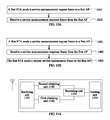
- FIG. 5A and FIG. 5B are flowcharts of still yet another method for discovering a service according to an embodiment of the present invention.
- FIG. 6A and FIG. 6B are schematic structural diagrams of an AP for discovering a service according to an embodiment of the present invention.
- FIG. 6C and FIG. 6D are schematic structural diagrams of a query unit in the AP for discovering a service according to an embodiment of the present invention.
- FIG. 7A and FIG. 7B are schematic structural diagrams of a STA for discovering a service according to an embodiment of the present invention.
- FIG. 8 is a flowchart of a method for registering a service according to an embodiment of the present invention.
- FIG. 9A and FIG. 9B are flowcharts of another method for registering a service according to an embodiment of the present invention.
- FIG. 10A and FIG. 10B are flowcharts of still another method for registering a service according to an embodiment of the present invention.
- FIG. 11A and FIG. 11B are schematic structural diagrams of an AP for registering a service according to an embodiment of the present invention.
- FIG. 12A and FIG. 12B are schematic structural diagrams of a STA for registering a service according to an embodiment of the present invention.
- FIG. 13A and FIG. 13B are schematic structural diagrams of a system for registering a service according to an embodiment of the present invention.
- FIG. 14 is a schematic diagram of information interaction of registering a service according to an embodiment of the present invention.
- FIG. 15A and FIG. 15B are a flowchart of a method for managing a direct association service according to an embodiment of the present invention.
- FIG. 16 is a flowchart of a method for obtaining a direct association service according to an embodiment of the present invention.
- FIG. 17 is a structural diagram of a STA for obtaining a direct association service according to an embodiment of the present invention.
- FIG. 18A and FIG. 18B are structural diagrams of an AP for managing a direct association service according to an embodiment of the present invention.
- FIG. 19 is a schematic structural diagram of a system for managing a direct association service according to an embodiment of the present invention.
- FIG. 20 is a schematic diagram of a Public Action frame according to an embodiment of the present invention.
- FIG. 21 is a schematic diagram of a query type table according to an embodiment of the present invention.
- FIG. 22 is a schematic diagram of a service discovery request frame according to an embodiment of the present invention.
- FIG. 23 is a schematic diagram of a service information table according to an embodiment of the present invention.
- FIG. 24 is a schematic diagram of simplified service information according to an embodiment of the present invention.
- FIG. 25 is a schematic diagram of a service discovery response frame according to an embodiment of the present invention.
- FIG. 26 is a schematic diagram of a service information element according to an embodiment of the present invention.
- FIG. 27 is a schematic diagram of a service announcement request frame according to an embodiment of the present invention.
- FIG. 28 is a schematic diagram of a service announcement response frame according to an embodiment of the present invention.
- FIG. 29 is a schematic diagram of a service maintenance frame according to an embodiment of the present invention.
- FIG. 30 is a schematic diagram of a direct association service request frame according to an embodiment of the present invention.
- FIG. 31 is a schematic diagram of a direct association service management table according to an embodiment of the present invention.
- FIG. 32 is a schematic diagram of a direct association service response frame according to an embodiment of the present invention.
- a service announcement request frame, a service announcement response frame, a service maintenance frame, a service discovery request frame, a service discovery response frame, a direct association request frame, and a direct association response frame may be implemented by extending a Public Action frame with a category being 4 in an action frame in an existing WLAN network; may also be implemented using existing management frames such as a Public Action frame, a Generic Advertisement Service (GAS) initial request frame, a GAS initial response frame, a GAS comeback request frame, and a GAS comeback response frame used in the IEEE 802.11u; may also be implemented by extending the Access Network Query Protocol (ANQP) in the IEEE 802.11u and using extended elements to carry new service-related information; and definitely may also be implemented by defining new frames, as long as objectives of the present invention can be achieved.
- the implementation is not limited in the present invention.
- FIG. 20 is a schematic structural diagram of a Public Action frame, where a value of a category is 4, a “Public Action field value” field is used for identifying a specific Public Action frame type, and currently there are 16 types of Public Action frames, which are Public Action field values 0 to 15.
- an existing Public Action frame is extended.
- a service discovery request frame is identified by a Public Action field value being 16
- a service discovery response frame is identified by a Public Action field value being 17
- a service announcement request frame is identified by a Public Action field value being 18
- a service announcement acknowledgment frame is identified by a Public Action field value being 19
- a service maintenance frame is identified by a Public Action field value being 20
- a direct association request frame is identified by a Public Action field value being 21
- a direct association response frame is identified by a Public Action field value being 22.
- the Public Action field values used in extended Public Action frames are only exemplary, and with development of standards, different values may be used. The values are not limited in the present invention.
- a service identifier, a device identifier, and a group identifier that are involved in the embodiments of the present invention may be allocated based on a local rule of an AP, that is, locally unique for the AP; or may be allocated based on a rule of being globally uniform, that is, globally unique. The allocation is not limited in the embodiments of the present invention.
- a service information table of an AP may be one table, or may be divided into two sub-tables, for example, a local service information table and a remote service information table, which is not limited in the present invention.
- Service information registered on the AP is saved in the local service information table, and service information registered on an accessible adjacent AP of the AP is saved in the remote service information table.
- querying the local service information table may be considered as querying all service information whose BSSID is the same as a MAC address of the AP, and querying the remote service information table may be considered as querying all service information whose BSSID is different from the MAC address of the AP; if both the local service information table and the remote service information table are to be queried, a BSSID is not limited.
- FIG. 1 is a flowchart of a method for discovering a service according to an embodiment of the present invention.
- the method for discovering a service is implemented by a first AP. As shown in FIG. 1 , the method includes the following steps:
- the first AP receives a service discovery request frame from a first STA, where the service discovery request frame includes M service query items, and each service query item includes a query type and query content.
- M is an integer greater than or equal to 0.
- a STA needs to query a required service during a service discovery process, where the query type may be a query type name such as a BSSID, a device name, a device capability, a service name, and a service identifier, or may be a query type identifier; for example, one query type identifier is defined for each query type name, and usually the query type identifier is globally uniform, which is not limited in the present invention, as long as the technical solutions of the present invention can be implemented. Exemplarily, in a query type information table shown in FIG. 21 , one query type identifier is defined for each query type name, which is not limited in the present invention.
- the service discovery request frame may be shown in FIG. 22 , where Length after a “Public Action field value” field is variable and is used to represent a length of an action detail in the service discovery request frame, and Length in each service query item is variable and is used to represent a length of the query content.
- the first AP queries a service information table of the first AP according to the service discovery request frame, and obtains a query result that meets the M service query items.
- the obtaining a query result that meets the M service query items includes obtaining the query result that meets the M service query items and is in the service information table of the first AP.
- a service discovery request frame includes one service query item, for example, a query type is “service name” and query content is “printing”, a query result needs to meet that “service name” is “printing”.
- M that is, a service discovery request frame includes two service query items, for example, the first service query item includes a query type being “service name” and query content being “printing”, and the second service query item includes a query type being “device capability” and query content being “supporting Wi-Fi Direct”, a query result needs to meet that “service name” is “printing” and “device capability” is “supporting Wi-Fi Direct”.
- the query result is all service information in the service information table of the first AP.
- the service information includes a BSSID, a device identifier, a service identifier, and a service name; the service information may further include a network access policy, a device name, a device capability, service description, and the like.
- the service information table may be shown in FIG. 23 , where the BSSID is a MAC address of an AP associated with a STA that declares the service information, for example, a MAC address of the first AP in this embodiment.
- the query result may be all service information that meets the M service query items, or may be simplified service information that meets the M service query items.
- a service discovery request frame includes two service query items, for example, the first service query item includes a query type being “service name” and query content being “printing”, and the second service query item includes a query type being “device capability” and query content being “supporting Wi-Fi Direct”, all service information that meets that “service name” is “printing” and “device capability” is “supporting Wi-Fi Direct” can be returned, or all simplified service information that meets that “service name” is “printing” and “device capability” is “supporting Wi-Fi Direct” can be returned, which is not limited in the present invention.
- FIG. 24 compared with service information, in simplified service information, query types being “service name” and “device capability” in a service query item are removed; returning of simplified service information can reduce an amount of information to be transmitted, thereby improving transmission efficiency.
- returning of service information is used as an example to describe a technical solution of the present invention, but does not constitute any limitation to the present invention.
- the first AP returns a service discovery response frame to the first STA, where the service discovery response frame includes the query result.
- the service discovery response frame may be shown in FIG. 25 , where Length is variable and is used to represent a length of an action detail in a service announcement response frame.
- the query result in the service discovery response frame may also be empty, which represents that the first AP does not discover service information that meets the M service query items.
- a value of the Length field is 0.
- the first AP may search the service information table of the first AP, and may further search that of another accessible adjacent AP, which can be configured as required.
- the first AP may forward a service discovery request frame to another accessible adjacent AP in a wireless manner, and receive a service discovery response frame returned by the another accessible adjacent AP.
- the first AP may also forward a service discovery request frame of the first STA to another accessible adjacent AP in another manner, and receive a service discovery response frame returned by the another accessible adjacent AP.
- an access controller AC
- the first AP may bind and encapsulate a service discovery request frame and a service discovery response frame using a data message in the Control And Provisioning of Wireless Access Points (CAPWAP) protocol, and communicate with another accessible adjacent AP using the AC.
- CAPWAP Control And Provisioning of Wireless Access Points
- the first AP may communicate with another accessible adjacent AP using the Transmission Control Protocol/Internet Protocol (TCP/IP), and encapsulate a service discovery request frame and a service discovery response frame using the TCP/IP protocol.
- TCP/IP Transmission Control Protocol/Internet Protocol
- a manner in which the first AP and another accessible adjacent AP communicate with each other is not limited in the present invention.
- forwarding is generally used to describe communication between the first AP and another accessible adjacent AP in the following.
- FIG. 2 is a flowchart of another method for discovering a service according to an embodiment of the present invention.
- the technical solution of the present invention is further described on the basis of the method for discovering a service shown in FIG. 1 of the present invention.
- the method includes the following steps:
- a first AP receives a service discovery request frame from a first STA, where the service discovery request frame includes M service query items, and each service query item includes a query type identifier and query content.
- M is an integer greater than or equal to 0.
- the first AP queries a service information table of the first AP according to the service discovery request frame, and obtains a query result that meets the M service query items.
- step 202 includes 202 A to 202 C, or 202 a to 202 c.
- the first AP queries the service information table of the first AP according to the service discovery request frame, and obtains all service information that meets the M service query items and is in the service information table of the first AP.
- step 102 for details, which are not described herein again.
- the first AP forwards the service discovery request frame to a second AP, receives a service discovery response frame returned by the second AP, where the service discovery response frame returned by the second AP includes all service information that meets the M service query items and is in a service information table of the second AP, and obtains the service information included in the service discovery response frame returned by the second AP.
- step 102 For a processing process after the second AP receives the service discovery request frame, refer to step 102 in the method shown in FIG. 1 of the present invention.
- the first AP obtains the query result that meets the M service query items, where the query result includes all the service information that meets the M service query items and is in the service information table of the first AP and the service information included in the service discovery response frame returned by the second AP.
- step 202 B may be performed before or after step 202 A, and steps 202 B and 202 A may also be performed synchronously.
- the first AP forwards the service discovery request frame of the first STA to another accessible adjacent AP to perform a service search in a wider range.
- the first AP queries the service information table of the first AP according to the service discovery request frame.
- the first AP forwards the service discovery request frame to a second AP, and receives a service discovery response frame returned by the second AP, where the service discovery response frame returned by the second AP includes all service information that meets the M service query items and is in a service information table of the second AP; and the first AP obtains the service information included in the service discovery response frame returned by the second AP.
- step 102 For a processing process after the second AP receives the service discovery request frame, refer to step 102 in the method shown in FIG. 1 of the present invention.
- the first AP may record, in the service information table of the first AP, all the service information that is included in the service discovery response frame returned by the second AP, meets the M service query items, and is on the second AP.
- the first AP forwards the service discovery request frame of the first STA to another accessible adjacent AP only when service information that meets the M service query items is not found on the first AP, to perform a service search in wider range.
- the service discovery request may further carry a device address or a device identifier of the first STA, so that the second AP determines whether the service discovery request frame of the first STA has been processed.
- the first AP forwards the service discovery request frame of the first STA to the second AP is used herein to describe the technical solution of the present invention.
- the first AP returns the service discovery response frame to the first STA, where the service discovery response frame includes the query result.
- step 103 for details, which are not described herein again.
- the first AP can discover service information within an accessible range. Therefore, a service discovery and search function in a wider range can be provided, richer service information can be provided to a user, and a user's demand of selecting a network according to a service requirement is met.
- a STA may obtain an available AP in a manner of active scanning or passive scanning.
- service information on the available AP may be obtained using a service discovery request frame and a service discovery response frame.
- An existing scanning manner may also be extended.
- a new service information element is defined, a probe request frame, a probe response frame, and a beacon are extended, and while information about an available AP is obtained, service directory information on the available AP is also obtained.
- a service information element is distinguished using an element identifier (element ID).
- element ID element identifier
- 17-31, 128-129, and 133-136 are still reserved for use for the element ID, and one value may be selected from 17-31, 128-129, and 133-136 to serve as an element ID of an extended service information element in the technical solution of the present invention.
- FIG. 3 is a flowchart of still another method for discovering a service according to an embodiment of the present invention.
- the technical solution of the present invention is further described on the basis of the method for discovering a service shown in FIG. 1 or FIG. 2 .
- the method includes the following steps:
- a first AP sends a beacon frame in a broadcast manner, where the beacon frame includes a service information element.
- the first AP When a passive scanning manner is adopted, the first AP periodically broadcasts a beacon frame, and a first STA needs to perform listening channel by channel to capture a beacon frame sent by the first AP, and obtains information about the first AP and service directory information on the first AP.
- the service information element includes a service directory item, and the service directory item includes a BSSID, a service identifier, and a service name.
- the service information element may further include a network type; the service directory item may further include service description.
- the network type may follow a definition in the IEEE 802.11 standard, for example, a private network.
- the service information element may be shown in FIG. 26 , where Length has a value of 0 to 256 bytes and is used to represent a length of the service information element.
- the first AP receives a service discovery request frame from a first STA, where the service discovery request frame includes M service query items, and each service query item includes a query type identifier and query content.
- M is an integer greater than or equal to 0.
- the first AP queries a service information table of the first AP according to the service discovery request frame, and obtains a query result that meets the M service query items.
- step 102 or 202 for details, which are not described herein again.
- the first AP returns a service discovery response frame to the first STA, where the service discovery response frame includes the query result that meets the M service query items.
- step 103 for details, which are not described herein again.
- FIG. 4 is a flowchart of yet another method for discovering a service according to an embodiment of the present invention.
- the technical solution of the present invention is further described on the basis of the method for discovering a service shown in FIG. 1 or FIG. 2 .
- the method includes the following steps:
- a first AP receives a probe request frame sent in a broadcast manner by a first STA, where the probe request frame includes a service information element.
- a Length field in the service information element is 0.
- the first AP returns a probe response frame to the first STA, where the probe response frame includes the service information element.
- the service information element includes a service directory item, and the service directory item includes a BSSID, a service identifier, and a service name.
- the first AP After receiving the probe request frame of the first STA, the first AP returns the probe response frame to the first STA and provides information about the first AP to the first STA. Moreover, because the probe request frame includes the service information element, the probe response frame returned by the first AP to the first STA also includes the service information element, and service directory information on the first AP is provided to the first STA.
- the service information element may be shown in FIG. 26 , where Length has a value of 0 to 256 bytes and is used to represent a length of the service information element.
- the first AP receives a service discovery request frame from the first STA, where the service discovery request frame includes M service query items, and each service query item includes a query type identifier and query content.
- the first AP queries a service information table of the first AP according to the service discovery request frame, and obtains a query result that meets the M service query items.
- step 102 or 202 for details, which are not described herein again.
- the first AP returns a service discovery response frame to the first STA, where the service discovery response frame includes the query result that meets the M service query items.
- step 103 for details, which are not described herein again.
- a first AP may discover a service, thereby avoiding a problem of frequent association and disassociation between different APs, which occurs because after being associated with an AP, the first STA discovers that a required service does not exist, and is then disassociated. This ensures that a user can more rapidly and accurately access a network that provides a service, and improves user experience. Moreover, a STA that provides a service in a network also does not need to periodically listen to a search request of another device and on a channel, thereby reducing resource consumption and power consumption of a STA that provides a service.
- FIG. 5A is a flowchart of still yet another method for discovering a service according to an embodiment of the present invention.
- the method for discovering a service is implemented by a first STA. As shown in FIG. 5A , the method includes the following steps:
- the first STA sends a service discovery request frame to a first AP, where the service discovery request frame includes M service query items, and each service query item includes a query type and query content.
- M is an integer greater than or equal to 0.
- a STA needs to query a required service during a service discovery process, where the query type may be a query type name such as a BSSID, a device name, a device capability, a service name, and a service identifier, or may be a query type identifier; for example, one query type identifier is defined for each query type name, and usually the query type identifier is globally uniform, which is not limited in the present invention, as long as the technical solutions of the present invention can be implemented. Exemplarily, in a query type information table shown in FIG. 21 , one query type identifier is defined for each query type name, which is not limited in the present invention.
- the service discovery request frame may be shown in FIG. 22 , where Length after a Public Action field value field is variable and is used to represent a length of an action detail in the service discovery request frame, and Length in each service query item is variable and is used to represent a length of the query content.
- the first STA receives a service discovery response frame returned by the first AP, where the service discovery response frame includes a query result that meets the M service query items.
- the query result may be service information that meets the M service query items, or may be simplified service information that meets the M service query items.
- the service information includes a BSSID, a device identifier, a service identifier, and a service name; the service information may further include a network access policy, a device name, a device capability, service description, and the like.
- the service information table may be shown in FIG. 23 , where the BSSID is a MAC address of an AP associated with a STA that declares the service information, for example, a MAC address of the first AP in this embodiment.
- a service discovery request frame includes two service query items, for example, the first service query item includes a query type being “service name” and query content being “printing”, and the second service query item includes a query type being “device capability” and query content being “Wi-Fi Direct”, a query result is all service information that meets that “service name” is “printing” and “device capability” is “Wi-Fi Direct”, or may be all simplified service information that meets that “service name” is “printing” and “device capability” is “Wi-Fi Direct”.
- the query result is not limited in the present invention.
- FIG. 24 compared with service information, in simplified service information, query types being “service name” and “device capability” in a service query item are removed; returning of simplified service information can reduce an amount of information to be transmitted, thereby improving transmission efficiency.
- the service discovery response frame may be shown in FIG. 25 , where Length is variable and is used to represent a length of an action detail in a service announcement response frame.
- the query result in the service discovery response frame may also be empty, which represents that the first AP does not discover service information that meets the M service query items.
- a value of the Length field is 0.
- a timer may also be set. If a service discovery response frame returned by the first AP is not received within a set time of the timer, the first STA considers that current service discovery fails; the first STA may send a service discovery request frame to the first AP again, or may send a service discovery request frame to another AP.
- the first STA needs to obtain information about an available AP through scanning, and requests service directory information on the available AP.
- the method further includes the following steps:
- the first STA sends a probe request frame in a broadcast manner, where the probe request frame includes a service information element.
- a Length field in the service information element is 0.
- the probe request frame is used to request service directory information on an AP; therefore, a service directory item in the service information element of the probe request frame is empty, and the Length field in the service information element is 0.
- the first STA receives a probe response frame returned by the first AP, where the probe response frame includes the service information element, the service information element includes a service directory item, and the service directory item includes a BSSID, a service identifier, and a service name.
- the method further includes the following steps:
- the first STA receives a beacon frame sent in a broadcast manner by the first AP, where the beacon frame includes a service information element, the service information element includes a service directory item, and the service directory item includes a BSSID, a service identifier, and a service name.
- the first AP When a passive scanning manner is adopted, the first AP periodically broadcasts a beacon frame, and the first STA needs to perform listening channel by channel to capture a beacon frame sent by the first AP, and obtains information about the first AP and service directory information on the first AP.
- a first AP may serve as a proxy for the first STA to search for device information and service information that can be provided in a network, thereby obtaining richer service information, meeting a user's demand of selecting a network according to a service requirement, and avoiding a problem of frequent association and disassociation between different APs, which occurs because after being associated with an AP, the first STA discovers that a required service does not exist, and is then disassociated. This ensures that a user can more rapidly and accurately access a network that provides a service, and improves user experience.
- An embodiment of the present invention provides a system for discovering a service.
- the system includes a first AP shown in FIG. 6A and a first STA shown in FIG. 7A .
- the first STA and the first AP interact with each other to implement the methods for discovering a service provided in the embodiments of the present invention.
- the system may further include a second AP, and the second AP is an accessible adjacent AP of the first AP. It may be understood that multiple second APs may exist in the system.
- the following describes in detail the first STA and the first AP in the system for discovering a service provided in the embodiment of the present invention.
- FIG. 6A is a schematic structural diagram of a first AP for discovering a service according to an embodiment of the present invention.
- the first AP includes a receiving unit 601 , a query unit 602 , and a sending unit 603 .
- the receiving unit 601 is configured to receive a service discovery request frame from a first STA, where the service discovery request frame includes M service query items.
- Each service query item includes a query type and query content, and M is an integer greater than or equal to 0.
- a STA needs to query a required service during a service discovery process, where the query type may be a query type name such as a BSSID, a device name, a device capability, a service name, and a service identifier, or may be a query type identifier; for example, one query type identifier is defined for each query type name, and usually the query type identifier is globally uniform, which is not limited in the present invention, as long as the technical solutions of the present invention can be implemented. Exemplarily, in a query type information table shown in FIG. 21 , one query type identifier is defined for each query type name, which is not limited in the present invention.
- the service discovery request frame may be shown in FIG. 22 , where Length after a Public Action field value field is variable and is used to represent a length of an action detail in the service discovery request frame, and Length in each service query item is variable and is used to represent a length of the query content.
- the query unit 602 is configured to query a service information table of the first AP according to the service discovery request frame, and obtain a query result that meets the M service query items.
- the query unit 602 is configured to obtain the query result that meets the M service query items and is in the service information table of the first AP.
- a service discovery request frame includes one service query item, for example, a query type is “service name” and query content is “printing”, a query result needs to meet that “service name” is “printing”.
- M that is, a service discovery request frame includes two service query items, for example, the first service query item includes a query type being “service name” and query content being “printing”, and the second service query item includes a query type being “device capability” and query content being “supporting Wi-Fi Direct”, a query result needs to meet that “service name” is “printing” and “device capability” is “supporting Wi-Fi Direct”.
- the query result is all service information in the service information table of the first AP.
- the service information includes a BSSID, a device identifier, a service identifier, and a service name; the service information may further include a network access policy, a device name, a device capability, service description, and the like.
- the service information table may be shown in FIG. 23 , where the BSSID is a MAC address of an AP associated with a STA that declares the service information, for example, a MAC address of the first AP in this embodiment
- the query result may be all service information that meets the M service query items, or may be simplified service information that meets the M service query items.
- a service discovery request frame includes two service query items, for example, the first service query item includes a query type being “service name” and query content being “printing”, and the second service query item includes a query type being “device capability” and query content being “supporting Wi-Fi Direct”, all service information that meets that “service name” is “printing” and “device capability” is “supporting Wi-Fi Direct” can be returned, or all simplified service information that meets that “service name” is “printing” and “device capability” is “supporting Wi-Fi Direct” can be returned, which is not limited in the present invention.
- FIG. 24 compared with service information, in simplified service information, query types being “service name” and “device capability” in a service query item are removed; returning of simplified service information can reduce an amount of information to be transmitted, thereby improving transmission efficiency.
- returning of service information is used as an example to describe the technical solution of the present invention, but does not constitute any limitation to the present invention.
- the sending unit 603 is configured to return a service discovery response frame to the first STA, where the service discovery response frame includes the query result.
- the service discovery response frame may be shown in FIG. 25 , where Length is variable and is used to represent a length of an action detail in a service announcement response frame.
- the query result in the service discovery response frame may also be empty, which represents that the first AP does not discover service information that meets the M service query items.
- a value of the Length field is 0.
- the first AP further includes a scanning unit 604 , where the scanning unit 604 is configured to send a beacon frame in a broadcast manner; or the scanning unit 604 is configured to receive a probe request frame sent in a broadcast manner by the first STA, and return a probe response frame to the first STA.
- the scanning unit 604 is configured to send a beacon frame in a broadcast manner; or the scanning unit 604 is configured to receive a probe request frame sent in a broadcast manner by the first STA, and return a probe response frame to the first STA.
- the scanning unit 604 is configured to periodically broadcast a beacon frame, where the beacon frame includes a service information element, the service information element includes a service directory item, and the service directory item includes a BSSID, a service identifier, and a service name.
- the first STA needs to perform listening channel by channel to capture a beacon frame sent by the first AP and obtain information about the first AP and service directory information on the first AP.
- the first STA When an active scanning manner is adopted, the first STA sends, on each channel, a probe request frame carrying a service information element, actively scans an available AP on the channel, and requests service directory information on the available AP.
- the scanning unit 604 is configured to receive the probe request frame sent in a broadcast manner by the first STA, where the probe request frame includes the service information element, and a Length field in the service information element is 0; and return a probe response frame to the first STA, where the probe response frame includes the service information element, the service information element includes a service directory item, and the service directory item includes a BSSID, a service identifier, and a service name, which are used to provide information about the first AP and service directory information on the first AP to the first STA.
- the service information element may be shown in FIG. 26 , where Length has a value of 0 to 256 bytes and is used to represent a length of the service information element.
- the service information element may further include a network type; the service directory item may further include service description.
- the network type may follow a definition in the IEEE 802.11 standards, for example, a private network.
- the query unit 602 includes a local subunit 602 A configured to query the service information table of the first AP according to the service discovery request frame, and obtain all service information that meets the M service query items and is in the service information table of the first AP; a remote subunit 602 B configured to forward the service discovery request frame to a second AP, receive a service discovery response frame returned by the second AP, where the service discovery response frame returned by the second AP includes all service information that meets the M service query items and is in a service information table of the second AP, and obtain the service information included in the service discovery response frame returned by the second AP; and a result obtaining subunit 602 C configured to obtain the query result that meets the M service query items, where the query result includes the service information obtained by the local subunit 602 A and the service information obtained by the remote subunit 602 B.
- the query unit 602 includes a search subunit 602 a configured to query the service information table of the first AP according to the service discovery request frame; a remote subunit 602 b configured to, when a search result of the search subunit 602 a is that none of service information in the service information table of the first AP meets the M service query items, forward the service discovery request frame to a second AP, receive a service discovery response frame returned by the second AP, where the service discovery response frame returned by the second AP includes all service information that meets the M service query items and is in a service information table of the second AP, and obtain the service information included in the service discovery response frame returned by the second AP; and a local subunit 602 c configured to, when a search result of the search subunit 602 a is that at least one piece of service information existing in the service information table of the first AP meets the M service query items, obtain all service information that meets the M service query items and is in the service information table of the first AP
- the service discovery request may further carry a device address or a device identifier of the first STA, so that the second AP determines whether the service discovery request frame of the first STA has been processed.
- FIG. 7A is a schematic structural diagram of a first STA for discovering a service according to an embodiment of the present invention. As shown in FIG. 7A , the first STA includes a sending unit 701 and a receiving unit 702 .
- the sending unit 701 is configured to send a service discovery request frame to a first AP, where the service discovery request frame includes M service query items.
- Each service query item includes a query type and query content, and M is an integer greater than or equal to 0.
- a STA needs to query a required service during a service discovery process, where the query type may be a query type name such as a BSSID, a device name, a device capability, a service name, and a service identifier, or may be a query type identifier; for example, one query type identifier is defined for each query type name, and usually the query type identifier is globally uniform, which is not limited in the present invention, as long as the technical solutions of the present invention can be implemented. Exemplarily, in a query type information table shown in FIG. 21 , one query type identifier is defined for each query type name, which is not limited in the present invention.
- the service discovery request frame may be shown in FIG. 22 , where Length after a Public Action field value field is variable and is used to represent a length of an action detail in the service discovery request frame, and Length in each service query item is variable and is used to represent a length of the query content.
- the receiving unit 702 is configured to receive a service discovery response frame returned by the first AP, where the service discovery response frame includes a query result that meets the M service query items.
- the query result may be all service information that meets the M service query items, or may be simplified service information that meets the M service query items.
- the service information includes a BSSID, a device identifier, a service identifier, and a service name; the service information may further include a network access policy, a device name, a device capability, service description, and the like.
- the service information table may be shown in FIG. 23 , where the BSSID is a MAC address of an AP associated with a STA that declares the service information, for example, a MAC address of the first AP in this embodiment.
- a service discovery request frame includes two service query items, for example, the first service query item includes a query type being “service name” and query content being “printing”, and the second service query item includes a query type being “device capability” and query content being “supporting Wi-Fi Direct”, a query result is all service information that needs to meet that “service name” is “printing” and “device capability” is “supporting Wi-Fi Direct”; or may be all simplified service information that meets that “service name” is “printing” and “device capability” is “supporting Wi-Fi Direct”, which is not limited in the present invention.
- FIG. 24 compared with service information, in simplified service information, query types being “service name” and “device capability” in a service query item are removed; returning of simplified service information can reduce an amount of information to be transmitted, thereby improving transmission efficiency.
- the service discovery response frame may be shown in FIG. 25 , where Length is variable and is used to represent a length of an action detail in a service announcement response frame.
- the query result in the service discovery response frame may also be empty, which represents that the first AP does not discover service information that meets the M service query items.
- a value of the Length field is 0.
- the first STA further includes a scanning unit 703 , where the scanning unit 703 is configured to receive a beacon frame sent in a broadcast manner by the first AP; or, the scanning unit 703 is configured to send a probe request frame in a broadcast manner, and receive a probe response frame returned by the first AP.
- the first STA can obtain information about an available AP, and request service directory information on the available AP.
- the scanning unit 703 is configured to send a probe request frame in a broadcast manner, where the probe request frame includes a service information element, and a Length field in the service information element is 0; and receive a probe response frame returned by the first AP, where the probe response frame includes the service information element, the service information element includes a service directory item, and the service directory item includes a BSSID, a service identifier, and a service name.
- the scanning unit 703 is configured to receive a beacon frame sent in a broadcast manner by the first AP, where the beacon frame includes a service information element, the service information element includes a service directory item, and the service directory item includes a BSSID, a service identifier, and a service name.
- the first STA further includes a timing unit configured to, after the service discovery request frame is sent, set a timer; if a service discovery response frame returned by the first AP is not received within a set time of the timer, consider that current service discovery fails, so that the first STA may send a service discovery request frame to the first AP again, or may send a service discovery request frame to another AP.
- a timing unit configured to, after the service discovery request frame is sent, set a timer; if a service discovery response frame returned by the first AP is not received within a set time of the timer, consider that current service discovery fails, so that the first STA may send a service discovery request frame to the first AP again, or may send a service discovery request frame to another AP.
- a first AP may serve as a proxy for a first STA to search for service information in a network, and the first AP may provide wider and richer service information to a user through a local search and a remote search, thereby meeting a user's demand of selecting a network according to a service requirement. Therefore, a STA that provides a service in the network also does not need to periodically listen to a search request of another device and on a channel, thereby reducing resource consumption and power consumption of a STA that provides a service.
- the first STA can obtain service information using the first AP both before association and after association, thereby avoiding a problem of frequent association and disassociation between different APs, which occurs because after being associated with an AP, the first STA discovers that a required service does not exist, and is then disassociated. This ensures that a user can more rapidly and accurately access a network that provides a service, and improves user experience.
- the first STA may declare, to the first AP, a service that the first STA can provide.
- the first AP may also spread, to another accessible adjacent AP in the network, the service information declared by the first STA.
- FIG. 8 is a flowchart of a method for registering a service according to an embodiment of the present invention.
- the method for registering a service is implemented by a first AP. As shown in FIG. 8 , the method includes the following steps:
- the first AP receives a service announcement request frame from a first STA, where the service announcement request frame includes a device address of the first STA and at least one service declaration item, and each of at least one service declaration item includes a service name.
- the first STA may send a service announcement request frame to the first AP to register a service on the first AP.
- the device address of the first STA is usually a MAC address of the first STA.
- the device address of the first STA is usually carried in a header of the service announcement request frame.
- the service announcement request frame may further include a device name, a device identifier, a device capability, device description, and the like of the first STA.
- the device name of the first STA may be, for example, a printer or a television, or may be, for example, cafe No. 1 and Ticket Center No. 2.
- the device capability of the first STA may be, for example, supporting Wi-Fi Direct or supporting Bluetooth; a capability parameter may further be carried in the device capability, for example, when Wi-Fi Direct is supported, a direct distance is carried. For example:
- the service declaration item may further include, in addition to a service name, service description.
- Ticket Center No. 2 may provide the following services:
- the first STA may register the multiple services on the first AP once, where the service announcement request frame includes multiple service declaration items.
- the first STA may also register services on the first AP for multiple times, that is, register one service on the first AP each time, and register the services for multiple times.
- the service announcement request frame only includes one service declaration item each time.
- the service announcement request frame may be shown in FIG. 27 , where Length is variable and is used to represent a length of an action detail in the service announcement request frame.
- the first AP obtains a device identifier of the first STA.
- the first AP queries an address correspondence table of the first AP according to the device address of the first STA, where the address correspondence table includes a correspondence between a device address and a device identifier; and when a device address in one existing address correspondence in the address correspondence table of the first AP is the same as the device address of the first STA, the first AP obtains a device identifier in the existing address correspondence, that is, the device identifier of the first STA; or when a device address in any address correspondence in the address correspondence table of the first AP is different from the device address of the first STA, the first AP allocates the device identifier of the first STA from a device identifier pool, and records, in the address correspondence table, an address correspondence between the device address of the first STA and the device identifier of the first STA.
- the first AP may also obtain the device identifier of the first STA from the service announcement request frame.
- the Ticket Center No. 2 whose device address is MAC1 has a device identifier DI-1
- a printer 1 whose device address is MAC2 has a device identifier DI-2.
- the first AP obtains, according to the at least one service declaration item, a service identifier corresponding to each of the at least one service declaration item.
- the first AP obtains a corresponding service identifier according to a service name of each service declaration item includes querying, by the first AP, a service information table of the first AP according to a service name of a first service declaration item in the at least one service declaration item; and when a service name in any piece of service information in the service information table of the first AP is different from the service name of the first service declaration item, allocating a first service identifier from a service identifier pool according to the service name of the first service declaration item; or when a service name in existing service information existing in the service information table of the first AP is the same as the service name of the first service declaration item, and a BSSID of the existing service information is the same as the MAC address of the first AP, obtaining a service identifier of the existing service information, that is, a first service identifier corresponding to the service name of the first service declaration item.
- a second service identifier corresponding to a service name of the second service declaration item is obtained; and so on.
- the Ticket Center No. 2 sends a service announcement request frame, where the service announcement request frame includes two service declaration items, the first service declaration item has a service name being “flight ticket booking”, and the second service declaration item has a service name being “train ticket booking”, so that the first AP obtains a service identifier SI-1 according to “flight ticket booking”, and then obtains a service identifier SI-2 according to “train ticket booking”.
- the first AP records, in the service information table of the first AP, service information corresponding to each of the at least one service declaration item, where the service information includes a BSSID, a device identifier, a service identifier, and a service declaration item.
- the first AP obtains first service information, where the first service information includes a BSSID of the first AP, the device identifier of the first STA, the first service identifier, and the first service declaration item; and records the first service information in the service information table of the first AP.
- second service information is obtained, and the second service information is recorded in the service information table of the first AP; and so on.
- the service information may further include the device name of the first STA, the device capability of the first STA, and a network access policy.
- the network access policy may represent an access policy inside a BSS to which the AP belongs, or may be an access policy for a specific service. For example, an AP1 is in a public network, an AP2 is in a private network, and the AP1 may access, according to an access policy of the AP2, the private network to which the AP2 belongs.
- the service information table may be shown in FIG. 23 , where the BSSID is a MAC address of an AP associated with a STA that declares the service information, for example, the MAC address of the first AP in this embodiment.
- the first AP returns a service announcement response frame to the first STA, where the service announcement response frame includes the device identifier of the first STA and a service declaration acknowledgment item corresponding to the at least one service declaration item, and the service declaration acknowledgment item includes a service identifier and a service name.
- the service announcement response frame includes the device identifier of the first STA obtained in step 802 ; and a service declaration acknowledgment item corresponding to each of the at least one service declaration item, including a first declaration acknowledgment item corresponding to the first service declaration item, where the first declaration acknowledgment item includes the service name of the first service declaration item and the first service identifier; and if there is also a second service declaration item, a second declaration acknowledgment item corresponding to the second service declaration item, where the second declaration acknowledgment item includes the service name of the second service declaration item and the second service identifier; and so on.
- the service announcement response frame may further include the device name of the first STA.
- the service announcement response frame may be shown in FIG. 28 , where Length is variable and is used to represent a length of an action detail in the service announcement response frame.
- a first STA associated with a first AP may declare service information on the first AP; the first AP manages and maintains service information inside a BSS to which the first AP belongs, and provides a service search function. In this way, the first STA does not need to periodically listen to a search request of another device and on a channel, thereby reducing resource consumption and power consumption of the first STA.
- the first AP may forward a service maintenance frame to another accessible adjacent AP in a wireless manner, and receive a service maintenance frame sent by another accessible adjacent AP.
- the first AP may also forward a service maintenance frame to another accessible adjacent AP in another manner.
- the first AP may bind and encapsulate a service maintenance frame using a data message in the CAPWAP protocol, and communicate with another accessible adjacent AP using the AC.
- the first AP may communicate with another accessible adjacent AP using the TCP/IP, and encapsulate a service maintenance frame using the TCP/IP protocol.
- a manner in which the first AP and another accessible adjacent AP communicate with each other is not limited in the present invention.
- forwarding is generally used to describe communication between the first AP and another accessible adjacent AP in the following.
- FIG. 9A is a flowchart of another method for registering a service according to an embodiment of the present invention.
- the technical solution of the present invention is further described on the basis of the method for registering a service shown in FIG. 8 .
- the method includes the following steps:
- a first AP receives a service announcement request frame from a first STA, where the service announcement request frame includes a device address of the first STA and at least one service declaration item, and each of the at least one service declaration item includes a service name.
- step 801 for details, which are not described herein again.
- the first AP obtains a device identifier of the first STA according to the device address of the first STA.
- step 802 for details, which are not described herein again.
- the first AP obtains, according to the at least one service declaration item, a service identifier corresponding to each of the at least one service declaration item.
- step 803 for details, which are not described herein again.
- the first AP records, in a service information table of the first AP, service information corresponding to the at least one service declaration item, where the service information includes a BSSID, a device identifier, a service identifier, and a service declaration item.
- step 804 for details, which are not described herein again.
- the first AP returns a service announcement response frame to the first STA, where the service announcement response frame includes the device identifier of the first STA and a service declaration acknowledgment item corresponding to the at least one service declaration item, and the service declaration acknowledgment item includes a service identifier and a service name.
- step 805 for details, which are not described herein again.
- a STA may cancel, using a service maintenance frame, a service that has been declared, and an AP may update, using a service maintenance frame, a service information table of an accessible AP.
- the service maintenance frame includes a maintenance state and a maintenance detail.
- the maintenance state includes a first maintenance state and a second maintenance state.
- the first maintenance state is used to, when a service declared by a STA is added on an AP, update and register the service on another accessible adjacent AP.
- the second maintenance state is used to, when a STA needs to cancel a service that has been declared, cancel the service on an AP; optionally, the AP updates and cancels the service on another accessible adjacent AP.
- the maintenance state may be represented by a character string; for example, Register represents the first maintenance state, and Cancel represents the second maintenance state.
- the maintenance state may also be represented by a number; for example, 1 represents the first maintenance state, and 0 represents the second maintenance state.
- the representation of the maintenance state is not limited in the present invention.
- the first AP sends a first service maintenance frame to a second AP, where the first service maintenance frame includes a maintenance state and a maintenance detail, so that the second AP updates a service information table of the second AP.
- the maintenance state in the first service maintenance frame is a first maintenance state, and the maintenance detail includes service information corresponding to each of the at least one service declaration item.
- the first AP sends the first service maintenance frame to the second AP, and the first service maintenance frame includes a first maintenance state; and the service information corresponding to each of the at least one service declaration item, including first service information corresponding to a first service declaration item; and if there is also a second service declaration item, second service information corresponding to the second service declaration item; and so on.
- the second AP is an accessible adjacent AP of the first AP.
- the first AP may access the second AP in a wireless manner, or the first AP may access the second AP in a wired manner, as long as communication can be performed between the first AP and the second AP.
- An access manner is not limited in the present invention.
- That the second AP updates the service information table of the second AP after receiving the first service maintenance frame includes recording, by the second AP in the service information table of the second AP according to the first maintenance state in the first service maintenance frame, the service information in the first service maintenance frame.
- the first AP may spread, to a wider range in the network, the service information declared by the first STA, and serve as a proxy for the first STA to provide a service search function in a wider range to a user.
- the first AP senses that the first STA is disassociated; or, the first AP receives a second service maintenance frame from the first STA, where the second service maintenance frame includes a maintenance state and a maintenance detail.
- the maintenance state in the second service maintenance frame is a second maintenance state, and the maintenance detail includes at least one service maintenance item.
- the service maintenance item includes a BSSID, the device identifier, and the service identifier, where the service identifier identifies a service that has been declared by the first STA.
- the first AP may cancel all the services that have been declared on the first AP by the first STA. All the service information declared by the first STA is deleted from the service information table of the first AP. Further optionally, the first AP may send a service maintenance frame to the second AP, so that the second AP updates the service information table of the second AP. For that the first AP senses that the first STA is disassociated, refer to an existing implementation manner, which is not limited in the present invention.
- the first STA may also send, to the first AP, a service maintenance frame whose maintenance state is the second maintenance state, to cancel all or some of the services that have been declared on the first AP.
- the BSSID and the device identifier in the service maintenance item in the second service maintenance frame that is received by the first AP and is from the first STA may be empty, so that the first AP may first obtain the BSSID, that is, a MAC address of the first AP, and a device identifier, that is, the device identifier of the first STA, where the first AP may query an address correspondence table of the first AP according to the device address of the first STA, and obtain the device identifier of the first STA; and then obtain, according to the obtained BSSID and device identifier and the service identifier of each service maintenance item in the at least one service maintenance item, all services that the first STA needs to cancel, and then perform subsequent processing.
- the service maintenance item in the second service maintenance frame that is received by the first AP and is from the first STA may be empty, which represents that the first STA needs to cancel all the services that have been declared.
- the first AP when the first AP receives the second service maintenance frame, if the service maintenance item includes the BSSID and the device identifier, the first AP first authenticates whether the BSSID is the MAC address of the first AP, and whether the device identifier corresponds to the device address of the first STA; and if the BSSID is the MAC address of the first AP and the device identifier corresponds to the device address of the first STA, the first AP performs subsequent processing; otherwise, the first AP considers that the second service maintenance frame is a malicious attack, and skips processing.
- the first AP updates the service information table of the first AP.
- the first AP When the first AP senses that the first STA is disassociated, the first AP deletes, from the service information table of the first AP, all the service information declared by the first STA, which includes obtaining, by the first AP, a BSSID, that is, the MAC address of the first AP, and a device identifier, that is, the device identifier of the first STA, where the first AP may query an address correspondence table of the first AP according to the device address of the first STA, and obtain the device identifier of the first STA, and further update the service information table of the first AP according to the MAC address of the first AP and the device identifier of the first STA; the first AP queries the service information table of the first AP according to the MAC address of the first AP and the device identifier of the first STA, and deletes, from the service information table of the first AP, all service information whose BSSID is the same as the MAC address of the first AP and whose device
- the first AP may recycle, into a device identifier pool, the device identifier allocated to the first STA.
- the first AP updates the service information table of the first AP according to the second service maintenance frame, which includes querying, by the first AP, the service information table of the first AP according to the first service maintenance item in the second service maintenance frame; when matched first service information exists, that is, a BSSID of the first service information in the service information table of the first AP is the same as a BSSID of the first service maintenance item in the second service maintenance frame, a service identifier of the first service information is the same as a service identifier in the first service maintenance item in the second service maintenance frame, and a device identifier in the first service information is the same as a device identifier in the first service maintenance item in the second service maintenance frame, deleting the first service information from the service information table of the first AP; and if a second service maintenance item further exists in the second service maintenance frame, querying the service information table of the first AP according to the second service maintenance item in the second service maintenance frame
- a BSSID and a device identifier in a service maintenance item in the second service maintenance frame may be empty, so that the first AP may first obtain the BSSID, that is, the MAC address of the first AP, and a device identifier, that is, the device identifier of the first STA, and the first AP may query the address correspondence table of the first AP according to the device address of the first STA, and obtain the device identifier of the first STA.
- the first AP queries the service information table of the first AP according to the MAC address of the first AP, the device identifier of the first STA, and the service identifier of the first service maintenance item in the second service maintenance frame; when matched first service information exists, that is, a BSSID of the first service information is the same as the MAC address of the first AP, the service identifier of the first service information is the same as the service identifier of the first service maintenance item in the second service maintenance frame, and the device identifier of the first service information is the same as the device identifier of the first STA, the first AP deletes the first service information from the service information table of the first AP; and if there is also a second service maintenance item in the second service maintenance frame, the first AP queries the service information table of the first AP according to the MAC address of the first AP, the device identifier of the first STA, and the service identifier of the second service maintenance item in the second service maintenance frame; when matched second service information exists, that
- the first AP may recycle, into the device identifier pool, the device identifier allocated to the first STA; if none of other STAs provides a service corresponding to a service identifier and canceled by the first STA, the first AP may recycle the service identifier into the service identifier pool.
- the first AP may send the second service maintenance frame to the second AP, where the second service maintenance frame includes a BSSID, that is, the MAC address of the first AP, and the device identifier of the first STA, so that the second AP updates the service information table of the second AP.
- the second service maintenance frame includes a BSSID, that is, the MAC address of the first AP, and the device identifier of the first STA, so that the second AP updates the service information table of the second AP.
- the first AP updates the second service maintenance frame using the obtained BSSID, that is, the MAC address of the first AP and the device identifier of the first STA, and then forwards the updated second service maintenance frame to the second AP.
- the first AP performs the foregoing 906 and 909 to update a service information table of the accessible adjacent AP; if an accessible adjacent AP of the first AP does not exist, the first AP does not need to perform the foregoing 906 and 909 .
- the service maintenance frame may be shown in FIG. 29 , where Length is variable and is used to represent a length of an action detail in the service maintenance frame.
- the first AP may further maintain service information spread by another accessible adjacent AP, and as shown in FIG. 9B , the method may further include the following steps:
- the first AP receives a third service maintenance frame from the second AP, where the third service maintenance frame includes a maintenance state and a maintenance detail.
- the maintenance state in the third service maintenance frame may be a first maintenance state, and correspondingly, the maintenance detail includes at least one piece of service information.
- the maintenance state in the third service maintenance frame may also be a second maintenance state, and correspondingly, the maintenance detail includes at least one service maintenance item; the service maintenance item includes a BSSID, a device identifier, and a service identifier.
- the first AP updates the service information table of the first AP according to the third service maintenance frame.
- the first AP When the maintenance state in the third service maintenance frame is the first maintenance state, the first AP records, in the service information table of the first AP, the at least one piece of service information included in the third service maintenance frame.
- the first AP queries the service information table of the first AP according to a first service maintenance item in the third service maintenance frame; when matched first service information exists, that is, a BSSID of the first service information in the service information table of the first AP is the same as a BSSID of the first service maintenance item in the third service maintenance frame, a service identifier of the first service information is the same as a service identifier of the first service maintenance item in the third service maintenance frame, and a device identifier of the first service information is the same as a device identifier of the first service maintenance item in the third service maintenance frame, the first AP deletes the first service information from the service information table of the first AP; if there is also a second service declaration item in the third service maintenance frame, queries the service information table of the first AP according to the second service maintenance item in the third service maintenance frame; when matched second service information exists, the first AP deletes the second service information from the service information table of the
- 910 and 911 may be performed before or after any one of 901 to 909 .
- a first STA associated with a first AP may declare or cancel service information on the first AP, the first STA does not need to periodically listen to a search request of another device and on a channel, thereby reducing resource consumption and power consumption of the first STA; the first AP may further spread, to an accessible adjacent AP in the network, device information and service information that are declared on the first AP, and may also receive service information provided by an accessible adjacent AP, to provide a service discovery function in a wider range and provide richer service information to a user, thereby meeting a user's demand of selecting a network according to a service requirement.
- FIG. 10A is a flowchart of still another method for registering a service according to an embodiment of the present invention.
- the method for registering a service is implemented by a first STA. As shown in FIG. 10A , the method includes the following steps:
- the first STA sends a service announcement request frame to a first AP, where the service announcement request frame includes a device address of the first STA and at least one service declaration item, and each of the at least one service declaration item includes a service name.
- the first STA may send a service announcement request frame to the first AP to register a service on the first AP.
- the device address of the first STA is usually a MAC address of the first STA, and the device address of the first STA is usually carried in a header of the service announcement request frame.
- the service announcement request frame may further include a device name, a device identifier, a device capability, device description, and the like of the first STA.
- the device name of the first STA may be, for example, a printer and a television, or may be, for example, cafe No. 1 and Ticket Center No. 2.
- the device capability of the first STA may be, for example, supporting Wi-Fi Direct or supporting Bluetooth; a capability parameter may further be carried in the device capability, for example, when Wi-Fi Direct is supported, a direct distance is carried. For example:
- the service declaration item may further include, in addition to a service name, service description.
- Ticket Center No. 2 may provide the following services:
- the first STA may register the multiple services on the first AP once, where the service announcement request frame includes multiple service declaration items.
- the first STA may also register services on the first AP for multiple times, that is, register one service on the first AP each time, and register the services for multiple times.
- the service announcement request frame only includes one service declaration item each time.
- the device identifier of the first STA may be carried in the service announcement request frame.
- the service announcement request frame may be shown in FIG. 27 , where Length is variable and is used to represent a length of an action detail in the service announcement request frame.
- the service announcement response frame includes the device identifier of the first STA and a service declaration acknowledgment item corresponding to each of the at least one service declaration item, and the service declaration acknowledgment item includes a service identifier and a service name.
- the service declaration acknowledgment item corresponding to each of the at least one service declaration item includes a first declaration acknowledgment item corresponding to a first service declaration item, where the first declaration acknowledgment item includes a service name of the first service declaration item and a first service identifier; and if there is also a second service declaration item, a second declaration acknowledgment item corresponding to the second service declaration item, where the second declaration acknowledgment item includes a service name of the second service declaration item and a second service identifier; and so on.
- the service announcement response frame may further include the device name of the first STA.
- the service announcement response frame may be shown in FIG. 28 , where Length is variable and is used to represent a length of an action detail in the service announcement response frame.
- the first STA after receiving the service announcement response frame, the first STA records the device identifier of the first STA and each service declaration acknowledgment item according to the service announcement response frame.
- the first STA may maintenance a service declaration information table, where the service declaration information table includes a BSSID, a device identifier, a service name, a service identifier, and the like.
- the first STA may send a service maintenance frame to the first AP to cancel all or some of services that have been declared.
- the method further includes the following steps:
- the first STA sends a second service maintenance frame to the first AP, where the second service maintenance frame includes a maintenance state and a maintenance detail.
- the first STA sends the second service maintenance frame to the first AP, the maintenance state in the second service maintenance frame is a second maintenance state, and the maintenance detail includes at least one service maintenance item, so that the first AP updates a service information table of the first AP according to the second service maintenance frame, and optionally forwards the second service maintenance frame to a second AP, where the service maintenance item includes a BSSID, the device identifier, and the service identifier.
- the first STA deletes, from the service declaration information table, service declaration information corresponding to each service maintenance item in the at least one service maintenance item.
- the BSSID and the device identifier in the service maintenance item may be empty.
- the service maintenance item in the second service maintenance frame may be empty, which represents that the first STA needs to cancel all the services that have been declared.
- the first STA when the first STA is disassociated from the first AP, the first STA deletes all service declaration information from the service declaration information table.
- a first STA associated with a first AP may declare or cancel, on the first AP, device information and service information of the first STA, and the first AP provides service information to a user, thereby meeting a user's demand of selecting a network according to a service requirement; the first STA also does not need to periodically listen to a search request of another device and on a channel, thereby reducing resource consumption and power consumption of the first STA.
- FIG. 11A is a schematic structural diagram of a first AP for registering a service according to an embodiment of the present invention, and the first AP is configured to implement the methods for registering a service shown in FIG. 8 and FIG. 9A of the present invention.
- the first AP includes a receiving unit 1101 , a first obtaining unit 1102 , a second obtaining unit 1103 , a recording unit 1104 , and a sending unit 1105 .
- the receiving unit 1101 is configured to receive a service announcement request frame from a first STA, where the service announcement request frame includes a device address of the first STA and at least one service declaration item, and each of the at least one service declaration item includes a service name.
- the device address of the first STA is usually a MAC address of the first STA, and the device address of the first STA is usually carried in a header of the service announcement request frame.
- the service announcement request frame may further include a device name, a device capability, device description, and the like of the first STA.
- the device name of the first STA may be, for example, a printer and a television, or may be, for example, cafe No. 1 and Ticket Center No. 2.
- the device capability of the first STA may be, for example, supporting Wi-Fi Direct or supporting Bluetooth; a capability parameter may further be carried in the device capability, for example, when Wi-Fi Direct is supported, a direct distance is carried. For example:
- the service declaration item may further include, in addition to a service name, service description.
- Ticket Center No. 2 may provide the following services:
- the service announcement request frame may be shown in FIG. 27 , where Length is variable and is used to represent a length of an action detail in the service announcement request frame.
- the first obtaining unit 1102 is configured to obtain a device identifier of the first STA.
- the first obtaining unit 1102 is configured to query an address correspondence table of the first AP according to the device address of the first STA, where the address correspondence table includes a correspondence between a device address and a device identifier; and when a device address in one existing address correspondence in the address correspondence table of the first AP is the same as the device address of the first STA, obtain a device identifier in the existing address correspondence, that is, the device identifier of the first STA; or when a device address in any address correspondence in the address correspondence table of the first AP is different from the device address of the first STA, allocate the device identifier of the first STA from a device identifier pool, and record, in the address correspondence table, an address correspondence between the device address of the first STA and the device identifier of the first STA.
- the Ticket Center No. 2 whose device address is MAC1 has a device identifier DI-1
- a printer 1 whose device address is MAC2 has a device identifier DI-2.
- the service announcement request frame further includes the device identifier of the first STA
- the first obtaining unit is further configured to obtain the device identifier of the first STA from the service announcement request frame.
- the second obtaining unit 1103 is configured to obtain, according to the at least one service declaration item, a service identifier corresponding to each of the at least one service declaration item.
- the second obtaining unit 1103 is configured to query a service information table of the first AP according to a service name of a first service declaration item in the at least one service declaration item; and when a service name in any piece of service information in the service information table of the first AP is different from the service name of the first service declaration item, allocate a first service identifier from a service identifier pool according to the service name of the first service declaration item; or when a service name in existing service information existing in the service information table of the first AP is the same as the service name of the first service declaration item, and a BSSID of the existing service information is the same as a MAC address of the first AP, obtain a service identifier of the existing service information, that is, a first service identifier corresponding to the service name of the first service declaration item.
- a second service identifier corresponding to a service name of the second service declaration item is obtained; and so on.
- the service announcement request frame includes two service declaration items, where the first service declaration item has a service name being “flight ticket booking” and the second service declaration item has a service name being “train ticket booking”, so that the first AP obtains a service identifier SI-1 according to “flight ticket booking”, and then obtains a service identifier SI-2 according to “train ticket booking”.
- the recording unit 1104 is configured to record, in the service information table of the first AP, service information corresponding to the at least one service declaration item, where the service information includes a BSSID, a device identifier, a service identifier, and a service declaration item.
- the recording unit 1104 is configured to obtain first service information, where the first service information includes the MAC address of the first AP, the device identifier of the first STA, the first service identifier, and the first service declaration item; record the first service information in the service information table of the first AP; and if there is also a second service declaration item, obtain second service information, and record the second service information in the service information table of the first AP; and so on.
- the service information may further include the device name of the first STA, the device capability of the first STA, and a network access policy.
- the network access policy may represent an access policy inside a BSS to which the AP belongs, or may be an access policy for a specific service. For example, an AP1 is in a public network, an AP2 is in a private network, and the AP1 may access, according to an access policy of the AP2, the private network to which the AP2 belongs.
- the service information table may be shown in FIG. 23 , where a BSSID is a MAC address of an AP associated with a STA that declares the service information, for example, the MAC address of the first AP in this embodiment.
- the sending unit 1105 is configured to return a service announcement response frame to the first STA, where the service announcement response frame includes the device identifier of the first STA and a service declaration acknowledgment item corresponding to the at least one service declaration item, and the service declaration acknowledgment item includes a service identifier and a service name.
- the service declaration acknowledgment item corresponding to each of the at least one service declaration item includes a first declaration acknowledgment item corresponding to the first service declaration item, where the first declaration acknowledgment item includes the service name of the first service declaration item and the first service identifier; and if there is also a second service declaration item, a second declaration acknowledgment item corresponding to the second service declaration item, where the second declaration acknowledgment item includes a service name of the second service declaration item and a second service identifier; and so on.
- the service announcement response frame may further include the device name of the first STA.
- the service announcement response frame may be shown in FIG. 28 , where Length is variable and is used to represent a length of an action detail in the service announcement response frame.
- the first AP further includes a maintenance unit 1106 , where the maintenance unit 1106 is configured to generate a first service maintenance frame, where the first service maintenance frame includes a first maintenance state and the service information corresponding to each of the at least one service declaration item.
- the sending unit 1105 is further configured to send the first service maintenance frame to a second AP, so that the second AP updates a service information table of the second AP.
- the service information includes a BSSID, a device identifier, a service identifier, and a service declaration item.
- the second AP is an accessible adjacent AP of the first AP.
- the service information corresponding to each of the at least one service declaration item includes first service information corresponding to the first service declaration item; and if there is also a second service declaration item, second service information corresponding to the second service declaration item; and so on.
- the receiving unit 1101 is further configured to receive a second service maintenance frame from the first STA, where the second service maintenance frame includes a second maintenance state and at least one service maintenance item, and each of the at least one service maintenance item includes the BSSID, the device identifier, and the service identifier.
- the maintenance unit 1106 is further configured to update the service information table of the first AP according to the second service maintenance frame.
- the maintenance unit 1106 is further configured to forward the second service maintenance frame to the second AP, so that the second AP updates the service information table of the second AP.
- the maintenance unit 1106 is configured to query the service information table of the first AP according to a first service maintenance item in the at least one service maintenance item; and when matched first service information exists, that is, a BSSID of the first service information in the service information table of the first AP is the same as a BSSID of the first service maintenance item, a service identifier of the first service information is the same as a service identifier of the first service maintenance item, and a device identifier of the first service information is the same as a device identifier of the first service maintenance item, delete the first service information from the service information table of the first AP.
- the service information table of the first AP is queried according to a second service maintenance item; when matched second service information exists, the second service information is deleted from the service information table of the first AP; and so on.
- a BSSID and a device identifier in a service maintenance item of the second service maintenance frame may be empty, and the maintenance unit 1106 is further configured to obtain a BSSID, that is, the MAC address of the first AP, and a device identifier, that is, the device identifier of the first STA; query the service information table of the first AP according to the MAC address of the first AP, the device identifier of the first STA, and the service identifier of the first service maintenance item in the second service maintenance frame; when matched first service information exists, that is, a BSSID of the first service information is the same as the MAC address of the first AP, a service identifier of the first service information is the same as the service identifier of the first service maintenance item in the second service maintenance frame, and a device identifier of the first service information is the same as the device identifier of the first STA, delete the first service information from the service information table of the first AP; if a second service maintenance item
- the maintenance unit 1106 is further configured to, when it is sensed that the first STA is disassociated, cancel all services that have been declared on the first AP by the first STA.
- the maintenance unit 1106 is configured to obtain a BSSID, that is, the MAC address of the first AP, and a device identifier, that is, the device identifier of the first STA, query the service information table of the first AP according to the MAC address of the first AP and the device identifier of the first STA, and delete, from the service information table of the first AP, all service information whose BSSID is the same as the MAC address of the first AP same and whose device identifier is the same as the device identifier of the first STA.
- the maintenance unit 1106 may obtain the device identifier of the first STA using the first obtaining unit 402 .
- the receiving unit 1101 is further configured to receive a third service maintenance frame from the second AP, where the third service maintenance frame includes a maintenance state and a maintenance detail.
- the maintenance unit 1106 is further configured to update the service information table of the first AP according to the third service maintenance frame.
- the maintenance state in the third service maintenance frame may be a first maintenance state, and correspondingly the maintenance detail includes at least one piece of service information.
- the maintenance state in the third service maintenance frame may also be a second maintenance state, and correspondingly, the maintenance detail includes at least one service maintenance item.
- the maintenance unit 1106 is configured to, when the maintenance state in the third service maintenance frame is the first maintenance state, record in the service information table of the first AP, the at least one piece of service information included in the third service maintenance frame; or when the maintenance state in the third service maintenance frame is the second maintenance state, query the service information table of the first AP according to a first service maintenance item in the third service maintenance frame; when matched first service information exists, that is, a BSSID of the first service information in the service information table of the first AP is the same as a BSSID of the first service maintenance item in the third service maintenance frame, a service identifier of the first service information is the same as a service identifier of the first service maintenance item in the third service maintenance frame, and a device identifier of the first service information is the same as a device identifier of the first service maintenance item in the third service maintenance frame, delete the first service information from the service information table of the first AP; if there is also a second service declaration item in the third service maintenance frame, query the service
- the service maintenance frame may be shown in FIG. 29 , where Length is variable and is used to represent a length of an action detail in the service maintenance frame.
- the first AP further includes an identifier recycling unit configured to recycle a device identifier and a service identifier.
- the identifier recycling unit is configured to, when the first STA has canceled all the services that have been declared, recycle, into the device identifier pool, the device identifier allocated to the first STA, and when none of other STAs provides a service corresponding to a service identifier and canceled by the first STA, recycle the service identifier into the service identifier pool.
- the first AP further includes an antenna configured to send and receive a wireless signal, and the antenna is connected to the receiving unit 1101 and the sending unit 1105 .
- FIG. 12A is a schematic structural diagram of a first STA for registering a service according to an embodiment of the present invention, and the first STA is configured to implement the method for registering a service shown in FIG. 10A of the present invention.
- the first STA includes a sending unit 1201 , a receiving unit 1202 , and a recording unit 1203 .
- the sending unit 1201 is configured to send a service announcement request frame to a first AP, where the service announcement request frame includes a device address of the first STA and at least one service declaration item, and each of the at least one service declaration item includes a service name.
- the first STA may send the service announcement request frame to the first AP to register a service on the first AP.
- the device address of the first STA is usually a MAC address of the first STA, and the device address of the first STA is usually carried in a header of the service announcement request frame.
- the service announcement request frame may further include a device name, a device capability, device description, and the like of the first STA.
- the device name of the first STA may be, for example, a printer and a television, or may be, for example, cafe No. 1 and Ticket Center No. 2.
- the device capability of the first STA may be, for example, supporting Wi-Fi Direct or supporting Bluetooth; a capability parameter may further be carried in the device capability, for example, when Wi-Fi Direct is supported, a direct distance is carried. For example:
- the service declaration item may further include, in addition to a service name, service description.
- Ticket Center No. 2 may provide the following services:
- the first STA may register the multiple services on the first AP once, where the service announcement request frame includes multiple service declaration items.
- the first STA may also register services on the first AP for multiple times, that is, register one service on the first AP each time, and register the services for multiple times.
- the service announcement request frame only includes one service declaration item each time.
- the service announcement request frame may be shown in FIG. 27 , where Length is variable and is used to represent a length of an action detail in the service announcement request frame.
- the receiving unit 1202 is configured to receive a service announcement response frame from the first AP, where the service announcement response frame includes a device identifier of the first STA and a service declaration acknowledgment item corresponding to each of the at least one service declaration item, and the service declaration acknowledgment item includes a service identifier and a service name.
- the service declaration acknowledgment item corresponding to each of the at least one service declaration item includes a first declaration acknowledgment item corresponding to the first service declaration item, where the first declaration acknowledgment item includes a service name of the first service declaration item and a first service identifier; and if there is also a second service declaration item, a second declaration acknowledgment item corresponding to the second service declaration item, where the second declaration acknowledgment item includes a service name of the second service declaration item and a second service identifier; and so on.
- the service announcement response frame may further include the device name of the first STA.
- the service announcement response frame may be shown in FIG. 28 , where Length is variable and is used to represent a length of an action detail in the service announcement response frame.
- the recording unit 1203 is configured to record the device identifier of the first STA and each service declaration acknowledgment item according to the service announcement response frame.
- the first STA may maintain a service declaration information table, where the service declaration information table includes a BSSID, a device identifier, a service name, a service identifier, and the like.
- the recording unit 1203 is configured to record, in the service declaration information table, a BSSID, that is, a MAC address of the first AP, the device identifier of the first STA, the service name of the first declaration acknowledgment item, and the first service identifier; if there is also a second service declaration item, record a BSSID, that is, the MAC address of the first AP, the device identifier of the first STA, the service name of the second declaration acknowledgment item, and the second service identifier; and so on.
- a BSSID that is, a MAC address of the first AP, the device identifier of the first STA, the service name of the second declaration acknowledgment item, and the second service identifier
- the first STA further includes an information maintenance unit 1204 .
- the sending unit 1201 is further configured to send a second service maintenance frame to the first AP, where the second service maintenance frame includes a maintenance state and a maintenance detail.
- the sending unit 1201 is configured to send the second service maintenance frame to the first AP, where the maintenance state in the second service maintenance frame is a second maintenance state, and the maintenance detail includes at least one service maintenance item, so that the first AP updates the service information table of the first AP according to the second service maintenance frame, and optionally forwards the second service maintenance frame to a second AP, where the service maintenance item includes the BSSID, the device identifier, and the service identifier.
- the BSSID and the device identifier in the service maintenance item may be empty.
- the information maintenance unit 1204 is configured to delete service declaration information to be canceled from the service declaration information table, and the information maintenance unit 1204 is configured to delete service declaration information corresponding to each service maintenance item from the at least one service maintenance item in the second service maintenance frame.
- the information maintenance unit 1204 is further configured to, when the first STA is disassociated from the first AP, delete all service declaration information in the service declaration information table.
- the first STA further includes an antenna configured to send and receive a wireless signal, and the antenna is connected to the receiving unit 1201 and the sending unit 1202 .
- FIG. 13A is a schematic structural diagram of a system for registering a service according to an embodiment of the present invention.
- the system includes the first AP shown in FIG. 11A of the present invention and the first STA shown in FIG. 12A of the present invention.
- the system may further include a second AP.
- the first AP is shown in FIG. 11B of the present invention
- the first STA is shown in FIG. 12B .
- the second AP may be reachable by the first AP in a wireless manner, and may further be reachable by the first AP in a wired manner, as long as communication can be performed between the first AP and the second AP, which is not limited in the present invention.
- multiple accessible adjacent APs of the first AP may exist, that is, as shown in FIG. 13B , multiple second APs exist; two second APs are schematically shown in FIG. 13B .
- FIG. 14 is a schematic diagram of information interaction of registering a service according to an embodiment of the present invention.
- the method for registering a service provided in the embodiment of the present invention is further introduced based on the system shown in FIG. 13B .
- the method for registering a service includes the following steps:
- a first STA sends a service announcement request frame to a first AP, where the service announcement request frame includes a device address of the first STA and at least one service declaration item.
- step 1001 in the embodiment of the present invention for details, which are not described herein again.
- the first AP After receiving the service announcement request frame, the first AP obtains a device identifier and a service identifier, and records corresponding service information in a service information table of the first AP.
- the first AP obtains a device identifier of the first STA according to the device address of the first STA; obtains, according to the at least one service declaration item, a service identifier corresponding to each of the at least one service declaration item; and records, in the service information table of the first AP, service information corresponding to the at least one service declaration item, where the service information includes a BSSID, a device identifier, a service identifier, and a service declaration item.
- the first AP returns a service announcement response frame to the first STA, where the service announcement response frame includes the device identifier of the first STA and a service declaration acknowledgment item corresponding to the at least one service declaration item.
- the service declaration acknowledgment item includes a service identifier and a service name.
- step 805 in the embodiment of the present invention for details, which are not described herein again.
- the first AP sends a first service maintenance frame to a second AP, where the first service maintenance frame includes a maintenance state and a maintenance detail, the maintenance state in the first service maintenance frame is a first maintenance state, and the maintenance detail includes the service information corresponding to each of the at least one service declaration item, so that the second AP updates a service information table of the second AP.
- the second AP After receiving the first service maintenance frame, the second AP updates the service information table of the second AP according to the first service maintenance frame.
- the second AP records, in the service information table of the second AP according to that the maintenance state in the first service maintenance frame is the first maintenance state, the service information included in the first service maintenance frame.
- step 906 in the embodiment of the present invention for details, which are not described herein again.
- the first STA When the first STA needs to cancel a service that has been declared, the first STA sends a second service maintenance frame to the first AP.
- the second service maintenance frame includes a second maintenance state and at least one service maintenance item, and the service maintenance item includes the BSSID, the device identifier, and the service identifier, where the service identifier identifies a service that has declared by the first STA.
- step 1003 in the embodiment of the present invention for details, which are not described herein again.
- the first AP After receiving the second service maintenance frame, the first AP updates the service information table of the first AP.
- the first AP updates the service information table of the first AP according to the service maintenance item in the second service maintenance frame.
- step 908 in the embodiment of the present invention for details, which are not described herein again.
- the first AP forwards the second service maintenance frame to the second AP.
- step 909 in the embodiment of the present invention for details, which are not described herein again.
- the second AP After receiving the second service maintenance frame, the second AP updates the service information table of the second AP.
- the process during which the second AP updates the service information table of the second AP is the same as the process during which the first AP updates the service information table of the first AP.
- a first STA associated with a first AP may declare or cancel service information on the first AP, and the first STA does not need to periodically listen to a search request of another device and on a channel, thereby reducing resource consumption and power consumption of the first STA; the first AP may further spread, to an accessible adjacent AP in a network, device information and service information that are declared on the first AP, and may also receive service information provided by an accessible adjacent AP, to provide a service discovery function in a wider range and provide richer service information to a user, thereby meeting a user's demand of selecting a network according to a service requirement. Moreover, because service information maintained on an AP is released by a STA that is authenticated and associated with the AP, security is ensured and reliability of a service is further ensured.
- an AP may further serve as a proxy to discover a STA that provides a direct association service and manage direct communication between STAs.
- a device capability is “supporting Wi-Fi Direct”
- this embodiment of the present invention is also applicable to a direct association service using other technologies, such as Bluetooth, which is not limited in the present invention.
- a STA may request to obtain a direct association service from an AP or turn off a direct association service using a direct association service request frame including a service request state.
- the service request state includes a first request state and a second request state; for example, the first request state may be referred to as enable, and the second request state may be referred to as disable.
- a service request state in a direct association service request frame is the first request state, it represents that the STA requests to obtain a direct association service; when a service request state is the second request state, it represents that the STA requests to turn off a direct association service.
- the service request state may be identified by a character string; for example, enable represents the first request state, and disable represents the second request state.
- the service request state may also be identified by a number; for example, 1 represents the first request state, and 0 represents the second request state. The identification of a service request state is not limited in the present invention.
- FIG. 15A and FIG. 15B are a flowchart of a method for managing a direct association service according to an embodiment of the present invention.
- the method for managing a direct association service is implemented by a first AP.
- the method includes the following steps:
- the first AP receives a direct association service request frame sent by a first STA, where the direct association service request frame includes a service request state and a service name.
- the first AP When the service request state is a first request state, the first AP performs steps 1502 to 1507 ; when the service request state is a second request state, the first AP performs steps 1508 and 1509 .
- the direct association service request frame may further include a device name.
- the direct association service request frame may be shown in FIG. 30 , where Length is variable and is used to represent a length of an action detail in the direct association service request frame.
- the first STA may request a direct association service from the first AP according to the service directory information.
- the service name in the direct association service request frame may also be a service identifier; for example, when the service identifier is allocated in a globally uniform manner, a direct association service may be requested according to the service identifier.
- a service name is used as an example for description, but does not constitute any limitation to the present invention.
- the first AP obtains a device address of a second STA.
- the first AP queries a service information table of the first AP according to the service name in the direct association service request frame.
- a device identifier of the existing service information that is, a device identifier of the second STA is obtained; otherwise, a direct association request fails, and the process of obtaining a direct association service ends.
- the device address of the second STA is obtained according to the device identifier of the second STA.
- a device identifier in the direct association service request frame that is, the device identifier of the second STA may also be obtained; the device address of the second STA may be obtained according to the device identifier of the second STA.
- a direct association service has a requirement on a distance between devices, a direct association service is only provided by a STA associated with the first AP.
- the first AP queries the service information table of the first AP, it further needs to be met that a BSSID is the same as a MAC address of the first AP.
- That the first AP obtains the device address of the second STA according to the device identifier of the second STA includes querying, by the first AP, an address correspondence table of the first AP according to the device identifier of the second STA, and obtaining the device address of the second STA, where the address correspondence table includes a correspondence between a device address and a device identifier.
- the first AP probes a distance between the first STA and the second STA according to the device address of the second STA.
- the first AP queries a direct association service management table of the first AP.
- the direct distance may be a distance preset on the first AP, or may be carried in a device capability declared by the second STA.
- the manner is not limited in the present invention.
- the direct association service management table includes a service name and a group address, and may further include channel information, a group identifier, a service identifier, and a device name.
- the direct association service management table may be shown in FIG. 31 .
- the group address is usually a device address of a STA that provides a direct association service.
- the first AP sends a direct association service response frame to the first STA.
- the direct association service response frame includes the group address in the existing direct association service management information, and may further include a group identifier and channel information.
- the first AP records first direct association service management information in the direct association service management table of the first AP, where the first direct association service management information includes the service name in the direct association service request frame and the device address of the second STA, and sends a direct association service response frame to the first STA.
- the direct association service response frame includes the device address of the second STA.
- the first AP sends the direct association service response frame to the first STA, where the direct association service response frame is used to suggest that the first STA and the second STA establish a direct association service.
- the first STA may decide whether to establish a direct association service to the second STA, or the first STA and the second STA determine through negotiation whether to establish a direct association service.
- the first AP may further allocate, to the first STA, a wireless channel used for direct communication.
- the first direct association service management information may further include first channel information, where the first channel information includes information about the wireless channel that is allocated by the first AP to the first STA and used for direct communication, and a first direct association service response frame further includes the first channel information.
- the first AP may further allocate a first group identifier to the direct association service request, where the first group identifier corresponds to the device address of the second STA; correspondingly, the first direct association service management information may further include the first group identifier, and the direct association service response frame further includes the first group identifier.
- one group identifier may correspond to device addresses of multiple STAs that provide a same service.
- the direct association service response frame may be shown in FIG. 32 , where Length is variable and is used to represent a length of an action detail in the direct association service response frame.
- the first AP allocates channel information of a direct association service, thereby avoiding mutual interference between direct communication between STAs and a signal of a channel on which the first AP is located, to ensure communication quality. It is also possible that the first AP does not allocate a channel, and direct communication between STAs can be performed on a specific channel, for example, a 2.4 gigahertz (GHz) channel 1, 6, or 11 currently used in a Wi-Fi Direct technology; or STAs may perform negotiation to select a channel to establish a direct association service. The manner is not limited in the present invention.
- GHz gigahertz
- the first STA may obtain the group address and the channel information from the direct association service response frame, and establish, on a corresponding channel, a direct association to the second STA, to further perform data interaction.
- a state identifier may be further included in the direct association service response frame; for example, when the state identifier is 0, it represents that a request fails, and when the state identifier is 1, it represents that a request succeeds.
- the group identifier in the direct association service response frame may also be used for representation; for example, when the group identifier is ⁇ 1, it represents that a request fails. It also represents that a request fails when Length in the direct association service response frame is 0, that is, the group identifier, the group address, and the channel information are all empty. The manner is not limited in this embodiment of the present invention.
- the first AP When the service request state is a second request state, the first AP performs the following steps 1508 and 1509 :
- the first AP queries the direct association service management table of the first AP according to the direct association service request frame.
- the direct association service management table includes a service name and a group address, and may further include channel information, a group identifier, and a device identifier.
- the group address is usually a device address of a STA that provides a direct association service.
- the first AP may recycle a group identifier in the existing direct association service management information into a group identifier pool, and recycle a channel resource corresponding to channel information in the existing direct association service management information.
- the first AP may return, to the first STA, an acknowledgment message, for example, an affirmative acknowledgment (ACK) message or a negative acknowledgment (NACK) message.
- an acknowledgment message for example, an affirmative acknowledgment (ACK) message or a negative acknowledgment (NACK) message.
- FIG. 16 is a flowchart of a method for obtaining a direct association service according to an embodiment of the present invention.
- the method for obtaining a direct association service is implemented by a first STA. As shown in FIG. 16 , the method includes the following steps:
- the first STA sends a direct association service request frame to a first AP, where the direct association service request frame includes a service request state and a service name.
- the service name in the direct association service request frame may also be a service identifier; for example, when the service identifier is globally unique, a direct association service may be requested according to the service identifier.
- a service name is used as an example for description, but does not constitute any limitation to the present invention.
- the direct association service request frame is used for the first STA to request to obtain a direct association service from the first AP.
- the first STA After obtaining an available AP through scanning and obtaining service directory information of the available AP, the first STA requests a direct association service from the first AP according to the service identifier.
- the first STA after obtaining service information using the method for discovering a service shown in FIG. 5A of the present invention, the first STA expects to establish a direct association service to a device that supports Wi-Fi Direct, and the first STA may further add a device name or a device identifier of the device in a direct association service request frame, to make a request to the first AP to establish a direct association service to the device.
- a device name is used as an example for description, but does not constitute any limitation to the present invention.
- the direct association service request frame is used for the first STA to make a request to the first AP to turn off a direct association service provided by the first STA, so that the first AP deletes related direct association service management information and recycles a group identifier and a channel resource; refer to the method for managing a direct association service shown in FIG. 15A and FIG. 15B for details, which are not described herein again.
- a STA that supports a Wi-Fi Direct function is not in a working state, by turning off a Wi-Fi Direct association service, resource consumption of the device may be reduced to release an available channel resource.
- the service request state is a second request state
- the first STA receives an acknowledgment message, for example, an ACK message or a NACK message, returned by the first AP.
- the direct association service request frame may be shown in FIG. 30 , where Length is variable and is used to represent a length of an action detail in the direct association service request frame.
- the first STA receives a direct association service response frame returned by the first AP.
- the direct association service response frame includes a group address, and may further include a group identifier and channel information.
- the group address is usually a device address of a STA that provides a direct association service.
- the direct association service response frame may be shown in FIG. 32 , where Length is variable and is used to represent a length of an action detail in the direct association service response frame.
- the first STA When it is determined according to the direct association service response frame that a direct association request succeeds, the first STA establishes a direct association service to a second STA corresponding to the group address in the direct association service response frame.
- the direct association service response frame further includes channel information
- that the first STA establishes a direct association service to the second STA corresponding to the group address in the direct association service response frame is establishing, by the first STA and on a wireless channel corresponding to the channel information, a direct association service to the second STA.
- the first AP allocates channel information of a direct association service, thereby avoiding mutual interference between direct communication between STAs and a signal of a channel on which the first AP is located, to ensure communication quality. It is also possible that the first AP does not allocate a channel, and direct communication between STAs can be performed on a specific channel, for example, a 2.4 G Hz channel 1, 6, or 11 currently used in a Wi-Fi Direct technology; or STAs may perform negotiation to select a channel to establish a direct association service. The manner is not limited in the present invention.
- the first STA may perform data interaction.
- a state identifier may be further included in the direct association service response frame; for example, when the state identifier is 0, it represents that a request fails, and when the state identifier is 1, it represents that a request succeeds.
- the group identifier in the direct association service response frame may also be used for representation; for example, when the group identifier is ⁇ 1, it represents that a request fails. It also represents that a request fails when Length in the direct association service response frame is 0, that is, the group identifier, the group address, and the channel information are all empty. The manner is not limited in this embodiment of the present invention.
- FIG. 17 is a schematic structural diagram of a first STA for obtaining a direct association service provided in an embodiment of the present invention.
- the first STA includes a sending unit 1701 , a receiving unit 1702 , and a service establishing unit 1703 .
- the sending unit 1701 is configured to send a direct association service request frame to a first AP, where the direct association service request frame includes a service request state and a service name.
- the service name in the direct association service request frame may also be a service identifier; for example, when the service identifier is globally unique, a direct association service may be requested according to the service identifier.
- a service name is used as an example for description, but does not constitute any limitation to the present invention.
- the direct association service request frame may be shown in FIG. 30 , where Length is variable and is used to represent a length of an action detail in the direct association service request frame.
- the first STA may request a direct association service from the first AP according to the service identifier.
- the direct association service request frame may further include a device name or a device identifier.
- the first STA After obtaining the service information using the method for discovering a service shown in FIG. 5A of the present invention, the first STA expects to establish a direct association service to a device that supports Wi-Fi Direct, and the first STA may further add a device name or a device identifier of the device in the direct association service request frame, to make a request to the first AP to establish a direct association service to the device.
- the receiving unit 1702 is configured to receive a direct association service response frame returned by the first AP, where the direct association service response frame includes a group address, and may further include a group identifier and channel information.
- the group address is usually a device address of a STA that provides a direct association service.
- the first AP allocates channel information of a direct association service, thereby avoiding mutual interference between direct communication between STAs and a signal of a channel on which the first AP is located, to ensure communication quality. It is also possible that the first AP does not allocate a channel, and direct communication between STAs can be performed on a specific channel, for example, a 2.4 GHz channel 1, 6, or 11 currently used in a Wi-Fi Direct technology; or STAs may perform negotiation to select a channel to establish a direct association service. The manner is not limited in the present invention.
- the direct association service response frame may be shown in FIG. 32 , where Length is variable and is used to represent a length of an action detail in the direct association service response frame.
- the service establishing unit 1703 is configured to, when it is determined according to the direct association service response frame that a direct association request succeeds, establish a direct association service to a second STA corresponding to the group address in the direct association service response frame.
- the service establishing unit 1703 is configured to establish, on a wireless channel corresponding to the channel information, a direct association service to the second STA.
- the first STA further includes a determining unit configured to determine, according to the direct association service response frame, whether a direct association service request succeeds.
- a state identifier may be further included in the direct association service response frame; for example, when the state identifier is 0, it represents that a request fails, and when the state identifier is 1, it represents that a request succeeds.
- the group identifier in the direct association service response frame may also be used for representation; for example, when the group identifier is ⁇ 1, it represents that a request fails. It also represents that a request fails when Length in the direct association service response frame is 0, that is, the group identifier, the group address, and the channel information are all empty. The manner is not limited in this embodiment of the present invention.
- the direct association service request frame is used for the first STA to make a request to the first AP to turn off a direct association service provided by the first STA, so that the first AP deletes related direct association service management information and recycles a group identifier and a channel resource; refer to the method for managing a direct association service shown in FIG. 15A and FIG. 15B for details, which are not described herein again.
- a STA that supports a Wi-Fi Direct function is not in a working state, by turning off a Wi-Fi Direct association service, resource consumption of the device may be reduced to release an available channel resource.
- the receiving unit 1702 is further configured to receive an acknowledgment message, for example, ACK or NACK, returned by the first AP.
- an acknowledgment message for example, ACK or NACK
- the first STA further includes an antenna configured to send and receive a wireless signal, and the antenna is connected to the sending unit 1701 and the receiving unit 1702 .
- FIG. 18A is a schematic structural diagram of a first AP for managing a direct association service according to an embodiment of the present invention.
- the first AP includes a receiving unit 1801 , a first obtaining unit 1802 , a probe unit 1803 , a query unit 1804 , a second obtaining unit 1805 , and a sending unit 1806 .
- the receiving unit 1801 is configured to receive a direct association service request frame from a first STA.
- the direct association service request frame includes a service request state and a service name, and may further include a device name.
- the service name and the device name in the direct association service request frame may also be a service identifier and a device identifier, respectively.
- a service identifier and a device identifier are allocated in a globally uniform manner, a direct association service may be requested according to the service identifier and the device identifier.
- a service name and a device name are used as an example for description, but do not constitute any limitation to the present invention.
- the direct association service request frame may be shown in FIG. 30 , where Length is variable and is used to represent a length of an action detail in the direct association service request frame.
- the first obtaining unit 1802 is configured to, when the service request state is a first request state, obtain a device address of a second STA.
- the first obtaining unit 1802 is configured to query a service information table of the first AP according to the service name in the direct association service request frame; when a service name in existing service information existing in the service information table of the first AP is the same as the service name in the direct association service request frame, and a device capability in the existing service information is supporting Wi-Fi Direct, obtain a device identifier of the existing service information, that is, a device identifier of the second STA; and obtain the device address of the second STA according to the device identifier of the second STA; or when the direct association service request frame includes a device name, obtain a device identifier in the direct association service request frame, that is, a device identifier of the second STA, and obtain the device address of the second STA according to the device identifier of the second STA.
- a direct association service has a requirement on a distance between devices, a direct association service is only provided by a STA associated with the first AP.
- the first AP queries the service information table of the first AP, it further needs to be met that a BSSID is the same as a MAC address of the first AP.
- That the first obtaining unit 1802 is configured to query an address correspondence table of the first AP according to the device identifier of the second STA, and obtain the device address of the second STA, where the address correspondence table includes a correspondence between a device address and a device identifier.
- the probe unit 1803 is configured to probe a distance between the first STA and the second STA according to the device address of the second STA obtained by the first obtaining unit 1802 .
- the query unit 1804 is configured to query a direct association service management table of the first AP.
- the direct association service management table may be shown in FIG. 31 .
- the query unit 1804 is configured to, when the service request state is a first request state, when the distance that is between the first STA and the second STA and is probed by the probe unit 1803 is not greater than a direct distance, query the direct association service management table of the first AP according to the service name in the direct association service request frame and the device address of the second STA.
- the direct association service management table includes a service name and a group address, and may further include channel information, a group identifier, a service identifier, and a device name.
- the group address is usually a device address of a STA that provides a direct association service.
- the direct distance may be a distance preset on the first AP, or may be carried in a device capability declared by the second STA.
- the manner is not limited in the present invention.
- the second obtaining unit 1805 is configured to obtain direct association service management information for a direct association service request of the first STA, and is configured to, when one piece of existing direct association service management information exists in the direct association service management table of the first AP, where a service name in the existing direct association service management information is the same as the service name in the direct association service request frame, and a group address in the existing direct association service management information is the same as the device address of the second STA, obtain the existing direct association service management information; or when a service name and a group address in any piece of direct association service management information in the direct association service management table of the first AP are different from the service name in the direct association service request frame and the device address of the second STA, obtain first direct association service management information, and record the first direct association service management information in the direct association service management table of the first AP, where the first direct association service management information includes the service name in the direct association service request frame and the device address of the second STA, and the direct association service management information may further include a first group identifier and first
- the first channel information includes information about a wireless channel that is allocated by the first AP to the first STA and used for direct communication.
- the first group identifier corresponds to the device address of the second STA, and is a group identifier allocated by the first AP for a direct association service request of the first STA. It should be noted that one group identifier may correspond to device addresses of multiple STAs that provide a same service.
- the sending unit 1806 is configured to send a direct association service response frame to the first STA according to the direct association service management information obtained by the obtaining unit 1805 .
- the direct association service response frame includes a group address, and may further include a group identifier and channel information.
- the first AP allocates channel information of a direct association service, thereby avoiding mutual interference between direct communication between STAs and a signal of a channel on which the first AP is located, to ensure communication quality. It is also possible that the first AP does not allocate a channel, and direct communication between STAs can be performed on a specific channel, for example, a 2.4 GHz channel 1, 6, or 11 currently used in a Wi-Fi Direct technology; or STAs may perform negotiation to select a channel to establish a direct association service. The manner is not limited in the present invention.
- the direct association service response frame may be shown in FIG. 32 , where Length is variable and is used to represent a length of an action detail in the direct association service response frame.
- the first AP further includes a direct association management unit 1807 .
- the query unit 1804 is further configured to, when the service request state is a second request state, query the direct association service management table of the first AP according to the service name in the direct association service request frame and a device address of the first STA.
- the direct association management unit 1807 is configured to, when the service request state in the direct association service request frame is the second request state, and one piece of existing direct association service management information exists in the direct association service management table of the first AP, where a service name in the existing direct association service management information is the same as the service name in the direct association service request frame, and a group address in the existing direct association service management information is the same as the device address of the first STA, delete the existing direct association service management information from the direct association service management table of the first AP.
- the direct association management unit 1807 is further configured to recycle the group identifier in the existing direct association service management information into a group identifier pool, and recycle a channel resource corresponding to channel information in the existing direct association service management information.
- the sending unit 1806 is further configured to, after the direct association management unit 1807 updates the direct association service management table, return, to the first STA, an acknowledgment message, for example, ACK or NACK.
- an acknowledgment message for example, ACK or NACK.
- the first AP further includes an antenna configured to send and receive a wireless signal, and the antenna is connected to the receiving unit 1801 and the sending unit 1806 .
- an embodiment of the present invention provides a system for managing a direct association service, where the system includes the first STA shown in FIG. 17 of the present invention and the first AP shown in FIG. 18A of the present invention.
- the first STA and the first AP perform interaction to search for a second STA that can provide a direct association service, and the first AP manages the direct association service.
- the system further includes the second STA, and the first STA and the second STA may perform direct communication.
- an AP may serve as a proxy to discover a STA that provides a direct association service and manage direct communication between STAs, and a STA does not need to periodically listen to a request of another device and on a channel, thereby reducing resource consumption and power consumption of the STA.
- a first AP may serve as a proxy for a first STA to search for service information in a network, and the first AP may provide wider and richer service information to a user through a local search and a remote search, thereby meeting a user's demand of selecting a network according to a service requirement.
- An AP may serve as a proxy to discover a STA that provides a direct association service and manage direct communication between STAs, so that a STA that provides a service in the network also does not need to periodically listen to a search request of another device and on a channel, thereby reducing resource consumption and power consumption of a STA that provides a service.
- the first STA can obtain service information using the first AP both before association and after association, thereby avoiding a problem of frequent association and disassociation between different APs, which occurs because after being associated with an AP, the first STA discovers that a required service does not exist, and is then disassociated. This ensures that a user can more rapidly and accurately access a network that provides a service, and improves user experience.
- the first STA associated with the first AP may declare or cancel service information on the first AP, the first STA does not need to periodically listen to a search request of another device and on a channel, and the first AP may further spread, to an accessible adjacent AP in the network, device information and service information that are declared on the first AP, and may also receive service information provided by an accessible adjacent AP, to provide richer service information to a user.
- service information maintained on an AP is released by a STA that is authenticated and associated with the AP, security is ensured and reliability of a service is further ensured.
- the program may be stored in a computer readable storage medium.
- the storage medium may include a read-only memory (ROM), a random access memory (RAM), a magnetic disk, or an optical disc.
Landscapes
- Engineering & Computer Science (AREA)
- Computer Networks & Wireless Communication (AREA)
- Signal Processing (AREA)
- Computer Security & Cryptography (AREA)
- Mobile Radio Communication Systems (AREA)
- Data Exchanges In Wide-Area Networks (AREA)
Priority Applications (1)
| Application Number | Priority Date | Filing Date | Title |
|---|---|---|---|
| US15/703,636 US10433241B2 (en) | 2012-07-06 | 2017-09-13 | Methods, devices, and systems for registering and discovering service |
Applications Claiming Priority (1)
| Application Number | Priority Date | Filing Date | Title |
|---|---|---|---|
| PCT/CN2012/078314 WO2014005330A1 (fr) | 2012-07-06 | 2012-07-06 | Procédé, dispositif et système d'enregistrement et de découverte de service |
Related Parent Applications (1)
| Application Number | Title | Priority Date | Filing Date |
|---|---|---|---|
| PCT/CN2012/078314 Continuation WO2014005330A1 (fr) | 2012-07-06 | 2012-07-06 | Procédé, dispositif et système d'enregistrement et de découverte de service |
Related Child Applications (1)
| Application Number | Title | Priority Date | Filing Date |
|---|---|---|---|
| US15/703,636 Division US10433241B2 (en) | 2012-07-06 | 2017-09-13 | Methods, devices, and systems for registering and discovering service |
Publications (2)
| Publication Number | Publication Date |
|---|---|
| US20150117430A1 US20150117430A1 (en) | 2015-04-30 |
| US9794865B2 true US9794865B2 (en) | 2017-10-17 |
Family
ID=49881274
Family Applications (2)
| Application Number | Title | Priority Date | Filing Date |
|---|---|---|---|
| US14/587,213 Active US9794865B2 (en) | 2012-07-06 | 2014-12-31 | Methods, devices, and systems for registering and discovering service |
| US15/703,636 Active US10433241B2 (en) | 2012-07-06 | 2017-09-13 | Methods, devices, and systems for registering and discovering service |
Family Applications After (1)
| Application Number | Title | Priority Date | Filing Date |
|---|---|---|---|
| US15/703,636 Active US10433241B2 (en) | 2012-07-06 | 2017-09-13 | Methods, devices, and systems for registering and discovering service |
Country Status (7)
| Country | Link |
|---|---|
| US (2) | US9794865B2 (fr) |
| EP (2) | EP2858421B1 (fr) |
| JP (1) | JP6068630B2 (fr) |
| KR (2) | KR101702606B1 (fr) |
| CN (1) | CN103891355B (fr) |
| ES (2) | ES2624429T3 (fr) |
| WO (1) | WO2014005330A1 (fr) |
Families Citing this family (38)
| Publication number | Priority date | Publication date | Assignee | Title |
|---|---|---|---|---|
| CN103891355B (zh) | 2012-07-06 | 2018-07-13 | 华为技术有限公司 | 一种服务注册与发现的方法,设备和系统 |
| AU2013352890B2 (en) * | 2012-11-29 | 2015-09-10 | Lg Electronics Inc. | Method for setting communication in Wi-Fi direct service system, and apparatus therefor |
| KR20150098619A (ko) * | 2012-12-17 | 2015-08-28 | 엘지전자 주식회사 | 무선랜 시스템에서 서비스 발견 방법 및 장치 |
| US9876862B1 (en) * | 2013-02-19 | 2018-01-23 | Marvell International Ltd. | Service identification with reduced ambiguity |
| AU2014382718A1 (en) | 2014-02-11 | 2016-08-18 | Telefonaktiebolaget Lm Ericsson (Publ) | Methods for service acquisition in device-to-device operation |
| US20150269207A1 (en) * | 2014-03-18 | 2015-09-24 | Cong Deng | Simple and efficient method for recycling device identifiers |
| CN105100137B (zh) * | 2014-04-26 | 2019-05-24 | 华为终端有限公司 | 一种服务发现的方法及电子设备 |
| JP6381330B2 (ja) * | 2014-07-23 | 2018-08-29 | キヤノン株式会社 | 通信装置、通信装置の制御方法、プログラム |
| CN106171015A (zh) * | 2014-08-13 | 2016-11-30 | 联发科技股份有限公司 | 无线通信网络中具有低功耗的服务发现 |
| US11095729B2 (en) | 2014-08-13 | 2021-08-17 | Mediatek Inc. | Service discovery in multi-medium communications networks |
| CN105636166A (zh) * | 2014-10-31 | 2016-06-01 | 华为技术有限公司 | 设备之间发现的方法及装置 |
| US10264515B2 (en) * | 2014-12-22 | 2019-04-16 | Qualcomm Incorporated | Enhanced access network query protocol (ANQP) signaling to scale to support large numbers of service providers at an access point (AP) |
| US9998982B2 (en) * | 2014-12-22 | 2018-06-12 | Qualcomm Incorporated | Enhanced access network query protocol (ANQP) signaling for radio access network (RAN) sharing |
| JP2016158032A (ja) * | 2015-02-23 | 2016-09-01 | キヤノン株式会社 | 無線通信装置およびその制御方法 |
| US10091640B2 (en) * | 2015-04-23 | 2018-10-02 | Lg Electronics Inc. | Method and apparatus for performing registration to NAN proxy server in wireless communication system |
| US10735543B2 (en) * | 2015-06-05 | 2020-08-04 | Apple Inc. | Device-to-device caching |
| JP2017046227A (ja) * | 2015-08-27 | 2017-03-02 | 株式会社バッファロー | 無線通信システム、端末装置、アクセスポイント、及びプログラム |
| JP6655913B2 (ja) | 2015-09-02 | 2020-03-04 | キヤノン株式会社 | 通信装置、制御方法及びプログラム |
| KR102156093B1 (ko) * | 2015-11-10 | 2020-09-15 | 후아웨이 테크놀러지 컴퍼니 리미티드 | 서비스 네트워크를 선택하는 방법 및 네트워크, 및 관리 장치 |
| US10171277B2 (en) | 2016-07-14 | 2019-01-01 | Huawei Technologies Co., Ltd. | Frame format and design of wake-up frame for a wake-up receiver |
| US10524304B2 (en) * | 2016-07-14 | 2019-12-31 | Huawei Technologies Co., Ltd. | MAC frame design of wake-up frame for wake-up receiver |
| US10445107B2 (en) | 2016-07-14 | 2019-10-15 | Huawei Technologies Co., Ltd. | Security design for a wake up frame |
| EP3306896B1 (fr) * | 2016-10-07 | 2025-10-22 | Nokia Technologies Oy | Accès à des services fournis par un système de stockage de données distribuées |
| US10172076B2 (en) * | 2016-10-13 | 2019-01-01 | GM Global Technology Operations LLC | Unified in-vehicle Wi-Fi service |
| WO2018084825A1 (fr) * | 2016-11-01 | 2018-05-11 | Hewlett-Packard Development Company, L.P. | Mises en œuvre de services via des accords de ressources |
| CN106851775A (zh) * | 2017-02-03 | 2017-06-13 | 惠州Tcl移动通信有限公司 | 基于Wi‑FiAware协议的互连方法及系统 |
| US11190554B2 (en) * | 2017-06-20 | 2021-11-30 | Samsung Electronics Co., Ltd. | System and method for discovery and access of uplink services |
| US10750435B2 (en) * | 2018-06-18 | 2020-08-18 | Blackberry Limited | Network address policy information received in a pre-associated state |
| CN111615219B (zh) * | 2019-04-30 | 2022-02-22 | 维沃移动通信有限公司 | 一种pc5链路建立方法、设备及系统 |
| US11252689B2 (en) * | 2019-07-12 | 2022-02-15 | Charter Communications Operating, Llc | Wi-fi access point coordinated transmission of data |
| KR20230021644A (ko) | 2020-06-09 | 2023-02-14 | 삼성전자주식회사 | 초광대역 시스템에서 서비스 정보를 교환하기 위한 방법 및 장치 |
| CN112383473B (zh) * | 2020-06-12 | 2023-02-07 | 支付宝(杭州)信息技术有限公司 | 辅助区块链网络中的节点建立p2p直连的方法 |
| US11153812B1 (en) * | 2020-06-19 | 2021-10-19 | Cisco Technology, Inc. | Provisioning site specific policies in wireless LAN deployments |
| CN112135335B (zh) * | 2020-09-23 | 2024-02-20 | 广州巨网时代科技有限公司 | 一种接入网络的方法、装置 |
| CN112804662B (zh) * | 2021-03-18 | 2021-07-30 | 成都极米科技股份有限公司 | 提供无线感知业务的方法、装置、终端设备及存储介质 |
| US11677859B2 (en) * | 2021-08-16 | 2023-06-13 | Cisco Technology, Inc. | Federated service registries for access providers |
| US20240397568A1 (en) * | 2023-05-24 | 2024-11-28 | Qualcomm Incorporated | Managing a group of wi-fi-enabled wearable or handheld wireless devices using a shared address |
| US12489691B2 (en) * | 2023-06-14 | 2025-12-02 | GM Global Technology Operations LLC | Method for persisting service discovery learning |
Citations (9)
| Publication number | Priority date | Publication date | Assignee | Title |
|---|---|---|---|---|
| US20050078644A1 (en) * | 2003-10-14 | 2005-04-14 | Intel Corporation | Service discovery architecture and method for wireless networks |
| US20060217147A1 (en) | 2005-01-18 | 2006-09-28 | Interdigital Technology Corporation | Method and system for system discovery and user selection |
| US20080221988A1 (en) * | 2005-03-07 | 2008-09-11 | British Telecommunications Public Limited Company | Wireless Network |
| EP2034661A1 (fr) | 2007-09-07 | 2009-03-11 | Deutsche Telekom AG | Procédé et système pour une authentification localisée, distribuée, dans le cadre de 802.11 |
| WO2009117472A2 (fr) | 2008-03-20 | 2009-09-24 | Intel Corporation | Techniques utilisant un serveur proxy de couche 2 pour la découverte et la connectivité dans des réseaux de services à faible consommation d’énergie |
| US20100322213A1 (en) | 2009-06-23 | 2010-12-23 | Huaiyu Liu | Service discovery in a wireless network |
| WO2011073516A1 (fr) | 2009-12-16 | 2011-06-23 | Nokia Corporation | Système, procédé et appareil permettant d'effectuer une recherche fiable de réseau, de capacité et de service |
| US20110149806A1 (en) | 2009-12-22 | 2011-06-23 | Samsung Electronics Co., Ltd. | Method and apparatus for service discovery in wi-fi direct network |
| US20140206349A1 (en) * | 2011-06-30 | 2014-07-24 | Orange | Obtaining, by a Terminal, of Information Relating to Access to a Service |
Family Cites Families (25)
| Publication number | Priority date | Publication date | Assignee | Title |
|---|---|---|---|---|
| US6983095B2 (en) * | 2003-11-17 | 2006-01-03 | Fiber Optic Network Solutions Corporation | Systems and methods for managing optical fibers and components within an enclosure in an optical communications network |
| US7394210B2 (en) * | 2004-09-29 | 2008-07-01 | Tir Technology Lp | System and method for controlling luminaires |
| JP2006101293A (ja) | 2004-09-30 | 2006-04-13 | Sanyo Electric Co Ltd | 通信装置、通信プログラム及び通信方法 |
| US7688046B2 (en) * | 2005-07-25 | 2010-03-30 | Apple Inc. | Power converters having varied switching frequencies |
| JP4671422B2 (ja) | 2006-01-31 | 2011-04-20 | キヤノン株式会社 | 通信システム、通信装置及びそれらの表示方法 |
| KR101375481B1 (ko) | 2007-07-06 | 2014-03-19 | 삼성전자주식회사 | 통신 시스템에서 통신 모드 결정 방법 및 장치 |
| US9104731B2 (en) | 2008-07-10 | 2015-08-11 | Sybase, Inc. | Relocated joins in a distributed query processing system |
| CN102090045B (zh) * | 2008-07-11 | 2015-09-16 | 马维尔国际贸易有限公司 | 服务发现方法 |
| KR101511386B1 (ko) | 2008-10-15 | 2015-04-13 | 엘지전자 주식회사 | 터널 다이렉트 링크 설정 무선 네트워크에서의 다이렉트 링크 설정 절차 |
| EP2246009A1 (fr) * | 2009-05-02 | 2010-11-03 | Braun GmbH | Système oscillatoire pour unité de commande motorisée |
| CN101965029B (zh) | 2009-07-21 | 2013-10-02 | 华为终端有限公司 | 支持切换的处理方法、通信装置及通信系统 |
| US9900759B2 (en) * | 2009-11-04 | 2018-02-20 | Qualcomm Incorporated | Method and apparatus for peer discovery in a wireless communication network |
| US8762543B2 (en) | 2009-12-15 | 2014-06-24 | Intel Corporation | Method and apparatus for autonomous peer discovery and enhancing link reliability for wireless peer direct links |
| US9391853B2 (en) * | 2009-12-23 | 2016-07-12 | Apple Inc. | Efficient service advertisement and discovery in a peer-to-peer networking environment with dynamic advertisement and discovery periods based on operating conditions |
| US8737370B2 (en) | 2010-05-17 | 2014-05-27 | Qualcomm Incorporated | Methods and apparatuses for direct link setup |
| US9078186B2 (en) * | 2010-10-20 | 2015-07-07 | Lg Electronics Inc. | Method of transmitting and receiving data in a multi radio access technology system using an access point and apparatus therefor |
| CN103179634A (zh) | 2011-12-21 | 2013-06-26 | 株式会社Ntt都科摩 | 一种伙伴发现和选择方法、装置及系统 |
| KR101849925B1 (ko) | 2012-02-24 | 2018-04-18 | 삼성전자주식회사 | 무선 통신 네트워크에서 디바이스 탐색 방법 및 장치 |
| US8867514B2 (en) * | 2012-03-20 | 2014-10-21 | Qualcomm Incorporated | System and method of infrastructure service discovery |
| US9002352B2 (en) | 2012-04-18 | 2015-04-07 | Qualcomm Incorporated | System and method of service discovery |
| CN103891355B (zh) | 2012-07-06 | 2018-07-13 | 华为技术有限公司 | 一种服务注册与发现的方法,设备和系统 |
| US9654960B2 (en) | 2013-05-31 | 2017-05-16 | Qualcomm Incorporated | Server-assisted device-to-device discovery and connection |
| US9980121B2 (en) | 2014-01-26 | 2018-05-22 | Lg Electronics Inc. | Method and apparatus for performing discovery in wireless communication system |
| WO2015119329A1 (fr) | 2014-02-07 | 2015-08-13 | 엘지전자 주식회사 | Procédé et dispositif destinés à effectuer une découverte dans un système de communication sans fil |
| WO2015152657A1 (fr) | 2014-04-02 | 2015-10-08 | 엘지전자 주식회사 | Procédé et appareil pour émettre-recevoir un signal par un terminal de réseautage sensible au voisinage (nan) dans un système de communication sans fil |
-
2012
- 2012-07-06 CN CN201280000930.6A patent/CN103891355B/zh active Active
- 2012-07-06 EP EP12880569.4A patent/EP2858421B1/fr active Active
- 2012-07-06 EP EP16202340.2A patent/EP3223564B1/fr active Active
- 2012-07-06 KR KR1020157001243A patent/KR101702606B1/ko active Active
- 2012-07-06 ES ES12880569.4T patent/ES2624429T3/es active Active
- 2012-07-06 KR KR1020177002559A patent/KR101727090B1/ko active Active
- 2012-07-06 ES ES16202340T patent/ES2727442T3/es active Active
- 2012-07-06 WO PCT/CN2012/078314 patent/WO2014005330A1/fr not_active Ceased
- 2012-07-06 JP JP2015518775A patent/JP6068630B2/ja active Active
-
2014
- 2014-12-31 US US14/587,213 patent/US9794865B2/en active Active
-
2017
- 2017-09-13 US US15/703,636 patent/US10433241B2/en active Active
Patent Citations (12)
| Publication number | Priority date | Publication date | Assignee | Title |
|---|---|---|---|---|
| US20050078644A1 (en) * | 2003-10-14 | 2005-04-14 | Intel Corporation | Service discovery architecture and method for wireless networks |
| CN1894899A (zh) | 2003-10-14 | 2007-01-10 | 英特尔公司 | 用于无线局域网(wlan)的服务发现方法 |
| US20060217147A1 (en) | 2005-01-18 | 2006-09-28 | Interdigital Technology Corporation | Method and system for system discovery and user selection |
| CN102325352A (zh) | 2005-01-18 | 2012-01-18 | 交互数字技术公司 | Wlan接入点以及在wlan接入点中使用的方法 |
| US20080221988A1 (en) * | 2005-03-07 | 2008-09-11 | British Telecommunications Public Limited Company | Wireless Network |
| EP2034661A1 (fr) | 2007-09-07 | 2009-03-11 | Deutsche Telekom AG | Procédé et système pour une authentification localisée, distribuée, dans le cadre de 802.11 |
| WO2009117472A2 (fr) | 2008-03-20 | 2009-09-24 | Intel Corporation | Techniques utilisant un serveur proxy de couche 2 pour la découverte et la connectivité dans des réseaux de services à faible consommation d’énergie |
| JP2011511588A (ja) | 2008-03-20 | 2011-04-07 | インテル コーポレイション | 高エネルギー効率のサービス発見および接続性を確保するためにネットワークのレイヤ2プロキシを利用する技術 |
| US20100322213A1 (en) | 2009-06-23 | 2010-12-23 | Huaiyu Liu | Service discovery in a wireless network |
| WO2011073516A1 (fr) | 2009-12-16 | 2011-06-23 | Nokia Corporation | Système, procédé et appareil permettant d'effectuer une recherche fiable de réseau, de capacité et de service |
| US20110149806A1 (en) | 2009-12-22 | 2011-06-23 | Samsung Electronics Co., Ltd. | Method and apparatus for service discovery in wi-fi direct network |
| US20140206349A1 (en) * | 2011-06-30 | 2014-07-24 | Orange | Obtaining, by a Terminal, of Information Relating to Access to a Service |
Non-Patent Citations (8)
| Title |
|---|
| "ISD SG Use Cases & Requirements," IEEE P802.11/0433r2, Wireless LANs, May 15, 2012, 7 pages. |
| "Wi-Fi P2P Training," Wi-Fi Alliance Proprietary, Mar. 2010, 96 pages. |
| Foreign Communication From a Counterpart Application, European Application No. 12880569.4, Partial Supplementary European Search Report dated Jun. 14, 2015, 5 pages. |
| Foreign Communication From a Counterpart Application, Japanese Application No. 2015-518775, English Translation of Japanese Office Action dated Jan. 5, 2016, 6 pages. |
| Foreign Communication From a Counterpart Application, Japanese Application No. 2015-518775, Japanese Office Action dated Jan. 5, 2016, 4 pages. |
| Foreign Communication From a Counterpart Application, PCT Application No. PCT/CN2012/078314, English of International Search Report dated Apr. 18, 2013, 2 pages. |
| Foreign Communication From a Counterpart Application, PCT Application No. PCT/CN2012/078314, English Translation of Written Opinion dated Apr. 18, 2013, 7 pages. |
| Partial English Translation and Abstract of Japanese Patent Application No. JPA2011-511588, Mar. 30, 2016, 15 pages. |
Also Published As
| Publication number | Publication date |
|---|---|
| CN103891355B (zh) | 2018-07-13 |
| KR101702606B1 (ko) | 2017-02-03 |
| ES2624429T3 (es) | 2017-07-14 |
| CN103891355A (zh) | 2014-06-25 |
| KR20170014022A (ko) | 2017-02-07 |
| EP2858421B1 (fr) | 2017-02-22 |
| KR101727090B1 (ko) | 2017-04-14 |
| KR20150023032A (ko) | 2015-03-04 |
| US20150117430A1 (en) | 2015-04-30 |
| EP3223564B1 (fr) | 2019-02-20 |
| EP3223564A3 (fr) | 2017-11-15 |
| EP3223564A2 (fr) | 2017-09-27 |
| WO2014005330A1 (fr) | 2014-01-09 |
| EP2858421A4 (fr) | 2015-12-02 |
| EP2858421A1 (fr) | 2015-04-08 |
| ES2727442T3 (es) | 2019-10-16 |
| US10433241B2 (en) | 2019-10-01 |
| JP6068630B2 (ja) | 2017-01-25 |
| US20180007619A1 (en) | 2018-01-04 |
| JP2015525993A (ja) | 2015-09-07 |
Similar Documents
| Publication | Publication Date | Title |
|---|---|---|
| US10433241B2 (en) | Methods, devices, and systems for registering and discovering service | |
| KR101688446B1 (ko) | Hessid의 공통 속성 및 관련 쿼리를 위한 시스템 및 방법 | |
| CN110475316B (zh) | 在无线网络中缓存网络发现响应 | |
| KR101709418B1 (ko) | 장치와 서비스의 발견 방법, 및 장치 미들웨어 | |
| US10397859B2 (en) | Wireless network access | |
| JP2013540391A (ja) | 無線ネットワークを介して利用可能なネットワーク能力を提示する方法および装置 | |
| CN117461339A (zh) | 一种标签的管理方法以及相关装置 | |
| KR20130096284A (ko) | 무선 네트워크를 통하여 이용 가능한 네트워크 능력을 발견하기 위한 방법 및 장치 | |
| JP2009520433A (ja) | アソシエーション/認証前におけるクエリのローミングのための端末、アクセスポイント、および方法 | |
| US20180219944A1 (en) | Method and apparatus and computer readable record media for communication on wi-fi (wireless fidelity) direct multi-group network | |
| KR20150098619A (ko) | 무선랜 시스템에서 서비스 발견 방법 및 장치 | |
| US9113449B2 (en) | Apparatus for managing network zone having plurality of wireless access points, method of connecting mobile terminal to wireless access point by the apparatus, and the mobile terminal | |
| CN101848513A (zh) | 一种WiFi接入网切换到WiMAX接入网的方法及相关设备 | |
| WO2013104271A1 (fr) | Procédé de rétroaction pour un balayage actif d'un terminal d'utilisateur et d'un point d'accès | |
| CN100411480C (zh) | 实现网络服务提供商选择的方法 | |
| CN100446492C (zh) | 局域网终端接入局域网的方法 | |
| CN101848514A (zh) | WiMAX接入网切换到WiFi接入网的方法及相关设备 | |
| JP6384187B2 (ja) | ネットワークシステム、中継装置、およびネットワークシステムにおいて複数のグループの構成を制御する方法 | |
| JP6304781B2 (ja) | サービスを登録して発見するための方法、デバイス、およびシステム | |
| JP2015035790A (ja) | 接続前情報要求を送信可能な無線端末との接続を制御する中継装置、プログラム及び方法 | |
| WO2025209289A1 (fr) | Procédé et appareil d'exécution de comportement, et dispositif de communication et support de stockage lisible |
Legal Events
| Date | Code | Title | Description |
|---|---|---|---|
| AS | Assignment |
Owner name: HUAWEI TECHNOLOGIES CO., LTD., CHINA Free format text: ASSIGNMENT OF ASSIGNORS INTEREST;ASSIGNORS:ZHUANG, YAN;WANG, YUNGUI;GU, YINGJIE;AND OTHERS;SIGNING DATES FROM 20141220 TO 20141222;REEL/FRAME:034886/0668 |
|
| STCF | Information on status: patent grant |
Free format text: PATENTED CASE |
|
| MAFP | Maintenance fee payment |
Free format text: PAYMENT OF MAINTENANCE FEE, 4TH YEAR, LARGE ENTITY (ORIGINAL EVENT CODE: M1551); ENTITY STATUS OF PATENT OWNER: LARGE ENTITY Year of fee payment: 4 |
|
| MAFP | Maintenance fee payment |
Free format text: PAYMENT OF MAINTENANCE FEE, 8TH YEAR, LARGE ENTITY (ORIGINAL EVENT CODE: M1552); ENTITY STATUS OF PATENT OWNER: LARGE ENTITY Year of fee payment: 8 |