USPP3207P - Apbican violet - Google Patents
Apbican violet Download PDFInfo
- Publication number
- USPP3207P USPP3207P US PP3207 P USPP3207 P US PP3207P
- Authority
- US
- United States
- Prior art keywords
- plant
- flowers
- blooming
- plants
- approximately
- Prior art date
Links
- 241000196324 Embryophyta Species 0.000 description 88
- 241001671243 Streptocarpus ionanthus Species 0.000 description 18
- 201000010099 disease Diseases 0.000 description 14
- 230000017260 vegetative to reproductive phase transition of meristem Effects 0.000 description 12
- 240000007585 Salvia mexicana Species 0.000 description 6
- 241000232081 Streptocarpus sect. Saintpaulia Species 0.000 description 6
- 241001669001 Streptocarpus shumensis Species 0.000 description 6
- 238000002474 experimental method Methods 0.000 description 6
- 230000002035 prolonged Effects 0.000 description 6
- 241001465180 Botrytis Species 0.000 description 4
- 241000272168 Laridae Species 0.000 description 4
- 230000000977 initiatory Effects 0.000 description 4
- 241000006479 Cyme Species 0.000 description 2
- 235000019754 Grower Diet Nutrition 0.000 description 2
- 241000235546 Rhizopus stolonifer Species 0.000 description 2
- 210000003462 Veins Anatomy 0.000 description 2
- 230000018109 developmental process Effects 0.000 description 2
- 239000000428 dust Substances 0.000 description 2
- 230000014759 maintenance of location Effects 0.000 description 2
- 210000000056 organs Anatomy 0.000 description 2
- 238000004382 potting Methods 0.000 description 2
- 230000001850 reproductive Effects 0.000 description 2
- 230000000717 retained Effects 0.000 description 2
- 239000002689 soil Substances 0.000 description 2
- 239000007787 solid Substances 0.000 description 2
- IVNZBWNBYXERPK-DZGBHZPSSA-K trisodium;(8Z)-7-oxo-8-[(4-sulfonatonaphthalen-1-yl)hydrazinylidene]naphthalene-1,3-disulfonate Chemical compound [Na+].[Na+].[Na+].C1=CC=C2C(N\N=C3/C(=O)C=CC=4C=C(C=C(C=43)S([O-])(=O)=O)S(=O)(=O)[O-])=CC=C(S([O-])(=O)=O)C2=C1 IVNZBWNBYXERPK-DZGBHZPSSA-K 0.000 description 2
Images
Definitions
- the inventor has executed numerous experiments, the first of which involved the selection and cross-pollenation of one of the parent plants, the Saintpaulia ionantha.
- the male parent in that series of experiments was the Saintpaulia species Ro'koko- Rhapsodie and the female parents were chosen initially for their particular color characteristics such as the Saintpaulia species Rosa-Rhapsodie and Saintpaulia species Rhapsodie in Blau and others.
- the pollenation of the parent plants was direct with the help of a fine dust brush.
- the seed pods of the pollenated plants developed normally and the seeds ripened well.
- the acquired seeds were used as the generic basis for. initiating further experimental series.
- About 30,000 seedlings were cultivated, and from thesev approximately 25 seedlings were selected by very rigid standards for further propagation.
- the phenotype of the derivative plant as compared with the appearance of the parent plants evidenced substantial change. Propagation of these plants and the refinement out of limited selected plants continued and tests were conducted for the development of permanent characteristics of disease resistance, early blooming and vigorous growth. After several series of experiments and refinements, a single plant was selected and further tested to ascertain that the new characteristics were permanent.
- the plant of the new variety is a hybrid of a descendant of a cross between the above-described improved Saintpaulia ionantha and the wild Saintpaulia shumensis, in which new variety the characteristics above-described for the aforesaid Saz'ntpaulia ionantha are retained, but are materially improved, together with the feature of a compact, large, central flower head in the mature plants, within and above a wreath of leaves.
- the flowers in the present new variety are burgundy red and the variety is designated Rhapsodie Ramona.
- Plant Pat. 3,207 Patented June 13, 1972 DESCRIPTION OF DRAWINGS
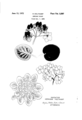
- the upper illustrations show, in full color, a cluster of flowers on one of the petioles from a stem, and the opposite sides of one of the leaves; and below is shown in pen and ink, one of the stems with flowers thereon, and a top plan view in reduced size of a plant illustrating a flower head and wreath of leaves therearound.
- Leaves.-Borne in rosette arrangement from 7 to 9 inches in diameter-shapeoval-length--2% to 3- /2 inches-width2 to 2 /2 inchesupper side medium hairy, under side slightly hairy-color upper side, dark green, under side, reddish, vein, greenish on underside of leaf.
- each stem may have ap: proximately twenty-five to thirty-five blooms and each stem has the strength to support that number.
- Resistance to disease-Resistance to disease in the present plant variety is notably improved over prior African violets.
- Of primary concern to breeders and growers of African violets in the past has been soft rot, mildew and botrytis which are caused by flowers opening beneath the leaves of the plant and primarily by early dropping of the flowers from their respective stems into the stem structure and pot as the flower ripens. These diseases can lead to complete decay of the plant.
- these problems are overcome inasmuch as the flowers uniformly open above the leaves of the plant and the ripened flowers will not drop from the flower stems. Each flower stays on the stern until it withers and will not drop into the moist soil at the top of the pot where it could lead to the above diseases.
- the leaf cuttings will initiate a percentage of plantlets in the high 90 percent range and they will come up at substantially the same time which is uniformly earlier than heretofore and the initiated plantlets are also of uniformly higher quality.
- Inherited characteristics The new plants will uniformly carry the characteristics of the parent plant. These characteristics include color and shading of flower, color and shape of leaf, uniform and vigorous growth characteristics, and the other new and permanentcharacte'risti'cs of the present variety above enumerated.
- Plants ofthe present variety approximately twelve months: old and. grown under normal conditions, will acquire a size of approximately eighteen to twenty inches in diameter and will yield approximately five hundred to six hundred individual flowers. Because of the uniformly high quality of the present variety, almost all of the plants are considered goodfor show purposes.
- a distinct variety of African violets substantially as herein shown and described,'characterized as to novelty by a habit of bearing a large, solid. flower head. which head is approximately from five to six inches in diameter at second blooming with approximately six to ei ht stems in each plant at first blooming, supporting the flowers of each flower head being above a wreath of dark green leaves on each plant surrounding. the flower head and. supporting approximately six blooms on each stem at. first blooming .and approximately double that number at second blooming and from approximately twenty-five to approximately thirty-five flowers per stem at full maturity, a long blooming period, .and said, plants being further characterized by substantially simultaneous early blooming of the flowers on the stems of each plant at eachblooming, and substantially simultaneously blooming of all plants.
Description
June 13, 1972 H. KOLTKAMP Plant Ptt. 3,207
AFRICAN VIOLET Filed Oct. '2, 1970 INVENTOR HERMANN HOLTKAMP gay lj WM, $24 4* ATTORNEYS United States Patent Office- Int. Cl. A0111 5/00 US. Cl. Plt.69 1 Claim ABSTRACT OF THE DISCLOSURE A hybrid violet of a descendant of a cross between the Saintpaulz'a. ionantha and Saintpaulia shumensis species which has permanent new characteristics including strength of stem, fast and vigorous growth, profuse flowering, uniform bouquet, prolonged blooming period, resistance to disease, reliability in initiating new plantlets, retention of flowers past maturity on their respective stems, reliability in new plants retaining characteristics of the parent and pronounced uniformity throughout the life cycle.
BRIEF SUMMARY OF THE INVENTION This is a division of application Ser. No. 765,700, filed Oct. 7, 1968.
To obtain the present violet with the above mentioned permanent new characteristics, the inventor has executed numerous experiments, the first of which involved the selection and cross-pollenation of one of the parent plants, the Saintpaulia ionantha. The male parent in that series of experiments was the Saintpaulia species Ro'koko- Rhapsodie and the female parents were chosen initially for their particular color characteristics such as the Saintpaulia species Rosa-Rhapsodie and Saintpaulia species Rhapsodie in Blau and others.
The pollenation of the parent plants was direct with the help of a fine dust brush. The seed pods of the pollenated plants developed normally and the seeds ripened well. The acquired seeds were used as the generic basis for. initiating further experimental series. About 30,000 seedlings were cultivated, and from thesev approximately 25 seedlings were selected by very rigid standards for further propagation.
The phenotype of the derivative plant as compared with the appearance of the parent plants evidenced substantial change. Propagation of these plants and the refinement out of limited selected plants continued and tests were conducted for the development of permanent characteristics of disease resistance, early blooming and vigorous growth. After several series of experiments and refinements, a single plant was selected and further tested to ascertain that the new characteristics were permanent.
The descendants of this plant were completely the same in appearance as the parent plant. The permanent qualities and characteristics included fast and vigorous growth, profuse blooming, a strong stem by African violet standards and resistance to disease.
The plant of the new variety, hereinafter described more in detail, is a hybrid of a descendant of a cross between the above-described improved Saintpaulia ionantha and the wild Saintpaulia shumensis, in which new variety the characteristics above-described for the aforesaid Saz'ntpaulia ionantha are retained, but are materially improved, together with the feature of a compact, large, central flower head in the mature plants, within and above a wreath of leaves. The flowers in the present new variety are burgundy red and the variety is designated Rhapsodie Ramona.
Other desirable characteristics of the plant may appear in the drawings and description.
Plant Pat. 3,207 Patented June 13, 1972 DESCRIPTION OF DRAWINGS The upper illustrations show, in full color, a cluster of flowers on one of the petioles from a stem, and the opposite sides of one of the leaves; and below is shown in pen and ink, one of the stems with flowers thereon, and a top plan view in reduced size of a plant illustrating a flower head and wreath of leaves therearound.
DETAILED DESCRIPTION The botanical description of the plant of the present variety is as follows, the colors being later specifically described in tabular form according to the Dictionary of Color by M aerz and Paul.
Rhapsoa'ie Ramona, Type 12/408 Male parent: Rhapsodie Red, Type 10/8. Female parent: Rhapsodie Purple-Red, Type 9/ 100.
Plants-4 to '6 inches tall.
Leaves.-Borne in rosette arrangement from 7 to 9 inches in diameter-shapeoval-length--2% to 3- /2 inches-width2 to 2 /2 inchesupper side medium hairy, under side slightly hairy-color upper side, dark green, under side, reddish, vein, greenish on underside of leaf.
Petz'ole.-'Round to oval, short and strong.
Fl0wers.Borne profusely in a central flower head, forming a compact upright bouquet above foliage, 5 to 6 inches in diameter.
Individual flowers.Quinquepartite, bilaterally symmetrical-size1 to 1% inches in diametercolor Burgundy red calyxquinquepartitepedunclesmultiflorous, up to 4 inches long, borne in compact cymes, with 6 to 12 flowers.
Reproductive organs.4tamenstwo, fructified antherslight yellow-ovarypilous-seed capsuledoes not push throughroots-well developed root system, white when young and active, turning to a brownish color on older plants.
The color designations, according to Dictionary of Color by Maerz and Paul are as follows:
Plate Letter No.
GENERAL OBSERVATIONS The following permanent characteristics are in all plants developed by me from the original cross pollenation of Saintpaulia ionantha with the wild Saintpaulia shumensis as hereinbefore described, including the present Rhapsodie Ramona above described in detail, and hereinafter claimed.
Strength of stem.-In the present new variety the stem is markedly stronger than heretofore and is capable of supporting approximately twenty-five to thirty-five blooms per stem when the plant is at fully maturity.
Fast and vigorous growth-The plants of the present variety will show first flowers approximately 6 weeks after potting and can be brought again to bloom in approximately 4 to 5-week cycles. In terms of commercialmonths.-It wi11'be appreciated that this is of significant importance in'termsof utilizationof space and'crop productivity on a commercial'basis. Under normal growing conditions, the plant will roughly double in size with each flowering.
Profuse flowering-In the plant of this new variety the number of blossoms per stem, as well as the number of stems, increases with each flowering. Approximately six blooms per stem can be expected at first flowering, approximately double that number with the second flowering. At full maturity, each stern may have ap: proximately twenty-five to thirty-five blooms and each stem has the strength to support that number.
Uniform bouquet.-In the present plant, the blossoms uniformly open:above the leaves. The stems come up through the middle of the plant and the flowers form a well'defined, attractive and compact crown characterized by shorter petioles and which crown is substantially hemispherical.- The bouquet formed by the opened blossoms above the leaves is well centered and is almost completely uninterrupted by the intrusion-of leaves and. this characteristic is found uniformly throughout the Prolonged blooming period.When the flowers of the presentvariety are not cut back to force shorter blooming ,cycles,-the-boloming period is markedly longer than heretofore Even as the flowers ripen past maturity, the appearance of the prolonged blooming period is maintained inasmuch as the flowers will not drop from the stems. There are no naked flower stems protruding'from the bouquet inasmuch as the flower will remain on the stem until it withers.
Resistance to disease-Resistance to disease in the present plant variety is notably improved over prior African violets. Of primary concern to breeders and growers of African violets in the past has been soft rot, mildew and botrytis which are caused by flowers opening beneath the leaves of the plant and primarily by early dropping of the flowers from their respective stems into the stem structure and pot as the flower ripens. These diseases can lead to complete decay of the plant. In the present variety, these problems are overcome inasmuch as the flowers uniformly open above the leaves of the plant and the ripened flowers will not drop from the flower stems. Each flower stays on the stern until it withers and will not drop into the moist soil at the top of the pot where it could lead to the above diseases. In the past the effective remedy for the above diseases was to promptly remove flowers as they fell. The benefit of less care and attention is especially appreciated in a commercial operation. In the present variety, the leaf cuttings will initiate a percentage of plantlets in the high 90 percent range and they will come up at substantially the same time which is uniformly earlier than heretofore and the initiated plantlets are also of uniformly higher quality.
Inherited characteristics.The new plants will uniformly carry the characteristics of the parent plant. These characteristics include color and shading of flower, color and shape of leaf, uniform and vigorous growth characteristics, and the other new and permanentcharacte'risti'cs of the present variety above enumerated.
Pronounced uniformity.Perhaps the most important opening flowers. As the plant matures toward first blooming, substantially all of the plants of a given flat will bloom at the same time. The flower stems protrude through the leaves and the flowers will open above the backdrop of leaves and will be uniformly centered in that backdrop forming"v a compact, single crown or bouquet of blossoms. After cutback, the plants :willuniformly bloom again infour to five weeks, again producing'a well defined, full bouquet roughly double in'size from that of the last blooming.
Since the plant roughly doubles in size with each flowering, it becomes commercially impractical to keep them beyond approximately one year because of the storage problems. Plants ofthe present variety approximately twelve months: old and. grown under normal conditions, will acquire a size of approximately eighteen to twenty inches in diameter and will yield approximately five hundred to six hundred individual flowers. Because of the uniformly high quality of the present variety, almost all of the plants are considered goodfor show purposes.
While there may be minor variations in the leaf' size and shape, and in the shape of the flowers, which'are commonto African violets, the other characteristics hereinbefore'described are constant. Of'partic'ular importance are: (1) the uniformly large, compact bouquet or flower head in each plant of approximately five to six inches in diameter at the second blooming, supported centrally of-and above a wreath of dark green leaves; (2) approximately six to eight flowers per stem at first blooming and approximately double that number at secondblooming, and approximately twenty-five to thirtyfive at full maturity; (3) substantially simultaneous and early blooming of the flowers on the stems of each plant at each blooming, and substantially simultaneous blooming of all plants started fromle'af cuttings at the same time under the same conditions and maintained under the same conditions at each blooming; (4) a plant having the foregoing features in which the flowers are a burgundy red with deeper color at the base ends of the petals, and which in subsequent propagations are of substantially the same color.
I claim:
1. A distinct variety of African violets substantially as herein shown and described,'characterized as to novelty by a habit of bearing a large, solid. flower head. which head is approximately from five to six inches in diameter at second blooming with approximately six to ei ht stems in each plant at first blooming, supporting the flowers of each flower head being above a wreath of dark green leaves on each plant surrounding. the flower head and. supporting approximately six blooms on each stem at. first blooming .and approximately double that number at second blooming and from approximately twenty-five to approximately thirty-five flowers per stem at full maturity, a long blooming period, .and said, plants being further characterized by substantially simultaneous early blooming of the flowers on the stems of each plant at eachblooming, and substantially simultaneously blooming of all plants. started from leaf cuttings at the same time-under the same conditions and :having the same treatment, and a distinctive and attractive burgundy red flower color of deeper color at the bases of the petals, and which flowers do not drop from the stems after withering, thereby avoiding damage and destruction due to mildewand botrytis from fallen blossoms.
No references cited.
ROBERT E. BAGWILL, PrimaryExaminer
Family
ID=
Similar Documents
| Publication | Publication Date | Title |
|---|---|---|
| USPP4255P (en) | Crepe myrtle | |
| USPP3207P (en) | Apbican violet | |
| USPP3148P (en) | African violet | |
| USPP3241P (en) | Holtkamp | |
| USPP3206P (en) | Koltkamp | |
| USPP3208P (en) | Koltkamp | |
| USPP3205P (en) | Koltkamp | |
| USPP3146P (en) | Holtkamp | |
| USPP3147P (en) | Holtkamp | |
| USPP3210P (en) | Kgltkamp | |
| USPP6694P (en) | Poinsettia plant named Lilo | |
| USPP3053P (en) | Holtkamp | |
| USPP4931P (en) | Euphorbia hybrid "Suleika" | |
| USPP3516P (en) | African violet | |
| USPP4381P (en) | Strawberry plant | |
| Ledesma et al. | 'Rapoza'a potential mango cultivar for the Americas. | |
| USPP3480P (en) | Poinsettia plant | |
| USPP1902P (en) | Ilex crenata plants | |
| USPP2925P (en) | Poinsettia plant | |
| USPP3713P (en) | Strawberry plant | |
| USPP242P (en) | Poinsettia | |
| USPP3123P (en) | Strawberry plant | |
| USPP3088P (en) | schlapfer | |
| USPP6122P (en) | Peach tree named `Delmass` | |
| USPP2015P (en) | Van rensselaer |