WO1987006579A1 - Amines et ethers nouveaux - Google Patents
Amines et ethers nouveaux Download PDFInfo
- Publication number
- WO1987006579A1 WO1987006579A1 PCT/EP1987/000210 EP8700210W WO8706579A1 WO 1987006579 A1 WO1987006579 A1 WO 1987006579A1 EP 8700210 W EP8700210 W EP 8700210W WO 8706579 A1 WO8706579 A1 WO 8706579A1
- Authority
- WO
- WIPO (PCT)
- Prior art keywords
- formula
- methyl
- ethyl
- ester
- diphenylpiperidyl
- Prior art date
- Legal status (The legal status is an assumption and is not a legal conclusion. Google has not performed a legal analysis and makes no representation as to the accuracy of the status listed.)
- Ceased
Links
- 0 *C1(*)CCN(*O[Al]OC(C(C(*)=O)=C*)=O)CC1 Chemical compound *C1(*)CCN(*O[Al]OC(C(C(*)=O)=C*)=O)CC1 0.000 description 5
- CWFUNHNLYSCDGQ-UHFFFAOYSA-N CC1NSNC1C Chemical compound CC1NSNC1C CWFUNHNLYSCDGQ-UHFFFAOYSA-N 0.000 description 1
- JKJSZGJVBAWEFB-UHFFFAOYSA-N Cc1n[o]nc1C Chemical compound Cc1n[o]nc1C JKJSZGJVBAWEFB-UHFFFAOYSA-N 0.000 description 1
Classifications
-
- C—CHEMISTRY; METALLURGY
- C07—ORGANIC CHEMISTRY
- C07D—HETEROCYCLIC COMPOUNDS
- C07D413/00—Heterocyclic compounds containing two or more hetero rings, at least one ring having nitrogen and oxygen atoms as the only ring hetero atoms
- C07D413/14—Heterocyclic compounds containing two or more hetero rings, at least one ring having nitrogen and oxygen atoms as the only ring hetero atoms containing three or more hetero rings
-
- A—HUMAN NECESSITIES
- A61—MEDICAL OR VETERINARY SCIENCE; HYGIENE
- A61P—SPECIFIC THERAPEUTIC ACTIVITY OF CHEMICAL COMPOUNDS OR MEDICINAL PREPARATIONS
- A61P3/00—Drugs for disorders of the metabolism
-
- A—HUMAN NECESSITIES
- A61—MEDICAL OR VETERINARY SCIENCE; HYGIENE
- A61P—SPECIFIC THERAPEUTIC ACTIVITY OF CHEMICAL COMPOUNDS OR MEDICINAL PREPARATIONS
- A61P7/00—Drugs for disorders of the blood or the extracellular fluid
- A61P7/02—Antithrombotic agents; Anticoagulants; Platelet aggregation inhibitors
-
- A—HUMAN NECESSITIES
- A61—MEDICAL OR VETERINARY SCIENCE; HYGIENE
- A61P—SPECIFIC THERAPEUTIC ACTIVITY OF CHEMICAL COMPOUNDS OR MEDICINAL PREPARATIONS
- A61P9/00—Drugs for disorders of the cardiovascular system
- A61P9/08—Vasodilators for multiple indications
-
- A—HUMAN NECESSITIES
- A61—MEDICAL OR VETERINARY SCIENCE; HYGIENE
- A61P—SPECIFIC THERAPEUTIC ACTIVITY OF CHEMICAL COMPOUNDS OR MEDICINAL PREPARATIONS
- A61P9/00—Drugs for disorders of the cardiovascular system
- A61P9/12—Antihypertensives
-
- C—CHEMISTRY; METALLURGY
- C07—ORGANIC CHEMISTRY
- C07D—HETEROCYCLIC COMPOUNDS
- C07D211/00—Heterocyclic compounds containing hydrogenated pyridine rings, not condensed with other rings
- C07D211/04—Heterocyclic compounds containing hydrogenated pyridine rings, not condensed with other rings with only hydrogen or carbon atoms directly attached to the ring nitrogen atom
- C07D211/80—Heterocyclic compounds containing hydrogenated pyridine rings, not condensed with other rings with only hydrogen or carbon atoms directly attached to the ring nitrogen atom having two double bonds between ring members or between ring members and non-ring members
- C07D211/84—Heterocyclic compounds containing hydrogenated pyridine rings, not condensed with other rings with only hydrogen or carbon atoms directly attached to the ring nitrogen atom having two double bonds between ring members or between ring members and non-ring members with hetero atoms or with carbon atoms having three bonds to hetero atoms, with at the most one bond to halogen directly attached to ring carbon atoms
- C07D211/90—Carbon atoms having three bonds to hetero atoms with at the most one bond to halogen
-
- C—CHEMISTRY; METALLURGY
- C07—ORGANIC CHEMISTRY
- C07D—HETEROCYCLIC COMPOUNDS
- C07D401/00—Heterocyclic compounds containing two or more hetero rings, having nitrogen atoms as the only ring hetero atoms, at least one ring being a six-membered ring with only one nitrogen atom
- C07D401/02—Heterocyclic compounds containing two or more hetero rings, having nitrogen atoms as the only ring hetero atoms, at least one ring being a six-membered ring with only one nitrogen atom containing two hetero rings
- C07D401/12—Heterocyclic compounds containing two or more hetero rings, having nitrogen atoms as the only ring hetero atoms, at least one ring being a six-membered ring with only one nitrogen atom containing two hetero rings linked by a chain containing hetero atoms as chain links
Definitions
- the invention relates to new amines and ethers, processes for their preparation, their use and medicaments containing them.
- the compounds according to the invention are used in the pharmaceutical industry for the production of medicaments.
- the invention relates to new amines and ethers of the formula I.
- R 1 is hydrogen, 1-6C-alkyl or 3-7C-alkoxyalkyl
- R4 and: R5 are the same or different and are hydrogen, hydroxy, halogen, nitno, cyano, trifluoromethyl, 1-4C-alkyl, 1-4C-alkoxy, completely or partially substituted by fluorine-substituted 1-4C-alkoxy, 1-4C-alkoxycarbonyl , 2-5C-acyl, amino or mono- or di-1-4C-alkylamino,
- R10 and R11 are the same or different and are hydrogen (H), 1-4C-alkyl, 1-4C-alkoxy, halogen, hydroxy or trifluoromethyl, and in which either
- R3 is 1-6C-alkyl or 3-7C-alkoxyalkyl, or
- R2 is hydrogen, 1-6C-alkyl or 3-7C-alkoxyalkyl and
- R3 is hydrogen, 1-6C-alkyl or 3-7C-alkoxyalkyl, where
- A2 means 2-4C-alkylene or 2C-alkyleneoxy-2C-alkylene, and the salts of these compounds.
- 1-6C-alkyl is straight-chain or branched and means, for example, a hexyl, neopentyl, isopentyl, butyl, i-butyl, sec.-butyl, t-butyl, propyl, isopropyl or in particular ethyl or methyl radical.
- 3-7C-Alkoxyalkyl stands for example for an ethoxyethyl, propoxyethyl, isopropoxyethyl, butoxyethyl, methoxypropyl, 2-methoxy-1-methylethyl, 2-ethoxy-1-methylethyl or in particular methoxyethyl radical.
- Halogen in the sense of the invention means bromine, fluorine and especially chlorine.
- 1-4C-alkyl is straight-chain or branched and means, for example, a butyl, i-8utyl, sec-butyl, t-butyl, propyl, isopropyl, ethyl or in particular methyl radical.
- 1-4C-alkoxy contains one of the 1-4C-alkyl radicals mentioned above.
- the methoxy and the ethoxy radical are preferred.
- 1-4C-Alkoxy which is wholly or partly substituted by fluorine is, for example, 1,1 2,2-tetrafluoroethoxy, trifluoromethoxy, 2, 2, 2-trifluoroethoxy or especially difluoromethoxy.
- 1-4C-alkoxycarbonyl contains one of the 1-4C-alkoxy radicals mentioned above. The methoxycarbonyl and the ethoxycarbonyl radical are preferred.
- 2-5C-acyl contains one of the 1-4C-alkyl radicals mentioned above.
- the acetyl radical is preferred.
- mono- or di-1-4C-alkylamino contains one or two of the 1-4C-alkyl radicals mentioned above.
- Di-1-4C-alkylamino is preferred, and here in particular dimethyl-, diethyl- or diisopropylamino.
- Aryl represents phenyl substituted by R10 and R11.
- the following may be mentioned as exemplary preferred aryl radicals: phenyl, 4-methoxyphenyl, 4-chlorophenyl, 4-methylphenyl, 4-fluorophenyl, 3-fluorophenyl, 3-chlorophenyl, 2-chlorophenyl, 3-methoxyphenyl, 2-methoxyphenyl, 2-methylphenyl , 3-chloro-4-methylphenyl, 3,4-dichlorophenyl, 3,6-dichlorophenyl, 3,4-dimethylphenyl, 2-trifluoromethylphenyl and 3-trifluoromethylphenyl.
- 2-5C-Alkylene is straight-chain or branched and stands for example for ethylene (-CH 2 -CH 2 -), trimethylene (-CH 2 -CH 2 -CH 2 -), tetramethylene (-CH 2 -CH 2 -CH 2 - CH 2 -), pentamethylene (-CH 2 -CH 2 -CH 2 -CH 2 -CH 2 -), 1, 2-dimethylethylene, 1,1-dimethylethylene, 2,2-dimethylethylene, isopropylidene, 1-methylethylene and 2 -Ethylpropylen, with ethylene and trimethylene being preferred.
- 2-4C-alkylene stands for ethylene (-CH 2 -CH 2 -), trimethylene (-CH 2 -CH 2 -CH 2 -) and tetramethylene (-CH 2 -CH 2 -CH 2 -CH 2 -), whereby Ethylene is preferred.
- 2-C-Alkyleneoxy-2C-alkylene stands for ethylene which is substituted by ethyleneoxy (-CH 2 -CH 2 -O-CH 2 -CH 2 -).
- water-soluble and water-insoluble acid addition salts such as the hydrochloride, hydrobromide, hydroiodide, phosphate, nitrate, sulfate, acetate, citrate, gluconate, benzoate, hibenzate, fendizoate, butyrate, sulfosalicylate, maleate, laurate, malate, fumarate, succinate , Tartrate, amsonate, metembonate, stearate, tosilate, 2-hydroxy-3-naphthoate, 3-hydroxy-2-naphthoate or mesilate, but also salts with bumetanide, furosemide, azosemide, galosemide, besunide, piretanide, etacrylic acid or 4-tienilic acid -Chlor-sulfamoyl-benzoic acid.
- One embodiment (embodiment a) of the invention is compounds of the formula Ia
- R1 is hydrogen, 1-6C-alkyl or 3-7C-alkoxyalkyl
- R2 means amino (NH 2 )
- R3 denotes 1-6C-alkyl or 3-7C-alkoxyalkyl
- R4 and R5 are identical or different and are hydrogen, hydroxyl, halogen, nitro, cyano, trifluoromethyl, 1-4C-alkyl, 1-4C-alkoxy, completely or partially substituted by fluorine-substituted 1-4C-alkoxy, 1-4C-alkoxycarbonyl, Mean 2-5C-acyl, amino or mono- or di-1-4C-alkylamino,
- R8 means aryl
- R9 means aryl
- R10 and R11 are the same or different and have the meaning hydrogen (H), 1-4C-alkyl, 1-4C-alkoxy, halogen, hydroxy or trifluoromethyl, and the salts of these compounds.
- E denotes ethylene (-CH 2 CH 2 -), trimethylene (-CH 2 -CH 2 -CH 2 -) or pentamethylene (-CH 2 -CH 2 -CH 2 -CH 2 -CH 2 -),
- R1 means methyl
- R2 means amino (NH 2 )
- R3 denotes methyl, ethyl or methoxyethyl
- R8 means aryl and R9 means aryl, where aryl represents a ring of the formula
- R10 and R11 are the same or different and are hydrogen (H), methyl, methoxy, chlorine, fluorine, hydroxy or trifluoromethyl, and the salts of the compounds.
- Cy 3-nitrophenyl, 2-chlorophenyl, 2,3-dichlorophenyl, 2-trifluoromethylphenyl or benzoxdiazolyl means E means ethylene (-CH 2 -CH 2 -), trimethylene (-CH 2 -CH 2 -CH 2 -) or pentamethylene
- (-CH 2 -CH 2 -CH 2 -CH 2 -CH 2 -CH 2 -) means, R1 means methyl, R2 means amino (NH 2 ), R3 means methyl or ethyl, R8 means phenyl and R9 means phenyl, and their salts.
- E means ethylene (-CH 2 -CH 2 -) or trimethylene (-CH 2 -CH 2 -CH 2 -),
- R1 means methyl
- R2 means amino (NH 2 )
- R3 denotes methyl or ethyl
- R9 means phenyl, and their salts. Examples of compounds of embodiment a according to the invention which may be mentioned are:
- a further embodiment (embodiment b) of the invention are compounds of the formula Ib
- A1 means 2-4C-alkylene
- A2 is 2-4C-alkylene or 2C-alkyleneoxy-2C-alkylene
- R1 and R2 are the same or different and are hydrogen, 1-6C-alkyl or 3-7C-alkoxyalkyl mean
- R3 denotes hydrogen, 1-6C-alkyl or 3-7C-alkoxyalkyl
- R4 and R5 are identical or different and are hydrogen, hydroxyl, halogen, nitro, cyano, trifluoromethyl, 1-4C-alkyl, 1-4C-alkoxy, completely or partially substituted by fluorine-substituted 1-4C-alkoxy, 1-4C-alkoxycarbonyl, Mean 2-5C-acyl, amino or mono- or di-1-4C-alkylamino,
- R8 means aryl
- R9 means aryl
- R10 and R11 are the same or different and have the meaning hydrogen (H), 1-4C-alkyl, 1-4C-alkoxy, halogen, hydroxy or trifluoromethyl, and the salts of these compounds.
- A1 means ethylene (-CH 2 CH 2 -),
- A2 denotes ethylene (-CH 2 CH 2 -) or ethyleneoxyethylene (-CH 2 -CH 2 -O-CH 2 -CH 2 -),
- R1 means methyl
- R2 means methyl
- R3 denotes methyl, ethyl or methoxyethyl
- R8 means aryl
- R9 means aryl
- Aryl for a ring of the formula is where R10 and R11 are the same or different and are hydrogen (H), methyl, methoxy, chlorine, fluorine, hydroxy or trifluoromethyl, and the salts of the compounds.
- Cy 3-nitrophenyl, 2-chlorophenyl, 2,3-dichlorophenyl, 2-trifluoromethylphenyl or benzoxdiazolyl means A1 means ethylene (-CH 2 CH 2 -), A2 means ethylene (-CH 2 CH 2 -) or ethyleneoxyethylene (-CH 2 -CH 2 -O-CH 2 -CH 2 -) means, R1 means methyl, R2 means methyl, R3 means methyl or ethyl, R8 means phenyl and R9 means phenyl, and their salts.
- A1 means ethylene (-CH 2 CH 2 -),
- A2 means ethylene (-CH 2 CH 2 -),
- R1 means methyl
- R2 means methyl
- R3 means methyl
- R9 means phenyl, and their salts. Examples of compounds of embodiment b according to the invention which may be mentioned are:
- the compounds of the formula I have a chiral center at the 4-position in the 1,4-dihydropyridine.
- the invention therefore encompasses both the enantiomers and, if a further chirality center is present, the diastereomers, and also their mixtures and racemates.
- Another object of the invention is a process for the preparation of the compounds according to the invention and their salts.
- the process is characterized in that
- Embodiments of the method are those in which, in the formulas IIa, IIb, IIIa, IIIb and IV to XII, the substituents or symbols Cy, E, A1, A2, R1, R2, R3, R4, R5, R8 and R9, the have meanings given in the subclaims and subsidiary claims, Z together with the carbonyl group, to which it is bound, represents a carboxyl group or a reactive carboxylic acid derivative and Y represents a leaving group.
- the process according to 1. and 2. is carried out in suitable, preferably inert, organic solvents.
- Examples include alcohols, such as ethanol, methanol, isopropanol or, in particular, t-butanol, hydrocarbons, such as toluene or xylene, ethers, such as dioxane, diethyl ether, tetrahydrofuran, glycol monoethyl ether, glycol dimethyl ether or other, for example polar solvents such as dimethylformamide, dimethyl sulfoxide, acetonitrile or hexamidophosphoric acid triamide , or chlorinated hydrocarbons such as methylene chloride, chloroform or tetrachlorethylene.
- hydrocarbons such as toluene or xylene
- ethers such as dioxane, diethyl ether, tetrahydrofuran, glycol monoethyl ether, glycol dimethyl ether or other, for example polar solvents such as dimethylformamide, dimethyl sulfoxide, acet
- reaction temperatures can vary within a wide range. In general, the reaction is carried out at temperatures between 20 ° C. and 150 ° C., preferably between 20 ° C. and 100 ° C., in particular at the boiling point of the solvent used.
- the process according to the invention according to 1 is carried out in the presence of a basic condensing agent, for example in the presence of an alkali alcoholate, such as sodium methylate or sodium ethylate.
- a basic condensing agent for example in the presence of an alkali alcoholate, such as sodium methylate or sodium ethylate.
- the method according to 2. can be carried out at normal pressure or at elevated pressure, working at atmospheric pressure being the rule and increased pressure being used in particular in the case of reactions with ammonia.
- the substances involved in the reaction are generally used in molar amounts, but - depending on the reaction condition - an excess (if desired, for example in ammonia in variants b and d) is also used can be.
- reaction conditions are used as for variants a to f.
- the reaction takes place in a manner known for the production of secondary or tertiary amines.
- the reaction can, if desired, be carried out in the presence of a base (e.g. an inorganic carbonate such as potassium carbonate) or by using an excess of amine XII.
- a base e.g. an inorganic carbonate such as potassium carbonate
- the enantiomerically pure compounds and their salts which are also the subject of the invention, are obtained, for example, by reacting the racemates obtained by the process described above with an enantiomerically pure optically active acid, separating the diastereomeric salts obtained, from the desired diastereomeric salts Enantiomers are released by adding base and, if desired, subsequently converted into their salts.
- optically active acids examples include di-0, 0'-p-toluoyl tartaric acid or in particular di-0.0'-benzoyl tartaric acid. Recrystallization is preferably suitable as the separation process.
- the configuratively uniform diastereomeric salts separated by means of these methods are obtained by adding preferably inorganic bases, such as e.g. Ammonia, or with the aid of basic ion exchangers in the optically active, enantiomerically pure compounds of the invention.
- inorganic bases such as e.g. Ammonia
- basic ion exchangers in the optically active, enantiomerically pure compounds of the invention.
- This process for the production of enantiomerically pure compounds is preferably used for the production of the enantiomerically pure dihydropyridines of embodiment a.
- the enantiomerically pure compounds according to the invention are obtained by starting from enantiomerically pure intermediates.
- the enantiomerically pure 1,4-dihydropyridines of the formula IX are particularly suitable here name, from which the desired enantiomerically pure end products according to the invention are obtained by reaction with the amine derivatives X - as described in process variant g. This route is preferably followed for the production of the enantiomerically pure dihydropyridines of embodiment b.
- the isolation and purification of the substances according to the invention obtained after 1 or 2 is carried out in a manner known per se, for. B. in such a way that the solvent is distilled off in vacuo and the residue obtained is recrystallized from a suitable solvent or subjected to one of the customary purification methods, such as, for example, column chromatography on a suitable carrier material.
- Acid addition salts are obtained by dissolving the free base in a suitable solvent, e.g. in a chlorinated hydrocarbon, such as methylene chloride or chloroform, or a low molecular weight aliphatic alcohol (ethanol, isopropanol) which contains the desired acid or to which the desired acid is subsequently added.
- a chlorinated hydrocarbon such as methylene chloride or chloroform
- a low molecular weight aliphatic alcohol ethanol, isopropanol
- the salts are obtained by filtering, reprecipitating, precipitating with a non-solvent for the addition salt or by evaporating the solvent.
- Salts obtained can be obtained by alkalization, e.g. with aqueous ammonia solution, are converted into the free bases, which in turn can be converted into acid addition salts. In this way, pharmacologically unacceptable acid addition salts can be converted into pharmacologically unacceptable acid addition salts.
- the starting compounds are known from the literature or can be prepared analogously to methods known from the literature.
- the benzylidene carboxylic acid derivatives IIIa can be prepared, for example, in analogy to G. Jones ["The Knoevenagel Condensation” in Org. Reactions, Vol. XV, 204f (1967)].
- the amidines IIa can be prepared according to H. Yamanaka et al., Heterocycles (1976), 1854.
- the cinnamic acid derivatives Ilb and the benzylidenecarboxylic acid derivatives VI can be prepared, for example, in analogy to G. Jones ["The Knoevenagel Condensation” in Org. Reactions, Vol. XV, 204f (1967)].
- the enamine derivatives IIIb and the enamines V are in for example analogous to AC Cope [J. Amer. Chem. Soc. 67, 1017 (1945)].
- ß-Ketocarb ⁇ nklanderivate IV and keto compounds VII can according to D. Borrmann ["reaction of diketene with alcohols, phenols and mercaptans" in Houben-Weyl, Methods of Organic Chemistry, Vol. VII / 4, 230ff (1968)] or Y. Oikawa et al. [J. Org. Chem. 43, 2087 (1978)].
- the compounds IX are accessible from corresponding starting compounds analogously to process variants a to f.
- the enantiomerically pure 1,4-dihydropyridines IX required for the production of enantiomerically pure compounds are known from Chem. Pharm. Bull. 28, 2309 (1980) or can be obtained analogously thereto.
- Compounds X can be obtained by reacting corresponding piperidines with omega-haloalkanols.
- the dihydropyridine derivatives XI are obtained by reacting enamines of the formula V with, for example, appropriately substituted omega-halogen-2-acyl-acrylic acid esters, which in turn are accessible from aldehydes of the formula VIII and suitable beta-keto-omega-halo-gencarboxylic acid esters.
- Mp Means melting point, h stands for hours, Kp. Stands for boiling point, dec. means decomposition.
- the product fraction is concentrated, the residue is taken up in dichloromethane and mixed with ethereal hydrochloric acid. After the product solution has been concentrated again, the residue is dissolved in about 10 ml of dichloromethane and the title compound is amorphously precipitated by slowly dropping it into 500 ml of a well-stirred mixture of equal parts of diethyl ether and petroleum ether. Mp: 124-138 ° C, yield: 4.9 g.
- Example 1 described the title compound as an amorphous powder, mp: 106-115 ° C (slow flow); Yield: 2.5 g.
- Example 4 Analogously to Example 4, the title compound is obtained from 3.60 g of acetyl-3- (3-nitrophenyl) acrylic acid [5- (4,4-diphenylpiperidyl-1) pentyl] ester, 1.11 g of ethyl amidinoacetate hydrochloride and 0.153 g sodium in
- Example 4 Analogously to Example 4, the title compound is obtained from 5.00 g of 2-acetyl-3- (2,3-dichlorophenyl) acrylic acid [3- (4,4-diphenylpiperidyl-1) propyl] ester, 1.55 g Amidinoacetic acid ethyl ester hydrochloride and 210 mg sodium in 25 ml abs. After transfer into the semifumarate, ethanol as hard, cubic crystals of mp: 191-93 ° C (from methanol / diethyl ether); Yield: 5.05 g.
- Example 4 Analogously to Example 4, the title compound is obtained from 6.11 g of 2-acetyl-3- (4-benzo [c] [1.2.5] oxdiazolyl) acrylic acid- [3- (4,4-diphenylpiperidyl-1) -pro- pyl] ester, 2.01 g Amidinoessigêt Acideethylester hydrochloride and 276 mg sodium in 35 ml abs. Ethanol as fine yellowish crystal flakes, mp: 127-131 ° C (slow flow, from methanol / diethyl ether); Yield: 2.7 g.
- Example 4 Analogously to Example 4, the title compound is obtained from 4.02 g of 2-acetyl-3- (2-chlorophenyl) acrylic acid- [3- (4,4-diphenylpiperidyl-1) -propyl] ester, 1.33 g of amidinoacetic acid ethyl ester. hydrochloride and 184 mg sodium in 50 ml abs. Ethanol as fine yellowish crystal platelets with a melting point of: 125-128 ° C. (from methanol / diethyl ether); Yield: 2.71 g.
- Example 4 Analogously to Example 4, the title compound is obtained from 4.28 g of 2-acetyl-3- (2-trifluoromethylphenyl) acrylic acid [3- (4,4-diphenylpiperidyl-1) propyl] ester, 1.33 g of amidinoacetic acid ethyl ester. hydrochloride and 184 mg sodium in 40 ml abs. Ethanol as fine yellowish crystal platelets with a melting point of 115-117 ° C. (from methanol / diethyl ether), yield: 3.32 g. 11.
- Example 4 Analogously to Example 4, the title compound is obtained from 4.98 g of 2-acetyl-3- (3-nitrophenyl) acrylic acid [2r (4,4-diphenylpiperidyl-1) ethyl] ester, 1.52 g of methyl amidinoacetate hydrochloride and 230 mg sodium in 40 ml abs. Methanol as a fine yellowish powder, mp: 110-116 ° C, slow flow (precipitated in petroleum ether / diethyl ether (2 + 1); yield: 3.12 g.
- acetoacetic acid ⁇ 2- [2- (2- (4,4-diphenylpiperidyl-1) ethoxy) ethoxy] ethyl ⁇ ester is prepared in an analogous manner - starting from triethylene glycol monochlorohydrin and by prior reaction as described for C.
- the compounds of the formula I according to the invention and their salts have valuable properties which make them commercially usable. They are in particular effective vasodilators with coronary therapeutic properties.
- the pharmacological activity of the compounds according to the invention is particularly evident in a slowly occurring, strong and optimally sustained drop in blood pressure.
- the compounds according to the invention have an inhibitory effect on calcium influx and a promotional effect on potassium outflow from cells, smooth muscle relaxing and peripheral, coronary, cerebral and renal vasodilator and salidiuretic, antithrombotic, antiarteriosclerotic and favorable hemorheological properties.
- the compounds according to the invention differ surprisingly and advantageously from the compounds of the prior art in their excellent activity, which is paired with low toxicity and the absence of significant side effects.
- Examples of advantageous properties of the compounds I are: the extent of the reduction in blood pressure, the good controllability of the reduction in blood pressure, which - especially in the case of the compounds of embodiment a - surprisingly low heart rate increase compared to the compounds of the prior art, the excellent bioavailability, the large therapeutic breadth, the lack of central side effects, the lack of kinetic interactions with other substances, the lack of tolerance development, the balanced physical properties and the great stability.
- the excellent activity of the compounds of the formula I and their salts according to the invention permits their use in human medicine, with primary (essential) and secondary, arterial and pulmonary hypertensions of all degrees of severity, coronary heart diseases (coronary insufficiency, angina pectoris, myocardial infarction etc.) being used as indications, peripheral and cerebral circulation disorders (brain stroke, temporary cerebral circulatory disorders, migraines, dizziness, renal Narrowing of the arteries etc.), hypertrophic cardiomyopathy, heart failure, diseases based on increased water and sodium retention and diseases based on increased calcium influx such as spasms of smooth muscle organs (respiratory tract, gastrointestinal tract, urogenital tract etc.) as well as arrhythmia, arteriosclerosis and Cell damage of different origins (e.g. hypoxia) can be considered.
- coronary heart diseases coronary insufficiency, angina pectoris, myocardial infarction etc.
- peripheral and cerebral circulation disorders (brain stroke, temporary cerebral circulatory disorders,
- Another object of the invention is therefore a method for the treatment of mammals, especially humans, who are suffering from one of the above-mentioned diseases.
- the method is characterized in that the diseased individual is administered a therapeutically effective and pharmacologically tolerable amount of one or more compounds of the formula I.
- the invention also relates to the compounds of the formula I for use in the treatment of the diseases mentioned.
- the invention also encompasses the use of compounds of the formula I in the production of medicaments which are used to combat the diseases mentioned.
- the invention further relates to medicaments which contain one or more compounds of the general formula I.
- the pharmaceuticals are produced by methods known per se and familiar to the person skilled in the art.
- auxiliaries which are suitable for the desired pharmaceutical formulations on the basis of his specialist knowledge.
- active ingredient carriers for example antio-kidants, dispersants, emulsifiers, defoamers, taste correctives, preservatives
- the active substances can be administered orally, rectally, by inhalation or parenterally (in particular perlingually, intravenously or percutaneously).
- the active ingredient (s) when administered orally in a daily dose of about 0.01 to about 10, preferably 0.05 to 5 mg / kg body weight, if desired in the form of several, preferably 1 to 4 individual doses to achieve the desired result.
- similar or generally lower doses in particular when the active compounds are administered intravenously
- the dose is slowly switched to a higher dose. After the desired therapeutic success has been reached, the dose is reduced again.
- the pharmaceutical preparations can also include one or more other pharmacologically active constituents of other groups of medicaments, such as other vasodilators, antihypertensives, alpha-1 receptor blockers, alpha-2 receptor stimulators , beta-1-receptor blockers, beta-2-receptor stimulators, ACE inhibitors, nitro compounds, cardiotics, diuretics, saluretics, alkaloids, analgesics, lipid-lowering agents, anticoagulants, anticholinergics, methylxanthines, antiarrhythmics, antihistamines, dopamine stimulants, such as dopamine stimulants, such as nifedipine, hydralazine, prazosin, clonidine, atenolol, labetalol, fenoterol, captopril, isosorbide dinitrate, digoxin, milrinone, mefruside, clo
- the antihypertensive activity of the compounds according to the invention can be demonstrated on the model of the spontaneously hypertensive rat.
- the compounds listed below are administered in the specified doses on four consecutive days on 6 male rats (strain SHR / N / Ibm / 8m, 250-350 g) with genetically determined high pressure (systolic blood pressure> 180 mmHg) administered once a day by gavage. Blood pressure is measured 6 and, if necessary, 2 or 24 hours after substance administration.
- Blood pressure measurement is done in a warming chamber at 36 ° C to achieve better blood flow to the tail artery.
- the animals are placed in perforated perforated metal cages and measured 20-40 minutes after warming up.
- an annular cuff with an inflatable rubber membrane to prevent blood flow and an annular piezo crystal sensor to record the pulse waves are pushed onto the tail.
- the cuff pressure is continuously reduced. The return of the pulse waves during pressure relief is automatically recognized and printed out as systolic blood pressure (Bühler, R. et al .: Microprocessor-based automation of blood pressure measurement in the conscious rat.
- the animals are trained for 14 days before the substance test.
- blood pressure pre-values are collected.
- Groups of animals receiving substance are tested against a control group.
- the connections examined are identified by consecutive numbers that correspond to the respective example numbers.
- Table I shows for the representatives of the compounds according to the invention the percentage reduction in blood pressure (BP) after oral administration in the rat.
Landscapes
- Organic Chemistry (AREA)
- Chemical & Material Sciences (AREA)
- Health & Medical Sciences (AREA)
- Medicinal Chemistry (AREA)
- General Chemical & Material Sciences (AREA)
- Veterinary Medicine (AREA)
- Chemical Kinetics & Catalysis (AREA)
- Life Sciences & Earth Sciences (AREA)
- Pharmacology & Pharmacy (AREA)
- Nuclear Medicine, Radiotherapy & Molecular Imaging (AREA)
- Engineering & Computer Science (AREA)
- Bioinformatics & Cheminformatics (AREA)
- Public Health (AREA)
- Animal Behavior & Ethology (AREA)
- General Health & Medical Sciences (AREA)
- Heart & Thoracic Surgery (AREA)
- Cardiology (AREA)
- Diabetes (AREA)
- Hematology (AREA)
- Obesity (AREA)
- Hydrogenated Pyridines (AREA)
- Pharmaceuticals Containing Other Organic And Inorganic Compounds (AREA)
- Plural Heterocyclic Compounds (AREA)
Description
Neue Amine und Ether
Anwendungsgebiet der Erfindung
Die Erfindung betrifft neue Amine und Ether, Verfahren zu ihrer Herstellung, ihre Verwendung und sie enthaltende Arzneimittel. Die erfindungsgemäßen Verbindungen werden in der pharmazeutischen Industrie zur Herstellung von Arzneimitteln eingesetzt.
Bekannter technischer Hintergrund
Es ist bekannt, daß bestimmte, auf verschiedene Weise substituierte 1,4-Dihydropyridinderivate pharmakologisch nützliche Eigenschaften aufweisen. Oberraschenderweise wurde nun gefunden, daß die unten näher beschriebenen neuen Verbindungen besonders interessante pharmakologische Eigenschaften aufweisen, durch die sie sich von den Verbindungen des Standes der Technik in vorteilhafter Weise unterscheiden.
Beschreibung der Erfindung
Gegenstand der Erfindung sind neue Amine und Ether der Formel I

worin Cy einen Cyclus der Formel


R 1 Wasserstoff, 1-6C-Alkyl oder 3-7C-Alkoxyalkyl bedeutet,
R4 und: R5 gleich oder verschieden sind und Wasserstoff, Hydroxy, Halogen, Nitno, Cyano, Trifluormethyl, 1-4C-Alkyl, 1-4C-Alkoxy, ganz oder teilweise durch Fluor substituiertes 1-4C-Alkoxy, 1-4C-Alkoxycarbonyl, 2-5C-Acyl, Amino oder Mono- oder Di-1-4C-alkylamino bedeuten,
R6 und R7 gemeinsam und unter Einschluß des Stickstoffatoms, an das beide gebunden sind, einen Rest der Formel


E 2-5C-Alkylen,
R2 Amino (NH2) und
R3 1-6C-Alkyl oder 3-7C-Alkoxyalkyl bedeuten, oder
E A1-0-A2,
R2 Wasserstoff, 1-6C-Alkyl oder 3-7C-Alkoxyalkyl und
R3 Wasserstoff, 1-6C-Alkyl oder 3-7C-Alkoxyalkyl bedeuten, wobei
A1 2-4C-Alkylen und
A2 2-4C-Alkylen oder 2C-Alkylenoxy-2C-alkylen bedeutet, und die Salze dieser Verbindungen.
1-6C-Alkyl ist geradkettig oder verzweigt und bedeutet beispielsweise einen Hexyl-, Neopentyl-, Isopentyl-, Butyl-, i-Butyl-, sec.-Butyl-, t-Butyl-, Propyl-, Isopropyl- oder insbesondere Ethyl- oder Methylrest.
3-7C-Alkoxyalkyl steht beispielsweise für einen Ethoxyethyl-, Propoxyethyl-, Isopropoxyethyl-, Butoxyethyl-, Methoxypropyl-, 2-Methoxy-1-methylethyl-, 2-Ethoxy-1-methylethyl- oder insbesondere Methoxyethylrest.
Halogen im Sinne der Erfindung bedeutet Brom, Fluor und insbesondere Chlor.
1-4C-Alkyl ist geradkettig oder verzweigt und bedeutet beispielsweise einen Butyl-, i-8utyl-, sec.-Butyl-, t-Butyl-, Propyl-, Isopropyl-, Ethyloder insbesondere Methylrest.
1-4C-Alkoxy enthält neben dem Sauerstoffatom einen der vorstehend genannten 1-4C-Alkylreste. Bevorzugt sind der Methoxy- und der Ethoκyrest.
Ganz oder teilweise durch Fluor substituiertes 1-4C-Alkoxy ist beispielsweise 1,1 2,2-Tetrafluorethoxy, Trifluormethoxy, 2, 2, 2-Trifluorethoxy oder insbesondere Difluormethoxy.
1-4C-Alkoxycarbonyl enthält neben der Carbonylgruppe einen der vorstehend genannten 1-4C-Alkoxyreste. Bevorzugt sind der Methoxycarbonyl- und der Ethoxycarbonylrest.
2-5C-Acyl enthält neben der Carbonylgruppe einen der vorsteherid genannten 1-4C-Alkylreste. Bevorzugt ist der Acetylrest.
Mono- oder Di-1-4C-alkylamino enthält neben dem Stickstoffatom einen oder zwei der vorstehend genannten 1-4C-Alkylreste. Bevorzugt ist Di-1-4C-alkylamino, und: hier insbesondere Dimethyl-, Diethyl- oder Diisopropylamino.
Aryl steht für durch R10 und R11 substituiertes Phenyl. Als beispielhafte bevorzugte Arylreste seien genannt die Reste: Phenyl, 4-Methoxyphenyl, 4-Chlorphenyl, 4-Methylphenyl, 4-Fluorphenyl, 3-Fluorphenyl, 3-Chlorphenyl, 2-Chlorphenyl, 3-Methoxyphenyl, 2-Methoxyphenyl, 2-Methylphenyl, 3-Chlor-4-methylphenyl, 3,4-Dichlorphenyl, 3,6-Dichlorphenyl, 3,4-Dimethylphenyl, 2-Trifluormethylphenyl und 3-Trifluormethylphenyl.
2-5C-Alkylen ist geradkettig oder verzweigt und steht beispielsweise für Ethylen (-CH2-CH2-), Trimethylen (-CH2-CH2-CH2-) , Tetramethylen (-CH2-CH2-CH2-CH2-), Pentamethylen (-CH2-CH2-CH2-CH2-CH2-), 1, 2-Dimethylethylen, 1,1-Dimethylethylen, 2,2-Dimethylethylen, Isopropyliden, 1-Methylethylen und 2-Ethylpropylen, wobei Ethylen und Trimethylen bevorzugt sind.
2-4C-Alkylen steht für Ethylen (-CH2-CH2-), Trimethylen (-CH2-CH2-CH2-) und Tetramethylen (-CH2-CH2-CH2-CH2-), wobei Ethylen bevorzugt ist.
2-C-Alkylenoxy-2C-alkylen steht für Ethylen, das durch Ethylenoxy substituiert ist (-CH2-CH2-O-CH2-CH2-).
Als Salze kommen alle Salze mit Säuren in Betracht. Besonders erwähnt seien die pharmakologisch verträglichen Salze der in der pharmazeutischen Industrie üblicherweise verwendeten anorganischen und organischen Säuren. Pharmakologisch unverträgliche Salze, die beispielsweise bei der Herstellung der erfindungsgemäßen Verbindungen im industriellen Maßstab als Verfahrensprodukte zunächst anfallen können, werden durch dem Fachmann bekannte Verfahren in pharmakologisch verträgliche Salze übergeführt. Als
solche eignen sich beispielsweise wasserlösliche und wasserunlösliche Säureadditionssalze, wie das Hydrochlorid, Hydrobromid, Hydroiodid, Phosphat, Nitrat, Sulfat, Acetat, Citrat, Gluconat, Benzoat, Hibenzat, Fendizoat, Butyrat, Sulfosalicylat, Maleat, Laurat, Malat, Fumarat, Succinat, Oxalat, Tartrat, Amsonat, Metembonat, Stearat, Tosilat, 2-Hydroxy-3-naphthoat, 3-Hydroxy-2-naphthoat oder Mesilat, aber auch Salze mit Bumetanid, Furosemid, Azosemid, Galosemid, Besunid, Piretanid, Etacrynsaure, Tienilinsäure oder 4-Chlor-sulfamoyl-benzoesäure.
Eine Ausgestaltung (Ausgestaltung a) der Erfindung sind Verbindungen der Formel Ia


R1 Wasserstoff, 1-6C-Alkyl oder 3-7C-Alkoxyalkyl bedeutet,
R2 Amino (NH2) bedeutet,
R3 1-6C-Alkyl oder 3-7C-Alkoxyalkyl bedeutet,
R4 und R5 gleich oder verschieden sind und Wasserstoff, Hydroxy, Halogen, Nitro, Cyano, Trifluormethyl, 1-4C-Alkyl, 1-4C-Alkoxy, ganz oder teilweise durch Fluor substituiertes 1-4C-Alkoxy, 1-4C-Alkoxycarbonyl, 2-5C-Acyl, Amino oder Mono- oder Di-1-4C-alkylamino bedeuten,
R8 Aryl bedeutet und
R9 Aryl bedeutet, wobei
Aryl für einen Ring der Formel

Hervorzuhebende erfindungsgemäβe Verbindungen der Ausgestaltung a sind solche der Formel Ia, worin
Cy Phenyl, 2-Nitrophenyl, 3-Nitrophenyl, 2-Cyanophenyl, 3-Cyanophenyl, 2-(1,1,2,2-Tetrafluorethoxy)-phenyl, 3-(1,1,2,2-Tetrafluorethoxy)- phenyl, 2-Difluormethoxyphenyl, 3-Difluormethoxyphenyl, 2-Chlorphenyl, 3-Chlorphenyl, 2,3-Dichlorphenyl, 2-Fluorphenyl, 3-Fluorphenyl, 2-Trifluormethylphenyl, 3-Trifluormethylphenyl oder Benzoxdiazolyl bedeutet,
E Ethylen (-CH2CH2-), Trimethylen (-CH2-CH2-CH2-) oder Pentamethylen (-CH2-CH2-CH2-CH2-CH2-) bedeutet,
R1 Methyl bedeutet,
R2 Amino (NH2) bedeutet,
R3 Methyl, Ethyl oder Methoxyethyl bedeutet,
R8 Aryl bedeutet und
R9 Aryl bedeutet, wobei Aryl für einen Ring der Formel

Bevorzugte erfindungsgemäβe Verbindungen der Ausgestaltung a sind solche der Formel Ia, worin
Cy 3-Nitrophenyl, 2-Chlorphenyl, 2,3-Dichlorphenyl, 2-Trifluormethylphenyl oder Benzoxdiazolyl bedeutet, E Ethylen (-CH2-CH2-), Trimethylen (-CH2-CH2-CH2-) oder Pentamethylen
(-CH2-CH2-CH2-CH2-CH2-) bedeutet, R1 Methyl bedeutet, R2 Amino (NH2) bedeutet, R3 Methyl oder Ethyl bedeutet, R8 Phenyl bedeutet und R9 Phenyl bedeutet, und ihre Salze.
Besonders bevorzugte erfindungsgemäße Verbindungen der Ausgestaltung a sind solche der Formel Ia, worin
Cy 3-Nitrophenyl bedeutet,
E Ethylen (-CH2-CH2-) oder Trimethylen (-CH2-CH2-CH2-) bedeutet,
R1 Methyl bedeutet,
R2 Amino (NH2) bedeutet,
R3 Methyl oder Ethyl bedeutet,
R8 Phenyl und
R9 Phenyl bedeutet, und ihre Salze.
Als erfindungsgemäße Verbindungen der Ausgestaltung a seien beispielsweise genannt:
2-Amino-1,4-dihydro-6-methyl-4-(3-nitrophenyl)-pyridin-3,5-dicarbonsäure-3-ethyl-5-[2-(4,4-diphenylpiperidyl-1)-ethyl]-ester,
2-Amino-1,4-dihydro-6-methyl-4-(3-nitrophenyl)-pyridin-3,5-dicarbonsäure-3-(2-methoxyethyl)-5-[3-(4,4-diphenylpiperidyl-1)-propyl]-ester, 2-Amino-1,4-dihydro-6-methyl-4-(3-nitrophenyl)-pyridin-3,5-dicarbonsäure-3-methyl-5-[4-(4,4-diphenylpiperidyl-1]-butyl]-ester,
2-Amino-1,4-dihydro-6-methyl-4-(2-nitrophenyl)-pyridin-3,5-dicarbonsäure-3-methyl-5-[2-(4,4-diphenylpiperidyl-1)-ethyl]-ester,
2-Amino-1,4-dihydro-6-ethyl-4-(3-nitrophenyl)-pyridin-3,5-dicarbonsäure-3-methyl-5-E2-(4,4-diphenylpiperidyl-1)-ethyl]-ester,
2-Amino-1,4-dihydro-6-methyl-4-(3-nitrophenyl)-pyridin-3,5-dicarbonsäure-3-(propyl-2)-5-[2-(4,4-diphenylpiperidyl-1)-ethyl]-ester, 2-Amino-1,4-dihydro-6-methyl-4-(3-nitrophenyl)-pyridin-3,5-dicarbonsäure-3-hexyl-5-[2-(4,4-diphenylpiperidyl-1)-ethyl]-ester,
2-Amino-1,4-dihydro-6-methyl-4-(3-nitrophenyl)-pyridin-3,5-dicarbonsäure-3-(2-n-butoxyethyl)-5-[2-(4,4-diphenylpiperidyl-1)-ethyl]-ester, 2-Amino-1,4-dihydro-6-methyl-4-(3-nitrophenyl)-pyridin-3,5-dicarbonsäure-3-methyl-5-{2-[4,4-di(4-methoxyphenyl)-piperidyl-1]-ethyl}-ester, 2-Amino-1,4-dihydro-6-methyl-4-(2-trifluormethylphenyl)-pyridin-3,5-dicarbonsäure-3-ethyl-5-[2-(4,4-diphenylpiperidyl-1)-ethyl]-ester, 2-Amino-1,4-dihydro-6-methyl-4-[3-(1,1,2,2-tetrafluorethoxy)-phenyl]-pyridin-3,5-dicarbonsäure-3-methyl-5-C2-(4,4-diphenylpiperidyl-1)-ethyl]-ester,
2-Amino-1,4-dihydro-6-methyl-4-(2-difluormethoxyphenyl)-pyridin-3,5-dicarbonsäure-3-ethyl-5-[2-(4,4-diphenylpiperidyl-1)-ethyl]-ester, 2-Amino-1,4-dihydro-6-methyl-4-(2-difluormethoxyphenyl)-pyridin-3,5-dicarbonsäure-3-ethyl-5-[4-(4,4-diphenylpiperidyl-1)-butyl]-ester, 2-Amino-1,4-dihydro-6-methyl-4-(3-nitrophenyl)-pyridin-3,5-dicarbonsäure-3-methyl-5-[2-(4,4-dihydroxyphenylpiperidyl-1)-ethyl]-ester, 2-Amino-4-(2,3-dichlorphenyl)-1,4-dihydro-6-methylpyridin-3,5-dicarbonsäure-3-methyl-5-[2-(4,4-diphenylpiperidyl-1)-ethyl]-ester, 2-Amino-4-(2,1,3-benzoxdiazol-4-yl)-1,4-dihydro-6-methylpyridin-3,5-dicarbonsäure-3-methyl-5-[2-(4,4-diphenylpiperidyl-1)-ethyl]-ester, 2-Amino-4-(3-cyanphenyl)-1,4-dihydro-6-methylpyridin-3,5-dicarbαnsäure-3-methyl-5-[2-(4,4-diphenylpiperidyl-1)-ethyl]-ester, 2-Amino-1,4-dihydro-6-methyl-4-(2-methoxyphenyl)-pyridin-3,5-dicarbon
säure-3-methyl-5-[2-(4,4-diphenylpiperidyl-1)-ethyl]-ester, 2-Amino-1,4-dihydro-6-methyl-4-(2-pyridyl)-pyridin-3,5-dicarbonsäure3-methyl-5-[2-(4,4-diphenylpiperidyl-1)-ethyl]-ester,
2-Amino-1,4-dihydro-6-methyl-4-(5-methyl-2-thienyl)-pyridin-3,5-dicarbonsäure-3-methyl-5-[2-(4,4-diphenylpiperidyl-1)-ethyl]-ester, 2-Amino-1,4-dihydro-6-methyl-4-(3-nitrophenyl)-pyridin-3,5-dicarbonsäure-3-methyl-5-{2-[4-(4-chlorphenyl)-4-phenylpiperidyl-1]-ethyl}-ester, 2-Amino-1,4-dihydro-6-methyl-4-(2-nitrophenyl)-pyridin-3,5-dicarbonsäure-3-methyl-5-[3-(4,4-diphenylpiperidyl-1)-propyl]-ester,
2-Amino-1,4-dihydro-6-ethyl-4-(3-nitrophenyl)-pyridin-3,5-dicarbonsäure-3-methyl-5-[3-(4,4-diphenylpiperidyl-1)-propyl]-ester,
2-Amino-1,4-dihydro-6-methyl-4-(3-nitrophenyl)-pyridin-3,5-dicarbonsäure-3-(propyl-2)-5-[3-(4,4-diphenylpiperidyl-1)-propyl]-ester, 2-Amino-1,4-dihydro-6-methyl-4-(3-nitrophenyl)-pyridin-3,5-dicarbonsäure-3-hexyl-5-[3-(4,4-diphenylpiperidyl-1)-propyl]-ester,
2-Amino-1,4-dihydro-6-methyl-4-(3-nitrophenyl)-pyridin-3,5-dicarbonsäure-3-(2-n-butoxyethyl)-5-[3-(4,4-diphenylpiperidyl-1)-propyl]-ester, 2-Amino-1,4-dihydro-6-methyl-4-(3-nitrophenyl)-pyridin-3,5-dicarbonsäure-3-methyl-5-{3-[4,4-di(4-methoxyphenyl)-piperidyl-1]-propyl}-ester, 2-Amino-1,4-dihydro-6-methyl-4-(2-trifluormethylphenyl)-pyridin-3,5-dicarbonsäure-3-ethyl-5-[3-(4,4-diphenylpiperidyl-1)-propyl]-ester, 2-Amino-1,4-dihydro-6-methyl-4-[3-(1,1,2,2-tetrafluorethoxy)-phenyl]- pyridin-3,5-dicarbonsäure-3-methyl-5-[3-(4,4-diphenylpiperidyl-1)-propyl]-ester,
2-Amino-1,4-dihydro-6-methyl-4-(2-difluormethoxyphenyl)-pyridin-3,5-dicarbonsäure-3-ethy1-5-[3-(4,4-diphenylpiperidyl-1)-propyl]-ester, 2-Amino-1,4-dihydro-6-methyl-4-(3-nitrophenyl)-pyridin-3,5-dicarbonsäure-3-methyl-5-[3-(4,4-dihydroxyphenylpiperidyl-1)-propyl]-ester, 2-Amino-4-(2,3-dichlorphenyl)-1,4-dihydro-6-methylpyridin-3,5-dicarbonsäure-3-methyl-5-[3-(4,4-diphenylpiperidyl-1)-propyl]-ester, 2-Amino-4-(2,1,3-benzoxdiazol-4-yl)-1,4-dihydro-6-methylpyridin-3,5-dicarbonsäure-3-methyl-5-[3-(4,4-diphenylpiperidyl-1)-propyl]-ester, 2-Amino-4-(3-cyanphenyl)-1,4-dihydro-6-methylpyridin-3,5-dicarbonsäure-3-methyl-5-[3-(4,4-diphenylpiperidyl-1)-propyl]-ester,
2-Amino-1,4-dihydro-6-methyl-4-(2-methoxyphenyl)-pyridin-3,5-dicarbonsäure-3-methyl-5-[3-(4,4-diphenylpiperidyl-1)-propyl]-ester, 2-Amino-1,4-dihydro-6-methyl-4-(2-pyridyl)-pyridin-3,5-dicarbonsäure3-methyl-5-[3-(4,4-diphenylpiperidyl-1)-propyl]-ester,
2-Amino-1,4-dihydro-6-methyl-4-(5-methyl-2-thienyl)-pyridin-3,5-dicarbonsäure-3-methyl-5-[3-(4,4-diphenylpiperidyl-1)-propyl]-ester und 2-Amino-1,4-dihydro-6-methyl-4-(3-nitrophenyl)-pyridin-3,5-dicarbonsäure-3-methyl-5-{3-[4-(4-chlorphenyl)-4-phenylpiperidyl-1]-propyl}-ester und ihre Salze.
Eine weitere Ausgestaltung (Ausgestaltung b) der Erfindung sind Verbindungen der Formel Ib


A1 2-4C-Alkylen bedeutet,
A2 2-4C-Alkylen oder 2C-Alkylenoxy-2C-alkylen bedeutet,
R1 und R2 gleich oder verschieden sind und Wasserstoff, 1-6C-Alkyl oder
3-7C-Alkoxyalkyl bedeuten,
R3 Wasserstoff, 1-6C-Alkyl oder 3-7C-Alkoxyalkyl bedeutet,
R4 und R5 gleich oder verschieden sind und Wasserstoff, Hydroxy, Halogen, Nitro, Cyano, Trifluormethyl, 1-4C-Alkyl, 1-4C-Alkoxy, ganz oder teilweise durch Fluor substituiertes 1-4C-Alkoxy, 1-4C-Alkoxycarbonyl, 2-5C-Acyl, Amino oder Mono- oder Di-1-4C-alkylamino bedeuten,
R8 Aryl bedeutet und
R9 Aryl bedeutet, wobei
Aryl für einen Ring der Formel

Hervorzuhebende erfindungsgemäße Verbindungen der Ausgestaltung b sind solche der Formel Ib, worin
Cy Phenyl, 2-Nitrophenyl, 3-Nitrophenyl, 2-Cyanophenyl, 3-Cyanophenyl, 2-(1,1,2,2-Tetrafluorethoxy)-phenyl, 3-(1,1,2,2-Tetrafluorethoxy)- phenyl, 2-Difluormethoxyphenyl, 3-Difluormethoxyphenyl, 2-Chlorphenyl, 3-Chlorphenyl, 2,3-Dichlorphenyl, 2-Fluorphenyl, 3-Fluorphenyl, 2-Trifluormethylphenyl, 3-Trifluormethylphenyl oder Benzoxdiazolyl bedeutet,
A1 Ethylen (-CH2CH2-) bedeutet,
A2 Ethylen (-CH2CH2-) oder Ethylenoxyethylen (-CH2-CH2-O-CH2-CH2-) bedeutet,
R1 Methyl bedeutet,
R2 Methyl bedeutet,
R3 Methyl, Ethyl oder Methoκyethyl bedeutet,
R8 Aryl bedeutet und
R9 Aryl bedeutet, wobei
Aryl für einen Ring der Formel
 steht, worin R10 und R11 gleich oder verschieden sind und die Bedeutung Wasserstoff (H), Methyl, Methoxy, Chlor, Fluor, Hydroxy oder Trifluormethyl haben, und die Salze der Verbindungen.
Bevorzugte erfindungsgemäße Verbindungen der Ausgestaltung b sind solche der Formel Ib, worin
Cy 3-Nitrophenyl, 2-Chlorphenyl, 2,3-Dichlorphenyl, 2-Trifluormethylphenyl oder Benzoxdiazolyl bedeutet, A1 Ethylen (-CH2CH2-) bedeutet, A2 Ethylen (-CH2CH2-) oder Ethylenoxyethylen (-CH2-CH2-O-CH2-CH2-) bedeutet, R1 Methyl bedeutet, R2 Methyl bedeutet, R3 Methyl oder Ethyl bedeutet, R8 Phenyl bedeutet und R9 Phenyl bedeutet, und ihre Salze.
Besonders bevorzugte erfindungsgemäße Verbindungen der Ausgestaltung b sind solche der Formel Ib, worin
Cy 3-Nitrophenyl bedeutet,
A1 Ethylen (-CH2CH2-) bedeutet,
A2 Ethylen (-CH2CH2-) bedeutet,
R1 Methyl bedeutet,
R2 Methyl bedeutet,
R3 Methyl bedeutet,
R8 Phenyl und
R9 Phenyl bedeutet, und ihre Salze.
Als erfindungsgemäße Verbindungen der Ausgestaltung b seien beispielsweise genannt:
1,4-Dihydro-2,6-dimethyl-4-(3-nitrophenyl)-pyridin-3,5-dicarbonsäure-3-ethyl-5-{2-[2-(4,4-diphenylpiperidyl-1)-ethoxi]-ethyl}-ester,
1,4-Dihydro-2,6-dimethyl-4-(3-nitrαphenyl)-pyridin-3,5-dicarbαnsäure- 3-(2-methoxyethyl)-5-{3-[3-(4,4-diphenylpiperidyl-1)-propoxi]-propyl}-ester,
1,4-Dihydro-2,6-dimethyl-4-(2-nitrophenyl)-pyridin-3,5-dicarbonsäure- 3-methyl-5-{2-[2-(4,4-diphenylpiperidyl-1)-ethoxi]-ethyl}-ester,
1,4-Dihydro-2,6-diethyl-4-(3-nitrophenyl)-pyridin-3,5-dicarbonsäure- 3-methyl-5-{2-[2-(4,4-diphenylpiperidyl-1)-ethoxi]-ethyl}-ester,
1 ,4-Dihydro-2,6-dimethyl-4-(3-nitrophenyl)-pyridin-3,5-dicarbonsäure- 3-(propyl-2)-5-{2-[2-(4,4-diphenylpiperidyl-1)-ethoxi]-ethyl}-ester,
1,4-Dihydro-2,6-dimethyl-4-(3-nitrophenyl)-pyridin-3,5-dicarbonsäure- 3-hexyl-5-{2-[2-(4,4-diphenylplperidyl-1)-ethoxi]-ethyl}-ester,
1,4-Dihydro-2,6-dimethyl-4-(3-nitrophenyl)-pyridin-3,5-dicarbonsäure- 3-(2-n-butoxyethyl)-5-{2-[2-(4,4-diphenylpiperidyl-1)-ethoxi]-ethyl}-ester,
1,4-Dihydro-2,6-dimethyl-4-(2-trifluormethylphenyl)-pyridin-3,5-dicarbonsäure-3-ethyl-5-{2-[2-(4,4-diphenylpiperidyl-1)-ethoxi]-ethyl}-ester,
1,4-Dihydro-2,6-dimethyl-4-[3-(1,1,2,2-tetrafluorethoxy)-phenyl]-pyridin- 3,5-dicarbonsäure-3-methyl-5-{2-[2-(4,4-diphenylpiperidyl-1)-ethoxi]-ethyl}-ester,
1,4-Dihydro-2,6-dimethyl-4-(2-difluormethoxyphenyl)-pyridin-3,5-dicarbonsäure-3-ethyl-5-{2-[2-(4,4-diphenylpiperidyl-1)-ethoxi]-ethyl}-ester,
1,4-Dihydro-2,6-dimethyl-4-(3-nitrophenyl)-pyridin-3,5-dicarbonsäure- 3-methyl-5-{2-[2-(4,4-dihydroxyphenylpiperidyl-1)-ethoxi]-ethyl}-ester,
4-(2,3-Dichlorphenyl)-1,4-dihydro-2,6-dimethylpyridin-3,5-dicarbon¬säure-3-methyl-5-{2-[2-(4,4-diphenylpiperidyl-1)-ethoxi]-ethyl}-ester,
4-(2,1,3-Benzoxdiazol-4-yl)-1,4-dihydro-2,6-dimethylpyridin-3,5-dicarbonsäure-3-methyl-5-{2-[2-(4,4-diphenylpiperidyl-1)-ethoxi]-ethyl}-ester,
4-(3-Cyanphenyl)-1,4-dihydro-2,6-dimethylpyridin-3,5-dicarbonsäure-3-methyl-5-{2-[2-(4,4-diphenylpiperidyl-1)-ethoxi]-ethyl}-ester,
1,4-Dihydro-2,6-dimethyl-4-(2-methoxyphenyl)-pyridin-3,5-dicarbonsäure- 3-methyl-5-{2-[2-(4,4-diphenylpiperidyl-1)-ethoxi]-ethyl}-ester,
1,4-Dihydro-2,6-dimethyl-4-(2-pyridyl)-pyridin-3,5-dicarbonsäure3-methyl-5-{2-[2-(4,4-diphenylpiperidyl-1)-ethoxi]-ethyl}-ester,
1,4-Dihydro-2,6-dimethyl-4-(5-methyl-2-thienyl)-pyridin-3,5-dicarbonsäure-3-methyl-5-{2l-[2-(4,4-diphenylpiperidyl-1)-ethoxi]-ethyl}-ester, 1,4-Dihydro-2,6-dimethyl-4-(2-nitrophenyl)-pyridin-3,5-dicarbonsäure3-methyl-5-{3-[3-(4,4-diphenylpiperidyl-1)-propoxi]-propyl}-ester, 1,4-Dihydro-2,6-diethyl-4-(3-nitrαphenyl)-pyridin-3,5-dicarbonsäure3-methyl-5-{3-[3-(4,4-diphenylpiperidyl-1)-propoxi]-propyl}-ester, 1,4-Dihydro-2,6-dimethyl-4-(3-nitrophenyl)-pyridin-3,5-dicarbonsäure-3-(propyl-2)-5-{3-[3-(4,4-diphenylpiperidyl-1)-propoxi]-propyl}-ester, 1,4-Dihydro-2,6-dimethyl-4-(3-nitrophenyl)-pyridin-3,5-dicarbonsäure-3- heκyl-5-{3-[3-(4,4-diphenylpiperidyl-1)-propoxi]-propyl}-ester, 1,4-Dihydro-2,6-dlmethyl-4-(3-nitrophenyl)-pyridin-3,5-dicarbonsäure-3-(2-n-butoxyethyl)-5-{3-[3-(4,4-diphenylpiperidyl-1)-propoxy]-propyl} ester,
1,4-Dihydro-2,6-dimethyl-4-(2-trifluormethylphenyl)-pyridin-3,5-dicarbonsäure-3-ethyl-5-{3-[3-(4,4-diphenylpiperidyl-1)-propoxi]-propyl}-ester, 1,4-Dihydro-2,6-dimethyl-4-[3-(1,1,2,2-tetrafluorethoxy)-phenyl]-pyridin-3,5-dicarbonsäure-3-methyl-5-{3-[3-(4,4-diphenylpiperidyl-1)-propoxi]-propyl}-ester,
1,4-Dihydro-2,6-dimethyl-4-(2-difluormethoxyphenyl)-pyridin-3,5-dicarbonsäure-3-ethyl-5-{3-[3-(4,4-diphenylpiperidyl-1)-propoxi]-propyl}-ester, 1,4-Dihydro-2,6-dimethyl-4-(3-nitrophenyl)-pyridin-3,5-dicarbonsäure-3-methyl-5-{3-[3-(4,4-dihydroxyphenylpiperidyl-1)-propoxi]-propyl}-ester, 4-(2,3-Dichlorphenyl)-1,4-dihydro-2,6-dimethylpyridin-3,5-dicarbonsäure-3-methyl-5-{3-C3-(4,4-diphenylpiperidyl-1)-propoxi]-propyl}-ester, 4-(2,1,3-Benzoxdiazol-4-yl)-1,4-dihydro-2,6-dimethylpyridin-3,5-dicarbonsäure-3-methyl-5-{3-[3-(4,4-diphenylpiperidyl-1)-propoxi]-propyl}-ester, 4-{3-Cyanphenyl)-1,4-dihydro-2,6-dimethylpyridin-3,5-dicarbonsäure-3-methyl-5-{3-[3-(4,4-diphenylpiperidyl-1)-propoxi]-propyl}-ester, 1,4-Dihydro-2,6-dimethy1-4-(2-methoxyphenyl)-pyridin-3,5-dicarbonsäure-3- methyl-5-{3-[3-(4,4-diphenylpiperidyl-1)-propoxi]-propyl}-ester, 1,4-Dihydro-2,6-dimethyl-4-(2-pyridyl)-pyridin-3,5-dicarbonsäure-3-methyl-5-{3-[3-(4,4-diphenylpiperidyl-1)-propoxi]-propyl}-ester und 1,4-Dihydro-2,6-dimethyl-4-(5-methyl-2-thienyl)-pyridin-3,5-dicarbonsäure-3-methyl-5-{3-[3-(4,4-diphenylpiperidyl-1)-propoxi]-propyl}-ester, und ihre Salze.
Die Verbindungen der Formel I besitzen an der 4-Position im 1 , 4-Dihydropyridin ein Chiralitätszentrum. Die Erfindung umfaßt daher sowohl die Enantiomeren und bei Vorliegen eines weiteren Chiralitatszentrums die Diastereomeren, als auch deren Gemische und Racemate. Besonders bevorzugt sind in diesem Zusammenhang die Enantiomeren, die in der 4-Position im Dihydropyridin die gleiche Konfiguration aufweisen wie die Enantiomeren (-)-2-Amino-1,4-dihydro-6-methyl-4-(3-nitrophenyl)-pyridin-3,5-dicarbonsaure-3-ethyl-5-[3-(4,4-diphenylpiperidyl-1)-propyl]-ester bzw. (-)-1,4-Dihydro-2,6-dimethyl-4-(3-nitrophenyl)-pyridin-3,5-dicarbonsäure-3-methyl-5-{2-[2-(4,4-diphenylpiperidyl-1)-ethoxi]-ethyl}-ester-hydrochlorid, die das linear polarisierte Licht der Wellenlänge 589 nm mit [α]D 22= - 0,90 bzw. mit [α]D 22= - 56,10 (c = 1, Methanol) drehen.
Ein weiterer Gegenstand der Erfindung ist ein Verfahren zur Herstellung der erfindungsgemäßen Verbindungen und ihrer Salze. Das Verfahren ist dadurch gekennzeichnet, daß man
1. zur Herstellung der Verbindungen der Ausgestaltung a Amidine der Formel Ha


2. zur Herstellung der Verbindungen der Ausgestaltung b a) Zimtsäurederivate der Formel IIb


oder h) 1,4-Dihydropyridinderivate der Formel XI
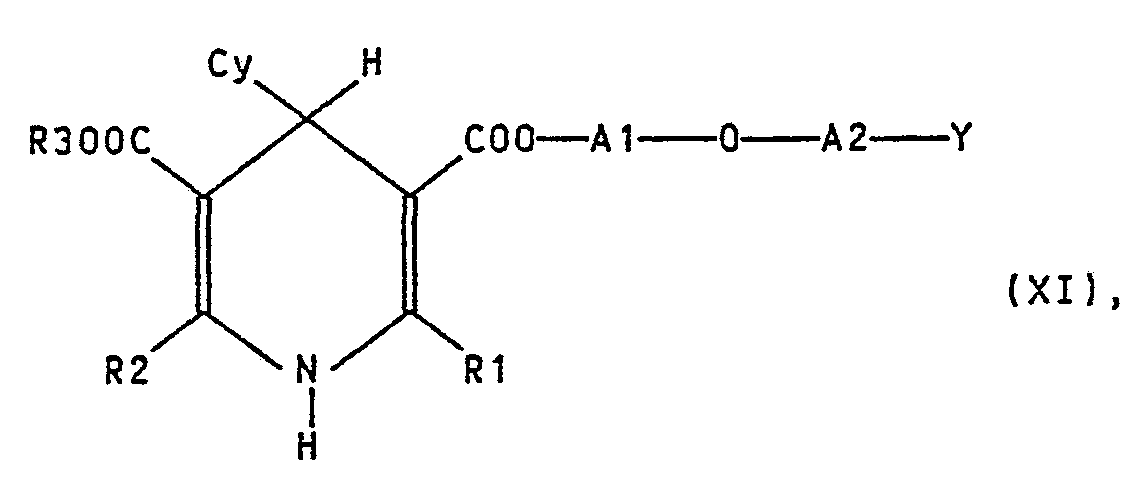

als solche(n) oder in Form ihrer Salze umsetzt und gewünschtenfalls anschließend erhaltene Salze in die freien Basen oder erhaltene Basen in die Salze überführt, wobei Cy, A1, A2, R1, R2, R3, R4, R5, R8 und R9 die für die Ausgestaltung b angegebenen Bedeutungen haben, Z gemeinsam mit der Carbonylgruppe, woran es gebunden ist, eine Carboxylgruppe oder ein reaktives Carbonsäurederivat (z. B. ein Carbonsäurehalogenid) und Y eine Fluchtgruppe darstellt.
Ausgestaltungen des Verfahrens sind solche, bei denen in den Formeln IIa, IIb, IIIa, IIIb und IV bis XII die Substituenten bzw. Symbole Cy, E, A1, A2, R1, R2, R3, R4, R5, R8 und R9, die in den Unter- und Nebenansprüchen angegebenen Bedeutungen haben, Z gemeinsam mit der Carbonylgruppe, woran es gebunden ist, eine Carboxylgruppe oder ein reaktives Carbonsäurederivat und Y eine Fluchtgruppe darstellt.
Das Verfahren gemäß 1. und 2. wird in geeigneten, vorzugsweise inerten organischen Lösungsmitteln durchgeführt. Beispielsweise seien genannt Alkohole, wie Ethanol, Methanol, Isopropanol oder insbesondere t-Butanol, Kohlenwasserstoffe, wie Toluol oder Xylol, Ether, wie Dioxan, Diethylether, Tetrahydrofuran, Glykolmonoethylether, Glykoldimethylether oder sonstige, beispielsweise polare Lösungsmittel wie Dimethylformamid, Dimethylsulfoxid, Acetonitril oder Hexamethylphosphorsäuretriamid, oder chlorierte Kohlenwasserstoffe wie Methylenchlorid, Chloroform oder Tetrachlorethylen.
Die Reaktionstemperaturen können - je nach Reaktivität der Edukte - in einem weiten Bereich variieren. Im allgemeinen wird die Umsetzung bei Temperaturen zwischen 20°C und 150°C, vorzugsweise zwischen 20°C und 100°C, insbesondere bei der Siedetemperatur des verwendeten Lösungsmittels durchgeführt.
Die Durchführung des erfindungsgemäßen Verfahrens gemäß 1. erfolgt in Gegenwart eines basischen Kondensationsmittels, beispielsweise in Gegenwart eines Alkalialkoholates, wie Natriummethylat oder Natriumethylat.
Das Verfahren gemäß 2. kann bei Normaldruck oder bei erhöhtem Druck durchgeführt werden, wobei das Arbeiten bei Normaldruck die Regel ist und erhöhter Druck insbesondere bei Umsetzungen mit Ammoniak zur Anwendung kommen kann.
Bei der Durchführung des erfindungsgemäßen Verfahrens gemäß Varianten a bis f werden die an der Reaktion beteiligten Stoffe in der Regel jeweils in molaren Mengen eingesetzt, wobei jedoch - je nach Reaktionsbedingung - gewünschtenfalls auch ein Öberschuß (beispielsweise an Ammoniak bei den Varianten b und d) eingesetzt werden kann.
8ei der Durchführung des Verfahrens gemäß Variante g kommen ähnliche Reaktionsbedingungen wie bei den Varianten a bis f zur Anwendung, jedoch sind - je nach Art des Substituenten Z - gegebenenfalls zusätzliche Maßnahmen erforderlich. Stellt Z beispielsweise eine Hydroxylgruppe dar, so ist die Reaktion bevorzugt in Gegenwart eines wasserabspaltenden oder wasserbindenden Kondensationsmittels (wie z.B. Dicyclohexylcarbodiimid) durchzuführen. Stellt Z ein Halogenatom (z.B. ein Chloratom) dar, so ist die Reak
tion gewünschtenfalls in Gegenwart einer Base (z. B. eines tertiären organischen Amins, wie Triethylamin, oder eines anorganischen Carbonates, wie Natriumcarbonat) durchzuführen.
Bei der Durchführung des Verfahrens gemäß Variante h kommen ähnliche Reaktionsbedingungen wie bei den Varianten a bis f zur Anwendung. Die Umsetzung erfolgt in einer Weise, wie sie für die Herstellung von sekundären bzw. tertiären Aminen bekannt ist. Je nach Art der Fluchtgruppe Y, die vorzugsweise ein Halogenatom, insbesondere ein Chlor- oder Bromatom ist, kann die Reaktion gewünschtenfalls in Gegenwart einer Base (z.B. eines anorganischen Carbonates, wie Kaliumcarbonat) oder unter Einsetzung eines Öberschusses von Amin XII durchgeführt werden.
Die enantiomer reinen Verbindungen und ihre Salze, die ebenfalls Gegenstand der Erfindung sind, erhält man beispielsweise, indem man die nach dem oben beschriebenen Verfahren erhaltenen Racemate mit einer enantiomer reinen optisch aktiven Säure umsetzt, die erhaltenen diastereomeren Salze trennt, aus den gewünschten diastereomeren Salze die Enantiomeren durch Zugabe von Base freisetzt und sie gewünschtenfalls anschließend in ihre Salze überführt.
Als optisch aktive Säuren seien beispielsweise die Di-0, 0'-p-toluoylweinsäure oder insbesondere die Di-0,0'-benzoylweinsäure genannt. Als Trennverfahren eignet sich vorzugsweise die Umkristallisation.
Die mit Hilfe dieser Methoden getrennten, konfigurativ einheitlichen diastereomeren Salze werden durch Zugabe vorzugsweise anorganischer Basen, wie z.B. Ammoniak, oder mit Hilfe von basischen Ionenaustauschern in die optisch aktiven, enantiomer reinen erfindungsgemäßen Verbindungen überführt.
Dieses Verfahren zur Herstellung enantiomer reiner Verbindungen wird vorzugsweise für die Herstellung der enantiomer reinen Dihydropyridine der Ausgestaltung a eingesetzt.
Alternativ erhält man die enantiomer reinen erfindungsgemäßen Verbindungen, indem man von enantiomer reinen Zwischenprodukten ausgeht. Hier sind insbesondere die enantiomer reinen 1,4-Dihydropyridine der Formel IX zu
nennen, aus denen man durch Umsetzung mit den Aminderivaten X - wie bei Verfahrensvariante g beschrieben - die gewünschten enantiomer reinen erfindungsgemäßen Endprodukte erhält. Dieser Weg wird vorzugsweise zur Herstellung der enantiomer reinen Dihydropyridine der Ausgestaltung b eingeschlagen.
Die Isolierung und Reinigung der nach 1. oder 2. erhaltenen erfindungsgemäßen Substanzen erfolgt in an sich bekannter Weise z. B. derart, daß man das Lösungsmittel im Vakuum abdestilliert und den erhaltenen Rückstand aus einem geeigneten Lösungsmittel umkristallisiert oder einer der üblichen Reinigungsmethoden, wie beispielsweise der Säulenchromatographie an geeignetem Trägermaterial, unterwirft.
Säureadditionssalze erhält man durch Auflösen der freien Base in einem geeigneten Lösungsmittel, z.B. in einem chlorierten Kohlenwasserstoff, wie Methylenchlorid oder Chloroform, oder einem niedermolekularen aliphatischen Alkohol (Ethanol, Isopropanol), das die gewünschte Säure enthalt, oder dem die gewünschte Säure anschließend zugegeben wird.
Die Salze werden durch Filtrieren, Umfallen, Ausfällen mit einem Nichtlδsungsmittel für das Anlagerungssalz oder durch Verdampfen des Lösungsmittels gewonnen.
Erhaltene Salze können durch Alkalisierung, z.B. mit wäßriger Ammoniaklösung, in die freien Basen umgewandelt werden, welche wiederum in Säureadditionssalze übergeführt werden können. Auf diese Weise lassen sich pharmakologisch nicht verträgliche Säureadditionssalze in pharmakologisch verträgliche Säureadditionssalze umwandeln.
Die Ausgangsverbindungen sind literaturbekannt oder können in Analogie zu literaturbekannten Methoden hergestellt werden. Die Benzylidencarbonsäurederivate IIIa können beispielsweise in Analogie zu G. Jones ["The Knoevenagel Condensation" in Org. Reactions, Vol. XV, 204f (1967)] hergestellt werden. Die Amidine IIa können nach H. Yamanaka et al., Heterocycles (1976), 1854 hergestellt werden. Die Zimtsäurederivate Ilb und die Benzylidencarbonsäurederivate VI können beispielsweise in Analogie zu G. Jones ["The Knoevenagel Condensation" in Org. Reactions, Vol. XV, 204f (1967)] hergestellt werden. Die Enaminderivate IIIb bzw. die Enamine V sind bei
spielsweise analog A.C. Cope [J. Amer. Chem. Soc. 67, 1017 (1945)] erhältIich. ß-Ketocarbαnsäurederivate IV und Ketoverbindungen VII können gemäß D. Borrmann ["Umsetzung von Diketen mit Alkoholen, Phenolen und Mercaptanen" in Houben-Weyl, Methoden der Organischen Chemie, Vol. VII/4, 230ff (1968)] oder Y. Oikawa et al. [J. Org. Chem. 43, 2087 (1978)] hergestellt werden. Die Verbindungen IX sind aus entsprechenden Ausgangsverbindungen analog Verfahrensvariante a bis f zugänglich. Die zur Herstellung enantiomer reiner Verbindungen benötigten enantiomer reinen 1,4-Dihydropyridine IX sind aus Chem. Pharm. Bull. 28, 2309 (1980) bekannt oder analog dazu erhältlich. Verbindungen X sind durch Umsetzung entsprechender Piperidine mit omega-Halogenalkanolen erhältlich. Die Dihydropyridinderivate XI erhält man durch Umsetzung von Enaminen der Formel V mit z.B. entsprechend substituierten omega-Halogen-2-acyl-acrylsäureestern, die ihrerseits wiederum aus Aldehyden der Formel VIII und geeigneten beta-Keto-omega-halo-gencarbonsäureestern zugänglich sind.
Das vorstehende Herstellungsverfahren ist lediglich zur Verdeutlichung angegeben, und die Herstellung der erfindungsgemäßen Verbindungen der Formel I ist nicht auf dieses Verfahren beschränkt. Vielmehr ist auch jede Modifikation dieses Verfahrens in gleicher Weise für die Herstellung der erfindungsgemäßen Verbindungen anwendbar.
Die folgenden Herstellungsbeispiele sollen die Erfindung näher erläutern, ohne sie einzuschränken. Schmp. bedeutet Schmelzpunkt, h steht für Stunden, Kp. steht für Siedepunkt, Zers. bedeutet Zersetzung.
Beisoiele
Endprodukte
1. 1,4-Dihvdro-2,6-dimethyl-4-(3-nitrophenyl)-pyridin-3,5-dicarbonsäure- 3-methyl-5-{2-[2-(4.4-diphenylpiperidyl-1)-ethoxi]-ethyl}-ester- hvdrochlorid
5,4 g 2-Acetyl-3-(3-nitrophenyl)-acrylsäure-2-[2-(4,4-diphenylpiperidyl-1 )-ethoxi]-ethylester und 1,2 g 3-Aminocrotonsäuremethylester werden in 50 ml 2-Propanol und 0,5 ml Essigsäure 5 h unter Rückfluß zum Sieden erhitzt. Die abgekühlte Lösung wird zur Trockene eingeengt, der fest aufgeschäumte Rückstand in wenig Dichlormethan gelöst und die Lösung über 3 x 20 cm Kieselgel chromatographiert (Eluens: Dichlormethan/Methanol/Essigsäure 9 + 1 + 1). Die Produktfraktion wird eingeengt, der Rückstand in Dichlormethan aufgenommen und mit etherischer Salzsäure versetzt. Nach dem erneuten Einengen der Produktlösung wird der Rückstand in ca. 10 ml Dichlormethan gelöst und die Titelverbindung durch langsames Eintropfen in 500 ml einer gut gerührten Mischung aus gleichen Teilen Diethylether und Petrolether amorph ausgefällt. Schmp.: 124-138°C, Ausbeute: 4,9 g.
2. (-)-1,4-Dihvdro-2,6-dimethyl-4-(3-nitrophenyl)-pyridin-3,5-dicarbonsäure-3-methyl-5-{2-[2-(4,4-diphenyloiperidyl-1)-ethoxi]-ethyl}-ester-hvdrochlorid
997 mg (-1-1,4-Dihydro-2,6-dimethyl-4-(3-nitropheny1)-pyridin-3,5-dicarbonsäure-3-methylester werden mit 3 ml Oxalylchlorid versetzt. Die Mischung wird bei Raumtemperatur solange gerührt, bis keine weitere Gasentwicklung mehr erkennbar ist. Unter Zusatz von je 5 ml abs. Toluol engt man den Ansatz dreimal zur Trockene ein. Der erhaltene braune feste Rückstand wird in 3 ml abs. Dichlormethan suspendiert und die Suspension unter N
-Begasung in eine auf 0°C gekühlte Lösung von 1,09 g N-[2-(2-Hydroxiethoxi)-ethyl]-4,4-diphenylpiperidin und 0,6 ml Triethylamin eingetropft. Nach dem Zutropfen rührt man die Mischung noch 2 h bei Raumtemperatur und engt dann zur Trockene ein. Der verbleibende bräunliche Rückstand wird in 100 ml Dichlormethan aufgenommen und dreimal mit je 50 ml Wasser extra
hiert. Nach dem Trocknen der organischen Phase über Natriumsulfat engt man die bräunliche klare Lösung weitgehend ein und chromatographiert den öligen Rückstand über eine 2 x 30 cm Kieselgelsäule mit Dichlormethan/Ethanol (98 + 2) als Elutionsmittel. Nach dem Einengen der chromatographisch einheitlichen Produktfraktion nimmt man den verbleibenden gelblichen Rückstand in 5 ml Dichlormethan auf und versetzt die Lösung mit etherischer Salzsäure. Nach erneutem Einengen der Hydrochloridlösung zur Trockene wird der fest aufgeschäumte Rückstand in 3 ml Dichlormethan gelöst und das Produkt durch Eintropfen der Lösung in 1 1 Petrolether/Diethylether (2 + 1) amorph ausgefällt. Nach Absaugen und Trocknen des Niederschlages erhält man die Titelverbindung als feines graues Pulver vom Schmp.: 118-128ºC (langsames Zerfließen); [α]D 22= - 0,9º (c = 1, Methanol); Ausbeute: 490 mg.
3. 1 , 4-Dihvdro-2,6-dimethyl-4-(3-nitrophenyl)-Pyridin-3,5-dicarbonsäure- 3-methyl-5-{2-[2-(2-(4.4-diphenylpiperidyl-1)-ethoxi)-ethoxi]-ethyl}- -ester-hvdrochlorid-hvdrat
Aus 4,54 g Acetessigsäure-{2-[2-(2-(4,4-diphenylpiperidyl-1)-ethoxi)-ethoxi]-ethyl}-ester, 1,41 g 3-Nitrobenzaldehyd und 1,20 g 3-Aminocrotonsäure in 80 ml 2-Propanol und 0,5 ml Eisessig erhält man nach analoger Umsetzung der Ausgangsverbindungen und Aufarbeitung des Reaktionsgemisches wie in
Beispiel 1 beschrieben die Titelverbindung als amorphes Pulver vom Schmp.: 106-115ºC (langsames Zerfließen); Ausbeute: 2,5 g.
4. 2-Amino-1,4-dihvdro-6-methyl-4-(3-nitrophenyl)-pyridin-3.5-dicarbonsäure-3-ethyl-5-[3-(4,4-diphenylpiperidyl-1)-prooyl]-ester
Zu einer Lösung von 5,49 g 2-Acetyl-3-(3-nitrophenyl)-acrylsäure-[3-(4,4-diphenylpiperidyl-1)-propyl]-ester-hydrochlorid und 1,67 g Amidinoessigsäureethylester-hydrochlorid in 15 ml Ethanol tropft man in der Siedehitze innerhalb von 60 Min. eine aus 0,46 g Natrium und 20 ml Ethanol bereitete Natriumethylatlösung zu und kocht anschließend noch ca. 30 Min. unter Rückfluß. Nach dem Einengen des Reaktionsansatzes wird der erhaltene Rückstand zwischen Essigsäureethylester, Natriumhydrogencarbonatlösung und anschließend Wasser verteilt. Die organische Phase engt man nach dem Trocknen über Natriumsulfat ein und chromatographiert den Rückstand über eine 3 x 30 cm Kieselgelsäule mit Dichlormethan/Ethanol (95+5) als Eluens. Die Produktfraktion wird eingeengt und der fest aufgeschäumte Rückstand in
wenig Methanol aufgenommen. Nach Zusatz von Diethylether/Petrolether (1+1) bis zur ersten bleibenden schwachen Trübung läßt man die Mischung im Kühlschrank 24 h stehen. Die Titelverbindung kristallisiert in feinen Plättchen vom Schmp. 174-175ºC aus. Ausbeute: 4,4 g.
5. (-)-2-Amino-1,4-dihvdro-6-methyl-4-(3-nitrophenyl)-pyridin-3.5-dicarbonsäure-3-ethyl-5-[3-(4,4-diphenylpiperidyl-1)-prooyl]-ester
10 g des Racemates aus Beispiel 4 und 6,02 g D-(+)-0,0'-Dibenzoylweinsäurehydrat werden in 300 ml Chloroform in der Siedehitze gelöst. Nach Zusatz von 50 ml Essigsäureethylester läßt man die Lösung langsam erkalten. Man erhält ein erstes Kristallisat (10 g), das nach dem Absaugen in der Siedehitze in einem Gemisch aus Chloroform/Methanol (4 + 1) umkristallisiert wird. Das nach dem Erkalten erhaltene zweite Kristallisat (8,5 g) wird erneut in der vorstehenden Lösemittelmischung umkristallisiert. Man erhält das 0,0'-Dibenzoyltartrat der Titelverbindung als grobe gelbliche Nadeln vom Schmp.: 178-179°C (Zersetzung); [α]D 22= + 10,3° (c = 1, Methanol); Ausbeute: 4,1 g. Das Salz wird in 300 ml Dichlormethan gelöst und die Lösung mit 200 ml konzentrierter Ammoniaklösung und anschließend mit je 100 ml Wasser dreimal extrahiert. Nach dem Trocknen der organischen Phase über Natriumsulfat engt man ein. Der verbleibende feste Rückstand wird in 5 ml Dichlormethan gelöst und das Produkt durch Eintropfen der Lösung in 1 l Petrolether amorph ausgefällt. Man erhält die Titelverbindung nach dem Absaugen als gelbliches feines Pulver vom Schmp.: 96-104ºC (langsames Zerfließen); [α]D 22= - 56,1° (c = 1, Methanol); Ausbeute: 2,31 g.
6. 2-Amino-1,4-dihvdro-6-methyl-4-(3-nitroohenyl)-pyridin-3,5-dicarbonsäure-3-ethyl-5-C5-(4,4-diphenylpiperidyl-1)-pentyl]-ester
Analog Beispiel 4 erhält man die Titelverbindung aus 3,60 g Acetyl-3-(3-nitrophenyl)-acrylsäure-[5-(4,4-diphenylpiperidyl-1)-pentyl]-ester, 1,11 g Amidinoessigsäureethylester-hydrochlorid und 0,153 g Natrium in
17 ml abs. Ethanol nach 2 h Reaktionszeit als graues Pulver vom
Schmp.: 98-120°C (langsames Zerfließen; amorph ausgefällt in Petrolether); Ausbeute: 1,97 g.
7. 2-Amino-4-(2,3-dichlorphenyl)-1,4-dihydro-6-methyl-pyridin-3,5-dicarbonsäure-3-ethyl-5-[3-(4,4-diphenylpiperidyl-1)-propyl]-ester-semifumarat
Analog Beispiel 4 erhält man die Titelverbindung aus 5,00 g 2-Acetyl-3-(2,3-dichlorphenyl)-acrylsäure-[3-(4,4-diphenylpiperidyl-1)-propyl]-ester, 1, 55 g Amidinoessigsäureethylester-hydrochlorid und 210 mg Natrium in 25 ml abs. Ethanol nach Öberführung in das Semifumarat als harte würfelige Kristalle vom Schmp.: 191-93ºC (aus Methanol/Diethylether); Ausbeute: 5 , 05 g.
8. 2-Amino-4-(4-benzo[c][1.2.5]oxdiazolyl)-1,4-dihvdro-6-methyl-pyridin-3,5-dicarbonsäure-3-ethyl-5-[3-(4,4-diphenyloiperidyl-1)-Propyl]-ester
Analog Beispiel 4 erhält man die Titelverbindung aus 6,11 g 2-Acetyl-3-(4-benzo[c][1.2.5]oxdiazolyl)-acrylsäure-[3-(4,4-diphenylpiperidyl-1)-pro- pyl]-ester, 2,01 g Amidinoessigsäueethylester-hydrochlorid und 276 mg Natrium in 35 ml abs. Ethanol als feine gelbliche Kristallplättchen vom Schmp.: 127-131ºC (langsames Zerfließen, aus Methanol/Diethylether); Ausbeute: 2,7 g.
9. 2-Amino-4-(2-chlorphenyl)-1,4-dihydro-6-methyl-pyridin-3,5-dicarbonsäure-3-ethyl-5-[3-(4,4-diphenylpiperidyl-1)-prooyl]-ester
Analog Beispiel 4 erhält man die Titelverbindung aus 4,02 g 2-Acetyl-3-(2-chlorphenyl)-acrylsäure-[3-(4,4-diphenylpiperidyl-1)-propyl]-ester, 1,33 g Amidinoessigsäueethylester-hydrochlorid und 184 mg Natrium in 50 ml abs. Ethanol als feine gelbliche Kristallplättchen vom Schmp.: 125- 128°C (aus Methanol/Diethylether); Ausbeute: 2,71 g.
10. 2-Amino-1,4-dihvdro-6-methyl-4-(2-trifluormethylphenyl)-pyridin-3,5-dicarbonsäure-3-ethyl-5-[3-(4,4-diphenylpiperidyl-1)-prooyl]-ester
Analog Beispiel 4 erhält man die Titelverbindung aus 4,28 g 2-Acetyl-3-(2-trifluormethylphenyl)-acrylsäure-[3-(4,4-diphenylpiperidyl-1)-propyl]-ester, 1,33 g Amidinoessigsäureethylester-hydrochlorid und 184 mg Natrium in 40 ml abs. Ethanol als feine gelbliche Kristallplättchen vom Schmp.: 115-117°C (aus Methanol/Diethylether), Ausbeute: 3,32 g.
11. 2-Amino-1,4-dihvdro-6-methyl-4-(3-nitrophenyl)-pyridin-3,5-dicarbonsäure-3-methyl-5-[2-(4,4-diohenylpiperidyl-1)-ethyl]-ester
Analog Beispiel 4 erhält man die Titelverbindung aus 4,98 g 2-Acetyl-3-(3-nitrophenyl)-acrylsäure-[2r(4,4-diphenylpiperidyl-1)-ethyl]-ester, 1 ,52 g Amidinoessigsäuremethylester-hydrochlorid und 230 mg Natrium in 40 ml abs. Methanol als feines gelbliches Pulver vom Schmp.: 110-116ºC, langsames Zerfließen (ausgefällt in Petrolether/Diethylether (2 + 1); Ausbeute: 3,12 g.
Ausgangsverbindungen
A. 2-Acetyl-3-(3-nitrophenyl)-acrylsäure-2-[2-{4,4-diphenyloiperidyl-1)-ethoxi]-ethylester
4,1 g Acetessigsäure-2-[2-(4,4-diphenylpiperidyl-1)-ethoxi]-ethylester, 15 g 3-Nitrobenzaldehyd, 8 ml Essigsäure und 0,5 ml Piperidin werden in 300 ml. Toluol am Wasserabscheider zum Sieden erhitzt. Nach Abscheiden von 1;9 ml Wasser wird die abgekühlte Lösung mit gesättigter Natriumhydrogencarbonatlösung und anschließend mit Wasser gewaschen. Nach dem Trocknen der organischen Phase mit Natriumsulfat engt man die klare rötlich-braune Lösung im Hochvakuum ein. Der erhaltene zäh-viskose Rückstand wird ohne weitere Reinigung zur Kondensation eingesetzt. Ausbeute: 53 g Rohprodukt als cis/trans-Isomerengemisch. Als Schlepper sind ferner geeignet: Benzol, chlorierte Kohlenwasserstoffe. Die Ausbeute an Rohprodukt beträgt 95-100% der Theorie.
B. Acetessigsäure-2-[2-(4.4-diphenylpioeridyl-1)-ethoxi]-ethylester
Zu 32,5 g N-[2-(2-Hydroxiethoxi)-ethyl]-4,4-diphenylpiperidin und ca. 0,1 g N,N-Dimethylaminopyridin in 200 ml Dichlormethan tropft man in der Siedehitze und unter kräftigem Rühren 20 ml einer 50%igen Diketenlosung in Aceton. Nach 1 h Sieden unter Rückfluß läßt man die Lösung erkalten und engt im Hochvakuum bis zur Gewichtskonstanz ein. Das verbleibende hellgelbe, zähe Öl wird ohne weitere Reinigung für die nächste Stufe eingesetzt.
In analoger Weise wird der Acetessigsäure-{2-[2-(2-(4,4-diphenylpiperidyl-1)-ethoxi)-ethoxi]-ethyl}ester - ausgehend von Triethylenglycolmonochlorhydrin und durch vorherige Umsetzung wie bei C beschrieben - hergestellt.
C. N-[2-(2-Hvdroxiethoxi)-ethyl]-4,4-diphenylpiperidin
2 g 4,4-Diphenylpiperidin, 50 g Diethylenglycolmonochlorhydrin, 250 g fein gepulvertes Kaliumcarbonat und 1 g Kaliumiodid werden in 1,2 1 eines 1:1 Gemisches aus Dioxan und 1-Butanol 50 h unter Rückfluß und kräftigem Rühren zum Sieden erhitzt. Nach dem Abkühlen wird filtriert und das Filtrat eingeengt. Der ölige Rückstand wird in Essigsäureethylester aufgenommen und die Lösung nochmals filtriert. Nach dem Einengen des Filtrats bis zur Gewichtskonstanz (Hochvakuum) erhält man die Titelverbindung als wachsartigen, zähen Rückstand. Ausbeute: 106 g. Mit etherischer Salzsäure erhält man das Hydrochlorid, das in 2-Propanol umkristallisiert wird. Schmp.: 120-121°C.
Die Herstellung weiterer Ausgangsverbindungen ist z. B. in der Europäischen Patentanmeldung 176 956 beschrieben.
Gewerbliche Anwendbarkeit
Die erfindungsgemäßen Verbindungen der Formel I und ihre Salze besitzen wertvolle Eigenschaften, die sie gewerblich verwertbar machen. Sie stellen insbesondere wirksame Vasodilatoren mit coronartherapeutischen Eigenschaften dar. Die pharmakologische Wirksamkeit der erfindungsgemäßen Verbindungen zeigt sich insbesondere in einer langsam eintretenden, starken und optimal anhaltenden Blutdrucksenkung. Darüberhinaus besitzen die erfindungsgemäßen Verbindungen hemmende Wirkung auf den Calciumeinstrom sowie fördernde Wirkung auf den Kaliumausstrom von Zellen, glattmuskulär relaxierende und peripher, coronar, cerebral und renal gefäßerweiternde sowie salidiuretische, antithrombotische, antiarteriosklerotische und günstige hämorheologische Eigenschaften.
In ihrer ausgezeichneten Wirksamkeit, die gepaart ist mit einer geringen Toxizität und dem Fehlen wesentlicher Nebenwirkungen, unterscheiden sich die erfindungsgemäßen Verbindungen in überraschender und vorteilhafter Weise von den Verbindungen des Standes der Technik.
Als vorteilhafte Eigenschaften der Verbindungen I sind beispielsweise zu nennen: das Ausmaß der Blutdrucksenkung, die gute Steuerbarkeit der Blutdrucksenkung, die - insbesondere bei den Verbindungen der Ausgestaltung a - im Vergleich zu den Verbindungen des Standes der Technik überraschend geringe Herzfrequenzsteigerung, die ausgezeichnete Bioverfügbarkeit, die große therapeutische Breite, das Fehlen zentraler Nebenwirkungen, das Fehlen kinetischer Interaktionen mit anderen Substanzen, das Ausbleiben einer Toleranzentwicklung, die ausgewogenen physikalischen Eigenschaften und die große Stabilität.
Die ausgezeichnete Wirksamkeit der erfindungsgemäßen Verbindungen der Formel I und ihrer Salze gestattet ihren Einsatz in der Humanmedizin, wobei als Indikation insbesondere primäre (essentielle) und sekundäre, arterielle und pulmonale Hypertonien aller Schweregrade, koronare Herzkrankheiten (Koronarinsuffizienz, Angina Pectoris, Myocardinfarkt etc.), periphere und cerebrale Zirkulationsstörungen (Gehirnschlag, temporäre cerebrale Durchblutungsstörungen, Migräne, Schwindel, renale
Arterienverengung etc.), hypertrophe Kardiomyopathie, Herzinsuffizienz, Krankheiten, die auf einer erhöhten Wasser- und Natriumretention beruhen und Krankheiten, die auf einem erhöhten Calciumeinstrom beruhen, wie z.B. Spasmen glattmuskulärer Organe (Atemwege, Gastrointestinaltrakt, Urogenitaltrakt etc.) sowie Arrhythmie, Arteriosklerose und Zellschädigungen verschiedener Genese (z. B. Hypoxie) in Betracht kommen.
Ein weiterer Gegenstand der Erfindung ist daher ein Verfahren zur Behandlung von Säugetieren, insbesondere Menschen, die an einer der obengenannten Krankheiten erkrankt sind. Das Verfahren ist dadurch gekennzeich¬net, daß man dem erkrankten Individuum eine therapeutisch wirksame und pharmakologisch verträgliche Menge einer oder mehrerer Verbindungen der Formel I verabreicht.
Gegenstand der Erfindung sind außerdem die Verbindungen der Formel I zur Anwendung bei der Behandlung der genannten Krankheiten.
Ebenso umfaßt die Erfindung die Verwendung von Verbindungen der Formel I bei der Herstellung von Arzneimitteln, die zur Bekämpfung der genannten Krankheiten eingesetzt werden.
Ein weiterer Gegenstand der Erfindung sind Arzneimittel, die eine oder mehrere Verbindungen der allgemeinen Formel I enthalten.
Die Arzneimittel werden nach an sich bekannten, dem Fachmann geläufigen Verfahren hergestellt. Als Arzneimittel werden die erfindungsgemäßen pharmakologisch wirksamen Verbindungen (=Wirkstoffe) entweder als solche, oder vorzugsweise in Kombination mit geeigneten pharmazeutischen Hilfsstoffen in Form von Tabletten, Dragees, Kapseln, Suppositorien, Pflastern (z.B. als TTS), Emulsionen, Suspensionen, Aerosolen, Sprays, Salben, Cremes, Gelen oder Lösungen eingesetzt, wobei der Wirkstoffgehalt vorteilhafterweise zwischen 0,1 und 95X beträgt.
Welche Hilfsstoffe für die gewünschten Arzneimittelformulierungen geeignet sind, ist dem Fachmann aufgrund seines Fachwissens geläufig. Neben Lösemitteln, Gelbildnern, Suppositoriengrundlagen, Tabletten, Hilfsstoffen und anderen Wirkstoffträgem können beispielsweise Antioκidantien, Dispergiermittel, Emulgatoren, Entschäumer, Geschmackskorrigentien, Konservierungs
Die Wirkstoffe können oral, rektal, per inhalationem oder parenteral (insbesondere perlingual, intravenös oder percutan) appliziert werden.
Im allgemeinen hat es sich in der Humanmedizin als vorteilhaft erwiesen, den oder die Wirkstoffe bei oraler Gabe in einer Tagesdosis von etwa 0,01 bis etwa 10, vorzugsweise 0,05 bis 5 mg/kg Körpergewicht, gewünschtenfalls in Form mehrerer, vorzugsweise 1 bis 4 Einzelgaben zur Erzielung des gewünschten Ergebnisses zu verabreichen. Bei einer parenteralen Behandlung können ähnliche bzw. (insbesondere bei der intravenösen Verabreichung der Wirkstoffe) in der Regel niedrigere Dosierungen zur Anwendung kommen. Bei einschleichender Dosierung wird zu Beginn der Behandlung eine geringere Dosis verabreicht, dann langsam auf eine höhere Dosis übergegangen. Nach Erreichen des gewünschten Therapieerfolges wird wieder auf eine niedrigere Dosis zurückgegangen.
Die Festlegung der jeweils erforderlichen optimalen Dosierung und Applikationsart der Wirkstoffe kann durch jeden Fachmann aufgrund seines Fachwissens leicht erfolgen.
Sollen die erfindungsgemäßen Verbindungen und/oder ihre Salze zur Behandlung der genannten Krankheiten eingesetzt werden, so können die pharmazeutischen Zubereitungen auch einen oder mehrere andere pharmakologisch aktive Bestandteile anderer Arzneimittelgruppen, wie andere Vasodilatoren, Antihypertensiva, alpha-1-Rezeptorenblocker, alpha-2-Rezeptorstimulatoren, beta-1-Rezeptorenblocker, beta-2-Rezeptorstimulatoren, ACE-Hemmstoffe, Nitroverbindungen, Cardiotoπika, Diuretika, Saluretika, Alkaloide, Analgetika, Lipidsenker, Antikoagulantien, Anticholinergika, Methylxanthine, Antiarrhythmika, Antihistaminika, Dopaminstimulatoren, Serotonin-Rezeptorenblocker etc., wie Nifedipin, Dihydralazin, Prazosin, Clonidin, Atenolol, Labetalol, Fenoterol, Captopril, Isosorbiddinitrat, Digoxin, Milrinon, Mefrusid, Clopamid, Spironolacton, Chlorthalidon, Furosemid, Polythiazid, Hydrochlorothiazid, Reserpin, Dihydroergocristin, Rescinnamin, Rauwolfia-Gesamtalkaloide, Acetylsalicylsäure, Bezafibrat, Warfarin, Atropin, Theophyllin, Lidocain, Astemizol, Bromocryptin, Ketanserin etc. enthalten.
Pharmakologie
Die antihypertensive Wirksamkeit der erfindungsgemäßen Verbindungen kann am Modell der spontan hypertonen Ratte nachgewiesen werden.
Zur Bestimmung der antihypertensiven Wirkung werden die unten aufgeführten Verbindungen in den angegebenen Dosen an vier aufeinander folgenden Tagen an je 6 männlichen Ratten (Stamm SHR/N/Ibm/8m, 250-350 g) mit genetisch bedingtem Hochdruck (systolischer Blutdruck > 180 mmHg) täglich einmal mittels Schlundsonde verabfolgt. Die Messung des Blutdrucks erfolgt jeweils 6 und gegebenenfalls 2 oder 24 Stunden nach Substanzgabe.
Die Blutdruckmessung wird in einer Wärmekammer bei 36ºC vorgenommen, um eine bessere Durchblutung der Schwanzarterie zu erreichen. Hierzu werden die Tiere in perforierte Lochblechkäfige verbracht und 20 - 40 Min. nach Beginn der Aufwärmung gemessen. Zur Messung des systolischen arteriellen Drucks wird eine ringförmige Manschette mit aufblasbarer Gummimembran zur Unterbindung der Durchblutung und ein ringförmiger Piezokristallaufnehmer zur Erfassung der Pulswellen auf den Schwanz aufgeschoben. Nach erfolgter Unterbindung des Blutstroms in der Schwanzarterie wird der Manschettendruck kontinuierlich reduziert. Die Wiederkehr der Pulswellen bei Druckablassen wird automatisch als systolischer Blutdruck erkannt und ausgedruckt (Bühler, R. et al.: Microprocessor-based automation of blood pressure measurement in the conscious rat. Proceedings of the 4th international Symposium on rats with spontaneous hypertension and related studies, Rascher, R. et al. (Eds.), Schattauer Verlag, Stuttgart, New York, 1982, S. 410-413). Pulssignale und Druckverlauf werden zur Auswertung graphisch aufgezeichnet.
Zur Gewöhnung an den Meßvorgang werden die Tiere vor Substanzprüfung 14 Tage trainiert. In der zweiten Trainingswoche werden Blutdruck-Vorwerte erhoben. Tiergruppen, die Substanz erhalten, werden gegen eine Kontrollgruppe geprüft.
In der anschließenden Tabelle werden die untersuchten Verbindungen durch laufende Nummern gekennzeichnet, die mit den jeweiligen Beispielnummern übereinstimmen.
Tabelle I gibt für die Vertreter der erfindungsgemäßen Verbindungen die prozentuale Senkung des Blutdrucks (BP) nach oraler Verabreichung bei der Ratte wieder.
Tabelle I
%-Änderungen (BP) an genetisch hypertonen Ratten nach täglich einmaliger p.o.-Applikation an vier aufeinanderfolgenden Tagen (N=6/Dosis).
1fd. BP ( % Änderung vs. Kontrolle),
Nr. Dosis Mittelwert für Meßzeitpunkte: μmol/kg Stunden nach Gabe (Tage)
2h (1.+4.Tag) 6h (1.-4. Tag) 24h (1.+3.Tag)
1 25 -49,0 -30,0 - 4,0
2 25 -45,5 -34,0 - 5,0
4 25 -53,5 -49,0 -33,5
6 25 -20,0 -30,3 - 4,5
7 25 -10,0 -29,5 - 3,5
Claims
Verbindungen der Formel I

worin Cy einen Cyclus der Formel

darstellt, in dem Y Sauerstoff (O), Schwefel (S), Vinylen (-CH=CH-), Azomethin (-CH=N-) oder eine Gruppe der Formel

R1 Wasserstoff, 1-6C-Alkyl oder 3-7C-Alkoxyalkyl bedeutet, R4 und R5 gleich oder verschieden sind und Wasserstoff, Hydroxy, Halogen, Nitro, Cyano, Trifluormethyl, 1-4C-Alkyl, 1-4C-Alkoxy, ganz oder teilweise durch Fluor substituiertes 1-4C-Alkoxy, 1-4C-Alkoxycarbonyl, 2-5C-Acyl, Amino oder Mono- oder Di-1-4C-alkylamino bedeuten, R6 und R7 gemeinsam und unter Einschluß des Stickstoffatoms, an das beide gebunden sind, einen Rest der Formel


E 2-5C-Alkylen,
R2 Amino (NH2) und
R3 1-6C-Alkyl oder 3-7C-Alkoxyalkyl bedeuten, oder
E A1-0-A2,
R2 Wasserstoff, 1-6C-Alkyl oder 3-7C-Alkoxyalkyl und
R3 Wasserstoff, 1-6C-Alkyl oder 3-7C-Alkoxyalkyl bedeuten, wobei
A1 2-4C-Alkylen und
A2 2-4C-Alkylen oder 2C-Alkylenoxy-2C-alkylen bedeutet, und die Salze dieser Verbindungen.
2. Verbindungen der Formel Ia


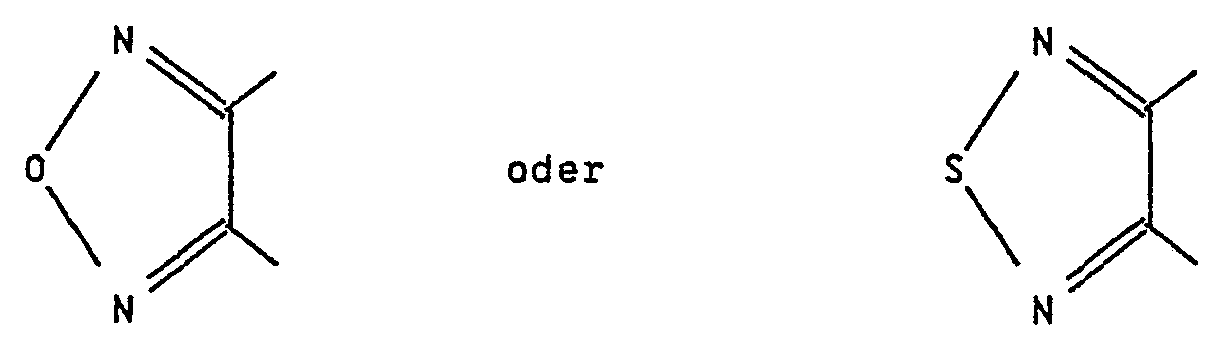
E 2-5C-Alkylen bedeutet,
R1 Wasserstoff, 1-6C-Alkyl oder 3-7C-Alkoxyalkyl bedeutet,
R2 Amino (NH2) bedeutet,
R3 1-6C-Alkyl oder 3-7C-Alkoxyalkyl bedeutet,
R4 und R5 gleich oder verschieden sind und Wasserstoff, Hydroxy, Halogen, Nitro, Cyaπo, Trifluormethyl, 1-4C-Alkyl, 1-4C-Alkoxy, ganz oder teilweise durch Fluor substituiertes 1-4C-Alkoxy, 1-4C-Alkoxycarbonyl, 2-5C-Acyl, Amino oder Mono- oder Di-1-4C-alkylamino bedeuten,
R8 Aryl bedeutet und
R9 Aryl bedeutet, wobei Aryl für einen Ring der Formel

3. Verbindungen der Formel Ia nach Anspruch 2, worin
Cy 3-Nitrophenyl, 2-Chlorphenyl, 2,3-Dichlorphenyl, 2-Trifluormethylphenyl oder Benzoxdiazolyl bedeutet, E Ethylen (-CH2-CH2-), Trimethylen (-CH2-CH2-CH2-) oder Pentamethylen
(-CH2-CH2-CH2-CH2-CH2-) bedeutet, R1 Methyl bedeutet,
R2 Amino (NH2) bedeutet,
R3 Methyl oder Ethyl bedeutet, R8 Phenyl bedeutet und R9 Phenyl bedeutet, und ihre Salze.
4. Verbindungen der Formel Ib

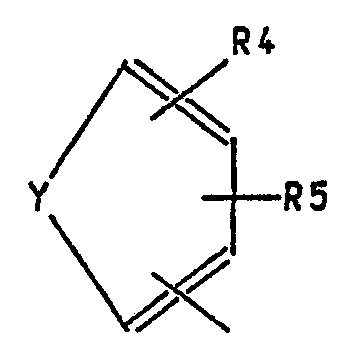

A1 2-4C-Alkylen bedeutet,
A2 2-4C-Alkylen oder 2C-Alkylenoxy-2C-alkylen bedeutet,
R1 und R2 gleich oder verschieden sind und Wasserstoff, 1-6C-Alkyl oder 3-7C-Alkoxyalkyl bedeuten,
R3 Wasserstoff, 1-6C-Alkyl oder 3-7C-Alkoxyalkyl bedeutet,
R4 und R5 gleich oder verschieden sind und Wasserstoff, Hydroxy, Halogen, Nitro, Cyano, Trifluormethyl, 1-4C-Alkyl, 1-4C-Alkoxy, ganz oder teilweise durch Fluor substituiertes 1-4C-Alkoxy, 1-4C-Alkoxycarbonyl, 2-5C-Acyl, Amino oder Mono- oder Di-1-4C-alkylamino bedeuten,
R8 Aryl bedeutet und
R9 Aryl bedeutet, wobei
Aryl für einen Ring der Formel

5. Verbindungen der Formel Ib nach Anspruch 4, worin
Cy 3-Nitrophenyl, 2-Chlorphenyl, 2,3-Dichlorphenyl, 2-Trifluormethylphenyl oder Benzoxdiazolyl bedeutet, A1 Ethylen (-CH2CH2-) bedeutet, A2 Ethylen (-CH2CH2-) oder Ethylenoxyethylen (-CH2-CH2-O-CH2-CH2- ) bedeutet, R1 Mathyl bedeutet, R2 Mathyl bedeutet, R3 Methyl oder Ethyl bedeutet, R8 Phenyl bedeutet und R9 Phenyl bedeutet, und ihre Salze.
6. Verbindungen ausgewählt aus der Gruppe bestehend aus
1,4-Dihydro-2,6-dimethyl-4-(3-nitrophenyl)-pyridin-3,5-dicarbonsäure-3¬
-methyl-5-{2-[2-(4,4-diphenylpiperidyl-1)-ethoxi]-ethyl}-ester
(-)-1,4-Dihydro-2,6-dimethyl-4-(3-nitrophenyl)-pyridin-3,5-dicarbonsäure¬
-3-methyl-5-{2-[2-(4,4-diphenylpiperidyl-1)-ethoxi]-ethyl}-ester
1,4-Dihydro-2,6-dimethyl-4-(3-nitrophenyl)-pyridin-3,5-dicarbonsäure-3-methyl-5-{2-[2-(2-(4,4-diphenylpiperidyl-1)-ethoxi)-ethoxi]-ethyl}-ester
2-Amino-1,4-dihydro-6-methyl-4-(3-nitrophenyl)-pyridin-3,5-dicarbonsäure¬
-3-ethyl-5-[3-(4,4-diphenylpiperidyl-1)-propyl]-ester
(-)-2-Amino-1,4-dihydro-6-methyl-4-(3-nitrophenyl)-pyridin-3,5-dicarbonsäure-3-ethyl-5-[3-(4,4-diphenylpiperidyl-1)-propyl]-ester
2-Amino-1,4-dihydro-6-methyl-4-(3-nitrophenyl)-pyridin-3,5-dicarbonsäure¬
3-ethyl-5-[5-(4,4-diphenylpiperidyl-1)-pentyl]-ester
2-Amino-4-(2,3-dichlorphenyl)-1,4-dihydro-6-methyl-pyridin-3,5-dicarbonsäure-3-ethyl-5-[3-(4,4-diphenylpiperidyl-1)-propyl]-ester
2-Amino-4-(4-benzo[c][1.2.5]oxdiazolyl)-1,4-dihydro-6-methyl-pyridin-3,5¬
-dicarbonsäure-3-ethyl-5-[3-(4,4-diphenylpiperidyl-1)-propyl]-ester
2-Amino-4-(2-chlorphenyl)-1,4-dihydro-6-methyl-pyridin-3,5-dicarbonsäure¬
-3-ethyl-5-[3-(4,4-diphenylpiperidyl-1)-propyl]-ester
2-Amino-1,4-dihydro-6-methyl-4-(2-trifluormethylphenyl)-pyridin-3,5-dicarbonsäure-3-ethyl-5-[3-(4,4-diphenylpiperidyl-1)-propyl]-ester
2-Amino-1,4-dihydro-6-methyl-4-(3-nitrophenyl)-pyridin-3,5-dicarbonsäure 3-methyl-5-[2-(4,4-diphenylpiperidyl-1)-ethyl]-ester und ihre Salze.
7. Verfahren zur Herstellung der Verbindungen der Formel Ia nach Anspruch 2 und ihrer Salze, dadurch gekennzeichnet, daß man Amidine der Formel IIa


8. Verfahren zur Herstellung der Verbindungen der Formel Ib nach Anspruch 4 und ihrer Salze, dadurch gekennzeichnet, daß man
a) Zimtsäurederivate der Formel IIb
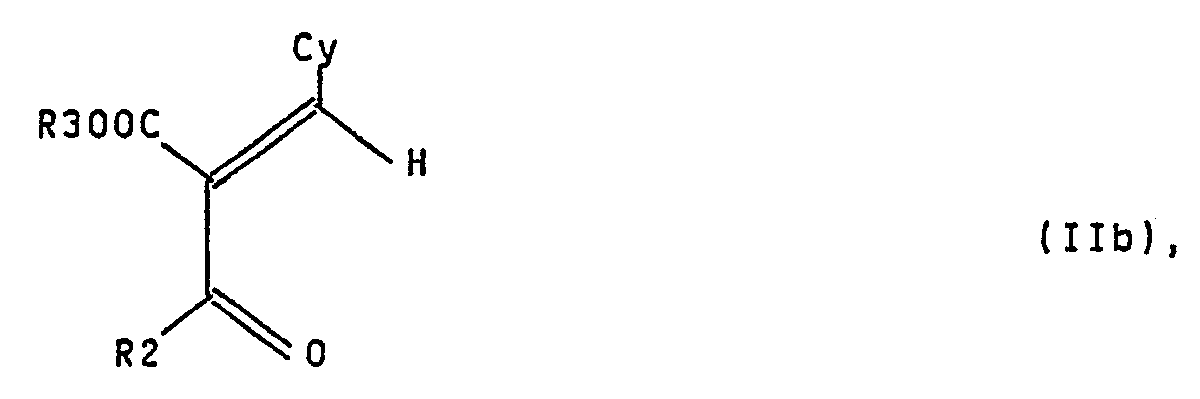


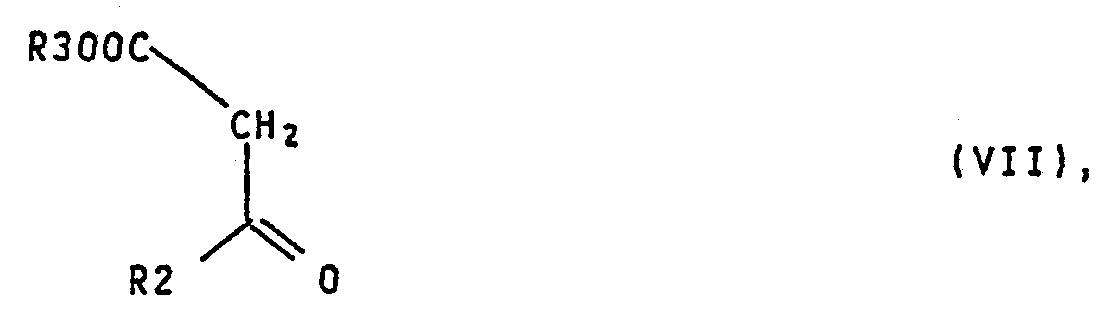


als solche (n) oder in Form ihrer Salze umsetzt und gewünschtenfalls anschließend erhaltene Salze in die freien Basen oder erhaltene Basen in die Salze überführt, wobei Cy, A1 , A2, R1, R2, R3, R4, R5, R8 und R9 die in Anspruch 4 angegebenen Bedeutungen haben, Z gemeinsam mit der Carbonylgruppe, woran es gebunden ist, eine Carboxylgruppe oder ein reaktives Carbonsäurederivat (z. B. ein Carbonsäurehalogenid) und Y eine Fluchtgruppe darstellt.
9. Arzneimittel enthaltend eine oder mehrere Verbindungen nach einem oder mehreren der Ansprüche 1 bis 6 und/oder ihre pharmakologisch verträglichen Salze.
10. Verbindungen nach einem oder mehreren der Ansprüche 1 bis 6 und ihre pharmakologisch verträglichen Salze zur Anwendung bei der Behandlung und/oder Prophylaxe von Hypertonie, koronaren Herzkrankheiten, peripheren und cerebralen Zirkulationstörungen und/oder Krankheiten, die auf einer erhöhten Wasser- oder Natriumretention beruhen.
Applications Claiming Priority (4)
| Application Number | Priority Date | Filing Date | Title |
|---|---|---|---|
| CH1633/86-3 | 1986-04-22 | ||
| CH163386 | 1986-04-22 | ||
| CH162386 | 1986-04-22 | ||
| CH1623/86-0 | 1986-04-22 |
Publications (1)
| Publication Number | Publication Date |
|---|---|
| WO1987006579A1 true WO1987006579A1 (fr) | 1987-11-05 |
Family
ID=25688198
Family Applications (1)
| Application Number | Title | Priority Date | Filing Date |
|---|---|---|---|
| PCT/EP1987/000210 Ceased WO1987006579A1 (fr) | 1986-04-22 | 1987-04-17 | Amines et ethers nouveaux |
Country Status (8)
| Country | Link |
|---|---|
| US (1) | US5064839A (de) |
| EP (2) | EP0242829A1 (de) |
| JP (1) | JPH01500118A (de) |
| AU (1) | AU7390187A (de) |
| IL (1) | IL82294A (de) |
| NZ (1) | NZ220022A (de) |
| PT (1) | PT84732B (de) |
| WO (1) | WO1987006579A1 (de) |
Cited By (1)
| Publication number | Priority date | Publication date | Assignee | Title |
|---|---|---|---|---|
| JPH03503525A (ja) * | 1988-02-19 | 1991-08-08 | ビイク グルデン ロンベルク ヒエーミツシエ フアブリーク ゲゼルシヤフト ミツト ベシユレンクテル ハフツング | 腫瘍疾患治療用の光学的に純粋なr‐(‐)‐ニグルジピン及びその誘導体 |
Families Citing this family (7)
| Publication number | Priority date | Publication date | Assignee | Title |
|---|---|---|---|---|
| WO1988007525A1 (fr) * | 1987-03-27 | 1988-10-06 | Byk Gulden Lomberg Chemische Fabrik Gmbh | Enantiomeres de 1,4-dihydropyridine |
| AU1541188A (en) * | 1987-03-27 | 1988-11-02 | Byk Gulden Lomberg Chemische Fabrik Gmbh | New optically active compounds |
| DE4092406A1 (de) * | 1989-12-22 | 1993-04-01 | ||
| AU3084992A (en) * | 1991-12-13 | 1993-07-19 | Byk Gulden Lomberg Chemische Fabrik Gmbh | 1,4-dihydropyridines for use in the treatment of dermatosis |
| GB9405833D0 (en) * | 1994-03-24 | 1994-05-11 | Pfizer Ltd | Separation of the enantiomers of amlodipine |
| PL247048B1 (pl) | 2024-04-25 | 2025-05-05 | Univ Of South Bohemia In Ceske Budejovice | Biostymulator roślinny i sposób jego wytwarzania |
| PL448416A1 (pl) | 2024-04-25 | 2025-03-03 | Uniwersytet Przyrodniczy W Lublinie | Biostymulator roślinny |
Citations (4)
| Publication number | Priority date | Publication date | Assignee | Title |
|---|---|---|---|---|
| EP0007293A1 (de) * | 1978-06-30 | 1980-01-23 | Aktiebolaget Hässle | Hypotensiv wirksamer 2,6-Dimethyl-4-(2,3-dichlorophenyl)-1,4-dihydropyridin-3,5-dicarbonsäure-3-methylester-5-ethylester, Verfahren zu seiner Herstellung und diesen enthaltende pharmazeutische Zusammensetzungen |
| EP0138505A2 (de) * | 1983-10-17 | 1985-04-24 | Takeda Chemical Industries, Ltd. | Dihydropyridin-Derivate, ihre Herstellung und Verwendung |
| GB2158065A (en) * | 1984-04-11 | 1985-11-06 | Bristol Myers Co | Dihydropyridines |
| EP0176956A2 (de) * | 1984-09-28 | 1986-04-09 | Byk Gulden Lomberg Chemische Fabrik GmbH | Neue Diarylverbindungen |
Family Cites Families (9)
| Publication number | Priority date | Publication date | Assignee | Title |
|---|---|---|---|---|
| US3849576A (en) * | 1964-01-29 | 1974-11-19 | Oreal | Process and cosmetic compositions for the treatment of skin and scalp |
| US3849396A (en) * | 1973-01-08 | 1974-11-19 | Upjohn Co | Lincomycin and clindamycin 1-o-ethers |
| US3852279A (en) * | 1973-03-12 | 1974-12-03 | Squibb & Sons Inc | 7-substituted -3,3a,4,5,6,7-hexahydro-3-substituted-2h- pyrazolo (4,3-c)pyridines |
| GB1509527A (en) * | 1974-06-05 | 1978-05-04 | Ici Ltd | 1-(aryl-or heteroaryl)oxy-3-(substituted-amino)propan-2-ol derivatives processes for their manufacture and pharmaceutical compositions containing them |
| EP0024638A1 (de) * | 1979-08-30 | 1981-03-11 | Byk Gulden Lomberg Chemische Fabrik GmbH | Substituierte Chinolinonalkancarbonsäuren, ihre Herstellung und sie enthaltende Arzneimittel |
| US4387219A (en) * | 1979-11-13 | 1983-06-07 | Sterling Drug Inc. | 2-Hydroxy gentamicin compounds |
| IL75400A (en) * | 1984-06-16 | 1988-10-31 | Byk Gulden Lomberg Chem Fab | Dialkoxypyridine methyl(sulfinyl or sulfonyl)benzimidazoles,processes for the preparation thereof and pharmaceutical compositions containing the same |
| IL76839A (en) * | 1984-10-31 | 1988-08-31 | Byk Gulden Lomberg Chem Fab | Picoline derivatives,processes for the preparation thereof and pharmaceutical compositions containing the same |
| US4886819A (en) * | 1986-08-27 | 1989-12-12 | The Green Cross Corporation | Dihydropyridine derivatives and pharmaceutical composition thereof |
-
1987
- 1987-04-16 NZ NZ220022A patent/NZ220022A/en unknown
- 1987-04-17 US US07/272,775 patent/US5064839A/en not_active Expired - Fee Related
- 1987-04-17 WO PCT/EP1987/000210 patent/WO1987006579A1/de not_active Ceased
- 1987-04-17 EP EP87105748A patent/EP0242829A1/de active Pending
- 1987-04-17 EP EP87902503A patent/EP0302871A1/de not_active Withdrawn
- 1987-04-17 AU AU73901/87A patent/AU7390187A/en not_active Abandoned
- 1987-04-17 JP JP62502951A patent/JPH01500118A/ja active Pending
- 1987-04-22 PT PT84732A patent/PT84732B/pt not_active IP Right Cessation
- 1987-04-22 IL IL82294A patent/IL82294A/xx unknown
Patent Citations (4)
| Publication number | Priority date | Publication date | Assignee | Title |
|---|---|---|---|---|
| EP0007293A1 (de) * | 1978-06-30 | 1980-01-23 | Aktiebolaget Hässle | Hypotensiv wirksamer 2,6-Dimethyl-4-(2,3-dichlorophenyl)-1,4-dihydropyridin-3,5-dicarbonsäure-3-methylester-5-ethylester, Verfahren zu seiner Herstellung und diesen enthaltende pharmazeutische Zusammensetzungen |
| EP0138505A2 (de) * | 1983-10-17 | 1985-04-24 | Takeda Chemical Industries, Ltd. | Dihydropyridin-Derivate, ihre Herstellung und Verwendung |
| GB2158065A (en) * | 1984-04-11 | 1985-11-06 | Bristol Myers Co | Dihydropyridines |
| EP0176956A2 (de) * | 1984-09-28 | 1986-04-09 | Byk Gulden Lomberg Chemische Fabrik GmbH | Neue Diarylverbindungen |
Cited By (1)
| Publication number | Priority date | Publication date | Assignee | Title |
|---|---|---|---|---|
| JPH03503525A (ja) * | 1988-02-19 | 1991-08-08 | ビイク グルデン ロンベルク ヒエーミツシエ フアブリーク ゲゼルシヤフト ミツト ベシユレンクテル ハフツング | 腫瘍疾患治療用の光学的に純粋なr‐(‐)‐ニグルジピン及びその誘導体 |
Also Published As
| Publication number | Publication date |
|---|---|
| JPH01500118A (ja) | 1989-01-19 |
| IL82294A0 (en) | 1987-10-30 |
| IL82294A (en) | 1991-11-21 |
| PT84732B (pt) | 1989-12-29 |
| AU7390187A (en) | 1987-11-24 |
| US5064839A (en) | 1991-11-12 |
| PT84732A (de) | 1987-05-01 |
| EP0302871A1 (de) | 1989-02-15 |
| NZ220022A (en) | 1990-04-26 |
| EP0242829A1 (de) | 1987-10-28 |
Similar Documents
| Publication | Publication Date | Title |
|---|---|---|
| EP0176956B1 (de) | Neue Diarylverbindungen | |
| EP0071819B1 (de) | Dihydropyridine mit positiv inotroper Wirkung, neue Verbindungen, ihre Verwendung in Arzneimitteln und Verfahren zu ihrer Herstellung | |
| DE3787346T2 (de) | Dihydropyridin-Derivate, ihre Herstellung und ihre Verwendung. | |
| EP0088274A1 (de) | Neue 1,4-Dihydropyridine, Verfahren zu ihrer Herstellung und ihrer Verwendung in Arzneimitteln | |
| WO1988007525A1 (fr) | Enantiomeres de 1,4-dihydropyridine | |
| EP0185964A2 (de) | Dihydropyridin-carbonsäureamide, Verfahren zu ihrer Herstellung und ihre Verwendung in Arzneimitteln | |
| WO1987006579A1 (fr) | Amines et ethers nouveaux | |
| EP0234196A1 (de) | Substituierte 1,4-Dihydropyridin-3-carbonsäurepiperazide, Verfahren zu ihrer Herstellung und ihre Verwendung in Arzneimitteln | |
| DE3130041A1 (de) | Dihydropyridine mit positiv inotroper wirkung, neue verbindungen, ihre verwendung in arzneimitteln und verfahren zu ihrer herstellung | |
| EP0179386B1 (de) | 1,4-Dihydropyridin-hydroxyamine, Verfahren zu ihrer Herstellung sowie ihre Verwendung in Arzneimitteln | |
| EP0127826A2 (de) | 1,4-Dihydropyridine, Verfahren zu ihrer Herstellung sowie ihre Verwendung in Arzneimitteln | |
| DE3244178A1 (de) | 1,4-dihydropyridinderivate, verfahren zu ihrer herstellung sowie ihre verwendung in arzneimitteln | |
| EP0236838A2 (de) | Aminoester-Dihydropyridine, Verfahren zu ihrer Herstellung und ihre Verwendung | |
| EP0244595A2 (de) | Dihydropyridinderivate, Verfahren zu ihrer Herstellung und ihre Verwendung als Arzneimittel | |
| EP0218068A1 (de) | Dihydropyridin-2-hydroxyamine, Verfahren zur Herstellung und ihre Verwendung in Arzneimitteln | |
| DE3816361A1 (de) | 1,4-dihydropyridindicarbonsaeure-(-)-menthylester | |
| DD235867A5 (de) | Verfahren zur herstellung von 1,4-dihydropyridinen | |
| EP0186028A2 (de) | Optisch aktive Nitrodihydropyridine, Verfahren zur Herstellung und ihre Verwendung in Arzneimitteln | |
| EP0362632A2 (de) | Basische 4-Aryl-DHP-amide, Verfahren zu ihrer Herstellung und ihre Verwendung in Arzneimitteln | |
| CH633265A5 (de) | Verfahren zur herstellung des neuen 1.4-dihydro-2.6-dimethyl-4-(3-nitrophenyl)-3.5-pyridindicarbonsaeure-isopropyl-(2-propoxy-aethyl)-esters. | |
| EP0205511A1 (de) | Neue piperazinderivate | |
| DE3712371A1 (de) | Substituierte 1,4-dihydropyridine, verfahren zu ihrer herstellung und ihre verwendung | |
| WO1988007531A1 (fr) | Nouveaux composes optiquement actifs | |
| WO1989003824A1 (fr) | Nouvelles pyrrolidines | |
| EP0240828A1 (de) | Optisch aktive 1,4-Dihydropyridinverbindung |
Legal Events
| Date | Code | Title | Description |
|---|---|---|---|
| AK | Designated states |
Kind code of ref document: A1 Designated state(s): AU DK FI HU JP KR NO US |
|
| AL | Designated countries for regional patents |
Kind code of ref document: A1 Designated state(s): AT BE CH DE FR GB IT LU NL SE |
|
| WWE | Wipo information: entry into national phase |
Ref document number: 1987902503 Country of ref document: EP |
|
| WWP | Wipo information: published in national office |
Ref document number: 1987902503 Country of ref document: EP |
|
| WWW | Wipo information: withdrawn in national office |
Ref document number: 1987902503 Country of ref document: EP |