WO1994006961A1 - Verfahren zum farben und bedrucken von textilen materialien aus cellulosefasern in gegenwart von zyklischen alphahydroxyketonen - Google Patents

Verfahren zum farben und bedrucken von textilen materialien aus cellulosefasern in gegenwart von zyklischen alphahydroxyketonen Download PDF

Info

Publication number
WO1994006961A1
WO1994006961A1 PCT/EP1993/002424 EP9302424W WO9406961A1 WO 1994006961 A1 WO1994006961 A1 WO 1994006961A1 EP 9302424 W EP9302424 W EP 9302424W WO 9406961 A1 WO9406961 A1 WO 9406961A1
Authority
WO
WIPO (PCT)
Prior art keywords
dyeing
liquor
cellulose fibers
dyes
cyclic
Prior art date
Legal status (The legal status is an assumption and is not a legal conclusion. Google has not performed a legal analysis and makes no representation as to the accuracy of the status listed.)
Ceased
Application number
PCT/EP1993/002424
Other languages
English (en)
French (fr)
Inventor
Henric Wagenmann
Ulf Baus
Eberhard Beckmann
Erich Kromm
Current Assignee (The listed assignees may be inaccurate. Google has not performed a legal analysis and makes no representation or warranty as to the accuracy of the list.)
BASF SE
Original Assignee
BASF SE
Priority date (The priority date is an assumption and is not a legal conclusion. Google has not performed a legal analysis and makes no representation as to the accuracy of the date listed.)
Filing date
Publication date
Application filed by BASF SE filed Critical BASF SE
Priority to JP6507760A priority Critical patent/JPH08501354A/ja
Priority to EP93919295A priority patent/EP0660894B1/de
Priority to US08/379,433 priority patent/US5558677A/en
Priority to DE59301994T priority patent/DE59301994D1/de
Publication of WO1994006961A1 publication Critical patent/WO1994006961A1/de
Anticipated expiration legal-status Critical
Ceased legal-status Critical Current

Links

Classifications

    • D—TEXTILES; PAPER
    • D06—TREATMENT OF TEXTILES OR THE LIKE; LAUNDERING; FLEXIBLE MATERIALS NOT OTHERWISE PROVIDED FOR
    • D06P—DYEING OR PRINTING TEXTILES; DYEING LEATHER, FURS OR SOLID MACROMOLECULAR SUBSTANCES IN ANY FORM
    • D06P1/00—General processes of dyeing or printing textiles, or general processes of dyeing leather, furs, or solid macromolecular substances in any form, classified according to the dyes, pigments, or auxiliary substances employed
    • D06P1/44—General processes of dyeing or printing textiles, or general processes of dyeing leather, furs, or solid macromolecular substances in any form, classified according to the dyes, pigments, or auxiliary substances employed using insoluble pigments or auxiliary substances, e.g. binders
    • D06P1/64—General processes of dyeing or printing textiles, or general processes of dyeing leather, furs, or solid macromolecular substances in any form, classified according to the dyes, pigments, or auxiliary substances employed using insoluble pigments or auxiliary substances, e.g. binders using compositions containing low-molecular-weight organic compounds without sulfate or sulfonate groups
    • D06P1/651—Compounds without nitrogen
    • D06P1/65106—Oxygen-containing compounds
    • D06P1/65118—Compounds containing hydroxyl groups
    • D—TEXTILES; PAPER
    • D06—TREATMENT OF TEXTILES OR THE LIKE; LAUNDERING; FLEXIBLE MATERIALS NOT OTHERWISE PROVIDED FOR
    • D06P—DYEING OR PRINTING TEXTILES; DYEING LEATHER, FURS OR SOLID MACROMOLECULAR SUBSTANCES IN ANY FORM
    • D06P1/00—General processes of dyeing or printing textiles, or general processes of dyeing leather, furs, or solid macromolecular substances in any form, classified according to the dyes, pigments, or auxiliary substances employed
    • D06P1/22—General processes of dyeing or printing textiles, or general processes of dyeing leather, furs, or solid macromolecular substances in any form, classified according to the dyes, pigments, or auxiliary substances employed using vat dyestuffs including indigo
    • D06P1/221—Reducing systems; Reducing catalysts
    • D—TEXTILES; PAPER
    • D06—TREATMENT OF TEXTILES OR THE LIKE; LAUNDERING; FLEXIBLE MATERIALS NOT OTHERWISE PROVIDED FOR
    • D06P—DYEING OR PRINTING TEXTILES; DYEING LEATHER, FURS OR SOLID MACROMOLECULAR SUBSTANCES IN ANY FORM
    • D06P1/00—General processes of dyeing or printing textiles, or general processes of dyeing leather, furs, or solid macromolecular substances in any form, classified according to the dyes, pigments, or auxiliary substances employed
    • D06P1/44—General processes of dyeing or printing textiles, or general processes of dyeing leather, furs, or solid macromolecular substances in any form, classified according to the dyes, pigments, or auxiliary substances employed using insoluble pigments or auxiliary substances, e.g. binders
    • D06P1/64—General processes of dyeing or printing textiles, or general processes of dyeing leather, furs, or solid macromolecular substances in any form, classified according to the dyes, pigments, or auxiliary substances employed using insoluble pigments or auxiliary substances, e.g. binders using compositions containing low-molecular-weight organic compounds without sulfate or sulfonate groups
    • D06P1/651—Compounds without nitrogen
    • D06P1/65106—Oxygen-containing compounds
    • D06P1/65112—Compounds containing aldehyde or ketone groups
    • Y—GENERAL TAGGING OF NEW TECHNOLOGICAL DEVELOPMENTS; GENERAL TAGGING OF CROSS-SECTIONAL TECHNOLOGIES SPANNING OVER SEVERAL SECTIONS OF THE IPC; TECHNICAL SUBJECTS COVERED BY FORMER USPC CROSS-REFERENCE ART COLLECTIONS [XRACs] AND DIGESTS
    • Y10—TECHNICAL SUBJECTS COVERED BY FORMER USPC
    • Y10S—TECHNICAL SUBJECTS COVERED BY FORMER USPC CROSS-REFERENCE ART COLLECTIONS [XRACs] AND DIGESTS
    • Y10S8/00—Bleaching and dyeing; fluid treatment and chemical modification of textiles and fibers
    • Y10S8/916—Natural fiber dyeing
    • Y10S8/918—Cellulose textile

Definitions

  • the invention relates to a process for dyeing and printing textile materials which consist of cellulose fibers or contain cellulose fibers in a mixture with other fibers in an aqueous medium at pH values above 12 with viable dyes in the presence of at least one Reducing agent for the viable dyes and finishing the coloring in the usual way.
  • EP-A-0 364 752 discloses a process for dyeing cellulose fiber textile materials with vat dyes in an alkaline medium, in which mixtures of sodium dithionite and / or thiourea dioxide and ⁇ -hydroxycarbonyl compounds, such as hydroxyacetone, are used as reducing agents , begins and the coloring
  • the object of the present invention is to provide a reducing agent for the process described at the outset which is stable in the strongly alkaline dye liquor, i.e. do not condense to colored products under dyeing conditions and if possible cause no odor problems.
  • the object is achieved according to the invention with a process for dyeing and printing textile materials made from cellulose
  • 40 fibers consist of or contain cellulose fibers in a mixture with other fibers, in an aqueous medium at pH values above 12 with viable dyes in the presence of at least one reducing agent for the viable dyes and completion of the dyeing in the usual way if a reducing agent is used cycli-
  • the textile materials consist of cellulose fibers or contain cellulose fibers in a mixture with other fibers. They can be in any processing state, e.g. as a flake, card sliver, yarn, skein, fabric or knitted fabric.
  • the cellulose fibers can either be natural or regenerated cellulose, such as rayon, viscose or polynosic fibers. Both mercerized cotton and raw cotton as well as raw yarn, which is present as a package or as a skein, can be dyed by the process according to the invention.
  • Synthetic fibers which are present in the textile materials in a mixture with cellulose fibers are, for example, polyester fibers, polyacrylonitrile fibers or synthetic polyamide fibers.
  • the cellulose fibers are dyed with viable dyes, such as vat dyes, in particular indigo, or sulfur dyes.
  • viable dyes such as vat dyes, in particular indigo, or sulfur dyes.
  • the vat dyes are either In ⁇ digo or anthraquinone or indigoid dyes.
  • Vat dyes and sulfur dyes have long been commercially available and documented in the Color Index (C.I.), cf. Color Index, 3rd edition 1971, volume 3, pages 3719 to 3844, and volume 4, C.I. ⁇ No. 58000 to 74000, Soc. Dyers and Colorists, England.
  • the combinable dyes are used in the process according to the invention in the amounts customarily used for dyeing, for example in the range from 0.01 to 10% by weight, based on the textile material.
  • a single dye or a mixture of 2 or more combinable dyes can be used here.
  • the dyeing of the textile materials can be carried out using the exhaust process, for example from a long aqueous liquor at a liquor ratio of 1: 5 to 1:40, preferably 1: 8 to 1:20. or also in the continuous process, for example block-steaming process.
  • liquor ratios of 1: 0.5 to 1: 3 and correspondingly higher concentrations of reducing agent and sodium hydroxide solution are used, usually 10 to 100 g / 1 at least one reducing agent and 50 to 200 g / 1 NaOH 38 ° Be ⁇ used.
  • Printing on textile materials is also possible using the method according to the invention.
  • the pH of the aqueous liquors is above 12. It is adjusted by adding alkali metal hydroxides to the aqueous dyeing medium. Suitable alkali metal hydroxides are sodium hydroxide and potassium hydroxide, preference being given to the use of sodium hydroxide solution as alkali metal hydroxide.
  • the concentration of the alkali metal hydroxide in the aqueous dye liquor is usually 10 to 500, preferably 30 to 250 ml of aqueous alkali metal solution at 38 ° B ⁇ / l liquor.
  • cyclic compounds according to the invention are used as reducing agents which have the structural unit at least once
  • Suitable compounds with the structural unit (I) in the ring of the molecule are the following compounds:
  • n 1 or 2
  • substituents R 1 , R 2 and R 3 independently of one another are H, C 1 -C 4 -alkyl, OH, OCH 3 or phenyl, for example the compounds Va-Vc:
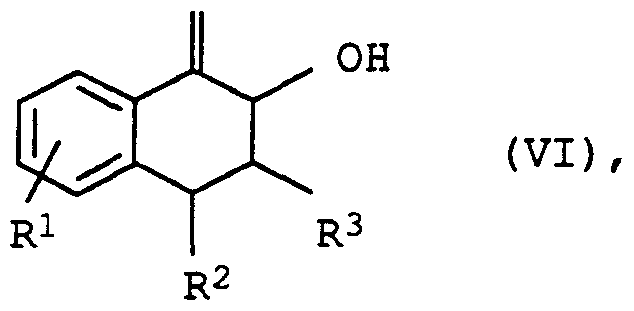
  • R 1 , R 2 and R 3 independently of one another denote H, C 1 -C 4 -alkyl, OH or OCH 3 , for example the compounds Vla-VIc:
  • cyclic ⁇ -hydroxyketones with the structural units I indicated above ⁇ -hydroxycyclohexanone and / or ⁇ -hydroxycyclopentanone are preferably used.
  • the cyclic ⁇ -hydroxyketones with the structural unit I are used in amounts of 0.5 to 10, preferably 1 to 6 g / 1.
  • quinoid compounds which are water-soluble at pH values above 12. These compounds are dissolved in the aqueous liquor under the dyeing conditions. Suitable quinoid compounds which are suitable for this purpose are known from DE-B-2 164 463.
  • Quinoid compounds are, for example, derivatives of benzoquinone, naphthoquinone, acenaphthenquinones or anthraquinones, such as hydroxyanthraquinones, for example 2-hydroxyanthraquinone and 1,4-di-hydroxyanthraquinone, anthraquinonecarboxylic acids, anthraquinone carboxylic acids, and such as anthraquinone-2-sulfonic acid and 1,4-diaminoanthraquinone-2-sulfonic acid. These connections are called accelerators common in vat dyeing.
  • the quinoid compounds are used in amounts of 1 to 10% by weight, based on the amount of the dye used.
  • the cyclic ⁇ -hydroxyketones with structure I can optionally be used with all reducing agents known for dyeing vat dyes, e.g. in a mixture with sodium dithionite and / or thiourea dioxide.
  • the weight ratio of the cyclic ⁇ -hydroxyketones to be used according to the invention to sodium dithionite and / or thiourea dioxide in such reducing agent mixtures is, for example, 1: 1 to 1:15, preferably 1: 2 to 1:10.
  • the alkaline-aqueous dyeing liquor can optionally also contain polymers of monoethylenically unsaturated carboxylic acids as dyeing aids.
  • dyeing aids are known, for example, from DE-B-2 444 823. These are essentially homopolymers and copolymers of monoethylenically unsaturated carboxylic acids.
  • the copolymers contain at least 10% by weight of a monoethylenically unsaturated carboxylic acid copolymerized.
  • Individual compounds of this type are, for example, polyacrylic acid, polymethacrylic acid, copolymers of acrylic acid or methacrylic acid with other monomers, e.g. Methacrylamide, acrylamide, acrylonitrile, methacrylonitrile, acrylic acid esters, methacrylic acid esters. Also suitable are copolymers of acrylic acid and maleic acid, copolymers of acrylic acid and itaconic acid, copolymers of maleic acid and vinyl star, copolymers of maleic acid and vinyl ethers. It is only essential that the copolymers contain at least 10, preferably at least 50 mol% of a monoethylenically unsaturated carboxylic acid in copolymerized form.
  • the copolymers can be used as coloring aids in the form of the free acids or preferably in a form already neutralized with alkaline solutions.
  • the K values of the homo- and copolymers of monoethylenically unsaturated carboxylic acids are from 15 to 90 and are preferably in the range from 20 to 65.
  • the K values are determined according to H. Fikentscher, Cellulosechemie, Volume 13, 58-64 and 71-74 (1932) in aqueous solution at a temperature of 25 ° C. and a concentration of 1% by weight at pH 7 on the sodium salt of the polymers.
  • the polymers are used in amounts of 0.05 to 2% by weight, based on the textile materials to be dyed.
  • the dyeing is carried out in the temperature range in which vat dyeings with reducing agents are usually carried out, for example from 20 to 130, preferably 40 to 115 ° C.
  • the usual pressure equipment such as HT equipment, jet dyeing machines, etc. are used, depending on the design of the textile material.
  • the textile material which after the treatment in the dyebath contains the linked dye in the leuco form, is treated in the usual way to complete the dyeings.
  • the textile material is first oxidized according to the methods used in the vat dyeing, e.g. Dwell in the air of the material containing the leuco dye or treatment of this material with an aqueous liquor which contains hydrogen peroxide or another oxidizing agent. After the oxidation, the dyed textile material is rinsed and soaped.
  • the dyeing can, however, also be carried out in such a way that the textile material which contains the vat dye in the leuco form is first rinsed, then oxidized and then soaped.
  • a wetting agent-containing aqueous solution which may also contain dissolved soda, is usually used for soaping.
  • a bleached cotton jersey is dyed in a 1:20 liquor ratio in a laboratory beaker bath with a liquor containing 0.5 g / l of the blue vat dye of CI no. 69825, 30 ml / 1 sodium hydroxide solution 38 ° B ⁇ and 3 g / 1 ⁇ -hydroxycyclohexanone contains.
  • the dyeing vessel is brought into the bath at a temperature of 25 ° C. and heated to a temperature of 60 ° C. within 15 minutes.
  • the cotton jersey is then dyed for 30 minutes at a temperature of 60 ° C. Then it is removed from the dyebath and finished in the usual way by oxidation, rinsing and soaping. You get a level, rub and washable blue color.
  • a bleached cotton jersey is dyed in a 1:20 liquor ratio in a laboratory beaker bath with a liquor containing 0.5 g of the green vat dye of CI no. 59825, 30 ml / 1 sodium hydroxide solution 38 ° Be and 3 g / 1 ⁇ -hydroxycyclohexanone contains.
  • the dyeing vessel is - as described in Example 1 - brought into the bath at 25 ° C. and heated to 60 ° C. within 15 minutes.
  • the dyeing of the textile material is carried out at 60 ° C. within 30 minutes.
  • the Cotton jersey is then removed from the dyebath and finished in the usual way by oxidizing, rinsing and soaping. You get a level, rub and wash-fast green color.
  • the color depth corresponds to a comparative dyeing which is obtained according to the known IN method by dyeing the same material with a dyeing liquor which contained 18 ml / 1 sodium hydroxide solution at 38 ° B ⁇ and 6 g / 1 sodium dithionite and in which the Coloring was carried out at 60 ° C within 45 min.
  • a bleached cotton jersey is dyed in a 1:20 liquor ratio in a laboratory cup bath.
  • the dye liquor contains 0.5 g / 1 of the blue vat dye of CI no. 69825, 30 ml / 1 sodium hydroxide solution 38 ° Be and 3 g / 1 hydroxyacetone.
  • the coloring was among the in
  • Example 1 conditions carried out. A level, rub-fast and wash-fast blue dyeing was obtained which was about 40% weaker in color than that obtained in Example 1.
  • Example 2 was repeated with the only exception that the cotton jersey was dyed with a liquor which now contained 3 g / l of hydroxyacetone as a reducing agent instead of the ⁇ -hydroxycyclohexanone. A level, rub- and wash-fast green dyeing was obtained which was about 50% weaker in color than the dyeing according to Example 2.
  • a bleached cotton jersey is dyed in a 1:20 liquor ratio in a laboratory beaker bath with a dye liquor containing 0.5 g / l of the blue vat dye of CI no. 60015 (Vat Blue 26), 30 ml / 1 sodium hydroxide solution at 38 ° B ⁇ and 3 g / 1 ⁇ -hydroxycyclopentanone.
  • the dyeing vessel is placed in the bath at 25 ° C. and heated to 60 ° C. within 15 minutes.
  • the cotton jersey is then dyed for 30 minutes at a temperature of 60 ° C.
  • the dyeing is then finished in the usual way by oxidizing, rinsing and soaping. You get a level, rub and wash-fast blue color.
  • the dyeing reaches the color depth of a comparative dyeing with a liquor which contains 18 ml / 1 NaOH 38 ° B ⁇ and 6 g / 1 sodium dithionite. Comparative Example 3
  • Example 3 is repeated with a dyeing liquor containing 0.5 g / l of the blue vat dye of CI no. 60015 (Vat Blue 26), 30 ml / 1 5 NaOH 38 ° B ⁇ and 3 g / 1 hydroxyacetone contains.
  • a level, rub-fast and wash-fast blue dyeing is obtained which is about 50% weaker in color than the dyeing according to Example 3.
  • a bleached cotton jersey is dyed in a 1:20 liquor ratio in a laboratory cup bath.
  • a dye liquor is used which contains 0.5 g / 1 of the vat dye of CI no. 69525 (Vat Black 25), 30 ml / 1 NaOH 38 ° Be and 3 g / 1 ⁇ -hydroxycyclopentanone.
  • staining vessel is placed in the bath at 25 ° C and heated to a temperature of 60 ° C within 15 min.
  • the material is then dyed at 60 ° C. for 30 minutes and the dyeing is then completed in the usual way by oxidizing, rinsing and soaping. You get a level, rubbing and washable olive-colored coloring.
  • Example 3 is repeated with a dyeing liquor containing 0.5 g / l of the vat dye of CI no. 69252 (Vat Black 25), 30 ml / 1 NaOH 38 ° Be and 3 g / 1 hydroxyacetone. In this way, a level rubbing and washable olive-colored coloring is obtained, which is about
  • Bleached cotton twill is impregnated at room temperature with a liquor absorption of 70% with a liquor containing 60 g / 1 of the green vat dye of CI no. 59825 (Vat Green 01), 2 g / 1 of a wetting agent (mixture of mono-, di- and tri-phosphoric acid esters of 2-ethylhexanol) and 10 g / 1 of an anti-migration agent (polyacrylamide) and 10 minutes at a temperature of Dried 130 ° C.
  • a wetting agent mixture of mono-, di- and tri-phosphoric acid esters of 2-ethylhexanol
  • an anti-migration agent polyacrylamide
  • the textile material is then impregnated with 100% of its weight at room temperature with a liquor which contains 30 g / 1 ⁇ -hydroxycyclopentanone and 100 ml / 1 NaOH 38 ° Be and then treated in a steamer at 102 ° C within one minute. It is then rinsed with cold water, oxidized for 3 minutes with 5 3 ml / 1 hydrogen peroxide, rinsed and soaped at 98 ° C. for 5 minutes. You get a level, rub and wash-fast green color. This reaches the color depth of a comparison staining after the usual are continuous processes with a liquor containing 100 ml / 1 NaOH 38 ° B ⁇ and 60 g / 1 sodium dithionite.
  • Example 5 The procedure is as described in Example 5, but a liquor is used as the reducing agent which contains 30 g / 1 hydroxyacetone and 100 ml / 1 NaOH 38 ° Be. This results in a level, rubbing and wash-fast green dyeing which is about 25% weaker in color than the dyeing obtained according to Example 5.
  • Bleached cotton twill is impregnated at room temperature with a liquor absorption of 70% with a dye liquor which contains 60 g / 1 of the blue vat dye of CI no. 69800 (Vat Blue 04), 2 g / 1 of a wetting agent (mixture of mono-, di- and triphosphoric esters of 2-ethylhexanol) and 10 g / 1 of an anti-migration agent (polyacrylamide).
  • a wetting agent mixture of mono-, di- and triphosphoric esters of 2-ethylhexanol
  • an anti-migration agent polyacrylamide
  • the impregnated material is dried for 2.5 min at 130 ° C and then impregnated at room temperature with 100% of its weight with a chemical liquor containing 30 g / 1 ⁇ -hydroxycyclopentanone and 100 ml / 1 NaOH 38 ° B ⁇ , and 1 min at Treated 102 ° C in the damper.
  • the fabric is then rinsed with cold water, oxidized for 3 minutes with 3 ml / 1 hydrogen peroxide, rinsed and soaped at 98 ° C. for 5 minutes. You get a level, rub and washable blue color.
  • the coloration reaches the color depth of a comparative coloration, in which the vat dye is reduced with a chemical liquor which contains 100 ml / 1 NaOH 38 ° B ⁇ and 60 g / 1 sodium dithionite.
  • Example 6 is repeated with the exception that a chemical liquor is used which contains 30 g / 1 hydroxyacetone and 100 ml / 1 NaOH 38 ° Be. The result is a level, rubbing and washable bluish coloration which is about 30% weaker in color than the coloration according to Example 6.

Landscapes

  • Engineering & Computer Science (AREA)
  • Textile Engineering (AREA)
  • Chemical & Material Sciences (AREA)
  • Chemical Kinetics & Catalysis (AREA)
  • Coloring (AREA)
  • Polymers With Sulfur, Phosphorus Or Metals In The Main Chain (AREA)

Abstract

Verfahren zum Färben und Bedrucken von textilen Materialien, die aus Cellulosefasern bestehen oder Cellulosefasern in Mischung mit anderen Fasern enthalten, in wässrigem Medium bei pH-Werten oberhalb von 12 mit verküpbaren Farbstoffen in Gegenwart von cyclischen Verbindungen, die mindestens einmal die Struktureinheit (I) im Ring des Moleküls enthalten, als Reduktionsmittel und Fertigstellen der Färbung in üblicher Weise.

Description

Verfahren zum Farben und Bedrucken von textilen Materialien aus Cellulose¬ fasern in Gegenwart von zyklischen Alphahydroxyketonen.
5 Beschreibung
Die Erfindung betrifft ein Verfahren zum Färben und Bedrucken von textilen Materialien, die aus Cellulosefasern bestehen oder Cel¬ lulosefasern in Mischung mit anderen Fasern enthalten, in wäßri- 10 gern Medium bei pH-Werten oberhalb von 12 mit verküpbaren Farb¬ stoffen in Gegenwart mindestens eines Reduktionsmittels für die verküpbaren Farbstoffe und Fertigstellen der Färbung in üblicher Weise.
15 Aus der EP-A-0 364 752 ist ein Verfahren zum Färben von textilen Materialien aus Cellulosefasern mit Küpenfarbstoffen im alkali¬ schen Medium bekannt, bei dem man als Reduktionsmittel Mischungen aus Natriumdithionit und/oder Thioharnstoffdioxid und α-Hydroxy- carbonylVerbindungen, wie Hydroxyaceton, einsetzt und die Färbung
20 bei pH-Werten von mindestens 13 sowie bei Temperaturen oberhalb von 75°C durchführt. Die Färbung wird dann anschließend in übli¬ cher Weise durch Oxidieren und Waschen des gefärbten Materials fertiggestellt. Die darin beschriebenen α-Hydroxycarbonylverbin- dungen, wie Hydroxyaceton, sind unter den Färbebedingungen nicht
25 ausreichend stabil und werden in unübersichtlicher Weise zu einer Vielzahl von Produkten umgesetzt, die unter anderem zu Geruch¬ sproblemen führen. Die Verwendung von Natriumdithionit und/oder Thioharnstoffdioxid als Reduktionsmittel beim Färben von Cellulo¬ sefasern mit Küpenfarbstoffen führt zu einer Belastung der Pro-
30 duktionsabwässer von Färbereien mit Sulfit- und Sulfationen.
Der vorliegenden Erfindung liegt die Aufgabe zugrunde, für das eingangs beschriebene Verfahren ein Reduktionsmittel zur Verfü¬ gung zu stellen, das in der stark alkalischen Färbeflotte stabil 35 ist, d.h. unter Färbebedingungen nicht zu farbigen Produkten kon¬ densiert und möglichst keine Geruchsprobleme verursacht.
Die Aufgabe wird erfindungsgemäß gelöst mit einem Verfahren zum Färben und Bedrucken von textilen Materialien, die aus Cellulose-
40 fasern bestehen oder Cellulosefasern in Mischung mit anderen Fa¬ sern enthalten, im wäßrigen Medium bei pH-Werten oberhalb von 12 mit verküpbaren Farbstoffen in Gegenwart mindestens eines Reduk¬ tionsmittels für die verküpbaren Farbstoffe und Fertigstellen der Färbung in üblicher Weise, wenn man als Reduktionsmittel cycli-
45 sehe Verbindungen einsetzt, die mindestens einmal die Struktu¬ reinheit (I) 0 OH
im Ring des Moleküls enthalten.
Überraschenderweise erhält man bei Einsatz der cyclischen α-Hy- droxyketone mit der Struktur I im Vergleich mit Hydroxyaceton eine höhere Farbausbeute. Ein weiterer entscheidender Vorteil ge¬ genüber Hydroxyaceton besteht darin, daß die cyclischen α-Hy- droxyketone mit der Struktureinheit I im Ring des Moleküls beim Färben keinen störenden Geruch entwickeln und aufgrund ihrer Sta¬ bilität im alkalischen pH-Bereich die Flotte nicht braun färben.
Die textilen Materialien bestehen aus Cellulosefasern oder ent¬ halten Cellulosefasern in Mischung mit anderen Fasern. Sie können in jedem Verarbeitungszustand vorliegen, z.B. als Flocke, Karden¬ band, Garn, Strang, Gewebe oder Wirkware. Bei den Cellulosefasern kann es sich entweder um natürliche oder um regenerierte Cellu- lose, wie Zellwolle, Viskose oder Polynosic-Fasern handeln. Nach dem erfindungsgemäßen Verfahren kann sowohl mercerisierte Baum- wolle als auch Rohbaumwolle sowie Rohgarn, das als Kreuzspule oder als Strang vorliegt, gefärbt werden. Synthesefasern, die in Mischung mit Cellulosefasern in den textilen Materialien vorlie¬ gen, sind beispielsweise Polyesterfasern, Polyacrylnitrilfasern oder synthetische Polyamidfasern.
Die Cellulosefasern werden mit verküpbaren Farbstoffen, wie Kü¬ penfarbstoffen, insbesondere Indigo, oder Schwefelfarbstoffen ge¬ färbt. Bei den Küpenfarbstoffen handelt es sich entweder um In¬ digo oder um anthrachinoide oder indigoide Farbstoffe. Küpenfarb- Stoffe und Schwefelfarbstoffe sind seit langem im Handel erhält¬ lich und im Colour Index (C.I.) dokumentiert, vgl. Colour Index, 3. Auflage 1971, Band 3, Seiten 3719 bis 3844, und Band 4, C.I.¬ Nr. 58000 bis 74000, Soc. Dyers and Colourists, England.
Die verküpbaren Farbstoffe werden bei dem erfindungsgemäßen Ver¬ fahren in den bisher beim Färben üblichen Mengen eingesetzt, z.B. in dem Bereich von 0,01 bis 10 Gew.-%, bezogen auf das textile Material. Hierbei kann man einen einzigen Farbstoff oder eine Mi¬ schung aus 2 oder mehreren verküpbaren Farbstoffen einsetzen. Das Färben der textilen Materialien kann nach dem Ausziehverfahren beispielsweise aus langer wäßriger Flotte bei einem Flottenver¬ hältnis von 1:5 bis 1:40, vorzugsweise 1:8 bis 1:20, erfolgen. oder auch im Kontinue-Verfahren, z.B. Klotz-Dämpf-Verfahren. Hierbei arbeitet man mit Flottenverhältnissen von 1 : 0,5 bis 1 : 3, und entsprechend höheren Konzentrationen an Reduktionsmit¬ tel und Natronlauge, wobei man üblicherweise 10 bis 100 g/1 min- destens eines Reduktionsmittels und 50 bis 200 g/1 NaOH 38°Be ein¬ setzt. Auch das Bedrucken von textilen Materialien ist nach dem erfindungsgemäßen Verfahren möglich.
Der pH-Wert der wäßrigen Flotten liegt oberhalb von 12. Er wird durch Zusatz von Alkalihydroxiden zum wäßrigen Färbemedium einge¬ stellt. Geeignete Alkalihydroxide sind Natriumhydroxid und Kali¬ umhydroxid, wobei die Verwendung von Natronlauge als Alkalihydro¬ xid bevorzugt ist. Die Konzentration des Alkalihydroxids in der wäßrigen Färbeflotte beträgt üblicherweise 10 bis 500, vorzugs- weise 30 bis 250 ml an wäßriger Alkalilauge 38°Bέ/l Flotte.
Um Cellulosefasern mit verküpbaren Farbstoffen zu färben, müssen die Farbstoffe in die Leukoform überführt werden. Hierzu verwen¬ det man als Reduktionsmittel erfindungsgemäß cyclische Verbindun- gen, die mindestens einmal die Struktureinheit
H
(I)
OH
im Ring des Moleküls enthalten. Bei diesen Verbindungen handelt es sich im wesentlichen um carbocyclische Verbindungen mit 6 bis 12, vorzugsweise 6 bis 8 Kohlenstoffatomen im Ring oder um gesät¬ tigte α-Hydroxycyclopentanone. Die cyclischen Verbindungen mit mindestens 6 Kohlenstoffatomen im Ring können auch eine Doppel¬ bindung oder einen annellierten aromatischen Substituenten en- thalten. Beispiele für geeignete Verbindungen mit der Struktu¬ reinheit (I) im Ring des Moleküls sind folgende Verbindungen:
In den Formel I-XV werden die Wasserstoffatome am carbocyclischen Ring der Übersichtlichkeit halber fortgelassen.
Figure imgf000005_0001
in der die Substituenten R1 , R2, R3 und R4 unabhängig voneinander H, Cι-C4-Alkyl, OH, OCH3 und Phenyl bedeuten, z . B . die Verbindun¬ gen Ha bis Ild :
Figure imgf000006_0001
Figure imgf000006_0002
in der die Substituenten R1, R2, R3 und R4 die in Formel II ange¬ gebene Bedeutung haben, z.B. die Verbindungen Illa-IIIc:
Figure imgf000006_0003
(CH2)n (IV) ,
in der n = 1 oder 2 bedeutet,
Figure imgf000007_0001
in der die Substituenten R1, R2 und R3 unabhängig voneinander H, Cι~ bis C4-Alkyl, OH, OCH3 oder Phenyl bedeuten, z.B. die Verbin- düngen Va-Vc:
Figure imgf000007_0002
CH3
(Va) (Vb) (VC)
Figure imgf000007_0003
in der die Substituenten R1, R2 und R3 unabhängig voneinander H, Cι~ bis C -Alkyl, OH oder OCH3 bedeuten, z.B. die Verbindun¬ gen Vla-VIc:
sowie
Figure imgf000007_0004
(Via)
Figure imgf000007_0005
die Verbindungen VII - XV:
Figure imgf000008_0001
(VII) (VIII) (IX) 0
Figure imgf000008_0002
Von den oben angegebenen cyclischen α-Hydroxyketonen mit den Struktureinheiten I werden vorzugsweise α-Hydroxycyclohexanon und/oder α-Hydroxycyclopentanon verwendet. In Abhängigkeit von der Farbstoffkonzentration im Färbebad verwendet man die cycli¬ schen α-Hydroxyketone mit der Struktureinheit I in Mengen von 0,5 bis 10, vorzugsweise 1 bis 6 g/1.
Um eine Beschleunigung des Färbevorgangs zu erreichen, hat es sich in einigen Fällen als vorteilhaft erwiesen, daß man das Fär¬ ben oder Bedrucken zusätzlich in Gegenwart von chinoiden Verbin¬ dungen durchführt, die bei pH-Werten oberhalb von 12 wasserlös¬ lich sind. Diese Verbindungen sind unter den Färbedingungen in der wäßrigen Flotte gelöst. Geeignete chinoide Verbindungen, die hierfür in Betracht kommen, sind aus der DE-B-2 164 463 bekannt. Chinoide Verbindungen sind beispielsweise Hydroxi-, Carbon¬ säure- und/oder Sulfonsäuregruppen enthaltende Derivate des Ben- zochinons, Naphthochinons, Acenaphthenchinons oder Anthrachinons, wie Hydroxyanthrachinone, z.B. 2-Hydroxyanthrachinon und 1,4-Di- hydroxyanthrachinon, Anthrachinoncarbonsäuren, Anthrachinonsul- fonsäuren, wie Anthrachinon-2-sulfonsäure und 1, 4-Diaminoanthra- chinon-2-sulfonsäure. Diese Verbindungen sind als Beschleuniger in der Küpenfärberei üblich. Die chinoiden Verbindungen werden in Mengen von 1 bis 10 Gew.-%, bezogen auf die Menge des angewende¬ ten Farbstoffs eingesetzt.
Die cyclischen α-Hydroxyketone mit der Struktur I können gegebe¬ nenfalls mit allen für das Färben von Küpenfarbstoffen bekannten Reduktionsmitteln angewendet werden, z.B. in Mischung mit Natri¬ umdithionit und/oder Thioharnstoffdioxid. Das Gewichtsverhältnis von den erfindungsgemäß zu verwendenden cyclischen α-Hydroxyketo- nen zu Natriumdithionit und/oder Thioharnstoffdioxid beträgt in solchen Reduktionsmittelmischungen beispielsweise 1:1 bis 1:15, vorzugsweise 1:2 bis 1:10.
Die alkalisch-wäßrige Färbeflotte kann außer mindestens einem verküpbaren Farbstoff und einer oder mehrerer cyclischer α-Hy¬ droxyketone mit den Struktureinheiten I gegebenenfalls zusätzlich Polymerisate von monoethylenisch ungesättigten Carbonsäuren als Färbehilfsmittel enthalten. Solche Färbehilfsmittel sind bei¬ spielsweise aus der DE-B-2 444 823 bekannt. Es handelt sich hier- bei im wesentlichen um Homo- und Copolymerisate von monoethyle¬ nisch ungesättigten Carbonsäuren. Die Copolymerisate enthalten mindestens 10 Gew.-% einer monoethylenisch ungesättigten Carbon¬ säure einpolymerisiert. Einzelne Verbindungen dieser Art sind beispielsweise Polyacrylsäure, Polymethacrylsäure, Copolymerisate aus Acrylsäure oder Methacrylsäure mit anderen Monomeren, z.B. Methacrylamid, Acrylamid, Acrylnitril, Methacrylnitril, Acrylsäu- reestern, Methacrylsäureestern. Außerdem eignen sich Copolymeri¬ sate aus Acrylsäure und Maleinsäure, Copolymerisate aus Acryl¬ säure und Itakonsäure, Copolymerisate aus Maleinsäure und Vinyle- stern, Copolymerisate aus Maleinsäure und Vinylethern. Wesentlich ist lediglich, daß die Copolymerisate mindestens 10, vorzugsweise mindestens 50 mol-% einer monoethylenisch ungesättigten Carbon¬ säure einpolymerisiert enthalten. Die Copolymerisate können in Form der freien Säuren oder vorzugsweise in bereits mit Alkalil- äugen neutralisierter Form als Färbehilfsmittel eingesetzt wer¬ den. Die K-Werte der Homo- und Copolymerisate monoethylenisch un¬ gesättigter Carbonsäuren betragen 15 bis 90 und liegen vorzugs¬ weise in dem Bereich von 20 bis 65. Die K-Werte werden bestimmt nach H. Fikentscher, Cellulosechemie, Band 13, 58-64 und 71-74 (1932) in wäßriger Lösung bei einer Temperatur von 25°C und einer Konzentration von 1 Gew.-% bei pH 7 am Natriumsalz der Polymeri¬ sate. Die Polymeren werden in Mengen von 0,05 bis 2 Gew.-%, bezo¬ gen auf die zu färbenden textilen Materialien, eingesetzt.
Die Färbung wird in dem Temperaturbereich vorgenommen, in dem üblicherweise Küpenfärbungen mit Reduktionsmitteln vorgenommen werden, z.B. von 20 bis 130, vorzugsweise 40 bis 115°C. Sobald bei Temperaturen oberhalb des Siedepunkts der Flotte gefärbt wird, arbeitet man in den gängigen Druckapparaturen wie HT-Apparaturen, Düsenfärbemaschinen, etc., entsprechend der Aufmachungsform des textilen Materials.
Das textile Material, das nach der Behandlung im Färbebad den verküpten Farbstoff in der Leukoform enthält, wird in üblicher Weise behandelt, um die Färbungen fertigzustellen. Zu diesem Zweck wird das textile Material zuerst nach den in der Küpenfär- berei gebräuchlichen Methoden oxidiert, z.B. Verweilen des den Leukofarbstoff enthaltenden Materials an der Luft oder Behandlung dieses Materials mit einer wäßrigen Flotte, die Wasserstoffper¬ oxid oder ein anderes Oxidationsmittel enthält. Nach dem Oxidie- ren wird das gefärbte textile Material gespült und geseift. Das Fertigstellen der Färbungen kann jedoch auch so vorgenommen wer¬ den, daß das textile Material, das den Küpenfarbstoff in der Leu¬ koform enthält, zunächst gespült, danach oxidiert und dann ge¬ seift wird. Zum Seifen verwendet man üblicherweise eine netzmit- telhaltige wäßrige Lösung, die ggf. noch Soda gelöst enthält. Man erhält reib- und waschechte Färbungen, wobei das Abwasser aus den Färbebetrieben nicht mit Sulfat- oder Sulfitionen verunreinigt ist.
Beispiele
Beispiel 1
Ein gebleichtes Baumwolltrikot wird im Flottenverhältnis 1:20 in einem Laborbecherbad mit einer Flotte gefärbt, die 0,5 g/1 des blauen Küpenfarbstoffs der CI-Nr. 69825, 30 ml/1 Natronlauge 38°Bέ und 3 g/1 α-Hydroxycyclohexanon enthält. Das Färbegefäß wird bei einer Temperatur von 25°C in das Bad gebracht und innerhalb von 15 min auf eine Temperatur von 60°C aufgeheizt. Das Baumwolltrikot wird dann 30 min bei einer Temperatur von 60°C gefärbt. Danach wird es dem Färbebad entnommen und in üblicher Weise durch Oxi- dieren, Spülen und Seifen fertiggestellt. Man erhält eine egale, reib- und waschechte blaue Färbung.
Beispiel 2
Ein gebleichtes Baumwolltrikot wird im Flottenverhältnis von 1:20 in einem Laborbecherbad mit einer Flotte gefärbt, die 0,5 g des grünen Küpenfarbstoffs der CI-Nr. 59825, 30 ml/1 Natronlauge 38°Be und 3 g/1 α-Hydroxycyclohexanon enthält. Das Färbegefäß wird - wie in Beispiel 1 beschrieben - bei 25°C in das Bad gebracht und innerhalb von 15 min auf 60°C aufgeheizt. Die Färbung des textilen Materials wird innerhalb von 30 min bei 60°C durchgeführt. Das Baumwolltrikot wird danach dem Färbebad entnommen und in üblicher Weise durch Oxidieren, Spülen und Seifen fertiggestellt. Man erhält eine egale, reib- und waschechte grüne Färbung. Die Farb¬ tiefe entspricht einer Vergleichsfärbung, die nach dem bekannten IN-Verfahren durch Färben des gleichen Materials mit einer Färbe¬ flotte erhalten wird, die 18 ml/1 Natronlauge 38°Bέ und 6 g/1 Na¬ triumdithionit enthielt und bei der die Färbung innerhalb von 45 min bei 60°C durchgeführt wurde.
Vergleichsbeispiel 1
Ein gebleichtes Baumwolltrikot wird im Flottenverhältnis 1:20 in einem Laborbecherbad gefärbt. Die Färbeflotte enthält 0,5 g/1 des blauen Küpenfarbstoffs der CI-Nr. 69825, 30 ml/1 Natronlauge 38°Be und 3 g/1 Hydroxyaceton. Die Färbung wurde unter den in
Beispiel 1 angegebenen Bedingungen durchgeführt. Man erhielt eine egale, reib- und waschechte blaue Färbung, die etwa 40 % farb¬ schwächer war als die in Beispiel 1 erhaltene.
Vergleichsbeispiel 2
Das Beispiel 2 wurde mit der einzigen Ausnahme wiederholt, daß man das Baumwolltrikot mit einer Flotte färbte, die anstelle des α-Hydroxycyclohexanons jetzt 3 g/1 Hydroxyaceton als Reduk- tionsmittel enthielt. Man erhielt eine egale, reib- und was¬ chechte grüne Färbung, die etwa 50 % farbschwächer war als die Färbung gemäß Beispiel 2.
Beispiel 3
Ein gebleichtes Baumwolltrikot wird im Flottenverhältnis 1:20 in einem Laborbecherbad mit einer Färbeflotte gefärbt, die 0,5 g/1 des blauen Küpenfarbstoffs der CI-Nr. 60015 (Vat Blue 26), 30 ml/1 Natronlauge 38°Bέ und 3 g/1 α-Hydroxycyclopentanon ent- hält. Das Färbegefäß wird bei 25°C in das Bad gebracht und inner¬ halb von 15 min auf 60°C aufgeheizt. Das Baumwolltrikot wird dann 30 min bei einer Temperatur von 60°C gefärbt. Die Färbung wird an¬ schließend in üblicher Weise durch Oxidieren, Spülen und Seifen fertiggestellt. Man erhält ein eine egale, reib- und waschechte blaue Färbung. Die Färbung erreicht die Farbtiefe einer Ver¬ gleichsfärbung mit einer Flotte, die 18 ml/1 NaOH 38°Bέ und 6 g/1 Natriumdithionit enthält. Vergleichsbeispiel 3
Beispiel 3 wird mit einer Färbeflotte wiederholt, die 0,5 g/1 des blauen Küpenfarbstoffs der CI-Nr. 60015 (Vat Blue 26), 30 ml/1 5 NaOH 38°Bέ und 3 g/1 Hydroxyaceton enthält. Man erhält eine egale, reib- und waschechte blaue Färbung, die etwa 50 % farbschwächer ist als die Färbung gemäß Beispiel 3.
Beispiel 4
10
Ein gebleichtes Baumwolltrikot wird im Flottenverhältnis 1:20 in einem Laborbecherbad gefärbt. Man verwendet eine Färbeflotte, die 0,5 g/1 des Küpenfarbstoffs der CI-Nr. 69525 (Vat Black 25), 30 ml/1 NaOH 38°Be und 3 g/1 α-Hydroxycyclopentanon enthält. Das
15 Färbegefäß wird bei 25°C in das Bad gebracht und innerhalb von 15 min auf eine Temperatur von 60°C aufgeheizt. Das Material wird dann 30 min bei 60°C gefärbt und die Färbung anschließend in übli¬ cher Weise durch Oxidieren, Spülen und Seifen fertiggestellt. Man erhält eine egale, reib- und waschechte olivfarbige Färbung.
20 Diese erreicht die Farbtiefe einer Vergleichsfärbung mit einer Färbeflotte, die 18 ml/1 NaOH 38°Bέ und 6 g/1 Natriumdithionit enthält.
Vergleichsbeispiel 4
25
Das Beispiel 3 wird mit einer Färbeflotte wiederholt, die 0,5 g/1 des Küpenfarbstoffs der CI-Nr. 69252 (Vat Black 25), 30 ml/1 NaOH 38°Be und 3 g/1 Hydroxyaceton enthält. Auf diese Weise wird eine egale reib- und waschechte olivfarbige Färbung erhalten, die etwa
30 25 % farbschwächer ist als die Färbung gemäß Beispiel 4.
Beispiel 5
Gebleichter Baumwollköper wird bei Raumtemperatur mit einer 35 Flottenaufnahme von 70 % mit einer Farbflotte imprägniert, die 60 g/1 des grünen Küpenfarbstoffs der CI-Nr. 59825 (Vat Green 01), 2 g/1 eines Netzmittels (Mischung Mono-, Di- und Tri- phosphorsäureester von 2-Ethylhexanol) und 10 g/1 eines Anti- migrationsmittels (Polyacrylamid) enthält und 10 min bei einer 40 Temperatur von 130°C getrocknet. Danach wird das Textilgut bei Raumtemperatur mit 100 % seines Gewichts mit einer Flotte imprä¬ gniert, die 30 g/1 α-Hydroxycyclopentanon und 100 ml/1 NaOH 38°Be enthält und dann innerhalb von einer Minute bei 102°C im Dämpfer behandelt. Danach wird mit kaltem Wasser gespült, 3 min mit 5 3 ml/1 Wasserstoffperoxid oxidiert, gespült und 5 min bei 98°C ge¬ seift. Man erhält eine egale, reib- und waschechte grüne Färbung. Diese erreicht die Farbtiefe einer Vergleichsfärbung nach dem üb- liehen Kontinue-Vefahren mit einer Flotte, 100 ml/1 NaOH 38°Bέ und 60 g/1 Natriumdithionit enthält.
Vergleichsbeispiel 5
Man verfährt wie in Beispiel 5 angegeben, verwendet jedoch als Reduktionsmittel eine Flotte, die 30 g/1 Hydroxyaceton und 100 ml/1 NaOH 38°Be enthält. Dabei fällt eine egale, reib- und waschechte grüne Färbung an, die etwa 25 % farbschwächer ist als die gemäß Beispiel 5 ehaltene Färbung.
Beispiel 6
Gebleichter Baumwollköper wird bei Raumtemperatur bei einer Flottenaufnahme von 70 % mit einer Farbflotte imprägniert, die 60 g/1 des blauen Küpenfarbstoffs der CI-Nr. 69800 (Vat Blue 04), 2 g/1 eines Netzmittels (Mischung aus Mono-, Di- und Triphosphor- säureester von 2-Ethylhexanol) und 10 g/1 eines Antimigrations- mittels (Polyacrylamid) enthält. Das imprägnierte Material wird 2,5 min bei 130°C getrocknet und dann bei Raumtemperatur mit 100 % seines Gewichts mit einer Chemikalienflotte imprägniert, die 30 g/1 α-Hydroxycyclopentanon und 100 ml/1 NaOH 38°Bέ enthält, und 1 min bei 102°C im Dämpfer behandelt. Danach wird das Textilgut mit kaltem Wasser gespült, 3 min mit 3 ml/1 Wasserstoffperoxid oxidiert, gespült und 5 min bei 98°C geseift. Man erhält eine egale, reib- und waschechte blaue Färbung. Die Färbung erreicht die Farbtiefe einer Vergleichsfärbung, bei der man die Reduktion des Küpenfarbstoffs mit einer Chemikalienflotte durchführt, die 100 ml/1 NaOH 38°Bέ und 60 g/1 Natriumdithionit enthält.
Vergleichsbeispiel 6
Das Beispiel 6 wird mit der Ausnahme wiederholt, daß man eine Chemikalienflotte einsetzt, die 30 g/1 Hydroxyaceton und 100 ml/1 NaOH 38°Be enthält. Es resultiert eine egale, reib- und waschechte blaube Färbung, die etwa 30 % farbschwächer ist als die Färbung gemäß Beispiel 6.

Claims

Patentansprüche
1. Verfahren zum Färben und Bedrucken von textilen Materialien, die aus Cellulosefasern bestehen oder Cellulosefasern in Mi¬ schung mit anderen Fasern enthalten, in wäßrigem Medium bei pH-Werten oberhalb von 12 mit verküpbaren Farbstoffen in Ge¬ genwart mindestens eines Reduktionsmittels für die verküpba¬ ren Farbstoffe und Fertigstellen der Färbung in üblicher Weise, dadurch gekennzeichnet, daß man als Reduktionsmittel cyclische Verbindungen einsetzt, die mindestens einmal die Struktureinheit
H
- —C— (I)
0 OH .
im Ring des Moleküls enthalten.
2. Verfahren nach Anspruch 1, dadurch gekennzeichnet, daß man die cyclischen Verbindungen in Mengen von 1 bis 10 g/1 Flotte einsetzt.
3. Verfahren nach Anspruch 1 oder 2, dadurch gekennzeichnet, daß man als Reduktionsmittel α—Hydroxycyclohexanon einsetzt.
4. Verfahren nach Anspruch 1 oder 2, dadurch gekennzeichnet, daß man als Reduktionsmittel α-Hydroxycyclopentanon einsetzt.
5. Verfahren nach einem der Ansprüche 1 bis 4, dadurch gekenn¬ zeichnet, daß man das Färben zusätzlich in Gegenwart von chi- noiden Verbindungen durchführt, die unter den Färbebedingun- gen wasserlöslich sind.
PCT/EP1993/002424 1992-09-16 1993-09-08 Verfahren zum farben und bedrucken von textilen materialien aus cellulosefasern in gegenwart von zyklischen alphahydroxyketonen Ceased WO1994006961A1 (de)

Priority Applications (4)

Application Number Priority Date Filing Date Title
JP6507760A JPH08501354A (ja) 1992-09-16 1993-09-08 環状α−ヒドロキシケントの存在下でのセルロース繊維からなる織物材料の染色及び捺染の方法
EP93919295A EP0660894B1 (de) 1992-09-16 1993-09-08 Verfahren zum färben und bedrucken von textilen materialien aus cellulosefasern in gegenwart von zyklischen alphahydroxyketonen
US08/379,433 US5558677A (en) 1992-09-16 1993-09-08 Dyeing and printing textile materials made of cellulose fibers
DE59301994T DE59301994D1 (de) 1992-09-16 1993-09-08 Verfahren zum färben und bedrucken von textilen materialien aus cellulosefasern in gegenwart von zyklischen alphahydroxyketonen

Applications Claiming Priority (2)

Application Number Priority Date Filing Date Title
DE4230870A DE4230870A1 (de) 1992-09-16 1992-09-16 Verfahren zum Färben und Bedrucken von textilen Materialien aus Cellulosefasern
DEP4230870.4 1992-09-16

Publications (1)

Publication Number Publication Date
WO1994006961A1 true WO1994006961A1 (de) 1994-03-31

Family

ID=6468017

Family Applications (1)

Application Number Title Priority Date Filing Date
PCT/EP1993/002424 Ceased WO1994006961A1 (de) 1992-09-16 1993-09-08 Verfahren zum farben und bedrucken von textilen materialien aus cellulosefasern in gegenwart von zyklischen alphahydroxyketonen

Country Status (8)

Country Link
US (1) US5558677A (de)
EP (1) EP0660894B1 (de)
JP (1) JPH08501354A (de)
AT (1) ATE135766T1 (de)
DE (2) DE4230870A1 (de)
DK (1) DK0660894T3 (de)
ES (1) ES2084508T3 (de)
WO (1) WO1994006961A1 (de)

Cited By (1)

* Cited by examiner, † Cited by third party
Publication number Priority date Publication date Assignee Title
EP0719621A1 (de) * 1994-12-28 1996-07-03 ALPI S.p.A. Färben von Holzfurnieren mit Küpenfarbstoffen

Families Citing this family (7)

* Cited by examiner, † Cited by third party
Publication number Priority date Publication date Assignee Title
TW251325B (de) * 1993-03-30 1995-07-11 Basf Ag
DE19712649C1 (de) * 1997-03-26 1998-06-18 Wella Ag Mittel und Verfahren zur Färbung keratinischer Fasern
DE10010059A1 (de) * 2000-03-02 2001-09-06 Dystar Textilfarben Gmbh & Co Mediatorsysteme auf Basis gemischter Metallkomplexe zur Reduktion von Farbstoffen
DE10010060A1 (de) * 2000-03-02 2001-09-06 Dystar Textilfarben Gmbh & Co Mediatorsysteme auf Basis gemischter Metallkomplexe zur Reduktion von Farbstoffen
DE102004014764A1 (de) * 2004-03-26 2005-10-06 Wella Ag Haarfärbemittel mit Küpenfarbstoffen
CN101349016B (zh) * 2007-07-20 2010-05-26 上海市毛麻纺织科学技术研究所 染料复合还原剂及采用该复合还原剂染色的方法
US11618981B2 (en) * 2016-08-01 2023-04-04 Wilana Chemical LLC Nylon floorcoverings employing vat dyestuffs and methods of making the same

Citations (3)

* Cited by examiner, † Cited by third party
Publication number Priority date Publication date Assignee Title
DE2164463A1 (de) * 1971-12-24 1973-06-28 Basf Ag Verfahren zum faerben und bedrucken von textilien mit kuepenfarbstoffen
JPS57191382A (en) * 1981-05-14 1982-11-25 Mitsui Toatsu Chemicals Treatment of dyed article by indanethrone vat dye
DE4103639A1 (de) * 1991-02-07 1992-08-13 Basf Ag Verfahren zum faerben von textilen materialien aus cellulosefasern

Family Cites Families (3)

* Cited by examiner, † Cited by third party
Publication number Priority date Publication date Assignee Title
US3883249A (en) * 1972-05-15 1975-05-13 Timothy R Pryor Z-factor and other diffractographic displacement and profile sensors
CH680180B5 (de) * 1988-07-29 1993-01-15 Ciba Geigy Ag
DE3833194A1 (de) * 1988-09-30 1990-04-05 Basf Ag Verfahren zum faerben von textilen materialien aus cellulosefasern

Patent Citations (4)

* Cited by examiner, † Cited by third party
Publication number Priority date Publication date Assignee Title
DE2164463A1 (de) * 1971-12-24 1973-06-28 Basf Ag Verfahren zum faerben und bedrucken von textilien mit kuepenfarbstoffen
FR2164824A1 (de) * 1971-12-24 1973-08-03 Basf Ag
JPS57191382A (en) * 1981-05-14 1982-11-25 Mitsui Toatsu Chemicals Treatment of dyed article by indanethrone vat dye
DE4103639A1 (de) * 1991-02-07 1992-08-13 Basf Ag Verfahren zum faerben von textilen materialien aus cellulosefasern

Non-Patent Citations (1)

* Cited by examiner, † Cited by third party
Title
DATABASE WPI Week 8302, Derwent World Patents Index; AN 83-02911K *

Cited By (1)

* Cited by examiner, † Cited by third party
Publication number Priority date Publication date Assignee Title
EP0719621A1 (de) * 1994-12-28 1996-07-03 ALPI S.p.A. Färben von Holzfurnieren mit Küpenfarbstoffen

Also Published As

Publication number Publication date
EP0660894B1 (de) 1996-03-20
DE4230870A1 (de) 1994-03-17
US5558677A (en) 1996-09-24
ES2084508T3 (es) 1996-05-01
JPH08501354A (ja) 1996-02-13
EP0660894A1 (de) 1995-07-05
DE59301994D1 (de) 1996-04-25
ATE135766T1 (de) 1996-04-15
DK0660894T3 (da) 1996-04-15

Similar Documents

Publication Publication Date Title
DE69322170T2 (de) Faserbehandlung
EP0613976B1 (de) Verwendung von Acrylamidpolymeren als Faltenverhinderungsmittel
EP0019188A1 (de) Verfahren zum Klotzfärben von bahnförmigen Textilien aus Cellulosefasern
EP0660894B1 (de) Verfahren zum färben und bedrucken von textilen materialien aus cellulosefasern in gegenwart von zyklischen alphahydroxyketonen
EP0364752B1 (de) Verfahren zum Färben von textilen Materialen aus Cellulosefasern
DE19727312A1 (de) Verfahren zum diskontinuierlichen Färben von cellulosehaltigem Textilmaterial mit Indigo nach dem Ausziehverfahren
DE2841036A1 (de) Verfahren zum faerben von textilien mit reaktivfarbstoffen
DE2947827A1 (de) Cellulosefasern mit verbesserter einfaerbungseigenschaft, verfahren zur herstellung einer solchen faser und verfahren zu aetzdruckbehandlung
DE2140727A1 (de) Verfahren zum Färben von Fasern, Tüchern oder Geweben
DE1012583B (de) Verfahren zur Erhoehung der Anfaerbbarkeit von Faeden, Fasern oder Erzeugnissen hieraus aus Polyacrylnitril oder dieses enthaltenden Mischpolymerisaten
EP1266070A1 (de) Mediatorsysteme auf basis gemischter metallkomplexe zur reduktion von farbstoffen
EP0017172B1 (de) Verfahren zum Färben von Cellulosefasern und von Cellulose/Polyester enthaltenden Fasermischungen mit Reaktivfarbstoffen
WO1993019240A1 (fr) Procede pour la teinture de matieres textiles composees de fibres de cellulose au moyen de colorants de cuve et sans reducteurs
DE1719551B2 (de) Af 05.03.68 OT -Verfahren zur Regenerierung von mit Adsorbaten beladenen kohlenstoffhaltigen Adsorptionsmitteln
DE4338489A1 (de) Verfahren zum Färben und Bedrucken von textilen Materialien aus Cellulosefasern
DE2057240C3 (de) Verfahren zum unregelmäßigen Färben von Cellulosefasern
DE1948995A1 (de) Verfahren zum gleichzeitigen Laugieren oder Mercerisieren und Faerben von Textilgut
CH687355B5 (de) Verfahren zum Färben von Cellulose-Textilmaterial.
DE4133995A1 (de) Verfahren zum faerben von mischfasern aus cellulosehaltigen fasermaterialien und hydrophoben fasermaterialien
AT201024B (de) Verfahren zum Verküpen von Küpenfarbstoffen
DE4406785A1 (de) Verfahren zum diskontinuierlichen Färben von cellulosehaltigem Textilmaterial mit Indigo nach dem Ausziehverfahren
DE2909701C2 (de) Verfahren zum Färben von Fasern, Fäden oder textilen Materialien aus linearen Polyestern oder Cellulosetriacetat
AT153974B (de) Verfahren zur Verbesserung der Echtheit von Färbungen mit wasserlöslichen Farbstoffen auf Faserstoffen, Flächengebilden u. dgl.
WO1990013703A1 (de) Verfahren zum färben von textilen materialien aus cellulosefasern
Kramrisch Recent Developments in the Dyeing of Acrylic Fibres

Legal Events

Date Code Title Description
AK Designated states

Kind code of ref document: A1

Designated state(s): CA JP US

AL Designated countries for regional patents

Kind code of ref document: A1

Designated state(s): AT BE CH DE DK ES FR GB GR IE IT LU MC NL PT SE

DFPE Request for preliminary examination filed prior to expiration of 19th month from priority date (pct application filed before 20040101)
121 Ep: the epo has been informed by wipo that ep was designated in this application
WWE Wipo information: entry into national phase

Ref document number: 1993919295

Country of ref document: EP

WWE Wipo information: entry into national phase

Ref document number: 08379433

Country of ref document: US

WWP Wipo information: published in national office

Ref document number: 1993919295

Country of ref document: EP

WWG Wipo information: grant in national office

Ref document number: 1993919295

Country of ref document: EP

NENP Non-entry into the national phase

Ref country code: CA